




Abstract
Most prior research on the effects of mobile and social media on well-being has worked from either the “technology addiction” or “screen time” approach. Yet these frameworks struggle with considerable conceptual and methodological limitations. The present study discusses and tests an established but understudied alternative, the technology habit approach. Instead of conflating mobile usage with problems (i.e., addictive/problematic usage) or ignoring users’ psychological engagement with mobiles (i.e., screen time), this approach investigates how person-level (habit strength) and day-level aspects of mobile habits (perceived interruptions and the urge to check) contribute to a key problem outcome, procrastination, as well as affective well-being and meaningfulness. In a five-day diary study with N = 532 student smartphone users providing N = 2,331 diary entries, mobile checking habit strength, perceived interruptions, and the urge to check together explained small to moderate amounts of procrastination. Procrastination, in turn, was linked to lower affective well-being and meaningfulness. Yet mobile habits showed only very small or no direct associations with affective well-being and meaningfulness. By separating habitual mobile connectivity from problem outcomes and well-being measures, this research demonstrates a promising alternative to the study of digital well-being.
Keywords
Introduction
Smartphones afford constant access to mediated communication, allowing users to habitually stay connected in daily life (Bayer, Campbell et al., 2016). However, from the technology addiction or problematic usage perspective, this ubiquitous mobile connectivity necessarily comes at the price of reduced well-being (e.g., Elhai et al., 2017). Various recent criticisms have questioned the validity of this overpathologizing approach (e.g., Billieux et al., 2015; Vanden Abeele, 2020). At the same time, the highly popular screen time approach is increasingly being called into question as a viable alternative (e.g., Kaye et al., 2020; Meier & Reinecke, 2020; Orben, 2020).
Answering the call for nuanced investigations of mobile media’s complex effects on well-being (Vanden Abeele, 2020), the present study considers an alternative that does not require the assumption of technology usage as inherently problematic or monolithic. Instead, mobile media use—specifically, the key behavior of mobile checking—is conceptualized and measured based on the technology habit approach (e.g., Bayer, Campbell et al., 2016; Bayer & LaRose, 2018; LaRose, 2010). This approach argues that mobile checking habits can impact the balance between connectivity and disconnection (Vanden Abeele, 2020), thus potentially explaining problem outcomes and well-being.
Specifically, in a five-day diary study (N = 532 student smartphone users, N = 2,331 diaries), I investigate whether and how mobile checking habits are linked to procrastination, a key functional problem. Procrastination, the irrational delay of intended tasks, is a prototypical self-regulatory failure detrimental to well-being (Sirois, 2016; Steel, 2007) and potentially facilitated by checking habits (Hofmann et al., 2017; Meier et al., 2016). Two user perceptions, in particular, may explain the connection between a person’s mobile checking habit and their procrastination: (a) perceived interruptions, resulting from a notification-driven checking (e.g., Elhai et al., 2021), and (b) the urge to check, signaling a user-driven mobile checking (e.g., Reinecke et al., 2017). In the following, these two mechanisms are theoretically grounded in habit-triggering connection cues (Bayer, Campbell et al., 2016) and linked to procrastination, affective well-being, and meaningfulness in daily life.
Accordingly, the present research critically reflects on three key approaches to the study of digital well-being and empirically tests core tenets of the digital well-being concept from the perspective of technology habits (Vanden Abeele, 2020). By predicting a problematic outcome (i.e., procrastination) through key aspects of person- and day-level mobile connectivity (i.e., checking habits)—rather than assuming mobile media to be problematic per se—this study presents the field with an alternative to its current default lenses of technology addiction and screen time. Drawing on their conceptual comparison and the diary study findings, the discussion addresses strengths and weaknesses of the three approaches and how they may complement each other in future research.
Technology addiction, screen time, and digital well-being
Considerable research has investigated whether and how mobile and social media affect (young) users’ mental health (for reviews of meta-analyses, see Meier & Reinecke, 2020; Orben, 2020). The two most influential approaches in this field have been the addiction or problematic usage approach and the screen time approach (Meier et al., 2020; Meier & Reinecke, 2020; Orben, 2020). The addiction approach “medicalizes people’s problematic relationship with digital media as a clinical condition” (Vanden Abeele, 2020, p. 4). That is, technology addiction research assumes any kind of problems resulting from usage of, for instance, smartphones to be caused by an underlying clinical disorder (i.e., “smartphone addiction”). Yet, for mobile and social media, no such clinical disorder is formally recognized (e.g., in the Diagnostic and Statistical Manual of Mental Disorders, 5th Edition [DSM-5]). Rather, research in this area simply takes addiction measures from other areas, often substance abuse scales, and applies their symptom checklists par for par to technology use, mostly in non-clinical samples. This practice has been repeatedly criticized as unnecessarily and unfoundedly pathologizing common everyday life behavior (e.g., Billieux et al., 2015; Satchell et al., 2020). This is particularly problematic when applied to popular new media technologies as it bears severe risks of stigmatization and diagnostic inflation, among others.
From a media effects perspective, a crucial criticism of this approach is that the pathologizing happens a priori (Billieux et al., 2015). Assuming that a technology such as the smartphone has a negative impact on users’ mental health can be a perfectly reasonable hypothesis requiring scientific inquiry. For instance, it may directly address concerns expressed by users themselves or other members of the public (e.g., parents, teachers). Yet the technology addiction approach ignores the possibility that the smartphone is unproblematic, let alone beneficial, for mental health. Rather, by defining and measuring (mobile) media use as a behavior that is problematic per se, it is inherently biased to generate negative effects findings.
This is particularly the case since addiction scales usually include the experience of “negative consequences” or “functional impairment” as a key diagnostic criterion (Kardefelt-Winther et al., 2017). While this criterion is critical for clinical contexts to avoid overpathologizing excessive but otherwise unproblematic use (Kardefelt-Winther et al., 2017), it disqualifies addiction scales for a media effects interpretation. Predictor (i.e., technology use) and outcome (i.e., negative consequences) are conceptually conflated, rendering their association downright tautological. Finding a negative correlation between a scale including this criterion and mental health may be interpreted to support construct validity (i.e., the scale measures a problematic engagement with technology), but it does not support a media effect (i.e., the technology is the cause behind mental health impairments).
The screen time approach may, at first glance, present a less biased alternative to test whether mobile media affect mental health. It simply requires researchers to quantify the amount of technology usage, usually in the form of a time spent or frequency measure, and correlate it with a mental health indicator (Meier & Reinecke, 2020; Orben, 2020). While less biased towards finding negative “effects” than addiction studies, the screen time approach still has several conceptual and methodological issues. Most importantly, making out monolithic “screen time” as the culprit for negative effects inherently ignores the diversity of applications, features, interactions, and messages that users engage with as well as the psychological processes involved in this engagement (Kaye et al., 2020; Meier & Reinecke, 2020; Orben, 2020). Moreover, it lack specificity, ignoring that a technology may cause some problems for some users in some situations while being entirely unproblematic for others in other situations (Vanden Abeele, 2020).
To conclude, both the addiction and screen time approach show severe limitations if one wishes to test whether, when, and how mobile media can have negative or positive consequences for well-being. Yet, despite its inherent issues (Billieux et al., 2015; Vanden Abeele, 2020), the addiction approach still dominates the field (Meier et al., 2020), particularly concerning the mental health effects of mobile phones (e.g., Elhai et al., 2017). Most other available evidence on mobile media’s effects on mental health comes from the screen time approach (Meier & Reinecke, 2020), which lacks construct validity and often (implicitly) operates from the position of technological determinism (i.e., strong uniform effects); it therefore does not present a viable alternative (Kaye et al., 2020; Orben, 2020).
Instead, the field needs a conceptual approach to study mobile media effects on well-being that (a) avoids medicalization; (b) is unbiased towards finding negative or positive effects; (c) captures between-person and within-person differences in how users psychologically engage with technology; and (d) provides a theoretical explanation for how and why usage is linked to well-being (Vanden Abeele, 2020). Specifically, such an approach should be able to explain digital well-being, the “subjective individual experience of optimal balance between the benefits and drawbacks obtained from mobile connectivity” (Vanden Abeele, 2020, p. 7).
A mobile checking habit may facilitate procrastination
The technology habit approach
The present study proposes that such an approach already exists in the concept of technology habits (Anderson & Wood, 2021; Bayer, Campbell et al., 2016; Bayer & LaRose, 2018; Schnauber-Stockmann et al., 2018; Tokunaga, 2016). Habits refer to a “memory representation of [a] habitual response” (Wood & Rünger, 2016, p. 291). The habitual response (e.g., checking one’s smartphone) is stored in a cognitive structure (i.e., a behavioral script), which was previously acquired through behavior repetition in stable contexts (Bayer & LaRose, 2018; LaRose, 2010; Schnauber-Stockmann et al., 2018). The conceptual core of habits is the automaticity of behavior initiation. Automaticity means the habitual response is activated efficiently, that is, with little awareness, effortful attention, intentionality, and/or controllability, though not all four characteristics have to co-occur (Gardner et al., 2012; LaRose, 2010).
The technology habit approach has several perks that make it particularly well suited to the study of digital well-being (Anderson & Wood, 2021; Bayer & LaRose, 2018). First, it offers a single focal concept (i.e., habits) that can be and has been applied to a wide range of media and communication technologies (Bayer & LaRose, 2018) at all main levels of analysis (i.e., devices, applications, features, interactions, and messages; Meier & Reinecke, 2020). Second, habits can be both healthy (e.g., brushing your teeth) and unhealthy (e.g., smoking); behavioral automaticity, by itself, does not determine whether the outcomes of a behavior are “good” or “bad.” A mobile checking habit, for instance, simply captures how easily the behavior (i.e., checking) is activated automatically. Such a habit can be beneficial in some instances (e.g., automatically reaching for the mobile and texting a good friend when feeling lonely) and detrimental in others (e.g., automatically reaching for the mobile and checking messages while driving a car). Finally, automaticity measures of habits are “frequency-independent” (Bayer & Campbell, 2012), meaning they do not require frequent or regular, let alone excessive, screen time. Rather, they tap into one crucial aspect of how the technology is used, namely the degree of automaticity when initiating technology use (Bayer, Dal Cin et al., 2016).
While automatic mobile checking may not cause problematic outcomes per se, it can do so under certain conditions. The root cause of many problems surrounding mobile devices is conflict between using the device and some other activity (e.g., driving the car, a face-to-face conversation, or work tasks; Hofmann et al., 2017). From this perspective, the “optimal balance” that defines digital well-being (Vanden Abeele, 2020) can best be achieved through a cybernetic, self-regulatory system that successfully navigates such conflicts by repeatedly comparing nominal states (i.e., a goal) to actual states (i.e., is my current mobile phone use goal-conducive?). If such self-regulation fails, however, automatic checking can increase the likelihood of being distracted by the mobile rather than pursuing one’s goals (e.g., Meier et al., 2016). Crucially, the more automatic mobile behavior is, the more difficult it is to ensure situational compatibility with other activities.
This deficient self-regulation model of media effects on mental health has recently gained traction (e.g., Bayer & LaRose, 2018; Hofmann et al., 2017; Reinecke & Meier, 2021; Tokunaga, 2015, 2016). It holds particular promise to explain situational shifts in the balance between mobile connectivity and disconnection (Vanden Abeele, 2020). Specifically, we can assume that the more automatically a user checks the mobile on average, the more likely they are to experience some problematic outcomes of this habit every now and then, due to the above-mentioned lack of conflict detection. Crucially, this does not require screen time to be excessive or to fulfill the criteria of behavioral addiction. A synopsis that summarizes the major conceptual similarities and differences between the habit, addiction, and screen time approaches can be found in the Supplement (Table S1).
Technology habits and procrastination
One potentially problematic outcome of (mobile) media use is procrastination. Procrastination represents a prototypical self-regulatory failure, defined as the irrational delay of intended tasks (Steel, 2007). Procrastination impairs academic performance and well-being (Sirois, 2016) and is particularly common among young adults (Beutel et al., 2016). Several studies find that automaticity in media selection is associated with procrastination (for reviews, see Hofmann et al., 2017; Reinecke & Meier, 2021). For instance, Meier et al. (2016) observe a positive relationship between a Facebook checking habit and procrastination with Facebook in two surveys. Similarly, Schnauber-Stockmann et al. (2018) find evidence that a stronger smartphone, TV, or computer habit increases procrastination with each device, due to more automatic device selection.
However, to date, research investigating whether a technology habit contributes to general procrastination, rather than procrastination just with that specific technology, is largely missing (but see Aalbers et al., 2021). For the technology habit approach to be a viable alternative to addiction or screen time, it should be able to explain effects on general outcomes of interest, such as procrastination and, therefore, well-being. This appears particularly plausible for mobile checking habits. Habitually checking the phone may distract from one’s current primary task (e.g., studying) by disrupting engagement with that task both behaviorally and cognitively, thus making room for task-irrelevant thoughts or mind-wandering (e.g., Stothart et al., 2015). Accordingly, habitual checks may be gateways to other, non-mobile-related procrastinatory activities (e.g., getting a snack because one lost concentration).
Overall, while automatically checking the mobile is not an inherently pathological behavior that necessarily reduces well-being, it can increase the likelihood that one “overlooks” goal conflicts in certain situations. By tipping the digital well-being balance towards constant connectivity (Bayer, Campbell et al., 2016; Vanden Abeele, 2020), a strong checking habit increases the probability that work- or study-related goal conflicts are ignored, thus setting individuals up to procrastinate more often.
H1: Mobile checking habit strength is positively related to procrastination.
Push and pull mechanisms of mobile checking
Habits are activated automatically through so-called cues (Wood & Rünger, 2016). In the context of mobile connectivity, Bayer, Campbell et al. (2016) propose four types of connection cues that may activate mobile checking: timing, spatial, technical, and mental cues. The present research focuses on the latter two, as they best describe the interplay between external push elements (i.e., technical cues such as notifications) and internal pull elements (i.e., mental cues such as boredom or loneliness), which together create constant mobile connectivity and its challenges for self-regulation.
Push: perceived interruptions from notifications
Notifications have been made out as particularly problematic design features of mobile (social) media, being both a symbol and key driver of the “attention economy” (Aalbers et al., 2021; Bayer & LaRose, 2018; Vanden Abeele, 2020). As the most obvious technical cues, notifications have been experimentally demonstrated to grab users’ attention (e.g., Johannes et al., 2019). Specifically, notification signals (e.g., beeps or vibrations) can elicit the perception that one is interrupted by uninitiated, unscheduled, and potentially unwanted messages, and thus taken out of one’s workflow (e.g., Elhai et al., 2021; ten Brummelhuis et al., 2012). Perceiving such interruptions from notifications should be particularly likely for users with a strong mobile checking habit: The stronger the memory representation of a habit, the more sensitive a person should be to notice cues that could trigger the habitual response (Bayer, Campbell et al., 2016; Stothart et al., 2015).
H2a: Mobile checking habit strength is positively related to perceived interruptions.
Feeling interrupted by notifications should, in turn, increase the likelihood of procrastinating. Short smartphone checking episodes that result from being interrupted by notifications may turn into extended breaks from main tasks as users “lose track of time” due to the often immersive nature of mobile (social) media (Bayer, Dal Cin et al., 2016). Stopping media use during task conflict therefore requires additional cognitive and motivational effort (i.e., self-control), which users may not be able to muster (Reinecke & Meier, 2021; Schnauber-Stockmann et al., 2018). If short delays from interruptions accumulate over the course of a workday, they should increase procrastination (see also Aalbers et al., 2021).
H2b: Perceived interruptions are positively related to procrastination.
While mobile checking habits may increase procrastination directly (H1), they may particularly do so via perceived interruptions (H2a and H2b). By increasing sensitivity for technical cues such as notifications, a person’s mobile checking habit strength should be linked to feeling more interrupted by these notifications, which in turn should initiate accumulating delays.
H2c: Perceived interruptions mediate the positive effect of mobile checking habit strength on procrastination.
Pull: the urge to check for messages
In contrast to technical cues, mental cues have been researched considerably less. One reason for this could be their idiographic nature; since mobile media permeate nearly all aspects of daily life, almost any thought or feeling could set off a chain of associations that triggers some user to check their phone (Bayer, Campbell et al., 2016; LaRose, 2010). Thus, investigating the impact of one specific mental cue (i.e., one cognition or emotion) on habitual mobile checking seems futile. While certain mental states may represent particularly potent and generalizable cues (e.g., boredom, fatigue, or loneliness), the conceptual core of mental cues is that an urge to check for messages arises within the user and, crucially, without any external triggers. This can also be explained as an “attention habit” (Anderson, 2016): Through reward learning, attention is automatically allocated to the mobile even if it is currently not physically salient or relevant to one’s task. Thus, while technical cues trigger a learned, notification-initiated push mechanism of mobile checking, eliciting perceived interruptions, mental cues trigger a learned, user-initiated pull mechanism, eliciting an urge to check.
As with external technical cues (see H2a), a stronger mobile checking habit should be triggered by internal mental cues more often (Bayer, Campbell et al., 2016). Users with stronger mobile checking habits should have their smartphones “top-of-mind” (Reinecke et al., 2018), that is, a more deeply engrained memory representation of the habitual response and potentially more as well as stronger cue-response associations. Therefore, users with stronger mobile checking habits should experience more situations in daily life where some internal state (e.g., boredom) creates the urge to check the mobile. Additionally, the urge to check may arise as an automatic attention habit even in the absence of such cues (Anderson, 2016), which should again be more pronounced among those users with a stronger mobile checking habit.
H3a: Mobile checking habit strength is positively related to the urge to check.
While users may not follow their urge to check the phone behaviorally, the urge itself may already affect concentration and flow during work tasks. Specifically, experiencing the urge to check—without actually checking—may already draw on the executive functions required to stay focused on a primary task. This assumption is supported by experiments that find the mere presence of mobile devices to drain attentional resources (e.g., Ward et al., 2017). Just as with external interruptions from notifications, such internal interruptions may increase the risk of procrastination.
H3b: The urge to check is positively related to procrastination.
Building on the arguments presented above (H1, H3a, and H3b), we can assume that the urge to check operates in parallel to perceived interruptions as a link between habit strength and procrastination. Users with a stronger mobile checking habit may experience more and stronger mental cues (Bayer, Campbell et al., 2016) and may have acquired a stronger attention habit towards their phone (Anderson, 2016), both of which should increase the urge to check. The attentional cost of experiencing—or downregulating—this urge increases the chance that individuals lose focus during work tasks. As with perceived interruptions from notifications, such brief mental distractions may accumulate over the course of a day, hence facilitating procrastination.
H3c: The urge to check mediates the effect of mobile checking habit strength on procrastination.
Procrastination links a mobile checking habit to affective well-being and meaningfulness
Recent reviews and theoretical critiques argue that digital well-being research should investigate both hedonic and eudaimonic well-being (e.g., Huta & Ryan, 2010; Huta & Waterman, 2014; Meier & Reinecke, 2020; Vanden Abeele, 2020). While hedonic well-being refers to experiences of pleasure (i.e., affective well-being) and contentment (i.e., satisfaction with life and its key domains), eudaimonic well-being is mostly understood as experiences of meaning, authenticity, and self-actualization (Huta & Waterman, 2014). Meaning, in particular, appears as the most straightforward marker of eudaimonia (Huta & Waterman, 2014). In their recent meta-review, Meier and Reinecke (2020) find there are numerous studies on how social and mobile media impact psychopathology (mirroring the negativity bias inherent in the addiction and screen time approaches; see also Meier et al., 2020) and the cognitive side of hedonic well-being (i.e., satisfaction measures). Yet there is a dearth of studies on affective and eudaimonic well-being.
The present research addresses this gap by exploring both the direct effect of mobile checking habits on these outcomes and whether procrastination as a potential problematic outcome of checking habits links habit strength to lower affective and eudaimonic well-being. Since habits represent a neutral concept that is neither “good” nor “bad” per se (Wood & Rünger, 2016), the present study does not make assumptions about its direct relationship with well-being.
RQ1: How is mobile checking habit strength related to positive affect, negative affect, and meaningfulness?
Procrastination, the focal problem outcome of interest, has generally been linked to reduced academic performance, health, and well-being (Sirois, 2016; Steel, 2007). Specifically, studies have demonstrated that procrastination elicits negative self-conscious emotions (e.g., guilt or shame), due to reduced task performance or because personal or social norms were violated (Hofmann et al., 2017; Reinecke & Meier, 2021). Procrastination has also been linked to increased stress, anxiety, and worry (Sirois, 2016). Beyond increasing negative affect, studies have observed a “spoiled pleasure effect,” meaning that the negative consequences of procrastination reduce the positive affect that may otherwise be derived from procrastinatory activities, which are typically rather hedonically pleasant (Reinecke et al., 2014; Reinecke & Meier, 2021).
H4: Procrastination is (a) negatively related to positive affect and (b) positively related to negative affect.
While it is comparatively well-established that procrastination decreases affective well-being, little research has examined eudaimonic outcomes (Sirois, 2016). The success or failure of self-regulation may particularly affect meaningfulness, a hallmark of eudaimonic well-being. In a recent theoretical review, van Tongeren et al. (2018) argue that successful self-regulation (e.g., avoiding procrastination) is linked to the experience of meaning since it provides a sense of coherence. According to their theoretical model, feelings of meaning arise from “monitoring processes [that] assess if current experience aligns with standards” (van Tongeren et al., 2018, p. 97). Since procrastination represents a violation of personal standards (i.e., not working towards an intended goal), it should evoke the experience that one’s daily activities were less meaningful than they could have been.
H5: Procrastination is negatively related to meaningfulness.
Hypotheses are summarized in Figure 1.
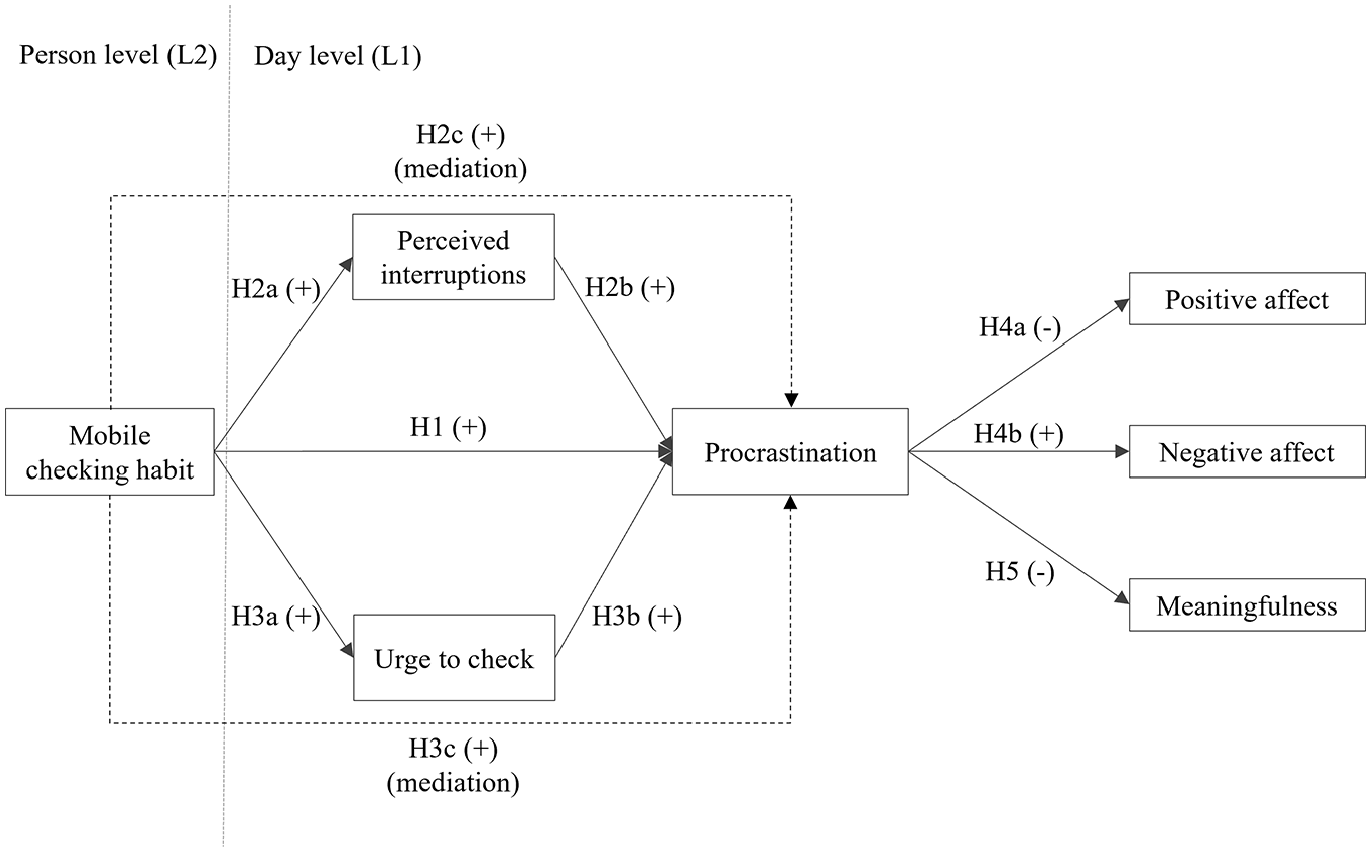
Hypothesized Model of Multilevel Relationships.
Method
Sample and procedure
Hypotheses were tested based on the data from a daily diary study among German student smartphone users. 1 The study consisted of an intake online questionnaire, assessing person-level constructs (e.g., mobile checking habit strength), and five online diary questionnaires. These were filled in each day after 5 p.m. over the course of five consecutive weekdays and assessed day-level constructs (e.g., procrastination). Participants were recruited from the personal networks of communication students at Johannes Gutenberg University of Mainz, Germany. Seven hundred and fourteen participants completed the intake questionnaire and could then sign up for the diaries. Data were eligible if participants had completed (a) the intake and (b) at least the Monday and Friday diary. This was the case for N = 532 participants (65% female, Mage = 23 years, SD = 2.44) who provided N = 2,331 diaries. This final sample did not differ substantially on age and gender from the initial sample. Attrition from the intake questionnaire to this final sample was acceptable (26%), given the rather strict eligibility criteria. Compliance with the diary protocol in the final sample was high (88%).
Measures
Participants reported their mobile checking habit strength in the intake questionnaire, since habit strength is conceptualized at person level (Schnauber-Stockmann et al., 2018). The remaining variables were assessed at day level. All items (Table S2) and psychometric properties (Table S3) are reported in the Supplement. Descriptive statistics (M, SD), between- and within-person correlations, and internal consistencies are reported in Table 1.
Means, Standard Deviations, Internal Consistencies, Between-Person and Within-Person Correlations.
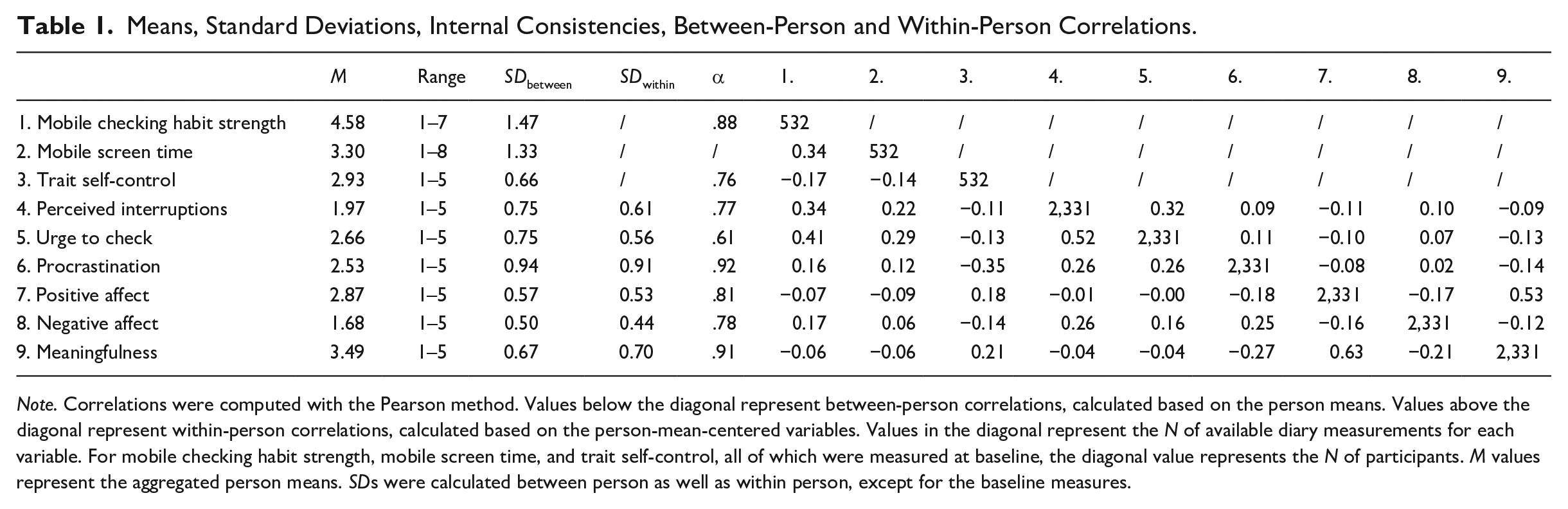
Note. Correlations were computed with the Pearson method. Values below the diagonal represent between-person correlations, calculated based on the person means. Values above the diagonal represent within-person correlations, calculated based on the person-mean-centered variables. Values in the diagonal represent the N of available diary measurements for each variable. For mobile checking habit strength, mobile screen time, and trait self-control, all of which were measured at baseline, the diagonal value represents the N of participants. M values represent the aggregated person means. SDs were calculated between person as well as within person, except for the baseline measures.
Mobile checking habit
The strength of participants’ mobile checking habit was assessed once at person level with the four-item self-report behavioral automaticity index (SRBAI, Gardner et al., 2012). An example item is “Reaching for my smartphone is something I often do automatically.”
Perceived interruptions
Perceived interruptions from mobile notifications were assessed each day with the three-item interruptions scale by ten Brummelhuis et al. (2012), for instance, “Today, notifications disturbed me several times during my work.”
Urge to check
The urge to check for online messages was assessed each day with the three-item urge to check scale by Reinecke et al. (2017). Participants were asked to indicate how frequently they felt the urge to check whether they received messages via (a) email, (b) social network sites (SNS), and (c) messengers. Internal consistency analysis indicated that the urge to check email correlated very weakly with SNS and messenger urges. This is plausible for students for whom email is likely less relevant than for working adults. The email item was thus omitted.
Procrastination
Participants reported the intensity of their daily procrastination using three items from the procrastination scale (Reinecke et al., 2014; Tuckman, 1991). An example item is “Today, I put off tasks that I intended to do.”
Positive and negative affect
Affective well-being was assessed each day with a 12-item short-form of the well-known positive and negative affect schedule (Mackinnon et al., 1999).
Meaningfulness
Eudaimonic well-being was assessed with a five-item version of the meaning experience scale (Huta & Ryan, 2010), which asked about daily activities. An example item is “What I did and experienced today was full of significance to me.”
Controls
As person-level controls, the intake questionnaire assessed trait self-control (Maloney et al., 2012), participant age and gender, as well as mobile screen time on an average day. As day-level control, the diaries assessed whether participants were studying on a given day. 2
Analytical strategy
Daily measurements (level 1) are nested within persons (level 2). For intraclass correlation coefficients, see Table 2. Thus, multilevel regressions were calculated using R-package lme4 (version 1.1.23) and the maximum likelihood estimator. Specifically, a within-between random effects model was implemented (Bell et al., 2019): Level 2 variables were sample-mean-centered, level 1 variables were person- mean-centered, and person means of level 1 variables were included as level 2 variables and again sample-mean-centered. To test H2c and H3c, two 2-1-1 multilevel mediation analyses were calculated with the mediation package (version 4.5.0), using the person means of level 1 variables as mediators. The p-values in the mediation analysis were estimated with quasi-Bayesian confidence intervals based on 2,000 Monte Carlo simulations. While this study was not preregistered, the data, R-Markdown, and materials are made available via the Open Science Framework (OSF): https://osf.io/mgkeu/.
Hypothesis Tests in a Series of Multilevel Regression Models.
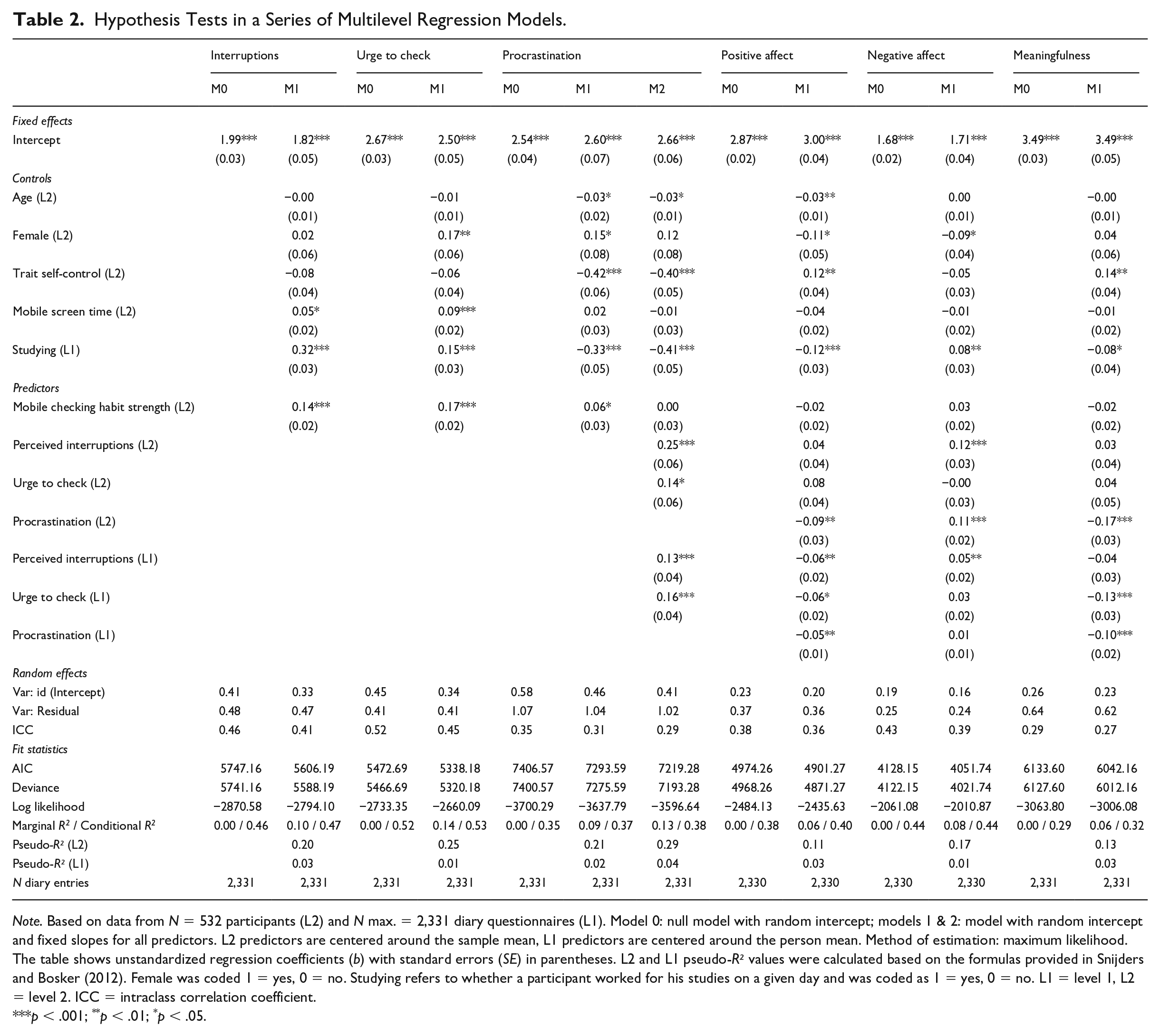
Note. Based on data from N = 532 participants (L2) and N max. = 2,331 diary questionnaires (L1). Model 0: null model with random intercept; models 1 & 2: model with random intercept and fixed slopes for all predictors. L2 predictors are centered around the sample mean, L1 predictors are centered around the person mean. Method of estimation: maximum likelihood. The table shows unstandardized regression coefficients (b) with standard errors (SE) in parentheses. L2 and L1 pseudo-R² values were calculated based on the formulas provided in Snijders and Bosker (2012). Female was coded 1 = yes, 0 = no. Studying refers to whether a participant worked for his studies on a given day and was coded as 1 = yes, 0 = no. L1 = level 1, L2 = level 2. ICC = intraclass correlation coefficient.
p < .001; **p < .01; *p < .05.
Results
Results of the multilevel regressions, including all controls, are summarized in Table 2. In H1 it was assumed that individuals with a stronger mobile checking habit would procrastinate more in daily life. Results confirm H1 (b = 0.06, p < .05). It was further assumed that those with a stronger mobile checking habit would perceive more interruptions from notifications in daily life (H2a) and experience the urge to check for messages more often (H3a). The data confirm both H2a (b = 0.14, p < .001) and H3a (b = 0.17, p < .001). According to H2b and H3b, perceived interruptions and urge to check should be positively related to procrastination. Between-person results show that participants who perceived more interruptions throughout the week also reported more procrastination (b = 0.25, p < .001). A similar, albeit weaker, between-person association was found for urge to check (b = 0.14, p < .05). Within-person results further show that participants reported more procrastination on days they perceived more interruptions (b = 0.13, p < .001) and a more frequent urge to check (b = 0.16, p < .001). H2b and H3b were therefore confirmed. It was further assumed that perceived interruptions (H2c) and urge to check (H3c) both mediate the positive effect of habit strength on procrastination. The mediation analysis confirms H2c (indirect effect = 0.04, direct effect = 0.03, total effect = 0.06) and H3c (indirect effect = 0.04, direct effect = 0.03, total effect = 0.7), all indirect and total effects p < .01 or < .001. The full model, including controls, explained Pseudo-R² = 29% of procrastination between individuals (level 2) and Pseudo-R² = 4% within individuals (level 1).
Procrastination was expected to be linked to decreased positive affect (H4a), increased negative affect (H4b), and decreased meaningfulness (H5). Between-person results show that participants who procrastinated more on average also reported decreased positive affect (b = −0.09, p < .01) and meaningfulness (b = −0.17, p < .001) and increased negative affect (b = 0.11, p < .001). Within-person results show that on days participants procrastinated more, they experienced lower positive affect (b = −0.05, p < .01) and lower meaningfulness (b = −0.10, p < .001), but not more negative affect. Thus, H4a and H5 were confirmed, while H4b was only supported between-person.
Finally, RQ1 asked how mobile checking habit strength is directly related to well-being. While we observe small between-person zero-order correlations suggesting those with a stronger checking habit experience lower well-being (Table 1), the multilevel models (Table 2) show no significant associations between mobile checking habit and positive affect, negative affect, or meaningfulness. However, for perceived interruptions and the urge to check, results show a significant between-person association of interruptions with negative affect (b = 0.12, p < .001) as well as several within-person associations, overall suggesting that on days participants perceived more interruptions and a stronger urge to check, they also experienced slightly lower well-being (see Table 2 for details).
As a robustness check, multilevel models were compared with and without controls. Results for H1–H5 and RQ1 were overall the same with or without controls and showed only slightly changed estimates, underlining the robustness of the observed associations. The only difference was that habit strength showed a small negative association with positive affect without controls, but not with controls (see R-Markdown on the OSF). As a second robustness check, the lagged effects (t-1) of each dependent variable were included. Results showed no changes in H1–H5, further underlining robustness. For RQ1, some minor changes of the associations between interruptions and urge to check with positive and negative affect can be observed (see Table S4 in the Supplement).
Discussion
The present research contributes to the discourse on mobile connectivity and well-being twofold. First, this paper avoided equating mobile usage with problems a priori (i.e., addictive or problematic usage) or treating mobile connectivity monolithically as screen time. Instead, this paper argues that the field can benefit from analytically separating person-level connectivity (e.g., mobile checking habit strength) and day-level connectivity (e.g., perceived interruptions, urge to check) from problem outcomes (e.g., procrastination) and well-being indicators (e.g., affect and meaning). Second, results from a diary study testing this approach demonstrate that individually and daily varying levels of mobile checking habits each significantly contributed to procrastination among students, beyond controls such as mobile screen time. Procrastination, in turn, was associated with lower affective well-being and meaningfulness. However, the findings also show that while habit strength, interruptions, and urge to check together explained relevant proportions of procrastination, their direct associations with well-being—with or without controlling for trait self-control, age, gender, studying, and mobile screen time—were either non-existent or small. In contrast to technology addiction or screen time, the technology habit approach in conjunction with a deficient self-regulation model thus offers a more nuanced conceptual lens to investigate challenges of ubiquitous mobile connectivity for well-being. This view appears to be shared by an increasing number of scholars (e.g., Bayer & LaRose, 2018; Bayer, Campbell et al., 2016; Schnauber-Stockmann et al., 2018; Tokunaga, 2015, 2016; Reinecke & Meier, 2021).
Specifically, and in stark contrast to technology addiction research, this study’s approach reveals that mobile checking habit strength (a) makes only a small contribution to procrastination and (b) is not robustly directly associated with decreased well-being. This suggests that habit automaticity makes it more difficult—but not impossible—for users to detect conflicts (e.g., with work tasks). Habitual mobile checking may be problematic in some situations (e.g., while studying), but not others. Such often demanded consideration of context sensitivity (e.g., Vanden Abeele, 2020) is largely lacking from the addiction and screen time approaches. Hence, this study underlines the need to separate usage habits from screen time, problem outcomes from users' self-regulatory capabilities, and well-being measures from all of the above.
While this study contributes a critical discussion of three key approaches to digital well-being and offers an empirical “proof of principle” of the habit approach, several limitations should be considered:
(1) The sample was fairly large on level 2 for a diary study, yet it was non-representative and included only young, highly educated student smartphone users from Germany, who showed below-average levels of procrastination (cf. Beutel et al., 2016). The analysis controlled for participants’ age, gender, and trait self-control; still, hidden moderators and sampling biases may explain some observed associations. On level 1, the diary sample size was sufficient, but larger samples as well as more fine-grained, contextually sensitive, and sophisticated analyses can be realized with the experience sampling method (see Aalbers et al., 2021, for an excellent example).
(2) To reduce participant strain and keep compliance high, the diaries included only a few items per construct. While most internal consistencies were adequate to excellent, they were sub-par for the two items measuring the urge to check. Findings for this variable should be treated with caution. Moreover, urge to check and perceived interruptions showed substantial between-person and smaller within-person correlations (see Table 1). This may be due to measurement inaccuracies but it could also reflect conceptual overlap. For instance, notifications—which were assumed to be more relevant for interruptions—might also condition the urge to check as an attention habit (Anderson, 2016). Additional measurement limitations concern low factor loadings for trait self-control and negative affect (see average variance extracted [AVE] values in Table S3), and high between-person correlations for positive affect and meaningfulness (see Table 1), possibly indicating a strong conceptual overlap in end-of-day diary assessments.
(3) The study exclusively relied on self-reports. This is because mobile habits capture users’ psychological interaction with mobile and social media (i.e., automaticity) rather than quantifiable use behavior (cf. Gardner et al., 2012; Meier & Reinecke, 2020). Still, the measures may show recall as well as other self-report biases. Future research should combine user-centered self-reports with technology-centered logging data (e.g., Aalbers et al., 2021), which would reduce the threat of common method bias present in this study. While this study’s habit measure (SRBAI) is well-established (Bayer & LaRose, 2018; Gardner et al., 2012; Wood & Rünger, 2016), future research could leverage implicit response-frequency measures of habit strength (Naab & Schnauber, 2016) or use experimental designs that, for instance, vary the amount of social or technical cues (Anderson & Wood, 2021; Bayer, Campbell et al., 2016).
(4) Furthermore, while diary data present an improvement over the mostly cross-sectional work in this field (Meier & Reinecke, 2020; Orben, 2020), they should not be interpreted causally. While we can probably assume (but not demonstrate) Granger causality for the effects of person-level measures assessed in the intake questionnaire (e.g., mobile habit strength) on later day-level measures (e.g., procrastination), the effects should still be treated as correlational. This also limits the mediation analyses, in which time precedence is only given for X (habit strength) and Y (daily procrastination) as well as X and M (e.g., urge to check), but not M and Y. Moreover, reverse associations may be plausible for well-being and procrastination (Sirois, 2016) as well as procrastination, urge to check, and perceived interruptions. Rather than checking habits driving procrastination, procrastination could be a habitualized behavior in which technology use is part of the habit (see Meier et al., 2016).
Despite these central limitations, the present study contributes to ongoing debates about how to study effects of digital technology on well-being. Conceptual comparisons of the three approaches, insights from this empirical study, and other researchers’ critical engagement with these approaches (see Table S1) suggest several ways forward. While the habit concept avoids some of the pitfalls of technology addiction and screen time (e.g., pathologization, conceptual conflation, or monolithical treatment of technology), it also shows potential for fruitful integration with them. For instance, experience sampling studies could combine descriptive screen time measures (i.e., behavioral frequency) and frequency-independent automaticity measures at multiple levels of mobile social media use (e.g., for various devices, applications, and features; Meier & Reinecke, 2020). This would allow assessments of their relative impact on well-being: it may help identify which device-, application-, or feature-specific habits (Anderson & Wood, 2021) and usage contexts pose the biggest challenges to maintain a healthy balance between connection and disconnection (Vanden Abeele, 2020). Such designs could be combined with experimental tests of digital well-being interventions (e.g., apps), which represent increasingly popular but largely untested “tech solutions to tech problems” (Bayer & LaRose, 2018, p. 122).
The critical view that many now take on current technology addiction research (e.g., Billieux et al., 2015; Kardefelt-Winther et al., 2017; Satchell et al., 2020; Vanden Abeele, 2020), and the comparison of all three approaches (Table S1), suggest that if researchers are interested in determining (mobile) media effects in non-clinical samples, the technology addiction approach is inapt. To study mediated behavior in everyday life and its occasional negative as well as positive outcomes, researchers can combine the habit and screen time approaches. However, habits show two crucial conceptual overlaps with addiction:
(1) Especially for new and extensively used technologies, strong habits often appear “addiction-like” (Bayer & LaRose, 2018, p. 123), yet without producing serious and persistent life impairments for the vast majority of users (Kardefelt-Winther et al., 2017).
(2) If they do, however, and if they are accompanied by a persistent loss of self-control over use, strong habits represent a necessary precursor for addiction (Bayer & LaRose, 2018; Tokunaga, 2015; Wood & Rünger, 2016). In this second scenario, a theoretically well-grounded behavioral addiction approach may be the best fit to understand and help users with severe impairments, especially since it offers the highest clinical utility (Kardefelt-Winther et al., 2017).
The habit approach may, however, present a more useful tool for a deeper understanding of various non-clinical challenges—as well as the often overlooked benefits—of mobile connectivity. Beyond procrastination, future research should broaden its focus and investigate other problem outcomes as well as benefits of technology habits. Studies have demonstrated that technology habits are a useful concept to explain texting while driving (e.g., Bayer & Campbell, 2012) or social and professional difficulties (e.g., Tokunaga, 2016). Yet the ubiquity of smartphone and social media use resulting from habitual checking may be at the center of many other problems and benefits of the “mobile connectivity paradox” (Vanden Abeele, 2020, p. 3). Such salient problems that could be explained by habitual checking may be “partner phubbing,” parent–child conflicts, and work–home boundary dissolutions, while benefits of mobile checking habits may be increased social support, better relationship management (especially over distance), and staying informed about political and public developments. Building research programs that integrate the technology habit approach will thus allow digital well-being researchers to better explain and test a wide range of both helpful and harmful outcomes of mobile connectivity.
Supplemental Material
sj-docx-1-mmc-10.1177_20501579211029326 – Supplemental material for Studying problems, not problematic usage: Do mobile checking habits increase procrastination and decrease well-being?
Supplemental material, sj-docx-1-mmc-10.1177_20501579211029326 for Studying problems, not problematic usage: Do mobile checking habits increase procrastination and decrease well-being? by Adrian Meier in Mobile Media & Communication
Footnotes
Funding
The author(s) received no financial support for the research, authorship, and/or publication of this article.

Supplemental material
Supplemental material for this article is available online.
Notes
Author biography
Adrian Meier is an assistant professor of communication science at the Friedrich Alexander University of Erlangen-Nuremberg, Germany. He obtained his BA (2010–2013), MA (2013–2015), and PhD (2015-2020) in Communication Science at the Department of Communication, Johannes Gutenberg University of Mainz, Germany. His research revolves around the question of whether and how (mobile) communication technologies can improve or impair mental health and well-being. Among other topics, he investigates this relationship through the lens of self-regulation processes, using diary and experience sampling studies, as well as experiments. He further applies systematic review methodology to systematize and integrate the vast interdisciplinary literature on communication technology and mental health. His work has been published in leading journals at the intersection of media psychology and communication, including Journal of Communication, Communication Research, Journal of Computer-Mediated Communication, and Media Psychology, among others.
References
Supplementary Material
Please find the following supplemental material available below.
For Open Access articles published under a Creative Commons License, all supplemental material carries the same license as the article it is associated with.
For non-Open Access articles published, all supplemental material carries a non-exclusive license, and permission requests for re-use of supplemental material or any part of supplemental material shall be sent directly to the copyright owner as specified in the copyright notice associated with the article.
