




Abstract
Mobile dating applications play a prominent role in Chinese gay men’s social lives. Based on in-depth interviews with 21 participants, this study explores how urban gay singles in China develop social relationships on dating apps. It reveals that relationship development is often driven by casual conversations, which are not motivated by clear pragmatic purposes. Casual conversations tend to unfold around common hobbies or experiences, serving as a source of sociability, or satisfaction in socializing itself. In contrast to casual conversations, two forms of conversations are deemed highly instrumental and undesirable: one is the sex-oriented conversation aimed at immediate sexual encounters; the other is the interrogative conversation in which people ask private questions in a nonreciprocal and rigid way. Besides craving sociability, users “relationalize” casual sex by perceiving it as a form of social connection and endowing it with the potential to foster a relationship. This is also reflected in users’ preference for sexual partners with whom they can hold a conversation. Users also exploit the affordances of different media platforms and capture the relationship potential by platform switching. They switch to the mainstream media platform WeChat for more synchronous communication and to collect more identity cues from each other. Platform switching also signals willingness for relationship development and mutual trust. Nevertheless, users keep going back to dating apps for new possibilities for social relationships.
Keywords
Introduction
Mobile dating applications, or “dating apps,” have triggered social debates about love and sex. Notwithstanding the various and often entangled motives users have (Timmermans & De Caluwé, 2017; Ward, 2017), dating apps are constantly referred to as “hook-up apps” by researchers, especially in gay dating app studies (Albury & Byron, 2016; Davis, Flowers, Lorimer, Oakland, & Frankis, 2016; MacKee, 2016; Race, 2015a). Affordances of dating apps seem to be manifest in the facilitation of casual sex (Licoppe, Rivière, & Morel, 2015; MacKee, 2016) rather than “serious” relationships (Chan, 2018; Yeo & Fung, 2018). Given the mixed motivations reported by users, combined with a tendency of researchers and the media to promote a primarily casual sex script, dating app studies could benefit from a broader perspective on how and why people use dating apps. We do this by focusing on social relationships, defined as “connections that exist between people who have recurring interactions that are perceived by the participants to have personal meaning” (August & Rook, 2013, p. 1838), and we ask the following question: How do users initiate and develop social relationships on dating apps?
With this question, we look at the Chinese context. Dating apps have gained millions of Chinese gay users. Although China’s “Great Firewall” has limited the Internet connection to foreign dating apps (e.g., Tinder and Grindr), these apps are still quite popular among metropolitan users who use a virtual private network (VPN) to climb the firewall. Meanwhile, local apps thrive in the safe haven protected by the “Great Firewall.” Blued, for instance, has more than 40 million registered users worldwide, approximately 70% of whom are from China (Cao, 2018). In China alone, Blued has more than 3 million daily active users (Hernández, 2016).
With this research, we hope to understand how single metropolitan Chinese gay men develop social relationships on dating apps. We explore their use patterns, their expectations of online dating, and their understandings of casual sex, or sex outside the stereotypical romantic relationship. We analyze how these factors intermesh with the technological affordances of dating apps. Before presenting our analysis, we first review the literature on the affordances of dating apps and gay users’ sexual practices.
Literature review
Affordances of dating apps
Affordances are derived from the interaction between subjective perceptions of utility and objective qualities of artifacts (Gibson, 1979). In media technology studies, the concept of affordances underlines the “mutuality of actor intentions and technology capabilities that provide the potential for a particular action” (Majchrzak, Faraj, Kane, & Azad, 2013, p. 39). Regarding the affordances of dating apps, their technological capabilities are manifest most prominently through their interfaces. Although the browsing interfaces of dating apps are more or less different from each other, they can effectively be categorized into two types (see Figure 1). One type has a grid view or a list view, presenting a range of nearby users’ profiles in descending order of geographic proximity. This type includes the most popular gay-specific apps, such as Grindr and Blued. One can start a conversation with any user displayed on the screen. The other type presents one single profile at a time. Users need to swipe left or right on the profile to signal their dis/interest in establishing a connection. Private messaging is possible only when both users signal their interest. Representatives of this type are Tinder and the Chinese gay app Aloha.
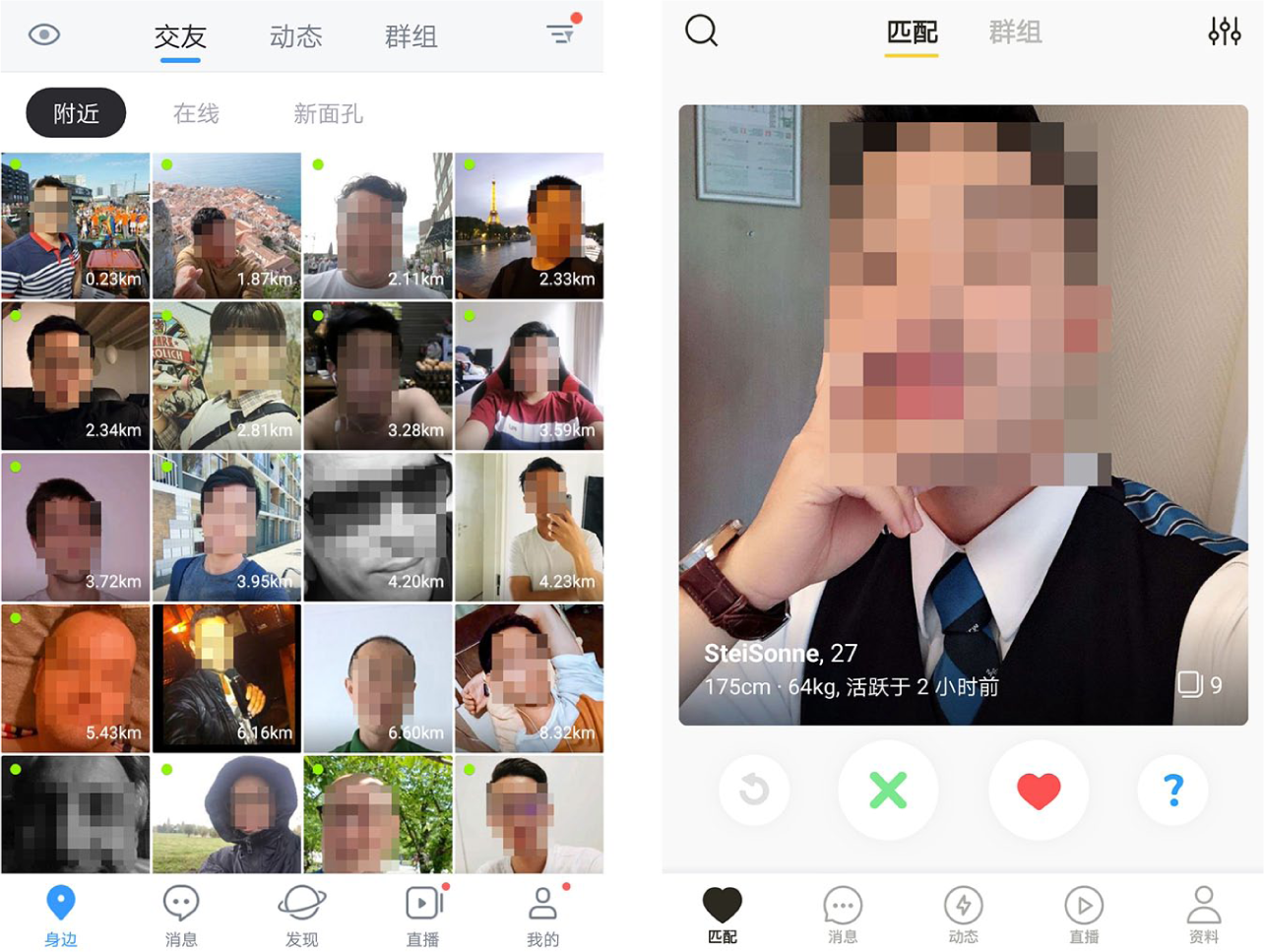
The screenshots show the interfaces of Blued (left) and Aloha (right), two dating apps developed by Chinese companies.
Despite the differences between these types of apps, their shared affordances are rather salient when dating apps as a whole are compared to other media platforms. Comparison is possible in the sense that different objects enable certain affordances to different degrees (Treem & Leonardi, 2013). For instance, a mobile phone has a higher degree of portability than a laptop (Schrock, 2015). To understand the affordances of dating apps, researchers have compared dating apps with dating websites. Chan (2017) argues that five affordances differentiate dating apps from dating websites: (a) mobility, (b) proximity, (c) immediacy, (d) authenticity, and (e) visual dominance. First, dating apps afford mobility—they can be used anywhere at any time, since they run on portable devices such as smartphones and tablets. Second, while dating websites connect people in broader regions, dating apps connect users who are in each other’s immediate proximity. Third, impromptu offline meeting, or immediacy, is more achievable on dating apps. Fourth, on many dating apps, users’ accounts can be linked to other social media accounts (e.g., Facebook and Instagram), offering a certain level of authenticity. Finally, due to the interface designs of dating apps, which highlight users’ profile pictures, dating apps are more visually dominated than dating websites. Lutz and Ranzini (2017) point out similar dating app affordances, and also note the presence of links to other social media accounts as further sources of identification.
These studies have two main limitations. First, dating apps are only compared to dating websites, not to other media platforms. In an environment of “polymedia” (Madianou, 2015) with abundant communicative opportunities offered by media technologies, people exploit the affordances of many different media platforms to manage their social relationships. Researchers have noted that dating app users tend to continue their interaction on other media platforms such as WhatsApp (MacKee, 2016; Ward, 2016). How the differences in affordances contribute to this platform switching needs to be examined. In this research, we place dating apps in a larger picture of polymedia, where the richness of media platforms enables platform switching in the course of relationship development. By keeping an eye on platform switching, we aim to understand what dating apps can and cannot afford for gay men’s relationship development.
Second, this comparative approach to affordances has been largely based on technological features and has neglected the nuances in users’ subjective perceptions of technological utility. Since affordances are where these two aspects intersect, researchers should also probe users’ perceptions of what they are able to do with dating apps, as well as the underlying norms and values that set up a range of acceptable behaviors. These perceptions are inevitably linked to a negotiation of the relation between relationship development and casual sex. In the next section, we thus review relevant studies to capture the complexity in this negotiation.
Transformation in gay sexual practices
In many studies on gay dating apps, engagement with casual sex seems to thwart the development of social relationships. Due to the affordances of visual dominance and synchronicity, dating apps are perceived by users to privilege casual sex and impede relationship development (Yeo & Fung, 2018). Those who look for “meaningful connections” are often frustrated (Brubaker, Ananny, & Crawford, 2014). Licoppe et al. (2015) reveal that users who seek immediate sexual encounters tend to bypass relationship development with certain conversation strategies. They make the conversation impersonal by not referring to personal issues and biographical detail that may lead to social and emotional involvement. Seeming to run through a checklist, they swiftly exchange personal photos and information about their locations, immediate goals, and sexual preferences. This sex-oriented conversation can be seen as a form of “pragmatic conversation” (Eggins & Slade, 1997); it is in opposition to what Eggins and Slade call “casual conversation,” the interaction that is not motivated by a clear pragmatic purpose.
Licoppe et al. (2015) seem to be sensitized to “no-strings-attached” sex by the phenomenon of “cruising,” or searching in public places for sexual partners, which is a long-standing practice among men who have sex with men. By referencing “cruising,” they try to understand how dating apps shape gay men’s sexual practices. They argue that Grindr users experience an interactional dilemma because they, “unlike people looking for sexual encounters in public places who can rely mostly on gaze and gesture, must use the medium of electronic conversation to initiate contact” (Licoppe et al., 2015, p. 2555). Indeed, unlike the classic “cruising” scenario in Humphreys’s (1970) ethnographic research, where men silently engage in sex with strangers in public restrooms, a preceding chat process is indispensable on dating apps. As Race (2015b) maintains, chat mechanisms on dating apps enable various forms of controlled and anonymized self-disclosure—such as sexual interests and HIV status—before sexual encounters, constituting new modes of partner sorting and risk prevention. Chatting allows a possible, though always contingent, “process of establishing a sense of safety” (Albury & Byron, 2016, p. 1), and enables users to co-construct their sexual fantasies and make arrangements for their incoming sexual encounters (Race, 2015a, 2015b).
Besides the chat mechanisms, other affordances of dating apps constitute a transformative force in gay men’s sexual practices. Most of all, the capacity to search users, add “buddies,” and keep track of “favorites,” allows sexual encounters with certain users to reoccur. As Race (2015b, p. 505) puts it: “The capacity to maintain a loose web of concurrent fuck-buddies is perhaps more available, more accessible and more widely accessed than ever.” He argues that gay men gain affective bonds and affinities in online hook-ups: “These devices and practices are participating in the construction of a specific sphere of sociability and amiable acquaintances among men in urban centers that prioritizes sex as a principle mechanism for connection and sociability” (Race, 2015a, p. 271).
Race (2015a) draws on sociability theory from Simmel (see Simmel & Hughes, 1949), who argues that in all human associations, regardless of content and interests, there can be satisfaction in the association itself: changing individual solitude into togetherness. This satisfaction is derived from the “artful, autonomous play-form of sociation” (Anderson, 2015, p. 98)—or the “sociability,” as termed by Simmel in which “the concrete motives bound up with life-goals fall away” (see Simmel & Hughes, 1949, p. 255). Framing sex as “play,” Race (2015a) addresses the social and affective function of sex and regards sex as a site for sociability.
Seeing these social and communal potentialities in sex, Race (2015a) challenges our understanding of casual sex that is overshadowed by the “no-strings-attached” hook-up frame (Wu & Ward, 2018). This frame may lose its explanatory power when it comes to a broader landscape of gay men’s dating app use. Users who look for casual sex can be open to romance, and vice versa (Chan, 2018; Yeo & Fung, 2018). Many tend to be flexible regarding their goals, which are often negotiated over time through interaction (Fitzpatrick & Birnholtz, 2016). Intentions for casual sex and social relationships can coexist (Birnholtz, Fitzpatrick, Handel, & Brubaker, 2014; Blackwell, Birnholtz, & Abbott, 2015; MacKee, 2016). How do we understand the coexistence of casual sex and relationship development? How is this relation implicated in affordances of dating apps? How does this relation, together with the technological features of dating apps, shape gay users’ experience of relationship development? With these questions, we explore how Chinese gay men experience relationship development on dating apps.
Methods
For this study, the first author conducted 21 semistructured one-on-one interviews. The length of interviews varied between 55 and 110 minutes. Questions were about motives for dating app use, perceptions of app functionalities, patterns in gay users’ communication, and actions taken to facilitate relationship development. Since this study focuses on urban gay users, we aimed to recruit gay participants from Beijing. While 19 of the participants were living in Beijing at the time of interviewing, two had studied in Beijing for 4 years before and left to study in other cities. The recruitment only required participants to be over 18 years old. Participants happened to be relatively young, as their ages ranged from 20 to 31 (M = 25.3). All but one identified as gay, with this participant still exploring his sexuality.
Participants were recruited on mainstream social media platforms—Douban and WeChat—via a post which advertised our research project. For the recruitment, we chose mainstream platforms instead of dating apps, because the latter are location-based. We were based in the Netherlands, and our research funds could not cover a trip to China. Participants contacted the first author, a Chinese gay man, through email or WeChat to participate. The common gay identity helped establish openness and trust in the interviews. Interviews were conducted via online voice calls through WeChat in October and November 2017. Online interviews not only saved on traveling expenses that could not be covered by the research fund (O’Connor, Madge, Shaw, & Jane, 2008), but also allowed for more reflective responses and were useful for asking private or sensitive questions (Madge & O’Connor, 2004). To minimize potential harm to participants, pseudonyms were assigned to all of them. As for data protection, interview recordings and transcripts were archived in the first author’s personal account of SURFdrive, a cloud storage service developed for Dutch universities. The data were only accessible to the first author (Choy, 2018).
In this exploratory research, the phenomenon of relationship development initiated on dating apps is investigated with minimal a priori expectations (Bowen, 2006). Although loosely guided by the research question, the data coding was rather inductive. The second author, a former user of dating apps and a dating app researcher, also engaged in the coding process. As a straight female from the United States, she was unfamiliar with the gay community and the gay dating app culture in China. This unfamiliarity allowed her to adopt a fresh viewpoint distinct from that of the first author, leading to fruitful discussions during the analysis process (Berger, 2015). Data coding was inspired by the method widely applied in grounded theory research, which consists of three steps: open coding, axial coding, and selective coding (Creswell, 2013). First, we closely read the transcripts and established preliminary codes. We obtained 324 codes in this stage. Second, through axial coding we explored the relations among these codes. We grouped interrelated codes into larger categories. In this stage some tentative hypotheses emerged. For instance, one tentative hypothesis was that the seemingly purposeless conversation on dating apps may give interlocutors pleasure and facilitate relationship development. This reminded us of the concept of “sociability” which highlights the nonpragmatic satisfaction in human interactions (Simmel & Hughes, 1949). Thus, we carefully read many articles on sociability to make sure this concept would be a good fit. Meanwhile, we realized that some knowledge of conversation typology would help us describe the different conversation patterns reported by participants. We then reviewed some literature on conversation typology to obtain the conceptual tools we deemed relevant (Dunne, 2011). Finally, we organized the categories derived in the second stage around three main themes: (a) sociability in casual conversations; (b) relationalization of casual sex; (c) platform switching for relationship potential. The first two themes are focused on how participants subjectively negotiated the relation between relationship development and casual sex, and help explain participants’ exploitation of media affordances analyzed in the third theme. The Findings section provides a detailed explanation of these themes.
Findings
Before introducing the three main themes, we report the prevailing mentality among the participants: the openness to all forms of relations. We asked the participants what their goals were in online dating. Their answers constitute a spectrum. On one end, Kai (26-year-old), a general manager assistant, was the only participant who sought “no-strings-attached” sex and firmly rejected any relationship development. He said it was because he was deeply hurt in previous relationships. On the other end, Xiaoduo (20), a university student, was the only participant who rejected casual sex, due to the risk of getting infected with sexual transmitted diseases. The other 19 participants were open to all sorts of relations—sexual or nonsexual—when they were single, although they had different priorities. Since this openness blurs the boundary between hook-up and “serious” dating in practice, we use the word “hook-up” (约炮) in narratives only when it was originally used by participants.
Sociability in casual conversations
As said earlier, gay users’ exploration of app affordances features a negotiation of the relation between relationship development and casual sex. The first theme we present here characterizes this negotiation. According to participants, relationship development on dating apps depends on chatting. A “good chat” would prompt moves to further interaction, such as exchanging contact information and meeting offline. Interestingly, participants appreciated the pleasure of “casual conversations” (Eggins & Slade, 1997), which they cannot obtain from a pragmatic conversation aimed at a concrete goal, such as sex or fast acquisition of personal information. In that sense, they desired sociability (Simmel & Hughes, 1949).
Sociability is realized in conversation (Simmel & Hughes, 1949). For those participants who appreciated sociability in online dating, a “good chat” itself was a valuable experience. Yuan (27), a business consultant, said that good chats kept him company during the “boring time of singlehood.” Zhu (27), an employee of a mobile application development company, said: “I wish I can experience more interesting things. For me, to have a good one-zero relation (anal sex) is less interesting than to discover a gay story I’ve never heard.” Participants perceived those with whom they could have a good chat as “interesting.” An interesting chat tends to unfold around topics like common hobbies or experiences. Guo (22), a postgraduate student, said that interesting people he hooked up with on dating apps often had professions he found intriguing, such as editors and designers: “After we met, we had a lot to talk about. They also recommended me lots of books to read.” Like Guo, many participants reported a tendency to interact with “interesting people.” Ankang (25), an Internet product manager, said he wanted to find interesting people on dating apps. Xin (31), a high school teacher, said: “I used to follow the guys who are tall, muscular, or handsome. Now I pay more attention to those who are talented or cultured . . . that is to say: interesting people.”
As Simmel argues, sociability in communication is above and beyond the purposive content which is bound up with the desire, for instance, to gain advantage over the other (see Simmel & Hughes, 1949). Participants regarded casual conversation—or in their own words, “a chat with little purpose” (目的性不强的聊天)—as the ideal communication. Guo elaborated on his preference for this form of chat: I prefer the talk with no direct purpose. We’ll see what we can chat about. For instance, you start with “hello,” or say “wow, you also went to this exhibition.” Then I’ll feel I probably would like to sleep with this person, or be his friend, or maybe do something else . . . If he knows something which I also find interesting, and if he doesn’t try to set a boundary for the conversation, then we will probably find more common hobbies when we chat freely.
The mentality revealed in Guo’s account prevailed among the participants. A casual conversation establishes a connection between users, based on which one may develop further expectations about the other, be it sex or a relationship. Casual conversations go hand in hand with uncertainty of users’ ultimate goals, and the uncertainty itself is intriguing. Feng (30), an advertising account manager, said that uncertainty is like a game. He said: “If the game’s result turns out good, you may get your reward. If not, at least you have enjoyed the process.” Feng’s analogy echoes Simmel’s argument that sociability is a “sociological play-form” (see Simmel & Hughes, 1949, p. 258) in which play itself takes an important role in sociability. The attraction of playing lies in the dynamics and chances of the activity itself, and “the freedom from all weight of firm content and residual reality” (Simmel & Hughes, 1949, p. 258). Similarly, online dating will lose its fun if the interlocutor is obsessed with a concrete goal. Helan (25), a yoga teacher, claimed that people could spoil the fun by being too purpose-centred. Even for hook-ups, he believed that people should invest more in communication than in getting fast sex “like animals on the grassland.”
Therefore, it is not surprising that many participants expressed their antipathy toward sex-oriented pragmatic conversations, which are highly instrumental. This type of conversation tends to start with an impersonal sex-related question, such as “hook-up?”; “are you 1 (top) or 0 (bottom)?”; “how big down there?”; or “do you have a place [to host]?” Certainly, a sex-oriented conversation can be less explicit and more tactful than this. However, a casual conversation is not about facilitating an immediate sexual encounter. For instance, Feng liked to compliment the interlocutor’s appearance when he merely wanted sex. But when he saw a person with an interesting profile, he would lead the chat to topics about life. Luogang (23), a postgraduate student, also deemed a “good chat” as nonsexual: “When I’m interested in chatting, we can chat about anything, as long as it’s not about sex. We can exchange our opinions on social issues.”
Another form of pragmatic conversation, though not sex-centered, is the interrogative conversation. Some participants called it “household register check” (查户口), which means that people ask private questions—about age, physical traits, profession, hobbies, or romance history—in a nonreciprocal, rigid, or aloof way. Based on that, the interrogative conversation seems to have a pragmatic purpose, which is to quickly judge if one is suitable as a dating partner. As Simmel claims, “as soon as the discussion gets business-like, it is no longer sociable” (see Simmel & Hughes, 1949, p. 259). Both Xiaoduo and Xin perceived the interrogative type of conversation as snobbishly categorizing people into social stereotypes. For Zhu, it was paradoxical that people did not want to be asked private questions. In his opinion, exchanging personal information was an important way to make the chat sustainable. However, Feng believed that there is a skill for asking questions appropriately: If your intention for asking questions is to bring us closer, you’d better give an answer in the first place. Like you said in the beginning: “Hello, my name is Wu Shangwei. What’s your name?” Then I said, “my name is Feng.” But if one person asks for my name abruptly, I will feel offended. What qualification do you have to ask me such a question? But some people just keep asking. “What’s your profession? What’s your height? What hobbies do you have? How many boyfriends have you had before?” This way of asking questions is like commanding, not like communicating.
“Interesting people” seem to master the skill of conversing amiably. They also master the self-governing that is prerequisite to sociability (Simmel & Hughes, 1949). Leshan (21), a university student, said: “For instance, [they] speak in a humorous way, use polite expressions, and appropriately ask for information. I mean, [talk] in an artistic way, like with fencing: Don’t do it like a fight where you use all the moves you know.”
To summarize, participants expected sociability on dating apps. They wanted the exhilaration of a casual conversation with interesting people, and the experience of momentary freedom from a reality fraught with calculated desires. Both sex-oriented conversations and interrogative conversations are too instrumental to generate sociability. Given the relatively new context of socializing enacted by dating apps, users still need to navigate appropriate expressions in online chatting.
Relationalization of casual sex
The second theme also focuses on negotiation in the subjective arena. Pursuit of sociability was not always the case, since participants sometimes also wanted immediate physical intimacy. They would then shorten the conversation and directly ask about the other’s purposes. As Luogang said, he would even ask the question “hookup?” which he usually hated. Nevertheless, in general, they tended to have more relational expectations for casual sex. In contrast to gay “cruising,” casual sex for young Chinese single gay men bears more social meaning and relation functions and is thus relationalized. We conceptualize this phenomenon among single gay men as the “relationalization of casual sex.” It consists of two subthemes: (a) casual sex is perceived as a form of social connection; (b) casual sex is endowed with relationship potential, or the potential to foster a relationship.
The first subtheme is related to participants’ emotional or spiritual demands in casual sex. Xin said that the best hook-up was to find a person with whom he could feel “spiritually connected,” a person who could please both his “spirit and body.” Leshan described himself as “both physically and spiritually needy.” Guo regarded the hook-up as a “spiritual handshake” with people whom he had good feelings about. Feng elaborated on his spiritual needs: I looked forward to hook-ups, but afterwards I often felt a sense of loss . . . It was only in recent years that I figured out I was not searching for bodily pleasure in sex, which though was one part [I sought] indeed. [Bodily pleasure] is just a small part. I want more mental and spiritual comfort. I mean, what I want in sex is a simulation of an intimate relationship via transient intimacy.
In this ideal hook-up described by participants, sociability spills into the intimate (sexual) connection, as many participants expressed their preference in hook-ups for “chattable” (聊得来的) people, with whom they could have a good chat before or after sex. Sangui (30), a lawyer, said he expected to hook up with interesting people who could offer “more things,” that is, who could talk about arts, literature, history, philosophy, or economics with him. Peng (22), a university student, said he liked to have a “long heart-to-heart talk” (促膝长谈) with his sexual partners after sex.
The second subtheme reflects a common view: casual sex can be a starting point for establishing a social relationship, either a romantic relationship or a friendship. Therefore, those users who look for “no-strings-attached” sex, such as Kai, always need to strategically keep the conversation short on dating apps to signal their disinterest in relationship development. As reflected in many participant stories, a casual sex partner may eventually turn out to be “Mr. Right,” or at least a friend.
Hook-ups are perceived as a fast track to a relationship. For Chong (25), a postgraduate student, relationship development based on mutual interests but without sex was slow. Echoing Chong, Xuesong (26), a graduate student, believed that sexual relations are the easiest to establish, compared with friendships and romantic relationships: “Anything can start with a sexual relation.” In his opinion, dating apps provide a space where people can be frank about their gay identity and sexual desires, and where people can easily establish sexual relations. In contrast, the conventional sex-after-commitment path requires a much longer time for people to get to know each other’s values, hobbies, and habits. In offline settings, this path may include a roundabout process of confirming each other’s gay identity. Although regarding this path as romantic, Xuesong thought it was not efficient or practical. Similarly, Zhu expressed his doubts about the efficiency of the sex-after-commitment path: Heterosexuals . . . would realize their attraction to the opposite sex in junior high school. In a simple environment like that, there is a big chance [for romance without sex]. Gay men are often enlightened quite late, and the chance for them to find each other is small . . . I’m after efficiency. I don’t want to spend too much time imagining and pursuing the good thing that is unlikely to happen.
Since casual sex is regarded as a form of social connection and is expected to bear relational functions, single gay men are willing to spend time socializing with their potential sexual partners. They may have a long chat on dating apps before meeting in person. When they meet, they may have dinner, shop, or watch a movie before eventually having sex. In other words, socializing activities preceding sex are common in many hook-ups. Relationalized hook-ups can be so time and energy consuming that participants like Sangui would rather masturbate when they feel lazy.
Although a few participants reported that they had found boyfriends through hook-ups on dating apps, relationalized casual sex often ends in vain, especially when the two parties have insufficient communication. They may fall out quickly when there is no mutual willingness to engage in more socializing activities. In many cases, one party is more willing to further the relationship development than the other. The former may find it hard to quit the sexual relation without being emotionally hurt, as revealed in Ankang’s and Feng’s accounts. Although Ankang made some confidants via dating apps, he did not become close friends with those who had sex with him. “You know, [I] surely invested some emotions. Then I became possessive. I held a grudge [because of the nonreciprocity].” Feng was strongly attracted to his last two sexual partners. He felt emotionally repressed: If the other party cannot respond to my [emotional] expectations, then every single moment in the carnal interaction there will be a voice telling me: “this guy doesn’t love you.” In these moments, I feel hurt. Because I feel like I’m a vibrator on two legs, or a free MB [money boy].
To summarize, the openness to all potential relations is reflected in participants’ preference for relationalized casual sex. “No-strings-attached” sex made these participants feel objectified, like they were merely an instrument used to satisfy others’ sexual desire. Therefore, they preferred sexual encounters in which they could feel connection and intimacy.
Platform switching for relationship potential
With the subjective negotiation revealed in the first two themes, gay users still need to use media platforms to develop a relationship. Regarding this, participants tended to change their contact platform to signal interest in relationship development: this action constituted the third theme. According to our participants, dating apps initiate—not maintain—relationships. Platform switching happens in the course of relationship development. To capture the relationship potential, participants tended to switch to WeChat, a mainstream social media application, after they had a good chat on the dating app. Nevertheless, participants always went back to dating apps for new potential relationships, especially when they were still single. This platform switching is intertwined with four affordances of dating apps and WeChat: on the one hand, leaving dating apps for WeChat is driven by communicative synchronicity and user identifiability on WeChat, as well as the negatively perceived sexual availability on dating apps; on the other hand, stranger connectivity on dating apps lures users to come back.
Communicative synchronicity
Relationship development leads to a higher demand for synchronicity in mediated communication. Synchronicity on dating apps is relatively low, because their use is limited. The chance for timely contact is small on dating apps, especially on foreign apps that seemed to be blocked by China’s “Great Firewall.”
Another factor for the limited use of dating apps is their potential to give away one’s gay identity. Coming out to someone is regarded as a sign of trust and closeness. Accordingly, app users may feel uncomfortable with being out to the acquaintances they are not close to in daily life. Yun (29), a doctor, felt embarrassed when he saw a colleague on an app who had never come out to him. He would never talk to this colleague on the app, since it would be “slapping him [the colleague] in the face.” He said: “Because [your gay identity] is revealed without your consent. No one would want that.” Jianhua (23), a journalist, also noticed this in his own experience: In real life, you know each other, but you don’t know each other’s sexual orientation. And if you accidentally see each other on Blued—at least my own experience is like this—the other guy would always block me. Seems like [they] worry that I get to know something.
Compared to dating apps, WeChat affords more immediate and stable connection. With more than 1 billion monthly active users (Deng, 2018), WeChat is “an app for everything” (Chao, 2017), supporting instant messaging, social networking, ride hailing, movie-ticket booking, etc. It is deeply embedded in users’ everyday life, and is often running in the background on one’s smartphone. Therefore, participants expected higher synchronicity from WeChat than from dating apps. As Leshan said: “I think it is inconvenient if I reach you through the dating app . . . I mean, I spend more time checking WeChat, right? I can’t open the interface [of dating apps] all the time.”
User identifiability
Both dating apps and WeChat have the affordance of user identifiability: users have profiles and can provide identity cues. Different from their Western equivalents but similar to WeChat, Chinese dating apps have integrated many functionalities of mainstream social media, allowing users to post status updates, follow each other, react to content, and so on. Even so, users of both Western dating apps and Chinese ones tend to switch to WeChat to gather more identity cues about others.
Nevertheless, platform switching is not necessarily about which app has a higher degree of user identifiability. Instead, it is more about seeing different sides of the same person. Participants held the view that people, including themselves, have left different identity cues on different platforms, since each platform has a different audience. Xiaoduo said: [On the dating app Aloha] I would post better looking pictures and think twice about the captions . . . It’s not as casual as on WeChat . . . Because it’s [also] unlike on Weibo [a Chinese microblogging platform] where you don’t care who sees your posts. On Aloha you have a bigger chance to make friends, or even develop a further relation with your audience. So, you need to think more about what aspect of yourself you are going to present.
Helan also reported the difference in self-presentation on different platforms, which, however, differs from Xiaoduo’s account. Helan regarded Blued, the dating app he was using, as a promiscuous place that was not worthy of effortful self-presentation. Instead, he preferred to post pictures and emotion statuses on WeChat for people he “cared about.”
Participants believed that platform switching allowed them to collect more identity cues about the people they met on dating apps. Moreover, platform switching also allowed more self-disclosure to those whom they were interested in. WeChat allows users to categorize their contacts into different groups and lets posts be seen only by chosen groups. Yun exploited that functionality and posted specific content for the group of people he met on dating apps. He hoped to deepen their understanding of him and nourish the potential of “natural” relationship development.
As Guo said, switching to WeChat signals trust and the willingness to “step further,” since it means more reciprocal self-disclosure. Nevertheless, in some cases, participants switched to WeChat at the request of their interlocutors before they had enough trust. WeChat allows users to block chosen contacts from seeing their posts: Zhu used to unblock his newly added WeChat contacts only after he knew enough about them. Some of them realized they were blocked when seeing no posts in Zhu’s profile, so they questioned Zhu about this. In this case, blocking sent a signal of mistrust that seemed unusual after contact had been made on WeChat.
Sexual availability
Many participants deemed dating apps an inappropriate environment for further communication, as they perceived dating apps as “too desire-oriented.” Indeed, dating apps have the affordance of sexual availability: sex can be easily arranged via the apps. For participants, this affordance was implied by the design features. Ankang thought that visual dominance and the distance-sorted array of users on Grindr served the need of finding casual sexual partners. Wang (28), working at an Internet company, echoed that users saw pictures as the primary form of communication. There would be little chance for further interaction if the pictures were unattractive. He compared using dating apps to shopping online: “If the advertisements cannot attract you, you will not have the desire to buy.” The profile settings on dating apps are also perceived negatively. Luogang thought that the profile settings on Blued, which required information about age, body measurements, and sexual preference (1 or 0: top or bottom), promoted a “quantitative way of thinking” that discouraged “deep talks.” Yuan regarded the profile settings on Blued as sexually suggestive. He disliked this way of self-presentation which he likened to “selling livestock.”
Participants also perceived the success rate of hook-ups to be higher than that of establishing social relationships via dating apps. Wang said he was mainly looking for casual sex on dating apps: “I’m not saying that I have closed the doors to other possibilities. I just feel that the only relation that has ever developed on dating apps for me is the hook-up relation.” Jianhua did not count on dating apps to find someone with whom he could “spiritually resonate.” He said dating apps have brought together gay men of different social strata, which made it hard for him to find someone similar to himself. Therefore, he regarded “dealing with sexual desire” as the most prominent affordance of dating apps. Because of dating apps’ affordance of sexual availability, participants switched to WeChat when they were willing to develop the relation with the other party. As Yuan said, he preferred a “normal channel” for further interaction.
Stranger connectivity
Dating apps have the affordance of stranger connectivity. By bringing strangers together, they create potential for new relationships. This affordance is often intensified by the large population in a metropolis such as Beijing, which has a population of more than 21 million (Westcott, 2018). Dating apps function as “a pool of alternatives” (Bauman, 1993, p. 108), where users keep going back for more opportunities. Many participants said that they were chasing the “novelty” in socializing with other gay men. Sang (23), a postgraduate student, said that he was attracted to novelty. He felt bored after he got to know the “behavior patterns” of a person and developed a “communication mode” with that person. Jianhua regarded “novelty” as an important factor in why he pursued hook-ups: “I think it is about the sense of novelty. It’s out of the evil of humanity. I would feel that there seem to be better [options].” Chuan (24), working in an automobile company, held a similar opinion. For him, he wouldn’t stop looking for new sexual partners even though he had found many: “Because one is always searching for novelty . . . Besides, who knows the next one won’t be the perfect one?”
Parallel to the pursuit of novelty is the short lifespan of most relations initiated on dating apps. It is rare, though not impossible, that two strangers eventually become close friends or partners. According to the participants, most people they connected with remained mere WeChat contacts. They only occasionally clicked “like” for each other’s posts. One reason was that their lives did not intersect. Feng reckoned the lack of common friends made it hard for dating app contacts to maintain their relation. Xiaoduo felt it was hard to mingle with people he met on dating apps, even those who were studying in the same university. Lixiang (25), a postgraduate student, felt lonely about being a gay man and hoped to confide in some friends he had made through dating apps. However, it was hard for him to initiate a chat again. Consequently, and paradoxically, a solution for the loss of connection is to find new connections on dating apps. Participants kept going back to dating apps in the hope that they could enjoy sociability again.
To conclude, participants were shuttling between dating apps and WeChat, experiencing the whole course of a gay relation, from its initiation on dating apps to its saturation or decline on WeChat. Dating apps played an important but limited role in participants’ gay social relations. As Feng said: “Dating apps have their own specialties . . . They can leave the rest to others and maximize their usefulness in ice-breaking.”
Conclusion
In this study, we aimed to understand the role dating app affordances play in relationship development experienced by single gay users in China. We argue that researchers should account for not only the technological features of the apps, but also users’ negotiation of the relation between relationship development and casual sex. Regarding the latter, we have found that single gay users of dating apps in Chinese metropolises tend to be open to all possible relations, sexual or nonsexual. This mentality is also captured in Chan’s (2018) research. We agree with Chan that “being open” on dating apps helps users capture relationship potential. Nevertheless, it is rash to interpret this openness as a conscious tactic or merely a pragmatic move, since gay users also appreciate the pleasure of socializing with “interesting people.” Being open to all possible results and not fixated on a concrete goal is deemed the most appropriate way to chat and thus lead to relationship development. By being less purpose-centred in chatting, gay users are better positioned to attain sociability. In a good chat, gay users manage their desires and patiently attend to their interlocutors. Then, at least temporarily, sociability is achieved.
On dating apps, it is the casual conversation that contributes to relationship development between two gay users. This finding falls in line with Eggins and Slade’s (1997, p. 16) argument about “the paradox of casual conversation.” Trivial and purposeless as it may seem, casual conversation constructs social reality and is a critical site for “negotiating social identity and interpersonal relationships” (Eggins & Slade, 1997, p. 9). For gay users, it serves the function of screening potential partners or friends. In contrast, conversations deemed highly instrumental are unlikely to facilitate relationship development: either the interrogative conversation or the sex-oriented conversation. From an opposite angle, our study confirms Licoppe et al.’s (2015) finding that gay users who prioritize immediate sex over relationship development tend to hold the sex-oriented checklist conversations rather than casual conversations.
The literature on gay dating app studies has shed light upon the tension between casual sex and relationship development (e.g., Licoppe et al., 2015; Yeo & Fung, 2018). Our contribution is that we show the possible coexistence of casual sex and relationship development, which is due to single gay users’ openness to both sexual and nonsexual relations. Rather than the “no-strings-attached” sex, users who are open to all possible relations prefer what we call “relationalized casual sex”—sex as a form of social connection that is endowed with relationship potential. Instead of impersonal sex which makes people feel objectified, single gay users may prefer “sex with connection”—people appreciate the uniqueness of their sexual partners and embrace the potential of a relationship with them. Relationalized casual sex involves a selection mechanism based on chatting, as the pleasure derived from chatting contributes to users’ willingness to have sex. In this sense, “casual sex” arranged via dating apps is more than casual.
Users are well aware of the differences in affordances of different platforms. Echoing MacKee’s (2016) study, our findings suggest that platform switching takes place when a certain degree of intimacy between two users has been reached. More than that, platform switching can be seen as a strategy for capturing relationship potential. As the connection develops, users have higher demands for communicative synchronicity and user identifiability, which can be satisfied by switching to mainstream social media like WeChat. Furthermore, since dating apps are stigmatized for their affordance of sexual availability, platform switching signals the openness to relationship development and mutual trust. Nevertheless, the momentum of relationship development initiated on dating apps often declines rapidly. Users keep going back to dating apps for the affordance of stranger connectivity, or the possibilities of new connections. Therefore, although dating apps seem to provide users with “the capacity to maintain a loose web of fuckbuddies” (Race, 2015a, p. 271), this capacity may not be exploited by single gay men in a metropolis. The large population of the metropolis enhances the stranger connectivity of location-based dating apps, which further increases single gay men’s chance to find sexual or romantic partners. Under this condition, sticking with a regular fuck buddy—who is either not good enough to be a boyfriend or not interested in being one—probably equals losing time they could spend on exploring new sexual encounters or finding romance. In this sense, dating apps’ stranger connectivity seems to undermine the likelihood of maintaining regular sexual partnerships while increasing the possibility of finding romantic relationships. In light of this, dating apps tend to dwell in the initiation, rather than the maintenance, of Chinese gay men’s social relationships.
Footnotes
Acknowledgements
We would like to thank Daniel Trottier for his valuable feedback on our manuscript. We also thank our reviewers for their many insightful comments and suggestions as well as the time and effort they spent reviewing this article.
Funding
The author(s) disclosed receipt of the following financial support for the research, authorship, and/or publication of this article: This work was supported by the China Scholarship Council (Grant No. 201606360116).
