



Abstract
The current article presents the results of interviews with 30 Polish never-married singles (14 women and 16 men) aged 20–43 years. Four themes were identified: (1) ambiguous perception of the usefulness of dating services as a means to search for a romantic partner, (2) acquiring skills in using dating services, (3) personal difficulties and failures in using dating services, and (4) online dating as self-obligation. The participants positioned themselves with regard to dating technology through ambiguous opinions and beliefs about the usefulness of dating services. They perceived using dating services to be a task that requires skills in self-commodification and self-branding and a good opportunity to gain practice in dating; they experienced various difficulties related to using dating platforms, and sometimes they reported a feeling of self-obligation to use such services. Single adults related to dating technology in various modes in the context of their singlehood and relationship desires.
Keywords
The recent revolution in the way that individuals search, select, and find romantic or sexual partners has directed people away from conventional means of seeking partners in favor of dating websites and applications (Degen and Kleeberg-Niepage, 2022; Finkel et al., 2012; Rosenfeld et al., 2019; Sharabi and Timmermans, 2021; Sumter et al., 2017; Sumter and Vandenbosch, 2019). The increasing popularity of the Internet and mobile dating arises, among others, from the unique features of dating services that make them, at least in regard to some aspects, a more useful method for meeting partners in comparison to conventional offline methods (Finkel et al., 2012; Ranzini and Lutz, 2017; Sharabi and Timmermans, 2021). For instance, online dating sites offer access to a larger pool of potential romantic partners, which is more limited in the case of traditional dating (Finkel et al., 2012; Rosenfeld et al., 2019). Dating services also enable involvement in brief computer-mediated communication (CMC) with potential partners and matching algorithms (Finkel et al., 2012). Furthermore, in contrast to traditional online dating sites, mobile dating apps provide users with additional affordances associated with diverse communication channels and mobile media (Fox and McEwan, 2017; Ranzini and Lutz, 2017; Schrock, 2015; Sharabi and Timmermans, 2021). Affordances may be understood as the inherent functional properties of an object that emerge when an actor remains in contact with an object, but they can also be defined as being activated by individuals’ perception of objects’ attributes (see Fox and McEwan, 2017; Schrock, 2015 for a discussion). The concept of affordances may vary in regard to the degree of generality. For instance, Fox and McEwan (2017) distinguished numerous specific affordances such as accessibility, bandwidth, social presence, privacy, network association, personalization, persistence, editability, conversational control, anonymity, information control, and synchronicity. In turn, Schrock (2015) proposed four broad affordances that characterize mobile media, that is, portability, availability, locatability, and multimediality.
Prior quantitative research in the area of dating services has provided an excellent understanding of certain uses or elements of user behavior. For instance, past studies have examined predictors of the use of online dating websites and online dating behaviors (e.g. Chan, 2017; Peter and Valkenburg, 2007; Sumter and Vandenbosch, 2019), attitudes toward dating technology, dating intentions, and motivations on Tinder (e.g. Degen and Kleeberg-Niepage, 2022; Smith and Duggan, 2013; Sumter et al., 2017; Sumter and Vandenbosch, 2019; Timmermans and De Caluwé, 2017), self-presentation in online dating, including the role of pictures in dating profiles (e.g. Degen and Kleeberg-Niepage, 2021; Ellison et al., 2006), Tinder affordances (e.g. Ranzini and Lutz, 2017), the associations between personality traits and the usage of online dating websites and apps (e.g. Sumter and Vandenbosch, 2019), the role of the quality of online relationship in relationship satisfaction (Sánchez et al., 2017), and the predictors of aggression associated with the quality of online and traditional dating couples (Sánchez et al., 2014).
Previous qualitative research has also provided an in-depth investigation of experiences with dating technology. For instance, Hobbs et al. (2017) performed interviews with three Australian women and three men aged 24–34, among whom four persons were single and two were coupled. The results of this study showed that some individuals used dating services to have casual sexual encounters; the participants acknowledged that dating services have immensely expanded the pool of potential partners and enhanced individual efficiency and agency without the need to devote additional time or energy to the process when people lead busy lives (Hobbs et al., 2017). Finally, the participants perceived Tinder as a tool that requires competencies for self-commodification and self-branding to present themselves as attractive and desirable users (Hobbs et al., 2017).
Furthermore, in a Polish sociological interview-based study involving 20 professionally active and never-married single adults (aged 28–40 years) who used dating websites, Rychłowska-Niesporek (2019) showed, among other outcomes, that single individuals believe that initiating new relationships via the Internet is currently the only reasonable way to search for a partner. The participants in this study also expressed ambivalent attitudes toward searching for a lifetime partner via the Internet; thus, they preserved their dating accounts without assuming that they would find “their soul mates” through such websites (Rychłowska-Niesporek, 2019).
Finally, in a recent study, Degen and Kleeberg-Niepage (2022) performed 68 qualitative interviews with German and Danish individuals aged 21–42 who were former users and active users of dating sites, a few of whom had never used the related mobile apps. The analysis of the interviewees’ narratives allowed Degen and Kleeberg-Niepage (2022) to identify the following four major categories reflecting the participants’ experiences: (1) the first category entitled “the Self” addressed the struggle experienced by the participants when using online dating apps, the ambivalence of their experiences and actions, and their fluctuation between positive feelings toward the mobile apps and negative feelings resulting from being unmatched; (2) the second category entitled “Daily practice/usage” was concerned with the ways in which the users integrated and managed the specific requirements and characteristics of mobile online dating into their daily lives to be successful in dating by investing minimal time and energy; (3) the third category entitled “Legends” reflected the participants’ perception of online apps and their users through ambivalent generalizations, stereotypes, and prejudices associated with dating mobile apps; and (4) the fourth category entitled “Resistance” addressed the participants’ use of resistive strategies to decrease the pressure and stress related to the usage of dating mobile apps both to protect one’s own self-esteem and self-value and to care for other users.
Even though the abovementioned quantitative and qualitative research gives several insights into the phenomenon of online dating websites and mobile apps, it leaves the rather unattended issue of how single individuals experience and position themselves toward dating technology as a method for searching for a romantic partner in the context of their singlehood and their relationship desires and goals. This little focus on single individuals is surprising taking into account three circumstances. First, the increasing number of single individuals has been indicated as one of the primary reasons explaining the advancing prevalence and importance of dating technology as a method for meeting potential partners (Hobbs et al., 2017; Sautter et al., 2010; Stoicescu et al., 2019). Indeed, single individuals have, for over 10 years already, been increasingly recognized as a group “at risk for Internet dating” (Sautter et al., 2010) and “online dating sites are a convenient way for single adults to strategically locate other individuals who are seeking a romantic relationship” (Ramirez et al., 2015: 101).
Second, searching for a romantic or sexual partner has been well identified in the literature as one of the major motives for using online dating websites and dating applications (e.g. Degen and Kleeberg-Niepage, 2022; Finkel et al., 2012; Peter and Valkenburg, 2007; Sharabi and Timmermans, 2021; Sumter et al., 2017; Sumter and Vandenbosch, 2019; Timmermans and De Caluwé, 2017). Therefore, single individuals who desire to have a partner may be particularly interested in using dating technology to search for a romantic partner, and their unmet relationship desires and needs may fuel their motivation to use dating platforms to satisfy these desires and needs (e.g. Sumter et al., 2017).
Third, most studies in the field of research on online websites and mobile apps (with the exception of the study by Rychłowska-Niesporek, 2019) have used a combined sample of single and coupled individuals (e.g. Chan, 2017; Degen and Kleeberg-Niepage, 2022; Hobbs et al., 2017) or have not differentiated the relationship status of the participants (Sobieraj and Humphreys, 2021). This sampling strategy allows researchers, for instance, to investigate the determinants of successful versus unsuccessful relationship development (e.g. Ramirez et al., 2015; Rosenfeld et al., 2019; Timmermans and Courtois, 2018); however, it does not allow researchers to recognize the uniqueness of single individuals’ experiences with dating technology in comparison to those of their coupled counterparts who may have different motives, goals, and usage patterns related to the usage of dating services. It derives from the notion that dating via dating services is not an isolated activity that is detached from other spheres of one’s life and relationship desires that translate into diverse health outcomes (Adamczyk, 2021; Jackson, 2018; Pepping and MacDonald, 2019). For instance, a strong desire to have a partner and remaining single despite one’s desire to be otherwise has been suggested to contribute to ambiguity, distress, anxiety, blame, guilt, sadness, and immobilization (Jackson, 2018). Furthermore, single persons who are strongly interested in having a partner have been found to report higher levels of depressive symptoms than both coupled individuals and individuals who were either not or only slightly interested in having a partner; they have also reported experiencing higher levels of loneliness than single people who were either not or only slightly interested in being in a relationship (Beckmeyer and Cromwell, 2019). Therefore, regarding the within-variation among single individuals in regard to their relationship desires and needs and the idea that single individuals who strongly desire to have a romantic partner may be particularly motivated to find a potential partner (Jackson, 2018), it is justifiable to expect that the diversity of single individuals’ relationship desires and goals may also affect their experiences with dating services and how they position themselves in relation to this method of searching for a romantic partner.
Recognizing the above-indicated gaps in the literature, in this article, we present the results of interview-based research conducted with 30 Polish never-married single individuals. The present study used an exploratory qualitative method characterized by an inductive, open, and flexible way (Słysz and Soroko, 2012) of examining the experience of singlehood. To be precise, we retained openness toward the data collected from 40 never-married, single adults living in Poland who participated in semistructured interviews devoted to the experience of singlehood. Among 40 eligible interviewees, 30 participants spontaneously raised the issue of online and mobile dating in reference to their singlehood. In line with the flexible nature of qualitative research, we decided to follow this unanticipated research topic that emerged during the interviews. Thus, the main analytical lens herein is the psychological perspective combined with a phenomenological approach, allowing us to discover the experiences of individuals in a specific domain (i.e. dating websites and apps) and to describe them from the individuals’ inner perspectives, distinguishing their experiences in terms of thoughts, feelings, and actions. Since qualitative research aims to answer the questions “how” and “why” rather than “what,” “where” and “when” (Patton, 2015), the present investigation is capable of answering the following questions: How do never-married, single individuals experience dating services?
Finally, because traditional and online romantic and dating relationships are strongly affected by social and cultural factors (Stoicescu, 2019), the Polish context should also be briefly noted in the current investigation. First, Poland has been recognized as resembling the United States with respect to the rates of technology usage and its integration into daily lives (Marganski, 2017). In Poland, the number of individuals who use dating applications is estimated to be 3.5 million (SpicyMobile, 2021), and approximately 730,000 Poles use Tinder (in the United States, in 2020, 44.2 million individuals used Internet dating services; Statista, 2021). Second, in general, Poland is characterized by a strong adherence to heterosexual marriage, general disapproval and low incidence rates of divorce, and less approval for alternative marital life formats (Janicka and Szymczak, 2019). Therefore, Poland may be considered a society that highly endorses the ideology of marriage and family and is strongly oriented toward coupledom (Niehuis et al., 2021); this is reflected in the Polish census data, which demonstrates that 45% of Poles express unfavorable attitudes toward singlehood (Centre for Public Opinion Research (CBOS), 2019). As a result, the Polish context appears to have a strong potential to affect the phenomenon of singlehood, thereby contributing to a negative perception of single individuals as being those who do not follow the socially accepted life path, that is, being in a serious relationship, in particular a marital relationship (Janicka and Szymczak, 2019).
As a result of the combination of the similar usage levels of mobile phones and dating apps present in Poland and in the United States (Marganski, 2017) and the strong marital and relationship orientation of Polish society (Janicka and Szymczak, 2019; Niehuis et al., 2021), the current investigation provides a unique opportunity to explore the experiences and positioning of single individuals in the domain of dating technology. Furthermore, this article adds to the prior studies that have been performed on non-American samples (e.g. German; Degen and Kleeberg-Niepage, 2021; German and Danish; Degen and Kleeberg-Niepage, 2022; Spain and Spain-Italy; Sánchez et al., 2014, 2017) and enables the further validation of the results obtained in prior studies that utilized U.S. Western, educated, industrialized, rich, and democratic (WEIRD) samples to counteract this U.S.-centric sampling bias in psychological research recently recognized by researchers (e.g. Cheon et al., 2020).
Method
Participants
The interviews were performed in the scope of a larger project concerning singlehood and the mental health of never-married, single adults. It is a mixed-method project of exploratory sequential design (see Creswell, 2012) in which the collection of qualitative data to explore the phenomenon of singlehood precedes the collection of quantitative data. We employed homogeneous sampling (Creswell, 2012) to enroll participants who met the following inclusion criteria: (1) never married 1 ; (2) single for at least 6 months; and (3) childless. The purposeful sampling strategy was performed utilizing advertisements posted on Facebook and resulted in achieving a final sample of 40 individuals who participated in the interviews. Among this group, 30 individuals spontaneously raised the issues of online dating websites and mobile applications when reporting their experiences related to singlehood, thus providing rich narratives concerning dating technology use (an intensity sample; Patton, 2015).
The sample utilized in the current investigation consisted of 30 individuals (14 women and 16 men) aged 20–43 years (M = 30.23, SD = 6.03). The majority of participants (n = 27) indicated being of heterosexual orientation; one man (Participant 13) indicated being homosexual, one woman (Participant 5) was bisexual, and one woman (Participant 28) was asexual. Further detailed characteristics of the 30 participants are provided in Table 1 and Table S1 in the online supplementary materials.
Demographic and relationships status characteristics of the participants.
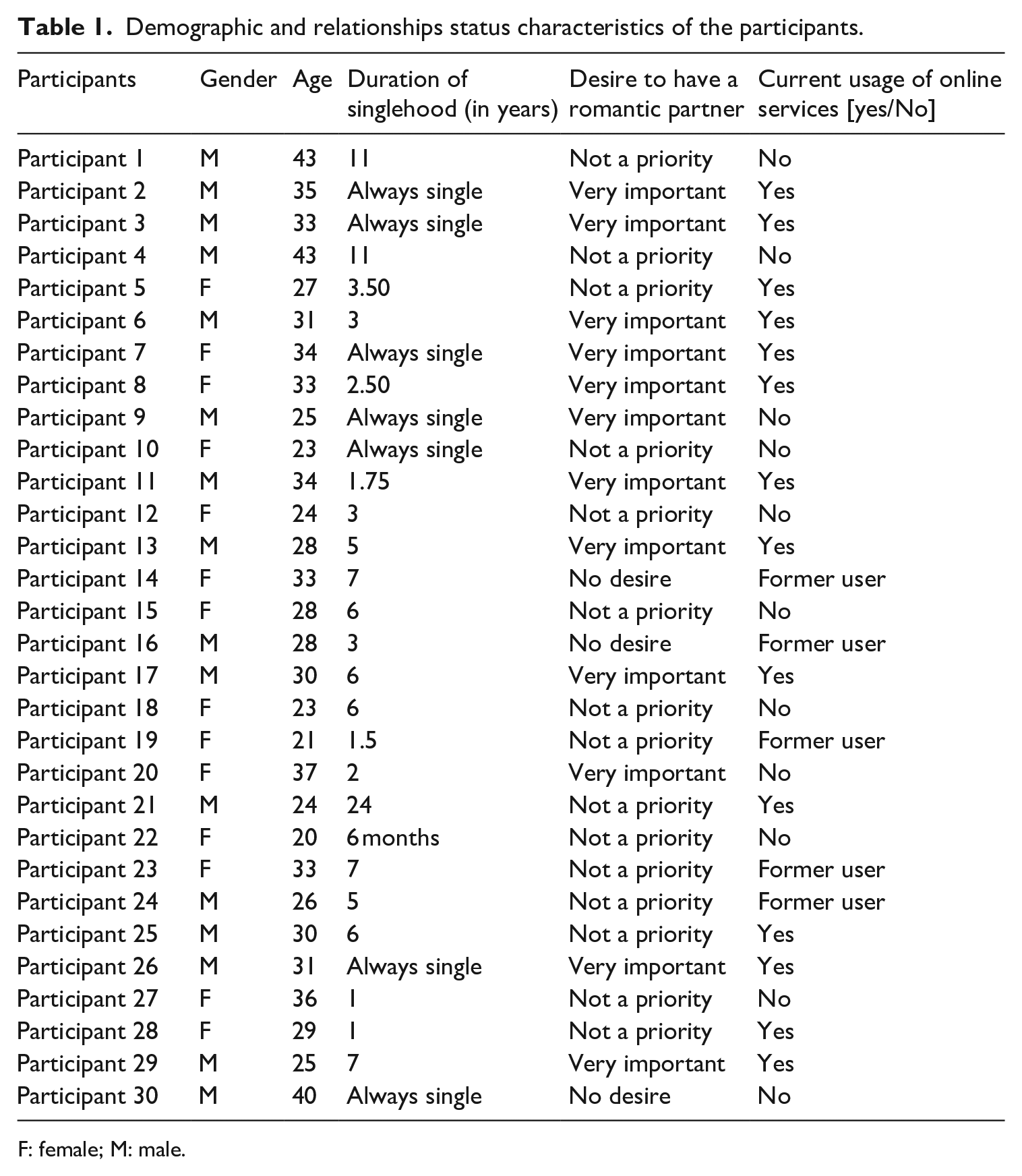
F: female; M: male.
Procedure
The investigation was performed by obtaining ethical approval from the faculty ethical board of (blinded name), and we fulfilled all ethical requirements in the data collection procedure. Data were collected via in-depth semistructured interviews conducted in the period from December 2020 to May 2021. In each interview, experiences related to singlehood were evoked by asking, “Please tell me about your life as a single person [what is it like for you to be single?], reaching out to how it used to be, how it is now, and how you see your future” (the entire interview guide is provided in the online supplementary file). This gave the participants the freedom to tell their stories, although the semistructured interview scenario was adjusted to each individual to follow the uniqueness of their experiences. Due to the COVID-19 pandemic, all interviews were conducted via online or mobile applications. All the respondents provided their informed consent to participate in the interviews, recorded them via voice recorder, and processed the data before the interviews began. Interviews were taped and transcribed verbatim. The duration of the interviews ranged from 28 to 95 minutes (M = 62 minutes). All the participants received compensation for their participation in the form of vouchers to an online bookstore that had a value of 90 Polish zlotys.
Qualitative content analysis
The inductive content analysis of the data collected in the present investigation was carried out through a qualitative content analysis (QCA) procedure based on the proposition by Graneheim and Lundman (2004). The analysis involved six phases (see Graneheim and Lundman, 2004): (1) the multiple readings of the transcribed interviews to understand the entirety of each interview’s content; (2) the extraction of the texts concerning the experiences in the domain of online and mobile dating and incorporating them into one text to create a unit of analysis; (3) the division of the text into meaning units that were subsequently condensed; (4) the abstraction of the condensed meaning units and labeling them using codes; (5) the analysis of the meaning units with codes and reaching an agreement regarding sorting the codes; (6) and the formulation of the themes reflecting the latent constructs. The first, fifth, and sixth steps of the analysis were performed by all three authors, whereas the second, third, and fourth steps of the analysis were conducted by the first and second authors. The phases of analysis were performed in a dialog to increase the credibility of the research findings, as this enables an agreement on how data are labeled and categorized (Graneheim and Lundman, 2004). As the final step, the general description of the experiences of never-married single individuals in the domain of online dating websites and mobile applications was elaborated. A detailed description of how we established the trustworthiness of the current investigation is provided in the online supplementary materials. Examples of meaning units, condensed meaning units, codes, categories, and themes are provided in Table S2 in the online supplementary file.
Results
The analysis identified four broad themes that captured the never-married, single individuals’ experiences with dating services in terms of opinions, feelings, and actions reported in the context of the experience of singlehood. These themes are elaborated below.
Theme 1: ambiguous perception of the usefulness of dating services as a means to search for a romantic partner
The essence of the first theme reflects the participants’ perceptions, opinions, and beliefs about the usefulness of dating services as a means to search for a romantic partner. They were embedded in the general context of their singlehood and manifested in the participants’ considerations of the pros and cons of using dating services and the factors inherently associated with dating technology, prompting them to use dating services to find a romantic partner or discourage them from doing so.
The statements of 23 participants conveyed users’ belief that dating websites and apps are a good way to search for a romantic partner and enable them to achieve the important relational goal of finding a desired romantic partner. An important argument for using dating websites and apps was the notion that dating technology extends the pool of potential partners and allows one to meet people outside their closest circle of friends and colleagues who often are already in romantic relationships. This opinion was expressed by one current user, a 30-year-old man, for whom being in a romantic relationship was important, although it was not a priority: I am trying with online dating. Yes, mostly via the internet. I work in a small company, the circle of my friends is small and closed, and most of them have their own families and children. Thus, it is difficult to find someone via “traditional” methods (P25).
Many of the participants appreciated having easy access to dating opportunities regardless of the time and place they sought such opportunities. For instance, one current user, a 34-year-old woman who had never been married and for whom having a partner was very important, noted that: “I can grab a blanket, I can grab a thermos, launch up my Tinder and start dating” (P7).
Participants acknowledged that the dating apps and sites were particularly useful during the COVID-19 pandemic. Since the pandemic limited the possibility of meeting a potential partner in traditional settings, dating services have emerged as an important means for finding a romantic partner, particularly for long-term single individuals who strongly desire to be in a relationship. Such a situation was experienced by one current 35-year-old user who had never been married: “The pandemic, when they shut everything down, it thwarted everything. Therefore, the only thing I truly had left was dating sites. “(P2).
Nevertheless, dating websites and apps were also perceived as a difficult way to search for a romantic partner, according to the statements of 15 participants. This opinion arose from the uncertainty of whether users can be sure of the genuine intentions of the person on the other side of the screen or whether other users might deceive them. This is illustrated in the statement of one current 21-year-old female user, who desired finding a partner but was not prioritizing the search at that moment in her life: I prefer to get to know people in person so I can know right away what kind of personality that person has, and like, just by writing with someone, we do not know what that person is truly like well because you can adopt any character (P19).
In some cases, a negative opinion of dating services resulted from the belief that such platforms are not a place to meet suitable romantic partners. Such concerns were expressed by a 23-year-old woman who had never used dating services but sought a quick way to find “the right man” without wasting time with meaningless relationships as a crucial goal: “I would be a little afraid because I think that on these dating sites men usually look only for pleasure in the moment. In addition, that is not what I am looking for” (P18).
A similar view was held by a 26-year-old man who had previously communicated with many women on Tinder but for whom being in a romantic relationship was not a priority at the time: I have tried using dating apps slightly with varying results. There is just a specific group of women there, not necessarily the group of women I should be looking for. So there is just a small chance that I will find someone suitable there with the qualities I look for in women (P24).
In addition, negative opinions of dating platforms were also sometimes a result of the necessity of paying extra to use these services and the belief that such paid services operate against the interests of users who genuinely want to find a romantic partner. This was expressed by a 35-year-old male user who was intensively using dating services to achieve his strongly desired goal of finding a partner: I have an account on three dating websites for about six months. In addition, my opinion is negative. For me it appears to be that paid websites try to do everything to not help me find a partner, and force me to prolong my subscription (P2).
Finally, some participants viewed dating services negatively because, in the face of the COVID-19 pandemic, they were forced to move their dating activity to the virtual space of the dating platforms. This happened in the case of one 24-year-old male user for whom being in a relationship was not a priority and who strongly preferred in-person rather than online contact: “For me personally, relationships in a pandemic can be very hard. I'm kind of looking forward a lot, to many things opening up, like cinemas, restaurants, so that I can, as little as possible, use any kind of communicators” (P21).
Theme 2: acquiring skills in using dating services
Six participants felt that online dating was a task that required having a good strategy and the skills needed for effective self-commodification and self-branding, for example, skills to make a good first impression on other users, initiate the first contact, and maintain an interesting conversation. These skills were considered by the participants as being connected to the necessity of possessing a suitable profile photo and an appealing, outstanding profile description to attract other users. The participants felt that possessing such skills was essential for increasing their chances of finding a romantic partner via dating services. This is illustrated by a never-married 35-year-old male user who greatly wanted to find a romantic partner: “It turned out that I have a problem with low-quality photos and unappealing descriptions that don’t show me as an interesting person. I have changed my description and photos, and then my popularity on dating websites has automatically increased” (P2).
Moreover, participants often experienced the necessity of possessing these specific skills as discouraging them from using dating services. This feeling was described by a 25-year-old man who did not use dating services, who had never been married, and who strongly desired to find a romantic partner: Maybe someday I will decide to use online dating. If yes, I will need to learn a lot about how to show my best side at the entrance. It is ok for me as an idea, but I cannot do that. It will be necessary to take some nice pictures and prepare the schema of conversations because it is important to make them interesting, catching. Only after that, I may try to do something (P9).
Finally, online dating was also considered a good opportunity to gain experience and practice skills that are essential in the sphere of both online and face-to-face dating, such as making a good first impression, initiating the first contact, and chatting with others; online dating was also considered a good opportunity to practice coping with various issues that occur in both online and offline dating relationships. Some participants emphasized that the skills acquired and honed in virtual spaces can be transferred to offline dating relationships and they hoped that dating services would improve the skills that are generally required in the domain of in-person romantic relationships. For instance, a 34-year-old female user recognized that using dating services helped her develop assertiveness and effective ways of coping with rejection: I was learning how to say no when I don’t want to meet with someone, how to care about myself, and the other person. I have learned that someone can say no to me, and I have to live with it (P7).
Theme 3: personal difficulties and failures in using dating services
The third theme was identified from the statements of 19 participants and reflects the participants’ personal experiences that involved several difficulties and failures faced when using dating websites and dating apps. While the essence of Theme 1 is based on the participants’ opinions, perceptions, and beliefs regarding the usefulness of dating technology as a means of searching for a romantic partner among both users and nonusers, the core of Theme 2 is rooted in the participants’ direct, personal, and unique experiences resulting from the usage of dating services. Three participants experienced dating services in terms of difficulties and failures resulting from the ambiguity of online dating and reported the feeling of uncertainty about whether and when they would receive, if at all, a response to their initial message sent to another user, and whether they would find a match. Such experiences were reported by one 35-year-old male user who had never been married and for whom finding a romantic partner was a high priority. He used dating services intensively to find a romantic partner: I don't like this kind of situation, which happens very often in dating online, when a girl doesn't respond for a week, then for two weeks, and, finally, there is no answer, because she didn't have the courage to say that there is no future for this relationship (P2).
For nine participants, using online dating websites and mobile apps was experienced in terms of increasing difficulties resulting sometimes from the feeling of necessity to create a catchy welcome message on the basis of limited information about the other person. For instance, Participant 21 (24-year-old male user) reported that: Dating online is rather not for me. I can spend three hours writing a message, this initial, welcoming message. On thinking what I want to write, knowing only the cover photo and short description of that person who wrote to me. Should I ask for something, do something? It is blocking me (P21).
Other participants experienced dating services in terms of difficulties due to their preference for face-to-face interactions over online interactions. A 29-year-old female user for whom finding a romantic partner was important but not a high priority indicated that
“I prefer personal contact; however, you do not get to it right away in online dating. Sometimes it is time-consuming, and you have to be patient” (P28).
Another challenging aspect of online dating websites and mobile apps was moving from online to direct, face-to-face contact with a person whom users had met via the Internet. One never-married user, a 31-year-old man for whom finding a partner was very important and who preferred online dating over in-person contact, reported that: It was difficult for me to make contact directly. I can say that if I wanted to go from that online contact to a relationship, it would get a little delayed in time, it would be something that I would put off or it would need some arrangement (P26).
Finally, participants also reported feeling ineffective and unsuccessful in their attempts to find suitable, serious partners via dating services. This experience was noted by a former dating service user, a 33-year woman who had been single for 7 years and for whom having a partner was important but was not a priority: There was a period when I actually wanted to have someone and I was actually even on dating sites. However, it did not work out at all. I met nice people, but I did not manage to have a relationship with any of these men (P23).
At the same time, for other participants, the lack of dating success prompted them to attempt, repeatedly, sometimes falling into a cycle of trying again to find a romantic partner and then giving up using dating services when a prior attempt was unsuccessful. These attempts were fueled by a strong desire to find a partner, as in the case of another 31-year-old male user: “These periods of trying usually last approximately two to three months, and then discouragement comes. It lasts also about two, three months and then I usually go back to trying. It is “trying-discouragement-trying-discouragement” (P6). Moreover, rejection by another user was also likely to diminish a person’s sense of self-worth and self-esteem and negatively affect his or her mood, as in the case of the Participant 6 who reported that: I don’t have a match, and then this negative scenario comes to me, “What is wrong with me? Am I not good enough?” This waiting is ok. in the beginning, somehow motivating, but later, when it is prolonged, my mood becomes worse, and my self-esteem decreases.
Theme 4: online dating as self-obligation
Two participants reported feeling strongly obligated to use dating services to find a romantic partner. The participants saw the use of dating services as a way to ensure that they employed every available method to find a romantic partner and to satisfy their relationship needs.
In the case of one 25-year-old male user, a sense of such obligation arose from the discrepancy between his very strong desire to be in a romantic relationship and his passivity in dating thus far. Forcing himself to use dating platforms provided Participant 29 with the feeling of being proactive and taking initiative in attempting to establish a relationship, even if this activity was limited to creating an account on dating sites without actively using them. This is illustrated below: I am asking myself to write to someone, to start the action, to do the first step instead of nagging about not doing anything. I am asking myself to do anything, to get the feeling, “Ok, now I am alone, but I am doing something to change it to not be alone in the future” (P29).
Moreover, in the case of Participant 29, the feeling of self-obligation to use dating services was also associated with self-blaming and feeling angry with himself: I feel anger. It is not sadness but rather anger. Anger at myself, being irritated due to being single, anger arising from the desire to not be alone, and feeling like, “Hey, do something!” It is like scolding younger brother for not doing something. And I am scolding myself: “in the evening, you have some time, so do something, search, write to someone instead of sitting, getting irritated, and deliberating about not doing anything” (P29).
In contrast, for Participant 23, a 33-year-old female nonuser, for whom finding a romantic partner was not a priority at that point in life, a feeling of self-obligation had previously motivated her to use dating services. Moreover, perceiving oneself as being “active” by using dating platforms protected her from blaming herself and feeling negative:
There was a time when I had a desire to have someone, and I was using these dating websites. I was trying for a while to prove to myself that I have done everything possible. However, it didn’t work. I didn't want to be unsatisfied with what I had done to find someone, accusing myself of just sitting and waiting for a prince on a white horse (P23).
Discussion
Our investigation initially began as an exploration of how Polish never-married single adults experience singlehood. The open and flexible nature of our qualitative research, however, enabled the single participants to freely provide their narratives on singlehood, which unexpectedly led us to the issue of dating via dating technology. Furthermore, the applied inclusion criterion of being a never-married single person allowed us to examine the experiences of persons who were current active users, former users, or had never used dating services, similar to the studies by Degen and Kleeberg-Niepage (2022) and Sobieraj and Humphreys (2021).
Our investigation extended these prior studies by showing how single individuals, regardless of being a current, former, or never-user, position themselves in regard to the dating technology that is available in Polish society characterized by the increasing prevalence and acceptance of dating technology (Marganski, 2017; Rychłowska-Niesporek, 2019) and a strong adherence to the ideology of coupledom and marriage (Janicka and Szymczak, 2019; Niehuis et al., 2021) in conjunction with the low acceptance rate of singlehood (CBOS, 2019).
By employing the prism of singlehood and the associated relationship desires and goals, we demonstrated that indeed “(. . .) the app itself does not prescribe or determine users’ behavior” (Degen and Kleeberg-Niepage, 2022: 192). Rather, the entire experience of singlehood in the specific marital and relational context interacts with the technological properties of dating platforms and determines single adults’ various experiences with dating services and their positions toward these services. These experiences and methods of positioning oneself toward dating websites and apps were captured in the current investigation through four major themes that reflect the participants’ various opinions, feelings, and actions. The diversity of single individuals’ experiences observed in the present study additionally confirmed and extended the notion made by Degen and Kleeberg-Niepage (2022) that “mobile online dating entails serious and multifaceted implications on subjects’ thoughts, motives, emotions, self-esteem and well-being” (p. 193).
Since dating technology has become a prevalent and integrated part of the daily lives of many people (e.g. Degen and Kleeberg-Niepage, 2022; Hobbs et al., 2017) and is often been perceived by people as the only sensible method for finding a romantic partner Rychłowska-Niesporek (2019), single adults—regardless of their relationship desires, that is, whether they strongly desire to have a partner, whether they do not desire to have a partner at all, or whether this desire is not a high priority in their lives, and regardless of their being a current, former or never-user—relate to dating services through their perceptions, opinions, and beliefs pertaining to the usefulness of dating services as a means by which to search for a romantic partner. This positioning of single individuals toward the social phenomenon of dating via dating technology has been captured in the current investigation in the first theme, namely, Ambiguous perception of the usefulness of dating services as a means to search for a romantic partner. This theme concerns the participant’s perceptions, opinions, and beliefs about whether dating services are a useful and effective tool for finding a suitable romantic partner. In addition, this positioning is not merely a simple function of relationship desires. This means that there is no direct translation of the strong desire to have a partner into positive views of dating services and using such services because single individuals who strongly desire to be in a relationship often hold negative views on dating platforms or do not use dating platforms to achieve their desired relational goal of finding a romantic partner. However, the lack of the desire to have a partner or having a desire that is not a high priority in someone’s life is often translated into negative perceptions, opinions, and beliefs about dating services, which consequently leads to the cessation of using dating technology (former users) or not using it at all (never-users).
Our first theme appears to resemble the “Legends” category identified in the study by Degen and Kleeberg-Niepage (2022) that addressed the German and Danish individuals’ references to generalizations, stereotypes, and prejudices about dating technology and the persons who use it. Theme 1 also corroborates with the study by Rychłowska-Niesporek (2019) that revealed the ambivalence and oscillation between positivity and negativity experienced by Polish single individuals. Specifically, 23 participants perceived dating platforms as a good way—and in some cases, the only way—to achieve their relationship goals. This finding is consistent with prior studies that have shown that many individuals consider using dating technology to increase their chances of satisfying their relationship desires (Ramirez et al., 2015; Sumter et al., 2017) and to enhance their individual efficiency and agency in the search for a romantic partner “(. . .) without having to devote much extra time or energy” (Hobbs et al., 2017: 279). This positive appraisal of online dating websites and applications appears to be related to communicative affordances (e.g. Fox and McEwan, 2017; Schrock, 2015). For instance, thanks to dating services, the participants had access to larger pools of potential partners than with offline methods and could easily communicate with such individuals. Participants also recognized the possibility of intensifying their searches for a partner due to the affordance of portability, as location-based real-time dating (LBRTD) apps can be used in a variety of locations (Ranzini and Lutz, 2017; Sharabi and Timmermans, 2021). Single individuals also acknowledged the benefits of the affordance of availability, that is, the possibility of being fully or partially connected via mobile media, which can be strategically adjusted in line with individual preferences for contact (Schrock, 2015).
Theme 1 also reflects several doubts about whether dating services are a truly useful and effective means for finding a romantic partner, as reported by 15 participants, both users and nonusers. The concerns sometimes contributed to no longer using dating services or not starting online dating at all. Negative opinions about the usefulness of dating services for achieving relationship goals arose, for instance, from several uncertainties largely connected to the lack of trustworthiness or credibility of other users. In terms of affordances (Fox and McEwan, 2017), the anonymity of users seems to increase the uncertainty about whether other users are trustworthy and credible or deceitful (e.g. Wotipka and High, 2016). In addition, this uncertainty about the intentions and sincerity of other users is fueled by informational control—one of the communication affordances—which allows people to choose what content they wish to either express or withhold during interactions (Fox and McEwan, 2017). The participants’ concerns also revolved around the uncertainty about whether a person they met via the Internet shares their desires and goals or is just looking for pleasure, adventure, and casual or sexual relationships. These worries are derived from the fact that people use dating services not only for finding love and a romantic partner but also for other reasons such as curiosity, casual sex, socializing, the thrill of excitement, or entertainment (see Degen and Kleeberg-Niepage, 2022; Sumter et al., 2017; Timmermans and De Caluwé, 2017). In addition, participants were highly aware of the fact that the most popular dating app, Tinder, is often perceived to be merely a hook-up or sex app (Sumter et al., 2017). At the same time, the participants’ perceptions of online dating and other users not only depended on the views of specific apps such as hook-up or relationships apps, as seen in the study by Sobieraj and Humphreys (2021), but also on the individuals’ own relational goals, that is, whether they are searching for a romantic or sexual partner. Finally, negative opinions about dating platforms sometimes resulted from the perception that dating services are focused more on earning the company money than on supporting people in their search for romantic partners. These sentiments reflect the recent notion made by Sharabi and Timmermans (2021) that dating services “also stand to benefit from an online dating experience that keeps people coming back for something better, even if that might potentially harm the future outlook and development of relationships formed online” (p. 2942).
The participants reflected on the usefulness of dating services for achieving relationship goals in the context of the COVID-19 pandemic, which forced people to move their activities almost exclusively to virtual spaces (see Madianou, 2020). Under these circumstances, depending on their attitude toward dating platforms and relationship desires, some participants continued searching for a romantic partner using dating services and viewed them as the only venue for such activity during the pandemic (e.g. Wiederhold, 2021). In contrast, for some participants, the COVID-19 pandemic and associated lockdowns and restrictions (closed cinemas, pubs, cafes) have severely limited their usage of dating services, as it was impossible for them to move relationships initiated online into the real world.
However, the issue of usefulness and effectiveness in reference to the self of single individuals recurs in Theme 2, namely, Acquiring skills in using dating services. This theme reflects the perspective of the six participants who viewed using dating services as a task that can only be accomplished when people have specific skills and strategies. Theme 2 reveals that single individuals may position themselves in regard to dating services through the prism of their own effectiveness and their endeavors to optimize their online dating practices to succeed and find a suitable romantic partner (Degen and Kleeberg-Niepage, 2022). Achieving dating success on dating platforms requires the constant shaping and optimizing of one’s user profile (Degen and Kleeberg-Niepage, 2022), as well as competencies and strategies that enable self-commodification and self-branding (Hobbs et al., 2017). These specific requirements, in turn, align with perceiving oneself in terms of being a person who is sufficiently competent and has knowledge of various strategies for succeeding in online and mobile dating. In addition, these considerations of an individual’s competency in the area of dating technology interact with an individual’s relationship desires and thus may operate as a triggering or hindering factor for initiating the use of dating services (active users), not using such services at all (never-users) or the cessation of using them when an individual experiences one’s own incompetence (former users). Our participants, similar to the participants in the Australian study by Hobbs et al. (2017), spoke of the necessity to have certain resources (skills, techniques, and appealing photographs) for self-branding and the commodification of the self to present themselves as desirable in the dating marketplace. This perception of online dating as a task needing special skills appears to arise from the specificity of dating services, which in general require possessing a profile with textual and photographic information (e.g. Ramirez et al., 2015; Stoicescu et al., 2019). Furthermore, such affordances as editability and conversational control (Fox and McEwan, 2017) may reinforce the perception of dating apps as a space where gaining some experience is needed before one can achieve a successful result. In addition, affordances such as information control and personalization allow an individual to choose what can be shared (e.g. on one’s profile or in private messages) and what should be hidden to maximize the chances of making a match and arousing the curiosity of other users. Persistence allows one to return to previous messages (Fox and McEwan, 2017) to analyze both effective and ineffective communication to improve one’s personal communicational skills and increase one’s possibility of achieving success (e.g. getting someone’s phone number or arranging a date for a face-to-face meeting). Moreover, similar to the participants in the study by Degen and Kleeberg-Niepage (2022), one participant also reported that he utilizes professional counseling in regard to online dating to increase the quality and effectiveness of his actions in the domain of online dating to achieve his strongly desired goal of finding a romantic partner. The effectiveness of this activity also requires knowledge of the multimediality of online dating (Ranzini and Lutz, 2017; Schrock, 2015), which is essential for success in online dating. Therefore, the sufficient integration of all these modes requires the clever use of various modes of communication, such as texting, voice, and sharing photographs; therefore, this process sometimes appears to be a difficult task for the participants. Given such notions, it is understandable that some participants felt discouraged from using online services due to the sense of not having useful skills and strategies. However, other participants recognized dating in the virtual space as a good opportunity to gain experience and skills necessary for both online and natural settings. This aspect of dating technology as training also emerged in the qualitative study of 18 U.S. individuals, among whom 14 participants indicated that they used Tinder to improve their flirting or social skills (Timmermans and De Caluwé, 2017).
For those single individuals who have decided to currently use dating services or for those who have used these services in the past as a method for searching a partner, dating via dating technology is either a past or a current source of various direct personal experiences and emotions reflected by the third theme, namely, Personal difficulties and failures in using dating services. This theme addresses the diversity of single participants’ difficulties and failures resulting from their “daily practice/usage,” which involves using individuals’ actions to handle the specific requirements and characteristics of mobile apps and integrate their logic of acceleration and optimization into their daily lives (Degen and Kleeberg-Niepage, 2022). Theme 3 also appears to resemble the category of “the Self” that was identified in the study by Degen and Kleeberg-Niepage (2022), which reflects the struggle experienced by the German and Danish participants when using online dating apps and their negative feelings that arise from remaining unmatched. The difficult experiences reported by our participants also appear to derive from the notion that the search for a romantic partner often requires time and energy and is often associated with stress and frustration (Finkel et al., 2012), as well as pressure (Degen and Kleeberg-Niepage, 2022). Specifically, three participants experienced feelings of uncertainty and discomfort when using dating technology due to not knowing if and when they would receive any answer to an initial message and whether they would be able to find a suitable partner at all. This first concern appears to reflect the asynchronicity associated with many computer-mediated channels (Fox and McEwan, 2017) that postpone in time a potential response from another user. Although this asynchronicity is overcome by mobile apps via its design, allowing one to send messages and receive responses in a short period of time (Ranzini and Lutz, 2017) or to have synchronous communication via voice chat, some channels of communication, in particular asynchronous text chats, are associated with unknown time periods between sending and receiving messages. As a result, concerns may arise when individuals do not receive any response to their messages.
In addition, dating services have been recognized as creating a unique social setting that is ambiguous, anonymous, and vulnerable (Pitcho-Prelorentzos et al., 2020), in which people who do not know each other completely and whose activity is based merely on their own assumptions (Gibbs et al., 2011; Pitcho-Prelorentzos et al., 2020). For instance, some participants reported negative experiences of being tricked by other users who used the informational control offered by dating apps and websites (Fox and McEwan, 2017) and who, for instance, withheld information about their age, their real relationship status, or having children. Moreover, our findings imply that some affordances, such as editability, conversational control, and information control, are likely to be experienced and perceived either positively or negatively depending on the situation. Stated differently, positive experiences were usually reported when the participants benefited from the dating services’ affordances, for instance, by personalizing their messages via the chat function or enhancing their profiles to make a good first impression. In contrast, negative experiences were more likely to be reported when other users benefited from the same affordances and, for instance, postponed their response and withheld some information, that is, when the participants were the recipients of the other users’ actions.
Nine individuals experienced several difficulties with initiating the first contact, the preference for face-to-face interactions compared to online interactions and the transition from online communication to offline contact. Our results suggest that the nature of these experiences was affected by the participants’ relationship desires and subjective judgment of the objective events encountered when using dating services. Specifically, participants who strongly desired to be in a romantic relationship sometimes perceived certain technological properties of the dating platforms (e.g. anonymity) to be obstacles interfering with their hopes of finding a partner. Consequently, they felt that their actions to find a partner were impeded, which contributed to their decreased sense of worth and self-esteem. Seven participants directly reported experiencing failure, disappointment, diminished self-efficacy, and hopelessness because they were not successful at finding a partner. These feelings appear to have resulted from a discrepancy between the services’ marketing promises guaranteeing dating success (Finkel et al., 2012) and the lack of actual success. Furthermore, these negative outcomes were particularly likely to occur among individuals who strongly desired to have a partner and who had been single for a long time, which made them vulnerable and highly motivated to use dating services to find a romantic partner. This finding is congruent with a recent study showing that unsuccessful attempts to find a romantic partner using dating services may lead to sustained and repetitive searches for a partner, which is often associated with exhaustion and fatigue (Rochadiat et al., 2020), and as our study showed, the decision to cease using dating services.
The considerations of dating services as increasing the efficiency and effectiveness of the search for a romantic partner enhance the social message that “(. . .) one has to stop waiting and subscribe to the right online dating site to fulfill the heteronormative, familial cultural ideal” (Lahad, 2019: 506). As a result of these circumstances, some single participants may feel obliged to use dating services. This specific mode of position is reflected by the fourth theme, namely, Online dating as self-obligation, which reflects two participants’ reported feeling that finding a romantic partner is a goal that they ought to pursue and achieve by employing all the available tools. Notably, this feeling of internal obligation does not always translate into the current use of dating services and may not be directly associated with any previous experiences with dating technology. The sense of self-obligation reported by participants can be explained by the desire to find a partner even if this desire was not currently a priority. This obligation contributed either to a feeling of needing to be active in the domain of online dating or to self-blaming and anger due to one’s own passivity in this area.
The conviction of the necessity to be active in one’s own search for a partner (Lahad, 2019) and the tendency to self-blame due to remaining single (Lewis and Moon, 1997) is reinforced by the perception of singlehood as a temporary and stressful state that must be altered (Lahad, 2019). Moreover, these social messages may be amplified by the marital and relational context, which in Poland is characterized by strong adherence to the ideology of marriage and family (Niehuis et al., 2021) and unfavorable attitudes toward singlehood (CBOS, 2019). Finally, the belief in the necessity to “stop waiting and start dating” (Lahad, 2019) is also fueled by marketing promises that ensure users that the utilization of dating services will result in their finding a partner with whom they may experience “a romantic spark” and “a satisfying and lasting long-term relationship” (Finkel et al., 2012: 39). These beliefs are also prompted by the affordance of accessibility (Fox and McEwan, 2017), which implies that if there is a possibility of dating “always and everywhere,” then there is both no excuse for not using dating services and the perceived need to be available on dating services to be successful (Degen and Kleeberg-Niepage, 2022).
Limitations and future research directions
Although the current study has provided important and unique insights into how never-married, single individuals experience dating services, it should also be considered in the context of its limitations. First, the interviewees were recruited via Facebook, which itself implies self-selection bias (see Timmermans and De Caluwé, 2017). Second, the generalizability of our findings can be limited only to the Polish setting or other sociocultural settings characterized by similar marital contexts and the prevalence of online dating and application usage. Therefore, future research may wish to cross-culturally explore the experiences of dating services to investigate whether the patterns discovered in the current study also emerge in other social and cultural contexts. Third, we focused only on never-married, childless individuals and covered a broad age range (20–43 years), capturing two life periods of young and established adulthood (Mehta et al., 2020). Although our results did not suggest age differences in the relationship desires, marital prospects, and experiences participants had with dating services, future studies may draw attention to the role of age in these phenomena and may include older participants, as well as single parents or divorced and widowed individuals. Fourth, our sample consisted predominantly of heterosexual individuals. Because individuals who do not identify themselves as exclusively heterosexual may use Internet tools and dating apps more often for relational purposes (e.g. Sumter and Vandenbosch, 2019), future research will benefit from the larger inclusion of nonheterosexual, single individuals to investigate the nature of their experiences with dating sites and apps. Fifth, our interviews were performed during the COVID-19 pandemic, which negatively affected general mental health and well-being and forced people to live and display their lives on the Internet (Madianou, 2020), including the dating sphere. Therefore, it is probable that if the data were collected during the pre-COVID-19 pandemic period, it would have reflected different experiences of our participants.
Conclusion
Our investigation demonstrates that dating via dating websites and mobile apps among never-married single individuals can be better understood as an activity that is embedded in the broader context of the entire experience of singlehood and the associated relationship desires and goals. The novel contribution of our study is the unraveling of the unique role of personal factors—such as the desire to find a romantic partner, the subjective perception of the usefulness of dating services and its affordances, and the willingness to use such services as a crucial means by which to achieve the relationship goal of finding a romantic partner—in determining both the meaning that never-married single adults may attach to dating technology and how they position themselves in relation to this social phenomenon even if they are former users or have never used dating services. Finally, our findings confirm the significance of individual characteristics for activity on dating services and support the notion that the perception of the affordances of dating websites and apps cannot be limited to the properties of technology and cannot be separated from users’ perception of these properties (Costa, 2018; Degen and Kleeberg-Niepage, 2022; Fox and McEwan, 2017).
Supplemental Material
sj-docx-1-nms-10.1177_14614448221097894 – Supplemental material for Never-married single adults’ experiences with online dating websites and mobile applications: A qualitative content analysis
Supplemental material, sj-docx-1-nms-10.1177_14614448221097894 for Never-married single adults’ experiences with online dating websites and mobile applications: A qualitative content analysis by Katarzyna Adamczyk, Kamil Janowicz and Marta Mrozowicz-Wrońska in New Media & Society
Footnotes
Acknowledgements
We thank our participants for their trust and participation. We thank Emilia Soroko, Ph.D., associate professor at the Faculty of Psychology and Cognitive Science, Adam Mickiewicz University in Poznań for her invaluable advice and guidance given to us on qualitative content analysis. We thank Monika Zielona-Jenek, Ph.D., assistant professor at the Faculty of Psychology and Cognitive Science, Adam Mickiewicz University in Poznań for her invaluable advice and guidance given to us on the ethical aspects of our study.
Author’s note
All authors have agreed to the submission and the article is not currently being considered for publication by any other print or electronic journal.
Declaration of conflicting interests
The author(s) declared no potential conflicts of interest with respect to the research, authorship, and/or publication of this article.
Funding
The author(s) disclosed receipt of the following financial support for the research, authorship, and/or publication of this article: The study was funded by a Research Grant (grant number UMO-2019/34/E/HS6/00164) issued by the National Science Center in Poland and awarded to Katarzyna Adamczyk. The funding agency had no role in the design or execution of the study, in data collection and management, in analysis, in the interpretation of data, or in the preparation, review, or approval of the manuscript.
Ethical approval
All procedures performed in studies involving human participants were in accordance with the ethical standards of the institutional and/or national research committee and with the 1964 Helsinki declaration and its later amendments or comparable ethical standards.
The research was positively evaluated by the Research Ethics Committee at the Faculty of Psychology and Cognitive Sciences, Adam Mickiewicz University in Poznań, Poland (Decision number: 2/07/2020).
Informed consent
Informed consent was obtained from all individual participants included in the study.
Human and animal rights
This article does not contain any studies with animals performed by any of the authors.

Availability of data and material
The dataset generated and analyzed in the current investigation is not publicly available to honor the individual privacy of the participants but is partially available from the corresponding author upon reasonable request.
Supplemental material
Supplemental material for this article is available online.
Notes
Author biographies
References
Supplementary Material
Please find the following supplemental material available below.
For Open Access articles published under a Creative Commons License, all supplemental material carries the same license as the article it is associated with.
For non-Open Access articles published, all supplemental material carries a non-exclusive license, and permission requests for re-use of supplemental material or any part of supplemental material shall be sent directly to the copyright owner as specified in the copyright notice associated with the article.
