



Abstract
Background:
In Colombia, communities living in the Andean region are the most affected by Chagas disease due to the presence of the main vectors, the environmental and risk factors associated with house infestation. Triatoma venosa is classified as a secondary vector that is frequently found in the departments of Boyaca and Cundinamarca, but epidemiological information and its association with risk factors in domestic and peridomestic areas is unknown. The study aimed to evaluate housing and environmental characteristics associated with domestic and peridomestic infestation by T. venosa and a risk map was estimated.
Methods:
A cross-sectional study was conducted in municipalities of Boyaca and Cundinamarca, Colombia. From March to July 2015, triatomine infestation screening surveys were conducted in 155 households. Multivariate analysis was performed to evaluate associations with the infestation and ecological niche modeling was estimated using environmental variables.
Results:
No statistical association was found with any of the housing variables in the adjusted multivariate analysis. However, in raw relationship infestation was associated with bushes < 10 m (OR = 3; 95% CI: 1.3–7.3) and higher temperature p value < 0.05. The developed final risk map pointed to 12 municipalities with no previous report of the disease, which should be sampled for the presence of T. venosa.
Conclusion:
This study highlights the relationship between environmental factors and T. venosa in Colombia and the importance of modeling tools to improve mapping efforts. Additional studies are needed to verify the association with bushes and higher temperatures and to verify infestation in predicted risk area with no previous report of the species
Introduction
The Triatominae (Hemiptera: Reduviidae) are a group of hematophagous insects considered important vectors of Trypanosoma cruzi, the causative agent of Chagas disease. They are widely distributed in America, with rare occurrences in Eastern Asia. However, they are primarily found in the Neotropical region. 1 Disease transmission occurs from the southern United States to Argentina, with approximately 25% of the human population at risk and between 700,000 and 800,000 new cases per year. 2
At the regional level, Triatoma venosa geographic distribution is constrained to Ecuador,3,4 Bolivia, 5 Costa Rica, Panama, and Colombia.6,7 In Colombia, this species has been found in the Magdalena River Valley and in the Western Andean Mountains at altitudes of 1600–2200 meters above sea level 8 in the departments of Antioquia, Boyaca, Casanare, Choco, Cundinamarca, Norte de Santander, Santander, and Tolima. 9
Most of the studies that have evaluated the vector species of Chagas disease in Colombia have focused on the primary vector. Few published papers have included epidemiological information for T. venosa that describes the species’ distribution and genetic characteristics.5,10–14 None have evaluated the potential factors associated with the infestation, nor have they developed any predictive maps.
House-level risk factors for triatomine infestation in Colombia have been concentrated on Rhodnius prolixus and Triatoma dimidiata.15,16 Although T. venosa is considered a secondary Chagas disease vector in the country, information about risk factors for domestic and peridomestic infestation is scarce. Furthermore, at this date, the ecological niche of T. venosa species is not known.
Risk factors may vary spatially between regions because of variation in human and vector behavior, ecology, and environmental factors. This local knowledge can then be used to target houses more effectively for vector control and determine house characteristics that could be prioritized in house improvement programs. 15
The main aim of this study was to identify associated factors for domestic and peridomestic infestation by Chagas disease vector T. venosa in the departments of Boyaca and Cundinamarca in Colombia and develop risk maps for the presence of the species. We also explore the relationship between the geographical distribution of T. venosa, and different bioclimatic and environmental factors to obtain the potential distributional model for this species. Those models will help to define the potential zones of higher infestation risk more accurately. This knowledge will help health authorities to prevent, monitor, and control T. venosa in Colombia.
Material and methods
Study area
A cross-sectional descriptive study was conducted in an area between coordinates -73,3°W to -73,6°W and 4,95°N to 5,16°N in the region known as Valle de Tenza located on the border between the departments of Boyaca and Cundinamarca. The administrative municipalities were Macheta, Tibirita, and Manta in the department of Cundinamarca, and La Capilla, Garagoa, Chinavita and Guateque in Boyaca (Figure 1).

Study area.
Sampling and collection of data for risk factor analysis
According to the conditions for access and available budget, a sample of houses was chosen in a region with previous local reports of the presence of T. venosa. A total of 155 houses were surveyed between March and July 2015. Geographic coordinates were recorded for each house with a GPS (GARMIN GPSMAP® 64) using the WGS84 datum.
Each locality was visited to inform residents about the objectives and activities of the study. Each household received educational leaflets describing Chagas disease signs and symptoms, transmission patterns, and the role of vectors. To identify risk factors for T. venosa infestation, a questionnaire was completed by interviewing a resident adult person over 18 years of age, and direct observation was made of variables related to housing materials (walls, roof, and floor), domestic animals (presence of dogs, cats, chickens, etc.), outbuildings (overhead storage, chicken coop, and grain shed), presence of vegetation (bushes, trees, and palm trees) around the houses, and domestic use of insecticides. Written consent was signed by the resident.
Each house was inspected by two technicians in search of triatomine for an average of 30 min per house, checking the interior of the houses and at peridomestic structures with the Tetramethrin spray at 0.2% to dislodge the bugs from cracks and other shelters. The infestation was defined as at least one bug inside the house (domestic) and/or in the area around the house where the inhabitants store their belongings for their subsistence (peridomestic). The main characteristics of the construction materials, the presence of domestic animals, the presence of wild animals, the number of inhabitants, and the number of rooms were recorded. The type of wall, the kind of flooring, and the type of ceiling were grouped into categories of good or poor quality based on whether the material exhibited cracks or potential shelters for triatomines. One additional variable was consolidated for the overall condition of the house by the sum of the characteristics of the walls, flooring, and ceiling. In good condition were those that had solid material in all three aspects at the same time. The intermediate condition was those with at least one element in poor condition, and houses in poor condition/quality were those in which all three aspects mentioned above showed poor conditions. In peridomestic areas, the presence of wild animals, structures such as chicken coops, clay ovens, elements such as wood and rock piles, and the characteristics of the vegetation such as the presence of bushes less than 10 meters in heigth, and household raised were recorded (yes/no). The temperature, relative humidity, and meters above sea level were also recorded.
Based on where the vector was present in the house, four groups of kind of houses were analyzed and called A, B, C, or D, each one of them had their respective comparison group for statistical analysis as is described in Table 1. These categorizations allow us to determine risk for transmission according to the location of bugs in the house.
Grouping of dwellings according to the location of the vector infestation in the dwellings and group of dwellings for statistical comparison.

D, domestic area; Negative, means no infestation for T. venosa anywhere; P, peridomestic area.
Statistical analysis (non-spatial)
Absolute and relative frequencies were calculated and presented in a table for each one of the variables studied for the 100% of the houses and also discriminated according to the type of house as was described in Table 1. Student’s t test and Mann-Whitney U test for quantitative, and chi-square and Fisher’s exact test for qualitative variables were used to evaluate the raw association, p value < 0.05 was considered statistical relation. A backward stepwise process was used for variable selection because it was important to explore and test all the variables registered, given that there were no previous reports for associated factors with this species. The statistical analyses were carried out in SPSS version 21.
Spatial analysis
Identification of clusters making circumferences with various radii for circles and elliptic shapes were developed using SatScanTM v9.4.1 (Harvard Medical School, Harvard Pilgrim Health Care Institute, Boston, USA). According to the infestation or not by T. venosa in domestic, peridomestic, or both of these areas of the houses, purely spatial scan statistics with the Bernoulli model were assumed. Simulations to generate random replications of the data set were developed to compare the likelihood of clusters in the data. Standard Monte Carlo statistics were calculated for the replications, and the collected data were considered in statistical relation when p value was under 0.05. To ensure enough power was reached, 999 replications were carried out for each one of the models run. 17
Ecological niche modeling (ENM) was developed using Maxent 3.3 18 ENM estimates the most uniform distribution, based on the maximum entropy principle, of the sampling points compared with background locations given the constraints derived from the data. 19 For the development of ENM, infestation was considered when the presence of the vector was found in any domestic or peridomestic or in both areas. Negative comparison data corresponded to infestation negative houses randomly selected by the program in the study area. Eighty percent of the collected points were used for training and the remaining points for testing model. A logistic format for the output was chosen, which provides the estimation of the probability of occurrence according to the environmental variables included. The independent environmental variables were 19 from WorldClim, representing the bioclimatic annual trends, seasonality, extreme factors, and quarters of a period for precipitation and temperature average conditions interpolated from data collected from around the world from 1950 to 2000, 20 the resolution was 30 arc-seconds (approx. 1 km). The altitude was obtained from the Consortium for Spatial Information which, at the time, had been provided by the NASA Shuttle Radar Topographic Mission with digital elevation data with a resolution of 30 arc-seconds. 21 The land cover variable with a resolution of 30 arc-seconds was obtained by the SPOT4 vegetation instrument. 22
Ethical considerations
The study and the informed consent procedure was approved by the ethics committee of CES University by Act 104 of 16 December 2013. All participants provided written informed consent. The research had authorization for the collection of specimens by the National Authority of Environmental Licenses (ANLA Spanish acronym) by resolution 0790 of 2014.
Results
Surveillance data
In total, information was collected from 155 houses. Sixty-two houses (40%) were surveyed in Cundinamarca and 93 (60%) in Boyaca province. A total of 118 (76.1%) houses were infested anywhere according to the definition given above, for A group, for B group were 12 (7.7%), for C group were 75 (48.4%), and for D group were 31 houses (20%). Extended information in supplement A. Two houses contained nymphs, one of them in the domestic area and the other in the peridomestic area. The colonization index was 0.8%.
Most respondents knew the bugs (96.8%) and had seen the insects inside the house (61.2%). Of the people who have seen the insects in the house, 68.4% claim to have seen them inside the bedroom. Official government control with insecticide was applied to 28% of the houses previously. Poor quality conditions of the house were recorded for 74.5%, this characteristic was found in 66.7% of the dwellings in group B and in 77% of group C. Domestic animals were recorded in more than 90% of the houses. Peridomestic structures in the annexes were found in 56.1% of the houses (see Table 2).
Description of the main characteristics for the total of the surveyed and discriminated dwellings according to analysis group.

MASL, meters above sea level; PQ, poor quality; SD, standard deviation.
Mean and SD.
Raw association assessments show no consistently associated factors when the kind of the infestation group was considered. The presence of peridomestic structures [odds ratio (OR) = 2.5; 95% confidence interval (CI): 1.0–5.8] and the presence of bushes (OR = 3; 95% CI: 1.3–7.3) were associated with an infestation type C. In contrast, these same variables were associated with reduced risk for infestation in group D (Table 3).
Raw association analysis according to type of location of the infestation in the house.

MASL, meters above sea level; N/A, not apply; NC, not calculated; OR, odds ratio; PQ, poor quality.
Full/Partial/Not plastering.
Mann–Whitney U test.
Student’s t test.
Fisher’s exact test.
The adjusted analysis for each one of the groups of kind houses did not show any statistical association when the variables with p values under 0.05 were included.
Spatial results
Although some apparent clusters for domestic infestation were observed in the municipalities of Tibirita and Garagoa, they they did not show a cluster with statistical relationship using Sat Scan (Figure 2).

Apparent clusters in the Municipalities of Tibirita and Garagoa
Ecological niche models showed the importance of the precipitation during the driest quarter and precipitation seasonality variables (30.2% and 23.6%, respectively) for explain the vector presence (Figure 3). Mean temperature during the warmest quarter explained 10%, and the altitude 7.6%. Receiver operating characteristic curves showed a value of 0.993 in the training data and 0.993 in the test data. However, strong differences were observed between sensitivity (48.1%; 95% CI: 0.34–0.62) and specificity (93.6%; 95% CI: 88.7–96.5). The Kappa value was 46.5% (95% CI: 32.6–60.6). Comparison of the model with historical reports of the presence and absence of the vector in the towns showed that just 25 of 52 municipalities reported as positive were predicted by the model and five municipalities (Caqueza, Chiscas, Choachi, Pajarito, Ramiriqui) that were never reported as positive were predicted by the model.
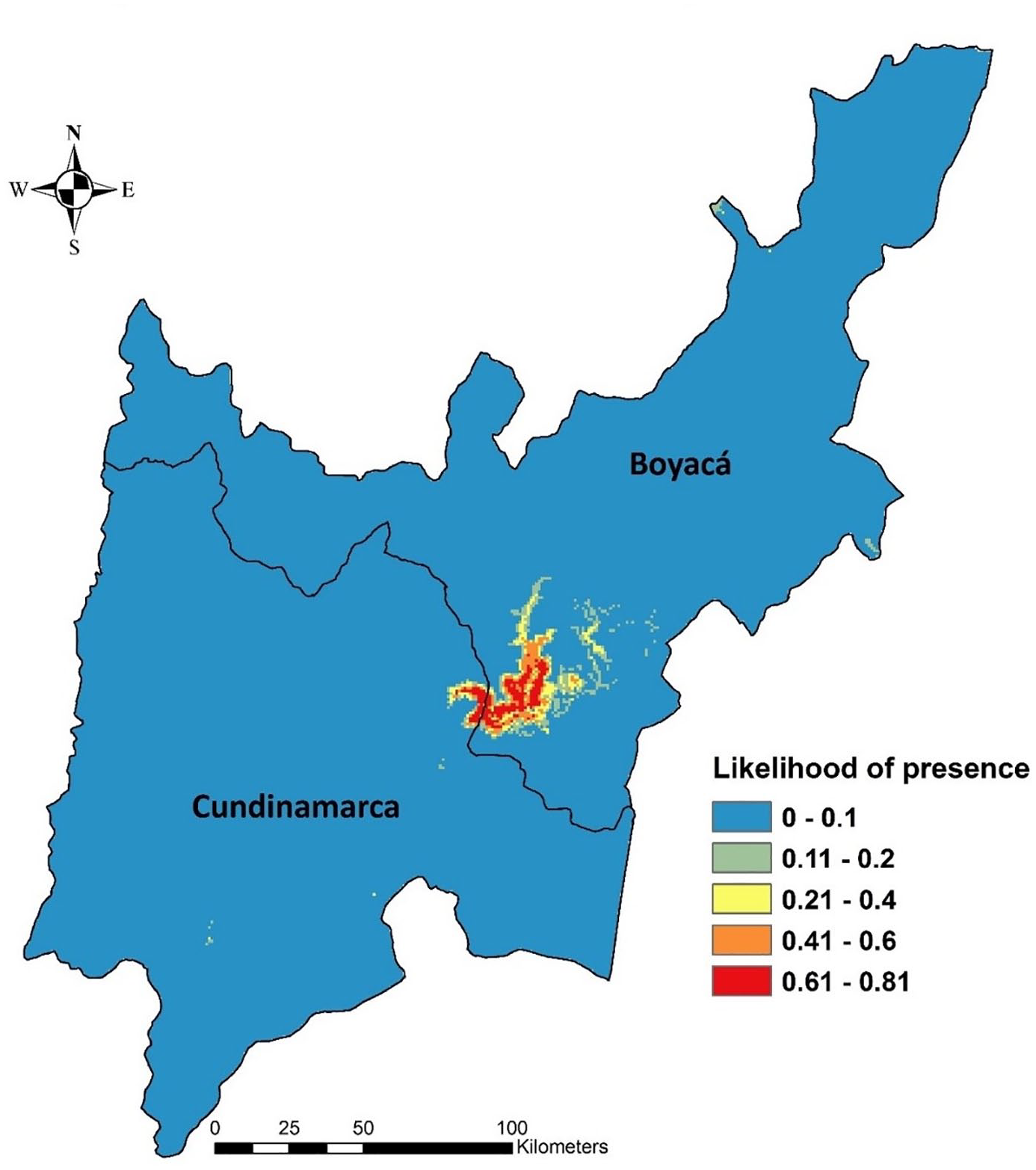
Ecological niche model for Triatoma venosa in Boyaca and Cundinamarca.
Discussion
The presence of T. venosa was high in the studied area, which is important in the knowledge of the ecology of the vector, but also to keep in mind in the public health surveillance of Chagas disease, due to the proven vectorial capacity of the species, despite the fact that several municipalities of the departments of Boyaca and Cundinamarca have been declared free of the vectorial transmission of the disease and that diagnosis of chronic cases is very low.23,24
Because domiciliation by T. venosa was scarce (only 0.8%) and the main proportion of houses were found with adults, we propose that in the studied area we have intrusions of adults to the dwellings instead of colonization of the houses by this species.
This is the first attempt to evaluate risk factors associated with domestic and peridomestic infestation and to develop risk maps for T. venosa in Colombia. Although no statistical associations were found based on logistic regression adjusted analysis, high infestation frequencies were found in houses with poor quality of plastering and presence of domestic animals and bushes. It is possible that the presence of these characteristics could be related to the general socioeconomic status of the population in Valle de Tenza. Similar findings have been reported for T. dimidiata, a species with similar distribution in domestic and peridomestic habitats and associated with poor quality of the coating of walls in studies carried out in Guatemala and México.25,26 The presence of domestic animals has been associated with infestation by T. dimidiata in México. 27 This class of conditions represents both hiding places and alternate food sources for vectors.
The presence of bushes less than 10 m in height was associated with infestation in group C houses (just domestic infestation), whereas this characteristic in houses of D group (just peridomestic infestation) has less probability of infestation. The presence of rock piles close to bushes and houses was very low (10–20%). Some researchers have reported the presence of caves or arid ground with cracks to be associated with bushes < 10 m in height and the presence of vectors such as T. dimidiata in the Andean Region of Colombia. 28 Bushes surrounded by rocks or caves may enhance the risk for T. venosa infestation in peridomestic areas and possible intrusion or even colonization from here to the domestic area of houses in the Andean Region of Colombia.
Characteristics of the house, such as poor quality of materials, the presence of domestic animals, peridomestic structures, or overall poor conditions, which have been previously related with infestation by other species such as T. dimidiata and T. maculata in Colombia, Venezuela, and Guatemala,28–30 were not found to be associated with infestation by T. venosa in the present study.
The main limitation was the sampling scheme which may have overfitted the predicted risk map and can only be addressed through more extensive random-design follow-up studies. In addition, the collection and aggregation of the data were not uniform. For example, the definition of the condition of a house may or may not consider the presence of electrical appliances and the hygienic conditions, 29 or may refer to the construction material, as in the present study.
Some municipalities previously reported as positive by the vector control authorities in Boyaca and Cundinamarca departments were considered negative by the predictive model, resulting in low model sensitivity. Further studies with random samplings and a larger sample size are needed. On the other hand, municipalities where triatomine presence has never been reported were predicted to be positive. With the collaboration of the Public Health entomologist, a study based on a random sampling of communities predicted to be negative or positive is planned to test the model. Such a follow-up study is necessary to determine the role of T. venosa in the transmission of T. cruzi in Colombia, mainly when a secondary vector may play an essential part.
In summary, this study highlights the relationship between environmental factors as the presence of bushes and peridomestic structures with T. venosa presence in domestic areas of the houses in Colombia. It is too important to prioritize active surveillance in homes with these characteristics. It is recommended to investigate the search for the species in the municipalities without a previous report detected by the risk map. Modelation tools should form part of the official prevention and control program for vector-borne diseases. More work is needed to better understand the ecology of T. venosa in order to better predict the risk factors associated with infestation and to include other potential variables that have been associated with other species.
Supplemental Material
sj-docx-1-tai-10.1177_20499361221084164 – Supplemental material for Risk factors and spatial analysis for domiciliary infestation with the Chagas disease vector Triatoma venosa in Colombia
Supplemental material, sj-docx-1-tai-10.1177_20499361221084164 for Risk factors and spatial analysis for domiciliary infestation with the Chagas disease vector Triatoma venosa in Colombia by Oscar Quiros-Gomez, Ángela Segura-Cardona, Piedad Agudelo Flórez, Néstor Pinto, Manuel Medina, Andrés F. Henao-Martínez, Mario J. Olivera and Gabriel Parra-Henao in Therapeutic Advances in Infectious Disease
Footnotes
Acknowledgements
Special thanks go to the communities living in Valle de Tenza, which permitted the inspection and survey of their houses, to the authorities of the municipalities studied, to the technician of the vector control programs in Boyaca and Cundinamarca, and especially to the technicians Juan Carlos Bermudez Parra and Rafael Smith Pérez Leguizamon for their support in the fieldwork.
Author contributions
Conflict of interest statement
The authors declared no potential conflicts of interest with respect to the research, authorship, and/or publication of this article.
Funding
The authors disclosed receipt of the following financial support for the research, authorship, and/or publication of this article: This work was supported by a Departamento Administrativo Nacional de Ciencia y Tecnología de Colombia (COLCIENCIAS) grant for the research program CHAGAS NETWORK ‘Unión Temporal Programa Nacional de Investigación para la Prevención, Control y Tratamiento Integral de la Enfermedad de Chagas en Colombia–RED CHAGAS’ (grant no. 380-2011, code 5014-537-83039).

Supplemental material
Supplemental material for this article is available online.
References
Supplementary Material
Please find the following supplemental material available below.
For Open Access articles published under a Creative Commons License, all supplemental material carries the same license as the article it is associated with.
For non-Open Access articles published, all supplemental material carries a non-exclusive license, and permission requests for re-use of supplemental material or any part of supplemental material shall be sent directly to the copyright owner as specified in the copyright notice associated with the article.
