



Abstract
Background:
While vancomycin loading doses may facilitate earlier pharmacokinetic–pharmacodynamic target attainment, the impact of loading doses on clinical outcomes remains understudied. Critically ill patients are at highest risk of morbidity and mortality from methicillin resistant Staphylococcus aureus (MRSA) infection and hypothesized to most likely benefit from a loading dose. We sought to determine the association between receipt of a vancomycin loading dose and clinical outcomes in a cohort of critically ill adults.
Methods:
Four hundred and forty-nine critically ill patients with MRSA cultures isolated from blood or respiratory specimens were eligible for the study. Cohorts were established by receipt of a loading dose (⩾20 mg/kg actual body weight) or not. The primary outcome was clinical failure, a composite outcome of death within 30 days of first MRSA culture, blood cultures positive ⩾7 days, white blood cell count up to 5 days from vancomycin initiation, temperature up to 5 days from vancomycin initiation, or substitution (or addition) of another MRSA agent.
Results:
There was no difference in the percentage of patients experiencing clinical failure between the loading dose and no loading dose groups (74.8% versus 72.8%; p = 0.698). Secondary outcomes were also similar between groups, including mortality and acute kidney injury, as was subgroup analysis based on site of infection. Exploratory analyses, including assessment of loading dose based on quartiles and a multivariable logistic regression model showed no differences.
Conclusion:
Use of vancomycin loading doses was not associated with improved clinical outcomes in critically ill patients with MRSA infection.
Introduction
Methicillin-resistant Staphylococcus aureus (MRSA) is a significant pathogen in critically ill patients. In a nationwide surveillance study of United States hospitals, S. aureus was responsible for 20% of nosocomial bloodstream infections, with an alarming increase in MRSA isolates more than doubling from 22% to 57% over the period from 1995 to 2001. 1 In critically ill patients, MRSA bacteremia is associated with a 22.1% higher attributable mortality rate compared with methicillin-sensitive S. aureus. 2 S. aureus is isolated in approximately one out of every five cases of ventilator-associated pneumonia, with approximately 56% MRSA isolates. 3
Recent data suggest that inadequate attainment of a therapeutic vancomycin area-under-the-curve (AUC) to minimum inhibitory concentration (MIC) ratio on days 1 and 2 of therapy in MRSA bacteremia is associated with treatment failure. 4 Critically ill patients commonly receive significant fluid resuscitation and experience fluid shifts from the intravascular to the extravascular compartment, which increases the volume of distribution (Vd) for hydrophilic drugs such as vancomycin.5,6 Accordingly, recently updated consensus guidelines on vancomycin state that a loading dose of 20–35 mg/kg actual body weight (not to exceed 3000 mg) can be considered for critically ill patients with suspected or confirmed MRSA infection in order to ensure rapid attainment of appropriate serum concentrations. 7 However, this recommendation is limited by moderate strength of recommendation (B) and quality of evidence (II), and is primarily based on pharmacokinetic outcomes rather than a documented clinical benefit. 7
In a recent survey of practitioners regarding vancomycin dosing in critically ill patients assessing self-reported consensus guideline compliance, use of loading doses for a variety of clinical scenarios was highly variable, with respondents often citing the lack of evidence for the clinical decision to forgo a loading dose, followed by concerns of nephrotoxicity. 8 Given that critically ill patients are particularly vulnerable to poor outcomes from MRSA infection and exhibit altered pharmacokinetics of vancomycin that may place them at risk of missing identified pharmacokinetic–pharmacodynamic targets, they are logically the population to gain the most benefit from loading doses of vancomycin. As such, we sought to determine whether critically ill patients with MRSA infection demonstrated improved clinical outcomes when receiving vancomycin loading doses (versus not) in order to provide needed clinical data to augment the pharmacokinetic outcomes previously assessed in studies of vancomycin loading doses.
Material and methods
Study design
This was a single center, retrospective cohort study of critically ill patients admitted to any intensive care unit (ICU) from January 2008 to October 2016 within a 865-bed tertiary academic medical center that serves as a referral center for the state and surrounding regions. Patients were included in the study if they had a positive respiratory or blood culture for MRSA and had vancomycin initiated for MRSA during or up to 48 h before an ICU admission. Exclusion criteria were as follows: weight ⩾125 kg, any MRSA culture other than from blood or respiratory source, <1000 colony forming units/ml or 1–2% MRSA on respiratory cultures, loading dose information missing (i.e. from outside hospital), or if vancomycin was started >48 h prior to the ICU admission. We elected to study pneumonia and bacteremia given the frequency of these infections in critically ill patients and their relative degree of morbidity compared with other infections (i.e. skin and soft tissue) in an attempt to prognostically enrich the study for patients that might clinically benefit from a loading dose of vancomycin. 9 A weight of ⩾125 kg was excluded so as not to confound the assessment of loading doses on a milligram per kilogram of actual body weight basis. Patients were classified into two cohorts based on their initial vancomycin dose received: loading dose (⩾20 mg/kg actual body weight) or no loading dose (<20 mg/kg actual body weight).
The primary outcome was clinical failure, defined as a composite outcome with similar definitions to prior studies of MRSA infection,10,11 which included: death within 30 days of first MRSA culture, blood cultures positive ⩾7 days, white blood cell (WBC) count >12 × 103/mm3 up to 5 days from vancomycin initiation, temperature >100.4°F up to 5 days from vancomycin initiation, or substitution (or addition) of another targeted anti-MRSA antibiotic such as daptomycin, linezolid, or ceftaroline. The primary outcome was adjudicated in the order of the outcomes stated above, thus while some patients may have had more than one definition of clinical failure, each patient was classified with only one of the definitions based on the sequential order assessed.
Secondary outcomes included all-cause mortality in the ICU, time from vancomycin initiation to ICU discharge, acute kidney injury (AKI) within 5 days of vancomycin initiation as assessed by the serum creatinine component of the Kidney Disease Improving Global Outcomes criteria, 12 first vancomycin serum trough concentration, and duration of vasopressor support, if applicable. Data were extracted from the electronic data warehouse and manual chart review was performed on all included patients to ensure integrity of the data. Data were collected on patients to ensure comparability at baseline, including potential factors hypothesized by the investigators as being associated with receipt of a loading dose including severity of illness assessments such as Sequential Organ Failure Assessment score (SOFA) 13 and Pitt bacteremia score (PBS),14,15 need for mechanical ventilation or vasopressor support at the time of vancomycin initiation, hospital service (classified into medical or surgical ICUs), history of kidney disease, and kidney function at the time of vancomycin initiation. Vancomycin MICs were determined per Clinical and Laboratory Standards Institute standards by broth microdilution via automated susceptibility testing methods with the Phoenix™ Automated Microbiology System (BD Diagnostics, Sparks, MD, USA) from January 2008 to October 2013 and April 2016 to October 2016 and Etest (bioMérieux, Marcy l’Etoile, France) from November 2013 to March 2016. Receipt of concurrent nephrotoxins within 5 days of receiving the loading dose was classified as the receipt of any of the following: angiotensin converting enzyme inhibitors, angiotensin receptor blockers, intravenous (IV) acyclovir, aminoglycosides, amphotericin B, colistin, foscarnet, non-steroidal anti-inflammatory drugs, polymyxin B, sulfamethoxazole/trimethoprim, IV tacrolimus, and piperacillin/tazobactam. The study was approved by the Institutional Review Board at the University of Kentucky (#54961) with a waiver of informed consent given the study design.
Statistical analysis
Based on prior studies of MRSA infections suggesting clinical failure rates as high as 41%,10,11 and assuming a higher percentage due to the requirement for critical illness in our study, we anticipated a baseline clinical failure of 60%. In order to detect a 20% decrease in the clinical failure, we determined that 97 patients were required in each group (194 patients in total) to achieve 80% power with an α = 0.05 for the primary composite outcome.
Descriptive statistics were used to summarize categorical variables as percentages and continuous variables as medians (interquartile ranges). Independent samples were compared using the chi-square test or Wilcoxon rank-sum test as appropriate. Given the relatively high frequency of death anticipated from studying critically ill patients, we analyzed time to ICU discharge from vancomycin initiation with a competing-risks regression approach using the methods of Fine and Gray 16 with death as a competing event and displayed graphically with a cumulative incidence function. Analysis of clinical failure by primary infection site (isolated bacteremia or pneumonia) between the loading dose and no loading dose groups was a pre-planned secondary analysis. Exploratory analyses of the primary outcome included the reconstruction of the loading dose variable in quartiles rather than a dichotomous variable, and evaluation of initial doses of ⩾1750 mg versus <1750 mg as hypothesized by other research groups to have benefit. 10 We built a multivariable logistic regression model for the composite outcome of clinical failure using the following pre-specified variables with complete data present identified by the study team with the potential to influence either the receipt of a loading dose or the outcome of clinical failure at the time the vancomycin loading dose was administered: vancomycin initial dose (as a continuous mg/kg variable), age, sex, MRSA culture site, chronic or end-stage renal disease, ICU service, day 1 maximum values for WBC, blood urea nitrogen, serum creatinine, and temperature, SOFA score, need for vasopressor support, or need for mechanical ventilation. The PBS was not included due to presumed collinearity with SOFA and other variables included. Variance inflation factors were used to assess collinearity and ensure all variables were appropriate to retain in the model. Statistical analyses were performed in Stata (StataCorp. 2019. Stata Statistical Software: Release 16. College Station, TX, USA: StataCorp LLC) and SAS (SAS Institute Inc., Cary, NC, USA). Statistical significance was set at p < 0.05.
Results
As shown in Figure 1, 871 patients were identified as having an ICU admission with a concurrent positive culture for MRSA during the specified ICU admission. Following application of the exclusion criteria, 449 patients were available for analysis. Of these patients, 103 (22.9%) received a loading dose while 346 (77.1%) did not. Patient demographics for the cohort are shown in Table 1. The cohort consisted primarily of patients on medical services with approximately half of MRSA cases isolated from respiratory cultures. Approximately three-quarters of the cohort required mechanical ventilation and one-third required vasopressor support at the time of vancomycin initiation. Patients were well-matched in terms of baseline characteristics between the two groups. Patients in the loading dose group received higher initial doses on a milligram [1500 (1250–1750) versus 1250 (1000–1500); p < 0.001] and a milligram per kilogram actual body weight basis [21 (20–22) versus 16 (15–18); p < 0.001] compared with the no loading dose group. Patients classified as receiving a loading dose tended to weigh less than patients in the no loading dose group [68 (61–85) kg versus 80 (66–97) kg; p < 0.001]. Only one patient received an initial vancomycin dose greater than 2 g. All patients were administered vancomycin via intermittent infusion.
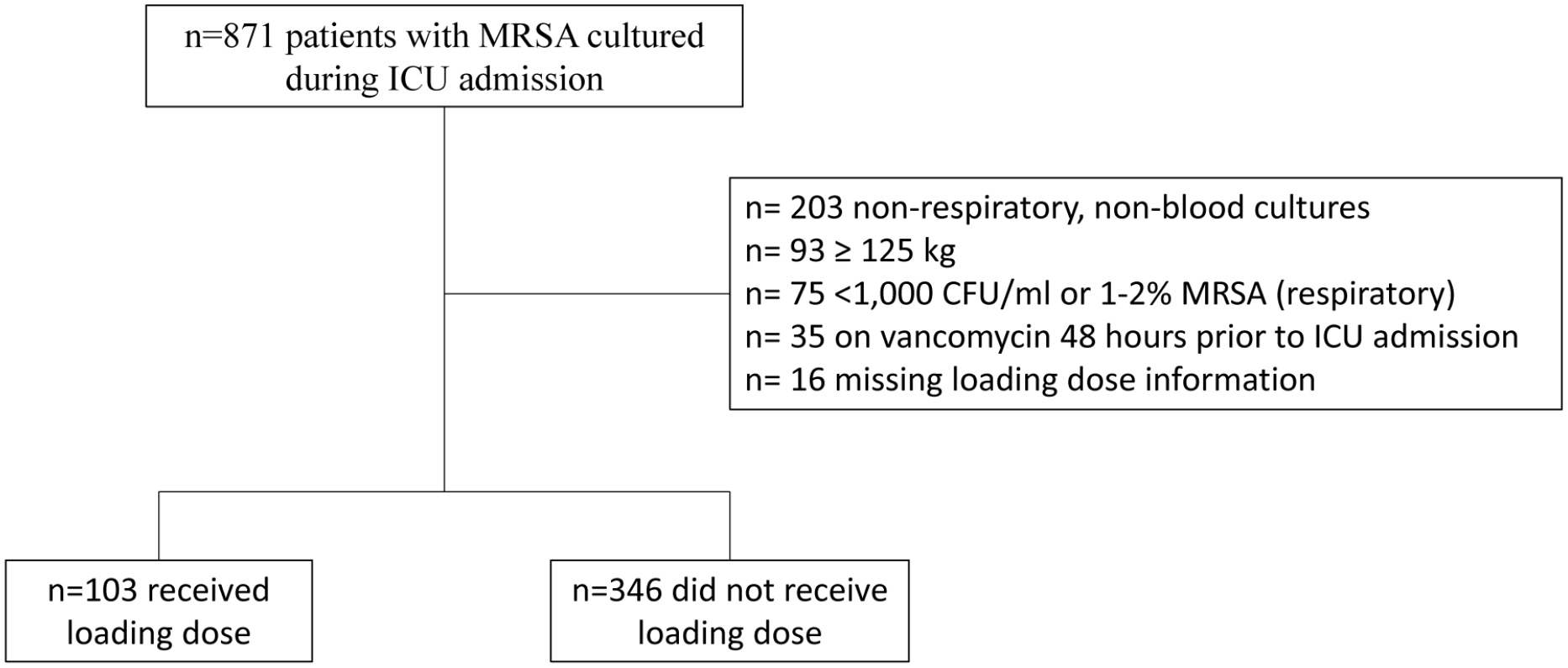
Application of inclusion and exclusion criteria.
Baseline demographics.

Available for 295 patients.
Long-term indication defined as ⩾4 weeks of therapy.
Available for 366 patients.
MRSA, methicillin-resistant Staphylococcus aureus.
There was no difference in the percentage of patients experiencing clinical failure between the loading dose and no loading dose groups (74.8% versus 72.8%; p = 0.698), with no significant difference between groups in any component of the composite outcome (Table 2). No differences were noted between groups in any of the secondary outcomes, including all-cause ICU mortality, AKI, or duration of vasopressor or mechanical ventilatory support. The first serum vancomycin trough concentration was slightly higher in the loading dose group, but this did not reach statistical significance [15.6 (11.0–24.4) µg/ml versus 14.0 (9.5–21.0) µg/ml; p = 0.056]. There were no differences in WBC or maximum temperature on days 2–5 following the initiation of vancomycin (Supplemental material eTable 1 online; Figure 2). In a simple competing risk regression model with death as a competing event, use of a loading dose was not associated with time to ICU discharge from vancomycin initiation (subdistribution hazard ratio 1.09; 95% confidence interval 0.86–1.40). The cumulative incidence function is shown in Supplemental eFigure 1. In the subgroup of patients with isolated MRSA bacteremia, there was no difference in clinical failure between the loading dose and no loading dose groups: 30/34 (88.2%) versus 63/80 (78.8%); p = 0.232. Similarly, in patients with MRSA respiratory cultures (with or without bacteremia), there were no differences between loading dose and no loading dose groups: 47/69 (68.1%) versus 188/265 (70.9%); p = 0.647.
Study outcomes.

Patients with end stage renal disease excluded from assessment.
Available for the 136 patients requiring vasopressor support at vancomycin initiation.
Available for the 331 patients requiring mechanical ventilation at vancomycin initiation.
Available for 361 patients.
ICU, intensive care unit; WBC, white blood cell.

Daily white blood cell count and temperature trends.
In exploratory analyses of the primary outcome, the vancomycin dose (in milligrams per kilogram actual body weight) was assessed in quartiles rather than a dichotomous variable and there were no significant differences in the frequency of clinical failure (p = 0.794; Supplemental eTable 2). Similarly, when initial doses of ⩾1750 mg were compared with doses <1750 mg, there was no difference in clinical failure between the two groups (p = 0.485; Supplemental eTable3). In the adjusted multivariable logistic regression model, the first dose of vancomycin (expressed in milligrams per kilogram as a continuous variable) was not associated with clinical failure: odds ratio 0.98 (95% confidence interval 0.91–1.06) (Supplemental eTable 4).
Discussion
This represents the first study to our knowledge to assess clinical outcomes associated with vancomycin loading doses recommended by consensus guidelines in critically ill patients with MRSA infection, 7 and the largest study of vancomycin loading doses in any patient population. While the ideal design to answer this clinical question is a randomized controlled trial, given the literature that every hour delay in antibiotics in a patient with sepsis is associated with a 7.6% reduction in survival, 17 including similar literature in S. aureus bacteremia specifically, 18 obtaining informed consent during this window for a definitively large study in critically ill patients is likely to hinder such a trial ever being done, particularly for confirmed MRSA infection rather than all patients receiving empiric vancomycin.
A randomized controlled trial of vancomycin loading doses in the emergency department showed that a loading dose of 30 mg/kg versus 15 mg/kg resulted in higher trough values at 12 and 24 h, but not by 36 h, with no significant difference in AKI or clinical outcomes between the two groups. 19 Similarly, other observational studies have shown an association between loading doses and higher target attainment of initial trough values without increasing the risk of AKI,20,21 although improved target trough attainment is not consistent across the literature.11,22 Similar to other studies, we did not observe any increased risk of AKI with use of a vancomycin loading dose.19,20 Particularly with updated consensus guidelines recommending AUC assessment at this juncture rather than trough assessment, 7 the existing literature linking vancomycin loading doses to trough attainment as justification for use of a particular dosing strategy deserves reevaluation. Thus, there is an increasing importance to evaluate clinical outcomes regarding the decision to administer a loading dose.
One small cohort study found an association of vancomycin loading doses (⩾20 mg/kg) with clinical response, as defined by survivors with a ⩾30% reduction in WBC count or C-reactive protein, or decline in fever over 48–72 h; however, the number of MRSA cases from the cohort studied was relatively small. 11 In a larger study of MRSA bacteremia, loading doses (⩾20 mg/kg) were not associated with treatment failure; however, in a post-hoc analysis where loading doses were reclassified as ⩾1750 mg, a protective effect of loading doses was noted. 10 In both studies, loading doses were not associated with nephrotoxicity.10,11 Of note, critically ill patients were not the focus of these prior studies, and ICU patients constituted approximately 25% of the cohort. 10 Our study did not find a benefit of loading doses on any of the distinct outcomes that we included in the primary composite outcome, nor when assessed by site of infection as a subgroup analysis. Similarly, there was no signal of benefit noted in the sensitivity analysis examining quartiles of loading doses, the reclassification of loading doses as 1750 mg or higher, or in the multivariable logistic regression model evaluating initial dose on a milligrams per kilogram basis as a continuous variable.
As noted previously, a recent survey of vancomycin dosing practices in critically ill patients revealed that a lack of clinical outcome data, concerns of nephrotoxicity, and time delay of admixed custom doses from the pharmacy (in the case of a loading dose) versus pre-mixed drug from automated dispensing cabinets limited application of loading doses in all cases. 8 Our data suggest loading doses of vancomycin do not increase the risk of AKI, even in critically ill patients with multiple risk factors for AKI. However, the data also suggest no clinical benefit of loading doses even in confirmed MRSA infections in critically ill patients, thus supporting the noted clinician hesitation. Indeed, given the increase in mortality with every hour delay in antibiotic therapy,17,18 our study supports the notion that therapy should not be delayed for dose customization to meet the specified loading dose criteria. This finding not only applies to emergency departments, post-anesthesia care units, and other ICU triage areas in resource-intensive healthcare settings, but may also be a relevant consideration to care provisions in lower resource-intensive settings where dose customization for loading doses may be limited. Although the mechanistic explanation of our findings is less clear for patients with bacteremia, the relatively poor ability of vancomycin to concentrate in pulmonary tissue, particularly after a single dose, may explain the lack of difference in clinical outcomes observed in our study. 23 Additionally, considering the literature associating a delay in second dose of antibiotics for patients admitted from the emergency department with sepsis with outcomes including mortality, 24 our study suggests that the initial, loading dose of vancomycin may not significantly influence clinical outcomes in critically ill patients, and a greater emphasis be placed on ensuring timely initiation of subsequent doses to ensure appropriate efforts to attain goal AUC:MIC targets for the initial 24 h period.
Strengths of our study included the large sample size, which was sufficiently powered to determine differences in clinical failure. We built on previous literature by studying only confirmed cases of MRSA and expanding on the study of pharmacokinetic outcomes to clinical outcomes of this patient population. Our definition of clinical failure has been used in other studies of MRSA infection and all components are measured objectively, thus not relying on subjective assessments such as clinical resolution.10,11 Anticipating that detecting a difference in an outcome such as ICU length of stay or vasopressor duration would require several-fold additional patients, the outcome of clinical failure is sensitive to surrogate outcomes such as WBC and temperature changes over time that may have seen more immediate effects from the loading dose, if present. The two groups of patients were similar in terms of severity of illness, kidney disease, and other pre-identified factors that might have predisposed to receipt of a loading dose or clinical outcome. We also included multiple types of infections commonly afflicting critically ill patients.
Our study also has noted limitations, including the retrospective, non-randomized, and single center design. Due to vancomycin dosing practices at the institution, we are not able to make any inferences about the clinical benefits of loading doses beyond 2000 mg as only one patient received a >2000 mg loading dose. However, a dose cap of 2000 mg was the most commonly reported dose cap in a prior study of vancomycin dosing practices among critical care pharmacists, suggesting this practice is widespread. 8 Relevant to this study, any patient over 100 kg was therefore essentially ineligible to be categorized as having received a loading dose. Accordingly, whether or not relatively larger loading doses (up to 3000 mg as maximally defined in current consensus guidelines) 7 are associated with any clinical benefit remains unknown at this time, although the lack of dose response noted in the exploratory analysis of loading dose by quartiles would suggest against this. Our study design also excluded patients weighing ⩾125 kg, thus our results may not be directly applicable to obese patients. The difference in the initial vancomycin dose between the loading dose and no loading dose cohorts was not as drastic as would have been the case if higher loading doses were used in our study. The loading dose group received an additional 5 mg/kg (or 250–500 mg typically). While dichotomization of information can have drawbacks, use of a loading dose or not is typically a dichotomous decision clinically. Additionally, the lack of signal in the quartile analysis and in the multivariable regression where initial dose was analyzed as a continuous variable supports the findings that initial dose does not appear to impact clinical failure. We also did not estimate or measure vancomycin AUC in these groups as a result of the loading dose, or in subsequent dosing intervals, and thus are unable to directly compare vancomycin AUC with these clinical outcomes. The known variability in vancomycin pharmacokinetics in critically ill patients makes it possible that patients in this study may have not achieved adequate AUC with the loading doses, thus explaining the lack of clinical benefit observed. For example, a significant number of these patients may have had AKI upon admission or been actively fluid resuscitated at the time of vancomycin loading dose, which would have increased the Vd and may have influenced the ability to achieve the target exposure with the vancomycin doses observed in the study. More patients had respiratory infections than bacteremia, thus if there was a differential effect of loading doses given the site of infection, we may have been underpowered to detect it. Finally, although patients appeared to be well-matched based on identified characteristics, we cannot rule out residual confounding and its effects.
Conclusion
In critically ill patients with MRSA infection cultured from the blood or respiratory tract, receipt of a loading dose of vancomycin (⩾20 mg/kg actual body weight) was not associated with any differences in clinical failure, mortality, ICU length of stay, AKI, or other outcomes when compared with patients not receiving a loading dose.
Supplemental Material
sj-pdf-1-tai-10.1177_20499361211005965 – Supplemental material for Efficacy and safety of vancomycin loading doses in critically ill patients with methicillin-resistant Staphylococcus aureus infection
Supplemental material, sj-pdf-1-tai-10.1177_20499361211005965 for Efficacy and safety of vancomycin loading doses in critically ill patients with methicillin-resistant Staphylococcus aureus infection by Alexander H. Flannery, Katie L. Wallace, Christian N. Rhudy, Allison S. Olmsted, Rachel C. Minrath, Stuart M. Pope, Aaron M. Cook, David S. Burgess and Peter E. Morris in Therapeutic Advances in Infectious Disease
Footnotes
Author contributions
AF conceived the concept, designed the study, analyzed the data, and wrote the first draft of the manuscript. KW, DB, AC, and PM assisted with the design of the study. CR, AO, RM, SP assisted with data acquisition, analysis, and data visualization. All authors contributed to review of the manuscript, added important intellectual contributions, and approved of the final version.
Conflict of interest statement
The authors declare that there is no conflict of interest.
Funding
This research received no specific grant from any funding agency in the public, commercial, or not-for-profit sectors.

Supplemental material
Supplemental material for this article is available online.
References
Supplementary Material
Please find the following supplemental material available below.
For Open Access articles published under a Creative Commons License, all supplemental material carries the same license as the article it is associated with.
For non-Open Access articles published, all supplemental material carries a non-exclusive license, and permission requests for re-use of supplemental material or any part of supplemental material shall be sent directly to the copyright owner as specified in the copyright notice associated with the article.
