




Abstract
Infectious diseases are the leading cause of mortality worldwide, with viruses in particular making global impact on healthcare and socioeconomic development. In addition, the rapid development of drug resistance to currently available therapies and adverse side effects due to prolonged use is a serious public health concern. The development of novel treatment strategies is therefore required. The interaction of nanostructures with microorganisms is fast-revolutionizing the biomedical field by offering advantages in both diagnostic and therapeutic applications. Nanoparticles offer unique physical properties that have associated benefits for drug delivery. These are predominantly due to the particle size (which affects bioavailability and circulation time), large surface area to volume ratio (enhanced solubility compared to larger particles), tunable surface charge of the particle with the possibility of encapsulation, and large drug payloads that can be accommodated. These properties, which are unlike bulk materials of the same compositions, make nanoparticulate drug delivery systems ideal candidates to explore in order to achieve and/or improve therapeutic effects. This review presents a broad overview of the application of nanosized materials for the treatment of common viral infections.
Introduction
Infectious disease agents such as bacteria, viruses, fungi 1 and parasites account for approximately 15 million deaths worldwide, with acute respiratory infections and human immunodeficiency virus (HIV) being the leading causes. 2 Viral infections alone pose significant global health challenges by affecting millions of people worldwide, with a negative impact on both health and socioeconomic development. 3 Efficient treatment of viral infection is hindered by the development of drug resistance, especially those associated with HIV4–7 and influenza. 8 This phenomenon constitutes a public health threat, which includes increased morbidity and mortality, 9 added costs associated with the use of more expensive drugs and a greater burden on public health systems. 2 Consequently, there is an obvious requirement for the development of novel methods to treat viral infections.
Nanotechnology refers to the development or application of particles with dimension(s) that fall into the nanometer range (10−9 or one billionth of a meter).10,11 The interaction between nanoscience and biological systems is known as ‘nanobiotechnology’,12,13 while the associated area known as ‘nanomedicine’ deals with the application of nanostructured materials to diagnose, treat and prevent diseases. 14
The first nanosystems applied in medicine were introduced to increase the efficacy of current, yet dose-limiting and poorly bioavailable drugs. 15 Currently, nanoparticles are known to exert their antiviral activities by various mechanisms. First, the unique properties of nanoparticles such as (1) small particle size (which can facilitate drug delivery into anatomically privileged sites),11,16 (2) large surface area to volume ratios (which ensures that large drug payloads can be accommodated), 17 and (3) tunable surface charge (to facilitate cellular entry across the negatively charged cellular membrane),18,19 make nanoparticles attractive tools for viral treatment. Second, it has been demonstrated that nanoparticles can contain biomimetic properties,20–22 which result in intrinsic antiviral properties. Popular examples of these include silver nanoparticles23,24 and dendrimers.25,26 Third, the possibility of drug encapsulation,16,27 functionalization by the formation of stable structures, 28 or modifications (with polymers such as poly(ethylene glycol) (PEG))17,29 can all lead to optimized drug dosing and improved delivery by increasing stability 30 and drug retention times. 31 Finally, it is believed that drug delivery can be vastly improved by engineering nanoparticles with targeting moieties to increase specificity to desired cell types, target tissues or sub-cellular compartments.17,19,32 A condensed summary of the mechanistic approaches to engineer nanoparticles with improved treatment benefits is shown in the schematic in Figure 1.

Multifunctional mechanisms for engineering nanoparticles with benefits in drug delivery.
Certain challenges exist for the treatment and subsequent eradication of viruses in the infected host. One major example is the establishment of reservoirs in cellular and anatomically privileged sites such as the blood-brain barrier (BBB) and blood-testis barrier. 33 This leads to low-level replication 34 in these compartments, which are inaccessible to conventional therapeutics. Nanoparticulate drug carriers are, however, able to traverse these membranes and are therefore promising tools to be investigated for circumventing this obstacle. 35 Other challenges in viral treatment include the use of RNA interference (RNAi) technology – a popular molecular approach for the treatment of many infectious diseases. 36 The inability of RNA to cross the cell membrane, due to the large molecular weight and anionic charge, 37 rapid renal clearance, uptake by phagocytes, and toxicity due to stimulated immune response, 38 all present limitations which prohibits their clinical utility. The incorporation of siRNA onto nanocarriers, however, can also overcome this limitation 39 to achieve successful inhibition of viral replication.
This review will provide an overview of the most recent (past 5 years) and relevant literature, which describes the application of nanotechnology for the treatment of common viral infections. Examples of nanosystems with applications in both drug and vaccine delivery for prevention of these viral infections are also reviewed. Finally, important considerations for nanoparticle antigenicity as well as the requirements for the design of nanomaterials, which are unique to viruses, are discussed.
Examples of biocompatible systems
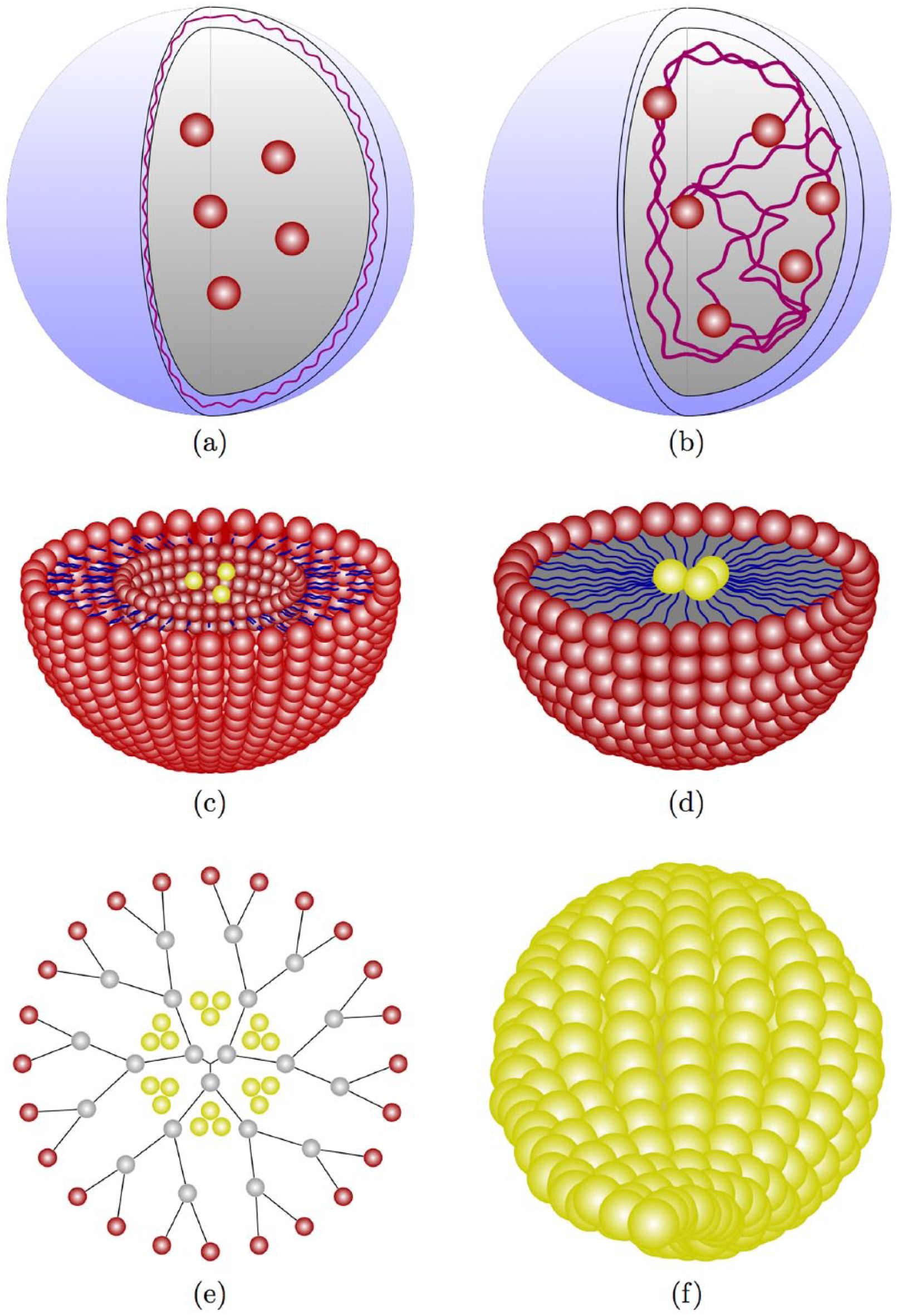
A nanopharmaceutical refers to any nanomaterial with therapeutic potential, for example, dendrimers, liposomes, micelles and nanocapsules.11,40 These can function as therapeutic agents, whereby the drug is either dissolved, entrapped, encapsulated, adsorbed or chemically attached. 41 Nanoparticles can have various shapes and chemical compositions 42 and can be classified according to the way drugs are delivered or by the characteristics of the matrix of which it is composed. 43 Here, we describe the most common types of nanocarriers (Figure 2) that are used for drug delivery, based on their composition.
Organic nanoparticles
Organic nanoparticles are the most extensively researched type of nanoparticle for drug delivery and the most widely approved system for therapeutic use in humans. 43 The most common types of organic nanoparticles are presented as follows.
Polymeric nanoparticles
Polymeric nanoparticles are colloidal solids with sizes ranging from 10 to 1000 nm. The small size can facilitate capillary penetration and uptake by cells resulting in increased concentrations at target sites.
49
Polymers approved by the World Health Organization (WHO) and the Food and Drug Administration (FDA) for use in medicine and pharmaceuticals include polylactides (PLA), polyglycolides (PGA) and poly(lactide-co-glycolides) (PLGA).
50
Poly(
Nanocapsules
Nanocapsules are hollow spheres, in which the drug is confined to an inner cavity, surrounded by a polymer coating. 56 The size can range from 50 to 300 nm, and they are characterized by their low density and high loading capacities. 49
An example of the use of nanocapsules in enhancing drug distribution is described; 33 limited antiviral distribution to brain tissue may be due to the permeability glycoprotein (P-gp) efflux transporter. Solutol® HS15 is an excipient that is able to inhibit P-gp, thereby improving drug distribution across the BBB. 11 Results from this study demonstrated that Solutol® HS15 nanocapsules loaded with the HIV protease inhibitor, indinavir, showed significantly increased uptake in the brain and testes of mice, compared to control mice where only indinavir solution was administered. 33
Nanospheres
These are matrix systems where the drug is physically or uniformly dispersed, with sizes ranging from 100 to 200 nm in diameter.56,57 Several research studies have been done using nanospheres for the treatment of hepatitis B virus (HBV), 58 herpes simplex virus (HSV), 45 and influenza,59,60 while comprehensive review articles on the application of these agents in viral treatment are also available.61,62
Liposomes
Liposomes are spherical 63 carriers ranging from 20 to 30 nm in size. They are composed of a phospholipid bilayer (which can mimic cell membranes and directly fuse with microbial membranes), 64 containing an aqueous core. 2 Hydrophilic and lipophilic drugs (or other biologically active compounds) can be incorporated into the inner aqueous cavity or the phospholipid bilayer, respectively. 65 Additional advantages of liposomes are that they are relatively non-toxic and biodegradable. 63 Liposomal formulations have been extensively studied in vaccine studies due to their ability to act as immunological adjuvants. 66
Micelles
Micelles range in size from 10 to 100 nm. 57 These are composed of an inner hydrophobic core (which can incorporate poorly water soluble drugs) and surrounded by an outer hydrophilic polymer (such as PEG, which can increase circulation time and consequently improve accumulation). 49 Examples of these include polymeric micelles, which have attracted much attention as drug delivery agents with significant therapeutic potential.67–69 Drug encapsulation with polymeric micelles is one of the most attractive nanotechnologies used to improve both the water solubility and stability of otherwise technologically limited (poorly water soluble and unstable) drugs. 70 An additional advantage of using micelles in therapeutics is that they display a slower rate of dissociation, thereby enabling a longer drug retention time, and eventually a higher accumulation of the drug at the target site. 35
Dendrimers
Dendrimers are symmetrical, macromolecular, and hyper-branched structures radiating from a central core via connectors and branching units, where interaction with its target environment is controlled by the terminal groups. 71 These are globular in nature and comprised of three distinct domains (central core, branches, and terminal functional groups). 72 They have increased functionality because they can encapsulate several chemical moieties, interior layers and have the ability to display multiple surface groups (multivalent surface).35,71
Solid lipid nanoparticles
Solid lipid nanoparticles (SLNs) represent an alternative drug delivery system to the conventional colloidal nanoparticles, described above. The use of SLNs also aims to combine the advantages of conventional nanocarriers, while avoiding some of their limitations. For example, large-scale production of polymeric nanoparticles is a major challenge, which limits their utility in drug delivery, whereas the production of SLNs can be achieved in both cost-effective and relatively simple ways (e.g. by high pressure homogenization and micro emulsion techniques). 73 Additional advantages of using SLNs include increased stability, safety and availability, and decreased toxicity, with improved drug-release profiles, compared to synthetic polymer nanoparticles.74–76
Inorganic nanoparticles
Metallic nanoparticles can be smaller than organic nanoparticles, ranging between 1 nm and 100 nm in size, while their loading efficacy is much higher. 35 There are two main approaches for the synthesis of metallic nanoparticles: the ‘bottom-up’ (or self-assembly) approach refers to the construction of the nanoparticle, level by level (e.g. atom by atom or cluster by cluster), and the ‘top-down’ approach uses chemical or physical methods to reduce the inorganic material to its nanosized form. 77 The reaction conditions (pH, temperature, time, or concentration) can be used to modify the nanoparticle characteristics (size and shape), while the choice of reducing agent can influence properties such as loading capacity, release, and aggregation profiles. 43
Gold nanoparticles
Gold nanoparticles (GNPs) are widely researched as nanocarriers due to their excellent conductivity, flexibility of surface modification, biocompatibility, and simplistic preparation methods. 78 Other advantages afforded by their unique physical and chemical properties include the gold core (which is inert and non-toxic), 79 photophysical properties (which can facilitate efficient drug release at remote sites), 80 and versatility of functionalization via thiol linkages. 81 There are basic GNP preparation methods which exist and can produce nanoparticles of varying diameters (1–2 nm, 82 1.5–5 nm,83,84 or 10–150 nm,85–87 depending on the application).
Silver nanoparticles
Silver nanoparticles are the most effective of the metallic nanoparticles against bacteria, viruses and other eukaryotic microorganisms, 88 particularly due to the inherent inhibitory and bactericidal potential of silver, 89 but also because of their good conductivity, catalytic properties, and chemical stability. 64 The key mechanisms of action of silver nanoparticles are the release of silver ions (which enhances antimicrobial activity), 90 cell membrane disruption, and DNA damage. 91 The reader is referred to a detailed review on the application of silver nanoparticles as virucidal agents. 92
Other metallic nanoparticles
Various other metallic nanoparticles such as titanium, 93 zinc, 94 and copper, 95 as well as metal oxide nanoparticles such as iron oxide, zinc oxide, and titanium dioxide 96 have demonstrated specific antiviral activities. Others, like platinum nanoparticles, which are used for the detection of influenza virus, 97 are yet to be evaluated.
Core-shell nanoparticles contain a simple spherical core particle, which is completely surrounded by a shell of a different material, 98 which can be monometallic or bimetallic in nature. 99 Several types of core-shell nanoparticles have been demonstrated to have biomedical applications.100–103
The reader is referred to recently published literature giving a comprehensive account of the application of metal and metal oxide nanoparticles in the treatment of viral infections. 96
Antiviral nanotherapeutics
Several nanomedicines have been approved or are currently undergoing investigation for the treatment of viral infections (Table 1). Examples of studies investigating the antiviral activities of potential nanotherapeutics in development are presented in the sections that follow.
Nanomedicines which are approved or under evaluation for the treatment of viral infections.
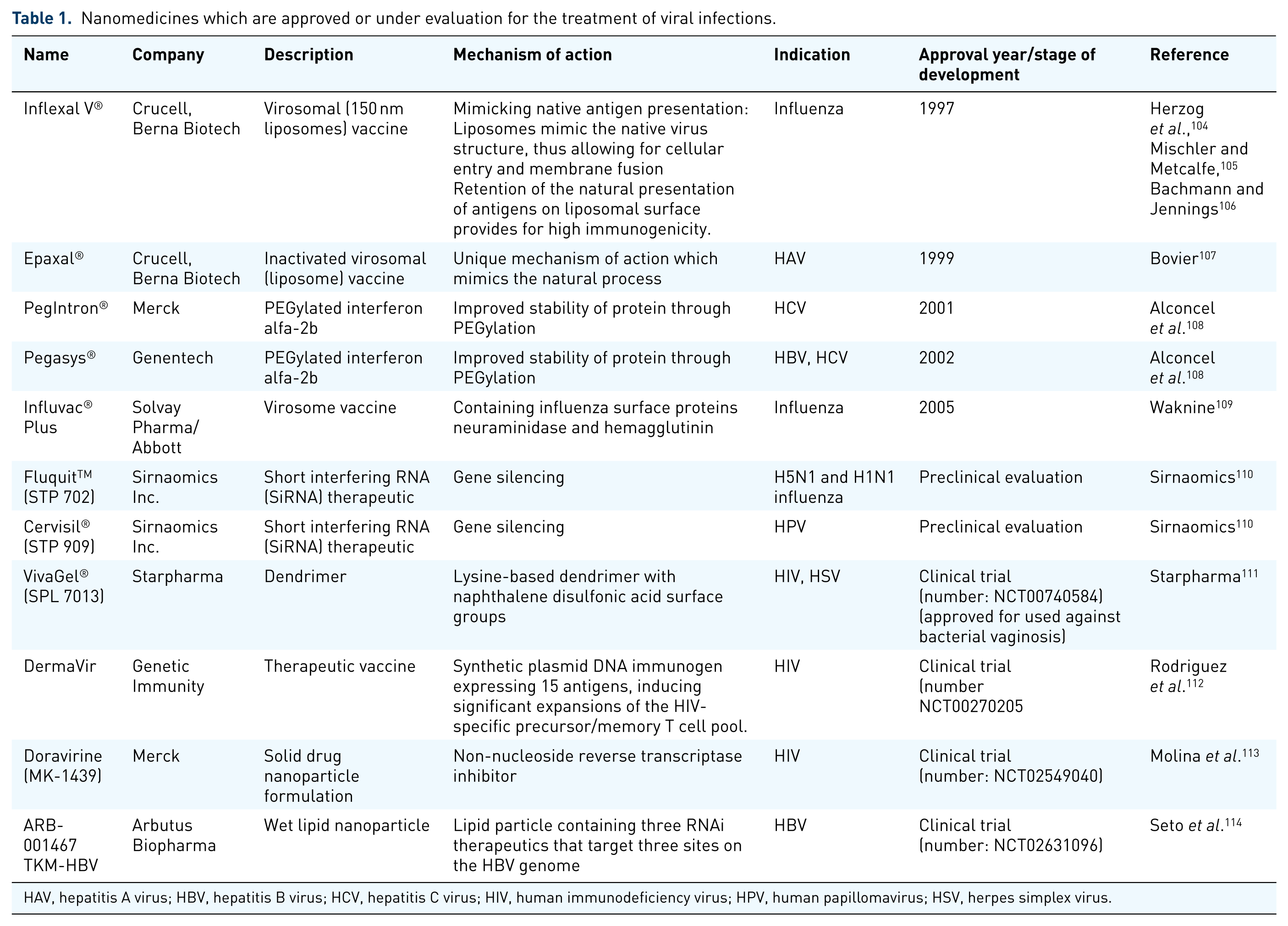
HAV, hepatitis A virus; HBV, hepatitis B virus; HCV, hepatitis C virus; HIV, human immunodeficiency virus; HPV, human papillomavirus; HSV, herpes simplex virus.
HIV
A cure or vaccine for HIV/AIDS remains elusive. Treatment is based on the use of drugs that target the various stages in the life cycle of the virus. The current antiretroviral (ARV) armamentarium includes six classes of drugs, that is, nucleoside/nucleotide reverse transcriptase inhibitors (N(t) RTIs), 115 non-nucleoside inhibitors (NNRTIs), 116 protease inhibitors (PIs), 117 entry/fusion inhibitors (FIs), 118 CCR5 antagonists, 119 and integrase inhibitors.120,121
The combination of three or more drugs, known as highly active ARV therapy (HAART) has significantly improved the expectancy and quality of life of HIV-infected individuals. 122 This type of therapy, however, is not devoid of unwanted occurrences; suboptimal adherence, heavy pill burdens, toxicity and other negative side effects, are all limitations of currently available therapeutics. Moreover, the chronic nature of HIV/AIDS infection requires that life-long treatment be taken, which can result in the development of drug resistance. It is therefore essential that novel methods to enhance the inhibition of HIV infection be investigated and developed.
Nanotechnology-based drug systems for HIV treatment represent an important option that requires ongoing investigation. Modern drug design, which can incorporate ARV drug delivery with nanosystems can decrease the dosage requirements and toxic side effects associated with current heavy pill burdens (which reduces the possibility of drug resistance), thereby improving the safety and efficacy profiles of the drug. 35
Different reviews have been published that focus specifically on HIV/AIDS vaccine development123–125 and delivery of siRNA for the treatment of HIV. 37 The reader is also referred to comprehensive accounts on conventional methods for HIV treatment and the recent advances using different types of nanoformulations with their respective applications in HIV treatment.11,126,127
In a study performed by Chiodo et al., 128 the NRTI drugs abacavir (ABC) and lamivudine (3TC) were attached to glucose-coated GNPs and evaluated for their anti-HIV activity, in vitro. Smart functionalization was achieved via the primary hydroxyl groups of the drugs, through an ester bond that can be cleaved off in acidic conditions (e.g. in the vagina to inhibit viral replication), to render the hydroxyl group available to facilitate chain termination – a fundamental mechanism of action of the NRTI class of drugs. These results illustrate a new level of multi-functionalization of GNPs as multivalent drug delivery systems for the treatment of HIV. 128
Regulatory T (Treg) cells are a specialized subpopulation of T-cells 129 that are important components of the immune system 130 and are also susceptible to HIV infection. 131 Infection with HIV can lead to immune hyperactivation, which can subsequently result in erosion, depletion, or exhaustion of T-cells. Treg cells are therefore of significant importance during HIV infection because of the potential to suppress immune hyperactivation and inflammation, 132 thereby preventing HIV disease progression. Jaramillo-Ruiz et al., 133 demonstrated for the first time that carbosilane dendrimers can be used for the prevention of Treg cell infection with HIV, in vitro. The negative phenotypic effects and decreased functionality of these cells due to HIV infection were also decreased with the application of these dendrimers. In addition, high biocompatibility and significant reduction in p24 antigen production was observed in cell culture and intracellularly. 133
In a study by Parboosing et al., 134 RNA decoys in the form of a 16-mer oligoribonucleotide originating from the stem loop 3 of the HIV packaging signal, were attached to dendrimers in an effort to disrupt the packaging process of the HIV life cycle. The results of this study demonstrated efficient delivery into lymphocytes and modest cytoprotective effect against HIV infection. 134
Jayant et al., 135 demonstrated that an ARV (tenofovir) and an investigational latency-reversing drug 136 (vorinostat) can be co-encapsulated on ultrasmall (10 ± 3 nm) iron oxide nanoparticles. This research achieved a sustained drug release period (increased by 30%) showing absolute drug release profiles over a 5-day period with simultaneous activation of latent HIV in cultured human astrocytes. Improved transmigration ability across the BBB and in vitro antiviral efficacy was also demonstrated. 135
Similarly, there has been a multitude of other studies that have investigated nanoparticles as novel agents in ARV drug delivery,137–139 other small molecule HIV inhibitors,140,141 and in vaccine development. 142
HBV
HBV causes inflammation of the liver and is the cause of chronic infection in approximately 240 million people. Complications of HBV infection include cirrhosis and liver cancer and accounts for more than 780,000 deaths per year. 143 Current anti-HBV nano-therapy includes interferon (IFN)-α, pegylated IFN (Pegasys®), lamivudine (Epivir®), adefovir (Hepsera®), entecavir (Baraclude®), telvivudine (Tyzeka®), and tenofovir (Viread®). 144 Limitations of anti-HBV treatment include high costs, undesirable side effects, the risk of liver failure during hepatic flares, and development of drug resistance. 145
New developments for HBV treatment using nanotechnology are being investigated. In an in vitro study done by Wang et al., 146 different types of cationic nanoparticles composed of biodegradable polymers were prepared by nanoprecipitation and solvent evaporation methods. These nanoparticles were evaluated for their transfection efficiencies in delivering siRNA and DNA to finally achieve inhibition of hepatitis B surface antigen (HBsAg) production. The results demonstrated that methoxy poly (ethyleneglycol)–poly(lactide) (mPEG–PLA) nanoparticles, containing a polyethyleneimine (PEI) layer, achieved the highest ant-HBV effect, and that successful delivery of siRNA is dependent on both size and surface charge. 146
Hepatitis C virus
Hepatitis C virus (HCV) infects approximately 130–150 million people globally, with progression to liver cirrhosis or liver cancer being a common occurrence. Approximately 500,000 people die each year as a result of HCV-related liver disease. 147 Standard nano-treatment for HCV infection is based on the use of PEGylated IFN and ribavirin. 148
Peginterferon α-2a (Pegasys®) was approved by the FDA for the treatment of HCV in 2002, while Peginterferon α-2b (PegIntron ®) was available in 2001. The latter drug has a molecular mass of 31 kDa showing superior results in clinical studies (versus the un-PEGylated form IFN-α2b of 19 kDa). 149
It has been demonstrated that IFN-α can be efficiently coupled to GNPs (physical binding), complexed with hyaluronic acid (HA) (via a thiolated interaction) for the target-specific and long-acting delivery in mouse models. These nano-complexes remained in the liver for 7 days post-injection (when compared to native IFN-α and PEG-Intron), thus offering great potential for the enhanced and prolonged treatment of HCV infection. 150
Notable results showing >99% HCV inhibition were reported by Wang et al. where nanozymes were constructed using GNPs functionalized with RNAse A and anti-HCV oligonucleotides, for active cleavage of sequence-specific HCV RNA in both cell culture and mouse models. These nanozymes also displayed excellent stability against proteinase degradation, effective internalization, and good toxicity profiles. 151
In a separate study 152 cross-linked polymeric micelles (CLPM) were used to target HCV, in vitro. The micelles were loaded with the recently identified potent anti-HCV compound, camptothecin (CPT), 153 which is also associated with limitations such as poor water solubility and chemical instability. The CLPMs used in this study enabled the formation of suitable amphiphilic micelles containing a hydrophobic core and hydrophilic shell, which demonstrated high loading capacity for CPT while maintaining HCV antiviral activity and reducing cytotoxicity.
In a study done by Moon et al., 154 siRNA targeting the proviral host factor required for HCV replication, was attached to lipidoid nanoparticles (lipid-like delivery molecules) 155 and investigated for its antiviral properties in mouse models. The results showed potent anti-HCV activity over several days, and could have important implications for treatment in patients who are non-responsive to current HCV drug regimens. 154
Cationic liposomes, particularly cholesterol-based types, are well suited for clinical application due to the decreased toxicity. Vitamin E (α-tocopherol) is rich with lipid-soluble antioxidants, with physiological pathways that can facilitate targeted delivery from the serum to the liver. 36 Vitamin E was attached to cholesterol-based cationic liposomes and used to effectively deliver inhibitory siRNA specifically to the liver in mouse models. Both HCV core antigen production and firefly luciferase activity (used as a reporter gene to determine extent of HCV replication) 156 were suppressed. 36
Influenza
Influenza is a highly infectious respiratory disease 157 with epidemics which are associated with morbidity worldwide, 158 while annual epidemics and sporadic pandemics results in the deaths of millions of people. Antigenic shifts and mutations of the genome between different species of influenza results in the high degree of variation, thereby enabling the emergence of novel influenza strains and drug resistance. 159 The emergence of new strains continues to pose a public health threat. 160
STP702 (FluquitTM) from Sirnaomics is a polymer-based nanotherapeutic which is currently under preclinical investigation. This incorporates siRNA targeting the conserved regions of influenza for effective antiviral activity against H5N1 (avian flu), H1N1 (swine flu), and newly emerging H7N9. 161
‘Nanotrap’ particles are thermoresponsive hydrogels which are capable of capturing live infectious virus, viral RNA, and viral proteins. 162 This type of novel technology can be extended to treatment of infectious diseases such as the influenza virus. Hendricks et al., 163 used liposomes for the delivery of glycan sialylneolacto-N-tetraose c (LSTc)-sialoside – a synthetic decoy receptor for influenza binding. The results showed that these liposomes are highly effective at competitively binding and capturing influenza A viruses, and can inhibit infection of target cells in a dose-dependent manner. 163
Hemagglutinin (HA) and neuraminidase (NA) are influenza glycoproteins, which function in viral attachment (to sialic-acid containing receptors on the cell surface) and release, respectively. 164 Oseltamivir is a NA inhibitor that inhibits cell–cell spread and ongoing influenza transmission from occurring. 165 In a study by Li et al., 166 oseltamivir-modified silver nanoparticles were shown to efficiently decrease H1N1 infection by inhibiting both HA and NA activities, in vitro. It was shown that prevention of DNA fragmentation, chromatin condensation, and caspase-3 activity also contributed to the antiviral properties of these nano-constructs. The toxicity profiles of these oseltamivir-modified silver nanoparticles, evaluated by cytopathic effect, transmission electron microscopy, and cell viability assays, were also demonstrated to be enhanced in MDCK cells, when compared to oseltamivir controls. 166
In another study, titanium dioxide (TiO2) nanoparticles functionalized with DNA fragments targeting the 3′ non-coding region of influenza A virus were synthesized using a polylysine linker. These nanocomposites were able to enter cells without transfection agents and were demonstrated to be efficient inhibitors of influenza A virus, in vitro. Control samples containing random DNA sequences, unbound DNA fragments in the presence of nanoparticles, and naked nanoparticles showed minor antiviral effects. 167
HSV
HSV is the causative agent of orofacial lesions, encephalitis (HSV-1), 168 genital (HSV-2) infections, 169 or disseminated disease. 170 The standard treatment for HSV infections is acyclovir, 171 with valacyclovir and famciclovir being precursor drugs with better bioavailability. 172
Acyclovir is used for the management of HSV with treatment modalities including oral, parenteral, or topical application. 173 There are, however, limitations associated with these treatment modes, which include poor oral bioavailability (15–30%), poor patient compliance, and low skin permeability, respectively. 174 Buccal administration of drugs provides an alternative route to improve efficiency and absorption of otherwise poorly absorbed drugs. 175 Nanospheres were evaluated as delivery agents for the buccal delivery of acyclovir in an effort to increase bioavailability. In vivo studies in rabbits showed a marked increase in the absorption of acyclovir-loaded nanospheres with peak plasma concentrations three fold higher than the free drug using oral dosing. The results also showed that the maximum drug concentration was prolonged (6 h versus 2 h), and this can reduce the frequency of drug administration. 176
Several studies have demonstrated increased HSV inhibition using acyclovir-loaded nanoparticles,170,177 and the inherent antiviral action of silver nanoparticles.178–180 Increased bioavailability was also demonstrated in nanoparticles loaded with anti-herpetic siRNA in mice 181 and acyclovir in rabbits. 182 Another recent study conducted in rat models, showed that hybrid polymeric nanoparticles loaded with acyclovir effectively improved permeability through vaginal membranes, and can increase the tissue distribution and bioavailability compared to the free drug. This will have important implications for the clinical therapy of HSV in the female population. 183 Other in vivo studies demonstrated similar results with increased drug retention times184,185 as well as enhanced dermal delivery. 186
Human papillomavirus
Epithelial cells are the target cells for human papillomavirus (HPV) infection and can result in a range of symptoms, varying from common warts to cervical neoplasia and cancer. There are more than 100 types of HPV that have been classified, with only a subset being identified as high-risk. 187
STP909 (Cervisil®) is a nanobased drug candidate, which incorporates siRNA for the treatment of HPV16 and HPV18 – two of the high-risk genotypes accounting for approximately 70% of cervical cancer cases. The results of in vitro studies show that strong duplexes are formed with the mRNA from the E7 genes in both HPV16 and HPV18, while in vivo rabbit studies demonstrate that these nanoparticles exert their antiviral activity by knock-down technology of the E7 gene. 110 The reader is referred to several other gene silencing studies targeting the E7 gene in mice models 188 and mammalian cells, 189 as well as vaccine studies190,191 investigating nanoparticles in vaccine formulations.
Other viruses
SPL7013, marketed as VivaGel® (Starpharma, Melbourne, Australia), is a poly-L-lysine dendrimer-based pharmaceutical that has potent antiviral action against the sexually transmitted HSV, HIV69,192, and HPV.193,194 Safety studies in clinical trials, however, demonstrated mild irritation and inflammation in the participants from the VivaGel® arm of the study.195,196
Zika virus (ZIKV) is a mosquito-borne and sexually transmitted infection, which the WHO declared as a global emergency outbreak in 2016, 197 affecting more than 20 countries in the Americas alone. 198 The unavailability of effective drugs or a vaccine hinders the efforts to control ZIKV infection globally. 199 VivaGel® has also been shown to have potent antiviral activity against ZIKV. 111
Respiratory syncytial virus (RSV) is the leading cause of severe lower tract respiratory disease, including bronchiolitis and pneumonia,200,201 and is the leading cause of hospitalization of infants. 202 It can also cause severe respiratory illness in the elderly and immunocompromised populations. ALN-RSV01 is a lipid-based nanoparticulate system containing siRNA and targets the nucleocapsid ‘N’ gene, a key viral protein of RSV. This was the first RNAi-based therapy approved for clinical trials and has since entered human phase II clinical trials, which demonstrate both safe and promising antiviral effects.203,204
Human parainfluenza 3 (HPIV-3) is an airborne virus, which infects human epithelial cells, 205 and it is the causative agent of respiratory tract disease in infants and children. 206 A recent study demonstrated inhibition of HPIV-3 replication, probably due to a cell-virus blocking mechanism using silver nanoparticles. The results of this study demonstrate that the inhibitory activity is dependent on both the size and zeta potential of the nanoparticles. 178
Ebola virus disease (EVD) is an often fatal and highly contagious disease in humans and non-human primates and is responsible for sporadic outbreaks of Ebola hemorrhagic fever.207,208 TKM-130803, developed by Tekmira Pharmaceuticals, is a lipid-based nanosystem containing siRNA directed against EVD. Results from a recent clinical trial showed that the drug was well tolerated, however, no significant protection was achieved in infected patients. This may have been attributable to the high viral loads and advanced stage of disease of the enrolled patients. 209 These results are in contrast to studies using non-human primates,210,211 where TKM-130803 was protective following administration of lethal doses Ebola virus. Further investigation into the drug formulation and dosage requirements of TKM-130803 are therefore warranted.
Human norovirus (HuNoV) has emerged as a leading cause of gastroenteritis outbreaks worldwide. The lack of effective antiviral treatment 212 against HuNoV is due to the absence of an appropriate animal model and inability to propagate the virus in cell culture, required for antiviral research. Gold/copper sulfide (AuCuS) core-shell nanoparticles have demonstrated rapid antiviral activity against GI.1 (Norovirus) virus-like particles. The AuCuS nanoparticles interact with the capsid proteins causing denaturizing (causing disruption and ultimately inactivation), thereby resulting in its virucidal activity. 213 Virus inactivation by metallic nanoparticles is a promising alternative to other physical and chemical methods.
Nanovaccines
Nanovaccinology has applications in both prophylactic and therapeutic approaches and can be used to either increase antigen processing or presentation and/or as an immunostimulatory adjuvant. 51 This approach offers many advantages over traditional vaccine design; it has the potential to overcome the limitations associated with conventional vaccines (weak immunogenicity, intrinsic in vivo instability, toxicity and the requirement of multiple administrations). 214
The enhanced humoral and cellular immune response that is elicited by nano based vaccines is due to the smaller size – which increases uptake by phagocytic cells, the gut-associated lymphoid tissue, and the mucosa-associated lymphoid tissue. This subsequently leads to enhanced antigen recognition and presentation. 214
Surface modification of these nanocarriers with targeting moieties (peptides, carbohydrates, or antibodies) can facilitate specific and selective immune responses by targeting specific receptors on the surface of various immune cells.215–217 An additional benefit of incorporating nanoparticles in vaccine formulations is accomplishing slow and sustained release of antigens or adjuvants.51,214 Nanovaccines can also eliminate the requirement for cold-chain transport or storage as the formulation can be lyophilized, thereby prolonging shelf-life over an increased range of temperatures (from 0°C to 4°C). 2 Another major advantage of using nanoparticles in vaccine delivery is that the sizes of these particles are approximately the same as viruses and bacteria, which the immune system readily identifies. 91 Examples of key vaccine studies incorporating nanotechnology are presented in the following section.
The occurrence of hepatitis A virus (HAV) is sporadic and epidemic in nature and is most closely associated with food-borne infections, transmitted via the fecal–oral route. 218 No specific treatment for HAV exists; however, it has been shown that cyclosporine A and silibinin can inhibit viral replication. 219 Epaxal® is an approved, liposomal-based vaccine for the prevention of HAV 15 and can be applied as an adjuvant with immuno-potentiating reconstituted influenza virus (IRIV); containing purified influenza antigens (neuraminidase and haemagglutinin). 220 Liposomes (virosomes) have been used to prepare these aluminum-free vaccines based on formalin-inactivated HAV (strain RG-SB). 107 Exapal® demonstrates good immunogenicity, efficacy, and tolerability in both adults and children. 221
Limitations of parenteral vaccines include requirements such as trained medical personnel, cold-chain maintenance, danger of reusing needles, high-dose regimens, and possibility of non-responsive immune response. 222 Mucosally administered vaccines are therefore an alternative approach that requires investigation. Chitosan, with its non-toxic, biodegradable and good biological profile, was investigated for the ability to form positively charged nanoparticles to facilitate the incorporation of other negatively charged therapeutic proteins or antigens by electrostatic interactions. 223 Both humoral and mucosal immune responses were elicited in mouse models, making this approach a valuable gene delivery system for nasal vaccination against HBV.
HepaXen is a liposome-based vaccine, which was initially intended to have antiviral action against hepatitis A, C, and E. Preclinical studies with this vaccine, which incorporates recombinant hepatitis B surface antigen and plasmid DNA encoding the protein, elicited an immune response which was 20 times greater than that of a leading prophylactic vaccine. 224 It is, however, uncertain whether a clinically valid vaccine candidate will become available, 225 as the last update from Lipoxen (the bio-pharmaceutical company involved in HepaXen’s development) was from a report in 2008, which stated that a partner organization (Serum Institute of India) would be responsible for the vaccines co-development. 226
Inflexal® V is a licensed virosomal adjuvant-based influenza vaccine, which has been on the market since 1995. The virosomes consist of reconstituted influenza virus envelope proteins, lacking the inner core and nucleic acid. Inflexal® V is extremely biocompatible and efficacious as it mimics natural infection. This vaccine also represents a good immunogenicity profile and is effective in immunocompromised and immunocompetent adults, children, and the elderly. 104 Influvac® is another licensed surface antigen inactivated subunit vaccine against influenza infection, showing good immunogenicity and safety profiles.109,227
In a study done by Tao et al., 228 the highly conserved extracellular matrix 2 protein (M2e) of influenza A virus was attached to 12 nm GNPs via thiol-gold interactions. Vaccination in mouse models provided complete protection following exposure to lethal PR8-H1N1 influenza, when the adjuvant CpG (a cysteine-guanine rich oligonucleotide) was added to the M2e-gold conjugates. 228
A number of other reports have been published that report results on influenza vaccines and the success in eliciting protective immunity.228–233 The reader is also referred to literature on recent vaccine research done on other viruses such as Ebola virus, 234 RSV,235–237 HPV, 190 norovirus, and rotavirus. 229
Nanoparticle uptake
Uptake is an important consideration in the design of nanotherapeutics, because this will have a direct influence on the therapeutic load, and hence the appropriate dose, entering the cells. Variations in the physical properties of the nanoparticles, as well as differences in the cellular membrane characteristics, can affect the efficacy of the uptake process.238,239
Accordingly, nanoparticle size is a major determinant of cellular uptake with approximately 50 nm in diameter being optimum for non-phagocytic cells. 239 Various ligands (proteins or peptides) can be used to enhance cellular uptake. 240 For example, the HIV-derived TAT peptide is a well-recognized cell penetrating peptide, which can be used to facilitate cellular entry.241,242 The surface charge of the nanoparticle has influence on whether or not it can traverse the negatively charged cell membrane, 18 whereby increasing the overall surface charge of the nanoparticle can result in increased uptake across cellular membranes. 239
Mechanisms of cellular internalization of nanoparticles include phagocytosis, macropinocytosis, caveolar-mediated endocytosis, or clathrin-mediated endocytosis. 19 The size of the nanoparticle also determines the mechanism by which nanoparticles enter the cells and where it subsequently localizes intracellularly. 11 It has recently been demonstrated that the shape of nanoparticles is also a determining factor of the mechanism of uptake.243–247 Therefore, knowledge of both of these aspects is invaluable in the engineering of nanoparticles targeted to specific micro-environments.
Antigenicity
The complement system forms part of the immune system and can be classed into four pathways (classical, alternate, lectin, and lytic pathways), which can be stimulated by synthetic materials. 248 The classical complement pathway is driven by antigen/antibody complex formation, while the others are antibody independent. 249 Certain nanocarriers, such as immunoliposomes and carbon nanotubes, are able to activate the complement system, 250 and can therefore promote opsonization or clearance of foreign nanomaterials, 251 thereby limiting its in vivo utility.
As described earlier, PEG is an important polymer for incorporation into nanoparticles (and drug carriers in general), mainly to facilitate enhanced bioavailability and therapeutic efficacy. The presence of anti-PEG antibodies has been demonstrated in patients receiving PEGylated drugs, but also in healthy individuals who remain unexposed to PEGylated therapeutics. 252 In additional, PEG polymers and PEG-like structures may be present in various consumer products, 253 cosmetics, 254 laxatives, and other pharmaceutical applications.51,255 In this regard, antibodies that are specifically directed at PEG may compromise the safety, efficacy 256 , and tolerance 257 of PEGylated nanocarriers.
Nanoparticle biodegradation and elimination
As the range of nanoparticles and their respective applications in medicine increases, it also becomes increasingly necessary to better understand the biodegradation processes. Biodegradation processes are also a critical determinant of sustained drug release and biodistribution profiles. 258 A systematic and complete analysis of the absorption, distribution, metabolism, and excretion pharmacokinetics of nanoparticles will result in improved and rational drug design. 259 Several factors, such as polymer composition, tacticity, hydrophobicity/hydrophilicity profiles, particle size, and molecular weight, can affect the rate of degradation. 260 Nanoparticle degradation has, however, been poorly studied at the cellular level, 261 and there is a paucity of information from in vivo studies.
Eventually, nanoparticles must exit the cell (via exocytosis) if biodegradation did not occur. The rate of exocytosis depends largely on nanoparticle composition and surface properties. For instance, cationic particles that tend to agglomerate intracellularly 262 have a slower rate of elimination compared to PEGylated particles that avoid protein interaction and subsequent agglomeration. 263 Subsequently, nanoparticles are excreted from the body. Nanoparticles <5 nm may be excreted in the urine while larger particles are often reabsorbed into systemic circulation and excreted mainly via the liver, kidneys, or colon.264,265
Some nanoparticles may be too large to undergo renal clearance and can accumulate in the body since they cannot be degraded.11,49 Uptake by macrophages of the mononuclear phagocytic system (MPS) can then modify/increase blood circulation time. 266 This also has important implications for viruses such as HIV, which infect and reside in these cells.
Limitations of nanoparticles as therapeutics
The poor permeability of biological membranes can limit the use of many important therapeutic agents. 267 Furthermore, not all cell types have the required machinery to conduct any one of the endocytotic pathways (macropinocytosis, phagocytosis, clathrin-mediated endocytosis, caveolin-mediated endocytosis, and clathrin- and caveolin-independent endocytosis), 268 thereby limiting uptake and utility of nanoparticles in medicine.
Non-specific cellular uptake can be defined as the internalization of extraneous materials and is characterized by poor material selectivity. 269 Non-specific uptake of nanoparticles by macrophages (which are the main component of the immune system) and organs of the reticuloendothelial system (e.g. liver and spleen) presents a significant limitation for its use as therapeutic agents. This phenomenon results in removal of the nanoparticles from circulation before reaching the target sites, thereby reducing treatment efficacy.270,271 A common approach to overcome non-specific interactions is to introduce PEG molecules with an optimum molecular weight onto the nanoparticle surface 272 and the use of active targeting ligands. 269
Certain physical processes that enable contact between nanoparticle surfaces can cause aggregation of nanoparticles, thereby resulting in clusters, which renders the particles larger than the nanometer range. This has important implications for the uptake, 273 persistence, 274 toxicity,275,276 fate, and mobility 277 of nanoparticles. The use of polymers, which act as steric stabilizers on the nanoparticle surface, however, can decrease aggregation in aqueous suspensions. 278 Other technical limitations of systemically administered nanoparticle-based therapeutics include uptake by the reticuloendothelial system and macrophages (discussed before), renal and biliary clearance, and enzymatic degradation of any proteins that may be present.279,280
As the range of nanoparticles and their utility in biomedical applications increases, so too does the requirement for toxicity studies, to evaluate the corresponding safety concerns in humans. Important parameters to consider include type of nanoparticle and its surface modification, dosage administered and the biodistribution at both cellular and organismal levels. 281 Examples of toxicity concerns include the effects of nanoparticle accumulation, circulation time, 282 and subsequent slow elimination or clearance. 259 Nanoparticle toxicity can potentially result in pulmonary toxicity, 283 renal and hepatotoxicity, 284 neurotoxicity, 285 and spermatoxicity. 286
Nanoparticle requirements that are unique to viral infections
Viruses are obligate intracellular parasites whose interactions with host cells often comprise a variety of receptor-ligand interactions. The intrinsic characteristics of viral disease, which include complexities in life cycles, different stages of replication in different sub-cellular compartments or organelles, differences in replication dynamics, the possibility of latent infection in inaccessible biological compartments and the development of drug resistance, all result in unique requirements for drug design.
Nanotechnology has been shown to be highly effective for biomedical applications such as cancer therapy, 287 with several marketed compounds such as Caelyx® and Doxil®. 288 A major limitation of chemotherapeutic agents, however, is the lack of specificity to the tumorous site, thereby necessitating large doses of toxic drugs to be delivered in order to achieve sufficient concentrations. 287
An important requirement for any effective therapeutic agent is delivery to the appropriate place at the appropriate concentrations for the appropriate period of time. 289 Two types of targeting mechanisms are possible. Passive targeting can occur due to increased permeability or leakiness (which can be caused by malignancy or inflammation) of the local vasculature. This results in the diseased area becoming more permissive to the accumulation of the nanotherapeutic agent. On the other hand, active targeting requires ligand (peptide, antibody, etc.) attachment to direct the nanotherapeutic to specific receptors, epitopes, or sites. 11 Active targeting is an important requirement for the treatment of virus infection because many antiviral drugs are required to localize at specific sub-cellular regions or organelles, which is dependent on the stage of replication and the mode of action of the drug. For example, integrase inhibitors preventing the strand transfer reaction of the HIV life cycle requires activity specifically in the nucleus of the cell where this process occurs. 290 Active targeting by incorporating a nuclear localization signal on the nanocarrier, for example, is therefore desirable to enhance specificity.
As previously mentioned, the size of the therapeutic is another critical consideration for infectious disease drug development, where entry to biologically inaccessible compartments (example viruses traversing the BBB and blood-testis barrier) 33 is necessary to prevent the establishment of latent infection with ongoing low-level replication. The BBB is a compactly controlled and selectively permeable barrier, 291 which restricts the passage of many substances, thereby hindering drug delivery (in efficient concentrations) from the blood to the brain. 292 HIV is able to establish latency in the brain where there is no exposure to ARV drugs. 291 Replication in this compartment can lead to several neurological disorders. 293 Nanocarriers have been successfully developed, which are capable of overcoming these barriers to achieve both targeted and specific delivery.291,294 The increased ability of ARV-conjugated nanoparticles to cross the BBB, while therapeutic efflux is reduced, is necessary to control and limit viral replication in this anatomically privileged site. 295 The use of nanoparticles to facilitate entry into these compartments is therefore an excellent option due to the small size. The reader is referred to recent literature on the challenges and recent advances in the treatment of HIV across the BBB.296,297
The drug payload to nanocarrier size ratio is an important consideration. High drug-loading and entrapment efficiency 298 is necessary to ensure that sufficient concentrations at the target site is available, thereby decreasing the possibility of the development of drug resistance. Targeted delivery of nanoformulations directly to the target site will also increase drug efficacy. 299
Premature drug-release has important implications for the treatment of systemic and intracellular infections. 64 Nanoparticles are retained for much longer periods than conventional therapeutics in the body 91 and therefore slow and sustained release is achievable. Controlled and sustained release is also an important consideration to ensure that the drug concentration is maintained within the therapeutic window, 81 thereby also decreasing the possibility of drug resistance.
Conclusion and future perspective
Nanoparticle-based delivery systems present new opportunities to overcome challenges associated with conventional drug therapies and have therefore attracted enormous interest in the treatment of viral infections. Nanomaterials can be engineered to incorporate conventional antiviral properties with those modifications that are unique to nanosystems (ultra small and controllable size, large surface area to volume ratio, and the ability to tailor the surface with the possibility of multi-functionalization). This is undoubtedly a promising tool for biomedical research and clinical use.
The recent advances in nanomedicine [ability to encapsulate or incorporate drugs with surface modification, targeted drug delivery (intracellularly or to specific cell populations), biocompatibility, and the ability to achieve slow and sustained drug release] offers superior therapeutic potential, compared to conventional approaches. These modifications can overcome common limitations associated with nanoparticles for biomedical applications, including increased permeability of biological membranes with associated specific uptake, and decreased toxicity profiles. Similarly, poorly water soluble and unstable drugs can be modified and complexed with nanocarriers to achieve improved solubility and stability under physiological conditions.
Future research should explore the possibility of (1) multi-functionalization to achieve concurrent drug delivery and imaging (via a fluorescent signal, for example), to determine in vitro localization, and specific cell/tissue/compartment targeting (using targeting ligands like peptides and proteins or molecular recognition strategies, for example) and (2) multiplexing, in order to increase the spectrum of disease that can be treated in heterogeneous populations, by simple, reliable and cost-effective methods. Improvements (increasing bioavailability and reducing toxicity) of currently available conventional antivirals should also be explored using advances in nanotechnology. As previously discussed, ‘nanotraps’ have illustrated effective inhibition of influenza viruses. This can be extended to other viruses such as HIV, hepatitis, and so on by specifically modifying the attachment carbohydrates of the defined host receptors. To this end, further research and development of these particles are required.
There is a paucity of information on the interaction between the immune system and nanomaterials. 250 When engineered to enable immune response modulation, as in the case of nanovaccines, two modes of action are possible: (1) to enhance antigen presentation and processing or (2) to function as an immunostimulatory adjuvant, both of which have important implications in drug design. Studies investigating the immunological characterization of nanocarriers are necessary to advance these systems closer to the reality of pharmaceutical application. In addition, studies relating to the pre-existence and induction of anti-PEG antibodies, and the impact of PEGylated nanotherapeutics, require careful attention.
The incorporation of nanotechnology for the treatment of infectious disease offers enormous potential for enhanced mechanisms of action of currently available therapeutics, or the development of novel therapeutics, both of which are desperately required in an era of drug resistance. Despite the various advantages that these nanoparticles have compared to conventional therapies, investigation into the toxicities and potential deleterious effects of certain nanosystems are still required.
Microbial evolution, resulting in the development of drug resistance, remains to be a major public health concern. Similarly, the evolution of technology, particularly exploiting the dynamic and versatile nature of nanomedicine, is necessary for the effective combating of infectious disease agents.
Footnotes
Acknowledgements
The authors would like to thank Dr Andrew Swanson for the images in Figures 1 and 2.
Funding
The author(s) disclosed receipt of the following financial support for the research, authorship, and/or publication of this article: We acknowledge the National Health Laboratory Service Research Trust (grant number 94503) and the National Research Foundation (grant number 99294) for the financial support. The Medical Research Council and Aspen Pharmacare are also acknowledged.
Conflict of interest statement
The author(s) declared no potential conflicts of interest with respect to the research, authorship, and/or publication of this article.