




Abstract
The purpose of this article is to examine an instrument designed to measure an individual’s spiritual capital. Spiritual capital represents a relatively new concept that relates to one’s relationship to financial resources such that he or she exhibits dispositions and behaviors toward justice-oriented environments. This study served to interpret the factor structure of Rima’s measure, consider differences in spiritual capital levels based on student area of study, and explore the influences on measures of students’ spiritual capital. The importance of this study relates to its interpretation of a measure for spiritual capital and its providing of information about an effort to quantify a concept largely considered abstract and intangible.
The purpose of this article is to examine an instrument designed to measure an individual’s spiritual capital (Rima, 2013). Spiritual capital represents a relatively new concept that relates to one’s compassionate application of resources such that he or she exhibits dispositions and behaviors toward justice-oriented environments. Rima (2013) defines spiritual capital as an individual’s “metaphysical impulse that animates and leverages other forms of capital to build capacity for advancing the common good” (p. 172). Rima reports that to date, there have been no efforts to determine the instrument’s validity or reliability (Sam Rima, 16 May 2016, personal correspondence).
Literature
The relevance of spiritual capital to social education relates to the interconnectedness between citizenship and economics education. In essence, the ideologies that govern one’s societal loyalties may shape one’s patterns of economic and financial practice. This sense of consciousness or spirit concerns an emotional basis for processing information when making decisions (Helminiak, 2015). For example, when given 10 dollars, one’s sense of spirit determines whether to put the money in a bank account, purchase a consumer good or service, or donate the money to the poor.
Adam Smith (1759/1976), in his Theory of Moral Sentiments, recognized that personal identity was a matter separate and distinct from one’s own material holdings. At the same time, Smith wrestled with the subject of human pride and the need to maintain a social image. Thus, economic and financial decisions represent processes of determining relationships with material items.
The educational relevance of this struggle in relation to economic and financial decisions appears in Arthur’s (2012) argument that financial literacy, conventionally understood, represents an educational effort to preserve a capitalist system founded on resource control. His claim that a financial education’s emphasis on numbers rather than social justice creates for a citizenry unknowing and/or uncaring of a political process of objectification would indicate a need for more attention to more compassionate and altruistic principles. He claims that Dominant cultural narratives found in financial literacy and entrepreneurship education texts are unethical and that our lack of adherence to neoliberal precepts is not the problem; the problem is the neoliberal material and symbolic construction of security, freedom, political action and our ethical obligation to others, which FLE and EE initiatives and research presently support. (Arthur, 2016: 10)
Thus, one’s definition of financial literacy education and would seem to represent a moral statement that involves broader consequences than one’s own social position. Patterns of consciousness and emotions or one’s spiritual nature may undergird the extent to which one engages in moral economic/financial practice.
Certainly, it is to be acknowledged that environment may shape the emotions that guide decision-making (Narvaez and Gleason, 2013; Panksepp and Biven, 2012). Yet, given a sense of spirit, it may be possible to (1) evaluate one’s identity as it relates to economic practice, (2) consider what processes to take in bettering one’s spiritual development, and (3) contemplate environments that may shape one’s spiritual formation.
The relevance of spiritual capital as a distinct social education notion relates to the quantification or degree of compassion or selflessness associated with financial (civic) practice of one or many. The term “spirit” represents a term that may conjure abstract notions that may directly or indirectly affect the emotional nature of a place, an individual, or a crowd. In the view that term involves a sense of shapeless abstraction, the sense that one’s spirit is something to be accumulated or spent would not seem plausible.
Interpreting amounts or degrees of spiritual capital considers the extent to which one may think or act in such way that his or her decisions involve a distancing or removal from the material elements of the decision. In other words, the individual’s sense of detachment from the resources such that she or he may act compassionately toward them.
It is recognized that compassion and charitable behaviors occur within all economic classes. Among the elite, there are those who are highly philanthropic and those who are less so. The former would be considered as exercising a greater degree of spiritual capital. Spiritual capital represents a concept that exists independently from notions of financial capital.
Lucey, Agnello, and Laney (2015) presented an alternative framework for financial literacy founded on compassionate principles of personal values and self-worth. They reasoned that fulfillment founded on principles of material control represented a self-defeating proposition of objectification. Moreover, they argued that through compassion, one recognizes the principles of manipulation and control that contribute to hoarding of financial resources. They claimed that a sense of self-worth that depends on personal finances represents an ultimately unfulfilling situation. A compassionate sense of financial literacy represents a form of detachment from financial bases for self-worth and a recognition of broader social and structural factors that affect one’s access to economic resources. Spiritual capital measures the degree to which one experiences the propensity act in a financially compassionate way.
This article conveys the results of an effort to interpret a measure of this compassionate sense of financial literacy through the notion of spiritual capital. In this sense, spirituality represents a sense of consciousness that interprets the principles that guide one’s choices. Thus, one may focus on the promotion of oneself and his or her personal interests, or on the needs of those socially marginalized, or in other ways. Cottingham’s (2003/2013) definition of spirituality as an “attempt to come to terms with the finitude of the human condition” would indicate that a sense of spiritual capital relates to one’s sense of detachment from material resources, such that his or her standards for values exist independently from wealth acquisition (p. 47). Rima (2013) suggests that spirit represents a quantifiable concept to be measured as a resource in one’s economic productivity.
This study
The purpose of this study is to examine Rima’s (2013) measure of spiritual capital. This instrument was originally designed to confirm patterns in qualitative research, though little work has examined dimensionality of the measure, reliability of composite scores, and associations with individual characteristics and family background variables. Rima maintains that the survey assesses both spirituality and capital and that scores can be graphed to indicate one’s “store” of spiritual capital. However, it is unclear what items correspond to specific composite scores and how scores were determined. This work sought to extend the work on Rima’s measure of spiritual capital by answering the following questions:
What is the factor structure of Rima’s (2013) measure of spiritual capital?
Are there differences in levels of spiritual capital based on students’ area of study (i.e. education vs business)?
Are individual characteristics (e.g. religious affiliation, gender, background in economics, graduate vs undergraduate status), and family background variables (e.g. family economic status, parental education level) associated with measures of students’ spiritual capital?
Developing a clearer understanding of Rima’s instrument is important, as this measure may provide a basis for interpreting degrees of compassionate financial literacy within individual or groups and measuring the effects of related educational interventions.
Method
Participants
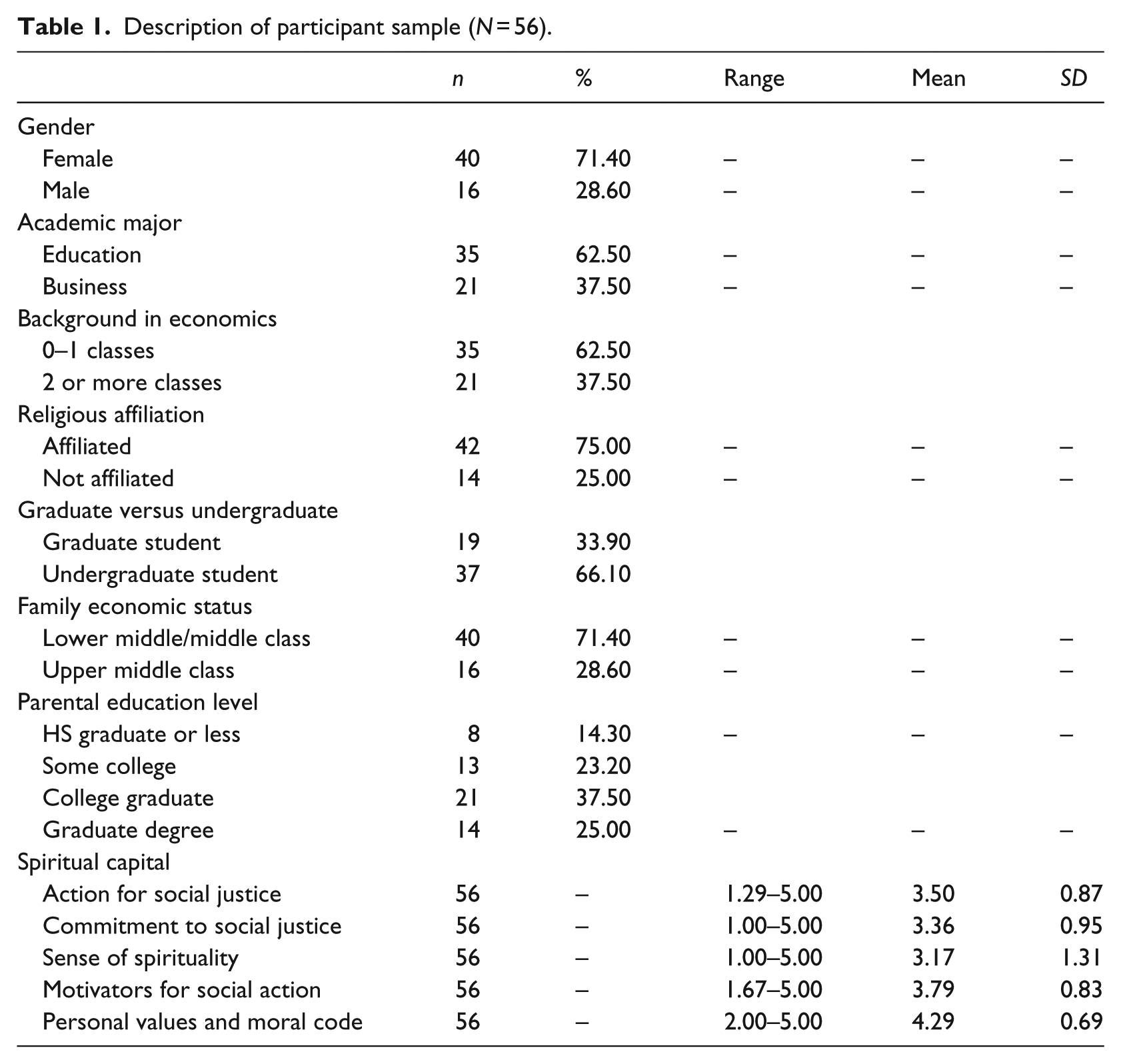
Participants (N = 56; 71% female) included undergraduate (n = 37) and graduate (n = 19) students from a public university in the Midwestern United States. Participants were recruited via mass email to participate in the online survey. All graduate and undergraduate students in the colleges of education (2916 as of fall 2016) and business (3912 as of fall, 2015) were invited to participate. Over a period of two months (September through October), respondents were invited three times to complete the online survey. The survey yielded 67 respondents of which 11 decided not to participate. See Table 1 for a full description of the participant sample.
Description of participant sample (N = 56).
Measures
Spiritual capital
Participants completed Rima’s (2013) 40-item measure assessing spiritual capital. Item examples include “I consider myself a deeply spiritual person” and “I am committed to standing in solidarity with those who suffer from social and economic injustice.” Responses ranged from 1 (strongly disagree) to 5 (strongly agree).
Individual characteristics
Gender
Participants reported their gender by checking “male” or “female.”
Academic major
Participants reported academic major by indicating whether they were affiliated with the College of Education or the College of Business.
Background in economics
Participants reported the total number of economics classes completed throughout high school and college with the following response options: 0–1, 2–3, 4–5, 6–7, and 8 or more. Because of participant responses and an uneven number of responses across categories, this variable was dichotomized to reflect 0–1 economics courses versus two or more economics courses.
Religious affiliation
Participants reported their religious practice by selecting their religious affiliation from the following list: Atheistic, Agnostic, Catholic, Evangelical Christian, Hindu, Jewish, Mainline Protestant, Muslim, Other, and Unaffiliated. For analysis purposes, this variable was dichotomized to represent whether or not participants reported a religious affiliation. Participants who reported that they were Atheistic, Agnostic, or Unaffiliated were labeled as No Religious Affiliation while all other responses were grouped as Religious Affiliation.
Graduate or undergraduate status
Participants indicated if they were an undergraduate, Master’s, or Doctoral student. For analysis purposes, this variable was dichotomized to indicate whether or not the participant was a graduate or undergraduate student.
Family background variables
Economic status
Participants reported their family economic status from the following response options: lower class, lower middle class, middle class, upper middle class, and upper class. To deal with skewedness and an uneven distribution of responses across all of the categories, for analysis purposes, economic status was recoded as a dichotomous variable to indicate lower middle/middle class or upper middle class.
Parental education level
Participants indicated the level of education for their most educated parent from the following categories: did not graduate high school, high school graduate, some college, college or university degree, post-baccalaureate (MA, PhD), and professional degree (JD, MD). For analysis purposes, parental education was recoded into a four-level variable: high school graduate or less, some college, college degree, or graduate degree.
Analyses and results
Research question 1
All data were analyzed in SPSS v. 24. To examine dimensionality of Rima’s (2013) measure, the 40 items assessing spiritual capital were factor analyzed using principal component analysis with Varimax rotation. Exploratory factor analysis revealed seven factors explaining 76.96% of the variance (see Table 2 for factor analysis results).
Factor loadings for exploratory factor analysis of Rima’s (2013) spiritual capital measure.
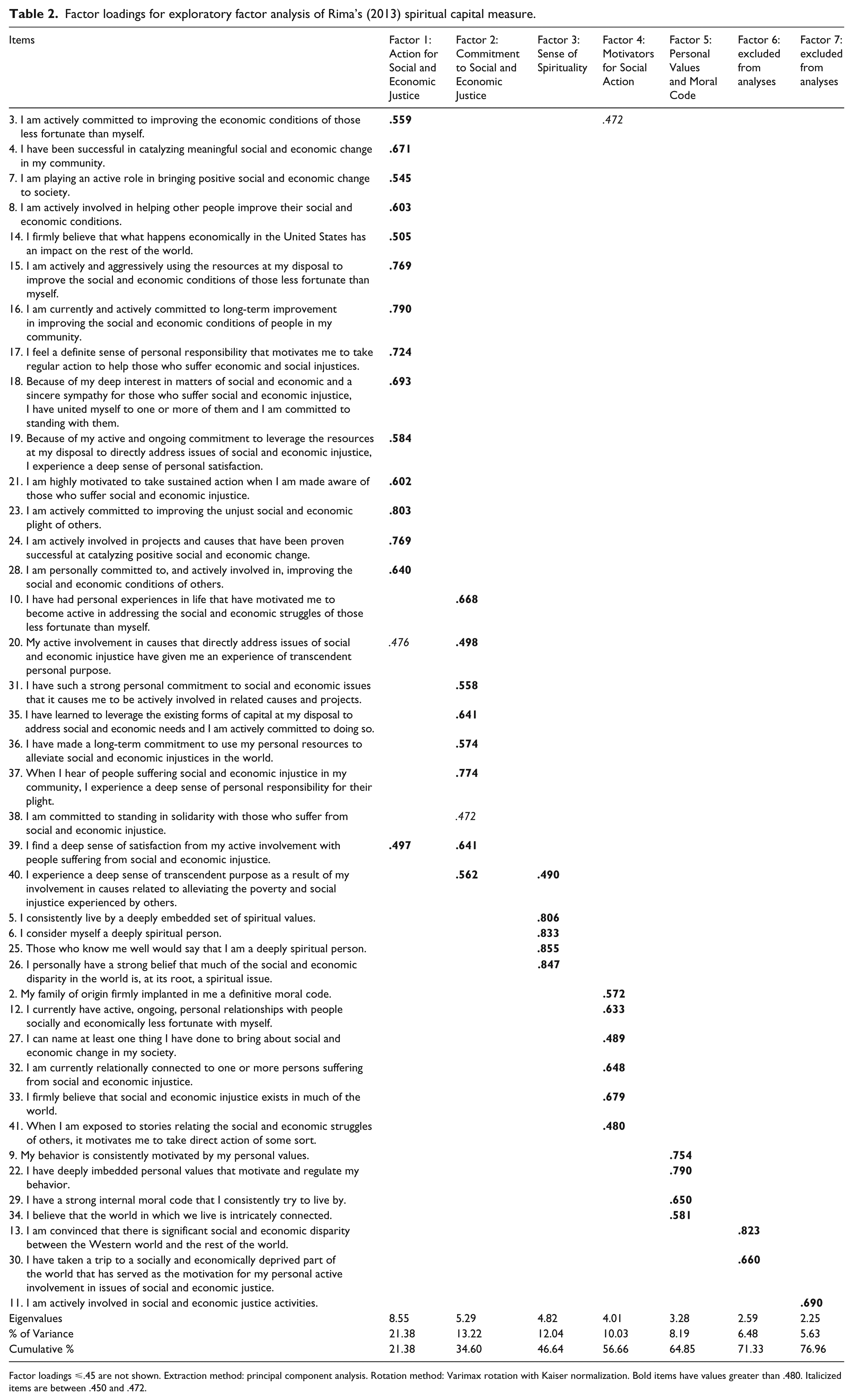
Factor loadings ⩽.45 are not shown. Extraction method: principal component analysis. Rotation method: Varimax rotation with Kaiser normalization. Bold items have values greater than .480. Italicized items are between .450 and .472.
Factor 1 included 14 items and explained 21.38% of the variance. This factor included items such as “I am actively involved in helping other people improve their social and economic conditions” and “I am playing an active role in bringing positive social and economic change to society.” Because items loading strongly onto this factor emphasized taking action to improve the social and economic conditions of others and society, this factor was labeled Action for Social and Economic Justice. Items were averaged so that higher scores indicated a greater likelihood to take action to promote social and economic justice. Cronbach’s alpha indicated adequate reliability (α = .96).
Factor 2 included nine items and explained an additional 13.22% of the variance. Items such as “I have a strong personal commitment to social and economic issues,” “I am committed to standing in solidarity with those who suffer from social and economic injustice,” and “When I hear of people suffering social and economic injustice in my community, I experience a deep sense of personal responsibility for their plight” loaded strongly onto this factor. Because these items reflect a sense of personal responsibility and obligation to social and economic justice, Factor 2 was labeled Commitment to Social and Economic Justice. Two of these nine items, “My active involvement in causes that directly address issues of social and economic injustice have given me an experience of transcendent personal purpose” and “I find a deep sense of satisfaction from my active involvement with people suffering from social and economic injustice” loaded strongly onto Factors 1 and 2. However, both demonstrated higher loadings onto Factor 2. In addition, while both mentioned active involvement, they also reflected an internal feeling or “satisfaction” and seemed to more closely align with the other items loading strongly onto Factor 2, so they were included in this composite score. Items were averaged so that higher scores indicated a stronger commitment to social and economic justice. Cronbach’s alpha indicated adequate reliability (α = .94).
Factor 3 included four items and explained an additional 12.04% of the variance. This factor was labeled Sense of Spirituality, as items such as “I consistently live by a deeply embedded set of spiritual values” and “I consider myself a deeply spiritual person” loaded strongly onto this factor. Items were averaged so that higher scores reflected a stronger sense of personal spirituality. Cronbach’s alpha indicated adequate reliability (α = .94).
Factor 4 included six items and explained an additional 10.03% of the variance. This factor was labeled Motivators for Social Action, due to items such as “my family of origin firmly implanted in me a definitive moral code” and “when I am exposed to stories relating to the social and economic struggles of others, it motivates me to take direct action of some sort” loading strongly onto this factor. Items were averaged so that higher scores indicated a greater likelihood of reporting motivators (e.g. experiences, family) for social action. Cronbach’s alpha indicated adequate reliability (α = .85).
Factor 5 included four items and explained an additional 8.18% of the variance. Items such as “my behavior is consistently motivated by my personal values” and “I have a strong internal moral code that I consistently try to live by” loaded strongly onto this factor, so it was labeled Personal Values and Moral Code. Items were averaged so that higher scores reflected a stronger endorsement of personal values and a moral code guiding behavior. Cronbach’s alpha indicated adequate reliability (α = .80).
Factor 6 included two items and explained an additional 6.48% of the variance. The two items, “I am convinced that there is significant social and economic disparity between the Western world and the rest of the world” and “I have taken a trip to a socially and economically deprived part of the world that has served as the motivation for my personal active involvement in issues of social and economic justice” did not show adequate reliability (r = .45) so these items were excluded from additional analyses. Finally, factor 7 explained an additional 5.63% of the variance and included only one item, “I am actively involved in social and economic justice activities.” As a single item, there was no measure of reliability so this item/factor was also excluded from additional analyses.
Research question 2
To test for differences in the levels of spiritual capital between education and business majors, independent samples t tests for each of the five composite measures noted above were conducted (see Table 3). Analyses revealed a significant difference in students’ Motivators for Social Action between education and business majors: t (30.813) = 2.183, p = .037. Specifically, education majors (M = 3.99, SD = 0.65) were more likely to report experiences and relationships that had motivated social action than business majors (M = 3.46, SD = 0.98). Analyses also revealed a marginally significant difference between education and business majors’ Action for Social and Economic Justice. Specifically, education majors (M = 3.66, SD = 0.74) were more likely to report taking action for social and economic justice than business majors (M = 3.24, SD = 1.00). However, no significant or marginally significant differences between education and business majors were found for Commitments to Social and Economic Justice, Sense of Spirituality, or Personal Values and Moral Code (see Table 3).
Results of t-tests comparing spiritual capital of education and business majors.
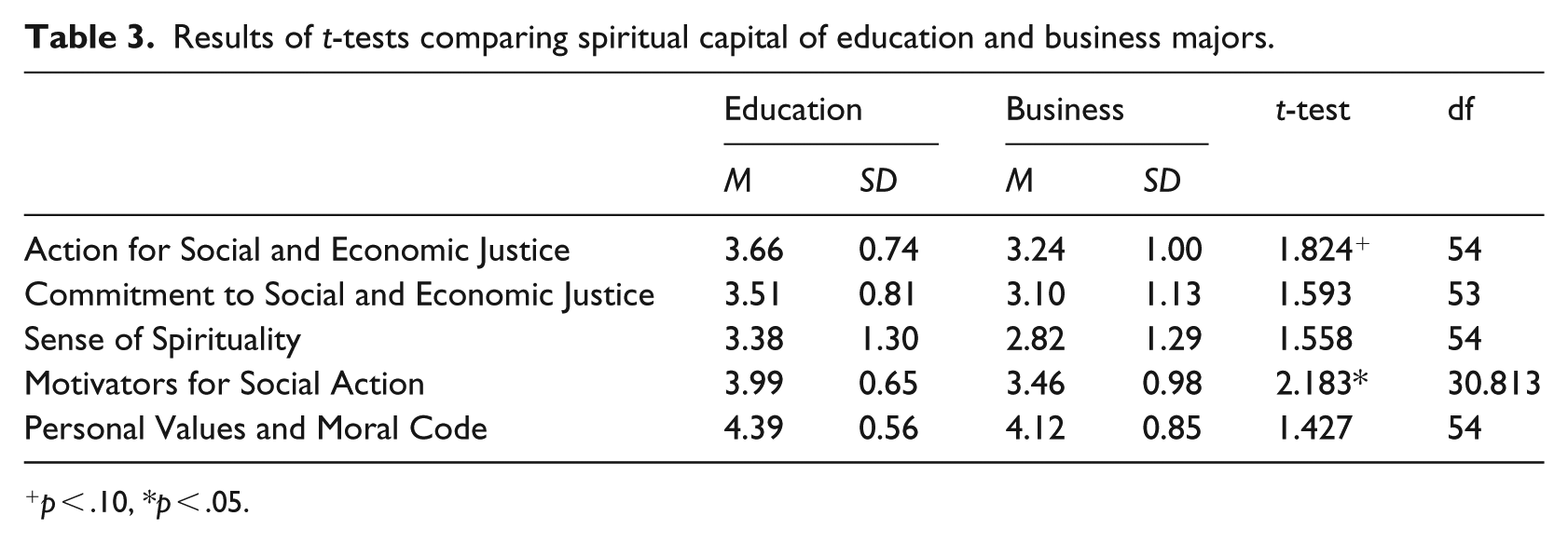
p < .10, *p < .05.
Research question 3
In order to explore the degree to which dimensions of spiritual capital are associated with individual characteristics (religious affiliation, gender, background in economics, and graduate vs undergraduate status) and family background variables (family economic status, parental education level), Pearson’s correlation coefficients were computed (see Table 4). For individual characteristics, religious affiliation was significantly associated with all five composite measures of spiritual capital: Action for Social and Economic Justice (r = .43, p < .001), Commitment to Social and Economic Justice (r = .40, p = .002), Sense of Spirituality (r = .56, p < .001), Motivators for Social Action (r = .47, p < .001), and Personal Values and Moral Code (r = .38, p = .006). In addition, being female was significantly associated with a sense of spirituality (r = .32, p = .017). However, being female was not significantly associated with any other composite measures of spiritual capital. Furthermore, background in economics, graduate versus undergraduate status, family economic status, and parental education level were not significantly associated with any dimensions of spiritual capital (see Table 4).
Correlations among study variables.
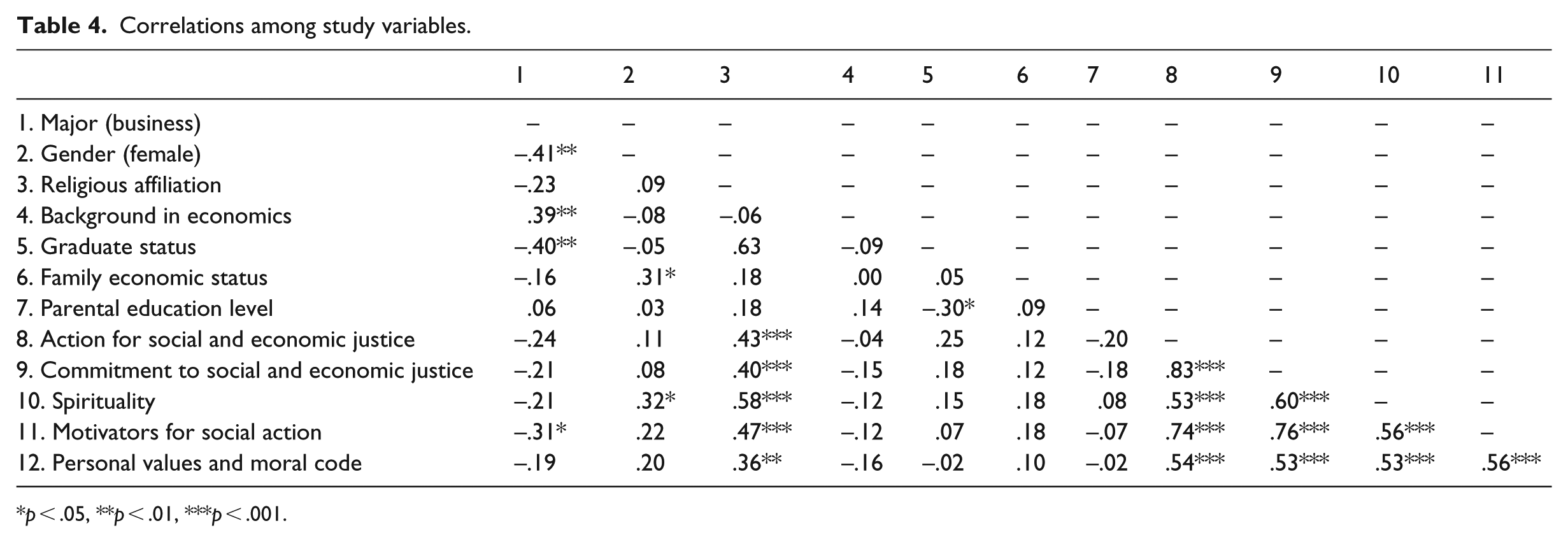
p < .05, **p < .01, ***p < .001.
Implications
Spiritual capital of education and business majors
The significantly higher degree of some dimensions of spiritual capital among education majors is consistent with findings of literature that compared education and finance majors’ perceptions of financial morality (Lucey and Bates, 2014). Specifically, this study found that education majors were significantly more likely to report motivators for social action when compared with business education majors. Furthermore, education majors reported marginally higher scores for action for social justice as well. Although data were not collected on students’ previous education courses taken, each education program includes a course on student diversity which addresses interpersonal and institutional discrimination of marginalized groups in education and a course on educational foundations focusing on organizational and structural issues related to schooling. Perhaps exposure to this type of curricular content informs these perceptions and makes students more aware of social and economic injustice. Furthermore, there could be preexisting differences in the prosocial behavior or general temperament of students who decide to major in education versus business.
Interestingly, there were no significant differences found for other dimensions of spiritual capital including a commitment to social and economic justice, a sense of spirituality, or personal values. This study found a distinction between education and business education majors on dimensions of spiritual capital that include motivation and action whereas these more general values are beliefs that showed no differences. Perhaps, as education majors, who are being prepared to work with children and adolescents, they feel more empowered or motivated to actively address issues of social and economic injustice because they believe they will be doing so through interactions with students in the classroom.
Measurement of spiritual capital
The conceptualization and measurement of spiritual capital represents an innovative process that offers potential for substantializing an alternative perspective of financial education. Additional studies may further investigate this concept and its measure using broader and more diverse samples. These efforts may refine this instrument in view of the findings presented. Findings from this study also show that spiritual capital is a multifaceted concept, as it found conceptually different (though related) aspects of spiritual capital from Rima’s (2013) measure. For example, taking action for social and economic justice may be different from feeling a commitment to these issues, as these constructs were revealed to be separate, distinct dimensions of spiritual capital. Similarly, a general sense of spirituality and reports of personal values or a moral code were also shown to be conceptually distinct, but related, aspects of spiritual capital. Finding differences in students’ composite scores based on student major on some dimensions, but not others, further supports the idea that there are multiple dimensions of this construct. Thus, a single composite score would likely be insufficient to fully capture and understand an individual’s sense of spiritual capital and future studies should consider multiple dimensions as well.
Spiritual capital and associated variables
The study found that some individual characteristics were associated with dimensions of spiritual capital, while others were not. Specifically, having a religious affiliation showed a moderate, positive association with each dimension of spiritual capital, as students who reported a religious affiliation were more likely to report higher levels of spiritual capital. Given this consistent significant association, religiosity or religious affiliation should be included as a covariate in future studies to control for the influence of this variable on one’s reported spiritual capital. Furthermore, it is recommended that more research be considered to unpack this association, as religious affiliation does not necessarily indicate a stronger moral inclination. For example, various denominations of Christian religions hold different scriptural interpretation and emphasize different aspects of their faith. Narvaez and Bock’s (2014) discussion of multi-ethic theory (MET) may partially explain this phenomenon. They point out that each person possesses the belief of their own morality and that different developmental contexts may reinforce different social ideologies. Thus, while a relationship between religious affiliation and spiritual capital may exist within our sample, the guiding tenets of these beliefs remains unclear.
However, the study found no significant associations between the five dimensions of spiritual capital and the number of economics classes, graduate status, family economic status, and parental education level. The absence of these relationships may occur because of limitations in the diversity of the sample. Additional studies that use more purposeful sampling techniques may be helpful to interpreting the possibilities of such associations.
Limitations
It is acknowledged that the small sample size limits the robustness and relevance of the research study. The importance of these data and their analysis relates to the interpretation of an unexplored concept associated with financial education.
The purpose of Rima’s (2013) survey was to confirm findings observed through qualitative research. The exercise of prudence is recommended when considering the survey and its applications.
Conclusion and implications for financial education
The importance of this study relates to its interpretation of a measure for spiritual capital and its introduction of the concept to the financial education community. In a field of study largely influenced by the business community, this article provides information about an effort to quantify a concept largely considered abstract and intangible. Yet, perhaps more importantly, this article brings to light the relevance of considering alternative ways of measuring financial literacy as a concept founded on moral principles and social justice. The predominant ideology that governs economic and financial thinking selectively values Adam Smith’s writings to claim advocacy for deregulation of business and free markets, and the notion of spiritual capital provides a manner of considering financial education as discipline that needs to be in touch with its altruistic elements. The results of this study would appear to suggest that business education majors possess significantly less spiritual capital than education majors. Perhaps the nature of financial education that business majors experience may require further examination.
Footnotes
Acknowledgements
The author acknowledges the contributions of Elizabeth S. White, Illinois State University, to the data analysis and manuscript preparation.
Declaration of conflicting interests
The author(s) declared no potential conflicts of interest with respect to the research, authorship, and/or publication of this article.
Funding
The author(s) received no financial support for the research, authorship, and/or publication of this article.