




Abstract
Politics is inseparable from conflict. But we often have the idea that the political process has to simply “solve” conflicts and in so doing make the conflict disappear. And because the politicians are not able to do this and instead simply continue arguing, we get the impression that we have incompetent politicians, whom we cannot trust. This is not new: in political education, it is important to see the aims and identify the meaning of conflicts. This allows us to have a constructive debate about the conflicts themselves. It is important to analyze conflicts as well as to develop the competence to deal with political controversies and conflicts constructively. This presentation will broach the issue of inequality without dramatizing it. Inequality can indeed threaten a democratic society, but for a free democratic society, inequality has to also be constitutive. The central thesis is that reflection on dilemmas stemming from inequality could be a strategy against political apathy and can help reinforce a sense of solidarity and cohesion in our society. This will be shown using an instrument borrowed from the psychology of communication, the “quadrate of value and development,” whose potentials for political education are currently being exploited for various projects.
The renowned didactic scientist Bernhard Sutor describes in his essay “A Political Song, a Nasty Song” a central problem for political education: The everyday citizen doesn’t want disputes. And because conflict is constant in politics, he wants no part of it […]. (Sutor, 2011: 25)
Politics is inseparable from conflict. But we often have the idea that the political process has to simply “solve” conflicts and in so doing make the conflict disappear. And because the politicians are not able to do this and instead simply continue arguing, we get the impression that we have incompetent politicians, whom we cannot trust (Boeser and Schnebel, 2013; Detjen, 2012; Schiele, 2013).
This situation (or problem) is not new: in political education, it is important to see the aims and identify the meaning of conflicts. This allows us to have a constructive debate about the conflicts themselves. This has been the case ever since the pedagogical debate over the theory of conflict that started with Ralf Dahrendorf and continued with Hermann Giesecke (Reinhardt, 2005b: 76). Whether we are speaking about the Dictate of Controversy from the Consensus of Beutelsbach (Beutelsbacher Konsens) (Wehling, 1977), or the goals of the Society of Civic Education: Didactics and Civic Youth and Adult Education (2004) or the didactic principle of conflict orientation (e.g. Sander, 2007) – it is always important to see conflict as something normal and legitimate. It is important to analyze conflicts as well as to develop the competence to deal with political controversies and conflicts constructively.
This presentation will broach the issue of inequality without dramatizing it. Inequality can indeed threaten a democratic society, but for a free democratic society, inequality has also to be constitutive. The central thesis is that reflection on dilemmas stemming from inequality could be a strategy against political apathy and can help reinforce a sense of solidarity and cohesion in our society. This I show with three problems in the political science: dilemmas concerning minorities in Europe and concerning religions in Europe, and dilemmas concerning the political theory, the so called theory of justice. This will be shown using an instrument borrowed from the psychology of communication, the “quadrate of value and development,” whose potentials for political education are currently being exploited for various projects.
The quadrate of value and development
The main idea of the quadrate of value and development is (Picture 1)
[…] every value (every virtue, every indicator principle, every character attribute) [can] only reach a constructive effect if it stands in a sustained tension to an opposite value, to a “sister virtue.” […] Without this […] tension (balance) the value deteriorates to its “degenerate form” [or] to its devalued exaggeration. (Schulz von Thun, 2001: 38)
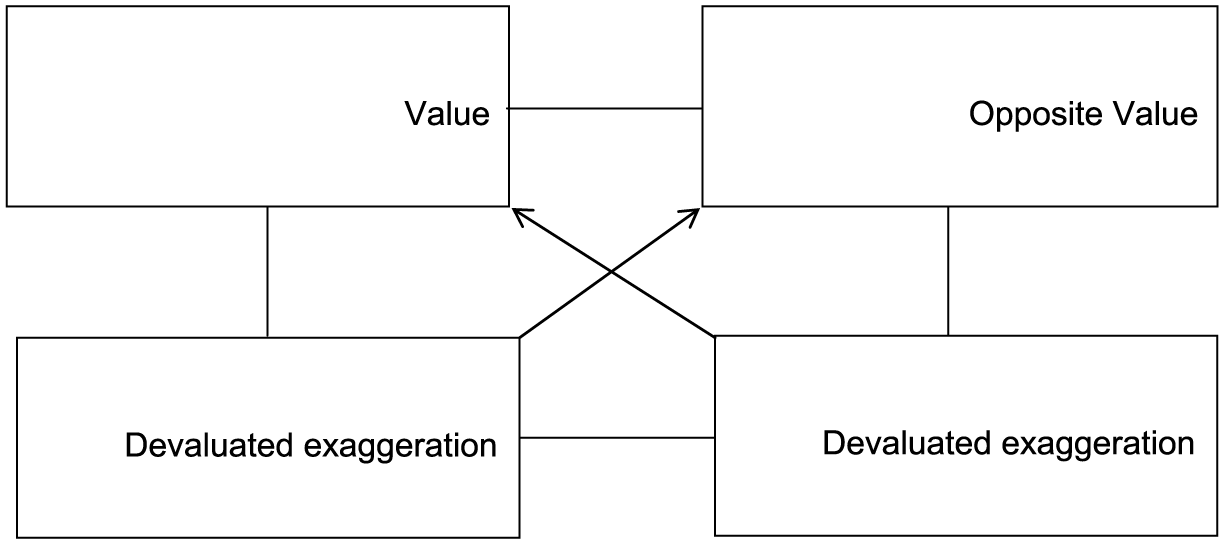
The quadrate of value and development.
For example, austerity is only a virtue if it is in combination with its sister virtue, generosity. Austerity alone would degenerate into parsimony, and generosity into extravagance. Thus, it depends on the tension or balance between the two values, of which we can’t say one is absolute because it will lead to a devalued exaggeration. If we would like to avoid the devalued exaggeration of one value, it is necessary to orient oneself toward the other value, in this case, generosity. So in this model, we emphasize the perspective of development. The idea of this contrast was originally proposed by the philosopher Nicolai Hartmann (1926), who made reference to the Nicomachean Ethics (Nikomachische Ethik) of Aristotle. This idea was further developed by the psychologist Paul Helwig (1936), a student of Hartmanns. 1 It became known to the general public through the communication scientist Friedemann Schulz von Thun (2001), and the definition of value discussed by Meyer (1999) and Thome (2005).
The applicability for the topic of inequality
Next, I will show examples of the applicability of this model on the topic of inequality. I will start with the topic of minorities in Europe.
Minorities in Europe
When we speak of minorities in Europe, it means, on the one hand, national minorities, that is, minorities who live in their own territory. On the other hand, we distinguish this type of minority from other minorities or people with a migration background, who live as a minority inside a majority society (Picture 2).
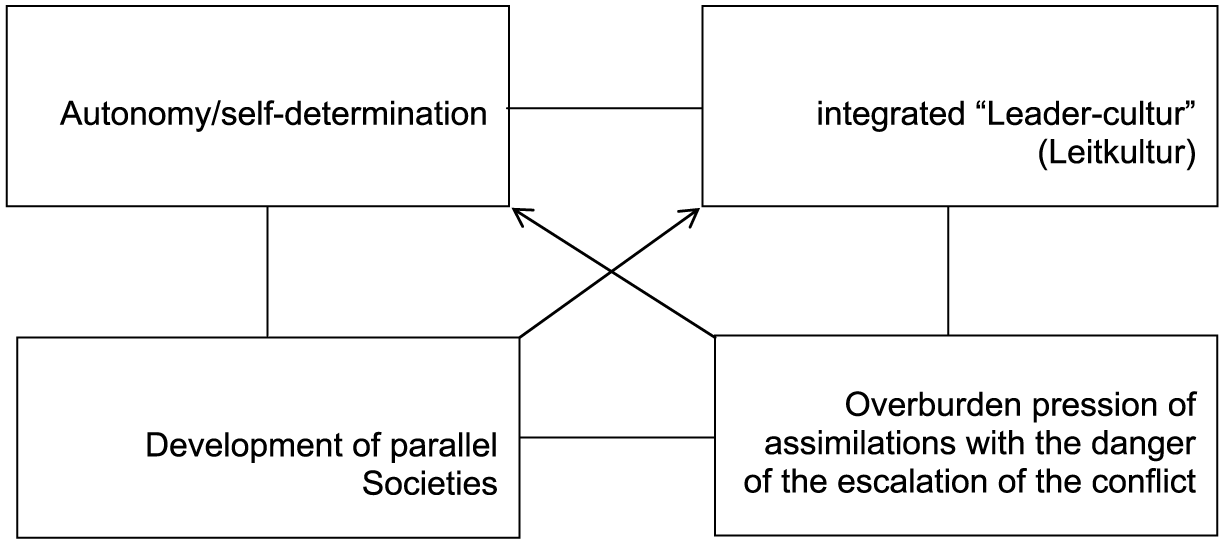
Quadrate of value and development over the treatment with national Minorities and immigrant minorities.
In both cases, we are confronted with the problem of how much self-determination can be given to the respective minorities and to what degree an integrated “Leader-culture” (Leitkultur) (I use the old term intentionally) is necessary for the cohesion of the society. 2 National minorities are fighting for their self-determination, and along with it, for a greater autonomy for “their” territory. While migration minorities, on the other hand, are trying to preserve their cultural identity in a cultural foreign state by maintaining the unique aspects of their ethnicity, language or religion (see also Biedermann, 2006).
The desire for autonomy, self-determination and the protection of their identity is legitimate. And as Charles Taylor (1997) showed very convincingly, it is a value that is socially necessary. If you, however, treat this value as absolute, it would lead to the development of parallel societies. In order to prevent such a development, it is necessary to have an opposite value, which guarantees that citizens identify with their state. And this is, namely, an integrated “Leader-culture” (Leitkultur). It is important to remember, though, that this opposite value cannot itself be treated as absolute, as this would place an overwhelming pressure to assimilate on a given group, which would carry with it the risk of an escalation of the conflict. Politics thus lies in a state of tension between the necessity of granting autonomy, on the one hand, and the need for a “Leader-culture” (Leitkultur), which is integrated into the whole society, on the other. Balance here does not mean finding a middle point between the two values, but rather orienting oneself around one value or the other value, depending on the given social situation.
A real solution to this state of tension is however not possible (see Schnebel, 2003). Rather, what exists here is the basic conflict between recognizing the special needs of groups, on the one hand, and striving to achieve equality, on the other (see also Schnebel, 2014). And so it is possible to discuss this as an abstract topic of political theory, which will take place later in this study. But first I would like to reflect on a second topic from the level of policy: The challenge of religious pluralism in European societies.
Dealing with religious pluralism
Before I present to you the central dilemma in dealing with religious pluralism, I will first share some basic thoughts about the topic of religion. I will first mention the state of tension between religion and politics in its different facets. The first question that comes to mind is whether it is possible to have politics without religion. Or, in other words, where does politics begin to intervene in religious questions? Does it begin with the separation of clerical and profane function? Do we speak of the politics of religion when we fight discrimination by punishing, for example, blasphemy? Can we imagine a state which did so as if there were no religion? Does the politics of religion begin with a commitment to human rights and democracy or does it begin when we speak about religion in schools or about the involvement of the public authority in the financing of religious communities? Here, we can ask quite a few more questions. The fact is now that a society without religion does not exist. Charles Taylor pointed this out in his book “A Secular Age,” published in 2009. He holds the opinion that a society without religion is just as hard to imagine as a society without politics. At the same time, he concedes that sometimes one gets the impression that religion is trapped in a gray zone between faith and atheism. Other authors say just a “[…] de-secularisation and [a] growing [..] secularization of societal relations” (Mecheril and Thomas-Olalde, 2011: 35) are taking place. Taylor (2009) supports this idea partially by stating that a growing need for spirituality can be observed (p. 51ff), even if in different kinds. Even if the concrete membership in formal religious denominations is decreasing, one can observe in the Federal Republic of Germany an increasing need for spirituality (Bundesamt für Statistik, 2015).
In the case that the economic situation becomes more precarious, such tendencies would increase. There is one more argumentation. According to Taylor, a pluralization of the religions is taking place, which favors a “return of the religions.” Because of the clash between different religions and their traditions in migration societies, they reproduce themselves by intensifying their religious communication (Tezclan, 2011: 306) and lived traditions (Apitzsch, 2003). Thereby arises an “[…] awareness of the peculiarity and relativity of one’s own religious coinage” (Hero and Krech, 2011: 28). A consequence of this is the increasing importance of the politics of religion. This is especially clear in the debate over the wish on the part of the Muslim religion-community for a legal requirement that supports their own religion. This desire makes the connection between Christianity and the state more conscious. What is now the main issue in the politics of religion?
Politics of religion
The politics of religion regulates a part of the public order. The question is now how much influence politics can have on religious questions and the internal affairs of religious communities. Is it acceptable if public courts impose a penalty for blasphemy? Can the government decide that new religious communities cannot use the same name for God as the dominant religions in the state in question? (Müller, 2014: 9) Another question is whether religious office-holders should be allowed to make election recommendations, or whether somebody can take an ecclesiastical office and a political office at the same time or the reverse (Müller, 2014). When there is no equalization between religion and politics, as there is in many Islamic nations, or when there is no religious imperative in the politics, a real separation between religion and politics is not possible. Even in Europe it is very often necessary that religion interfere in politics, for example, to prevent discrimination or to guarantee a peaceful way of life in society. The politics of religion has in this way the task of protecting human rights. Concrete controversial issues of politics, which are relevant here and in which the politics of religion is decisive for the development of society, are, for example, the religious instructions in schools and the level of the financial support for religious buildings or other types of activities of religions (Picture 3).
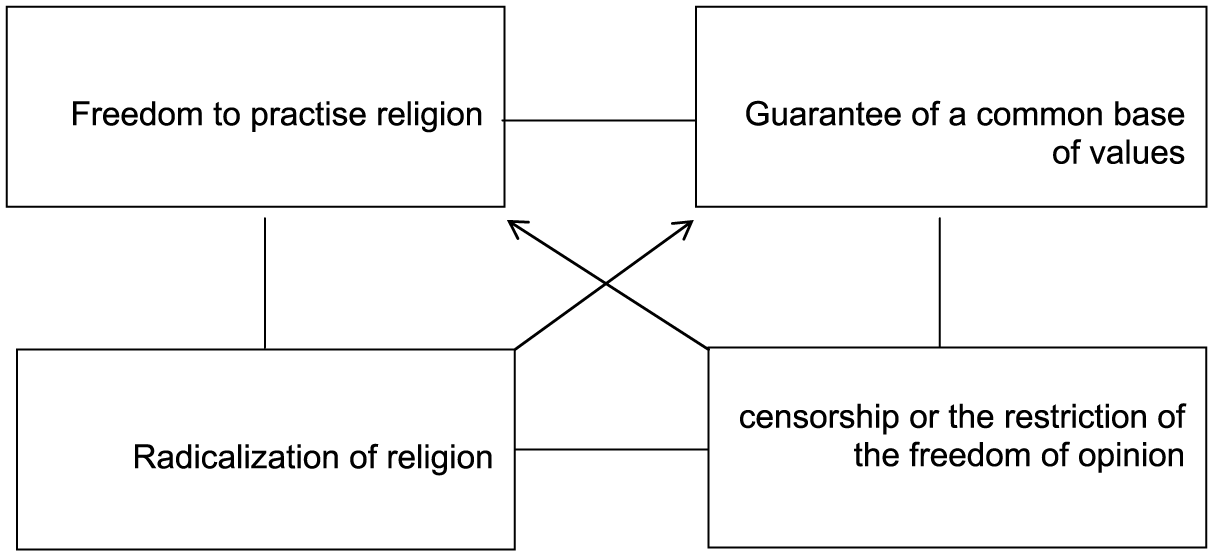
Quadrate of value and development.
Now there are naturally a lot of quadrates of value and development, which we can think of here. I have decided to use the examples of the two virtues of freedom to practice religion and the guarantee of a common base of values. The value or the virtue is here thus the freedom to practice religion. Here, we have different ways in which it may become devalued. I decided on the radicalization of religion because if we practice the religion with all of its conceivable rituals, it can lead to a radicalization. One could also say that religion and law merge into one another. When all imaginable, or even manipulative, means of convincing people, are used or when people can or want to engross themselves more deeply in their religion, it can lead to the radicalization of religion. And if the private or economic situation of an individual worsens, the need to do this grows. When it comes to the other virtue, the “guarantee of a common base of values,” its devalued exaggeration can take the form of censorship or the restriction of the freedom of opinion. The reason is that in order to maintain a common base of values for the whole society, it is not possible that everyone can simply publish his religious opinion, but rather it is necessary that they pay attention to ensure that their message fits into a common value-package, otherwise it would need to be sanctioned because it doesn’t accord with the common base of values. Thus, these are two values which do not accord with one another (Schnebel, 2016). 3
This quadrate of value and development, as well as the before-mentioned state of tension in dealing with minorities, has a common reference point for a fundamental question of the political theory.
Theory of justice and theory of recognition
In both cases, the theories of justice and recognition can be argued. The theories of justice or the so called egalitarian theories stand in opposition to the theories of recognition or communitarian theories. While the first-mentioned theory assumes that a just state must grant everyone the same rights (Rawls, 1972), recognition theory assumes that the same rights cannot apply equally to everyone because groups of minorities can only overcome their negative self-image through recognition of their cultural idiosyncrasies by the majority society.
According to recognition theorists, the community stands in the foreground (similar also for the communitarian, see among others Etzioni, 2001; Sandel, 1993; Walzer, 1992) and the community counts as the basic force and stamina of a society, and accordingly for the state – while the egalitarians are of the opinion that the individual and his or her autonomy stands in the foreground and that a society develops itself better with a minimal consensus because the individual has the possibility of realizing a good life according to higher standards.
In a quadrate of value and development, it is easier to show this basic state of tension between the recognition of the special needs of groups and the notion of justice through equality in the following way (see also Schnebel, 2014; Picture 4).
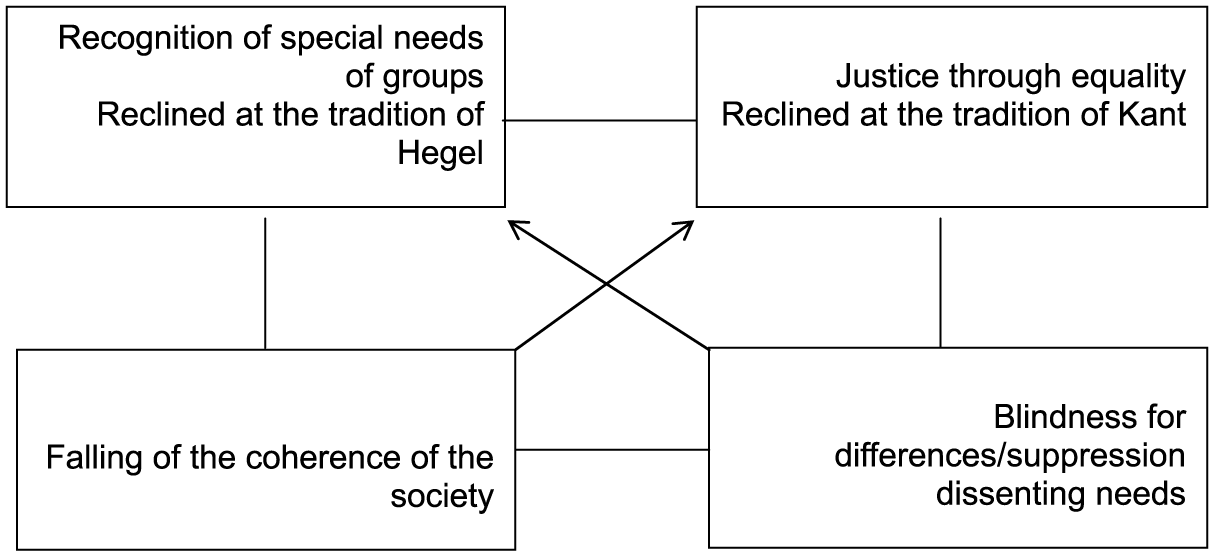
Quadrate of value and development over the problematic of justice.
If the recognition of the special needs of groups is treated as absolute, it leads to decreasing solidarity and to fragmentation of the society because the individual groups don’t have enough in common. If the notion of justice through equality is treated as absolute, it leads to blindness to differences and to the suppression of divergent needs. In turn, the blindness to differences and the suppression of divergent needs can also lead to fragmentation of the society if the minority groups – as mentioned before – become radicalized (Taylor, 1997). Thus, neither orientation, the recognition of special needs, nor the notion of justice through equality is able to guarantee a stable society without its opposite value. The conflict between the values is thus not resolvable (Schnebel, 2014). However, this point of view is still useful for politics because it emphasizes the balance between two legitimate values, it illustrates the danger of treating a value as absolute, and it shows the necessary correction (direction of development) of one-sided politics. It also gives reasons for the political apathy (Politikverdrossenheit) of many citizens, especially because a lot of citizens can’t identify with decisions. Especially in a multicultural or multi-religious society, it is important to always find compromises, which do not respect the needs of one group before the needs of the others. The consequence is distancing oneself from politics or sealing oneself off from it.
A lot of people react with disinterest or even with radicalization and political activities which don’t lead to constructive debate, but rather an escalation of conflicts. If in such a situation the economic situation worsens or the joblessness rate goes up, then the probability of political apathy or radicalization increases – this is also true for religious as well as political opinions. The uses of this for political education will be shown in what follows.
Use for political education and the didactic embedment
At the end, I will present some thoughts about the application of the quadrate of value and development for political education, and I will reflect on the didactic embedment with you. From my point of view, it is necessary to mention the following points (see also Wohning, 2015):
The learner will become conscious of the significance of conflicts in politics and realize that different positions in the politics are not necessarily negative, but rather inevitable. Through this it is possible to produce more interest in political issues and reduce political apathy (Boeser-Schnebel and Schnebel, 2014).
A quadrate of value and development illustrate the conflict lines and the legitimate interests which are behind the different positions.
With this approach learners can see that politics is a never-ending process of problem-solving and the “amendment” of laws is not necessarily to be blamed on the incompetence of politicians, but rather the insoluble dynamic of the problem.
Learners are confronted with the situation that different political views exist not because dissenting persons are dim-witted, but rather that different perceptions and concepts of values exist (Reinhardt, 2005a: 130).
Learners can develop a kind of perception which makes it easier to deal with insoluble conflicts of value and which makes their tolerance for ambiguity higher. If not, the danger exists that an individual in a value-pluralistic society will become overwhelmed because of the production of a state of equilibrium (Äquilibration) – to use a term from the development psychologist Jean Piaget – which would lead to absolutisation of one’s own values.
Learners learn from experience that issues from daily politics can form the basis of larger political dilemmas, and they can therefore enter into debate in the core area of politics (Sander, 2007: 178ff).
The work with the quadrate of value and development exhibits a similarity to the method of dilemma proposed by Sybille Reinhardt (2013), who uses moral dilemma as a starting point for the political learning process.
My proposal for the application of the quadrate of value and development is, however, to turn political dilemmas into a topic of discussion in order to improve the political judgment of educated people (see also Boeser-Schnebel and Schnebel, 2014; Massing and Weißeno, 1995).
Conclusion
Conflicts and insoluble dilemmas are a general part of politics and are inherent to a migration society. To see this and to deal with it competently are central aims of political education so that political maturity may be achieved (see also Hufer, 2008). The quadrate of value and development is in its simplicity very plausible in that it visualizes the tension between two values and the consequences of making a value absolute, and it underscores the non-reversibility of the field of tension. Even if some critical arguments against this instrument are justified, as we can discuss later, the opportunity to learn from it can’t be denied. Politics can be understood in this way as a never-ending process of problem-solving. The biggest potential of this concept is in my opinion its ability to strengthen a culture of civil political discourse, which is just what a heterogeneous society needs. For learners, the most surprising result of their encounter with the quadrates of value is that they gain a valuable perspective of a value which they had earlier rejected, because they had only seen its devalued exaggeration. The internal tensions in a migration society with heterogeneous values – which are often based on religious differences – can be better understood and appreciated, because the cost of establishing a society which is homogeneous in its values would be very high, and could in the end put a democratic form of government in question.
Footnotes
Declaration of Conflicting Interests
The author(s) declared no potential conflicts of interest with respect to the research, authorship, and/or publication of this article.
Funding
The author(s) received no financial support for the research, authorship, and/or publication of this article.