



Abstract
Afghanistan is often characterised as a ‘failed’ or ‘fragile’ state in terms of state ‘functionality’, lacking in capacity to provide security and wellbeing to its citizens and failing to prevent violent conflict and terrorism. Since 2001, education has become a major victim of Afghanistan’s protracted crisis that involves international military interventions, fragile democracy and growing radicalisation. Drawing upon qualitative interviews with educational officials and practitioners in Afghanistan and critically examining the literature in education and conflict, we argue that Afghanistan’s education is caught in the nexus between deteriorating security conditions, weak governance and widespread corruption, resulting in rebel capture of educational spaces for radicalisation and violent extremism. More broadly, we contend that education faces the risk of capture for radicalisation in contexts where state fragility and fundamentalism intersect. Finally, we highlight some critical issues relating to educational programming in conflict-affected contexts.
Introduction
Education in conflict-affected contexts can provide higher quality of life through economic wellbeing and improve political participation as a means to reduce underlying causes of conflict (Walter, 2004). Opportunities to participate in education reduce the likelihood of young people’s involvement in armed conflicts (Barakat and Urdal, 2009; Thyne, 2006) and higher levels of education increase the chances of economic opportunities and hence, provide youth a stable livelihood (Østby and Urdal, 2010). Most importantly, education can support stability by promoting ‘resilience, communication and language skills, by teaching conflict resolution, and by giving predispositions to challenge injustice’ (Davies, 2013: 2). However, in fragile environments, education is trapped in a complex political economy that undermines its role in enabling wider societal transformation. Yet, educational rebuilding in post-war societies tends to disregard political economy factors that undermine educational reforms as well as implicitly fuel conditions of conflict. Firstly, education systems can promote linguistic and cultural repression, biased history teaching, ethnic and gender-based exclusions, war and hate curriculum and inequity, both in terms of access and quality of education (King, 2014). Secondly, education is either outside the political project of post-war peacebuilding or is limited narrowly to the agenda of economic development. Consequently, where reforms in education are planned, these predominantly focus on the customary processes of technical areas, such as rebuilding physical infrastructure, teacher training, increasing school enrolment, distribution of educational materials, school upgrade, assessment policies and teacher recruitment. While these reforms are important, they are unlikely to address the systemic problems in education that are likely to contribute to conflict. The purpose of this article is to analyse political economy of education in post-2001 Afghanistan to highlight micro level political and economic dimensions that surpass the debates about technical reforms in education. It draws upon qualitative interviews with educational stakeholders including government officials, development practitioners and civil society activists in Afghanistan (n = 31) as well as the experience of working with the Afghan government (2011–2015) to argue that education in Afghanistan is caught in the complex nexus between insecurity, widespread corruption and weak governance, fostering an environment for radicalisation. These findings provide important insights into processes of educational development in conflict-affected contexts where political economy dimensions in education interact with radicalisation and violent extremism.
Firstly, we discuss education and conflict as a growing area of research and policy, followed by an analysis of political economy in the education sector. In the second part of the paper, we provide some contextual analysis of educational development in Afghanistan since 2001 from a conflict perspective. The third section will critically examine education in Afghanistan using a political economy framework (Department for International Development, 2002; Pherali, 2015). Finally, we conclude with some implications of our analysis to the wider field of education, conflict and international development.
The contested role of education in conflict: a global debate
Education as victim within conflict zones
The disintegration of the Soviet Union and conclusion of the Cold War altered the nature of armed conflicts from ‘inter-state’ wars to ‘intra-state’ civil wars. These wars are now fought within the states and civilian habitats characterising, undemarcation of battlefields. According to the International Institute for Strategic Studies (2015), violence has increased globally over the last decade, claiming 180,000 lives in 42 conflicts in 2014 alone, which is three times more than the death toll in 2008. In Afghanistan, 11,000 civilian deaths were recorded in 2015, and one in four of these have been children (United Nations Assistance Mission in Afghanistan, 2015). Civilians, particularly children constitute the prime victim of wars and suffer enduring physical, psychological, and socio-economic effects. The United Nations (UN) report states that ‘the physical, sexual and emotional violence to which children are exposed shatters their world. War undermines the very foundations of children’s lives, destroying their homes, splintering their communities and breaking down their trust in adults’ (Machel, 1996: 39). Civil wars have a debilitating impact on a country’s education system both in terms of decimating educational infrastructure and teaching workforce as well as cuts in educational spending as the military budget increases (Lai and Thyne, 2007). As educational institutions represent state authority, rebels often target schools as defiance to state control and more so, as a propaganda tool. Hence, teachers and children are not only caught in the middle of the conflict but also become tactical targets during civil wars (Global Coalition to Protect Education from Attack, 2014; van Wessel and van Hirtum, 2013). More notably, the most profound effect of civil wars on education ‘is on quality [of] rather than access to’ education, which poses serious challenges for post-war educational reconstruction (Buckland, 2005).
Access to education as a means to conflict reduction?
Low income countries are more susceptible to civil wars and conflict-prone countries are likely to be poor (Crocker and Hampson, 1996; Hoddie and Hartzell, 2005; Walter, 2002). Using a dataset involving 120 conflict-affected countries over thirty years, BarakatBrakat and Urdal (2009) find a significantly positive correlation between large young populations, low levels of education, and the likelihood of conflict. Similarly, the rebel recruitment thesis signifies that access to education increases the opportunity costs for youth to join armed groups as educational opportunities signal hope for a stable livelihood (Collier et al., 2004). Education is a trust-building tool between the government and its citizens, and a good quality education provides knowledge and skills to resolve conflicts peacefully. For instance, Ishiyama and Breuning (2012: 73–74) conclude that countries that have greater increases in educational access especially, higher education, in the period following the end of a conflict, are less likely to experience recurrence of conflict and a longer period of peace duration. However, this undermines the nature of educational contents, ideological positions of educational actors including teachers and in some contexts, extremist groups who control educational spaces and influence pedagogies. Even though formal education plays an important role in building and sustaining national identity and mitigating conflict through building resilient societies (Davies, 2011), it can equally play a socially destructive role by maintaining unequal access to education, offering a segregated and unjust educational provision, manipulating history and suppressing minority languages and cultures (Bush and Saltarelli, 2000; Davies, 2005; Pherali, 2016: 3).
Education as manipulation for political means
Despite being enshrined in numerous UN charters and treaties as a vehicle for freedom and prosperity, education is often manipulated by both state and non-state groups for their political motives. Narrowly defined to promote national identity and justify a political system, education is central to endeavours, ranging from ‘state formation’ (Green, 2013), to ‘communal empowerment’, to bolstering ‘self-strengthening’ resistance to the encroachments of Western and/or imperialist influences, or at furthering projects of post-colonial nation-building or post-conflict peace-building (Lall and Vickers, 2009). The biased curricular contents, enforced by authoritarian states fabricate chauvinistic national identity that is repressive of and deceptive to diverse representations of civic lives (Pherali, 2016: 4). For example, regimes in India and Pakistan revised their school curricula to teach contrasting historical narratives that would lead to fundamentalisation of national identities and antagonistic views towards each other’s nations (Lall, 2008). The assumption that an increased access to education may serve positively for conflict transformation is seriously flawed and hence, educational programming in conflict-affected contexts requires a critical appreciation of education’s contesting role in conflict and fragility (Gross and Davies, 2015).
Securitisation of education in conflict-affected contexts
Since the terrorist attacks of 9/11 and the invasion of Iraq in 2004, new dynamics in the nature, volume and geographies of aid to education have emerged (Novelli, 2010). Despite being discursively framed as ‘humanitarian interventions’ (Fearon, 2008: 52), the educational aid in conflict-affected contexts appears to be increasingly politicised along security interests rather than the fundamental learning needs of children (Novelli, 2010; United Nations Educational, Scientific and Cultural Organisation, 2011). Over the past decade, the East–West and state-centric cartography is being shifted to a much more complex, fluid and transnational picture, where ‘terror suspects’ reside within the borders of our own ‘friendly’ states, hence, the development work and education aid is becoming an integral part of global war on terror (Duffield, 2008; Novelli, 2010: 545). For example, in Iraq and Afghanistan, educational aid is increasingly submerged under the counter-insurgency strategy with detrimental effects for both development work and personal security of development practitioners (Novelli, 2010: 453).
Education for peacebuilding
Lately, much hope has been placed on education as peace-builder not just in neo-classical economic terms that assume investment in education and economic growth as solutions to conflict, but also as a vehicle that facilitates peace, social justice, and democratisation processes (Lopes Cardozo and Shah, 2016; Milton and Barakat, 2016; Novelli et al., 2014; Smith et al., 2011). It could also be argued that the link between education and peacebuilding is empirically fragile and often being defined by immediate humanitarian needs, protection, and post-war reconstruction of education. However, there is a growing recognition of education as a complex process, located contextually in economic, cultural, political and social interactions with serious implications for educational programming in conflict-affected environments. This paper aims to deal with these dimensions of education drawing upon the case of Afghanistan.
Methodology
The paper draws upon qualitative interviews and focus-group discussions with key educational stakeholders including officials from the Afghan Ministry of Education and educational practitioners representing nongovernmental organisations (NGOs) in Kabul as well as provincial education representatives, teachers and NGO workers who support education in Jalalabad, the provincial capital of Nangarhar. Nangarhar is one of the most strategically significant provinces in the country, linking Afghanistan with Pakistan through Kabul as well as the Southeast regions to the North bordering with Pakistan. In the last two years, Islamic State (IS) activities are increasing in the province. Recently, it was reported that 58 schools were closed due to IS threat, driving around 300,000 pupils out of school (European Asylum Support Office, 2016: 28). Fieldwork in Kabul and Nangarhar helped us to gain insights into complex political and security situations within school surroundings and understand a broad range of perspectives of educational stakeholders in the country. The data were transcribed into English and thematically analysed using the conflict analysis framework (Department for International Development, 2002; Pherali, 2015) to represent security, political, economic and social dimensions of education in Afghanistan. Enhanced by researchers’ critical reflections on their experience of intensive research in the area, this approach helped interactively to engage with participants’ conceptions and different viewpoints and generate new perspectives about interconnections between power and resources in the education sector (Bogdan and Biklen, 2006; Krueger, 1998). The findings from the qualitative interviews are discussed and reflected upon, drawing upon the researchers’ broad academic and professional engagement in Afghanistan and beyond in the area of political economy of education.
Education in conflict-affected contexts: a political economy analysis
A political economy analysis plays a critical role in development planning and reforms in education in all settings – especially, in contexts characterised by social, political, and economic divisions (De Herdt et al., 2012; Kingdon et al., (2014); Novelli et al., 2014). Collinson (2003: 3) defines political economy analysis as ‘the interaction of political and economic processes in a society: the distribution of power and wealth between different groups and individuals, and the processes that create, sustain and transform these relationships over time’. In Afghanistan where ethno-regional elites continue to pit each other over state power and resources, a political economy analysis provides useful insights into challenges relating to education and social change. The current state of fragility and growing conflict among the Taliban, Islamic State (IS) and various ethnic groups involves struggles for political dominance and control over resources, which is leading Afghanistan to the brink of failure across public sectors including education (Goodhand, 2013; Sahar, 2014; Sahar and Sahar, 2015; Suhrke, 2013). The political economy in this sense encompasses the examination of ‘how the relationships between individuals and society and between markets and the state affect the production, distribution and consumption of resources’ (Novelli et al., 2014: 10). This approach, aligns with the Marxist and critical political economy perspectives and explores causes and consequences of unequal and asymmetric power relations between social groups (Caporaso and Levine, 1992; Dasgupta, 1985). It engages with broader political and economic dimensions, which influence policy-making processes and deliberations. Hence, it seeks to emphasise both the influence of imperialism, war, social inequalities and injustices, and the relationships between state, capital and civil society on economic and political interactions as well as the potential for transnational solidarity to challenge unequal power relations (Cox and Sinclair, 1996; Duffield, 2001; Novelli et al, 2014; Robertson, 1995; Robinson, 1996). A critical political economy focuses on, as Fenton notes:
… structural inequalities and the consequences for representation in power and access to consumption, and places issues of economic distribution at its centre. It prioritises the relationship between the economy and forms of democratic politics. (Fenton, 2007: 7)
Golding and Murdock (1991: 15) argue that ‘different ways of financing and organising cultural production have serious consequences for the range of discourses and representations in the public domain and for audiences’ access to them.’ In educational terms, these concepts relate to educational goals, policies and practices that are concerned with access to education, quality of learning and teaching, language of instruction, curriculum, teacher recruitment and redeployment as well as resource allocation across ethnically and geographically diverse regions.
Socioeconomic disparities tend to determine patterns of educational access in which privileged social groups access a better-quality education, secure influential positions in public realms, and control economic resources. In contrast, the conditions of marginality and exclusion faced by ethnic minorities, indigenous people, Dalits and women imperil their access to educational opportunities, political participation and ability to gain social mobility. Educational dynamics such as inequitable distribution of educational aid (Burde, 2014), divided schooling (Gallagher, 2004), linguistic and cultural repression through the medium of instruction (Bush and Saltarelli, 2000), and dominance of informal governance in educational management (Pherali et al., 2011) exacerbate drivers of conflict in fragile societies.
Although most of the conflict-affected countries such as Burundi, Kosovo, Iraq, Afghanistan, and Somalia have been assisted by international organisations in their post-war ‘state-building’ and ‘peace-building’, the overall impacts in terms of improving security, and promoting development remain mixed (Berdal and Zaum, 2013). Post-war transitions are often prolonged and rebuilding is particularly slow which delays tangible outcomes in securing long-term peace and bringing about positive changes in people’s life conditions. This is notably manifested through competing interests and values held by international and local actors that focus around the agenda of free market economy, national identity in cultural and political terms and geopolitical interests of donor countries in the process of war-to-peace transitions (Berdal and Zaum, 2013: 3; Goodhand, 2002). The post-war reconstruction often exploits the condition of state fragility, where the relationships between the state, society and the market are ruptured, to impose assertive neoliberal policies, involving privatisation of services and deregulation of market activities (Klein, 2008). The rapid growth in the educational sector especially, private schools and higher education institutions in post-war societies represents an expression of market liberalisation which Klein (2008) calls ‘the shock doctrine’ – that neoliberal capitalism exploits the public’s disorientation following massive collective shocks such as wars, terrorist attacks, or natural disasters – to achieve control by imposing economic shock therapy.
Afghanistan’s educational progress amid violent conflict
Modern education in Afghanistan has a turbulent history due to significant political upheavals, religious extremism, and ideological contentions of both internal and international players who have been at the centre of the country’s efforts for democratisation and development. Since the Western style education was introduced in Afghanistan about a century ago in a bid to modernise the country by embedding scientific thinking in the curriculum (Baiza, 2013; Gregorian, 1970), education has suffered manipulation and exploitation for ideological purposes in the backdrop of unstable political systems inspired by contesting political ideologies, ranging from communism to religious fanaticism.
Nevertheless, education is the only hope for people who are caught in protracted crises such as military occupation (Pherali and Turner, 2017), refugee situation or forced displacement (Dryden-Peterson, 2011). In Afghanistan, a country that has been shattered by protracted conflict, people value a good quality education as a pathway to social and economic development and to escape from the conflict trap (Burde, 2014). Yet, a recent survey revealed that out of a total population of 30 million, 54.5% of Afghans have no formal or home schooling, with a significant gender gap of 37.8% of men with no formal schooling as compared to 69.3% of the Afghan women (The Asia Foundation, 2015). Afghans in urban areas (80.1%) were found to be more satisfied with the current provision of education than those who lived in rural areas (63.7%). More worryingly, satisfaction with education has decreased in all regions in 2015 as compared to 2014 and a clear majority of the youth cite unemployment (71.4%) as the most critical problem they face. According to the National Risk and Vulnerability Assessment (2011–2012), Afghanistan is the second youngest nation in the world only after Uganda with over 50% of its population under the age of 15 (The Asia Foundation, 2015). The report notes that around 13% (1.2 millions) of children in Afghanistan can be classified as child labourers. As the largest state employer (67%) that attracts merely 15% of the national budget, the system is under enormous pressure to accommodate the increasing number of school graduates in the university system. It is estimated that the number of grade 12 school graduates will double from 225,000 in 2014 to 451,000 in 2019, putting pressures on the already crippling higher education sector or the job market that also suffers from ongoing violence and insecurity (The Asia Foundation, 2015).
After the removal of the Taliban government by the US-led invasion, efforts have been made for the expansion of educational opportunities for Afghan children and young people. Many national and international organisations such as the United Nations Children’s Emergency Fund, Asian Development Bank, Afghan Assistance Coordination Authority, Independent High Commission on Education for Afghanistan, and the Academic Council on Education in collaboration with the government of Afghanistan have implemented programmes for rebuilding the education sector (Baiza, 2013). The new Constitution of Afghanistan which was ratified in 2004 (Articles 17, 44, 45, and 46) stipulates that 9 years of basic education would be compulsory for all Afghan children (6–15 years) who would be taught a unified national curriculum. Education in state schools and institutions would be free up to the university level (Samady, 2013). The National Development Strategy (2006–2010), adopted in 2006, also envisages a significant expansion of basic education, university studies, teacher and vocational training. Subsequently, the Education for All agenda became an integral part of National Priority Programmes, followed by the National Education Strategic Plans (Phase I: 2006–2010; Phase II: 2010–2015; and Phase III: 2015–2020) that primarily focused on six major areas of educational reforms: general and Islamic education; curriculum development; teacher education; science and technology education; technical and vocational training; and education management (Ministry of Education, 2015). These policies overall emphasise on Afghanistan’s ambition to be ‘actively engaged with the rest of the world’, and to ‘provide equal access to quality education for all to enable people to participate and contribute productively to the development, economic growth and stability’ in Afghanistan (Ministry of Education, 2015: 46).
In 2002, an estimated 900,000 boys attended school, while women and girls were almost completely excluded from educational opportunities (Ministry of Education, 2015). Since the fall of the Taliban, the Afghan government, in support with its development partners, has built or reinstated more than 16,000 schools, recruited and trained nearly 200,000 teachers, and increased net enrolment rates for school-aged children past 56% (Ministry of Education, 2015). Currently, more than 9.1 million students, including more than 2.5 million girls are enrolled in school. However, another 1.5 million school-aged children are still out of school because of violent conflict, lack of adequate educational infrastructures, and severe poverty (Ministry of Education, 2015). There is an emphasis on fostering national unity and social cohesion through education as well as a commitment to the global agenda of Sustainable Development Goals, with an ambitious target of enrolling 14 million students including 6.5 million girls in 22,000 schools and employing 486,000 teachers (50% female) by 2020 (Ministry of Education, 2015).
Children and young people now spend 8.1 years on average at school as compared to 2.5 years ten years ago while the literacy rate among youth has also increased with female and male literacy rising from 29% and 43% in 2005 to 48% and 64% in 2012 respectively (National Risk and Vulnerability Assessment, 2011–2012). The number of state and private institutions of higher education also rose drastically from only 5 public institutions in 1995 to 34 public and 101 private institutions in 2015. Similarly, the number of students in universities has soared from an estimated 7,800 in 2001 to around 300,000, including around 100,000 women who are currently enrolled in public and private universities (USAID, 2017). The government also initiated the Education Quality Improvement Programme (EQUIP) I & II in 2008, with a broad objective of increasing access to quality basic education, especially for girls, through school grants, teacher training, and strengthened institutional capacity with the support of communities and private providers (Afghanistan Research and Evaluation Unit, 2016). Until the closing date of EQUIP II in December 2016, a total of USD437 million has been invested in this programme (Lahire, 2015).
As impressive as these facts and figures might appear against the backdrop of a country that inherited in 2001 an abysmal human development index and tattered educational system, the real success needs to be gauged against the progress that the Afghan government can make from 2015 and later. Firstly, security concerns are still paramount which significantly jeopardise rebuilding of public services such as education. After 15 years of engagement, the international community is withdrawing its combat troops, leaving the country’s political and economic fate in the hands of Afghans, with serious security concerns. For example, 2015 was the bloodiest year on record since 2001 for the Afghan security forces that are stretched farthest to actively engage in clashes with the Taliban and IS. General John Campbell, the top US commander in Afghanistan, reported before the US Senate that 2015 saw a tough fighting season and the country would face ‘a tenuous security situation’ in the spring of 2016 when the new offensive season begins (cited in Bowman, 2016). The mounting influence of IS across the country has put an additional security burden on all parties engaged militarily inside Afghanistan, and on the regional players to recalibrate their security agendas – thus, culminating into a further regional security crisis.
Secondly, weak governance is increasingly a major challenge amid growing insecurity. The 2015 Corruption Index has placed Afghanistan as the third of the ten most corrupt and most violent places in the world (Transparency International, 2015) which has resulted in a significant amount of reconstruction aid being wasted with serious repercussions for sustaining peace and development. The nexus between insecurity and corruption has derailed the efforts of building state capacity to deliver public services and improving the system of governance. Thus, there is an increasing effect of ‘informal governance’ (Pherali et al., 2011) that utilises traditional power structures and patronage outside the formal government institutions. This situation has led to disconnection between the legitimate state and the periphery, where most Afghans live (Barfield and Nojumi, 2010). The shrinking state presence and the growing influence of informal networks in the rural areas has meant that public trust in institutions such as security, health, justice, and education has significantly diminished, creating a breeding ground for armed groups such as Taliban fighters and IS. In this context, the local state authorities survive not because they are accountable to the public but because they maintain a balanced relationship between the central authority and regional/local level patronage networks. Particularly, ‘the middle and low-rank government officials privilege their short-term personal gains over long-term investment in the system’ (Afghanistan Research and Evaluation Unit, 2016: 25).
A political economy analysis: power and education in Afghanistan
Historically, education in Afghanistan has functioned as a ‘catalyst’, ‘perpetrator’ and, has also become ‘victim’ of violence (Pherali, 2016). The communist regime (1978–1992) supported by the Soviets, concentrated on educational reforms that were primarily aimed at building socialist political foundations rather than responding to the fundamental needs of the country. The textbooks circulated in the state-administered schools, colleges and universities, relentlessly advocated for atheism, women’s rights and gender equality. Belton (2009: 198) states that ‘the communist regime placed education in the vanguard of its campaign to unify, modernise and render socialist what it viewed as a backward, fragmented and excessively religious society’. The teachers were directed to teach and disseminate Soviet–Afghan friendship, and Russian language courses and new textbooks were introduced, presenting lessons within a Marxist-Leninist framework. On the other hand, the resistant factions manipulated education to galvanise jihad against the Soviets and mobilise people along religious ties. The United States and some Gulf States provided intensive financial resources and technical support to develop textbooks that would promote an Islamic jihad against the Soviet occupation. These texts had little educational values except for violent jihad and disseminating ideological interests – thus creating antagonistic identities among Afghan youth (Burde, 2014). The literacy texts would start with ‘A is for Allah. Allah protects all Muslims’; ‘J is for Jihad. Jihad is an obligation of all Muslims’; ‘T is for topak (gun)’. Ahmed has a topak and conducts jihad with it against the Soviets’ (Textbook, grade 1). The mujahedeen used subjects as apolitical as mathematics as a means of glorifying jihad, indoctrinating a generation with Islamic ideology and radicalisation. The state and its opponents deliberately promoted ‘hate education’ through which Afghan society was deeply militarised. This manipulation of education by two opposing political and religious ideologies (communism vis-à-vis Islam) led to the ‘fundamentalisation’ of national identities. The hijad (the war of resistance against the Soviets) and its international patrons added yet another dimension to education – that is, the process of Islamising education by replacing a substantial part of mathematics and scientific education with religious education (Burde, 2014).
Since 2001, education has been a space of political scuffle between Kabul and the anti-government forces, which include the conservative mullahs, criminal gangs and local warlords, especially the Taliban. One participant in Nangarhar province lamented that:
Educational institutions are the battle grounds of ideas between different, conflicting actors; lucrative sources of money and; influential agencies in communities. (Senior education manager, Nangarhar province)
In order to control educational institutions for the above purposes, the anti-government forces carry out violent attacks on schools, teachers, students, and administrators (Burde, 2014; Giustozzi and Franco, 2013; Glad, 2009). The Taliban perceive education as a key field of state activity that undermines Afghan identity and cultural values (Afghanistan Research and Evaluation Unit, 2016). According to the Ministry of Education (2015), typical attacks include bombings of buildings, arson, suicide bombings, and targeted killings of administrators, education aid workers and teachers. As schools are the most prevalent institutions representing state authorities, they have become an easy target for the Taliban who defy the authority of the government in Kabul. A key member of the Afghan government reported that:
. . . as many as 1005 schools in 24 of the 34 provinces were closed in late 2016 due to increasing insecurity. This, in addition to other challenges in society [such as], early marriage and lack of female teachers, has excluded about 3.5 million children from access to education. Almost 75% of these out-of-school children are girls. (Deputy Minister of Education, Kabul)
Another official also reported about attacks on schools and children that:
. . . about 300 schools were destroyed during September and October 2016, 388 children were killed and 1121 injured in conflict between January and June 2016. (Senior Adviser to the Education Minister, Kabul)
In recent years, the Taliban insurgency has transformed into a problem concerning both political and military dimensions in which violence against education blatantly serves for both ideological and tactical objectives of the insurgency. Firstly, the Taliban claim that the new curriculum and text books induce ‘negative change’ by promoting un-Islamic education and Western values in the Afghan society. They have consistently demanded that the mujahedeen-era textbooks and Taliban approved religious texts be adopted and the schools where ‘Christianity is being taught’ be demolished (Giustozzi and Franco, 2013; Rowell, 2014). Secondly, the Taliban intend to gain physical control over schools which serve for recruitment and military training. It would also serve for their ideological campaign to gain wider public support. The attack on schools is also a war tactic to undermine government legitimacy and decimate the link between the state and wider periphery. In December 2006, the Taliban leadership issued a layeha (Bill) that authorised attacks on schools that used new textbooks (Glad, 2009; Rowell, 2014). The layeha contained a detailed procedure and stages of conduct that ranged from administration of warning, physical beating and arson attacks on schools to the killing of educational staff. An educational officer lamented that:
Taliban have banned the teaching of social and cultural studies such as music and arts in schools, claiming that these subjects are un-Islamic and promote the Western culture and values. (Education manager, Nangarhar province)
To ensure that schools adhere to the Taliban’s code of conduct, each school has at least one teacher who reports to the Taliban on a regular basis (Ruttig, 2011). A senior educational official in Nangarhar mentioned that:
Taliban have representatives in all school protection councils who also closely monitor school management processes, participate in staff recruitment and facilitate the recruitment of Taliban affiliates to all available vacancies. (Senior education officer, Nangarhar province)
An interviewee at a development partnership office also stated that:
Before awarding a contract to a construction company to build or repair school buildings in areas controlled by Taliban, we seek the approval of Taliban for that company – otherwise the Taliban would not allow the work to go ahead. (An education officer working with an international NGO, Jalalabad city)
It was found that public institutions in rural areas are still under the control of the Taliban. Schools and educational authorities seriously lack in public accountability and there are concerns about rising corruption, rent-seeking and nepotism in the educational sector, and the allocation of resources tends to be utilised to perpetuate patronage networks rather than improving educational activities. A political leader who had formerly served in the government reported:
In [the] education sector, all stakeholders including teachers, students, parents and ministers are interconnected and interdependent. They collectively create and build mutual interests and protect these mutual interests. President Karzai once appointed an illiterate man yet powerful to the provincial education directorate in the province of Uruzgan. This man was extremely keen on this position as this position could help him influence the whole province. President Karzai accepted him, as in return, Karzai needed the support of the people to bolster his own patronage networks. (Former Minister of Education, Kabul)
Burde (2014) notes that there is a growing concern about ‘elite capture’ of resources and decision-making in the education sector. Corruption in school construction, teacher recruitment, and maintaining ‘ghost’ schools and staff are systemic problems in Afghan education. A participant during our research also stated:
[The nexus of] Insecurity, corruption, nepotism and politicisation of education has destroyed the education sector. The access and quality are rapidly shrinking. (Local civil rights activist, Jalalabad city)
Another official who is affiliated to the government mentioned that:
Two of the former education ministers who intended to run in the presidential elections used the education sector as an effective tool of accessing and influencing the public and extending their patronage network. On a single account, the MoE [Ministry of Education] awarded 60 diplomas to MPs [members of parliament] who had never attended schools. Education sector is dead. (A senior adviser to the Ministry of Education, Kabul)
The Ministry of Education (2015) has also noted that they frequently receive complaints about nepotism and favouritism in school resource allocation and decision-making. However, the patronage pyramids also constitute educational authorities that maintain symbiotic power and economically beneficial relationships between institutions at all levels such as provincial/district level educational offices, school management committees and teachers and parents (Afghanistan Research and Evaluation Unit, 2016). The education sector is lucrative as it is the single largest state employer and serves as an influential ‘vote bank’ during elections. The ruling party has a political advantage in teacher recruitment, which has resulted in increased politicisation of education (Giustozzi and Ali, 2010). There is also ethnic monopoly on curricular selection and unbalanced representation of Afghanistan’s diversity. A senior government official mentioned that:
The curriculum favours history and culture of certain ethnic groups by ‘exaggerating’ their past while ‘downplaying’ the role other ethnic groups have played in nation-building and democratisation processes. (Deputy Minister of Education, Kabul)
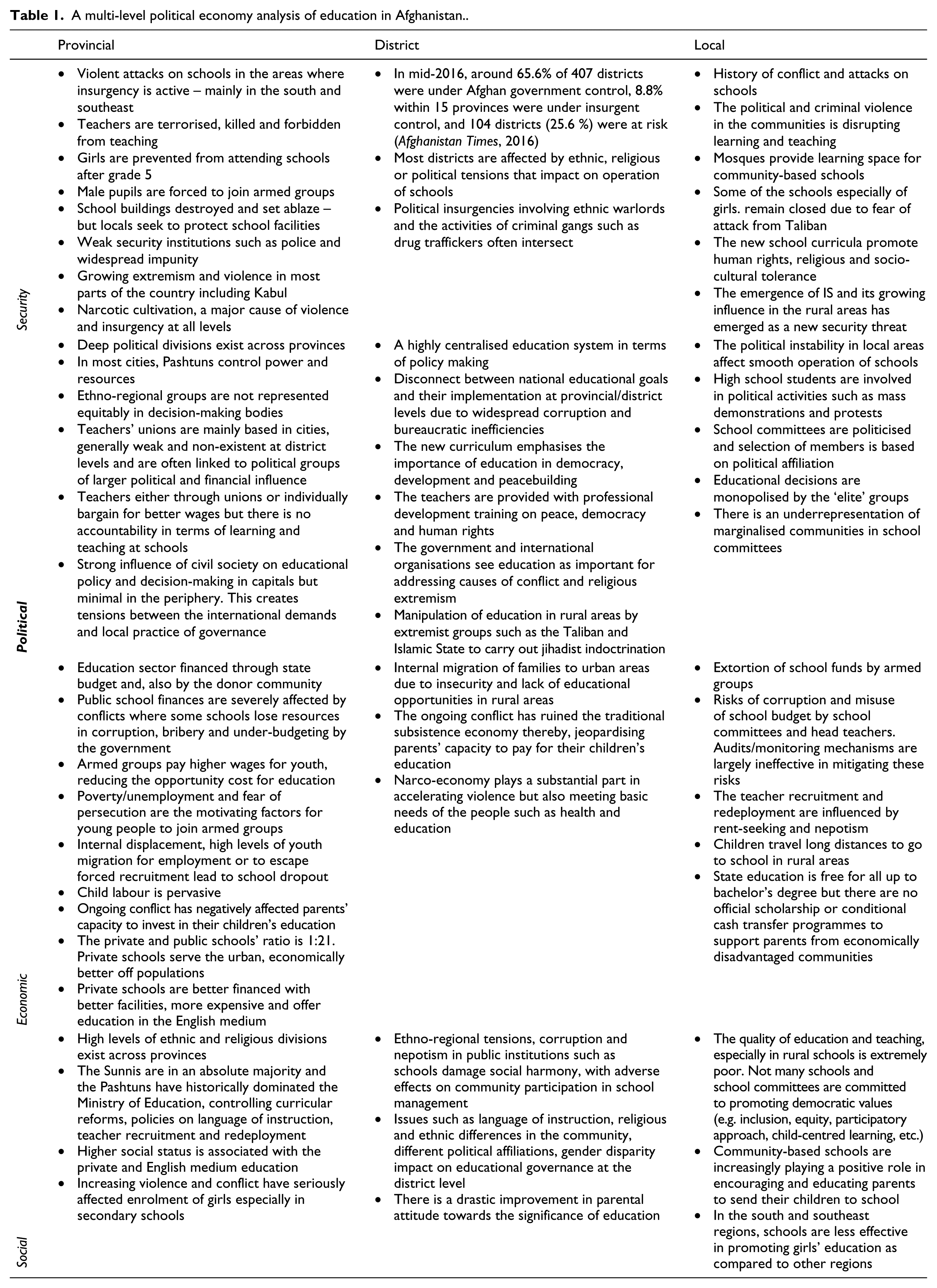
Educational institutions in post-2001 Afghanistan have yet again become a major site for transmitting political ideologies and recruiting new members. Schools are prominent sites for political campaigns such as political debates, distribution of political literature, open protests and demonstrations which sometimes turn into violent scuffles. More ominously, 89.1% of students surveyed across ten provinces reported that they had personally witnessed Islamic groups such as Hizb-i Islami, Jamiat-ul Islah (Salafis), Hizb-ut Tahrir, Taliban and Jundullah operating at schools (see Afghanistan Research and Evaluation Unit, 2016). Using a conflict analysis framework in the education sector (Department for International Development, 2002; Pherali, 2015) and drawing upon our qualitative interviews, we present in Table 1 a multi-level political economy analysis of education in Afghanistan.
A multi-level political economy analysis of education in Afghanistan..
Radicalisation in educational institutions
Concerns about growing extremist ideology was a recurring theme in our interviews with key informants in the education sector. Zaman and Mohammadi (2014) also report that educational institutions including mosques and madrassas, schools, colleges, and universities are becoming primary sites of radicalisation. The extremist clergies, associated with larger Islamist groups, have extended their influence beyond the mosques and madrassas such as computer and English-language learning centres. For instance, in several poor neighbourhoods of Mazar-e Sharif, extremist ideology was observed being taught alongside Excel and PowerPoint lessons (Fazli et al., 2015). Zaman and Khalid (2015) observe that militant groups such as the Taliban, Hizb-e Islami and IS extensively use social media as part of their broader campaign against the Afghan government and its allies – primarily targeting young students. Based on their study of radicalisation activities across eight university campuses, Zaman and Mohammadi (2014) conclude that while the universities did not play a direct part in the process, Islamist groups were strongly active in university campuses which are dominated by the Pashtun ethnic group.
In Iraq, universities became literal battle grounds during 2005–2007 when Anbar University campus was controlled by Al Qaeda (Milton and Barakat, 2016) and universities generally ‘witnessed the radicalization of the student body as differing ideologies compete for ascendency and influence on campus’ (Latif, 2006: 3). Some participants in our interviews also mentioned that students under the dominance of radical Islamic ideology would display negative views about human rights, gender equality, liberal democracy, foreign troops’ presence in Afghanistan, secular education and women’s rights. Hence, radicalisation in educational institutions appears to be increasing amid weak governance and security failures across Afghanistan.
Conclusion: a way forward in education in Afghanistan and other conflict-affected contexts
The scale of politicisation and ideological influence on young people in schools, madrassas and universities seems to suggest that the future of Afghanistan’s Western-backed liberal democracy is fragile and faces a serious threat of radicalisation. Our analysis shows that educational institutions are increasingly falling in the trap of political extremism not only at the expense of children’s right to gain quality education but also putting the long-term peace of the country in jeopardy. In this context, educational programming that undermines complex social, political, economic and security dimensions of Afghan society is likely to not only fail but also exacerbate conditions of conflict.
Insecurity, corruption and weak governance are the three most prevalent challenges for educational development in Afghanistan. Children, teachers and educational officers face serious security threats from armed groups such as the Taliban and IS who reject modern education that aims to provide Afghan children with a global outlook, critical thinking and knowledge and skills to engage in economic activities in the era of globalisation. Firstly, schools in Afghanistan need to be located in the historical context of Afghanistan’s forty yearlong ‘war ideologies’ which continues to be a dominant feature even today. The growing influence of radical Islam on schools exacerbates Afghanistan’s already crumbling education sector and adds to the country’s state fragility. Secondly, corruption has increased significantly in Afghanistan in recent years (Transparency International, 2016; United Nations Office on Drugs and Crime, 2012) and the education sector is no exception (Hall, 2011). The widespread poverty in rural areas and rapid processes of educational decentralisation that provide schools and local school management committees with direct access to educational funds often result in ‘pervasive, petty corruption that permeates the day-to-day transactions at the classroom, school, and district levels’ (Chapman, 2002: 3). Finally, weak governance at the state level is manifested through disconnection between administration and the justice system as well as between and within the Afghan government and the international community on the elements of the administrative system. As Nijat notes:
Weak legislative and research capacity, over-politicized legislation, the inability of the governance machinery to operate as one system as opposed to separate and disconnected units, patronage and political interference in technical decision-making, an internally divided civil service, harmful urban-focused reform implementation and insecurity will continue to challenge good governance. (Nijat, 2014: 3)
As we have shown above, these problems extensively permeate the education system across all administrative levels. The nexus between insecurity, corruption and weak governance also manages to sustain the failing administrative system through a mutually beneficial relationship in which one fuels the other. For example, insecurity contributes to corruption and weak governance whereas, the weak governance is the cause of corruption which erodes public trust on state institutions such as education.
In post-2001 Afghanistan, due to explicit violent insurgency, national and international responses have focused mostly on the military dimension while little attention has been paid to educational dimensions that interact with elements of violence and radicalisation. Radicalism unlike terrorism, has social dimensions and a potential to create an environment that would lead to the formation of societies where acts of terrorism find some sympathy and degree of support (Taşpınar, 2009). Education can serve as a fertile ground for cultivating radical ideas that terrorist activities can capitalise on. Hence, thinking about education only in technical terms (e.g. teacher recruitment, school building, enrolment and textbook supply) and clinging on to the idea that more schools in Afghanistan would mean more peace is utterly flawed. What happens in schools and university campuses and the kind of learning that is taking place in classrooms and the outcomes that are being produced by educational investment are more pertinent questions in conflict-affected contexts.
This paper has examined micro-level political economy factors of education in Afghanistan to demonstrate that education is caught in a complex interplay between security, political, economic and social dynamics. This analysis also provides some insights into other similar conflict-affected contexts where educational reforms face multiple barriers and often fail to cater for the needs of socially and economically disadvantaged populations. Firstly, the intersectionality between fundamentalism and state fragility produces a conducive environment for radicalisation through education. The weak governance, insecurity and corruption in the education system only fuel public distrust towards the state, creating a manipulative space for non-state actors. Secondly, in post-war societies where governance structures are either broken or yet to be fully established, the influx of international policy prescriptions can overwhelm local stakeholders and lead to negative repercussions. As the international promises of service delivery such as education and health meet with national incapacities to deliver them, it can only lead to public frustration and mistrust of the government, putting the fragile peace in jeopardy. Thirdly, in the context of ongoing violence where schools are deliberately attacked by armed groups, promoting the conventional notion of schooling can put children’s lives at risk (Pherali, 2016). Finally, without establishing effective accountability systems and building capacities of local stakeholders, devolution of school management responsibilities to local stakeholders can suffer ‘elite capture’, rent-seeking and corruption. These outcomes can be rather more prevalent in the context of poverty where people lack in adequate economic opportunities. Additionally, the local level educational initiatives may contradict with the political agenda of the elitist state and international authorities, which exposes the irony of the local ownership agenda. In other words, local initiatives are only endorsed if they conform to the donors’ agenda for ‘development’.
A good quality education has a prominent role in post-war peacebuilding – especially, in the long-term peace, development and social transformation. Hence, education should be an integral part of peace and development strategy of a post-war society so that approaches to improve security, political settlements and conflict transformation are supported through sustainable educational structures. The challenge is to find a balance between globally non-threatening educational practices at the local level and the ideologically non-intrusive global agenda for education in the contexts that have been affected by violent extremism.
Footnotes
Declaration of conflicting interests
The author(s) declared no potential conflicts of interest with respect to the research, authorship, and/or publication of this article.
Funding
The author(s) disclosed receipt of the following financial support for the research, authorship, and/or publication of this article: This research was supported by a seedcorn grant from British Association for International and Comparative Education.