




Abstract
In this article, I argue that the world-view adopted by Children’s Rights Education advocates influences the form of education they present. In the first part of the article, I discuss three perspectives: (1) the legalistic perspective, which sees Children’s Rights Education as a matter of technical implementation; (2) the reformist-hermeneutic perspective, which focuses on the interpretation and elaboration of core children’s rights texts; and (3) the radical view, which sees Children’s Rights Education as part of a broader political struggle for education. In the second part, I consider the implications of each of these perspectives for teachers and argue that only the latter tradition positions teachers as agents of change, while the others reduce teacher agency. The article argues that the first two perspectives are unlikely to achieve radical change for children, and that Children’s Rights Education advocates must engage more overtly with the politically contested nature of education.
Keywords
Introduction
This article stems from my reflections on a recent research project I led for United Nations International Children’s Emergency Fund (UNICEF; Jerome et al., 2015) in which my colleagues and I had the opportunity to interview a number of Children’s Rights Education (CRE) advocates working in non-governmental organisations (NGOs) and education institutions in several countries. One of the contradictions that struck me during these conversations was that our respondents often seemed to envisage fairly significant changes as a result of CRE, for example, transformed pedagogic practices, innovative forms of school decision-making and a greater degree of child-centeredness and curricular flexibility, while also discussing fairly small changes in legislation or policy. I was struck by this belief that relatively conservative reforms might lead to radical changes, and intrigued that such a position seemed to ignore much current scholarship and research focusing on the dominant education policy paradigm of international standards, accountability and performance management, which seem to exert a narrowing effect on school practice in many countries (Ball, 2008).
Furthermore, as a teacher and teacher educator, I was also struck by how much of the conversations focused on structural and national policy change, and therefore tended to minimise or simplify the role of the teacher. By contrast Ball and his colleagues have documented the complex and nuanced ways in which teachers exert agency in the processes of policy interpretation and implementation – what they call ‘policy enactment’ (Ball, 2010; Ball et al., 2012). Others working in the broad field of political or citizenship education have noted that teachers’ own political beliefs (Leenders et al., 2008) or world-views (Wilkins, 1999), and their access to like-minded practitioners (Schweisfurth, 2006) have an impact on how they interpret policy. Wilkins demonstrated how the world-view of student teachers he spoke to was informed by dominant discourses about the value of traditional teaching and scepticism towards politics, which he argued would lead these teachers to adopt a fairly conservative form of citizenship education, regardless of how radical the curriculum may be.
In reflecting on CRE, I want to focus quite narrowly on how different positions taken up by academic researchers and theorists reflect different world-views, and, second, to think about the implications of these world-views for conceptualising the role of teachers. Following Wilkins, I use the term ‘world-views’ to indicate the underlying set of beliefs and values about children, education and children’s rights, which inform how people understand CRE. This is evident in the ways they frame CRE (e.g. Do they see it primarily as part of a broader human rights international legal framework, or do they see it in interpersonal terms?) and the types of actions they prioritise for implementation (e.g. Do they see this primarily as top-down policy development or as bottom-up culture shift?). This focus only represents a small part of the overall ambition of CRE, which addresses education in all its possible manifestations. Nevertheless, given the significance of schools in the lives of most children, it seems a worthwhile focus to explore in order to clarify some of the current thinking around CRE for teachers and to reflect on the tensions I have already noted. As such, this article seeks to shed light on one small part of the overall field of CRE.
What is CRE?
Human Rights Education (HRE) is a well-established field with the United Nations (UN) sponsoring a world programme for HRE over several decades (UN General Assembly, 2010), issuing a Declaration on HRE and Training (UN Declaration on Human Rights Education and Training (UNDHRET); UN General Assembly, 2011) and spawning resources and initiatives around the world (see, for examples, www.ohchr.org). Because the academic literature using the term CRE is relatively limited, those interested in exploring CRE must also draw on work that focuses on children’s rights to and in education (Quennerstedt, 2011) and material that makes direct links between HRE and the rights of the learners engaged in that process. While many authors continue to use the terminology of HRE, they can be taken as referring to CRE, where they accommodate the fact that children are simultaneously rights holders and learners. While this may appear to be self-evident in all HRE work, there is a tendency in some HRE work to focus on the human rights of adults in other parts of the world (poor countries affected by conflict and poverty) at the expense of exploring children’s rights in relation to the lives of the learners (Krappmann, 2006) and so HRE and CRE are not entirely synonymous. Krappmann has argued that HRE in Western classrooms can become lessons about others’ rights and problems, and the children in those classrooms may experience such HRE as just another passive and potentially alienating classroom teaching experience.
Because of this, CRE was formally adopted in 2014 by UNICEF’s Private Fundraising and Partnership Division (UNICEF PFP, 2014) as a key objective in order to clarify that children should learn about rights through education programmes which emphasise their status as rights holders, and which connect learning to their lives. As such, in this article, I refer to CRE to signify UNICEF’s recent initiative of that name and to material in the wider tradition of HRE, which explicitly addresses this need to connect to the rights of the learners themselves.
While there has been relatively little written on CRE in particular (Ang, 2009; Lundy, 2012), there are some key reference points, which point the way to a definition. Most notably for the purposes of this article, these sources include the Committee on the Rights of the Child (CRC) itself (UN General Assembly, 1989); General Comment No. 1, which presents the Committee’s interpretation of Article 29 (UN Committee on the Rights of the Child, 2001); and UNICEF’s handbook (UNICEF PFP, 2014) which clarifies that CRE should (1) address children’s knowledge and understanding of the Convention on the Rights of the Child (CRC) (UN General Assembly, 1989), (2) adopt processes which respect and promote those rights, and (3) prepare children to become active agents in promoting children’s rights and holding duty bearers to account. Subsequent sections consider these sources in greater detail.
In reflecting on the developing CRE literature, this article explores the different positions taken up by academic researchers and others writing about CRE, through a three-part classification system, which identifies some of the distinctive ways in which these world-views differ. This is offered as a heuristic device to clarify some of the significant positions adopted within a continuum of discussions about the nature of CRE. The first position treats CRE as part of a legal framework and tends to perceive it as relatively uncontested area for implementation of already agreed standards; position 2 acknowledges the CRE standards do not represent the whole picture and adopts a slightly more creative hermeneutical process of interpretation of a range of relevant documents, and position 3 places CRE more firmly in contested ideological terrain and adopts a more radical perspective. In the second part of the article, I draw out some of the implications of each position for conceptualising teachers’ role in promoting CRE. The purpose of the article is to reflect on some of the different emphases which are often glossed over in the literature, and to identify more clearly how different interpretations of CRE reflect different world-views and also suggest different kinds of roles teachers might undertake in order to enact CRE in schools. As such, this article contributes to the broader project which Quennerstedt (2011) called for in developing the theoretical basis for children’s rights work. 1
Three world-views on CRE
A legalistic world-view: Implementing children’s rights standards
This first position treats children’s rights in general, and CRE in particular, as a relatively neutral set of ideas, which are not seen as politically contentious. On this reading, children’s rights are not seen as controversial, education itself is not seen as particularly controversial and thus CRE as a specific area of endeavour is not problematised. This position treats interpretation and implementation as pragmatic matters, requiring efficient administration, monitoring and accountability structures. For example, the UNICEF website simply says that the CRC ‘is in force in virtually the entire community of nations, thus providing a common ethical and legal framework to develop an agenda for children. At the same time, it constitutes a common reference against which progress may be assessed’ (UNICEF, n.d.). On this view, the international declarations, conventions, resolutions and other assorted instruments provide an agreed framework, which defines CRE; indeed, in September 2014, the Office of the High Commissioner for Human Rights (OHCHR, 2014) published a website, which pulled together these key references and included over 250 documents.
As part of the World Programme for HRE (2005–2019), the UN has issued guidance, action plans, self-evaluation toolkits and programme evaluation reports, which flesh out what HRE (and by implication CRE) should look like in practice (UN, 2012a, 2012b; UNICEF and UNESCO, 2007). The evaluation report of the first phase (UN General Assembly, 2010) gives the impression that implementation is a technical process requiring better training, better use of resources and clearer policy commitments at state level.
This approach is reflected in Quennerstedt’s (2011) synthesis of the academic literature on children’s rights in education, where she notes that much of the work in this area is largely descriptive or evaluative, rather than contributing to a more developed theorisation of the field. As is evident in the UN material already mentioned, such academic work is mainly preoccupied with establishing what CRE should look like (largely answered by appeal to international standards) and the extent to which it is happening (generally perceived as a question of policy formulation and implementation). Struthers (2015), for example, seeks to clarify what it means to provide education about, for and through rights by an analysis of the text of the UNDHRET, not a study of educational resources. Others are also largely concerned with developing a close reading and tight interpretation of the UN documents, and in this sense, CRE appears to be simply read-off those documents (see, for example, Centre for Human Rights and Citizenship Education (CHRCE), 2012; Gerber, 2008; Lundy and McEvoy, 2012).
In relation to the question of implementation, this legalistic approach tends to focus on the technical aspects of policy making, typically focusing on the need for policy alignment at national, regional and local levels to support school reform. For example, the Inter-American Institute of Human Rights (IIHR, 2005) urges governments to pursue the following steps: (i) the incorporation of human rights standards into national legislation … (ii) the development of relevant content and methodologies in curriculum policy documents, plans and study programs; (iii) the inclusion of similar content and methodologies in school text books; and (iv) continuous training for school teachers. (p. 8)
Similarly, Clair et al.’s (2012) account of CRE focuses on the definition of standards, baseline assessments and alignment between policy and partners. Implementation is largely seen as a pragmatic process of managing educational change with various authors describing ‘ambivalent policy’ as ‘one of the keys to understanding why change in educational settings is slow’ alongside ‘a heavy blanket of traditions and cultures’ (Quennerstedt, 2011: 675). This slowness can also be attributed to policy actors’ ignorance of children’s rights, for example, Lundy (2012) bemoans ‘a general lack of awareness of the CRC and its links to domestic policy’ (p. 408). So it is possible, within this legalistic world-view of CRE, to find practical non-political reasons to explain the implementation process. Indeed, this is almost inevitable as CRE is itself seen as unarguable, and therefore, there are no obvious reasons why it should be rejected. Ignorance and administrative inefficiency thus emerge as key factors – neither of which seriously jeopardises the positioning of CRE as uncontroversial and self-evidently positive.
This is not to say that such work is always essentially politically naïve, one might argue that some advocates of this first position present themselves deliberately as uncontroversial precisely because children’s rights here are being used as a mechanism to hold governments to account. On this reading, adopting a legalistic approach rather than an overtly political one may be seen as an attempt to defuse the controversy inherent in discussions about the treatment of children (and the subsequent questioning of adult decisions). As noted in the introduction though, there is also a risk that presenting CRE in such terms may limit the impact in reality – small changes may reasonably be expected only to deliver small improvements.
A reformist world-view: The hermeneutic process of building an interpretation of CRE
Our second position in relation to CRE is, in many ways, an extension of the first, but one in which authors are more explicit, and often more creative, in constructing further elaborations of CRE. In moving further beyond those core declarations and conventions, these examples get closer to embracing CRE as a distinctive ideological position within education and one which represents a broader challenge to education policy and practice. To some extent, this is represented within the UN by the General Comments issued by the Committee on the Rights of the Child, which elaborate on the Convention with detailed guidance, for example, General Comment No. 1 (UNCRC, 2001) interprets Article 29 on the aims of education, but in doing so significantly expands the range of the Article and goes some way towards elaborating a more overtly political view of CRE. It states that CRE has implications for the curriculum, educational processes and institutions and calls for a whole raft of child participation and peer education initiatives (paragraph 8). It also stakes out a very distinctive ideological position, attacking education which prioritises competition and a narrow focus on knowledge acquisition (paragraph 12). This must be seen as presenting CRE in opposition to policies currently observed in many states, rather than just an additional layer of policy to be introduced.
UNICEF’s CRE Toolkit (UNICEF PFP, 2014) represents a further interpretation and elaboration on the General Comment’s interpretation of Article 29, for example, an appendix to this handbook urges teachers to adopt a pedagogy, which is interactive and features humour, suspense and positive modelling. While these may be valuable characteristics of teaching, they are certainly not specified in the CRC and as such they represent a commitment to quite freely interpret the key texts.
In promoting this fuller interpretation of CRE, it is increasingly clear that the Committee positions itself in some fairly contentious educational territory, although it does not always acknowledge this. To point out some of the most controversial issues, the notion of empowerment within a school where adults have legal responsibility (and thus where they have the final say) has been derided as disingenuous by critics of progressive methods (Buckard, 2007), the focus on holistic education is seen as problematic in the context of high-profile international standardised tests (Mejias and Starkey, 2012), the call to promote equality without fundamentally challenging the basis of social inequality is seen as hypocritical and naïve by proponents of critical race theory (Gillborn, 2008), and the debate about whether a curriculum should be driven by ‘relevance’ is opposed to a recent emphasis on the curriculum as the vehicle for a more rarefied form of ‘powerful knowledge’ (Young, 2013). The Committee frames its declarations in the name of ‘interpretation’ of the CRC, but it is evident that the positions advocated by the Committee are far from being neutral or uncontroversial, indeed they strike at the heart of current education policy debates.
The academic work which could be situated in this second category tends to be more explicit in its recognition that this CRC-related ‘activity meaning system’ (Dauite, 2008) is actually being formulated and interpreted within a context in which children, childhood and education are contested concepts. For some authors, this involves the construction and elaboration of CRE and the drawing of definitional boundaries in relation to other related agendas, such as civics or ethics. Hung (2012), for example, emphasises that the distinctiveness of CRE stems from the universality and unconditionality of human rights, and defends this against possible conflation with citizenship education, which requires boundary setting and therefore some element of conditionality (see also Kiwan, 2005). Others focus on promoting child-centred education and participative methods, focusing on forms of pedagogy which exemplify children’s capacity for working cooperatively (McCowan, 2012; Osler and Starkey, 2005, 2010). Such work spans a variety of approaches, from very specific teaching strategies to whole school programmes, for example, Lyle (2014) promotes Philosophy for Children as a CRE teaching method; a Council of Europe (2007) handbook lists over 40 specific teaching strategies that promote children’s rights; and school councils are justified in relation to children’s rights (Fielding, 2001;Whitty and Wisby, 2007; Wyse, 2001) and Rights Respecting Schools programmes are offered as mechanisms for embedding children’s participation rights into school structures (Covell and Howe, 2005; Sebba and Robinson, 2010; Trivers and Starkey, 2012). While one can see how these ideas could be developed from a reading of the CRC, it is clearly an additional interpretation, which builds on specific aspects of the CRC and minimises others.
A radical world-view: Education as contested terrain
To some extent, both the positions considered so far could be described as ‘declarationist’ (Keet, 2015: 4) insofar as they are focused on the interpretation and implementation of declarations, conventions and other international legal instruments. In this section, I outline two different views of CRE: first, some authors frame CRE within a more overtly radical critique of contemporary educational practices, and second, others develop a more context-related approach, devising distinctive models of CRE, which aim to promote very different objectives, and in doing so move away from notions of universal international standards and technical implementation processes.
Starkey (2012) argues that the Universal Declaration of Human Rights (UDHR) and the rights framework emerging from it is essentially a utopian vision and that such visions ‘may challenge unequal social and economic conditions’. In pursuing this commitment in the field of education, the more radical constructions of CRE often draw on critical pedagogy, for example, explicitly building on Freire’s radical pedagogy (Butler, 2012; People’s Decade for Human Rights Education (PDHRE), 2006; Roche, 1999) and appealing to CRE’s ‘transformative potential’ (Tibbits, 2005). In a study of a school implementing an Amnesty programme, Mejias and Starkey (2012) argued there were tensions between a dominant neoliberal ideological paradigm promoting individualised, competitive, consumer models of education and the humanistic, collaborative, developmental educational ideology espoused within Amnesty’s rights-based model. They concluded that these competing priorities (accountability, managerialism, standardised tests) are not simply alternative policy prescriptions vying with CRE for attention, but they often function as components of an overarching neoliberal paradigm, which may be inherently antithetical to CRE (see also Ichilov, 2012). In a similar vein, Kjørholt (2013) contrasts educational approaches which recognise children as right-holders and agents for promoting rights, with those that see them in terms of human capital.
The second type of response acknowledges that there may be different legitimate traditions of CRE, each with their own distinctive ideological perspective. This is very different from the first position (the legalistic world-view), which tends to focus on the standard to be achieved, and which would therefore see local variations as steps on the way to full implementation. On this approach, there are a number of legitimate alternative interpretations, which must be justified in relation to the CRC and to the local context. This opens up the possibility of more fully responding to the criticisms described by Baxi (1997) that rights are excessively individualistic and rooted in western thinking, but in doing so undermines the notion of a single standard to be achieved.
Bajaj (2012), for example, outlines three forms of CRE, which reflect different priorities. First, she describes education for global citizenship, which rests on the assumption that human rights inform a new global political order. Second, Bajaj describes education for coexistence, which is informed by the commitment that CRE can lead to healing and reconciliation. And third, she describes education for transformative action, in which education is part of a radical politics of inclusion and social justice. This recognition of the legitimacy of a range of forms of CRE is also reflected in Tibbits’ (2008) later work, which draws attention to the overall national context and the likely ways this may shape rights education. In post-conflict contexts, Tibbits argues, it may be more appropriate to focus on the rule of law and the legitimacy of authorities; in repressive regimes, CRE/HRE might become a focus point for resistance and empowerment; in democratic but poor countries, issues related to sustainable development may be most significant, and in wealthy democracies, such education programmes might be more focused on issues related to discrimination. This adds another significant dimension to CRE, and recognises that while there are clearly important principles underpinning it, in reality these might lead to radically different processes and outcomes.
Thinking about the role of teachers
Each of the positions outlined above implies a different kind of vision of the teacher in relation to the process of implementing CRE. This section draws on wider work in the field of the sociology of education, in particular the work of Ball and his colleagues (Ball, 2010, 1993; Ball et al., 2012; Bowe et al., 1992), who consistently emphasise the role of the teacher in interpreting policy. Crucially though, borrowing from Barthes, Ball also distinguishes between writerly and readerly texts, which position teachers in different relations to a text (Bowe et al., 1992). Readerly texts specify what should happen in some detail and leave little room for additional interpretation, while writerly texts invite a more active engagement and are open to more creative interpretation. Below, I apply this idea to outline three possible roles for teachers in relation to each of the positions on CRE outlined above.
Teachers as implementers
In the first position, CRE is largely provided to teachers intact, as a body of recommendations (or requirements) specified in international agreements. This implies a top-down implementation model in which teachers are perceived as the implementers of CRE, as determined by others higher up the educational system. Typically others design resources for CRE, train teachers in CRE pedagogy, and set up monitoring and quality assurance mechanisms and teachers’ role may therefore be seen as relatively passive – being trained, using appropriate resources and teaching methods, and complying with inspection. If there is leeway for interpretation, it is at the micro-level regarding day to day decisions about how best to implement these sources of guidance.
Checklists produced by the UN and other international bodies are generally at a fairly high level, and thus specify overall system requirements for the government to address (e.g. European Union Agency for Fundamental Rights (EUAFR), 2010) with the expectation that national plans should develop more detailed specifications (OHCHR, 1997; UN, 2012b). However, some of these documents do specify CRE in some detail (UN, 2012a: 32), and Jennings (2006) goes a stage further in outlining a set of standards for teachers, derived from international human rights instruments. The basic point to make here is that teachers are seen in relatively simplistic ways as cogs in the implementation machine, to be incentivised and monitored to ensure alignment between international agreements, national policy and classroom practice.
As a consequence of this simplified model, teachers tend to be seen as either compliant or as obstacles, and problems largely arise from teachers’ ignorance of children’s rights (Cassidy et al., 2014). For example, Howe and Covell (2005) have argued that teachers often adopt a negative approach to CRE, and Figue (2013) and Leung et al. (2011) report that many teachers see children’s rights as a threat to adult authority (thus, failing to understand the appropriate role of adult duty bearers). Thus, teacher training becomes a key recommendation in many reports on HRE and CRE (Burridge et al., 2013; Danish Institute for Human Rights (DIHR), 2013; Human Rights Centre (HRC), 2014; Morgan and Kitching, 2006; UN High Commissioner for Human Rights (UNHCHR), 2010). This is seen as important to address the teachers’ lack of knowledge and understanding (Keng, 2008).
Teachers as gatekeepers and collaborative agents
To some extent, even the second position we have considered fosters some of the same tendencies to simplify the role of teachers; however, whereas the first position may characterise teachers as simply being unaware of the principles of the CRC and CRE, the second position opens up the possibility of their opposition being more deliberate and political (Lyle, 2014). This goes beyond seeing teachers as ignorant or afraid and identifies the problem that many have world-views in which children are defined as incapable and in need of direction and control. Such views are unlikely to be remedied by simple solutions like Keng’s (2008) myth-busting workshops about the CRC.
This recognition that teachers may have principled reasons for being cautious or sceptical about CRE opens up different forms of conceptualising their roles. In the context of a large NGO programme for HRE, Bajaj (2012) argued that teachers can be seen as ‘collaborative agents’ and therefore urges CRE advocates to engage with teachers, listen to their concerns and try to win them round through discussion (i.e. political engagement). On this view, teachers can open the doors of the classroom to CRE, encourage students to engage with CRE, promote CRE to parents and, in the words of one evaluation project, become ‘points of social cohesion’ (Capra International, n.d.: 3). This second role therefore still positions teachers as essentially readerly (in the sense that CRE is already established according to expert interpretations), but teachers are recognised as having a significant gatekeeper role, and therefore, CRE is best promoted through a dialogue with teachers. This represents a political engagement with the teacher, albeit one which may be slightly optimistic about the strength of some of their objections.
Strategies designed to tackle these issues may involve an explicit challenge to the world-views of teachers, for example, Covell and Howe (2005) note that some teachers in their Hampshire study chose to focus on teaching children about their responsibilities before they were prepared to teach them about their rights, and one might argue that some direct training to challenge this as a misconception would help to defuse such opposition. However, more pragmatic responses may effectively sidestep the problematic teacher’s world-view and seek to promote the other benefits of CRE, thus making an appeal to the teachers’ other priorities. Typically, such strategies include promoting CRE because it leads to other valued outcomes such as better attendance, behaviour and even literacy levels (see Covell and Howe, 2005; Trivers and Starkey, 2012). The risk here is that such strategies promote the instrumental value of CRE rather than an intrinsic value, and this implies that one may reject CRE if it no longer secures these other outcomes.
Even if teachers are convinced that the list of CRE strategies outlined above (under the heading ‘A reformist world-view’) are valuable in their own right, and not as means to other ends, there is still the problem that such teaching strategies may not sit easily in an education system configured around other values. Yamasaki (2002) argues that teachers who attempt to promote more rights-based pedagogic strategies in traditional schools, where such principles are not routinely promoted, are likely to be perceived by students as hypocritical. We return to this below, but it introduces the rationale for a more political engagement with children’s rights, which is the subject of the next section.
Teachers as change agents
By contrast, once one has acknowledged that CRE must be constructed within specific national and institutional contexts, and within ongoing educational debates, it follows that teachers must be seen as active agents of change themselves. On this view, CRE is more firmly positioned as a writerly phenomenon, which requires people to actively engage with it in order to create an educational agenda they can implement. In dealing with teacher beliefs about CRE, David (2002) points out that the CRC may present a challenge to traditional beliefs because it represents a shift from education as welfare provision to education as a right, and implies a second shift in adult roles from protection to facilitating emancipation and autonomy. This emphasises the significance of the world-view which informs teachers’ responses to CRE.
In this vein, Howe and Covell discuss evidence that teachers’ implementation of the curriculum is influenced by the extent to which it resonates with their own beliefs and values and thus we might expect CRE to be promoted by those with a commitment to children’s rights and children’s agency more generally (Howe and Covell, 2005). Schweisfurth (2006) makes a similar point, observing that teachers’ strategic decisions about how to spend their time reflects their own motivation in relation to the topic. This resonates with other research that argues teacher beliefs have a significant impact on how they interpret the curriculum, especially topics seen as political (Jerome, 2012; Jerome and Clemitshaw, 2012; Leenders et al., 2008; Myers, 2009). Al-Nakib’s (2012) case study of curriculum reform in Kuwait indicates that, where teachers are willing to embrace a CRE approach, they can also use their agency to interpret even relatively unpromising and conservative curricula frameworks. This potential of teachers’ agency is also reflected in Gerber’s (2008) account of HRE implementation where she acknowledges the traditional top-down model of policy implementation can be reversed to some extent, with committed teachers joining together with NGOs to develop new forms of education. A report on UNICEF UK’s work in Scotland documents how this approach has led to almost half of all state schools gaining ‘Rights Respecting Schools’ status, in the absence of formal policy requirements (Jerome et al., 2015).
Concluding remarks
The argument developed above can be summarised in the following table (Table 1).
Summary of three positions in relation to CRE.
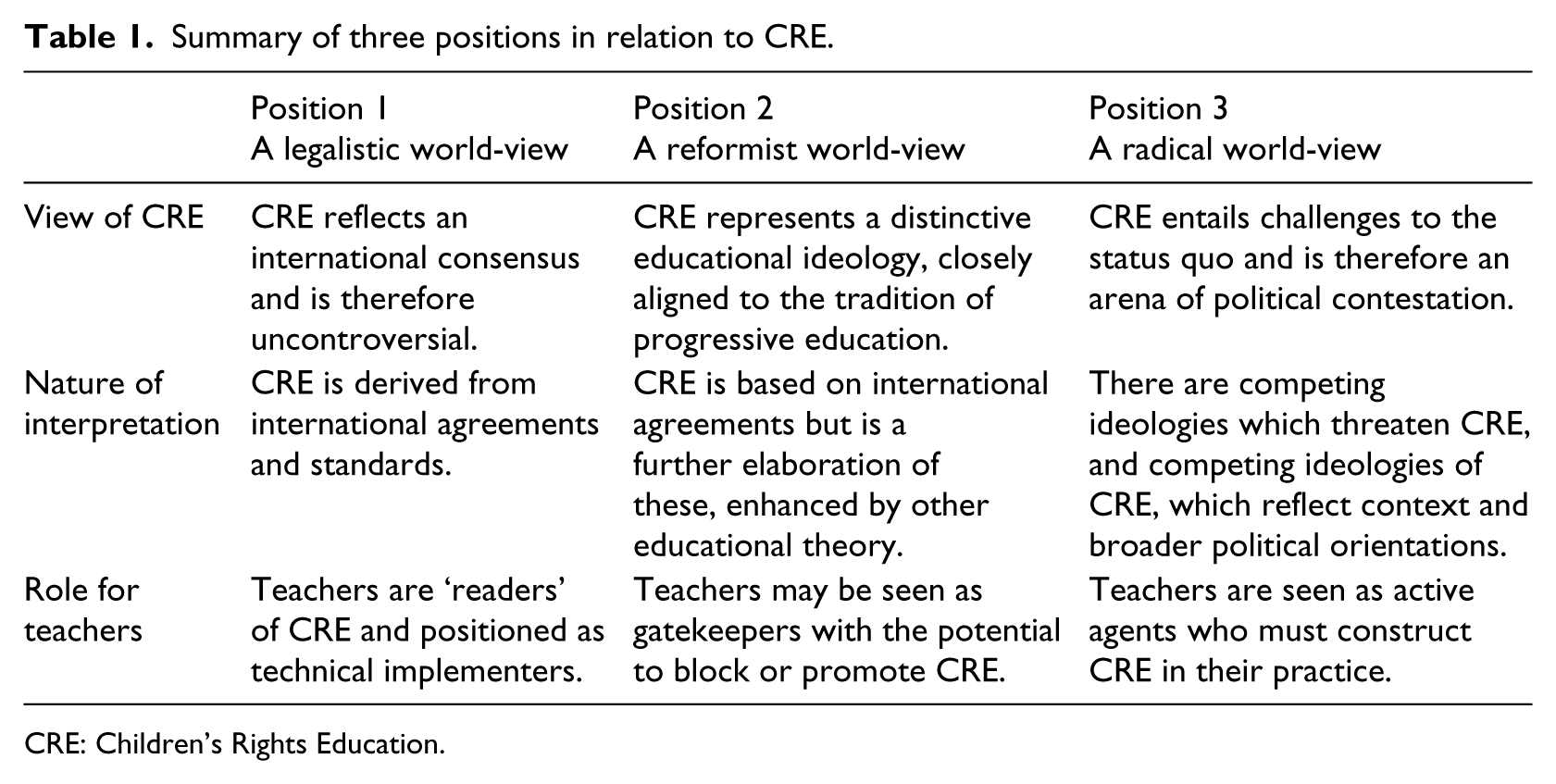
CRE: Children’s Rights Education.
The third category outlined above indicates that the forces that keep children from fulfilment of their rights are greater than mere tradition and ignorance (although these would be significant enough challenges in their own right). These inhibiting forces include the tendency within education policy to individualise education, to perceive it in terms of a personal investment in social capital and to judge it according to the success with which educated individuals can transition into the economy. Such a view resonates with Freire’s (1972) account of banking education, and is now perpetuated by a broader neoliberal global paradigm, in which individualisation, marketisation and, ultimately, monetisation dominate other competing value systems (UN General Assembly, 2014). Keet (2015) has argued that old HRE discourses must be replaced with a new Critical HRE which explicitly addresses the problematic relationship between human rights and the neoliberal global economic context, which so routinely violates human rights.
Those adopting the first two world-views may defend their positions precisely on the grounds that they will avoid plunging CRE into hotly contested political territory. On the legalistic world-view, change can be implemented through bureaucratic mechanisms, without having to engage in overtly political arguments, and teachers can simply be instructed about best practice. On the reformist-hermeneutic world-view, CRE can simply be elaborated by experts, and then somehow promoted to teachers as a valuable project. Both positions hold on to the ideal that one can derive a universal standard for education outside of the ongoing debates about what education is for, who should control it, and what values should inform it. However, I would argue that a CRE which fails to acknowledge the essential oppositional nature of such a project is destined to become marginal. As such, it is likely to be perceived by children as yet another manifestation of adult hypocrisy (Yamasaki, 2002). A CRE which acknowledges the essentially political nature of education, at least holds out the prospect of developing intellectual and ethical coherence in naming and dealing with the dominant discourses which undermine human rights. If it is important that the means of education are aligned with the ends (McCowan, 2009) it is also important that CRE recognises the systemic and ideological constraints which inhibit children’s rights in the education system.
This renders CRE a political agenda for educational reform as much as, if not more than, a narrow programme for teaching and learning. It also demands a more sustained writerly approach to interpreting CRE, so that teachers (those who are won over to the cause) see themselves as agents of change (Fullan, 1993). Those advocating for CRE also need to be clear what form of CRE they are pursuing, and avoid conflating the means envisaged in relatively apolitical models (such as outlined in position one), with the transformational ends envisaged in other more radical accounts of CRE (such as those discussed in position three). To put it baldly, if one is happy to advocate for CRE which promotes a slightly enhanced role for student voice and a slightly more flexible curriculum structure to allow for individual choice, then one should not couch CRE within the radical terms of empowerment and transformation; whereas if one intends to use CRE to tackle systemic inequalities and the marketisation of education, one has to be clear that this is no mere technical matter of compliance with international standards, rather it is a radical call to action.
The implications of this final point are significant. It means that the appropriate course of action would be for CRE advocates to engage governments more directly and critically to question the dominant education paradigms and to assert a more democratic set of principles as the basis for education. Indeed, this more oppositional tone is evident in the UN Special Rapporteur on Education’s 2014 report (UN General Assembly, 2014), in which human rights are presented in stark contrast to prevailing market-related values and principles in education. It also means approaching teachers who feel frustrated by the ways in which their agency is constrained and education is distorted, and encouraging them to adopt children’s rights as an alternative framework for conceptualising their practice. This means essentially giving up the UN sponsored dream of a ‘one size fits all’ CRE (implemented from the top-down) for a series of locally negotiated solutions, which address local problems in the context of local cultures, traditions and resources – what Hopgood (2013) referred to as the ‘democratization’ of human rights.
Footnotes
Declaration of Conflicting Interests
The author(s) declared no potential conflicts of interest with respect to the research, authorship, and/or publication of this article.
Funding
The author(s) received no financial support for the research, authorship, and/or publication of this article.