




Abstract
Recently, doubt has been cast on the ability of Scottish education to meet relevant Human Rights requirements relating to education. This article will outline both a means of clarification for international requirements for Human Rights Education, and an analysis of documentation outlining Scottish educational policy for compatibility with these requirements. In doing so, this article will outline the development, and application, of a tool for document analysis focused on international requirements for Human Rights Education. The findings of this analysis suggest a number of key limitations in the current approach favoured by the Scottish Government. This approach posits Global Citizenship Education as a cross-curricular theme capable of fulfilling obligations in relation to rights in Curriculum for Excellence. I suggest that there is a distinct lack of support for the Human Rights Education requirements relating to the inclusion of taught content about human rights and that problems of apoliticality and the misguided focus on responsibilities all stand as significant barriers to Global Citizenship Education meeting the aims of Human Rights Education. I argue, on this basis, that the strategy currently adopted in Scotland appears to fall short of meeting basic international requirements for Human Rights Education.
Keywords
Introduction
Background
Over the last several decades, significant attention has been given to the importance of human rights within education (Bajaj, 2011; Tibbitts, 2002). The key development of this period has been the emergence of Human Rights Education (HRE) as both a concept, and an educational programme in its own right (Coysh, 2014). With the continuing, and often appalling, levels of rights violations and anti-democratic and discriminatory practices taking place across the planet, HRE emerges as an attempt to provide an education that ‘encompasses a social justice theme’ (Lapayese, 2005: 389). The ongoing international refugee crisis, and many serious issues surrounding social justice and inequality within the United Kingdom itself, poses serious and complicated questions about moral and legal obligations we have to others (Cruft et al., 2015; Struthers, 2015b). Many of these issues are reliant on a secure understanding of the rights to which we are all entitled. With significant questions relating to the future standing of the European Convention on Human Rights, and the Human Rights Act itself within the United Kingdom, there is a strong need to clarify the role of education, and the obligations the state has in their realisation. Moreover, the role and prominence of rights in society more generally has recently been called into question, partly as a response to Brexit, among other things. 1 This has made the need to articulate the importance of human rights in a liberal, democratic and just society a pressing issue.
Successive Scottish Governments have cited a commitment to the promotion of a society that is inclusive and respects, and realises, the rights of all people (BEMIS, 2011). A feature of such a commitment ought logically to be the full implementation of the principles and values underpinning human rights within Scottish education. However, in the absence of an explicit directive from Government, initiatives like HRE are unlikely to get very far (BEMIS, 2013; Gerber, 2011). The strategy proposed by the Scottish government for meeting rights obligations relies on the development of HRE through Global Citizenship Education (GCE). However, serious questions have been raised in literature about the suitability of forms of citizenship education in meeting the aims of HRE (Howe and Covell, 2011; Kiwan, 2005). As McCowan (2012: 67) notes, the conceptual basis for upholding the rights of learners remains ‘nebulous’ at best, with little clarity about what obligations teachers themselves have in providing education, and how these may be met. Importantly, Tomaševski (2001b: 9) argues, education is often wrongly ‘perceived as inherently good’ failing to recognise that questions about what, and how, children are taught are crucial.
Research aims
The study outlined here sought to further clarify international requirements for HRE, aiming to offer a concise rendering of a range of relevant United Nations requirements relating to Human Rights in education. This exploration then became the backdrop against which it was possible to analyse documentation outlining Scottish educational policy on HRE for compatibility with these requirements. From these two broader aims, more specific research questions become apparent and form the basis of this article: First, what are the basic international requirements surrounding the provision and realisation of HRE? Second, with these in mind, is GCE, as an initiative, compatible with these requirements? In what follows, I will offer an answer to both of these questions. Finally, this article will briefly describe the development and application of a tool for analysis of policy in light of international standards for HRE.
Human Rights and Education
On 10 December 1948 the United Nations General Assembly adopted The Universal Declaration of Human Rights (UDHR). Though non-binding, it represented a clear statement of principles. As Cruft et al. (2015) note, human rights are the distinctive ‘legal, moral, and political concept of the last sixty years’ (p. 1). As Gordon (2013) suggests, one common understanding of human rights is that they are universal moral norms that have binding obligatory force on people regardless of legal recognition. These obligations hold in all places at all times are not premised on national citizenship, and are indefeasible. A right, we can say then, is a justified claim on others and protects those features seen as most fundamental to our humanity: survival, freedom from oppression, wellbeing, and basic human dignity (McCowan, 2013). For the purposes of this study, it will be sufficient to acknowledge that human rights, whatever their ontological status, make legal, enforceable claims on states (Gordon, 2013; McCowan, 2012; UNESCO, 2006, 2007).
The right to education (RTE) established in UDHR Article 26(2), while non-binding, contains principles that have been subsequently restated, and strengthened, in the binding conventions 2 of the International Covenant on Economic, Social and Cultural Rights (UN ICESCR, 1966) and the International Covenant on Civil and Political Rights (UN ICCPR, 1966). The ICESCR is widely considered to contain the most authoritative expression of the RTE (Beiter, 2006), and is ratified by 160 countries (McCowan, 2013). However, the most important publication for current purposes is the United Nations (UN) Convention on the Rights of the Child (UNCRC (UNICEF), 1989). As McCowan (2013) argues, the UNCRC is very likely the most influential of all rights documents, given its status as the most ratified of all international treaties with 192 signatories. Crucially, it also represents a significant shift in thinking about the rights of children. The UNCRC, for the first time, makes children themselves rights-holders rather than recipients of protections only (McCowan, 2013).
The General RTE
The RTE, as Beiter (2006) reminds us, like other economic, social and cultural rights, is not always easy to comprehend. While the majority of states are willing to protect this right, it is arguably unclear what it ultimately demands of them (Beiter, 2006; Robeyns, 2006). Katarina Tomasevski, during her time as the UN Special Rapporteur on the RTE, 3 worked to dispel any notion that may have lingered that simple attendance in schooling would suffice to fulfil a state’s obligation to the RTE (McCowan, 2013). In contrast to ‘first generation rights’, the RTE is said to entail positive duties, an area that has less straightforward implications for the state (Beiter, 2006; Gordon, 2013; Jover, 2001). Halvorsen (1990) explains that this kind of right places additional burdens on the state as a consequence of the fact that the fulfilment of this right requires both resources and time in order to be implemented; that is, it requires active steps on the part of state actors. Positive rights such as the RTE obligate others to ‘assist, support and promote’ the right bearer in accomplishing their legitimate claim (Gordon, 2013: 29). The UN itself asserts that ‘education is both a human right itself and an indispensable means of realising other human rights’ (CESCR, 1999: n.p.).
HRE in Scotland
Recent work by BEMIS 4 (2011, 2013) and Struthers (2015a, 2015b) has carefully considered the extent to which Scotland currently meets the standards set forth by international legislation on HRE. The conclusions drawn indicated that Scotland currently fails to live up to its obligations in relation to the provision and implementation of HRE within formal education. As BEMIS (2011) note, proposals in the UNESCO (2006) Plan of Action are clear that national curricula should be designed for HRE with HRE being defined within the curriculum and included in all curriculum subjects. This, it is suggested, is currently not happening in Scotland (BEMIS, 2013; Struthers, 2015b). Struthers (2015b: 69) suggests that the lack of HRE in Scotland is ‘largely attributable’ to the lack of clear guidance within the curriculum.
Despite a broad consensus regarding the importance of HRE, it has largely remained poorly defined in literature and legislation (Struthers, 2015b). As Lenhart and Savolainen (2002) outline, the combination of ‘human rights’ and ‘education’ refers to a number of related areas of practice and research ranging from teaching about and for human rights, to the role of education in promoting and protecting the rights themselves. Bajaj (2011: 482) suggests that while there are many variants of HRE, there is a series of core commitments that all advocates hold. HRE is geared towards the promotion of discourses surrounding inequalities, social justice, and the transformation of the classroom into a ‘political space’ where students and teachers develop their awareness of these issues as well as learn the importance of acting accordingly (Lapayese, 2005: 389). Fundamentally, HRE is about the provision for, and development of, awareness and protection of human rights (Bajaj, 2011; Flowers and Shiman, 1997; Lapayese, 2005; Struthers, 2015b; Tibbitts, 2002). In practice, this means that HRE must include both ‘content and process’ relating to human rights (Bajaj, 2011: 482), that is, it is not enough that children learn about their rights, but that education itself must be participatory and rights-respecting (Bajaj, 2011).
HRE in the curriculum
The Scottish curriculum, Curriculum for Excellence (CfE) is designed and intended to be flexible, focusing on outcomes and experiences in order to enable a wide range of teaching and learning strategies to be employed (Scottish Executive, 2004). Exploration of the contents of CfE highlights that aspects of HRE are found, to some extent, across the three teaching areas of: (1) interdisciplinary learning (IDL), (2) freestanding subjects, and (3) themes across learning (Struthers, 2015b). Although one finds few explicit requirements in CfE to educate about human rights themselves, a number of experiences and outcomes reflect ideas relevant to the fulfilment of the UN Declaration on Human Rights Education and Training (UNDHRET) (2011) Article 2(2). Article (2) states that HRE must include education about, through, and for human rights and that this must be clearly established in the curriculum (UNDHRET, 2011) What is most striking, however, is that nowhere in CfE is there a commitment for learners to demonstrate even a basic understanding of human rights norms, principles, the values that underpin them, or the mechanism for their protection or promotion (Struthers, 2015b). Crucial to the process of implementing HRE is avoiding an ad hoc approach by enabling teachers and other educators to understand that HRE ‘is an explicit entitlement within curricula’ and included within all curriculum subjects (BEMIS, 2013: 9; UNESCO, 2006).
The Scottish Government has defended its position on the basis that ‘human rights are embedded within the curriculum’ as a cross-curricular theme (BEMIS, 2011: 15; Scottish Government, 2010). Indeed, this more holistic approach towards the fulfilment of HRE through interdisciplinary means is demonstrated clearly in the promotion of Global Citizenship within CfE. Global Citizenship provides the strongest evidence of engagement with HRE within the curriculum as a whole but is not unproblematic itself. Moreover, even if compatible with HRE, there are serious conceptual worries about whether or not the idea of Global Citizenship is coherent enough to survive as an overarching aspect of the curriculum rather than as a discrete subject (Print, 2015).
Global Citizenship Education (GCE)
Global Citizenship, as envisaged in the Scottish Curriculum, functions as an interdisciplinary subject (or cross-curricular theme) and contributes towards the four capacities 5 central to CfE. In particular, GCE can be seen as a key component of the development of the capacity for responsible citizenship that all Scottish students ought to develop in their time in formal education (LTS, 2011). In practice, this means that all subject areas and all teachers have a responsibility for the delivery of elements of global citizenship and the development of responsible citizenship more broadly.
Mannion et al. (2011) note that over the past decade, there has been an increase in calls for Western nations to provide an education system that is more globally orientated. This global orientation will be a feature of both its pedagogy and the curriculum itself and is intended to equip young people with the skills and values needed to be aware of, and engaged with, pressing global issues (Mannion et al., 2011). In the face of the ever-increasing influence of globalisation on education, and political decision-making more generally, this seems a reasonable suggestion. Indeed, the values commonly associated with global citizenship such as tolerance, universality, and respect for the rights of others seem entirely suited to the HRE project (Pigozzi, 2006; Print, 2015). There are, as Print (2015) suggests, a wide variety of ways in which someone may learn about global citizenship. They are however all ‘problematic in their influences and biases’, leading to a number of competing perspectives on the proper shape of Global Citizenship in education (Parker, 2008; Print, 2015: 187). As Davies (2006) observes, there is a rather complicated variety of permutations of the relationship between the concepts global, citizenship, and education. This variety can often be underpinned by the expression of entirely conflicting values making any kind of broad consensus on Global Citizenship particularly distant (Davies, 2006; Parker, 2008). In order to establish the compatibility, or otherwise, of Global Citizenship with HRE, it will be necessary to carefully consider the relevant policies. The above considerations suggest that there may be enough theoretical similarities between the goals of Global Citizenship and those of HRE to make this a legitimate strategy for the fulfilment of international requirements for HRE in Scotland.
Developing a tool for analysis
The development of a conceptual framework outlining the key commitments of international requirements for HRE served two functions in this study: first, in the development of a standard for judging the necessary criteria for HRE fulfilment in national educational policy, and second, as a tool for assessing the compatibility of Global Citizenship and HRE as currently enacted in Scottish education.
In order to develop a tool for document analysis, I employed a combination of elements from framework development as used in the assessment of different educational policies (or aims) by Chin et al. (2007) and Johnson and Morris (2010) coupled with thematic analysis (Braun and Clarke, 2006). This combination of framework development and thematic analysis has been demonstrated elsewhere as The Framework Method, though my own use of similar techniques is a simplified version catering to the specific needs and scope of the current project, the small range of documents studied, and its research aims (Gale et al., 2013).
Document selection
The following documents served as the primary basis for the creation of this framework, however, requiring a greater level of focus: UNCRC (UNICEF) (1989) and UNDHRET (2011). The rationale for this selection was twofold: first, the UNCRC is both the most ratified of all documents dealing with human rights. Second, it is legally binding, and the Scottish Government makes clear in its overarching policies on children’s welfare and education Getting it Right for Every Child (GIRFEC, 2013), that the UNCRC is the cornerstone of its efforts. UNDHRET, while non-binding, represents the most recent and explicit example of the UN’s understanding of HRE, making this a key document in evaluating policies against this standard. 6
Establishing a standard for HRE
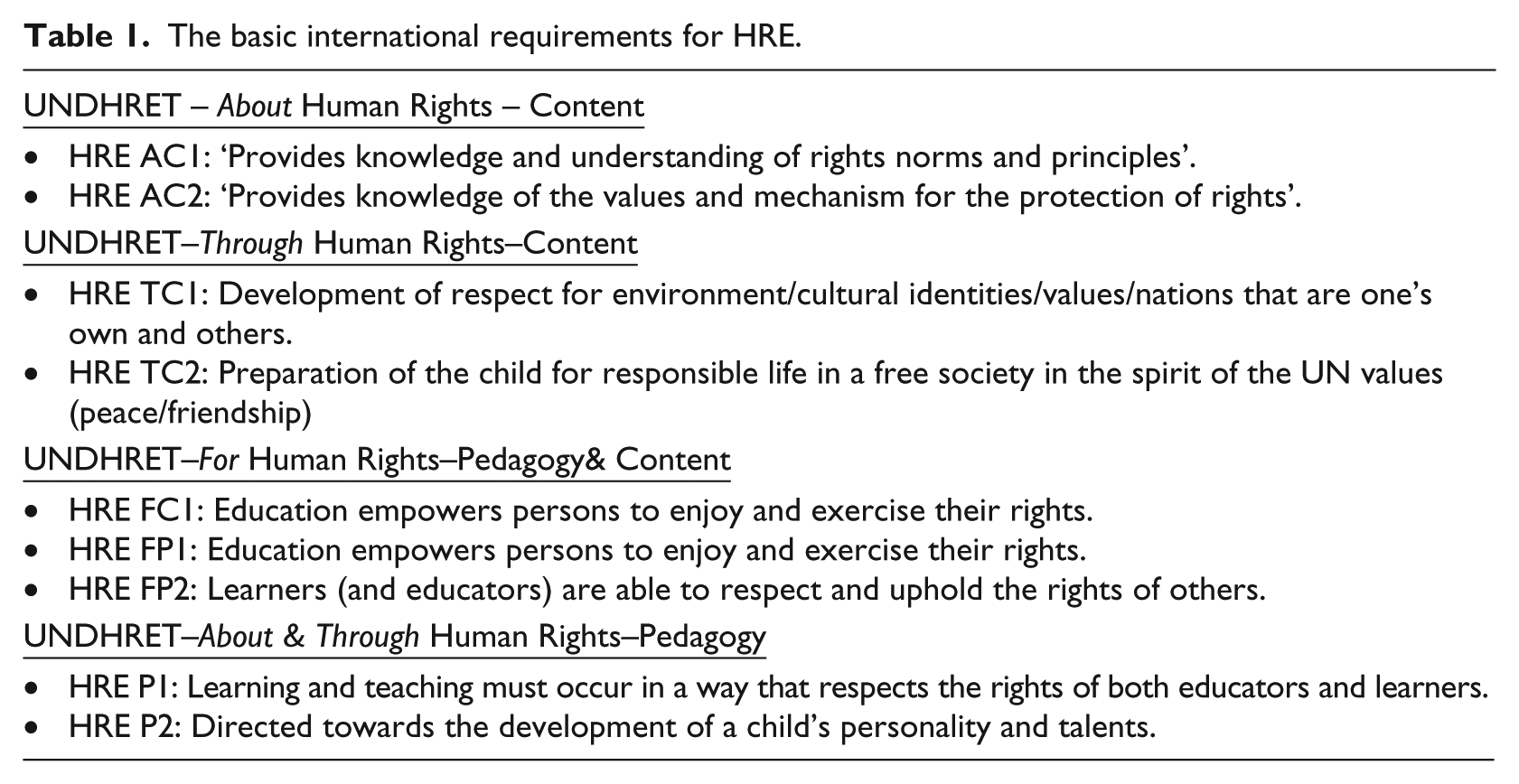
The requirements outlined in the framework below (Table 1), which constitute the tool for analysis, draw together the UNCRC, UNWPHRE (OHCHR, 2014) and UNDHRET articles relevant to education or HRE. Separating taught content (C) and pedagogy (P) requirements as bellow allows for more focused analysis on either of those elements of the curriculum and a range of supporting documents. This is crucial in that both what is taught and how it is taught are of significant importance in developing HRE within education. On the basis of the articles relevant to education and HRE, I propose the following framework outlining the basic international requirements for HRE as a tool for analysis.
The basic international requirements for HRE.
Data collection and analysis
Document selection
In order to make use of the tool for analysis developed here (Table 1), three key documents were selected as the basis for this analysis covering different aspects important to understanding both what GCE is, and how it fits into the Scottish Education system more broadly. Of specific focus were as follows: Developing global citizens within Curriculum for Excellence (DGC) (LTS, 2011), Building the Curriculum 3 (BTC3) 7 (Scottish Government, 2008), and finally, CfE Experiences and Outcomes (CfE:EO) (LTS, 2009).
Analysis of documents
Qualitative document analysis (QDA) was employed in order to establish the strength of support in realising the key requirements of HRE. This QDA review used the Basic International Requirements for HRE (Table 1) as an analytical framework to assess the suitability of Scottish policy on GCE in meeting the UN aims of HRE. The strength of support demonstrated in each of the documents considered, in relation to the areas identified through the framework tool, was categorised in line with the following rating scale: ‘good’, ‘partial’, ‘limited’, ‘none’, or ‘unclear’ (Triple-S, 2013). A rating of ‘good’ demonstrates very clear references to overarching policies that support a specific requirement outlined in the tool (Wach and Ward, 2013). By contrast, a rating of ‘none’ or ‘unclear’ means that there is no explicit mention, or very ambiguous mentions of policies or practices that would support or enable the fulfilment of a particular requirement (Wach and Ward, 2013). The primary unit of analysis here was taken to be sentences themselves and so individual sentences were selected for analysis.
Analysis of documents: General trends
Overall, the analysis of the documents considered highlighted a number of general trends relating to the strength of support given for both the general themes of HRE (About, For, Through) and the specific HRE requirements that go along with them. 8
The lack of content About Human Rights
The first, and most notable of the trends uncovered was the overall lack of evidence of statements supporting taught content About Human rights. This, largely speaking, relates to taught content that specifically outlines what rights are, the principles that underpin them, and the mechanisms for their protection and promotion. Of the documents considered, CfE: Experiences and Outcomes provided the most explicit statements in support of both this theme and the HRE requirements on taught content About rights. However, the statements rated ‘good’ or ‘partial’ often make reference to rights and responsibilities in a way that makes little mention of the importance of the underlying norms or mechanisms essential for the realisation and protection of human rights themselves (BEMIS, 2013). In terms of expected outcomes relating to knowledge About human rights, there are a number of statements, largely restricted to Religious and Moral Education and the Social subjects, that reference rights (or human rights) but lack further in-depth expectations for coverage. In particular, as BEMIS (2013) and Struthers (2015b) have previously concluded, there is limited coverage of content relating to human rights throughout CfE generally, and the analysis of Developing Global Citizens here found the same. In general, the majority of the evidence for support for HRE requirements About Human Rights found in this document refers to democratic values or even more generic ‘values’ as important aspects of the taught curriculum. While these are likely consistent with HRE, they are not explicitly so, and consequently cannot be judged as providing good evidence of support for the HRE requirements (Table 1), nor can they offer evidence in support of the more general issue of compatibility between GCE and HRE. Therefore, while there are a number of statements rated as ‘good’ or ‘partial’ evidence of support for the HRE requirements, the lack of detail, and indeed the paucity of relevant statements, limits the strength of support demonstrated in the document when analysed as a whole. Relevance here is taken to refer to the inclusion criteria for statements in this analysis, that is, statements that can reasonably be concluded to be about the topic under consideration (HRE or human rights), and would exclude statements that refer to, for example, timetabling, or other administrative policies referenced in the documents.
In a similar vein to CfE: Experiences and Outcomes, Developing Global Citizens, while containing some statements strongly supportive of the relevant HRE requirements, overall demonstrates a very limited number of explicit statements that were rated ‘good’. For example, the direction that GCE ought to ‘develop learners’ understanding of equality and human rights issues’ (LTS, 2011: 14), is the most explicit reference to teaching about rights in the document. The majority of the text, however, demonstrates only ‘partial’, ‘limited’, or ‘unclear’ evidence in support of the HRE requirements. For example, the statement that ‘Education to develop global citizenship is values-driven’. (LTS, 2011: 12) offers a clear sense that commitment to citizenship values, and the importance of a global perspective are taken into account, but it is unclear what these values are, or what associated taught content might be. Though true that the instances of ‘good’ evidence were closely matched to the HRE requirements, these were few and far between. In general, the document lacked specificity, or depth, in relation to human rights.
Furthermore, there appears to be a tendency in the documents considered to run discussion of rights and responsibilities together. While not surprising, when considered against the backdrop of the lack of explicit focus or clarity on rights this is potentially concerning. One specific example of this is the direction that pupils are able to exercise ‘rights appropriately and accept the responsibilities that go with them’ (LTS, 2009: 24). Indeed, of the 13 statements in all 3 of the documents considered containing ‘rights’, 7 of these tied them immediately to responsibilities. Furthermore, there are four additional statements that focus on responsibilities alone with no reference to rights. As there are only five instances of ‘human rights’ found in this analysis, this points strongly towards a potential conflation of rights and responsibilities.
It is clear that rights and responsibilities cannot be separated entirely, but this analysis highlights the fact that mention of ‘rights’ does not occur consistently or explicitly enough to fulfil some of the HRE requirements considered. In particular, HRE requirements stating that it is rights that must be the explicit feature of curricula and not responsibilities (or any other proxy) (BEMIS, 2013). With rights and responsibilities run together in this way, the key fact that states themselves bear the primary responsibilities in relation to rights can be obscured (Howe and Covell, 2011). To confuse this state responsibility with individual responsibility is to misunderstand human rights. The best way to ensure that learners develop responsible and rights-respecting attitudes is through explicit focus on the rights themselves, the means for the protection and realisation, and the kind of participatory activities that goes along with them (Bajaj, 2011; Howe and Covell, 2010).
With the two concepts run together in policy as demonstrated here, this offers a partial explanation for the lack of explicit mention of rights themselves. There is, of course, a long standing general criticism of citizenship education suggesting that while capturing some sense of rights, what is actually taught in classrooms often translates into an explicit and unhelpful focus on responsibilities (Howe and Covell, 2011). Scholars investigating this issue, and the general link between HRE and citizenship education, have posited that the latter is rarely, if ever, sufficient to fulfil the goals of the former (Bromley, 2011; Cassidy et al., 2014; Covell and Howe, 2011). Tibbitts (2002: 291) argues that citizenship education fails to ‘promote a critical awareness that results from exploring human rights’ and is potentially a miseducation about rights and an unhelpful conflation for practitioners (Howe and Covell, 2010; Kiwan, 2005). Indeed, research data suggest that focus, primarily, on responsibilities may, in fact, comprise children and young people’s capacity for understanding their rights (Howe and Covell, 2005, 2010). It has been claimed emphasis on responsibilities tends to be negative and demoralising, focusing more on a sense of what is owed to others rather than what one is entitled to (Damon and Gregory, 1997; Howe and Covell, 2005, 2010). Crucially, the key difference between programmes of citizenship and HRE is that effective HRE requires learners who are willing and capable of holding the government to account (Osler and Starkey, 2010). The analysis undertaken here supports these concerns and points towards a serious impediment to ensuring the suitability of the proposed strategy of using GCE as a means to drive HRE in Scotland.
Evidence of support for taught content delivered Through Human Rights
In contrast to the previous theme, there is a good body of evidence for support of HRE requirements relating to taught content aligned with the Through branch of UNDHRET (2011) in both Developing Global Citizens and CfE: Experiences and Outcomes. In the former, there are both explicit, and strongly implied, commitments that are supportive of the development of knowledge and understanding for both respect (for culture, and the environment especially), and other values, included within the text of the document. Indeed, in the analysis, it became apparent that many of the statements surrounding issues relevant to HRE requirements TC1 & 2 required very little, if any, interpretation in order to make clear their support for these requirements. Demonstrative of this fact is that of the 13 statements judged to be relevant for analysis of these requirements, 12 were rated as providing strong evidence in support of the HRE requirements considered. This is the best outcome for any of the analysed themes, and specific requirements therein, in any of the documents considered.
Analysis of Developing Global Citizens–UNDHRET theme – Through Human Rights (Taught content)
HRE TC1: Development of respect for environment/cultural identities/values/nations that are one’s own and others.
HRE TC2: Preparation of the child for responsible life in a free society in the spirit of the UN values (peace/friendship)
Overall, Developing Global Citizens contained a number of statements strongly supportive of both HRE TC1&2, with these statements being widespread throughout the document. For example, statements reminding that ‘[e]ducation to develop global citizenship is values-driven’ were common but only demonstrate partial or limited evidence of compatibility due to the lack of specificity regarding what these values may be (LTS, 2011: 12). Very little, and most often no, interpretation was required to extract the intention of the authors in a way that would be consistent with the requirements considered. In relation to both the UNDHRET theme of taught content supportive of learning Through human rights, and the specific HRE requirements outlined above, this document provided multiple, and explicit, examples of statements rated as ‘good’ evidence.
Turning to CfE: Experiences and Outcomes, a similar, though not as strong, picture emerged. This document also contained a number of statements clearly in support of the relevant HRE requirements. Of the issues clearly highlighted, environmental issues/developing respect for the environment was by far the most prevalent. A good selection of statements supporting the development of environmental consciousness runs throughout this document. Overall, the Experiences & Outcomes demonstrated a wealth of different elements relating to environmental awareness and respect. There is a strong sense throughout the document of the importance of environmental considerations in the modern age, and the important value that cultural (and other) identities have. This importance is both recognised and seen as something worthy of respect and protection. Although the document contains a number of mentions of identity/personal identity/cultural identity, there are no specific outcomes (or suggestions of content) associated with them, leading to many of these statements being judged as being ‘partial’ rather than ‘good’ evidence. For example, while a direction to ‘recognise that our lives are linked together in our increasingly interdependent and globalised world’ (LTS, 2011: 8) stood as good evidence, the statement suggesting that GCE enables learners to develop values ‘to act responsibly in our modern world’ was rated as only partial evidence for the same HRE requirement (LTS, 2011: 12).
Pedagogy, DGC, and the rights of learners and educators
Importantly, the analysis of Developing Global Citizens, while highlighting a lack of detail relating to taught content About HRE as discussed previously, did demonstrate strong signs of compatibility with the HRE requirements relating to pedagogy. Overall, DGC contained a number of statements strongly supportive of both HRE FC1 and FP1/P2. In particular, the main strength of this document in this analysis is the clear importance of adopting a global perspective and the importance of cultural and environmental respect. In considering this document for pedagogy, it was important to carefully consider statements and attempts to infer (when necessary) how the broader sense of the statements may translate into classroom practice. For example, when one is directed to be ‘open-minded and reflective’ and care ‘about and respect others’ one can reasonably conclude that, as a pedagogical approach, one would be required to act in ways consistent with both the spirit of HRE and the specific requirements (HRE FP1&2) discussed below (LTS, 2011: 16).
Analysis of Developing Global Citizens: UNDHRET theme–For Human Rights (pedagogy/content)
Key HRE requirements considered:
HRE FC1: Education empowers persons to enjoy and exercise their rights.
HRE FP1: Education empowers persons to enjoy and exercise their rights.
HRE FP2: Learners (and educators) are able to respect and uphold the rights of others.
While a number of statements were rated ‘good’ or ‘partial’ as evidence of support for the HRE requirements, many of them were very generic (e.g. ‘develop empathy’ (LTS, 2011: 12)), and as such there are still questions to be asked about how one envisages this translating into either taught content or pedagogy. The development of empathy, for example, is a particularly complex and perhaps unrealistic goal for formal education. However, such a commitment is rationally underpinned by mutual respect for others which is consistent with HRE. The latter is, of course, necessary to the fulfilment of HRE FP1 which is also fundamentally linked to the fulfilment of FP2. Due to the overarching requirement that people actually do something in order to demonstrate compliance with the pedagogical requirements outlined above (at the very least), the contents of this document are only an imperfect guide. In terms of the document itself, there is a very mixed picture of support for the HRE requirements considered under this theme. Of the three requirements, HRE FP1 receives the greatest support, with the majority of statements rated ‘good’ offering support for this requirement above the other two considered. As a result, an overall rating above ‘partial’ for this document is not possible. With HRE FC1 receiving very little support, this affects the overall rating of this theme in the analysis of this document.
Analysis of Developing Global Citizens–UNDHRET theme–About & Through Human Rights (pedagogy)
Key HRE requirements considered:
HRE P1: Learning and teaching must occur in a way that respects the rights of both educators and learners.
HRE P2: Directed towards the development of a child’s personality and talents.
While little explicit is said on the matter of supporting the rights of educators, it is reasonable to conclude that the evidence of the importance of developing a generally democratic and participatory approach to teaching and learning is strongly aligned with this goal. One statement, rated as ‘good’ evidence in support of HRE P1, suggests that educators mirror ‘the values and attributes … expected of learners’ (LTS, 2011: 17). This stands as the clearest evidence of full support for HRE P1, with other statements on the role of educators suffering from lack of clarity.
In considering the fulfilment of HRE P1 in relation to learners, there is much clearer reference to attitudes and approaches consistent with this requirement. In particular, the recognition that learners are ‘citizens now, not in waiting’ (LTS, 2011: 13) strongly embodies the values of HRE, and in particular, the strong influence of the UNCRC which mandates the significance of young people’s right to participation in decision-making in important areas of their lives now, and not through proxies such as their parents or others. This document outlines a range of attitudes and abilities that are very much consistent with the HRE requirements, and in particular, the importance of recognition of a shared humanity and mutual respect and protection for all. In addition, the document makes reference to the importance of critical thinking skills, and the necessity, in our modern world, of taking a ‘global view’ on a range of scientific and ethical issues.
Generally, the document makes clear references to the importance of personal development, and of meaningful participation in decision making, both strongly in line with the HRE requirements considered. The strength of support for HRE P2 is much clearer in this document than it is for HRE P1, but both requirements receive support within the text. With a number of statements rated as ‘good’ and ‘partial’, the document again demonstrates a preference for approaches to teaching and learning that are in line with the requirements considered. The lack of specificity in many of the statements is the only feature that detracts from a clear rating of ‘good’. Overall, the pedagogical approach either explicitly suggested, or strongly implied, by this document is supportive of the aims of HRE. This is an interesting finding in the sense that it highlights a clear strength in CfE in relation to a commitment to principles that are consistent with HRE. However, while these principles can be found in CfE, and in particular in DGC, they are not always brought to the fore. This is a recurring trend with an overall sense in the documents considered. While HRE is present in the background, it is not made explicit in the documents considered.
Ambiguity, IDL, and Building the Curriculum 3
Building the Curriculum 3 (BTC3) is primarily focused on outlining the shape of the Scottish Curriculum for 3- to 18-year-olds. As such, the majority of the text is concerned with broader themes such as the four capacities, the purpose of the curriculum, or offering guidance for curriculum planning. For current purposes, the document also considers learner’s and educator’s entitlements in education (primarily the former, however). Importantly, the document outlines the Scottish Government’s envisaged model of IDL. As noted earlier, IDL is seen as a key component of GCE fundamental to the development of HRE in Scotland according to the 2010 response to the UN (Scottish Government, 2010). During the analysis process, it became apparent that this document lacked any statements that could be judged as ‘good’ evidence of compatibility with the HRE requirements considered. This analysis could find no clear evidence of compatibility with any of the themes considered, nor the specific HRE requirements that fall under these headings. What the analysis did find was that the general aims of CfE, as stated in BTC3, were rated as ‘partial’ evidence of compatibility with HRE. While it was not expected that such broad statements could ever be explicitly focused enough to rate as ‘good’, it is nonetheless important that this was the case. That the general aims of CfE, the four capacities, and many other overarching policy statements included in this document were rated as ‘partial’ evidence of compatibility, is promising when considering the larger question of how compatible CfE and, for current purposes, GCE, is with HRE. The major conclusion to take from the analysis of this document is as follows: the pedagogical approach suggested in BTC3, as it relates to inter-disciplinary learning, is particularly ambiguous with reference to any specific value system. This is both unsurprising, and a particularly neutral finding in relation to any overall judgement of compatibility with HRE more broadly. Although it is true that some pedagogical approaches could be strongly incompatible with HRE, the majority of modern educational approaches (predominately child-centred) are largely consistent, at least in principle, with human rights legislation (UNCRC in particular) and the general thrust of the HRE movement.
Is GCE compatible with HRE?
Returning to the central question of the compatibility of GCE and HRE, the findings of this research highlight serious issues in this regard. First, I have argued that the interchangeable focus on rights and responsibilities demonstrated in the analysis undertaken here is a serious impediment to the compatibility of GCE and HRE. Furthermore, I have highlighted the lack of explicit focus on rights in the documents analysed for any of the key themes of HRE (about, for, through). In particular, the lack of content about human rights stands as the most significant, and serious, deficit in the documents analysed. While noted that Developing Global Citizens offers evidence of values consistent with HRE requirements through education, elsewhere such commitments are often left up to the reader to extract and certainly do not count as clear evidence of engagement with the values of the UN nor the basis for effective HRE in classrooms. The broader lack of specificity and vagueness in the documents stands as a serious weakness in current policy. Finally, I have suggested that the analysis of the documents considered here points towards more general worries with the fit of citizenship or global citizenship more generally with HRE. Both in terms of content, and in the ordering of priorities.
The conflation of HRE with citizenship suggested here, and elsewhere, arguably demonstrates a trend in education to provide HRE in an apolitical way driven by a fear of engaging in potentially controversial issues (Tibbitts, 2002). Indeed, as Osler and Starkey (2006) suggest, one major reason for this aversion to engaging more fully with HRE is a fear that it will be seen as provocative or inflammatory (Horton, 2011). It is beyond the scope of this work to suggest that the documents considered lack explicit focus on HRE for this reason, nor would it be fair to do so, but given the clear deficit in the language used in relation to some (though not all) of the HRE requirements considered, there is a question to be asked in further research. The recurring theme of vagueness and a commitment to generic ‘values’, arguably suggests a certain level of apoliticism in the documents considered. While there are explicit mentions of both rights and democratic participation, there are very few principles or specific values outlined. This stands as both an interesting finding of this analysis, and fits into the narrative outlined by Osler, Starkey, and Tibbetts above. Relevant here is the long-standing general worry that citizenship education is often seen as a competence in policy documents (in the case of CfE a ‘capacity’) that can be developed rather than an ongoing, value driven, practice. The potential outcome of this tendency is that that task of citizenship then becomes a process of acquisition or development of specific competencies (Mannion et al., 2011), something that seems a rather odd match for the development of the kind of values and awareness that are central to HRE.
The findings of this study demonstrate that while there is good evidence of compatibility of GCE with HRE in relation to pedagogical approaches, the values that are important to HRE are often left unarticulated, which lends some weight to the notion that citizenship education (and by extension GCE) is potentially seen along competency rather than principled practice lines in Scottish Education (Biesta, 2009; Biesta and Lawy, 2006). Without clearly articulated principles, there is a concern that the rather more generic set of values often noted in the analysis here are simply a poor substitute for the kind of values articulated by HRE. Moreover, in order to preserve the normative, and obligatory, force of human rights, much clearer direction in relation to stated principles and values is necessary. As Mannion et al. (2011: 453) put it, the justice-oriented citizen ‘may be easily obfuscated within the curricular global turn’ a sentiment shared by Kiwan (2005) and others.
Allied with the calls by BEMIS (2013) and Struthers (2015a, 2015b) for further work on human rights both in the taught curriculum and teacher training in Scotland, the analysis undertaken in this study offers further evidence that Scottish education policy currently fails to meet all of the HRE requirements outlined by the UN (Table 1). In conclusion, while there is much that is good in relation to pedagogy and taught content delivered through the lens of human rights, the lack of explicit focus on teaching about rights stands as a major deficit in the documents considered. HRE is not an ‘explicit entitlement’ within the curriculum which is seen as a necessary condition for full compatibility and compliance with international HRE requirements (BEMIS, 2013: 9; OHCHR, 2014; UNESCO, 2006). Educational curricula that lack explicit direction, and requirements that human rights content is included in all curricular areas, run contrary to reasonable, and potentially binding, expectations one may have on the basis of the UN documents discussed here. Consequently, if the Scottish Government intends that HRE is to be developed through GCE, much more should be done to make the importance of rights, the principles that underlie them, and the mechanisms for their protection, explicit and unambiguous in the relevant documentation in order to enable the effective translation of policy into practice within schools. Moreover, as Struthers (2015a: 25) suggests, given the global importance of HRE it is ‘not unreasonable to conclude that it should form a central feature of national education programmes’.
The main recommendation of this work, therefore, is to establish a clear, and explicit, commitment to the teaching of content about human rights within the Scottish curriculum. How this may be best achieved is a topic for future consideration. Second, I believe given the usefulness of the tool used for analysis here, a wider scale analysis of documentation surrounding Scottish educational policy for HRE is both possible, and warranted, given the findings of this study. Work by Struthers (2015a) and Cassidy et al. (2014) has already noted worries about how well teacher training in Scotland is able to meet the requirements of HRE and further work in this area seems justified.
Footnotes
Declaration of conflicting interests
The author(s) declared no potential conflicts of interest with respect to the research, authorship, and/or publication of this article.
Funding
The author(s) received no financial support for the research, authorship, and/or publication of this article.
