




Abstract
This article examines the learning trajectory of the emerging professionalism of Finnish early childhood education and care student teachers, focusing in particular on their professionalism in early childhood education and care world-view education in the context of cultural and world-view superdiversity. Of specific interest here is what students postulate as meaningful in their professional learning processes and why, and what kinds of directions this value-learning process has taken. The data was generated over a year-long learning process in a group with seven early childhood education and care students and six in-service early childhood education and care teachers through survey responses, reflective learning diaries and retrospective in-depth interviews with the students. Using the Kuusisto and Gearon (2017a) value-learning-trajectory model as an analytical tool, the findings are presented through an in-depth case study depicting one student’s learning throughout the process and across the data sets. To conclude, the conceptual working model is developed further to depict the development of emergent early childhood education and care teacher professionalism with a particular focus on world-view education and early childhood education and care superdiversity.
Introduction
This article examines the emerging professionalism of Finnish early childhood education and care (ECEC) student teachers, focusing in particular on world-view-superdiversity-related ECEC professionalism. Global change means increasingly diverse ECEC contexts, many of which are already struggling with a lack of qualified ECEC teachers. Therefore, for the equal treatment of and social justice for all children and families, it is socially essential that ECEC professionals are equipped with intercultural and interreligious competences as a part of their professionalism (see Rissanen et al., 2016; 2020; Kuusisto 2017) – which also poses a challenge for ECEC teacher education programmes.
‘World views’ are here understood as both organized (Weltanschauung) and private (Lebensanschauung) ontological, epistemological and ethical orientations, ascribing meaning to the world but also orienting people in their everyday lives (Van der Kooij et al., 2017; Koirikivi et al., 2019; Poulter et al., 2016; Åhs et al., 2019). World views can be secular, religious or hybrid; in children’s personal world views, spiritual and secular elements are increasingly intertwined (Kuusisto and Kallioniemi, 2016; Åhs et al., 2019).
‘Superdiversity’ refers to the ‘diversification of diversities’ where various combinations of, and dynamic interactions between, intersecting identity markers interconnect (Vertovec, 2007, 2015, 2019). In addition to cultural diversity, educational arenas host a rapidly expanding diversity of world views – here referred to as ‘world-view superdiversity’ – an aspect of superdiversity that is often unrecognized in education. World-view superdiversity here refers to the multiple combinations of, and dynamic interaction between, intersecting identity markers – including those connected to world views. Furthermore, returning to hybridity in personal world views, diversification ‘within’ these merges elements from myriad origins (Kuusisto and Kallioniemi, 2017). World-view superdiversity is here coined with the notion of ‘lived religion’ – that is, the diverse ways in which religions are manifested in the lives of communities, groups and individuals – contrary to essentializing religions as fixed categories and structures (Ammerman, 2016). Åhs et al., (2019), examining personal meaning-making, emphasize heterogeneity in individual interpretations and actuated value choices. The heterogeneity and fluidity of world views challenges prevailing norms and emphasizes ‘new diversity’ (Vertovec, 2015), locality and individual experience. In ECEC, an understanding of world-view superdiversity thereby entails acknowledging the continuous ‘diversification of diversities’ when it comes to children’s and adults’ outlooks on life, their related values, and pedagogical sensitivity regarding these.
Emerging professionalism in ECEC world-view diversity therefore refers to ECEC teacher students’ professional learning through their individual value-learning processes as professional educators relating to world-view superdiversity in the ECEC context. This entails professional sensitivity to, competences in, and values and attitudes related to world views, implemented in educational practices and interaction in real-life encounters, and the ways in which world views are talked about. ECEC is often the first societal arena for children, and thereby the most important secondary socialization context for value learning. This makes ECEC teachers’ professional competences in worldview diversity particularly important, as they are the adult role model for encountering diversity throughout the day across different situations. Professionalism in world-view diversity therefore connects directly to values, social justice and human rights for equal treatment. It is a continuous process of value learning as part of wider professional development.
Finnish ECEC and world-view education
Finland is an interesting context for examining this topic. Its education system has raised interest through its success in the Programme for International Student Assessment, where the high standard of teacher education and autonomy of teachers were highlighted. Also, world-view education is one of its set national ECEC curriculum content areas. ECEC world-view education is non-confessional and non-binding, and taught to a whole group. It is based on positive recognition of all religious and non-religious world views (Finnish National Agency for Education, 2018).
The world-view landscape in Finland has diversified notably during the past decades. Alongside other Nordic countries, with a strong Lutheran predominance in socio-historical nation construction, the state of flux follows the secularization, pluralization and individualization of world views, together with increased migration. Cultural diversity is accounted for in policy guidelines, curricula and teacher training. However, there is more variance across and within Nordic countries with regard to the recognition of world-view diversity.
Recent evaluations of Finnish ECEC quality and curriculum implementation (see Tainio et al., 2019) highlight world-view education as one of the content areas where further development is needed. Finnish ECEC professionals also report a notable lack of knowledge and pedagogical skills in dealing with religions and world views. Geographical variance – and hence inequality in acquiring quality education – is notable. Eerola et al. (2020) analyse Finnish ECEC policy discourses, noting how local policy frameworks are linked to global ideas on ECEC and highlight different discourses according to the characteristics of the municipality. Empirical research further illustrates fluctuation regarding the handling of world-view diversity in ECEC (Kuusisto, 2017; Puskás and Andersson, 2017; Reimers, 2019). Hence, further development of this content area is critical to equip students for their profession.
Professionalism in ECEC world-view diversity
Colmer (2017) connects ECEC professionalism with professional identity and sense of agency, and concludes that professional identity is socially constructed in collaborative professional dialogue, contributing to educators’ sense of agency. Furthermore, Gorter and Arocena (2020) note that although previous research indicates the importance of teachers’ beliefs, attitudes or ideologies in changing educational practices, the topic has been understudied. Their study included professional development through an in-service course, gathering data before, during and after the course on teachers’ beliefs – in this case, translanguaging. The findings highlight the complex relationship between professional development and the changes in the teachers’ beliefs and practices in the broader frame of approaches to teaching (Gorter and Arocena, 2020).
Rissanen et al. (2016; 2020) and Kuusisto et al. (2015) have examined developing interreligious and intercultural sensitivities and competences among Finnish student teachers. In line with the above, they also connect developing teacher professionalism to negotiations on teachers’ personal beliefs, values and identity. The student teachers’ reflections on their personal values and world views were regarded as important in developing a sensitivity to children’s world views and an understanding of how world views shape identities and practices in education (Rissanen et al., 2016; 2020).
Previous research has examined teacher professionalism and world-view education in schools (see Everington et al., 2011; Freathy et al., 2016; Luodeslampi et al., 2019) and ECEC professionalism (see Campbell-Bar, 2019; Karila, 2008 Vandenbroeck et al., 2016), especially following the academization of ECEC teacher education. However, professionalism in ECEC world-view diversity has received scant attention, and the present study aims to contribute to filling this gap in the research.
ECEC professionalism (see Arndt et al., 2018; Dalli et al., 2012; Urban and Dalli, 2012) is seen here as multidimensional, with cultural, communal, organizational and individual elements (Karila, 2008). 1 Havnes (2018) portrays ECEC professionalism through the triangular relationship between policy, research and practice. Our focus is on the individual level of professionalism and the rhizomatic, relational and dialogical nature of emerging teacher professionalism, challenging the coherence in professional development. Following Arndt et al. (2018) and Gaches and Walli (2018), we see ECEC teachers’ professional development not as linear, but as an ever-evolving multilayered construction, where the teacher subject is in progress, thus highlighting the complexity in teaching and teacher education (Bakker, 2016; Urban, 2008).
Urban (2008, 2010) argues that concepts related to ECEC professionalism are often limited, highlighting the control and normalization of diverse individual practices. Moreover, evidence-based approaches aiming to capture ‘the problem’ and then to ‘solve it’ do not acknowledge what we aim to achieve educationally (Biesta, 2013): to shape thinking into that of a professional teacher. Therefore, it is vital to be critical in how we view professional knowledge and the dominance of professional epistemologies (Campbell-Barr, 2019; Urban, 2008, 2010).
Bakker (2016) distinguishes between ‘instrumental’ and ‘normative’ professionality, illustrating the importance of a person, their values, and the social and societal context in teachers’ development, rather than technical skills or qualifications. An instrumental understanding of teacher professionality does not grasp the real nature of education as complex, multidimensional and not measurable by fixed learning outcomes. This normative element is highly relevant in the Finnish context, where teachers have a high level of autonomy in implementing curricular aims, following high expectations of their professional ethical standards. There is a notable difference between professionalism emerging from a top-down demand and professionalism ‘from within’ as professional practice (Havnes, 2018).
Everington et al. (2011) highlight a clear relationship between teachers’ personal biographies and their ways of responding to religious and cultural diversity; it is a complex and dynamic relationship between personal, professional and sociocultural factors. Particularly, as also recognized in other international studies, there is a need in teacher education to develop a deeper understanding of how teachers’ personal and professional identities intersect (White, 2014: 77).
Anchored in the above, teacher professionalism has also been approached from the perspective of value learning along personal and professional trajectories (Kuusisto and Gearon 2017a, 2017b, 2019). Merging life history and value-learning research in examining how individuals negotiate professional values, as embedded in societal and historical-political contexts, (Luodeslampi and Kuusisto 2017), Kuusisto and Gearon conceptualize the process of value learning and (re)negotiation through six critical staging posts (see Figure 1).
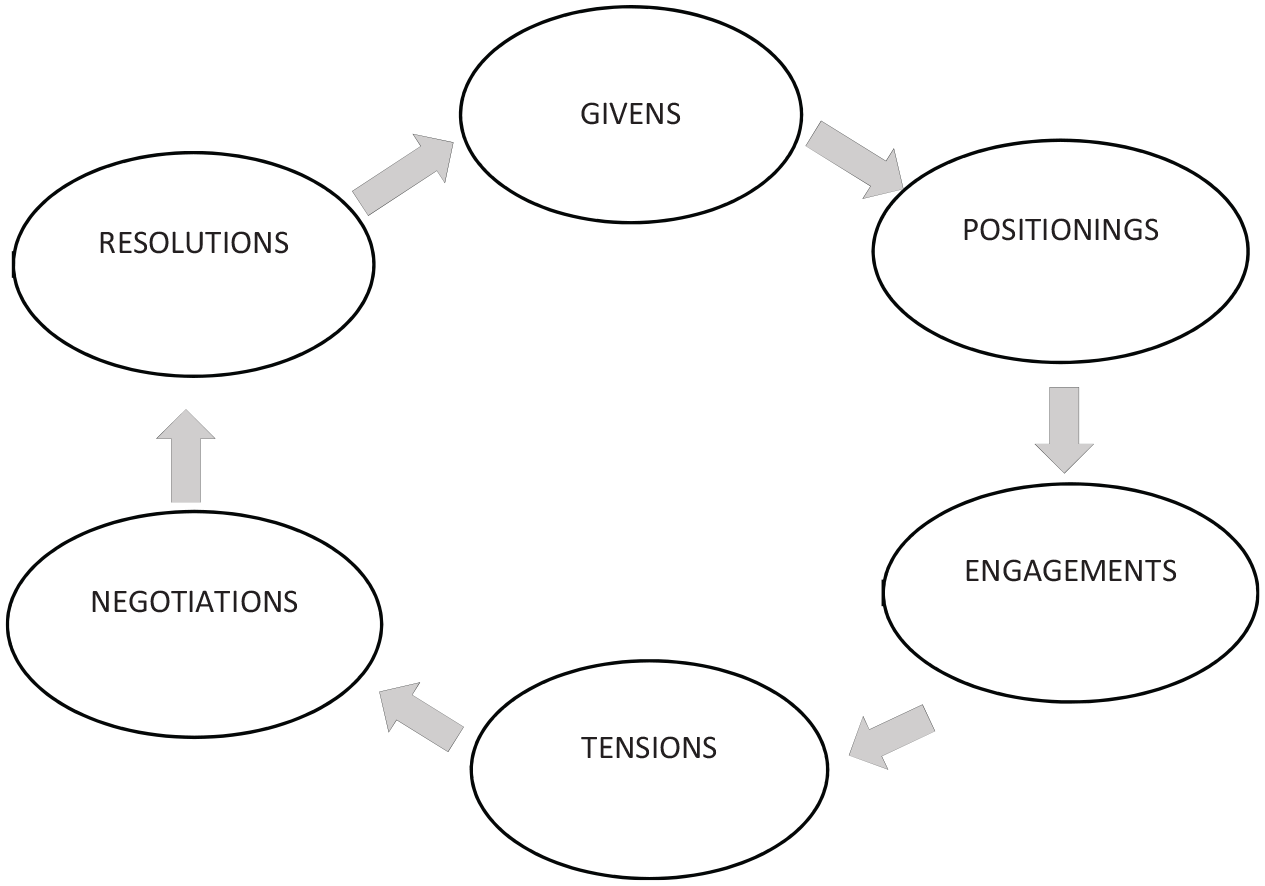
Value-learning-trajectory model (Kuusisto and Gearon, 2017).
These meaning-making staging posts are life-trajectory (1) givens (markers which underpin value-learning choices); (2) positionings (features of a life story that individuals identify with); (3) engagements (individuals’ incorporation of values in their life, questions of values encountered in personal and professional life, and a sense of needing to make adjustments); (4) tensions (meeting points where conversations might happen – e.g. between personally held and wider societal/historical-political values); (5) negotiations (confrontations and managing tensions); and (6) resolutions (reflection on the outcomes of resolving tensions through negotiation or the inability to transform tensions into resolutions (see Gearon and Kuusisto, 2017: 169–170).
Method
This study set out to examine the trajectory of emerging world-view education and – answering to societal and ECEC world-view superdiversity – world-view related professionalism through a small case study sample of Finnish second-year ECEC student teachers. The value-learning-trajectory working model (Kuusisto and Gearon, 2017a, 2017b) was employed as an analytical tool, testing its potential as a proof of concept. The analysis was guided by the following research question: What do ECEC student teachers assert as meaningful elements and processes along their learning trajectory of emerging world-view-diversity professionalism?
The study connects with critical participatory and action research traditions, using praxeology as a research method with particular relevance for teacher education (Bergold and Thomas, 2012; Pascal and Bertram, 2012; Winterbottom and Mazzocco, 2016), while also placing special importance on peer learning and mentoring (Kupila and Karila, 2018). Praxeological learning strives to grasp the complexity of real-life situations and capture reality in all its ‘messiness’ in a systematic way. Fundamental to praxeological understanding – and strongly aligned with the life-history approach on which the Kuusisto and Gearon model is based – is that in addition to the academic elite, practitioners possess important knowledge (Winterbottom and Mazzocco, 2016). Praxeology aims to empower students to seek transformation through finding ways to solve problems with their own knowledge (Pascal and Bertram, 2012).
The ‘thick’ data was generated over a year, starting off with a six-month group learning period involving seven ECEC student teachers and six in-service ECEC teachers. The students were offered this voluntary process alongside their obligatory course on Ethics and World-View Education. Critical to this participatory design was providing a safe space for communication (Bergold and Thomas, 2012). Three methods were used: a survey (at the beginning of the process), in-depth interviews (retrospective accounts at the end of the year) and reflective learning diaries (composed in four parts during the course). The corresponding author, with long experience as an ECEC teacher, had a direct investment in and worked closely with the participants – in praxeology, researchers are committed to a deep involvement in the real world under study (Winterbottom and Mazzocco, 2016). However, the researchers did not intervene in the students’ plans, and instructor input was kept to a minimum, empowering the students’ voices (Pascal and Bertram, 2012). Collective knowledge production, a close connection to ECEC praxis, and critical awareness of the cultural context were important in the process, where the students and researchers became ‘critical friends’ or ‘co-producers of knowledge’; this was also why a dual-interviewer setting was used, to increase reliability (Bloor et al., 2001; Åhs et. al., 2019). This type of mutual creation of understandings (Urban, 2008) relates to the hermeneutical idea of knowledge creation through a dialogical process (see also Poulter, Kuusisto & Lamminmäki-Vartia, forthcoming).
The analysis was carried out in two phases. First, a thematic content analysis (see Cohen et al., 2018) of the seven student interviews was carried out, with a focus on reflections on emerging professional trajectories and ECEC world-view superdiversity (Poulter et al., forthcoming). In addition to the trajectories of emerging professionalism, the analysis aimed to generate understanding of the critical turning points that these professional learning trajectories had taken. Eight thematic categories provided an important overview of the students’ emerging professionalism. Second, one student trajectory – which was considered typical of the sample – was chosen through which a more substantial view across the three data sets (survey responses, learning diaries and interview narratives) would be given. This part of the analysis – the trajectory of a student (‘Tina’) across the data sets – is presented in the following.
Questions of ethics were carefully considered throughout the research process, in close adherence to the ethical guidelines of the Finnish Advisory Board on Research Integrity (2012). This included informed consent, confidentiality and anonymity, and particular care was given to sensitivity throughout the process.
Emerging professionalism in ECEC world-view diversity: Tina’s value-learning trajectory
Tina’s ‘givens’ (see Figure 1) – the starting point for emerging professionalism in ECEC world-view diversity – are strongly founded on a natural scientific world view of her childhood home. Her primary socialization did not include religious elements, although she was christened Lutheran – customary also in secular Nordic families – and later resigned her church membership. Tina self-identifies as an agnostic who is interested in spirituality, valuing the ability to believe in her own way. She thinks ECEC world-view education could be replaced with philosophy, as less ‘personal’ and more objective. Tina thinks ECEC should not ‘enforce’ any world view, and hence the role of Nordic Lutheranism bothers her. In the questionnaire, she states that she does not have the pedagogical tools for ECEC world-view education.
‘Positioning’ depicts relational aspects in world-view diversity – both personal and professional ways of locating oneself in this multiplicity. Reflecting on world-view education has made Tina understand that she also holds a world view, and that it is non-religious. This has helped her to realize the importance of world views in education:
When I started to reflect on my own world-view education . . . I understand that I also have that [a world view]; it is important for me, so it must be important for other people as well. And, like, everyone should have a right to that. (Interview)
Tina feels comfortable with her present way of not positioning herself in relation to any fixed world-view category. She uses the metaphor of ‘surfing’ for this liminal in-between space: ‘That [agnosticism] feels safe at this stage or, like, that I don’t deny anything but also that I don’t fully stand behind anything either, it is kind of surfing . . . this is a nice in-between space’ (Interview). Tina says that in the first mentoring-group meetings, she was worried about becoming excluded because she did not have a religious world view, but she soon realized that she belonged, rather, to ‘the insiders’. Through reflecting on her own position, Tina became aware of her personal biases towards religions. She connected that to a lack of contact with children from different religious backgrounds in her own childhood. Tina thinks that the learning process has helped her to gain more understanding and openness towards world-view education as a teacher, which is particularly important to her:
Now I feel, like, that I am more okay with the entire subject and it is no longer a trench-warfare-like feeling in me; it is, rather, more like that, well, I am, like, I am and, okay, you are like that and it just feels natural. (Interview)
‘Engagements’ depict active personal encountering and agency with the learning content – here, ECEC world-view education. For Tina, group meetings were relevant for regularly reminding her of the subject, meeting others with different world views, and experiencing equal worth and respect in this diversity. Consequently, she considers the group learning significant for her professional growth: ‘I have enjoyed listening to the ideas of teachers and students acquainted with world views. A shared open discussion and distribution of knowledge and practical skills are important ways for me to increase my own vision of world-view education’ (Reflective diary). Also, the shared activities with the more experienced professionals were important for Tina’s learning. She felt that, in her novice role, she had a chance to co-construct knowledge:
Working with teachers has been a pleasure and a very good way for me to learn new things. Mutual encountering of issues made me feel that one doesn’t need to be perfect when entering the field, as professional growth happens all the time. (Reflective diary)
However, working with children was the real eye-opener for Tina. She noticed that children are primed to talk about world views and experiences of religions. She started to think that if one omits world-view education, something is left unrecognized in the encountering of a child. One situation in particular was critical for Tina’s reflections on children’s willingness to engage in world-view dialogue:
We had a conversation where a child said, ‘Yes, God has created everything’. And it somehow struck me how I found those old things emerge in me again, because if one does not believe in God, it is kind of difficult somehow. But then, someone was, like, ‘There is that Big Bang’, and then there was a kind of panic about how would I start with this – like explaining what is correct. How, how can I manage this situation? But then the children themselves started chatting together and I was just watching them, like, ‘Oh my, this is so great’ [laughs]. (Interview)
Tina experienced the situation as challenging and reflected on how, instead of disputing her own standpoint as ‘the truth’, the situation went fine when letting the children discuss it among themselves. She was surprised at how openly the children discussed the topic. This experience provoked her openness with regard to the implementation of world-view education in ECEC.
Tina’s narrative on this event can also be seen to illustrate the staging points of ‘tensions’ or ‘negotiations’ along the trajectories of professional development and value learning. It is therefore an illustrative example of how the different sections of the model are intertwined in often ‘messy’ individual learning processes. Learning is seldom a ‘tidy’ linear process that proceeds along clear ‘stages’ towards a goal; rather, complications and intersections can become some of the most meaningful turning points for value learning to take place.
‘Tensions’ depict situations where individual experiences perceive tensions between binaries, such as topics that are perceived as either personally or professionally challenging. Tina experiences a conflict between her desired pedagogical content knowledge and what she perceives as her actual competence:
[My] competence is presently hindered by a rather poor general knowledge of different world views and a lack of confidence . . . my pedagogical content knowledge is weak with regard to world views, and especially transmitting knowledge to children feels challenging. I’d like to find a way deeper into the world of world views so that I would be able to take world-view diversity better into account in pedagogical terms. Dealing with just religious festivities and ethnic music gives such a surface-level, artificial perception of religions. (Reflective diary)
Tina raises openness to continuous learning as being important for emerging professionalism in ECEC world-view diversity. This includes open-mindedness and awareness of one’s lack of knowledge. Tina thinks that teachers should search for information together with children. Tina also points to a discrepancy between actual ECEC world-view diversity and the seemingly increasingly exclusive policy and practice towards it. As a supply teacher, she has not seen any implementation of world-view education:
I notice that there really isn’t anything taking up world views . . . Maybe . . . if there are some festivities, but not like every day . . . It feels like the more there’s diversity like there now is, the more emphasis there is that ‘no to philosophies’, that it [worldviews] is sort of excluded altogether. That previously it was maybe Christianity that was brought up, like hymns and all, and festivities. But now it feels that it is somehow blocked out completely. (Interview)
Tina sees ECEC traditions related to religion as unnecessary and old-fashioned. She thinks that the borderline between religious practice and transmitting knowledge about religions is vague, and that how individuals experience these matters can vary notably. She mentions religious songs and nativity plays as examples:
Justifications for this kind of traditions seem to be something like ‘This is how it’s always been done’, which does not convince me. It is difficult to set a borderline between religious practice and [learning for] general knowledge, as experiences are so subjective. (Reflective diary)
Tina sees diversity as both a challenge and an opportunity. She thinks that it is easier to take up topics related to religions in more diverse ECEC settings. She also says that it would have been better to acquire more tools for managing ECEC diversity in her teacher education, and that it can be rather scary to enter the field so poorly equipped. She hopes that professional experience will gradually strengthen her competences. Tina also remarks that children’s personal world views are much more than ‘culture’ and, though these fascinate her, she regards it as being difficult to support children in their development in this respect – even if there were time to encounter an individual child on a more personal level. Moreover, some world views feel more alien to Tina than others, and she hopes to familiarize herself with these more through the children:
[It] feels still perhaps strange when there’s no surface touch to these, something closer to me on a regular basis. But it’s not like these would be threatening, just different – that one would like to learn to know them better. So, [I] hope I’ll get to know more of these also through the children. It intrigues me – that’s a positive feeling. (Interview)
‘Negotiations’ relate to meaning-making negotiations that individuals engage in either through personal reflection or interaction with others. These can also be set in imaginings of future situations as a professional. Along these lines, Tina wonders how she should, after finishing her studies, respond to children’s world-view-related wondering. How can she respond sensitively so as not to judge children’s thoughts or present her personal truth claims over others? She wonders how to keep these discussions open and show appreciation of children’s own views:
How will I react when . . . children say something like it is this way or that? How will I react so that I’m not, like, ‘No’ or ‘It is this or that’ – my own view? Or, ‘It’s at least not that!’ – not even by accident? (Interview)
Tina thinks that attitudes in the ECEC working community are critical in determining whether world views have a place and recognition there. That is where she thinks she will learn the most:
Attitudes held in the working community can influence whether world-view-related matters are swept under the carpet or not. [The] working environment is after all the place where we learn the most, so it would be critically important to make everyone recognize the importance of world views to ECEC and the children there. (Reflective diary)
Tina states that it demands more confidence from teachers to implement world-view education than, for example, mathematics. She sees this content area as ‘the black sheep of the ECEC curriculum’. Even colleagues may indicate that there are more important things:
I think it takes openness and courage . . . not everyone is perhaps so keen to be on board, so there may be some eye-rolling . . . to get them all to realize it’s not something primitive or only in history – there’s more to it than, like, someone reading the Bible . . . all the discussion and critical thinking and emotional skills and all that, like a broad view of the world and everything. (Interview)
Tina thinks that people tend to have negative perceptions of religion and that, as world view as a notion is connected to this, it becomes associated with something less intelligent, relics of history. She wonders how such prejudices could be worked on but is also afraid of the reactions of her colleagues and parents if she worked with world-view-related contents. This is also connected to the importance of collegial support:
I would like to, but then, if one is the only one doing that in the unit . . . it may be a tough nut to crack for a young teacher to start to deconstruct the situation. There is a willingness to do it, but I’m not sure I have the guts. (Interview)
‘Resolutions’ represent an increasing professional understanding of the content area from one’s personal perspective. In this, positioning, engagements, tensions and negotiations have each had a structuring effect of their own. Resolutions are a contact surface, to which the emerging knowledge adheres. Also, for Tina, it has been meaningful to become more aware of her professional development. She realizes that emotional skills are very important to her as a teacher, and combines these and thinking skills in world-view education: ‘As a teacher, I have learned from myself that emotional skills are very important . . . This world-view education has been a part of it. Or it connects so much to all emotional and thinking skills, at least for me’ (Interview).
For Tina, professionalism is increased reflective awareness of pedagogical situations. She thinks that some people are more sensitive by nature, but that one can develop in this through professional experience. Professional situations leave a memory trace of how one performed in them and, through reflection, one can improve. Teachers need to be ‘world-view-sensitive’. For Tina, world-view professionalism means taking all world views into account in ECEC and listening to children:
Children need to have a possibility to ask questions and discuss the topics they think are important. As a teacher, I have a duty to . . . start to build children’s awareness of world-view diversity. Discussions and field trips are good starting points for world-view education. Children gain a holistic view of the world when connecting world views to culture, language and history. In this way, world views are a natural part of children’s daily lives. (Reflective diary)
According to Tina, handling world-view diversity and providing children with more knowledge of the world are related to broadening their view of life – also if a child comes from a religiously committed home:
If the child herself acts very religiously, then I feel that it is good to shake her thinking a bit . . . that these are OK too. That you and your family live that way but there are also other ways. And these are all equal. (Interview)
Tina sees the relevance of world-view education in the child’s right to be more competent in choosing their own world view later on. She regards teacher professionalism as a key role:
We need world-view education so that everybody has a possibility to gain knowledge from the world around them, and to find a meaningful path for oneself. That is why teacher professionalism is an important and essential thing in children’s experiences. (Reflective diary)
Although the value-learning model is pictured as cyclical (Figure 1), learning processes as such are, as noted above, much more complex. However, whatever the end result of a particular learning process, the process itself is likely to have influenced one’s thinking. Therefore the ‘givens’, as the starting point for future learning, have already become more informed by these past situations and inform future learning. In Tina’s case, this is illustrated in how she feels that her new know-how is part of her strengthened professionalism. World-view education has become more amalgamated in her professionalism and she feels more comfortable in implementing it:
My know-how has melted into an inseparable part of my identity, kind of. This has become closer to my heart and, because of that, it is something I want to develop in the field. I could do much more meaningful pedagogical planning for the child group now, being better equipped to deal with this. At least I would have more courage to talk with children about world views [laughs] . . . I have more courage to put my hands into world-view issues. (Interview)
Conclusion
Through the case-study trajectory presented above, we have aimed to exemplify the complexity of value learning among student teachers in their emerging professionalism in ECEC world-view diversity. By focusing on Tina’s narrative account, we can also see the embeddedness of learning in this particular socio-historical context – secular Lutheran Nordic Finland and its particular national curriculum guidelines for ECEC. Tina’s learning trajectory demonstrates how reflection on various intersecting processes, like her experience with the children’s openness to discussing religions and reflections on teacher positionality, can create parallel and intertwined ‘tracks’ or cycles to the process of professional value learning. Through our analysis of the ECEC students’ learning trajectories, we have reconfigured Kuusisto and Gearon (2017) learning-trajectory model to illustrate further this complexity in ECEC student teachers’ emerging professional learning (Figure 2). The data illustrates how professional learning processes are not necessarily linear, but windows for the rhizomatic development of ECEC professionalism. Learning here is characterized by simultaneous, overlapping and ‘messy’ negotiations, actualizing through tensions and questions, and sometimes, though not always, leading to successful resolutions. In the reconfigured model, all stages interact with each other and build on the emerging professionalism. Every shift in positionings, engagements, tensions, negotiations or resolutions contributes towards ‘spinning the wheel’ for informing further professional development. This continuous positioning and repositioning, with no definable start or finish (Arndt et al., 2018: 102; Kristeva, 1991, 1998, 2008), contributes towards the development of a continuously open and problematizable teacher subjectivity.
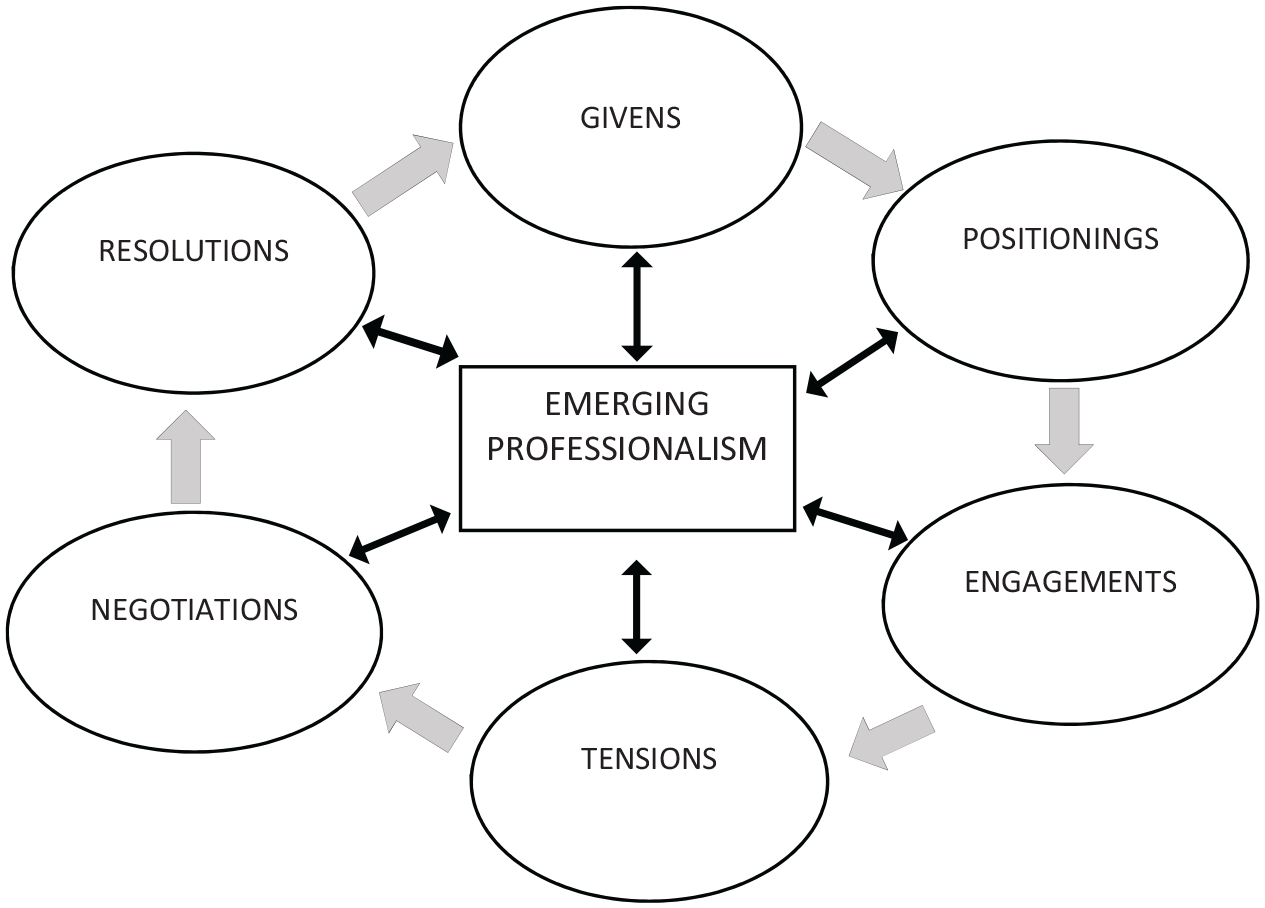
Learning-trajectory model (adopted from Kuusisto and Gearon 2017) of emerging ECEC world-view-diversity professionalism.
The students in our sample attempted to balance between the dimensions of professionalism – personal and domain-specific knowledges and the working environment (Karila, 2008) – when constructing their emerging professionalism in ECEC world-view diversity. Through the data, we recognize the necessity of using one’s personal biographical account – ‘givens’ – as a starting point for value negotiation and world-view reflection. An active individual agency in relation to world-view diversity requires openness to evaluate and locate one’s own position, the fluidity of the context and meaning-making through social engagements. This may necessitate problematizing some of the prevailing norms, and increased awareness of one’s own prejudices and liabilities.
Engaging in open conversation with ECEC praxis can help in ‘making sense’ (Urban, 2008) of challenging situations. The benefit of praxeological learning in teacher education is well illustrated in the data excerpt where Tina found children discussing God – in the practical encountering of child-generated discussion and, through that, a raised awareness of the knowledges which cannot be ‘taught’ in teacher education. Tina also linked world views to broader educational aims (Biesta, 2013), resulting in her critical reflection on professional knowledge and a new way of knowing (Urban, 2010) about world-view education and superdiversity. Furthermore, tensions in emerging professionalism are important, as negotiating binaries necessitates confrontation, which may function as a catalyst for development. Pedagogically, it might also be useful to simulate confrontations in teacher education – like Tina does in her reflective diary through pondering how to tackle children’s life questions. Finally, it is important to recognize that the different staging posts – givens, positionings, engagements, tensions and negotiations – have different structuring roles in emerging professionalism. For this evolvement to happen, a student teacher needs collegial support on how to engage professionally with world-view superdiversity.
Footnotes
Funding
This study was supported by The Ministry of Education and Culture, Finland (OKM/44/592/2018).
Notes
Author biographies
 ). She is a student in the Doctoral program of School, Education, Society and Culture. Her study examines the topical question of implementation of worldview education in Finnish Early Childhood Education and Care.
).
) as well as Honorary Research Fellow at the Department of Education, University of Oxford, UK. Arniika’s research interests include children’s and youths’ value learning trajectories and personal ontologies, their negotiations on values and memberships across social contexts, and the teaching and learning related to values, religions and worldviews in different formal and informal settings.