




Abstract
In this article, we contribute to theory by integrating literature on citizenship and entrepreneurship, based on which we develop a framework for how personal development is achieved for young people in the context of open leisure activities. The empirical material in this study consists of survey data collected in Swedish open leisure centers. A questionnaire was distributed to 265 publicly funded leisure centers all over Sweden. The material was analyzed in an exploratory study involving factor analysis using hierarchical regression in four steps. When reviewing the results, it is clear that citizenship and entrepreneurship both contribute to personal development at open leisure centers in Sweden. To conclude, this exploratory study provides evidence that concepts from citizenship and entrepreneurship theory can help in understanding the personal development of young people in publicly run leisure settings.
Keywords
Introduction
The concept of social entrepreneurship has been rapidly emerging in the public and non-profit sectors during recent years (Jiao, 2011). Social entrepreneurs can be part of a value creation process by combining resources in a new way. The entrepreneurial motivations of those people who work in the public sector may therefore differ from those of people working in the private sector (Hall et al., 2012). Rose (1999) claims that since the 1980s, there has been a transition from active citizenship to the role of entrepreneur, with a belief in individuals and their ability to take personal responsibility for their lives.
In more precise terms, it is from here that our research takes its fundamental standpoint – from the non-profit sector, in youth clubs and in similar meeting places for young people organized and managed by local councils and organizations. In this article, we will argue that it is possible to simultaneously develop the ability of young people to take responsibility, to recognize opportunities, and to take initiatives, and at the same time to develop their citizenship.
In this article, we contribute to theory by integrating literature on citizenship and entrepreneurship, based on which we develop a framework for how personal development is achieved for young people in the context of open leisure activities.
A citizen may be described as a member of a political community or a state, who has certain legal, social and moral rights, duties, and responsibilities. Citizenship is a political concept with a variety of rights and responsibilities in a given political community. These rights and responsibilities change over time as a result of social struggle, economic change, and shifts in governing ideology. The idea of citizenship is built on the equal value and equal opportunities of individuals to participate in and influence public activities. Even though citizenship may mean different things in different nations, it also has a broader sociological and historical meaning that is universal (cf. Petersson et al., 1998). Inglehart (1997) and Giddens (1991) state that young citizens participate in society with “self-actualizing” or “self-reflexive” involvements in personally meaningful causes guided by their own lifestyles and shifting social networks. A portfolio with skills for citizenship has been identified as being able to show mutual respect for others, to have social awareness, to be able to take self-responsibility, and to have strong self-confidence and a sense of good self-worth (Hall et al., 2010). Gibb (2002) talks about learning as being a social and developmental process that can take place outside an organized and structured context, and about the capacity to learn from different sources. Individuals can learn from their mistakes, by doing, by coping, by experiment, and by grasping opportunities that come their way.
Lawy and Biesta (2006) claim young people routinely participate in a wide range of different practices in the company of their families and peers, and in connection with leisure and the media. Furthermore, in some situations, young people are taken seriously and have real opportunities for shaping and changing their lives. However, in other situations, young people are not regarded as legitimate participants. Their voices are ignored, and there is little opportunity for them to change the situations they are in. In other contexts, young people are taken seriously and have real opportunities to shape their lives. Lawy and Biesta (2006) suggest that citizenship learning cannot be comprehended as being a one-dimensional process; instead, it is grounded in a complex myriad of experiences that are practiced in the everyday life of young people.
This can all be linked to entrepreneurial behavior. Colardyn and Bjornavold (2004) define informal learning as being the kind of learning that is acquired from the activities of everyday life that are related to work, family, or leisure. Chell and Athayde (2009) claim that attention is now being paid to how non-formal activities may be a source of learning and skills development. These activities can broaden young people’s experience and provide opportunities for learning within communities. Based on this, both citizenship behavior and entrepreneurship behavior may be linked to personal development among youths in informal activities, such as leisure.
However, the question as to whether entrepreneurship and citizenship can be reconciled has long been debated. As early as in the early 1990s, researchers had strong opposing views on this, evidenced for example by the debate in Public Administration Review between Bellone and Goerl and Terry (Bellone and Goerl, 1992, 1993; Terry, 1993). The problem of reconciling the two concepts has also been experienced in the school system, where entrepreneurship has been seen as the antithesis to democracy and citizenship. Those holding this view see entrepreneurship as being market driven, greedy, and individual, and thus very different to democracy and citizenship. However, others such as Davies et al. (2004) maintain that there is no reason why links cannot be forged between entrepreneurship and citizenship, and that democracy in itself can perhaps be regarded as being a result of enterprising action.
In a similar vein, Sarasvathy and Venkataraman (2011) recently suggested, in their thought-provoking essay, that entrepreneurship may be a social force akin to democracy. Based on this, they hold that entrepreneurship is a tool for changing society for the better, and one that everyone should be entitled to embrace. Even though they do not discuss the interface between democracy and entrepreneurship, they imply that both are of central importance for individual and societal development.
The term ‘social entrepreneurship’ has emerged as a new label for describing the work of the community as well as for voluntary and public organizations for social rather than profit objectives (Shaw and Carter, 2010). Dacin et al. (2010) argue that there are a myriad of definitions of social enterprise, most of them related to the ability to utilize resources that address social challenges. Leadbeater (1997) claims that social entrepreneurs will be one of the most important sources of innovation as they have the opportunity to identify individuals who represent underutilized resources. It is argued that social enterprises operate mainly on a local level, providing goods and services that have an impact individually, but which also have an impact collectively for communities and society (Haugh, 2005). Dees (1998) claims that social entrepreneurs need to develop new models for a new century, and that this implies a blurring of sector boundaries. The fundamental purpose of social entrepreneurship is to create social value for the public good. For a social entrepreneur, the social mission is fundamental. Social entrepreneurs and their undertakings are driven by social goals, a desire to benefit society in some way or ways that are intended to increase social values that contribute to the welfare or wellbeing in a given human community (Peredo and McLean, 2006). Thompson (2002) argues that many social entrepreneurs are people with the characteristics and behaviors associated with business entrepreneurs and work in society. However, they are more interested in taking care and helping than making money (Thompson, 2002). Zahra et al. (2009) have identified three types of social entrepreneurs: Social Bricoleurs, Social Constructionists and Social Engineer. Social Bricoleurs focus on discovering and addressing with small-sale local social needs. In short, Social Constructionists exploit opportunities and market failures by filling the gap for introducing reforms and innovations to the social system. A Social Engineer recognizes systemic problems in the social structures that exist and deals with them through the presentation of the broad changes.
Youth clubs and similar meeting places are a part of the social economy which in this case deliver public services and enable young people to visiting various meeting places that are funded by taxes from the local councils. It is of interest to understand the value creation for both the members and society based on the resources that are offered to them.
This is the basic point of departure in this study, and we thus hold that theories of entrepreneurship and citizenship can be seen as being complementary to each other as the core of both theories includes personal skills and qualities such as motivation, learning, social awareness, the development of self-confidence, self-responsibility, and creativity.
Based on our empirical material concerning leisure activities among young people at youth clubs and similar meeting places, we will explore the impact of citizenship and entrepreneurial aspects on personal development among young people.
Open leisure activities
The main characteristic of the youth clubs (fritidsgård) and similar meeting places operated by local councils is that the leisure activities should be open to everyone regardless of when they want to visit them. This idea still prevails, and youth clubs, youth houses, and similar meeting places do not require a membership card and there is no registration of who is present. These meeting places are open to all young people from the ages of 13–25, and can be attended more or less free of charge. Young people are free to come and go, and no demands are made on them to “do” things. They can simply hang around or take part in the activities that are on offer, such as table tennis, board games, and so forth. The members may introduce activities that are based on their own interests, such as forming a film club or making outdoor trips. In the local councils, there are also clubs for children who are younger than 13, which are referred to as leisure-time clubs (fritidsklubb).
Many young people spend their time at youth clubs, particularly boys who do not trust the school system. We know very little about their expectations regarding these visits or those of girls entering the leisure sector and attending youth clubs. We also know very little about what the attraction of these meeting places is, why young people go there, whether they fulfill their needs, and how they develop their skills (Lindström, 2009; Olson, 1992; Ungdomsstyrelsen, 2006).
Open leisure activities are sometimes run and organized by the local councils themselves or by organizations and associations, and are run with funds from the local councils.
Within this environment, a special pedagogy has been developed, characterized by participation, dialogue, and empowerment. Ardström (2001), who writes about management in open leisure activities, argues that the most qualified pedagogical mission is to work with young people at the youth clubs and similar meeting places. Havström and Pettersson-Svenneke (2008) also point out that this is a qualified pedagogical mission that needs reflection and methodological efforts from educated staff. In their investigation, they found a connection between the educational level of the staff and the positive work on democracy that is being done at the youth clubs. Laxvik (2006) states that it is not a matter of social work but rather of meeting young people on their own terms. Thorn-Wollnert’s (2003) study shows that leadership for young people is not a question of therapy. They argue that nowadays the clubs concentrate on activities that foster, strengthen, and focus on what is positive (Thorn-Wollnert, 2003) in young individuals.
Pettersson-Svenneke and Havström (2007) further argue that developed and well-functioning democratic methods have a lot to offer the club members. Young citizens will have a chance to develop their talents and interests, strengthen their self-confidence, and find fellowship. By arranging their own leisure-time activities and putting their mark on them, they develop their skills and self-esteem (Pettersson-Svenneke and Havström, 2007).
However, certain concerns have also been noted in connection with the open leisure activities. Laxvik (2001) discusses the “collective subordination logic” (kollektiva underordningens logik), in which youth leaders position their own needs in such a way that they are seen and acknowledged before the needs and expectations of the members. He argues that a culture could develop among members and youth leaders of youth clubs and similar meeting places for young people where a sense of subordination could occur. For example, Mahoney et al. (2001) have found in a 20-year longitudinal study of Swedish boys that youth club members engage more often in antisocial behavior.
Open leisure activities for young people in Sweden – From the 1930s to today
The 1930s became in many ways a landmark regarding views of leisure time and leisure activities. This was the time when the government started to be interested in social politics and in controlling the leisure time of children and young people. By the early 1900s, attention was being paid not only to the idea of young people being seen as a disturbing factor in society but also to the concept of fostering. The first so-called work houses (arbetsstugor) were established to keep young children off the streets and to give them adequate schooling and education. The aim was to foster them into becoming fully fledged citizens by encouraging them to learn an occupation and discipline (Olson, 1992, 1997, 1999).
From the 1930s onwards, the government wanted to develop a policy for leisure, and a number of investigations were initiated. These resulted, for example, in a focus on children’s leisure time. The investigators emphasized that leisure activities must not be a question of social class and, for example, citizens should be able to participate in sports activities at a reasonable cost. It was seen as being the responsibility of the state to stimulate the cultural activities of citizens, to prevent ill health, and to foster the development of democratic citizens (SOU1957; SOU1964; SOU1965; SOU1966; SOU1969).
During the 1970s, visible results were being recognized from the investments being made by local councils investments in the leisure sector as thousands of outdoor clubs, leisure clubs, sport halls, and drill halls were gradually being constructed. This was also a period when the government’s interest in investing in leisure education could be clearly seen. Education for leisure leaders was established at a group of folk high-schools, and education for recreation instructors was introduced at the local council level.
In the late 1980s, there were about 1500 local council centers in Sweden, most of which were run under the management of the local council. Youth clubs were seen as being local social meeting places and a complement to cafés and other meeting places for young people. The youth clubs were also supposed to serve as a counterforce to commercial leisure services. During the 1980s, the professionalization of the leisure sectors continued. Leisure activities for young people were regarded as a means of prevention, and cooperation was soon introduced with schools, the social services agencies, and the police (Gunnarsson, 2002; SOU, 1996).
During the 1990s, the demands for lower costs and a reorganization of local governmental activities became a reality as a result of the Swedish economic crisis. Both the leisure and the culture sector became aware of this new reality. Many traditional youth clubs were closed down or received offers to be taken over by voluntary or private actors. The local council premises that remained after the reorganization were facilities such as “multi-activity buildings” or “youth buildings” which the young people or associations took responsibility for managing (Gunnarsson, 2002). In 2006, there were about 1400 local council centers in Sweden, most of which were run under the regime of the local council (Sveriges kommuner och landsting, 2010).
At present, the local councils are responsible for offering leisure activities to their citizens, which include young people. These activities, however, are not compulsory in the same way as school and healthcare are. Nevertheless, leisure activities have been recognized as an important means of fostering young people into becoming responsible and democratic citizens. The main responsibility of the local council is to facilitate infrastructure and provide active support to the youth associations. Despite this fact, formalized club activities are still seen as being the cornerstone in local cultural and leisure-time activities. The notion is that through associations, young people will be fostered formally and informally into democratic citizens.
Personal development – A youth perspective
Meer and Sever (2004) argue that people define their citizenship in many different ways in relation to the local, national, or global community. Citizenship is both a status or an identity, and a practice or process of relating to the social world through the exercise of rights/forms of protection and the fulfillment of obligations. Like power relations, rights of citizenship are not fixed but are instead objects that are struggled with, that are defended, reinterpreted, and extended (Arnot, 1997). Similarly, Sherrod et al. (2002) claim that there is no absolutely correct definition of citizenship, and there are both broad and narrow conceptualizations. However, it is argued that citizenship should include components related to moving beyond self-interest and expressing a certain amount of concern for others. Furthermore, it is claimed that it should involve some sense of connection to a group or groups other than only oneself, arguing that the nation could be one such group. Having an understanding of the rights and responsibilities, and a certain amount of tolerance of a citizen in a democracy, is another aspect that is mentioned. Sherrod et al. (2002) state that it is clear that citizenship needs to pervade all aspects of the lives of young people, but at the same time ask whether there are differential opportunities in different settings. Traditionally, they mean that schools have been seen to be the major seats for socialization, but ask whether their role has changed and indicate the role of community organizations as being even more effective in education for citizenship. They ask how the increasing globalization impacts the development of citizenship as well as the increasing diversity of the youth population. On a worldwide scale, special challenges are posed. They argue that we need to understand the expression of citizenship in these different young people (Sherrod et al., 2002). Van Ewijk (2009) argues that modern citizenship is a highly fruitful concept for social work. Citizenship-based social work is defined as a field of action, knowledge, and research, aiming at integration of all citizens and supporting and encouraging self-responsibility, social responsibility, and the implementation of social rights. Moreover, arguing that keywords for integration into the society and the community are citizenship, responsibility, and social rights.
Youth development can be defined as a process that all young people go through on the way to adulthood. This process automatically involves all the people surrounding the young person in question, such as family members, peers, and the community. It is argued that young people will not be able to build essential skills and competencies or be able to feel safe, cared for, valued, useful, and spiritually grounded unless their family and community provide them with the support and opportunities they need along the way. It is also argued that youth development is a process in which family and community must actively participate (Pittman, 1993). Youth development is not merely a prescription for curing troubling youths. Youth development is about people, programs, institutions, and systems that provide all young people with the support and opportunities they need in order to empower themselves (Center for Youth Development and Policy Research, 2012). There is increasing awareness of the fact that the way young people spend their time outside school has consequences for their development (Mahoney et al., 2006).
Bernelo et al. (2011) claim that personal development can be defined as activities that improve self-knowledge and identity, develop talents and potential, build human capital and employability, enhance the quality of life, and contribute to the realization of dreams and aspirations. Moreover, that personal development can also be viewed as being closely related to coaching. Bernelo et al. (2011) claim that personal development is a term for everything that a person may develop individually, such as every aspect that gives individuals greater control over their lives and feelings makes them feel better and builds stronger relationships with people in their surroundings. The term “personal development” can also refer to remaining focused on what really counts in life, and is considered to be important and necessary for good health. It is also argued that the term personal development can refer to becoming more productive and efficient in work. However, what personal development means exactly is something that each individual has to decide for himself or herself. It is claimed that it is the goals of the individual that determine what personal development is, and that it is the individual who is the driving force in the development.
Morin (2006) uses what he calls a social/personality model contrast and integrates levels of consciousness, focusing attention outwards toward the environment, in this context consciousness, and inwards toward the self, for example, self-awareness. Morin (2006) claims self-awareness refers to the capacity to become the object of one’s own attention and occurs when an organism focuses not on the external environment, but on the internal milieu becoming a reflective observer, processing self-information. Consciousness is defined as focusing attention on the environment – processing incoming external stimuli. In Morin (2006), neurocognitive proposals are outlined and compared using the social/personality model as a theoretical background. Results suggest that many new concepts recently introduced to describe various levels of consciousness are closely related. Kleitman and Stankov (2007) have studied the relationship between self-confidence, personality dimensions, and measures of speed of test-taking and found that self-confidence is a robust factor which is meaningfully related to and independent of cognitive abilities.
It is argued by Rochat (2003) that self-awareness is the most fundamental issue in psychology from both a developmental and an evolutionary perspective. Moreover, that self-awareness is a dynamic process, not a static phenomenon, and that we are constantly oscillating in our levels of awareness: from dreaming or losing awareness about ourselves while asleep or being highly self-conscious in public circumstances. Using a metaphor, Rochat (2003) concludes that self-awareness develops like an onion, layer after layer, in a cumulative consolidation. Self-awareness is our experience of fluctuating through these layers as we act, perceive, and think in the world.
Larson (2006) claims that numerous studies have found that under the right conditions, people become intrinsically motivated by a challenging task; they become personally engaged. Moreover, this evidence shows that they learn more effectively when they are intrinsically motivated or when they have internalized a learning goal, concluding with the observation that “one does not have to enjoy every moment to remain engaged.” Larson (2006) states that this is a new way of thinking about positive youth development, particularly with a focus on the concept of young people as producers of their own growth and what it means for mentoring. She argues that parents, teachers, and young mentors want to control and mold them, and refers to what she defines as a new paradigm and a new and harder challenge to support and enable young people to control and motivate themselves to help them mobilize their potential for growth.
Larson (2006) argues that young people have a built-in motivational system with an enormous potential to engage themselves in positive development, but that everyday life presents an obstacle course of situations and conditions that can keep this system turned off. One of the conclusions presented is that a focus for advocates of positive development is to determine how to provide more opportunities for this motivational system to be activated.
Ryan and Deci (2000) identify intrinsic motivation as doing something for its own sake, and apply to activities such as play, sport, and leisure. The cognitive evaluation theory stresses the importance of autonomy and competence to intrinsic motion, and argues that events which are perceived to detract from these will diminish intrinsic motivation. Play and enjoyment are viewed in the motivational literature as a cardinal indicator of intrinsic motivation and deeper psychological engagement in an activity (Ryan and Deci, 2000). However, the motivation of young people can also be seen as relating to their psychological engagement in an organized activity and thus to whether they gain the developmental opportunities it affords (Hansen and Larson, 2007). Preliminary evidence is provided suggesting that dosage, motivation, having a leading role, and the adult–youth ratio are associated with greater developmental experiences in youth programs (Hansen and Larson, 2007).
Main findings across studies are that the primary motivations for participation in organized activities are intrinsic, for example, excitement and enjoyment to affiliate with peers and youth leaders and to build competencies. Pressure from adults or educational/career goals are seldom cited as reasons for participation. Mahoney et al. (2006) claim for the vast majority of young people that participation is associated with positive developmental outcomes. Moreover, that it is consistent and strong evidence of a positive association between participation in organized activities and a variety of indicators of positive development, such as lowered rates of smoking and drug use. Mahoney et al. (2006) argue that the wellbeing of young people who do not participate in organized activities is reliably less positive compared to those who do participate.
Methodology
The empirical material in this study consists of survey data collected in Swedish open leisure centers. A questionnaire was administered to 265 publicly funded leisure centers all over Sweden. Each center was sent a package of 30 printed questionnaires and was asked to distribute them to the youths present on a chosen day. The researchers received 1061 questionnaires from 60 leisure centers, indicating that a majority of the centers did not participate. However, those that did respond represent all parts of Sweden and there does not appear to be any systematic bias. Given that it is an exploratory study, we find the responses satisfactory for analysis (Befring, 1994).
Turning to operationalization, the dependent variable – personal development – was measured by five items reflecting the extent the respondent had experienced personal development while attending the leisure center. When we look at the independent variables, self-perception was measured by three items reflecting the respondent’s self-confidence, self-image, and self-esteem. Influence was measured by five items reflecting whether the respondent could influence activities at the center. Finally, entrepreneurial behavior was measured by five items reflecting whether the respondent acts proactively, takes risks, and is innovative. Several control variables are used in the study, namely, age (three age groups), sex, attendance level (three levels), perception of gender equality (four levels, from gender equal to clear differences favoring males), general activity level (three items reflecting whether the respondent is active at the leisure center), and Internet activity level (four items reflecting Internet activity at the leisure center). Factor analysis indicates that all measures are unidimensional and alphas are appropriate at levels between 0.76 and 0.89.
The analysis is done using hierarchical regression in four steps. First, age, sex, attendance level, and gender equality perceptions were introduced. Then, activity level (general and Internet) is added followed by a baseline of controls before independents are entered. In the third step, citizenship variables (self-perception and influence) are entered, and in the final fourth step, entrepreneurial behavior is added.
Results
In Table 1, the means, standard deviations, alphas, and correlations for the variables studied are displayed. As can be seen, standard deviations are overall reasonable, indicating sufficient variation in the sample. Overall, the means are above the center point which can be a sign for positive bias. Still, even though the respondents tend to be positive toward many of the constructs, it is not alarming. Alphas for most composite scales are good, although they tend to be somewhat high for some scales, indicating perhaps a battery of questions that is somewhat too narrow. Turning to bi-variant correlation, there are some indications that multicollinearity may be present with correlations of between 0.6 and 0.7 for some relations. However, there are no high variance inflation factors (VIFs) even though the dependent variable correlates significantly with all other variables except age and sex.
Means, standard deviations (SDs), alphas, and correlations.
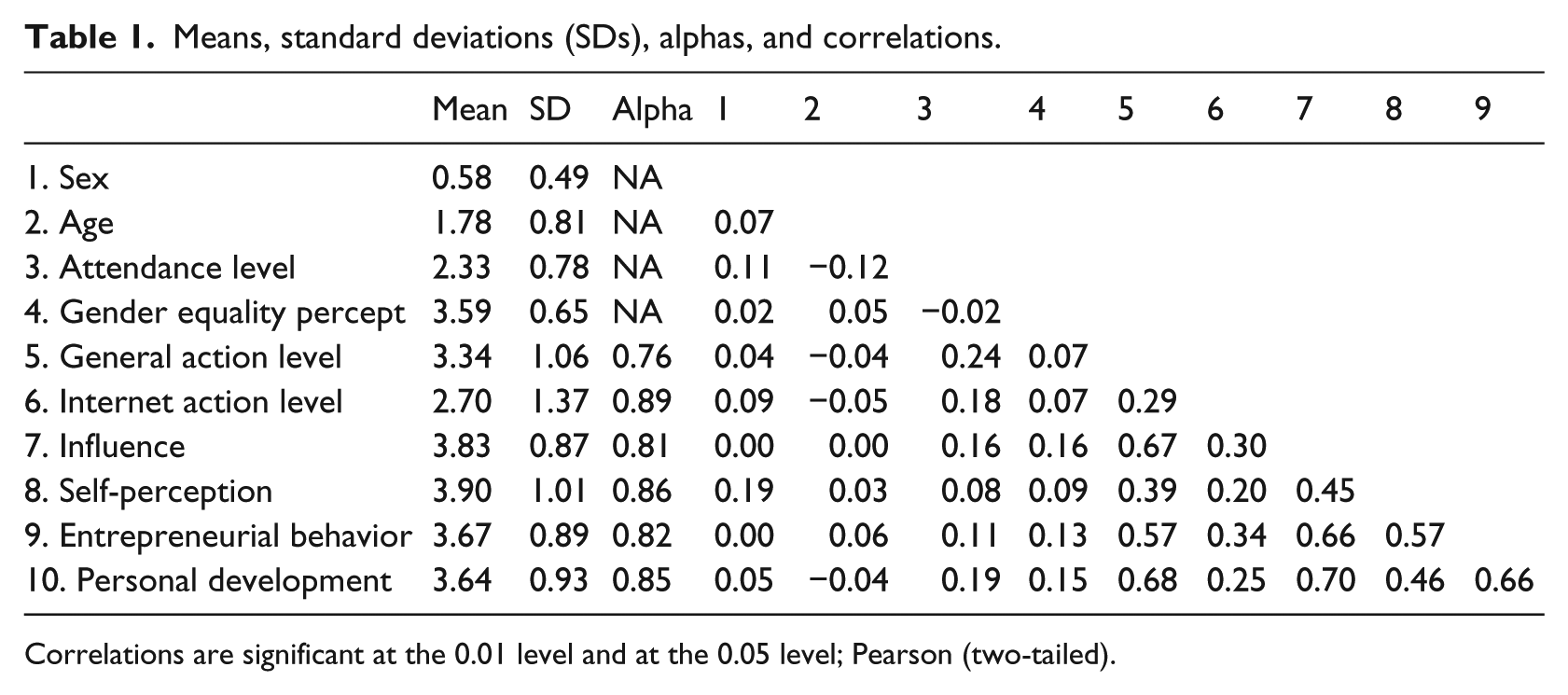
Correlations are significant at the 0.01 level and at the 0.05 level; Pearson (two-tailed).
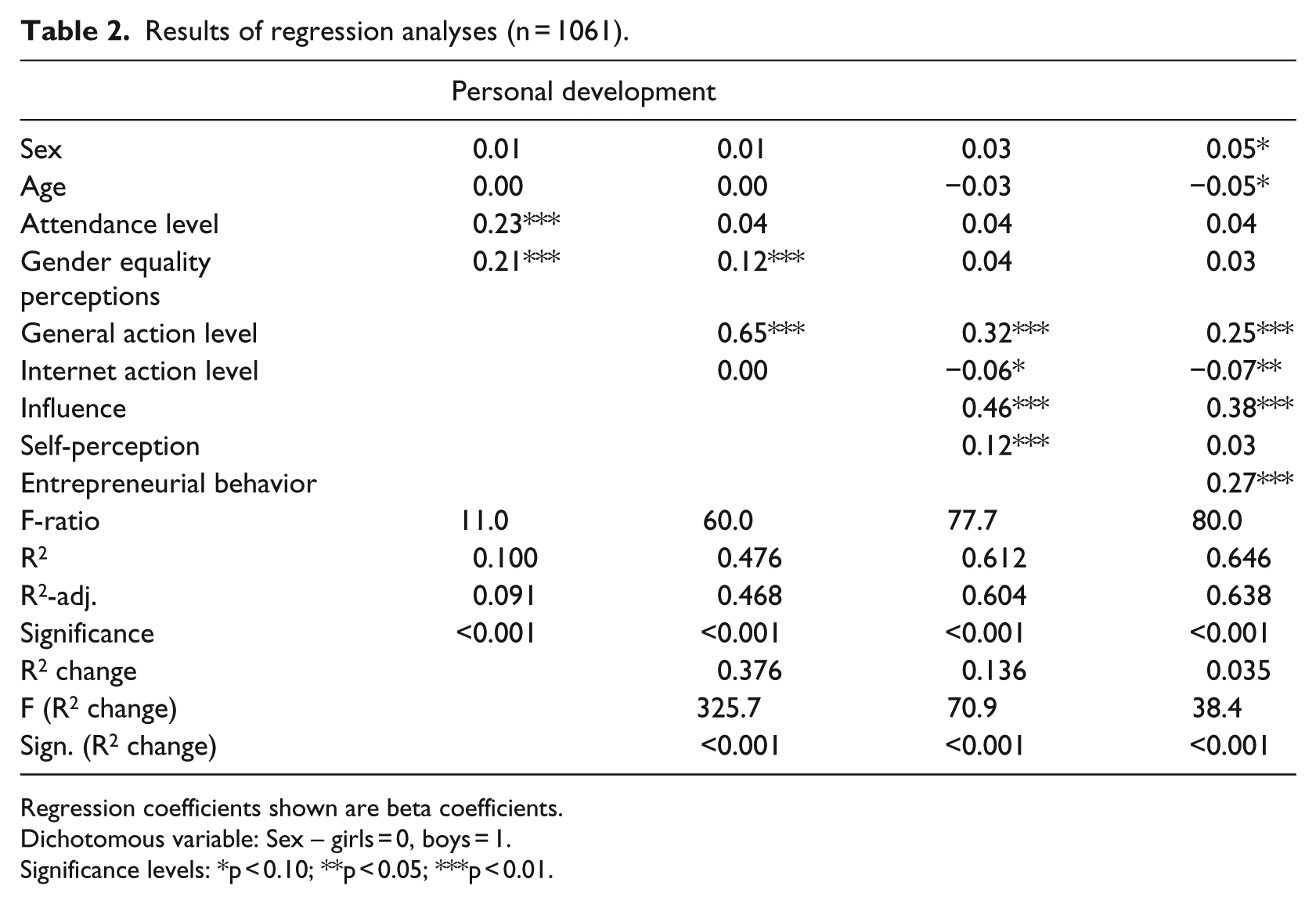
Turning to the hierarchical regression analysis (Table 2), all four models are highly significant and each block contributes significantly to explained variance. In the control models, we found significant results for attendance level, perceived gender equality, and general action level, where attendance was only significant without the general action level being introduced. Almost 50% of variance is explained by an R2-adj. of 0.468. Therefore, without the independent variables in the model, personal development is linked mainly to the general activity level and whether the individual perceives the leisure center to be gender equal.
Results of regression analyses (n = 1061).
Regression coefficients shown are beta coefficients.
Dichotomous variable: Sex – girls = 0, boys = 1.
Significance levels: *p < 0.10; **p < 0.05; ***p < 0.01.
Then, when introducing the block with citizenship variables, another 14% of the variance is explained and both influence (β = 0.46, p < 0.01) and self-perception (β = 0.12, p < 0.01), together with general action level (β = 0.32, p < 0.01) and Internet action level (β = −0.06, p < 0.10). Thus, citizenship variables contribute clearly toward explaining personal development. In the fourth step, entrepreneurial behavior is introduced and raises explained variance by 3.5%. Given that the other variables explain more than 60% of the variance, this is quite good and highly significant. In the final model, six variables make a significant contribution to the model: influence (β = 0.38, p < 0.01), entrepreneurial behavior (β = 0.27, p < 0.01), general action level (β = 0.25, p < 0.01), Internet action level (β = −0.07, p < 0.05), sex (β = 0.05, p < 0.10), and age (β = −0.05, p < 0.10).
Discussion and conclusion
It can be observed that young citizens visiting open leisure centers for youth are encouraged and given the opportunity to take action on issues that are of concern to them. The research shows that young people are perceived as being capable of active learning. Furthermore, of particular significance to their development are the activities and the environment at the centers. Important factors in helping young people to develop as citizens are their feelings motivated and having the opportunity for ownership. Communication between the club members and staff is an important part of the activities at the centers. The members are more like co-creators, and it seems as though members have room for their desire to learn and develop themselves. Thompson (1999) talks about the importance of entrepreneurs who show initiative, who are willing to think conceptually, and who see change as an opportunity. Fuchs et al. (2008) claim that young citizens tend to display an entrepreneurial attitude in everything they do and that young people are usually very creative, straightforward, and unconcerned with the potential risks inherent in their actions.
From the results of the study, it is possible to argue, first, that staff at the meeting places might act likes social entrepreneurs and, second, that their approach also effects and strengthens the skills of members for entrepreneurship and active citizenship.
Looking at the results of this study, it is clear that citizenship and entrepreneurship both contribute to personal development at open leisure centers in Sweden. Interestingly, when entrepreneurial behavior is introduced in the final step of the hierarchical regression analysis, the impact from self-perception becomes insignificant and only three clearly malleable variables remain. From citizenship theory, the role of influence has a strong foundation and we find support for this, as the perceived influence of young people at the center has the strongest link to personal development. However, over and above this and the impact from whether the youth is active, entrepreneurial behavior also has a strong link to personal development.
Based on our results, it seems clear that both citizenship theory and entrepreneurship theory should be used to outline the management of open leisure centers. One central idea with leisure centers is that the youths are active at the center and we can also see that this activity is linked to their personal development. However, if management at these leisure centers controls the activities too much and curbs the influence of the youths, the personal development will suffer. Moreover, if activities are too much of a routine and not entrepreneurial (in terms of being creative, somewhat daring, and based on the drive of the youth), the full effect of personal development is not achieved. Thus, to promote personal development among the youths, leaders in open leisure centers should encourage the young people to engage in challenging activities that are based on the youths’ own ideas. A coaching leadership style would probably work best for this purpose.
To conclude, this exploratory study provides evidence that concepts from citizenship and entrepreneurship theory can help in understanding the personal development of young people in publicly run leisure settings, indicating that Sarasvathy and Venkataraman (2011) may have a point when they promote entrepreneurship behavior as a general tool for development. It also indicates that there are good chances that citizenship and entrepreneurship can and should co-exist in a public setting to achieve the best results. This research indicates that it would be both valuable and desirable to encourage citizenship and entrepreneurial behavior at an early stage of compulsory school.
Footnotes
Declaration of Conflicting Interests
The author(s) declared no potential conflicts of interest with respect to the research, authorship, and/or publication of this article.
Funding
The author(s) received no financial support for the research, authorship, and/or publication of this article.