




Abstract
This article explores the communication strategies used by Vietnam’s communist government during the earlier phases of the COVID-19 pandemic. What makes this case worth studying is the examination of Vietnam’s hybridised use of Western public relations strategies with communist propaganda and the fluctuating, emphasis on one or the other depending on the outbreak’s implications. While Vietnam was praised as a pandemic hero in 2020, thanks in part to some academic and news media representations of the Vietnam government as an effective communicator, this perception changed when the Delta variant hit the country. What happened? Which communication strategies changed? Which remained? To answer these questions, we used a mixed qualitative method consisting of a case study and manual and computational thematic analyses of government and news media and social media texts to identify the strategies and themes that were dominant during the first COVID-19 outbreaks. This study helps to throw light on the effectiveness but also the problems that may arise from a mixed use of public relations and propaganda strategies during a global pandemic; it also raises questions about the need to build a country-specific pandemic communication framework as well as to rethink theories and uses of propaganda vis-à-vis PR today.
Keywords
Introduction
This article explores some of the main communication strategies used by the Vietnamese government (VNGov) during the earlier phases of the COVID-19 pandemic, seeking to typify them as propaganda, public relations (PR), a combination of both, or something different altogether, unique to communist Vietnam. We also examine several of the most salient themes in some of the country’s main news media outlets and in the VNGov’s official social media sites to seek patterns and possible links between communicative strategies and dominant COVID-19 themes. Conceptually, we build a working pandemic communication framework to help us both analyze the findings and critically assess whether the use of the PR-propaganda dichotomy is still valid, or if it ever was, in Vietnam. Although specific to the Vietnamese case study, our framework and some of our findings have the potential to contribute to the emerging pandemic communication scholarship, and, collaterally, to academic discussions about PR and propaganda.
Using a single case study might be regarded as a limitation; however, as L’Etang (2006) suggests, a case-based approach is the best way to offer deeper and richer insights into a specific communication practice (pandemic communication strategies in this case) by a specific political regime in a specific country (communist Vietnam) at a specific time (early stages of the pandemic). A case study also enables us to move away from both, technocratic “predominantly American” PR typologies (L’Etang, 2006), and self-centered “organizational boundaries” (Edwards, 2018) that often neglect the role of sociocultural and political factors (such as values, customs, communication, and media habits), agency and intentions in the construction of the public agenda.
But, why Vietnam? In the initial stages of COVID-19, the VNGov was represented as a pandemic success for the negligible number of COVID-19 infections and deaths attributed to the creative use of communication and various media platforms and tools (Bucatariu, 2020); however, Vietnam’s communicative efforts to keep COVID-19 in check were shattered in June 2021 when the Delta outbreak hit the country (see Clark, 2021; Le, 2021; Pesek, 2021; Watson, 2020). The situation turned into a deeper health crisis and communication fiasco when Pham Minh Chinh succeeded Nguyen Xuan Phuc as Prime Minister (Pesek, 2021). The news media attributed the chaos to communication deficiencies and mishaps in Chinh’s cabinet, leadership and discourse, drawbacks in containment policy, and a miscalculated vaccination strategy (see An and Le, 2021; BBC Vietnamese, 2021a; Clark, 2021; Flower, 2021; Nguyen-Thu, 2020).
But, what changed? What were the main characteristics of the communication strategies of the Vietnamese government during the first pandemic phase? Which characteristics changed in the Delta phase?
The political context
Vietnam is constitutionally a socialist regime led by the Communist Party of Vietnam (CPV) (Bui, 2013; Constitution of the Socialist Republic of Vietnam, 2013; London, 2014). Scholars have represented VNGov’s single-party rule as an ‘authoritarian’ (Kerkvliet, 2019), semi-authoritarian (Bui, 2013; Vu, 2022), or soft authoritarian (Cain, 2014; Thayer, 2009) regime. Saxonberg (2013) argued that Vietnam remains a communist country since the CPV maintains political power and control over matters pertaining to politics, culture, and media (of all types). As a communist country, the VNGov has used propaganda techniques to communicate with citizens, inform and educate, control and restrict information flows, build national unity, gain legitimacy and consent.
Since the mid1980s and 1990s the VNGov adopted the “Doi Moi” (or renovation) policy, a system based on market socialism and the construction of a rule-of-law state (Bui, 2013; London, 2014; Nguyen HQ, 2016). The 1986 Reform Policy promoted the country’s integration into the international economy, which boosted the adoption of technological and telecommunication advances brought by the rise of the Internet. The arrival of foreign investors who brought PR practices with them prompted the VNGov to add some PR tools and practices to the governmental propaganda toolkit (McKinney, 2006; Huyen, 2006).
The fact that Vietnam is a socialist country ruled by a communist party within a communist state (or ‘party-state’) explains why existing research has mainly focused on its use of propaganda, largely associated with single-party, single-ideology, usually totalitarian, state-centered political systems. For example, Nguyen-Thu (2018) critically discussed the party-state’s overall propagandist efforts focusing on the use of “blunt political propaganda” (p. 897) that “could never fully convince audiences” (p. 897) and often engenders resistance, particularly in online spaces. As Nguyen-Thu (2018) also suggested, social media has enabled Vietnamese publics to collectively resist government policy when they perceive that brutal propaganda, censorship, and coercion are at play and “are ever naïve in putting uncritical trust in the communist leaders” (p. 147). Nguyen-Thu (2018) further explained that cultural and social public spaces have traditionally been “sites of negotiation and contestation between top down and bottom-up agendas” (p. 147). Thus, a culture of resistance is culturally embedded in Vietnamese society.
The over-emphasis on studying Vietnam’s communication solely or largely in terms of propaganda suggests a lack of interrogation about whether communication in Vietnam exceeds propaganda. Or of whether there is a hybrid form of communication practice whereby PR and propaganda coexist, especially during a pandemic situation. What L’Etang (2006) calls “health propaganda”, described as a practice that “has moved away from individual behavioral change” (p. 28) to prioritize health promotion as a “collective activity” (p. 28), might be applicable to the Vietnamese case. In fact, health propaganda is a concept that could be applicable to communicative practices during the COVID-19 pandemic not only used by communist regimes like Vietnam, but also by countries and institutions (such as the World Health Organization [WHO]) of the liberal democratic West.
Literature review, gaps and research questions
The COVID-19 pandemic prompted risk, crisis and health communication scholars to develop research on the VNGov’s approach to the situation, largely from the perspective of propaganda and dissemination of misinformation. Bucatariu (2020), for example, investigated the effectiveness of the VNGov’s management of the global health disaster highlighting its use of visual content in official social media accounts, text messaging and outdoor propaganda. Nguyen H and Nguyen A (2020) analyzed the role of social media in amplifying online falsehoods; Nguyen TTP et al. (2020) examined different types of fake news that undermined public trust. The dissemination of misinformation (and of research and publications about it) eventually prompted governmental measures to promote transparency and timely and factual information.
VNGov’s COVID-19 communication has also been analyzed in social, cultural, political, and religious papers, largely from the perspective of propaganda (Dinh and Nguyen TMH, 2022; Đỗ et al., 2020; Nguyen XP and Vu HV, 2021; Phạm, 2020; Robert, 2020; Small and Blanc, 2021; Tran, 2021). Specifically, Dinh and Ho (2020) explained how cultural collectivism is used as a ‘weapon’ by domestic news media in the fight against the pandemic, in a country where, as Huyen (2006) indicated, cultural collectivism is largely underpinned by strong interpersonal relations and spiritual ways of life.
Other research papers examined health propaganda practices by the party-state; Tran et al. (2020) sought to identify the main channels through which information about the pandemic was consumed by health and community workers. Le et al. (2020) surveyed the demand for health information about the pandemic. Pham and Le (2021) investigated the role of the media in improving public compliance with preventive measures. Do et al. (2021) researched public awareness of the pandemic in correlation with the VNGov’s dissemination of information.
More relevant to our research, Duong et al. (2021) found that the Ministry of Health’s (MOH’s) social media campaigns and its interpersonal communication strategies were essential to manage COVID-19 outbreaks during the earlier stages of the pandemic. One important illustration was the animated interactive “Jealous Coronavirus” video, an educational song and dance challenge that became ‘viral’ on TikTok and other platforms, and among media commentators in Vietnam and globally (Hutchins and Tindall, 2021; Jealous Coronavirus music video, 2020; Jenna, 2020).
Notably, Hutchins and Tindall (2021) expressively represented the VNGov video as a “PR strategy” (not propaganda): This public relations campaign included a song called “Ghen Cô Vy”, a cartoon, and a handwashing dance challenge on social media …The song, cartoon, and dance were all produced by Vietnam’s National Institute of Occupational Health and Environment (NIOEH) and encouraged COVID-19 safe practices ….The goal of the campaign was to get out the message that “prevention is better than a cure” and to join the community together to build good habits (Hoang, 2020). This campaign gained support from the United Nation Development Program and UNICEF... (Hutchins and Tindall: 72).
This video showcased a media-savvy VNGov that understood the use of digital PR tools to tune with audiences’ media habits and culture. The animated characters and music in the video prompted audiences to tag and challenge two friends to dance and remake the piece; a text which directly appeals to Vietnamese sociocultural interpersonal relations traits that will be discussed in the next section.
Hutchins and Tindall (2021) used theories of “viral diffusion” to explain how this online engagement technique, based on audience engagement and participation, spreads messages “through more of a growing branch than a direct line” (p. 74). This was indeed an effective media text that was praised, for example, by late-night host John Oliver in the US (Last Week Tonight, 2020).
Hutchins and Tindall’s (2021) analysis is just one of the very few, if not the only piece of academic writing that has expressively linked the VNGov with the use of PR; this fact confirmed gaps in the literature about research on the VNGov’s use of PR or indeed other communication strategies different from, or in conjunction with, propaganda during the pandemic. This gap also prompted two obvious but nonetheless valid questions: 1. What were the main communication strategies adopted by the VNGov during the earlier phases of the COVID-19 pandemic (propaganda? PR? A mix? Other?), and did such strategies change from one outbreak to the next? 2. What were the most salient themes in the public agenda during the same periods and were there any links between some of these themes and the communication strategies used by the VNGov?
To answer these questions, we used a mixed qualitative method consisting of a single case study, and thematic and textual analysis. The analysis and discussion of the strategies and themes draw on the Vietnam-specific pandemic communication conceptual framework that will be developed in a later section of this article.
Next, we will briefly situate the media landscape in Vietnam.
The communication and media landscape in Vietnam
Although after WW2 American cultural industry had impregnated Vietnamese media content, since the end of the Vietnam war, in 1975, and the subsequent victory of the Communist north and its reunification with the south, Communist propaganda practices have dominated the country’s media landscape (Drummond and Thomas, 2003; Huyen, 2006; Mak, 2009; Mares, 2013; Nguyen-Thu, 2018, 2020). Therefore, for half a century, propaganda has been the main communication tool used by the regime to build popular support for governmental policies, influence public opinion, mobilize citizens to accomplish the regime’s goals and gain legitimacy (Dinh and Nguyen TMH, 2022; Mares, 2013; Tran, 2021; Vu, 2022). The news media in all its forms—outdoor posters, loudspeakers, news outlets, channels, and now digital and social platforms—are all used as tools of government propaganda “to lead the masses” within a system that views journalists as “revolutionary soldiers in the field of culture ideology” (Mares, 2013: 243-244).
Most news media outlets in Vietnam are owned and controlled by the government (Bui, 2016; Mach and Nash, 2019; McKinley, 2009). The Central Propaganda and Education Commission (CPEC) and the Ministry of Information and Communication (MIC) are the central bodies that supervise propagandist activities and control and regulate the media system. The CPEC operates directly under the Vietnamese Communist Party as the ideological gatekeeper, providing central direction to government and local propaganda networks. The MIC exclusively governs the communication industries, including telecommunication, information technology, media, and publishing industries (Mach and Nash, 2019; Nguyen-Thu, 2018). The CPEC and MIC work closely together as media gatekeepers to ensure the accomplishment of government agendas. One leading example of media censorship is the mandatory weekly meetings of media outlets with the CPEC and MIC that often result in penalties for outlets that in the eyes of these official media censoring bodies have published, or intend to publish or produce, problematic content. Consequently, state media coverage tends to be “concerted and uniform” (Nguyen-Thu, 2018: 897).
Journalists assimilate self-censorship into their work to avoid harassment or monitoring (Mach and Nash, 2019; Nguyen-Thu, 2018; Thayer, 2014), by, for example, fudging the meaning of words or avoiding covering particularly perceived ‘sensitive’ or ‘negative’ issues (Marr, 1998). Ordinary citizens are particularly skillful at reading between the lines (Harms, 2016), spotting propaganda content, and rendering some official posters as fake and unwelcome (Bayly, 2020).
The 2020s have been marked by a “reconstruction scheme” that aims to centralize the mass media, which has reduced the number of news media organizations (Vietnam+, 2021). At the same time, the number of arrests and imprisonments among bloggers, dissenters and independent journalists has increased (Reporters Without Borders, 2021; Vu, 2022). Since press freedom is suppressed (Cain, 2014; Thayer, 2009; Vu, 2022), Vietnamese audiences have opted to acquire information through the Internet and social media sites (Bui, 2016).
The rise of social media platforms has allowed Vietnamese audiences to access global communication channels, mainly YouTube and Facebook (Bui, 2016; Mach and Nash, 2019; Vu, 2022), through the widespread use of smartphones (Deloitte, 2020; Hootsuite, 2021). The acceleration of Internet and smartphone penetration rates in Vietnam (Degenhard, 2021) has prompted the government to reshape its communication strategies by incorporating social media as an “extended arm” of state-owned media (Dinh and Nguyen TMH, 2022).
Social media platforms have posed disruptive challenges for the VNGov in terms of maintaining “political and social stability” (Vietnam News, 2019, par. 2) since the ownership and control of these platforms fall into the hands of big tech companies overseas. Global social media platforms have provided media-savvy Vietnamese players with a voice and some level of participatory power (Kurfürst, 2015; Mach and Nash, 2019; Vu, 2022). This process has made government regulations (such as conventional communist censorship) less feasible (Bui, 2016), especially in a country culturally prone to resist.
To face the challenge posed by social networking, the VNGov has adopted deflection tactics, similar to China’s application of flooding and distraction on mainstream and social media (Nguyen-Thu, 2018; Roberts, 2018). Flooding “is performed by the constant production and circulation of hundreds of millions of politically neutral and misleading messages to mold the results of algorithm-based information flows” (Nguyen-Thu, 2018: 24), which results in a form of hidden censorship. Another strategy consists of using deceit and disinformation, disseminated by groups of hired Internet commentators (Bui, 2016). A military cyber warfare unit, called Force 47, was formed and employed by the government to counter anti-state opinion or ‘wrong views’ (Bui, 2016; Nguyen M et al., 2017; Reporters Without Borders, 2021; Vu, 2022) and influence public opinion (Pearson, 2021). These strategies, as we discuss in the second section of this article, are consistent with what Jowett and O’Donnell (1999) called “black” propaganda which in reality embodies just plain lies, deceit, deception or deflection.
In addition, the VNGov has adopted three major regulatory and restrictive strategies to supervise and penalize social media platforms, namely, (a) state ownership and control of the communication and media infrastructure, where three state-owned groups account for up to 90% of the broadband Internet market, while another three dominate the mobile subscriptions market (Market Research, 2021); (b) a contested 2019 Cybersecurity Law enforced to censor ‘toxic’ content, particularly about the country’s leaders and politically sensitive issues, on new media and social media (Freedom House, 2020; Mach and Nash, 2019); the penalties are severe and involve lengthy prison sentences (Thayer, 2009), as the government tends to apply Cain’s strategy (2014) of “Kill one to warn one hundred” (p. 1); and (c) collaboration of the party-state with overseas media platform providers to remove unwanted content (Pearson, 2020); for instance, Facebook had to remove anti-state posts from within Vietnam to avoid local traffic restrictions (Pearson, 2020).
Given the official restrictions and censorship described above, how has PR functioned as a profession and as a practice, in Vietnam thus far?
PR practice and its links with culture in Vietnam
PR has developed rapidly and has become a significant profession in Vietnam, mainly since the 1990s, when foreign investors started to establish in the country. But Vietnamese PR practice differs from Western practices in several ways, as in Vietnam the PR profession has been shaped by the country’s deeply embedded sociocultural, political, and economic background (Huyen, 2006).
The discipline has had to adjust to a sociocultural context that has been heavily impacted by cultural collectivism, the war with the US and the rise of the Communist party-state. The trajectory of the PR profession has also been influenced by the specificities of the Vietnamese culture. Three cultural characteristics stand out, (a) the predominance of interpersonal relations where personal is prioritized over professional relations, which would pose ethical conundrums, mainly conflict of interest, to Western PR practitioners; (b) the so-called ‘envelope culture’, which describes a normalized Vietnamese media relations practice through which practitioners pay reporters to attend their events and publish favorable content (or unpublish unfavorable content); and (c) associated with the envelope culture is the importance of ‘face’ as the Vietnamese attach particular importance to maintaining a ‘positive face’ or reputation (McKinney, 2006), to the point that ‘saving face’ is even “more important than telling the truth” (Phuong-Mai et al., 2005: 409). The concept of ‘face’ is linked with Vietnam’s cultural collectivism, which prioritizes collective over individual goals (Dinh and Ho, 2020; Mak, 2009). Everyone is thus obligated to share certain responsibilities and maintain harmony towards the collective goals, which entails avoiding confrontations or disagreements by silencing themselves to ‘save face’ in front of others (Phuong-Mai et al., 2005). Mak (2009) has suggested that “face” is the “the PR industry's best ally for the future in Vietnam” (p. 118), as the country gives great value to building and managing image and reputation in the eyes of audiences.
The discussion above confirms that apart from a few studies about the trajectory of PR in contemporary Vietnam, there has been little research exploring the use of PR by the government. Recent works on VNGov’s pandemic politics and media also (and understandably) discuss the use of propaganda (see Nguyen-Thu, 2020). The few studies that do consider the use of PR concur that the profession has evolved in a peculiar Vietnamese style embedded in collectivist interpersonal relations practices (Loan, 2011; see also Doan and Bilowol, 2014; Huyen 2006; Mak 2009).
Conversely, the non-academic, professional literature has paid more attention to PR practice, but mainly by applying Western normative frameworks, such as Grunig and Hunt’s (1984) normative, systemic, Americanized four models of PR. For example, Nguyễn ĐQ (2020) suggested that the VNGov has incorporated Gruningian two-way communication tactics to plan their communication tactics to build and manage perceptions of governmental effectiveness, ‘positive face’ and domestic and international credibility.
Drawing on the political, media and PR landscapes presented above, the following section attempts to develop a working pandemic communication conceptual framework that helps us get a better understanding and evaluation of our findings.
A pandemic communication framework
Governments have largely responded to the COVID-19 emergency as organizations reacting to a crisis, with ad hoc responses, emergency regulations, educational guidelines and often strategic or deliberate silences (Capano, 2020). The lines between information that is based on evidence and information that may be biased, misleading, fake, or based on ideological commentary have become blurred and difficult to discern for lay but increasingly engaged audiences. After three years of the global surge of the virus (and at the time of editing this article), over 667 million confirmed cases, and close to 7 million reported deaths (World Health Organization, 2023), it is commonsense to argue that COVID-19 has become a normalized reality. As Capano et al. (2022) have suggested, governments need to implement more permanent and aggressive communication strategies, policy, and actions in the rising “post COVID state” (p. 1). There is emerging literature on pandemic communication, notably books by Berube (2021) and Croucher and Diers-Lawson (2023), who approach the subject from multidisciplinary perspectives where theories of resilience or bioadaptability (Berube, 2021) and “cocreational”, “dialogic”, and “relationship-focused” views stress the importance of “communicating change” (Taylor as cited in Croucher and Diers-Lawson, 2023). Cocreation and dialogic approaches are akin to Vietnam’s collectivist culture, where Vietnamese publics, as Nguyen-Thu (2020) has suggested, are “never docile subjects of propaganda” (p. 146) and “master the arts of reading between the lines” (p. 146) to play and interact with official messages. These constitute meaning cocreation skills that are not new and are deeply embedded in the country’s culture to the extent that they were key, as Huyen (2006) explained, to the country’s collective “war of resistance” (p. 485) and subsequent victory against the US in 1975, a collective, bottom-up, grassroots PR communication tactic that for Huyen (2006) needs to be further explored.
Polarized debates and misinformation about different aspects and phases of the pandemic point to a set of communicative actions and events which, we argue, should not be exclusively considered in terms of risk and/or crisis communication. The COVID-19 pandemic and how humans have dealt with information about the virus and its implications have exceeded both. The concepts of risk and crisis communication are mainly based on pre-emptive and/or reactive communication frameworks and guidelines to face sudden crises or new threats (Heath, 2013; Smith, 2020). However, the ‘threat’ has become normalized and permanent and any conceptual attempt needs to be approached critically. With the exception of Huyen (2006), Doan and Bilowol (2014), and Nguyen-Thu (2018, 2020), among a few others, there is little critical theoretical discussion in the literature, from a Vietnamese perspective, about propaganda, communication/PR, cocreation, compliance and resistance, concepts that are key to understanding Vietnamese communication practice.
To build a working pandemic communication framework we use a mixed conceptual scaffold that draws mainly on Edwards’s (2018), Moloney (2006), and L’Etang’s (2006) critical sociocultural approaches to PR, propaganda and persuasion, prioritizing the examination of issues of culture and power in Vietnam. We also use included elements of government and health communication, and agenda setting theories.
As L’Etang (2006) argued, any discussion about the links between PR and propaganda asks for critical analysis of historical and political backgrounds, communication formats, techniques, and theories engaging “with epistemological questions of knowledge, truth, and interpretation…and morality (right or wrong, good or bad).” (p. 24). Thus examining PR and propaganda as a dichotomy or binary, is not only simplistic but problematic. Both terms are deeply intertwined and share significant features, among which the use of persuasion to “influence” audiences’ awareness, attitudes, and behaviors (Perloff: 2020) is probably one of the most salient. L’Etang (2006) has reminded us that contemporary PR professionals see propaganda as “a threat”, while journalists and media sociologists see the terms as “interchangeable” and PR an “outgrowth of capitalism, an instrument of domination” (p. 23). This explains why Moloney (2006) calls public relations “weak propaganda”; for him, intentions matter suggesting that the intentions of PR “are propagandistic”. To face the bombardments of PR propaganda, Moloney (2006) advocates for a rather idealistic “PR voice” for all, which would enable citizens to counter one-sided, monologic “persuasive messages”, “selected facts” and “emotional appeals”. Moloney’s (2006) PR voice for all is somehow consistent with the collective culture that led Vietnam’s war of resistance to US domination in the 1960s and 70s (Huyen, 2006).
What is PR then? The most widespread and legitimizing view of PR sees the profession as a “management function” that maintains “mutual lines” of communication between an organization and its publics by using “research and ethical communication tools” (Harlow, 1976: 36). Theaker (2020) explained that PR, as a management function, provides counsel, involves two-way or dialogic communication, a practice that involves not only telling people what to do but also “listening”, which is “an essential part of relationship-building” (p. 5). Theaker also adds that PR “is socially responsible” (p. 5) and intertwined with building and managing reputations, or ‘saving face’ in Vietnamese style PR terms. In this context, Doan and Bilowol (2014) use the term “professionalism” to analyze Vietnam’s use of PR, a concept that turns problematic if one considers the importance of the personal and the so called “envelope” culture.
Edwards (2018) has defined PR as the “promotional industry” par excellence, a prolific source of meaning and circulation and dissemination of meaning; a key tool that guarantees the discussion of ideas in civil society, thus proffering a Habermasian approach based on equal communication, respect, and consent, not dissimilar from Moloney’s (2006) “PR voice” for all. Edwards (2018) believed the promotional ethos of PR “shapes its activities” (p. 23), as the “hidden persuaders of the past” (p. 1) are now very visible, mainly digital players, that build relationships, and “co-opt our loyalty” (p. 1) to persuade us on behalf of their organizations. For Edwards (2018), PR is part of our everyday lives, shaped by the cultures in which it acts, has agency and hence exerts an impact on society that should be “measured in social and cultural terms, as well as in terms of organisational interests” (p. 5).
However, we argue, propaganda can also be viewed as a meaning-making apparatus of promotion to build and circulate ideas and identity to gain legitimacy and consent. As L’Etang (2006) argued, “The contemporary problem facing public relations is that many basic definitions of propaganda could be equally used to describe public relations” (p. 28).
Grunig and Hunt’s four communication models (publicity, public information, two-way asymmetrical and two-way symmetrical models) and “excellence theory” (see Grunig et al., 2006; also, Grunig and Hunt, 1984) where publicity and public information (so-called information-out, one-way, monologic models) have been matched with propaganda (see Xifra 2020). In their zest for legitimating the PR profession, Grunig and Hunt (1984) defined PR in terms of how organizations try to align their interests with those of their audiences, but always from the perspective of the organization, not really the audiences.
Critical approaches tend to consider a more dialogic engagement; for example, Heath and Waymer (2019) explained PR as “strategic processes” and “rhetorical strategies” that help communities use diverse texts to guarantee “continuity” and “relatedness”; they see PR as a community-building tool, that helps people “individually, collectively, and organizationally to cocreate shared narrative continuity which provides the constitutive rationale for collective actions and enlightened choice making” (p. 1). Cocreation, relatedness and community are akin to Vietnam’s collectivist and interpersonal approach to PR.
If PR is about the cocreation, promotion and dissemination of meaning, building and managing relations, reputations, and community using different channels of communication, what is propaganda? A basic understanding of propaganda represents it as an ideological, “value-laden” communication tool. As Heath (2013) indicates, the term propaganda comes from the Latin “to propagate or to sow”, which, put simply, means to promote or disseminate “particular ideas”, which might make propaganda similar to PR, insofar as the promotional industry described by Edwards (2018).
Through the years the terms propaganda acquired negative connotations associated with fascist and communist manipulatory communication practices, especially among Western democratic countries where propaganda is usually viewed as tantamount to lies, distortions, deceit, manipulation, psychological warfare, brainwashing, and spin.
However, as Xifra (2020) and other scholars have suggested, Western countries have used, and still use, propaganda techniques in situations of war, crises and emergency (such as COVID-19); furthermore, Xifra (2020) has suggested that propaganda tactics are equivalent to Grunig and Hunt’s (1984) publicity and public information models.
Jowett and O’Donnell (1999: 6) explained propaganda as a “deliberate, systematic attempt to shape perceptions, manipulate cognitions, and direct behaviour to achieve a response that furthers the desired intent of the propagandist”. These authors also point to another problematic dichotomy: “White” vs “black” propaganda, where the “white” format is based on accurate information and sources, while the “black” one is based on concealed or fake sources and evidence. So, in today’s terms, fact vs fake; and, facts and fakes, deflection, spin, restrictions, censorship, and misinformation are used by both propaganda and PR.
Jowett and O’Donnell (1999) further differentiated propaganda’s top-down, monologic type of communication strategies from persuasion techniques, which they defined as dialogical, ‘interactive’, and deliberative practices that presuppose competing views in settings where audiences may be persuaded by the main parties or agents instead of being manipulated or controlled.
Persuasion is one of the main tools used by both PR professionals in strategic planning (Smith, 2020) and propaganda makers in single-party or single ideology systems. Perloff (2021) argued that persuasion has become a ‘critical weapon’ in the hands of powerful companies and political organizations that hire persuasion experts to help them discursively ‘deflate’ their competitors or opponents. Jowett and O’Donnell (1999: 27) approach persuasion as a “subset of communication” aimed at influencing others and reinforcing the behavior.
The claims above suggest that both propaganda and PR use persuasion to shape, influence perceptions, attitudes, behaviors, online/offline identities, and actions at individual and collective levels, in the construction of the public agenda. The idea of influencing publics and/or citizens is at the heart of both communication practices. The difference lies in cultural and contextual cirumstances, political systems (namely, communism’s controlling and censoring practices or liberal democracy’s idealized freedom of expression with their variations in the political spectrum), times, and, especially, agents and their intentions. As Moloney (2006) suggested, the intentions of PR “are propagandistic”.
In this vein, Taylor (2002) indicated that there is an historical misunderstanding in the West about propaganda, which is predominantly viewed as an unethical, coercive, or untrustworthy ideological practice conducted by others, usually “an (undemocratic) enemy or potential adversary” (p. 437). Taylor (2002) argued that propaganda should be embraced as it involves some similarities with Western persuasion and publicity practices and processes, to the point of calling it ‘democratic propaganda’. He views propaganda as the selection, packaging, and use or omission of information to influence sentiments and attitudes of target audiences that benefit political, economic, or religious power elites’ aims of power; these ‘packaging’ strategies are also used by Western PR and political communicators.
This is why, we argue, the more dialogic approach offered by persuasion, trying to influence audiences via rhetorical appeals, that is, though using (a) facts or data (logos), (b) emotions such as cultural empathy, love or fear (pathos), and (c) building character, face or reputation (ethos), can be more helpful to analyze the intersections between PR and propaganda. Dialogue, as Smith (2020) explains, could be associated with both so-called “ethical persuasion” or advocacy, a more “sincere” quest for “understanding”, which describes a more interactive, conscious exchange between two or more parties in communication, a mutual experience of sharing to build consensus and reach conflict resolution, a description that is more akin to Vietnam’s collectivist culture.
The foregoing discussion suggests that both persuasive dialogic techniques and linear top-down, propaganda tools are used by both PR in liberal-democratic western countries and communist nations, like Vietnam. Thus, PR-Propaganda relationships should not be viewed as a simplistic binary or dichotomy of right vs wrong. L’Etang’s (2006) concept or health propaganda proved that in a pandemic, like COVID-19, some restrictive public information practices can be prioritized for sake of the collective. This does not mean that dissent and resistance are obliterated.
In this article we are trying to build a government pandemic communication applicable to the VNGov case. The pandemic has demonstrated that effective government communication matters, as “governing necessarily involves constant exchanges of information and communication about policies, ideas and decisions between governors and the governed” (Canel and Sanders, 2015: 6). Government communication has been viewed as a policy tool to call citizens to action through the provision (or withholding) of information or knowledge from citizens to influence the public agenda. Strömbäck and Kiousis (2011) explained government communication in terms of the management of relationships and reputations through “purposeful communication and action” to accomplish its missions and goals (p. 8). Note that the concepts above emphasize the management of purposive, and hence strategic, communication and relationships between governments and their publics, which evoke well-known definitions of PR but also, evoke meanings that are not very far from Jowett and O’Donnell (1999) concept of propaganda.
Also linked with government communication and PR is the concept of health communication, defined by Harrington (2014) as “the study of messages that create meaning in relation to physical, mental, and social wellbeing” (p. 9). Relevantly, Lewis (2014) approached health communication from the perspective of power, participation, and culture, prioritizing the perceptions of ordinary citizens over the view of health experts. They stressed “people’s own understanding and personal experience, commonsense knowledge and the centrality of culture” (p. 11), which is a fundamental claim considering COVID-19 events whereby the experiences and voices of ordinary people have become more prominent mainly through social media platforms. For example, the world has witnessed how the voices and sentiments of frontline workers and COVID-19 victims have become more visible globally, especially in news media and social media conversations. Such voices and sentiments have also been used to shape government communication strategies and messaging to influence the public agenda.
In this context, the concepts of agenda setting and building, which focus on explaining the role of the media (of all types) and of politicians and opinion leaders, in setting the public agenda (Gilardi et al., 2022; McCombs and Shaw, 1972; among others) play a key role in the conceptualization of government pandemic communication. Intermedia and social media agenda setting, which are later iterations of agenda setting, suggest an increased transfer of content between news media outlets and social media platforms (Harder et al., 2017), making platforms crucial to set the public agenda to reach audiences that learn about politics and policy mainly via social media (Gilardi et al., 2022). Intentionality, sourcing, and agency of meaning and messaging are also crucial elements of agenda setting and building.
In sum, the foregoing discussion suggests that any conceptual framework intended to identify, analyze and understand the VNGov’s pandemic communication strategies needs to consider deeply embedded Vietnamese cultural values and customs (i.e., cultural collectivism, interpersonal communication, face, and a skeptical tendency to resistance); political system (communism open to business with the capitalist world); and changing circumstances or times, especially when the pandemic has become normalized and permanent. Thus, instead of pre-emptive or reactive guidelines or premises, we are building a fluid, hybridized communication framework that includes techniques from propaganda, PR, persuasion (e.g., emotional appeals, face), and other practices, such as digital communication strategies, to inform, persuade, regulate, and influence citizens’ attitudes and behavior to shape and control the public agenda.
Thus, based on our critical review of the literature and on Vietnam’s cultural, political and media landscapes, we tentatively propose a country-specific working government pandemic communication framework as a hybrid and fluid set of communicative strategies aimed at shaping, restricting (when necessary), and thus controlling public understanding and influencing sentiments, attitudes, and actions of propaganda-savvy citizens during a global epidemic. Vietnamese government pandemic communication blends and alternates persuasive, dialogic and monologic communication techniques used by both PR and propaganda in a hybrid and fluid pandemic communication style that adjusts to different outbreaks, various treatments, citizen’s feedback, compliance and resistance situations, changing circumstances, and times.
More broadly, a critical pandemic communication framework should prioritize, paraphrasing Merton et al. (1946), a dynamic, responsive and socially responsible dialogue or interaction between persuader and persuadee, where the intentions of all players converge towards promoting meaning, discourses and action in the pursuit of the collective good.
A mixed method
We used a mixed qualitative method consisting of a single case study and thematic analysis to answer our two main research questions, (a) what were the main communication strategies used by the VNGov during the first outbreaks of the pandemic? and (b) what were the most salient themes in the news media and social media, namely Facebook, triggered by those strategies? In addition, the overall method draws on categories included in the pandemic communication concept proposed above, namely, the use of power, culture, ideologies, the need to shape and control the media agenda and the hybrid or fluid use of propaganda, PR and persuasion, to communicate with citizens.
As we indicated at the outset, we acknowledge the limitations of using a single case study in qualitative research, such as limited representativeness which results in unlikely generalization in other cases (Stake, 1995). This research primarily aims to provide an understanding of pandemic communication in Vietnam in particular; it does not necessarily help explain similar phenomena elsewhere due to the uniqueness of the Vietnam context. However, as Thomas (2011) argued, case studies allow researchers to examine specific cases ‘holistically’ by one or more methods and to develop analytical frameworks that equip researchers to evaluate, illustrate and support the phenomenon studied. Moreover, the single-case study design extends the theories (Yin, 2009) while providing wide-ranging, ‘thick’ experiences (Tight, 2017).
The use of thematic analysis helped us identify and analyze the most salient agenda themes triggered by the pandemic communication strategies used by the VNGov as well as some meaningful patterns within the data set because, as Braun and Clarke (2006) argued, the importance of a theme is not dependent on the amount of data but on whether the data, which in this case are media texts, supply material that is relevant to answer the research question(s).
To select texts from the Vietnamese news media and government social media, we employed non-random ‘typical’ case sampling, as we aimed to identify the “key features of a phenomenon being investigated” (Deacon et al., 2021: 133). Therefore, the material selected can be considered ‘typical’ or representative of a trend at the time of the study, namely urgent releases or directives, posts, updates, and press conference briefings published on the VNGov’s Facebook page, and news articles on media outlets. Also, typical features suggested in our Vietnam-specific pandemic communication framework, namely the use of tactics usually associated with PR and/or propaganda, or both, such as dialogic persuasion (emotional rhetorical appeals, such as war and fear appeals to trigger audiences’ responses).
We reviewed Facebook posts on the VNGov profile page because this primary channel of communication enables the VNGov to update and respond to users’ comments 24/7, even though Facebook is not owned and controlled by the VNGov. Since the mass media in Vietnam are state-owned, it is essential to investigate how the pandemic was communicated on news media outlets under the control and censorship of the VNGov.
We reviewed news articles on three of the most popular mainstream media outlets in Vietnam, namely Nhandan (Nhân dân), which is the mouthpiece of the Vietnam Communist Party (VCP); VnExpress, the first and leading online newspaper in terms of readership; and Tuổi Trẻ (Tuổi trẻ thành phố Hồ Chí Minh), perceived as a quality, credible newspaper in Vietnam and internationally. To learn how COVID-19 has been communicated without the VNGov’s censorship, we selected BBC Vietnamese, an independent international media outlet published in the Vietnamese language and accessible by a number of Vietnamese readers. An explanation for this choice is that the thematic analysis of the texts would reveal thematic differences between state-owned media and independent international media outlets; thus shedding light on what has been communicated, or not, in news media in Vietnam pertaining to COVID-19.
We used Factiva to collect English-language news articles and Google to gather Vietnamese-language news articles, using key words ‘COVID-19 + Vietnam’, ‘Coronavirus + Vietnam’, and ‘Corona virus + Việt Nam’.
The data were collected from 23 January 2020, when Vietnam recorded its first COVID-19 cases, to 31 December 2021 when the vaccine roll-out helped flatten the disease curve. The sampling period ran throughout the first phases or outbreaks of the pandemic, which, according to our research, were marked by two major variants and specific themes that we will identify and explain as follows:. 1. The Alpha variant, also called here the pre-Delta phase, was predominant globally in 2020. We identified three subphases within this period marked by other emerging subvariants (such as the Beta Variant); each one of the subphases ended when their corresponding periods of lockdown ended: The first ended on 15 April 2020; the second on 11 September 2020, and the third on 21 March 2021. 2. The Delta variant phase dominated most of 2021, from 15 June 2021 to 31 December 2021.
Overall, we collected over 300 articles and 70 posts initially selected as “typical” texts. Data for the pre-Delta (predominantly Alpha) phase were collected between 23 January 2020 and 21 March 2021. From this period, we selected 15 “typical” news articles and 9 Facebook posts (n = 24). The data corresponding to the second major outbreak, marked by the Delta variant, were collected between 15 June 2021 and 31 December 2021, also with a total of 24 (n = 24) “typical” texts (19 news articles and 5 posts). Therefore, we analyzed 48 texts (from the news media and Facebook posts) overall.
The relatively small sample size (n = 48) is adequate for our study because, following Yin (2009), we focused more on the identification and analysis of the typical strategies used by the VNGov, which, in turn, prompted specific key themes in the media. Our inductive thematic analysis (i.e., data-driven) was primarily informed by the six-phase process proposed by Braun and Clarke (2006, 2012) to address question 2. We used open coding to manually code each piece of text before examining the codes and collating them into the themes, which were then reviewed and refined to derive dominant themes. The process started with researchers reading and re-reading the texts to familiarize themselves with the government communication content, taking notes about the meaning of the texts, thus, enabling the coding process (Braun and Clarke, 2006, 2012). Initially, we identified and provided labels (or codes) to data related to COVID-19, that is, complicated and severe situations, detrimental impacts of COVID-19 or preparedness and preventive measures in Vietnam. Once the first codes were generated, we re-read the data to guarantee that all the data were coded. This was then followed by a review of initial codes to discover similarities among them and an examination of coherence in the patterns of data related to Question 2.
Then, we clustered similar codes related to a thematic topic to form a theme (or subtheme), such as ‘government preparedness and response’ and ‘difficulties in dealing with COVID-19’. We examined the correlation among potential themes and put them together to exemplify “an overall story about the data” (Braun and Clarke, 2012: 65). Each theme was checked for uniqueness so that emerging themes could be defined and named. In the last phase, we were able to generate a report on salient themes that emerged from the data given the theme analysis vis-à-vis the use of PR, propaganda and/or dialogic persuasion.
We used qualitative data analysis software NVivo 12 to assist us in managing our manual data, particularly in coding, categorizing and retrieval of data. We imported the sampled texts into NVivo 12 database and examined the similarities and differences among the textual data before grouping similar concepts into respective codes (or nodes within the NVivo database). We identified the themes that arose from the textual data and returned to the data to code or refine the codes in a flexible way. Therefore, the use of NVivo 12 has helped increase data reliability and transparency (Tight, 2017). See Figure 1 which is a summary of open coded, themes and subthemes emerging from our research. Timeline of COVID-19 outbreaks and salient themes in Vietnam. Coding sheets and NVivo visualisations are available from the researchers upon request.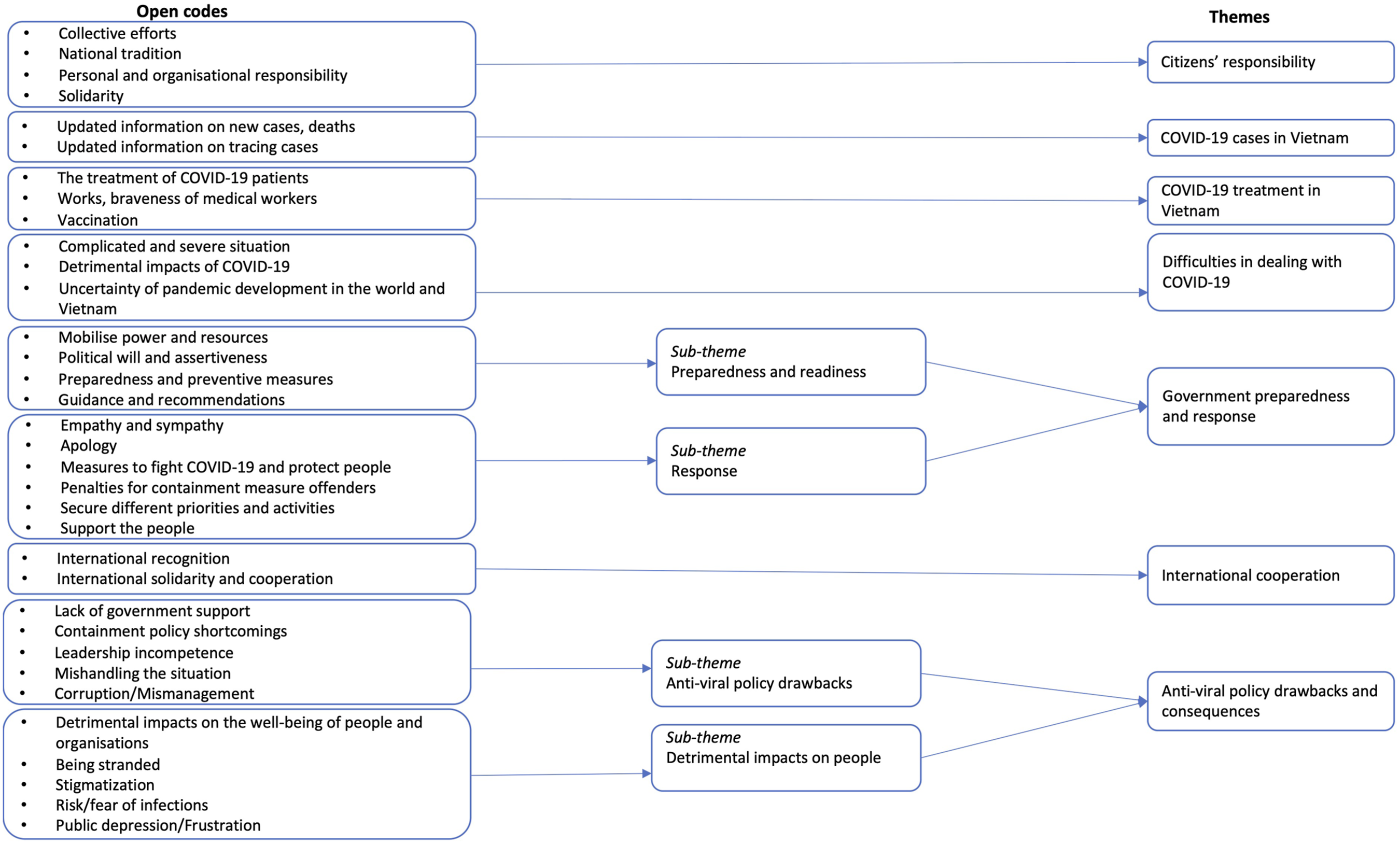
Discussion of findings: phase 1: the pre-delta phase
The data collected from the Vietnamese news media and VNGov’s official Facebook page during the first period of the pandemic showed that from January 2020 to March 2021 the VNGov adopted a hybridized propaganda-PR-persuasion strategy to raise public awareness about COVID-19, promote health literacy and vaccination, mobilize society to cooperate with and support the government, and persuade the public to comply with containment measures.
Having considered propaganda as a weapon to fight COVID-19 (Humphrey, 2020; Tuyết, 2021), the VNGov applied news management practices to set the media’s agenda (Dinh and Nguyen TMH, 2022) by prompting journalists to speak in one voice to advocate the government’s containment measures. The MOH provided updates on new cases, medical recommendations, COVID-19 treatment, anti-viral measures, and guidance for communicative activities. The CPEC and the MIC acted as media gatekeepers, ensuring that all media outlets spoke in a uniform voice. For instance, the MIC demanded that media outlets publish the same messages from the Prime Minister and guidance from the MOH to fight COVID-19 (Vinh, 2021). Although government communication was collective, involving primarily the VCP General Secretary, the President, the Prime Minister, and the COVID-19 taskforce, and the National Steering Committee for COVID-19 Prevention and Control (NSCC), the messaging was centrally controlled, concerted and consistent from central to grassroots levels.
Furthermore, the VNGov subsidized media production and content nationwide (Vinh, 2021). Newspapers, schools, outdoor advertising screens, and governmental organisations were requested to redistribute official information, data, and media productions provided by the MOH and MIC (Vinh, 2021).
All media outlets were directed to increase pandemic coverage and counter viral fake-news on their channels and social media platforms (Dinh and Nguyen TMH, 2022; Hằng, 2020; Nguyễn ĐQ, 2020; Nguyen H and Nguyen A, 2020; Vinh, 2021). From 01 February 2020 to 31 May 2020, media outlets in the country published 560,000 news articles about COVID-19 (Hằng, 2020). The MOH collaborated with the Vietnam National Television to launch the Steadfast Vietnam program to promote health literacy and keep the public informed about how the government was dealing with the COVID-19 health threat (Vu, 2022). Anti-fake news groups were founded on Facebook by television stations to spread official news and accurate information and engage with the public 24/7. Notably, the News Checks page on Facebook was established to identify fake news about COVID-19 on social media (Nguyen H and Nguyen A, 2020).
As in Vietnam, most kinds of arts are produced under the supervision of the government, within a predominantly censored and restrictive communist system; drama, TV shows, documentaries, music, and the arts were considered part of the propaganda apparatus to fight COVID-19 (Humphrey, 2020; Tran, 2021; Tuyết, 2021; Vinh, 2021). Music was labelled as a ‘weapon to fight COVID’ at the time (Tuyết, 2021), using rhetorical persuasive, emotional appeals (mainly fear and war). The ‘Jealous of COVID’ (2020) song, in which the MOH encouraged people to wash their hands, wear masks and avoid gathering, went viral on social media worldwide, also using emotional appeals relatable to Vietnamese collective culture. Interpersonal relations and responsibility were at the heart of the viralised video.
Government communication content in the form of Gruningian publicity, such as press releases, urgent statements and directives, were disseminated via media channels, such as social media and mobile devices (Dinh and Nguyen TMH, 2022; Nguyễn ĐQ, 2020; Nguyen-Thu, 2020) and via traditional propaganda channels, such as posters, leaflets, and loudspeakers, which were used widely to visualize COVID-19 at community levels (Exhibition Center, 2020; Robert, 2020). The loudspeakers, as Nguyen-Thu (2020) explained, evoked images of the Vietnam War and US invasion, using the metaphor to unite the people against a new enemy, COVID-19. In the past, outdoor posters, leaflets, and loudspeakers were instrumental for the communist regime to promote ideology, mobilize and give warning to the public in the face of war, with loudspeakers used to warn people about B-52 bombers during the American War (Mares, 2013).
During peacetime, these channels provide the public with mundane information, official news and patriotic content. During the pandemic, these channels primarily conveyed WHO-released information about COVID-19, COVID-19-related governmental announcements, the importance of containment measures recommended by WHO, and urged people to comply with such measures (Exhibition Center, 2020) via patriotic content, such as songs or mobilizing posters.
The VNGov propagandist efforts were mixed with dialogic communication tools to persuade the public at local levels to comply with containment measures using participatory community tactics advised by the WHO (2020) to enhance COVID-19 prevention and protection (Thiện, 2021; Vinh, 2021). Leaders and/or ‘credible persons’ in communes were assigned by the local government to approach households and talk to them about the disease, convincing them to comply with the measures (Thiện, 2021). In remote areas, the same approach was deployed in at least 12 languages of minority ethnic people. Mobile loudspeakers were employed to broadcast the government’s messages in minority ethnic languages multiple times a day (Vinh, 2021).
Therefore, although the VNGov seemed to prioritize its use of PR during the first phase, it did not completely abandon propaganda. The government triangulated its media strategy by imposing censorship while, at the same time, cooperated with journalists, and resorted to deceitful tactics on social media platforms appealing to nationalist emotions. On 8 June 2020, the then-Prime Minister, Nguyen Xuan Phuc, made a controversial comment comparing the country’s early success in pandemic containment to the situation in the US. His comment disappeared from all the state-owned media hours after it sparked criticism on social media (Nguyen-Thu, 2020). The VNGov also cooperated with Facebook to remove unwanted content regarding COVID-19 (Pearson, 2020; Trang, 2020). The government also used tools of deceit and deflection through texts by the Force 47 group, and other Internet commentators exacerbating pro-government material to counter what officials viewed as ‘toxic’ anti-government discourse and fake news (BBC Vietnamese, 2021d; Pearson, 2021; Vu, 2022). At the same time, prominent political dissenters and independent journalists were arrested and received hefty sentences (Reporters Without Borders, 2021).
Therefore, our data suggest that the VNGov employed propaganda to get their messages across multiple channels during the first phase of the pandemic (Dinh and Nguyen TMH, 2022; Nguyễn ĐQ, 2020; Nguyen-Thu, 2020; Vinh, 2021). The messaging was centrally controlled and remained consistent from central to grassroots levels, ensuring media outlets spoke in a uniform voice (Nguyen-Thu, 2020; Vinh, 2021). The VNGov’s propaganda during this period proved effective in providing the public with sufficient knowledge of COVID-19 (Dinh and Nguyen TMH, 2022; Tran, 2021; Tam et al., 2021); and delivering prompt factual and visually compelling content from known sources (Bucatariu, 2020).
However, the VNGov also used Westernised publicity (Grunig and Hunt, 1984) hybridized with communist propaganda tactics and censorship in order to simultaneously both persuade and enforce consent. The VNGov engaged with social media platforms to inform and educate about COVID-19, and to manage their relationship both domestically and internationally (Dinh and Nguyen TMH, 2022; Trang, 2020). The VNGov’s profile page on Facebook, @thongtinchinhphu, enabled the government to post up-to-the-minute information about COVID-19 and counter fake news while enhancing interaction and online engagement between the government and the users (Dinh and NguyenTMH, 2022).
From January to May 2020, there were nearly 17 million posts and comments on social media about COVID-19 in Vietnam (Ministry of Health, 2021). PR tactics were instrumental for the VNGov in this phase to raise public awareness about COVID-19 and mobilize collective action to fight COVID-19 in a cost-efficient way (Nguyễn ĐQ, 2020; Tam et al., 2021; Vinh, 2021). Medical experts, government officials, and journalists became opinion leaders on social media, spreading insightful and informative content from the government and fact-checking misinformation (Nguyen H and Nguyen A, 2020).
Dialogic, more interactive, communication persuaded audiences to change their health behavior and comply with the containment measures (Nguyễn ĐQ, 2020; Trang, 2020; Vinh, 2021). Essential health messages, such as the washing hands viral song and animated message ‘Jealous of COVID’ (2020) and safety ‘5K messages’ showcased media-savvy creative and interactive messaging, and use of persuasive emotional appeals which represented heart-wrenching stories and visuals, especially about medical workers’ sacrifices, were disseminated on news media outlets and social media to convince people to stay at home for the safety of all society (Mỹ, 2021). The country’s leaders showed leadership and empathy when encountering the global health crisis, especially during weekly press conferences (Dinh and Nguyen TMH, 2022; Watson, 2020).
Dominant themes during the first COVID-19 phase
The first salient theme that we found in the studied news media and social media texts during the first COVID-19 phase showed that the VNGov seemed to have met the demands for information about the pandemic among the domestic publics. The government provided the public with updates about newly infected cases and deaths in Vietnam and the world, which helped represent how effective the government was in curbing COVID-19 compared to other countries (Thông tin Chính phủ, 2020b). The following post on the VNGov’s Facebook page illustrates this claim: On average, the number of infected cases in the world is increasing from 100 to 1,000 within seven to nine days. In Japan, the time span is about 28 days. In Vietnam, infected cases are increasing from 100 to 171 within seven days, and after nine days, there are only 203 cases recorded. Thus, the number of infections in Vietnam has increased remarkably slowly because Vietnam has implemented proactive, timely, early and effective solutions. (Thông tin Chính phủ, 2020b, par. 3) …was how the VNGov seemed to have met the citizens ‘demands for information about the pandemic. The government was represented as providing pragmatic and proactive information.
The second salient theme in the news media related to the VNGov preparedness to stop the spread. The VNGov’s approach was proactive as they advanced evidence-based health information relatively early, even though knowledge of the new disease was limited at the time (World Health Organization, 2020). Keeping the public informed about the pandemic’s development and progress in combating it helped the VNGov persuade people of the benefits of lockdowns and other harsh containment measures. Press conferences and news media texts highlighted proactive and preventive measures based on the WHO’s recommendations (Thông tin Chính phủ, 2020a), which helped represent how effective the government was in curbing COVID-19 compared to other countries (Thông tin Chính phủ, 2020b). Press conference briefings on social media and news media texts emphasized preventive measures based on WHO’s recommendations (Thông tin Chính phủ, 2020a) The VNGov kept the public updated about the governmental COVID-19 policies and actions over time, such as (entire or partial) lockdowns and restrictions nationwide or in certain regions, isolation or collective quarantine, and mandatory health declarations.
The government’s communication thus emphasized a persuasive action and response strategy, which took into consideration the impact of COVID-19 on various stakeholders. On the VNGov’s Facebook page, Vice Premier Vu Duc Dam made sense of the government’s actions while showing empathy to all stakeholders who suffered from the harsh containment measures: It is easy for the managers to put a region under lockdown and isolation as long and as wide as possible, but it is tough for the people. Instead of blocking the whole district, we block a few communes, instead of blocking all of the communes, we block a few villages. This is the bravery of a manager. (Thông tin Chính phủ, 2021a, par. 22)
Keeping the public informed about the difficulties in dealing with COVID-19 (third salient theme), that is, detrimental impacts of the virus and uncertain development of the pandemic, and progress in combating the disease (second salient theme) helped the VNGov persuade the public of the benefits of lockdowns and other harsh containment measures.
The fourth salient theme relates to treatment provided to COVID-19 patients in Vietnam (Nga, 2020). Specifically, the government’s messages called attention to the endless efforts of medical workers and many other people to save patients’ lives at all costs despite under-resourced conditions, convincing people to comply with containment measures and underpinning the message, ‘No one is left behind’. On mainstream media outlets, stories of vaccines and drugs were of salience since the government prioritized both public health and socioeconomic targets while living ‘safely with the virus’ (Tuổi Trẻ, 2021, par. 8). Also, cultural, social and ideological beliefs and values, such as cultural collectivism and interpersonal solidarity, were embedded in the government’s messages as shown in the fifth theme pertaining to citizens’ responsibility. When the country entered a hard lockdown for 14 days, Vietnam’s President and General Secretary of the Vietnamese Communist Party, Nguyen Phu Trong, sent a message to all Vietnamese people calling for national solidarity to fight COVID-19: With the spirit of putting people’s health and life first, I call on all compatriots, comrades and soldiers across the country and abroad to unite with one heart, unify our will and act actively to drastically and effectively implement the guidelines of the Party and State, the direction and administration of the Government and the Prime Minister. Every citizen is a soldier on the front of disease prevention and control. (Tuổi Trẻ, 2021, par. 8)
The VNGov emphasized citizens’ responsibility associated with collectivism to fight against COVID-19 to persuade them that the government’s efforts alone would not work without their consensus, compliance, and support: One of the primary factors contributing to Vietnam’s control of the Covid-19 epidemic and low numbers of infected people and deaths is people’s compliance to epidemic prevention regulations. When health authorities recommend wearing masks and washing hands frequently, most people comply. When the government orders social distancing, most people obey. That is the expression of awareness and civic responsibility in the face of the great danger from the pandemic. (Chân N, 2020, par. 3)
It is of note that the government’s cooperation and support abroad was the sixth key theme in the outbreak, in which Vietnam was portrayed as a responsible member of the world (Tuổi Trẻ, 2021). In this way, the government informed the public of its external PR (Grunig and Hunt, 1984).
Findings: phase 2 - The Delta variant phase
The urgency and severity of the Delta variant made the VNGov return to deflecting and deceitful tactics (e.g., by using Force 47 tactics mentioned earlier) and focus on spreading misinformation and contradictory messages. Instead of addressing rumors and concerns over a potential curfew in Ho Chi Minh City (HCMC), on 25 July 2021, government authorities only warned that social distancing would be extremely strict. A de facto curfew was imposed without a declaration from 26 July 2021 onward (BBC Vietnamese, 2021c). Again, on 20 August 2021, propagandist groups publicly dismissed rumors of an imminent lockdown in HCMC (Huy, 2021). Two days later, an emergency state was imposed, leaving no room for the inhabitants to deal with shortages of food and necessities (Long and Lê, 2021).
Contradictory messages were disseminated during the Delta crisis (Dien, 2021), for example, on 7 October 2021, Premier Pham Minh Chinh issued a media release, affirming that “coming home is of people’s righteous need” (Luật Khoa Tạp chí, 2021). This order contradicted his urgent release one week earlier, in which he directed leaders in HCMC and other provinces to closely supervise the number of people moving in and out of their areas (Luật Khoa Tạp chí, 2021). Such confusion was ascribed to the government’s inconsistency and mishandling of information at central to local levels (Trần, 2021).
The VNGov used monologic and coercive propaganda tactics during the Delta variant phase, illustrated by texts in the news media that stressed, for example, the so-called “small truths to promote big lies” tool (Yang and Bennett, 2022: 89). “The outbreak of COVID-19 has been so complicated for nearly five months in HCMC; however, no one has suffered from food shortage, lack of garment and grief so far,” as a leader of the Department of Labours, War Invalids and Social Affairs was quoted as saying on 18 October 2021 (Phong, 2021, par. 2). Notwithstanding limited support from the government (Thái, 2021; Đan, 2021), countless people suffered from COVID-19 and anti-viral measures in HCMC (BBC Vietnamese, 2021b; Diep, 2021; Nguyen L, 2021; Nguyên P, 2021; Thắng et al., 2021). This tactic backfired as the quote immediately triggered public outrage on social media, especially from those who had suffered from substantial hunger or were grieving for family members and friends who had died from COVID-19 (Phong, 2021).
In addition, the government again used rhetorical and persuasive war appeals portraying COVID-19 as the collective ‘enemy’ and called on the people to fight it collectively during the pre-Delta phase (VietNamNet, 2020). Propaganda slogans primarily appealed to emotions (fear), love (fellow countrymen), the culture of collectivism (Dinh and Ho, 2020), patriotism, and values of solidarity and ideology (Exhibition Center, 2020; Humphrey, 2020)
To combat public backlash, the VNGov resorted once again to the use of dialogic PR strategies together with propaganda. In addition to campaigns to promote health literacy (Nguyễn ĐQ, 2020; Vinh, 2021), the vaccine campaign turned into a PR achievement where fundraising efforts resulted in a USD390 million vaccine program (Dương et al., 2021). Instead of donating vaccines to other countries (like China did), Vietnam’s so-called ‘vaccine diplomacy’ consisted of massive vaccine donations to a country in the developed world (My, 2022).
Moreover, Premier Chinh attempted to showcase his leadership, responsibility, and accountability (Nguyễn SD, 2021; Quốc, 2021). The leaders of HCMC publicly acknowledged mistakes and apologized to the public in the hope that “people will forgive” (BBC Vietnamese, 2021c, par. 33). The government also launched for the first time live-streaming dialogues with the public on social media platforms to listen to and address their concerns over the ongoing health crisis and anti-viral policy (Sỹ, 2021).
Dominant themes during the delta phase
Two dominant themes prevailed during the Delta outbreak phase. Despite the efforts of the VNGov to intensify their information about anti-viral health measures, vaccines, and policies (Đan, 2021; Thái, 2021), the first salient theme consisted of news media and social media criticism of the VNGov’s confusing messages, coercion, and overall propaganda. Media coverage and comments consistently flagged the VNGov’s shortcomings, mismanagement, and contradictions in containment measures with detrimental impact on the people’s well-being (BBC Vietnamese, 2021b; Nguyen L, 2021; Thân, 2021; Thắng et al., 2021; Thi, 2021).
Domestic media, except for Nhandan, the Vietnam Communist Party’s mouthpiece, focused on people’s suffering from hunger due to food shortages (Nguyên P, 2021), unemployment due to long-lasting lockdowns (Diep, 2021), and their fear of exposure to COVID-19: The Delta variant has uprooted the daily life in Covid-19 hotspot HCMC, causing hardship, despair and food shortages. (…) He worries they may have to beg for food should they run out of rice. (Diep, 2021, par. 1)
Some specific themes, namely ‘corruption/mismanagement’ were salient in Tuoitre newspaper, a relatively critical media outlet in Vietnam. The newspaper published a series of investigative articles about scandalous corruption cases related to domestically fraudulent COVID-19 kit tests (Thân, 2021). However, themes arising from international media coverage, such as ‘leadership incompetence’ and ‘containment policy shortcomings’, could hardly be found in any sampled domestic news media. Such a disparity in thematic topics apparently indicated the extent to which the VNGov could tolerate criticism on domestic news media. Emerged themes from the analytic process showed that BBC Vietnamese had the freedom to describe public depression and frustration while directly criticizing the incompetence of the leadership: Should a natural disaster happen, it brings about obvious consequences; all our actions aim to alleviate those consequences wisely, not to fight against the pandemic like fighting an enemy or creating barriers with meaningless and unreasonable means. (…) Anti-epidemic (measures) require knowledge, experts’ minds, not the expertise of a politician or security officer (BBC Vietnamese, 2021a, par. 21)
As a result, the second Delta theme was marked the VNGov return to hybridizing propaganda with dialogic communication to address and clarify urgent issues brought by the Delta variant as well as criticism or concerns raised by news media outlets and individual commentators. On social media, the government attempted to clarify confusing or contradictory information about specific regulations and actions during lockdowns and address public concerns over vaccine-related deaths (Thông tin Chính phủ, 2021d). The VNGov also conveyed messages about protecting people’s health at all costs (Thông tin Chính phủ, 2021b, 2021c). During this phase, the VNGov publicly took unprecedented accountability and responsibility and more importantly, actively engaged in direct dialogue with citizens on a real-time basis, thus maintaining dialogic stakeholder relationship management (Degenhard, 2021).
Conclusion
Our research findings suggest that the VNGov adopted a pandemic communication style that hybridized traditional monologic propaganda with PR dialogic communication strategies in order to inform citizens build and set and set the media agenda, combat misinformation, and mold people’s understanding and attitudes during different phases of the pandemic. We have aimed to demonstrate that this rather fluid strategy rendered mixed results depending on the way the VNGov prioritized or alternated dialogue, persuasion or restrictive propaganda in a cultural context marked by a collective tendency to skepticism and resistance to propaganda. Also, the VNGov applied persuasive appeals to national culture, traditions, and ideologies, that is, patriotism, solidarity and collectivism, to win hearts and minds and ultimately public consent.
The VNGov managed to control the agenda, especially in the pre-Delta phase, by prioritizing dialogic PR communication strategies and persuasion over propaganda. However, during the Delta phase the government returned to top down propaganda, control, censorship, and coercion. As can be seen from the salient themes during the Delta phase, the disparity in the level of criticism between domestic news media and international news media indicates an apparent censorship and incorporated self-censorship within state-controlled media. Specifically, COVID-19 infections and deaths were updated daily but were not salient themes during this phase. Instead, updates on COVID cases and mortality were presented at the end of the news. News media were assigned to publish positive stories related to the pandemic (Dien, 2021).
This strategy rendered adverse social media reactions. Documented public sentiments on social media showed that public criticism peaked from late August to late September in 2021, overshadowing any demostrations of support that might still exist primarily due to contradictory and inconsistent messaging, and rather ambigous and non-credible communication. Criticism of the government’s COVID-19 policies and communication escalated, resulting in arrests and fines for journalists (Reporters Without Borders, 2021), social media users and the dismissal of a university lecturer. Facebook user Tran Hoang Huan was arrested for posting content that criticized the government’s COVID-19 policies, whereas Duy Tan University lecturer Tran Thi Tho was dismissed for sharing comments about the insufficient government response to people affected by the pandemic (RFA).
Negative public sentiments during the Delta phase prompted the government to use again a dialogic approach with citizens on social media to counter the criticism. Indeed, criticism on social media sometimes led to dialogic communication, investigation, and apologies from government officers. Local government officers publicly apologized to a man who was wrongly fined for buying bread in Nha Trang City in July 2021 and a woman who was physically coerced to take a COVID-19 test in Thuan An City in September 2021 (Doan, 2023).
Notably, in both phases of the pandemic in Vietnam, we found that fact-based propaganda worked when the government’s performance was perceived as efficient, with a relatively high level of transparency, as shown during the first 18 months of the pandemic (Bollyky et al., 2022; Bucatariu, 2020; Tam et al., 2021; Taylor, 2022). However, the consequences of deceit, deception and deflect strategies, especially when the government’s performance is perceived as deficient or poor (see Luật Khoa Tạp chí, 2021), especially among prone-to-resistance Vietnamese citizens, that know how to read propaganda ‘between the lines’ (Nguyen-Thu, 2020: p. 177).
Another implication from our study suggests that dialogic techniques have been key to the way the VNGov persuaded citizens to comply with containment policies. Although authoritarian regimes can resort to tools of repression (i.e., censorship) to generate public compliance during a pandemic (Dien, 2021; Waldman, 2020), this does not mean that citizens will automatically and uncritically accept government regulations. Vietnamese people are well-known for not always complying with restrictions and regulations (Nguyen S, 2020); they are critical enough to identify and demonize propagandist content (Bayly, 2020; Dien, 2021; Nguyen-Thu, 2020).
Although the satisfactory COVID-19 outcomes during the pre-Delta phase of the pandemic could be attributed to public compliance (Tam et al., 2021) and public trust in government (Bollyky et al., 2022; Dien, 2021), public compliance, in this case, needs to be seen in the pandemic context and in association with cultural factors, such as the prioritization of the collective (Pham et al., 2020). Indeed, the VNGov appealed to cultural values, such as collectivism and national solidarity, but also responded to critique and resistance to call for collective actions and compliance with containment measures.
Ultimately, and perhaps the novelty of our study is the VNGov’s visible and explicit adoption of hybrid, changing, rather fluid PR-propaganda strategies as essential tools to build compliance during the earlier phases of the pandemic. Thus, propaganda and PR should not be viewed as opposite or binary terms but rather as similar media-savvy practices that are united by their use of promotion and persuasion to influence their audiences, while separated by cultures, political systems and specific circumstances such as COVID-19 pandemic.
Footnotes
Declaration of conflicting interests
The author(s) declared no potential conflicts of interest with respect to the research, authorship, and/or publication of this article.
Funding
The author(s) disclosed receipt of the following financial support for the research, authorship, and/or publication of this article: This research received support from the 2021 HASS Enabler Funding Scheme (round 2) at The University of Queensland.
