




Abstract
Government communication introduced important lessons during the worldwide experience with the COVID-19 pandemic. It is important to apply known efficacious principles of risk and health communication strategies. The purpose of the study is to depict and explore the United Arab Emirates government communication scenario in tackling the COVID-19 pandemic as well as look at the types of strategies, information and messages delivered via digital mediums to handle challenges that are raised based on the Crisis and Emergency Risk Communication model. The study includes a qualitative analysis of two government bodies’ digital platforms: ‘The Ministry of Health and Prevention’ (mohap) and ‘Crisis and Disasters Management Authority’. Results indicated that the UAE government used different communication aims and strategies to face the pandemic according to the risk management scenario. In the quarantine phase, communication focused on giving people information about the disease, raising awareness about the disease, motivating health and behaviour change, informing people about government decisions and procedures. In the coexistence phase communication focused on emphasising the necessity of adherence the health measures, providing information on re-work in institutions and commercial centres, involving people in the health and social initiatives, confronting non-compliance with health precautions. Government communication also focused on facing rumours and false information. UAE government communication used digital platforms and social media to address more than 200 nationalities living in the state for ensuring that they adhere to the precautionary measures and coordinate with the authorities. Government communication was committed to a set of values including equality between citizens of the state and residents, societal and individual responsibility, recognising the frontline medical staff and acknowledging their sacrifices. UAE implemented an integrated, coherent and effective scenario to deal with the crisis. It developed risk communication strategies in health communication to manage the COVID-19 crisis by following international standards and also took into account its own political, economic, social and cultural features. The UAE government used many strategies to inform and convince people including clarification of measures strategy, reassurance strategy, ambiguity reduction strategy, behaviour efficacy strategy, correcting misinformation and rumours, advising strategy.
Keywords
Introduction
On 11 March 2020, the World Health Organization (WHO) declared COVID-19 to officially be a pandemic after 3 months when China broke out the first outbreak of coronavirus disease in December 2019 in Wuhan city.
1
At the time of writing this article, there have been reports of over 40 million COVID-19 cases worldwide and just over one million deaths globally, and more the 28 million recovered. In UAE (9,897,835 population), there are 121,000 COVID-19 cases, 475 deaths and 113,000 recovered.
2
The first patient in UAE was released on 29 January 2020. In response to the global outbreak of novel coronavirus (COVID-19), UAE authorities took actions to protect citizens, residents and visitors (
Conceptual Framework and Literature Review
Government communication is generally defined as all the communication activities of government bodies that are aimed at conveying and sharing news, information to present and explain government policies, plans, decisions and actions. Government communication acts on achieving many objectives such as explaining to the public the government’s goals, decisions, actions and activities; keeping people up to date with their rights and obligations; giving the community instructions for how to act in the case of an emergency and increasing awareness of social, economic, environmental issues (Kang et al., 2018; Soukenik, 2018).
Risk communication refers to disseminate information about health risks. It is also a kind of specialised communication process that addresses citizens about how to save their life, adapt attitudes and behaviours that may help them against risks.
Risk communication was also identified as a tool for guiding citizens about how to respond in time of infectious and disease threats. It is an interactive process of communication that aims at raising awareness during risks and disasters. The main goal of risk communication is to help communities to discuss social and environmental risks, to create mutual understanding and acceptance about the taken procedures for keeping the community safe. In risk communication activities like situation analysis, assessing information, developing strategies, creating messages, integration and coordination are very important steps that help officials to build effective communication plans (Dickmann et al., 2016; Infanti et al., 2013).
During risks and emergencies, information from public officials should be adequate, frequently not sporadically reported, not deceptive, authoritative and unambiguous. Misinformation leads to uncertainty and anxiety, but news consumption from trusted sources make individuals keep away from delusions, rumours and alternative facts (Bratu, 2020). The current pandemic has posed many challenges facing governments and health communication organisations. The rapid escalation of the pandemic has been accompanied by tension, confusing and disinfodemic news. A flexible communication strategy has to be adapted with a proactive approach to handle all social, cultural and economic challenges related to the pandemic (Ratzan et al., 2020). There are a vast number of guidelines, principles and rules of effective risk communication strategies and plans. They are concerned with audience involvement, communication tools, risk assessment methods and evaluating decision-making process. Risk communication strategies are strongly associated with threat sense, attitudes and behavioural change (Reynolds & Seeger, 2005).
Health communication refers to communication strategies built to enrich health information to the public and community and impact their health behaviours, practices and decisions. Health communication concerns health education, risk communication, health literacy. Strategies in heath communication act to disseminate information that influences personal health behaviours and choices to be more committed to proper health procedures (Basch et al., 2020; Jansen & Van der, 2019).
Bulunmaz (2019) defined health communication as the use of communication to promote healthy behaviours that protect citizens and society from diseases and infections. Rudd and Baur (2020) clarified the key elements of health communication in clarity, which men that easing comprehension and facilitating the use of appropriate information, providing evidence, meaningful contexts, clarifying the action steps. Rigor which reflects the need to plan the delivery process of information by all types of media and communication. Numeracy, numbers data can help in the comparison process and indicate the immediate protective actions. Action, to provide the action steps for behaviour change.
The development of new media and communication technologies and their availability from a wide range of platforms creates great advantages for health communication by using effective media strategies (Schiavo, 2020). The European Centre for Disease Prevention and Control (ECDC) established principles that guiding health communication strategies including accurate information, available to the audience, balance among resources and information, consistent content, competent with community culture, strong evidences, reach to the target audience and understandability. In general, health disasters have always required effective communication strategies and components while planning risk messages, warnings, notifications, information regarding health issues.
The literature indicates that many studies had published about government, health and risk communication during the COVID-19 pandemic focused on how to plan, design and deliver informative and persuasive messages to interact and influence the audience’ knowledge, attitudes and behaviours during the crisis. Many of them examined the practices and effectiveness of communication strategies used by the government and organisations. An and Tang (2020) referred that the pandemic has hit every country in the world. Politicians and government officials tested their crisis management capabilities to adopt divergent emergency management effective strategies in both the short and the long run. Governments struggled with the fast and widespread of COVID-19 faced many overwhelming challenges with the novel of the pandemic that is considered a compelling global crisis that is not easily solvable because of the scale and speed of infections (Moon, 2020).
The COVID-19 outbreak caused negative and enduring impacts on the economy and society, which reshaped individuals’ lifestyles and behaviours (Wen et al., 2020). During these uncertain times, information is very important as there are a lot of fears in society (Surg, 2020). Boberg et al. (2020) mentioned that besides that the pandemic has severe cultural, societal, political, economic effects, it has also effects on media and government communication in unprecedented ways. These media should be credible sources facing the spreading out of misleading fake news and lies or fabrications.
During the pandemic, government communication should adhere to many principles such as balancing between all citizens’ needs and expectations; emphasising the concept that their well-being is considered as a top priority; addressing and sharing all COVID-19 issues, knowledge to all segments in the society (Jallow et al., 2020). People and organisations are using digital means to communicate and collaborate to get news about the pandemic and to work, interact and discuss by using many platforms and applications (Jallow et al., 2020). Mason et al. (2019) discussed the role of digital communicating during disasters to warn, respond and recover as well as conveying operational messages. During such crises and large public health threats, government communication should be transparent and open to all publics, interact and coordinate with all citizens and institutions to raise their awareness, engagement in anti-pandemic procedures by providing all necessary information and instructions, spreading recent statistics about infected cases, and delivering notifications about the decisions and actions.
Many apps were developed by government organisations that allowed citizens to track the situation and get health advice (Grizzle et al., 2020; Moon, 2020). Chesser et al. (2020) found that publics prefer using trusted and reliable information channels and sources to get health information and increase COVID-19 knowledge and disease prevention strategies. Government communication during the pandemic helps in decreasing the level of confusion among people by covering the news with factually accurate information and enabling individuals to make rational decisions as regards keeping themselves safe, and also confronting the feel of apprehensive preponderantly about the future (Derek & Veronika, 2020).
Government communication develops health communication campaigns to ensure that people are being noted effectively, respectfully about the situation, and are being helped to understand the claims of these campaigns such as ‘Stay Home’ concepts. Campaigns during this novel should be flexible, resilient and establishing partnerships with all partnerships in society to inform, educate people (Stolow et al., 2020).
Reynolsds et al. (2005) built an integrative model for ‘Crisis and Emergency Risk Communication’ based on five stages—Precrisis: in that stage communication campaigns target the public to facilitate recognition of the emerging risk, prepare them for the possibility of an adverse situation and changes in behaviours, to warn them about threats; Initial Event: in that stage communication reflects empathy, helps in the understanding of the circumstances, consequences; Maintenance: in that stage communication supports and cooperates with the response and recovery actions, gets feedback from target publics to correct any misunderstandings and misleading data. Resolution: communication acts to inform and convince about ongoing rebuilding efforts for remediation and recovery. It acts also to reinforce positive identities and images. Evaluation: communication acts on evaluating and assessing the effectiveness of all strategies and plans. Rambaree and Nässén (2020) applied the ‘Interest Theory of Rights’ (ITR) as a framework to assess the Swedish strategy during the pandemic, and how the government communication advised the citizens to apply mutual understanding and follow the advice and the recommendations with a high level of responsibility. During the pandemic, government communication can support public health initiatives and provide interactions with citizens, social dialogue about public health and trust information (Pulido et al., 2020). In the current pandemic, social media provides rapid and effective key information with established professional platforms and to meet the community needs (Chan et al., 2020). Chesser et al. (2020) demonstrated the importance of established reliable public health information through social media, trusted sources and channels such as health experts and government to increase the knowledge about COVID-19 and the strategies had been taken to prevent the disease. Seale et al. (2020) found government communication in Australia affected the perceptions and behaviours of citizens and helped them to adapt the right recommended behaviours.
Objectives and Questions
The study aims to explore the strategies and practices of government communication for health purposes during the risk of COVID-19 pandemic executed by two government bodies in the United Arab Emirates. The study reveals the next questions:
Methods
To answer the RQs, a qualitative analysis approach was conducted to interpret the content of text data and information that related to coronavirus pandemic published through the Instagram accounts of tow government bodies in UAE:

The research process included the following procedures: (a) collecting topics related to the COVID-19 pandemic from accounts from 29 February 2020 when the state announced its first case of the new coronavirus, in a family from Wuhan to 30 September 2020; (b) segmenting the collected information to categories; (c) analysing and describing the information; (d) constructing a view about the government communication strategies used during the pandemic.
Findings
As the 2020 coronavirus continues to spread across all countries, governments are actively coordinate with global and local organisations to implement health awareness campaigns to help in curbing virus transmission and its related risks as well as offer relief actions for market and individuals.
In response to that challenging time, government and business organisations in the UAE are taking required actions to reduce the negative impacts of the pandemic on their markets and investments. The COVID-19 strategy of UAE is managed by ‘The National Crisis and Disasters Management Authority’. The UAE government advised citizens to understand the critical situation and follow the advices and recommendations. The period of dealing with the pandemic can be divided into two phases. The first began on 29 February 2020, after announcing the first corona case, it includes also the statement of the quarantine on 26 March 2020 to separate and restrict the movement of people during certain periods that differed according to circumstances and regions, the government called it ‘national sterilisation programme’. The second began on 25 June with the end of the quarantine and phase of coexistence with the coronavirus.
Communication Strategies
Figure 1 describes the government communication strategies that were shown in the selected Instagram accounts. Researchers analysed 699 posts in the first period and 270 posts in the second period related to the corona novel.
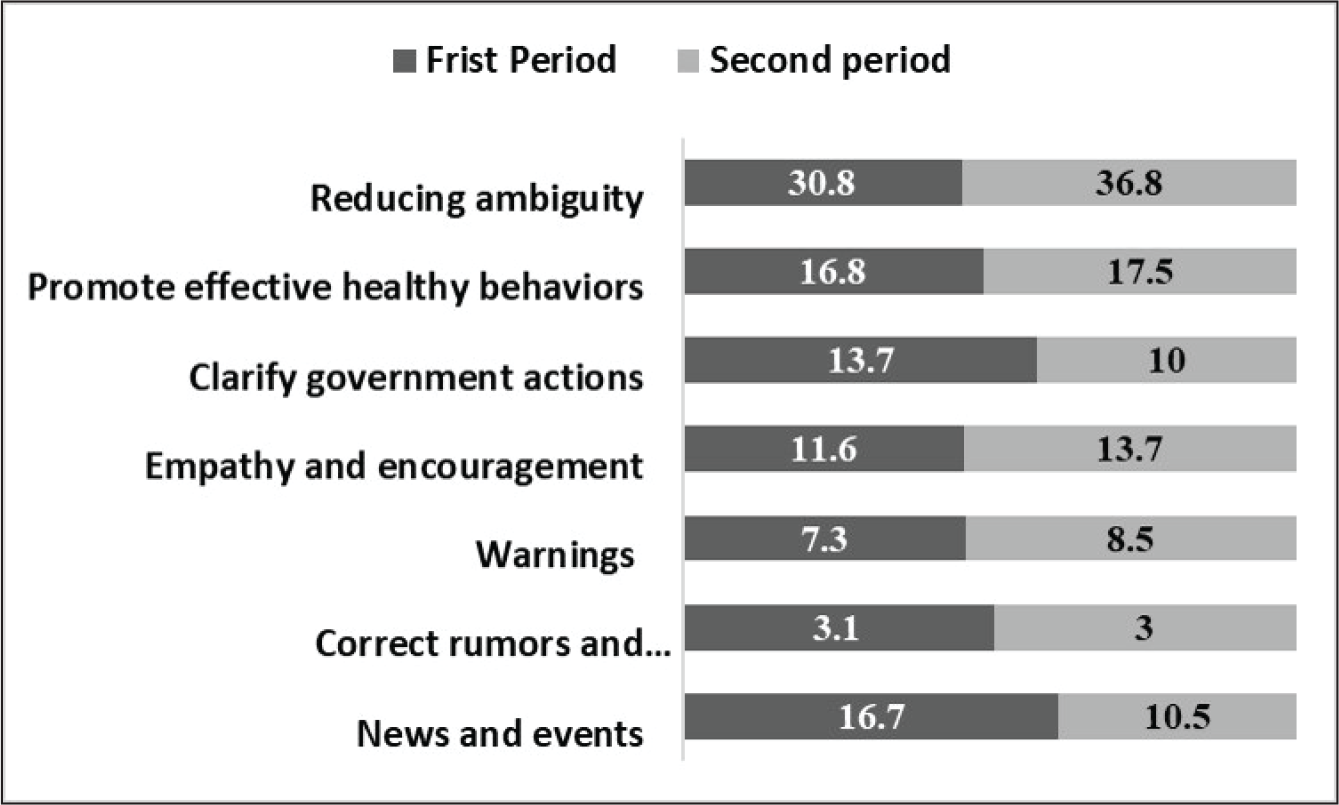
In both periods, the first strategy was ‘reducing ambiguity’. Posts under that strategy included information about the virus, numbers of infected cases and information about the means of infection.
The second strategy was ‘promote effective healthy behaviours’. Posts under that strategy included spreading the awareness of effective healthy behaviours such as hand washing, social distancing and others. The third strategy in the first period was ‘news and events’, which including news about the activities of the ministry or the authority related to the actions of confronting the pandemic. While the third strategy in the second period was ‘empathy and encouragement’ to support citizens and medical staff and reassuring the availability of food and stability of daily life. The fourth strategy in the first period was ‘clarify government actions’ that incudes State decisions and procedures for dealing with the pandemic related to health, economic, social, educational and travel. While the fourth strategy in the second period was news and events. The fifth strategy in the first period was ‘empathy and encouragement’ while the fifth strategy in the second period was ‘clarify government actions’. The sixth strategy in both periods was ‘warnings’ against violating state procedures and to declare the penalties of non-compliance. The seventh strategy in both periods was ‘correct rumours and misunderstandings’ to deny rumours and correct any false information or news.
Types of Posts
Figure 2 describes the types of posts on Instagram accounts of the two bodies. Researchers analysed the 699 posts in the first period and 270 posts in the second period related to the corona novel.
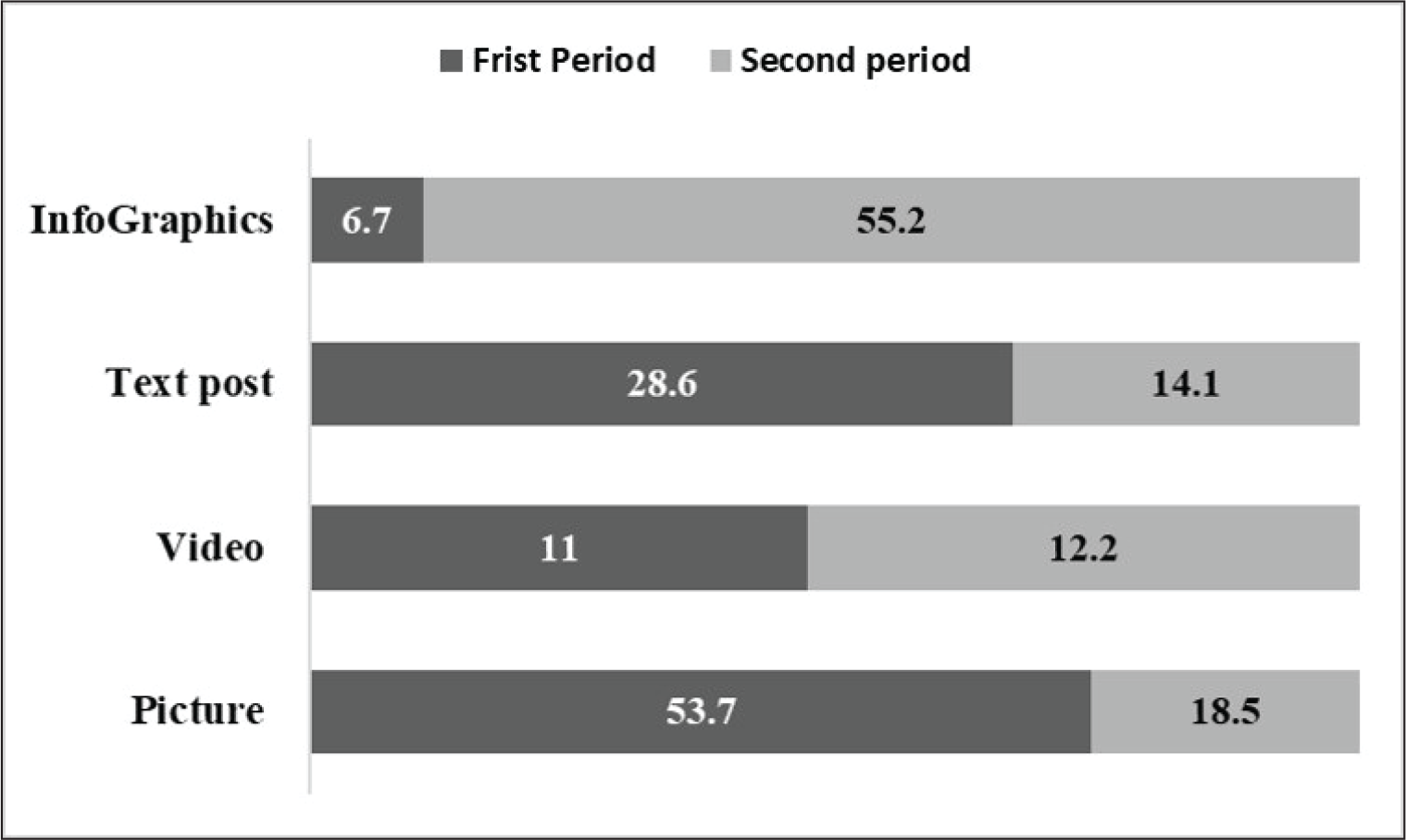
In the first period, pictures were the first type of posts spread on both the National Emergency and Crisis and Disasters Management Authority account and the Ministry of Health and Prevention account. Text posts came in the second rank, then videos and infographics. On the contrary, infographics came first in the second period, then pictures, texts and videos.
Types of Information
Ministry of Health launched an awareness part on its website, titled, ‘Your Health, Our Priority’ to publish information about COVID-19, its prevention, treatment and recommendations, precautions from World Health Organization (WHO). ‘National Emergency Crisis and Disaster Management Authority’ (a federal organisation takes the responsibility for the safety of all citizens and residents during a crisis) informed people daily about statistics related to confirmed and recovered cases. Government communication spread information under many themes including the quarantine is necessary to fight COVID-19; UAE has solutions to fight the pandemic; the government has effective guidelines for people, workplace and community during emergency conditions; explaining the governmental efforts to contain COVID-19; 3 UAE has a strategy for the period after the pandemic. By analysing the two institutions’ posts about COVID-19, researchers concluded the following.
Aims of UAE Government Communication during COVID-19 Pandemic
Phase One
Giving people information about the disease.
Motivating health and behaviour change.
Meeting the needs of media.
Informing people about government decisions and procedures.
Spreading messages to reassure people about the availability of food and the requirements of life.
Phase Two
Emphasising the necessity of adherence to the health measures.
Providing information on re-work in institutions and commercial centres.
Confronting non-compliance with health precautions.
Strategies
Phase One
Coordination and partnerships with media and other institutions such as the police, municipalities, service institutions, private health institutions and partnerships with various media outlets.
Warning and intimidation from negative implications of not adhering to health precautions and behaviours related to disease prevention, as well as legal penalties for violating the procedures and prohibitions.
Health awareness about measures to prevent and deal with the pandemic.
Confronting rumours and false news related to the symptoms and causes of the disease and the state decisions.
Taking into account the cultural differences inside the society as more than 200 nationalities living in UAE.
Phase Two
Complementarity in providing information on health measures, prevention and warning of disease, along with providing information on the return of life to normal, in light of taking precautionary measures.
Following-up with community about the spread of the virus and government decisions.
Partnership with the community by involving the people and interacting with them and obtaining their feedback.
Rehabilitation people regarding the return of commercial, service and educational activities.
Values
Equality between citizens of the state and residents.
Societal and individual responsibility and the importance of each individual’s role in dealing with the situation.
Appreciating the humanitarian conditions.
Continuing, clarity, accurate information.
Recognising the frontline medical staff and acknowledging their sacrifices.
Trust the official sources of information and be warned against circulating misinformation and rumours.
Messages, Type of Information
Statistics
Detailed instructions
Steps and procedures
Correcting false information
Following-up the spread of the disease locally and international
Right behaviours (hand washing/sanitising, cleaning surfaces, avoiding crowds, social distancing)
Providing regular updates about government decisions and procedures
Supporting the people working in the health sector naming them ‘the first line of defense’ and highlighting their efforts
Guiding people about how to face and manage pandemic issues
Posting COVID-19 updates
Provide easily referenced Q&A and FAQs
Communicate about issues related to government-mandated quarantine, financial and market concerns, work-from-home policy and business impacts
Challenges
The speed of disease and injury development locally and internationally
Ambiguity and lack of clarity
The spread of rumours and false news
Business disruptions and negative economic impacts
The inability of some people to come back to the state due to the flight shutdown
Failure to respond to the precautionary standards by some people especially youth and workers
Discussion and Conclusion
Government communication concentrated on delivering information about how the government handles the COVID-19 outbreak since the spread of the novel as proper and effective risk communication depends on consistent media presence with information and guidance (Abrams & Greenhawt, 2020; Park et al., 2020). UAE government dependent on accurate, confident, transparent and trusted communication which are effective values during risks and emergencies )Park & Lee, 2018).
The UAE government communication was based on a set of strategies to counter the corona pandemic which focused on the following directives and instruction: involving the community in the efforts to contain the pandemic; raising awareness about the government efforts; supporting government preventive measures; enhancing social initiatives and responsibility; informing and guiding people about the economic, educational and social repercussions and solutions; following-up the society with the actions taken by the UAE leaders and their assurances that the government is assuming its responsibility of protecting everyone on UAE; focusing on UAE international humanitarian role. The two selected bodies used many kinds of media to spread news and information, digital platforms and social media used to give citizens information about the pandemic and to deny rumours. They are also used to monitor the reaction to the pandemic over time (Alahdal et al., 2020; Fagherazzi et al., 2020).
To conclude, UAE developed risk communication strategies in health communication to manage the COVID-19 crisis. It followed the international standards and also took into account its own political, economic, social and cultural features. The UAE government used many strategies to inform and convince people including clarification of measures strategy, reassurance strategy, ambiguity reduction strategy, behaviour efficacy strategy, correcting misinformation and rumours, advising strategy.
Footnotes
Declaration of Conflicting Interests
Funding
The authors received no financial support for the research, authorship and/or publication of this article.