




Abstract
Social comparison plays an important role in depression. However, the process of social comparison selection among depressed individuals remains understudied. This study investigated the choices made by individuals with elevated depression scores (assessed with the Patient Health Questionnaire-8) when exposed to vignettes depicting individuals with varying depression severity and coping ability. We experimentally activated either self-assessment or self-enhancement motives and had participants choose from four vignettes: (1) Mild Depression/Coping Well; (2) Mild Depression/Coping Poorly; (3) Severe Depression/Coping Well; and (4) Severe Depression/Coping Poorly. Our first hypothesis was that most participants would select the Mild Depression/Coping Well vignette, presenting a potential upward social comparison standard (H1). Additionally, we expected higher depression scores to correlate with selecting vignettes featuring greater severity (H2). We further hypothesized that those in the self-enhancement condition would prefer coping poorly vignettes more than those in the self-assessment condition (H3). We conducted a between-subject online experiment (N = 449). Confirming H1, most participants favored the Mild Depression/Coping Well vignette, while the Severe Depression/Coping Poorly vignette was least selected. Supporting H2, higher depression levels were linked to opting for alternative comparison standards over the Mild Depression/Coping Well vignette. Contrary to H3, participants’ choices were not influenced by self-motives.
Introduction
Individuals with depressive symptoms tend to engage more frequently in social comparison than individuals without depression (Appel et al., 2015; McCarthy & Morina, 2020; Morina et al., 2024). Social comparisons comprise evaluations of one’s own attributes, abilities, or well-being relative to other individuals (Festinger, 1954; Unkelbach et al., 2023). These comparisons can be made to upward (i.e., better-off), downward (i.e., worse-off), or lateral (i.e., similar) standards (Gerber et al., 2018). Crucially, upward social comparisons are mostly associated with negative affective impact (Morina et al., 2024). Experiencing more negative feelings after upward social comparisons is associated with depressive symptoms (Giordano et al., 2000; Morina & Schlechter, 2023).
Social comparison can be construed as a process involving the element of acquiring social information (Wood, 1996). This process involves actively seeking information and selecting from available social standards to compare against (Gerber et al., 2018; Wood, 1996). Social comparison selection is then followed by an evaluation of the (dis-)similarities between the target and standard, which in turn may elicit significant reactions (Gerber et al., 2018; Wood, 1996). That is, if more than one source of social information is available, a selection of one social standard needs to be made for social comparison to occur. The social comparison selection approach represents the most frequently used experimental approach in the field of social comparison (Gerber et al., 2018; Wood, 1996). This approach examines who people choose to compare themselves with when faced with a choice of social standards. Literature suggests that individuals generally tend to choose comparing to others who outrank them on the attribute in question, indicating a preference for upward (rather than downward) social comparison (Gerber et al., 2018). However, it remains unclear what proportion of people with depression choose upward social comparisons when faced with a choice to compare with others who are also affected by depression. In particular, it is conceivable that individuals with elevated depression levels have certain preferences when faced with a choice between others who report mild versus more severe depression, or who cope well versus poorly with depression. This is highly relevant, as well-being in general, and depression in particular, represent significant social comparison dimensions in individuals with depression (Morina & Schlechter, 2023; Schlechter & Morina, 2024).
In studies of individuals with physical health complaints, patients were presented with different vignettes representing different levels of disease severity and coping ability (Arigo et al., 2015; DeVellis et al., 1990; Kulik & Mahler, 1989; Van der Zee et al., 1998; Willy et al., 2024). This research suggests that patients tend to compare to individuals who exhibit effective coping strategies (Arigo et al., 2015). For instance, in a study with cardiac patients, about half of the participants selected upward illness/upward coping strategies (Willy et al., 2024). This may be because selecting such comparison standards leads to optimism about improving one’s condition. This aligns with the literature suggesting that depressed individuals tend to choose upward (rather than downward) social comparison (McCarthy & Morina, 2020).
For depressed individuals, there may be several potential reasons to select upward comparison. First, they might select upward comparison not because they seek useful information or motivation, but because they tend to focus on negative aspects of their own lives due to cognitive biases (Gaddy & Ingram, 2014), reinforcing feelings of inferiority and potentially perpetuating a cycle of upward social comparison (Beck & Haigh, 2014). Second, depressed individuals may select upward comparisons because they perceive most other individuals as better-off. Accordingly, upward comparison standards represent the larger group, which influences the perception of the availability of choice. Drawing on this research, our first hypothesis was that most individuals would select standards with mild depression and good coping abilities (H1).
However, the general trend towards upward social comparison may be affected by the degree of depression severity. Social-cognitive theories posit that individuals with depression seek validation and recognition of their experiences (LeMoult & Gotlib, 2019). Accordingly, when faced with the choice, individuals experiencing higher depression severity may select potential comparison standards portraying severe depression as a means of validation, fostering a sense of recognition and understanding. In a similar vein, cognitive-behavioral models of depression state that individuals with depression exhibit cognitive biases (Beck & Haigh, 2014), interpreting information in a manner congruent with their negative emotional states (Gaddy & Ingram, 2014). As a result, individuals with higher depression severity may be more drawn to narratives that resonate with their own depression levels. Based on this reasoning, we expected that higher depression severity is associated with a higher likelihood of selecting standards with higher depression severity and poor coping abilities (H2).
Going beyond depression severity, social comparison selection in individuals with depression may be influenced by self-assessment and self-enhancement motives (Gregg et al., 2011; Sedikides & Strube, 1997). Those motivated by self-assessment (i.e., striving to know the truth about the self) aim for accurate self-information. Therefore, individuals with higher self-assessment motives may be more inclined to engage in narratives depicting potential upward social comparison, as it may provide accurate information about how the comparer is doing and coping relative to other individuals and what needs to be done to improve one’s own behavior. Individuals motivated by self-enhancement (i.e., striving to view oneself positively) can be expected to select narratives depicting potential downward social comparisons to maintain a positive self-image. Accordingly, individuals with more pronounced self-enhancement motives may be more inclined to focus on dissimilarities to potential downward standards, leading to contrast, which in turn may be followed by positive emotions (Mussweiler, 2020; Terol et al., 2015). Accordingly, we expected that individuals who are primarily motivated by self-enhancement are more likely to select narratives displaying poor coping than individuals primarily motivated by self-assessment (H3).
In view of the lack of knowledge about social comparison selection in depression, we examined this behavior using the selection approach in a sample of individuals with elevated self-reported depression scores. We applied four vignettes that portrayed different narratives of depression severity and coping strategies. To examine the role of the motives of self-enhancement and self-assessment in potential social comparison selection, we experimentally manipulated participants’ primary activation of either self-enhancement or self-assessment motive (for details, see Materials). Then, participants were instructed to select one of the four vignettes (1) Mild Depression, Coping Well; (2) Mild Depression, Coping Poorly; (3) Severe Depression, Coping Well; and (4) Severe Depression, Coping Poorly.
Our first hypothesis was that most individuals would select the Mild Depression, Coping Well vignette (H1). In addition, we expected that higher depression scores are associated with a higher likelihood of selecting vignettes other than the Mild Depression, Coping Well vignette (H2). We further expected differences between the self-enhancement and self-assessment condition. Individuals in the self-enhancement condition were expected to more frequently select vignettes displaying poorer coping than participants in the self-assessment condition (H3). We exploratorily examined whether the activation of self-motives interacts with depression severity.
As a final exploratory research question, we examined whether self-motive activation, vignette selection, and depression severity are associated with perceived similarity with the selected vignette and subsequent negative affect. It may well be that individuals in the self-assessment condition focus more on similarities with the portrayed character than in the self-enhancement condition, as the former aim to more accurately assess their own level of coping. In addition, participants with elevated depression scores may perceive higher similarities with individuals described as having poor coping skills. Last, we investigated whether higher depression severity is associated with higher perceived similarity.
Methods
Procedure
Participants were recruited during January 2022 via Prolific, an online crowdsourcing platform (Palan & Schitter, 2018). Research suggests that data obtained from Prolific are of good quality (Douglas et al., 2023; Peer et al., 2022). Materials were presented via Unipark (https://www.unipark.com). To participate, participants had to be at least 18 years old and native English speakers or demonstrate a level of English equivalent to their native language, as determined by Prolific when participants register on the platform (Palan & Schitter, 2018). Additionally, they had to report a minimum score of five on the Patient Health Questionnaire for depression (PHQ-8, see below), indicating at least mild depression (Kroenke et al., 2009). All participants provided informed consent and received a monetary compensation of £2.51. We did not perform an a priori power analysis as no equivalent study existed. Therefore, we did not have an expected effect size. This is because prior studies varied in the effects they reported and used experimental designs that differed from ours (Arigo et al., 2015; DeVellis et al., 1990; Kulik & Mahler, 1989; Van der Zee et al., 1998; Willy et al., 2024). In addition, these studies were conducted in the context of physical health and their effects do not extend to mental health problems. Accordingly, we aimed to have at least 200 participants per experimental group to elucidate even small effects (Schönbrodt & Perugini, 2013). This number of participants was also considered feasible given our financial resources. Initially, N = 1121 participants were recruited for a different study (Morina et al., 2023). A total of 500 participants (44.6% of the initial sample) reported a PHQ-8 score of 5 or higher and were invited to participate in the present study, which took place 8 weeks later. Of those, n = 451 (90.1%) participated in the present study and had a PHQ-8 score of 5 or above. Post-hoc sensitivity analyses for χ2-test with 3 degrees of freedom revealed that we could reliably detect an effect size index w of 0.20 with our final sample size, an alpha-level of .05 and a power of .95. We assessed no further clinical diagnostic information. We examined the data for unusual response patterns (Curran, 2016; Ward & Meade, 2023) using the Careless package in R (Yentes & Wilhelm, 2021). We did not identify any unusual response patterns. Hence, no participants were excluded at this point. The study received ethical approval from the Ethics Committee of the Institute of Psychology at the University of Münster (2021-68-NM-FA). The present study was not preregistered.
Materials
Experimental manipulation
The present study employed a between-subject design in an online survey format. We experimentally manipulated the activation of self-motives. That is, the Unipark software randomly assigned participants to either the self-assessment or self-enhancement condition. In both conditions, we aimed to activate the respective self-motive by means of a writing task. The exact phrasings were adapted and modified from Wilson and Ross (2000) and Audia et al. (2015) and are presented in Supplemental Material 1. Within both conditions, participants were asked for a self-description of their social skills and self-confidence (independent variable). These dimensions were chosen as they can be assumed to represent salient and relevant attributes for most individuals. In the self-assessment condition, participants were instructed: “Please take up to 5 minutes to describe your social skills and self-confidence in a way that provides the most accurate assessment of yourself.” In the self-enhancement condition, they were instructed: “Please take up to 5 minutes to describe your social skills and self-confidence in a way that makes you feel particularly good about yourself.”
We conducted a post-hoc manipulation check, to discern whether our manipulation induced the intended effects. To this end, two raters blind to the conditions evaluated the following question: “Did this person describe their social skills and self-confidence in a way that makes them feel particularly good about themselves?” with the response options 1 (“definitely not”), 2 (“probably not”), 3 (“possibly”), 4 (“probably”), and 5 (“definitely”). This was based on the rationale that higher values should emerge in the self-enhancement condition compared to the self-assessment condition. The ICC of the ratings of the two coders was .78. For the aggregated ratings of the two coders, higher mean levels emerged for the self-enhancement condition (M = 3.82, SD = 1.05) compared to the self-assessment condition (M = 2.15, SD = 1.03), t (446.64) = 17.03, p < .001. This indicates that our manipulation seems to have worked as intended.
Dependent variables
Vignette selection
Following the activation of self-assessment or self-enhancement motives, four vignettes were presented, from which participants were instructed to select one they wished to read. Importantly, participants were not explicitly asked to select one of the vignettes with the purpose of comparing themselves to the selected vignette. However, given that social comparisons of one’s own well-being take place with high frequency, they are very likely to occur when individuals with elevated depressive symptom scores are asked to read about the well-being of other individuals with depressive complaints. Therefore, and in accordance with social comparison selection research approach (Arigo et al., 2015; DeVellis et al., 1990; Kulik & Mahler, 1989; Van der Zee et al., 1998; Willy et al., 2024), we also label this methodology social comparison selection. Participants read the title of four different vignettes from which they could select and read one: (1) Mild Depression, Coping Well; (2) Mild Depression, Coping Poorly; (3) Severe Depression, Coping Well; and (4) Severe Depression, Coping Poorly. The order in which the titles of the vignettes were presented was counterbalanced across participants to avoid order effects resulting from the presentation of the vignettes (e.g., a general trend to select the first vignette). The participant’s choice was recorded and served as a dependent variable. Afterwards, participants were shown vignettes corresponding to their choice, which were formulated based on accounts from individuals with depression sourced from the forum https://mentalhealthforum.net, as well as coping strategies sourced from the website https://healthline.com. The length of the vignettes adhered to the parameters outlined by Arigo et al. (2018). The vignettes differed in the described depression severity and coping strategies, while they were held constant in all other aspects. To ensure linguistic precision, the vignettes underwent review and refinement by an English native speaker. The vignettes are fully presented in Supplemental Table S2.
Perceived Similarity
Subsequently, participants were asked to evaluate the perceived similarity between themselves and the selected individual described in the case vignette, which was evaluated using three items adapted from Arigo et al. (2018). The items read as follows: (1) “While reading the description, how much did you focus on similarities between yourself and the ‘comparison standard’?”, (2) “While reading the description, how much did you focus on differences between yourself and the ‘comparison standard’?”, and (3) “While reading the description, did you perceive some similarity with the ‘comparison standard’?”. The items were rated on five-point scales ranging from 1 (not at all) to 5 (very much”).
Negative Affect
The International Positive and Negative Affect Schedule Short Form (Thompson, 2007) was used to assess affect using 10 items rated on a five-point Likert scale from 1 (not at all) to 5 (very much). In the present study, we used the five items that assess negative affect (hostile, ashamed, upset, afraid, nervous) at the beginning of the study. Current affect was reassessed at the study’s conclusion after participants evaluated the perceived similarity with the person in the case vignette. Negative affect was assessed twice to account for baseline levels of negative affect in the vignette choices. This enabled us to adjust for changes in affect during the course of the study. Internal consistencies were α = .68 for the baseline assessment of negative affect and α = .71 for the second assessment of the study. Negative affect did not increase from baseline to follow-up.
Further data exclusion
To ensure the quality of our manipulation, we carefully examined the responses that participants provided in the free text field in response to the self-assessment or self-enhancement manipulation. We excluded one participant who provided very brief responses as we could not ensure that they took the task seriously enough. In addition, we excluded another participant who provided answers unrelated to the self-motive manipulation. This resulted in a final sample size of N = 449 participants included in our analysis.
Demographic characteristics
Of the participants, n = 218 (48.6%) were female, n = 227 (51.0%) were male, and n = 4 did not disclose their gender. On average, they were 27.85 (SD = 8.36) years old. Most participants had a bachelor’s degree (n = 150) or graduate degree (n = 117) and were married/in a partnership (n = 122) or single (n = 321). Of the participants, n = 225 were assigned to the self-assessment condition and n = 224 to the self-enhancement condition. The groups did not differ in terms of gender, education, marital status, or age (all ps > .09). They also did not differ in depression severity (p = .076) or negative affect at baseline (p = .354).
Analysis procedure
We performed all analysis in R version 4.01 (R Core Team, 2021). Data and the R Code are openly available in the open science framework: https://osf.io/6qs5e/?view_only=5a11c674a3ad4152b9a7dfa85492afd3.
Exploratory research questions
Next, we ran two multiple regression modes to examine whether the activation of self-motives, the selection of one of the four vignettes, negative affect at baseline, and depression severity predict a) perceived similarity with the selected vignette and b) negative affect at the end of the experiment. We set α = .05 for all statistical tests.
Results
Distribution of the choices of vignette selection.

Descriptive Statistics of all constructs for the entire sample and as a function of vignette selection.

Note. M = Mean, SD = Standard Deviation.
Multinomial regression models with odds ratios of selecting one of the vignettes based on the activation of self-motives and depression severity.
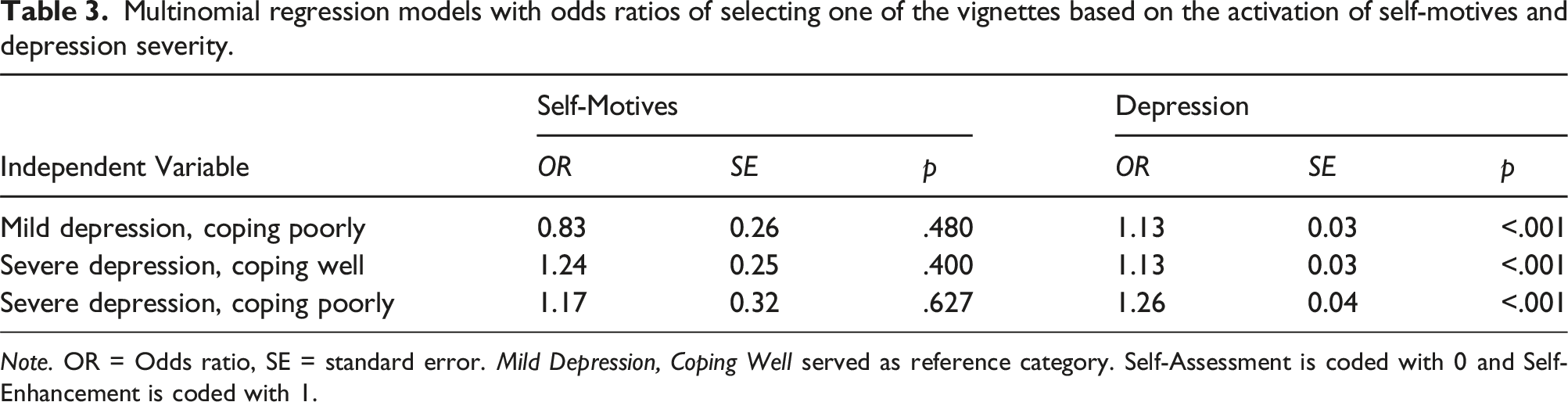
Note. OR = Odds ratio, SE = standard error. Mild Depression, Coping Well served as reference category. Self-Assessment is coded with 0 and Self-Enhancement is coded with 1.
Exploratory research questions
Regression models predicting perceived similarity and negative affect after the selection of a vignette.

B = regression weight; SE = standard error. Mild Depression, Coping Well served as reference category for vignette selection. Self-Assessment served as reference category for self-motives.
Discussion
We investigated social comparison selection in individuals with at least mild self-reported depressive symptoms and the role of self-enhancement and self-assessment motives in this process. Participants were randomly assigned to one of the two experimental conditions (self-assessment vs. self-enhancement) and then instructed to select one out of four vignettes they would wish to read: (1) Mild Depression, Coping Well; (2) Mild Depression, Coping Poorly; (3) Severe Depression, Coping Well; and (4) Severe Depression, Coping Poorly.
In line with our first hypothesis (H1), nearly half the sample selected the vignette portraying Mild Depression, Coping Well. This aligns with research on comparison selection in participants with physical diseases (Arigo et al., 2015; DeVellis et al., 1990; Kulik & Mahler, 1989; Van der Zee et al., 1998). For instance, our findings are very similar to those among cardiac patients (Willy et al., 2024). Overall, two-thirds of our sample chose a vignette depicting an individual coping well. This inclination towards coping well scenarios could be indicative of a tendency to relate more positively to situations where challenges are managed successfully. However, the focus on upward social comparisons can lead to different outcomes. For instance, the Identification-Contrast Model (Buunk et al., 2019) outlines two ways in which individuals evaluate social comparisons: (1) identification and (2) contrast. Emotional responses to social comparison vary, with upward identification being linked to positive emotions (Buunk et al., 2006; Cabrera-Perona et al., 2017), while upward contrast is related to negative emotions (Arigo et al., 2015). If an individual with elevated depressive symptoms assimilates themselves towards other depressed individuals coping well, the comparison is likely to raise hope that the comparer, too, will be able to cope with challenges at issue (Buunk et al., 2006; Cabrera-Perona et al., 2017). If a comparer with elevated depressive symptoms, on the other hand, contrasts away from depressed individuals coping well, the comparison is likely be associated with negative emotions. In the context of depression, individuals have a tendency to focus on negative aspects in their lives (Beck & Haigh, 2014), which hints at the possibility that upward comparisons result in contrasting rather than assimilation. Our study design, however, did not allow the investigation of assimilation and contrast effects, which are best defined as an increase or decrease of the comparer’s self-evaluation as a direct result of social comparison (Wheeler & Suls, 2007). These effects need to be investigated in future research.
The vignette depicting Severe Depression, Coping Poorly stood out as the least frequently selected option. This implies that participants were less likely to choose narratives depicting more challenging circumstances and inadequate coping strategies. There may be many possible reasons behind this observed pattern. It could reflect a psychological inclination towards positive or hopeful narratives. This would be in line with studies in the context of physical health, in which patients preferably compared to well-adjusted individuals with effective coping strategies (Arigo et al., 2015). This finding is further in line with recent studies showing that upward rather than downward social comparison is related to depressive symptoms (Morina et al., 2024).
In line with our hypothesis H2, higher depression levels were linked to choosing one of the alternative comparison standards instead of the Mild Depression, Coping Well vignette. Despite the general trend to select the Mild Depression, Coping Well vignette, individuals with higher depression scores were more likely to opt for vignettes portraying severe depression. This differential pattern in vignette selection aligns with cognitive biases in depression (Beck & Haigh, 2014), indicating that individuals with depression interpret information congruent with their negative emotional states (Gaddy & Ingram, 2014). Further, individuals with higher depression severity may have engaged in cognitive avoidance. They may have a selective preference for vignettes aligned with their existing cognitive patterns, while dismissing those displaying coping strategies incongruent with their current depression levels (Ottenbreit & Dobson, 2004).
In contrast to our hypothesis H3, participants’ selection of vignettes remained consistent irrespective of the activation of self-motives. We initially hypothesized that participants in the self-enhancement condition would be more inclined to select standards that are worse-off to increase their own current well-being (White & Lehman, 2005). Despite the experimental manipulation designed to prime individuals with these distinct self-motives, there was no observable impact on the types of vignettes selected. The consistency across the self-motive conditions may indicate that our manipulation of the self-motives did not play a substantial role in shaping participants’ decisions during the vignette selection process. This was further substantiated by the absence of group differences in the perceived similarity between the portrayed individual and oneself. Potentially, self-motives are more complex and depend on situational demands and cannot be easily elicited in experimental designs (Gregg et al., 2011; Sedikides & Strube, 1997). Additionally, having elevated depressive symptoms might impede the manipulation of self-motives even more.
Furthermore, greater depression severity was associated with greater perceived similarity with the depicted standard in the vignette. This suggests that individuals with more severe depression tend to identify more closely with characters in the vignettes, perceiving a greater similarity between their own experiences and the portrayed struggles. This appears plausible as individuals with higher depressive symptoms are genuinely more likely to be similar to the individuals depicted in the vignettes. This suggests that our study participants indeed compared themselves with the vignettes, as this result presupposes that study participants evaluated (dis-)similarities with the vignette protagonist.
Following the selection of vignettes in the study, negative affect was significantly higher when participants were exposed to the Mild Depression, Coping Poorly scenario compared to the baseline category of Mild Depression, Coping Well. This suggests that the depiction of ineffective coping strategies in the selected vignette potentially elicited a heightened negative emotional response. Moreover, negative affect was found to be significantly lower for the self-enhancement motive compared to the activation of the self-assessment motive. This effect replicates prior findings (Wilson & Ross, 2000; Study 4) and underscores the influence of motivational priming on emotional responses. In particular, individuals primed for self-enhancement likely approach the vignette with a more positive or self-affirming mindset, leading to a mitigated negative affect compared to those primed for self-assessment. Moreover, this indicates that our manipulation seems to have worked as intended despite having no direct effect on selection behavior.
Limitations
This study has noteworthy limitations. Importantly, our study was not preregistered. We did not conduct a power analysis. Our study was sufficiently powered to detect an effect of w = 0.20, which however could not be found in our study, decreasing confidence in a potential effect of our manipulation. Our self-motive manipulation may have not activated the self-assessment and self-enhancement motives sufficiently, and more research is needed on the complex contextual factors that may influence their activation. While the use of vignettes allows for controlled experimental investigation, they may lack external validity. Furthermore, in all vignettes, both depression severity and coping were included. While this was done in line with previous research in health psychology (Arigo et al., 2015; Willy et al., 2024), we cannot clearly disentangle which of both aspects predicted selection. Moreover, future research needs to investigate whether the findings generalize to other potentially relevant comparison dimensions, such as appearance or success. In addition, our online crowdsourced sample lacks diversity, thus limiting generalizability. Our reliance on self-report measures has potentially introduced response bias. While the PHQ cut-off value of five is well-validated to indicate elevated depressive symptoms (Kroenke et al., 2009), it is rather low and does not correspond to diagnosable depression. Integrating clinician-administered assessments could enhance understanding of selection processes among depressed individuals. Moreover, future research may benefit from explicitly instructing participants to engage in social comparison, thereby enhancing the likelihood that a genuine social comparison process will be triggered (Wood, 1996). A further limitation of this study is the ambiguity regarding the participants’ position relative to the comparison standard. Future selection studies should ensure that the comparison direction (i.e., upward, lateral, or downward) applies to all study participants as intended. This is relevant as 3.3% of participants in our study did not perceive any similarity with the portrayed standard. Finally, affect and similarity assessments were both assessed following comparison selection. Thus, while the influence of motive activation on comparison selection was investigated experimentally, the subsequently collected data were grouped based on the participants’ choice and should therefore be interpreted with caution.
Clinical Implications and Future Research
The present findings have several relevant research and clinical implications by shedding light on putative processes of comparison selection in depressed individuals. Future studies may investigate the process of information selection in social comparison in more detail. For instance, studies could clarify whether vignettes were selected based on their perceived instrumental, hedonic, and/or cognitive utility (Sharot & Sunstein, 2020). It is vital for future research to discern what motivates depressed individuals to engage in social comparison with upward or downward standards. We also need to better understand how depressed individuals may benefit from comparing to individuals with depression who are coping effectively. Furthermore, we need to examine what processes lead to assimilation and contrast effects in the context of social comparison. Therapeutic approaches may highlight such effective coping methods to positively impact emotional well-being and empower individuals facing challenges. If individuals with higher levels of depression indeed actively avoid selecting potentially helpful narratives, understanding avoidance in the context of vignette selection has implications for treatment engagement. It would then be essential to address this in individuals who may tend to overlook coping strategies inconsistent with their current state. Interventions may need to recognize and address avoidance patterns to increase individuals’ willingness to engage in a wider range of coping strategies. Additionally, acknowledging the therapeutic significance of validation and relatability in narratives emphasizes the potential effectiveness of integrating genuine experiences that resonate with individuals’ struggles. This may also be relevant in the context of group therapy sessions. However, before implementing any of these suggestions, research needs to carefully discern the active ingredients of potential interventions.
Conclusion
The present study provides insights into the complex dynamics that shape individuals’ selection of comparison standards. Our findings reveal that most people with depressive symptoms selected vignettes with good coping. Individuals with higher self-reported depressive symptoms exhibited a greater inclination to select vignettes portraying more severe manifestations of depression and poorer coping. Self-motives had no discernible influence on the choice of the vignettes. Our study provides an important starting point for future research on social comparison selection in depression.
Supplemental Material
Supplemental Material - Social comparison selection in individuals with depression and the role of self-assessment and self-enhancement motives: An experimental investigation
Supplemental Material for Social comparison selection in individuals with depression and the role of self-assessment and self-enhancement motives: An experimental investigation by Pascal Schlechter, Thomas Meyer, and Nexhmedin Morina in Journal of Experimental Psychopathology
Footnotes
Declaration of conflicting interests
The author(s) declared no potential conflicts of interest with respect to the research, authorship, and/or publication of this article.
Funding
The author(s) received no financial support for the research, authorship, and/or publication of this article.

Supplemental Material
Supplemental material for this article is available online.
Author Biographies
References
Supplementary Material
Please find the following supplemental material available below.
For Open Access articles published under a Creative Commons License, all supplemental material carries the same license as the article it is associated with.
For non-Open Access articles published, all supplemental material carries a non-exclusive license, and permission requests for re-use of supplemental material or any part of supplemental material shall be sent directly to the copyright owner as specified in the copyright notice associated with the article.
