



Abstract
Current models point to weight/shape concerns as core symptoms of eating disorders. A striking feature of these concerns is their persistence even in the absence of objective signs of overweight. To help delineate the mechanisms involved in persistent weight and shape concerns, we focused on feelings of disgust following food intake. In two studies, we tested if individuals with weight/shape concerns interpret feelings of disgust as a signal of threatening eating-disorder-related outcomes. Participants read scenarios involving high or low amounts of food intake that varied in the presence/absence of feelings of disgust. Following each scenario, participants rated perceived threat related to gaining weight. In Study 1, we compared women with high (n = 26) versus low (n = 32) weight/shape concerns. Specifically, the high group inferred heightened threat related to gaining weight when scenarios implied disgust. This disgust-based reasoning was especially pronounced following small amounts of food intake (i.e., low objective threat). These findings were replicated in Study 2 (N = 346) using a correlational approach. This study showed a positive relationship between weight/shape concerns and disgust-based reasoning for scenarios implying low objective threat of food-induced weight gain. Together, the results provide converging evidence consistent with the view that disgust-based emotional reasoning might be involved in weight/shape concerns.
Introduction
Eating disorder symptoms are highly prevalent, especially among women, and often follow a chronic course (Fichter et al., 2017; Smink et al., 2013), which contributes to high individual and societal costs (e.g., Wade et al., 2012). Current models attribute a crucial role to weight and shape concerns in the development and maintenance of eating disorder symptoms (Fairburn et al., 2003; Pennesi & Wade, 2016; Stice & Shaw, 2002). A striking feature of these concerns is their persistent nature even in the absence of any objective sign of overweight or body abnormality (Tiggemann, 2004). Clearly, such robustness of weight and shape concerns may help explain why eating disorders often run a chronic course (e.g., Johnson & Wardle, 2005). Yet, it also points to the crucial question of why these concerns are highly resistant to correction.
In an attempt to help answer this question, the current studies focus on the potential role of disgust in the persistence of weight and shape concerns. There is increasing theory-informed speculation and empirical evidence suggesting that disgust may be somehow involved in eating disorder symptomatology (Fox et al., 2015; Harris et al., 2019; Troop & Baker, 2009). For example, a series of studies found correlational evidence indicating that individuals with relatively high scores on eating disorder concerns are also relatively easily disgusted (i.e., show heightened disgust propensity) (e.g., Davey et al., 1998; Griffiths & Troop, 2006; Spreckelsen et al., 2018), and showed relatively high disgust to pictures of the own body (Masselman et al., 2023). These findings have been extended to clinical samples showing that also individuals with clinically diagnosed eating disorders reported both higher generic disgust propensity and self-directed disgust compared to individuals without eating disorders (e.g., Bektas et al., 2022; Kot et al., 2021). However, it remains to be specified and tested how exactly disgust may contribute to the persistence of weight and shape concerns.
From a functional (evolutionary) perspective, disgust is generally conceptualized as a defensive emotion that serves the central function of promoting avoidance and escape of harmful contaminants in the environment (e.g., Oaten et al., 2009). Food stimuli are among the most common disgust elicitors, because the incorporation of “bad” food is a major pathway to get inflicted by an infectious disease (Curtis et al., 2011). Accordingly, it has been proposed that heightened food-induced disgust at the prospect of actual food intake may help explain the excessive food restriction as seen in anorexia nervosa and avoidant restrictive food intake disorder (e.g., Harris et al., 2019).
Importantly, heightened feelings of disgust may not only emerge when being confronted with particular food stimuli, for example, in the context of a meal, but may also arise following the actual ingestion of food. In this case, the feelings of disgust may be taken to signal that one has ingested “bad,” or too much, food. Especially for individuals with high weight/shape concerns, such a signal (i.e., feelings of disgust) may fuel schema-congruent fearful concerns and taken to imply that the ingestion of this food will make them fat (Williamson et al., 2004). In line with this, a qualitative interview study among patients with anorexia nervosa found that patients inherently associated disgust with feelings of fullness and fear of becoming fat (Espeset et al., 2012). Thus, in these cases, the threat of physical harm associated with the emotion of disgust is not restricted to becoming ill (i.e., food-induced infection), but is extended to a more metaphorical or ideational harm (food-induced fatness). This ideational (self-directed) disgust can then be interpreted as serving to protect the individual’s body from the harmful influence of food on one’s body shape and weight (Glashouwer & de Jong, 2021; Troop & Baker, 2009).
If indeed individuals with weight and shape concerns can be characterized by a relatively strong tendency to rely on a disgust-based emotional reasoning heuristic, they may enter a downward spiral which could help explain the persistence of their concerns. There is evidence that individuals with high body image concerns show heightened vigilance for bodily symptoms and experience intensified interoceptive sensations (e.g., Khalsa et al., 2015). Such heightened interoceptive sensitivity will lower the threshold for experiencing physical sensations after food intake, which, in turn, may be taken as a signal that they have eaten too much, thereby lowering the threshold for experiencing disgust; if then these feelings of disgust are taken to indicate that they will become fat, this will further strengthen their body image concerns, which, in turn, would lower the threshold for future experiences of disgust following food intake, and so on (see Figure 1). Heuristic model displaying how individuals with high body image concerns may enter a downward spiral when relying on disgust-based emotional reasoning (“if I feel disgusted, I will become fat”).
In two subsequent studies, we tested whether indeed individuals with high body concerns would show disgust-based emotional reasoning of the type: “If I feel disgusted, I will become fat.” In these studies, we used a scenario approach that was originally designed by Arntz et al. (1995) to examine emotional reasoning in the context of anxiety disorders (“if I feel anxious, there must be danger”) and has also been successfully applied to examine disgust-based reasoning within the context of contamination concerns (e.g., Verwoerd et al., 2013) and fear of vomiting (Verwoerd et al., 2016). The current scenarios described situations in which the participants had eaten some food that could vary in amount and caloric value. For half of the scenarios, the description of the situation implied that the participants experienced disgust following food intake. Following each scenario, participants rated a series of statements to index their concerns related to gaining weight/becoming fat.
Consistent with previous research in the context of contamination fear (Verwoerd et al., 2013), we expected that specifically in low objective threat conditions disgust may be taken as relevant information. Therefore, we anticipated that specifically after eating a low amount of food, individuals with high body concerns would employ relatively strong disgust-based reasoning. We further expected that participants would generally anticipate to gain weight after eating a high quantity of high caloric food, and that in such case not only for women with low weight/shape concerns but also for women with high weight/shape concerns their ratings would be largely independent of their feelings of disgust, because under these high objective threat conditions, disgust would not add relevant information over and above their concrete food intake. Based on previous research indicating that women with eating disorders show a heightened expectancy of becoming fat following food intake (e.g., Milos et al., 2017), we finally expected that independent of the disgust response participants with high weight/shape concerns would generally show heightened concerns related to gaining weight/becoming fat after eating food.
Study 1
Methods
Participants
Participants were first-year psychology students (all women) who were recruited via an online screening (N = 314). For the actual study, we invited participants who fell into the lowest (<0.84) or highest (>2.92) quartile of the combined shape and weight concern subscales of the Eating Disorder Examination Questionnaire (EDE-Q, Fairburn & Beglin, 2008). Final inclusion and selection was based on the EDE-Q scores as measured in the lab. The final sample (n = 58) had a mean age of 19.49 (SD = 1.51, range 17–24), and consisted of 32 participants scoring low on weight and shape concern (weight concern: Mdn = 0.40, IQR = 0.60; shape concern: Mdn = 0.50, IQR = 0.50) and 26 participants scoring high on shape/weight concern (weight concern: Mdn = 3.60, IQR = 1.40; shape concern: Mdn = 3.81, IQR = 1.06). The group with low body concern had a significantly lower BMI (M = 20.55, SD = 2.04, range = 17.76–26.30) compared to the high body concern group (M = 22.54, SD = 1.99, range = 18.91–25.89), t = −3.75, CI difference = −3.06 to −0.93, p < .001. Participants received course credits in exchange for participation.
Materials
Eating disorder symptoms
The Eating Disorder Examination Questionnaire (EDE-Q, version 6; Fairburn & Beglin, 2008) was used to measure eating disorder symptoms during the last 28 days. The EDE-Q consists of four subscales: restraint, eating concern, weight concern, and shape concern. The items are scored on a 7-point scale ranging from 0 (no days) to 6 (every day). All subscales showed good internal consistency (restraint eating: Cronbach’s α = .86; eating concern: α = .85; shape concern: α = .96; weight concern: α = .89).
Disgust-based reasoning
Following the procedure originally designed by Arntz et al. (1995), we used a scenario approach to measure disgust-based reasoning (Verwoerd et al., 2013). The content of the current scenarios varied by the amount of food (low vs. high), its caloric value (low vs. high), and the presence of a disgust response (present vs. absent) resulting in (2 × 2 × 2 = ) eight different types of scenarios. For each type of scenario, we designed two different scripts resulting in a total of 16 unique scenarios (see Appendix A for a description of all scenarios-note that these represent translated versions; during the study the scenarios were presented in Dutch). An example of a scenario with high amount of food, high calories, and the presence of a disgust response would be: “You have a day with the family and have gone to play minigolf. You were competing against your older cousin and won. In the evening, you went to a Chinese all-you-can-eat-restaurant. You eat various dishes. You have noodles, rice, meat, different kinds of vegetables, and visit the dessert buffet twice. After eating you begin to feel disgust. In the car back home, you think back about what has happened today.” An example of a scenario with a low amount of food, low calories, and the absence of a disgust response would be: “Your mother is visiting you today. You have cleaned your room and you welcome her with a cup of tea and some biscuits. You eat two biscuits with your tea. Your mother compliments you on your room and makes a small chat with your roommates. When she has left, you think back about what has happened this day.”
Each scenario was shown on a separate screen, and the order of scenarios was random. To control for the possibility of non-intended differences between scenarios with and without a disgust response, we constructed two versions of the tasks to which participants were randomly allocated. The content of the scenarios in the two different versions was the same, yet the added response was systematically switched (thus all scenarios that were followed by a disgust response in one version, were not followed by such response in the other version, and vice versa).
Participants were asked to empathize with the situation and to rate each scenario on eight statements using a 7-point Likert scale ranging from 1 (strongly disagree) to 7 (strongly agree). The mean of six statements related to their weight and shape concerns (“I will gain in weight”; “my body will become less beautiful”; “others will find me fat”; “I am going to do something to lose weight”; “others will reject me because of my body”; and “I will become fatter”) was used as threat index and subjected to the analyses. The internal consistency of this scale was excellent (total group: Cronbach’s α = .98, low concern group: α = .96, high concern group: α = .95). The other two statements were related to social contacts, and were included as filler items in an attempt to disguise the aim of the study (e.g., “This day was good for my social contacts”).
Procedure
The study was approved by the Ethical Committee Psychology of the University of Groningen, and participants gave written informed consent. This study was part of a broader lab study in which participants did several tasks and completed several questionnaires. The study started with body measurements including height and weight, followed by two haptic memory bogus tasks and an estimation of their own width (see Glashouwer et al., 2019). Thereafter, participants completed the disgust-based reasoning task, the State-Trait Anxiety Inventory (Spielberger et al., 1970), EDE-Q, Body Image State Scale (BISS; Cash et al., 2002), questions about the aim of the haptic memory tasks, and performed an Implicit Association Test unrelated to the current study.
Statistical analyses
To test our hypotheses, we subjected the threat index to a mixed ANOVA with body concern (low vs. high) as between-subject factor, and amount of food (low vs. high), caloric value (low vs. high), and the presence of a disgust response (present vs. absent) as within-subject factors. To statistically control for version of the disgust-based reasoning task, we included version as additional factor in the model. Power analysis using G*Power 3.1.9.7 (Faul et al., 2009) indicated that a total sample size of N = 54 would be sufficient to reliably detect the critical two-way within-between interaction of Group x Disgust Response with a large effect size (f = .40), α = .05 and power = .80. All data will be made available at the DANS database.
Results
Threat ratings for women low versus high in body concern as a function of amount of food, the caloric value of the food items described in the scenarios, and the presence/absence of a disgust response.
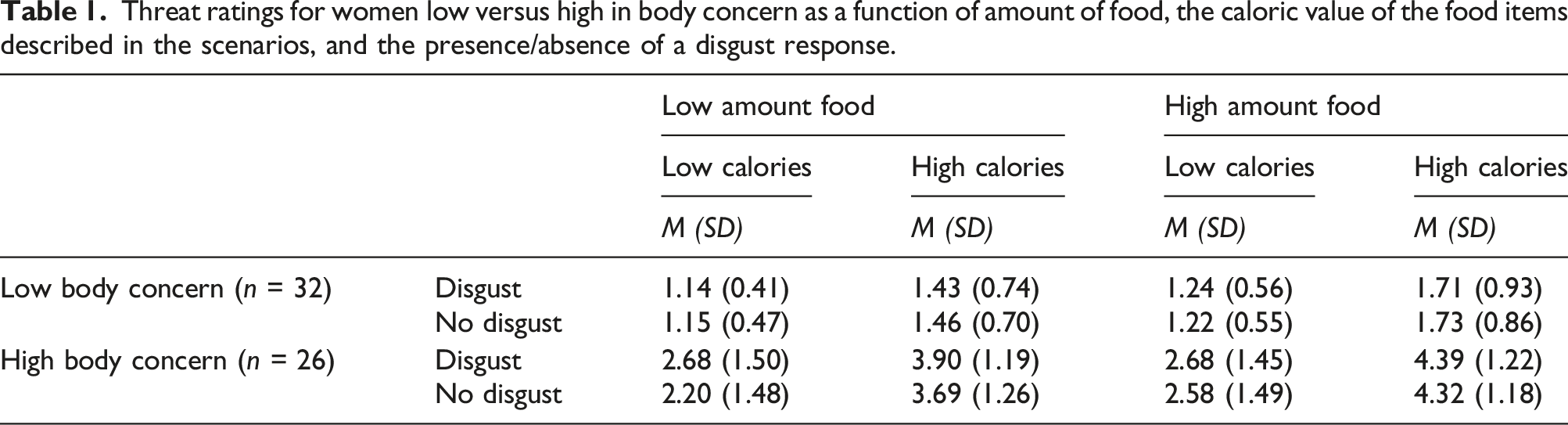
Supporting the validity of the scenarios as well as the selection criteria for assigning participants to a high versus low body concern group, the high body concern group generally showed much higher threat index scores in response to the current scenarios than the low body concern group, as was evidenced by a significant main effect of group, F (1, 54) = 59.92, p < .001, partial η2 = .53. Indicating that people generally showed disgust-based emotional reasoning, there was a main effect of response that was driven by overall higher threat ratings for scenarios with a disgust response compared to scenarios without a disgust response, F (1, 54) = 14.51, p < .01, partial η
2
= .21. Supporting the hypothesis that disgust-based emotional reasoning would be especially pronounced in women with heightened body concerns, this main effect of disgust response was qualified by a significant disgust response by group interaction, F (1, 54) = 17.47, p < .01, partial η
2
= .24. This interaction was driven by the finding that individuals higher in body concern showed a larger increase in threat ratings when a disgust response was added to the scenario (mean difference = 0.22) compared to individuals lower in body concern (mean difference = 0.01). Accordingly, post hoc paired t tests showed that the difference in threat ratings between the disgust and non-disgust scenarios was statistically significant for the women with high body concerns (t (25) = 3.02, p < .01), whereas this difference was not significant for the low body concern group (t (31) = −0.21, p = .82. In line with predictions, the heightened emotional reasoning in high body concerned women was especially evident for scenarios involving low amounts of food, as was evidenced by a significant three-way interaction between disgust response, group, and amount of food, F (1, 54) = 5.58, p < .05, partial η
2
= .09 (see also Table 1 and Figure 2). Post hoc paired t tests indicated that for women with high body concern, the threat ratings for the low amount of food scenarios were significantly higher in the presence than in the absence of a disgust response (t (25) = 3.03, p < .01), whereas this difference did not reach significance for the high amount of food scenarios (t (25) = 1.01, p = .31). Both contrasts did not reach significance in the low body concern group (low amount of food: t (31) = −0.44, p = .66; high amount of food: t (31) = 0.11, p = .90). Yet, for both the high and low body concern groups, the threat index was higher for the high than for the low amount of food scenarios, for both the non-disgust condition (high body concern group: t (25) = 4.97, p < .001; low body concern group: (t (31) = 4.38, p < .001), and the disgust condition (high body concern group: t (25) = 2.56, p = .017; low body concern group: t (31) = 4.43, p < .001 Three-way interaction effect between group (low body concern vs. high body concern), amount of food (low vs. high), and disgust response (absent vs. present), including error bars (2*SE).
The heightened disgust-based reasoning in high body concerned women was independent of the caloric value of the food involved in the scenarios as was evidenced by the absence of a four-way interaction between disgust response, group, amount of food, and caloric value, F (1, 54) = 1.08, p = .30, partial η 2 = .02. More generally, it appeared that the heightened emotional reasoning in high body concerned women was independent of the caloric density of the food per se, as was evidenced by the absence of a significant three-way interaction between disgust response, group, and caloric value, F (1, 54) = 0.62, p = .43, partial η 2 = .01. Finally, there were some significant effects that did not directly bear on the current hypotheses. More specifically there were significant main effects of amount of food [F (1, 54) = 58.52, p < .001, partial η 2 = .52] and caloric value [F (1, 54) = 115.60, p < .001, partial η 2 = .68] that were qualified by significant interaction effects of amount of food x group [F (1, 54) = 7.44, p < .01, partial η 2 = .12] and caloric value x group [F (1, 54) = 40.68, p < .001, partial η 2 = .43]. As can be seen in Table 1, these findings indicate that especially in the high body concern group, participants’ threat index was heightened when they had eaten a high versus a low amount of food, and food of high versus low caloric value.
Discussion
The findings supported the hypothesis that individuals with high body concerns are more inclined to use food intake–induced feelings of disgust as information indicating that they may gain in weight/become fat than individuals low in body concerns. In line with our predictions, this type of disgust-based emotional reasoning bias was especially pronounced for scenarios in which disgust emerged following the intake of a relatively low amount of food (i.e., situations reflecting low objective threat for compromising one’s weight/shape). Such reliance on emotional feelings instead of objective information may help explain the persistent nature of body image concerns even in the absence of any objective sign of overweight or body abnormality.
Although the current study was designed to test the relevance of emotional reasoning within the context of weight and shape concerns, the findings also showed that individuals with high eating disorder symptom scores (as indexed by the EDE-Q) more generally reported higher threat ratings related to weight and shape concerns after eating food. These findings seem consistent with previous findings indicating that individuals with high body concerns more generally reported a heightened probability of becoming fat following food intake compared to participants with low body concerns (e.g., Milos et al., 2017). This more general threat expectancy bias may also contribute to the persistence of people’s weight and shape concerns (cf. de Jong & Daniels, 2020; Rief et al., 2015).
Although the overall group difference in disgust-based reasoning was of a large effect size (partial η 2 = .24), it should be acknowledged that the current sample size was relatively modest. Due to its modest sample size, the current study not only lacked sufficient power to detect small to medium sized effects, but it also rendered the study sensitive to chance findings. Therefore, Study 2 was designed to test the robustness of these findings in an independent and larger sample of undergraduate students. In an attempt to enhance the sensitivity of the design, we employed a correlational instead of an extreme group design (Preacher et al., 2005), and restricted the emotional reasoning task to the most critical types of scenarios (i.e., low amount of low caloric food vs. high amount of high caloric food). In a further attempt to enhance the sensitivity of the design, we doubled the number of different scripts for each type of scenario. Furthermore, it might be relevant to consider that in the current study, weight and shape was assessed before the emotional reasoning task. In Study 2, we reversed this order of assessments, which may lower the chance of participants becoming aware of the aim of the study. Finally, Study 2 was not restricted to female participants but opened up for both sexes.
Study 2
Methods
Participants
Three-hundred and forty-six students (80.1% females), aged between 17 and 31 years (age: M = 21.14, SD = 2.51, range 17–31; BMI based on self-reported height and weight: M = 22.06, SD = 3.66, range 13.49–46.30), participated in an online survey. Participants were recruited via a first-year psychology students participant pool (n = 151), or via social media such as Facebook or a paid participant pool (n = 195). They received course credits or could win a voucher of 20 euro (20 vouchers were raffled) in exchange for participation.
Materials
Eating disorder symptoms
Similar to study 1, the EDE-Q was used to index eating disorder symptoms (restraint eating: Cronbach’s α = .85; eating concern: α = .79; weight concern: α = .85; shape concern: α = .91).
Disgust-based reasoning
The task was now restricted to the most critical types of scenarios and no longer independently varied in the amount and caloric density of food. We removed scenarios with high amount of low caloric food and low amount of high caloric food and restricted the task to two types of scenarios (low amount of low caloric food vs. high amount of high caloric food) that each was systematically followed by the absence or presence of a disgust response. For each of the four types of scenarios, we designed four different scripts resulting in a total of 16 unique scenarios (see Appendix B for detailed description). Again, we used two different versions to control for non-intended differences between scenarios with/without disgust response. We used the same rating scale as in Study 1 to index perceived threat related to weight and shape concerns. The internal consistency of the scale was again excellent (Cronbach’s α = .97).
Procedure
The study was approved by the Ethical Committee Psychology of the University of Groningen. Questionnaires were completed at a self-selected location and time via a link to an online questionnaire (Qualtrics, Provo, UT). The study was part of a broader study. First, participants completed the food-related scenarios to measure disgust-based reasoning related to body concern. Unrelated to the current study, participants were subsequently presented with eight scenarios to measure disgust-based reasoning in contamination fear and the “contamination obsessions and the washing compulsions” subscale of the Padua Inventory (Van Oppen et al., 1995). Thereafter, participants filled out the EDE-Q that was used in this study as a measure of eating disorder symptoms and subsequently reported their height and weight allowing to compute their BMI. Finally, participants completed a series of questionnaires that were not part of the current study but have been described elsewhere (von Spreckelsen et al., 2018; Study 2).
Statistical analyses
To examine our research questions, we conducted two separate hierarchical linear regression analyses (one for low and one for high amount of food scenarios) with the mean score of the shape and weight EDE-Q subscales as the dependent variable. As independent variables, we included the threat ratings derived from scenarios without a disgust response in the first step, and the threat ratings derived from the scenarios with a disgust response in the second step. This allowed to examine whether the threat index in scenarios with a disgust response explained additional variance in body concern over and above the threat index related to scenarios without disgust response. To statistically control for version of the disgust-based reasoning task and sex, we included version and sex as covariates in the model. Power analysis using G*Power 3.1.9.7 (Faul et al., 2009) indicated that a total sample size of N = 312 would be sufficient to detect a small to medium increase in R2 (f2 = .05) with α = .05 and power = .95. All data will be made available at the DANS database.
Results
Descriptive statistics
Means and standard deviations and Spearman Rank correlations.

aThreat index in scenarios with disgust response and low amount of low caloric food.
bThreat index in scenarios without disgust response and low amount of low caloric food.
cThreat index in scenarios with disgust response and high amount of high caloric food.
dThreat index in scenarios without disgust response and high amount of high caloric food.
eEDE-Q = Eating Disorder Examination Questionnaire.
*p < .001.
Relation between disgust-based reasoning and body concern in scenarios involving the intake of a low amount of low caloric food
Linear regression analysis with shape/weight concern of the EDE-Q as dependent variable for scenarios with low amount of low caloric food.

aThreat ratings in scenarios without disgust response.
bThreat ratings in scenarios with disgust response.
*p < .05, **p < .01, ***p < .001.
Relation between disgust-based reasoning and body concern in scenarios involving the intake of a high amount of high caloric food
Linear regression analysis with shape/weight concern of the EDE-Q as dependent variable and scenarios with high amount of high caloric food.

aThreat index in scenarios without disgust response.
bThreat index in scenarios with disgust response.
*p < .05, **p < .01, ***p < .001.
Discussion
Using a correlational instead of an extreme group approach, Study 2 added further evidence for a relationship between weight/shape concerns and disgust-based reasoning bias. In line with predictions, this relationship was evident for the scenarios involving a low amount of food intake (i.e., scenarios with low objective threat related to weight and shape concerns). It should however be acknowledged that in absolute sense the added value of disgust-based reasoning as indexed by the current scenario approach was very small. One explanation for this relatively small effect might be that by removing the high caloric/low amount of food scenarios, the low amount of food scenarios in Study 2 became less ambiguous in terms of threat value than in Study 1, thereby reducing the sensitivity to find effects of disgust on individuals’ threat ratings. In line with this speculation, the mean threat index score for the low amount of food scenarios (without disgust) was 1.7 in Study 2 versus 2.2 in Study 1. Similarly, by removing the high amount of low caloric food scenarios, also the high amount of food scenarios became probably less ambiguous with a mean threat index score of 3.3 in Study 2 versus 2.4 in Study 1. In addition, it is relevant to consider that the relatively small emotional reasoning effect might also be (partly) explained by the online approach of Study 2. Since we did not include an attention check, and neither set a minimum amount of time for reading the scenarios, it cannot be ruled out that within the current online context participants may not have read the information fully, thereby reducing the sensitivity of the experimental manipulation. Study 2 also replicated the finding that independent of “experiencing” disgust, individuals with relatively high weight/shape concerns reported a relatively high threat expectancy related to weight and shape concerns following food intake (as described in the scenarios). This threat expectancy bias was of a large effect size and evident for both low and high amounts of food intake, although the threat expectancy bias seemed most pronounced (as reflected in R2) when the amount of food intake was relatively high.
General discussion
In two subsequent studies, we found consistent evidence supporting the hypothesis that individuals with weight and shape concerns are inclined to use feelings of disgust following food intake as a threat signal indicating that they may gain in weight. Consistent with the view that such disgust-based emotional reasoning would be especially relevant in the absence of straightforward objective signs of overeating, both studies showed that the biased reliance on feelings of disgust was especially evident following the intake of low amounts of food. Such reliance on subjective instead of objective information will hamper correction of unjustified threatening expectancies (I will become fat/overweight), and may therefore contribute to the persistence of individuals’ weight and shape concerns, also in the absence of objective signs of overweight or bodily abnormalities.
It should be acknowledged that the current studies focus on the impact of feeling disgusted following the (imagined) ingestion of food intake. It would be interesting to complement this research with testing if also when merely confronted with food (e.g., in the context of a meal), individuals with high weight/shape concerns would also show disgust-based emotional reasoning. In addition, it should be mentioned that the studies relied on non-clinical samples. An important next step would therefore be to test whether a similar pattern of heightened disgust-based reasoning can also be found in treatment seeking samples of individuals with eating disorder symptoms. In addition, it should be acknowledged that although the scenario approach can provide important information about people’s use of emotional information under controlled and standardized conditions (e.g., Arntz et al., 1995; Engelhard & Arntz, 2005; Gangemi et al., 2012; Verwoerd et al., 2013; Verwoerd et al., 2016), it does not provide information about how emotional reasoning might express itself in daily life. It would therefore be helpful to follow up this research using an Ecological Momentary Assessment (EMA) approach allowing to examine the link(s) between real-time eating, feelings of disgust, the perceived probability of gaining weight/becoming fat, and individuals’ body image concerns (cf. Aan Het Rot et al., 2015). Such an approach might also be helpful to put the limited absolute size of the disgust induced increase in threat ratings that were found in the current studies into perspective. It might well be that the impact of disgust-based emotional reasoning is much larger in concrete daily circumstances compared to the impact of adding a disgust response to the artificial non-ideographic scenarios that were used in the current research.
An EMA approach might also provide the opportunity to determine the temporal dynamics between disgust-based reasoning and weight/shape concerns. Yet, also the EMA approach per se will not provide the critical information that is required to test the proposed causal influence of emotional reasoning on the persistence of body image concerns. Another important next step would therefore be to experimentally reduce disgust-based emotional reasoning and to test whether this would result in a decline of participants’ body image concerns (see Lommen et al., 2013 for an example of such emotional reasoning modification intervention within the context of spider phobia). If indeed this would be the case, this would not only be important as evidence for the causal impact of emotional reasoning on weight/shape concerns, but would also provide a theory-derived and empirically supported starting point for improving currently available treatment options.
Although the focus of the current study was on emotional reasoning, the findings of both studies also consistently showed that individuals with high eating disorder symptoms more generally (i.e., irrespective of disgust) reported increased threat related to weight and shape concerns after eating compared to individuals with low eating disorder concerns. Such threat expectancy bias will probably also act in a way to counteract the modification/neutralization of individuals’ weight/shape concerns (see e.g., Milos et al., 2017). Because it is a common finding that strong prior expectancies tend to be highly robust against correction (de Jong & Daniels, 2020; Rief et al., 2015), also this more general threat expectancy bias might be an important target for (experimental) interventions aiming at reducing body image concerns (Rief & Glombiewski, 2016).
As an important limitation, it should be emphasized that the scenario approach relies on imagined situations and imagined responses, and it should be verified in future research whether similar findings can be found in the context of real-time experiences. In addition, in the current design, we restricted the experimentally manipulated emotional response to disgust. It would be interesting for future research to see whether emotional reasoning bias in individuals with high eating disorder symptoms is restricted to disgust or may also be evident with regard to other emotions (e.g., fear or shame). Finally, it should be acknowledged that it remains to be tested whether the emotional reasoning bias and the more general threat expectancy bias are independent of sex. Study 1 was restricted to women and although Study 2 was open to both men and women, the uneven distribution across both sexes and the more generally low number of male participants did not allow to test whether the biases varied as a function of sex.
To conclude, the current studies can be seen as a proof of principle indicating that next to a more general “food-will-make-me-fat” threat expectancy bias, indeed disgust-based emotional reasoning might also be involved in the persistence of weight and shape concerns. An important next step would be to examine its appearance in clinical samples and in daily life, and to test its proposed causal impact on the persistence of body image concerns.
Supplemental Material
Supplemental Material - “If i feel disgusted, i will become fat”: Disgust-based emotional reasoning in the context of weight and shape concerns
Supplemental Material for “If i feel disgusted, i will become fat”: Disgust-based emotional reasoning in the context of weight and shape concerns by Peter J. de Jong, Elise C. Bennik, and Klaske A. Glashouwer in Journal of Experimental Psychopathology
Footnotes
Acknowledgments
The authors would like to thank Suzanne Oosterhuis, Else de Vries, Faya Adipatria, Fadime Gökkaya, Freya Thiel, Julia Geyer, Femke Roke, Anita Vellenga, and Maru Palstra who helped with the data collection.
Declaration of conflicting interests
The author(s) declared no potential conflicts of interest with respect to the research, authorship, and/or publication of this article.
Funding
The author(s) disclosed receipt of the following financial support for the research, authorship, and/or publication of this article: This study was supported by a Veni grant [451-15-026] awarded to the last author by the Netherlands Organisation for Scientific Research. The funding source had no involvement in the design, data collection or writing the report of the study.

Supplemental Material
Supplemental material for this article is available online.
Author Biographies
References
Supplementary Material
Please find the following supplemental material available below.
For Open Access articles published under a Creative Commons License, all supplemental material carries the same license as the article it is associated with.
For non-Open Access articles published, all supplemental material carries a non-exclusive license, and permission requests for re-use of supplemental material or any part of supplemental material shall be sent directly to the copyright owner as specified in the copyright notice associated with the article.
