




Abstract
We aimed to validate word lists developed by Tabri and Palmer (2020) for use in attentional bias research on appearance-related concerns. Three lists contained appearance words (attractiveness, stigmatized appearance, general appearance), and three contained non-appearance words (positive emotion, negative emotion, inanimate objects). Although matched on lexical criteria, their perceived meanings had not been assessed. Using a semantic differential approach, we examined perceptions of evaluation, potency, activity, and threat, and explored associations with eating disorder psychopathology. Participants from the community (Study 1: N = 299; Study 2: N = 311) rated attractiveness and positive emotion words as similarly positive, and stigmatized appearance and negative emotion words as similarly negative. General appearance and inanimate object words were rated as neutral. Differences reflected intensity, not type. Appearance word ratings were modestly associated with appearance overvaluation, body dissatisfaction, and weight stigma. Associations for non-appearance words were weaker and inconsistent. These findings support the semantic validity of the word lists and their utility in attentional bias research on eating disorders and other conditions involving appearance concerns.
Keywords
Appearance concerns play a harmful role in sustaining various psychiatric conditions, including social anxiety disorder, body dysmorphic disorder, and eating disorders (American Psychiatric Association, 2013). For example, individuals with social anxiety disorder often worry about how they appear and fear negative evaluations, leading them to avoid social situations (Moscovitch et al., 2013). Research shows that individuals with body dysmorphic disorder place excessive importance on appearance in defining their self-worth (Hartmann et al., 2015; Veale, 2004). Similarly, in the cognitive-behavioral theory of anorexia nervosa and bulimia nervosa, the excessive importance placed on body shape and weight in defining self-worth and body dissatisfaction are central mechanisms driving and maintaining disordered eating (Fairburn et al., 2003). Recent research also suggests that appearance concerns are general and transdiagnostic across social anxiety, body dysmorphic, and eating disorders rather than disorder-specific (Stewart et al., 2024).
Cognitive theories indicate that appearance overvaluation and body dissatisfaction facilitate selective attention to appearance-related cues in body dysmorphic disorder (Oden-Lim et al., 2012; Toh et al., 2017; Veale, 2004) and eating disorders (Aspen et al., 2013; Fairburn et al., 2003; Williamson et al., 2004), fueling weight-control behaviors aimed at reducing body shape and weight that ultimately harm health. Of note, considerable empirical attention has been devoted to understanding the role of appearance-related attentional biases among community samples and individuals with eating disorders (Aspen et al., 2013; Brooks et al., 2011; Dobson & Dozois, 2004; Johansson et al., 2005; Ralph-Nearman et al., 2019; Rodgers & DuBois, 2016; Stojek et al., 2018; Van den Eynde et al., 2011). The two most common tasks used to examine attentional biases with words as stimuli in prior research are the modified Stroop and dot-probe tasks, which both involve the use of appearance and neutral words. In the modified Stroop task, researchers compare participants’ reaction times for identifying the ink color of appearance words relative to neutral words. Slower reaction times for appearance-related words, compared to neutral words, suggest an attentional bias for appearance-related content. This bias may stem from body image factors (e.g., body dissatisfaction, appearance focused self-concept) that influence how individuals process appearance-related stimuli. Specifically, people with higher levels of body image concerns might be more likely to notice, encode, store, and retrieve appearance-related information than neutral information. This heightened focus could be because appearance-related words are more emotionally salient, triggering self-referential thoughts or feelings. In some cases, individuals may attempt to avoid negative emotions or anxiety that these words provoke, whereas in other cases, they may be drawn to appearance-related stimuli due to a strong motivational focus on desired appearance goals (Vitousek & Hollon, 1990; Williamson et al., 2004).
In the dot-probe task, participants are instructed to identify the spatial location of a dot-probe that is presented in the same location of either the appearance word or neutral word after a brief interstimulus interval. To make inferences about attentional biases, researchers compare reaction times from trials when the dot is presented at the location of the appearance word to reaction times from trials when the dot is presented at the location of the neutral word. Critically, the findings from two recent reviews of the literature concluded that the results from prior research using various attentional bias tasks, including the modified Stroop and dot-probe tasks, have low reliability (internal consistency) and validity due to various methodological limitations (Enouy et al., 2022; Stott et al., 2021; Xu et al., 2024).
A key methodological limitation of prior research was the choice of target and control words. To limit differences in response times due to confounding factors, researchers match the words in terms of lexical characteristics, including word length, number of syllables, orthographic neighborhood (i.e., the set of words that can be formed by substituting a single letter), and estimated frequency of usage in the English language (Balota et al., 2007). Critically, prior studies have rarely matched target and control words on these lexical characteristics. For instance, many studies in prior research used 25 or fewer words with repetition (Stojek et al., 2018), which increases habituation effects that influence response times (Ben-Haim et al., 2016). Another limitation in word choices is the exclusive use of fat-related and thin-related words (e.g., Dobson & Dozois, 2004; Stojek et al., 2018), which ignores other aesthetic aspects of appearance (e.g., body parts, appearance-related adjectives). Furthermore, most of the attentional bias research in eating disorders does not compare reaction times for appearance-related words with other non-appearance words that have a similar emotional valence (e.g., plump and angst, thin and glee). Consequently, differences in response times between appearance and neutral words in prior research may be due to emotional valence effects of appearance words rather than the semantic meaning of the appearance words.
To address these limitations, Tabri and Palmer (2020) developed word lists for use in their modified Stroop task. The six lists of words were for attractiveness, stigmatized appearance, general appearance, positive affect, negative affect, and neutral inanimate objects. Each list had 20 words. The appearance words covered a broad aesthetic spectrum of appearance that included words for body shape and weight, other aspects of physical appearance (e.g., skin), general descriptors of appearance (e.g., physique, complexion), style (e.g., fashionable), and (un)attractiveness (e.g., sexy, ugly). Of note, most of the 20 words in each list were matched on lexical characteristics (i.e., number of letters and syllables) at the word-level. As well, the six word lists were matched, on average, in terms of their estimated frequency of use in the English language (Balota et al., 2007) and orthographic neighborhood at the list-level. Using a modified Stroop task that included the six lists of words, Tabri and Palmer (2020) showed that people who overvalue appearance more (relative to less) took longer to identify the ink color of attractiveness words—not words that describe stigmatized appearance or general appearance. Also, by including non-appearance words of similar emotional valence, Tabri and Palmer (2020) were able to rule out that the association between appearance overvaluation and time to identify the ink color of attractiveness words was due to the words having a positive valence—there was no association between appearance overvaluation and time to identify the ink color of positive emotion words.
Tabri and Palmer’s (2020) findings are important because previous research has shown that people in the general population have an attentional bias towards positive and negative words rather than neutral words (Liu et al., 2022), suggesting that emotional words automatically capture more attention than neutral words. The possibility that people automatically have an attentional bias to emotionally charged words in comparison to neutral words regardless of whether they are body, shape, or weight related obfuscates interpretations of the results from previous attentional bias research. As such, Tabri and Palmer’s (2020) findings provide initial evidence of an attentional bias for attractiveness words among people who scored higher (relative to lower) on a measure of appearance overvaluation and that this bias has to do with the semantic meaning of the attractiveness words and not its emotional valence.
Overview of the Current Research
The purpose of the current study was to further validate the word lists developed by Tabri and Palmer (2020) using the semantic differential approach (Osgood, 1952). Specifically, we examined people’s perceptions of the words in terms of evaluation (bad vs. good), potency (weak vs. strong), and activity (passive vs. active). We examined these perceptions in Study 1 with a community sample and expected participants to perceive attractiveness words and positive emotion words similarly in terms of being more good (vs. bad), more strong (vs. weak), and more active (vs. passive). Likewise, we expected participants to perceive stigmatized appearance words and negative emotion words similarly in terms of being more bad (vs. good), more weak (vs. strong), and more passive (vs. active). Moreover, we expected participants to perceive general descriptors of appearance and inanimate objects to be neutral in terms of bad vs. good, weak vs. strong, and passive vs. active.
In Study 2, we replicated and extended the findings of Study 1 by also examining participants’ perceptions of each word in terms of threat vs. safety. We expected that positively valenced words (attractiveness and positive emotion words) would be viewed as more safe vs. threatening to a similar degree. Similarly, we expected that negatively valenced words (stigmatized appearance and negative emotion words) would be viewed as more threatening vs. safe to a similar degree. As well, we expected that neutral valenced words (general descriptors of appearance and inanimate object words) would be viewed as more neutral (between threatening vs. safe on the response scale).
Finally, in Studies 1 and 2, for exploratory purposes, we examined the associations between participants’ semantic differential ratings on the one hand, and their appearance overvaluation, body dissatisfaction, body mass index (BMI), and weight stigma on the other hand. Appearance overvaluation, body dissatisfaction, and BMI have each been associated with attentional biases in prior research (Aspen et al., 2013; Brooks et al., 2011; Dobson & Dozois, 2004; Johansson et al., 2005; Ralph-Nearman et al., 2019; Rodgers & DuBois, 2016; Stojek et al., 2018; Tabri & Palmer, 2020; Van den Eynde et al., 2011) and so examining their associations with semantic differential ratings may shed light on how appearance words are perceived in relation to eating disorders psychopathology and body weight.
Sample Size and Statistical Power
The sample sizes in the current research were determined using both practical and substantive considerations. Because no prior studies have examined semantic differential ratings for appearance-related versus non-appearance-related words, there was no empirical basis for estimating an expected effect size. As such, we entered the study with uncertainty about the magnitude of potential differences—whether they would be large, small, or negligible, but that any differences would reflect variations in degree rather than kind. Our goal was not to test a null hypothesis of no difference, but rather to remain agnostic in the absence of prior evidence. Given this uncertainty, the sample size was constrained by the financial resources available for participant recruitment and data collection.
Transparency and Ethics Statements
Materials, data, and statistical outputs are available on the Open Science Framework (OSF): https://osf.io/fc364. The research was approved by Carleton University Research Ethics Board—B (certificate number 117233). All participants provided informed consent. None of the reported studies were preregistered.
Study 1
Method
Participants and Procedure
Participants were recruited from Amazon’s Mechanical Turk (MTurk). A recruitment notice was posted indicating that the study involved completing questionnaires about appearance and other words. To be eligible, participants had to be American citizens, be currently residing in the US, and English be their first language. A total of 348 participants accessed the study on MTurk. Of the 348 participants, we excluded 48 participants because they either did not pass the eligibility criteria (n = 16), had complete or partial missing data (n = 31), or a duplicate IP address (n = 1). Thus, the analyzed sample included 300 participants (169 women, 127 men, 2 non-binary, 1 Transgender man, and 1 preferred not to specify). They ranged in age from 20 to 91 years (M = 39.53, SD = 12.61).
Materials
After providing informed consent, participants completed the semantic differential questions, followed by three questionnaires that measured eating disorder psychopathology.
Semantic Differentials
Participants rated the 20 words in each of the six lists (attractiveness, stigmatized appearance, general appearance, positive emotion, negative emotion, and inanimate objects) developed by Tabri and Palmer (2020) in terms of evaluation, potency, and activity (Osgood, 1952). The presentation order of each word category and presentation order of the words within each category were randomized to minimize method variance. For evaluation, participants were asked to rate the extent a given word was more closely described by the adjective “bad” or the adjective “good.” Responses were anchored at 1 (bad) and 7 (good) with 4 on the response scale labeled neutral. An average score was computed for each word list with higher scores indicating greater positive evaluation.
For potency, participants were asked to rate the extent a given word was more closely described by the adjective “weak” or the adjective “strong.” Responses were anchored at 1 (weak) and 7 (strong) with 4 on the response scale labeled neutral. An average score was computed for each word list with higher scores indicating greater potency.
For activity, participants were asked to rate the extent a given word was more closely described by the adjective “passive” or the adjective “active.” Responses were anchored at 1 (passive) and 7 (active) with 4 on the response scale labeled neutral. An average score was computed for each word list with higher scores indicating greater activity.
Participants were asked to work at a rapid pace so that their ratings were based on their first and immediate reactions. Note that three participants missed one or more ratings (total of six ratings). Thus, the average scores for these participants were computed based on available data.
Body Mass Index (BMI)
Participants self-reported their height in inches and weight in pounds, which we used to calculate their BMI.
Appearance Overvaluation
The 20-item Beliefs About Appearance Scale (BAAS; Spangler & Stice, 2001) was used to measure the extent participants overvalue the importance of appearance for self-views (five items; e.g., “How I feel about myself is largely based on my appearance”), their feelings (five items; e.g., “My ability to feel happy depends upon how I look”), interpersonal relationships (five items; e.g., “The opinions others have of me is based on my appearance”), and achievement (five items; e.g., “My appearance influences my ability to do things”). Participants responded to each item using a 5-point response scale with endpoints, not at all (0) and extremely (4). An average was computed with higher scores reflecting greater appearance overvaluation. Internal consistency (ɑ = .96) and composite (ω = .96) reliability in the current research were excellent.
Body Dissatisfaction
The 5-item body dissatisfaction questionnaire developed by Tabri and Palmer (2020) was used to measure the extent to which participants were dissatisfied with their appearance. The five items were: “When I think about my body compared to others, I feel dissatisfied,” “I am satisfied with my body compared to other people like me” (reverse-coded), I feel distressed when I look at others people’s bodies,” “When I compare my body to other people, I realize that I am quite satisfied” (reverse-coded). Participants responded to each item using a response scale with endpoints strongly disagree (1) and strongly agree (7). After reverse scoring two items, an average was computed with higher scores indicative of greater body dissatisfaction. Internal consistency (ɑ = .80) and composite (ω = .79) reliability in the current research were good.
Weight Stigma
The 13-item Antifat Attitudes Questionnaire (AFA; Crandall, 1994) was used to measure weight stigma. The items were used to calculate three subscale scores: “Dislike” (seven items; e.g., “I really don’t like fat people much”), “Fear of Fat” (three items; e.g., “I feel disgusted with myself when I gain weight”), and “Willpower” (three items; e.g., “Fat people tend to be fat pretty much through their own fault”). Participants responded to each item using a 7-point response scale with endpoints, strongly disagree (1) and strongly agree (7). An average score for each subscale was calculated with higher scores reflecting greater dislike, fear of fat, and willpower. Internal consistency (ɑs = .85 to .94) and composite (ωs = .85 to .94) reliability in the current research ranged from good to excellent.
Data Analytic Approach
We used paired samples t-tests to examine differences in evaluation, potency, and activity ratings for attractiveness relative to positive emotion words, for stigmatized appearance words relative to negative emotion words, and for general appearance words relative to inanimate object words, respectively. We used bivariate correlations to examine associations between semantic differential ratings on one hand and appearance overvaluation, body dissatisfaction, BMI, and weight stigma on the other hand. Analyses were conducted using SPSS version 28. Data were checked to ensure the general assumptions and conditions required to perform paired samples t-tests were met. Assumptions of normality were not met for a few of the pairings and there were a few outliers above or below 3 SDs from the mean. However, although removing the outliers fixed the normality issues, all results remained virtually the same. As such, we reported the results with outliers included.
Results
Semantic Differentials
Semantic Differentials for Evaluation (Bad Good), Potency (Weak Strong), and Activity (Passive Active) in Study 1
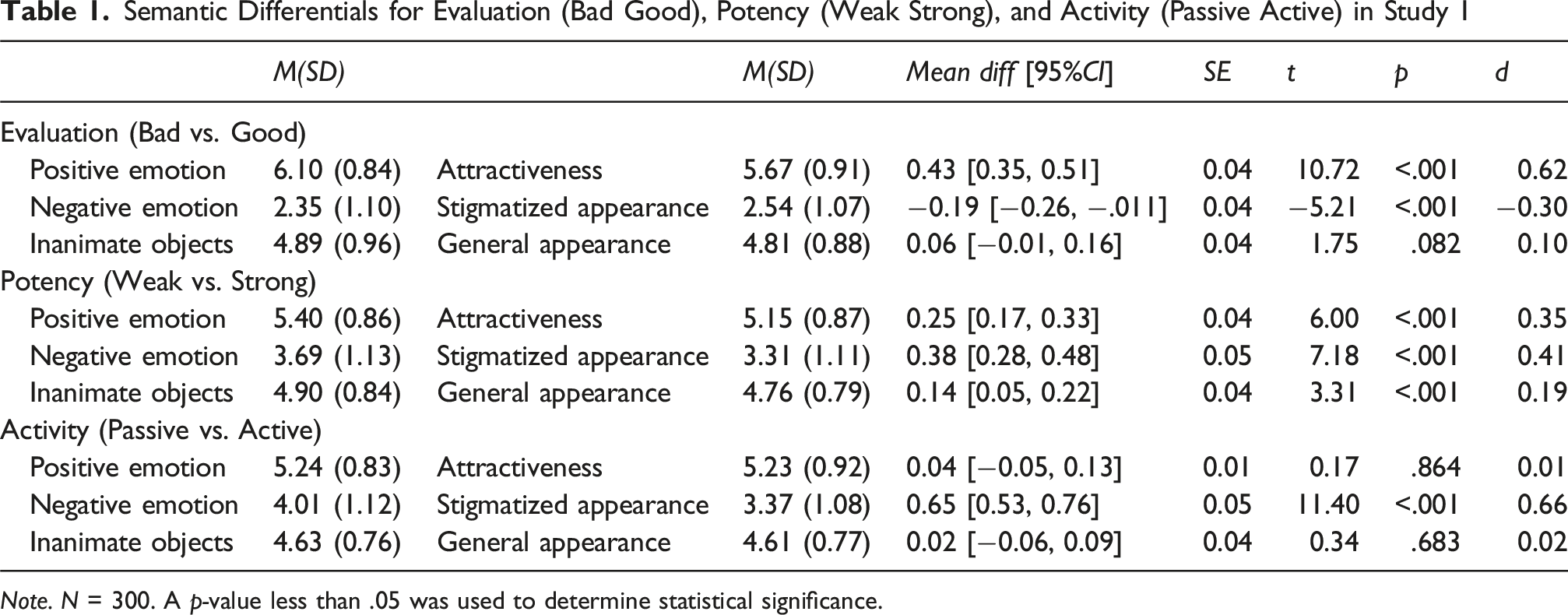
Note. N = 300. A p-value less than .05 was used to determine statistical significance.
Potency ratings followed the same pattern of results (see Table 1). The mean values for positive emotion and attractiveness words indicated that they were perceived as more “strong” relative to “weak,” but positive emotion words were perceived as moderately more “strong” relative to attractiveness words (p < .001). Likewise, the mean values for negative emotion and stigmatized appearance words indicated that they were perceived as more “weak” relative to “strong,” but stigmatized appearance words were perceived as moderately more “weak” relative to the negative emotion words (p < .001). Furthermore, the mean values for inanimate objects and general appearance words were closer to the midpoint of the response scale indicating “neutral” and their difference was statistically significant (p < .001).
Activity ratings followed a different pattern of results (see Table 1). Specifically, the mean values for positive emotion and attractiveness words indicated that they were perceived as more “strong” relative to “weak,” but there was no statistical difference between them (p = .864). Likewise, the mean values for inanimate objects and general appearance words were closer to the midpoint of the response scale indicating “neutral” and did not differ statistically (p = .683). However, the mean value for negative emotion words was at the scale midpoint, which corresponds to “neutral,” whereas the mean value for stigmatized appearance was below the scale midpoint, which is closer to the “passive” side of the response scale. The magnitude of the difference was moderate and statistically significant (p < .001).
Semantic Differential Ratings and Eating Disorder Psychopathology
Correlogram Depicting Correlations Between Measured Variables in Study 1


Note. N = 300. BMI = Body Mass Index. A p-value less than .05 was used to determine statistical significance.
Participants who scored higher (relative to lower) on appearance overvaluation (M = 1.92, SD = 0.97) perceived attractiveness, stigmatized appearance words, and negative emotion words as more “good.” They also perceived attractiveness, positive emotion, and stigmatized appearance words as more “strong.” As well, they perceived attractiveness words as being more “active.” The magnitude of the associations was small.
Participants who scored higher (relative to lower) on body dissatisfaction (M = 3.84, SD = 1.42) perceived general appearance and inanimate object words as more “bad.” They also perceived attractiveness, general appearance, and inanimate object words as more “weak.” As well, they perceived attractiveness, positive emotion, general appearance, and inanimate object words as more “passive.” The magnitude of the correlations ranged from small to small-to-moderate.
In terms of weight stigma, participants who reported more (relative to less) dislike of fat people (M = 2.49, SD = 1.43) perceived stigmatized appearance and negative emotion words as more “good” and positive emotion words as more “bad.” They also perceived attractiveness appearance, stigmatized appearance, and negative emotion words as more “strong.” As well, they perceived stigmatized appearance, general appearance, and inanimate object words as more “active.” Participants who reported more (relative to less) fear of fatness (M = 4.33, SD = 1.69) perceived attractiveness words as more “good.” Participants who scored higher (relative to lower) on the measure of lack of willpower (M = 4.46, SD = 1.46) perceived attractiveness, positive emotion, general appearance, and inanimate object words as more “good” and perceived attractiveness, general appearance, and inanimate object words as more “strong.” As well, they perceived attractiveness and general appearance words as being more “active.” The magnitude of the correlations ranged from small to moderate.
Discussion
Prior research has not examined how people perceive the words used in attentional bias studies on eating disorders. In Study 1, we aimed to fill this by investigating how people perceive the appearance and non-appearance words in Tabri and Palmer’s (2020) word lists. The results were generally consistent with expectations in that people perceived appearance and matched emotional valence words similarly in terms of evaluation, potency, and activity. This was the case for attractiveness and positive emotion words as well as general appearance and inanimate object words.
For stigmatized appearance words and negative emotion words, they were perceived similarly in terms of evaluation and potency, but not activity. Participants tended to rate negative emotion words as more neutral in terms of being active or passive, but they rated stigmatized appearance words as more passive. The difference in activity ratings may be because some of the negative emotion words seem to have an approach orientation (e.g., hostile) whereas other negative emotion words seem to have a withdrawal orientation (e.g., timid). In sum, people tend to perceive appearance and non-appearance words similarly in terms of evaluation, potency, and activity.
In exploratory analyses, we found that participants’ ratings of evaluation, potency, and activity for appearance-related words were linked to BMI and various aspects of eating disorder psychopathology. Specifically, participants with higher BMI tended to perceive attractiveness, stigmatized appearance, and general appearance words more negatively, indicating these words were perceived as “bad,” “weak,” and “passive.” In contrast, participants with a higher appearance overvaluation perceived these same categories of words more positively, as “good,” “strong,” and “active.” Higher body dissatisfaction was linked to more negative perceptions of attractiveness and general appearance words, whereas increased weight stigma (perceiving fat people as having less willpower) and greater fear of fatness were associated with viewing attractiveness words more positively. Interestingly, disliking fat people was associated with more positive perceptions of stigmatized appearance words.
Overall, these findings suggest that individual differences in BMI, body dissatisfaction, and specific psychopathologies like appearance overvaluation influence how appearance-related words are perceived. This highlights a complex interplay between eating disorder psychopathology and perceptions of appearance descriptors, where both positive and negative biases toward appearance words are connected to different psychopathological features. These findings shed light on how possible perception biases in eating disorders might reinforce body-related distress and perpetuate disordered eating behaviors. The minimal associations between psychopathology measures and non-appearance words further underscore the specificity of these biases to appearance-focused content, underscoring that how individuals with eating disorders psychopathology perceive and react to appearance-related stimuli may be important for potential interventions.
A possible limitation of Study 1 is that we did not examine participants’ perceptions of the words in terms of how threatening vs. safe they were. This is potentially important because theory indicates that people higher (relative to lower) in appearance overvaluation have an attentional bias towards stimuli that are perceived as threatening (e.g., Aspen et al., 2013). It may also be that perceived threat is the factor that contributed to the difference in activity scores for negatively valenced words, due to its role in eating disorder psychopathology. As such, in Study 2, the objective was to replicate the findings of Study 1 and to extend the findings by examining participants perceptions of threat vs. safety.
Study 2
Method
Participants, Procedure, and Materials
As in Study 1, participants were recruited from MTurk. Eligibility criteria were also identical to that of Study 1, and we blocked participants who completed Study 1 from completing Study 2. A total of 386 participants were recruited. Of the 386 participants, we excluded 75 participants because they either did not pass the eligibility criteria (n = 12), reported “no” for at least one of the data quality questions (n = 2), or withdrew their data (n = 61). Thus, the analyzed sample included 311 participants (196 women, 112 men, 3 non-binary; one did not report their gender). Participants ranged in age from 19 to 79 years (M = 42.23, SD = 13.13). Note that one participant did not report their height and so was excluded from the BMI calculations and exploratory correlational analyses involving BMI. Three participants missed one or more ratings (total of ten ratings). The average score for these participants were computed based on available data.
The procedure, materials, and data analytic approach in Study 2 were identical to that of Study 1. After providing informed consent, participants completed the semantic differential scale, followed by the questionnaires that assessed appearance overvaluation, body dissatisfaction, and weight stigma dislike, fear of fat, and willpower. Internal consistency (αs = .84 to .96) and composite (ωs = .84 to .97) reliabilities in Study 2 for these measures ranged from good to excellent. The one difference in Study 2 was that participants also rated each word in terms of how closely it was described by the adjective “threatening” or the adjective “safe.” Responses were anchored at 1 (threatening) and 7 (safe) with 4 on the response scale labeled neutral. An average score was computed for each of the six lists of words with higher scores indicating greater safety.
Results
Semantic Differentials
Semantic Differentials for Evaluation (Bad Good), Potency (Weak Strong), Activity (Passive Active), and Threat (Threatening Safe) in Study 2
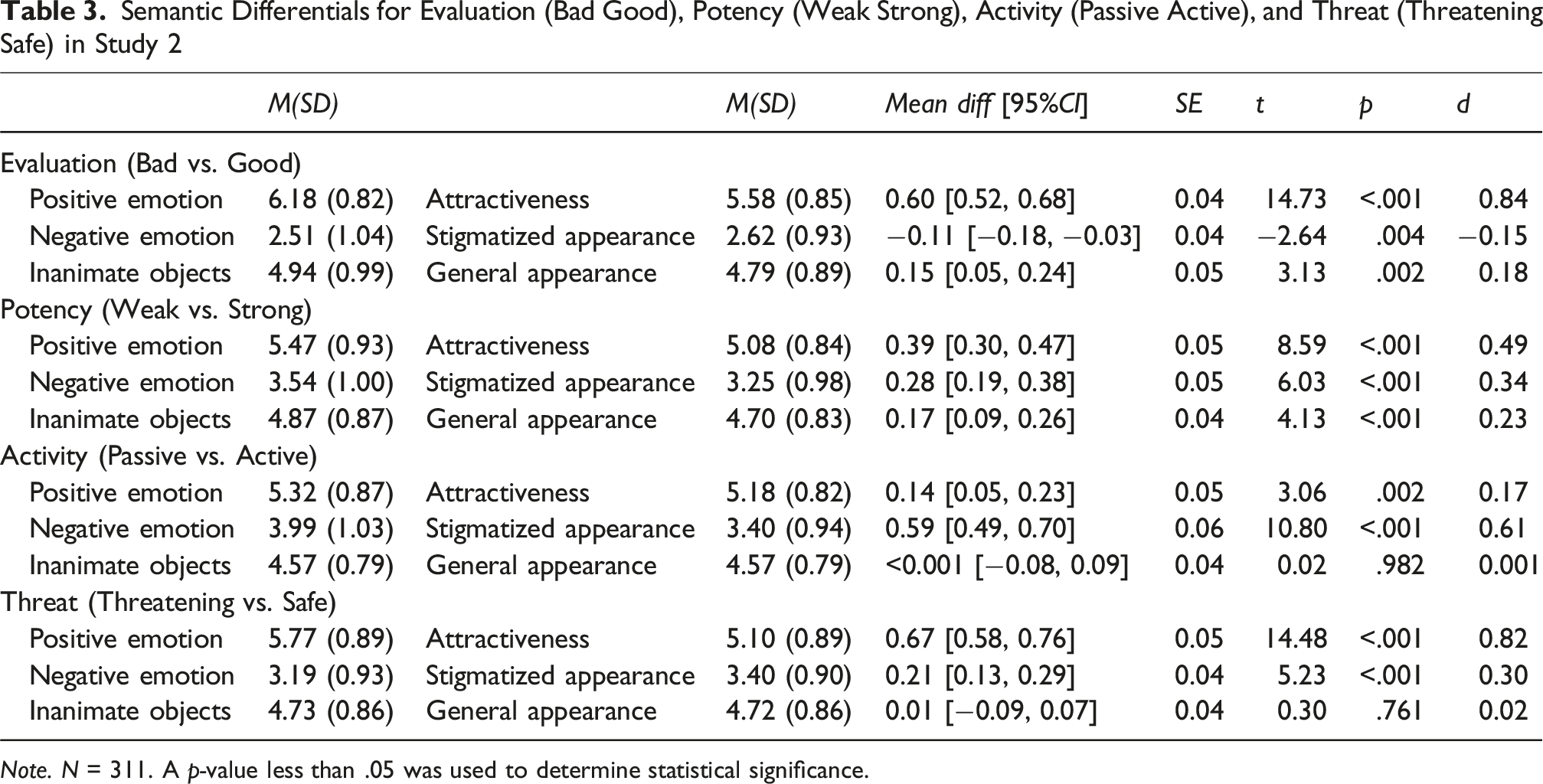
Note. N = 311. A p-value less than .05 was used to determine statistical significance.
For potency ratings, the mean values for positive emotion and attractiveness words indicated that they were perceived as more “strong” relative to “weak,” but positive emotion words were perceived as moderately more “strong” relative to attractiveness words (p < .001). Likewise, the mean values for negative emotion and stigmatized appearance words indicated that they were perceived as more “weak” relative to “strong,” but stigmatized appearance words were perceived as more “weak” relative to the negative emotion words (p < .001). Additionally, the mean values of neutral inanimate object and general appearance words were close to the midpoint of the response scale indicating “neutral,” but there was a small difference in that general appearance words were perceived as more “neutral” (closer to the midpoint of the response scale) relative to the inanimate object words (p < .001).
In terms of activity ratings, only the difference between negative emotion and stigmatized appearance words was statistically significant (p < .001). The mean value for negative emotion words was at the scale midpoint, which corresponds to “neutral” whereas the mean value for stigmatized appearance words was below the midpoint of the scale, which is on the “passive” side of the response scale. The magnitude of the difference was moderate. The difference between the mean values for positive emotion and attractiveness words was statistically significant (p = .002), but the difference was small. As such, positive emotion and attractiveness words were perceived as more “active” relative to “passive.” Also, the mean values for inanimate objects and general appearance words were very similar (p = .982) and both were close to the midpoint of the response scale, indicating “neutral.”
As for threat vs. safe ratings, the mean values for positive emotion and attractiveness words indicated that they were perceived as “safe” relative to “threatening,” but positive emotion words were perceived as moderately more “safe” relative to attractiveness words (p < .001). The mean values for negative emotion words and stigmatized appearance words indicated that they were perceived as more “threatening” relative to “safe,” but negative emotion words were perceived as slightly more “threatening” relative to stigmatized appearance words (p < .001). The mean values for general appearance and inanimate object words were very similar (p = .761) and close to the midpoint of the response scale indicating “neutral.”
Semantic Differential Ratings and Eating Disorder Psychopathology
Correlogram Depicting Correlations Between Measured Variables in Study 2


Note. N = 311. BMI = Body Mass Index.
A p-value less than .05 was used to determine statistical significance. n = 1 participant did not report their height and was excluded from the BMI calculation.
Participants who scored higher (relative to lower) on appearance overvaluation (M = 2.79, SD = 0.99) perceived attractiveness words, negative emotion words, general appearance words, and neutral inanimate object words as more “good” relative to “bad.” They also perceived attractiveness, general appearance and inanimate object words as more “strong” relative to “weak.” As well, they perceived attractiveness, general appearance, and inanimate object words as more “active” relative to “passive” and more “safe” relative to “threatening.” The magnitude of the associations was small.
Participants who scored higher (relative to lower) on body dissatisfaction (M = 3.86, SD = 1.36) perceived stigmatized appearance words as more “bad” relative to “good” and more “weak” relative to “strong.” They also perceived positive emotion words as more “passive” relative to “active.” The magnitude of the associations was small.
In terms of weight stigma, participants who reported more (relative to less) dislike of fat people (M = 2.42, SD = 1.34) perceived stigmatized appearance and negative emotion words as more “good” relative to “bad” and positive emotion words as more “bad” relative to “good.” They also perceived stigmatized appearance and general appearance words as more “active” relative to “passive.” Lastly, they perceived stigmatized appearance and negative emotion words as more “safe” relative to “threatening.” The magnitude of these associations ranged from small to moderate.
Participants who reported more (relative to less) fear of fatness (M = 4.31, SD = 1.60) perceived attractiveness, general appearance, and inanimate object words as more “good” relative to “bad.” Similarly, attractiveness, general appearance, and inanimate object words were perceived as more “strong” relative to “weak.” Attractiveness and general appearance words were perceived as more “active” relative to “passive.” Similarly, attractiveness and general appearance words were also perceived as more “safe” relative to “threatening.” The magnitude of the correlations were small.
Participants who scored higher (relative to lower) on the measure of lack of will power (M = 4.28, SD = 1.45) perceived attractiveness, general appearance, and inanimate object words as more “good” relative to “bad.” They also perceived general appearance, and inanimate object words as more “strong” relative to “weak.” As well, they perceived attractiveness words as being more “active” relative to “passive.” General appearance and inanimate object words were perceived as more “safe” relative to “threatening.” The magnitude of the correlations ranged from small to moderate.
Discussion
The findings largely replicated those observed in Study 1 in terms of evaluation, potency, and activity ratings across appearance and non-appearance words of the same valence. A profile plot comparing the Cohen’s d effect sizes in Studies 1 and 2 is in Figure 1. Although the direction and relative ordering of effects replicated closely across studies, the magnitude of the effects tended to differ. In Study 1, effect sizes ranged from −.30 to .62, whereas in Study 2 they ranged from −.15 to .84. Most effects were slightly larger in Study 2, particularly for attractiveness-based appearance ratings (evaluation ds = .62 vs. .84; potency ds = .38 vs. .49). The one effect size that was smaller in Study 2 was for evaluation ratings of stigmatized appearance words. Despite these differences, the pattern of results in Study 2 closely approximated the pattern observed in Study 1. In short, evaluation, potency, and activity ratings for appearance relative to matched emotion words differed in degree, but not in kind. Profile Plot Depicting Differences in Evaluation (Bad Good), Potency (Weak Strong), and Activity (Passive Active) Ratings Between Studies 1 and 2.
Extending Study 1, we showed that the semantic ratings of threat (i.e., threatening vs. safe) were similar across matched appearance and non-appearance words of the same valence. There was a large difference with positive emotion words being perceived as more safe relative to attractiveness words. This difference was in terms of degree as the mean evaluation ratings for positive and attractiveness words were both on the “safe” side of the response scale. There was also a moderate difference between stigmatized appearance and negative emotion words, with negative emotion words being perceived as more threatening relative to stigmatized appearance words. Importantly, the mean values for negative emotion and stigmatized appearance words were both on the “threatening” side of the scale and so were perceived similarly. Participants’ perceptions of general appearance and inanimate object words were very similar in terms of threat. The mean difference was not statistically significant, and both means were close to the midpoint of the response scale (i.e., neutral). In short, threat (vs. safety) ratings for appearance relative to matched emotion words differed in degree, but not in kind.
Lastly, across Studies 1 and 2, the patterns of correlations between eating disorder symptoms and psychopathology on the one hand and semantic differential ratings of appearance and non-appearance words on the other hand were similar. In Study 1, the correlations ranged from −.20 to .34, whereas in Study 2 the correlations ranged from −.15 to .29. In terms of absolute differences in magnitude between studies, the range was approximately .00 to .15, with most differences falling in the small range (≈.03–.08). The largest between-study differences were observed for appearance-related word categories, where correlations were consistently weaker in Study 2. Overall, the correlational patterns observed in Study 1 were largely replicated in Study 2, with attenuation in magnitude rather than changes in direction or structure.
General Discussion
The purpose of the current research was to further validate word lists developed by Tabri and Palmer (2020) for use in attentional bias research in psychiatric disorders that involve appearance concerns. These lists were already matched on objective lexical criteria (i.e., letter and syllable count) and, at the list level, on English language frequency and orthographic neighborhood. However, previous research had not investigated people’s perceptions of the words in these lists. In the current research, we addressed this gap by using a semantic differential approach, assessing how people perceive the words in terms of evaluation (bad vs. good), potency (weak vs. strong), activity (passive vs. active), and threat (vs. safe).
In both Studies 1 and 2, participants rated appearance and non-appearance words matched on valence similarly across evaluation, potency, activity, and threat, indicating that the word lists are well-matched subjectively. These results suggest that word characteristics other than their appearance-related content are unlikely to drive a possible bias. Further, highly similar findings in Studies 1 and 2 speak to their robustness. This suggests extensive tests of stimulus materials are not required in forthcoming studies. As well, these findings enhance the existing lexical matching of the lists at both word and list levels, supporting the validity of Tabri and Palmer’s (2020) word list and its suitability for attentional bias research in eating disorders. The word lists have broad potential for application in various research contexts, including experimental research with physiological correlates (e.g., functional magnetic resonance imaging; fMRI) and with implicit or bias measures (e.g., Implicit Association Test; IAT) as well as research on cognitive-behavioral theory-based body image interventions aimed at modifying attentional biases. These diverse applications underscore the versatility of the word lists, making them valuable to a wide range of researchers and extending their utility beyond the scope of the current research.
The findings of the current research also advance knowledge on the subjective experience of the appearance and non-appearance words in relation to participants’ BMI, appearance overvaluation, body dissatisfaction, and weight stigma—factors that have been linked to selective attention for appearance-related information in prior research (Aspen et al., 2013; Brooks et al., 2011; Dobson & Dozois, 2004; Fairburn et al., 2003; Johansson et al., 2005; Lane et al., 2017; Melles et al., 2021; Ralph-Nearman et al., 2019; Rodgers & DuBois, 2016; Roefs et al., 2008; Shafran et al., 2007; Stojek et al., 2018; Stott et al., 2021; Tabri & Palmer, 2020; Van den Eynde et al., 2011; Waller & Meyer, 1997; Warschburger et al., 2015; Williamson et al., 2004). Participants with a higher (relative to lower) BMI were more likely to perceive stigmatized appearance and general appearance words more negatively (i.e., bad, passive, and threatening). These findings are consistent with previous research showing that people with higher (relative to lower) BMI who rate their own body as less attractive tend to focus more on their self-identified least attractive body part and on the body part of other people that they perceive to be most attractive (Roefs et al., 2008).
Regarding weight stigma, participants higher (relative to lower) in fear of fatness and who viewed fat people as having less (vs. more) willpower perceived attractiveness words and general appearance words as more positive (good, strong, active, and safe). Also, interestingly, participants with greater (relative to lower) dislike of fat people perceived stigmatized appearance words as more positive (good, active, and safe). One possible explanation may be because moral failure and its associated emotions (remorse, guilt, and shame) often follow a person’s engagement in stigmatizing cognitions (Tangney et al., 2007). In other words, people who report higher (relative to lower) weight stigma may be ashamed or feel guilty about having weight stigmatizing thoughts and thus rate the stigmatized appearance words in a socially desirable way. Another possibility is that people with stronger anti-fat beliefs may see stigmatized appearance words as less harmful because these words align with their negative views on fatness. To them, stigmatized appearance words may be justified or accurate rather than bad or threatening, which reinforces their biases. Future research on Tabri and Palmer’s (2020) word lists can examine these possibilities.
Participants with higher (vs. lower) appearance overvaluation perceived attractiveness words as more positive (good, strong, active, and safe), though the associations were small. These findings help explain why people with higher appearance overvaluation may show an attentional bias toward attractiveness-related words. According to Vitousek and Hollon’s (1990) cognitive theory of eating disorders, individuals who place high value on appearance develop cognitive structures (schemata) that link appearance with self-worth. For example, they may associate thinness with positive qualities like self-control and beauty, and link fatness with negative qualities and personal faults. The link between appearance overvaluation and positive evaluations of attractiveness words aligns with this theory, supporting the idea that people who overvalue appearance have emotionally charged beliefs about the implications of appearance for the self.
In contrast, people with higher (relative to lower) body dissatisfaction perceived stigmatized appearance words more negatively (i.e., bad vs. good) in Studies 1 and 2. Like those with high appearance overvaluation, people with higher body dissatisfaction have cognitive structures (schemata) that emphasize the negative implications of appearance for self-worth (see Rodgers & DuBois, 2016), likely explaining their more negative perception of stigmatized appearance-related words. Research also shows that people with body dissatisfaction focus selectively on stigmatized appearance stimuli, likely due to concerns about external standards of attractiveness. For example, they report stronger than-ideal internalization and feel more pressure to be thin from peers, family, romantic partners, and media (Cafri et al., 2005; Paterna et al., 2021). Thus, people with higher body dissatisfaction are more sensitive to societal standards of attractiveness, likely viewing stigmatized appearance-related words as reminders of perceived shortcomings in appearance. Given these results were exploratory, they should be considered preliminary pending replication.
As for threat ratings, prior research suggests that people with eating disorders and those with high appearance overvaluation and body dissatisfaction often perceive appearance-related stimuli as threatening, contributing to attentional biases (Aspen et al., 2013; Melles et al., 2021; Rodgers & DuBois, 2016; Shafran et al., 2007). However, we found that body dissatisfaction was not associated with higher threat ratings for any word category. In contrast, people with higher appearance overvaluation perceived attractiveness and general appearance words as safer rather than threatening, possibly reflecting a bias toward positive appearance-related stimuli (Tabri & Palmer, 2020; Vitousek & Hollon, 1990). These findings align with research findings showing that individuals with anorexia nervosa consciously desire to be attractive (Granek, 2007; Gregertsen et al., 2017).
In sum, eating disorder psychopathology was more frequently associated with ratings of appearance-related words than non-appearance words, supporting the discriminant validity of the non-appearance words in relation to eating disorder measures.
Limitations and Future Directions
Some limitations of the present research should be noted. First, we recruited a convenience community sample of Americans from an online panel. Although community samples recruited from online panels are more representative of their general population than student samples, the limited demographic information we collected prohibited us from assessing the extent to which the samples in the current research were representative of the general U.S. population. As such, external validity of the results to the general U.S. population is unknown.
Second, because the research was conducted in North America, it is unclear whether the findings generalize to non-Western cultures, which may have different societal standards of attractiveness. However, eating disorders and related psychopathology are not restricted to North America due, in part, to the globalization of Western beauty standards (Jung & Forbes, 2010; Littlewood, 2004). Thus, the findings may still have relevance beyond Western contexts and future studies should explore this possibility.
Third, the findings may not extend to individuals with a diagnosed eating disorder as our research did not include a clinical sample and the measures used to assess eating disorder pathology were not diagnostic instruments. As such, future research should replicate and extend these findings with clinical populations. It is possible that people with diagnosed eating disorders may exhibit greater differences in perception of evaluation, potency, and activity for appearance words.
Fourth, semantic differential ratings may be sensitive to prevailing evaluative standards and patterns of language use, which can shift over time. Because meanings and connotations of appearance-related and non-appearance words are shaped by broader cultural and linguistic contexts, it is possible that the evaluative, potency, activity, and threat ratings observed in the present research may change as social norms and language evolve. Accordingly, periodic re-validation of these semantic ratings may be necessary to ensure their continued relevance and accuracy in future research.
Conclusions
In the current research, we found that appearance and non-appearance words of the same valence from Tabri and Palmer’s (2020) word lists were perceived similarly in terms of evaluation, potency, activity, and threat. As well, eating disorder psychopathology was more frequently associated with ratings of appearance-related words than non-appearance words, supporting the discriminant validity of the non-appearance words in relation to eating disorder measures. These findings will help ensure that future attentional bias research on psychiatric disorders involving appearance concerns using Tabri and Palmer’s (2020) word lists can separate the appearance-related meaning of words from their emotional or perceptual influence. That is, with these lists, researchers can more confidently study attentional biases toward appearance-related words, knowing that observed differences in attention are not simply due to word choice. Doing so will also facilitate comparisons across studies and so advance knowledge of how attentional biases form and function in psychiatric conditions involving appearance concerns.
Footnotes

Ethical Considerations
The research was approved by Carleton University Research Ethics Board—B (certificate number 117233).
Consent to Participate
All participants provided informed consent via the online survey.
Consent for Publication
Informed consent for publication was provided by the participants.
Funding
The authors disclosed receipt of the following financial support for the research, authorship, and/or publication of this article: This research was supported by a Social Sciences and Humanities Research Council (SSHRC) of Canada research grant to Tabri [430-2019-00941]. SSHRC did not have a role in determining the aims and outcomes of the current research or in the decision to submit the article for publication.
Declaration of Conflicting Interests
The authors declared no potential conflicts of interest with respect to the research, authorship, and/or publication of this article.