




Abstract
The Emotional Image Tolerance (EIT) task assesses tolerance of negative emotion induced by negatively valenced images. We made several minor modifications to the task (Study 1) and adapted the task to include positive and neutral images in order to assess whether individuals respond to the valence or the intensity of the image content (Study 2). In both studies, we assessed subjective distress, gender differences in task responses, and associations between behavioral and self-reported distress tolerance, and related constructs. Across both studies, the EIT successfully induced distress and gender differences were observed, with females generally indicating more distress than males. In Study 2, responses on the adapted EIT task were correlated with self-reported distress tolerance, rumination, and emotion reactivity. The EIT successfully induces distress and the correlations in Study 2 provide promising evidence of validity.
Distress tolerance, the ability to withstand negative emotional and/or aversive states, is linked to the development and maintenance of several psychopathologies including anxiety (Bernstein et al., 2011) and depression (Lin et al., 2018), as well as dysregulated behaviors including substance use (Brown et al., 2005), eating disorders (Anestis et al., 2007), and non-suicidal self-injury (Slabbert et al., 2018). Conceptualized as a multifaceted construct, distress tolerance encompasses five facets: tolerance of uncertainty, ambiguity, frustration, physical discomfort, and negative emotion (Zvolensky et al., 2010). Its transdiagnostic nature has captured the attention of many researchers and clinicians, whose focus is to improve methods of measurement in order to better ascertain how distress tolerance functions as a mechanism underlying these disorders, and consequently develop targeted prevention and intervention initiatives.
Assessment of the five facets of distress tolerance has predominantly utilized well-validated and widely used self-report measures that capture one’s perceived ability to withstand aversive emotional and physical states and have been established to be related to emotional disorders (Anestis et al., 2007; Bernstein et al., 2011; Leyro et al., 2010; Zvolensky et al., 2010). In contrast, behavioral tasks attempt to capture differences in actual ability to tolerate experimentally elicited distress. However, until recently, only two facets of distress tolerance had been assessed using behavioral tasks: tolerance of frustration, which is commonly assessed using the Paced Serial Addition Test (Lejuez et al., 2003), mirror-tracing task (Strong et al., 2003), and an adaptation of the Wisconsin Card Sorting Task (Nock & Mendes, 2008), as well as tolerance of physical discomfort, which is generally assessed using the breath holding task (Daughters et al., 2005) and cold pressor task (Daughters et al., 2005; see Leyro et al., 2010, for a review of the most frequently used laboratory tasks). Although performance on these tasks is associated with psychopathology (Feldner & Hekmat, 2001; Renna et al., 2018; Tull & Gratz, 2013), given the links between distress tolerance and emotional symptomology, it is surprising that little effort has been made to develop tasks specifically assessing tolerance of emotional distress.
Recently, Veilleux and colleagues (2019) developed the Emotional Image Tolerance (EIT) task. This is a computer task designed to assess individuals’ tolerance to negative emotionally valenced stimuli while experiencing distress (Veilleux et al., 2019). In this task, participants are presented with 45 images sourced from the International Affective Picture System (IAPS), a well validated image set containing images demonstrated to reliably induce both positive and negative affect (Lang et al., 2008). Individuals are presented with each of the images and instructed to indicate distress when they experience it (using predetermined keys on the keyboard). Additionally, after indicating distress participants have the option to escape the image if their distress becomes too overwhelming. Images are presented for a maximum of 30 s.
This task differs from almost all previous behavioral distress tolerance tasks in two key ways: it separates overall task persistence from task persistence while experiencing distress (as indicated by the individual) and it also provides multiple trials (45 images) over a range of emotional content to more reliably assess tolerance of negative emotion. While the separation between overall task persistence and distress persistence is sometimes measured in studies using the cold pressor task (with overall task persistence capturing the total time a participant’s hand is immersed in cold water and distress persistence capturing the time between acknowledging distress before removing the hand), this metric is not often used and the distress is related to physical pain/discomfort rather than emotional distress. The authors validated the EIT task in a series of studies which established significant associations between responses on the task and extant measures of behavioral distress tolerance, namely, the mirror-tracing task and the cold pressor task (Veilleux et al., 2019). Importantly, participants reported higher levels of negative affect after completing the EIT task, even in comparison to the mirror-tracing task, which indicates the task is successful in eliciting negative emotion. The EIT task showed small yet significant associations with self-report distress tolerance in one study, but no significant associations in the other two studies, consistent with the discrepancies that exist in the literature between many self-report and behavioral measurements of the same construct (Glassman et al., 2016; McHugh et al., 2011; Podsakoff et al., 2003).
While early validation studies are encouraging, there are several aspects of the task that could be improved. Currently, when participants elect to escape an image as they find it too distressing, the next image is immediately presented on the screen. This poses a potential concern, whereby participants may be inclined to escape the images more quickly in order to complete the task faster. One way to address this would be to display a blank screen after a participant escapes an image, which will remain there until the 30 s is complete. This would remove any potential incentive to escape images to move through the task more quickly. Additionally, although Veilleux et al. (2019) assessed changes in negative affect pre- and post-task, the experience of subjective distress was not directly assessed throughout the task. This means researchers are unable to evaluate how the distress elicited is initiated and evolves throughout the task. Individuals may experience a significant increase in distress after the first few blocks but then plateau toward the end as they become more accustomed to the nature of the images. Alternatively, participants may become increasingly more distressed toward the end of the task if they feel “overwhelmed” by the number of distressing images they are exposed to. An explicit measurement of subjective distress, asking participants to rate their level of distress both prior to completing the task and at the end of each block of images, would be a valuable addition and allow researchers to analyze patterns of distress over time.
It is also important to assess gender-related differences on the task. Evidence suggests males and females tend to have differential responses to emotional stimuli (Bradley et al., 2001; Gomez et al., 2013). In one of the earlier studies assessing gender-related difference in the emotional processing of the IAPS images, Bradley et al. (2001) established that while both men and women exhibited large affective reactions to highly arousing images (i.e., threat, mutilation, erotica), women tended to demonstrate greater “defensive reactivity” (i.e., startle response) to aversive images than men. While both men and women reacted similarly to pleasant images, men demonstrated heightened arousal for erotica. These results are mirrored in other research where compared with men, women rate images with content related to physical violence, and suffering of animals, as more unpleasant (Gomez et al., 2013). Women also rated these content-specific images, along with images of mutilated bodies, as more arousing than men (Gomez et al., 2013).
Gender-related differences have also been identified on other behavioral distress tolerance tasks, such as the cold pressor task, whereby females tend to report greater subjective distress (Lighthall et al., 2012), pain (Fowler et al., 2010; Robinson et al., 2003), anxiety (Fowler et al., 2010), and do not endure the task for as long as men (Fowler et al., 2010; Robinson et al., 2003). Given these differences in behavioral tolerance, as well as the differential processing of emotional stimuli, it is necessary to explore how males and females respond to the EIT task, as it is plausible females may find the task more distressing than males.
Further, the highly arousing nature of these images does call into question whether individuals responding to the task are in fact responding the negative valence of the images or to their arousing and intense nature. The task is designed to assess individuals’ ability to tolerate negative emotional images. However, given these images are all rated as highly arousing, there is the potential for responses to be a result of individuals not being able to withstand the arousal intensity of the image, regardless of whether they are negatively or positively valenced. This raises the question as to whether responses would be similar when viewing images that are positive in valence but equally as intense, particularly given there is evidence to suggest individuals display an augmented physiological response (i.e., skin conductance) when processing arousing stimuli of either valence, compared with stimuli low in arousal (Bradley et al., 1996). It is therefore important to assess the relative impact of valence versus arousal in order to ensure that the EIT task is in fact assessing tolerance of “negative” emotional images.
We conducted two studies to address these concerns. In Study 1, we made minor modifications to the EIT task and assessed gender-related differences in responses on the task as well as patterns of distress over time. To validate the task, we also examined associations between performance on the task and other constructs known to be related to distress tolerance. In Study 2, we extended the task, to contain negative, positive, and neutral images, in order to assess whether participants’ responses to the images in the task are a result of the valence of the image, rather than their arousing nature.
Study 1: Modifying the EIT task
The aim of the first study was to further validate the EIT task, modified to include a blank screen presented immediately after an image is escaped until the maximum viewing time of 30 s is met, as well as Visual Analogue Scale distress ratings completed prior to commencing the task and at the end of each block of images. We assessed gender-related differences in responses on the task as well as patterns of distress over time. We also examined associations between behavioral responses on the task (i.e., how often/quickly a person indicates distress and number of images escaped) and other related psychological constructs. Constructs selected were based on previous research establishing relationships between low distress tolerance and greater emotion reactivity (Cougle et al., 2013), rumination (Slabbert et al., 2018), difficulties in emotion regulation (Bardeen et al., 2015), anxiety (Bernstein et al., 2011), depression (Lin et al., 2018), and intolerance of uncertainty (Laposa et al., 2015).
Materials and method
Participants
Participants were 50 undergraduate psychology students between the ages of 17 and 48 (M age = 21.17, SD = 4.72). Given our focus on exploring gender-related differences in task responding, an equal number of males (n = 25) and females (n = 25) were recruited and completed the study. 1 All 50 participants were included in the analyses. The majority of participants (80%) were born in Australia. Due to the graphic nature of the images, and in line with the screening process employed by Veilleux et al. (2019) to minimize participant risk, individuals who self-reported a prior history of social anxiety, posttraumatic stress disorder, and/or panic disorder were ineligible to participate. Individuals who reported heightened psychological distress, as indicated by scores on the Kessler Psychological Distress Scale (K6), or reported having made any plans or attempts to end their life in the past 12 months were also ineligible. Eligibility criteria were stated on the study advertisement.
Measures
Behavioral distress tolerance
Individual differences in behavioral distress tolerance were assessed using the modified EIT task (Veilleux et al., 2019). Participants were instructed to view the image presented and press “q” as soon as they experienced distress or discomfort. They were asked to continue viewing the image until the distress or discomfort was nearly intolerable, at which point they could press “p” to escape the image. Images were presented for a maximum of 30 s. If a participant elected to escape an image, a black blank screen would appear for the remainder of the 30 s. Five key variables were calculated for each participant. First, the number of times an individual indicates distress (distress threshold count). Second, the number of times a participant escapes an image (distress escape count). Third, the average time taken to indicate distress when viewing an image (average distress threshold reaction time). Fourth, the average time between indicating distress and escaping an image (average distress escape reaction time). This variable by nature only includes images where participants pressed “p” on the keyboard to escape and image. Finally, the fifth variable encapsulates both time taken between indicating distress and escaping an image, as well as time between indicating distress and the image automatically moving onto the next one at the end of the 30 s (average distress persistence reaction time). Images were 45 negatively valenced images selected from the International Affective Picture System (Lang et al., 2008), presented in five blocks of nine images (Table S1). Images were randomized within in blocks, and presentation of blocks was randomized across participants. The task was run using E-Prime 2.0 on a 22″ monitor.
Self-report distress
Participants responded to the statement “Please rate how distressed you currently feel,” rating their level of distress on a 10-point Visual Analogue Scale (0 = not at all distressed to 9 = extremely distressed) prior to completing the task and after each block of images.
Individual image distress ratings
After completing the behavioral task, all images were viewed again and rated on a 10-point Likert-type scale for the degree of distress they elicited (0 = no distress to 9 = extreme distress). These ratings were completed for the purpose of selecting the 15 most distressing images to form the stimulus set for Study 2.
Self-reported distress tolerance
Individual differences in self-reported perceptions of distress tolerance were assessed using the Distress Tolerance Scale (Simons & Gaher, 2005). The 15 items are measured on a 5-point Likert-type scale (1 = strongly agree to 5 = strongly disagree), with higher scores reflecting a greater perceived ability to tolerate distress. The internal consistency was good in this sample (α = .83).
Emotional reactivity
Individual differences in emotion reactivity were assessed using the Emotional Reactivity Scale (Nock et al., 2008). The 21-item scale assesses three aspects of emotional reactivity: sensitivity (8 items: e.g., “My feelings get hurt easily”), intensity (10 items: e.g., “When I experience emotions, I feel them very strongly/intensely”), and persistence (3 items: e.g., “When I am angry/upset, it takes me much longer than most people to calm down”). Items are rated on a 5-point Likert-type scale (1 = not at all like me to 5 = completely like me) and scores are summated to produce a total emotional reactivity score. Higher scores reflect greater emotion reactivity. The internal consistency was excellent in this sample (α = .94).
Intolerance of uncertainty
The 27-item Intolerance of Uncertainty Scale (Freeston et al., 1994) was used to assess negative beliefs regarding uncertainty. Items including “uncertainty makes life unbearable’ and “uncertainty makes me uneasy, anxious, or stressed.” are rated on a 5-point Likert-type Scale (1 = not at all like me to 5 = completely like me), with higher scores reflecting a higher intolerance of uncertainty. The internal consistency was excellent in this sample (α = .92).
Emotion regulation
Individual differences in the use of two emotion regulation strategies, cognitive reappraisal and expressive suppression, were assessed using the Emotion Regulation Questionnaire (Gross & John, 2003). The questionnaire contains 6 items that assess cognitive reappraisal (e.g., “I control my emotions by changing the way I think about the situation I’m in”) and 4 items that assess the use of expressive suppression (e.g. “I keep my emotions to myself”). Items are rated on a 7-point Likert-type scale (1 = strongly disagree to 7 = strongly agree), with higher scores on each subscale reflecting greater use of the emotion regulation strategy. The internal consistency was adequate for the cognitive reappraisal subscale (α = .74) and good for the expressive suppression subscale (α = .82).
Difficulties in emotion regulation
The Difficulties in Emotion Regulation Scale (Gratz & Roemer, 2004) was used to assess challenges in regulating emotions. This scale contains 36 items that assess six difficulties with emotion regulation; non-acceptance of emotional responses (e.g., “When I’m upset, I become irritated at myself for feeling that way”), difficulty in engaging in goal-directed behavior (e.g., “When I’m upset, I have difficulty concentrating”), impulse control difficulties (e.g., “When I’m upset I lose control over my behaviour”), lack of emotional awareness (e.g., “When I’m upset I take time to figure out how I’m really feeling”), limited access to emotion regulation strategies (e.g., “When I’m upset, I believe there is nothing I can do to make myself feel better”), and lack of emotional clarity (e.g., “I have difficulty making sense out of my feelings”). Items are rated on a 5-point Likert-type scale (1 = almost never to 5 = almost always) and are summed to generate a total difficulties in emotion regulation score, with higher scores reflecting greater difficulties with emotion regulation. The internal consistency was good in this sample (α = .89).
Experiential avoidance
The tendency to avoid unpleasant situations and/or feelings was assessed using the Brief Experiential Avoidance Questionnaire (Gámez et al., 2014). This questionnaire contains 15 items (e.g. “I’m quick to leave any situation that makes me feel uneasy” and “I work hard to keep out upsetting feelings”) rated on a 6-point Likert-type scale (1 = strongly disagree to 6 = strongly agree) with higher scores reflecting higher levels of experiential avoidance. The internal consistency was good in this sample (α = .79).
Rumination
Individual differences in repetitive negative thinking were assessed using the 10-item abbreviated version of the Repetitive Thinking Questionnaire (RTQ; McEvoy et al., 2014). Participants responded to items such as “Once I start thinking about the situation I can’t stop” and “I know I shouldn’t think about the situation but I can’t stop,” using a 5-point Likert-type scale (1 = not true at all to 5 = very true). Higher scores reflect a greater tendency to engage in repetitive negative thinking. The internal consistency was excellent in this sample (α = .90).
Depression, anxiety, and stress
The 21-item Depression, Anxiety, and Stress Scale (DASS; Lovibond & Lovibond, 1995) contains three 7-item scales that assess individual differences in depression (e.g., “I couldn’t seem to experience any positive emotion at all”), anxiety (e.g., “I felt I was close to panic”), and stress (e.g., “I found it difficult to relax”). Participants are asked to rate the extent to which each statement applied to them in the past week on a 4-point Likert-type scale (0 = did not apply to me at all to 3 = applied to me very much, or most of the time). The DASS-21 has demonstrated good reliability and validity (Antony et al., 1998; Henry & Crawford, 2005). The internal consistency was adequate for the depression (α = .74) and stress (α = .75) subscales and good for the anxiety subscale (α = .80).
Procedure
Ethical approval was granted by the University Human Research Ethics Committee (HRE2019-0068). The study was advertised on the University’s online research participation pool, with eligibility criteria explicitly stated on the advertisement. Upon arriving at the lab, participants were asked to complete an eligibility screener to confirm they met the criteria to take part in the study. Eligible participants were then seated in a lab cubicle in front of a computer. After providing informed consent, participants completed the well-validated self-report measures using the online survey program Qualtrics. The experimenter then explained the EIT task, before leaving the participant in the cubicle to read the written instructions and complete the task. The experimenter remained present outside the cubicle in order to answer and queries or respond to any adverse experiences viewing the images. Upon completion of the task, participants rated each image for degree of distress. They were then given the opportunity to view a humorous video, before being provided with a list of useful resources containing counselling service details. The study took approximately 1 hr and students received course credit for their participation.
Results
On average, less than 1% of data were missing, and missing completely at random χ2(2948) = 0.000, p = 1. Missing data were imputed using Expectation Maximization (Tabachnick & Fidell, 2013). Task descriptive statistics, disaggregated by gender, are presented in Table 1. In total, there were 3 participants who did not indicate distress on any of the 45 images, and 18 participants who did not press “p” to skip an image and therefore viewed all 45 images for the entire 30 s.
Study 1: EIT task scores disaggregated by gender.

Note. EIT = Emotional Image Tolerance; RT = Reaction Time.
*p < .05; ** p < .01; *** p < .001.
Subjective ratings of distress over time
To examine patterns of distress over the duration of the task and explore whether these differed between males and females, a mixed-model analysis of variance (ANOVA) was conducted to assess Visual Analogue Scale distress ratings over time, with gender included as a between-subjects factor (Figure 1). Mauchly’s Test of Sphericity revealed that the assumption of sphericity had been violated, χ2(14) = 108.775, p < .001; therefore, a Greenhouse–Geisser correction was used (Tabachnick & Fidell, 2013). There was a significant effect of time on distress ratings, F(2.598, 124.712) = 57.552, p < .001, η p 2 = .55, with distress ratings increasing over time. Specifically, participants reported a significant increase in distress after viewing images in Block 1, and again after Block 2, and then distress plateaued for the remaining blocks (Table S3).There was also a significant effect of gender, F(1, 48) = 4.898, p = .032, η2 p = .09, with females reporting higher levels of distress than males. There was no significant interaction between time and gender, F(2.598, 124.712) = 1.687, p = .180.

Study 1 distress ratings over time.
Gender-related differences on key EIT task variables
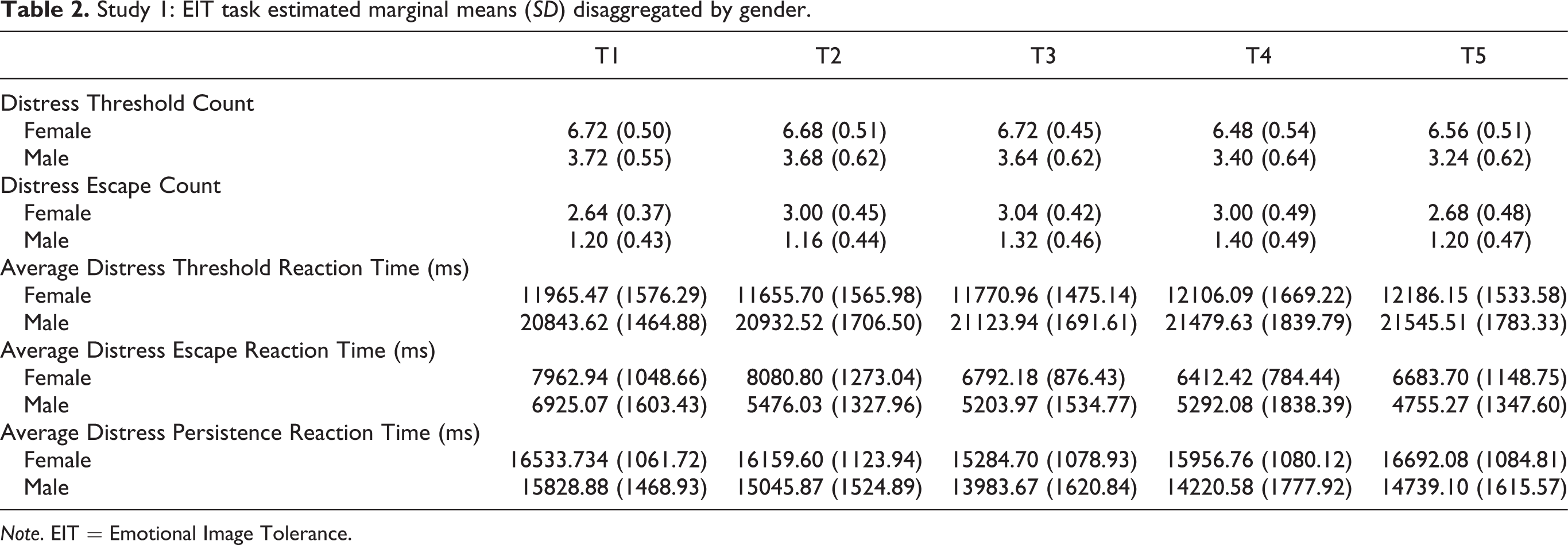
To examine if males and females responded differently to the task, five generalized linear mixed models (GLMMs) were conducted to assess gender-related differences with regard to how often distress was indicated, how many images were escaped, how quickly distress was indicated, how quickly an image was escaped, and how long individuals were willing to view an image after indicating distress (Table 2). All GLMMs included participant as a random factor, and both gender, time, and the interaction between the two as fixed factors.
Study 1: EIT task estimated marginal means (SD) disaggregated by gender.
Note. EIT = Emotional Image Tolerance.
Distress Threshold Count (number of times distress is indicated)
There was a significant main effect of gender on the number of times distress was indicated, F(1,240) = 17.21, p < .001. In general, females indicated distress significantly more times than males throughout the task. There was no main effect of time, F(4,240) = 1.26, p = .29, nor was there a significant interaction between gender and time, F(4,240) = 0.30, p = .88.
Distress Escape Count (number of times participants escaped an image)
There was a significant main effect of gender on the number of times a participant elected to escape an image after indicating distress, F(1,240) = 7.52, p < .01. Females escaped significantly more images than males throughout the task; however, there was no main effect of time, F(4,240) = 1.26, p = .29, or interaction between gender and time, F(4,240) = 0.73, p = .57.
Average Distress Threshold Reaction Time (time taken to indicate distress)
There was a significant main effect of gender on distress threshold reaction times, F(1,240) = 17.64, p < .01, whereby females were, on average, quicker to indicate distress than males. There was no main effect of time, F(4,240) = 0.53, p = .71, or interaction between gender and time, F(4,240) = 0.08, p = .99.
Average Distress Escape Reaction Time (time taken to escape an image after indicating distress)
There were no main effects of gender, F(1,134) = 1.12, p = .29; time, F(4,134) = 1.40, p = .24; or an interaction between gender and time, F(4,134) = 0.45, p = .77, on average escape reaction times.
Average Distress Persistence Reaction Time (time spent viewing an image after indication of distress)
There were no main effects of gender, F(1,209) = .65, p = .42, or time, F(4,209) = 1.22, p = .30, on distress persistence reaction times. The interaction between gender and time was also not significant, F(4,209) = 0.21, p = .93.
Within task correlations
To assess within task validity, we examined correlations between subjective distress ratings and responses on the task (Table 3). Distress ratings at the end of each block were significantly correlated with three of the five key task variables. Higher self-reported distress was associated with a higher distress threshold count, higher distress escape count, and faster distress threshold reaction times.
Study 1: Correlations between key EIT variables and Distress Ratings after controlling for gender.

*p < .05; **p < .01; ***p < .001.
Associations between EIT task variables, self-report distress tolerance, and other psychological constructs
To assess the validity of the task, we examined partial correlations (adjusting for gender) between the key EIT task variables, self-reported distress tolerance, and other psychological constructs that have been demonstrated to be related to distress tolerance (Table 4). None of the correlations between the EIT task variables and self-report distress tolerance were significant. With regard to the other variables, only two of the hypothesized relationships were significant. Expressive suppression was negatively correlated with the Distress Escape Count variable, such that individuals who reported engaging in expression suppression to a greater degree were less likely to escape images. Difficulties in emotion regulation were negatively associated with the Distress Escape Count variable such that individuals who reported greater difficulties regulating their emotions were less likely to escape images.
Study 1: Correlations between EIT key variables, demographics and self-report psychological measures controlling for gender.

Note. DASS: Depression, Anxiety, and Stress Scale.
*p < .05; **p < .01; ***p < .001.
Discussion
Using the EIT task, modified to include the presentation of a blank screen after an image is escaped and subjective distress ratings, this study aimed to examine patterns of distress over time, assess whether males and females responded differently on the task, as well as validate the modified version of the task. Results indicate that consistent with the original Veilleux et al. paper, the modified EIT task successfully induces distress, with both males and females experiencing heightened distress over the duration of the task. Overall, females reported significantly more distress than males, indicated distress more frequently, indicated distress more quickly, and escaped more images than males. The EIT task variables were significantly associated with within-task distress ratings; however, they were not correlated with self-report distress tolerance, or emotion regulation, emotional reactivity, rumination, depression, anxiety and stress. Significant negative associations were established between the number of times distress was indicated and expressive suppression whereby individuals who tend to suppress their emotions were less likely to indicate distress, which provides some support for the validity of the task. It is possible individuals who suppress their emotions experience a dampened level of distress while completing the task, and consequently indicate distress less often. Additionally, individuals who experienced greater difficulties in emotion regulation were less likely to escape images. Failure to escape intensely negative images may reflect difficulty disengaging form emotional stimuli, and this may be reflected in self-reported emotion regulation difficulties. However, further research is clearly needed to test both these possibilities. Given the small sample size (n = 50), validation in larger samples is necessary as it is likely that some of these correlations (i.e., self-report distress tolerance and Distress Escape RT; r = −.34) may be significant with a higher sample size, particularly given the samples are further reduced for associations such as these which only include data for individuals who pressed “p” to escape an image and thus have even lower power than correlations which include the entire sample.
Taken together, these findings indicate the modified version of the task effectively induces distress, and that behavioral indices of distress tolerance are associated with subjective distress ratings, suggesting the task functions as a valid assessment of distress tolerance. Results also suggest females experienced more distress overall, at both a self-report level and captured behaviorally.
Study 2: Responding to valence or arousal?
The aim of the second study was to assess whether participants’ responses to the images in the EIT task are a result of the valence of the images, rather than their arousing nature. To do this, we extended the task, to contain negative, positive, and neutral images, with negative and positive images matched on arousal ratings. We also examined distress ratings over time, gender-related differences on task variables, and associations with other theoretically related constructs.
Method
Participants
Participants were 50 undergraduate psychology students (who had not participated in Study 1) between the ages of 17 and 43 (M age = 22.04, SD = 6.14), recruited through the University research participation pool. The same screening processed employed in Study 1 was implemented, and an equal number of males (n = 25) and females (n = 25) were recruited and completed the study. 2 All 50 participants were included in the analyses.
Task development
To assess whether individuals are in fact responding to the valence of the images and not the arousal aspect, we adapted the EIT task to contain 15 negative images, 15 positive images, and 15 neutral images 3 (45 images in total). The 15 negative images were selected based on participant image ratings in Study 1. The 15 images with the highest distress ratings, common to both males and females, were selected. Example of these images include burn victims, mutilated bodies, and deceased children. Within the International Affective Picture System, all images are rated on how pleasant or unpleasant they are (1 = unpleasant to 9 = pleasant) and on how intense (or arousing) they are (1 = not at all intense to 9 = highly intense). Based on the validated valence and arousal ratings provided in the IAPS handbook, the top 15 negative images selected from Study 1 had an average valence rating of 1.66 and average arousal rating of 6.466. The 15 positive images were then selected to match this arousal rating, with an average arousal rating of 6.43 and average valence rating of 7.29. Examples of these images include rollercoasters (IAPS 8499), skydivers (IAPS 8185), money (IAPS 8501), and excited children playing in the swimming pool (IAPS 2216). Given our focus on examining gender-related differences in tolerance of emotional stimuli, we explicitly avoided including images of a sexual nature despite their high arousal rating and positive valence, as evidence has established males rate these images as more pleasant than females (Bradley et al., 2001). The 15 neutral images were selected based on a valence rating of approximately 4.5 (scores ranging from 1–9) indicating neutrality. They had a valence rating of 4.72 and arousal rating of 2.81. Examples of these images include mugs (IAPS 7009), a tissue box (IAPS 7950), a towel (IAPS 7002), and filing cabinet (IAPS 7224).The structure of the task remained the same, with five blocks of nine images, each block containing three negative, three positive, and three neutral images. Images were randomized within block, and block order was randomized. The Visual Analogue Scale distress ratings remained the same, as did the instructions the participants were provided.
Measures
The same self-report measures used in Study 1 were used in Study 2. Reliability indexes are as follows: Distress Tolerance Scale (α = .87), Emotional Reactivity Scale (α = .94), Intolerance of Uncertainty Scale (α = .94), Cognitive Reappraisal (α = .87), Expressive Suppression (α = .83), Difficulties in Emotion Regulation Scale (α = .91), Brief Experiential Avoidance Questionnaire (α = .86), RTQ (α = .92), Depression (α = .85), Anxiety (α = .74), and Stress (α = .77).
Procedure
The procedure remained the same as Study 1, with the exception that participants were no longer required to rate the images for distress after completing the task.
Results
On average, less than 1% of data were missing, and missing completely at random χ2(2953) = 0.000, p = 1. Missing data were imputed using Expectation Maximization (Tabachnick & Fidell, 2013).
Subjective ratings of distress over time
A mixed-model ANOVA was conducted to assess Visual Analogue Scale distress ratings over the duration of the task, with gender included as a between-subjects factor (Figure 2). Mauchly’s Test of Sphericity revealed that the assumption of sphericity had been violated, χ2(14) = 28.45, p < .001; therefore, a Greenhouse–Geisser correction was used (Tabachnick & Fidell, 2013). There was a significant effect of time on distress ratings, F(4.08, 54.737) = 36.458, p < .001, η2 p = .43, with distress ratings increasing over time. The pattern of distress ratings was the same as in Study 1 whereby participants reported a significant increase in distress after viewing images in Block 1, and again after Block 2, and then distress plateaued for the remaining blocks (see supplementary materials). There was no significant effect of gender, F(1, 48) = 1.45, p = .029, or interaction between time and gender, F(4.077, 0.647) = 0.413, p = .790.

Study 2 distress ratings over time.
Valence-related and gender-related differences in task responses
Given participants generally did not tend to indicate distress or escape positive and neutral images, we only examined differences in “count” variables (i.e., number of images distress was indicated on/number of images escaped), as there was insufficient data to examine differences on reaction time variables (i.e., time taken to indicate distress).
A mixed-model ANOVA was conducted to assess whether participants indicated distress significantly more times on negative, positive, or neutral images, with gender included as a between-subjects factor. Mauchly’s Test of Sphericity revealed that the assumption of sphericity had been violated, χ2(2) = 116.465, p < .001; therefore, a Greenhouse–Geisser correction was used (Tabachnick & Fidell, 2013). There was a main effect of valence, F(1.04, 4232.88) = 289.711, p < .001, η2 p = .86, with participants indicating distress significantly more times on negatively valenced images (M = 11.76, SD = 4.91) than both positively (M = 0.39, SD = 0.87, p < .001) and neutrally (M = 0.10, SD = 0.57, p < .001) valenced images. Individuals also indicated distress significantly more times on positively valenced images than neutrally valenced images (p < .05). There was also a main effect of gender F(1, 50.46) = 5.748, p < .05, η2 p = .11, with females indicating distress significantly more times than males overall; however, there was no significant interaction between gender and valence, F(1.04, 53.382) = 3.654, p = .061.
This analysis was repeated to examine valence-related differences in terms of number of images escaped. Mauchly’s Test of Sphericity revealed that the assumption of sphericity had been violated, χ2(2) = 261.473, p < .001; therefore, a Greenhouse–Geisser correction was used again (Tabachnick & Fidell, 2013). There was a significant effect of valence on number of images escaped, F(1, 1028.48) = 47.62, p < .001, η2 p = .498, with individuals escaping significantly more negatively valenced images (M = 5.59, SD = 5.93) than positively (M = 0.02, SD = 0.14, p < .001) and neutrally (M = 0.02, SD = 0.14, p < .001) valenced images. There was a significant main effect of gender F(1, 65.34) = 5.904, p < .05, η2 p = .11, with females escaping significantly more images than males. There was also a significant interaction between gender and valence F(1, 122.644) = 5.679, p < .05, η2 p = .11, whereby females escaped significantly more negative images than males, t(1) = 2.4, p < .05. There were no gender-related differences on positive, t(1) = 1.00, p = .32, and neutral images, t(1) = 1.00, p = .32.
Associations between EIT task negative image variables, self-report distress tolerance, and other psychological constructs. To assess the validity of this task, we examined the correlations between the key EIT task variables calculated from scores on the negative images, with the self-report distress tolerance and the same psychological constructs assessed in Study 1 (Table 5). After controlling for gender, several of the EIT task variables were significantly correlated with self-report distress tolerance. Specifically, self-report distress tolerance was negatively correlated with the distress threshold count variable, such that individuals who reported a higher tolerance for distress on the Distress Tolerance Scale, indicated distress significantly less on negative images. Self-report distress tolerance was also negatively correlated with the Distress Escape Count variable, such that individuals who reported a higher tolerance for distress, escaped significantly fewer negative images than individuals with a lower self-reported distress tolerance. Further, self-report distress tolerance was positively associated with Distress Threshold reaction times, whereby individuals who reported a higher tolerance for distress, took longer to indicate distress on negative images. Additionally, the Distress Threshold reaction time variable was negatively associated with emotional reactivity, such that individuals who reported higher emotional reactivity were quicker to indicate distress on negative images than individuals who reported lower emotional reactivity. The Distress Threshold reaction time variables were also negatively associated with rumination, whereby individuals who reported higher levels of rumination indicated distress significantly more quickly than individuals who reported lower levels of rumination.
Study 2: Correlations between EIT key variables on negative images, demographics and self-report psychological measures controlling for gender.

Note. DASS: Depression, Anxiety, and Stress Scale.
*p < .05; **p < .01; ***p < .001.
Discussion
The aim of this study was to examine patters of distress over time, gender-related differences on key task variables, and importantly, to ascertain whether individuals respond to the valence or arousal aspect of images in the EIT task. Using a version of the task containing negative and positive images matched on arousal, as well as 15 neutral images, results confirmed that individuals responded to the “valence” or “negative aspect” of the image, as opposed to simply its arousing nature, with participants indicating distress on, and escaping significantly more negative images than positive and neutral images. Indeed there was almost no indication of distress or escaping of positive and neutral images. Consistent with Study 1, gender-related differences in responding were also identified, with females indicating distress on, and escaping, more images than males. Further, these gender differences were specifically related to negative images, with no gender-related differences apparent on positive and neutral images. This version of the EIT task was also successful in inducing distress, with all participants increasing in self-reported distress (Visual Analogue Scale distress ratings) over the duration of the task. There were no gender-related differences in distress ratings. Finally, there were significant associations between key EIT task responses on the negative images and self-report Distress Tolerance Scale scores, with all correlations in the expected direction, providing support for the validity of the task. Additionally, significant relationships with both emotional reactivity and rumination provide further support for task validity.
General discussion
The aim of this article was to modify and evaluate the EIT task, with a specific focus on assessing patterns of distress, gender-related differences, and determining whether individuals respond to the valence of images as opposed to the intensity of their content. This was achieved in two studies. In the first study, the EIT task was modified to present a blank screen for the remainder of the 30 s after participants elected to escape an image, as well as the addition of Visual Analogue Scale distress ratings throughout the task. The second study focused on determining whether individuals responded to the valence or the arousal of the images. In both studies, patterns of distress and gender-related differences were assessed. Additionally, both tasks were validated by examining associations between key task variables, self-report distress tolerance, and other constructs known to be related to distress tolerance.
In both studies, the modified version of the EIT task successfully induced distress, with individuals not only experiencing heightened distress after viewing the first block of images but with distress increasing and then plateauing for the duration of the task. These results support findings from the original study, where negative affect increased post-task (Veilleux et al., 2019), and build on these findings by allowing researchers to examine patterns of subjective distress at different points throughout the task. Specifically, in both studies, individuals experience a sharp spike in distress after viewing the first block of images, with distress continuing to increase after viewing the second block, before plateauing for the remainder of the task. One possible implication of this could be that researchers may not need to administer the entire task in future research. They may acquire similar results using only the first three blocks which would reduce the amount of lab time and participant burden significantly. Unsurprisingly, effect sizes indicate these patterns are stronger in the first study, where individuals viewed 45 negative images in succession, as opposed to 15 negative images dispersed between positive and neutral images in Study 2. This suggests that the inclusion of positive and neutral images reduced the impact of the negative images (that were rated the most distressing in Study 1) on the experience of distress throughout the task. From a clinical perspective, this finding indicates that “buffering” negative stimuli with positive or neutral information/stimuli might assist in decreasing overall distress. This is evidenced in previous research that supports the postulation that positive emotional experiences buffer the effects of negative moods and/or distress and this can reduce the likelihood of engaging in dysregulated behaviors such as risky drinking (Mohr et al., 2008). Interestingly, females reported higher distress ratings than males in the first study but not in the second. These differences are likely attributable to the consistent presentation of negative emotional stimuli which is more effective at eliciting a greater distress response, and potentially females find this overwhelming consumption of negative content more distressing than males; however, this may not be the case when distressing content is presented less frequently, as in Study 2.
Additionally, gender-related differences on key task variables were present in both versions of the task, with females tending to indicate distress and escape negative images faster and more frequently than males. These findings add to the existing body of literature that demonstrate males and females tend to respond differentially to emotional stimuli(Gomez et al., 2013) are consistent with previous research that demonstrates females tend to exhibit stronger affective, defensive reactions on unpleasant IAPS images (Bradley et al., 2001). Therefore, researchers utilizing this task in future studies may wish to control for gender in analyses or account for these differences in the design of their studies. With regard to whether individuals’ responses on the task were driven by the valence or arousal of the images, results from the second study demonstrate that participants are indeed responding to the negative valence of the image, and not simply the intensity and arousing nature of the content. Our findings allow us to conclude that this task is in fact assessing tolerance of negative emotion and not simply tolerance of intense and confronting stimuli.
In terms of task validation, our findings were mixed; however, this is not uncommon, particularly when examining associations between self-report and behavioral measures of the same construct (Ameral et al., 2014; Bernstein et al., 2011; Cougle et al., 2013). No relationships between task variables and self-report distress tolerance were present in the first study; however, in the second study, three of the five key task variables were associated with self-report distress tolerance, whereby individuals with a higher perceived tolerance for distress, took longer to indicate distress, indicated distress less often and escaping fewer negative images in the task. These inconsistencies are similar to those in the original task development study, where Veilleux et al. established small-to-moderate relationships with self-report distress tolerance in the first study, but not in the second or third. Several arguments exist in regards to why these discrepancies frequent the literature, one being that items comprising self-report measures such as the Distress Tolerance Scale predominantly assess judgments about feelings (i.e., “There’s nothing worse than feeling distressed or upset”), as opposed to behavioral tasks that assess actual willingness to continue engaging in distress (Veilleux et al., 2019). However, we did establish significant associations with self-report distress tolerance in Study 2, prompting an exploration as to why this may be.
A possible explanation for these significant findings may be the addition of positive and neutral images to the task. It is possible that the 15 negative images, classified as the most distressing from the original task, become more salient when dispersed between neutral and positive images. An additional explanation could be that these findings may be explained by the “strong situation hypothesis” that is based on the premise that the strength of the situation impacts the degree to which individual differences influence behavior (Cooper & Withey, 2009; Mischel, 1977). According to this concept and supporting evidence (Beaty et al., 2001; Withey et al., 2005), strong situations result in limited behavioral options and individual differences are less likely to be detected given most people tend to respond in a similar manner. In Study 1, participants were repeatedly presented with only distressing, negative images, which may have resulted in “overwhelming distress” and consequently similar behavior between all participants with regard to indicating distress and escaping images given the nature of the heightened, distressing situation. In contrast, in weaker situations such as Study 2 where only 15 negative images were dispersed between neutral and positive images, behavior is more likely to reflect individual differences (i.e., distress tolerance) as behavioral expectancies are more ambiguous and responses are more likely to be driven by personality than by the situation (Cooper & Withey, 2009). These findings suggest the version of the task comprising negative, positive, and neutral images may allow for better detection of individual differences in distress tolerance, despite the first task inducing higher levels of distress.
With regard to associations with other relevant constructs, there were also mixed findings. Although the EIT task was associated with expressive suppression and difficulties in regulating emotions in the first study, the second version of the task in Study 2 was significantly associated with rumination and emotional reactivity. Both sets of associations provide some evidence of validity, however they were not consistent across studies; this may be a function of the differences between the tasks. Further research is required to continue to explore whether these associations can be replicated. It is important to note, as Veilleux et al. did, that it is possible both samples may comprise individuals who tend to experiencer lower levels of distress given the strict eligibility criteria. This may explain why there are not many significant associations with symptomology. Future research would benefit by loosening eligibility criteria or using the task to assess distress tolerance in clinical samples.
While these findings provide a valuable contribution to the assessment of behavioral distress tolerance, there are several limitations. Given the recency of the task, the modifications made in this research, and the relatively small sample, it is important that both versions of the task continue to be tested and validated in larger samples, particularly to attempt to replicate the established relationships with self-report distress tolerance evidenced in Study 2. A specific limitation of the task in Study 2 is the use of the same instructions as Study 1 which ask participants to indicate when they feel “distressed.” Given the nature of the positive and neutral images, asking participants to indicate when they experience an “emotional reaction” may be a more accurate way of assessing responses to the images, and may consequently produce a different pattern of results. With regard to the selection of positive images for Study 2, despite being specifically selected to match the negative image arousal ratings from the IAPS normative sample, it is important to acknowledge that these stimuli are inherently very different to the negative stimuli. Compared to the negative content including images of mutilations and burn victims, images of happy children and other pleasant scenes are, on face value, unlikely to elicit an equally arousing response and consequently would not be as difficult to tolerate. The only other more positively valenced, highly arousing images in the IAPS collection were erotica, and given past research has demonstrated large gender differences in responses to these images, we decided not to include these. Additionally, our lack of physiological measures (i.e., skin conductance, meant we were unable to capture and directly compare physiological arousal responses across images. This is something to consider for future research using this task. Both studies comprised non-clinical samples, specifically university students who had to adhere to strict eligibility criteria to participate. Given the importance of assessing distress tolerance is to examine its relationship with psychopathology, it is necessary for future research to utilize the task among clinical populations, particularly among disorders where low distress tolerance is known to play significant role in etiology and maintenance. Finally, the subjective distress ratings and validation measures are reliant on self-report data. Future research may benefit from incorporating psychophysiological assessment, as it may provide a more holistic understanding of how the task functions.
In conclusion, the current research establishes that the EIT task successfully induces distress that this is specifically linked to the valence of the images, and that gender differences need to be considered when using the task given females respond more strongly than males. While the version of the task containing only negative images appears to induce the highest levels of distress and may be utilized as an effective stressor in many areas of research, the multivalenced version appears to be more closely associated with self-report distress tolerance and potentially more sensitive to detecting individual differences in tolerance. Although further assessment of both tasks if required, our findings are an important extension of current behavioral assessments of distress tolerance.
Supplemental material
Supplemental Material, sj-pdf-1-epp-10.1177_20438087211007597 - Assessing distress tolerance using a modified version of the Emotional Image Tolerance task
Supplemental Material, sj-pdf-1-epp-10.1177_20438087211007597 for Assessing distress tolerance using a modified version of the Emotional Image Tolerance task by Ashley Slabbert, Penelope Hasking, Lies Notebaert and Mark Boyes in Journal of Experimental Psychopathology
Footnotes
Availability of data and material
The data are available from the corresponding author upon reasonable request.
Declaration of conflicting interests
The author(s) declared no potential conflicts of interest with respect to the research, authorship, and/or publication of this article.
Ethical approval
All procedures performed in studies involving human participants were in accordance with the ethical standards of the institutional and/or national research committee and with the 1964 Helsinki declaration and its later amendments or comparable ethical standards.
Funding
The author(s) disclosed receipt of the following financial support for the research, authorship, and/or publication of this article: AS was supported by an Australian Government Research Training Program Stipend Scholarship. MB was supported by the National Health and Medical Research Council, Australia (Investigator Grant 1173043).

Informed consent
Informed consent was obtained from all individual participants included in the study.
Supplemental material
Supplemental material for this article is available online.
Notes
References
Supplementary Material
Please find the following supplemental material available below.
For Open Access articles published under a Creative Commons License, all supplemental material carries the same license as the article it is associated with.
For non-Open Access articles published, all supplemental material carries a non-exclusive license, and permission requests for re-use of supplemental material or any part of supplemental material shall be sent directly to the copyright owner as specified in the copyright notice associated with the article.
