




Abstract
Imagery rescripting (IR) is a promising treatment for a variety of disorders, but its working mechanisms remain largely unknown. To elucidate the associative and evaluative learning processes underlying IR, we exposed participants to an aversive film clip followed by an instructed fear-conditioning procedure. The acquired fear memory was subsequently manipulated by either rescripting- (IR) or exposure-based (imaginal exposure; IE) interventions and their effects were examined on subjective and psychophysiological fear responses in three successive studies. Though the interpretation of the results was challenged with respect to the employed analogue IR intervention (Exp 1) and unexpected findings in the control condition (Exp 3), the present results establish preliminary evidence for the hypothesis that IR produces differential effects on fear responding when compared to IE. For example, in line with stimulus devaluation theory, IR effectively reduced subjective distress to the conditioned stimulus (Exp 2). Also, IR resulted in decreased physiological fear responses after fear reinstatement (Exp 3). The findings advance our general understanding of the processes involved in IR and they tentatively indicate that rescripting- and exposure-based treatments may work through different mechanisms. Moreover, this line of research demonstrates the challenges encountered when working with analogue models to test mechanisms of therapeutic change.
Introduction
Disorders of emotional memory, such as post-traumatic stress disorder and anxiety disorders, are typically characterized by associative fear memories (Ehlers & Clark, 2000; Foa & Kozak, 1986). In order to reduce fear responses, traditional psychological treatments mainly rely on exposure techniques, which are thought to impede the activation of dysfunctional fear memories via inhibitory learning processes (Bouton, 1993; Miller & Matzel, 1988). Recently, imagery rescripting (IR) has been introduced as a means to change emotional memories (e.g., Holmes, Arntz, & Smucker, 2007; Smucker, Dancu, Foa, & Niederee, 1995). In IR therapy, emotion-inducing mental images that contribute to the onset and maintenance of emotional disorders (Ehlers & Clark, 2000; Holmes & Bourne, 2008) are actively modified in order to reduce associated negative emotions and other psychological symptoms. Patients are first instructed to imagine the mental image as vividly as possible. Next, they are asked to change the distressing image into a more desired direction or to introduce trustworthy helpers to the imagined situation, who can assist patients to construct a new, more benign image. Compared to traditional and primarily verbally based cognitive treatment techniques that focus on patients’ thoughts and interpretations of events, IR uses the patients’ experienced emotions as a starting point for therapy by enabling them to express inhibited emotional responses in the imagined situation. Given that mental images promote perceptual information processing, thereby eliciting stronger emotional responses than verbal processing (for reviews, see Holmes & Mathews, 2005, 2010), IR capitalizes on perceptual means rather than verbal modes to target emotional memories (Arntz, Tiesema, & Kindt, 2007). Though IR appears to be a promising treatment for a multitude of psychological disorders (Arntz, 2012; Morina, Lancee, & Arntz, 2017), its underlying working mechanisms remain largely unknown.
It has been suggested that IR manipulates the memories underlying emotional disorders (for a review, see Arntz, 2012). Modern learning theory (e.g., Davey, 1997; Mineka & Zinbarg, 2006) offers a theoretical framework to explicate the memory processes involved in IR. Within this model, it is assumed that a conditioned stimulus (CS) does not directly evoke a conditioned response (CR). Instead, the CS triggers a mental (cognitive) representation of an aversive event (unconditioned stimulus; UCS), and an activation of this memory trace (CS-UCS association) then leads to the CR. The intensity of the CR is determined by two factors: First, the strength of the association between CS and UCS (i.e., outcome expectancy) and second, the evaluation of the UCS memory. Based on this theory, two hypotheses about how IR might affect emotional memories can be derived.
Analogous to traditional models of extinction learning where a competing memory (CS-noUCS association) is formed (inhibitory learning; Bouton, 2004; Craske, Liao, Brown, & Vervliet, 2012), it has been hypothesized that IR works by facilitating the generation (or strengthening) of new or alternative, positively valenced memory representations that compete with the old and problematic, negatively valenced memories when presented with the same retrieval cue at any given moment (e.g., Holmes & Mathews, 2010). This mechanism also underlies conventional extinction-based treatments such as in vivo or imaginal exposure (IE) therapy. During exposure, the CS is not paired with a feared aversive event (UCS) and therefore acquires a new meaning (Bouton, 2002). Thus, new learning is driven by changes in contingency between CS and UCS, while the valence of the stimuli involved in the learning process is not directly changed. Extensive animal and human research suggests that the new memory trace then competes with the original memory trace, which remains intact even after successful extinction (Bouton, 2002; Delamater, 2004; Hermans, Craske, Mineka, & Lovibond, 2006). Consequently, return of fear (RoF; i.e., relapse) is often observed after treatment (Durham, Higgins, Chambers, Swan, & Dow, 2012; Hofmann & Smits, 2008; Loerinc et al., 2015).
Alternatively, IR might change the meaning of the memory representation of an aversive event (e.g., Arntz, 2011, 2012), possibly through UCS-devaluation processes (Davey, 1989). According to Davey’s conditioning theory (1997), the strength of a CR elicited by a CS is mediated by the cognitive representation of the UCS. Changing the subjective evaluation of the UCS can thus modulate the CR’s strength (Hosoba, Iwanaga, & Seiwa, 2001; White & Davey, 1989). Rather than facilitating the formation of a new memory trace, IR may be a means to change the dysfunctional meaning of the original UCS-memory representation directly by generating additional, corrective information about the UCS that is included into the mental representation of the existing memory of the UCS. 1 This might promote the generalization of the treatment effect to stimuli or situations outside the therapy context, thereby reducing the considerable relapse rates often observed after exposure treatment. In line with this proposition, recent experimental studies into the underlying mechanisms of IR provide preliminary support for the claim that IR changes the meaning of the original aversive experience (Dibbets, Poort, & Arntz, 2012; Hagenaars & Arntz, 2012). Given the promising potential of IR as a therapeutic intervention, it appears worthwhile to further investigate its underlying processes (Arntz, 2012). Here, we present three experiments that aimed to examine the underlying mechanisms of IR compared to exposure.
The methods of these experiments are only briefly presented for reasons of clarity. For a detailed description of all material, methods, and results, we refer the reader to the Supplementary Material.
Experiment 1
Background
Based on the alleged differential working mechanisms of IR and IE, it is predicted that rescripting-based techniques are more effective in the long run by preventing RoF after successful treatment. The Pavlovian fear-conditioning paradigm is well-suited to investigate RoF, and different manipulations have been developed to study RoF in animals and humans (Bouton, 2002, 2004; Hermans et al., 2006; Vansteenwegen et al., 2005). One particular technique is UCS reinstatement (Dirikx, Hermans, Vansteenwegen, Baeyens, & Eelen, 2004, 2007; Haaker, Golkar, Hermans, & Lonsdorf, 2014), which reinstates the fear response to the original CS by means of unexpected nonassociative UCS presentation after successful extinction learning (i.e., repeated exposure to the CS). In Experiment 1, we aimed to investigate whether IR leads to reduced reinstatement of the conditioned fear response when compared to IE.
Specifically, the experiment comprised a 2-day differential conditioning procedure (Kunze, Arntz, & Kindt, 2015). On Day 1, participants first watched a 12-min aversive film. Then, an instructed fear-conditioning phase followed: A picture from the aversive film was used as reinforced conditioned stimulus (CS+) and the auditory and visual presentation of the most aversive scene of the aversive film (human scream) served as UCS. Next, participants in the (1) IR condition underwent a short rescripting intervention in order to devalue the UCS, while participants in the (2) IE condition were repeatedly exposed to the aversive film by means of mental imagery. On the following day (Day 2), fear extinction, reinstatement, and a test phase took place. Conditioned responding was measured using physiological (e.g., fear-potentiated startle; FPS) and self-report measures (e.g., online subjective distress). Based on the proposition that IR reduces the strength of the CR by directly changing the (emotional) meaning of the UCS-memory representation through a revaluation process, we hypothesized that UCS reinstatement after extinction should result in less conditioned responding in the IR group, when compared to the IE group. Given that the interventions took place on the same day as fear learning, we also examined possible differential effects of IR and IE on the consolidation of the induced fear response.
Materials and method
Participants
Seventy healthy adults participated in the study, which was approved by the Ethics Review Board (ERB) of the University of Amsterdam (UvA; 2013-CP-2902). Prior to testing, all participants were screened for a history of physical and/or sexual abuse, current mental and/or physical illness, and (prescribed) medication and/or drug intake at the time of testing by means of a self-report questionnaire. Written informed consent was obtained from all participants, and they received either partial course credit or small monetary compensation (20 Euro) for their participation. Data from nine participants were lost due to a technical error in the audiovisual system. The final sample consisted of 61 participants (21 male, M Age = 21.41, SD Age = 2.47), which were randomly allocated to IR (n = 30) or IE (n = 31).
Measures
Conditioned fear responses were measured by means of FPS, skin-conductance responses (SCR), and online subjective distress (see also Kunze et al., 2015).
To assess possible differences between groups, trait anxiety levels were measured with the trait scale of the State-Trait Anxiety Inventory (STAI-S/T; Spielberger, Gorsuch, & Lushene, 1970). Changes on mood and state anxiety in response to the fear-conditioning procedure and the interventions were assessed by the Positive and Negative Affect Schedule (PANAS; Watson, Clark, & Tellegen, 1988) and STAI-S, respectively. Evaluative ratings for startle probe intensity, UCS aversiveness, (un)pleasantness and vividness of the imagery exercise, as well as retrospective UCS expectancy ratings were collected on 11-point Likert-type scales. Avoidance and intrusions toward the aversive film were measured with an adapted version of the Impact of Event Scale (IES; Horowitz, Wilner, & Alvarez, 1979).
Materials
A 12-min compilation of ‘Salò, or the 12 Days of Sodom’ (Pasolini, 1975) served as aversive film clip. During fear conditioning, a 3-s film fragment (of a human scream) from the aversive film served as UCS. A picture of the perpetrator from the aversive film served as CS+, while the CS− depicted a man who was unrelated to the film.
Procedure
Day 1
Participants were screened for exclusion criteria, written informed consent was obtained, and STAI-T, STAI-S1, and PANAS1 were administered. After EMG and SCR electrode attachment and a short startle habituation phase, participants were instructed to rate their subjective levels of distress toward CS+ and CS− during each stimulus presentation. Next, they were presented with both CSs to assess baseline responding. Then, the aversive film was presented and an instructed fear-conditioning procedure (Olsson & Phelps, 2004) followed. Specifically, participants were told that a short aversive film clip would always follow the picture of the perpetrator from the aversive film, whereas the aversive film clip would never follow the picture of the other man. During fear conditioning, CS+, CS−, and noise alone (NA) were each presented three times (CS+ 100% reinforced). Afterward, STAI-S2 and PANAS2 were administered. After a 30-min break, the intervention (IR or IE) took place. During the imagery intervention (approx. 10 min), participants were either asked to rehearse the aversive film in their imagination (IE) or they were instructed to rescript the content of the aversive film into a less aversive and more satisfying storyline (IR), 2 after a short imaginal reactivation of the most aversive scene from the aversive film (adapted from Hagenaars & Arntz, 2012). Immediately after memory reactivation and at the conclusion of the interventions, participants were asked to verbally rate their distress levels and the vividness of the current mental image ranging from 0 (not at all distressed/vivid) to 10 (very distressed/vivid). At the end of Day 1, STAI-S3, PANAS3, and evaluative ratings about the intervention were administered and the electrodes were removed.
Day 2
STAI-S4 and PANAS4 were administered after electrode attachment and before a short startle habituation phase. During fear extinction, CS+, CS−, and NA startle probes were presented 20 times (all stimuli unreinforced). Nineteen seconds after the last extinction trial, the UCS was presented once. Eighteen seconds after this unexpected UCS presentation, participants were presented with six trials of each CS+, CS−, and NA (all stimuli unreinforced). Finally, STAI-S5, PANAS5, IES, retrospective UCS expectancies, and an exit interview were administered and all electrodes were removed. For a thorough description of the (fear conditioning) procedure, see Figure 1 and Supplementary Material.
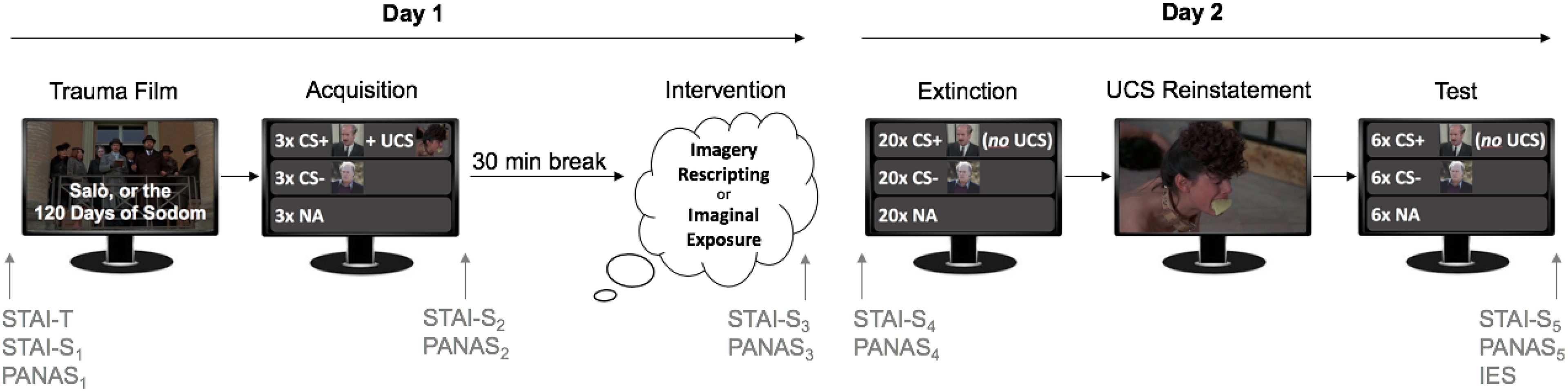
Schematic overview of the procedure (Experiment 1). CS = conditioned stimulus; IES = Impact of Event Scale; NA = noise alone startle probe; UCS = unconditioned stimulus; PANAS = Positive and Negative Affect Schedule; STAI-S/T: State-Trait Anxiety Inventory.
Results
Sample characteristics
The two groups did not differ on gender, X 2(1) = 0.03, p = .860, trait anxiety, t(59) = 0.72, p = .943, perceived startle probe intensity, t(59) < 0.01, p = .956, or perceived aversiveness of the UCS, t(59) = 0.236, p = .814. A significant group effect was found only for age, t(59) = 2.22, p = .030. However, given the very small difference in mean age between the groups (see Supplementary Table A.1), we did not further attend to this group difference in the analyses.
Manipulation check
Several significant main effects of Time for STAI-S, F(1, 59) = 91.28, p < .001, ηp 2 = .61, negative affect, F(1, 58) = 71.95, p < .001, ηp 2 = .55, and positive affect, F(1, 58) = 51.01, p < .001, ηp 2 = .47) indicated that the fear-learning procedure was successful. While the groups did not differ on STAI-S and PANAS before the interventions (all Fs < 1.35, ps > .250), significant Time × Condition interactions indicated between-group differences on STAI-S, F(1, 59) = 12.67, p = .001, ηp 2 = .18, positive affect, F(1, 58) = 10.62, p = .002, ηp 2 = .16, and negative affect, F(1, 58) = 7.80, p = .007, ηp 2 = .12, in response to the interventions. A marginally significant main effect of Condition after the intervention on STAI-S scores indicated that participants in the IR condition felt significantly less anxious after the intervention compared to participants in the IE condition, F(1, 59) = 3.58, p = .063, ηp 2 = .06. Regarding negative affect, no differences between the groups could be observed, F(1, 58) = 1.45, p = .234, ηp 2 = .02. However, participants in the IR condition reported significantly more positive affect than participants in the IE condition after the intervention, F(1, 58) = 7.59, p = .008, ηp 2 = .12. On the following day, no differences between the groups could be observed on STAI-S and negative affect (all Fs < 4.87, p > .488). A significant Time × Condition interaction on positive affect scores, F(1, 59) = 4.61, p = .036, ηp 2 = .07, suggested group differences over the course of the second day of testing. Subsequent inspection of the data revealed that participants in the IR condition reported more positive affect in the beginning of the second test day compared to participants in the IE condition (see Supplementary Table A.1). The groups did not differ on either the intrusion or the avoidance scale of the IES (ts < 0.53, ps > .589).
With respect to the imagery intervention, we observed a significant decrease in subjective units of distress (SUDs) in the IR condition, F(1, 59) = 46.42, p < .001, ηp 2 = .44, and a significant increase in the IE condition, F(1, 59) = 11.23, p = .001, ηp 2 = .16. Similarly, there was a decrease in vividness ratings in IR, F(1, 59) = 31.82, p < .001, ηp 2 = .35, but an increase in IE, F(1, 59) = 4.49, p = .038, ηp 2 = .07.
Fear-potentiated startle
The results are summarized in Table 1(a) to (h). Successful fear conditioning for both groups was indicated by a marginally significant Stimulus × Trial interaction (b), F(1, 59) = 3.70, p = .059, ηp 2 = .06. As suggested by a significant main effect of Stimulus from the last trial of acquisition to the first trials of extinction (c), F(1, 56) = 13.08, p = .001, ηp 2 = .19, and a marginally significant main effect of Stimulus on the first trials of extinction alone (d), F(1, 56) = 3.24, p = .077, ηp 2 = .06, differential startle responses could be observed on Day 2 which demonstrates successful transfer of the fear response in both groups. A differential decrease of CRs could not be observed over the course of extinction (e), Stimulus × Trial, F(9, 504) = 0.85, p = .569, ηp 2 = .02, but a nonsignificant main effect of Stimulus on the last trials of extinction suggested successful extinction in both groups (f), F(1, 56) = 0.38, p = .541, ηp 2 = .01. Nondifferential fear reinstatement was indicated by a significant main effect of Trial (g), F(1, 56) = 12.79, p = .001, ηp 2 = .19. Contrary to the hypothesis, no differences between the groups could be observed (Trial × Condition × Stimulus, F(1, 56) = 2.07, p = .156, ηp 2 = .04). However, there was a trend-level Stimulus × Condition effect on the first trials of reinstatement testing (h), F(1, 56) = 2.87, p = .096, ηp 2 = .05. Follow-up t-tests indicated a significant difference between CS+ and CS− in the IE condition (p = .001) but not in the IR condition (p = .294; see Figure 2).
Experiment 1: Mixed repeated-measures ANOVA results with between-subjects factor Condition (IR vs. IE) and within-subjects factors Stimulus (CS+ vs. CS−) and Trial for FPS responses.

Note. Significant p values relevant for the interpretation of the results are marked bold. ANOVA = analysis of variance; IR = imagery rescripting; IE = imaginal exposure; CS = conditioned stimulus; FPS = fear-potentiated startle.

Experiment 1: Mean FPS responses to CS+, CS−, and NA during fear acquisition, extinction, and reinstatement test for the (a) IR and (b) IE condition. Error bars represent SEM. FPS = fear-potentiated startle; CS = conditioned stimulus; NA = noise alone; IR = imagery rescripting; IE = imaginal exposure; SEM = standard error of the mean.
Skin conductance
Evidence for fear acquisition could not be found on SCR. Without successful fear learning, the SCR results cannot reliably be interpreted. Therefore, SCR data are not further presented here.
Online distress
The results are summarized in Supplementary Table A.2(a) to (h) and Figure A. A significant Stimulus × Trial × Condition interaction (b), F(1, 59) = 10.40, p = .002, ηp 2 = .15, suggested differences in fear learning between the groups during fear conditioning, which was due to a slight decrease of CS− ratings in the IE condition (p = .001) but not in the IR condition (p = .586). More importantly, a strong main effect of Stimulus (b) indicated successful fear learning for the CS+ in both groups, F(1, 59) = 151.26, p < .001, ηp 2 = .72. A significant main effect of Stimulus (d) suggested successful transfer of the fear response to Day 2, F(1, 59) = 93.60, p < .001, ηp 2 = .61. As indicated by a significant Stimulus × Trial interaction (e), F(3.29, 193.88) = 22.76, p < .001, ηp 2 = .28, fear extinction occurred in both groups. However, a significant main effect of Stimulus (f) on the last two trials of extinction indicated that extinction of subjective distress ratings did not fully take place, F(1, 56) = 49.35, p < .001, ηp 2 = .46. During reinstatement testing, a significant Stimulus × Trial interaction (g) suggested a differential increase in distress ratings for both groups, F(1, 59) = 57.89, p < .001, ηp 2 = .06, but no differences between the conditions could be found. Over the course of reinstatement testing, a differential decrease of distress ratings was observed for both conditions as indicated by a significant Stimulus × Trial interaction (h), F(1.61, 95.04) = 9.75, p < .001, ηp 2 = .14.
Discussion: Experiment 1
With this study, we aimed to examine the effects of an IR versus IE-based intervention on RoF after extinction within a complex associative learning paradigm. Contrary to the expectations, IR did not reduce fear reinstatement on either subjective or physiological measures, when compared to IE.
We speculated that a number of methodological and procedural limitations of the current study contributed to the null findings. First, the lack of a no-intervention control condition prevented us from interpreting the direction and strength of the possible effects of IR and IE on fear responding. Second, we exerted relatively little experimental control over the IR intervention. For example, the range in duration of the IR exercises was rather large (2–9 min). Also, the content of the new scripts differed widely across participants and some participants took the IR intervention more seriously than others. Moreover, many participants reported that they could not imagine being part of the rescripted scene (even just as an observer). Taken together, these limitations suggest that more standardized imagery exercises are required in order to systematically investigate the effects of IR versus IE.
Experiment 2
Background
In order to gain more experimental control over the imagery exercises, we designed a standardized IR intervention. This second study aimed to validate the new IR exercise and to investigate whether CRs could be manipulated by means of standardized imagery interventions.
For this purpose, we used the same fear-learning procedure as presented in Experiment 1. After fear conditioning, participants were randomized into one of three conditions: In the (1) devaluation condition, participants received an imagery intervention designed to devalue the aversive film. In the (2) no-intervention control condition, participants did not receive any intervention after fear learning. In the (3) inflation condition, participants received an imagery intervention, which aimed to further increase the aversiveness of the film. Whereas the latter condition mainly served as imagery-control group, we also explored whether CRs in the present fear-conditioning paradigm could be manipulated not only by means of devaluation but also through inflation of the UCS (White & Davey, 1989). We hypothesized that participants in the devaluation condition would show decreased subjective and physiological CRs compared to participants in the inflation and control condition.
Materials and method
Participants
Sixty-nine healthy adults participated in the study, which was approved by the ERB of the UvA (2014-CP-3820). Participants were screened for exclusion criteria according to the procedure used in Experiment 1. Written informed consent was obtained from all participants, and they received either partial course credit or small monetary compensation (15 Euro) for their participation. Three participants were removed from the analysis because they did not complete the experiment. The final sample consisted of 66 participants (18 male, M Age = 22.09, SD Age = 3.34). Participants were randomly allocated to the devaluation (n = 22), inflation (n = 22), or control (n = 22) condition.
Measures
With regard to the fear-conditioning procedure, all materials and measures (i.e., FPS, SCR, and online distress) were identical to those described in Experiment 1.
In order to test the devaluation hypothesis independently of online conditioned fear responses, we used Self-Assessment Manikins (SAM) to assess valence and arousal toward the CS. STAI-S and PANAS ratings were discarded for reasons of parsimony. Instead, we added four visual analogue scales (VAS) to assess specific emotions that play a particularly important role in the aversive film (i.e., shame, fear, anger, tension).
Imagery exercises
The imagery exercises used in this study comprised 5-min audio fragments, delivered via headphones. In line with Experiment 1, both imagery exercises consisted of a reactivation and an intervention phase. Participants were instructed to close their eyes during the entire exercise and to imagine everything as vividly as possible. After reactivation of the most aversive scene from the aversive film, participants in the devaluation condition were presented with an audio script, which depicted the victims and perpetrators of the scene as actors who care about each other’s feelings and who do not wish to hurt each other during the shooting of the movie. In the inflation condition, the aversiveness of the film was further increased by presenting participants with an audio script that described how the victim was further tortured and humiliated by the perpetrator.
Procedure
Experiment 2 took place on one day. Up to and including the fear-conditioning phase, the procedure was the same as described in Experiment 1, except that VAS1 and SAM1 were administered after electrode attachment. Following instructed fear conditioning, participants filled out VAS2 and were randomized to the devaluation, inflation, or no-intervention control condition. While participants in the devaluation and inflation condition were presented with standardized scripted audio interventions, participants in the control condition were instructed to read magazines for the duration of the intervention (5 min). Then, VAS3 was administered and participants who received an imagery intervention were asked to rate how pleasant or unpleasant they experienced the intervention and how vividly they could imagine the scripts. During a 30-min waiting period, participants were instructed to read magazines provided by the experimenter. Next, participants filled out VAS4 and startle habituation took place before the testing phase, where the CS+, CS−, and NA were each presented eight times. At the conclusion of the experiment, VAS5, SAM2, and an exit interview were administered.
Results
Sample characteristics
The three groups did not differ in age, F(2, 63) = 0.08, p = .277, gender, X 2(2) = 3.21, p = .201, perceived UCS aversiveness, F(2, 63) = 2.61, p = .081, or STAI-T scores, F(2, 63) = 1.39, p = .257 (see Supplementary Table B.1).
Manipulation check
A significant main effect of Time suggested an increase on all VAS emotions (all Fs > 7.74, ps < .007), indicating that the fear-acquisition procedure successfully induced negative emotionality. In line with the expectations, several Time × Condition interactions indicated group differences over the course of the intervention on shame, F(2, 63) = 3.85, p = .027, ηp 2 = .11, fear, F(2, 63) = 10.76, p < .001, ηp 2 = .26, tension, F(2, 63) = 5.56, p = .006, ηp 2 = .15, and anger, F(2, 63) = 13.39, p < .001, ηp 2 = .30. Bonferroni-corrected comparisons revealed that shame decreased significantly in the devaluation condition, F(1, 63) = 17.70, p < .001, ηp 2 = .22, but not in the inflation condition, F(1, 63) = 0.09, p = .767, ηp 2 < .01, or no-intervention control condition, F(1, 63) = 3.90, p = .053, ηp 2 = .06. Fear decreased significantly in the devaluation condition, F(1, 63) = 36.67, p < .001, ηp 2 = .37, and control condition, F(1, 63) = 13.95, p < .011, ηp 2 = .18, but not in the inflation condition, F(1, 63) = 0.17, p = .676, ηp 2 < .01. Similarly, tension decreased significantly in the devaluation condition, F(1, 63) = 37.45, p < .001, ηp 2 = .37, and control condition, F(1, 63) = 30.39, p < .001, ηp 2 = .33, but not in the inflation condition, F(1, 62) = 3.12, p = .082, ηp 2 = .05. On anger, the same pattern of results was observed, with a significant decrease in the devaluation condition, F(1, 63) = 46.33, p < .001, ηp 2 = .42, and control condition, F(1, 63) = 33.20, p < .001, ηp 2 = .35, but not in the inflation condition, F(1, 63) < 0.01, p = .992, ηp 2 < .01. After the intervention, several main effects of Condition suggested group differences on anger, F(2, 63) = 6.14, p = .004, ηp 2 = .16, tension, F(2, 63) = 8.48, p = .001, ηp 2 = .21, and fear, F(2, 63) = 3.87, p = .026, ηp 2 = .11, but not on shame, F(2, 63) = 2.59, p = .083, ηp 2 = .08. Inspection of the data indicated that participants in the inflation condition felt significantly more angry, tense, and fearful than participants in the devaluation or control condition.
Concerning the imagery interventions, participants in the devaluation condition experienced the imagery exercise as significantly more pleasant than participants in the inflation condition, F(1, 42) = 94.41, p < .001, ηp 2 = .69. Both groups were able to vividly imagine the scripts, with no differences between the conditions, F(1, 42) = 0.06, p = .813, ηp 2 < .01.
SAM ratings
In line with the hypothesis, analysis of the SAM ratings revealed that CS+ valence ratings remained relatively stable over time in the devaluation condition, F(1, 63) = 3.56, p = .064, ηp 2 = .05, while participants in the inflation condition, F(1, 63) = 18.83, p < .001, ηp 2 = .23, and control condition, F(1, 63) = 39.16, p < .001, ηp 2 = .38, rated the CS+ significantly more negatively at the end of the experiment, compared to the beginning of the experiment. No group differences were found on any of the other SAM items (i.e., valence CS−, arousal CS+, arousal CS−, all Fs < 2.73, ps > .073).
Fear-potentiated startle
The results are summarized in Supplementary Table B.2(a) to (d) and Figure B. Successful fear conditioning was indicated by a significant Stimulus × Trial interaction (b) for all groups, F(1, 62) = 7.28, p = .009, ηp 2 = .11. A significant Stimulus × Trial interaction (c) from the last acquisition trial to the first trials of the test phase indicated differences in startle responses before versus after the intervention, F(1, 62) = 4.54, p = .037, ηp 2 = .07. Planned comparisons revealed that startle responses to the CS+ remained relatively stable, F(1, 62) = 0.05, p = .817, ηp 2 < .01, while startle responses to the CS− increased over time in all groups, F(1, 62) = 5.99, p = .017, ηp 2 = .09. Extinction of the acquired fear response in all groups was indicated by a significant Stimulus × Trial interaction (d), F(3, 186) = 4.38, p = .005, ηp 2 = .07. Contrary to the hypothesis, differences between the groups could not be observed for any of the testing phases.
Skin conductance responses
Differential fear learning on SCR could again not be observed during acquisition. Therefore, SCR data are not further presented here.
Online distress
The results are summarized in Table 2(a) to (f). A significant Stimulus × Trial interaction (b) suggested differential fear learning, F(1, 63) = 27.10, p < .001, ηp 2 = .30. During the test phase from the last acquisition trial to the first extinction trials, a significant Trial × Condition interaction (c) indicated a differential effect of the interventions on online distress ratings, F(2, 63) = 4.08, p = .022, ηp 2 = .12. Planned comparisons revealed that there was an overall decrease of distress responses to CS+ and CS− in all three groups. However, analysis of the CS+ indicated that the Trial × Condition interaction was clearly driven by group differences on CS+ distress ratings (d), F(2, 63) = 3.80, p = .028, ηp 2 = .11, but not by CS− ratings (e), F(2, 63) = 0.96, p = .390, ηp 2 = .03. In line with the hypothesis, the reduction in distress toward the CS+ was significantly larger in the devaluation group, compared to the inflation and control group (Figure 3). None of the conditions showed evidence for differential fear extinction, as indicated by nonsignificant Stimulus × Trial interaction (f), F(1.78, 112.08) = 2.70, p = .078, ηp 2 = .04.
Experiment 2: Mixed repeated-measures ANOVA results with between-subject factor Condition (Devaluation vs. Inflation vs. Control) and within-subject factors Stimulus (CS+ vs. CS−) and Trial for subjective distress.

Note. Significant p values relevant for the interpretation of the results are marked bold. ANOVA = analysis of variance; CS = conditioned stimulus.
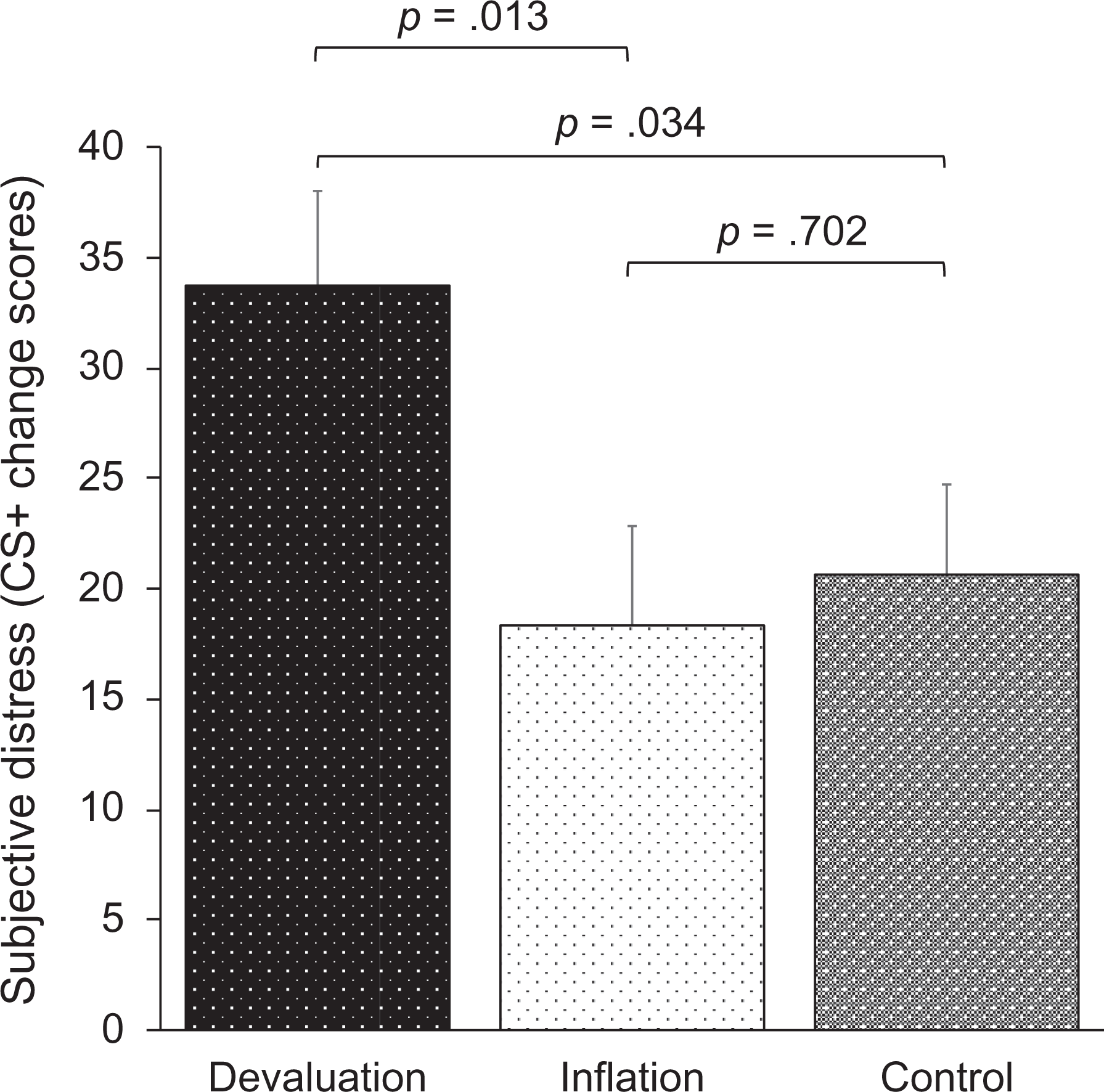
Experiment 2: Subjective distress CS+ change scores from the last trial of acquisition to the first block of extinction trials. Error bars represent SEM. CS = conditioned stimulus; SEM = standard error of the mean.
Discussion: Experiment 2
In line with the UCS-devaluation hypothesis, the standardized devaluation intervention resulted in significantly less subjective conditioned responding, compared to an intervention intended to increase the aversiveness of the film clip and a no-intervention control condition. Even though the results were not reflected by physiological data (FPS), the hypothesis was further indirectly supported by the fact that valence ratings (SAM) of the CS+ remained relatively stable before versus after the experiment in the devaluation condition, while participants in the inflation and control condition rated the CS+ significantly more negatively at the end of the experiment. Moreover, several group differences between the devaluation and inflation condition on anger, tension, fear, and shame ratings suggested that the devaluation script significantly reduced negative emotions induced by the fear-learning procedure. However, the devaluation script did not significantly reduce such emotion ratings more than the control procedure. Taking the absolute scores of these variables into consideration (see Supplementary Table 2.1), it is likely that this unexpected result may be due to a floor effect.
In line with Davey (1989), we showed that devaluation of the aversive film diminished the subjective CR toward stimuli associated with the aversive event, indicating that UCS devaluation took place. Overall, we concluded that the standardized IR intervention effectively reduced subjective fear responses. Yet, given that the fear response was not consolidated at the time of extinction, the present results only reflect the immediate effects of a devaluation procedure on conditioned fear responses, and long-term effects of IR-based techniques need yet to be uncovered.
Experiment 3
Background
This study aimed to further investigate the effects of IR (vs. IE) on fear memory consolidation. To control for variances in duration and content of the individualized IR interventions used in Experiment 1, a standardized IR intervention (Experiment 2) was used in the present experiment. Moreover, a no-intervention control group was added to facilitate the interpretability of the results with regard to the efficacy of IR and IE.
Fear memory was induced using the instructed fear-learning procedure presented in Experiments 1 and 2. Following fear acquisition, participants were randomized to a (1) standardized IR, (2) standardized IE, or (3) no-intervention control condition. We tested whether IR subsequent to fear conditioning would interfere with the process of fear memory consolidation, thus decreasing conditioned fear responding on the following day.
Materials and method
Participants
Seventy-four healthy adults (19 male, M Age = 22.55, SD Age = 4.77) participated in the study, which was approved by the ERB of the UvA (2015-CP-4675). Prior to testing, participants were screened for exclusion criteria according to the screening procedure described in Experiment 1. Written informed consent was obtained from all participants, and they received either partial course credit or small monetary compensation (25 Euro) for their participation. Participants were allocated to the IR (n = 26), IE (n = 24), or control (n = 24) condition.
Measures
With regard to the fear-learning procedure, materials and measures (i.e., FPS and online distress) were identical to those in Experiments 1 and 2. Instead of SCR, cardiac activity was used to measure autonomic responses during fear conditioning (see Measures in Supplementary Material).
Similar to Experiments 1 and 2, STAI-T/S, PANAS, and valence and arousal (SAM) ratings were assessed at different stages during the experiment. Also, six VAS measured specific emotions relevant to the aversive film and subsequent fear-conditioning procedure (i.e., shame, fear, sadness, anger, disgust, perceived control). Subjective units of distress (SUDs) were measured retrospectively to monitor the effect of the imagery exercises.
Imagery exercises
In line with Experiment 2, both standardized imagery exercises (IR and IE) consisted of a short reactivation and intervention phase (5 min total). Based on participant feedback in Experiment 2, the IR intervention remained essentially the same, apart from some details (see Materials in Supplementary Material). The IE script consisted of imaginal rehearsal of the most aversive scene from the aversive film in detail.
Procedure
Day 1
Up to and including fear conditioning, the procedure was the same as presented in Experiment 2. After instructed fear acquisition, participants filled out STAI-S2, PANAS2, VAS2 and they were assigned to either the IR, IE, or control condition. In IR and IE, participants were presented with each scripted audio intervention twice (10 min total) to enhance the efficacy of the exercise, and STAI-S3, PANAS3, VAS3, and a short questionnaire about the quality of the imagery exercise (i.e., pleasantness, vividness, valence, and intensity) were assessed. Participants in the control condition did not receive any control task but were dismissed after fear conditioning.
Day 2
STAI-S4, PANAS4, and VAS4 were administered before the testing phase, and participants were instructed that they would be presented with the same two pictures as on the previous day. During the test phase, CS+, CS−, and NA were each presented once. Nineteen second after the last stimulus, the UCS was presented. Eighteen seconds after this unexpected UCS presentation, CS+, CS−, and NA were each presented 20 times during the extinction phase. Order of stimulus type was counterbalanced for the trials before and immediately after UCS reinstatement. At the conclusion of the experiment, STAI-S5, PANAS5, VAS5, SAM2, and an exit interview were administered.
Results
Sample characteristics
The three groups did not differ in age, F(2, 70) = .028, p = .756, gender, X 2(2) = 0.25, p = .882, trait anxiety, F(2, 68) = 0.63 p = .538, perceived startle probe intensity, F(2, 70) = 3.10, p = .052, or aversiveness of the UCS, F(2, 68) = 0.13, p = .878 (see Supplementary Table C.1).
Manipulation check
Several significant main effects of Time suggested increases in STAI-S scores, F(1, 69) = 88.51, p < .001, ηp 2 = .56, negative affect, F(1, 64) = 67.56, p < .001, ηp 2 = .51, feelings of shame, F(1, 69) = 24.85, p < .001, ηp 2 = .27, fear, F(1, 64) = 26.40, p < .001, ηp 2 = .28, anger, F(1, 69) = 57.31, p < .001, ηp 2 = .45, sadness, F(1, 69) = 55.20, p < .001, ηp 2 = .44, and disgust, F(1, 69) = 162.55, p < .001, ηp 2 = .70, as well as decreases in positive affect, F(1, 64) = 99.32, p < .001, ηp 2 = .61, indicating that fear acquisition was successful. The groups did not differ before the intervention on any measure (all Fs < 3.04, ps > .054), except for anger, F(2, 69) = 3.57, p = .034, ηp 2 = .09, and sadness, F(2, 69) = 8.59, p < .001, ηp 2 = .20. In line with previous findings, we observed differences between IR and IE before versus after the intervention: A marginally significant Time × Condition interaction, F(1, 45) = 3.98, p = .052, ηp 2 = .08, suggested a stronger decrease of STAI-S scores in the IR condition, F(1, 45) = 37.18, p < .001, ηp 2 = .45, compared to the IE condition, F(1, 45) = 10.10, p = .003, ηp 2 = .18. Similarly, disgust scores decreased significantly more in the IR condition, F(1,45) = 37.73, p < .001, ηp 2 = .46, compared to the IE condition, F(1, 45) = 6.74, p = .013, ηp 2 = .13, as indicated by a significant Time × Condition interaction, F(1, 45) = 5.96, p = .019, ηp 2 = .12. On negative affect, shame, sadness, and anger scores, no differences between the conditions could be observed over time, as indicated by several nonsignificant Time × Condition interactions (all Fs < 3.22, ps > .080). However, several main effects of Condition for anger, F(1, 45) = 6.84, p = .012, ηp 2 = .13, sadness, F(1, 45) = 6.64, p = .013, ηp 2 = .13, shame, F(1, 45) = 6.81, p = .012, ηp 2 = .13, and negative affect, F(1, 43) = 4.63, p = .037, ηp 2 = .10, indicated that participants in the IE condition reported overall higher scores on these measures than participants in the IR condition (see Supplementary Table C.1). An increase in positive affect and perceived control, as well as a decrease in fear ratings was observed for IR and IE, with no differences between the groups (all Fs < 2.48, ps > .122). On the following day, the groups did not differ on any of the variables (all Fs < 2.88, ps > .063), except for STAI-S, F(2, 69) = 4.12, p = .020, ηp 2 = .11, and disgust scores, F(2, 69) = 4.40, p = .016, ηp 2 = .11, which indicated that participants in the control condition felt overall more anxious and disgusted compared to participants in the intervention conditions.
With regard to the imagery intervention, we observed a significant Time × Condition interaction on retrospective SUDs over the course of the intervention, F(1.54, 69.33) = 5.53, p = .011, ηp 2 = .11. While the groups reported similar distress levels after the first reactivation, F(1, 45) = 0.40, p = .842, ηp 2 < .01, SUDs were significantly lower in the IR condition compared to the IE condition after the first, F(1, 45) = 5.76, p = .021, ηp 2 = .11, and the second intervention, F(1, 45) = 6.00, p = .018, ηp 2 = .12. Moreover, significant main effects of Condition on imagery exercise pleasantness, F(1, 46) = 85.46, p < .001, ηp 2 = .65, valence, F(1, 46) = 126.08, p < .001, ηp 2 = .73, and intensity, F(1, 46)= 5.65, p = .022, ηp 2 = .11, indicated that the IR intervention was overall perceived as more positive than the IE intervention. Also, a main effect of Condition suggested that participants in the IR condition could imagine the script more vividly than participants in the IE condition, F(1, 46) = 4.18, p = .047, η p 2 = .08. Overall, we concluded that the intervention was successful.
Fear-potentiated startle
The results are summarized in Table 3(a) to (f). A main effect of Stimulus (b) indicated successful fear learning, F(1, 70) = 10.42, p = .002, ηp 2 = .13. A nonsignificant Stimulus × Trial × Condition interaction from the last trial of acquisition to the first testing trial on Day 2 (c; F(2, 70) = 0.35, p = .708, ηp 2 = .01) and a nonsignificant Stimulus × Condition interaction on the first testing trial on Day 2 (d; F(2, 70) = 1.03, p = .364, ηp 2 = .03) indicated that the transfer of the learned fear association from Day 1 to Day 2 did not differ between groups. Even though visual inspection of the data suggested that IR resulted in decreased differential fear responding when compared to IE at the beginning of Day 2 (Figure 4), this group difference was statistically not significant. During the reinstatement phase, a significant Stimulus × Condition interaction (e) suggested differences between the groups in response to UCS reinstatement, F(2, 70) = 3.40, p = .039, ηp 2 < .09. Planned comparisons revealed a significant main effect of Stimulus in the IE condition (F(1, 70) = 10.25, p = .002, ηp 2 = .13), but not in the IR (F(1, 70) = 1.64, p = .205, ηp 2 = .02) or control condition (F(1, 70) = 0.24, p = .629, ηp 2 < .01). A nonsignificant Stimulus × Trial × Condition interaction (f) suggested no differences between the groups over the course of fear extinction, F(18, 630) = 1.56, p = .064, ηp 2 = .04.
Experiment 3: Mixed repeated-measures ANOVA results with between-subject factor Condition (IR vs. IE vs. control) and within-subject factors Stimulus (CS+ vs. CS−) and Trial for FPS.

Note. Significant p values relevant for the interpretation of the results are marked bold. ANOVA = analysis of variance; IR = imagery rescripting; IE = imaginal exposure; CS = conditioned stimulus; FPS = fear-potentiated startle.

Experiment 3: Mean FPS responses to CS+, CS−, and NA during fear acquisition, test, reinstatement, and extinction for the (a) IR, (b) IE, and (c) no-intervention control condition. Error bars represent SEM. FPS = fear-potentiated startle; CS = conditioned stimulus; NA = noise alone; IR = imagery rescripting; IE = imaginal exposure; SEM = standard error of the mean.
Heart rate
No fear acquisition could be observed on HR. Without evidence for successful fear learning, subsequent HR data cannot reliably be interpreted. Therefore, HR data are not further presented here.
Online distress
The results are summarized in Supplementary Table C.2(a) to (g) and Figure C. A significant Stimulus × Trial interaction (b) indicated successful fear conditioning in all conditions, F(1, 70) = 5.32, p = .024, ηp 2 = .07. A significant main effect of Stimulus (d) during the first testing trial on Day 2 suggested successful transfer of the fear response from Day 1 to Day 2, F(1, 70) = 66.66, p < .001, ηp 2 = .49. No differences between the groups were found. During the reinstatement phase, differential fear reinstatement was evidenced by a significant Stimulus × Trial interaction (e), F(1, 70) = 7.22, p = .009, ηp 2 = .09. Contrary to the hypothesis, there was no interaction with Condition. A nonsignificant Stimulus × Trial × Condition interaction (f) suggested no differences in fear extinction between the groups, F(3.98, 139.37) = 0.57, p = .684, ηp 2 = .02, and a significant main effect of Stimulus (g) on the last trials of extinction indicated that subjective fear responses to the CS+ were not completely diminished, F(1, 70) = 35.75, p < .001, ηp 2 = .34.
Discussion: Experiment 3
With this experiment, we investigated the effects of standardized IR versus IE on the consolidation of CRs within a complex fear-conditioning procedure. Contrary to the expectations, differences between the groups were not observed on subjective fear responses (i.e., distress; see General discussion). However, in line with the hypothesis, IR resulted in decreased differential physiological fear responses (FPS) after unexpected UCS presentation, when compared to IE. Nevertheless, these group differences could not be reliably interpreted, because the control condition did not yield the expected pattern of results. While we expected that participants in the control condition would show differential fear responses to the CS+ and CS− on the second day of testing (before and after unexpected UCS presentation), inspection of the data indicated that this was clearly not the case. These findings are rather puzzling, given that Kunze, Arntz, and Kindt (2015) previously observed successful retention of fear responding in a similar no-intervention condition.
A possible explanation for this unexpected result might lie in the observed pattern of FPS results in the control group during acquisition (see Figure 4(c)). FPS is an amygdala-initiated response that reflects the emotional component of fear learning (LeDoux, 2003; Walker & Davis, 2002), whereas subjective measures such as UCS expectancies and subjective distress ratings reflect the declarative, more cognitive knowledge of the fear association (Sevenster, Beckers, & Kindt, 2012). In instructed acquisition procedures, participants are usually aware of the CS-UCS association before differential fear learning, as reflected by increased subjective responding to the CS+ compared to the CS− on the first acquisition trial (e.g., Experiments 1 and 2 of this manuscript; Sevenster, Beckers, & Kindt, 2013; Soeter & Kindt, 2012). Over the course of fear acquisition, an evaluative component is added to the CS-UCS association, which is typically reflected by differential fear responses to CS+ and CS− on FPS. Inspection of the FPS acquisition data in the control group of the present experiment, however, did not reveal differential fear learning during acquisition, but rather paralleled FPS responses for CS+ and CS−. This may suggest that, for a yet unknown reason, the valence of the UCS was either not transferred to the CS+ during fear conditioning in the control group, or equally transferred to both CS+ and CS−. This might have led to unsuccessful (differential) fear memory encoding and/or consolidation.
In light of the unexpected observations in the control condition, several interpretations of the data are possible. First, it could be argued that the interventions produced the expected effects, namely that IR decreased differential fear responding after unexpected UCS presentation, whereas IE did not. Alternatively, it seems plausible that IR did not have an additional effect to no-intervention after fear learning. Rather, repeated exposure to the trauma content (IE) after fear acquisition might have increased conditioned responding (Davey & Matchett, 1994) and strengthened the fear memory.
In sum, though the unanticipated results in the control condition compromise the interpretability of the present results and the reliability of the adapted fear-conditioning paradigm, we observed differences between IR and IE on FPS which may indicate that the analogue models of these two therapeutic techniques depend on different underlying processes.
General discussion
We originally aimed to study the underlying mechanisms of IR. A number of methodological and procedural difficulties were encountered, such that the objective of the studies changed from a focus on the working mechanisms of IR to improving the methods and experimental procedures. In Experiment 1, we investigated the hypothesis that IR works through devaluation of the UCS-memory representation, using individualized IR and IE interventions on conditioned fear. In order to gain more experimental control over the content of the intervention and to reduce between-subjects variability, we subsequently validated a standardized IR intervention in Experiment 2. An improved version of this standardized intervention was then used in Experiment 3, where we further aimed to examine the effects of IR versus IE on the consolidation of previously induced fear responding.
The formerly introduced fear-conditioning procedure, which uses (un)conditioned stimuli from a previously presented aversive film clip, offers a starting point to study more complex emotional memories and their corresponding treatments (Kunze et al., 2015) compared to the traditional procedure with a single picture followed by an electric shock. Nevertheless, the three experiments presented in this manuscript revealed that the validity of the paradigm is still compromised. Depending on the pertinent research question, additional improvements might be necessary to enhance the clinical utility of the paradigm and experimental interventions under consideration. For example, it remains unclear whether the IR interventions used in the present study were potent enough to sustainably manipulate the induced fear response. Given that memory updating is dependent on the strength of new learning after memory reactivation (Wichert, Wolf, & Schwabe, 2013), it is possible that the present studies were limited by the fact that the employed IR interventions were simply not powerful enough.
One option to increase the efficacy of reduced IR interventions may be to enhance the participants’ personal relevance of the UCS. This appears particularly important with regard to the fact that IR aims to not only create more benign images of aversive events but also more positive images of the self (Holmes et al., 2007; Stopa, 2009). In order to model memories that are characterized by dysfunctional representations of the self (e.g., low self-efficacy) in analogue settings, mental images can be used to explicate the involvement of participants in the aversive event (i.e., UCS; see Dibbets et al., 2012). This may possibly render the induced memory more relevant to the participants’ self and more susceptible for changes brought about by IR.
Another methodological limitation concerns the timing of the interventions. In Experiment 1, IR and IE took place after fear learning on Day 1, and the differential effects of the interventions were examined during UCS reinstatement subsequent to an extinction phase on the following day. This may be problematic for two reasons: First, as the extinction memory may not have been consolidated at the time of reinstatement, the physiological response to reinstatement reflects the efficacy of extinction training rather than the strength of the newly formed inhibitory memory. Second, it could be argued that fear reinstatement was not solely dependent on the effects of IR and IE on Day 1, but that it may have also been influenced by the extinction phase prior to reinstatement on Day 2. For example, it was previously shown that extinction may disrupt the reconsolidation of fear memories (Schiller et al., 2010; but see Agren, 2014 for a discussion), indicating that an extinction phase after successful memory consolidation may confound the effects on subsequent UCS reinstatement. To investigate the unbiased effects of the interventions on fear responding, we therefore removed the extinction phase prior to UCS reinstatement in Experiment 3. However, the timing of this test phase was also suboptimal, given that UCS reinstatement is typically observed after successful extinction learning, which was clearly not the case in Experiment 3. Thus, in order to circumvent these procedural difficulties and to investigate clinically and ecologically more relevant effects of IR, we suggest that future studies employ multiple-day procedures, which (for example) include a fear-learning phase (Day 1), an intervention phase after successful memory consolidation (Day 2), and a time-lagged test phase (Day 3).
An additional procedural concern arises with regard to the fear-learning phase of the current paradigm, which involved two parts: (a) Participants were confronted with the aversive film and (b) they were conditioned to specific stimuli from the aversive film. As a consequence, the aversive film and the subsequent conditioning procedure may have unintentionally induced two different memories. This might pose a problem for the validity of conditioned responding as outcome variable, for we cannot be certain that changes in the mental representation of the aversive film are sufficiently potent to affect the induced fear association, as assessed by CRs to the CS+. Instead, discrete rescripting of the associated UCS (i.e., a very specific scene from the aversive film) may be necessary in order to influence reactions toward the conditioned stimuli. Given that our previous findings (Kunze et al., 2015) indicated that presentation of the aversive film enhanced subsequent CRs, we argue that it should generally be possible to weaken conditioned responding after successful devaluation of the aversive film. We do however suggest that rescripting should very explicitly address the UCS in order to increase its anxiolytic potential (Dibbets & Arntz, 2016) within the present paradigm.
It bears mentioning that FPS data were not mirrored by subjective distress data and vice versa in any of the experiments. One possible explanation for this unexpected dissociation may be that FPS and subjective distress characterize different components of fear memory. Though this was originally not intended, it might be possible that subjective distress ratings as used in the present study do not directly reflect experienced emotional distress, but rather comprise a contingency-like fear-learning component (Sevenster et al., 2012; but see Luck and Lipp (2015) and Mertens and De Houwer (2016) for contrasting evidence for this idea). In light of this assumption, an absence of group differences on subjective distress between IR and IE does not come as a surprise given that UCS devaluation is theorized to work relatively independent from any CS-UCS contingency (Davey, 1997) and to leave the declarative knowledge of the association between stimuli intact. This also implies that the effects of IR on subjective distress in Experiment 2 may not uniquely reflect UCS devaluation. Instead, the reduction of subjective distress ratings after the intervention might to some extent represent direct changes in contingency-like expectations about the CS-UCS association. The fact that such effects of IR on subjective distress could not be observed in Experiments 1 and 3 further support the notion that, contrary to exposure-based interventions, IR may not directly target the declarative knowledge of CS-UCS contingencies.
On a positive note, the present results revealed differential effects of IR and IE on conditioned fear responses. This may support the claim that rescripting-based treatments work via different mechanisms than exposure-based therapies. For example, in Experiment 1, we found increased positive affect after the intervention in the rescripting but not in the exposure condition. The fact that IR enhances positive affect is rather remarkable, given the fact that most IR interventions currently focus on the reduction of negative emotions associated with memories of aversive events. In line with other studies (Çili, Pettit, & Stopa, 2017; Watson, Rapee, & Todorov, 2016), our results suggest that increased positive emotionality might constitute a mechanism for the effectiveness of IR. Specifically, it has been proposed that increasing patients’ sense of control and mastery about distressing images or memories play an important role in rescripting-based treatments (Arntz, 2012; Arntz et al., 2007; Krakow et al., 2001; Long et al., 2011). Moreover, the fact that increased positive affect after IR was only observed in Experiment 1 (individualized rescripting) but not in Experiment 3 (standardized rescripting) indicates that IR might work by helping patients to express inhibited actions and meet unmet personal needs (Arntz, 2012).
In Experiment 2, we showed that a standardized rescripting-based intervention effectively reduced subjective distress to the CS+, when compared to both control conditions. These results are in line with Davey’s (1989) UCS-devaluation theory and support the notion that rescripting-based treatments might work via UCS devaluation. While it could be argued that the observed effects on subjective distress were due to a demand effect, this seems unlikely given that participants in the inflation condition did not report significantly higher distress responses after the intervention. However, the fact that this pattern of results was not observed in Experiment 1 or 3 compromises the robustness of this finding. Moreover, the UCS-devaluation theory was further supported by valence ratings toward the CS+, which remained stable over the course of the experiment in the devaluation condition, whereas participants in the other conditions rated the CS+ to be significantly more negative after the intervention than before fear acquisition.
Results on FPS in Experiment 3 suggest differential effects of IR and IE on memory encoding and/or consolidation (see Discussion: Experiment 3). While the interpretation of these findings is compromised by unanticipated data in the control condition, the results promote the hypothesis that rescripting-based and exposure-based treatments may rely on different working mechanisms.
The current studies provide further insight into the underlying processes of IR, by expanding previous results on the effects of IR on artificially induced fear memory consolidation (e.g., Dibbets & Arntz, 2016; Dibbets et al., 2012; Hagenaars & Arntz, 2012). However, the three experiments did not focus on the clinically more relevant aspect of memory reconsolidation. When the reconsolidation process of a memory is manipulated, the behavioral and subjective expressions of the fear memory can be altered (Beckers & Kindt, 2017; Elsey & Kindt, 2017). Reconsolidation of emotional memories can be disrupted by pharmacological (e.g., Dȩbiec & LeDoux, 2004; Kindt, Soeter, & Vervliet, 2009; Nader, Schafe, & LeDoux, 2000; Sevenster et al., 2013) and behavioral interventions (e.g., Golkar, Tjaden, & Kindt, 2017; James et al., 2015; Monfils, Cowansage, Klann, & LeDoux, 2009; Schiller et al., 2010). In line with previous findings, which showed that imagined events can undergo reconsolidation (Soeter & Kindt, 2012) and the proposition that memories can be updated when corrective information is presented during their reconsolidation (Lee, 2009), it has been suggested that IR may be a behavioral means to achieve such memory updating (Arntz, 2012). Future studies should examine whether and under which conditions IR may interfere with the reconsolidation of emotional memories (e.g., Siegesleitner, Strohm, Wittekind, Ehring, & Kunze, 2019).
Conclusion
IR yields strong effects on a variety of disorders in clinical settings (Morina et al., 2017). However, the present line of research indicated that we are not yet able to completely model these effects in analogue settings. Even though it was repeatedly shown that the current paradigm was useful in inducing more complex emotional memories (Kunze et al., 2015; for similar approaches see Streb, Conway, & Michael, 2017; Wegerer, Blechert, Kerschbaum, & Wilhelm, 2013), it is yet to be determined whether the present procedures may discern the effects of different interventions. Given that experimental models of psychopathology provide an invaluable tool to advance our understanding of emotional memory formation and modulation (James et al., 2016; van den Hout, Engelhard, & McNally, 2017), additional research is needed to further develop and validate experimental procedures that enable the investigation of multifaceted emotional memory and its corresponding therapeutic interventions.
Supplemental material
Supplemental Material, SupplementaryMaterial_Kunze2019_JEP - Investigating the effects of imagery rescripting on emotional memory: A series of analogue studies
Supplemental Material, SupplementaryMaterial_Kunze2019_JEP for Investigating the effects of imagery rescripting on emotional memory: A series of analogue studies by Anna E. Kunze, Arnoud Arntz and Merel Kindt in Journal of Experimental Psychopathology
Footnotes
Acknowledgments
The authors would like to thank Anouk Baltus and Karen Fischer for their assistance during data collection, and Bert Molenkamp for technical support.
Author contributions
AEK, AA, and MK contributed to the development of the study concept and study designs. AEK and research assistants collected the data. AEK performed the data analysis and interpretation, and drafted the manuscript. All authors contributed to the writing of and approved the final manuscript.
Declaration of Conflicting Interests
The author(s) declared no potential conflicts of interest with respect to the research, authorship, and/or publication of this article.
Funding
The author(s) disclosed receipt of the following financial support for the research, authorship, and/or publication of this article: This work was supported by grant 022.003.038 from the Netherlands Organization for Scientific Research (NWO), awarded to the Dutch-Flemish Research School Experimental Psychopathology (EPP). The funding source had no role in the study design and did not have any role during data collection and analysis, interpretation of the data, writing of the report(s), or decision to submit results.

Supplemental material
Supplemental material for this article is available online.
Notes
References
Supplementary Material
Please find the following supplemental material available below.
For Open Access articles published under a Creative Commons License, all supplemental material carries the same license as the article it is associated with.
For non-Open Access articles published, all supplemental material carries a non-exclusive license, and permission requests for re-use of supplemental material or any part of supplemental material shall be sent directly to the copyright owner as specified in the copyright notice associated with the article.
