




Abstract
Enhancing the reduction of avoidance may optimize treatment for anxiety disorders. Past research focused on boosting fear extinction to reduce avoidance, however, with limited success. Directly extinguishing avoidance may be more promising. This preregistered study tested the impact of incentives and instruction for non-avoidance compared to passive fear extinction on long-term avoidance and fear reduction. On Day 1, participants acquired conditioned fear and avoidance to a conditioned stimulus (CS) paired with an aversive outcome. Next, incentives or instructions encouraged non-avoidance to the CS, which was no longer reinforced by a US regardless of avoidance (Incentives and Instruction group). In a third group, avoidance was unavailable and the CS was passively presented in absence of the US (Passive Fear Extinction group). On Day 2, avoidance retention and reinstatement and return of fear were tested. In the short term, incentives and instruction strongly reduced avoidance with similar fear reduction compared to passive fear extinction. Importantly, incentives and instruction were linked to lower long-term avoidance retention. Avoidance reinstatement was evident in all groups, but avoidance remained higher after passive fear extinction. Finally, incentives yielded a lower return of threat expectancies. Thus, targeting avoidance instead of fear better reduced long-term avoidance and, for incentives, the return of fear. Especially, incentives could be a promising add-on to exposure.
Introduction
Pathological avoidance and safety behaviors are a key feature of anxiety and related disorders (Craske et al., 2017). Avoidance behavior entails responses to completely avoid feared or threatening stimuli or situations. For safety behaviors, feared stimuli or situations are not avoided, but responses are carried out before or during confrontation with these stimuli or situations to minimize or prevent the anticipated harm (Krypotos et al., 2018; Pittig et al., 2020). These behaviors are a major cause of impairments and a core factor for the maintenance of anxiety disorders (Beesdo et al., 2007; Craske et al., 2017; Pittig et al., 2020). Avoidance and safety behaviors are thus a major target during behavioral treatments for anxiety disorders, such as exposure-based cognitive behavioral therapy (CBT). Although exposure-based CBT consistently yields high effect sizes, not all patients benefit (equally well) (e.g., Loerinc et al., 2015). For example, some patients avoid exposure or treatment itself (Garcia-Palacios et al., 2007; Haby et al., 2006). Others may utilize dysfunctional safety behaviors during exposure, which may be detrimental to the effects of exposure (Helbig-Lang et al., 2014). Understanding how avoidance and safety behaviors can be reduced in the long term may thus represent a pathway to optimizing treatment for anxiety disorders.
It is commonly assumed that avoidance and safety behavior are motivated by fear and anxiety. Thus, it is intuitive that a reduction of fear and anxiety would eliminate avoidance and safety behaviors. In experimental human research, the reduction of fear and its impact on avoidance responses is typically modeled by human fear and avoidance conditioning (Lonsdorf et al., 2017; Pittig et al., 2020). Participants initially acquire conditioned fear to a formerly neutral stimulus (CS+) after its repeated pairing with an aversive unconditioned stimulus (US). During avoidance acquisition, participants learn to perform a predefined avoidance response that prevents the occurrence of the aversive US. Without any intervention, such acquired avoidance responses tend to persist even when the US does not occur anymore (Lovibond et al., 2009; Pittig, 2019; Pittig & Wong, 2021). Past research examined fear extinction as a potential pathway to the reduction of avoidance. Fear extinction training incorporates forced presentations of the CS+ in absence of the US while no avoidance or safety behaviors can be performed (i.e., fear extinction under response-prevention). As a result, a gradual decrease of conditioned fear responses as indexed by US expectancy or skin conductance responses (SCRs) is typically observed. Past research showed that fear extinction training also reduces avoidance, however, only to a certain degree. Especially avoidance responses that require minimal effort or costs (i.e., low-cost avoidance) are (at least partly) resistant to fear extinction (e.g., Vervliet & Indekeu, 2015; Zuj et al., 2020).
As a result, subsequent research attempted to optimize fear extinction to boost the reduction of avoidance and safety behaviors. For example, Krypotos and Engelhard (2018) added a novel neutral outcome during fear extinction (instead of no outcome in standard fear extinction). However, this novelty-based extinction did not result in less frequent avoidance. Similarly, other strategies to optimize fear extinction failed to show beneficial effects on avoidance reduction. Compound fear extinction, that is, presenting two CSs+ simultaneously as a compound stimulus, resulted in comparable levels of avoidance compared to standard fear extinction (Krypotos & Engelhard, 2019). Counterconditioning via mental imagery (Hendrikx et al., 2021) and positive affect induction prior to fear extinction (Gatzounis & Meulders, 2022) also had limited effects on avoidance reduction. So far, targeting fear extinction learning to optimize the long-term reduction of avoidance responses has shown limited success.
Directly targeting avoidance via instrumental extinction strategies may be a more promising approach for its long-term reduction compared to the indirect pathway via fear extinction. In a recent exemplary study, participants initially acquired avoidance responses. Next, one group received passive fear extinction training, while instrumental contingencies were reversed in another group, that is, avoidance responses to the CS+ were followed by the US. In the short-run, this instrumental contingency reversal resulted in less frequent avoidance compared to fear extinction (Krypotos et al., 2020). Contingency reversal, however, may provide limited clinical implications as it would require punishing patients for their avoidance behavior. Multiple alternative instrumental strategies to reduce avoidance exist (see Dymond, 2019). We have recently demonstrated extinction of avoidance by means of instruction and social observation of non-avoidance behaviors as well as incentives for non-avoidance (Pittig, 2019; Pittig & Wong, 2021). Compared to no instrumental intervention, instructions to refrain from avoidance and incentive for non-avoidance strongly reduced avoidance. Both instrumental strategies also initiated short-term fear extinction learning when no more aversive USs occurred. Thus, both instrumental strategies may better reduce avoidance responses compared to passive fear extinction. Furthermore, persistent avoidance has been linked to a return of fear (Engelhard et al., 2015; van Uijen et al., 2018). If instructed and incentive-based avoidance extinction better reduce avoidance in the long-run, they may also minimize a return of conditioned fear. So far, there are, however, no controlled studies comparing the impact of incentive-based and instructed extinction of avoidance compared to passive fear extinction on the long-term retention of avoidance and conditioned fear.
Testing the long-term impact of incentive-based and instructed extinction of avoidance provides important clinical implications for exposure-based CBT. First, novel findings provide clinical utility as both strategies can be seen as proxies for therapeutic interventions. Instructions to “test whether a feared outcome does occur” can be seen as a laboratory proxy of the prediction-error based exposure rationale (Craske et al., 2022; Pittig et al., 2022; Pittig, Heinig, et al., 2021). Incentive-based extinction translates to therapeutic strategies emphasizing positive outcomes for approaching a feared situation. Moreover, instrumental strategies better account for the stepwise process of exposure, in which avoidance reduction is a prerequisite for any fear extinction experience (Pittig et al., 2020). Examining the long-term effects of these strategies thus provides implications on how to optimize delivery of exposure.
To this end, the present study used a 2-day fear and avoidance conditioning paradigm examining the long-term effects of incentive-based and instructed extinction of avoidance compared to passive fear extinction. On the first day, participants first acquired conditioned fear and avoidance. Next, no more USs occurred while procedures differed between three randomized groups. In the Incentive group, avoidance responses were still available and participants learned that non-avoidance responses are associated with a small reward, whereas avoidance was associated with missing the reward. The Incentive group thus incorporated competing rewards to motivate the extinction of avoidance responses (i.e., incentive-based avoidance extinction). In the Instruction group, avoidance was also available and participants were instructed to not avoid to test their threat expectancy (i.e., receiving an aversive US). However, no information on whether the US would occur or not was provided (i.e., instructed avoidance extinction). In both groups, participants continued to choose between avoidance and non-avoidance until they performed an accumulation of ten non-avoidance responses. In the Passive Fear Extinction group, no avoidance responses were available and participants passively observed 10 trials of the CS+ under extinction (i.e., fear extinction training). On the second day (24 hours later), all participants completed identical procedures testing the retention and the reinstatement of avoidance responses and return of conditioned fear.
Methods
Procedures, sample size, and analyses were preregistered at https://osf.io/3wyng. Original data of the study are available at https://osf.io/2xec3/.
Participants
Demographic and Questionnaire Data.

Note. Means (and standard deviations) for the three groups. NEO-PI-R-N1 = anxiety subscale of NEO-PI-R, range = 0–32 (Costa & McCrae, 1992); STAI-S = State Anxiety Inventory, range = 20–80 (Spielberger et al., 1983); PROMIS Short Form v1.0-Anxiety 8a (Wahl et al., 2011), range = 8–40; ADS-L = General Depression Scale, range 0–60 (Hautzinger et al., 2012); Risk taking = Short-scale risk-taking-1, range = 1–7 (Beierlein et al., 2014); AS = Acceptance scale, range = 7–49 (Wolgast, 2014).
aχ 2 (2, 135).
bF (2, 132).
Materials and Procedures
Experimental Design.

Note. A = CS (geometric shape), -= no US, + = US, […] = preventing all outcomes possible, €i = increasing small reward for non-avoidance, number of trials is indicated in parentheses.
aThe phase ended after a participant performed ten non-avoidance responses (same number of passive trials as in the Passive Fear Extinction group). In case of excessive avoidance, the phase would end after a total 35 trials to keep the overall duration reasonable (which, however, did not occur during this study).
Single-Cue Fear and US-Avoidance Paradigm
The paradigm was based on a previous study (Pittig & Wong, 2021). It consisted of a minimum of 52 trials subdivided into eight phases on two consecutive days (see Table 2). On Day 1, the paradigm included 1) CS habituation, 2) fear acquisition training, 3) US-avoidance acquisition training, 4) test, and 5) incentive-based versus instructed avoidance extinction versus passive fear extinction. On Day 2, the paradigm included 6) avoidance retention test, 7) reinstatement and avoidance reinstatement test, and 8) return of fear test. All phases were identical for the three groups, except Phase 5 (incentive-based vs. instructed avoidance extinction vs. passive fear extinction). In each trial, the same geometrical shape was presented for 8s as CS. Inter-trial-intervals (ITIs) varied from 18 to 21s.
Day 1: CS Habituation, Fear and US-Avoidance Acquisition, and Test
Before starting, participants were instructed that geometrical shapes and aversive USs will be presented and that they should keep paying attention (i.e., no contingency instructions). During CS habituation (4 trials), the CS was presented without any outcome. Fear acquisition training (12 trials) consisted of three consecutive blocks with three out of four CSs followed by the US (75% US reinforcement) in each block.
During US-avoidance acquisition training (8 trials), participants were instructed that they can prevent all outcomes of an upcoming CS by pressing an avoidance mouse button or not prevent outcomes by pressing a non-avoidance button (right/left counterbalanced). Participants had to decide which button to press at the beginning of each trial. After the participant’s response, the CS was presented for its full duration (8S) irrespective of the specific response. However, the US was delivered or omitted in line with the (non-)avoidance response (100% following non-avoidance and 0% following avoidance responses). In the subsequent test phase (2 trials), avoidance responses were unavailable and the CS was followed by the US.
Day 1: Incentive-Based versus Instructed Avoidance Extinction versus Passive Fear Extinction
Before the next phase started, all participants received additional instructions, which differed between groups. In line with these instructions, Phase 5 also differed between groups.
The Incentive group was instructed about the chance to win a small amount of money during the subsequent trials and that they would receive the rewards gained in three randomly selected trials (see Pittig, 2019). During Phase 5, participants still had to press the avoidance versus non-avoidance button. However, no USs were presented irrespective of the participant’s response. A feedback of winning a small reward was presented when participants pressed the non-avoidance button (e.g., “Gained reward: 0.10€” displayed as green text). When participants pressed the avoidance button, a feedback of missing the small reward was presented (e.g., “Missed reward: 0.10€” in red text). Participants had to learn the response-reward contingencies by trial and error. The level of reward started at 0.10€ and increased from trial to trial to provide increasing incentives for non-avoidance (see €i in Table 2, average increase of 0.04€ per trial in randomized step size of 0.03€, 0.04€, or 0.05€; see Pittig, Boschet, et al., 2021). The number of trials depended on participants’ responses: the phase ended after an accumulation of ten non-avoidance responses (non-consecutive) or after a total of 35 trials to keep the overall duration reasonable. All participants, however, reached the criterion of ten non-avoidance trials. Thus, all participants experienced 10 trials of the CS not being followed by the US despite no avoidance.
The Instruction group was instructed that they can continue to decide before each stimulus and to “please press the non-avoidance button to test your expectancy that an electrical stimulus will occur” (see Pittig & Wong, 2021). This instruction served as a laboratory proxy for cognitive preparation in exposure therapy. During Phase 5, participants still had to press the avoidance versus non-avoidance button. However, no USs were presented irrespective of the participant’s response. There were no rewards in the Instruction group. The number of trials was determined in the same way as in the Incentive group. All participants reached the criterion of ten non-avoidance trials, that is, all participants experienced 10 trials of the CS not being followed by the US despite no avoidance.
The Passive Fear Extinction group was instructed to keep paying attention and continue when they are ready. This instruction was provided to introduce a similar break between experimental phases as in the other two groups. Afterwards, 10 CSs were presented in absence of the US and avoidance as well as non-avoidance responses being unavailable (i.e., passive fear extinction training). Thus, at the end of Day 1, each participant experienced 10 trials of the CS not being followed by the US despite no avoidance, which was expected to induce fear extinction learning.
Day 2: Avoidance Retention, Avoidance Reinstatement, and Return of Fear
All procedures on Day 2 were identical for the three groups. During avoidance retention test (4 trials), the CS was presented with avoidance responses being available. Irrespective of the participant’s response, no USs or rewards was presented. For reinstatement, three USs were presented in absence of a CS during a prolonged ITI (approximately 30s between USs). For subsequent avoidance reinstatement test (4 trials), the CS was again presented with avoidance responses being available, but no USs or rewards were presented. Finally, during return of fear test (8 trials), the CS was presented in absence of the US and avoidance being unavailable.
Conditioned Fear Measures: US Expectancy Ratings and SCRs
For US expectancy ratings, participants rated their expectancy of an US occurring after the CS during every CS presentation on a visual analog scale from 0% to 100%. Ratings were done via the computer mouse using the dominant hand as to not bias SCR measures on the non-dominant hand. Ratings were completed at the beginning of each CS presentation. During trials with available avoidance responses, US expectancy ratings were completed after the avoidance or non-avoidance response.
Skin conductance was recorded on the hypothenar eminence of the non-dominant hand with two reusable Ag/AgCl electrodes and a constant voltage of 0.5 V using a V-Amp system (Brain Products, Germany; sampling rate = 500 Hz). Data monitoring, acquisition, and parameterization was conducted with BrainVision Analyzer (Brain Products, Germany). A notch filter (50 Hz) and a 1 Hz FIR lowpass filter to remove high frequency noise was applied. Biased response intervals (e.g., coughing, excessive movement) were time marked by the experimenter and excluded. SCRs were obtained with semi-automatic trough-to-peak scoring by calculating the maximum increase in skin conductance during CS presentation in comparison to the corresponding trough (see Boucsein et al., 2012). During trials with available avoidance responses, SCR were measured during the CS presentation after the avoidance or non-avoidance response. The square root was taken to obtain normal distribution (Dawson et al., 2007). Due to technical failure on one or both days, 12 participants (Passive Fear Extinction = 3, Incentive = 5, Instruction = 4) had to be excluded from SCR analyses.
Statistical Analysis
Main analyses were preregistered and focused on group differences in the frequency of US-avoidance (0 = non-avoidance, 1 = avoidance) and conditioned fear responses (US expectancy, SCRs) on Day 2 and the last phase of Day 1. The same variables were analyzed during CS habituation, fear acquisition training, US-avoidance acquisition training, and test on Day 1 to verify comparable levels between groups (manipulation check). Analyses were conducted within each phase using repeated measure ANOVAs (Group × Trials, see Table 2) because different trajectories are expected per phase. In addition, a planned repeated measure ANOVA (Group × Trials: last trials of avoidance retention vs. first trials of avoidance reinstatement) was conducted for avoidance frequency to examine reinstatement of avoidance responses. Moreover, planned 2 × 3 repeated measure ANOVAs with factors Trials and Group were conducted to test for group differences in the increase of conditioned fear from the last trials of the reinstatement test (i.e., Trials 43–44) to the first trials of the return of fear test (i.e., Trials 45–46). This analysis aimed to test for differences in return of conditioned fear using US expectancy and SCRs as dependent variables. This return was also tested with a repeated measures ANOVA (Group × Trials) in the final extinction test phase. We additionally tested a return of fear in comparison to levels of conditioned fear at the end of the first day (i.e., the last trials with no avoidance responses of Phase 5). These analyses were not preregistered, however, we expected that conditioned fear during the last trials of avoidance reinstatement would be influenced by the level of avoidance, thus expected to differ between groups. Combined, the analyses are thus a more comprehensive test of return of fear.
Greenhouse–Geisser correction was applied whenever necessary. Follow-up analyses were conducted with t tests or non-parametric U or W tests when assumptions of normal distribution were violated. Bonferroni–Holm correction was applied in case of multiple comparison following significant main or interaction effects of the corresponding ANOVAs (adjusted p values are reported). In addition to frequentist analyses, Bayes Factor (BF) analyses were conducted (see Doorn et al., 2019; Krypotos et al., 2017). BF10 is reported for comparing the probability of the data coming from the H1 (e.g., mean difference between groups is not zero) compared to the H0 (e.g., mean difference between groups is zero) and BF01 for the reversed comparison. Bayesian analyses with default priors and frequentist analyses were conducted in JASP (Version 0.16.2; (JASP Team, 2022). In case of multiple factors in Bayesian ANOVAs, BFs refer to analyses of effects (across matched models), in which models including the effect are compared to equivalent models without the effect.
Results
Avoidance responses, US expectancy, and SCRs are shown in Figure 1. Average proportion of US-avoidance (top), US expectancy (middle), and SCRs (bottom) across phases (+/−SEM), averaged for two consecutive trials. During Trials 27–36, no avoidance responses were available in the Passive Fear Extinction group.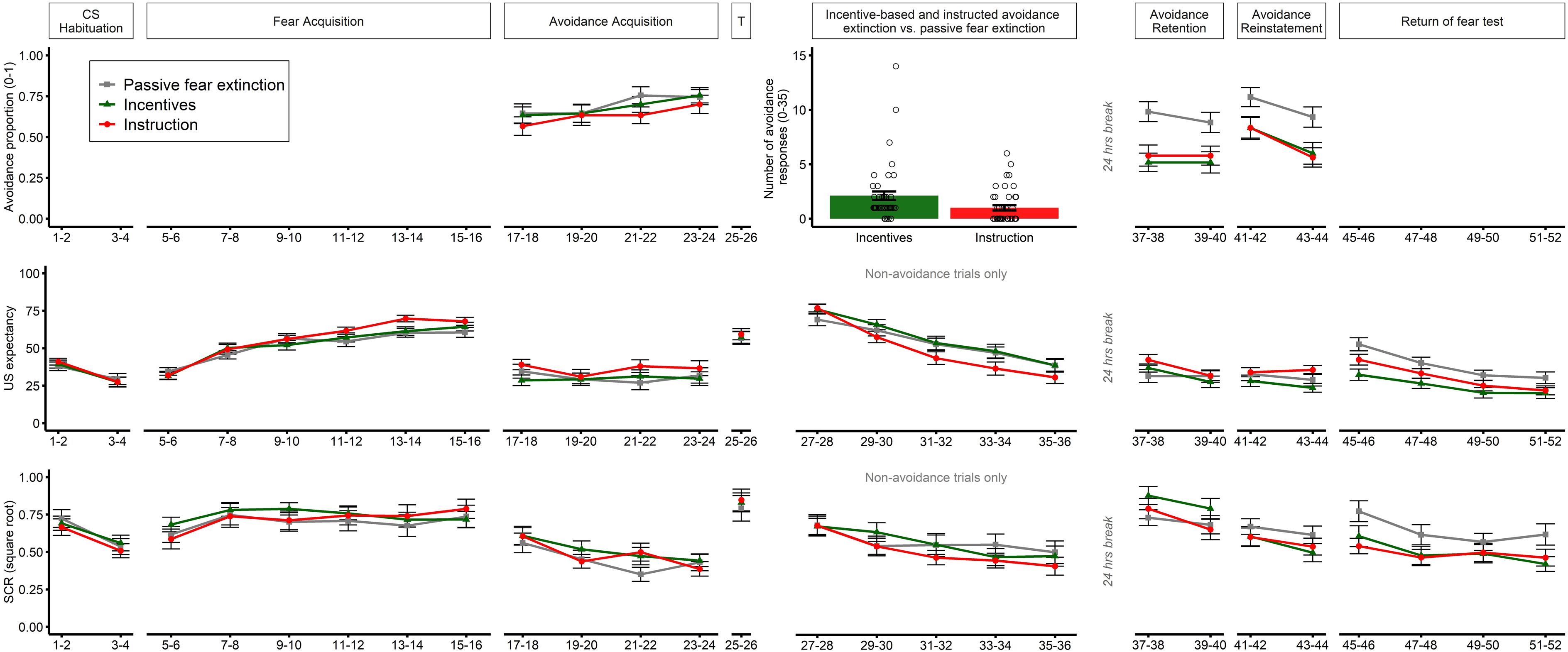
Fear and Avoidance Acquisition (Day 1)
All groups acquired conditioned fear and US-avoidance without any group differences (see Figure 1). 1 During test, there were no group differences in US expectancy or SCRs, US expectancy: F (2, 132) = 0.11, p = .895, η 2 = 0.002, BF01 = 12.66; SCRs: F (2, 120) = 0.15, p = .862, η 2 = 0.002, BF01 = 11.46. Thus, differences in the subsequent phases could not be explained by differences in initial fear and avoidance acquisition.
Incentive-Based versus Instructed Avoidance Extinction versus Passive Fear Extinction (Day 1)
For avoidance, the absolute number of avoidance responses was significantly higher in the Incentive (M = 2.11, SD = 2.63) compared to the Instruction group (M = 1.00, SD = 1.56), U = 1330.5, p < .001, r = .41, BF10 = 14.66, presumably because participants in the Incentive group had to learn reward contingencies by trial and error. However, all participants in the Incentive and Instruction group performed ten non-avoidance responses during the phase.
For these ten non-avoidance trials, US expectancy and SCRs were compared with the 10 passive extinction trials of the Passive Fear Extinction group. US expectancy and SCRs decreased across trials without group differences, main effect Trials: Fs > 16.58, ps < .001, ηs 2 > 0.035, BFs10 > 1000, other main or interaction effects, Fs < 1.96, ps > .097, ηs 2 < 0.009, BFs01 > 3.48. Thus, all groups showed successful and comparable fear extinction in trials without avoidance.
Avoidance Retention Test (Day 2)
Importantly, the proportion of avoidance responses were less frequent in the Incentive (M = 0.34, CI95 = 0.23–0.45) and Instruction group (M = 0.39, CI95 = 0.27–0.49) compared to the Passive Fear Extinction group (M = 0.62, CI95 = 0.51–0.74; see Figure 1), main effect Group: F (2, 132) = 6.71, p = .002, η 2 = 0.083, BF10 = 22.92; Incentive versus Passive Fear Extinction: t = 3.40, Bonferroni–Holm corrected p = .003, d = 0.68; Instruction versus Passive Fear Extinction: t = 2.87, Bonferroni–Holm corrected p = .010, d = 0.57. The Incentive and Instruction group did not differ, t = 0.51, Bonferroni–Holm corrected p = .611, d = 0.10. No other main or interaction effects were significant, Fs < 0.89, ps > .349, ηs 2 < 0.001, BFs01 > 5.53. Thus, retention of avoidance was higher after passive fear extinction compared to incentive-based and instructed extinction of avoidance.
US expectancy and SCRs decreased across trials without group differences, main effect Trials: Fs > 10.29, ps < .003, ηs 2 > 0.018, BFs10 > 12.94, other main or interaction effects, Fs < 2.57, ps > .080, ηs 2 < 0.009, BFs01 > 1.35. These results are, however, influenced by the different level of avoidance responses between the groups and are thus merely reported for the sake of completeness.
Avoidance Reinstatement Test (Day 2)
After reinstatement, the proportion of avoidance increased in all groups (Trials 39–40 to 41–42), which did not differ between groups, main effect Trials: F (1, 132) = 31.04, p < .001, η 2 = 0.042, BF10 > 1000; interaction Group × Trials: F (2, 132) = 0.27, p = .765, η 2 < 0.001, BF01 = 11.44.
During avoidance reinstatement test, the proportion of avoidance responses were again less frequent in the Incentive (M = 0.47, CI95 = 0.36–0.58) and Instruction group (M = 0.47, CI95 = 0.35–0.58) compared to the Passive Fear Extinction group (M = 0.69, CI95 = 0.57–0.80), main effect Group: F (2, 132) = 4.45, p = .014, η 2 = 0.052, BF10 = 4.10; Incentive versus Passive Fear Extinction: t = 2.51, Bonferroni–Holm corrected p = .028, d = 0.49; Instruction versus Passive Fear Extinction: t = 2.64, Bonferroni–Holm corrected p = .028, d = 0.51. The Incentive and Instruction group did not differ, t = 0.14, Bonferroni–Holm corrected p = .886, d = 0.03. In addition, avoidance decreased across trials (Trials 41–44), which did not differ between groups, main effect Trials: F (1, 132) = 27.40, p < .001, η 2 = 0.031, BF10 > 1000; interaction Group and Trials: F (2, 132) = 4.45, p = .014, η 2 = 0.052, BF01 = 10.00. Thus, all groups showed increased avoidance after reinstatement and avoidance continued to remain higher in the Passive Fear Extinction compared to the two other groups.
For US expectancy, no significant main or interaction effects were found, Fs < 2.03, ps > .136, ηs 2 < 0.023, BFs01 > 2.03. SCRs decreased across trials without group differences, main effect Trials: F (1, 120) = 5.75, p = .018, η 2 = 0.010, BF10 = 2.01; main effect Group: F (2, 120) = 0.88, p = .417, η 2 = 0.011, BF01 = 4.22; interaction: F (2, 120) = 0.27, p = .766, η 2 < 0.001, BF01 = 10.48.
Return of Fear Test (Day 2)
For US expectancy, the increase from the last trials of the reinstatement test (Trials 43–44) to the first trials of the return of fear test (Trials 45–46) differed between groups, interaction Group and Trials: F (2, 132) = 5.27, p = .006, η 2 = 0.021, BF10 = 5.84. The Passive Fear Extinction group showed the largest increase (Trials 43–44: M = 28.87, SD = 27.80; Trials 45–46: M = 52.60, SD = 29.20), the Instruction group a smaller but significant increase (Trials 43–44: M = 35.49, SD = 19.62; Trials 45–46: M = 42.28, SD = 23.86), and the Incentive group no significant increase (Trials 43–44: M = 23.54, SD = 19.93; Trials 45–46: M = 32.29, SD = 25.54), post-hoc Wilcoxon test for the Passive Fear Extinction group: W = 122.5, z = 3.86, p < .001, r = .70, BF01 = 224.16; Instruction: W = 232.5, z = 2.57, p = .010, r = .46, BF10 = 3.05; Incentive: W = 331.0, z = 1.29, p = .199, r = .23, BF01 = 1.83. Comparison to the levels of US expectancy at the end of the first day yielded the same results (i.e., the last trials without avoidance responses of Phase 5): The Passive Fear Extinction group showed the largest increase (Trials 35–36: M = 36.54, SD = 25.81), the Instruction group a smaller but significant increase (Trials 35–36: M = 29.67, SD = 26.18), and the Incentive group no significant increase (Trials 35–36: M = 36.64, SD = 28.94), interaction Group and Trials: F (2, 132) = 5.35, p = .006, η 2 = 0.027, BF10 = 6.38; post-hoc Wilcoxon test for the Passive Fear Extinction group: W = 182.5, z = 3.06, p = .002, r = .56, BF01 = 10.72; Instruction: W = 253.0, z = 2.48, p = .013, r = .44, BF10 = 4.86; Incentive: W = 519.5, z = 0.85, p = .399, r = .15, BF01 = 4.00.
During the whole phase, US expectancy significantly decreased across trials, F (2.07, 271.25) = 46.98, p < .001, η 2 = 0.079, BF10 > 1000. Importantly, US expectancy was lower in the Incentive group compared to the Passive Fear Extinction group, while there were no other significant group differences, main effect Group: F (2, 132) = 5.00, p = .008, η 2 = 0.049, BF10 = 5.46; Incentive versus Passive Fear Extinction: t = 3.15, Bonferroni–Holm corrected p = .006, d = 0.57, Instruction versus Passive Fear Extinction: t = 1.82, Bonferroni–Holm corrected p = .141, d = 0.33; Incentive versus Instruction: t = 1.31, Bonferroni–Holm corrected p = .194, d = 0.24. There was no significant interaction effect, F (4.14, 271.25) = 1.28, p = .279, η 2 = 0.004, BF01 = 18.11.
SCRs increased from the last trials of the reinstatement test to the first trials of the return of fear test, main effect Trials: F (1, 120) = 10.53, p = .002, η 2 = 0.013, BF10 = 15.45. The interaction of Group and Trials missed significance, F (2, 120) = 2.64, p = .076, η 2 = 0.006, BF01 = 1.34. Comparison to the levels of SCRs at the end of the first day yielded the same results, main effect Trials: F (1, 120) = 20.66, p < .001, η 2 = 0.054, BF10 > 1000; non-significant interaction of Group and Trials: F (2, 120) = 2.03, p = .136, η 2 = 0.011, BF01 = 2.28. During the whole phase, SCRs significantly decreased across trials, F (2.74, 325.46) = 11.40, p < .001, η 2 = 0.022, BF10 > 1000. There was a significant but less robust main effect of group, without significant group differences in corrected post-hoc tests, Group: F (2, 120) = 3.16, p = .046, η 2 = 0.038, BF10 = 1.45; post-hoc tests: ts < 2.20, ps > .09, ds = 0.43. There was no significant interaction effect, F (5.47,325.46) = 1.11, p = .356, η 2 = 0.004, BF01 = 23.77.
Combined, these findings provide evidence that return of threat expectancy was pronounced in the Passive Extinction compared to the Incentive group. The instruction group showed no clear differences from either of the other groups.
Discussion
The reduction of dysfunctional avoidance and safety behaviors is a key target during exposure-based CBT. Past research aiming to boost long-term reduction of avoidance behavior by optimizing fear extinction learning showed limited success. Building on previous studies showing short-term avoidance reduction by means of incentives and instruction (Pittig, 2019; Pittig & Wong, 2021), the present study compared the long-term impact of these avoidance extinction strategies to passive fear extinction. In the short term, incentive-based and instructed avoidance extinction strongly reduced avoidance and resulted in similar levels of fear reduction compared to passive fear extinction. Most importantly, a key finding of the current study is that long-term retention of avoidance was lower after incentive-based and instructed avoidance extinction compared to passive fear extinction. While reinstatement of avoidance was evident in all groups, absolute levels of avoidance remained lower after incentive-based and instructed avoidance extinction compared to passive fear extinction. Interestingly, incentive-based extinction of avoidance was linked to a lower return of threat expectancies compared to passive fear extinction, while results for instructions were less robust. Overall, directly targeting avoidance by means of incentives or instruction for non-avoidance compared to targeting fear better reduced long-term avoidance and, for incentive-based avoidance extinction, even threat expectancies.
Replicating our previous studies (Pittig, 2019; Pittig & Wong, 2021), incentive-based and instructed avoidance extinction caused strong reduction of avoidance responding in the short term (see Phase 5). Avoidance responses were more frequent during incentive-based extinction of avoidance, presumably because response-reward contingencies had to be learned by trial and error. Nevertheless, all participants met the criteria of ten non-avoidance responses after which the CS+ was not followed by a US anymore, that is, the same amount of extinction trials compared to passive fear extinction. Despite occasional avoidance responses associated with incentive-based and instructed avoidance extinction, no differences in the reduction of conditioned fear were evident at the end of the first day (during Phase 5). These findings highlight that incentive-based and instructed avoidance extinction initiate comparable levels of fear extinction learning than passive fear extinction. They also highlight that any differences in long-term fear and avoidance responding are not caused by different degrees of initial fear extinction learning.
In this regard, the first major finding showed that long-term retention of avoidance was lower after incentive-based and instructed avoidance extinction compared to passive fear extinction. After passive fear extinction, the level of long-term avoidance retention returned to the high level of avoidance at the end of avoidance acquisition. These findings support that not only short-term (e.g., Vervliet & Indekeu, 2015; Zuj et al., 2020) but also long-term low-cost avoidance is resistant to fear extinction. In contrast, incentive-based and instructed avoidance extinction resulted in lower levels of avoidance retention, with no significant differences between both instrumental strategies. Directly targeting avoidance responses via instrumental extinction strategies thus better reduced long-term avoidance retention.
The second major result concerns the reinstatement of avoidance. Following well-established procedures for the reinstatement of conditioned fear (Haaker et al., 2014; Lonsdorf et al., 2017), we found a significant reinstatement of avoidance responses in all groups. This finding of avoidance reinstatement in a multiple day design expands recent findings of short-term avoidance reinstatement in humans (e.g., Krypotos & Engelhard, 2019). Most importantly, levels of avoidance following reinstatement remained lower after incentive-based and instructed avoidance extinction compared to passive fear extinction, again, with no significant differences between both instrumental strategies. The benefits of directly targeting avoidance responses via instrumental extinction strategies thus persisted after individuals re-experienced an aversive outcome. Combined, these findings highlight that directly targeting avoidance instead of conditioned fear better reduces long-term avoidance, even after re-experiencing aversive or stressful events.
Theoretically, the group differences in retention and reinstatement of avoidance can be explained by different learning experiences. One explanation may be the differences in contextual change between groups. For the Passive Fear Extinction Group, avoidance was unavailable during fear extinction on the first day, but available during avoidance retention and reinstatement on the second day. This constituted a contextual change and thus renewed the avoidance rate (e.g., Gatzounis & Meulders, 2020; Hendrikx et al., 2021; Vervliet & Indekeu, 2015; Zuj et al., 2020). In contrast, avoidance was available in all the aforementioned phases in the Incentive and Instruction groups, that is, there was no contextual change. Another explanation may be that, non-avoidance responses may have gained predictive value themselves (i.e., a response-outcome association). When avoidance was available in our study, non-avoidance was also an active response (i.e., behavioral response via mouse click), which differs from passive non-avoidance. During avoidance acquisition, participants in all groups could learn that avoidance predicted no US, whereas non-avoidance predicted a certain US. This may have formed a distinct association between non-avoidance responses and the US. This association was not changed by passive fear extinction, because it requires learning that active non-avoidance, which was not available during passive fear extinction, is no longer followed by an aversive outcome. This learning experience was only available in the Incentive and Instruction group, which, in the long term, may have strengthened non-avoidance responding. However, we only assessed threat expectancy for the CS-US association, which, during the critical phase on the first day (Phase 5), were influenced by whether or not participants performed an avoidance or non-avoidance response. Thus, these threat expectancies reflect both the CS-US association and the response-US association. Future research should thus directly assess associations between non-avoidance and aversive outcomes. Another explanation for the group differences in avoidance retention is the reinforcement of active non-avoidance via relief learning. Empirical studies have shown US omission due to avoidance results in pleasant prediction error, namely relief, which positively reinforces avoidance (Papalini et al., 2021; San Martín et al., 2020; Vervliet et al., 2017). In the current study, executing active non-avoidance during incentive-based or instructed avoidance extinction may have led to relief, given that this behavioral approach was not followed by an US. Subsequently, behavioral approach to the CS+ may have been positively reinforced by relief, resulting in a reduction in avoidance retention. However, this alternative explanation is in speculation given that we did not assess relief. Future research may thus examine relief responses and action-outcome expectancies associated with incentive-based and instructed avoidance extinction.
Interestingly, there were also some differences in the return of conditioned fear. When avoidance became unavailable at the end of the second day (i.e., during the return of fear test), threat expectancy most strongly increased in the Passive Fear Extinction group and to a smaller degree in the Instruction group. No significant increase was found in the Incentive group. Moreover, threat expectancies were lower in the Incentive compared to the Passive Fear Extinction group across the whole phase. This findings hint at a beneficial effect of incentive-based avoidance extinction regarding long-term fear reduction. These findings are also noteworthy as they highlight the crucial role of avoidance for long-term fear reduction. Groups did not differ in the reduction of conditioned fear responses at the end the first day (i.e., during Phase 5), ruling out that differences in return of fear are linked to differences in initial fear extinction. More importantly, individuals in the Passive Fear Extinction group, but not in the Incentive group, already experienced that the feared stimulus was not followed by an aversive outcome when avoidance was not available (during Phase 5). Yet, the former showed higher threat expectancies when avoidance became unavailable on the second day, that is, despite experiencing the same contingencies as previously on the first day. The findings support a bidirectional relationship between conditioned fear and avoidance, more specifically, the notion that avoidance can preserve or increase fear responding (see Pittig et al., 2020). Thus, the long-term reduction of avoidance is crucial for the long-term reduction of fear.
However, the effects on long-term conditioned fear need to be interpreted with some caution and limitations of the present study should be considered in future research. Result on long-term conditioned fear differences were promising regarding threat expectancy in incentive-based avoidance extinction, but less robust for instructed extinction and SCRs. Bayesian analyses showed that sample size was not sufficient for robust evaluation of these smaller effects (e.g., due to higher variability in SCRs). Nevertheless, descriptive results point in the same direction of higher fear responses in the Passive Fear Extinction group. Future research should thus replicate and extend the present findings. In addition, as the primary aim was testing the retention of avoidance, we did not test the retention of conditioned fear in absence of avoidance. Future research may test whether instrumental versus fear extinction may result in different levels of fear retention.
Despite some limitations, our findings offer clinical implications and future directions. First, our results emphasize the role of monitoring long-term avoidance reduction. Clinically, a return of avoidance seems critical as it can trigger a return of fear, re-inducing a vicious circle of fear and avoidance. Our results show that a return of avoidance can best be reduced by instrumental extinction strategies. Instructed extinction of avoidance can be seen as a proxy for deducing the exposure rationale (i.e., confrontation with feared situations without avoidance or safety behavior). While an exposure rationale is already common practice in exposure-based CBT (Arch et al., 2015; Craske et al., 2022; Neudeck & Wittchen, 2012; Pittig, Heinig, et al., 2021), our laboratory model may help to optimize understanding its mechanisms and moderators. Understanding these mechanisms and moderators may help to inform for whom and under which conditions the exposure rationale works best to reduce avoidance (e.g., adapting the way of delivering the rationale for different patients). In addition, highlighting incentives for approaching feared situations is less often incorporated in traditional exposure, but incentive-based extinction of avoidance was the most beneficial strategy in this study. Clinical research may examine the impact of incentives during exposure-based CBT, e.g., adding positive outcomes following an exposure exercise (e.g., traveling to a desired location by exposing oneself to public transportation). Finally, although long-term avoidance responses were lower following incentive-based and instructed extinction, they were not absent. Future research may thus examine which interventions during exposure (i.e., procedural interventions) as well as before or after exposure (i.e., flanking interventions) can optimize the long-term reduction of avoidance by instrumental extinction strategies (Pittig, Wong, et al., 2020).
In conclusion, the present study replicated a strong reduction of avoidance by incentives and instruction in the short term with similar levels of fear reduction compared to passive fear extinction. More importantly, both avoidance extinction strategies yielded lower retention and reinstatement of avoidance in the long term. When avoidance subsequently became unavailable, incentive-based extinction was linked to a lower return of threat expectancies. Directly targeting avoidance instead of fear therefore better reduced long-term avoidance and, for incentives, the return of threat expectancy. Future research should address the specific mechanisms underlying the stronger reduction of avoidance (e.g., contextual change, unlearning of the association between non-avoidance and aversive outcome, and relief), which may be promising to boost the delivery of exposure therapy.
Footnotes
Acknowledgments
The author would like to thank Julian Koch and Naja Kärcher for their help with data collection.
Author contributions
Andre Pittig: conceptualization; data curation; formal analysis; funding acquisition; methodology; software; project administration; resources; supervision; visualization; and writing—original draft, review and editing.
Alex H. K. Wong: conceptualization; methodology; and writing—Review and editing.
Declaration of conflicting interests
The author(s) disclosed receipt of the following financial support for the research, authorship, and/or publication of this article: The author(s) declared no potential conflicts of interest with respect to the research, authorship, and/or publication of this article.
Funding
This work was funded by the Deutsche Forschungsgemeinschaft (DFG; German Research Foundation) grant PI1269/2-1-389569971 to AP.
