



Abstract
Frequencies is an artistic initiative developed by Turner Prize-winning artist Oscar Murillo, as an enterprise which opens connections between children and young people geographically thousands of miles apart. The Frequencies initiative has involved the Murillo Studio Team laying empty canvases across desks and tables, in hundreds of schools, across over 30 countries and five continents. Children and young people, ages 10–16 years, are invited to freely mark the empty canvases. In this article, I discuss a research project that examined a sample of marks made by children and young people on the Frequencies canvases. I identify abstract (non-figurative nor textual) marks created by children and young people, across various cultural and geographical spaces. Through the article, I apply a semiotic approach, drawing on indigenous and philosophical ideas that posit human and more-than-human worlds as deeply interconnected – suggesting these abstract marks as a manifestation of our deep connectedness. I highlight the forms and potential functions of abstract marks produced by children and young people, as a system of signs that may tune into the deeper aspects of self, potentially shared beyond social identities, cultures, spaces and histories. Paying attention to the abstract, and potentially, universal mark making of children and young people may support wider understandings about how self and subjectivity is expressed through free creativity.
Introduction
Mark making is an artistic process that can have various functions for children and young people. For very young children, mark making can support their emergent thoughts and understandings of the world (Brierley, 2018; Kress, 2012; Papandreou, 2014). The universal forms of marks made by children, such as spirals, geometrical patterns, scribbles and dots (Dunst and Gorman, 2009; Matthews, 2003), are less understood (Thomas, 2024). Mark making also happens in the literacy practices of young people – and can be a discourse of resistance, challenging the unspoken, institutional framings and normative practices of the dominant system (Rowe and Hutton, 2012). An example is graffiti, a hybrid of marks and text that is viewed as subversive, or understood as political and aesthetic. Similarities between contemporary graffiti practices and prehistoric rock art have been identified (Frederick, 2009). When ‘discussing visual art as an active and integrated materiality in social relations, the two forms of visual expression may actually be mutually informative’ (Fahlander, 2019: 32).
Marks can be intuitive, unspoken and non-formalised, and can be considered in terms of their visual expression, how marks relate to their available space and how new additions are adjusted to older ones (Fahlander, 2019). Mark making from various ancient traditions, performed one’s presence in the world through trace, similar with the graffiti practices of urbanised young people (Frederick, 2009). From this wider perspective, mark making is a mode of material signification and creative thinking with lasting implications for human becoming (Malafouris, 2021). Making marks and bringing one’s sense of self into the moment has been practised across various cultures, geographies, time and space – where certain marks may hint at a shared I-am-ness with human and more-than-human worlds, and out-of-this world dimensions of experience (Thomas, 2024).
For young people, graffiti can create a site of belonging and contested citizenship (Halsey and Young, 2002). Graffiti, when seen as an expressive resource for young people, in the negotiation of power and agency (Campos, 2015), can for example, inform the development of sanctioned spaces, such as alternative arts based programmes (Halsey and Young, 2002). Graffiti does not only emerge in public urban spaces. Schools can also be an unsanctioned site, with graffiti seen in restrooms, benches, walls, armchairs and fences (Bangayan-Manera, 2019). Graffiti on school desks inspired a long-term initiative by Turner-Prize winning artist, Oscar Murrillo, known as ‘Frequencies’. A visit to the artists old high school highlighted the densely graffitied wooden desks, sparking memories for Murrillo of his youth. As an adolescent from Brazil who emigrated to the UK, the graffitied desks signified Murrillo’s earlier desires to break free from the normative environment of education, through the release found in mark making (Zwirner, 2024).
In 2013, Murrillo brought his vision to life through the Frequencies Initiative. Starting in Columbia, blank canvases were laid on the desks of schools, and children and young people ages 10–16 years, were invited to freely mark them. Since 2013, the Frequencies initiative has expanded to include 350 schools, in over 30 countries, producing over 40,000 canvases – that demonstrate a wealth of mark making by children and young people across various cultural and geographical spaces. As an artist, Murrillo is inspired by the notion of connectedness and community, stemming from his cross-cultural ties to diverse cities and places (Zwirner, 2024). Frequencies as an initiative celebrates youth perspectives, and as an enterprise, opens connections between children and young people geographically thousands of miles apart. Murillo sees Frequencies as a recording device, capturing the mark making of children and young people that conveys the conscious and unconscious energy of young minds at their most absorbent, optimistic and conflicted.
In this article, I discuss a research project that examined a sample of marks made by children and young people on the Frequencies canvases. I identify abstract (non-figurative nor textual) marks created by children and young people ages 10–16 years, across various cultural and geographical spaces. I highlight the similarities between these marks, and marks made by (a) children and young people in consciousness research (see ‘Research Context’); and (b) marks identified across various cultures, geographies and time. Through the article, I apply a semiotic approach, drawing on indigenous and philosophical ideas that posit human and more-than-human worlds as deeply interconnected – suggesting these abstract marks as a manifestation of our deep connectedness. I highlight the forms and potential functions of abstract marks produced by children and young people, as a system of signs that may tune into the deeper aspects of self, potentially shared beyond social identities, cultures, spaces and histories (Thomas and Durston, 2025). Paying attention to the abstract, and potentially, universal mark making of children and young people may support wider understandings about how self and subjectivity is expressed through free creativity.
Research context
In 2021, I was one of several researchers and artists (from various disciplines and institutions), commissioned to work with the Frequencies canvases. Commissioned researchers and artists were also given a blank canvas from which we would interpret, analyse and write about the marks made by children and young people. Researchers and artists were invited to examine the canvases both in person and through an electronic database. On first analysis of the canvases, I was intrigued by the abstract marks made by children and young people, that resembled marks made by children and young people in my own research studies (see Thomas, 2021, 2022, 2023, 2024). In my own research practices, I explore the nature of consciousness and extra sensory experiences with children, through qualitative and creative research methodologies – focusing on important aspects of consciousness, such as self and subjectivity (Thomas, 2022, 2023, 2024; Thomas & Durston, 2025).
Children and young people drawing consciousness involves spirals, geometrical patterns, mandalas and other abstract marks that convey the deeper aspects of their selves and experiences (Thomas, 2024). Self and consciousness are slippery terms, contentious words that can have different meanings depending on the discipline or perspective one takes (Velmans, 2009) – and are viewed as one of the most enigmatic problems in fields such as philosophy or neuroscience (Durston and Baggerman, 2017). The last few decades have seen an overclaiming of self, consciousness and the human condition through westernised, biologised and reductionist lenses, especially in the field of child development (Macvarish et al., 2014). Involving children in research that investigates the nature of self and consciousness challenges reductionist, and typically modern westernised claims, to the nature and development of children.
Studies with children and young people explore self and consciousness from a position of mystery, from the not-really-knowing position, offering affordances for children and young peoples’ experiences and insights to define their meanings (Thomas and O’Riordan, 2025). Children and young people explore the contents of their own selves and conscious experiences (thoughts, feelings, sensations), and their experiences that can go beyond the typical five sense sensorium (Thomas, 2023, 2024). These experiences are extra sensory (hearing sounds and voices others cannot hear, exceptional dreams, etc. – see Thomas, 2021, 2022, 2023). They are experiences accepted as the norm in some cultural contexts (Adams et al., 2022; Tobert, 2023) or can be viewed as psychotic-like in western contexts (Remberk, 2017). For children and young people, they can carry a subjective reality and meanings that can, at times, aide their wellbeing (Thomas, 2021). Extra sensory experiences can defy the limitations of language and the linguistic capacities of both children and adults, positioning creative actions such as art, play or drawing as necessary processes for representing their extra sensory experiences (Thomas, 2023, 2024).
What these experiences can signify are the subterranean dimensions of human experience and their potential connections with more-than-human and out-of-this-world phenomena (Thomas, 2024 – see figures 11, 18, 19). While marks made on the Frequencies canvases by children and young people carry similarities with abstract marks made by children and young people in consciousness research, it is challenging to interpret them without the marks producers (the children and young people who engaged with the Frequencies canvases). In consciousness research, children and young people claim their abstract marks represent dimensions of their ‘out of this world’ experiences (aged 10 years – see Thomas, 2024) – or their ‘truer self’ that is connected and unified with all (aged 16 years – see Thomas, 2022). Marks can represent transitional states, such as spirals that children report moving through in times of crisis or when near death (see Thomas, 2022; Thomas and O’Connor, 2024). The connections that can be made between abstract marks produced by children and young people in consciousness research, with those on the Frequencies canvases, is in the acts of mark making through free creativity.
Abstract mark making in both instances may also be an act of resistance. For children and young people in consciousness research, their experiences and images challenge dominant western, materialist worldviews (Thomas, 2023). While children and young people in the Frequencies process may be resisting educational norms, similar with young people who mark walls in urban spaces (Frederick, 2009). Through abstract mark making in free creativity, subterranean dimensions of experience or self, may emerge through statements of I-am-here-now (Thomas, 2024). Without opportunities to co-interpret the Frequencies marks with their producers, I turned to the marks made by children and young people in consciousness research (Thomas, 2022, 2023, 2024). I also considered similar marks (in terms of their forms) made across millennia by peoples and their cultures. It’s important to note how social contexts, environments, relations and influences can shape how children and young people make marks (Kress, 2012). In the case of marks made on the Frequencies canvases, children and young people were in classroom spaces with peers, engaging in individual and collective mark making. We are unaware how much creative freedom was afforded to children and young people in some contexts. For children and young people in consciousness research, their marks are made in response to research questions about their selves and experiences, with interviews conducted in homes, schools, hospitals and community spaces (Thomas, 2021, 2022, 2023; Thomas & O’Connor, 2024). For the purposes of this article, the focus stays with the abstract marks themselves, as ‘a whole coherent unto itself, like a spider-web held by its own connotations and suspended in virtual isolation from its surroundings apart from minimal strategic anchor points’ (Jones, 2003: 652). Reading marks, or signs, against other systems of signs is a semiotic orientation. Semiotics, as the study of signs, examines anything that can be taken as a sign, providing that someone, or a group of people who are part of the same culture interprets it as signifying something (Aiello, 2006).
Semiotics and children and young people’s abstract marks
The field of semiotics is extensive and interdisciplinary, and is concerned with studying signs and meanings, typically within areas of social life (Eco, 2020). Analyses can focus on how signs function in relation to other systems, such as language and objects (Daylight, 2017). For example, the red traffic light that signifies the action to stop (in most countries) or how smoke signifies the object of fire. Semiotics has been used to analyse children’s drawings (Kabuto, 2009; Soundy, 2015), graffiti (Amjad, 2025) and children’s visual observations of archaeological sites (Diamantopoulou and Christidou, 2018). Most semiotic interpretations of children and young people’s art apply social semiotics, importantly focusing on how meanings of signs are constituted within social relations, practices and actions (Berger, 2011; Kress, 2012; Soundy, 2015). Children’s drawings, for example, are considered in terms of multimodality that considers the sign’s meanings in relation to social contexts and interactions (Diamantopoulou and Christidou, 2018; Soundy, 2015). This is valuable when interpreting children’s relations with aspects of their social lives but may miss deeper significations and meanings of the human and more-than-human and out-of-this-world experience (Thomas, 2024). Children and young people, through their abstract marks, may signify dimensions of self and experience that go beyond social actions and worlds, needing wider semiotic frameworks to be interpreted and understood (Thomas, 2024).
Semiotic interpretations are also applied to the natural and more-than-human worlds, which examine the semantic value of micro-organisms, to the macro universe (Favareau, 2010; Hendlin, 2020; Nöth, 2001). Fields such as Biosemiotics challenges semiotic structuralism, based on anthropocentric and logocentric foundations (Nöth, 2001). The demarcation of the social and natural worlds has rendered human semiosis as ‘caught in a web of ratcheting symbolic meanings [where] the widening disjunct between models and reality have perpetrated various violences, from the colonial structures of capitalism to the one-size-fits-all of communism’ (Hendlin, 2020: 51). The natural world has become a socio-cultural product that humans are distinct from, missing symbolic and meaning potentialities beyond the social world that interplay with humans. Various non-western belief systems view people as themselves, nature and the cosmos, all part of an extended ecological family (Salmón, 2000). Indigenous (non-western and western) epistemological models about the nature of reality, and human/more-than-human worlds, can posit similar ontological theories. In ancient Europe, people considered themselves as conscious probes of a divine entity-at-large, deeply connected to the land, the elements and the cosmos (Thomas, 2023). For the Diné peoples, their perspective begins with idea (that typically emerges through experience), that everything in the Cosmos is connected, and all minds and bodies are expressions of a deeper spiritual essence (Zimmerman, 2004). Expanding semiotic meanings into the natural world holds relevance for children and their non-languaged explorations, interactions and relations with nature (McVittie, 2018).
While indigenous ideas of the world have been dismissed through rationality and science, the attributes for ascription of supernatural powers to some parts of nature has significantly helped to conserve the natural world (Aniah et al., 2014). Whether through philosophy, science or indigenous belief systems, understanding the interconnectedness of all things has implications for restricting semiosis to the social world of humans. Wider philosophical understandings of the world can imbue reality as consciousness itself and semantic in process, rather than a physical world composed of dead inert matter (see Kastrup, 2018). Meaning is signified through the natural patterns, orders or habits in nature that are archetypal – as natures mental templates, that extend into the world as mental and continuous with our minds (Kastrup, 2017, 2018). Representations of nature may carry significance for how we consider the nature of self or beingness, as an archetypal experience of the universe itself (Tarasti, 2012). The idea of an evolving, self-generative universe with immanent creativity (Pickering, 2016), with which our very beingness may be contingent upon, suggests the relationality between human and more-than-human semiosis. Processes of free creativity (whether free mark making, younger children learning to draw or children and young people drawing consciousness) may be a tuning into the frequencies of other systems of experience, meanings and semiosis. Moving the dial beyond social constructionism can support better understandings about the deeper semiotic connections between human, more-than-human and the out-of-this-world dimensions of experience and meaning.
Applied semiotics can be situated within these wider philosophical frameworks. Peirce (1931–1958) proposed all the universe as perfused with signs, if not composed exclusively of signs (Santaella et al., 2022). Peirce’s triune approach towards the analysis of signs, considers the combination of representations, objects and interpretations, where a sign is something that stands in a structured relation with two other things (Afisi, 2020). The sign, object and interpreter, for Peirce, are the three basic elements of semiosis (signs and meanings). Piercian semiotics involves a three-part classification system to support the analysis of signs, including index, icon and symbol, that can have shared cultural understandings (Bradley, 2009). Icon is a sign that looks like the object that it stands for. Index signifies the relationship between itself and the object it stands for. An example might be a footprint that signifies the human body, or the smoke that indicates the fire (as in the earlier example). As for symbol, it indicates symbolic meanings of the sign, based on interpretation, and at times, consensus. Using Peirce’s triadic classification system has been valuable for interpreting the abstract marks identified on the Frequencies canvases (in terms of icon, index and symbol) in tandem with reading the marks against similar systems of signs produced by other children and young people, and those produced through ancient cultural systems.
Methodology
The canvases were examined physically and through an online database where photographs of the canvases are stored (Figures 1 and 2).
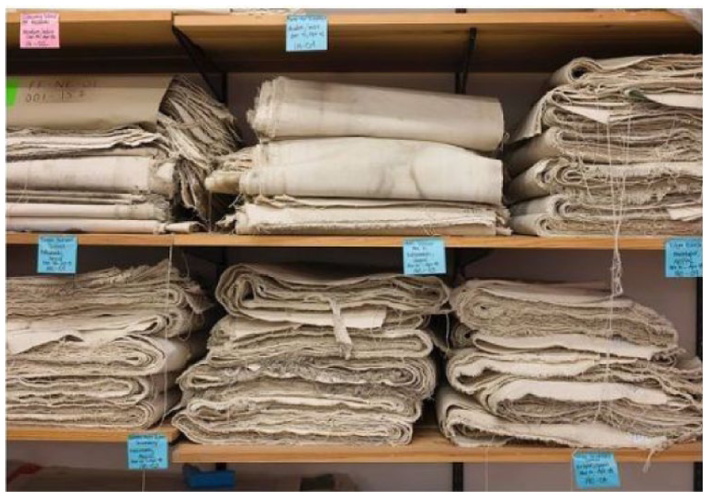
Storage of the canvases.
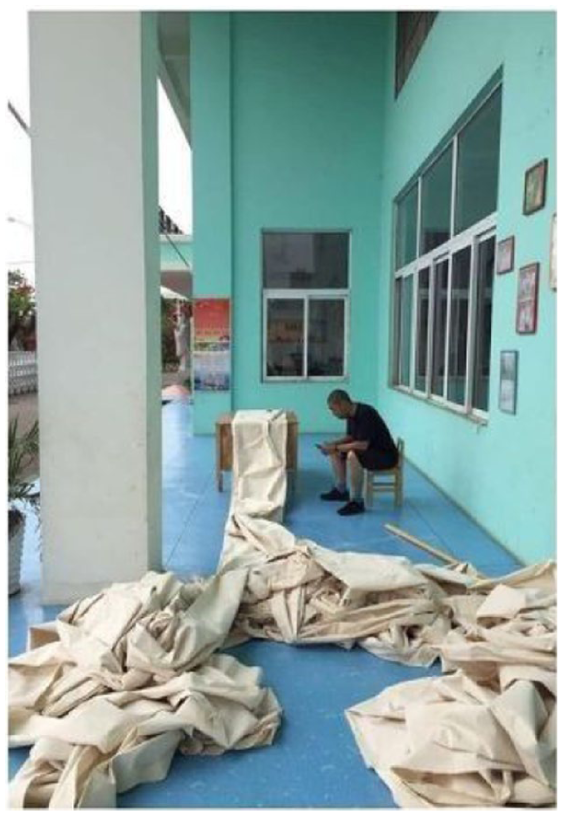
Setting up the canvases.
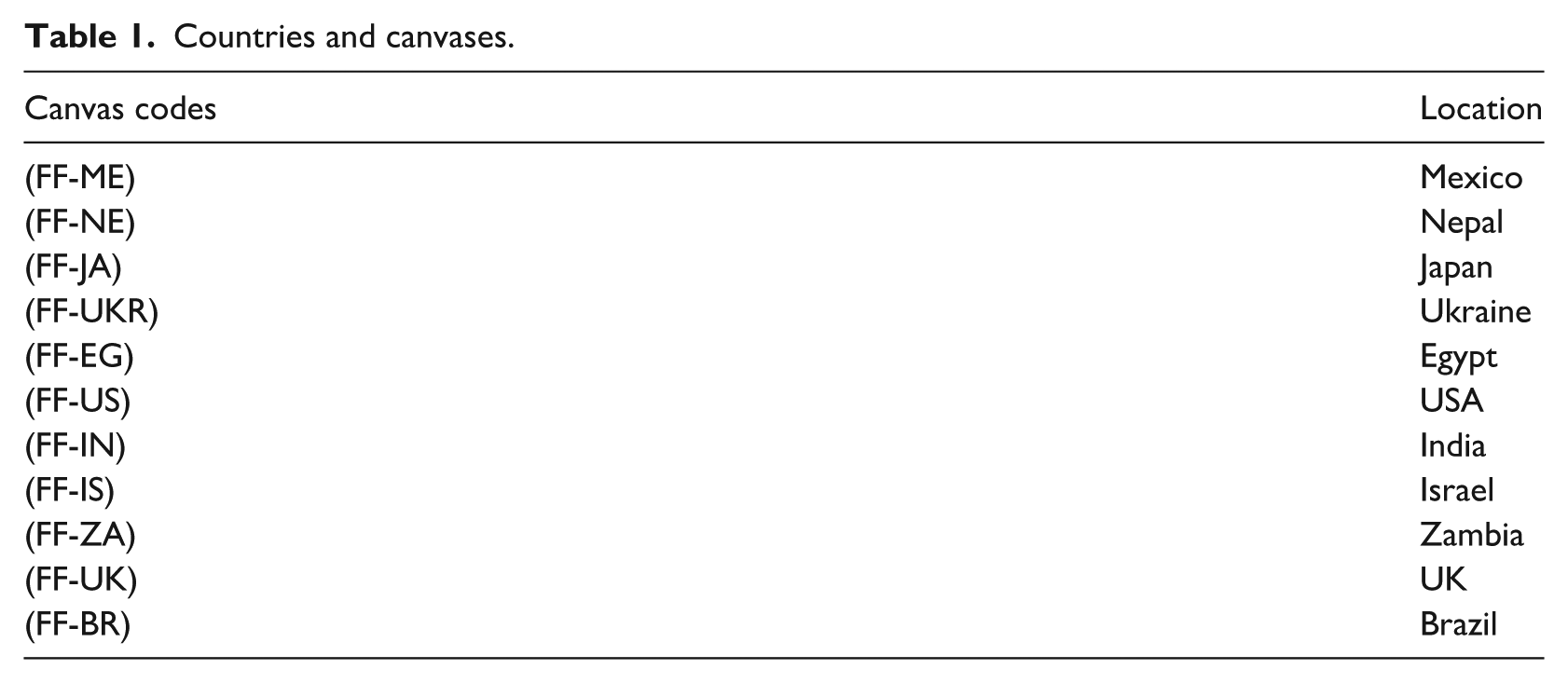
Due to the extensive number of canvases (over 40,000 from 30 countries to date), I selected a sample of canvases from various countries that demonstrated abstract mark making. The criteria for selecting canvases included (a) canvases that displayed non-figurative and textual marks, referred to as abstract marks; (b) a representative range of counties from the selected Frequencies canvases (Table 1).
Countries and canvases.
Analysis of abstract marks
After visiting the canvases in their storage space, I examined canvases using the online database. Using the selected sample of countries, I examined canvases from each country, selecting those that displayed abstract marks (abstract is defined as marks that are non-textual, figurative nor signify specific cultural-political-geo localities). I compared the abstract marks found on the Frequencies canvases with (a) marks made by children and young people in consciousness research; and (b), marks produced through ancient cultural systems that endure across time and space. I developed a semiotic framework to interpret the abstract marks on the Frequencies canvases (Table 2).
Semiotic framework for analysing abstract marks on the frequencies canvases.
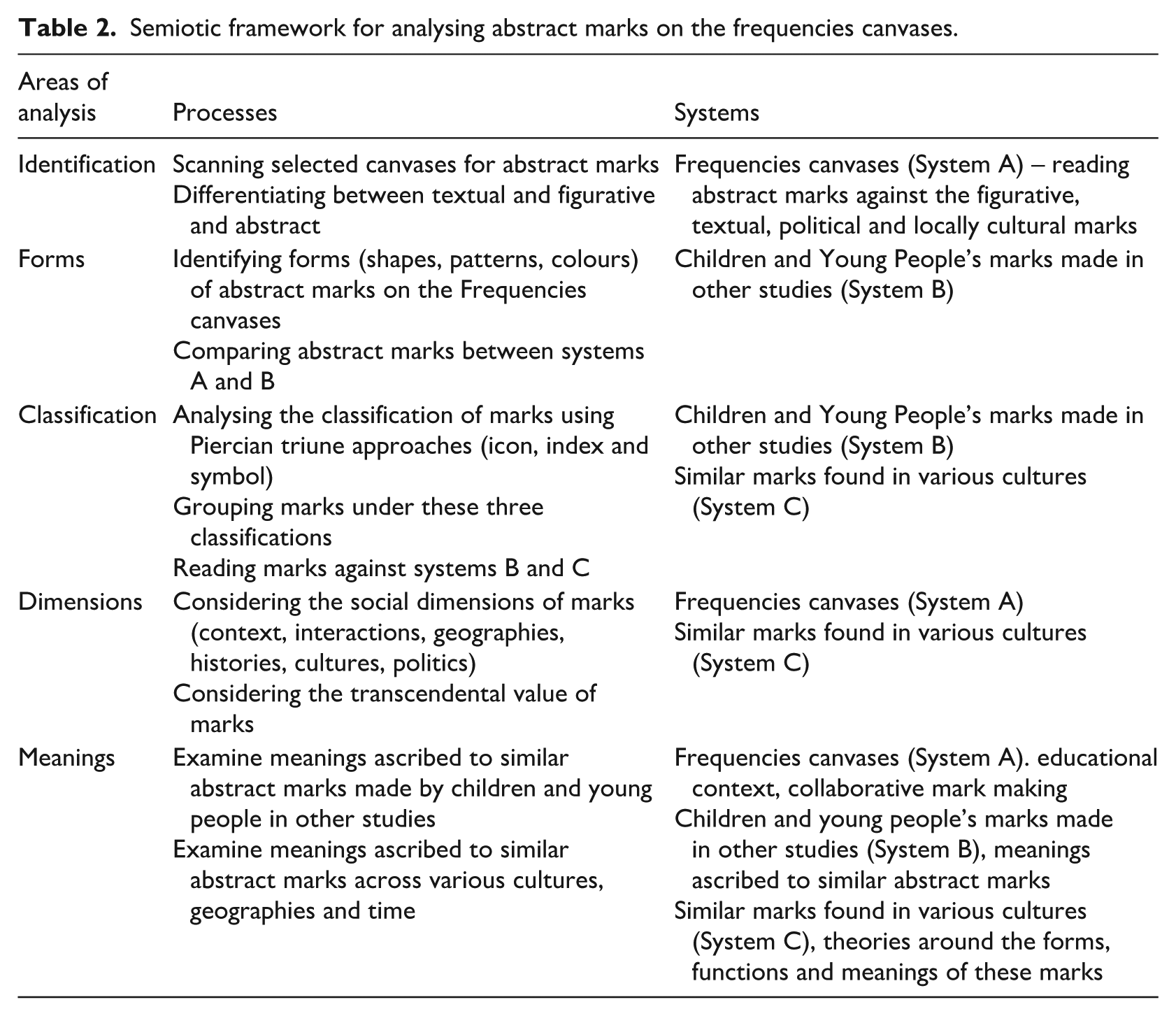
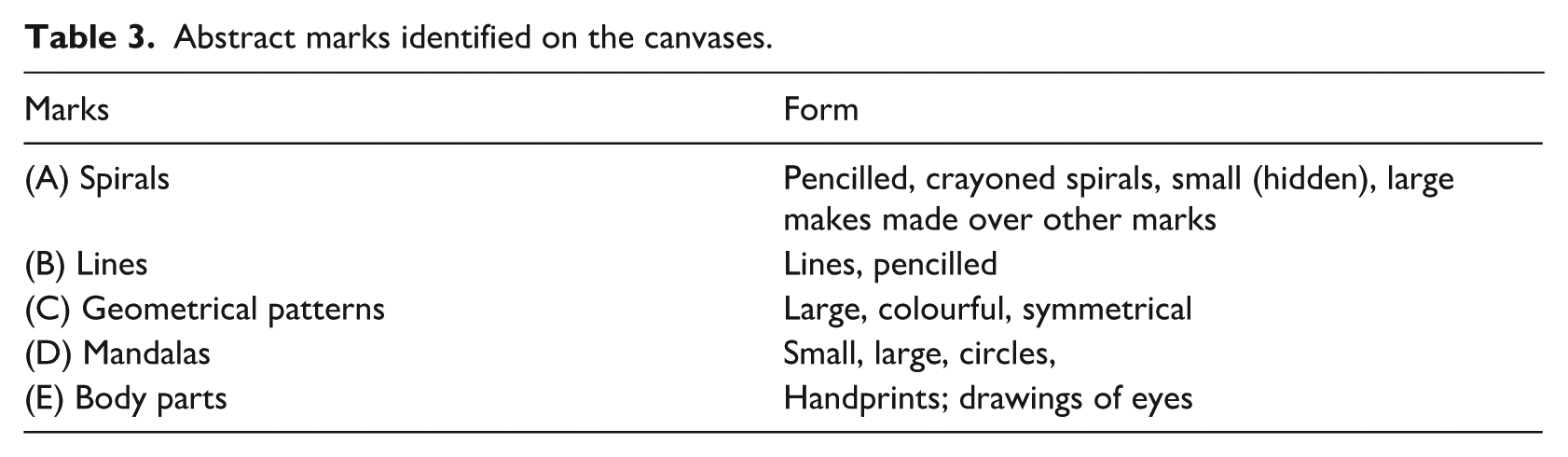
Applying a semiotic orientation to the Frequencies marks involved five main areas of analysis: Identification; Forms; Classifications; Dimensions and Meanings – and three systems of signs (A, B and C) from which to read the Frequencies marks against. Identification involved scanning the selected canvases for marks that were not figurative, textual or had obvious political, geographical, religious or cultural denotation (i.e., flags, song lyrics, expletives, landscapes, etc.) in System A (Frequencies Canvases). Forms involved examining the shapes of the abstract marks identified on the canvases (see Table 3) and comparing them with forms in systems B and C (marks made in other studies with children and marks produced through ancient cultural systems). I then categorised marks from their identified forms (spiral, lines, geometrical patterns, mandala-type marks and handprints (see Table 3). The Frequencies abstract marks were then interpreted against the meanings assigned by children and young people in consciousness studies, and those ascribed to abstract marks produced through ancient cultural systems.
Abstract marks identified on the canvases.
Findings and discussion
Several abstract forms of interest were identified across the sample of Frequencies canvases:
Spirals
Spirals are central in the early drawing development of children, in art, literature and in the architecture of ancient civilisations (Tsuji and Müller, 2019). Spirals are ubiquitous in nature, from plant and insect life to human hair and fingerprints, to the movement of water and celestial bodies (Israel, 2015). Spirals feature consistently in the mark making of children and young people in consciousness research (Thomas, 2023, 2024; Thomas and O’Connor, 2024), depicting transitions between different spaces or states of being (Thomas, 2024). Lousa and Mikosz (2019) describe the theme of the spiral as a kind of sacred passport required to enter a sacred kingdom (Lousa and Mikosz, 2019). This spiral theme is identified in the megalithic and Neolithic period in Europe, Mexico, China and Egypt, where such spirals demonstrate the evolutionary nature of the journey made to the realm of immortality (Lousa and Mikosz, 2019). The spiral form’s persistence over space and time was identified on the Frequencies canvases:
Figures 3 to 6 show large and small spirals. In Figure 3, consider the large spiral central to the canvas, as a typhoon swirling-up the colours and figures. Smaller spirals are detected around the edges of the canvas, carved in black pencil and juxtaposing, swallowing, the vibrant colours and fixed images. Figure 4 demonstrates textual, figurative and abstract marks. The canvas holds a natural theme (like Figure 3) with trees, butterflies and V shaped strokes that may signify birds. Amid the scene, is a thick spiral, that may symbolise a sun that nourishes the life on the canvas. Other curious marks are detected on the canvas, non-convex polygons made from thin straight lines, with mandala features (lines within circles – see section ‘Mandalas’). Figure 5 demonstrates an explosion of abstract, figurative and textual marks, characteristic of the Frequencies canvases. Part of a colourful spiral falls off the edge of the canvas, half of its form, remaining unmanifest.
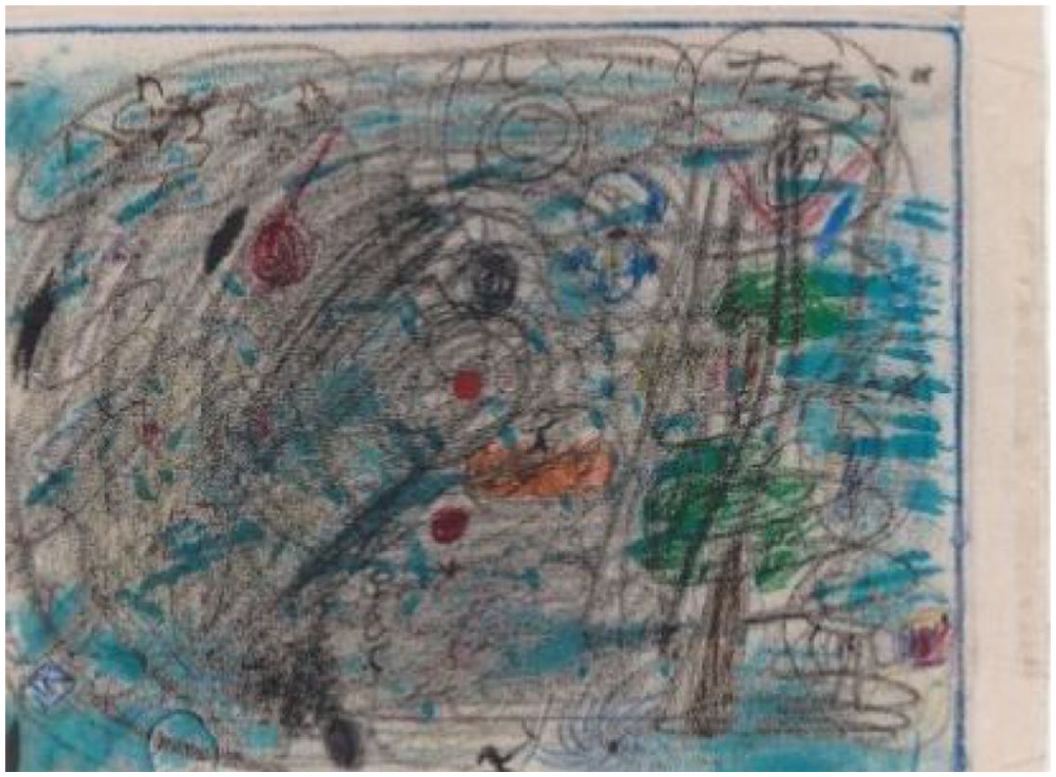
Frequencies (SA), Japan.
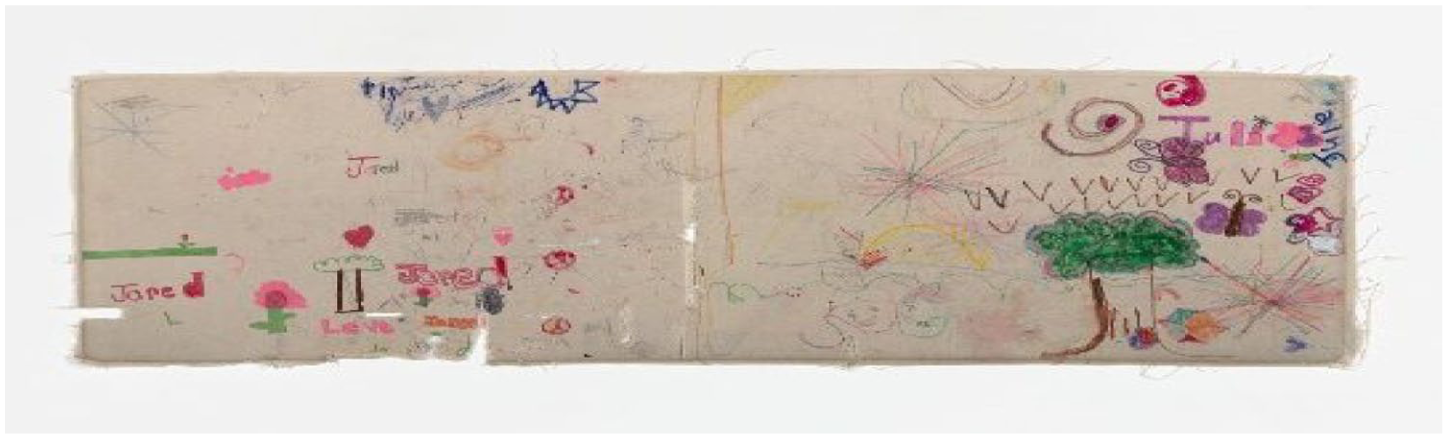
Frequencies (SA), USA.
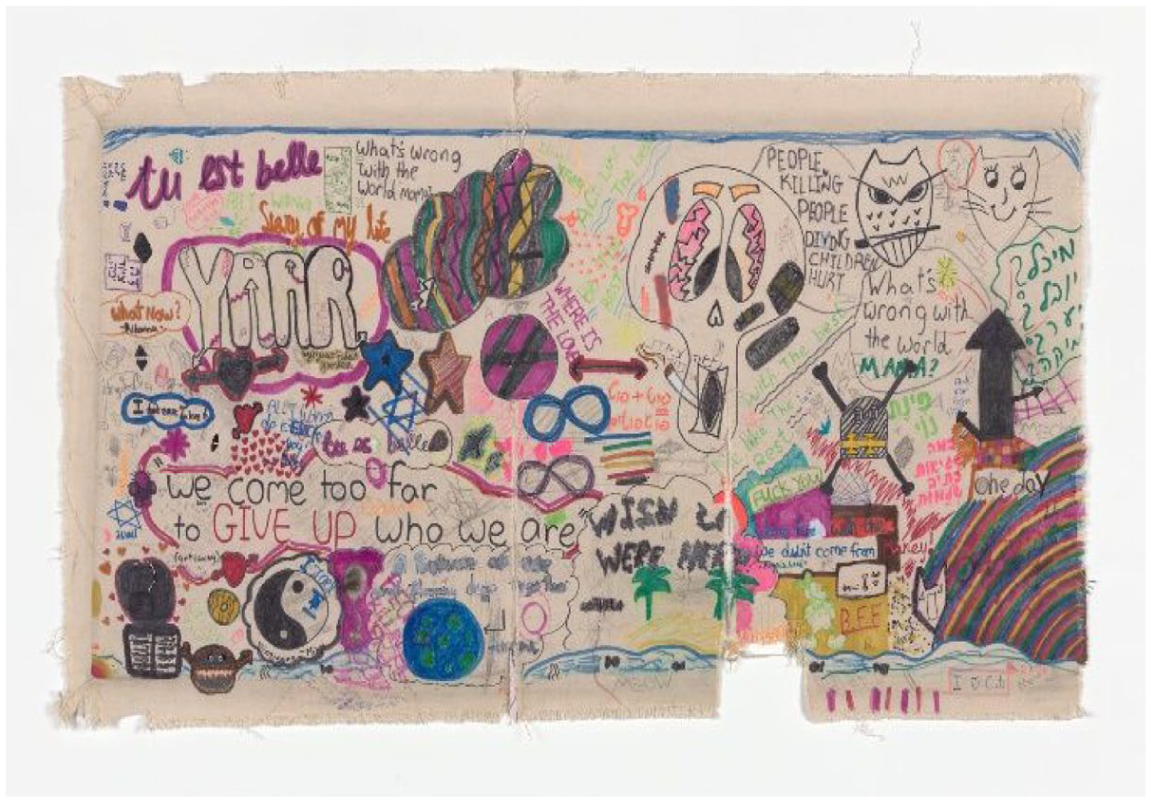
Frequencies (SA), Israel.
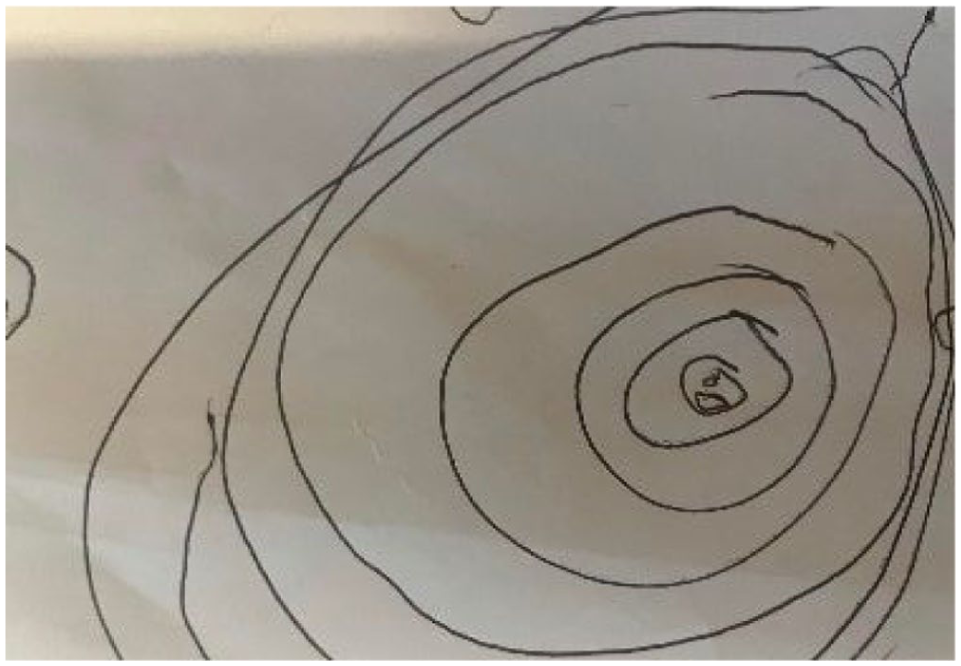
Consciousness research (SB), ‘Portal to another world’, age 5 years.
Reading Frequencies spirals against system B (marks made by children and young people in other studies), shows their similarity in terms of their forms. Spirals in system B are defined by children as ‘portals’ or ‘tunnels’, representing shifts in consciousness and states of self (see Figure 6). They can signify a bridge between different spaces, for example, physical and non-physical worlds of experience (Thomas, 2022, 2023, 2024). Spirals are marks, images prior to language (Bridger et al., 2022) and can emerge when children and young people cannot find words to represent how they experience, perceive or feel (Thomas, 2023, 2024). In the case of the Frequencies canvases, spirals are contrasted against the more figurative marks such as natural landscapes, graffiti-styled names/text and figures. Where the culture and geography of some of the mark makers can be identified through textual marks, for example, abstract spirals reach beyond these boundaries. Spirals transcend classroom discourses, signifying the release from the norms and expectations of the dominant themes present on canvases.
Considering spirals from system C (marks made by ancient peoples across various cultural and geographical contexts), shows interesting meanings assigned to their enduring presence. For example, spirals are found engraved in ancient stone in Ireland, depicting the close relationship between Neolithic people and the cyclic elements of nature (Bridger et al., 2022; Lousa and Mikosz, 2019). As a mark repeated across time and space, indigenous scholars have suggested that traditional spiral ontologies, link nature, human history, ancestors and descendants (Fritsch, 2024). The spiral’s meanings across ancient cultures, are inextricably bound up with ideas of creation and life giving – it’s influence strong on creativity, imagination and knowledge (Lousa and Mikosz, 2019).
Geometrical patterns and lines
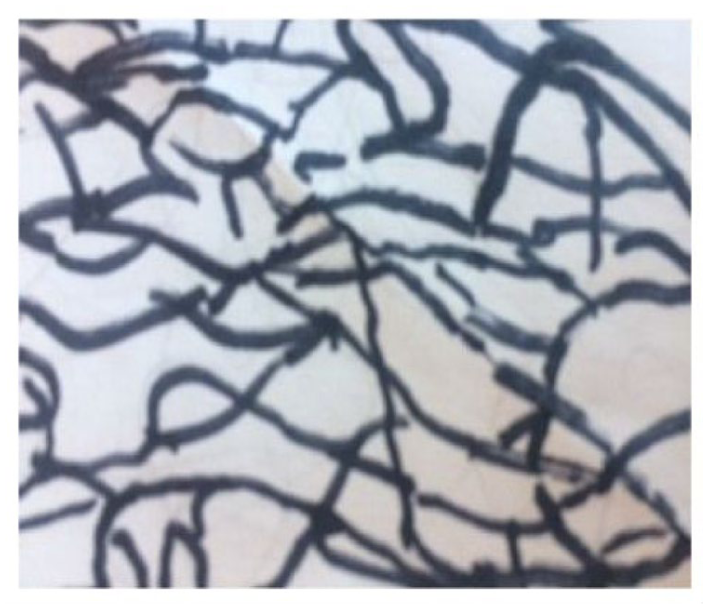
Studies of children’s mark-making highlight the casual interaction between signs produced by children and ancient shapes or structures (Quaglia et al., 2015). For example, Kellogg (1955 cited in Quaglia et al., 2015) catalogued configurations, such as lines and squiggles, that presented themselves more frequently in the drawings of children from various cultures. The marks that emerge through young children in early literacy development follow a predictable sequence of lines, squiggles and spirals (Dunst and Gorman, 2009) transcending cultural divergences. Lines and geometrical patterns were also identified on the Frequencies canvases (Figures 7 and 8).
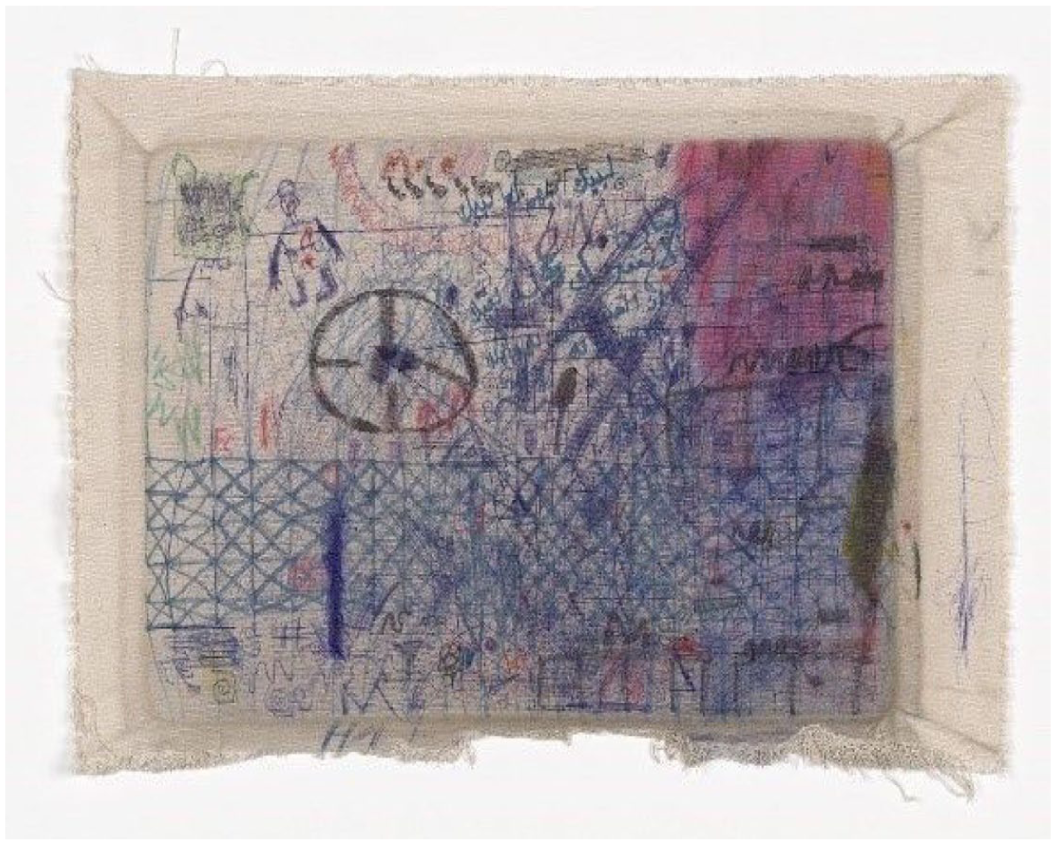
Frequencies (SA), Egypt.
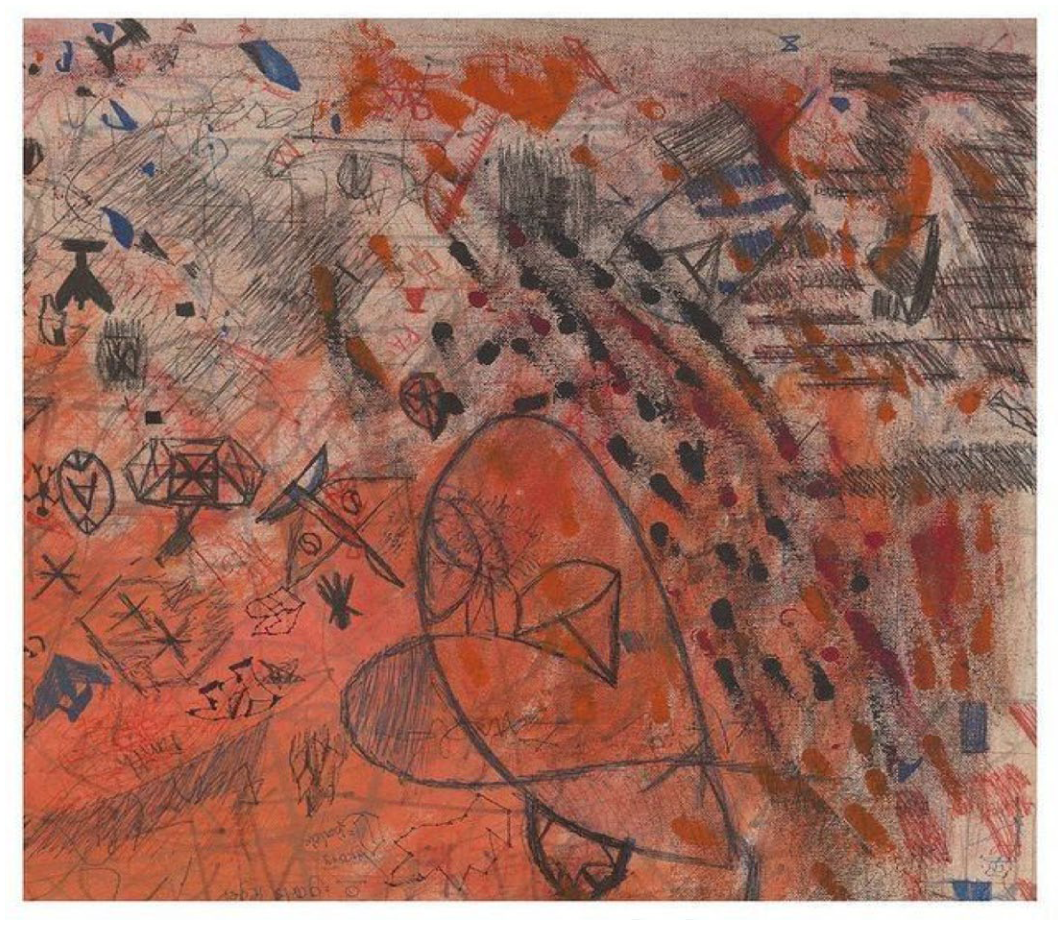
Frequencies (SA), Brazil.
The nature of the mark making activity as collaborative may explain the many lines found across canvases from various countries. Collaborative mark making has been associated with increased scribbling in children (Dunst and Gorman, 2009). Lines can signifiy images of thought and awareness that are deeply rooted in oneself (Antosa and Kiram, 2020), and can be perceived, interpreted, wondered about, tested and associated with other meanings (Labbo, 1996). Lines, collaboratively or individually produced, symbolise the interconnectivity and intersubjectivity imbued within the creative moments of making marks, as important signifiers of the self. Lines as mark making, further allow for the complexity and instability of atmospheres that are difficult to identify or explain (Bates et al., 2022), where lines may reach out and contest the constrained school environment. Lines as a form of mark making can be representational abstractions that travel from mind to world, and a bridge between the mental and material world (Malafouris, 2021).
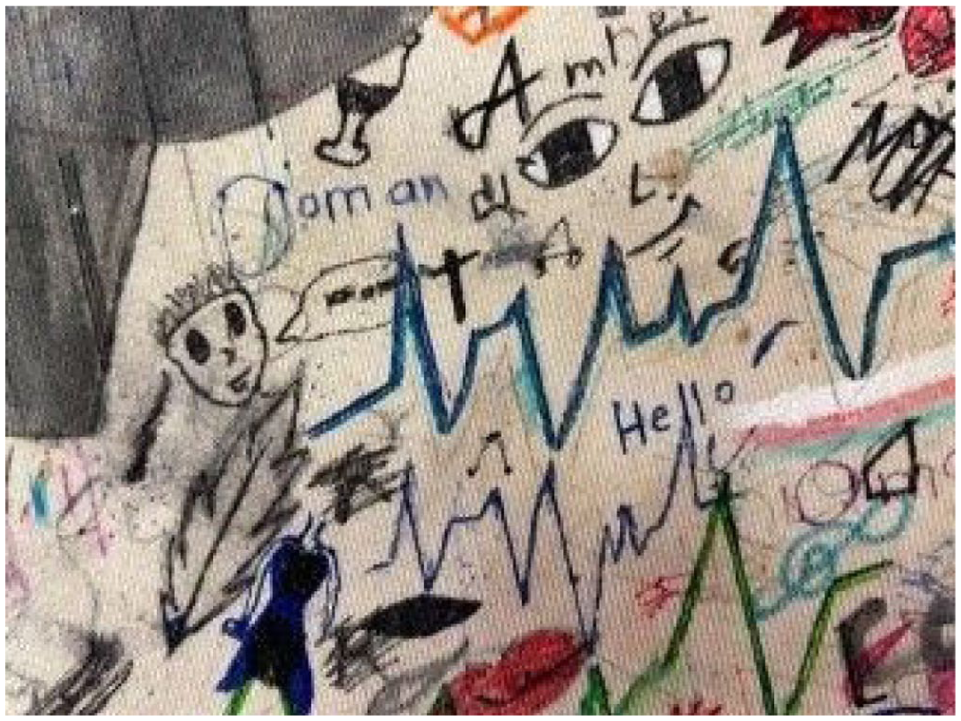
Figures 9 to 13 show examples of lines in various formations. In Figure 8, lines can be classified as both symbolic and indexical representations of life or the heart. We find lines looking like those on heart monitors in hospital contexts, lines that bleed into the text ‘Hello’ – marking the presence of the lines producer. Figures 5 and 7 show lines in colour and pen, that are formed into geometrical and asymmetrical patterns. The lines in Figure 5 appear cross hatched, forming an interesting, repeated pattern. Malafouris (2021) examines lines as marks in the context of human becoming and signs as material enactments. Ochre in the Blombos context, a community in the African middle stone ages, show lines engraved as a series of parallel crossed lines and hatched design. The ochre, recovered between 1999 and 2000 is from c75,000 to 100,000 year old levels, and is now curated at the Iziko-South African Museum, Cape Town (Malafouris, 2021). The cross-hatched design may symbolise something else beyond the mark making itself, communicating messages and meanings between the people of the Blombos community (Malafouris, 2021). Geometrical patterns and lines have been understood to signal transcendence in pre Columbian and western European artistic traditions too (Leone and Parmentier, 2014). Since the discovery of the first portable and parietal rock art in Europe in the late 1800s, researchers have tried to understand why Palaeolithic artists engaged in abstract mark making (Von Petzinger, 2017). These abstract marks may signify transcendental dimensions of experience, beyond the representational because ‘they are on one hand beyond knowing and, on the other hand, anchored in an utterly separate realm’ (Leone and Parmentier, 2014).
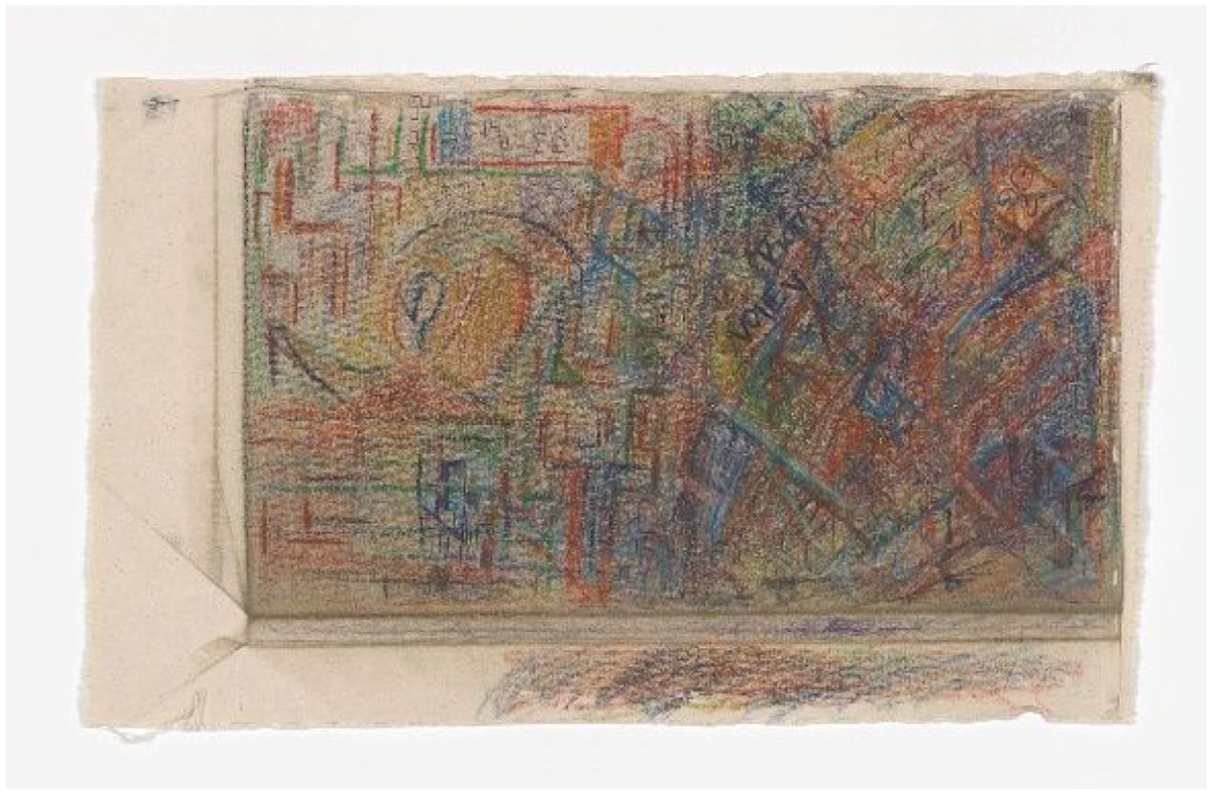
Frequencies (SA), Nepal.
Frequencies (SA), Nepal.
Consciousness research (SB), age 14 years, ‘I am connected with everything’.
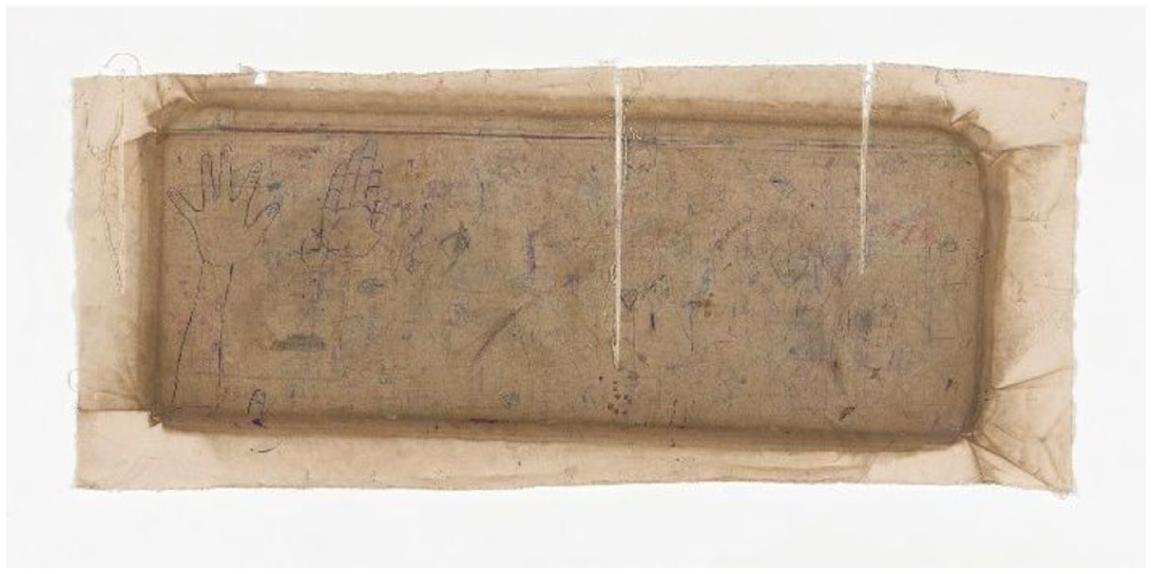
Frequencies (SA), Zambia.
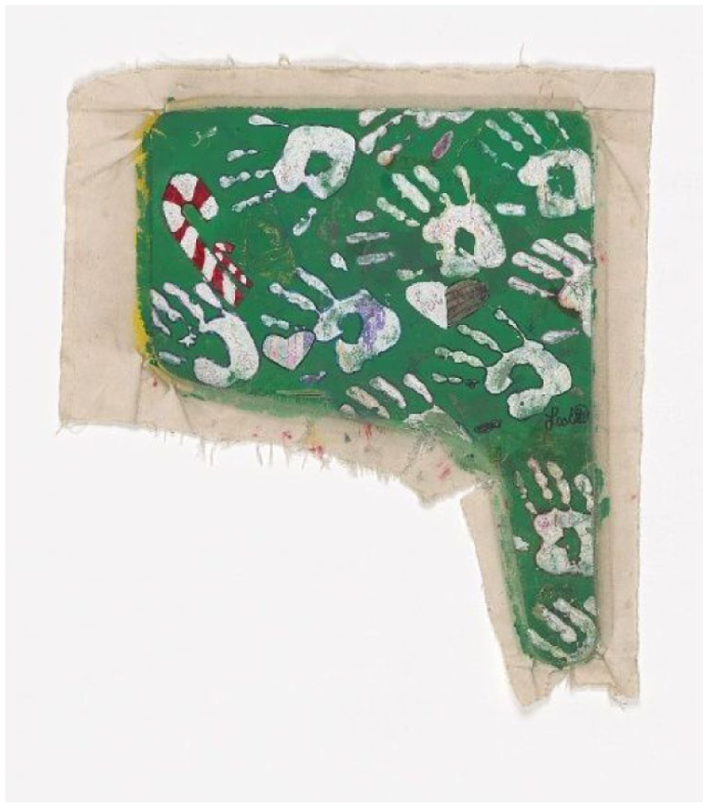
Frequencies (SA), Mexico.
Handprints and eyes (body parts)
While handprints and eyes are less abstract than lines and spirals and indexical of the body, they may connote deeper levels of signification of the archetypal I-am, the affirmation of a shared beingness (Tarasti, 2012). When an image is indexical it is directly connected to the signified (Figure 14), such as smoke (fire) or handprints (bodies/selves/presence). Barthes (1986) defined the indexical properties of photography through the mediums capacities to capture that what has been here in the moment it was photographed (Lehmann, 2017).
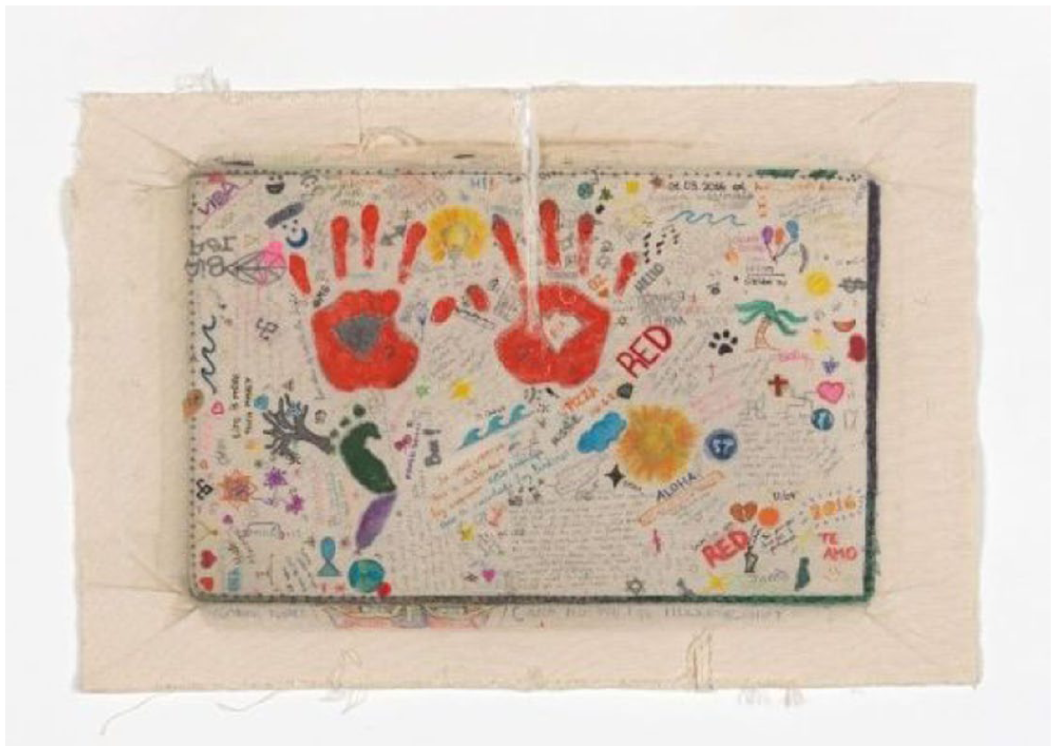
Frequencies (SA) Japan.
The mark of the human hand is a universally recognisable image (Von Petzinger, 2017; Walker et al., 2016), a mark identified across sample canvases from the Frequencies sample. The human hand mark ‘transcends temporally and geographically defined cultural divisions and represents the earliest known artistic symbol of the human form’ (Walker et al., 2016: 2). Marks such as handprints represent ways of knowing, being and community in indigenous settings. For example, Mills and Dooley (2019) highlight instances of the multi-sensoriality of indigenous literacies observed in participatory community research with an indigenous school. A recurring motif in the children’s paintings ‘was the handprint – featured in two thirds of the artworks. Handprints were often integrated into the painted landscape as trees, evoking symbolic connections to the land’ (Mills and Dooley, 2019: 33).
The handprints of children are found in system C (marks made by ancient peoples across various cultural and geographical contexts; Figure 15).
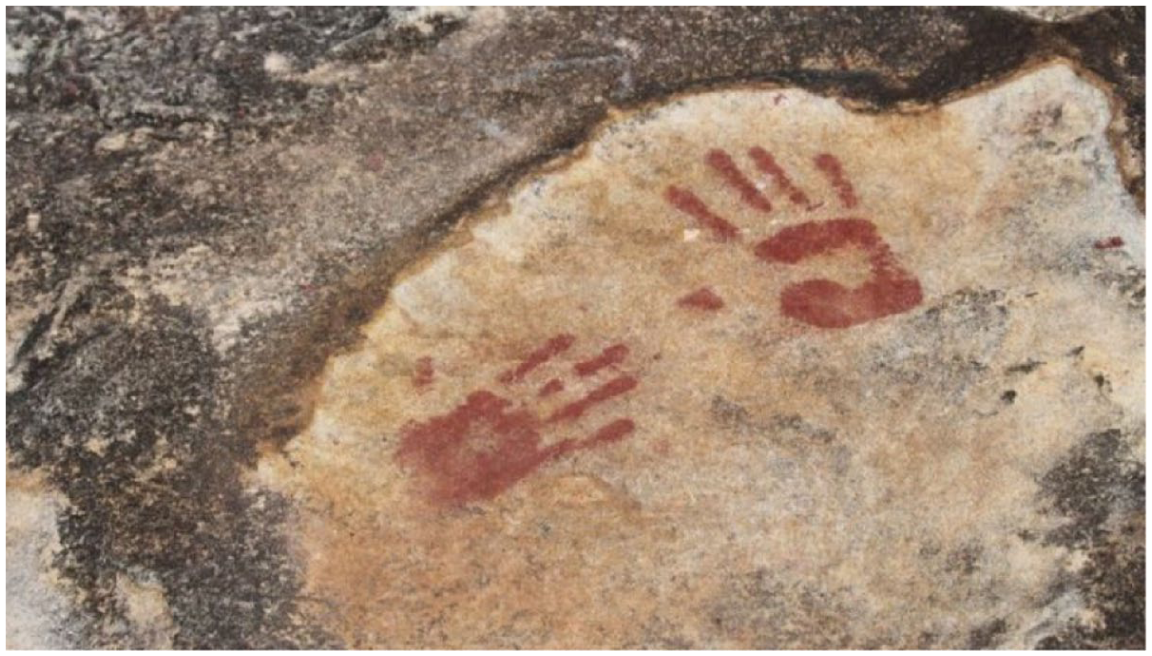
(SC) Ancient prehistoric handprints made by children 169,000 and 226,000 BC.
What handprints may express is ‘the proud gesture that says “I” and “here”. I my hand, and here is the testimony to that’ (Schaub, 1996: 84). A tactile mark that expresses a simple way of being. The handprint transcends contemporary social contexts, languages, histories, cultures, time and space. Often, the meaning of signs can change over time, and interpreted synchronically (meanings at a given point in time) and diachronically (meanings that evolve over time – see Berger, 2011). The I-am-here-ness signified through handprint marks may transcend given points in time and evolved meanings – it’s signification a constant. Peirce (1931–1958) notes how indexical signs direct the attention to their objects by blind compulsion, hinting at a process aprior/beyond socially conditioned readings of signs – their signification relational to systems of meaning which contain the same signs (Aiello, 2006). Handprints denote a material presence at the first level of signification (Barthes, 1986) as an obvious association to what people see. At the second level of signification, I-am-here-ness as a transcendental value is connoted through the hand marks.
Iconography of the eye was found in the frequencies canvases, similar with images produced by children and young people in consciousness research (see Figures 16–18). The eye image can represent the ‘I’ of experience for some children that can be ‘magic’ or see aspects of reality not normally accessed through ordinary perception (see Thomas, 2022, 2023, 2024).
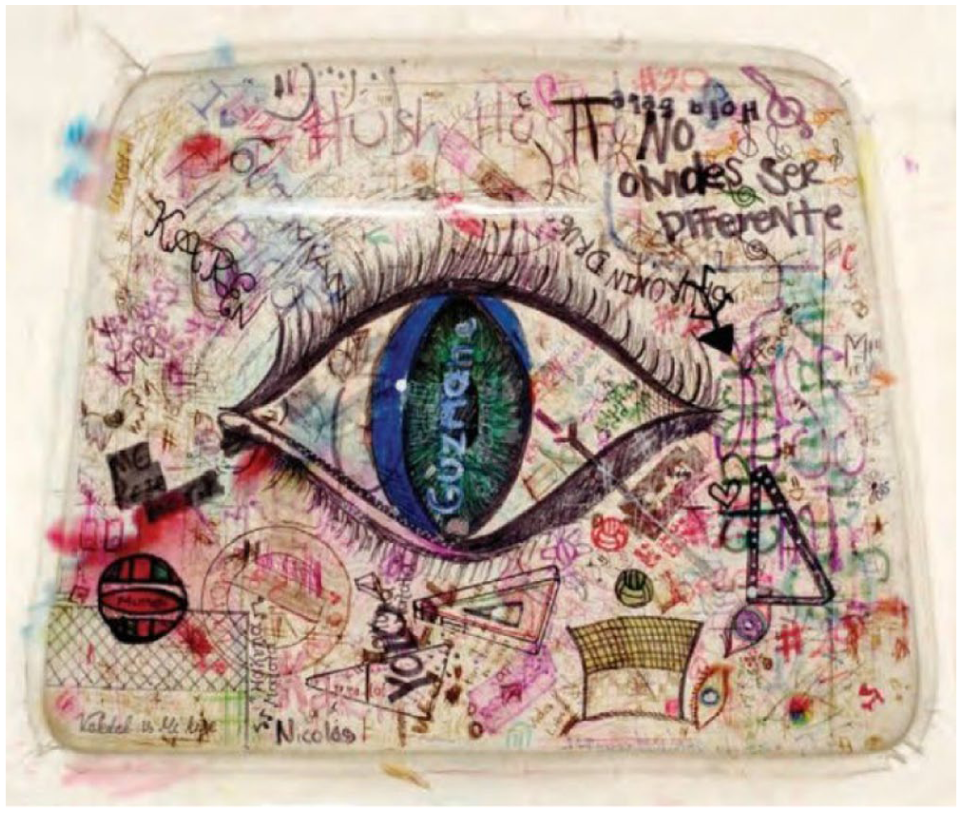
Frequencies (SA), Brazil.
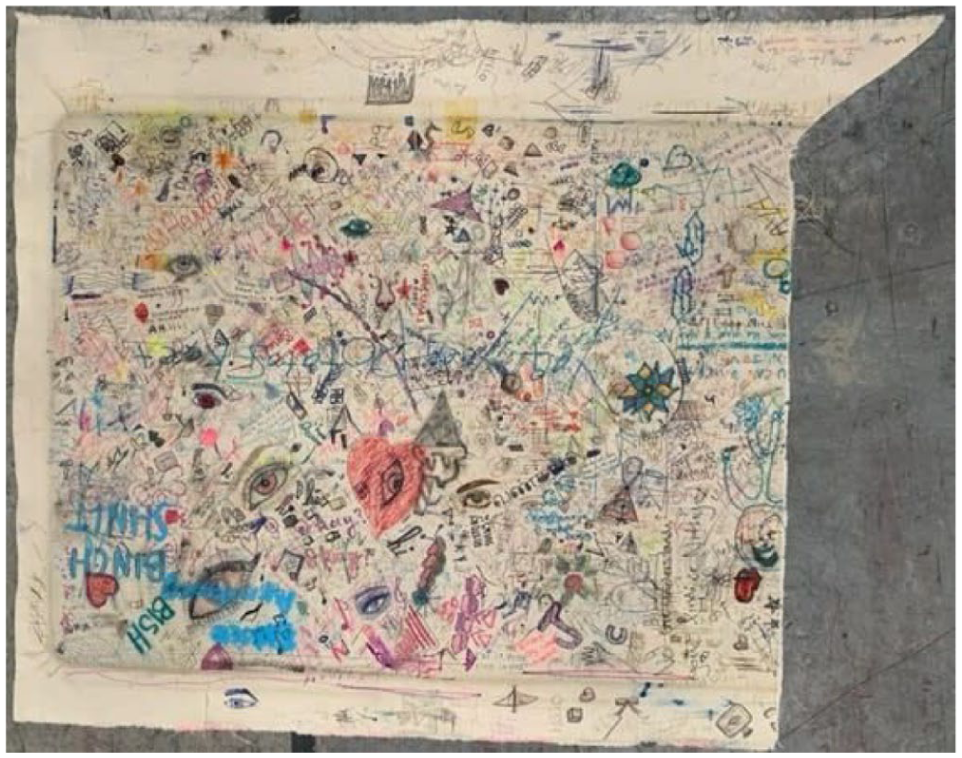
Frequencies (SA), UK.
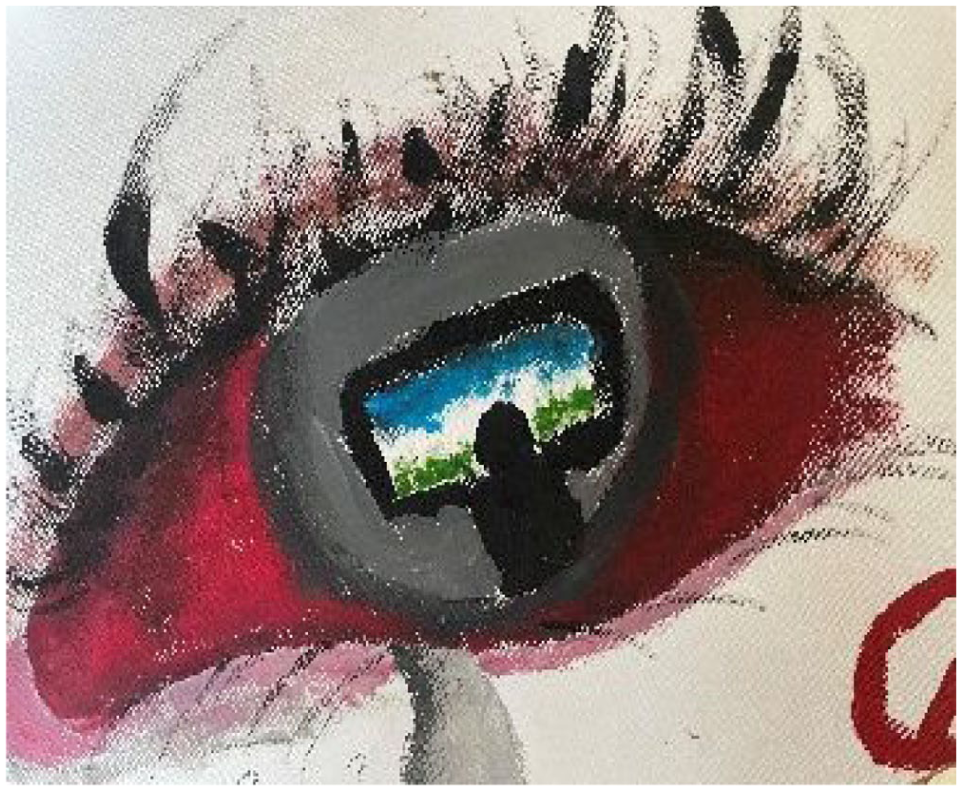
Consciousness research (SB), ‘the I of reality’, age 12 years.
The eye as icon for the body, sight and perception, carries importance in some ancient civilisations. For example, ancient Egyptians used the Eye of Horus, a symbol that emerged from arguably one of the most recognised mythologies of Isis and Osiris (ReFaey et al., 2019). Themes of dismemberment and fragmentation are found in the myth of Isis and Osiris, with the eye signifying the restoration to self-wholeness. The recurring eye image located across canvases (from many countries in the dataset) functions as icon, signifying the self as embodied and present. The eye that transcends various cultures and geographies, iconic to the human being, may act as representaman for ‘the world’s one eye that looks out from all knowing beings’ (Schopenhauer, 2014).
Mandala
The mandala symbol has become popular in western late modernity, forming part of new age movements, and playing a role in the commerce and capitalisation that sees a ‘buying of Buddha and a selling of Rumi’ (Arjana, 2020). The mandala image may therefore be highly accessible to children and young people from various cultures and geographies, its popular culture status influencing the high incidence of mandala marks found on the Frequencies canvases. The mandala mark is interesting and can be read through the lens of post-modernity, or as a symbol that signifies deeper, transcendental meanings demonstrated across time, histories and cultures. The mandala is persistent, appearing across diverse cultural, mythological and religious landscapes (Zaluchu and Widjaja, 2019). As a symbol, the mandala is often associated with the self, as its psychological expression (Holbrook and Comer, 2017). The mandala is an interesting image, involving both the circle and the square. In ‘the sun worship of indigenous peoples, or in modern religion, in myths or dreams, the symbol of the circle represents the ultimate wholeness, whereas the symbol of the square indicates secularity, flesh and reality’ (Hwang, 2011: 331). Mandalas connote the I-am as both individual and collective, local and transcendental.
Mandalas can emerge in consciousness research with children to represent the self (Figure 19).
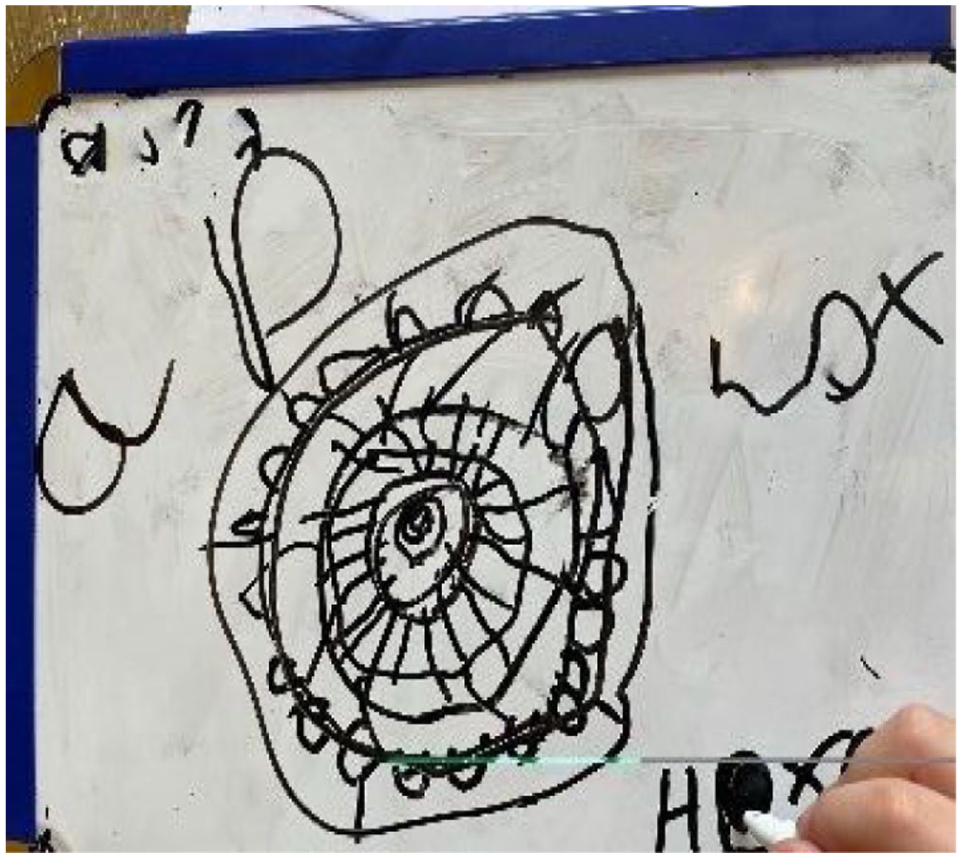
Consciousness research (SB), age 5 years ‘Magic Me’.
In Jungian psychoanalytics, the mandala signifies the deep structures of the self and aspects of the collective unconscious (Jung, 1973). A high incidence of mandalas was found on the Frequencies canvases:
Figure 20 shows an exquisite mandala centred between a figurative drawing from a famous movie scene (the Simpsons) and marks that are iconic of the body (the phallus – a subversive mark in the educational context of mark making) and the more-than-human world (birds, feathers). Understandings of the mandala symbols beyond the social dimension (pop culture) are arrived at when considering systems B and C. For example, in consciousness research with children and young people (SB), mandalas are representative of a deeper self that never changes (the circle) – despite changing thoughts, feelings and bodies across the life course (squares or shapes) – see Thomas and O’Connor (2024).
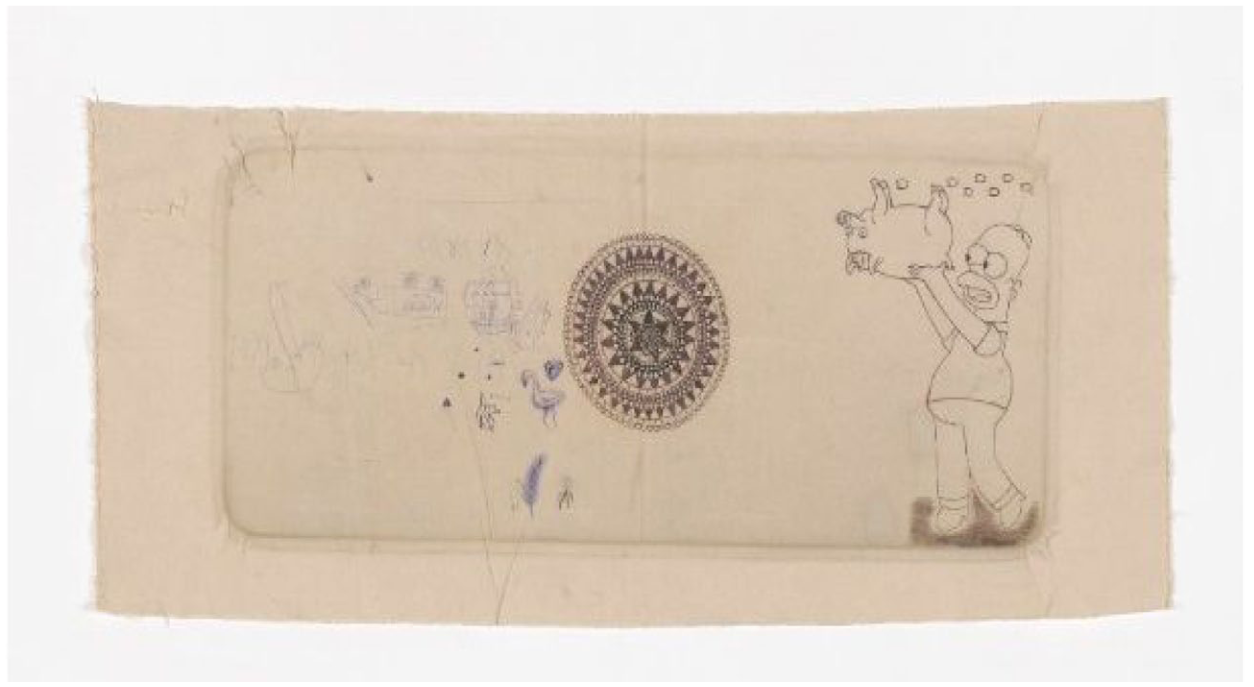
Frequencies (SA), Ukraine.
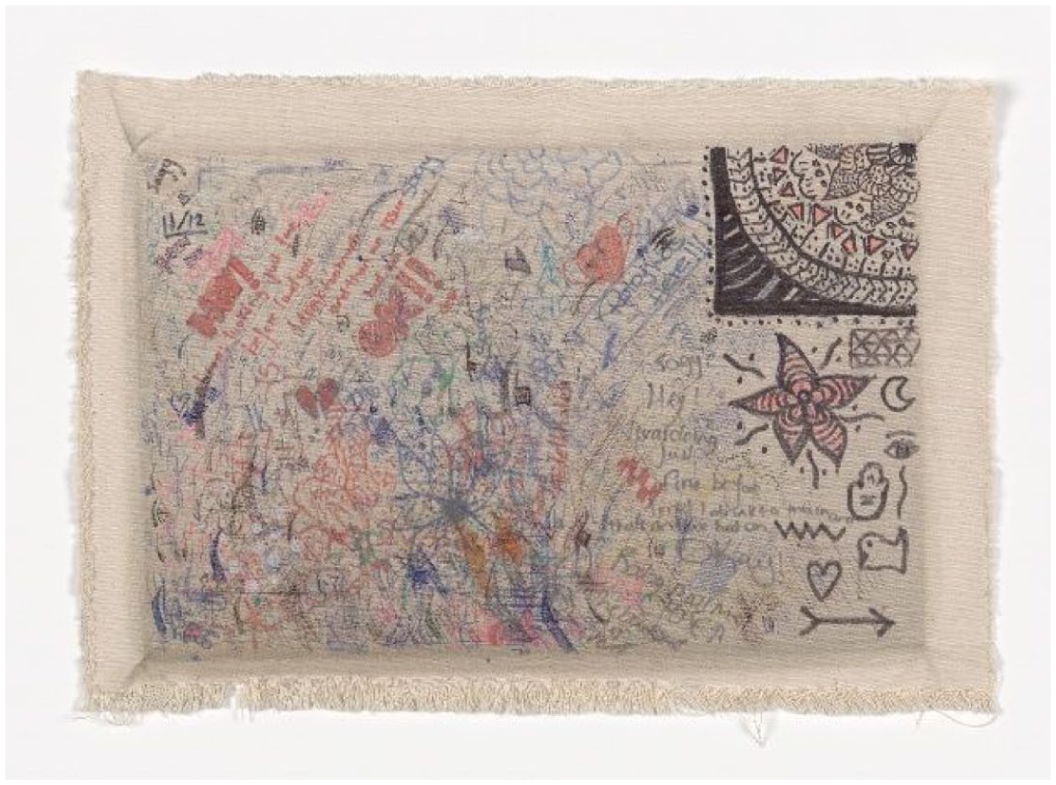
Figures 21 and 22 show various types of mandalas freely marked by children and young people (yin and yang, flower mandalas, circle mandalas). The mandala has been investigated as a cognitive graphic of sacred space, a cartography of religious and spiritual geography (Walcott, 2006). Exploration of the mandala as an instrument in Tibetan Buddhist ceremonies illustrates its function in emancipatory and culturally contested space, its signification broadening the power of its cartographic depiction (Walcott, 2006). For young people, mandalas can symbolise limited interaction with social reality and an avoidance of wider social conflicts (Liu et al., 2020) – a theme signified through the unifying mandala in Figure 20.
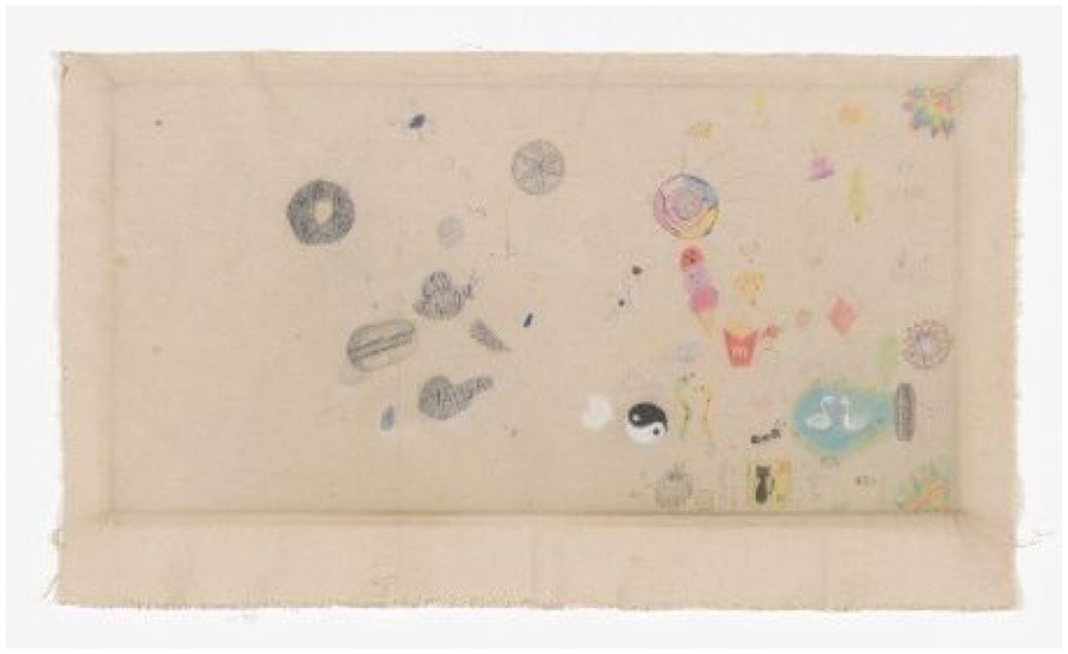
Frequencies (SA), Israel.
Frequencies (SA), Egypt.
Studies with mandalas and teenagers (Liang et al., 2020), show how the processes of drawing mandalas facilitated young people to enter a more focused state of engagement and absorption, perhaps triggering states of mindfulness. The activity of free mark making in the Frequencies initiative may facilitate similar states of consciousness in children and young people, explaining the presence of abstract marks, such as mandalas, spirals and geometrical forms, that signify realms beyond the social worlds. The canvas mandalas, under this premise, may signal a safer dimension of experience for some children and young people, especially in countries that may encounter social and political disruptions. Mandalas, whether produced through free mark making, or in research studies with children, serve as an epistemic bridge between social and more-than-human, out-of-this-world states of being. As a symbol of the self in collective cosmology, the persistent presence of the mandala mark across the Frequencies canvases, connotes a tuning into present and past, diversity and wholeness that can be applied to the abstract marks included here.
Summary
Using a semiotic approach, informed through the lenses of other systems of signs, various cultural worldviews and philosophy has been valuable for uncovering the universality and shared meanings hidden within children and young peoples’ abstract mark making on the Frequencies canvases. What is less clear are the meanings and intentions of the marks producers (children and young people in the Frequencies initiative), in terms of whether their choices (if any) where consciously or unconsciously directed to forming these universal signs (and their interpreted meanings). Abstract marks produced in artistic initiatives or research studies can often be missed, hidden in the margins (Jellema et al., 2023). Abstract marks made by children and young people can be considered as Piagetian failed realism (Matthews, 2003), rather than creative expression or a tuning into systems of meanings betwixt and beyond their environments. Expectations placed on children to conform in their creativity, restricts and redirects their mark making into dominant literacy practices. Education systems are a good example where teachers ‘as [well-meaning] agents of the state machinery’ (Leafgren and Bornhorst, 2016: 32) determine what children are allowed to touch and do as they become cultured into academic systems.
Without the marks producers to ask, interpreting abstract marks is challenging. By identifying similar systems of signs across other studies with children and young people, and various cultural contexts located across space and time, some interpretations can be arrived at. Opening the field to include the semantic and symbolic relevance of the natural world, and the possibilities of subterranean dimensions of human experience, gives rise to an interconnectedness of self and expression that lies beyond limiting social and physical definitions of what it means to be human (Thomas, 2023). Abstract lines, spirals, scribbles and other abstract marks, hold epistemic and ontic relevance in terms of their relationality and shared meanings, regardless of individual, cultural or geo-political differences for children and young people. Connections between children and young people’s literacy practices and earlier marks from many cultures can also be seem in the digital literacies of children and young people. The use of emojis, for example, work to convey a range of statements and sentiments normally enacted through language (Alshenqeeti, 2016). A further depth to emoji use is that children and young people are returning language to an earlier stage of human communication (Alshenqeeti, 2016). Recognising the relevance for abstract marks in children and young people’s free mark making, where they can be restrained by prescriptive systems of signs that may not hold relevance, safety, wholeness or connectedness. Gallagher (2005), notes a strong factor in the art of children is the recognition, by the child, of certain symbols or schemata that constitute a balanced, pleasing whole. In spaces where children and young people may experience fragmentation of self (such as educational spaces), or unease in one’s individual identity, falling into universal signs and their connection with the ancestors, the natural world and the universe, sees that wholeness manifest.
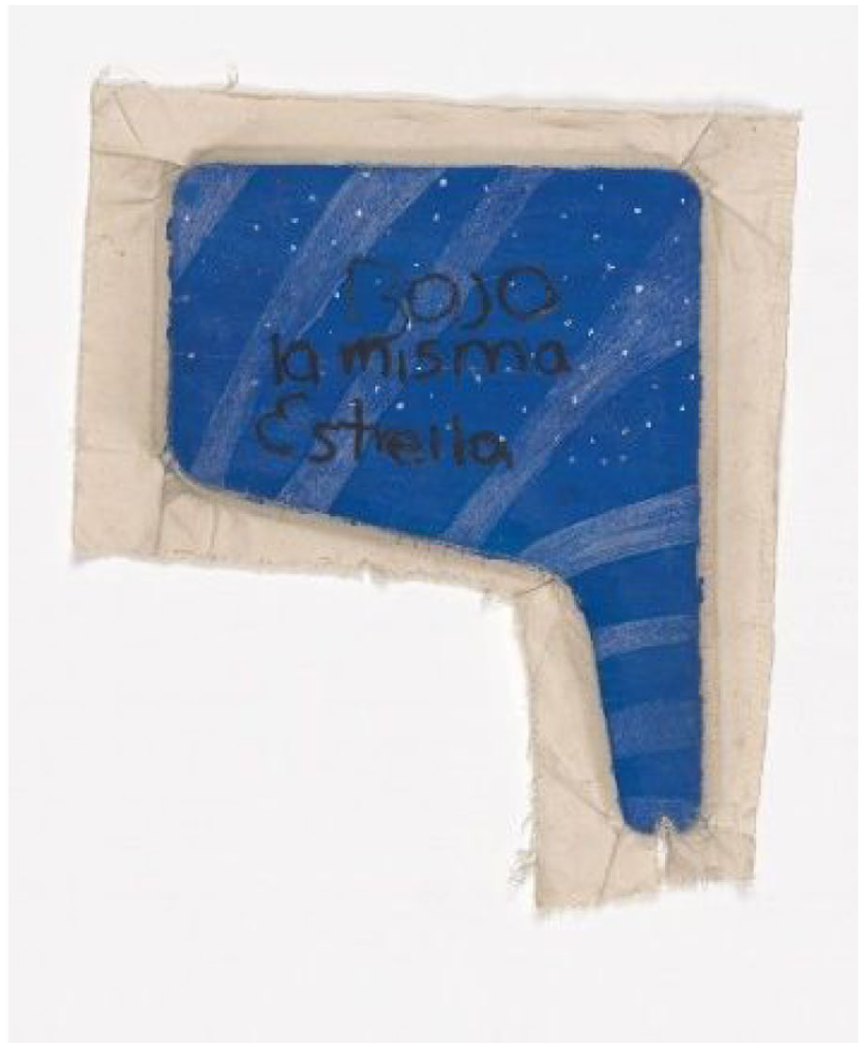
Themes of self are intrinsic to the creation of spirals, mandalas, lines, handprints and eyes, themes intuited and developed across various cultures, histories and geographies. The universal sense of I-am-ness, the archetypal beingness, is connoted through children and young people’s abstract mark making on the canvases. This idea of self-transcendence departs from classical ideas of self as universal and the measure of all things, reducing humans to a basic unit with a knowing subject (Braidotti, 2016). Rather, categories of transcendence, and an innate I-am-ness, is an appeal to wider philosophical enquiry necessary for understanding the mysteries of selfhood as intra-connected (Barad, 2007) or shared with humans, non-humans and beyond. It is a move to find new ways for integrating complimentary perspectives of self, rather than to exacerbate antagonistic positions (Andacht and Michel, 2005; Thomas and Durston, 2025). Children and young people’s abstract mark making embodies the ‘moi and soi’ (Tarasti, 2012), the combining of individual and collective subjectivities that are spoke about in cultured stories of indigenous groups, its whispers still present in the fields of the collective. The abstract signs analysed on the Frequencies canvases reach beyond immediate social referents, as ‘aliquid stat pro aliqou’ (something in the place of something else – Jakobson, 1975), of which is representation is beyond our linguistic grasp (Figure 23).
Frequencies (SA), Mexico ‘Under the same Star’.
Rethinking self and subjectivity through how children and young people express it, could inform and transform systems rooted in constructionist or physicalist ontologies, that in turn limit self as socially constructed or discrete from others and the world (Thomas and Durston, 2025). Paying attention to how children and young people in sanctioned, and unsanctioned, free mark making spaces, can support systems to tune into dimensions of human experience that impact the lifeworlds (Habermas, 1996) of children and young people. Frequencies as an initiative may have achieved its aim to open its connections between children and young people geographically thousands of miles apart, while conveying the unconscious energy of young minds a their most absorbent. More than this, Frequencies may have captured a tuning into to dimensions of self and meaning beyond the social and cultural worlds of children and young people.
Footnotes
Acknowledgements
I would like to thank Oscar Murrillo and the Murillo team for affording researchers opportunities to study the Frequencies canvases. I would also like to thank Horizontal Enterprises for funding the research. I would like to thank the children and young people who were involved in mark making on the canvases.

Ethical considerations
This study was granted ethical approval on [23/12/2021] by [BAHSS Ethics Review Panel, University of Central Lancashire, Reference number: BAHSS20278]
Funding
The author disclosed receipt of the following financial support for the research, authorship, and/or publication of this article: The author received financial support for the research from Horizontal Enterprises Ltd.
Declaration of conflicting interests
The author declared no potential conflicts of interest with respect to the research, authorship, and/or publication of this article.