



Abstract
This article investigates agency in children and young people affected by the climate-induced natural disasters in recent years in Queensland, Australia to understand their role in processing and coping with these events. The narratives of participants were explored using semi-structured interviews with eight participants aged between six and fifteen; this paper focuses on participants of twelve and above. Children and young people have capabilities for positively handling the consequences of climate change – they may be able to co-produce narratives, solutions and ways forward with policy makers in order to find pathways to dealing with the effects of climate change, individual extreme weather events, and the emotional fallout inevitable from a traumatic, or potentially life-threatening experiences. While feelings of stress, anxiety and fear were expressed, children and young people stated that these negative psychological consequences can be mitigated by acts of agency; an understanding of the potential of natural disasters, and knowledge about how to plan to reduce the impact, so that they feel empowered and prepared to act when faced with future extreme weather events. There is, however, a systemic failure by policy makers in recognising children’s social competence in being able to understand climate issues and their causes as they remain powerless in an ‘adult world’. The data challenge the perpetuated discourse that associates children and young people with passivity and draws attention to the need to view them as insightful and invaluable active agents in a collective fight against climate crisis, and in their own stories.
Introduction
This paper explores the opinions of young people who directly experienced the consequences of climate-related events in rural areas in Queensland, Australia. Its core contributions are to the Sociology of Childhood, offering new knowledge on children’s agency as a potential mitigation mechanism for the negative emotional consequences that may arise from climate-led disasters. Where children feel they can act agentically and do something in the moment, either preventatively, or at crisis points, they report feeling better equipped to manage climate-related emergencies. Key findings indicate emotionally ambivalent responses to extreme weather events (EWEs). Indeed, ‘Climate emotions’ (Pihkala, 2022) can hold back agentic action. For example, participants experienced vicarious distress which made them feel powerless, witnessing family members upset over loss of livestock, or property.
In this paper, we define childhood, examine the development of children’s agency and consider the research in the field of children’s experiences of climate change. The Australian context for climate change with a focus on Queensland offers local context. Research methods, moulded to understand the impacts of natural disasters through the eyes of children are explored.
Defining childhood, defining agency
‘Children’ are those aged under 18 (UNCRC, 1989), though defining children as separate from young people may be necessary due to their distinct needs and experiences. Data obtained in this study are mostly from young people. Distinctions between categories of ‘child’ and ‘young person’, as well as transitions between the two, are, however, classed, racialized and gendered. Childhoods are also linked to the geographical context they take place in, and how these shape, and are shaped by, the children and young people living there. The critique in the Sociology of Childhood has, for some time, been around the ways in which childhoods discussed in research are often focused on, or refer back to, the global north.
A number of different theories of agency have developed from James et al. (1998) on theorising childhood where, children and young people’s agentic action, and social competence, were first taken as a given. One of the original authors, Prout (2011), developed this argument, to point out that childhood agency is always relational. That is, it does not exist in isolation away from adult, majority culture, nor from childhoods in different contexts. Holloway et al. (2019) reviewed the notions of bounded agency, negotiated agency and also relationality. Bounded, and negotiated agency build upon earlier work such as Hutchby and Moran-Ellis (1998) which points out children – regardless of context-always find themselves in ‘arenas’ of agency. That is, as they are ‘minors’ in a majority world of adult social actors where legal, social and political limitations to their agency exist. Evans (2007) points out that bounded agency is: ‘influenced but not determined by environments and emphasiz[es] internalized frames of reference as well as external actions’ (p. 93). In the context of our project, then, Evans’ ‘bounded agency’ shows how it is shaped by the Queensland locations in which it takes place, but also by external factors such as national Australian government policy frameworks children have no say in. The notion of having a say and being prepared, links with Uprichard’s (2008) notion of children as beings, but also as becomings, coming into a world where climate issues become more frequent and more pressing.
Agency, as we know from other research, is experienced unevenly depending on children’s age (Hoang and Yeoh, 2015), gender (Earles, 2011), social class (Oswell, 2013) and location, (Twum-Danso Imoh et al., 2019). Agency relates to social structure through these stratifications; it cannot be decoupled from our classed and gendered identities any more than other aspects of social life such as school experience, for example. Agency, we argue is intrinsic to young people and children, but, of course is necessarily bounded. Munford and Sanders’ (2015) work with vulnerable young people in New Zealand points out that agency is enacted with others – often those in significant roles such as parents or caregivers. Given they argue agency is in some ways co-constructed, the extent to which children in this study are supported by family is key. Young people can perhaps work to resist the ‘bind’ against their agency by finding spaces in which they are listened to, such as youth activism forums, in school council, where pupil voice (should be) listened to, and in individual and collective agentic action against climate disaster locally.
Young climate activists such as Greta Thunberg have been exercising political agency to demand change and fight climate inaction (Holmberg and Alvinius, 2020) by harnessing not only practical resources, but also thinking about the emotional side of responding to EWEs. Here, Pikhula’s (2022) concept of ‘climate emotion’ is relevant. ‘Climate emotion’ refers to feelings people can have as a result of the climate crisis, ranging from despair to embarrassment. Pikhula created a wheel of emotion, that details how feelings can overlap to create wider categories of response such as surprise-related, or anxiety-related emotional responses. This can relate to anxiety about future climate events, as well as to present feelings. This paper does not aim to focus on such well-publicised acts of agency and climate activism, but instead accesses more understudied voices. While Thunberg has a powerful voice, it is a voice and yet there are many more voices of children and young people that have not been accessed, in relation to the climate emergency. The interplay of agency in children, their ability to act, and feel heard, in supporting their wellbeing after direct experience with EWEs will be further drawn upon in this study.
Impacts of climate change on children
Existing empirical work conducted with children and young people in flood and other disaster settings has taken place across different geographical contexts, but tends to focus on older children, and has been more concentrated on subjects in the global south (see Barnwell and Wood, 2022; Ngcamu, 2023; Rousell and Cutter-Mackenzie-Knowles, 2022). For example, a study in Pakistan, a country susceptible to flooding, consulted 100 children aged between five and nine. It found that children’s awareness and preparedness for floods improved their disaster response; far from protecting and shielding children, instead preparing and upskilling them is key (Shah et al., 2021).
There are exceptions to a global south focus, such as research on children’s views of experiencing flooding in the UK (Walker et al., 2012), which used visual methods to ask children to draw their flooded homes. A major report by Mort et al. (2016) looked at the resilience and recovery of children affected by flood in England. They found common benefit for children of families who were honest about what was happening and mutually shared their experiences.
Studies exploring the physical impact of climate-led natural disasters have been far more established than those investigating the psychological or social aspects, which remain an emerging area of research, especially among the young (Burke et al., 2018). The lack of knowledge in this field – partly because it is new and emerging – can reinforce the political and social discourse that portrays children merely as the victims of climate change rather than active social agents (Starzdins and Skeat, 2011).
While a single EWE event can be traumatic, cumulative stress produced by slower-onset natural disasters can lead to PTSD, but also issues such as depression (Catani et al., 2008). Work by Tanner (2010) highlights how children’s voices are being disregarded in public forums about climate change. Börner et al. (2021), argue environmental disaster can intersect with existing childhood inequalities and exacerbate problems due to the underlying systemic oppression that becomes manifested in the process.
Children in the US mid-west, participated in a mixed-method study by Trott (2020). Participants were informed about their local ecology, climate change and individual as well as collective environmental actions in after-school programs. After gaining new information, participants reported feeling empowered and motivated to act in fighting climate consequences (Trott, 2020). Trott (2020) stated that no matter how insignificant the actions of young people may be, this can ‘offset’ the negative consequences that arise from learning first-hand about the alarming facts of our climate crisis. Providing activities such as participatory projects and open dialogue can allow supportive adults to help children build their sense of agency and understand their agentic capabilities (Ojala, 2016; Trott, 2020).
Understanding climate change, Australian context and children’s climate actions
Being in the Anthropocene – where significant changes to the Earth are driven by humans – has led to Intergovernmental Panel on Climate Change (IPCC, 2018) reports that global temperatures have increased to over 1.1 degree Celsius since the pre-industrialisation period. Consequently, this continued rise will affect our wellbeing and quality of lives by causing stronger, more frequent and longer EWEs (IPCC, 2018). Australia is largely exposed to droughts, bushfires and floods due to its geographic location and patterns of climate, which makes it one of the most vulnerable developed countries to the effects of EWEs (Forino et al., 2014; Starzdins and Skeat, 2011). The entanglement of government interests in fossil fuel industries are linked to how much profit there is involved in the sector which makes the two tricky to decouple (Lazarus and Van Asselt, 2018). School curriculum sustainability focuses more on greening schools, recycling, and ‘grow your own’ initiatives than on EWE crisis management (Education Queensland, 2024). Children have increasingly been recognised for their agency and have been asked to participate in natural disaster mitigation and recovery plans within communities (Burke et al., 2018). A failure to recognise their agency can exclude children from major decisions about climate action. In Queensland, children are not specifically involved in natural disaster mitigation or recovery plans, unlike children in Brazil and the Philippines discussed by Tanner (2010), whose work was mentioned earlier in the paper. While it is outside the scope of this paper to explore these different models, the lack of inclusion for Queensland’s children may simply be related to the newness of the issues which are steadily becoming more commonplace.
Methodology
The project was carried out in Queensland with participants aged between 5 and 15 years old; three of whom were impacted by bushfires; three by drought; and two by flood (see Appendix for further details). Whilst we are aware this is a small sample, the research took place during Covid lockdown in 2020–2021 and so a number of challenges with face-to-face meetings had to be circumnavigated; nonetheless there are enough data to offer ‘thick description’ (Geertz, 2003). Interviews were held online using Zoom and WhatsApp video. Such platforms can offer a comfortable and convenient way to interact with visual, auditory and textual elements that mimic the offline space (Salmons, 2012). In the context of this research, online interviews were particularly effective in reaching those living in rural areas and helped to overcome the issue of geographical distance between researcher and participant.
Bronfenbrenner’s (1979) ecological theory is useful to apply as a lens on climate change and its impact on children. He postulated that the child’s immediate environment (known as the microsystem) and the interactions within their closest circle, such as family and peers, can have a large influence on children’s development and wellbeing. This is borne out in the data here, in relation to the impacts of extreme weather events, as the children’s immediate environment and closest relationships are affected by EWEs. How the people closest to them cope, manage in a crisis and, importantly communicate with the children after the event reflects the importance of the microsystem.
This paper draws on data generated for a dissertation for a bachelor’s degree. The project used semi-structured interviews with a series of open-ended questions to explore the narratives constructed by children and young people to demonstrate how they actively think, feel and act, in spite of any negative psychological effects caused by direct experiences of climate change. O’Reilly and Dogra (2017) state that this methodology allows researchers to have the flexibility to shape the questions according to the interviewees’ individual experiences, while giving participants a voice about a particular issue. As this research covered a potentially sensitive or stressful topic, it posed moderate risk to emotional harm for participants. Participants were made aware of their right to withdraw at any time as a matter of course. If the participants showed any signs of distress, the safety procedure was to notify their parents or legal guardians and signpost reliable support services. The use of pseudonyms to preserve confidentiality and anonymity in this project were chosen by the participants, which offered a way to establish rapport. Many of the participants voluntarily communicated the reason behind their choice of pseudonym. For instance, Phoebe discussed how she likes the character named ‘Phoebe’ from her favourite TV show ‘Friends’. In this way, we were able to mutually engage in a conversation about her interest. The focus on children and young people’s emotional responses to the research topic evoked verbal and non-verbal cues, which provided an opportunity to analyse possible deeper meanings behind their narratives (Thomas, 2017). When data were transcribed, we paid attention to non-verbal cues, and did not write them out of the transcripts. The inclusion of non-verbal cues is important in showing children’s emotional responses to these topics, this was anticipated in how the transcripts were crafted.
Ethical protocols were followed, in line with BSA guidance. This encompasses issues such as participant information and voluntary informed consent being shared with parents prior to the interviews taking place, and assent being gained on the day from those under 16 years old. Aside from this formalised ethical approval process, ethics was managed on a ‘minute by minute, day by day’ basis (Kouchaki and Smith, 2024). The benefits of consulting children about their experience of EWEs in order to include their voices outweighs ethical issues that did arise, for example where one sibling talked over the other during the interview.
Participants were recruited through schools, though this proved too bureaucratic and time consuming to pursue, through Facebook, with some success, and through convenience sampling through a personal contact Researcher 1 had. The personal contact, who worked in a local environmental education centre, was able to act as a gatekeeper and signposted his colleagues and their family contacts with children who had personal experiences of natural disasters, and this aspect of recruitment was the most successful. For Facebook recruitment, posts with interview information were uploaded. It became apparent that the study was untimely as it was close to the anniversary of the devastating bushfires of the previous year in the area. Some parents perceived that this may re-traumatise their children. Had the research team lived in the immediate local area this could have been anticipated.
In any qualitative research, and especially that which concerns children, the researchers hold the responsibility to not impose their own views on the participants but to enable them to express their own unique perceptions about the world (Punch, 2002). Greig et al. (2013) further explain that the power dynamics between the children and researchers can influence them to provide answers that they perceive as being more favourable and likely to please the adults; while this aspect of social desirability is always possible in research, it can be magnified in research with children. The effect of the power imbalance that exists when adults question children can be reduced – though never fully removed – by carefully framing research questions, as these can shape the way participants answer (Greig et al., 2013; Patnaik, 2013). See Appendix 2 for a list of questions taking this into account. Nonetheless, having outsider status can be useful in that it allows the researcher- as long as they remain reflexive and show sensitivity- to take the role of the ‘novice’, and allow the participants to be the experts, telling the researcher about their lived experiences. This approach is well documented by the likes of Corsaro (2012) and others who ask children to ‘tell about ‘their experiences, where they do not assume outsiders ‘know’.
Data analysis
The data were analysed using thematic analysis, taking an approach based on Charmaz’s (2006) work. Codes were built up from the data, in order to establish themes that came up frequently, that were salient to the research question, and that were surprises, or outliers (Braun and Clarke, 2019). Themes were built from initial codes, generated by listening to interview transcripts, making notes, and returning to what stood out. We listened to the transcripts ‘looking for’ children’s views on EWEs. The rationale for this approach was that it best included the views of participants by looking and listening to what they said and did in interviews online. The next section explores the first theme in the data, that of the challenges of uncertainty.
Challenges of uncertainty
When natural disasters had created significant change to the participants’ environment, a sense of uncertainty surfaced. This section discusses this uncertainty as being caused by the lack of information available. Lacking knowledge created feelings of worry. The connection between EWEs and climate change was made explicit in interview questions built on participants’ understanding. Participants such as Jasmine, who has experienced a flood, and lived in a suburb of a metropolitan area of Queensland, associated negative emotions with ‘not knowing’: Jasmine, 13: [anxiously fiddles her fingers with a rubber band] I felt quite stressed. . . I didn’t know what was happening, I didn’t know what was going to happen, so I freaked out more than I would’ve.
Jasmine’s hand gestures indicate discomfort in recalling the experience of the flood. Jasmine links her own lack of comprehension with an inability to plan for an extreme weather event with ‘freaking out more than she would have’ had she felt prepared. This could have come in the form of simulating what action to take in future flood, which may have made her agency less bounded, perhaps in a similar kind of after school programme to those attended in Trott’s (2020) research mentioned earlier.
While Jasmine’s response captured the insecurity caused by sudden changes to the environment, Robert described how the gradual impacts of drought can extend the sense of uncertainty, altering his routines for the long-term. Robert lived on a family farm in rural Queensland: Robert, (12): it was also worrying because you didn’t know it was ever gonna end or go back to what it used to be.
This change to everyday life experienced by a family living on a farm is particular to the characteristics of drought. Comparing Jasmine’s narrative to Robert’s, illustrates that the sense of uncertainty experienced by participants can occur in the moment or continue for a longer period. Robert’s comments magnify how the uncertainty caused by drought is particularly difficult for farms, where access to water is crucial in completing daily tasks and making a profit. This suggests that actions in the child’s microsystem (Bronfenbrenner, 1979) such as the parental choice to live in a rural environment, can influence emotional wellbeing. The events that happened at home hit close: to family and at an affective level. Patterns of shifting climate can change children’s relationships with the places they call ‘home’. This is because, like the children in this study, they witness their homes being destroyed or becoming uninhabitable through flood or fire. Strong feelings about where you grew up being destroyed or damaged are almost inevitable, as indicated in the data. Opportunities to act to safeguard and protect those places-either the building of your home itself or in the immediate environment-through feeding livestock, conserving and catching water or developing flood defences on private property can offer children a feeling of being involved and avoid feeling passive.
When asked ‘How do you feel looking back now?’, Phoebe responded: Phoebe (sister of Jasmine), 15: Ummm, scary suppose? I didn’t understand how to prevent it. You kind of have to know what could happen and the procedures in place to make sure if it does happen you’ve got a plan.
We know that uncertainty, in other research on health (Guillemin, 2004; Montazeri et al., 2004), is a key factor in stress; even when a medical diagnosis is a worst-case scenario, participants report it is better to know what they are facing. Being uncertain of what lies ahead of us in our home environment is slightly different to waiting for medical tests or a medical diagnosis, but can raise similar emotions. It robs both children and adults of agentic action, putting into tension Phoebe’s agency and autonomy to act, as without knowing what action to take, her agency is bound. Being prepared was important for Phoebe. She showed an understanding of the need to plan for mitigating the impacts of a future flood. The narratives of Jasmine, Robert and Phoebe, who were caught off guard by a lack of awareness of how to protect themselves and their homes, then become clearer. Negative emotions related to uncertainty could have been alleviated if the participants understood strategies could be employed to prevent harm or damage to people or property.
Having disaster management plans in place prior to EWEs may be key in supporting the agency of children in affected areas.
Observing distress amongst family
Another issue for the young people in carrying forward negative emotion about the EWEs they had experienced was through witnessing the distress of family members. Robert and his sister Beth detailed observations about the impacts of stress on their family: Robert, 12: [looks down to the floor and kicks his legs] You. . . like worry about the family because they check the weather and talk about rain. It is stressful. You just hope. . . you really hope the weathers going to change and rain.
Robert’s comments reflect a view of himself as not simply a victim of drought, but as someone concerned for other’s feelings. Pfefferbaum and North (2008) stated that distress externalised by parents could impact children’s emotions post-disaster through seeking cues displayed by their parents to ascertain danger or safety. For Robert, however, the long-term impacts of drought may have meant constant navigation of his parents’ emotions. Here, Robert’s own agency is stymied as he sees that of his caregivers and elders also limited, so lack of agency, when it comes to rainfall, is universal.
In Beth’s case: Beth (sister of Robert), 15: It’s sad seeing everyone going through it. I don’t know, it was just causing so much stress that it made everyone feel like [short pause] I don’t know, it was frustrating. . .
Beth, as an active agent, shows understanding of others’ emotional responses to natural disaster. This is important for young people like her, who seek to make sense of their situation. Indeed, agency can be freed up somewhat if dialogic spaces are made to discuss feelings openly. Involving children and young people in pre- and post-disaster conversations requires more attention in the public forum with national and local policies, and can help strengthen young people’s relationship to their local environment.
The new normal
Participants showed that due to the significant amount of time new routines such as feeding livestock required, such routines became a source of stress. When asked about the effects of drought on schoolwork, Jessica (13) highlighted how she was able to adapt to the new routines: I think it just become normal, if I’m being honest. I think it just become the new normal, we have gotten used to it. Everyone’s experiencing the same thing. . .
Jessica suggests that she has accepted that the changes brought about by drought have become a part of her daily routines. Agency is usually considered to be a ‘heroic’ act (Pile and Keith, 1997). Children and young people’s smaller and more everyday agentic action- as explored in this paper- need to be recognised too. Here, then structure and agency are at odds: the agentic action to feed the animals cuts into other free time, but helped with managing climate emotion by ‘doing something’.
Phoebe was asked about the potential ways the climate crisis can affect her future: Phoebe, 15: I think it’ll be hard. . . you can’t be close to creeks or like bits where it floods easily, and you can’t be close to where bushfires are present. So, you got to think about where you are going to live.
When talking about a future with a hotter climate, Phoebe highlighted that natural disasters are an element to consider as she decides where to live in her imagined future. Pleasant locations, such as creeks, can become unsafe spaces. Other structural factors that erode empowerment then may be about availability of household insurance for properties and other fiscal constraints created by climate emergency. Empowerment can be supported by knowledge on how to stay safe.
Conclusion
This paper explored children’s agency, amongst participants who have been directly affected by climate-related EWEs in and around their homes in Queensland, Australia. It considered, against a wider backdrop of global climate change, the ways in which agentic action helped them both process, and cope with, the events they experienced. Key substantive findings were around children’s agency and climate change, specifically about the experience of feeling ill-prepared. Not knowing what to do, and anticipating another future EWE and how this stymied agentic action were central. The role of post-disaster communication, both with peers who had experienced the same, and with family to mitigate post-disaster vicarious distress, would help develop practical and emotional literacy. This supports agency for these young people who are then able to access help they need. This could take the form of peer group support perhaps. The lack of, and limitations to, ways for children to be involved in disaster response in Queensland is also a key point for policy makers to consider. Theoretical implications are about agency, which surfaced as certainly bounded, in line with Holloway et al.’s (2019) summary. Bronfenbrenner’s (1979) notion of the microsystem was also useful for theorising children’s meaning making of climate change.
Methodological contributions were around the role of non-verbal data for exploring children’s experiences of climate change, perhaps because such peek experiences reach ‘beyond words’ and so cannot be captured by verbal articulations alone. The role of video interviews for canvassing opinions in itself is now well established, but here, it offered access to children who lived in remote, outback locations, whose eye witness accounts may have been quite sharply contrasted to those living in urban areas who would not have experienced climate change and its effect on land in the same ways as in rural spaces.
Policy-related implications are partly linked to school curriculum. EWEs are not covered in Queensland schools’ curriculum, but there is need for it based on these data. In a similar way to how children are taught how to call emergency services in a crisis, or practice fire drills from buildings, so too perhaps they need to learn an emergency protocol for EWEs in order to be fully agentic and not rendered passive in future emergencies. Government education departments could introduce sustainability into the curriculum but also could teach about extreme weather event crisis management, to equip children with the knowledge and skills necessary to understand problems caused by climate change, thereby increasing their agency.
Areas for future research could include canvassing the opinions of urban children by comparison to these children who lived in rural areas. The difference is that though urban children may not directly witness the impact of EWEs yet, this could become as lived reality in future years. A project that allowed children to feed back about what they would like to know, in a policy-maker context, should flood, drought or fire happen again would also be useful. Specifically, a consultation between children and local government in Queensland, and those in charge of public safety and public health would be beneficial. An opportunity for children and young people to feed back to school boards and curriculum advisers to think about ways to embed skills into the curriculum for children attending schools and growing up with the climate crisis around them would also be a useful avenue for future research in this field. The voices of the young people included in this study are from rural areas. Their voices are usually on the margin of policy debates and initiatives with and for children: as under 18s, in rural outback locations. Continuing to amplify them in policy and practice spheres is key.
Footnotes
Appendix 1
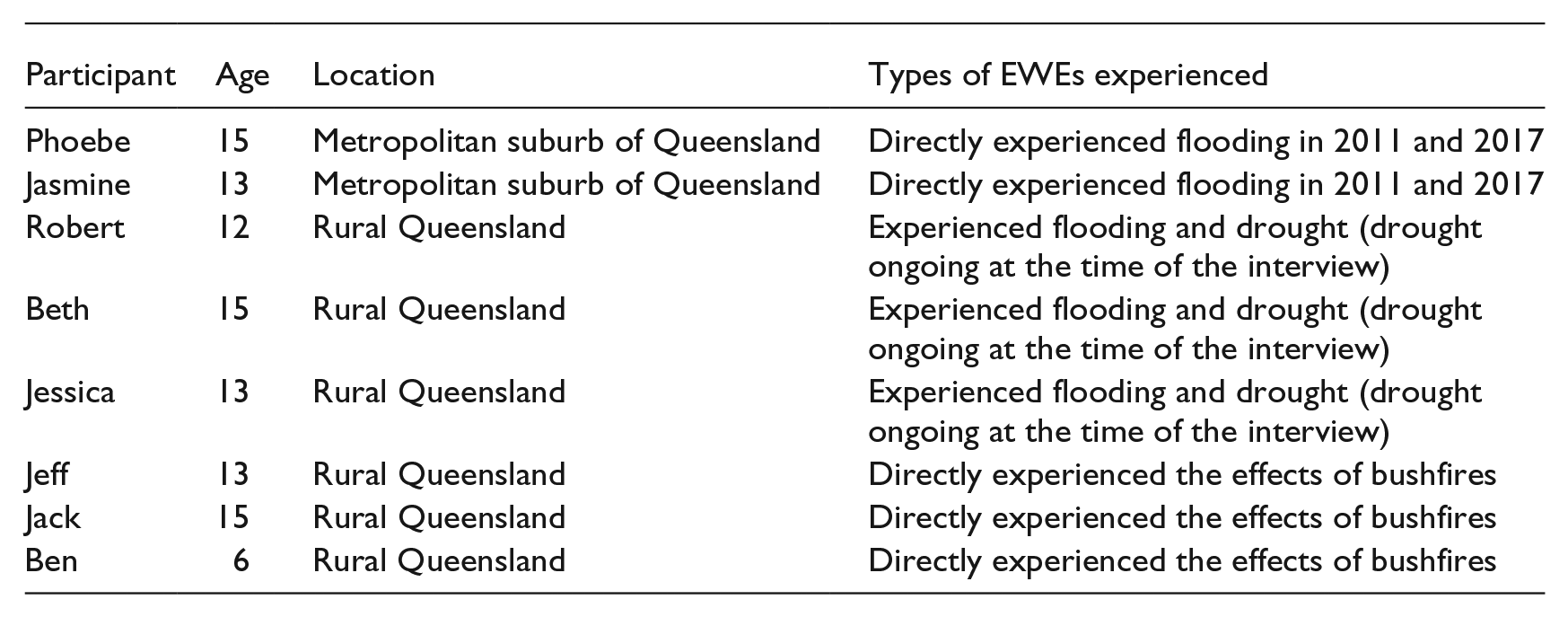
| Participant | Age | Location | Types of EWEs experienced |
|---|---|---|---|
| Phoebe | 15 | Metropolitan suburb of Queensland | Directly experienced flooding in 2011 and 2017 |
| Jasmine | 13 | Metropolitan suburb of Queensland | Directly experienced flooding in 2011 and 2017 |
| Robert | 12 | Rural Queensland | Experienced flooding and drought (drought ongoing at the time of the interview) |
| Beth | 15 | Rural Queensland | Experienced flooding and drought (drought ongoing at the time of the interview) |
| Jessica | 13 | Rural Queensland | Experienced flooding and drought (drought ongoing at the time of the interview) |
| Jeff | 13 | Rural Queensland | Directly experienced the effects of bushfires |
| Jack | 15 | Rural Queensland | Directly experienced the effects of bushfires |
| Ben | 6 | Rural Queensland | Directly experienced the effects of bushfires |
Appendix 2
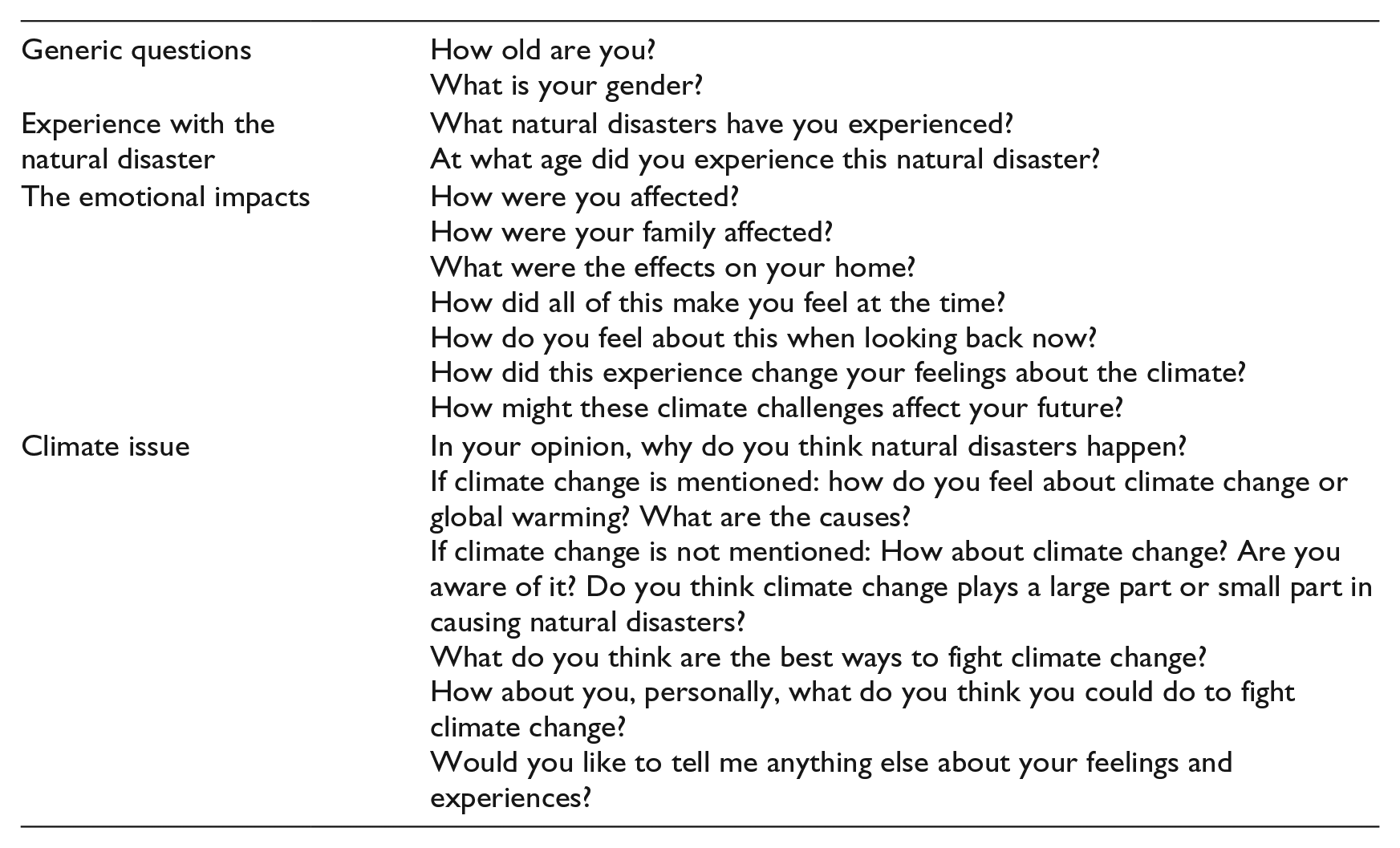
| Generic questions | How old are you? What is your gender? |
| Experience with the natural disaster | What natural disasters have you experienced? At what age did you experience this natural disaster? |
| The emotional impacts | How were you affected? How were your family affected? What were the effects on your home? How did all of this make you feel at the time? How do you feel about this when looking back now? How did this experience change your feelings about the climate? How might these climate challenges affect your future? |
| Climate issue | In your opinion, why do you think natural disasters happen? If climate change is mentioned: how do you feel about climate change or global warming? What are the causes? If climate change is not mentioned: How about climate change? Are you aware of it? Do you think climate change plays a large part or small part in causing natural disasters? What do you think are the best ways to fight climate change? How about you, personally, what do you think you could do to fight climate change? Would you like to tell me anything else about your feelings and experiences? |
Appendix 3
By using a transcription, participants’ various emotions were firstly identified by highlighting words associated with feelings to evaluate the emotional impacts of natural disasters amongst the participants. Some negative feelings that were repeatedly expressed by the participants were categorised such as stress and worry, which were then analysed in context to understand what kind of situations participants associated certain emotions with. These categorisations allowed to generate codes that were organised into tables and were evaluated to create thematic subheadings.
Funding
The author(s) received no financial support for the research, authorship, and/or publication of this article.
