



Abstract
In this article, we enact a partial cartographic storying of reconceptualist turns in our work. We do this by situating ourselves in relation to each other and our work across time as a mode of tracing the (situated) possibilities that these turns have enacted for children-in-relation with worlds. In enacting this dialogic and cartographic storying, we collaborate in a way that is inspired by Black methodologies. This means that we intentionally think with liberatory possibilities in our work in early childhood education research and practice across modalities, disciplines, temporalities and geographies. Importantly, like Black methodologies this co-theorizing is also ontological; it is inseparable from our own relational becomings. Following an anticolonial ethos, we are interested in the liberatory potentials of our work, at multiple scales and in different but specific places. We attempt to enact the difficult task of (re)storying our childhood education research and practice in ways that pay attention to the interconnected presences and effects of white supremacy, human supremacy and colonialism, while simultaneously refusing to reinscribe a flattened damage-centred understanding of children, educators and their relational worlds.
Thinking with Black methodologies in early childhood studies
We want to begin by articulating our approach to storying selected reconceptualist turns and (re)turns in our work including how this work holds dissonances and resonances with broader movements in the field of early childhood education. Our early childhood research crosses disciplines to think with Black and Indigenous feminisms, Black ecologies, critical posthumanisms, hydrofeminisms, scientific knowledge-making, erasures and more. In alignment with our commitments to interdisciplinary work, in this paper we undertake a transmodal storytelling approach thinking across disciplines with diffractive images, stories and cross-genre writings to engage with the ways in which our work has and continues to interrupt racisms, coloniality and ecological extractivism – particularly as interconnected effects in which early childhood education is intimately implicated. This approach to storytelling takes inspiration from Black methodologies in foregrounding creative approaches to making knowledge through interdisciplinary narratives that critically examine racisms and other oppressions while taking care to attend to livingness. McKittrick (2020) beautifully discusses this as the rebellious and subversive onto-epistemological possibilities of Black methodologies: . . .one of the many ways race and racism are manifested is through colonial and imperial knowledge systems that express and normalise discipline-based and place-based classifications that hierarchically organise (according to race, place) our epistemologies. Within black studies and anti-colonial studies, one can observe an ongoing method of gathering multifariously textured tales, narratives, fictions, whispers, songs, grooves; these narratives push up against and subvert prevailing colonial and imperial knowledge systems by centring and legitimising other (black) ways of knowing (p. 5).
As McKittrick’s words remind us, Black methodologies help us notice how our past-present-future research works to unsettle hierarchical, fixed and colonial knowledge-making about children and their relational worlds. Black methodologies underline our insistence on the necessity of inter-disciplinary approaches to transgress normative, oppressive and deficit onto-epistemologies of marginalized childhood(s). Rather than a progressional view of meanings, interpretations and articulations of our reconceptualist work, Black methodologies orient us towards partial knowledges-in-motion that interrupt linear temporalities. This shares resonances with a diffractive rather than reflective (re)turn and (re)reading of our work (Barad, 2007). Black methodologies also orient us to the world making capacity and liberatory potential of storytelling, while reminding us to carefully narrate relational stories in ways that do not reinforce deficit subjectification of ourselves and the communities that we work with. In this regard we turn again to Katherine McKittrick (2020), who emphasizes that livingness cannot be reduced to resistance to oppression. An important otherwise to the resistance/oppression binary trap is to engage anticolonial analytics that intentionally has parts of stories that lack clarity (or are not shared altogether) as strategic tactics to evade an essentialist and objectifying gaze (McKittrick, 2020). For the rest of this paper, we bring together the methodological orientations we have outlined here as we engage in dialogic encounters with our reconceptualist work in early childhood studies.
Storying practices of witnessing
Joanne, I think the first time we met (though virtually!) was in May of 2017 when I presented as part of a webinar to the reading group that you were part of at the University of Cape Town. I was presenting work drawn from my paper, Storying practices of witnessing: Refiguring quality in everyday pedagogical encounters (Nxumalo, 2016). In that paper I was working with primarily Donna Haraway’s figure of the modest witness to trouble normative prescriptive conceptions of quality in early childhood education. This figure created a way for me to engage with quality as having material-embodied-ethical-political effects, as more than a dominant discourse. I situated this refiguring of quality within selected more-than-human encounters within the context of my work with an early childhood centre in what is now British Columbia, on unceded Coast Salish territories. It has been an ongoing theme of my work to closely attune to and affectively think-with everyday encounters between place, children, educators and more-than-human others. In this article, I brought forward children’s and educators’ pedagogical encounters with lands, racoons and water through an analytic encounter with images taken during our forest encounters and during subsequent pedagogical inquiries. These encounters then became a place to trouble already known accounts of what counts as quality in early childhood education, particularly in relation to human-centric and binary hierarchies that these accounts hold in place. For instance, witnessing children’s encounters with a forest that holds past-present histories of settler colonialism including Indigenous people’s displacement, ecological damage and extractive capitalism, brought forward ‘quality’ as an unresolved question rather than an already-known measure. For instance, witnessing ‘nature’ as logged red cedar trees, English ivy and abandoned waste in this forest brought different questions about the kinds of childhood pedagogies that might be needed to respond to these inheritances (Figure 1). Such questions demand a situated affective ethics that cannot be fit into pre-defined quality identifiers. Joanne, I wonder how your work at that time intersected with mine and what your thoughts are in looking back to this time? This article was part of necessary engagements with possibilities for more-than-human perspectives to enact a shift away from universalized, human-centric, standards-based ways of thinking about quality in early childhood education. However, looking back I am struck by the ongoing intractability of early childhood education from developmental, neoliberal and individualist conceptions of quality – this includes environmental education, which in some contexts has been reduced to an ‘objectively rated’ checklist of developmentally appropriate measures and outcomes (Tilton, 2023).
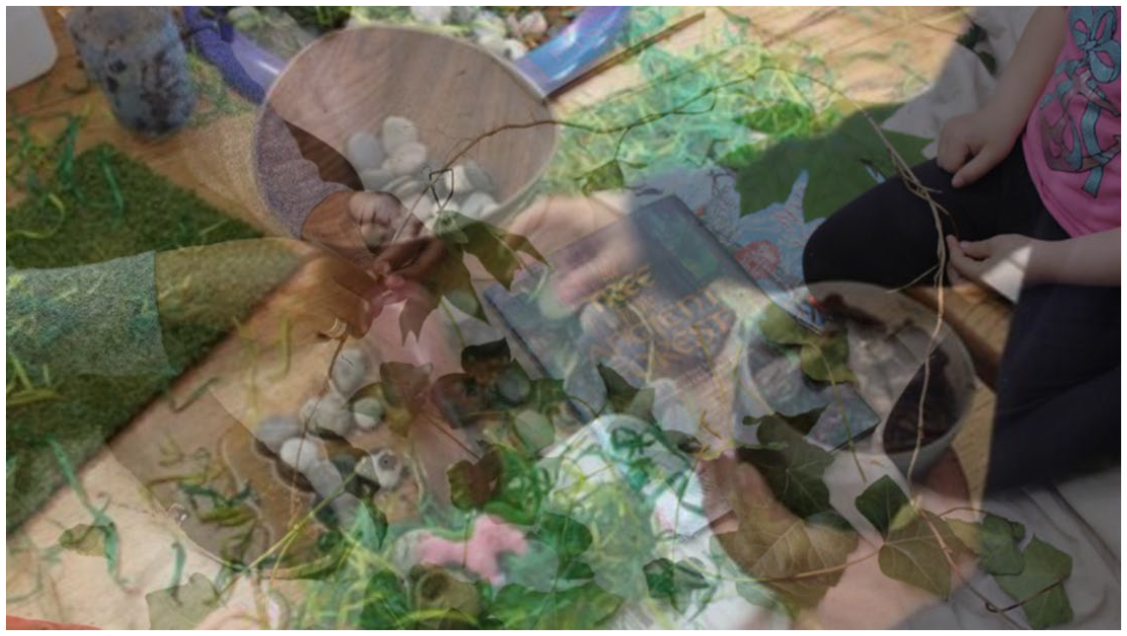
Reconceptualizing ‘quality’ in early childhood education.
It’s so interesting to look back and see that we were both, in different settler colonial contexts (me in South Africa, you in Canada) thinking through possibilities for complexifying quality in early childhood education through engaging more-than-human perspectives. I sense that it was part of what drew me to your research. I still remember reading your PhD thesis and connecting to your voice through your writing. At the time that you presented your webinar, I was in the thick of my Master’s thesis in which I intrawove material-discursive, textual, visual and auditory accounts of everyday early classroom encounters with critical posthumanist concepts to trouble narrow conceptions of quality in South African early childhood education (Peers, 2018). Before saying a bit more about this research, I want to briefly provide some context. Early childhood education in South Africa was up until recently not education but only development: more a form of active ‘under’ development (Rodney, 2018), where Black children have been actively left out. The recent National Planning Commission has only recommended 2 years of pre-school education, assuming once again that a national plan for increased employment and economic activity does not involve our youngest members. Their care is left to the informal sector and to the under-valued Early Childhood NGO and private sector. Situated within this context, in my research I worked diffractively with South Africa’s Curriculum and Assessment Policy Statement (CAPS) Life Skills Curriculum document to illustrate limits of current forms of documentation in the South African context. I engaged diffractive visual and textual methods to show the interruptive potential of different transmodal forms of pedagogical documentation that enrich and trouble dominant individualist, developmental and human-centric signifiers of quality. In reconceptualizing and refiguring quality, I sought more just ways of repositioning children as co-constructors of theories, thoughts and ideas through practices of pedagogical documentation that foregrounded attention to the multiplicity of ways children learn and relate with human and more-than-human others. In Figure 1, I have visually illustrated my intraweaving methods by diffracting an image from my research with an image from your forest-ivy-quality encounters with children. It is interesting to me how the binaries that underpin the notion of quality education remain entangled in my current doctoral research. I continue to work to disrupt binaries that separate nature and culture, adult and child and time and place. These binaries and dominant humanist views continue to limit research possibilities through colonial a Eurowestern understandings of relations.
(Re)storying posthumanist turns
Joanne since our first meeting around work on foregrounding human/more-than-human relations in early childhood research and practice, we have seen a proliferation of research that brings posthumanist and/or new material feminist theories into conversation with early childhood studies, including environmental early childhood education. The increased focused on questions of ontology, and on the need to undo human supremacy at multiple scales has been an important ‘reconceptualist turn’ in early childhood research and education. I think it is important to underline here that this is work is situated within Eurowestern knowledge paradigms, as is the majority of research in early childhood studies (Pérez and Saavedra, 2017). I say this to join others who have expressed a need to disrupt moves that universalize this posthumanist ‘turn’ towards ontology. This universalization (including through marginalizing ‘footnoting’ gestures) enacts erasure of multiply situated Indigenous knowledges that have always lived and theorized human/more-than-human worlds as consisting of interconnected, reciprocal and relational axiological and ontological orientations (see e.g. cautionary insights from Bang, 2020). In my own work, I am also interested in how the movements away from anthropocentrism that Indigenous ontologies, posthumanist, new material feminist theories each make in distinct yet resonant ways, can also be a part of resisting anti-Blackness (Nxumalo, 2021). I am committed to interdisciplinarity through knowledge making that works against anti-Blackness, coloniality and anthropocentrism in early childhood education. In conversation with the previous discussion on the dangers of universalization, this means that I need to be clear on where and with whom I make knowledge from in co-theorizing with perspectives that do not fit neatly together; namely critical posthumanist theories, and Black and Indigenous feminist theories (see Nxumalo and Tuck, 2023 for more on my grappling with the potentials and tensions of this work). Importantly, the ‘where’ of making knowledge is inseparable from the ways in which I enter the world; ways which are partially and always insufficiently described by naming (Ndwandwe clan, Canadian immigrant, Black, feminist, anticolonial scholar-activist, motherscholar, pedagogical facilitator, early childhood educator. . .). I am also continuing to learn from Black and Indigenous scholars who complexify the binary logics of inclusion/exclusion while noticing absences and erasures in citational practices. At the same time this work helps me to articulate the necessity of anti-colonial, reciprocal, in-depth and mind-body engagements with method- and knowledge- making (Liboiron and Smiles, 2021; McKittrick, 2020). As McKittrick (2020) beautifully says:
Perhaps the function of communication, referencing, citation, is not to master knowing and centralize our knowingness, but to share how we know, and share how we came to know imperfect and sometimes unintelligible but always hopeful and practical ways to live this world as black (p. 17).
Here, citation as knowledge-making and method-making is expanded beyond the ‘academic’ – in my work this includes thinking-with lands, waters, my grandmother’s teachings, young people’s performance of a creation story, climate change stories from elders in my Nkambeni community. . .and more (Nxumalo and Montes, 2023; Nxumalo and Villanueva, 2020; Nxumalo, 2023). Thinking alongside Black, Indigenous and Black-Indigenous anti-colonial scholars, I continue to work with the ethical commitments that are brought forward by thinking ‘posthumanist turns’ alongside Black childhoods in settler colonial places (Figure 2). Joanne, I am inspired by the deeply affective ways in which you weave critical posthumanist work in thinking childhoods, lands and waters alongside ‘post’ apartheid legacies in South Africa (see https://relationalresearcher.com/ for Joanne’s beautiful textual and visual work). Your work to me is an important demonstration of the necessity of ‘undisciplined’ interdisciplinarity in co-theorizing with posthumanist thinking-becoming-doing alongside childhoods.
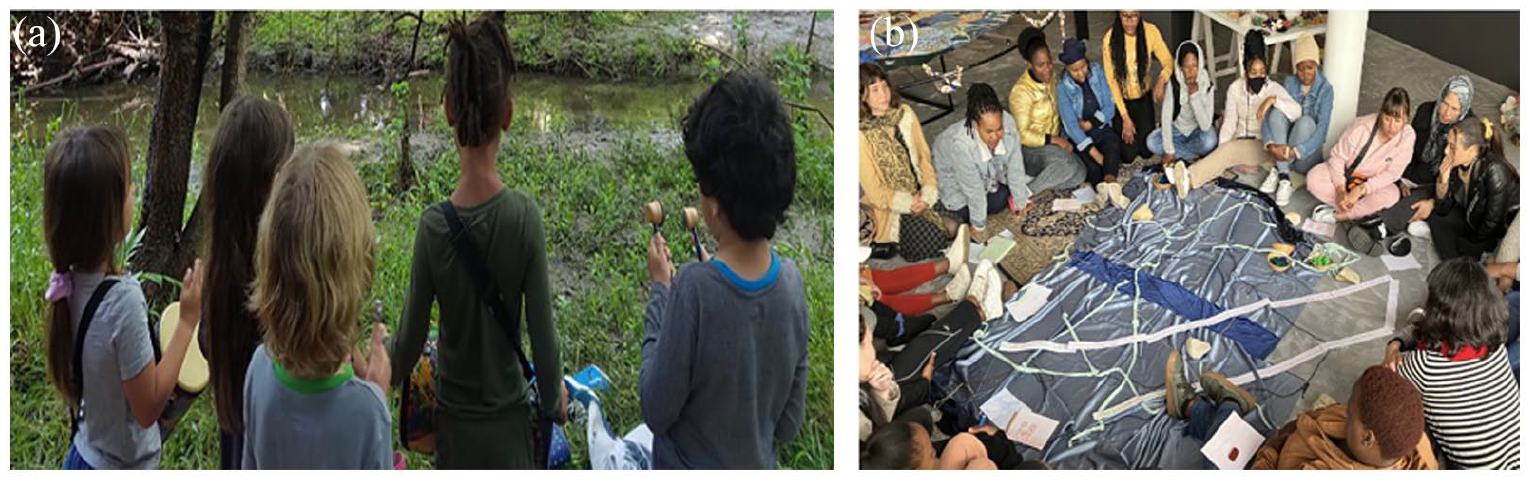
Thinking with water: singing to creek waters, listening to ocean kraals.
Thank you Fikile. I am struck by the ways in which our work has both turned to watery relations to shift humanist, colonial and racist educational places and spaces. Like you, I have brought critical posthumanist work into conversation with Black feminist and anticolonial work to unsettle ‘education-as-usual’. For example, in my recent work I have been engaged in embodied theoretical and pedagogical work to think with the waters of Camissa (colonially known as Cape Town). I share here an excerpt of this writing-in-progress that I think diffracts beautifully with your offering on thinking Black childhoods affirmatively and in relation with the more-than-human. It draws from my work with students in an early childhood teacher education programme on a storytelling inquiry with ocean kraals that worked with colour, crayons, threads and song to invite them to cast nets into haunted waters (see Figure 2). Ocean kraals are ocean baskets designed as fishing sites and are scattered all along the south coast of South Africa, utilized in pre-colonial times for fishing purposes. In this work I see resonances with yours Fikile in how we both work with the possibilities of storytelling as disruptive ‘receonceptualist’ acts of collective remembering and colourful knowing, doing and becoming in early childhood education.
South Africa is haunted. Disorderly ghostly matter/s surface, sink and drift in the ocean and shorelines. The sites of Camissa, ǁkhamis sa, translated as ‘place of sweet waters’, carry the history of colonisation and Apartheid, characterised by segregation and exclusions (Camissa Museum, 2022). Camissa is not separate from global waters and land but always already a part of entangled violences of settler colonialism, land dispossession, slavery, transnational labour exploitation, extractivism and omnicides (Ghosh, 2021; McKittrick, 2006; Sharpe, 2016). Early childhood education shores are polluted by the debris of Apartheid’s education segregation laws and continues to affect the majority of young children in South Africa. The sedimented separation of relations between black bodies and environments (which includes space, place and other species in their materiality) lingers in the ongoing erasures of histories of knowledge, peoples, animals, oceans, plants and land, and continues to affect early childhood education. These erasures are embedded in single and simplified knowledges and stories in early childhood educator teaching education classrooms.
As a brown body, woman, researcher, mother, wife, scholar, daughter and child of Apartheid it means being truly present in and with time. So how does this make me think differently about freedom? When I visit St James tidal pool with my family we are not only engaging with the present day tidal pool waters in which we can swim, we are also affected by the fact that it was illegal for me to swim there as a child. With this in mind, I am becoming more response-able about actively staying with the trouble, making murky the perceived free and clear ocean waters of False Bay for all bodies equally. We are not living in a time where we can simply say the water is now open to all. How should this make us think about privileged bodies in water? How should we actively pay attention to the marks on brown bodies who have yet to enjoy those same freedoms? An urgent re-storying is needed in order to unravel colonial practices of education and resurface Indigenous knowledges, stories and relations (Nxumalo, 2020). How can environmental storytelling make the invisible erasures visible and furthermore produce new histories in early childhood classrooms? The stories of ocean kraals are washed out to sea in colonial history; absented from education spaces. How can educators and children work with ocean kraals as a place of care in early childhood classrooms?
Re(turns) towards testifying-witnessing
As we engage in this dialogue, we are witness to ongoing impacts of war on children around the world. The catastrophes in Gaza, Congo and Sudan continue to have horrific impacts on children. Here are just a few of the devastating headlines:
The Gaza Strip is the most dangerous place in the world to be a child. And day after day, that brutal reality is reinforced. (UNICEF, 2023a) At least two million children have been forced from their homes since the conflict in Sudan erupted four months ago – an average of more than 700 children newly displaced every hour. (UNICEF, 2023b) More than 5% of children in the Democratic Republic of Congo area now displaced after the number of people forced from their homes rose by 27% in the past four months amid escalating violence. (Save the Children, 2023)
It feels important to speak on these injustices, from my own partial and situated perspectives. It feels imperative to respond, at multiple individual and collective scales, to some (how do I decide what to respond to?) of the ongoing systemic, onto-epistemic and material violences that children continue to be subjected to in places both near and far to my current location; places that may not seem to be connected to my research. This is not to disregard a critical attunement to the proximity of the statements such as the ones that I have quoted above to: universalized Global North understandings of child rights and child-nation development; the disaster industrial complex; and to the unsettling ‘arithmetic logic applied to both the preservation and loss of life’ (Alagraa, 2021, para. 8). I am heartbroken that the brutalities continue unabated; even as we witness, in the case of Gaza, what has been called a ‘livestreamed genocide’; ‘the first genocide in history where its victims are broadcasting their own destruction in real time in the desperate so far vain hope that the world might do something’ (Ní Ghrálaigh, 2024). How might ‘reconceptualist turns’ in the fields in which I situate my work (including early childhood education, childhood studies and children’s geographies) respond to the question of what it can look like to individually and collectively bear witness
In creating shifts away from passive witnessing, to what I call testifying-witnessing, I humbly learn from Black feminisms and Black modes of living to notice and respond to injustice in storied (and sometimes speculative or imaginative) ways that also affirm complex ways of belonging, living relationally and making place and place relations. Relatedly, I learn from multiply situated Black cultural traditions of testifying (and responsive witnessing to this testifying) that expose the violence of racism while also relationally, creatively and inventively refusing singular narratives that define Black life only through the lens of oppression and/or resistance (McKittrick, 2021; Tarpley, 1995). This is difficult work – working through, in a particular context, what it can look like to notice and respond to violence in ways that attend to life yet also do not reinstate the subjectifying distortions of vulnerable/resilient; oppression/resistance, joyful/unhappy; damaged/innocent binaries and the particular ‘stickiness’ of these binaries to marginalized and racialized childhoods.
I see resonance with your call Fikile to testifying-witnessing with feminist new materialist and Indigenous orientations towards relationality. According to Indigenous and feminist new materialist ontologies we are already in relation (before we can claim who we are) – both are grounded in relationships. Southern African Indigenous onto-epistemologies of Ubuntu (before they got Humanized), recognized the reciprocal relations between and among humans, plants, places and animals. What might it look like for reconceptualist early childhood education to centre reciprocity and relationality with human and more-than-human worlds both near and afar to the contexts in which we work? For instance, in my collaborative work children, water, teachers, crayons, education students and the ocean, I have been affected by the potential of stories which have been invisibilized. This opens the possibilities to disrupt notions that we need to look to a future concept to finds relational ways to thrive. Instead, the act of re-membering draws on our embodied ontologies and epistemologies, a powerful rendering of ways of being and knowing that we have been forced to forget. Our call is to notice the erased, the discarded and the used up excesses of our consumer world. This has opened the way for new kinds of stories to emerge in relation with South African early childhood teacher education. Caring for our world means that throwing ‘away’ is no longer an option. There is no ‘away’. Thinking with and caring for one another and our shared environment requires us to listen attentively to the quiet, less dominant voices and the wealth of stories that can create new connections and energies among us that can point the way towards differently possible futures.
I return to this question: What might it look like for reconceptualist early childhood education to centre reciprocity and relationality with human and more-than-human worlds both near and afar to the contexts in which we work? In attempting to testify-witness Palestinian childhoods, I have joined a global collective of childhood studies researchers and students in a
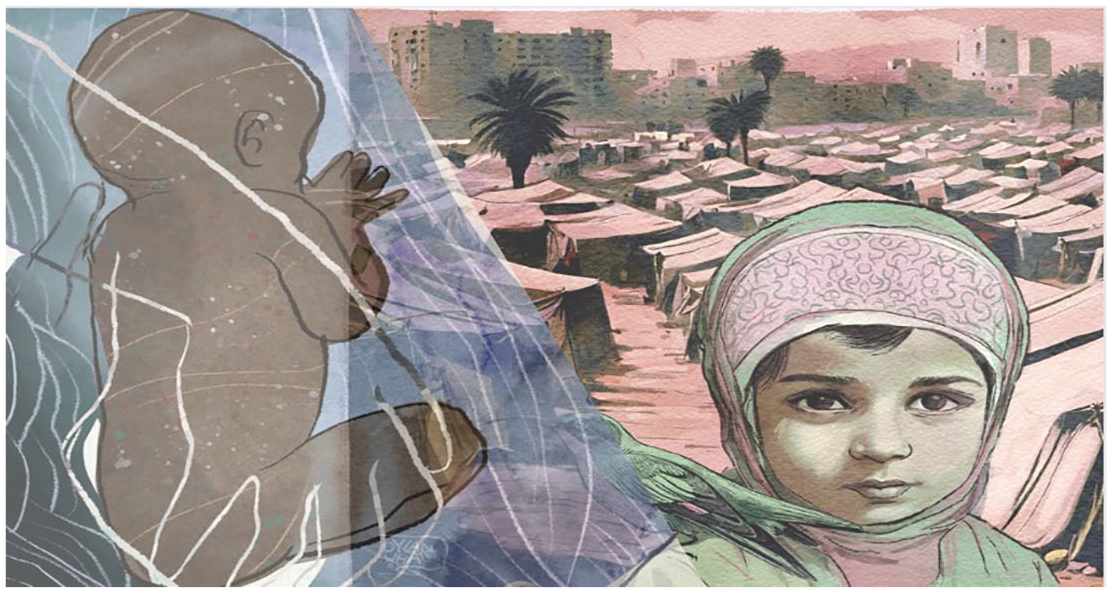
The revolution has many lanes (right hand image courtesy of Dylan McGarry).
Dear Salma
I have watched many times the short heart wrenching clip of you mourning the death of your beloved bird, killed due to airstrikes in your community. I am writing to let you know that I have thought of you often with worry about all the losses that you have endured. I wanted to write to you to tell you about the beauty that I saw, imagined, and was moved by in this brief video moment.
I noticed your lovely brown heart print dress; a beautiful reflection of your love and care for the bird you gently held in your hands. I imagined many beautiful moments you had shared with the bird before and during the devastation of your community.
I noticed that others around you tried to console you and helped you to bury your bird in a plant pot; beautiful gestures that reflected the love and care that surrounded you in that moment. My hope is that you continue to be surrounded by love and care through both joyful and difficult times.
I noticed your little hands in the soil as you buried your bird; I imagined and hoped for you Salma, many beautiful past and future moments in relation with Palestinian land and land stories.
I noticed your beautiful bright green bird and was curious about what kind of bird it was; I looked up birds in Palestine and was not sure what bird your bird was; perhaps it was a parakeet. In reading about birds in Palestine, I learned about the Palestine Sunbird طائر الشمس الفلسطيني which is the bird perched on the shoulder of the Palestinian girl in Dylan’s drawing. I read that the Palestine Sunbird holds many teachings, including teachings about Palestinian freedom, hope, and strength. I imagine and hope for you Salma many past and future storied relations with birds in Palestine and their teachings. I hope you are ok.
Ceasefire now!
In solidarity, Fikile Nxumalo
I have responded to your offering by diffracting the bird-child-camp image with a co-created image from the Crayons and Ocean Kraals story and by adding (bolded) poetic text in your letter. Diffracted through your call, Salma and the birds of Palestine is an offering from the children in Camissa. The colour brown reminds us of custodianship and care. Fierce care which is founded on relations that aren’t about separateness or bounded landscapes, but always already for collective freedom and custodianship. I have also chosen to respond with a piece of co-created artwork of an ocean kraal (Figure 4) re-entitled From the River to the Sea(s). I invite the reader to testify to and witness the affects and call to action of our entangled imagery and words.
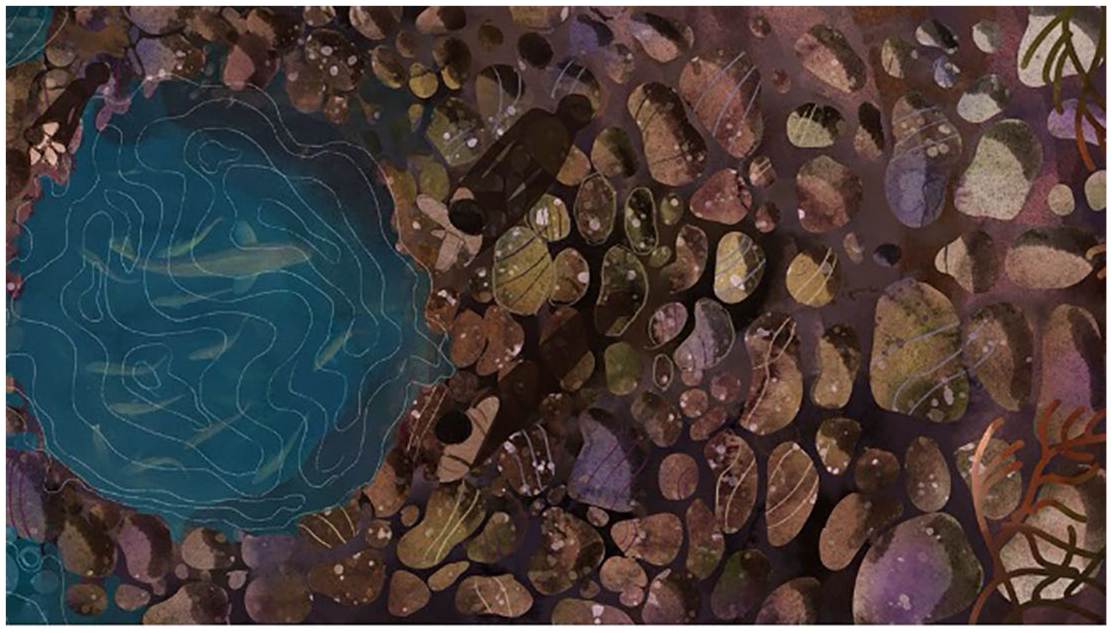
From the river(s) to the sea(s).
Concluding thoughts
We intentionally return to the question posed earlier: How might ‘reconceptualist turns’ in the fields in which we situate our work (including early childhood education, childhood studies and children’s geographies) respond to the question of what it can look like to individually and collectively bear testify-witness to structural violence against young children; even with the knowledge of the inadequacies of our responses in ending this violence? What does it mean to ‘reconceptualize’ childhood if it is not to actively work towards (organize, write, dream, teach, draw, plant, dance, swim, march. . .and more) – in particular spaces, places, moments and encounters – creating more liveable human and more-than-human worlds?
Footnotes
Funding
The author(s) received no financial support for the research, authorship, and/or publication of this article.
