




Abstract
In this paper, we highlight climate change pedagogies within the context of an Indigenous Summer Encounter for Latinx and Indigenous children led by Miakan-Band Elders, members of a Central Texas Coahuiltecan community. We focus on anticolonial cartographies activated through movement, sound and performance that enacted Indigenous fugitivity, futurity, and relationality; pedagogical attunements that remain undertheorized as approaches to climate change education. In engaging with these pedagogies as climate change education, we are interested in contributing to recent work that resists the disciplinary boundaries of what typically counts as climate education and invites expansive and interdisciplinary approaches to climate change education. This includes approaches that inquire into how climate change education can be a site to nurture reciprocal relations with the more than human world. In particular, we highlight the Summer Encounter as illustrating possibilities for anticolonial climate education that engages creative pedagogies in foregrounding Indigenous relational onto-epistemologies with young people. We discuss the potential of this work as climate change education that actualizes and dreams more livable futures.
Keywords
Introduction
Amidst the ongoing and interconnected effects of colonialism, racial capitalism, and extractivism, vulnerability to current times of environmental precarity is highly inequitably distributed. As Farhana Sultana (2022) states; “climate coloniality occurs where Eurocentric hegemony, neocolonialism, racial capitalism, uneven consumption, and military domination are co-constitutive of climate impacts experienced by variously racialized populations who are disproportionately made vulnerable and disposable” (p. 4). Amongst these vulnerabilities are disproportionate impacts of climate change on Indigenous peoples who have experienced hundreds of years of dispossession from lands and waters. Alongside this dispossession Indigenous peoples continue to protect the vast majority of the earth’s biodiversity (Bang et al., 2022; Garnett et al., 2018).
Clearly, Indigenous communities have invaluable insights on responding to climate change and its effects on relations with lands, waters and animal life. It is therefore critically important to find ways to resist the ongoing erasure, marginalization or superficial inclusion of Indigenous peoples, relational knowledges and lands in dominant forms of climate change education. This includes disrupting colonial anthropocentric constructions of the more-than-human world. As Megan Bang states succinctly, “climate justice can’t happen without Indigenous peoples” (2022, p. 152). Bringing this assertion to contexts of education is filled with generative possibilities. For instance, it brings forward multiple questions, including: How can pedagogical environments that are focused on issues of ecological precarity disrupt human centrism by foregrounding Indigenous epistemologies of entangled nature-culture relations (Bang and Marin, 2015)? How might such pedagogical environments also be designed in ways that disrupt extractive relations with the more-than-human by centering emplaced Indigenous onto-epistemologies of relationality, responsibility, reciprocity and care (Bang, 2020; Nxumalo, 2021a)? What might it look like to design pedagogical environments such that they intentionally resist material, ontological and epistemic injustice by actively resisting the emplaced effects of settler colonialism?
In this paper we enter these questions through a particular focus on the anticolonial potential of embodied, creative, interdisciplinary pedagogies that center Indigenous onto-epistemologies and that push against the boundaries of what typically counts as climate change education. We draw inspiration from work that has underlined the necessity for educational responses to climate change to include interrupting extractive and human centric relations to lands and waters. In this work, climate change education is not only about knowledge making, it is also an anticolonial onto-epistemological concern that requires a radical shift in dominant colonial ways of knowing and becoming with lands and waters (Bang et al., 2022; Nxumalo et al., 2022; Yanchapaxi et al., 2022).
Responding to the imperative to refuse coloniality in all its forms in climate change education, the purpose of this paper is to center the potentials that emerged from a Summer Encounter led by Coahuiltecan elders that included a focus on pedagogies and curriculum-making in relation with lands and waters. All aspects of the curriculum were grounded in Indigenous presencing, knowledges and relations. Indigenous presencing actively interrupts the marginalization and/or erasure of Indigenous people, onto-epistemologies and relations from specific places (Simpson 2011). We have both been witness to the particular insidiousness of Indigenous erasure in Texas education and environmental research spaces. Our research collaboration was designed as an active resistance to this erasure, centering Coahuiltecan-based understandings of living in relation to lands and waters. Coahuiltecan onto-epistemologies guided the entirety of the Summer Encounter. In this research, we filmed and photographed the daily pedagogical encounters as forty young people aged 4 to 14, came together with elders and camp facilitators from 8:30 am to 6 pm each day over 5 days in summer. The young people responded to and co-created the curriculum through visual arts, poetry, dance, song and theater.
While refusing neoliberal individualist discourses of environmentalism, we insist on the mattering of small, everyday pedagogical moments in making more livable worlds. Therefore, we focus in on small events within the Summer Encounter. We also intentionally take an expansive view of climate change education to include education that seeks to interrupt extractive relationships with the more-than-human world and that view humans as separate from and superior to the more-than-human world. We are interested in how anticolonial climate change education might be part of cultivating reciprocal ways of relating to the more-than-human world as an intrinsic part of living with ecologically damaged lands and waters.
Alongside our previously stated intention of disrupting Indigenous erasure and marginalization, our intent is to think through and make visible expansive possibilities for creative education to be an important part of anticolonial climate change education. Attending to selected moments during the Summer Encounter’s performing and visual arts pedagogies, a key intent of this work is to think with anticolonial creative expression as a site of affective knowledge-making and world-building that matters for climate justice. We conclude on the scholarly significance of this work in relation to what it might offer to pedagogical possibilities for countering the coloniality of climate change education. We underline the importance of interdisciplinary teaching and learning as important sites of enacting climate change pedagogies that matter for young people growing up amidst the challenges of escalating and unevenly distributed environmental precarity.
Situating
The Summer Encounter is situated within the context of Central Texas on the lands of the Alabama-Coushatta, Caddo, Carrizo/Comecrudo, Coahuiltecan, Comanche, Kickapoo, Lipan Apache, Tonkawa and Ysleta Del Sur Pueblo (Division of Diversity and Community Engagement, 2021). Central Texas is also home to many more Indigenous communities. Due to the complex and violent history of colonial border separation in Texas and Mexico, many Indigenous peoples were dispossessed of their ancestral territories (Guidotti-Hernandez, 2011), subsumed within the racial project of mestizaje (Urrieta, 2017), and have had their sociopolitical efforts undermined by federal and state recognition policies (Chavana, 2019). Within Central Texas, the Summer Encounter took place in what is currently known as San Marcos, Texas. Ajehuac Yana is one of the Coahuiltecan names for this place, which also names the sacred springs currently known as Spring Lake. Ajehuac Yana holds the creation story of the Coahuiltecan people as shared by the Miakan/Garza Band. Ajehuac Yana waters were an intrinsic part of the Summer Encounter, including through water ceremonies at the sacred spring and indoors; embodied and creative teachings of the Coahuiltecan creation story through drama; creative writing invitations and, through expressions of relationality with and gratitude to the waters through song and dance. Alongside situating Central Texas lands and waters as participants in the Summer Encounter and in our research, we also want to name our ethical and political commitments to the places and people where this research is situated:
Fikile: Currently living in settler colonial Canada, I come to this work as a Black Swazi (Ndwandwe clan) feminist environmental educator with a commitment to unsettling individualized Western scientific knowledge as the dominant way of learning about climate change, and relatedly, the marginalization of Black, Indigenous and Black-Indigenous knowledges in climate change education. Our collaborative research was situated within a larger project that aimed to investigate, at multiple scales, what can be learned about water related adaptation to climate change within the context of Central Texas (Planet Texas 2050, 2020). My immersion in the everyday activities of the week-long Summer Encounter is one part of a collaboration on anticolonial water pedagogies and relations with the Coahuiltecan elders, Dr Mario Garza and Maria Rocha, who design and lead the Summer Encounter. My central intent in this research is to witness, affirm and collaboratively share anticolonial Indigenous pedagogies and curriculum-making. I also enter this research with an ethical commitment towards Black, Indigenous and Black-Indigenous liberation as inter-connected, including in relation to liberatory responses to climate change induced precarities.
Pablo: I am descendant of the Chichimeca Guamares and the Purépecha people from the valley of Huatzindeo (Salvatierra, GTO, Mexico), specifically from a small rancho at the foot of the Culicán mountain and am an active Danzante Mexica (Aztec Dancer) with Danza Ollinyolotl and Mitotiliztli Yaoyollohtli. Currently living in Kirikir?i:s (Wichita) territory, my educational praxis is embedded within the traditional teachings of my family, the Land, and Indigenous onto-epistemologies. I center and deeply value the stories and knowledges that surge from lived experiences, intergenerational teachings, and community-based learning. I have been in relation with the Miakan/Garza Band since 2017 and served as the Native Youth director for the annual Summer Encounter for 4 years. Through this participation, I cultivated a beautiful relationship with Coahuiltecan elders, Dr Mario Garza and Maria Rocha. The Summer Encounter came to our elders as a vision to teach Indigenous and Latinx youth the depth of their ancestral culture and practices. As such, this work is always in relation and serves to amplify the educational endeavors that the Indigenous communities in central Texas have created and continue to create.
Conceptual-ontological-methodological threads
We are interested in making visible the anticolonial forces that are activated when children, youth and educators come together to perform in reciprocal relation with Yana Wana – spirit of the water 1 . In the specific context of this work within the places and spaces of what is known as San Marcos, Texas, we use ‘anticolonial’ to refer to ruptures in colonial knowledge-making that erase Indigenous lands and relational knowledges, that center individualism and human-centrism, and that discipline and narrow knowledge about and responses to the climate crisis into Western scientific and techno-scientific enclosures. Importantly, while ‘anti’ suggests resistance to coloniality, the anticolonial pedagogical work that we seek to make visible in this paper is much more than a resistance to coloniality. Beyond resistance, this pedagogical work is a form of liberatory world-making that exceeds knowability through the effects of colonialism. As Black and Indigenous studies scholarship teaches us, it is important to find ways to avoid repetitions of damage-centered forms of inquiry that are based on a theory of change centered on revealing or describing racialized and colonial injustice and harm (McKittrick, 2019; Tuck, 2009). We are interested in inquiry into pedagogical practices and/as relational knowledges that do the challenging work of recognizing the colonial and racialized causalities of ecological precarity yet are not centered on illustrating or proving injustice and harm. As an otherwise to proving injustice or harm, we are interested in relational worldings –real, desired imaginary worldings that such practices and knowledge activate. In gathering our conceptual orientations, we intentionally bring Black and Indigenous thought into conversation to underline entangled resonances between Black, Indigenous and Black-Indigenous conceptions of liberation in settler colonial contexts (King, 2019).
An underpinning orientation of our work is the necessity of interdisciplinarity in climate change education. Katherine McKittrick (2016) beautifully describes the effects of interdisciplinarity in relation to Black Studies as “forging relational knowledges [that] assist in anticolonial academic research and teaching while also disrupting biocentric scripts, disciplined ways of knowing, and the spatial workings of knowledge” (p. 4). We see this as resonant with the need for climate change education that disrupts (Eurowestern) human-centric logics and unsettles the separating out of the (Western) science of climate change from the ethics and politics of climate change including potential responses. This is to say that we see anticolonial interdisciplinary pedagogies and curriculum as offering one way out from individualized Western scientific knowledge as the dominant way of learning about climate change. Interdisciplinarity holds potential in situating climate change education as a collective social and ethical concern that requires engagements with the conditions for creating “just, sustainable, and culturally thriving futures” (Bang, 2020: p. 434).
In making visible the anticolonial potential of the Summer Encounter as interdisciplinary climate change education, we turn to work in Indigenous studies for a conceptual framing of the Encounter’s pedagogical orientations. In previous research, Fikile turned to Cree scholar Karyn Recollet’s (2015) theorizations of the anticolonial impact of round dancing in urban spaces to think through how young children’s sustained collective pedagogical encounters with situated Indigenous water songs in urban spaces are also anticolonial counter-mappings against settler colonial erasure (Nxumalo and Villanueva, 2020). Here we return to Dr Recollet’s work to help us co-theorize the importance of creative embodied expression as modes of activating real and imagined thriving human and more-than-human futures. Such creative expression is simultaneously collective and embodied and is situated in and responsive to particular lands and waters, which as we discussed earlier, is an important pedagogical response to climate change and ecologically damaged places. Karyn Recollet (2015) discusses the ways in which collective embodied movements are pedagogical modes of Indigenous presencing in urban spaces. Dr Recollet puts forward the complex concept of glyphing to describe the ways in which Indigenous motion as “choreographic fugitivity” (p. 93) can be seen as mappings of Indigenous futurity that foreground Indigenous land and life and activate human/more-than-human radical relationality; where: Music, dances, and other forms of persistent Indigenous motion activate specific spatial/temporal cartographies in much the same way that petroglyphs activate Indigenous presence on land/sky spaces. This work is rooted in the premise that we build a relationship with the land through activating it. What then, are the lexicons of land and territories, and how can we activate (re)mapping to explore the futuristic narrative of complex land histories? (p. 91, emphasis added).
Thinking alongside glyphying as a mode of theorizing anticolonial creative pedagogies, orients us towards four interrelated aspects of such pedagogies as highlighted in the previous quote; they are spatially and temporally cartographic; they enact fugitivity through particular choreographies; they materialize Indigenous futurities and, they center human/more-than human relationality. Importantly these pedagogical concepts are ontological, epistemological and methodological. As Karyn Recollet (2015) teaches us, glyphing is a mode of knowledge-making (for instance as a mode of understanding emplaced Indigenous futurities) that is also ontological (for instance the affective becomings of Indigenous presence that take place in collective movements of round dancing). This onto-epistemic articulation is also resonant with work in the context of Bawaka Country in what is currently Australia that has shown the ways in which everyday Indigenous practices of “relational creativity” are ontological – co-shaping relationality with and responsibility for, places and more-than-human relations therein. These practices, which include multimodal practices of intergenerational knowledge-sharing such as story-telling, movement, singing and weaving in relation with more-than-human kin are also methodological (Country et al., 2022: p. 436).
In resonance with these invitations to interconnect “empirics, methodology, and theoretics” (p. 436), our methodology also involves attuning to the ways in which situated creative pedagogical knowledges-concepts-practices enacted anticolonial relationality, cartography, fugitivity and futurity. These pedagogical knowledges-concepts-practices are engaged as theories of change in relation to materializing anticolonial climate change education. In entangling methodology with ways of relational knowing and becoming, our approach is also resonant with postqualitative methodologies that work with concepts as method (Jackson and Mazzei, 2022; Taguchi and St Pierre, 2017). Like these approaches, our inquiry is guided by the interruptive provocations that particular concepts bring to ‘data’ rather than starting with a pre-determined method of analysis. Such approaches also invite attentiveness to the onto-epistemological mattering of multisensorial encounters with the more-than-human. For the remainder of the paper, after introducing each pedagogical orientation, we think selected pedagogical moments of the Summer Encounter as interconnected onto-epistemological enactments of anticolonial cartographies, fugitivity, and futurity. In addition, threaded throughout, is a discussion of the ways in which relationality is an intrinsic part of each of these anticolonial enactments of climate change education. Attention to relationality builds on our previous work underlining the importance of relationality and reciprocity with lands and waters as an integral part of anticolonial climate change education. (Nxumalo and Montes, 2021; Nxumalo, 2021a).
Cartographic interruptions
What kinds of pedagogical commitments emerge if we insist that climate change education must include sustaining and nurturing anticolonial relations with more-than-human life? What commitments emerge from climate change orientations that seek ways (situated in particular places and spaces) to center Indigenous land and land relations? One possibility is that these questions suggest careful attention to the ways in which climate change education enacts mappings and re-mappings (cartographies) of emplaced Indigenous relationality with the more-than-human world. Here cartographies refer to sonic, affective, embodied mappings of emplaced, temporal and spatial more-than-human relationality (Recollet, 2016). Our emphasis on emplaced is intentional – an attunement towards cartography means that the where of these pedagogical practices is central to the ways in which they emerge and are activated. Importantly, we work with an anticolonial conception of cartography that while situated in time and place, works with non-linear conceptions of time; an important refusal of encountering Indigenous knowledge in static or binary ways. We see such complex cartographic enactment in this example from the Summer Encounter. On the last day of the Summer Encounter, a large canopy tent has been set up on the grass next to Ajehuac Yana, the Sacred Springs. The children are dressed in bright blue shirts and protective red head bands, both of which they have hand made themselves. The sound of hand rattles accompanies their movements as does the sound of ayoyotes (made from the seeds of the ayoyote tree) which are wrapped around their ankles. Family and community members are assembled in a circle to watch this performance of a Coahuiltecan creation story that the young people have been rehearsing all week. As the children find their positions for the beginning of the performance, they repeat “Mother Earth, Father Sky: Beauty, Strength, Wisdom I am”.
Accompanied by a narrator, the children embody the moon, water, spirits, people, a deer and a water bird. Through movement and song, they collectively enact a Coahuiltecan creation story. The story tells of the emergence of the Coahuiltecan people from the Sacred Springs. The Springs are visible from the setting of the performance; an active presence in the children’s performance. In the story, people, animals, sky, moon, water are in reciprocal relationality. This relationality maps space and time in complex ways in its situatedness at the Sacred Springs – the storied place that is the site of the children’s storytelling; storytelling that has occurred across multiple generations. The presence of the children and their families in this place on this land (now part of a university), the singing, the rattle sounds, the dance movements of the children as they embody human and more-than-human ancestors (Figure 1), the words of the narrator, the clear green-blue moving waters of the Sacred Springs, the sun’s shifting glittery effects on the water, the affective responses of all those (human and more-than-human) that are witnesses to this encounter…and more, all come together to presence and (re)map Coahuiltecan land relations. The enactment of the creation story in this particular place that has seen the waters commercialized and contained by a dam, can be seen as anticolonial embodied mappings of Indigenous past-present-future geographies. We witnessed this moment as a re-creation of creation, as ceremonial cartography and as spiritual commitment to re-establishing and thus sustaining kinship between the community and Ajehuac Yana despite the presence of commercialization and water containment in the form of a dam and a submerged amusement park right behind the young people. Choreographing the creation story at Ajehuac Yana.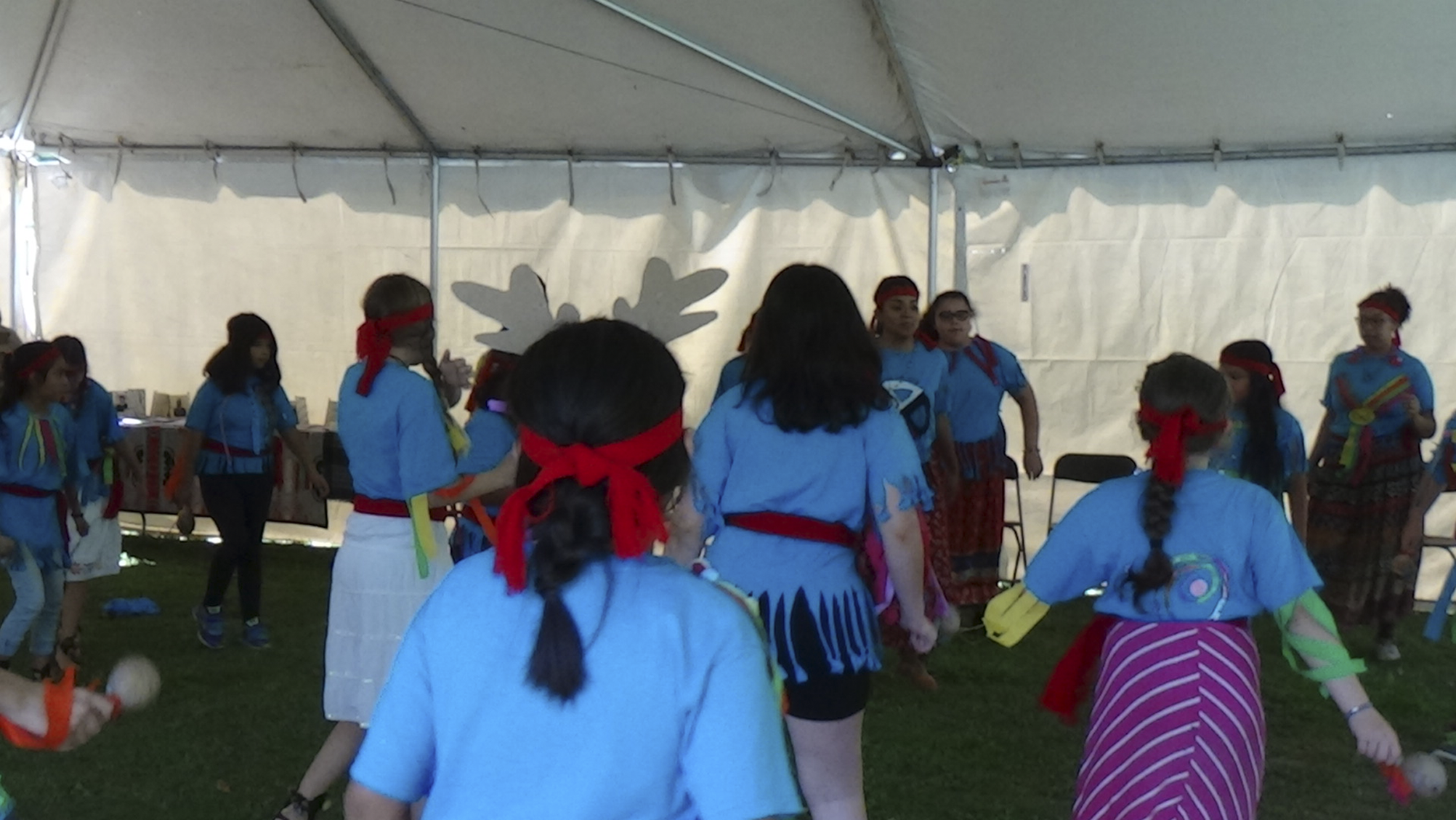
Thinking with cartography helps orient to the anticolonial reverberations of the young people’s collective movements. We suggest that these cartographies of anticoloniality can be seen as enacted through a co-mingling of three interrelated effects of movement. These effects include the young people’s relating (ontological movements) with imaginatively storied and physically present more-than-human relatives. They also include the embodied ways of knowing (epistemological movements) that emerge in relation with embodied sonic expression. Importantly the underlying ethical commitments and responsibilities (axiological movements), that are foregrounded through the centering of the creation story performance, are also a part of cartographies of anticoloniality. These potentials of movement share a resonance with Megan Bang’s (2020) underlining of “learning on the move” (p. 434) as necessitating attention to entangled epistemic, ontological and axiological effects and responsibilities. She says: Our spatial arrangements and mobilities shape the epistemic and ontological grounds we make available to young people, and they feel the axiologies from whence these arise. Importantly, we must always recognize that young people also creatively reimagine landscapes and forms of movement (p. 443).
The previous sentence also reminds us that in thinking with anticolonial cartographies, it is important to underline again that the moments that we story here are pedagogically complex. While they contain specific, emplaced (ontological, epistemological and axiological) teachings such as those expressed in the carefully rehearsed narration and choreographed movements, these moments cannot be described through binary, individualist and humanist constructions of teaching and learning. Each time we witness the performance over the week, there are different individual and collective movements and sounds that emerge as children “creatively reimagine landscapes and forms of movement” (Bang, 2020: p. 443) in relation to human and more-than-human participants in the gatherings.
Fugitive Cartographies
We are interested in attending to how fugitivity might come to matter in creative anticolonial climate change education. While there are multiple directions that are possible in thinking with fugitive creative practices, we are particularly interested in thinking with how fugitivity helps us affirm and notice practices that elude representation according to pre-determined constructions of what counts as climate change education. This elusiveness is resonant with Black studies scholars’ conceptions of fugitivity as escape from containment and as the creation of otherwise worlds despite anti-Black conditions (Moten, 2018). We are interested in what emerges from reading particular pedagogical practices as mappings that create movement away from colonial ways of knowing and relating to climate change. Black, Indigenous and Black Indigenous peoples have long histories of subversive mapping practices that elude the colonial gaze (Kelley, 2021). Thinking with insights from Black geographies helps us to further underline the anticolonial mattering of both the everydayness and the fugitivity of creative cartographies. For example, Katherine McKittrick (2011) describes how for Black people: Conditions of bondage did not foreclose black geographies but rather incited alternative mapping practices during and after transatlantic slavery, many of which were/are produced outside the official tenets of cartography: fugitive and maroon maps, literacy maps, food-nourishment maps, family maps, music maps were assembled alongside ‘real’ maps (those produced by black cartographers and explorers who document landmasses, roads, routes, boundaries, and so forth) (p. 949, emphases added).
The simultaneous production of “alternative mapping practices” with “real maps” as necessary parts of creating Black geographies is for us an important reminder to consider how anticolonial cartographies might complicate what counts as climate change education while staying away from reproducing hierarchical binaries between different ways of knowledge making. This connects back to our earlier assertion on the necessity of interdisciplinary climate change education. In theorizing fugitive possibilities of anticolonial climate change pedagogies, we intentionally bring Black and Indigenous geographies into conversation to underline the interconnectedness of Black, Indigenous and Black-Indigenous liberation, including as it relates to responding to climate injustice (Maynard and Simpson, 2022). This intentional co-theorizing is also a part of Fikile’s situating of herself in this work as a Black feminist in co-resistance to coloniality in education.
The openness of fugitivity to inventiveness and creativity in mapping “the unmappable—the unseen, the unseeable, the affective, the performative, the sensory” (Kelley, 2021: p. 184) makes it generative for a space to make and imagine liberatory futures that are still to come. So how might “choreographic fugitivity” (Recollet, 2016: p. 93) be illustrated in the Summer Encounter? An important part of such anticolonial fugitive expressions is their opacity and their subversion of the colonial gaze. Therefore, our storying of selected fugitive cartographic practices is necessarily partial as we join our own anticolonial researcher refusals (Tuck and Yang, 2014) together with the refusals enacted through the Summer Encounter pedagogies. Each year the Summer Encounter is guided by a theme that frames the pedagogies that come before, during and after the encounter. This year, the theme which can also be described in relation to axiological ontological and epistemological commitments is interconnectedness with the Universe and all that is within it. These commitments are in place long before the children have arrived. They are actualized for instance in the gathering of educators and elders for a water ceremony at Ajehuac Yana the day before the encounter begins. These commitments are carried home with the children in multiple ways, including through the vials of blessed Ajehuac Yana sacred springs water that they each bring home. The ethos of interconnectedness-with-the universe is present in multiple material-discursive-embodied ways throughout the Summer Encounter. This includes the presence of spiral formations (and underpinning spiral knowledges) that are part of the Summer Encounter’s relational pedagogies. Here we name some of the presences of spiral formations throughout the encounter while purposefully withholding explanations. Spiral knowledges are present in the spiral-map formations that the children make when they walk as a group to line up for their morning tea; the spiral symbol the children print onto bags that will carry the water vials they bring home, the spiral shapes children make when they write poetry on their connectedness with more-than-human relatives….
We connect these fugitive spiral cartographic practices to climate change education as an onto-epistemological concern that includes nurturing relational ways of becoming with and knowing the more-than-human (Bang et al., 2022). Here we want to pause and emphasize that our intent is not to infer sameness across differently situated Indigenous knowledges. Despite this risk, we think it is important to notice that this framing of Summer Encounter spiral pedagogies as centering relational ontologies and epistemologies shares an affinity with a Yolŋu-led collective’s storying of how songspirals enrich and heal Country; described as “the seas, waters, rocks, animals, winds, and all the beings that exist in and make up a place, including people” within the context of what is currently Australia (Country et al., 2022). The collective powerfully stories spirals as: always emergent, tracing connections past and future in ways that remain always rooted in relationships with place and Law. They are deeply ontological, so need to be sung, shared, cared for as part of survivances and creations across the generations, forever (p. 443).
This storying of the ontological effects of spirals is connected to our earlier discussions on the anticolonial force of creative expressions of more-than-human relationality. In this paper we are putting forward that such creative expressions or “relational creativity” (Country et al., p. 436) are a necessary part of anticolonial climate change education. Here again we contend that climate change education includes pedagogies that nurture embodied expressions of becoming-with more-than-human relations (Nxumalo et al., 2022). These are complex fugitive pedagogies. Small practices of making, walking, and dancing in spiral formations as fugitive mapping practices insist on foregrounding care for lands, waters, skies – the universe and all within it. They are cartographies that resist coloniality and linearity. As composed and enacted through spatialized spiral onto-epistemologies, these creative expressions cross multiple temporalities; connecting ancestral knowledges, presencing Indigenous peoples and land relations, and (fugitively) mapping liberatory futures.
Mapping Indigenous Futurities
Several scholars have underlined the necessity of centering accountability to Indigenous futurity in environmental education and research. This includes work that has generated insights on how critical place inquiry and land education enact such accountability (Tuck and McKenzie, 2014; Tuck et al., 2014). In engaging with mappings of Indigenous futurity as an important part of creative anticolonial climate change pedagogies, we draw inspiration from this work and turn to further insights from Black and Indigenous feminist scholarship situated outside of environmental education. In thinking alongside the potentiality of Indigenous futurity, it is important that we situate this discussion within meanings and possibilities of futures amidst the heightened uncertainty brought by current ecological vulnerability. Drawing from Black and Indigenous feminist conceptions of futurity means that rather than idealist or utopian hope, we situate Indigenous futurity within current times of increasingly precarious planetary futures.
In previous work, Fikile has turned to Black futurity as an affirmative orientation for researching Black children’s place relations while situated amidst anti-Blackness (Nxumalo, 2021b). Similarly, we turn here to Black and Indigenous futurities as onto-epistemological orientations that do not ignore the uncertainty of planetary futures due to the ongoing of settler colonialism and racial capitalism. Instead, we draw on conceptualizations of Black and Indigenous futurity as an insistence on the importance of imagining and practicing otherwise relations that are not premised on settler colonial time. For instance, Tina Campt’s (2017) conceptualization of Black feminist futurity asks us to attend to complex temporalities and subtle sonic cartographies of Black futurity, as a Future anterior sense of the NOW…a tense of anteriority, a tense relationship to an idea of possibility that is neither innocent nor naive. Nor is it necessarily heroic or intentional. It is often humble and strategic, subtle and discriminating. It is devious and exacting. It’s not always loud and demanding. It is frequently quiet and opportunistic, dogged and disruptive (p. 17, emphasis in original).
In attending to the complex temporalities of Black futurity articulated by Tina Campt as insistent present performativities and imaginaries of desired futures, we see resonances with Karyn Recollet’s (2015, 2016) theorizing of the ways in which Indigenous sonic and movement performances activate Indigenous futurities. This work invites an encounter with the complex temporalities of Indigenous futurities in multiple ways, such as in noticing how remixing of sonic and movement forms activates temporalities that disrupt representations of Indigeneity predominantly in relation to the past. Instead, Recollet discusses possibilities for cartographic dialogues between past/present/future through specific examples of Indigenous performance and visual art that stay in motion. Indigenous futurity activated through such modes of creativity is material, affective and intimately (re)connected to past-present-future relations to lands and water.
As stated, Campt (2017) develops an analytic for noticing the sonic cartographies of Black futurity, bringing forward practices of listening to the “sonic frequencies” (p. 4) of mundane everyday images of Black life. This work suggests that we be on the lookout for “quiet frequencies of futurity” (p. 28); where quiet does not imply silence. We bring Campt’s and Recollet’s theorizing of futurities together to think alongside one moment that is repeated (though never the same) throughout the week-long Summer Encounter. We invite you to pause here and listen to the recording of children singing to Yana Wana Recording Link - Singing Yana Wana https://soundcloud.com/the-lab-932730907/aptza-i-yana-wana?ref=clipboard&p=i&c=1&si=A59E812997604742BE18978F2D1696BE&utm_source=clipboard&utm_medium=text&utm_campaign=social_sharing
In thinking with the children’s singing to and with Yana Wana, we intentionally attend to affective soundings rather than to translated ‘meanings’ of the words of the song. This intentional opacity joins with the fugitivity that is already present in this song. Instead, we notice for instance the repetitions in the song; repetitions that also create a reverberating echo of voices, ayoyote and rattles such that each subsequent repetition is unlike the previous one; perhaps this is the kind of Indigenous remixing that actuates Indigenous futurity while confronting ongoing settler colonialism (Recollet, 2016). This song and its accompaniments, including voice-rattle-ayoyote repetitions-in-motion, can be seen as a mode of mapping relationality with Yana Wana. In this place, relationality with Yana Wana waters is inseparable from Indigenous futurity. Importantly, this is not a human-centered practice; materializing Indigenous futurity “is a collective, relational, more-than-human endeavor” (Country et al., 2022: p. 438). In Coahuiltecan onto-epistemologies, this means for instance that Yana Wana is a spiritual, lively and responsive co-presence as the young people sing while shaking instruments. Yana Wana is also a material presence during the Summer Encounter – indoors through the presence of a water altar, and outdoors as the children perform the creation story next to the sacred springs - singing with and to Yana Wana. We are reminded that the more-than-human also “sing [s] our world into existence” (Country et al., 2022: p. 438). In this short clip, the sound of water is imperceptible to human ears. However, in attuning affectively to the “quiet frequencies of futurity” (Campt 2017: p. 28), we are moved as we encounter with this song as young people and Yana Wana collectively (re)mapping Indigenous futurity and more livable worlds into being at multiple spatial and non-linear temporal scales.
As the song illustrates, settler colonialism has not succeeded in severing reciprocal relationality with Yana Wana. At the same time, we also wonder if this song, as a sonic cartography of a future that is not defined by pastpresent settler colonialism is also “a performance of a future that hasn’t yet happened but must” (Campt, 2017). As in previous discussions throughout this paper, we intentionally suture Black and Indigenous theorizations to insist on the interconnectedness of Black, Indigenous and Black-Indigenous liberatory futures. Young people Singing Yana Wana into the past, present and future is an example of pedagogies of radical relationality that interrupt hierarchical separations of human and more-than-human worlds. As we have illustrated throughout the paper, such pedagogies are a necessary part of anticolonial climate change education.
Towards creative anticolonial climate change education
In this paper, we have witnessed pedagogical encounters within the context of an Indigenous Summer Encounter for Latinx and Indigenous children and youth in relation with Yana Wana. Thinking with Black and Indigenous feminists, we have focused on the anticolonial cartographies activated by creative pedagogies of movement, sound and performance. We have particularly highlighted the anticolonial potential of witnessing the pedagogies as cartographic enactments of Indigenous fugitivity, futurity and relationality. Our insistence on the mattering of these pedagogies as climate change education joins scholarship that has highlighted three inter-related key orientations of climate change education. The first is that climate change education needs to be anticolonial and that a necessary part of anticolonial climate change education is foregrounding Indigenous peoples, knowledges and relational onto-epistemologies. The second is that more expansive and interdisciplinary approaches to climate change education are needed. Such approaches include sonic, embodied, emplaced and creative movement pedagogies such as those highlighted in this paper that activate Indigenous futurity, including in ways that fugitively elude full ‘knowability’. Thirdly, while the pedagogies we have discussed have not explicitly attended to Indigenous, Black and Black-Indigenous solidarities, co-theorizing with Black and Indigenous feminisms has opened up possibilities for attunement to how climate change education can be a site for actualizing and dreaming more livable Black, Indigenous and Black-Indigenous collective futures.
In closing, Coahuiltecan onto-epistemologies have always already enacted cartographic disruptions within pedagogy and curriculum; what we now consider climate justice education. Yana Wana and the Coahuiltecan community have gifted us with ceremony, water knowledge, and a commitment to more-than-human kinships as vital ways of unsettling current extractive educational models.
Footnotes
Declaration of conflicting interests
The author(s) declared no potential conflicts of interest with respect to the research, authorship, and/or publication of this article.
Funding
The author(s) disclosed receipt of the following financial support for the research, authorship, and/or publication of this article: This work was supported by the University of Texas at Austin (Planet Texas 2050).
