




Abstract
The purpose of this study was to investigate the impact of a two-phase intervention programme meant to reinforce comprehension of the structural framework of stories among 92 preschool children (aged 4–6 years) over 4 months. During the first phase, the children were called upon to produce their own original stories following the Story Grammar pattern, while in the second phase, based on their previous training on the structural framework of stories, they were trained to produce digital stories using the web2 tool StoryJumper. Both phases of the intervention programme included a combination of verbal and visual aids. The quantitative analysis of the data showed that the intervention programme significantly improved children’s ability to comprehend the structural elements of stories and to create organized, comprehensible stories. Following our expectations, the children’s new knowledge on the structure of stories was transferred to their digital creations. The implementation of the intervention programme helped substantive questions emerge about the formation of a multi-level strategy which would effectively support the transfer of knowledge and skills from a traditional to a digital environment through processes that are meaningful for children.
Introduction
Storytelling is an effective instructional tool that is profoundly affected by culture and context. Storytelling occurs naturally during interactions between children and their peers or/and adults (parents and/or teachers). Storytelling is a difficult and challenging process, especially for young children, as they are required to organize a complete and comprehensible oral narrative structurally, syntactically and conceptually. For this reason, to facilitate comprehension, the events of a story must be governed by temporal sequencing and linked by causal relationships (Spencer and Petersen, 2020). Decades of research evidence suggests that children are better able to understand a story they hear or read when organized based on Story Grammar (Stein and Glenn, 1977). Story grammars contain a set of universal features on how stories are organized, which correspond to the comprehension and memorization mechanisms we inherently possess; mechanisms that operate independently of the level of education and socio-cultural environment (Georgeakopoulou and Goutsos, 2011). For many decades, story grammar has been utilized in teaching to assist students exhibiting comprehension problems and difficulties in reading and writing narrative texts (Nielsen and Friesen, 2012). It has also been utilized to aid preschool and primary school children comprehend the overall structure of stories (Pesco and Gagné, 2017). Most existing studies explored preschool and primary school children’s narrative abilities in terms of organizing complete and well-structured oral or written texts. To our knowledge, there is no study investigating the transfer of these skills to other learning areas such as creating digital narratives/stories based on the traditional story grammar patterns learned in a physical classroom learning environment. Children’s efforts to create digital stories focus mainly on specific aspects of using certain digital storytelling applications (StoryJumper, Storybird etc). Using these storytelling applications children learn to select proper storytelling tools (scenes, characters) and create complete digital narratives. In spite of the researchers’ suggestion that children must synthesize their stories first as an oral text and then transfer these stories into digital environments (O’Byrne et al., 2018), the majority of researchers began their interventions with children trying to use a variety of storytelling tools (Dörner et al., 2002; Hull and Katz, 2006; Sadik, 2008). Under such condition a research question remains: how do we know that children reach their potential abilities in creating digital narratives/stories, working exclusively on digital storytelling applications without exploring other ways which combine children’s purposeful interactions first in physical and then in digital learning conditions?
Teaching children to produce stories based on the traditional pattern of story grammar
It has been argued that direct instruction on story structure, namely story grammar patterns, increase the number of structural elements students include in their stories and helps them mentally assimilate this knowledge, resulting in comprehending and creating more complex oral or written narrative texts (Stevens et al., 2010; Vretudaki and Tafa, 2022). Through story grammar, cognitive psychologists propose a structural framework, a structural context in which a fictional narrative, a story, can be built. Specifically, they suggest that a well-organized story should contain the following structural elements: (a) an appropriate introduction, (b) information about the place and time of the story (setting information), (c) a central character and secondary characters, (d) an initial problem, (e) purposeful actions/attempts by the central character to solve the problem, (f) possible obstacles that arise, (g) the resolution of the initial problem, and an (h) ending (Thorndyke, 1977). Although young children may be aware of what structural elements are necessary in each new story they compose, they have difficulty including them in their narrative (Kao, 2015). Typically, they emphasize the climax of events, omitting a number of elements critical to understanding. Teaching children the elements of story grammar helps them understand and internalize their meaning and increases their ability to report more of them in each new attempt to create a complete narrative (Sa, 2012; Stevens et al., 2010). Given that the degree of organization of spoken language is transferred to written language, it becomes apparent that it is necessary to structure language from the preschool period (Spencer and Petersen, 2020).
Several studies that focused on enhancing the narrative skills (retelling, story generation) of preschool and primary school children suggest a series of verbal scaffolding techniques such as: precise instructions on the structural elements of stories, modelling, repeated readings of stories and visual aids such as: cards, pictures, animated pictures, puppets etc (Vretudaki, 2022). All these techniques aim to expose children to the structural elements of stories and help them understand how necessary they are and how to use them (Pesco and Gagné, 2017). Hayward and Schneider (2000) utilized a series of cards depicting the structural elements of stories. They first supported the children in their study who had language difficulties to convey the meaning of the cards with the structural elements of a story (main character, initial problem, episode plot, ending) and then stimulated their interest through playful procedures to sort the cards in order, identify the missing card from a layout or story, etc. The children’s repeated exposure to books, their practice with the structure of stories, their focus on the new vocabulary that each story ‘brought with it’ and the techniques to help focus the children’s attention helped them approach their maximum potential. All these procedures were very effective and helped children understand what the main story components are and how to use them in a purposeful and fruitful way.
Children’s knowledge of how stories are structured and organized appears much earlier than their ability to comprehend the written word and is significantly related to their later reading comprehension (Wellman et al., 2011). Lever and Sénéchal (2011) formulated a programme where they read stories to children in dialogical manner, pausing for comments and questions mainly during the reading, to enhance the children’s understanding of both the structure and content of the stories they were read in the study. They concluded that when the questions, comments and discussion were related to the structural elements of stories, the children’s ability to retell the stories they heard in an organized way increased significantly, but also, to a lesser extent, it enhanced their ability to produce new, original stories.
In other studies, too, researchers sought to deepen children’s understanding both on the level of the structural organization of a story (literal narrative comprehension) and on the level of a meaningful organization of the text (inferential narrative comprehension) related to the implicit, rather than explicitly, stated information. They considered that discussion and questions concerning: (a) the basic structure of the story they read to the children (e.g. who was the main character, what problem he/she faced, what he/she did to solve it, etc.) and (b) the implicit information in the story (thoughts, emotions, characters’ internal motivations, etc.), significantly enhance their ability to comprehend declarative and implied information in the story, resulting in retelling and narrating more organized oral stories, and ones that are more complete in scope and meaningful content (Grolig et al., 2020; Silva et al., 2014; Verzolla et al., 2012).
Training children to produce digital stories
Digital story making as well as the traditional narration must be seen as a sociocultural oriented activity because the majority of the digital tools, including images, movements, sounds, text, gestures, are culturally interpreted for sense-making processes for engaged learners (Bruner, 2002; Erstad and Wertsch, 2008).
The integration of new technologies in preschool classrooms has enabled teachers and students experiment with various original, and innovative applications such as digital story creation (Kosara and Mackinlay, 2013). A prerequisite is the creation of an appropriate learning context that will allow and enhance children’s interactions both with each other and with a range of new tools so that they can express themselves and create digital stories (Read and Markopoulos, 2013). Like traditional storytelling, digital storytelling revolves around a specific topic chosen by children which they enrich with relevant content. Compared to traditional storytelling, researchers believe that children have more active roles as co-authors who intentionally interact with each other to shape a fictional story (Dörner et al., 2002; Sadik, 2008). Digital storytelling requires children to compose the information given to them in a way that makes sense to them, thus enhancing their creativity, exploratory and critical thinking skills (Hull and Katz, 2006).
Researchers suggest the following important parameters to be considered when teachers cooperate with children to create digital stories: (a) the composition of the story as an oral story should be in the foreground, while the technology should be in the background; (b) it is necessary to include the seven digital components (selection of images, creation of an initial script, the script must underpin the basic structure, discussion of the script with the children, inclusion of the emotions that emerge from the story, the addition of the children’s voice, the teacher’s editing of the creation); (c) the teacher needs to explain the data, guide and support the children’s every effort (Bull and Kajder, 2004; O’Byrne et al., 2018).
In the Fleer (2020) study, children played dual roles to create an animation story. In one, as a protagonist in their narratives, and in the other as the audience of their productions. The children’s dual roles, being ‘inside’ during and ‘outside’ after the creation of their digital story, increases the demands of these procedures and gives more advanced psychological characteristics to the whole process. In the Undheim (2020) study, children reached their potential abilities in their digital story creation because of their involvement as editors, photographers, journalists (recording their voices) and creators. In the Åberg et al. (2015) study three types of narratives/stories were produced by 6-year-old children using the Storybird digital story creation software in a school in Sweden: (a) coherent narrative, (b) fragmented narrative, and (c) disconnected narrative. The researchers concluded that the digital stories created by the children did not reflect their actual skills in story composition as the teacher was often focused on managing the digital tool and on properly organizing the children’s voices (inserted in the form of captions in each picture), rather than on the meaningful connection of the pictures and the interrelation of events in a sequence, leading to an organized story with character development, actions, and resolution.
Another study conducted in Greece investigated the differences between digital stories and stories created using the traditional approach by infants and toddlers. Children were given an introduction of a story and worked in four different groups with different materials and procedures. The results showed that aspects such as creativity, imagination and expression of ideas and thoughts seemed to be facilitated and enhanced when using web2 tools, since the groups of children who approached story creation in the traditional way consumed their time in drawing pictures rather than in designing and meaningfully connecting the oral story they created (Bratitsis et al., 2012). In producing digital stories, as in any other learning process, it is necessary to provide space and time for children to interpret the characters they are given (in pictures) based on their experiences, and to gradually become familiar with the traits they attribute to them (emotions, objects, scenes), involving traditional story-making patterns (e.g. drawing, story wall) where appropriate, (Leinonen and Sintonen, 2014). These processes appear to be more formative and effective than those processes where children are asked to create stories in a specific time in a strictly digital environment.
Even in extremely interactive digital environments which focus on procedure not outcomes (narrative), children must first use physical materials to create their narratives. Specifically, children in the Gil and Sylla (2022) study looked at all the available physical blocks given to them to think about which ones to use to construct their narrative/story. The blocks communicated with a computer via Bluetooth and with each other through magnets embedded on the sides of each block. Each physical block embodied a story element having the respective visual representation on the upper face. Children’s narratives unfolded according to the combination of blocks that the children connected to each other. Children could change the scene, try out different plots, shift direction etc. moving these blocks in a way that was meaningful for them. This study showed us the necessity of planning a story with physical materials which automatically connected with a digital application. The study also highlighted the more interactive and holistic nature of the digital storytelling process. But, in our view, digital storytelling does not address the gap in children’s prior awareness of story construction. Which story element must be put first, second and so on, and why interrupting this sequence can lead to misapprehending the story. More research is needed within this research field to specify appropriate and effective procedures to create digital stories in early childhood settings.
Methodology
Research questions
Based on the above considerations, the following research questions were explored:
(a) Are preschool children capable of creating complete and organized digital stories?
(b) Did the initial training of children in the production of fictional stories based on story grammar effectively assist their efforts in creating digital stories?
Sample
The sample of the present study was drawn from preschool children aged 4 to 6 years (M = 54.89, SD = 2.18), who attended six public randomly selected kindergartens in the prefecture of Heraklion and Chania, Crete, in semi-rural and rural areas. The total sample consisted of 92 children, of which 44 were girls and 48 were boys. For ethical reasons children from all classes participated in the intervention procedures, even those who exhibited difficulties in language (unclear speech, those whose native language was not Greek). The survey was conducted in a naturalistic setting with the participation of post-graduate classroom teachers. In this way, the research did not disturb children’s everyday school life. The research lasted for about four (4) months (October-February). All the children were divided into two groups. After matching the groups, they were randomly assigned to experimental (three classes) and control group (three classes). Based on teachers’ statements the sample population had no previous knowledge in story making activities at school or home. The study followed the recommendations of the Research Ethics Committee of the University of Crete (https://www.ehde.uoc.gr/index.php/en). Before the study commenced all parents were informed about the purpose and design of the study and consented to their children’s participation.
Data collection
The data were collected in three phases: (a) in the beginning of the programme, (b) at the end of the first phase and (c) at the end of the second phase of the intervention programme. Before the first phase, a battery of tests was administered to all the sample children to ascertain the group’s equivalence. At the first phase of the intervention programme, which lasted for 2 months, the experimental group children practiced storytelling following explicit instructions based on story grammar patterns. At the end of the first phase the children’s ability in storytelling was evaluated using a wordless book and five cards, successively. Accordingly, in the second phase of the programme which lasted approximately 2 months, based on their prior knowledge about story construction the experimental group children tried to create stories using the StoryJumper software. After the experimental group children systematically practiced creating digital stories their enhanced storytelling knowledge was re-tested following the same evaluation procedures used at the end of the first phase of the programme. Children in the control group did not receive any training about the story grammar elements and their critical role in story construction. After each book reading (same books, same order), the children drew the scenes they found most interesting from each story they heard. They moved towards the second phase without story structure awareness. In the second phase of the programme, they trained on the StoryJumper application and learned to manipulate storytelling tools. Children in the control group followed the same procedures as the experimental group children in creating digital stories. First, they organized and wrote their original stories on a big sheet paper in any way they could and then came into the digital environment and formulated their stories utilizing the appropriate storytelling tools. The whole programme lasted about 4 months (January-May).
Before the intervention programme
(a)The participants’ level of non-verbal intelligence was measured before the intervention programme using the Raven Coloured Progressive Matrices (Sideridis et al., 2015). The Cronbach’s reliability coefficient a was 0.87 and concurrent validity was 0.97.
Before and after the first and second phase of the intervention programme
(b) Children’s ability to tell fictional stories was assessed in two different but complementary ways: (1) telling a fictional story using a wordless book and (2) telling a fictional story with cards. The fictional stories produced by the children were assessed according to Petersen et al.’s (2008) Index of Narrative Complexity story coding form. Based on the Index a complete narrative consists of: (a) Character(s), (b) a Context (place, time), (c) an Initial Event/Problem, (d) the Internal response of the main character, (e) a possible Plan, (f) Actions to solve the initial problem, (g) possible Complications, (h) Consequences of the story events, (i) Dialogue, (j) narrators’ Evaluative Judgements, (k) Chronological and Causal links; and (l) Appropriate introductions and endings.
Children were initially asked to tell a story using a
(c) The children were then asked to tell a story using
(d) The free access software StoryJumper was utilized for the purposes of this study. StoryJumper is a Web2.0 digital storytelling tool that allows the user to create digital stories in book format. Because of this, it offers a wide variety of props (characters, scenes, objects). It also provides the possibility of writing text, recorded narration, video and music. For internal validity, all children were given the same elements/cues (four characters and three scenes). Also, the scaffolding procedures of the teachers’ assistance to the children had been defined in advance jointly so that there were no differences in how their efforts were supported.
Materials
All the books selected (18) were well-structured and included information that addressed all the structural elements of stories. Eight of the books were read during the intervention phase, and the illustrations from another eight books were used to create cards. Also, a wordless book was used, and the illustrations of another book were used (to create the five cards) to have children tell fictional narratives before and after the intervention.
Seven cards were made which listed words that referred to the structural elements of stories. These seven cards were of different colours, and each carried one of the following words: Where? (place), When (time), Who (main character), What (problem), What? (episodes/events)? How? (resolution), End, (Hansen, 2004).
Intervention programme-first phase
The intervention phase consisted of five levels of children practicing producing stories. In the
Intervention programme – second phase
After completing the first phase of the intervention there was an introductory period where the children familiarized themselves with programme props (images with characters, scenes, objects) and the material related to the creation of a multimedia book (captions, cover, voice, music, etc.). At the same time, the children were also trained in the hand coordination aspects of using a computer (using a mouse, screen movement, right click, left click).
Training children in creating digital stories followed the following stages: (
The teacher observed the creation of the story without interfering with the story plot. She only commented where necessary to reframe children’s thought and behaviour and remind them of their original story design. When they completed their digital story, they presented it to the whole class who evaluated it using certain criteria [structural organization (if it had all the structural elements), how interesting (did they like it?) and comprehensible (did they understand the story?) it was]. The whole process was playful and aimed at getting positive feedback on their whole effort.
Results
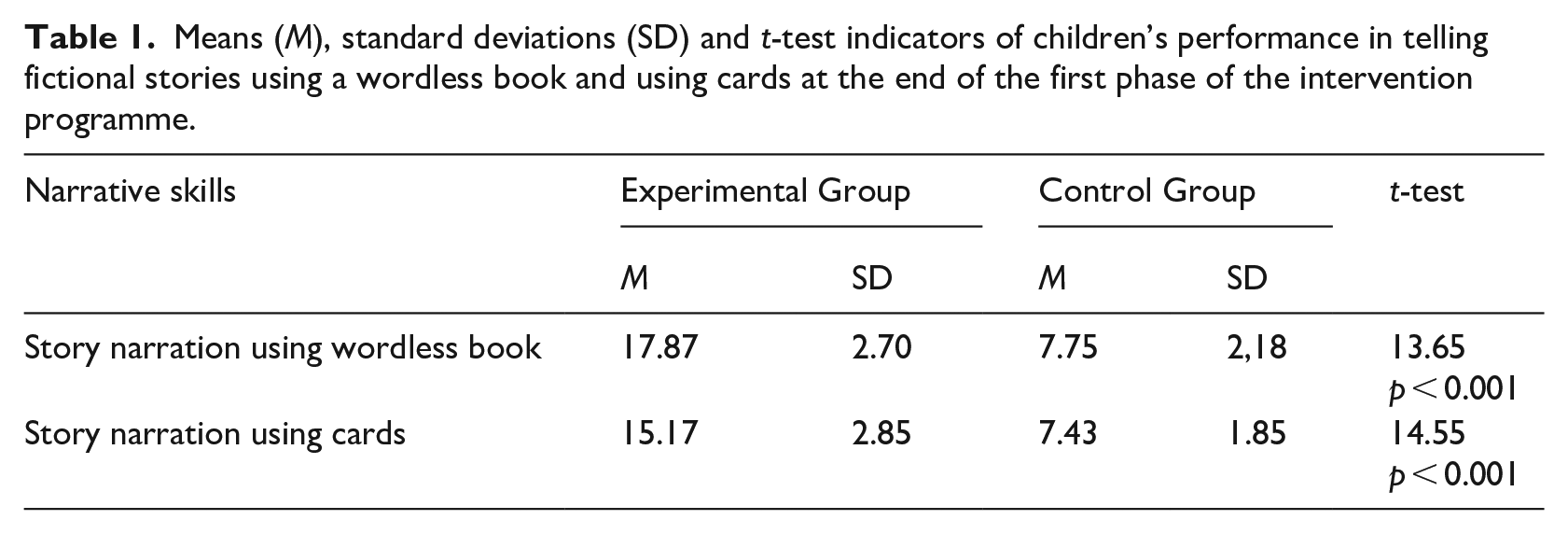
Before the implementation of the first phase of the intervention programme the groups’ baseline equivalence was held on all criteria. The results showed that in non-verbal intelligence t = −0.24, p > 0.05, in storytelling with a wordless book t = −0.86, p > 0.05, and in storytelling with cards t = −0.35, p > 0.05, there were no statistically significant differences between the performance of the children in the experimental group and the control group. Investigating the differences in comparative group performance, the t-test indicators showed statistically significant gains in favour of the children in the experimental group in telling fictional stories using a wordless book and in storytelling fictional stories using cards (Table 1). To further establish the reliability of the study’s results, we used the Cohen’s d standardized effect size. Cohen’s d represents the magnitude of differences between the groups on a given variable and is considered complementary to the reporting of results from a test of statistical significance. It is also regarded as the most common method for assessing the size of the effect. The effect sizes vary between the measures with consistently high values for the differences between the experimental and control group in relation to the structural content of their narratives when the wordless book was used as an aid (Cohen’s d = 3.87) or cards (Cohen’s d = 2.87).
Means (M), standard deviations (SD) and t-test indicators of children’s performance in telling fictional stories using a wordless book and using cards at the end of the first phase of the intervention programme.
In addition, at the end of the first phase of the intervention programme, a measurement was carried out regarding the presence of specific structural elements in the children’s narratives when using a wordless book and cards. The results showed significant differences in the mean performance of the children in the experimental group and the control group (Table 2). The observed effect size for children’s narratives using wordless books, assessed to be high (Cohen’s d = 2.13) and on cards (Cohen’s d = 1.75). Significant differences and differences on the margins of statistical significance were also found in the calculations concerning the presence of specific additional criteria (dialogue, narrative coherence, narrator’s evaluative devise) in the children’s narratives in relation to their participation group. The effect size concerning the additional criteria which were found in children’s narratives when using wordless books was medium (Cohen’s d = 0.47), whereas when using cards was it was low (Cohen’s d = 0.36).
Means (M) and standard deviations (SD), F and t indicators of children’s performance on the narrative criteria at the end of the first phase of the intervention programme.
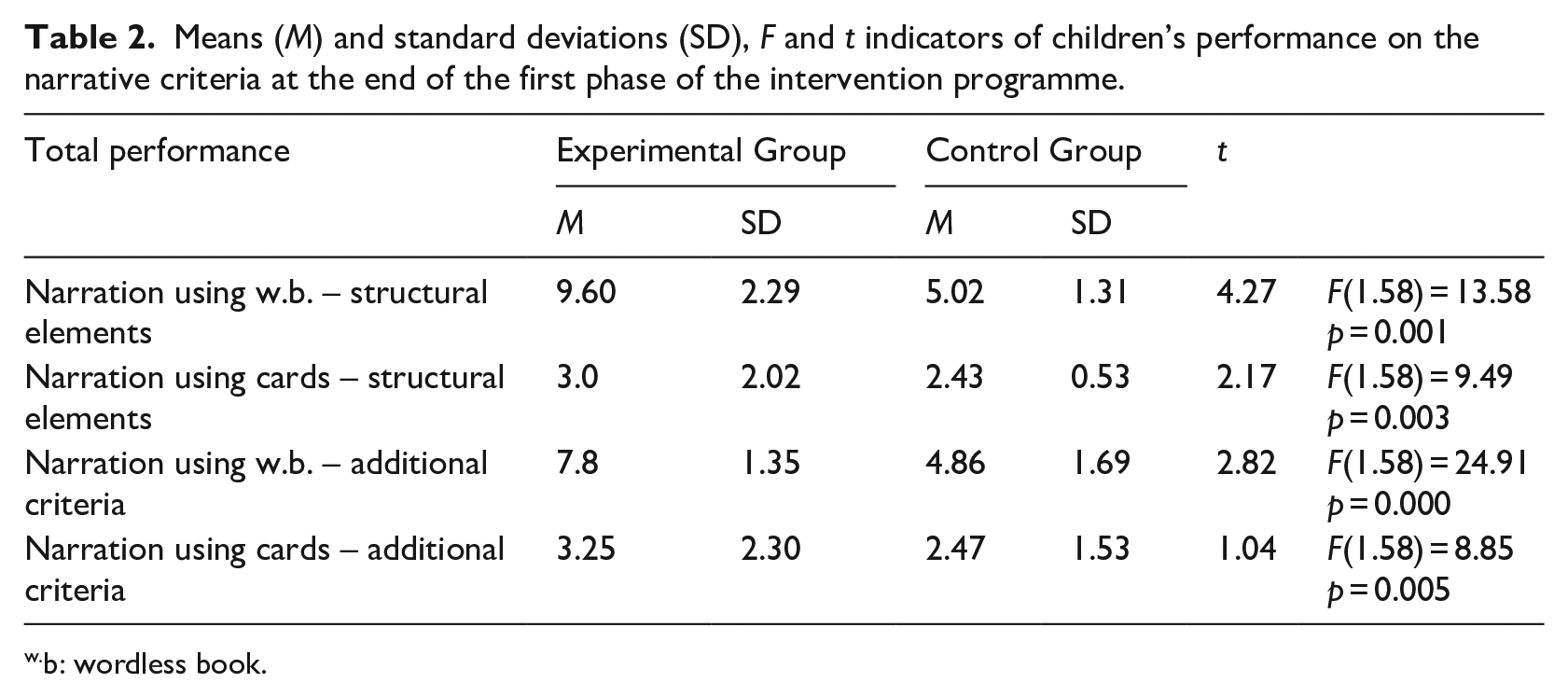
b: wordless book.
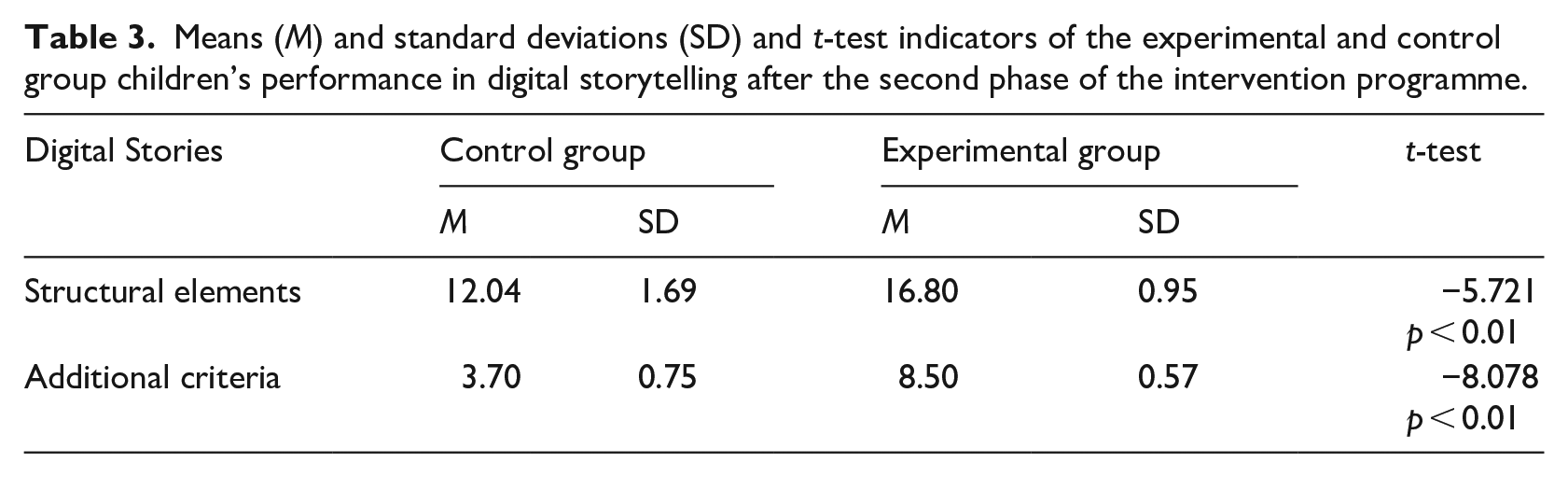
Additional analyses of the digital productions of the children of the experimental and control group were carried out at the end of the second phase of the intervention programme to investigate the story content in terms of structural and other additional criteria/elements. The results showed that the digital stories of the control group children were comparatively shorter in length with less structural elements than the experimental group children. With regard to the additional criteria, they were found to a low degree in the control group children’s digital stories (Table 3). Specifically, of all the structural elements, those that showed the largest differences in children’s digital stories (control – experimental) were those of complications that appeared as an obstacle to the protagonist’s attempts to solve his/her problem (t(46) = 2.75, p < 0.05) and the planning prior to these attempts (t(46) = 4.58, p < 0.005). Among the set of the additional criteria/elements the comparative data showed that the experimental group children added more dialogues (t(46) = 7.00, p < 0.001) to their digital narratives, more advanced connectors which their appearance consolidate a more coherent story (t(46) = 4.58, p < 0.005) and more narrator’s evaluations or comments (t(46) = 10.58, p < 0.001) made with regard to the complications and development of the story events that they created.
Means (M) and standard deviations (SD) and t-test indicators of the experimental and control group children’s performance in digital storytelling after the second phase of the intervention programme.
Discussion
The main purpose of this study was to investigate whether preschool children can create complete and comprehensible digital stories and to investigate whether children’s prior training in story production, through traditional story grammar patterns, enhanced and supported their efforts to create coherent and organized digital stories. The data from the two groups were compared. The experimental group children received explicit instructions about story grammar elements and were trained to construct coherent stories. After that they received further training to create digital stories in the StoryJumper application. The control group did not receive training in story construction but followed the same programme as the experimental group children in creating digital stories. The results showed that with proper practice the experimental group children became able to organize their thinking and actions effectively and created organized and comprehensible digital stories.
We believe that the following factors contributed to this result: (a) Predominantly, the children’s prior systematic practice in story structure which allowed them to manage these complex psychocognitive processes (planning, organization, verbalization of content, reviewing, revising) more effectively, (Bratitsis et al., 2012), (b) the time and space given to the children, particularly in the first phase to consolidate their newly acquired knowledge in a variety of ways, as well as the opportunity to work with more traditional processes in the second phase, in terms of story design and recording, before entering the digital environment to create stories (Leinonen and Sintonen, 2014), (c) the undeniable assistance of the classroom teacher with her organized and coordinated interventions (scaffolding) which aimed either to reframe the children’s thinking or to support their efforts by encouraging them to think and reflect on the possible development of a story by drawing on their personal experiences and their previous experience in producing fictional stories or to guide them when they faced cognitive deadlocks (Read and Markopoulos, 2013). Based on sociocultural theories and the Cognitive Apprenticeship method, the mediation of the adult or teacher in understanding and producing complex cognitive processes is crucial (Rogoff, 1990). (d) The engaging and interesting environment of digital story creation software (Kosara and Mackinlay, 2013), (e) the interaction between the pairs which was increasingly focused on creating an original story as the children became more experienced with the software management processes (O’Byrne et al., 2018). (f) Adherence to the seven important processes proposed by researchers in the field that significantly support children’s early attempts to think in an organized way before act digitally (Bull and Kajder, 2004).
Among the two groups we noticed serious differences in the process of digital story construction. In the experimental group, in order to create a well-formed digital stories like traditional ones, children proposed ideas, recorded their ideas, and rethought them to come up with an interesting story. In the transition from traditional storytelling to digital storytelling, there were commonalities as mentioned, but also differences (Cherry, 2017). Digital storytelling is supported by a variety of multimedia digital tools versus traditional storytelling which is primarily supported by images. In digital storytelling children combine characters, and scenes, audio narration, as well as music to present information about a particular subject using technology. Consequently, children who were previously engaged in processes such as exploring, analysing, and interpreting pictures to create structured stories and produce oral and written narratives based on the sequence of pictures accelerated their understanding about story structure and enhanced a variety of aspects of their literacy (O’Byrne et al., 2018). In addition, the experimental group children’s familiarity with the story structure gave them more ‘mental space’ to add dialogues to their characters and personal remarks in relation to characters’ actions and reactions in their digital stories. In this way, knowledge and skills which were acquired in a classroom learning context were transferred effectively and creatively to digital stories and vice versa.
In the control group, children were very enthusiastic over the storytelling application and involved themselves willingly. They had to manipulate the same characters, scenes and objects as the experimental group children, but on the way to create stories they faced many deadlocks despite their teacher’s assistance. They found a subject for each story based on their personal experience and their classrooms activities, but they omitted crucial information about central characters’ plans and intentions, about settings and obstacles which emerged in the characters’ actions etc. In other words, the structure of their stories was weak and characterized by repetitions and omissions. With regard to the manipulation of the storytelling tools, we observed the same difficulties as the experimental group children. It was amply evident that their lack of practice in story structure generated additional difficulties because they could not realize by themselves whether their story was complete or not. In our view a series of a character actions is not a story (Kao, 2015; Sa, 2012).
Conclusions and implications
Our study provides insights into how preschoolers can experience effective multilevel strategies and how this contributes to the discussion on the pedagogy of creating digital stories. Based on the results of our own study we believe that children’s digital creations should follow after systematic practice in story production in conditions of natural interaction with the peer group and physical intervention materials (cards, pictures, books, story recording papers). At the first level of practice, the teacher must be present to manage all the difficulties that arise (e.g. children’s common questions or teachers’ queries; why do they need all the structural elements? why do they need to be in a sequence? where to get ideas about each topic?), but also their behaviour (constant interference with irrelevant ideas, aggressive behaviour to impose an opinion, fatigue and disengagement from the process) so that they can think and act in a more organized way in the second phase when they are asked to create a digital story. It is important to understand that when children use a computer or tablet, they should have carried out all the required actions beforehand, so that all they need to do is transfer their ideas to the digital environment. This process is demanding so we need to relieve the children of the extra burden they have, for example: with our help, choosing the characters, scenes and objects they are interested in beforehand (the stock is very large and they get confused about what to choose), then come up with an organized story where they connect all the characters, scenes and objects they have chosen into complete events that are meaningful and valuable to them, and assign thoughts and feelings to the characters based on the problem they are facing. All the above mental processes are extremely demanding for preschool children, so they need specific (training) steps and enough time to take ownership of each step/stage of the strategy. In addition, we suppose that the intervention programme which was carried out by the classroom teachers in natural classroom settings and the stable methodological design (provided by the first researcher), so that all the teachers applied each session of the intervention programme in exactly the same way, helped the reliability of this intervention. Therefore, we believe that it can be applied in any preschool classroom.
In addition, it would be beneficial during the children’s practice with the fictional stories in their physical or digital form, if teachers also involved the children in a variety of other programmes such as discussions with experts, visits, readings of relevant narrative or informational texts. (Markodimitraki et al., 2022) so that the children could get more information on the topics discussed in the stories. Children’s emergent capabilities need to be enhanced in a number of ways if they are to be more cognitively and linguistically active.
