



Abstract
This paper applies a posthumanist lens, informed by the work of Hollett and Ehret and of Ingold, to consider children’s playful affective entanglements with the human and the more-than-human during fluctuating periods of social distancing in the COVID-19 pandemic. Through this refracting theoretical lens, I (re)examine a selection of play and leisure experiences of an emergent subject – the pandemic child – during the national U.K. lockdowns of 2020 and 2021. Via a national online, qualitative survey, children and families were invited to share examples of their play and leisure experiences during the pandemic to the Play Observatory, a U.K. research project that ran from 2020 to 2022. These survey contributions provide portals through which to (re)consider children’s connection, participation and emergent becomings, attuning analytical attention towards children’s affective place-event entanglements during pandemic times. A posthumanist (re)telling of children’s Play Observatory contributions demonstrates how children were imbricated in constantly emergent affects, meanings, becomings and potentialities, that waxed and waned, intensified and dissipated, transcending the physical locus of lockdown. This paper contributes to the field by unsettling discourses of rupture, loss and deficit that have tended to dominate public and policy discussions of children’s experience of lockdowns. It contributes to ongoing, collective attempts to interrupt policy responses to the pandemic that centre individualising practices of curriculum ‘catch-up’ and fail to invite into the debate consideration of the potential richness of experiences and events encountered by the pandemic child outside of the strictures of normal schooling and curriculum.
Introduction
From infancy children connect intergenerationally and intragenerationally via everyday activity across various spheres of experience (cultural, care/schooling, play and leisure) involving family and community (local to global). Vallgårda et al. (2015) argue that children’s daily lives involve movement across emotional frontiers (e.g. between home, classroom, playground, care settings, cultural sites, wider family locations) and engagement within the networks of social and affective relationships these sites contain. Another constant of children’s lives is the drive to be involved in play, and through it to explore knowledge, meaning-making and emotion. Olsen (2016) argues that in play ‘children practice and perform emotions, develop habits of feeling, and in so doing, learn how to feel’ (p. 324). However, fluctuating physical and social restrictions introduced in response to the COVID-19 pandemic in 2020 impacted immediately on children’s playful and affective engagement in their everyday inter-/intra-generational worlds. On 23rd March 2020 the U.K.’s national lockdown started when the Cabinet Office’s stay at home order came into force. The order stated: ‘The single most important action we can all take, in fighting coronavirus, is to stay at home in order to protect the NHS and save lives’ (Cabinet Office, 2020: 1). Schools were closed to children whose parents were not deemed to be key workers. The restrictions also specified that ‘communal places within parks, such as playgrounds, sports courts and outdoor gyms’ were required by law to be closed to the public. Not until 23rd June 2020 was it announced that playgrounds and other cultural and leisure facilities in England could reopen, from 3rd July (Prime Minister’s Office, 2020). Thus lockdown disrupted the usual childhood theatres of school and thirdspaces outside of home (Soja, 1996) for physical and social connection and participation. With it came concerns about children living lives in deficit, removed from environments designed to stimulate learning and development. In addition to their access to formal learning, children’s play and wellbeing during the pandemic also became a focus of research (Graber et al., 2020, 2023; Moore et al., 2020).
National lockdowns in the U.K
In the countries of the U.K. the initial lockdown, starting in March 2020 and continuing for most until July 2020, withdrew the majority of children from schools and care settings. It kept them in the home for most of the day, with the exception of an hour’s daily walk with members of their household (Cabinet Office, 2020). Children with some pre-existing health conditions were officially categorised as being especially vulnerable to the COVID-19 virus and required to observe even stricter social distancing measures to shield them from the virus across a 4-month period (Cabinet Office, 2020). Not all children were at home during lockdown, but even those physically present in school and early years settings still experienced disruption to their affective networks due to missing playmates and altered social/physical arrangements in classrooms and playgrounds (Carter, 2023).
In lockdown, physical access to wider family and community networks and to contexts outside of the home for intra-generational peer-to-peer connection was reduced. Simultaneously, the time many children spent in close proximity to their immediate family vastly intensified. Access to inter-generational connection within households was often increased, particularly in those families with parents on furlough or working from home. COVID-19 was not the first global pandemic, but it was the first one of the digital age. Very quickly practises of work, schooling and leisure pivoted online. Digital media facilitated the interpenetration of these physical locations, allowing children to connect with school, wider family contexts, many third spaces – such as museums, uniformed children’s organisations – and with national and global content and communities (King et al., 2021; Watson et al., 2021; Wiles, 2021). It is important to acknowledge, however, that this digital access was contingent on socio-economic factors and thus not something to which all children had equal access (Holt and Murray, 2022). Despite the steep overall rise in use of digital communication tools, social/physical distancing tended to be viewed as a rupture to many of the everyday affective networks of connection and participation. The very combination of terms used to describe this new state of existence – ‘lock’ and ‘down’ – evoke feelings of entrapment, stasis and isolation and raised many questions. How would the ‘pandemic child’ navigate these new circumstances in everyday play, how might their wellbeing be impacted and how/would they connect with, participate and (re)constitute affective networks in pandemic times?
The Play Observatory
The Play Observatory was a collaborative and interdisciplinary research project, funded by the Economic and Social Research Council in 2020 as part of its COVID-19 Rapid Response Call. The project collected contributions from children aged 1 to 17 and was designed with a broad understanding of play, informed by the work of Iona and Opie and Opie (1959, 1969, 1997) and of Sutton-Smith (1997). Data collection was achieved via three streams of activity:
A national, online multimodal survey (see Olusoga et al., 2022);
Online ethnographic interviews with 10 children and their families (see Cowan et al., 2022); and
Media production workshops on the topic of play and COVID held with young filmmakers (see Cannon et al., 2023).
Via the project website (publicly advertised via Twitter, Facebook, radio and press coverage), children and families were invited to contribute self-reported episodes of play and leisure, between March 2021 and March 2022. We designed a national online, qualitative survey, inspired by the postal surveys of children’s play conducted by the Opies (via schools and teacher intermediaries) in the third quarter of the 20th century. The survey was first and foremost intended to address and privilege the child contributor, whilst recognising that access would be mediated via their parent/legal guardian. The interface was designed to provide adjustable open-ended prompts to provoke rich descriptions of play episodes and to capture multimodal data. The survey collected demographic information and prompted contributors to use a combination of open text boxes and tick boxes to report and reflect on examples of their play. Contributors were able to upload accompanying audiovisual files. Like the Opie surveys, our prompts nudged children to report not just what they played, but with whom, where, how and with what equipment, helping to situate and contextualise the play, and acknowledging the presence of the human and more-than-human (e.g. creatures, materials, platforms) brought into relation during play. The survey was also attuned to affect and contributors were prompted to report (via text and/or emojis) on their emotional state during and after the play episodes they shared (Olusoga et al., 2022). After a piloting, another prompt was added to capture any further reflections arising during the process of creating and uploading contributions. Together, the contributions provide snapshots of the pandemic child’s play that can facilitate a sociomaterialist, posthumanist approach to analysis.
Theoretical lenses
Entangled intra-action and the emergent pandemic child
Existence is not an individual affair. Individuals do not pre-exist their interactions; rather, individuals emerge through and as part of their entangled intra-relating (Barad, 2007: xi)
The pandemic child as an object of study does not pre-exist the conditions of the pandemic (human and more-than-human), but instead arises from its entanglement with them. A socio-materialist posthumanist lens helpfully decentres agency as a quality held by the pandemic child and resists the siloing of the pandemic experience into separate categories of relationships, materials, space and time. In posthumanist theory, people are not separate from space, time and matter, we are in quantum entanglement with it. In intra-action rather than inhabiting a state of being, bodies are in a state of becoming that emerges from their intra-actions (Barad, 2007). Applying this lens allows us to question whether lockdown is best perceived as a rupture or if it can instead be viewed as a point or period of pivot in the nature of enfolding entanglement of which children are part. National lockdown’s social distancing measures in the U.K. did largely restrict most children to the physical location of the home. The restricting conditions placed on the daily walk created echoes of a pre-industrial past, where the limitations of walking or riding (horses or horse-drawn vehicles) imposed on most people a physical and temporal home-range, that the train, bus, car and plane eventually expanded. COVID restrictions in the U.K. strictly limited car use and imposed a narrow daily window of time for being out in public to exercise, effectively containing out-of-home experience to the streets and green spaces within a sixty-minute walking distance (there and back). However, they also facilitated an intensification of material, discursive and relational human and more-than-human entanglements within and immediately around these domestic spaces. A burgeoning use of digital platforms of various types (social, work/school-oriented, entertainment-focused) became part of this mix (Watson et al., 2021). They brought family, work and schooling into the home and were also a means by which the material and discursive practices of the pandemic circulated to and between households. Examining the following selection of survey contributions through this lens attunes analysis to consideration of the nature of the pandemic child’s unfolding playful entanglements. It makes visible assemblages of emergent, hybridised contexts, nodes and modes of connection and intra-activity, with human and more-than-human resources, in which the pandemic child is in a constant state of becoming.
Nodes, lines, surfaces and wayfaring
The notions of the assemblage and the rhizome from Deleuze and Guattari (1987) are pertinent here. The rhizome is dispersed and non-hierarchical; an interconnected web of intra-relations that is dynamic and changing. Parr (2010) explains that for Deleuze and Guattari, the rhizome is ‘indeterminate and experimental. . . a map not a trace’ (p. 60). That distinction between mapping and tracing is instructive. It orientates the researcher to the open, heterogeneous and unfolding nature of reality and the multiplicities of entangled experience and offers a profusion of entry points for theory and research. A feature within the rhizome is the assemblage, which Livesey describes as: . . .complex constellations of objects, bodies, expressions, qualities, and territories that come together for varying periods of time to ideally create new ways of functioning. (2010: 18).
Assemblages emerge as entanglements cohere and they function as nodes within the rhizome. They are dynamic in nature; coalescing, intensifying, merging, dissipating multiplicities. Approaching the assemblage, the researcher must look for ‘coming and going rather than starting and finishing’ (Parr, 2010: 60), for deterritorializing lines of flight. Across the various phases of the pandemic, different entanglements of the human and more-than-human enfold. Thus the rhizome and the assemblage offer a challenge to a binaried view of lockdown as a rupture, a cutting off of the pandemic child from an assumed hierarchical, arborescent, pre-pandemic reality. If we think in terms of the assemblage – of comings and goings, waxings and wanings – our analysis can be attuned to a mapping (inevitably partial) of intensifications within some aspects of the pandemic child’s rhizomatic entanglements and to dissipation or adaptations of nature and form in other aspects.
Thorpe et al. (2024), in their paper on pandemic experiences of women in Aotearoa New Zealand working in sport and fitness, describe COVID-19, with its capacity for disruption of relations between bodies, space and matter, as ‘an affective force producing new becomings, new ways of knowing-feeling-moving’ (p. 4). In their 2023 paper, Thorpe et al. (2023) examine women’s physical activity and argue that during the pandemic there was a deterritorialization of, and reprieve from, what they term ‘the fitness assemblage’. As nomadic escaping lines of flight opened up new possibilities of affective, embodied, spatial entanglement, ‘new more-than-human fitness assemblages’ productive of new subjectivities emerged (Thorpe et al., 2023: 14). This can prompt us to attend to the nomadic potential of lines of flight during the pandemic, with its smoothing of the temporal and spatial striations of children’s pre-pandemic normality, and to locating the emergent becoming of the pandemic child in differently configured play assemblages.
Lines of flight can be detected in the opening up of digital spaces, the encounter between line and surface on the daily walk, the hybridisation of place as both offline and virtual. Ingold (2007) considers the line and makes a distinction between two types of line, the thread and the trace. He argues that a thread is ‘a filament of some kind, which may be entangled with other threads or suspended between points in three-dimensional space’ (Ingold, 2007: 42). A trace he describes as ‘an enduring mark left in or on a solid surface by a continuous movement’, the nature of which is either additive or reductive (Ingold, 2007: 44). Ingold argues that via ‘transformation of threads into traces. . .surfaces are brought into being’ whilst ‘conversely, it is through the transformation of traces into threads that surfaces are dissolved’ (Ingold, 2007, 54). He also writes of ghostly lines, the imagined lines that connect constellations and in doing so render them as meaningful narratives. Place as a concept, as a storied experience is thus intimately bound up with the concept of the line, an association that is further examined in Ingold’s distinction between the walk and the assembly (Ingold, 2007: 76). He writes that: The line, in the course of its history, has been gradually shorn of this movement that gave rise to it. Once the trace of a continuous gesture, the line has been fragmented - under the sway of modernity - into a succession of points or dots. This fragmentation. . . has taken place in the related fields of travel, where wayfaring is replaced by destination-oriented transport, mapping, where the drawn sketch is replaced by the route-plan, and textuality, where storytelling is replaced by the pre-composed plot.
He continues: It has also transformed our understanding of place: once a knot tied from multiple and interlaced strands of movement and growth, it now figures as a node in a static network of connectors. To an ever-increasing extent, people in modern metropolitan societies found themselves in environments built as assemblies of connected elements.
Ingold invites a return from the assembly to the walk, from destination focused ‘transport’ across surfaces, to movement focused ‘wayfaring’ along surfaces as a better, more human paradigm for living. These are useful tools with which to consider the disrupting effects of the pandemic, as restrictions removed the pandemic child from the usual daily transport between relatively static nodes within connected networks of home, school and thirdspaces. In their play, was the pandemic child instead able to experience wayfaring, knowing-feeling-moving along tracing lines (of flight), bringing physical and digital surfaces into being, experiencing relations, affect and embodiment within new and emergent assemblages of the human and more-than-human?
Affective atmospheres, place-events and focal moments
The emergent nature of affect and of place is explored by Hollett and Ehret (2015). The subject of their paper is Bean, the pseudonymised nickname given to a 12-year-old male oncology patient. This research has intriguing resonance for thinking about the pandemic child, as Bean, like the pandemic child, is studied during a period where he is socially and physically remote from the people and spaces of his usual daily life for an extended period. During his 4-week stay in a children’s hospital ward, Bean’s room was made ‘into a microcosm of his life at home’ (Hollett and Ehret, 2015: 1854) via the inclusion of familiar materials and cultural references. At the same time, in response to his request, the researchers helped Bean to learn something new – how to play with the videogame Minecraft. Across a series of play sessions in the hospital playroom and Bean’s own hospital room, together in play they co-constructed a Minecraft-generated world called ‘Bean Town’.
Hollett and Ehret (2015) argue that Bean’s experience of Minecraft gameplay is embodied within digital, material and social space. In the play episodes ‘the relational experiences between multiple bodies - both human and non-human - generate feeling’ (Hollett and Ehret, 2015: 1850), that is, affect emerges from the intra-action of the human and more-than-human. They also apply what they describe as ‘an emergence perspective’ to space, conceptualising place ‘as an ongoing open possibility or an event’ a ‘place-event’ (Hollett and Ehret, 2015: 1852). They argue that affect and movement are part of the entanglement of the place-event. Place-events are experienced in the embodied and affective sensation/perception of moving through place, being in ‘emplacement. . . [within] an ongoing meshwork of affective forces and potentials. . .a simultaneity of stories told so far’ (Hollett and Ehret, 2015: 1852).
In their analysis, Bean Town is dynamic, hybrid and emergent, an ‘ongoing place-event in which atmospheres are felt across bodies in shared affective experiences, spilling out from the screen and into the hospital’ (Hollett and Ehret, 2015: 1852). They explain how affect guides their analysis in the study, via ‘the notion of …moments of interruption that are felt [original emphasis] upon bodies and cause them to move unexpectedly’ (Hollet and Ehret, 2015: 1856). This framing draws attention to ‘focal moments’ of embodied resonating affective intensity that interrupts the flow of experience across the entangled multiple human and more-than-human bodies. The high points and the culminating affects that lead up to them become the focus of analysis. This is an approach also taken up by Nordström et al. (2021) in their study of ‘the emergence and unfolding of positive affect’ that they term ‘unfolding joy’, witnessed in the literacy activities of children in a Finnish early years classroom. The term unfolding here indicates affective intensities are sometimes slow to build and unfurl, and yet remain potent experiences.
Entangled encounters with the data
Locating myself in relation to the data
Like everyone else on the planet since 2020, I am not an outsider looking in when it comes to the COVID-19 pandemic. When the U.K. lockdown started on 26th March 2020, my family and I had already been in quarantine for a week, as my husband and I both had suspected COVID. Once recovered, I was one of the 2.2 million people in the U.K. told to shield at home on medical grounds (ONS, 2020). As we adjusted to lockdown, both parents working from home and both children adapting to accessing schooling online, I started recording our pandemic experience in photographs, videos, social media posts and WhatsApp conversations with family, friends and colleagues. As a historian, the urge to document the stubborn persistence of the everyday during extraordinary times, was immense, as was the urge to record the emergence of the new (e.g. the emergence of my family’s facemask making and wearing practices – see Olusoga and Bannister, 2023). As a play researcher my focus was on the unfolding play and leisure episodes, involving my children, who also began to record them to share with me. By the summer of 2020 plans for the Play Observatory project were conceived. This was a process often observed by our families, as we and they worked/learned from home, and some of them became keen to make their own contributions to the historical record of the pandemic, via the project’s online survey.
I share this information to establish that the Play Observatory is a research-assemblage. I come to this data already in various forms of entanglement with it, and I will include consideration of this as I address each example presented below. The three contributions presented involve the play experiences of:
A family from Ispwich, England with three children aged four, seven nine years.
A 10-year-old boy from Leeds, England (my son) and his 6 year old cousin (my niece) many miles away.
A 12-year-old girl from Birmingham, England who shielded during the 2020 national lockdown.
Rather than approaching the data in search of themes, in tune with the theoretical lenses outlined earlier, I come to my encounters with it in search of ‘focal moments’ of affective intensity (Hollett and Ehret, 2015), ready to respond to and reflect upon their resonances.
Tyres, traces and threads
On 1st June 2020 new guidance was issued on the rules for accessing green spaces safely, permitting the re-opening of outdoor sports grounds. Groups of up to 30 people could take part in sport provided it was organised by a business, charity or public body (DEFRA, 2020).
A parent made this survey contribution recording an encounter she and her three children had on their daily walk shortly after this, involving tractor tyres left on a rugby field in Ipswich in June 2020. In the text and the accompanying series of media files, we can map additive traces and entangled threads involving the knowing-feeling-moving intra-acting human and more-than human. The contribution reads (note that the survey prompts are in italics):
Please describe what you have seen children/young people playing, doing or saying.
Playing with a tractor tyre, jumping, hiding
Don’t forget to tell us details of who, when and where.
Sisters and brother N, i [sic] and E on a daily walk in June 2020, early evening around our local rugby field. The players had left out tractor tyres to train with and the children enjoyed climbing on them, jumping across the gap and hiding inside.
What seemed to be the mood of those taking part?
relaxed, happy, inventive (Play Observatory, PL48A1/S009)
The tyres were not a destination, but an encounter emergent within the walk. Figure 1 captures the middle child (a boy aged seven) bouncing up from the rim of the tyre, an entanglement of suspended threads – arms outstretched, hair flying upwards, tongue peeking out from the side of his mouth, a beam of light curving across the image, bisecting his face. Agentic intra-activity involves his body, its weight, the springiness of the rubber, the tyre’s size and shape, the sunlight, his mother (just visible at the left side of the image) and her camera (positioned low and to the side of the tyre).
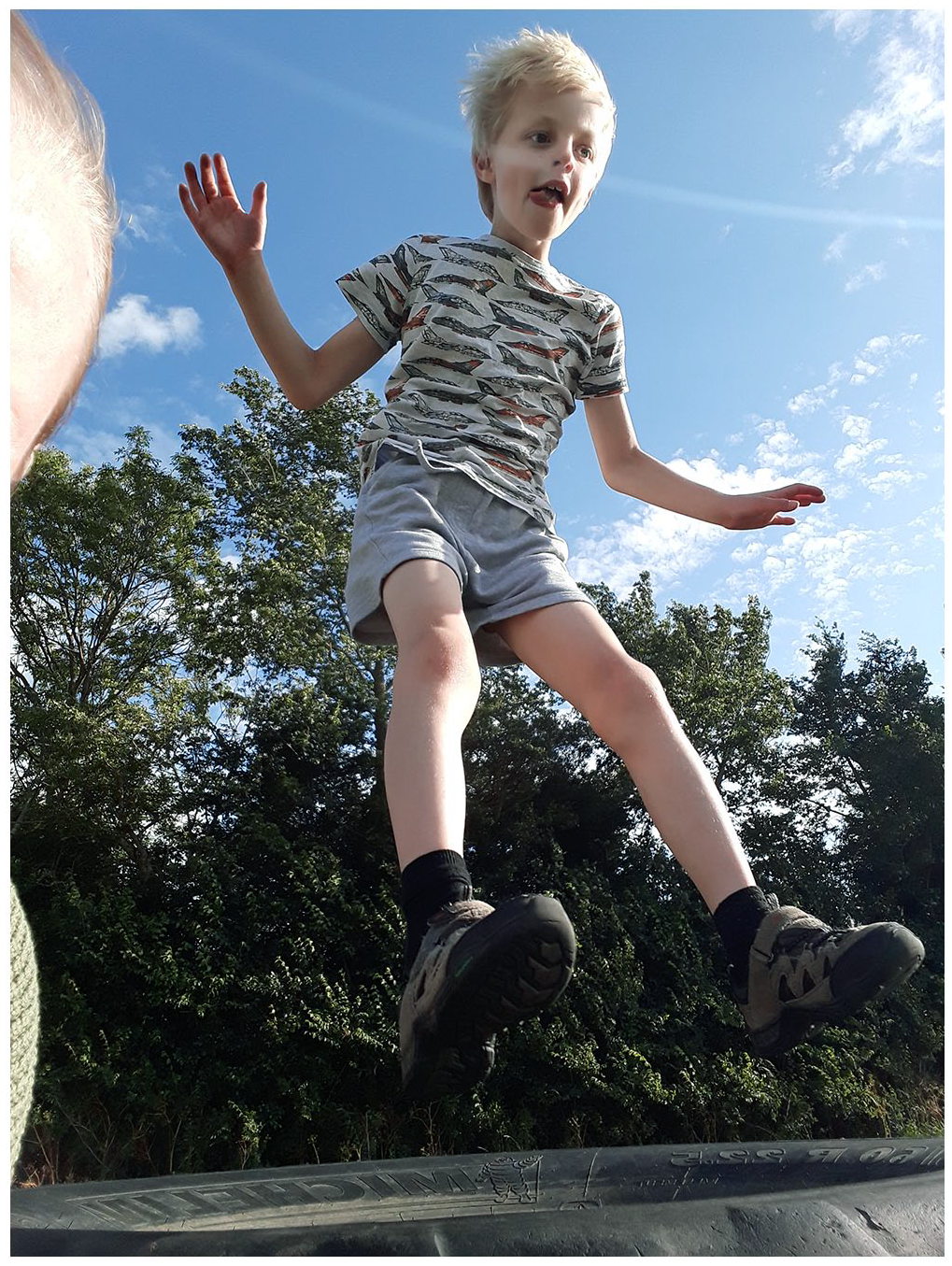
Child jumping on the rim of a tyre Play Observatory (2023) PL48A1/S009/p2.
In Figure 2 (a video file) the parent sits in the bottom centre of the frame looking down at the camera, which sits within the (unseen) tyre, pointing towards the sky. Periodically we see the boy and his older sister (aged nine) take turns to climb onto the rim of the tyre. Each time, they steady themselves for a moment, swing back their arms and jump over the gap to the opposite side of the tyre – literal lines of flight. They giggle and exclaim joyfully as they leap between their mother and the camera, feet thumping loudly against the rubber surface as they land. Their mother keeps looking down at the lens, sharing a small smile with the camera and its future audience.
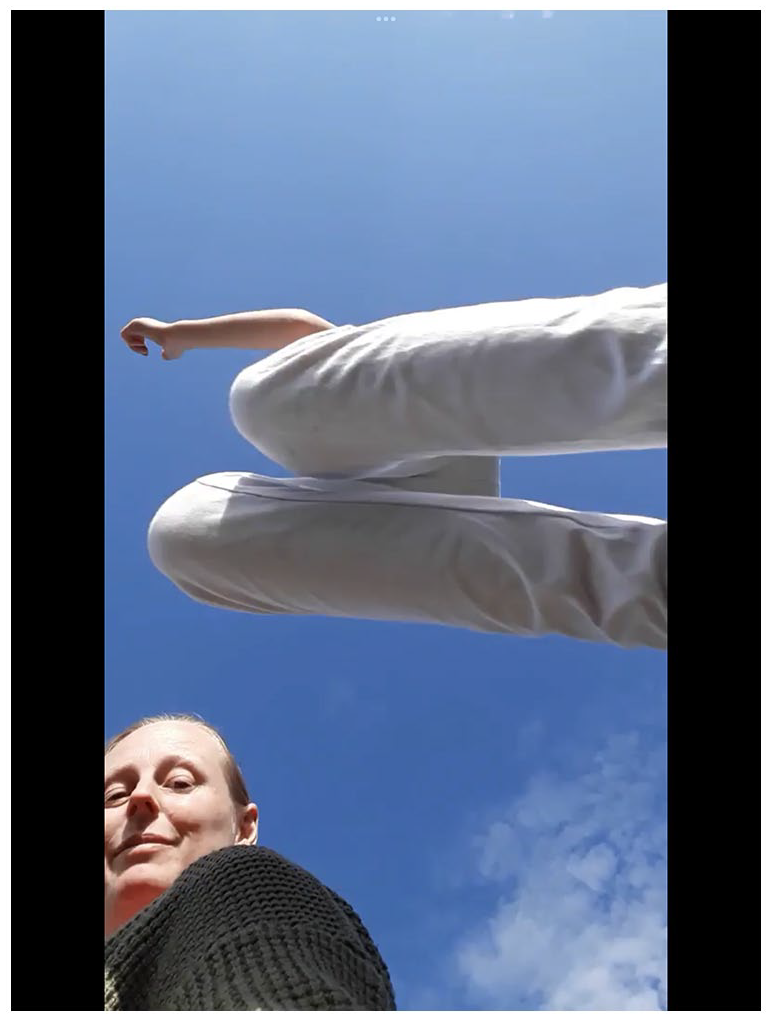
Children jumping across the tyre and over the camera (still from the video) Play Observatory (2023) PL48A/S009/v1.
In Figure 3 play is situated within the tyre, this time with the youngest sibling (age 4) also involved. The children inhabit the cavity within the inner rim, their torsos tuck neatly within the tyre and their legs stretching out in front of them. The dry warm weather has made grass visibly dry and the tyre inviting to crawl inside for a while. The tyre is now a hiding place, concealing parts of the body away from direct adult observation. In contrast with the other photograph and video, this time the parent and camera look down at the tyre from above, this vantage point capturing an image of tyre, turf, legs and arms, and the face of the 7-year-old. Within the cavity the children face each other and intra-generational connection in a shared experience is facilitated. The image is a snapshot of entangled elements – human and non-human – children, adults, space, materials and affect.
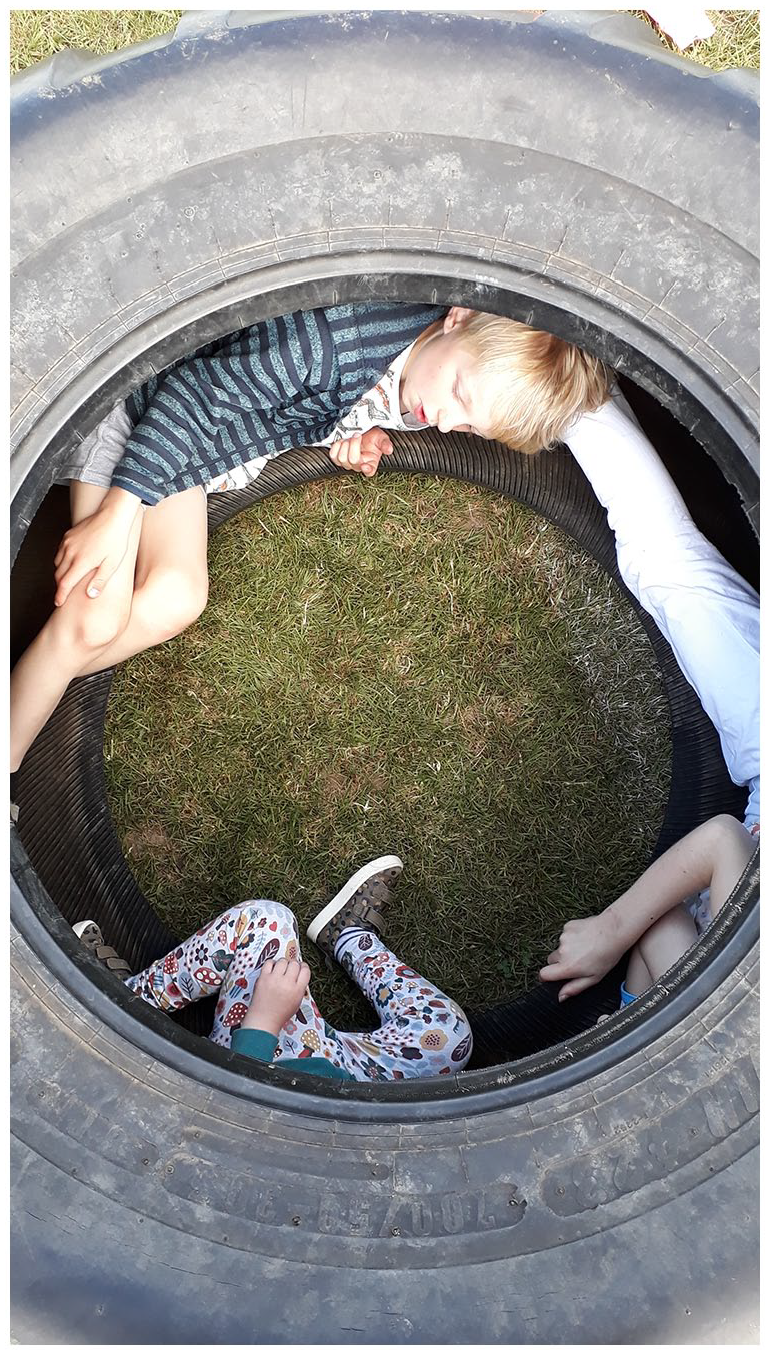
Children sitting in the tyre Play Observatory (2023) PL48A/S009/p1.
The tyres strewn across this field are examples of Ingold’s (2007) additive traces. Their emplacement the result of intra-activity that is discursive (recent national policy changes allowed the re-opening of the rugby club), embodied (the result of the physical movement of the returned players and coaches), relational (arising from collective entanglement of game, rules, encounters, interpretations) and heterogeneous (involving the human and the more-than-human). When the family encounters them, the players are gone but these tyres, as traces, are a visible palimpsest of play (Marsh and Bishop, forthcoming) that brings the past into entanglement with the present. The scale, weight and materiality of the tyre is agentic, productive of various forms of knowing-feeling-moving in its multiplicity of entanglements.
Hybrid wayfaring: Art club, sticker wars and iPad hide and seek
Play with cousins featured in some Play Observatory contributions, in intra-activity with various digital platforms across households and sometimes across long distances. This contribution from my own family features hybrid digital/offline materials and modes of play involving my then 10-year-old son, Levi (this is a pseudonym). FaceTime Art Club was the name given to an activity involving him and his 6-year-old female cousin. I facilitated FaceTime Art Club in our household. In my niece’s household adult facilitation was shared between my sister-in-law and brother.
Levi chose to upload three images from FaceTime Art Club to the survey (Figures 4–6) and also selected a group of three emojis (coded by the project as very happy + ok + calm) to describe how the play made him feel. Levi asked me to complete the description portion of the contribution, so I added my own account of the play, guided by him and the survey prompts. It reads:
Please describe what you have seen children/young people playing, doing or saying.
In the lockdown in early 2021, Levi started spending his Sunday mornings doing painting with his younger cousin via FaceTime. She lives at the other end of the country and they were missing each other. Sometimes she would want to copy what Levi was making. He made a Saxon shield for his home-schooling history project, and she then painted her own version. These sessions then often turned into them taking turns to put virtual stickers on each other’s faces on the screen. Sometimes, his cousin would ask to play hide and seek. She and Levi would take turns to hide, whilst their parents carried the iPads. When it was their turn to seek, they would instruct their aunt or uncle to follow their instructions as to where to point the iPad so that they could look for each other.
What seemed to be the mood of those taking part?
Both children looked forward to these sessions. They would tell each other about what they’d been doing since the last session. Levi enjoyed showing his cousin some of his art skills and she liked to ask him how he did things and to have a go herself. The sessions generally started off quite calmly and ended up very raucous. (Play Observatory PL168C1/S004)
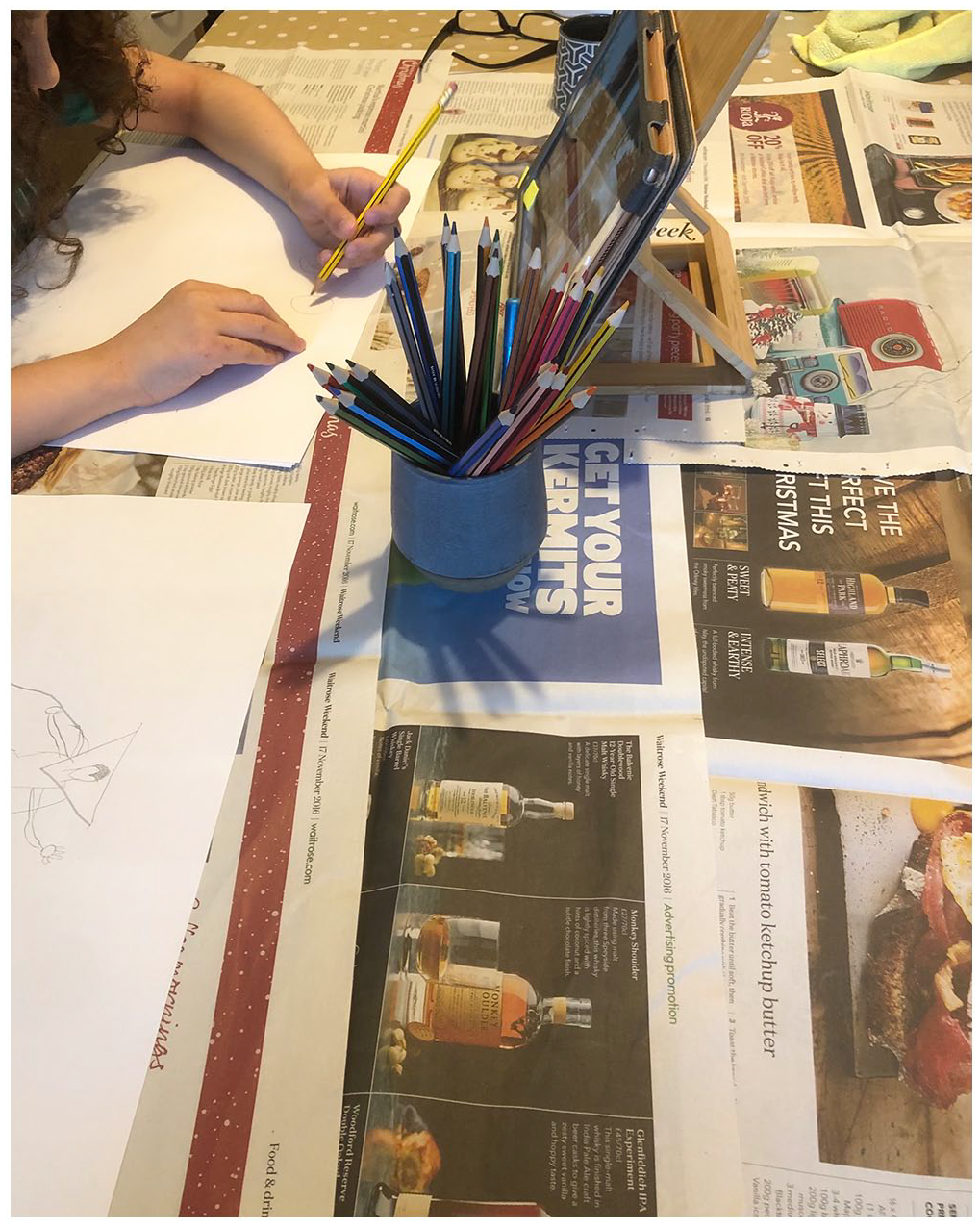
FaceTime Art Club Play Observatory (2023) PL168/C1/S004/p1.
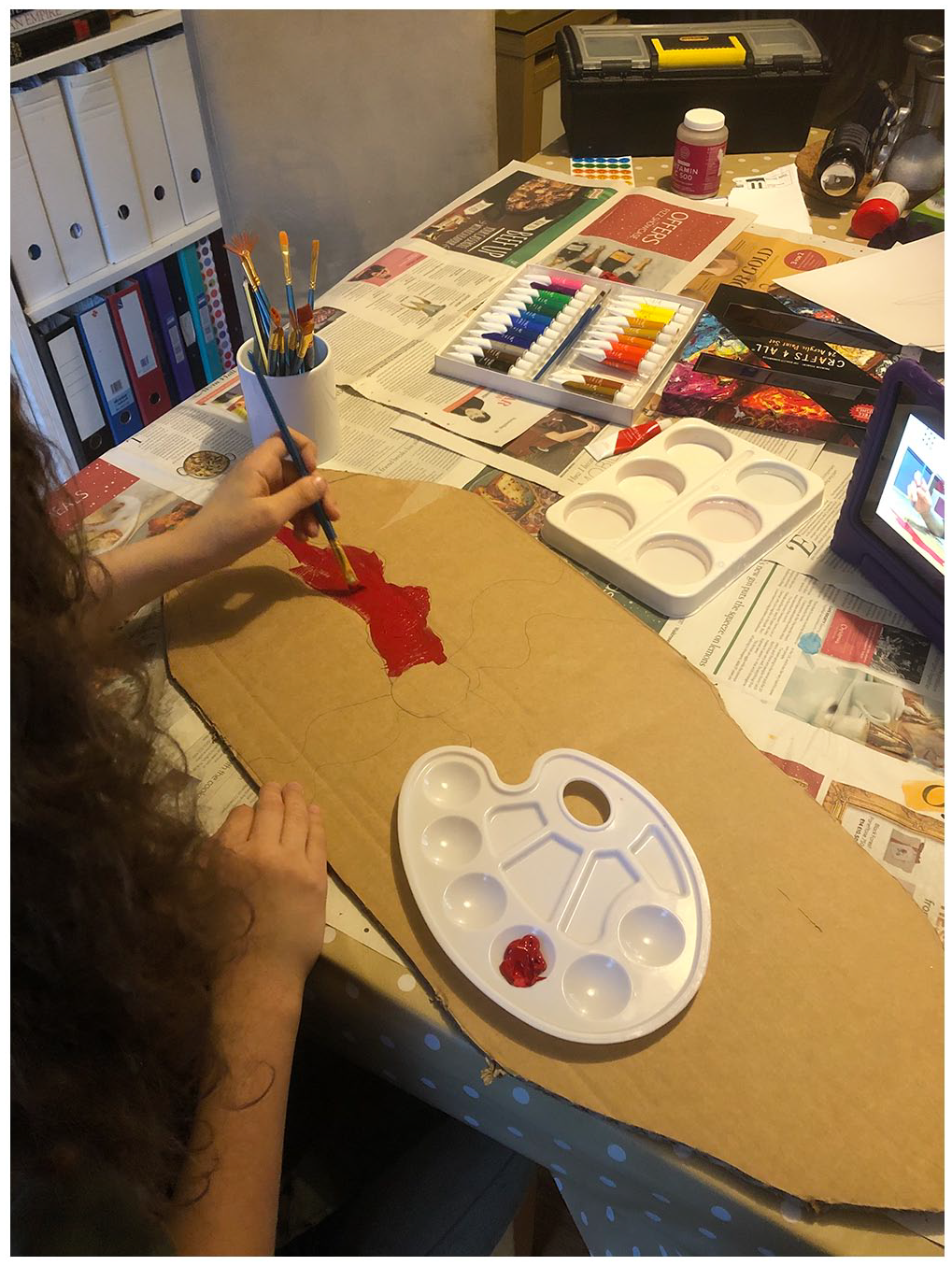
Levi painting cardboard Saxon shield Play Observatory (2023) PL168C/S004/p2.
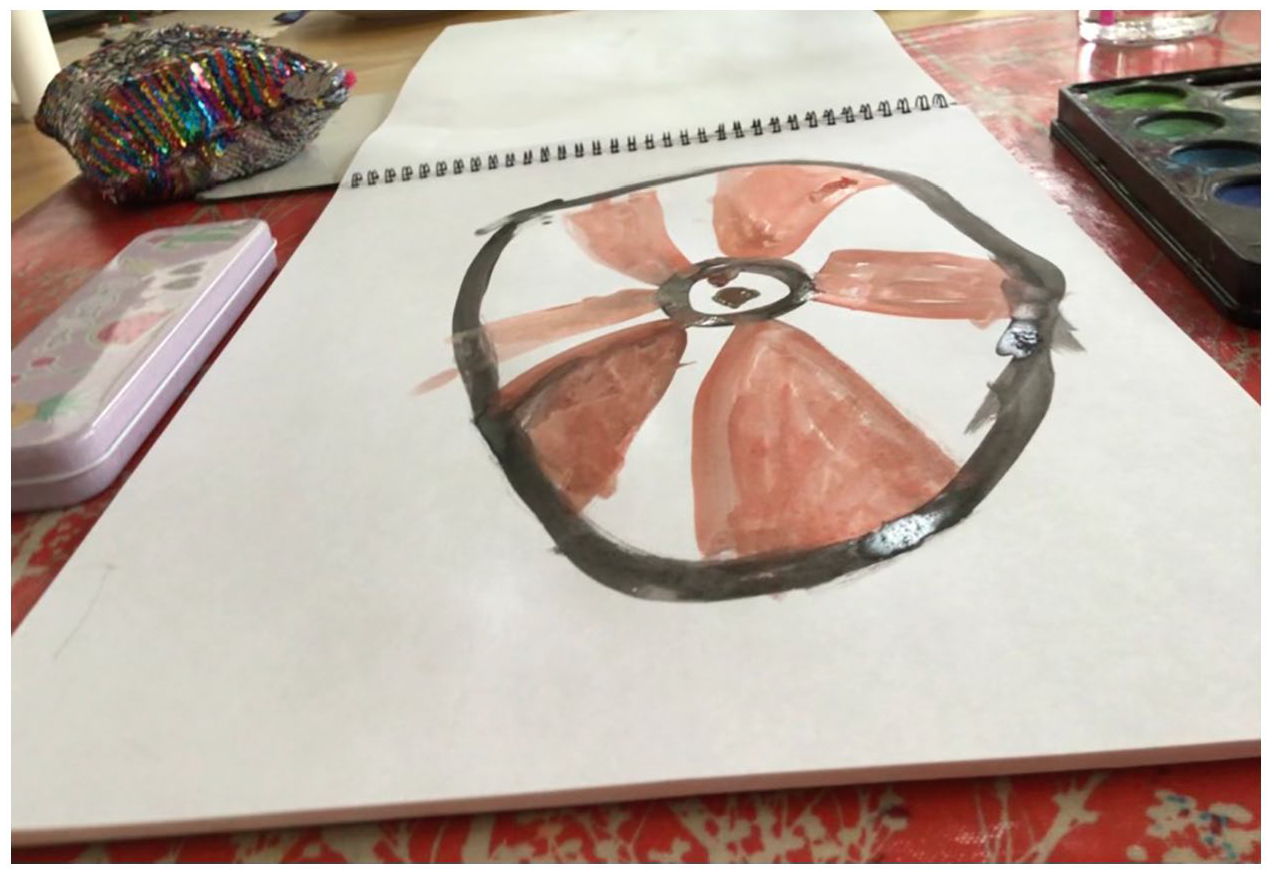
Levi’s cousin’s version of a Saxon shield Play Observatory (2023) PL168C/S004/p3.
FaceTime Art Club features hybrid play, involving digital and offline materials, the human and the more-human.
Vertical age grouping enables Levi (the youngest in his sibling relationship) to take on the role of the older, more-experienced other in this encounter with a younger cousin, allowing him to enjoy assuming ‘the mantle of the expert’ (Heathcote and Herbert, 1985). This involves a repurposing of ideas from home-schooling as Levi shares his research (I recall that this involved holding up books and printouts to the iPad camera) and recounts the steps in his artistic construction of a cardboard replica of a Saxon shield (see Figure 5). His younger cousin (an only child) responds to this experience of sibling-like attention and nurturing, following his instructions carefully (see Figure 6).
There is a fluidity and a build-up of affect, as the children redirect their attention in the different episodes of play within a session, from art to virtual sticker wars to virtual hide and seek. Virtual sticker wars begin as a flow of new information and skills from the younger niece to her cousin. Growing bored with painting during one session, she uses her knowledge of the affordances of FaceTime to place a sticker directly over Levi’s face on her screen. Never having used this aspect of FaceTime before, Levi is intrigued and asks how this was done. Soon each is locked in a battle to cover the face of the other with virtual stickers, generating much shouting, laughter and jabbing of fingers as stickers are selected (to be as insulting as possible) and overlapped to smother the screen. The play flows, becoming even more physical with the cousin’s request that they each enlist the help of an adult to play virtual hide and seek. Taking turns to hide, the child in the role of seeker instructs their aunt or uncle to move through their respective houses, camera facing outward and microphone on, as they search for their hidden cousin. The houses themselves are also at play, their agency felt in the affordances for hiding (spaces for concealment, tendencies to muffle or amplify noises and giggling of hidden children) and in the physical demands they make on the adults in the climbing up and down of creaking stairs, bending so that the iPads could ‘look’ under sofas and beds, and the flinging open of cupboards and doors. In this example we see an entanglement that is digital, discursive, affective and physical. It draws together the human and more-than-human across divides of geography and generation into new forms of ‘knowing-feeling-moving’ (Hollett and Ehret, 2015). Experimenting with these digital tools, online surfaces and offline spaces, this hybrid play, the children and their adults are wayfarers; becomings emerging from affective, overspilling place-events.
Affective place-events: ‘I danced on the road to the Macarena song which felt a bit naughty’
This last example is drawn from the HomeCool Kids (https://www.homecoolkids.com/), an online magazine written and published by children in the Midlands area of the UK with the support of their families. It was set up during the first national UK lockdown, enabling the children to continue to intra-act initially with their neighbour and eventually with family, friends and community (in Birmingham and beyond). These multimodal online texts provide fascinating, extended opportunities for the children to map some of their pandemic experiences. They reveal aspects of their playful, intergenerational entanglements and how they feel about them. In a Home Cool Kids article from child LH entitled ‘My Story when I shielded’, 11-year-old LH reflects on examples of intergenerational play and activity within her family and wider community (Figure 7).
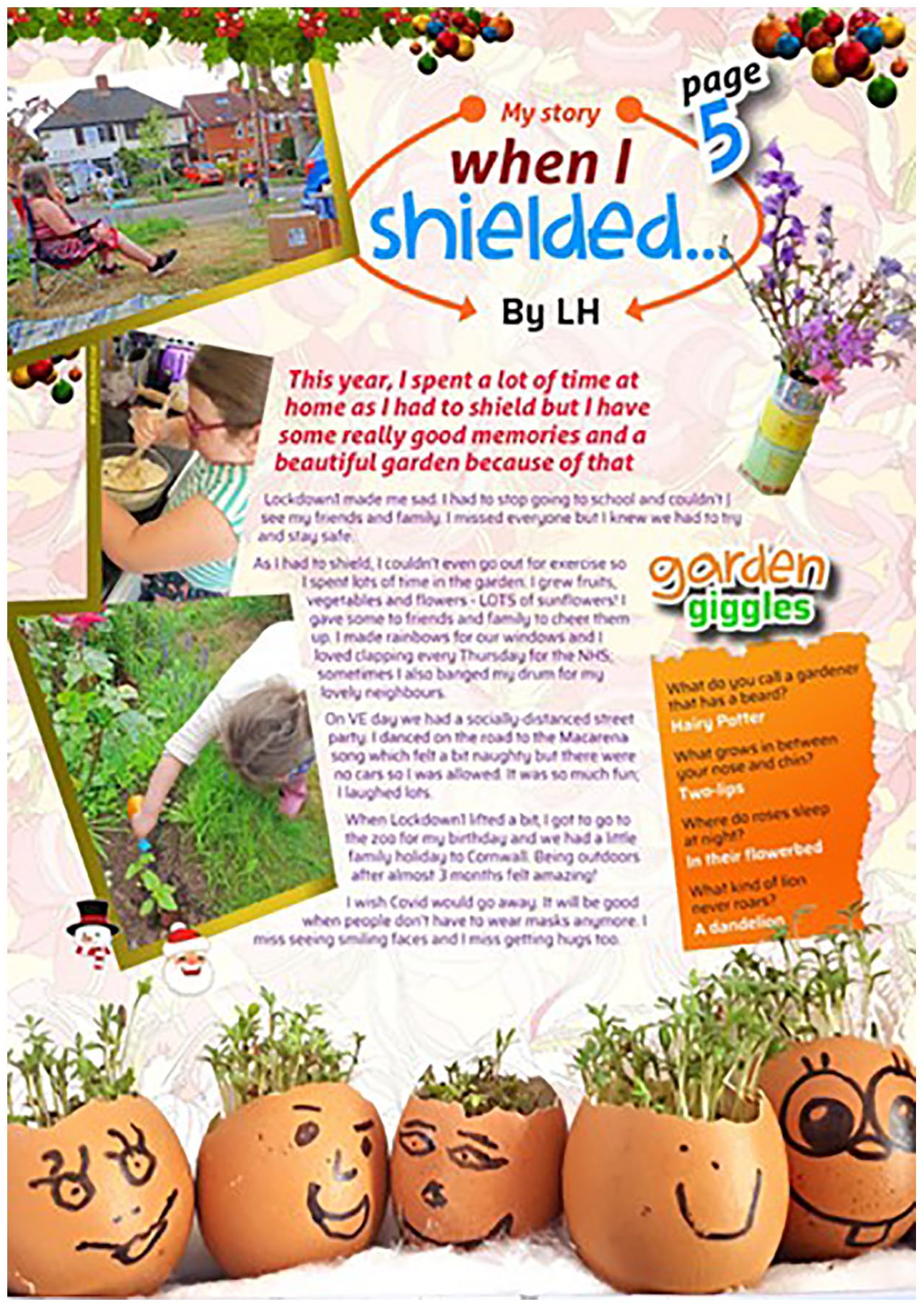
LH, ‘My story when I shielded’ (HomeCool, Issue 5, Dec 2020: 5) © HomeCool Kids, https://www.homecoolkids.com/ Reproduced with permission.
The article text reads: This year, I spent a lot of time at home as I had to shield but I have some really good memories and a beautiful garden because of that. Lockdown made me sad. I had to stop going to school and couldn’t see my friends and family. I missed everyone but I knew we had to try to stay safe. As I had to shield, I couldn’t even go out for exercise so I spent lots of time in the garden. I grew fruits, vegetables and flowers – LOTS of sunflowers! I gave some to friends and family to cheer them up. I made rainbows for our windows and I loved clapping every Thursday for the NHS: sometimes I also banged my drum for my lovely neighbours. On VE day we had a socially-distanced street party. I danced on the road to the Macarena song which felt a bit naughty but there were no cars so I was allowed. It was so much fun: I laughed lots. When Lockdown 1 lifted a bit, I got to go to the zoo for my birthday and we had a little family holiday to Cornwall. Being outdoors after almost 3 months felt amazing! I wish Covid would go away. It will be good when people don’t have to wear masks anymore. I miss seeing smiling faces and I miss getting hugs too!
There is much to unpack. For LH the garden is rich in human/non-human entanglements and intra-actions of space, time and matter. It is a site of embodied and creative intra-activity of spacetimemattering (Barad, 2007), producing and productive of, entanglements involving the more-than-human – soil, weather, plants, insects – and the human, connecting LH to people outside her home, via the gifting of grown produce (see Figure 8).
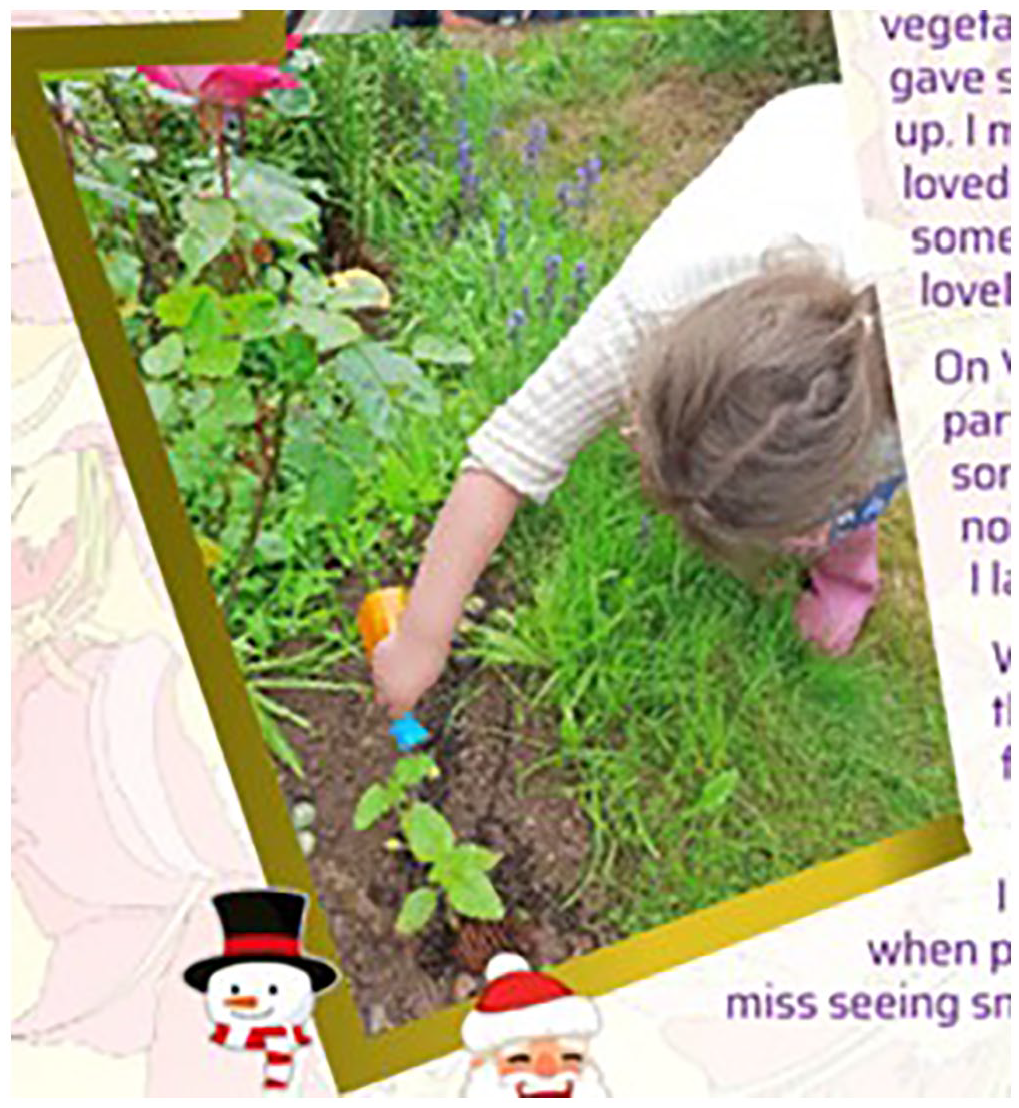
Close up of LH gardening, from LH, ‘My story when I shielded’ (HomeCool, Issue 5, Dec 2020, p.5) © HomeCool Kids, https://www.homecoolkids.com/.
Reproduced with permission
Discursive and material practices of ritual and celebration feature, with strong emotional and sensory aspects, affective atmospheres emerging from intra-activity involving people and events beyond the home. The normally transient space of the front doorstep becomes a site of collective participation and expression, an emergent ongoing place-event with the sound and embodied movement of drumming for the NHS. Connection is made across time in the ritual, collective observance of the anniversary of World War Two’s Victory in Europe Day. This cultural observance connects and entangles multiple pasts to the present. Revisiting and re-enactment of street celebrations draws on cultural knowledge from 1945. Entanglement with music from 1996 (the ‘dancing in the road to the Macarena’) is made possible with the car-free roads of 2020 COVID traffic restrictions. This transgression of the everyday pre-pandemic spatial restrictions that privilege the car in relation to pedestrians, and especially children, gives rise to affect. LH’s self-reported sensation of feeling ‘a bit naughty’, but also laughing and experiencing fun, is a form of ‘unfolding joy’ (Nordström et al., 2021). Despite having to shield, LH’s participation in life within and beyond her home is an illustration of Barad’s (2007) statement that ‘agency is a matter of intra-acting’ (p. 235). Her identity and agency as a participant emerges from her complex intra-actions with entangled space, time, matter, discourse, even within the confines of shielding (Figure 9).
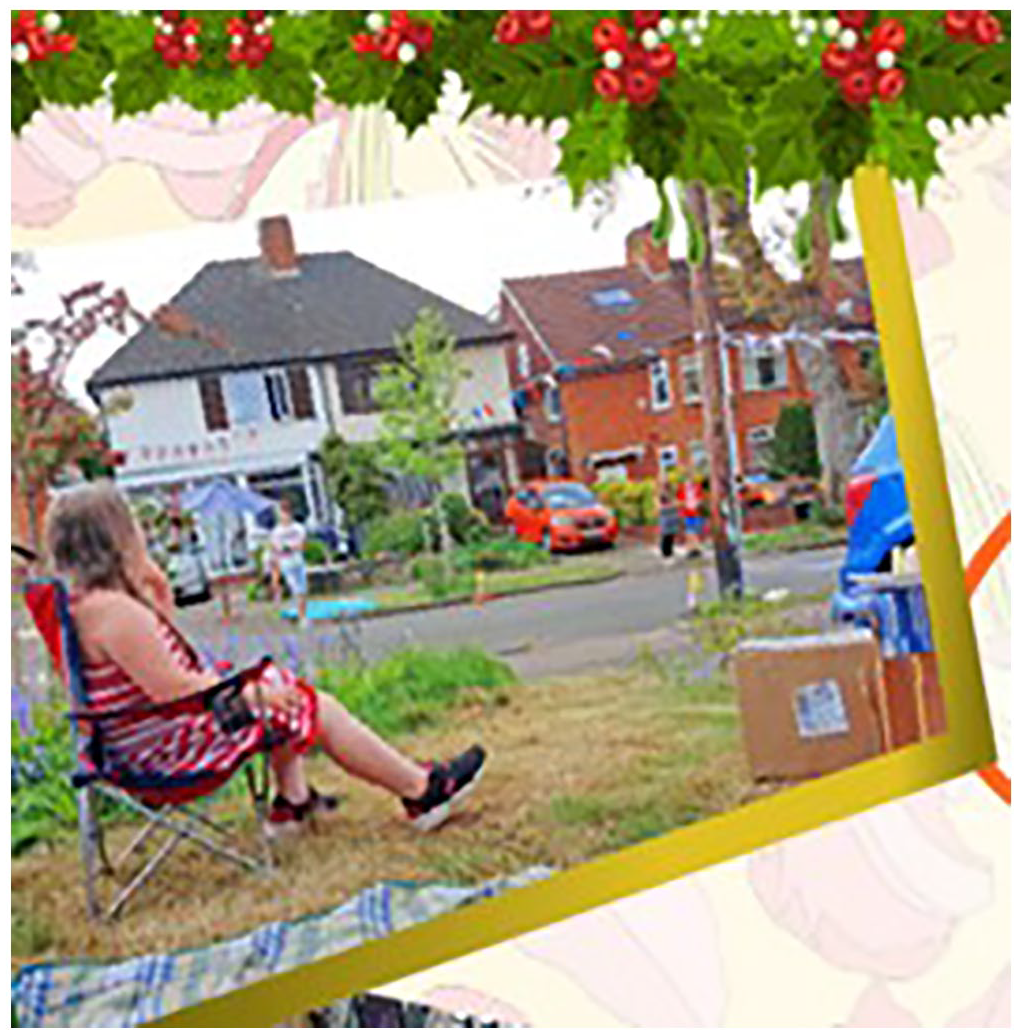
Close up of LH attending socially distanced VE Day Street Party from LH, ‘My story when I shielded’ (HomeCool, Issue 5, Dec 2020: 5) © HomeCool Kids, https://www.homecoolkids.com/. Reproduced with permission.
Reflections and re/fractions
Attending to focal moments of affective intensity (Hollett and Ehret, 2015) in these examples, has uncovered deep and complex entanglements of the human and non-human, emergent affective atmospheres and place-events that are productive of connection and participation. The pandemic child (and adult) constantly emerges out of this entangled intra-activity. Within play assemblages, intra- and inter-generational, the wayfaring pandemic child is repeatedly emplaced, experiencing affective connection and playful participation in myriad forms. Applying Ingold (2007) to (re)consider the pre-pandemic ‘normal’, home, school, care and leisure are experienced as destinations within a constellation of daily experience. Schooling and curriculum can be viewed as an assembly, a network of successive, predetermined points between which (ordinarily) the child is transported via the practices of the classroom and the lesson. Pandemic restrictions pivot the child from the assembly to the walk, from transport across the nodes of childhood spaces of home and school, and thirdspaces, towards a de/re/territorialising meandering, where nomadic lines of flight open up new ways of knowing-feeling-moving, and thus becoming. In the return to ‘normal’ goals that appear to underpin ‘post’-COVID educational policy discourses and interventions, the return of the assembly is in favour. The child is framed as being behind in their progress across it, and the adult role is to facilitate transport to ‘catch-up’ with lost progress. Surfaces and becomings that emerged from the traces of the wayfaring pandemic child are either unseen or considered dissolved.
My reading of each example is re/fracted through my own affective place-events of knowing-feeling-moving (Hollett and Erhet, 2015), bringing them into further entanglement. A FaceTiming camera facing a blue sky, held by my daughter, her small smile and her eyes looking down at the screen/at me, faces of my son and husband and glimpses of trees coming in and out of shot, is how I experienced the family daily walk during 15 weeks of shielding. The photographs from Sunday mornings with my son and niece, give rise to flashbacks, echoes of what was seen/heard/felt as I contained spilling paint pots and lost sight of my niece and sister-in-law beneath an accreting surface of stickers erupting on screen in response to the repeating landing and taking off of fingers in flight. I revisit the embodied knowing-sensing-feeling of clambering up and down my own home physically, encountering my niece’s home virtually, experiencing the entangling physical agency of both spaces and of the surfaces, cameras and microphones of two iPads. Reading LH’s article triggers my body’s muscle memory of dancing the macarena as a nursery teacher in 1996, bringing the face of the 3-year-old child who decided to teach it to me that summer floating up from the depths of my mind.
However, looking again at the examples through a social justice lens produces other re/fractions. Not all children have equal access to the spatial, material, discursive, technological, social, cultural and relational elements we have seen our contributors experience in these examples. The rugby club tyres were there for children to encounter, not locked away or behind a fence. The term ‘FaceTime Art Club’ clearly indicates a level of digital cultural knowledge and access to hardware and to broadband connectivity that we know is not universal. Access to a garden and the knowledge and means to grow, harvest and share garden produce is not enjoyed by all children. Having a front door you feel safe to stand at, a road you feel safe to be in, having a community that is valued and that you feel that you are part of and can celebrate with, means that you can become a participant in significant cultural events and rituals. (It is notable that whilst VE Day 75th anniversary celebrations were allowed to go ahead on Friday 8th May, controversially, at the end of July, with under 24 hours’ notice, the U.K. government issued restrictions banning separate households in Greater Manchester, and parts of East Lancashire and West Yorkshire from meeting to celebrate the end of Ramadan (ITV News, 2020)).
Conventional reflections on these examples could lead us to commend our child contributors on their resourcefulness during the pandemic. We might praise those who we deem to have exercised agency and demonstrated their resourcefulness as a personal quality and seek deficit explanations of those who we fear did not. Barad (2007) reminds us, however, that agency ‘is an enactment, not something that someone or something has. Agency is doing/being in its intra-activity’ (p. 235). A post-humanist re/fraction thus helps us to break down the concept of re/source/fulness and acknowledge the many different forms of intra-acting entanglement that have contributed to it. What emerges is an appreciation of how play is part of the constitution, re-figuring and re-constitution of children’s affective networks. In complex, multimodal, more-than-human play assemblages, the entanglements of the pandemic child involve them (re)examining, (re)making, (re)covering, (re)imagining, (re)telling, (re)purposing, (re)iterating and (re)claiming. It is important to acknowledge that children have experienced sadness, and loss during the pandemic. But there has also been rich, productive entangled intra-action resulting in the possibility of different becomings. The entangled, intra-acting child-friendly society, as seen through a posthumanist COVID lens, needs to be committed to opening up this possibility of different becomings in post-COVID times where children, affect and place-event playfully unfold.
Footnotes
Funding
The author(s) disclosed receipt of the following financial support for the research, authorship, and/or publication of this article: The research featured in this article was funded in the UK in 2020-22 by the Economic and Social Research Council (ESRC) under the UKRI Rapid Response to COVID-19. The award number was ES/V015451/1 and the project title was: ‘A National Observatory of Children’s Play Experiences during COVID-19’.
