



Abstract
During crisis times, what children are playing and what grown-ups think their games signify can become a focus of adult anxiety. The Play Observatory, a COVID-19 research project, drew on folklore studies and cultural histories of childhood to collect, document and understand what children were playing and doing during extraordinary times, in ways which were meaningful to children themselves. This article discusses some of the children’s and families’ contributions, juxtaposed with children’s contributions to the archive of childhood folklorists Iona and Peter Opie, to highlight and contest adultist interpretations around children’s play during difficult times. We suggest that these interpretations are rooted in particular social constructions of the child, of childhood and of play that reflect themes of innocence, purity and vulnerability, and the need for adult protection from contamination, both material and symbolic. We introduce the idea of ‘inflection’ to suggest how habitual and perennial forms of play may be made to temporarily accommodate contemporary issues by the players as opposed to the play (and hence the child) being ‘infected’ with troubling or distressing themes which detract from idealised constructs of childhood.
Introduction
In March 2020, COVID-19 was identified as a pandemic by the World Health Organisation which declared the outbreak to be ‘a public health emergency of international concern’ (Onyeaka et al., 2021: 2). Measures implemented to stop the spread resulted in the ‘unique phenomenon’ of a ‘global lockdown’ at both national and international levels (Onyeaka et al., 2021: 4), affecting myriad aspects of people’s everyday lives. When speaking in terms of the COVID-19 pandemic as a ‘crisis’, this article considers not only the risks from the virus itself, but also the swiftly implemented measures to contain it. These include stringent restrictions on movement and social interaction resulting in physical confinement and regulation, and the necessity of rapidly adapting to new and potentially isolating, more difficult ways of living, including for children. In the UK, where the authors of this article are based, children experienced the sudden closure of schools and leisure amenities, including playgrounds, and restrictions to movement outdoors and with whom they could interact face-to-face. Consequently, we perceive and refer to the pandemic as a time of crisis in this article.
During times of societal crisis, children’s play and lives can become a focus of adult anxiety given that their play has been utilised to ‘take the temperature’ of a situation in relation to emergent causes for concern, or in a knee-jerk response to alarming or upsetting incidents making the headlines, generating sensationalised ‘moral panics’ (Cohen, 2002). This is particularly true when children’s play appears to reference the crisis in some way. The Play Observatory was conceived as a rapid-response research project to the COVID-19 pandemic. Inspired and informed by children’s folklore studies and cultural histories of childhood and play, and particularly the mid-20th century surveys of children’s play by Iona and Peter Opie, we sought to document and understand more about children’s everyday experiences in what felt to be extraordinary times. 1 Our focus was, and remains, trained on what was extraordinary for children during this time and what was ordinary, the interplay between these two states, and how this may relate to other times of crisis. Linked to this, we became aware of ways in which a crisis context affects the adult gaze on children and play.
Drawing on Play Observatory contributions and archival sources, we take a ‘long view’ of the present and consider the COVID-19 pandemic as one example of a period of interruption and adversity in children’s lives. We examine accounts of children’s play and life experiences today and in the past, highlighting and contesting some of the interpretations and assumptions commonly made by adults that make judgements about children’s play drivers in accordance with social constructions of childhood.
Pandemic childhoods: Adult anxieties
That the global pandemic changed the shape of children’s everyday lives is undeniable with many of the fundamental elements of children’s everyday lives stripped unceremoniously away in one evening – 24 March 2020 – for many UK children. As Barron et al. (2021: 366) observe, citing UNICEF (2020), ‘its wide-ranging effects risk being catastrophic to children with long-term consequences’, those risks being not only contracting the virus but the multifaceted impact of social distancing measures. Barron et al. (2021) continue, noting that media reports of the pandemic had the potential to generate ‘a culture of fear. . .which may reveal itself through disproportionate anxiety’ for both adults and children (p. 367). As Black et al. (2023) state, when evaluating institutional policy documents generated by ‘Canadian professional organisations’ (p. 72), ‘we are concerned that there is a moral panic about the negative effects of school closures and other pandemic responses on children’s mental health’ (Black et al., 2023: 76).
These concerns are reflected in a number of academic and popular articles concerned with children’s ‘coping’ and ‘resilience’ during the pandemic. As Bartlett and Vivrette (2020) write, ‘the Covid-19 pandemic and its associated social and economic stressors can undermine children’s development and well-being’ (p. 1). The authors suggest ways in which adults may ‘promote. . .protective factors’ (Bartlett and Vivrette, 2020: 1) to boost children’s resilience. Similarly, McKenzie (2021), focusing on younger children’s resilience during COVID-19 observes that ‘it is our . . . duty as early childhood educators to protect our children from the physical dangers of disasters and to bolster them emotionally to help them build resilience to survive this pandemic’ (p. 12).
Such literature notably puts the ball in the court of adults such as parents and educators to support and scaffold children’s resilience and model behaviour. For as Dominguez-Álvarez et al. (2020:11), drawing on results from their study of Spanish children’s coping and adjustment, observe, ‘The parental personality trait of resistance to adversity (i.e. resilience, Bensimon, 2012) interacts with child engagement and disengagement coping to produce positive or negative outcomes’. It is possible to see how adults may perceive themselves, or be informed to perceive themselves, as gatekeepers of the well-adjusted child and secure childhood in such circumstances and also be alert to evidence to the contrary. This idea of adults attempting to protect children is not new and taps into ongoing constructions of childhood as a vulnerable space and children as needing protection.
Constructing the vulnerable child
These dominant social constructions of childhood (cf. Prout and James, 1997) vastly pre-date the pandemic and are the foundations upon which adult anxieties are built. Scott et al. (1998: 691) note that habitually ‘children (as particular cherished beings) and childhood (as a cherished state of being) are constructed as “at risk”’. The parental role becomes shaped by the twin pressures of risk anxiety and a prevailing discourse of protectiveness, resulting in the constant duty to ‘anticipate and guard against potential threats to children’s well being’ (Scott et al., 1998: 691). Garlen (2019: 59) contends that ‘the assumption of risk concretizes the purity of the child, masking its social constructedness and perpetuating the myth of childhood innocence’. Garlen (2019) argues that childhood is a social practice, a ‘performative identity construct. . . produced and maintained through the rhetoric of protection, which justifies protective practices and policies’ (p. 57). The requirement for performativity impacts on children as well as on adults. For adults their role is manifested via habitual acts of protectiveness, and for children their play becomes perhaps the most important forum within which to demonstrate to adults their expected innocence and perceived purity. From the perspective of the risk-anxious and protective adult, the form (e.g. outdoor physical play vs indoor digital play) and content of children’s play, therefore, becomes a medium of both potential reassurance and potential threat.
Garlen (2019) argues that the ‘nature of innocence is defined in relation to its absence, in that we can define what it means to be innocent by identifying what we seek to protect children from’ (p. 59). Similarly, the perceived innocence of children’s play is defined in relation to the forms and content from which it is to remain untainted. Social constructions maintain the social order. They keep people and things where they should be, preventing cross-contamination and pollution, as well as ambiguous identities. Douglas (1966) argues that ‘as we examine pollution beliefs we find that the kind of contacts which are thought dangerous also carry a symbolic load. . .I believe that some pollutions are used as analogies for expressing a general view of the social order’ (p. 4). Lanclos (2000) identifies how in play ‘children’s use of rude materials, and corresponding adult reactions to and anticipation of that use, serves as a kind of flashpoint for the discussion and negotiation of definitions of what it is supposed to mean to be a child’ (p. 7). Lanclos contends that Douglas’s concept of ‘dirt’ as ‘matter out of place’ is central to this argument which can be extended beyond Lanclos’s (2000) discussion of rude language in children’s play to fears around actual disease and contagion (p. 8).
The social distancing practices of the COVID pandemic disrupted the social and spatial order. They confined families within their houses, broke down boundaries between the adult and child worlds by bringing schooling and employment into the domestic sphere, and saturated entire populations in the pandemic messaging of government via proliferating forms of digital news and social media. During the first weeks and months of the pandemic, with anxieties running high, one particular discourse of concern began to emerge, focusing on children’s reactions to the virus and centring on their play. Articles in the press both highlighted and responded to adult anxieties about the turn children’s play appeared to be taking, especially games that referenced the pandemic, many of which parents were sharing via social media posts (Bologna 2020; cf. Cray, 2020). We argue that, within the already circulating constructions of the child and of childhood, beliefs and anxieties about play and its taintedness could be a way for adults to attempt to reinstate pre-pandemic social order, at a time when the boundaries had become fuzzy, and to keep children within the socially constructed realm of childhood.
Children’s play, illness and contagion: A folklore studies perspective
Our approach to this discussion of past and contemporary play experiences is rooted in our academic backgrounds: folklore studies, histories and sociological studies of childhood and play. These overlapping perspectives compel us to take a ‘long view’ of the present and approach play as part of children’s cultural worlds. We saw the pandemic as a global and historical event impacting the whole generational structure. Its protracted nature meant that the everyday ‘stuff’ of living – which includes play – took place alongside, and became intertwined with, the extraordinary events of life at this time. At the same time, we remain mindful that there are various comparable events/periods across time and space and, via historical sources, we can examine children’s experiences of them, where those sources exist.
In Once Upon a Virus (2004), a groundbreaking book examining vernacular culture and stigma in the context of HIV and AIDS, the folklorist Diane Goldstein describes her instinctive reaction to first encountering children’s play incorporating the disease on overhearing a game of tag: To my surprise I heard the oldest child, who was around seven or eight years of age, say, ‘Tag, you’ve got AIDS.’ Part of me was pleased that a seven-year-old child knew what AIDS was, that public awareness had hit even the youngest sectors of society. But another part of me was terrified to see that the stigmatization of AIDS had drifted into the popular culture of one so young. (2004: 1)
This nuanced response of reassurance of consciousness of risk, combined with anxiety that the virus and accompanying discrimination towards those with HIV/AIDS had entered children’s play, may resonate with parents during COVID-19 whose concern to keep their children safe through awareness, for some conflicted with the desire to ensure they were protected from its more frightening and threatening elements. Yet Goldstein (2004) goes on to discuss how the episode ‘reminded me that a number of children’s games are about fear of infection’ (p. 2), commenting on the ‘historical emphasis in children’s folklore on fears of infection, childhood obsessions with body parts, fluids, and emissions and concerns about diversity and conformity’ which made the integration of AIDS into children’s play unremarkable.
Folklorists recognise that despite adult framing of children as vulnerable, and adult attempts to shield children from knowledge of troubling situations, folklore and children’s play have functioned as spaces for children’s expression. Bronner (1988) comments that while adults may attempt to protect children from ‘the harshness of news. . . children have the outlet of folklore to discuss the meaning of issues of the day’, commenting that topics such as death, abortion, child abuse, sexually transmitted diseases and civil rights issues have all made their way into children’s lore (p. 33).Consequently, folklorists arguably anticipate that wider events have the potential to inform play which can spark research. Lanclos (2003) witnessed how folklore can make plain children’s recognition of ‘and ambivalence toward the very label of child’ (p. 48), and that via folklore ‘children both engage with and critique the expectations they encounter in their families, in the schools, and among their peers’ (Lanclos, 2003: 5).
This is not to dismiss fears that children experienced during the pandemic, nor play as a means of coping: ‘Play allows children to repeat things they have seen and heard, retell it and remould it until it makes some kind of sense as a coping mechanism’ (Beresin and Bishop, 2023: xxiii). However, what allows for such interpretations at all is play’s ambiguous nature, which also means that play practices may be interpreted in ways serving adult interests. We suggest that adult – frequently parental or caregiver – awareness of and concern about these kinds of play is itself an observable phenomenon in times of crisis when adults may become hyper-aware of risk.
In the case of the coronavirus pandemic, despite the continuation of play containing reference to the pandemic (evidenced in the Play Observatory data and noted by Bishop (2023) in relation to coronavirus chase games), this concern did not transform into a broader panic in and of itself (although the pandemic intersected with other ongoing concerns around childhood), perhaps because such play became understood by adults as a means for children to ‘cope’ and so play more generally was encouraged and promoted. Some experts encouraged parents to be aware of and manage their own anxieties to ensure they were not projecting them onto their children (e.g. Cray, 2020), as discussed above.
Infection or inflection?
In our analysis we avoid labelling play examples from the Play Observatory as singularly ‘COVID play’ or ‘crisis play’, instead seeking what we term ‘inflection points’ where habitual forms of play and crisis intersect on children’s terms. The word inflection derives from the Latin term ‘inflectere’, meaning ‘to bend’ (Hoad, 1993: 235). It is used in many fields (maths, physics, economics, sociology) to identify the moment when an accumulation of forces results in a spontaneous change of direction. We use it here to consider ways in which the accumulation of the new discourses and practices of the emerging pandemic intersects with children’s play, causing a spontaneous change in direction (a bending or nodding towards the crisis as seen in references in their play and in adaptations (of physicality/rules) made to play). These inflection points can tip back again or bend towards a new set of accumulating forces. Inflection serves as a counterpoint to an adult tendency to view COVID references or adaptions to play as a sign that play has been ‘infected’ by the presence of the virus/pandemic. The term ‘infection’ derives from the Latin word ‘inficere’, meaning to ‘stain, taint, spoil’ (Hoad, 1993: 234). It connotes danger and impurity, placing it in direct tension with dominant constructions of childhood and of play as pure and in need of protection. It also allows for more nuanced considerations of the play event.
There is an inherent fluidity in our conceptualisation of inflection, informed by posthumanist understandings of the nature of being-doing-feeling. The child is viewed as being in quantum entanglement with the human and the more-than-human, and the ‘accumulation of forces’ mentioned above can be understood in terms of the enfolding nature of such entanglements. As Barad (2007) reminds us ‘agency is a matter of intra-acting’ (p. 235) and thus the child and their play are both becomings, emergent from ever-changing coalescences and dispersals of the human and the more-than-human. Viewed in this way, inflection sheds light on this folkloric engagement with crises such as illness and epidemics, by demonstrating the process by which these themes move transiently through children’s play, intra-acting with, rather than tainting, the play or the player.
Contemporary examples from the Play Observatory
The following analysis considers a variety of Play Observatory contributions where we see the pandemic as ‘inflecting’ children’s play as opposed to ‘infecting’ or polluting its presumed purity. They are taken from the Play Observatory online survey which ran from March 2021 to March 2022 and received 203 submissions from child and adult contributors, submitting separately or in partnership (see Play Observatory, 2023). The social restrictions arising from Covid-19 required the use of remote methods of data collection and the project adopted two complementary approaches – an online qualitative survey (Olusoga et al., 2022) and 10 video-call interviews with children and their families in various parts of the UK (Cowan et al., 2022). From the outset, we wished to position children as contributors to the survey, providing a means for them to describe and document their own experiences of play. We balanced this aim with legal, ethical and safeguarding considerations surrounding children’s participation in this research, recognising that some adult involvement was essential.
Children were invited to represent how they felt about their play experiences through selecting one or more emojis to convey their emotion(s) at the time and/or describing them in words. These offered the possibility of capturing the range of emotions experienced during play and avoided the presupposition that play is necessarily ‘fun’. In addition contributors could upload digital images and recordings of their play.
Harry Potter and the defeat of the coronavirus
A parent in Germany shared the example of her 8-year-old son ‘reviving and adapting a game he played while younger in the bath called “shampoo shop” where he would mix and sell shampoos on the ledge of the bath’. During the pandemic, this game became one of ‘potion making’, making a magic or protective cure for the virus.
The parent observed other examples of magical fantasy play around the Harry Potter franchise – their son and his best friend ‘playing with wands’ and ‘playing Harry Potter during the first lockdown and conjuring spells to defeat Corona’. These activities are reported as child-initiated, with the children appearing to be ‘cheerful’ and ‘purposeful’ in their play (Play Observatory PL61A1/S001).
These play incidents demonstrate the melding together of multiple factors: play memories and a favourite game’s revival, the availability of play objects, the influence of children’s mediascapes in the form of the Harry Potter franchise, companionship with the presence of a friend in one instance, and presumably the adult observing the bathtime play in another, all inflected in this particular moment with the then current pandemic. The children here approach the pandemic through the lens of fantasy, as something that can be overcome – in this case through magical means and the child/childrens’ own perceived agency. This is not to say that the children ‘believed’ their actions would have the desired consequences. As Sutton-Smith (1997), considering phantasmagorical play, observes: ‘Children know that they are manipulating their thoughts about reality, not reality itself; and they know that their play self is not the same as their everyday self’ (p. 159). However, the children here absorbed the pandemic into familiar performances in ways which, within their play frame, gave them agency over it.
Representations of pandemic discourses and practices in play
The following examples share themes around practices for avoiding infection, informed by advice, guidance and official regulations regarding sanitising and social distancing. These messages – omnipresent during the pandemic – appeared in public spaces via notices and images, and were conveyed through media outlets such as radio and television news bulletins, accessible to children as well as adults.
In England, a grandparent shared a description of two play moments involving her 4-year-old grandson and his parents in their family home. One day, she wrote, the child asked his parents if he could have the washing-up gloves, continuing: ‘When they turned to talk to him, he was wearing a long apron and had put his sun visor down over his face to mimic PPE. He needed the gloves to complete the outfit’.
The same grandmother contributed a further example concerning the same child, demonstrating his awareness of COVID-19 rules and then current guidelines on social distancing. The playful moment took place during a familiar game of ‘Cafe’, with the grandmother recording that she had put out the plastic chairs used in the game ‘as we would normally do’. Her turn of phrase here suggests that this was a habitual intergenerational play activity. Her grandson, though, rearranged them ‘to make sure they were 2 metres apart, saying it was not allowed to be close together now’. During this play, the child’s mood was described as being ‘A wish to be absolutely sure he was following the rules he had learned about through media and listening to adult conversation’ (Play Observatory PL71A1/S001). As in the above example, this play is imaginative and informed by mediascapes and adult interactions. However, rather than play countering COVID-19, this play is inflected with themes of preventative action to avoid it.
This contribution to the survey from a 4-year-old girl from Wales (Figure 1) is a drawing from an unspecified date in 2020, featuring a smiling hand and a container of hand sanitiser. Both are anthropomorphised, with large eyes, smiles and arms and hands extended outwards. A jet of blue sanitiser sprays from the container, and around the page are butterflies. The accompanying first person text seems to be a collaboration between child and parent: I have been drawing pictures of germs and hand sanitiser. I love drawing. I have also been drawing lots of rainbows since last year and colouring in lots of pictures in rainbow colours. I put lots of rainbows in my front window last summer (but we took them off at Christmas to put Santa up). I have been asking when I can go places again and often add “when the germs have gone” to my plans and ideas. I draw at home, in school and at day nursery. I love colouring in rainbow colours now. I draw with my friends and my Mami (mum). I normally draw on paper but I sometimes draw on an iPad at home or in school.
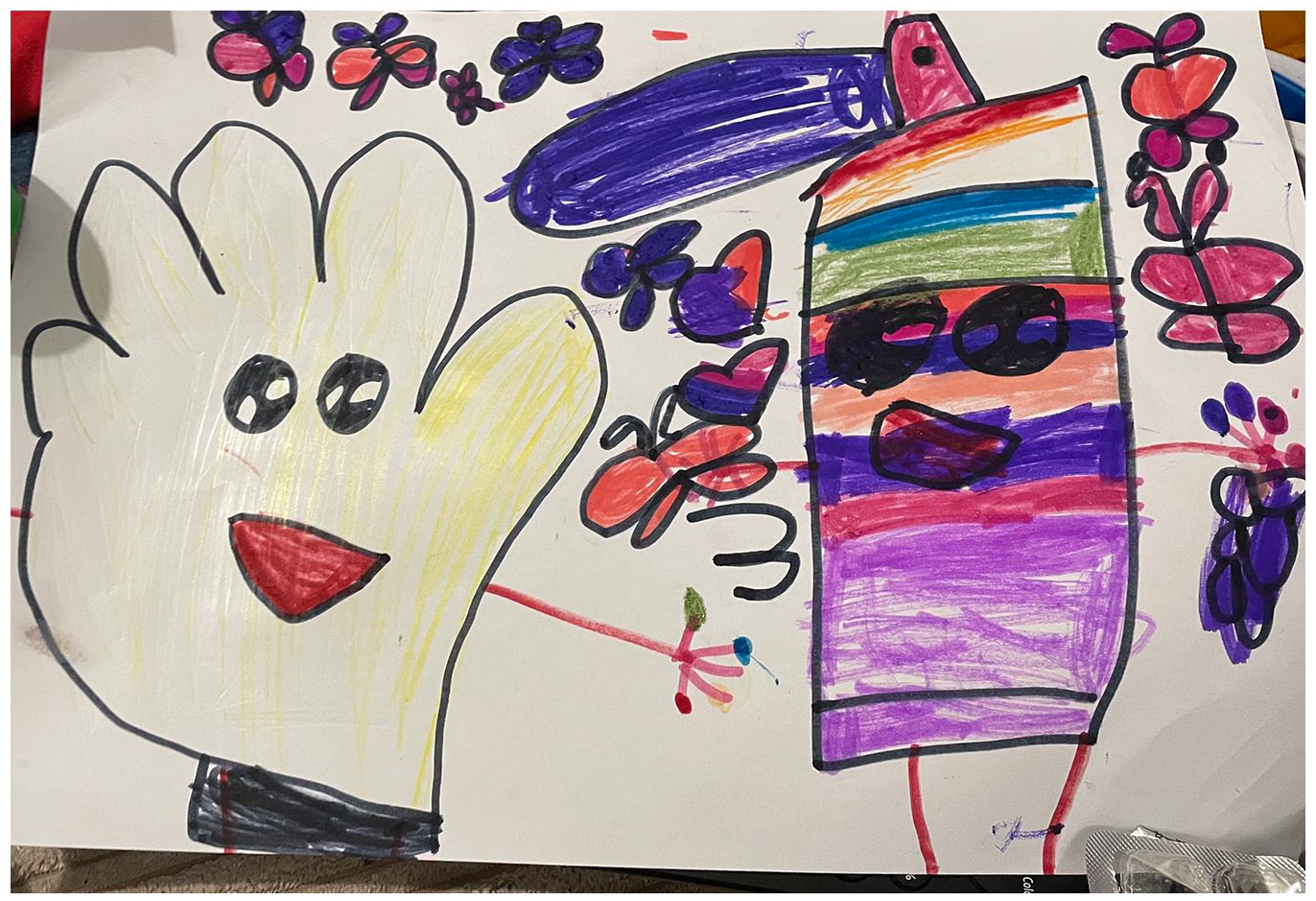
Drawing of hand and sanitiser Play Observatory (2023) PL46C1/S001/p1.
The image, the phrase in the middle section ‘when the germs have gone’, and the reported drawings of rainbows in 2020, demonstrate her understanding of unfolding practices and visual literacies of pandemic. Reflecting on how the play made her feel, the child has selected a smiley face emoji and states that: ‘Drawing makes me happy. I like showing people my drawings. I send photos to my nanny, bampy, granny and grandpa’.
The drawing is inflected by the emergent pandemic hygiene practices and discourses associated with disease and contagion. The butterflies surround the hand sanitiser as a motif that hints perhaps towards its smell or the idea that it displaces the germs (reminiscent of historical understandings of disease being spread via miasmas). Hybridity and flow from discursive, artistic and material practices, their capture and dissemination via digital technology across time and space to connect with the wider familial networks, reflect deep entanglement and productive intra-action. With the coming of Christmas, however, this inflection gives way and pandemic related drawings are taken down to make space for Santa and the usual decorative rituals of the holiday.
The emotional tone of this drawing from a 5-year-old girl from England (Figure 2) is very different. The first national lockdown in the UK was announced on 23 March 2020 and began on 26 March. This drawing was made on 19 March at a time when there was a national debate raging about the need for lockdown. The accompanying text quotes the child and reads, ‘Everything has corona virus because it’s been outside, apart from the medium tree because it stayed inside. The tiny tree is crying because it doesn’t understand what’s happening’. The parent comments that: ‘The corona virus is represented by the spots. The v shapes are flying birds. I also notice that the smallest cloud, bird and sun are also crying (so the child sun and cloud)’.
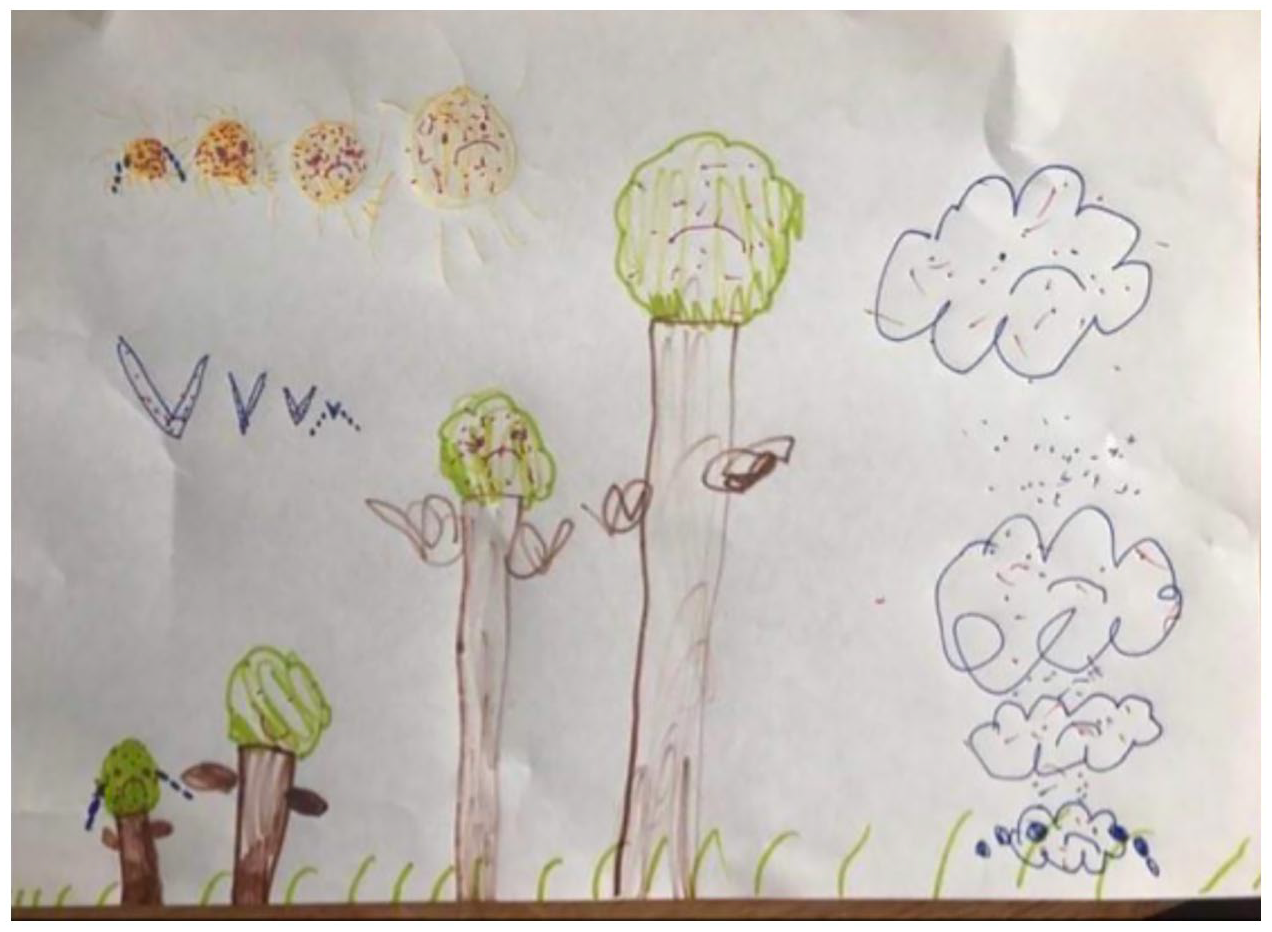
Drawing of trees Play Observatory (2023) PL177A1/S001/p1.
Responding to the prompt about emotion the parent describes the child as ‘Very serious and thoughtful whilst drawing’, and indeed, the image is complex and sombre. Trees, birds, clouds and suns are arranged in sets of four of diminishing size. In each case the smallest is depicted as crying. This contribution exemplifies how the sudden significance and danger of being ‘outside’ has become an inflection point in this child’s play which finds expression in the visual elements of the frowns and sad faces on the more-than-human entities in the drawing, as well as in the accompanying text, which reads somewhat like a morality tale.
Contentious play: Corona tag
A Play Observatory contribution, from a teacher in Worcester, UK, describes 9-10-year-old pupils playing ‘Corona tag’, the familiar game of touch chase (‘tag’) but re-framed in terms of the virus and its transmission: Early March 2020, before schools partially closed (and government insisting they would not close), the year 5 children I worked with were playing corona tag. The playtime had been lengthened to 30 minutes in the morning to give time for hand washing and for us teachers to clean down the desks, as well as for air circulation and fresh air. The children were playing a version of tag called corona tag where the person who was ‘on’ had coronavirus and whoever they caught had the virus passed on to them. (Adult contributor, Play Observatory PL213A1/S001).
‘Corona tag’ and similarly named chase games, in which the chaser was, or had, the coronavirus, emerged rapidly in many different places at once, beginning in February-March 2020, and continued to be reported over a period of several years (Bishop, 2023). Children reimagined familiar games, their play inflected by discourses, terminology, imagery, practices and information relating to the pandemic, garnered from both their mediascapes and their everyday surroundings, resulting in a variety of forms with ingenious details and associated rules.
This particular account counterpoints the focus of school staff during breaktime on hygiene measures, designed to prevent the spread of the virus, with the children’s playful enactment of the virus’s transmission in their playtime game. The pretence of the chaser ‘spreading’ the virus through the act of touching the other players heightens the basic premise of the game, overlaying the roles of chaser and chased with imagined additional ‘danger’ and thrill.
The children are described as being ‘very jovial and happy in their play’, their carefree disposition, perhaps engendered partly by the extended playtime as well as the game, contrasting with the teachers’ concern to protect pupils and themselves from infection. The account highlights the adult perception of the game as contentious, the children being ‘told by senior leadership that it was not an “appropriate” game and they should stop’. The contributor states, however, that ‘they did not, they just got better at pretending they weren’t playing it!’
This neatly illustrates the ambiguity of play and its propensity to be seen as indexical of the state of childhood in times of crisis. The senior leadership’s view of the game appears to cast it as disrespectful, trivialising or even mocking, and potentially disregarding of, public health safety measures. In this construction, the child is not so much viewed as vulnerable and in need of protection as disruptive, threatening and dangerous to the social order. The observations of the contributor of this account present a different perspective, similar to that of Lanclos, noted above, in that the actions of the children, in finding ways to continue playing the game in plain sight of the adults whilst evading detection, both recognise and resist the adultist expectations placed on them.
Representations of contagion, healing, illness and death in the Iona and Peter Opie Archive
The Play Observatory project was informed by prior research projects all taking inspiration from the work of folklorists Iona and Peter Opie, particularly their research into the everyday expressive culture of school-aged children in Britain c.1950–1990. Although not the only people to have studied children’s folklore in Britain, the Opies’ research was of particular significance due to the extended period over which it took place, their insistence on documenting contemporary examples from children on a national scale at a time when children’s participation was not the norm in the social sciences, and the way in which their fieldwork was informed by extensive historical and comparative research (Bishop, 2020).
The Opies were interested in children’s oral culture and games, and undertook to gain information from children from all over Britain, first via written surveys administered through primary and lower secondary school teachers, and later via sound recordings and weekly observations at a school playground. Their resulting archival collection is a rich source of information about children’s everyday play lives. 2
Play and themes of contagion
The examples of play, oral lore, customary practices and belief contributed by children illustrate the prevalence of references to illness and contagion in their oral culture and play in mid 20th-century Britain. Although not from a specific period of crisis per se (although among earliest examples from their 1950s surveys are references to World War II), they are suffused with examples mentioning common childhood complaints, illnesses and afflictions. Some also referenced illness via mediascapes of the time, such as the fictitious disease of ‘Lurgy’, and children also, in response to questions about charms and vernacular cures made suggestions of methods for healing – some magical in content – as well as apotropaic practices to ward off disease or misfortune.
Common complaints and illnesses prevalent in childhood, such as the flu, measles, whooping cough and chickenpox, crop up regularly in children’s rhymes. This is perhaps understandable in the case of ‘flu’, given its usefulness as a rhyme for ‘you’, especially in the context of counting out rhymes to select who is ‘on’ or ‘it’ in the game, as in this example from Kirkcaldy, Fife, in Scotland (Figure 3).
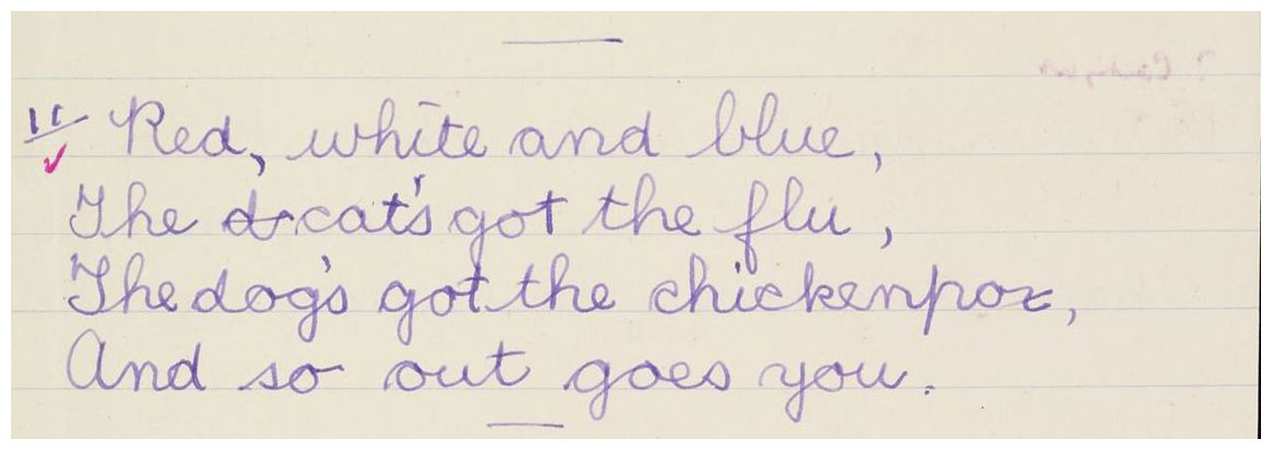
Archive of Iona and Peter Opie, Bodleian Libraries, University of Oxford, MS. Opie 3 fol. 304v, https://www.opiearchive.org/item/1512. Image: CC BY-NC 4.0.
In the rhyme, it is not a human family member who has succumbed but animals common as pets. Similarly, Roud has found that cats having measles and dogs with flu are ‘a surprisingly tenacious image in popular playground imagery’, featuring in singing games and rhymes collected from 1980 onwards (2010: 288).
In rhyming play, the player may also fall sick, as evinced by the contribution ‘Monkey, monkey, I am sick / Send for the doctor quick quick quick’ (MS. Opie 3 fol. 274r), also from a Kirkcaldy High School pupil, and the more morbid ‘Mother, Mother, I am sick’, a skipping rhyme collected by a teacher from boys at Oundle School, Northamptonshire, in 1952, in which the speaker is said to be dying (Figure 4):
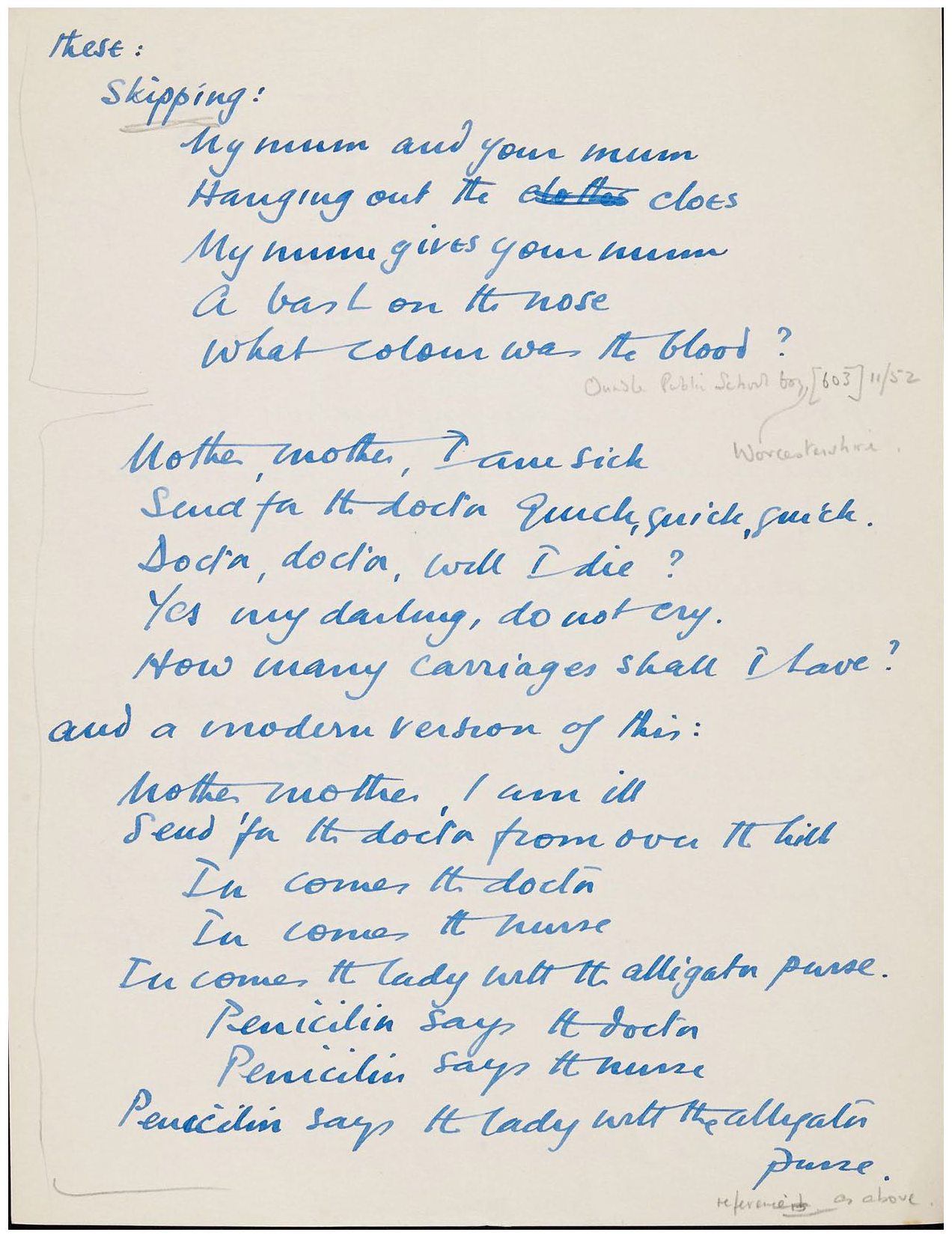
Archive of Iona and Peter Opie, Bodleian Libraries, University of Oxford, MS. Opie 9 fol. 239v, https://www.opiearchive.org/item/3705. Image: CC BY-NC 4.0.
Play, illness and pranks
While contributions to the Opies’ research were not often contextualised, some offer glimpses of wider social history that resonate with contemporary experiences. This contribution, for example, which was collected in response to the Opies’ questioning around oral lore and children’s customs on special or festive days, relates an April Fool’s Day prank which hints at disease control measures. The 9-year-old boy contributor from Birmingham, writing in 1953, described how he tricked his brother, and his sibling’s intriguing reply (Figure 5).
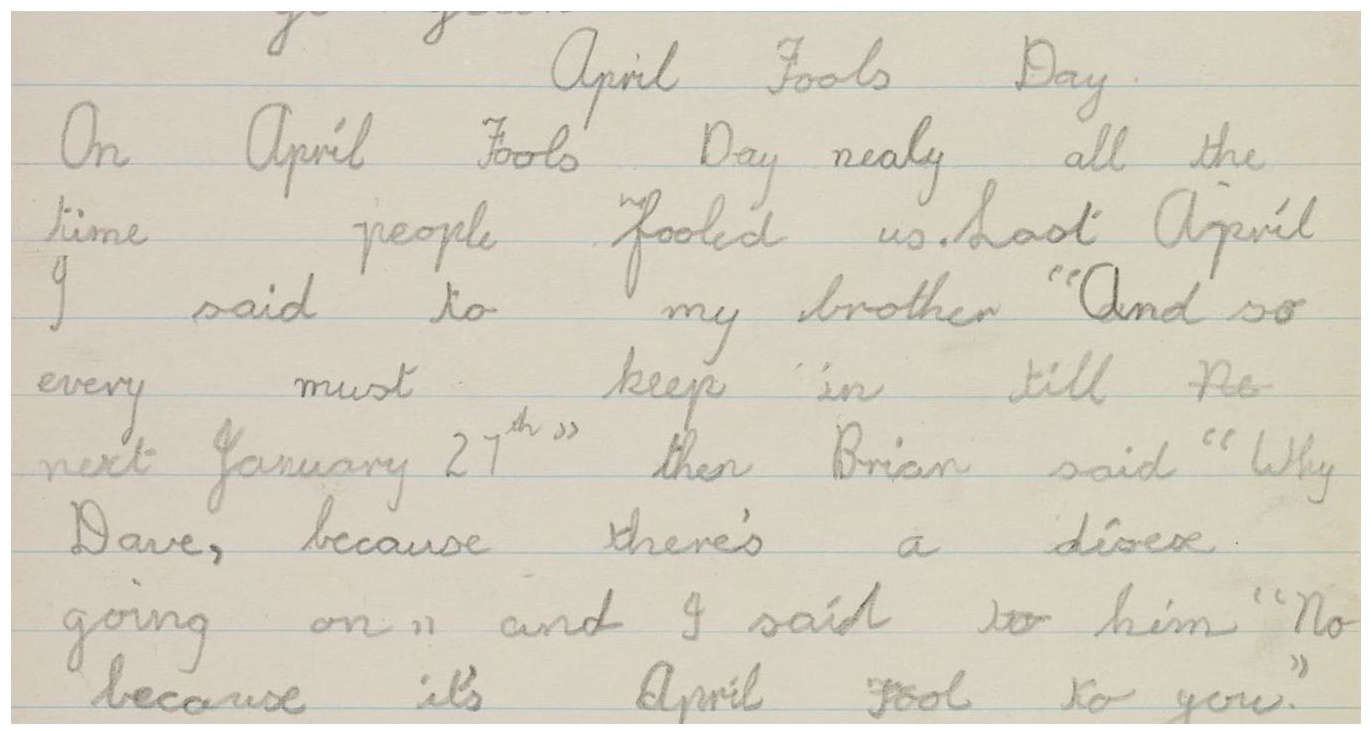
Archive of Iona and Peter Opie, Bodleian Libraries, University of Oxford, MS. Opie 9 fol. 517r, https://www.opiearchive.org/item/5426. Image: CC BY-NC 4.0.
Lacking further data, we can only attempt our own contextualisation, and it is worth considering that at around the time of the prank – the early 1950s – the UK experienced severe influenza outbreaks, with Birmingham one of the ‘Great Towns’ affected according to Proceedings of the Royal Society of Medicine in March 1951. This example, though, demonstrates how a habitual folkloric play practice, pranking in accordance with calendar custom, may become ‘inflected’ by a specific moment without losing its perennially playful structure or intended purpose. The brother’s comment in response to the prank shifts the tone of play, bending the ordinary towards the extraordinary and making it manifest in how it may be interpreted by the performers.
‘The dreaded lurgi’; Play and societal panics
The Opies (Opie and Opie, 1969: 62–123) documented numerous games revolving around the concept of chasing, catching and touch. These are predicated on a metaphor of contagion or harm but this is not generally an explicit focus for players themselves except in certain ‘unpleasant aberrations’ (Opie and Opie, 1969: 62). These latter comprised games in which the touch of a particular player was explicitly said to transmit a disease, affliction or undesirable characteristic to other players (Opie and Opie, 1969: 75, 76). The degree of unpleasantness varied. So, while ‘Fever’ is reported by an 11-year-old girl from Middlesex in 1960 to be ‘a made up game and a good one if you don’t know what to play at play-time’, ‘Lodgers’, played in Guernsey in 1961, involves throwing a ball of paper at someone while other players shout ‘How much do they pay a week’ or ‘How many have you got’. The person who is on ‘is supposed to have fleas’ (both examples from the Archive of Iona and Peter Opie, Bodleian Libraries, University of Oxford, MS. Opie 94).
Perhaps the most widespread of these in Britain in the mid-20th century was ‘Lurgi’, games of which greatly proliferated in 1954 after the BBC radio comedy programme, The Goon Show, aired an episode entitled ‘The Lurgi Strikes Britain’ (Opie and Opie, 1969: 76–78) in which this tongue-in-cheek epidemic threatens to wipe out the country’s entire population. The associated catchphrase, ‘the dreaded lurgi’, became widespread among children and adults, referring to any infection, real or imagined, and also surfaced in children’s chase games. In a 1960 example from Scarborough, ‘if [the player] hits somebody [with the “lergi”, a small object] that person has to pick up the “Lergi” and everybody shouts “David’s got the Lergi” (or whatever his name may be). Thus the game keeps going on’ (Archive of Iona and Peter Opie, Bodleian Libraries, University of Oxford, MS. Opie 94). The lurgi catchphrase and lurgi games have persisted up to recent times (Roud, 2010: 32), many decades after their immediate trigger.
As the Opies point out, such games are not confined to Britain, nor the recent past, citing comparative examples from New Zealand, Spain and Italy, and a late 19th-century example from Madagascar (Opie and Opie, 1969: 77). The parallels between these games and the pandemic-inspired games of ‘Corona tag’ discussed above show that the practice of inflection has a long history, and children habitually bend their games in accordance with the accumulating force of discourses and information from mediascapes and their everyday surroundings.
Concluding thoughts
Evidence from play examples and incidents contained in the Opie Archive demonstrate that illness, and risk of illness or injury, is a constant motif in children’s play. Yet, they also show that habitual play can accommodate or reflect specific moments, when they are inflected with contemporary issues, including severe outbreaks of illness. What is striking about such accounts is that their overall tone does not stress or highlight the extraordinariness of the times or situation. Instead, the extraordinary element emerges from the account of the ordinary. In a similar fashion, children’s contributions collected by the Play Observatory are not necessarily ‘pandemic play’ and, we argue, should not be routinely labelled as such, but are examples of children’s play inflected with issues arising from pandemic times and bringing together multiple playful genres and motifs.
This article has explored how children’s play, even in crisis times, is ambiguous and so subject to interpretation founded in adult anxieties. Furthermore, it has introduced the concept of ‘inflection’ – a new concept allowing us to overturn perceptions – whereby habitual and customary play is ‘inflected’ momentarily (and perhaps even in the longer term) with aspects of crisis situations which children turn to their own playful purposes. In these instances, inflection draws on the virus as a cultural reference. The framing of play via the concept of inflection also seems to allow adults to accommodate a wider range of possible motives and emotional states in the child. It further provides opportunities for the adults to make reassuring connections to their own childhood memories of play. Rather than immediately following the imperative to worry about and shut down forms of play seen as infected with difficult ideas or circumstances, for adults bathed in the discourses of protection, prevention and risk anxiety, inflection can provide the cognitive and temporal space to step back, observe and engage with children’s play as it shifts back and forth in content, tone and practice.
Returning to our interdisciplinary perspective, we hope we have demonstrated the importance of stepping outside crisis moments to take a longer view, which permits slower, more informed, analysis rather than a race to interpret within crisis situations. Furthermore, we wish to emphasise the importance of distinguishing between play in the pandemic from play about the pandemic, while being interested in both.
Footnotes
Funding
The author(s) disclosed receipt of the following financial support for the research, authorship, and/or publication of this article: The research featured in this article was funded in the UK in 2020-22 by the Economic and Social Research Council (ESRC) under the UKRI Rapid Response to COVID-19. The award number was ES/V015451/1 and the project title was: ‘A National Observatory of Children’s Play Experiences during COVID-19’.
Notes
Author biographies
 ) and her publications include contributions to Play Today in the Primary School Playground (2001), Children, Media and Playground Cultures (2013), Children’s Games in the New Media Age (2014),Changing Play (2014), and The Lifework and Legacy of Iona and Peter Opie (2019).