




Abstract
This paper shares methodological insights from our research which sought to centre children in the production of knowledge during the 2020 global pandemic to consider how this can inform research with children beyond the crisis. Drawing on our longitudinal participatory arts-based research with 30 children aged 9–12 during 2020–22, the paper illustrates our response to the shifting research landscape which included navigating social restrictions to develop child-centred ways of working with socially distanced arts-based methods and technologies. The paper sets out key principles focused on foregrounding children’s ways of knowing and attentive seeing which underpinned our reframing of the research encounter from one in which adults are intent on extracting children’s ready-made thoughts to a space in which knowledge generation is recognised as a process of co-construction and engagement with children. Central to this process is our commitment to feminist care ethics and the application of principles from early childhood research and pedagogy which prioritise attentiveness to younger children’s rhythms and pace. Our aim, in setting out an approach which makes a space for playfulness with older children, is to elaborate the potential of slower, attentive methods and to offer a methodological framework to address to wider questions about what arts-based methods do.
Keywords
Introduction: Beyond methods
The starting point for our research was the 2020 global pandemic and our concern as childhood scholars that children’s voices were being largely overlooked in policy, politics and public discourse (Lomax et al., 2021; British Academy, 2022; Rowland and Cooke, 2020; Save the Children, 2023; Spray and Hunleth, 2020; UNICEF, 2021). As has now been well-documented, researchers who sought to respond to this ‘invisibilising’ (Spray and Hunleth, 2020) of children needed to navigate rapidly shifting policies, technologies and research governance, un-tested for pandemic conditions (Nind et al., 2023). Our second related concern derives from a longstanding, critical interest in arts-based methods and what these can offer child-centred research (Lomax, 2012; Lomax et al., 2021, 2022; Harvey and Cooke, 2021; Spray et al., 2022). This paper responds to these concerns, sharing methodological insights from our arts-based research with children in which we aimed to support children aged 9–12 to chronicle their experiences of the pandemic over time.
In setting out our approach in the context of what at first appeared to be the considerable limitations imposed by remote methods, whereby ‘knowing’ might be reasonably assumed to be challenged by socially distanced communication technologies, our intention is to respond to longstanding debates about the contribution of arts-based methods of knowledge generation for researching inclusively with children and young people. Our aim in the paper is therefore to consider how arts-based methods might, through a process of methodological re-framing based on attentiveness to and playfulness with children (Lomax, 2020; Rutanen et al., 2021), support richer understandings of children’s lives from their perspectives. Accordingly, we set out a methodological approach which prioritises attentive engagement with children. By this we mean an approach in which the emphasis is on adults to make space for, and attend to, children’s rhythms and pace, verbal and physical playfulness, and ways of being in the research space. Our approach constitutes a departure from adultist research agendas, which remain entrenched in some ‘participatory’ arts-based approaches, which despite their child-centred claims, can require children to adjust to adult priorities and agendas; to answer adult questions, responding appropriately and ‘on topic’ to whatever is asked in whatever form (Gallacher and Gallagher, 2008; Webber, 2020).
Our concept of attentiveness seeks to interrogate assumptions about children’s participation and what arts methods ‘do’ (Spray et al., 2022) to offer a methodological framework through which the arts can be mobilised to support being alongside children, including when ‘apart’. In this aim, our paper seeks to contribute to a body of methodological literature which addresses processes of knowledge generation and exchange during the pandemic (e.g. Anas et al., 2022; Cuevas-Parra and Stephano, 2020; Dodds and Hess, 2021; Spray et al., 2022; Lomax, Smith and Percy-Smith, 2022) as well as speaking to enduring epistemological and ontological concerns about the nature of children’s participation and voice (Mazzei and Jackson, 2012; McLaughlin and Coleman-Fountain, 2019; Spyrou, 2016, 2019). In so doing, our paper extends our previous work, in which we reflect on, respectively, how we created online asynchronous spaces for children to narrate their experiences during the first phase of the pandemic and lockdowns (Lomax et al., 2021) and how we co-created arts-based resources with children to share their messages with other children and adults during early 2021 when many children returned to school and resumed some elements of their pre-pandemic lives (Lomax and Smith, 2022). In common, both papers draw on principles from feminist care ethics (Doucet and Mauthner, 2014) to consider how researchers can support children’s inclusion throughout the process of knowledge generation and exchange. This includes a focus on how arts-based methods can support children to narratively and textually document and share their stories, through animation and zine-making, in ways which make visible their collective experiences while retaining the particularities of children’s individual experiences and their anonymity. This paper extends this earlier work to offer a conceptual framework based on attentiveness to and playfulness with children which derives from our reflections from researching with children longitudinally over more than 2 years during and immediately following the pandemic in England, including over 34 workshops; 29 of which were carried out remotely via Zoom or Teams.
To illustrate our approach, we draw on ‘telling moments’ (Gabb and Fink, 2015) from our research to exemplify instances that informed our thinking beyond methods, by which we mean the tendency within arts-based approaches to employ the term as a signifier for inclusion which can obfuscate the need to critically explore how these methods are ‘child centred’ (Spyrou, 2019). As Hunleth (2011: 91) suggests, a focus on methods, at the expense of a critical examination of methodological processes ‘takes. . . for granted their utility as tools’ that may or may not offer insights into children’s worlds. To elaborate our methodological position, we critically interrogate moments of what might be seen, on first examination, evidence of methodological ‘failure’ (Ross and Call-Cummings, 2020), including for example, the troubles we encountered in consistently securing the space for children away from adults, or when children appeared ‘off-topic’ (Webber, 2020). These include when teachers and parents/carers entered the virtual research space or when children’s attention appeared more focused on discussing what they had eaten for breakfast. However, rather than seeing these moments as fracturing our attentive approach, we suggest that these instances offer important epistemological and ontologically insights. As we consider, methodological attention to children’s playful engagement with the research materials and with others in the space are, in themselves, informative of children’s experiences at this time as they sought to re-connect with peers and claim a space to narrate their experiences. Such moments are illustrative of the ‘sociality’ of research (McLaughlin and Coleman-Fountain, 2019) and the potential of a slower, more playful approach that can support children’s multimodal participation. More particularly, in embracing children’s own temporalities; their desires to take time, to immerse themselves in their ideas, feelings and relationships brings in to focus Alison Clark’s (2023: 31) notion of the importance of unfragmented time for children’s participation and the broader social dynamics that shape children’s inclusion and voice.
Our methodological approach is underpinned by our commitment to a slower, more responsive, playful engagement with children which centres children’s expressive, sensory ways of knowing, framed by feminist care ethics (Doucet and Mauthner, 2014) with principles from early years research and pedagogy and in particular Alison Clark’s proposal for a ‘slow pedagogy’ (Clark, 2023). As we explore, a feminist ethics of care which prioritises attentiveness (to children) and responsibility (for the knowledge produced), combined with early years pedagogy premised on a deeper mode of engagement with young children and infants, offered a way for us to centre older children as informed knowledge producers while being ‘in the room apart’ (Ptolomey and Nelson, 2022). These principles offer the possibility for transformative participatory research practice with older children whereby the onus is on adults to adjust to children’s rhythms and ways of being and not the other way around. Moreover, attending to and supporting children’s diverse, expressive ways of communicating is an approach which is sensitive to children’s emotional wellbeing, a prerequisite for researching with children during pandemic and in contexts of global uncertainty, intergenerational and geo-political inequality. For the children we researched with, this included the temporal dimensions of the pandemic (waves of national lockdowns and rapidly imposed tiered restrictions) and the insecurity this generated which, along with the global economic downturn, the climate emergency and international conflict, continues to negatively impact children’s access to education, health and social care and their mental, physical and social wellbeing (Cattan et al., 2023; Save the Children, 2023; UNICEF, 2021). As we consider, the affordances of this approach have the potential to extend beyond the temporalities of the pandemic, having wider implications for theoretical and methodological debates about children’s inclusion in research and their participation in society and how researchers can move beyond the relentless schoolification of research and directive forms of data extraction on children.
The rush to fast knowledge and the problem of children’s ‘voice’
The exigencies of the pandemic and the urgency to understand its impacts on children generated a rush of rapid research. In the UK, with some notable exceptions, for example, Cowan et al.’s (2021) exploration of young children’s play experiences; Carter et al.’s (2023) research on children’s friendship and play; much of this was based on large-scale surveys of parents/ carers or teachers about children (Nind et al., 2023). This may in part be explained by the need to obtain data rapidly and cost-effectively in conditions when researchers could not meet in person with children and their carers. However, while there is a place for large, generalisable studies of children’s wellbeing (Morris and Fischer, 2022), what survey-based research based on adults’ views of children cannot do, is grapple with the particularities of children’s experiences from their perspectives. For example, what it felt like to experience cycles of lockdown and school closure; not being able to see family members and friends; to have national examinations and other educational and social milestones cancelled as well as the emotional impact of economic hardship on many children at this time.
Our research aimed to address this gap in understandings of children’s lives during the pandemic, hearing directly from them in recognition that they have unique insights to offer. However, in this we, as others (Aissatou et al., 2022; Pascal and Bertram, 2021; Tyrie et al., 2023), were challenged by pandemic conditions which in the UK including long periods of lockdown and requirements to socially distance (Brown and Kirk-Wade (2021). This necessitating us to carefully consider how we might centre children in the research process when we could not meet them in person. From the outset this involved thinking creatively about the design and methods that might support the participation of the most disadvantaged, including care experienced, digitally and/or socio-economically excluded children, those from minority ethnic backgrounds and children with special educational needs whose voices were so important to hear at this time (UNICEF, 2021; United Nations, 2020). A central challenge was how to adapt socially distanced approaches to ensure children’s inclusion and to consider how arts-based methods, usually predicated on researchers’ sensorial immersion and bodily presence (Hackett et al., 2017) might translate to research practice that precludes being in the room with children.
Sample and study design: Centring children
The study took place during March 2020 to July 2022 over six iterative phases of knowledge generation with a total of thirty children aged 9–10 at the start of the study. As illustrated in Figure One, the initial core sample of 16 children were recruited in the Spring of 2020 at the beginning of the Covid-19 pandemic in the UK during their final term of year 5 in England. A further cohort of four children were recruited in July 2021 following additional funding. Our phased recruitment reflects both the availability of funding and the challenges that we, and the participating schools, experienced in responding to the rapidly fluctuating policy landscape. This meant that we were not able to work with all the schools at the outset of the study. Children were recruited through the schools using a tiered consent process which included consent to participate in the research and consent to use their anonymised data (Lomax, 2020). This involved the development of a child-centred animation (Lomax and Smith, 2021) which we shared with children to explain the project’s aims and the children’s rights as participants, topics that were revisited at key moments in the research, for example during the co-production of the animation and zine with children. All 20 children worked with us throughout this period to July 2022. A further 10 children took part in the summer of 2021. These children included friends, siblings and cousins of the core sample and took part, at the request of the core sample, in some of the artmaking at this time.
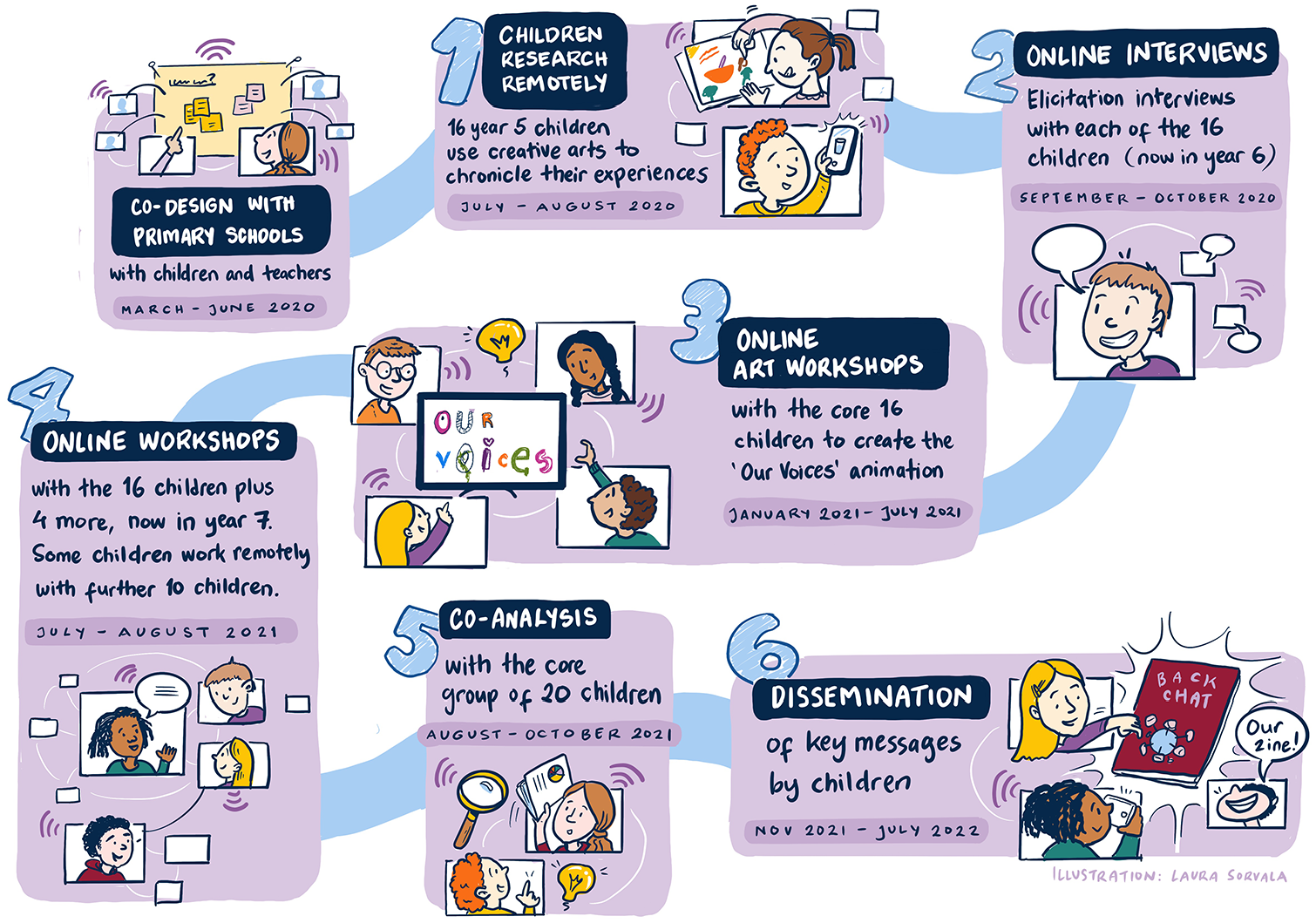
The iterative study phases.
The children attended one of six primary schools located in the 10% most deprived local authorities in the North of England and included disadvantaged and vulnerable (care experienced and children with special educational needs) as well as digitally excluded children, the children of key-workers and children from minority ethnic backgrounds, to ensure the representation of the most vulnerable children in context of the specific risks to them during the pandemic (OECD, 2020). In most cases the participating schools were able to support digitally excluded children, providing laptops for them to complete schoolwork which they used to participate in the study. However, children did not have consistent access to high quality technology and had to join on mobile phone (sometimes borrowed from parents), as technology could not be updated, and devices broke (Lomax and Smith, 2022). Year five pupils were purposively selected as, while we could not know the extent of the impact of the pandemic at the outset of the study, early suggestions were that this year group were likely to experience significant challenges associated with school closure. Year six is a significant milestone in the education of children in England which marks the end of Key Stage 2 and is the school year in which children sit national examinations (SATS) before their transition to secondary school at the start of year seven. Year six also includes key social milestones, typically an overnight class trip, prom and leavers assemblies which, due to Covid and lockdowns, did not happen for these and other children in England at this time.
The study phases, which are illustrated in Figure One, involved children meeting with us online in small groups of four to make art together and share their experiences over time. The phases developed iteratively, according to children’s preferences and drew on a wide range of creative, visual and performance arts including drawing, college, photography, music and singing. Our child-led research practice included offering children a range of methods to research with (Lomax and Smith, 2021). Researchers working in ways that emphasise flexibility and choice observe that children themselves very often adapt and repurpose methods in ways which are meaningful to them and which exceed researchers’ classification of methods. For example, as we experienced, combining pencil-sketches and ink-drawings with a tracing of an important image, itself captured in a photograph on a mobile phone. Accordingly, our research sought to offer a range of arts materials and media (including art paper, pastels, washi tape, felt etc) that could be used to draw, sculpt, collage or paint as well as providing opportunities for children’s participation through the expressive arts (singing and musical performance) thereby offering children the flexibility and choice to adapt these media and to introduce their own methods and ways of knowing in to the research process.
Children joined remotely, sometimes from school and on other occasions from home; for example, during periods of school closure, when children had tested positive for covid, were shielding or when school bubbles ‘burst’. 1 To support the artmaking, we sent packs of art-materials to children, which along with refreshments (illustrated in Figure Two) were regularly topped-up according to children’s preferences (for example, adding washi-tape, felt and tissue paper).
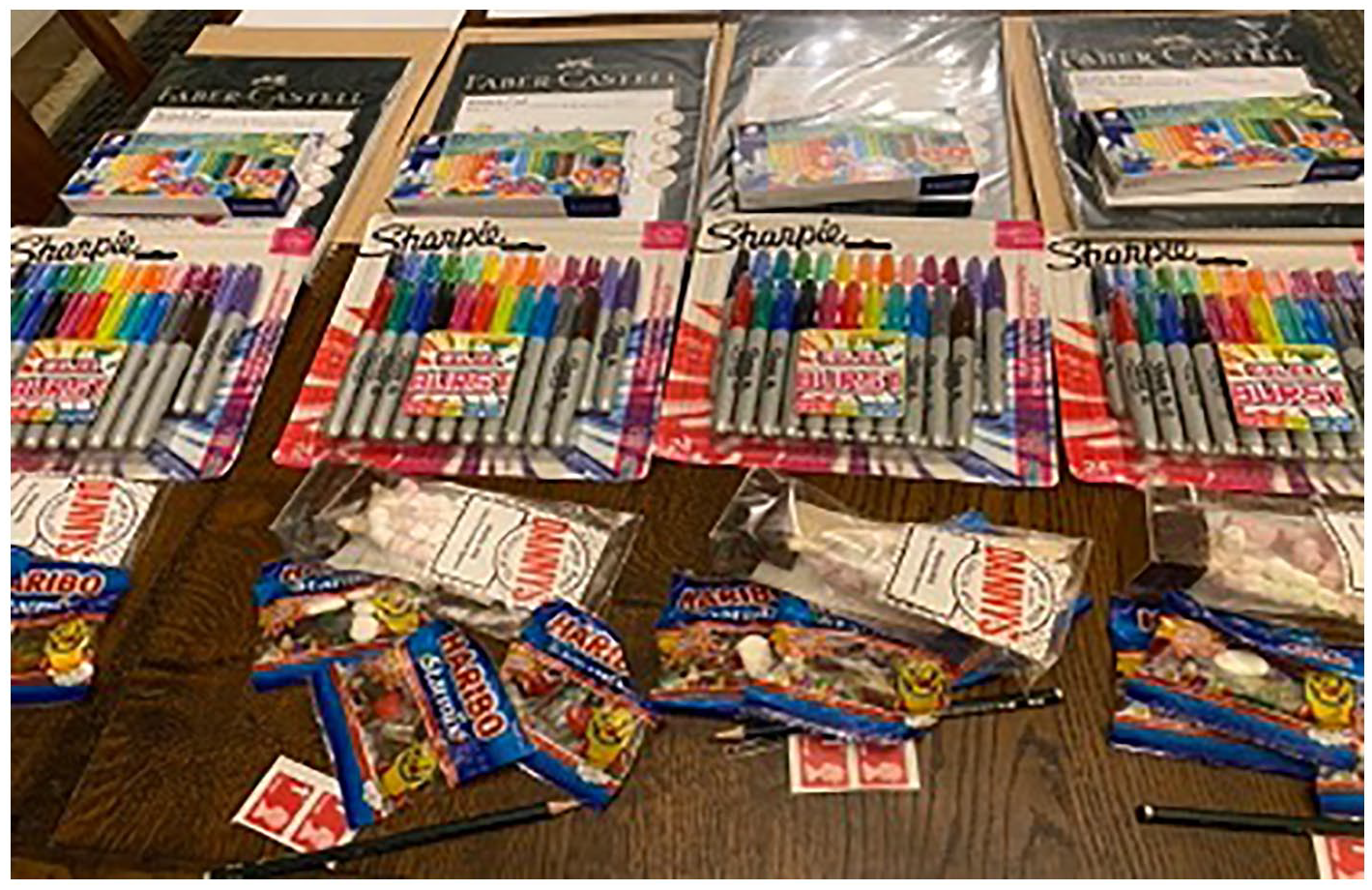
The art packs posted to children.
This process generated over 100 items of visual and textual data, more than 20 hours of in-depth image-elicitation interviews and 50 hours of children’s narratives which we curated with the children, an artist and graphic designer into an animation (Lomax and Smith, 2022) and a zine (hud.ac/backchat) which were disseminated to decision makers and policy influencers in education and children’s services regionally and nationally.
Towards an ‘attentive’, playful methodology
Arts-based methods were selected as they offered the possibility of collaborative and flexible ways to research with children over time, to support children’s reflections through the act of making art together. This includes, as Sophie Woodward (2020: 69) suggests, their capacity to support expressive ‘sensory, kinaesthetic, material and imaginary ways of knowing’. However, such methods assume being in the same physical space as children and their potential to research inclusively with children under these social conditions was at this time unknown. This section describes how we responded to these challenges, developing a methodology to support children to narrate their experiences through words, images, music and text across the virtual and physical temporalities of home and school. In so doing, our intention is to contribute to wider questions in childhood studies about the possibilities of arts-based methods for supporting children’s inclusion and enhancing understandings about what it means to be a child in contemporary times.
Our approach is centred on three interconnected ontological, theoretical, and methodological principals which have their origins in feminist care ethics (Doucet and Mauthner, 2014), early years pedagogy (Blaisdell et al., 2019; Clark, 2023; Kinnunen and Puroila, 2016) and multimodal theory (Hackett et al., 2017; Powell and Somerville, 2020). Collectively these principles provide a framework with which to support children’s meaning-making with materials (Marsh, 2017); to acknowledge and interrogate the relational nature of knowledge and to take care of children. To illustrate these principles, we draw on examples of the children’s interactions with us, each other and with the technologies, arts and other materials in the physical and online space. Our reflections offer the opportunity to consider ‘what arts methods do’ (Spray et al., 2022); how they can enable us to situate children’s ways of knowing; interrogate the co-construction of knowledge and how these shape understandings of children and childhood. For clarity, the section outlines each principle in turn whilst also signposting their interconnectivity (Figure Three).
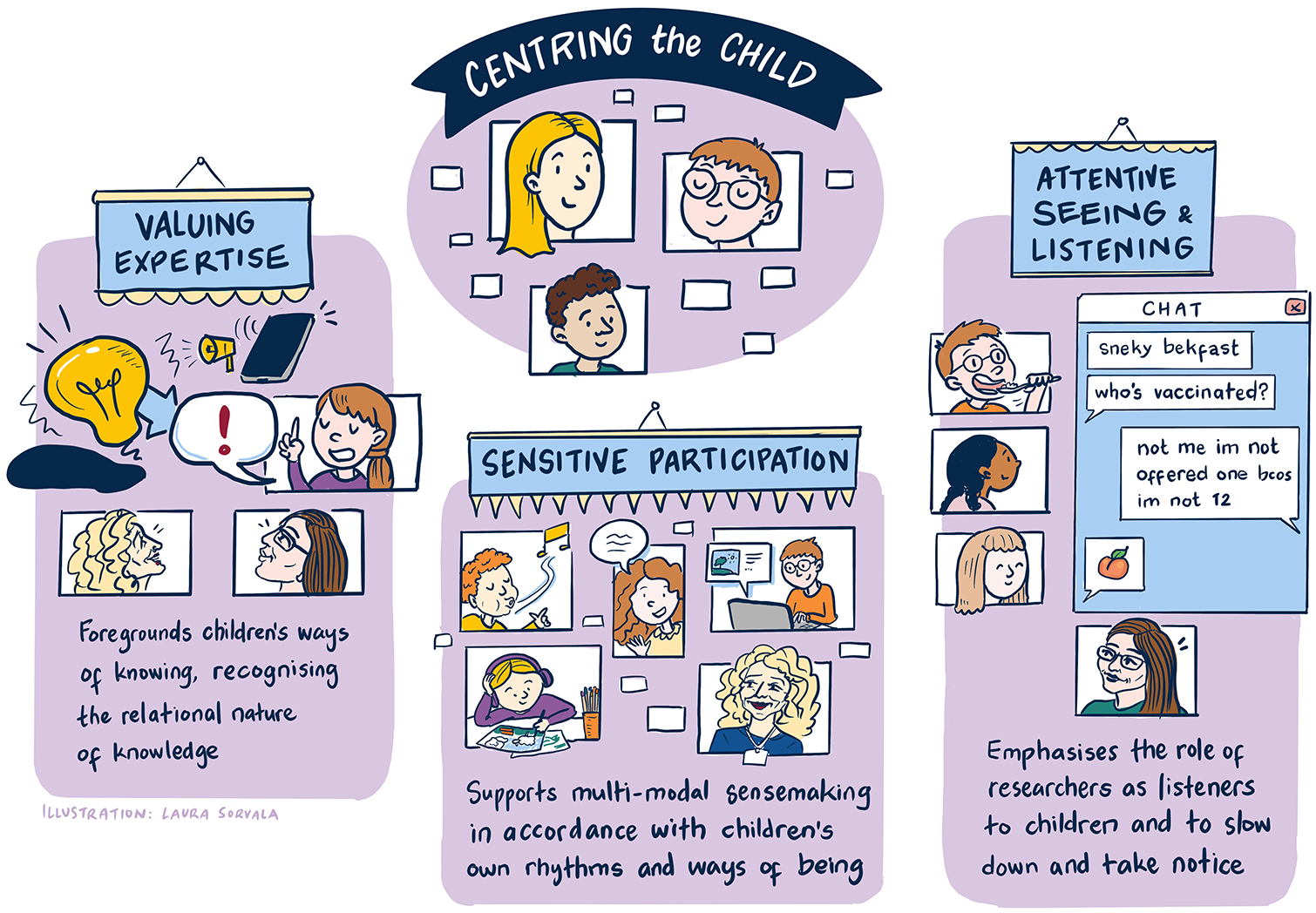
Principles of attentive arts-based methodology.
Centring children’s multi-modal sense-making
At the core of our approach is our commitment to children’s participation as more than verbal and a recognition that hearing children, even essentially verbal older children, requires making a space for ‘the voice beyond words’ to embrace communication as a sensory and embodied act (Hackett et al., 2020). Rather than a purely verbal activity, multimodal approaches recognise how touch, gaze, gesture and movement are important ways that children (and adults) convey meaning and how this is mediated through ‘things’ (art materials, technologies and other items that children make relevant). To fully engage children therefore requires researchers to ‘create opportunities for children to express their views. . . adapting to the child’s interests, levels of understanding and preferred ways of communicating’ (Blaisdell et al., 2019: 16), using methods that support sense-making in accordance with children’s rhythms and ways of knowing. It requires adults to stand back a little instead of seeking to impose their agendas on children, rather to ‘watch.. listen. . . reflect and engag(e) (children) . . . to enter the child’s world in just a small way’ (Greenfield, 2004: 4).
Our approach, in which we made art, played games, and paid attention to children was designed to be flexible, child led and to disrupt conventional methods of engagement, imposed research design and truth finding (Chesworth, 2018). We aimed to dismantle conventional adult-child binaries to attend to how children wanted to be in the space at this time to respond to children’s ways of being and knowing. For our participating children this included opportunities to ‘talk more’, ‘make more art’ and to bring their pets and other items into the space (beanie hats, picnic champagne glasses, puppies and giant land snails). It also meant being playful and playing games. This included verbal games such as ‘what sort of animal you would be’ and ‘either/or games’ which involved choosing a favourite food, game, sport etc (over another). It included dancing and physical stretching games and, framed by our ethic of care, included a game at the end of each session to allow for each child to speak and finish the session on a hopeful note for each other at this uncertain time.
Our playfulness emerged from things that the children shared that were important to them (pets, wildlife, friends and family, clubs, arts and sports). We were also ‘careful’, and responsive to children’s anxiety at this time (e.g. about family members shielding and/ or that they couldn’t see in person). Workshop sessions included and allowed for playful physical movement. There was no expectation that children would sit still throughout, and children would frequently leave to find objects they wanted to share with us and each other and with which to support their artmaking. Examples included fetching a parent’s phone to make a cat self-portrait or to introduce a new puppy. We sought to flatten social hierarchies through joining in the play and the creative activities, sharing our own artwork and we encouraged the children to do the same in order to make clear that all contributions are welcome. At same time, we tried not to dominate the space but to be comfortable with silence in order to leave room for children to lead the conversation and raise their own topics. We also learned to pay attention to and use the chat function on Zoom. This included responding to children’s use of emojis and often hilarious use of filters and frames.
Our playful approach draws on early childhood research and pedagogy including Hackett et al. (2017) proposal for arts-based collaborative ethnography in which ‘making’ and play are both a methodology and a way of knowing, and Chesworth’s (2018) proposal for anti-reductionist approaches which, rather than following a set of predetermined methods, facilitate children’s involvement and make room for the unexpected. While this focus on playful and non-linear approaches is increasingly a feature of research with younger children and infants, it is not often visible in work with older children. This may be in part because researchers often access children in schools where adults ‘rule’ (Hillier and Aurini, 2018) or because these approaches are more usually associated with non or pre-verbal children. Our theoretical commitment to children’s multi-modal literacies, alongside our apprehensions about the potential limitations of the online space (the difficulty children might experience in connecting, the variable sound quality and broader cultural expectations about online spaces as formal structured teaching spaces), acted as provocation for us to think creatively about how we could facilitate older children’s contributions beyond verbal language. Figure Four illustrates the practices we developed to support children’s participation beyond methods and the schoolification of research (Gallacher and Gallagher, 2008)
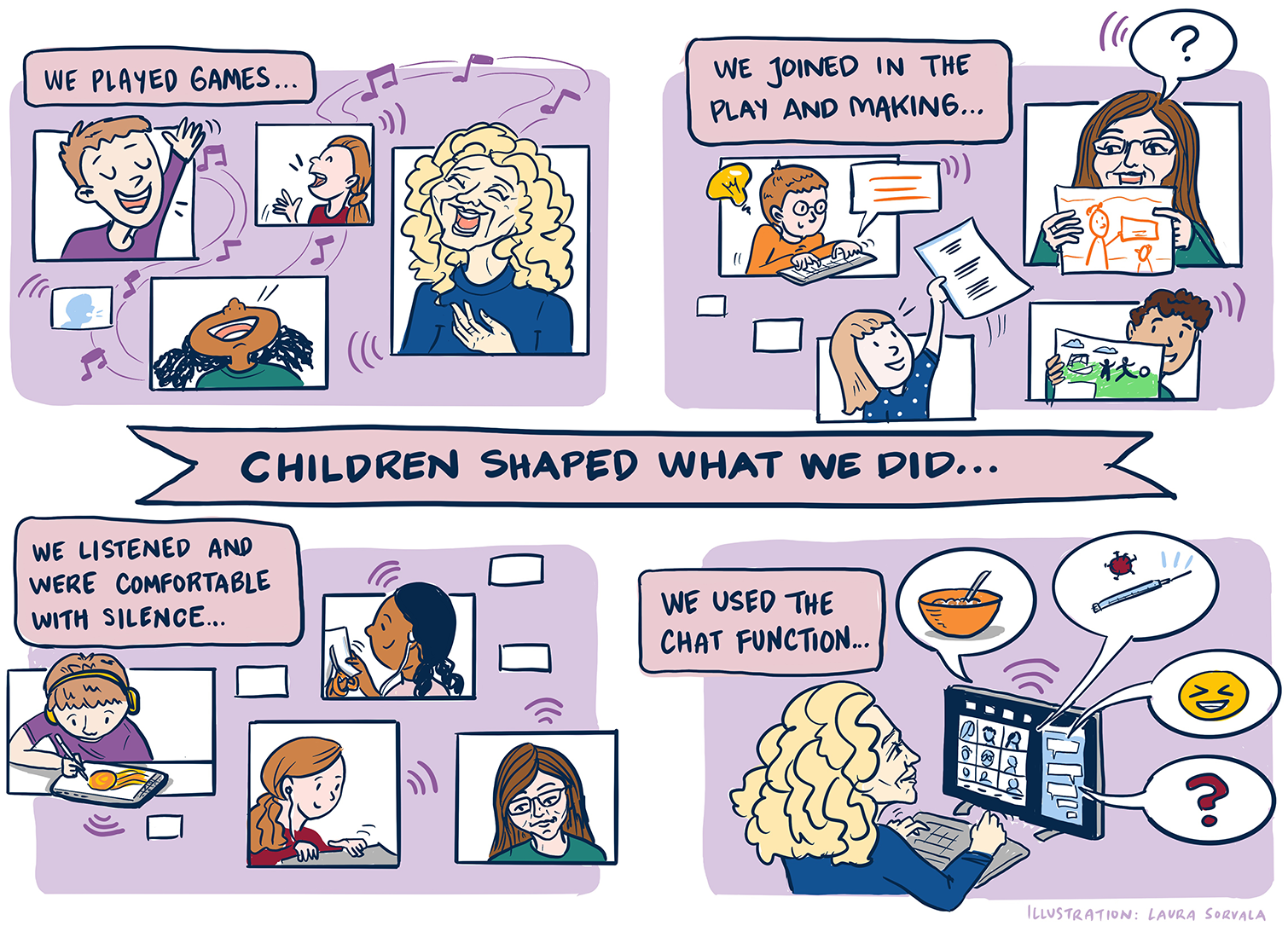
Dismantling authoritarian adult-child research relationships.
Dance and movement, drawing and crafting, talking and gesturing, writing and image-making are some of the ways that children in our research sought to make sense of their worlds and convey meanings to us and each other. To illustrate how children’s voices emerged through these modalities we first draw on two extracts from an online workshop with four children which took place in December 2021. As context, the children were 11 and 12 years old at this time and eligible, or about to become eligible, for the covid vaccine which had just been rolled out to children aged 12 in England (NHS England, 2021). Nationally, restrictions on social mixing were being eased while facemasks had just been made a legal requirement as part of the Government’s response to the new Omicron variant (Gov.UK, 2021).
The first mention of the new vaccination programme occurs near the start of the workshop (Extract One) when ‘Cory’ 2 uses the chat function to post a ‘whose vaccinated?’ to which ‘Gemma’ replies ‘not me im not offered it bcos im not 12’ and then ‘I don’t think id want it tho’. The topic is temporally abandoned by the interjection of Bella’s peach emoji and her explanation (‘idk [I don’t know] why I sent that’. To which Cory responds ‘lol’ [laugh out loud’]. However, the topic re-emerges later (Extract Two) in response to Cory’s spoken observation during the zine-making activity about what he perceives as an ‘anti vax’ position in the (anonymised) artwork of another child. For context, at this point in the workshop the children, who have joined separately from home, are reviewing the collective artwork for the zine we are working on together. Cory’s verbal comment ‘I feel like we might have a future anti-vaxxer there’ is based on his observation of a piece of artwork located at the ‘bottom right in orange’ which then generates a lengthy verbal exchange in which all four children discuss their own attitudes to vaccination, its perceived safety and the circulation of conspiracy theories that were prevalent at the time on social media. They also discuss, in response to prompts by us, how they get their information (You Tube, TikTok, listening in on adult conversation, teachers and friends) and the un/trustworthiness of social media.
Online Zine-making workshop, Dec 2021
Line 1: From Cory to Everyone: Line 2: From Cory to Everyone: Line 3: From Bella to Everyone: Line 4: From Cory to Everyone: Line 5: From Cory to Everyone: Line 6: From Gemma to Everyone: Line 7: From Gemma to Everyone: Line 8: From Belle to Everyone: Line 9: From Bella to Everyone: Line 10: From Cory to Everyone:
Online Zine-making workshop, Dec 2021

Of methodological and theoretical relevance is how children’s narratives materialise through the mobilisation of technologies (the chat function and emoji’s) and art (the other children’s artwork they are reviewing) and how this is ‘child led’, that is, initiated by the children. These examples illustrate the need to make space for and pay attention to children’s use of different communicative modalities and how discussion of pressing issues for children (about whether to have the vaccine, its risks and possible side effects) can occur in fragments alongside comical exchanges (sneaky breakfasts, peach emojis and ‘future anti-vaxxer . . .’ – ‘joke’) rather than as singular, coherent narratives. These fragments evidence how children’s voices do not emerge ready formed but are relational with other children in the space including those in the virtual room and those symbolically present in the artwork as well as being responsive to wider public and media narratives about the pandemic and vaccine. They illustrate how children’s voices can be seen and heard when researchers are open to and create opportunities for children to engage ‘with the swirls and tugs of others’ words (and) ideas’ (Luttrell, 2010: 225) through different media (text, talk, art) and take notice of children’s sense-making through attentive forms of knowledge generation (Clark, 2023).
Attentive seeing and listening
The previous section discussed how children’s inclusion can be supported through methods that make room for children’s sense-making in accordance with children’s own rhythms and ways of knowing. This section emphasises the role of researchers as attentive listeners and their responsibilities to attune to children, to slow down and to take notice of the transitory moments that occur in research with children. To illustrate this, we draw on the small moments of children’s talk and interaction including their playfulness with things which, might seem irrelevant or dismissed as ‘just chat’ to consider what a focus on these small moments between children might offer in terms of richer understandings of children’s lives.
The first example, Extract Three ‘Can I borrow you for a second?’, occurs between two children, ‘Bella’ and ‘Gemma’ in an online workshop in March 2021 during which the children are creating self-portraits as part of the animation we are making together. The children have joined online. Three of the children are in school and one, Gemma, is joining from home, where she is shielding. For context, March 2021 marks the end of the third national lockdown in England. Schools have reopened and recreation in outdoor public spaces is allowed between two people. Children have now spent one year in and out of lockdown and subject to tiered restrictions, have missed more than half of their expected days in school (Brown and Kirk-Wade, 2021; Major et al., 2021). They have been unable to socialise together outside school due to the ‘stay at home’ order. In this sequence, Bella, who is creating a hand-drawn self-portrait momentarily pauses her artwork to ask Gemma her view about what colour she should use for the sleeves of the dress she has drawn (‘Can you suggest any colours for the arms?’). This example is one of a number where the children address each other verbally or via the text function to make a personal announcement, ask a question or share a joke.
Online art workshop, March 2021: Portrait-making (live discussion)
The second example, Extract Four, ‘Have any of you done that thing where you can line up Haribo’s?’ also takes place during Spring 2021 just before schools reopen on March 8th. The workshop is with another group of four children during a rare moment when the children are in school together. It’s important to note here that the children are unusually in school. Although as the children of essential workers and/ or classed as vulnerable they are entitled to attend school, in line with what is now known about the attendance of vulnerable children (Centre for Social Justice, 2022) these children do not generally attend but have come in specifically for this workshop at the invitation of their teacher. Like Gemma and Bella in the earlier sequence, they now rarely see each other. They have missed transition to year six and all the social events that accompany the final year of primary school. They are also socially distanced, seated apart in a row formation in an otherwise empty classroom. As such they cannot readily see what each other are doing or engage in face-face social interaction. This seating arrangement is untypical for this school where children usually sit in small groups at shared tables. In this extract, the children are also working on their self-portraits.
Online art workshop, February 2021: Portrait-making (live discussion)
At this point in the workshop the children are simultaneously working on their self-portraits are enjoying a packet of Haribo sweets, a hot chocolate drink and a packet of marshmallows that we sent ahead. As can be seen from the extract, the presence of these snacks and the children’s sensory enjoyment of them generates a playful sequence of chat between them which begins with Amy’s announcement that she ‘has not put all the marshmallows in!’ (her hot chocolate). Rosie replies at once, ‘You didn’t put the marshmallows in? I put all of them in!’ a comment which is followed by Bea’s question to the others ‘Have any of you done that thing where you can line up Haribos? It’s very satisfying!’ How can we understand what the children are doing in these small moments together? And what does this suggest about attentive listening as a methodology? To understand this, it is important not only to attend to when and how this happens in these spaces (recurrently, across the data set) but expand our gaze to consider what is happening beyond the space. That is, to consider the social conditions of children’s lives at this time and how stay at home and school closure orders are impacting what children can and cannot do at this time including their relationship with their peers.
Firstly, as mentioned, children in England have, at this point, spent a significant period out of school. Contact with classmates has been reduced to online lessons organised and managed to facilitate instruction at the expense of children’s social interaction, for example by instructing children to keep cameras and microphones off. Where children have been able to attend school, social interaction with other children has been reduced to small ‘bubbles’ to minimise the spread of the coronavirus. Seen through the lens of children’s ongoing enforced social dislocation from peers, Bella’s question to Gemma about how she should colour the sleeves, and Gemma’s thoughtful reply ‘I think any colour would really go with that. . . .’, are a way for each to re-establish their friendship when they unable to see each other as part of the usual school day. Likewise, Amy, Rosie and Bea’s exchange in which each describe their tangible activities in the moment but out of view of their peers is a way to re-affirm the social connection between them through their shared enjoyment of sweets. These sequences are of theoretical interest because they illuminate important elements of children lives, their social relationships and friendships and their efforts to maintain them in these research spaces during the pandemic.
Secondly, of methodological relevance is what they suggest about the importance of an approach which is attuned to and sensitive of children’s needs, rhythms and pace. We did not rush children through the artmaking but thought carefully about how to create a space that would facilitate and be responsive to children’s ways of being and knowing. This included posting art materials according to their preferences and providing refreshments. Sending these items wasn’t just about offering symbolic care for children it was about curating an unhurried space where children could talk through their ideas and make art together, discussing what was good and not so good (Bella: ‘Don’t use the pastels, they are rubbish!’).
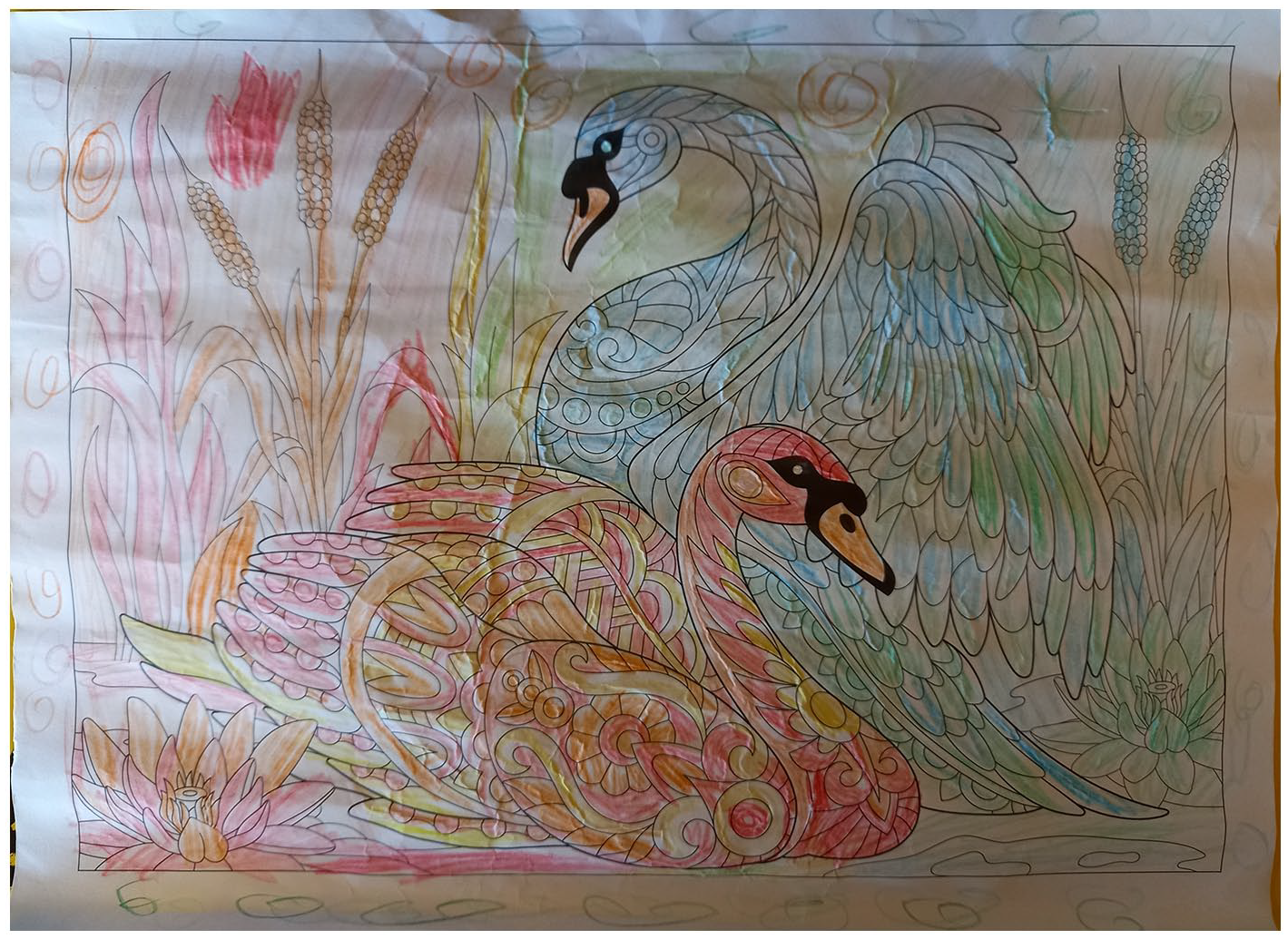
The pandemic meant that childhood researchers (and social scientists more generally) had to adjust methods for researching with children (and adults). As a result of this, practices such as sending participants refreshments, became de rigueur during and after the pandemic. However, this practice is often conceptualised purely as an act of reciprocity or a way of symbolically expressing care for participants. While this may be so, our contention is that these materials that we, as researchers, and participants themselves, bring to the research space, need to be understood as an intrinsic element of the research and part of the process through which children communicate their needs as children and as citizens. While children, generally did not complain about the pandemic restrictions, their social (and other) losses at this time were palpably expressed in these moments with each other and in and through their artmaking. Overall, we observed children’s anxiety about their learning (difficulties managing work without a teacher to help); concerns about vulnerable family members (who were shielding or who worked in health and social care or who had lost their jobs); and children’s mounting sense of social isolation (Lomax and Smith, 2022). Children expressed these feelings through their art and its articulation as, for example, in the following sequence in which ‘Connor’ explains how he has used colour in his swan picture (Figure Five) to represent the importance of social relationships for him at this time. As he elaborates:
‘The blue and the green (colours on the swans) threading together represents coming closer during lockdown because we understand each other more’. Connor, aged 10, 2022:12 Back Chat Zine, pp 6, hud.ac/backchat)
Connor’s reflections on friendship.
Connor’s explanation comes at a moment towards the end of a series of workshops at which point the children in this once tight friendship group of are noticeably struggling to maintain their friendship. The cancelled birthday parties, erosion of opportunities to meet in and outside school at a time when the children were also transitioning to secondary school appear to have taken their toll on their formerly close relationships. The tension between the two boys, who appear keen to maintain their friendship with the two girls who seem increasingly irritated and determined not to engage with the two boys, is very apparent during this workshop. Where once the four children had spontaneously danced together, shared jokes and collapsed into giggles, here the girls repeatedly turn off their camera and refuse to respond to the boys’ contributions. The boys’ frustration is palpable in their body language and comments to us about the girls’ behaviour. Connor’s explanation about the significance of his art, which comes at a moment when the girls have abandoned the call altogether, seems to offer a pragmatic resolution to his feeling of loss, his reflection on his once closeness with the girls and his reconciliation to demonstrable fractures in the relationships.
This section has explored how awareness of and attention to children’s multisensorial engagement with arts materials, refreshments and technologies can support children to communicate their experiences visually, textually and verbally. It considered how this is enabled through a methodology that is alert to the small moments of interaction between children and with ‘things’, how understanding of what is being voiced in these moments is enhanced through ethnographically locating children’s contributions and how these are reflective of children’s lives in context of the wider social and policy landscape. Theorising these small moments as relational with dominant narratives about children, for example as counterpoint to the ‘we are all in in together’ trope (Trnka, 2020), offers a way to understand the impact of policy decisions on children from their perspectives. In these examples, their rights to play, to learn and to connect with others. Noticings offer a lens to see children’s experiences as they are expressed in these fleeting moments and the opportunity to layer knowledge to build a fuller picture of children’s experiences and how these are evidenced across the visual and textual data coproduced with children.
Children’s inclusion and its challenges
The previous section explored how understandings of children’s pandemic lives was facilitated through an attentive approach which included taking time to work at children’s pace, providing materials that children valued, listening carefully and being in the moment with children. Part of an ‘ethic of care’ (Doucet and Mauthner, 2014) we aimed to respond to children’s needs, to be respectful of children‘s contributions and to foster trusting relationships over time through our consistent attention to children. Our approach is the antithesis of ‘fast’ knowledge and conventional methods of engagement, where, by and large, adults ask children questions to elicit children’s ‘message like thoughts’ (Komulainen, 2007: 25). These moments of playfulness suggest a less hierarchical research space in which children are comfortable to contribute, adults are at ease supporting children and through which valuable insights can emerge. This penultimate section of the paper takes up the theme of children’s inclusion, and specifically how this was challenged by the expectations of other adults in the space and what this suggests about child-centred methodology and children’s voice.
Online art workshop, February 2021: Portrait-making (live discussion)
(Mrs T, teacher enters the classroom, addressing Helen
This example (Extract Five ‘Do they need to speed up with these?’) is one of a number in which adults (parents/carers, teachers) enter the physical and online space. They include, as this sequence, a teacher expressing concern about the time that the artwork is taking. Other examples include a parent joining in their child’s sharing of his recent camping trip to offer their version of events. These adult contributions appeared to challenge our commitment to centring children as they momentary take possession of the space, asserting a different, adult-focused agenda on children. While we were, as in the above example, able to gently re-assert with the teacher that it was ok for the artwork to spill over the time allotted in school, there was a palpable rupture to the feeling of the space at that moment. The children stopped talking to Helen as they contemplated this redefinition of the space and the expectations of them as pupils to finish work on time. Similarly, in the camping trip example, Connor suspends his contribution with the group, allowing his dad to hold the floor and to finish the story. It was very noticeable that children, at least at the moment of parental/carer intervention, conceded to the adult in the space, pausing what they were doing to allow the adult to take the floor. Although it’s important to add that we did notice how over time children increasingly pushed back against adults, often using humour to assert their ownership of the space. These moments are methodologically ‘telling’ (Gabb and Fink, 2015) in terms of their illustration of the in-the-moment challenges of realising child-centred methodological principles and how these interruptions can fracture the delicate balance between our positioning of children as having rights to be heard and normative assumptions about children as acquiescent to adults. As such they offer an important reminder of the ‘socialness’ (McLaughlin and Coleman-Fountain, 2019) of participation, bringing into focus how children, even within an explicitly inclusive research agenda are subject to and expected to accommodate adult priorities and agendas.
This is not to criticise the work of teachers and the care of parents/carers or to suggest that research spaces are discreet entities somehow uncontaminated by the world beyond. Rather it is to highlight the contingencies of children’s voice and how it is subject to the disciplinary power of adults. Whether adults are physically in the space, on, or off camera or elsewhere, children’s voice inexorably contains traces of the ‘other’ (Hackett et al., 2017). Attentive methodology brings in to view the broader social dynamics that shape children’s inclusion through its analytic focus on how each is entangled materially and symbolically in the space. Recognising and attending to the contingencies of voice illuminates the power structures that shape children’s ways of being in the world and brings into view ‘what is being allowed or disallowed’ (Pyles, 2017: 9) and what this reveals about children’s lives.
Conclusion
Our paper draws on our longitudinal research in which we sought to develop a methodological framework for supporting socially distanced arts-based research with children. Our methodological approach based on foregrounding children’s participation through attentive seeing and prioritising slower, playful methods with children responds to longstanding debates about children’s voice and inclusion. Firstly, it rejects a move towards fast knowledge and traces of such approaches that can still be seen in some arts-based approaches whereby adults seek to control the space and children’s contributions. Instead, we embrace a more reflexive, responsive engagement with children through the arts and other materials and technologies that children make relevant. Our approach draws on feminist care ethics (Doucet and Mauthner, 2014) to prioritise attentiveness and care for children and on early childhood research and pedagogy (Clark, 2023), which, translated to research with older children provides a framework with which to support children’s playful and ‘unhurried’ participation.
Secondly, our approach responds to contemporary developments in childhood studies and in particular, the ontological shift away from understanding children as autonomous independent agents to emphasise the relationality, connectedness and materiality of childhood and children’s interdependence with people and things (Spyrou, 2019). Accordingly, our approach provides a methodological lens and analytic framework through which to attend to voice as it is articulated in research spaces with children. This includes how it is shaped and emerges through the materiality and sociality of children’s engagement with other children, adults and objects. Thirdly, in setting out methodological principles that can support slow, messy generative ways of knowing, our aim is to attend both to the small details of children’s ‘communicative codes and symbols’ (Rinaldi, 2001: 130) but also to offer a way to ethnographically locate children’s individual stories, to makes visible the powerful other voices, connecting them to the public issues of history and society (Back, 2007). In setting out a methodological approach which can support ‘attentive seeing’ our intention is to reframe childhood research from a space in which adults are intent on extracting children’s ready-made thoughts (Komulainen, 2007) to one which recognises knowledge generation as a process of ‘co-construction and engagement with children’ (Rutanen et al., 2021).
Footnotes
Acknowledgements
We would like to thank the children who researched with us, sharing their stories about the impact of the pandemic on their lives. We would also like to thank the teachers and parents who supported the research at this time. We also thank artists – Belinda Walsh www.belindawalsh.com; Anna Zelasko @annaxietea, Finn Tanner, Amanda Ptolomey and Darren Kefford www.media-alive.co.uk who worked so carefully to honour the integrity of the children’s visual and textual narratives. Finally, thank you to Laura Sorvala  for Figures 1, 3 and 4 illustrating how we worked with children.
Funding
The author(s) disclosed receipt of the following financial support for the research, authorship, and/or publication of this article: Funding for this research was provided by The British Academy (SRG2021\211308) and the Huddersfield Centre for Research in Education and Society (HudCRES).