



Abstract
Early childhood (EC) professionals are valuable educators and teachers, and their work involves being caregivers, yet the effects of the COVID-19 pandemic have highlighted the lack of ‘caring about’ and ‘for’ EC professionals. With the increasing focus on educator wellbeing, this paper explores how eight EC professionals understand the role of care for their wellbeing. Drawing upon a feminist ethics of care, this paper interrogates the role of care in the everyday professional work lives of educators. The findings reveal that while EC professionals understand the importance of self-care, however, their self-care is more likely to be prioritised when it is promoted by leadership (e.g., centre directors, organisational). This study also found that EC professionals need to receive care through recognition by parents, centre leaders and colleagues.
Introduction
The COVID-19 pandemic had a strong impact on the psychological wellbeing of early childhood (EC) professionals (Berger et al., 2022). It was reported that EC professionals were stressed and anxious, due to increased levels of emotional labour (Cumming, 2017; Egan et al., 2021; Quinones et al., 2021) and a sense of social invisibility during the pandemic (Cumming et al., 2020). Research prior to the pandemic suggested that improving the mental health and wellbeing of EC professionals relies on improving their working conditions (Cumming & Wong, 2019), addressing educator stress through health promotion strategies (Corr et al., 2017), and improving relationships in the EC sector (Beltman et al., 2019).
In their search for a definition of wellbeing, Cumming et al. (2020) have defined wellbeing as both individual and as an aspect of work-related wellbeing. In a review of the EC wellbeing literature, Cumming (2017) argues that wellbeing in EC education consists of multifaceted layers that include personal (i.e., emotional and mental) and work-related (i.e., work conditions, colleagues, job satisfaction) wellbeing. These personal and professional factors can either promote or hinder educator wellbeing (Cumming & Wong, 2019; Eadie et al., 2022). The COVID-19 pandemic illustrated how political, environmental, family and professional factors interacted to create harmful effects on the wellbeing of EC professionals. For example, Berger et al. (2022) documented how Australian EC educators faced significant workload demands and lack of public acknowledgement and government support during the pandemic, while also worrying about their own health and the health and wellbeing of others.
Strategies to improve EC educator wellbeing have been suggested on the basis of the many interconnected factors that influence educator wellbeing. These include adjusting workload demands and building positive relationships between professionals (Jones et al., 2019), promoting safe workplace environments that focus on mental and physical health (Cumming, 2017; Logan et al., 2020), and supporting educator autonomy by giving EC professionals a sense of ownership over their workload (Collie et al., 2015; Cumming & Wong, 2019; McMullen et al., 2020). Few studies have investigated the work-related wellbeing of EC professionals (Logan et al., 2020). Jones et al. (2020) suggest that workplace wellbeing comprises a positive work environment where educators have the autonomy to make their own choices, but that this needs to be supported by leaders.
Self-care is a practice that supports EC teachers advocating for themselves and others (O’Hara-Gregan, 2022). However, a sustainable model is needed to care for educators, rather than placing the responsibility for caring about their wellbeing on educators themselves (Rodriguez et al., 2022). These authors suggest that healing circles can nurture the mental health and wellbeing of educators.
Recent policy documents in early childhood education and care have focused on recognising EC professionals’ wellbeing, supportive leadership, and professional recognition of the EC sector (Education Services Australia, 2021). The policy document ‘Shaping our Future’ is a 10-year strategy that aims to ensure a sustainable and high-quality skilled EC profession in Australia (Education Services Australia, 2021). The strategy was coordinated by the Australian Children’s Education and Care Quality Authority and developed by Australian governments and representative stakeholders to be implemented over the next 10 years. Consultation between these groups resulted in the creation of six priority areas, with one of these being promoting wellbeing. Action points were included under the priority area of promoting wellbeing, including to: ‘investigate options for improved wellbeing supports’, ‘promoting wellbeing resources for educators and teachers’, and ‘initiate and promote research monitoring the wellbeing of educators and teachers’ (Education Services Australia, 2021, pp. 52–54). These resources and the ‘Shaping our Future’ report represent important steps to improving the wellbeing and retention of educators in the EC sector. However, as these strategies and prior literature (e.g., Reupert et al., 2021) suggest, further research and investment is needed to continue to build the holistic wellbeing of the EC profession.
In this paper, we use the term ‘promotion’ to signify strategies that encourage the care for EC professionals’ wellbeing, through the lens of a feminist ethics of care. Langford et al. (2017) argues that ethically caring for children involves promoting their wellbeing. In other words, the promotion of one’s wellbeing is interconnected with a sense of care for the individual. A feminist ethics of care approach provides an analytical framework to examine the complexities of views around the care and wellbeing of EC professionals.
Theoretical framework: Feminist ethics of care
In EC education, care is a ‘key component of the complex professional space in which EC educators work’ (Ailwood et al., 2022, p. 917). Therefore, advocating for, and careful consideration of, care in EC requires further attention. Ethics of care scholars have argued that the notion of care is a complex social process (Nguyen et al., 2017) and care needs to be understood according to a particular context, nested in relationships (Tronto, 2013). A feminist ethics of care perspective proposes that the value of care work and caring relationships are often assigned to women (Langford & Richardson, 2020), who are often viewed as the ‘nice ladies who love children’ (Stonehouse, 1989). As Langford and Richardson (2020) highlight, the ethics of care affirms the value of caring well in EC settings at both a societal and political level. Despite care being an integral part of who EC educators are and what they do (Barnes et al., 2021; Dahlberg et al., 1999; Quigley & Hall, 2016), early childhood policies do not often reflect the value of caring in the work of EC educators (Langford et al., 2017).
How do educators care well? According to Langford et al. (2020), if educators are ‘compassionate, sensitive to context, attentive and responsive’ (p. 113), they are able to make care choices that value children’s and families’ perspectives, through caring and responding to children’s needs, and the needs of families. A caring system in early childhood education provides a site for everyone to flourish, and through an ethics of care perspective, EC educators assess their caregiving role ‘by asking what they care about, what they must care for, how they must give care and respond to caregiving practices’ (Tronto, 2012, p. 314). However, researchers assert that care in EC should address not only the needs of children, but should also provide a space for educators to feel valued and supported, and implement policies and structures that care for educators (Langford & Richardson, 2020). These authors suggest that acknowledgement of EC educators’ care work also involves providing space and time to critically engage in identifying the complexities of caring well in EC and valuing educators’ perspectives through democratic conversations.
Fisher and Tronto’s (1990) definition of care suggests that creating caring institutions involves a holistic view of care through four phases or steps: …caring about, i.e., recognising a need for care; caring for, i.e., taking responsibility to meet that need; caregiving i.e., the actual physical work of providing care; and care receiving, i.e., the evaluation of how well the care provided had met the caring need… conflict, power relations, inconsistencies and divergent ideas about good care could affect care processes’ (p. 160).
Adding to this, Tronto (2013) explains that caring involves recognising when caring is required, while care receiving involves a response from someone that has to be cared for, as well as judgements about whether the care provided was sufficient. The care setting can also assess the value of the care (Tronto, 2013). Thus, care and caregiving involves multiple processes, as well as independent and collective judgements about the quality and suitability of care provided.
Tronto (2013) considers ‘caring with’ the final phase of care, which recognises that care is a democratic process and should involve the individual wishes, needs, and expectations of those being cared for. The concept of ‘caring with’ also involves a call to address societal inequalities and a form of ‘political ethics involving collective readiness to seek just public solutions’ (Nguyen et al., 2017, p. 201). Tronto (2013) explains that a distinctive aspect of democratic care is the standpoint that we are all care receivers, stating: ‘we are care receivers, all.’ (p. 146). In this sense, Tronto (2013) reminds us to be inclusive, we have to think of ourselves as caregivers and receivers: ‘once people recognise their own self-care, they also see how much of their time and energy are devoted to caring for themselves and others’ (p. 146).
In their everyday work, EC educators actively create caring learning environments for children and families, and their work is considered ‘purposeful and central to human wellbeing and flourishing’ (Langford et al., 2020, p. 113). The EC profession assert the value of care as part of their everyday work, and therefore, educators should be respected as authorities on the practice of care. However, less is known about the processes of care receiving, as defined by Tronto (2013), in the EC sector. Researchers have argued that one of the factors that hinders educator wellbeing is their capacity to receive care and place their own needs above those of the children and families they serve (Quinones et al., 2022). Therefore, it is important for research and policy to recognise the importance of educator care receiving, as well as care and caregiving in EC, and we argue that addressing all will significantly improve the wellbeing of educators and those they care for.
Drawing upon Tronto’s conceptual frame of care (2013) and a feminist ethics of care (Langford et al., 2017; Langford & Richardson, 2020; Langford et al., 2020; Langford & White, 2019), the study presented within this paper provides a space for critical discussion about the role of care in the everyday lives of EC educators. This research provides insights into the current challenges that EC professionals experience in caring and being cared for to improve their wellbeing, issues that continue to plague early childhood education in Australia.
Methodology
Ethical approval was obtained from Monash University (approval number 31543). The study aimed to investigate EC professionals’ views on how they cared for their personal wellbeing and how their work impacted them positively and/or negatively. Further, this study aimed to address, from EC professionals’ perspectives, how wellbeing could be supported at an individual level and in their workplaces.
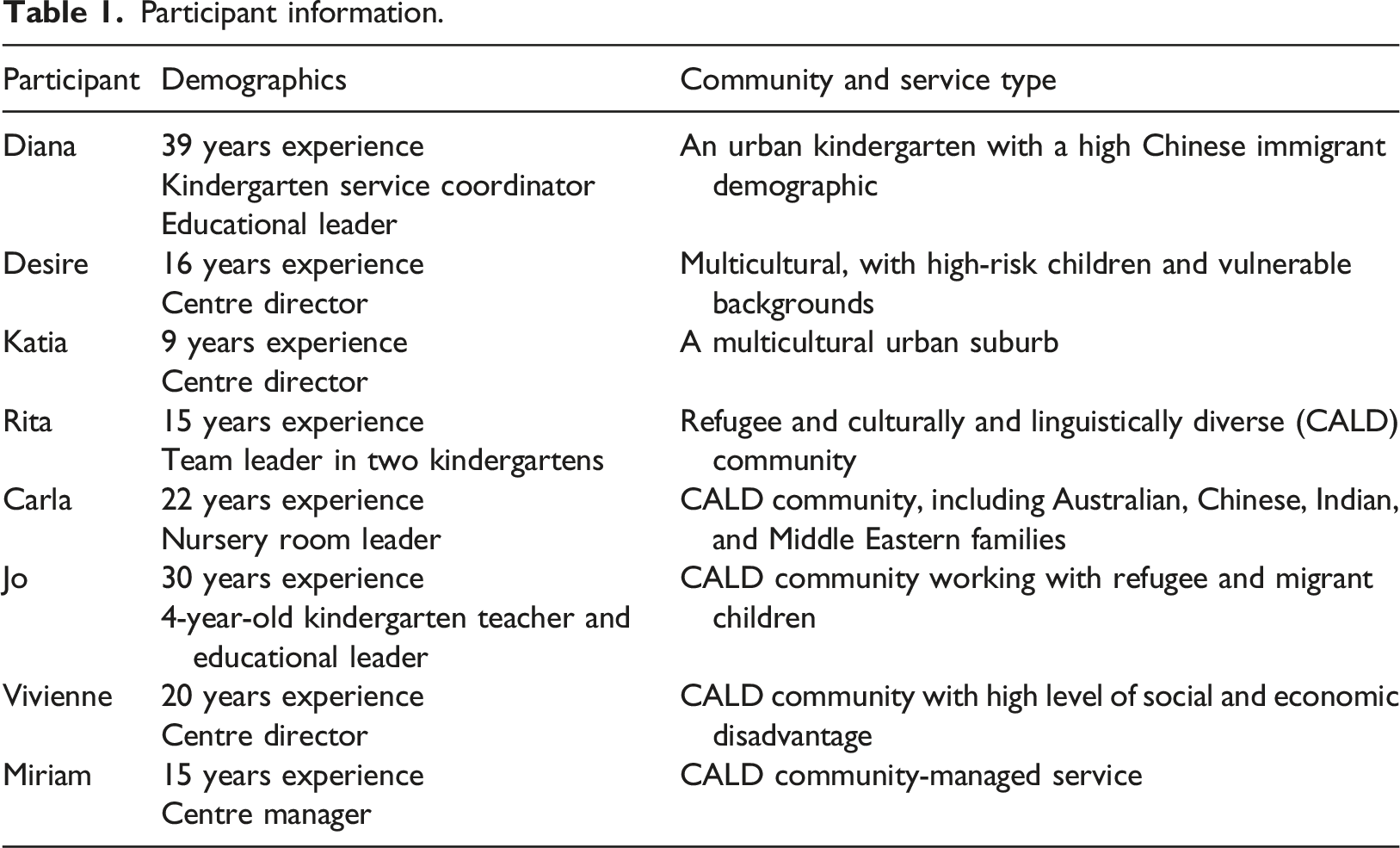
Eight participants provided consent to be interviewed for this study. Participants were recruited through several means, including emails to Victorian EC centres to invite professionals to participate; snowballing, whereby professionals were invited to share the details of the study with other professionals who might be interested in participating; and through the professional contacts of the researchers. All participants were female and there was a mix of educators, teachers and education leaders included in the sample. Their years of experience working in EC education ranged from nine to 39 years (mean 18.7 years). Some participants did not give the number of years they had worked in the EC sector.
In-depth interviews
The eight participants interviewed in this project worked in long day care centres and sessional kindergartens in Victoria, Australia. The interviews were conducted via the Zoom video-conferencing platform between August and October 2022.
As the interviews were undertaken by Zoom it was important to build a virtual safe space for the participants. This was done by explicitly stating that the interview offered a safe place to share their thoughts and feelings. Throughout the interview, the researchers created trust with participants by ‘going off track’ and discussing what mattered to them, and showing that they appreciated the educators’ everyday work. As this research is about care, we also showed care by being compassionate and sensitive to their concerns and hopes (Langford et al., 2020).
Participant information.
Data analysis
Data were analysed using thematic analysis. Coding was undertaken in consultation by two researchers and involved the following steps: (1) independent reading and re-reading the interview transcripts; (2) independent identification of codes that captured salient phrases or ideas in the interview schedules related to educator wellbeing; (3) a consensus discussion was then used to discuss each researcher’s interpretations and collate related ideas into themes and subthemes. Finally, all authors come together to review and refine the themes and prepare this article for publication (Braun & Clarke, 2006). The findings show how EC educators promote their own wellbeing and how their wellbeing can be better supported through personal and organisational change.
Results
The following themes and subthemes were identified through the thematic analysis procedure described above. Subthemes have been organised under the main themes of promoting wellbeing at an individual level and promoting wellbeing at an institutional level. This approach aligns with earlier research that has acknowledged these as the two components of educator wellbeing (Quinones et al., 2021).
Identifying individual care/self-care for early childhood professionals
Physical wellbeing was identified by participants in this study as related to promoting professionals caring for their wellbeing at an individual level. As discussed by Tronto (2013), caring involves caring for the individual needs of others, while also caring for oneself. The caring for others involves recognising a need for your own care. Adding to this, we discussed this as professionals’ views on their personal wellbeing as self-care. Participants, including Diana, Rita, and Katia discussed the ways in which they cared for themselves, with a focus on participating in activities that met their physical needs. Pre-COVID I found my happy place was the dance floor. So, for me, that was a place for physical activity. I was much lighter because of it, the physical activity released the endorphins... That facilitates my wellbeing enormously (Diana). We [the centre ] have mental health groups so that you can join and they might put out a yoga session at a certain time each day and you can actually be a part of that, some meditation… I think it is fantastic for us as educators to be able to be involved if we choose to do so (Rita). I do try to do things that make me feel happy, like going to the gym, just to sweat it out. That is—that 45 minutes I’m cut out from the world, my family, my work colleagues. That’s just me just sweating it out (Katia).
For most participants, self-care activities were experienced outside of the workplace. Deb and Katia released stress or endorphins through physical activities such as dance and gym sessions, while Rita preferred other approaches such as yoga and meditation. For Katia the gym was a way of being ‘cut out from the world’ and focusing on herself. According to Tronto (2010) ‘caring for’ involves taking responsibility to meet a need; in these professionals' views, in order for them to take care of their wellbeing, this involves taking care of their physical wellbeing through caring practices such as yoga, dance and meditation.
Another participant discussed the importance of being aware of one’s wellbeing; however, she found it difficult to explain how she took care of herself beyond her everyday work. Carla explains how moving jobs was a last-ditch strategy she used to look after her personal wellbeing. I had to put myself first because I figured [if] I wouldn’t, I would probably end up leaving the industry. I was getting sick from being in that atmosphere, like physically ill because my immune system was run down. So, I figured I wasn’t doing the right thing by them in the long run anyhow, so it was time for me to move on (Carla).
Carla was acutely aware that she was struggling, and the emotional toll of the job manifested as physical sickness. Notably, Carla’s concern related to the children in her care, whom she ‘adored’ and worried that she could not properly care for when her own emotional and physical wellbeing was compromised. Ultimately, it was her realisation that if she did not force herself to prioritise her own wellbeing, not only would the children in her care suffer, but her longevity within the profession would also be at risk. Unlike Deb and Katia, who relied on physical activities that connected them to their own interests and bodies, Carla realised that she needed a complete change in her work environment.
Individual wellbeing was entangled with the wellbeing of others, and thought of in relation to others. For example, Miriam struggled to talk about her personal wellbeing practices, but instead focused on the wellbeing of her team. I guess wellbeing as an educator, it’s a difficult one for me because being a centre manager I feel like I can't, I can only speak from what I know of seeing my team... I've had to be a bit more flexible to support and enable the team so that if they do want to reduce their days… I don’t know, for me because I'm always focusing on my team and their wellbeing… So we reached out and we actually have our own—she’s a holistic therapist and so we pay her so many hours a month and educators they contact her, it’s all confidential, but then she helps us support them on a deeper more personal lens. She rang me the other day, she said I haven't seen you Miriam, for a very long time, how about you, you need to schedule time for yourself. I'm like yeah, but we’ve only got four hours and really want to make sure the team—I don’t want to take away that time for the team because I feel like I need to prioritise them. So I think yeah, I can only speak for me personally, but I do tend to put myself last (Miriam).
Miriam struggles to prioritise her own self-care. As a centre manager, she takes responsibility for caring for the team but positions herself as outside the team and thus as a team member to be cared for. Instead, she points out the complexity of ‘care receiving’, struggling for funding availability for a therapist. As Fisher & Tronto (1990) suggests, a holistic view of care also requires multiple processes that are independent and collective judgements about care. In this quote, we can perceive that Miriam places others’ care receiving first, by providing them with access to care offered by the centre.
Interpreting care at an institutional level
The participants discussed wellbeing at an institutional level, with many suggesting that there needed to be more recognition of their professional work from parents and leaders. Diana explained how testimonials from parents that she personally collected and showcased for the centre director allowed her ‘worth’ to be visible and recognised. …it surprised me what a lift it gave me that I collected some testimonials from parents as part of my portfolio to convince my employer that I was worthy. And to have these testimonials written and presented, but it gave much such an incredible lift… (Diana).
Diana was able to be recognised for her work through the words of parents, which validated the quality of her caregiving practices to the centre director. For Diana, ‘caring about’ herself was about proactively documenting what she did so that she could create opportunities for recognition. Like Diana, Vivienne also felt that workplace leadership played an important role in recognising EC professionals’ work and achievements: So leadership. Recognising [wellbeing], I think one of the things that we like to do is recognise individual differences, celebrate people’s achievements, whether it be one of our Cert [certificate] 3 girls [educators] has just enrolled to do her diploma…. Because you feel like a part of a family. You get to connect with others (Vivienne).
Both Diana and Vivienne acknowledged the important role that leadership (centre and organisational leaders) plays in wellbeing. Vivienne argued that EC leaders should know their staff and their unique contributions to the workplace. In Diana’s case, it appeared she had to actively present and display her contributions for her centre director to recognise her work. Knowing staff and celebrating their achievements creates a safe environment for staff, where leadership and staff can both care for and receive care. Vivienne recognises that caring for educators involves what Tronto (2013) refers to as ‘caring with’ as a democratic process where there are individual wishes and expectations of those cared for by recognising individual differences and contributions. Vivienne also acknowledges that the need to be cared for is the first step in being responsible for others.
Several of the participants recognised the importance of being with others, as this is a precursor to caring with others. Desire, a centre leader, states that creating spaces to socialise and connect outside of the workplace is important: I know that I assist our team by offering wellbeing days. We go for a walk along the river once a month... I’m going to go to this yoga class... Or next month we might go to the movies. I think that’s something we do as a team so that we can be together without the negativity of the workplace (Desire).
Desire’s caring with her team involves care practices that connect with other educators and that as a centre director is also able to ‘care about’ her own needs and those of others, and ‘care receive’ as a collective process. Despite some workplaces creating spaces for staff to connect, Vivienne argues that care, as a vital ingredient of wellbeing, is in some cases missing: I think one of my concerns, though, is that the wellbeing—we should be caring for each other as a social norm. But I don’t see that. I think we used to, but that’s where I’m seeing it breakdown in that, in some cases (Vivienne).
Vivienne’s concern is that caring for others was something that is assumed, but more recently she observed less of this care in workplace settings. For her, she feels that this is a social concern and that this missing element of care for others is eroding personal wellbeing. This breakdown of care as a social norm is something that Rita contends that we need to care about. Rita explains how the work of educators involves caring about caregiving, as discussed by Tronto (1990), and that this involves an evaluation of care processes. I feel confident in lots of spaces, but not necessarily in my own mental health space… I feel confident in doing it all for everybody else, but what about me? That’s something I really need to learn to do. And I think there’s a lot of educators in that space because we are people, we think about everybody else, we’re caring, we’re nurturing, we want to support children, we want to support their families, we want them to have a great start in their journey into education, we want all of those things, but what do we need for ourselves to be able to perform those things? If we’re not caring for ourselves we can't care for other people and that’s really a space that a lot of educators including myself are definitely [are] in (Rita).
Rita explains how caring for oneself is important before caring for others. As Tronto (2013) explains, the distinctive aspect of care is that we are all care receivers. Rita evaluates and questions how educators forget to receive care and learn how to self-care, when she questions: ‘What about me? That’s something I really need to learn to do… we’re caring… what so we need for ourselves to support those things.’ In this reflection, Rita suggests that learning about self-care is being aware of one’s own caring needs. Similarly, Jo explains how to be aware of self-care by reflecting on what is affecting you: I think we are acknowledging the wellbeing of our colleagues more than what we did maybe 15 to 20 years ago. Back then it was like, ‘No, keep going. You’re having a bad day—get up and get going, and you should be able to cope with that…’ Whereas now it's like, ‘Yeah, hang on a minute, I can see that this is really affecting you. Take a day, or go and take a breather, and come back’. So, I think we are more aware of our colleagues’ wellbeing (Jo).
Jo’s care for the wellbeing of others involves assessing when colleagues need ‘care receiving’. This also extends to EC professionals reporting that they are not so good at taking care of themselves because the focus as an educator is to care about others—children and families.
Overall, EC professionals argue that care, whether to care for (themselves and others), care receive or care about are important to the wellbeing of early childhood professionals at an institutional level. While centre leaders often create spaces for care practices, it is important for EC professionals to prioritise the caring for themselves and others and acknowledge, connect and contribute to caring practices.
Discussion
The aim of this study was to explore the topic of educator care and wellbeing, both from the perspective of how EC professionals provide care and promote the wellbeing of others, and from the perspective of how EC settings can support educator wellbeing individually and collectively. Wellbeing and care are discussed in the context of the personal things EC professionals can do to manage their individual wellbeing by ‘caring for’ themselves (e.g., yoga and mindfulness), and institutional wellbeing in which the EC workplace promotes the ‘care receiving’ for educator wellbeing (e.g., mental health days and acknowledging that EC professionals' care needs are different). These reflections on wellbeing in the context of EC wellbeing reflect earlier findings with Australian educators (Hine et al., 2022).
The findings of the current study support Fisher and Tronto’s (1990) holistic view of care; however, with some complexity around how educators perceive how to care for themselves. Specifically, educators focus on how their ‘care for’ decisions are often guided by their responsibility and the philosophy of EC education to proritise, provide, and maintain caregiving environments for children and families. EC professionals were aware of this deeply entrenched responsibility to care for, and provide care to, others; sometimes at the expense of their own wellbeing. A feminist ethics of care perspective suggests that societal expectations also place responsibility for care and caregiving onto women (Langford & Richardson, 2020; Langford & White, 2019). Thus, it is not surprising that EC professionals, who are predominantly female, face personal, institutional, and societal pressures to care for others at the expense of their own wellbeing. EC professionals minimise their own wellbeing needs by placing the care of others first before their own care; they ‘care for and care about’ others. This is a unique finding that has not been observed in earlier research on educator wellbeing. Their ‘caring about and with others’ suggests that they also are able to advocate for their worth and recognise their individual differences through the recognition of their professional work from both parents and leaders.
Indeed, this study represents a unique contribution to the educator wellbeing literature, which has often focused on primary and secondary school teachers. While there is growing interest and scholarly research into the wellbeing of EC educators, this paper specifically explores how the wellbeing of EC educators is entangled with the concept of care, particularly in how EC promote their personal wellbeing by caring for, caring about, caring with and receiving care. Changing policy and the ‘Shaping our Future’ initiative we hope will continue to put EC educator wellbeing on the agenda for researchers, policymakers, and wellbeing program developers. The results of the current study provide many suggestions from the perspective of educators (e.g., taking a wellbeing day, meditation, collaboration, support from leaders) to support policymakers and program developers when developing and implementing initiatives to support EC educator wellbeing through ‘caring about’ and ‘caring for’ their EC educators’ wellbeing, and strategies for EC educators for ‘care receiving’ from others beyond their colleagues and workplace. Finally, ‘caring with’ was perceived as connecting outside the workplace, such as directors caring with their staff about further qualifications.
Wellbeing initiatives to care about, care for, and care with EC professionals should not only suggest different types of wellbeing strategies for professionals (e.g., yoga and mindfulness), but should also address how institutions can make space and provide time for professionals to engage in self-care practices. Models of self-care in other professional fields (i.e., social work and out-of-home care) support this idea that self-care involves multiple processes, including people having the knowledge, skills, time, and encouragement from their organisation to engage in self-care (Miller et al., 2019). The importance of educator self-care at both the individual and the institutional level links back to Tronto’s (2013) explanation that ‘we are care receivers, all’ (p. 146), and ‘once people recognise their own self-care, they also see how much of their time and energy are devoted to caring for themselves and others’ (p. 146). Therefore, there is a need for better professional development for professionals and changes to public perception on the importance of self-care. Recently, particularly in light of the COVID-19 pandemic, there have been increased calls for greater public and political recognition of the role of professionals as care providers (Quinones et al., 2022; Reupert et al., 2021).
While the results of this study also support calls for greater recognition of EC education by parents, families, and the community, recognition of EC professionals as care receivers and people in need of care is also required through individual, community, and policy change. As shown in this study, EC educators have different perspectives on how EC workplaces hold significant responsibility for their wellbeing. Rather than educators taking care of everyone, a systematic approach needs to be developed at an institutional level with support of government initiatives and accessible funding for workplaces.
Conclusion
This study represents an important contribution to the field of EC education and care by identifying the complexity of care—caring about, for, giving, receiving and with wellbeing. However, it is apparent that additional research is required to develop programs and policies to address and promote the many wellbeing challenges of EC professionals as identified through this study. There are some limitations that should be noted; this study has a small sample of EC professionals and the research was undertaken in one Australian state, Victoria.
The next few years represent an opportune time to systematically improve educator wellbeing in Australia, drawing on government and mental health initiatives such as ‘Shaping our Future’ and others like the ‘Be You’ educator wellbeing resources. The results of this study can be used to direct care for health mental health services, education departments, and early childhood centres on the best ways to promote wellbeing and care for professionals, and safeguard retention of EC professionals in the future. More research is needed to understand the perspectives of EC professionals on continuing to care for their personal and institutional wellbeing.
Footnotes
Acknowledgements
We thank all the EC professionals who participated in this study, and our reviewers and editors for their comments, which helped to improve this article.
Declaration of conflicting interests
The author(s) declared no potential conflicts of interest with respect to the research, authorship, and/or publication of this article.
Funding
The author(s) received no financial support for the research, authorship, and/or publication of this article.
