



Abstract
The Play Observatory was a COVID-19 rapid response project funded by UK Research and Innovation (UKRI) exploring children’s play experiences during the pandemic through an online survey, case studies and a filmmaking workshop. With access to many of the usual spaces and places of play curtailed during the lockdowns of the pandemic, in this article, we focus on children’s resourceful and playful placemaking during the restrictions, as well as their creation of mediated third spaces in their own homes and neighbourhoods. We discuss Play Observatory survey submissions centring on children’s use of space and place in their play. Images of den-building showed imaginative productions of worlds in the spaces of the home in which children felt secure. Arguably this was to do with the way they used material artefacts to move the locus of control closer to themselves, even as the world seemed out of control for many. In the same way, video clips and films submitted to the Observatory revealed much about everyday life during the pandemic, the third spaces that were enabled and the postdigital worlds of entanglement in which children played. This paper will present and discuss contributions to the Play Observatory’s archive which are revelatory of children’s exploration of time, space and placemaking during restrictions associated with the pandemics. In our explanation of how the pandemic influenced play, we offer insights into young people’s postdigital and collusive creative practices and their playful imbrication of material and cultural resources.
About the Play Observatory
The Play Observatory’s formal title was ‘A National Observatory of Children’s Play Experiences During COVID-19’. It was a research project which ran from October 2020 until March 2022 funded in the UK by the Economic and Social Research Council (ESRC) under the UK Research and Innovation (UKRI) Rapid Response to COVID-19. It brought together a team of researchers from the University College London (UCL) Institute of Education, the University of Sheffield’s School of Education and the UCL Bartlett Centre for Advanced Spatial Analysis. The project’s aim was broadly twofold. Firstly, we wanted to investigate children’s play practices during the Coronavirus pandemic, in particular the influences on their play of the various restrictions imposed by lockdowns, their affective responses to their changed circumstances and references in their play to the virus itself. Secondly, we wanted to collect these experiences and find a way to represent them as a record of a unique time, as a searchable archive for future generations to explore. It was a project which combined a social science approach with an arts and humanities lens on the representation of children’s experiences now and in the future.
The first part of the project entailed an online survey which invited submissions to the observatory in a range of formats. This had to be both sensitive to children’s needs in the present day, uploading their images, videos and associated files as well as accurate and ethical in the recording of the metadata, the consents and permissions for the future. The meticulous concern for these issues and careful design of the online, outward-facing site of the Play Observatory is accounted for in the editorial for the special issue and more detail in other dissemination from the project, alongside accounts of the follow-up case studies and a film workshop (Cowan et al., 2022; Olusoga et al., 2022). We received submissions from the UK and international sources, including in Germany, Australia and Singapore, featuring children and young people from 0 to 18 years. Formats varied from single comments and images to multiple sets of images and videos.
Children’s production of place and (third) space during Covid 19
Two of our research questions in the project allowed us to focus on children’s production of space and place in their pandemic play:
How have children been playing during the pandemic (both offline and online, analogue and digital), from the initial outbreak of the virus, throughout lockdown and during ongoing social distancing?
How can interdisciplinary perspectives from cultural studies, folklore studies, history of childhood, media literacies, multimodality and education help us better understand the role and value of play for wellbeing during times of crisis?
We sought to place interdisciplinary perspectives in dialogue with the play we were observing and, in particular with a subset of submissions to the Play Observatory which were focused on children’s use of space. In this article, we focus on children’s production of space in their play, in particular on the phenomenon of den building, which was a recurring theme in the play examples submitted. We are also concerned with how children’s production of space was reflected in their media productions and image making, drawing on theories of placemaking and third spaces to account for what we were seeing. In connecting play in physical spaces with children’s playful constructions of still and moving image texts relating to space we are working in a postdigital paradigm, even as there are complexities in how this is defined. As Jandrić et al. (2018) attest: The postdigital is hard to define; messy; unpredictable; digital and analogue; technological and non-technological; biological and informational. The postdigital is both a rupture in our existing theories and their continuation. However, such messiness seems to be inherent to the contemporary human condition. (Jandrić et al., 2018: 895)
Play is a key characteristic of the ‘human condition’ and a postdigital take on the texts, practices and artefacts of play is a good fit for this since it entails studying a phenomenon which is inherently messy and unpredictable and which exhibits a complex, kaleidoscopic vitality (Law, 2004; Opie, 1994; Potter and Cowan, 2020). With access to many of the usual spaces and places of play curtailed during the lockdowns of the pandemic, we were interested in exploring children’s resourceful and playful entanglements with placemaking during the restrictions, their creation of mediated third spaces in their own homes and neighbourhoods, as well as in digital/hybrid spaces.
Placemaking and third spaces in pandemic play
In the context of the binary between home and school, play has been theorised as being generative of a ‘third space’ which is loaded with agentic potential, particularly concerning its presence in a cross-cultural context (Yahya and Wood, 2017). But outside of the more straightforward representations of first and second spaces in ‘home’ and ‘formal schooling’, the application of third space theory to what we have seen in the submissions to the play observatory became more complex. Pandemic play in our data is redolent with the notion of agency which seeks to bridge many worlds at once and bring some situated meaning and even much-needed continuity to the situation facing the families. But, of necessity, it takes place in the first space of the home and surrounding area. Nevertheless, much of what we will describe later in the article in analysing the submissions to the observatory happens in a ‘playful’ third space in which hierarchies are flattened, in the photographs submitted of home life altered under lockdown, between family members in the media productions, between researchers and families in the interviews and in response to the dramatically shifting and changed nature of daily life during the Coronavirus emergency. The third space, with its parallel and eventually intersecting origin in both architecture and sociocultural theory (Bhabha, 1994; Gutierrez, 2008; Lefebvre, 1991), has a much less literal and more metaphorical meaning, closer to more recent formulations which reject the idea that it is tied to specific locations or more traditional notions of power relations (Hawley and Potter, 2022; Potter and McDougall, 2017). Whilst this makes shared meanings more problematic, third space theory has value in that it invites us to consider intercultural, communicative phenomena in our research, permeated with porous expertise from all social actors in the process.
It is important to distinguish place and space, along the lines identified in the literature on ‘placemaking’, particularly in its more recent iterations. Placemaking is defined by urban geographers and anthropologists as the agentive making of spaces by communities within specific cultural and economic contexts, often in opposition to existing imposed conditions. However, placemaking has gained further traction and currency in an even wider range of disciplines and ‘is theorised by Spatial and Design Disciplines, Social Science, Art, Education, Music, Tourism. . .’ (Strydom et al., 2018: 165). We also connect the notion of placemaking with multimodal social semiotics (Kress, 2010), which emphasises meaning-making in multiple modes, including the arrangements of materials and configurations of space in purposeful and principled ways.
In the Play Observatory, with its focus on collecting instances of play during the pandemic wherever and however they were occurring, we became interested in play in which children sought to frame the world differently, in response to the changed conditions of their lives brought about by lockdown and related legislation. In this, we were closest in our definition of placemaking to those which position it as an active and creative response to external forces generating a sense of ‘placelessness’ (Beza, 2016).
We focus initially on several images depicting children’s ‘dens’ that were submitted to the Play Observatory survey. Research on free play has highlighted children’s tendency to appreciate places away from direct adult supervision, including those that are secretive, safe, and constructed by children themselves (Kylin, 2003; Roe, 2006; Sobel, 2002). Dens, which may often appear untidy, disorderly or temporary to adult onlookers, tend to carry particular significance to children, with Kylin (2003) describing a den as ‘an important place for the child, a place filled with meaning’ (p. 31). As places of relative seclusion and privacy on the margins away from the ‘adult gaze’, dens arguably offer children opportunities for independence and agency, both in the construction of and play within such spaces (Rogers and Evans, 2008; White et al., 1995). Drawing rapidly and readily on what is ‘to hand’ for making dens, both materially and in terms of environmental affordances, in den play children can be considered the architects of their playspaces, playing in a space not specifically made for them, but designed and created by them (Cowan, 2018; Kress, 1997).
Whilst den-play is of course also a feature of play in non-pandemic times, Sobel’s (2002) observation that dens relate to a child’s desire to have ‘one’s own place’ carries particular resonance at a time when the use of public spaces was curtailed, and home spaces often took on new or shared functions such as home-schooling and working-from-home. Acting as both secret and social spaces (Kylin, 2003), dens arguably became a way for children to act on the world in which they could move the locus of control closer to themselves. They were frequently encouraged by their parents and carers, as we will see in the examples later in the article, to make places which echoed and endorsed those in Sobel’s (2002) cross-cultural studies of children’s dens and play spaces in previous times. Dens intervene in the space of the home, making play spaces from everyday artefacts and places within spaces. Children made dens before the pandemic, of course, but in the submissions and parent reflections, we saw how they dominated much of the visual language of pandemic play, effectively framing the space of the home differently, undertaking meaningful placemaking in the face of the changed realities of lockdown.
Framing and focusing on film
The pandemic opened the way for experimentation with film in ways that rehearse some emergent characteristics of postdigital play practices. In this section, we draw on Apperley et al. (2017) whose work develops thought around young people’s playful ‘practices of interfacing across indeterminate arrangements’ in game study scholarship. The arrangements to which they refer encompass the tangibles and the intangibles of gameplay, namely the bodies of gamers and the material stuff of the non-digital, entangled with contingent practices that they describe as ‘the aesthetics of recruitment’: the concept of recruitment . . . helps to emphasize the unpredictability of the arrangements of bodies and spaces associated with postdigital play. Each recruitment generates a new interfacial configuration and hence shifting possibilities or imperatives for literacies. (Apperley et al., 2017: 207)
We take inspiration from their work and see correlations with how filmmaking is necessarily a space-framing and place-making practice fraught with unpredictability and rich in possibility. In particular, the creative skills associated with assembling an evocative mise-en-scène or a compelling series of shots recall how cinematic resources are recruited into the service of configured meanings in planning, production and editing processes (Bordwell et al., 2019). However, as many filmmakers know, part of the complexity of production is about negotiating the planned and the actual conditions of filming: from the weather to the unpredictable performance of actors and the reliability of props, the plan is constantly under review. What is left in and out of the frame is quickly calibrated with the demands of the narrative, with what makes for emotional or sensorial resonance and with the potential to include a serendipitous turn of events. For us, agentive acts of creative imbrication are manifested in such film-making practices to create the space and time for story and make-believe.
The word ‘imbricate’ describes how tiles are laid on rooftops so that they overlap to make them strong and withstand the elements. In filmmaking, the video clips and layers of sound that constitute the final edited piece are imbricated elements woven and blended to produce a tightly wrought multimodal text that represents aspects of memory and experience (Cannon, 2018). As Apperley et al. (2017) observe in the context of game literacy practices, ‘virtual’ proprioceptive cognition, ‘actual’ gameplay and tools and associated social practices are all imbricated. In this account, we view the processual stuff of filmmaking in similar ways: we provide evidence, in the form of textual analyses of Play Observatory film and media contributions that allow holistic understandings of children’s postdigital entanglements, playful engagements with and in the world and something of their experimental spatial and temporal negotiations.
In our analysis, we employ Bakhtin’s concept of the chronotype to deepen understanding of children’s den-making and filmmaking in third spaces. Chronotope was originally conceived to explain the inextricable layers of meaning that accrete in recurrent moments and places in literature, such as ‘the encounter’, ‘the road’ or ‘the threshold’. Chronotope, whose literal meaning is time-space, is also a familiar theory in discourses related to cinema studies (Alexander, 2007) and creative media education (Kumpulainen et al., 2014). We were inspired by Perrino’s (2021) use of the term in her critique of circulating Covid imagery. She cites Bakhtin thus: In the literary artistic chronotype, spatial and temporal indicators are fused into one carefully thought-out, concrete whole. Time, as it were, thickens, takes on flesh, becomes artistically visible; likewise, space becomes charged and responsive to the movements of time, plot, and history. (Bakhtin, 1981: 84, cited in Perrino, 2021: 582)
We propose that chronotopic thinking becomes salient when applied to filmic representations and images of dens during a universal and historic moment of crisis, particularly when the pandemic was comprehended in both abstract and concrete ways. Our data demonstrate how ‘play-time-space’ is materially choreographed and woven within and among the features of a room, or visibly and audibly sculpted on a timeline, suggesting that these places of play provide a sense of unity for children, where elsewhere there may be feelings of fragmentation and discord.
Images of placemaking: The case of dens and shelters
We begin our discussion of submitted spatial data with still images of dens and shelters. Sobel’s (2002) in-depth ethnographic studies of children’s dens and special places make compelling reading, recording children’s play and organisation of outdoor spaces in the US, UK and in the Caribbean, with examples from many other cultures collected along the way. The importance of space which is under the control of the child, and which contributes to their sense of themselves in the world is a key feature of the children in Sobel’s observations, particularly between the ages of 6 and 9. In the submissions to the Play Observatory, and some of the subsequent interviews, it was clear that dens were a key feature of pandemic play, even in younger children. Whereas in Sobel’s work, the children were for the most part playing in outdoor spaces, we began to see den-making as a claim to space inside the home, at a time when access to the wider world was circumscribed.
In one of the submissions, Figure 1 below, the parent has photographed the exterior and interior of a child’s den constructed on a balcony: this is an act of placemaking on the part of the child and their carers. You can see how a substantial section of the precious space of the balcony has been taken over by the child’s den structure. The two pictures were submitted as a two-frame illustration. The top frame shows its careful construction: books anchor the cloth coverings over the backs of four dining chairs, with the bottom part of the frame given over to the child’s play inside the structure. The child is backlit against one of the covering cloths, sitting next to his stuffed toy pretending to eat dinner. Other toys crowd the space which resembles a domestic scene in a shelter from the outside world, secure and warm. The accompanying text from the parent comments on the ‘tent house’ We built this tent house on the balcony once and he asked to do it again a lot of times. . .. My son seemed to have strong intentions and determination to build it and choose and put stuff in it. It was nice and it engaged us for quite some time, though it made me feel a bit sad. I felt like he needed ‘some other place’ to be when we couldn’t go anywhere. [Text accompanying submission, © Play Observatory. 2023. PL72A1/S003/p1]
Placemaking implies agentive action on the world, as we have seen above, and the parent uses phrases which indicate this: ‘strong intentions and determination’. They were asked over and over again to make the den. The essence of the activity here is that the child made ‘some other place’ built from resources to hand, allowing control over the immediate environment through play, with the adult suggesting that this placemaking offered a sense of escape from the confinements of lockdown.
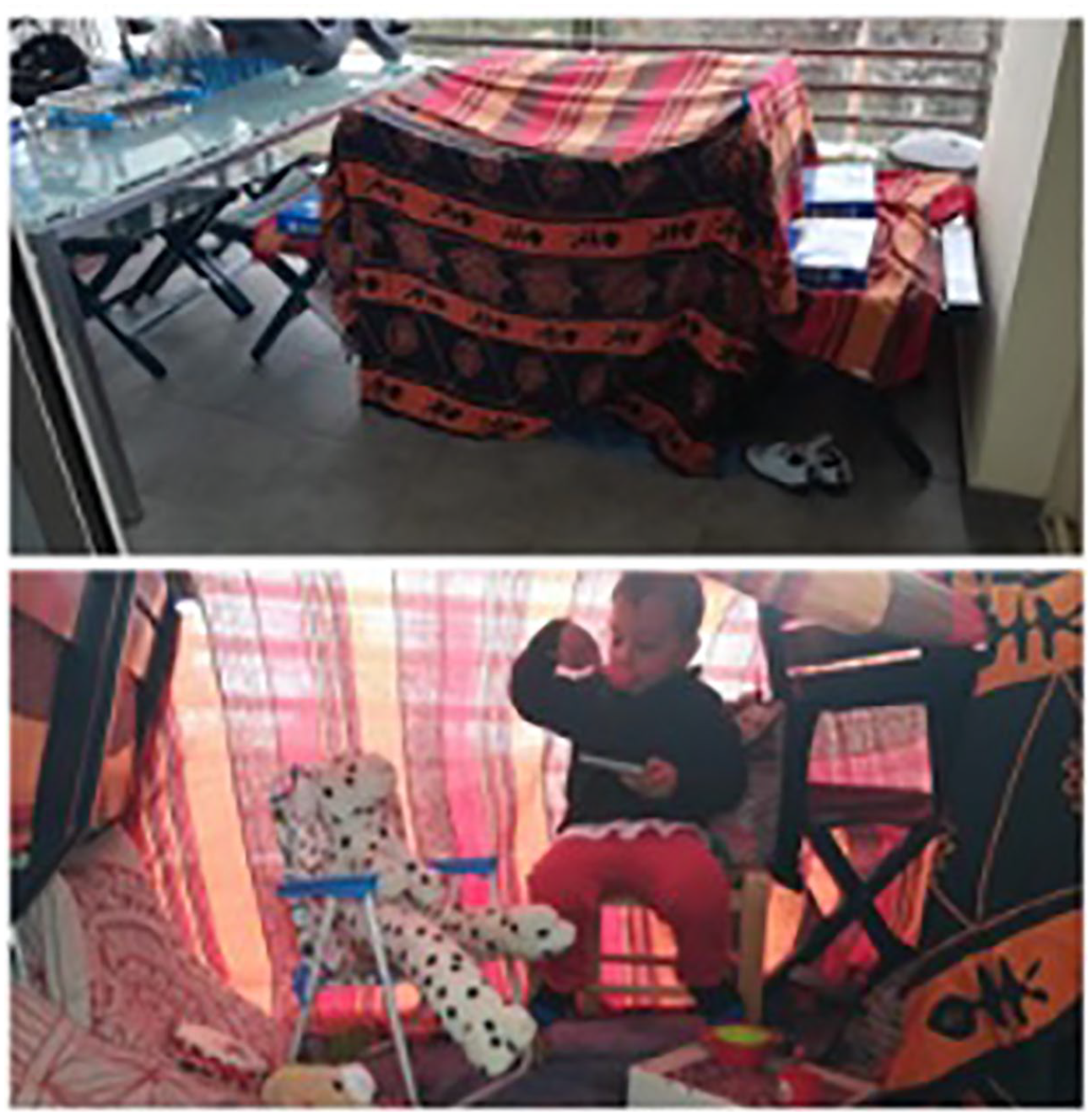
Merged exterior and interior views of a den in Nicosia, Cyprus. © Play Observatory. 2023. PL72A1/S003.
In another submission, a parent in the United Kingdom described dens made by her eight-year-old daughter and six-year-old son in their bedrooms during the lockdown, with an example shown in Figure 2. In this image, children’s bunk beds have been enclosed with large sheets of fabric and a hanging canopy. This has been extended into the room with a further sheet of fabric attached to a chair, creating several separate but adjoined enclosed spaces. One of the children is visible on the top bunk, beneath the uppermost canopy, with the den’s interior almost completely obscured from view.
The parent included the following comment: They take with them their most treasured toys and books. Other than hiding places, I have begun to wonder if these spaces symbolise our current way of life, a form of separation or delineation, similar to the social distancing and bubbles imposed by our experience of COVID-19. (Text accompanying submission PL72A1/S003 © Play Observatory 2023)
Despite being made with commonplace items such as sheets in the everyday space of the bedroom, the sense that the den is a special, important place to the children is conveyed in the observation that they took their ‘most treasured’ items inside. As in the example from Cyprus, the parent includes a reflection on the possible significance of den-creation within the pandemic context, speculating that this play may have been mirroring the wider social distancing and separation children were experiencing. With dens often associated with safety, seclusion and privacy and affording children with a high degree of agency and control, it could be argued that the act of den-building took on particular power and importance during the pandemic. As the parent comments suggest, dens arguably allowed for the creation of ‘some other place’ when access to places became so limited and provided a safe and agentive way of exploring concepts central to the pandemic such as separation and distance through physically making and inhabiting their safe places.
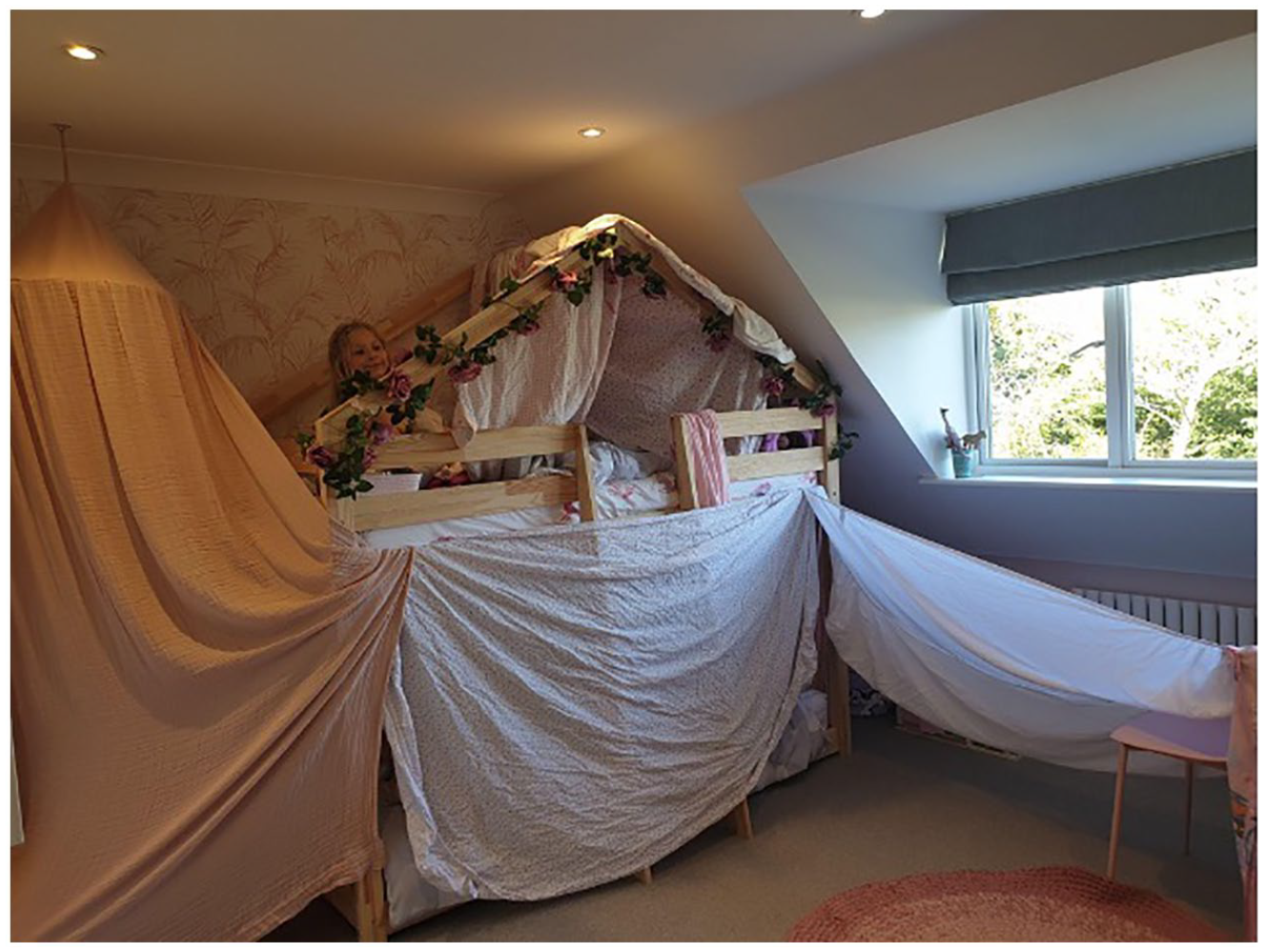
A den in Cheltenham, United Kingdom. © Play Observatory. 2023. PL82A1/S001.
By far the majority of the dens we saw in the submissions were attempts to perform ‘placemaking’ in the home. Everyday household materials such as cushions, quilts and other loose coverings were placed over furniture to create spaces underneath. These spaces were often given names, such as ‘Bear Cave’, to signal their essential ‘otherness’ from the rest of the home. They became entry points into different ways of being in the world, spaces of shelter but also imaginary and affective activity. There were occasionally other dens in other places. In one example, an artefact outside led to a desire to make a shelter from a found resource in the environment, an outside den, even closer in spirit to the work of Sobel (2002). In Figure 3, children make use of tractor tyres in their play, including hiding in them.
As we have written in the commentary on this: This image typifies the results of exploratory walks close to home and the use of found materials in the environment in which to play which chimes both with den building and thinking on outdoor play more generally (Whitebread et al., 2017). Its selection for inclusion by the parent also makes a statement about the relationships between the siblings, close in age and encircled within their own play space.
The overriding affective emotions in these images of dens are security and togetherness, simultaneously secret and social (Kylin, 2003), enhanced by the pushing away of the world, whether child-led or parent and carer-led. In many instances, we see examples of co-creation, and while these are not instances of transgressive play, they are arguably evidence of a form of third space creation, a negotiated act of placemaking whether inside or outside the home.
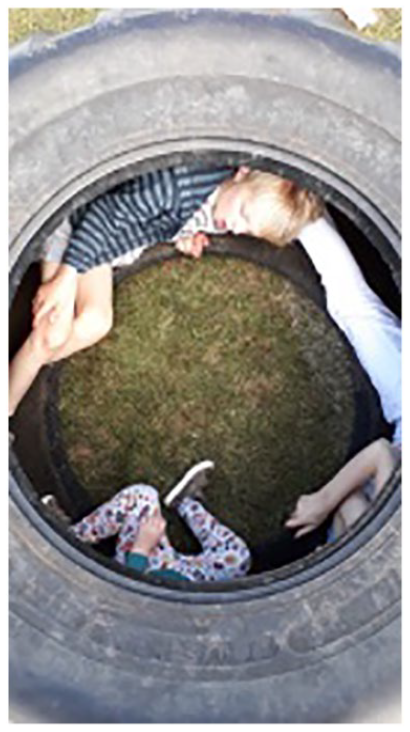
Children playing inside a tractor tyre © Play observatory. 2023. PL48A1/S009.
Filmmaking: ‘Covid Gone’
Turning to placemaking in media, using moving images and sound, we examine ‘Covid Gone’, a short film submitted to the Play Observatory. It is a piece in which outside and inside spaces are represented in a form of sensemaking about the changed world, and a hope for a return to normality after the Covid emergency has ended. The film runs for a little over 2 minutes and takes the form of a YouTube or TikTok style ‘lyric video’ in which words appear written on the screen whilst they are performed in voiceover and occasional lip-syncing in the edit. It was completed at home during the first lockdown in the summer of 2020, in a collaboration between a British 10-year-old boy, Louis and his father, Jonathan. The film is a record of play and play spaces inside and outside the home, presented in sophisticated edits which dramatically underscore the lyrics of memory and loss of amenities and normal life. It is notable for many reasons, including its verse-chorus structure, in which the images are chosen to mirror the structure of the lyrics, moving between inside and outside view, between family and close-ups on the face of the performer, Louis (see Figure 4). In this way, there are further echoes of filmic structures used by children and young people in other projects (see, for example, the films presented in Potter, 2012).
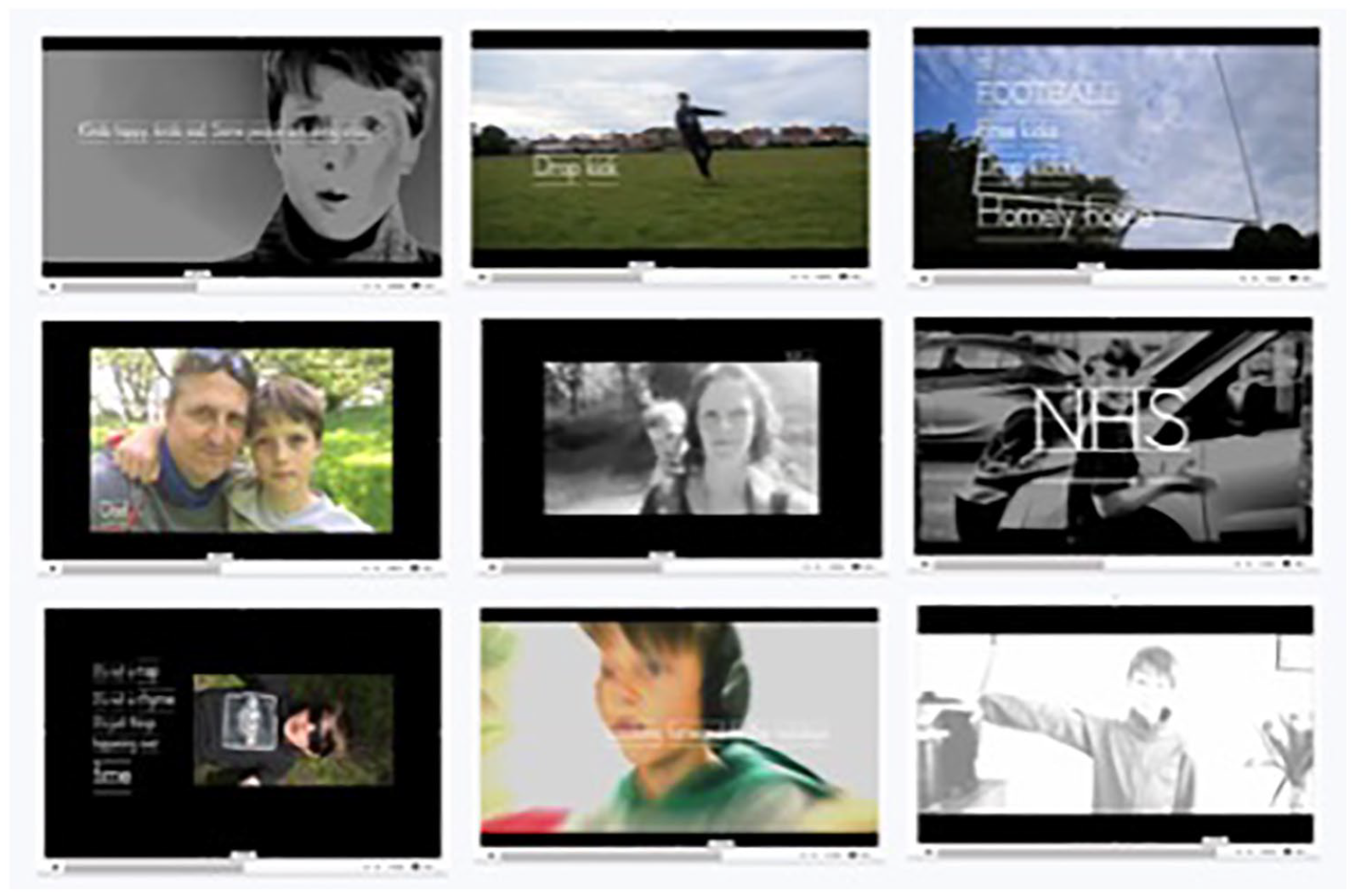
Thumbnails of short sequences in ‘Covid Gone’: Indoor and outdoor play, family members and more. The film is available to view at You can view this film at https://youtu.be/yolGe6UT3_w © Play Observatory. 2023. PL56C1/S001.
The act of making the film itself is also arguably a form of intergenerational play which, as Jonathan noted in a post-production interview, helped to ‘keep everything positive’. Jonathan was mainly behind the camera and took the lead on editing. Louis developed the writing and the concept behind the production. It is a record of pandemic play and a look ahead to the end of lockdown and a return to the things that Louis most enjoys in life: football, family and friends. It expresses the confusion and uncertainty of the time, combined with a high degree of resourcefulness and inventiveness in the production, but also compresses ‘space-time’ and is a form of mediated ‘placemaking’ as ‘sense-making’, in which the digital is imbricated with family life in pandemic times.
Filmmaking: Loo paper hoarder and park police
Cannon et al. (2023) have written elsewhere about certain media texts submitted to the Play Observatory that illustrate how private spaces in the home had been compartmentalised into specific areas of activity. One child had made a short film reflecting on how domestic time and space had been wrought during the pandemic, with, for example, an area for exercise, schoolwork and meditation. In the following example, a fiction is spun around the common practice for some during the pandemic of stocking up on dwindling supplies of basic household items. Young British filmmaker, Woody aged 10, had taken part in an online drama project during the height of the first lockdown in the Spring of 2020, resulting in two short films that made their way into the pandemic play archive. Figure 5 is a still taken from Woody’s film ‘Loo Paper Hoarder’, featuring his toddler sister (named L in this article) portrayed as the eponymous toilet roll hoarder. This is the final scene in the film, in which Woody cuts in for a close-up of L watching TV while nestling in her snug den of toilet rolls.
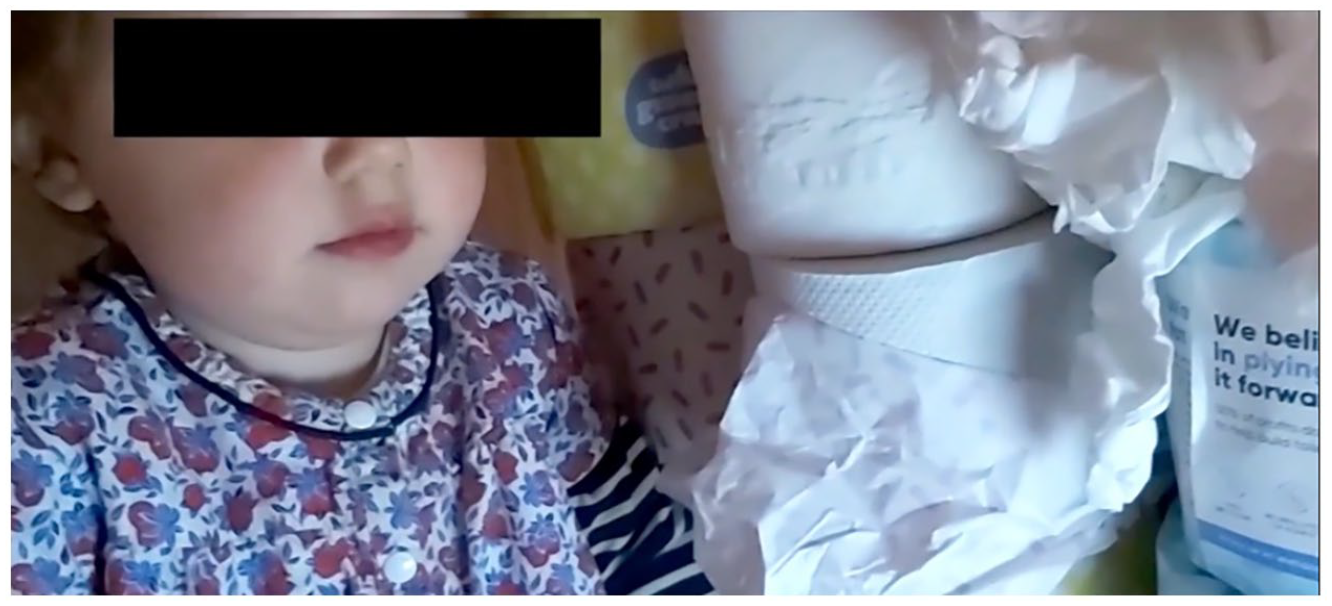
L in her toilet roll den. The filmmaker himself obscures his identity. Still from ‘Loo Paper Hoarder’ film by Woody, aged 10. © Play Observatory. 2023. PL192C1/S002.
As mentioned above, for Perrino (2021: 582) chronotype was helpful in her exploration of the fear factor embedded in Covid imagery, arguing that the concept ‘was key to study the entwined temporal and spatial dimensions in the images and stories that populate our lives’. Chronotopic thinking thus offers a way of understanding the vibrant and complex spatio-temporal relations baked into the image in Figure 4. Resulting from Woody’s tightly composed microcosmic frame, and his creative choices relating to mise-en-scène, voiceover, light and sound, the viewer is complicit in both L’s sense of satisfaction and solace. More implicitly in terms of meaning-making, this interpretation of the image combines and contrasts with an appreciation of the swirling macrocosmic maelstrom outside of the ‘sequestered space of dens’ (Goodenough et al., 2021). Below is a further example of Woody’s particular approach to filmmaking, which demonstrates the complexity of postdigital third space play with time, imagined place, plot and the recruitment and arrangement of the raw materials at one’s disposal.
‘Park Police’ is Woody’s fictional social commentary on public space lockdown rules, specifically in his local park, where he enlists his sister L once more, this time as the protagonist in a ‘cop-show spoof’. The 1-minute short film can be viewed here: https://youtu.be/ZI1gjevWKv0
During the project symposium, Woody explains his inspiration for shooting Park Police – filmed on his phone: . . .so, basically this was the time where . . . er . . . the park that we were in had like, guards basically enforcing Covid regulations . . . It was a simple premise, you know, not much happens - she interrogates a person, the person gets quite angry, and then she eats a banana. (Extracted from The Play Observatory Research Symposium video from January 2022, https://vimeo.com/user3263566)
The film begins with a scene emulating the audiovisual tropes of a TV police procedural, in that we see close-up shots of L donning boots and uniform to pounding music. Figure 5 sets the scene for what becomes a definitive upending of roles and rules in a peculiar time and space: a toddler patrols the park on her trike, identifies (Figure 6) and reprimands a group of adults contravening picnic rules, eventually resolving to join the picnic herself (Figures 7 and 8).
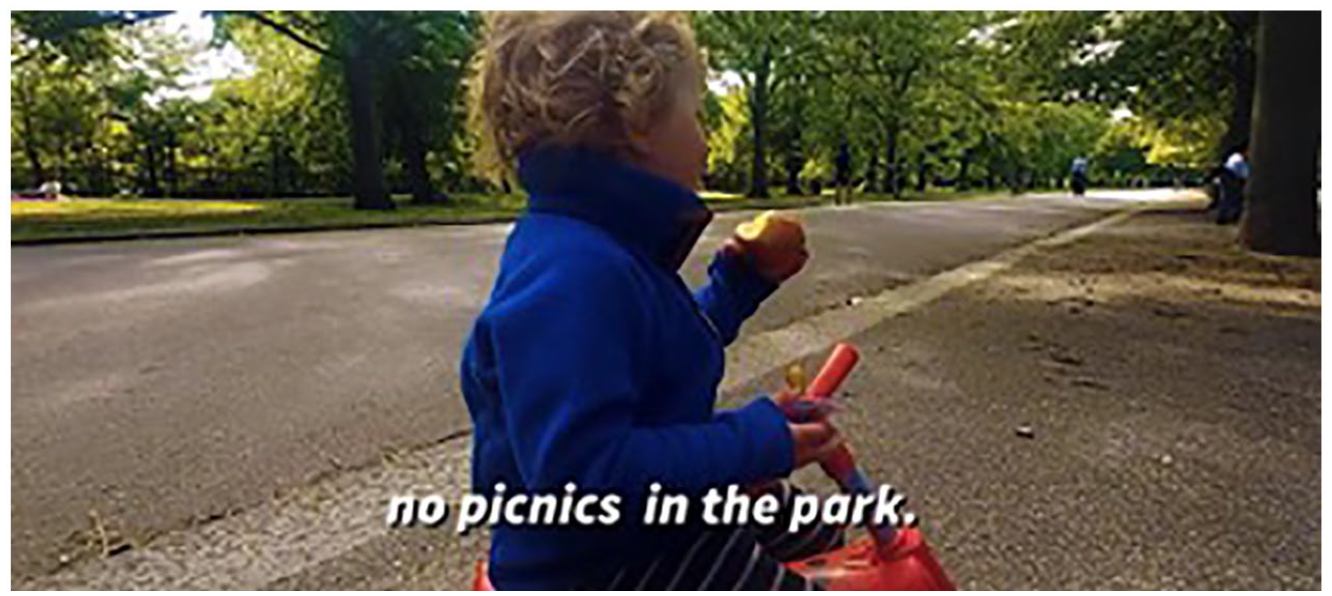
Still from Park Police by Woody. L eats an apple while patrolling the park on her trike. © Play Observatory. 2023. PL192C1/S001.
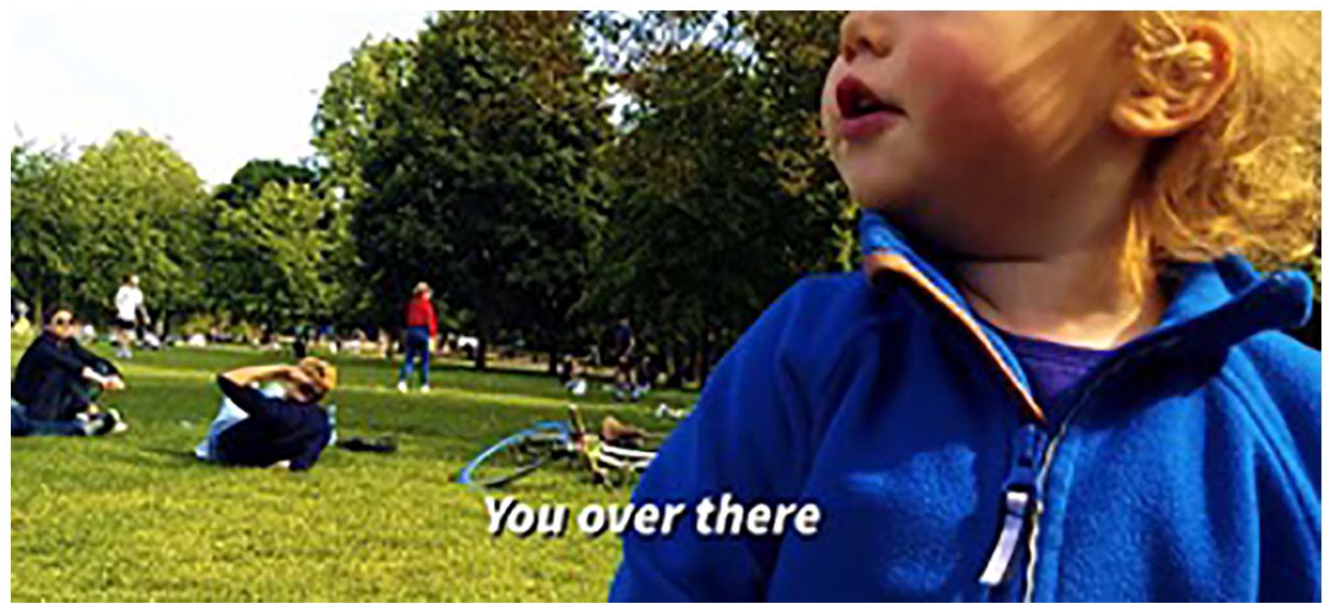
Still from Park Police by Woody. L identifies a person breaking the picnic rules and runs towards them. © Play Observatory. 2023. PL192C1/S001.
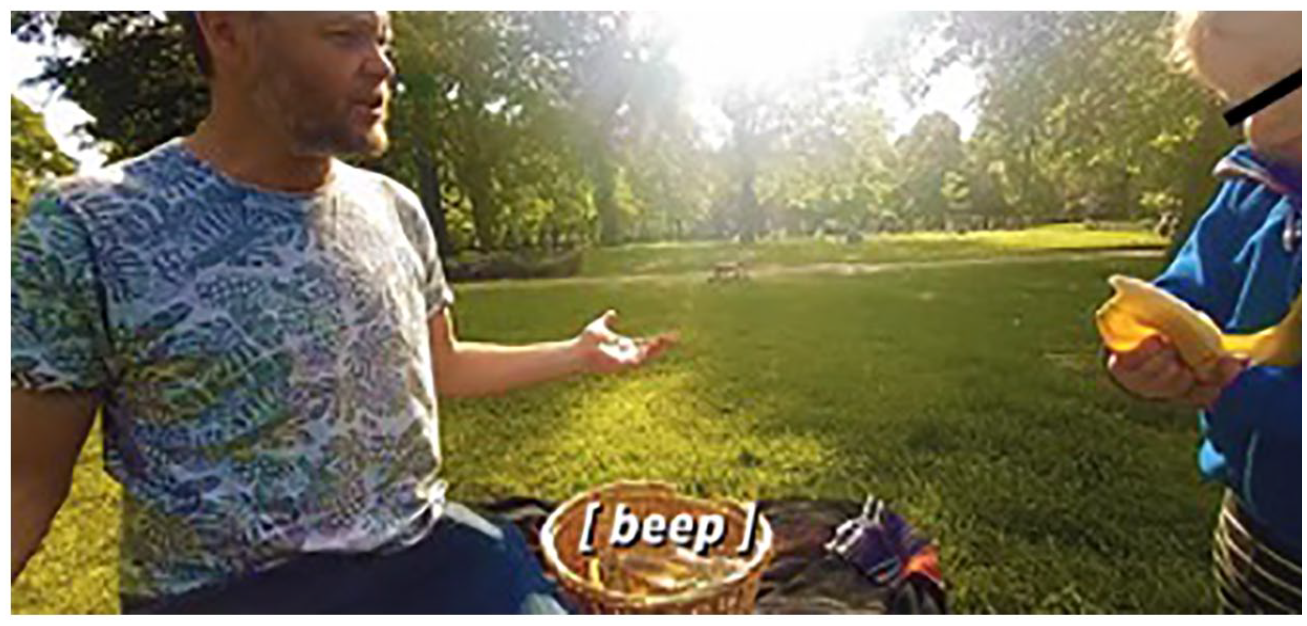
Still from Park Police by Woody. L reprimands the culprit, who protests, and she proceeds to eat a banana. © Play Observatory. 2023. PL192C1/S001.
Moving out of the home, Woody chooses to locate his story in the local park – a public space already crisscrossed with new symbols of restriction and prescriptive protocols. He realises a new rendering of time and re-charges existing space with alternative satirical meanings. Bakhtin (1981) suggests that ‘(the) chronotope is the place where the knots of narrative are tied and untied’ (p. 434), in other words, where plots unravel in unexpected ways, which is characteristic of iterative experimental play with the materials and the performers at hand. Woody’s sister seems to take direction exceptionally well and joins in the collective family role-play with gusto. She too enjoys a moment of agency, which was recognised and retained in the final edit by her brother, in the climactic and transgressive eating of the banana.
There is no scope in this article to undertake a comprehensive multimodal analysis of every shot in this film, much as it is warranted, but what can be made clear is the collaborative nature of ‘the enactment of these chronotopic configurations’ (Perrino, 2021: 583). We may be familiar with ‘family-viewing’ as a social practice, but in this text, as above in the making of ‘Covid Gone’, and implicit in many of the artefacts submitted to the Play Observatory, ‘family-making-fun’ seems to be an appropriate term to describe the collusive, and at times mischievous dispositions that marked the production processes. With the help of his family, Woody draws on his knowledge of TV and film conventions to frame and express a complex narrative based on his understanding of a world whose codes of conduct had been turned upside down.
The authors propose that what he accomplished was far from ‘simple’, despite his assertion to the contrary, and that Woody’s representation of what seemed to him at the time to be absurd social distancing rules, helped him negotiate his way through the confusion using humour, family collaboration and the audience’s collective memory of the time. Arguably for a sense of collusion to be effective, there is a need for mutual understanding between parties and for agreement on some kind of joint outcome that often goes against the grain. We argue that this kind of overturning of norms and compression of conventional power relations sets the tone for generative postdigital third space practices (Potter and McDougall, 2017).
Interview videos
After they submitted instances of play to the observatory, participants had the option of a further discussion of pandemic play in their household. If they indicated that they wanted to do this, they were invited to take part in an online interview with two members of the team, at a time to suit them, of between 30 and 40 minutes duration, depending on the age of the children. We prepared a semi-structured interview schedule to be carried out using the online conferencing software Zoom. Further details of how this was managed, including ethical conduct in the research, are available elsewhere (Cowan et al., 2022). The focus of this article is on how the interview videos provide further evidence of the imbrications of bodies, artefacts and practices in postdigital play, such as we uncovered in the Play Observatory. We discuss below two interviews which bring some of these concepts together and introduce new elements to the study.
The ‘bear cave’ interview
In a previous section of this article, we argued that den-building during pandemic play moved the locus of control of the space closer to the children, at a time when other aspects of life were seemingly out of control. For the very youngest children in the study the filmed interview, in a house taken over by dens and ‘placemaking’, also revealed how daily life was imbricated with the presence of the digital. Two researchers joined the interview via the parent’s digital device, an iPad, via a ‘point of view’ (POV) exploration of the spaces of the home. The two boys, aged just under 2 and 4 respectively, took the researchers on a guided tour of their dens with the parent filming them as they clambered through the various spaces of the ‘bear cave’ they had created. The camera, held by their mother, follows them as they make their way through the house showing the researchers around their dens. The shots are mainly at the child’s height, as the parent attempts to keep up and follows them under tables, past overturned chairs and takes the viewer into the heart of the play. Explanations to the camera morph into play episodes as the two boys tumble through the worlds they have made and start playing in them. The camera on the iPad merges into the everyday, with the children lost in their games and exhibiting no obvious awareness of the filming. However, at one point one of the children offers one of the interviewers a virtual ice cream through the screen, arguably an example of ‘postdigital’ play as the technology becomes woven into events.
The space of the house during the pandemic has been transformed by the children’s placemaking, with the active collusion of the parents. In the following extract INT1 and INT2 are the researchers, RES1 is the mother and RES3 is the older child, aged just under 4.
It looks like there’s a chair there as well holding things up, that looks great. Mm.
–– specifically requested that the den for today’s call could be on his bed.
Ah, okay.
Quite right, quite right.
Hey –– do you make dens in other places as well?
I make dens in all the places.
All the places, okay.
You must be so good at that by now. Wow. Where else have you made your dens?
In the hallway.
In the hallway.
Yeah.
Do people have to walk around your den to get in then?
They have to go up, they have to go through the den.
They have to go through the den to come into the house. Oh brilliant.
(©Play Observatory Interview PLE2021-08-05RBRa0001)
Anyone entering the house at this point is immediately aware that ownership of space in the home has been co-opted by the children for pandemic play. The space is under the control of the children and to gain access, adults have to ‘go through the den’. There are many layers to this experience. The play itself happened as a result of ‘placemaking’ within the space of the home, itself an act of both agency and collusion. The filmed record of events and the interview were made on a device which was available in the home. And whilst there were some drawbacks to the online nature of the ‘fieldwork’ in the play observatory, mainly related to transcription errors and lack of ability of the devices to capture fully all aspects of multimodal communication, there were undoubted benefits in terms of familiarity of the devices used to connect and the relative lack of disruption to the daily pattern of life, and play, during the pandemic. Additionally, these online methods necessitated by the pandemic offered a particular perspective on the play, for instance being taken inside child-sized dens via the iPad in ways that would have been physically challenging or impossible in person. Arguably, such methods also shifted child-researcher power relations by ‘shrinking’ researchers to be the same size as the children on the screen, affording them with more autonomy by allowing them to hold and move the iPad to decide what gets recorded and how, and enabling intimate insights into home environments without physically intruding in these private spaces (Cowan et al., 2022).
Discussion and concluding thoughts
We have identified in the work described in this article, patterns of postdigital third space arrangements, not least of which is the playful repurposing of domestic space, the at times transgressive, nature of the content, the practices that brought them about and the collaborative environment in which they were produced or recorded. In Bakhtinian terms, we argue that there is ‘thick’ wit and ingenuity with ‘the times’, and responsiveness in the ideation and editing of these texts that seem to illustrate the flattening of time and space ‘in just one spatio-temporal layer’ (Perrino, 2021: 590). The final rendering of a film through the compacted layers of image and sound seems to be a metaphor for the extrusion of meaning in time and space in children’s domestic pandemic play.
As noted above in the opening sections, dens intervene in the space of the home framing it differently, enabling a form of play which moves the locus of control closer to the child, using placemaking as a way to change hierarchies of space. There are parallels between den building and filmmaking. The films, like the dens, permit alternative representations of spaces in the home, closer to how the child sees the changed nature of their experience.
The evidence we have collected of children’s creative and affective experiences in spaces in all settings, in both still and moving images allows us to ascribe particular value to moments of play during the pandemic. We should note, at this point, that not all children had the best of experiences; we encountered some evidence of distress and feelings of unwelcome solitude. However, we believe that the research itself generated a space in which children could play, think, and talk safely about these experiences and have them recorded.
We have written elsewhere about children’s agency in their pandemic play and use of media (Cannon et al., 2023). In this article, we investigated children’s creative manipulation of space, time and digital/non-digital assets that revealed experiences reminiscent of practices observed in playgrounds in previous times (Potter and Cowan, 2020). We argue that such practices were thrown into sharp relief by the extraordinary circumstances of lockdown life during COVID-19 which nevertheless, in the submissions to the Play Observatory, at times recorded intense social collaboration and creative manipulation of time-space.
Some of what we have seen reveals postdigital forms of play in everyday life; screens were present but existed alongside the overlapping materials and imbricated worlds of the digital. Filmmaking brought representational play with time-space elements and in some cases (‘Covid Gone’ for example) enabled intergenerational understandings, joint purposes, and safe collaboration. In these examples, we saw de-hierarchised roles, new identities, and the disruption of norms, alongside resourcefulness with the expressive properties of people, places, and raw materials to hand. There are echoes here of Kress’s (1997) writing in a multimodal frame about children drawing rapidly and readily on ‘what is to hand’. A further corollary was provided by physical, concrete play with time-space elements in den-building, alongside representative play in filmmaking. In their play, children, and sometimes the adults who cared for them, were arguably revealed as designers of spaces and places in multiple modes during the changed circumstances of the pandemic.
Footnotes
Funding
The author(s) disclosed receipt of the following financial support for the research, authorship, and/or publication of this article: The research featured in this article was funded in the UK in 2020-22 by the Economic and Social Research Council (ESRC) under the UKRI Rapid Response to COVID-19. The award number was ES/V015451/1 and the project title was: ‘A National Observatory of Children’s Play Experiences during COVID-19’.
