




Abstract
This article generates two dialogical theorisations of young children’s encounters in more-than-human worlds involving metaphor. The first theorisation devises metaphor as an entry point into the dialogues of more-than-humans and includes rare attention to metaphors as multimodal intra-action. The second theorisation provides an alternative to Linell’s view that relation with non-humans would be merely a metaphorical extension of dialogue, ‘as if’ they were human. Instead, a new model recognises the potential for dialogue as a relational engagement with otherness in a more-than-human-centric approach. The theorisations underpin interpretations of a range of early childhood play episodes with protagonists: sand, paper, tissue and plastic. The materials are beyond any assumed instrumental interaction waiting to be acted upon by humans; rather, they can be in social and material worlds, meeting places, of more-than-humans intra-acting. Penny Lawrence has proposed attending to the quality of relation in dialogues. The significance of these theorisations is for more-than-human study of any encounter to take account of the potential for dialogue, and for studies of dialogue to take account of the more-than-human. In particular, the processes of blending in multimodal metaphorical co-constitutive processes offer notable insights into intra-actions within more-than-human dialogues.
Introduction
Materials and objects create meeting places . . . They live, speak, gesture, and call to us. (Pacini-Ketchabaw et al., 2014: 1) We hear the sounds joining together.
This article generates two new dialogical theorisations of young children’s encounters in more-than-human worlds involving multimodal metaphor. They have significance for the study of any encounter of more-than-humans, and thereby encompass humans and non-humans. Material calls and can be engaged with, as Pacini-Ketchabaw et al. (2014: 1) acknowledge. This engagement occurs in the second quote above from an observation about how the sounds of sliding plastic plates join. The theorisations apply in interpretations of children’s play with protagonists in the form of plastic, paper and sand later in the article. An original multimodal conceptualisation for the meeting places of both metaphor and dialogue opens up enquiry particularly involving the youngest children and the non-human. The theoretical framing explains the terms shortly.
The first theorisation concerns metaphor as an entry point into the dialogues of more-than-humans. Multimodal metaphor research beyond written and verbal modes is still rare (Forceville, 2019). Attention to this is timely as well as especially relevant in early childhood, when speech is not necessarily the dominant mode (Kress and Van Leeuwen, 2001). This is a relational process, as well as a comparative cognitive one. Metaphor does not simply take meaning from one domain to make the non-human domain more intelligible; it is also a matter of how the multimodal affects of the more-than-human come together, and potentially blend, in the metaphor.
The second theorisation proposes a new alternative to Linell’s (2009) view that involving the non-human would be merely a metaphorical extension of human dialogue, ‘as if’ the person were in dialogue with a human. I will argue that a dialogue with the non-human is not only ‘as if’; because of relational regard, there is potential for a new model of more-than-human dialogue.
Theoretical framing of dialogue and metaphor
Before I set out metaphor as a dialogical entry point, I briefly outline the use of the following important terms: ‘dialogue’, ‘more-than-human’ and ‘metaphor’.
Dialogue
Dialogue is defined as dia ‘through’ or ‘by’ logos – that is, engagement in knowledge and discourse (Linell, 2009: 4) with the other. It is not only a matter of the number of speakers. To further qualify the term ‘dialogue’, I refer to Buber’s (1970) ‘I–You’ as dialogical. It is relation arising ‘in between’ the collocutors ‘I’ and ‘You’. For Buber, the contrasting ‘I–It’ attitude is instrumental to the other, acting on them, and remains monological. In this article, the relational quality of regard (Lawrence, 2019) determines the dialogue.
In his later thinking, Buber (2002: 12) increasingly includes non-humans in relation: ‘No kind of appearance or event is fundamentally excluded . . . The limits of the possibility of dialogue are the limits of awareness’. In this process, anyone or anything engaged with dialogically is a ‘You’. This change of attitude and repositioning does not necessarily transform the nature of all others into persons (Berry, 1985: 36). Although personhood has broadened in recent ecocentric rather than anthropocentric thinking, and is long established for non-humans within non-western thought (Ingold, 2011; Malone, 2016; Oriel, 2014), personhood is not the focus here and is not required for dialogue to take place. It is not only the human that makes the dialogue. This article continues to develop the notion of entry into dialogue (Lawrence, 2019) because it contributes to the human awareness of more-than-human dialogue.
More-than-human protagonists
More-than-human modes of enquiry ‘attend closely to the rich array of the senses, dispositions, capabilities and potentialities of all manner of social objects and forces assembled through, and involved in, the co-fabrication of socio-material worlds’ (Whatmore, 2006: 604). The protagonists include human bodies rather than exclusively humans, and they are involved with lively worlds. This world view derives from Spinozan and Deleuzean relational ontology, in which bodies are defined by the capacity to affect and be affected by others (Deleuze, 1988), and are all immanently interconnected. Since the material turn (Dolphijn and Van der Tuin, 2012), focused on matter and the agency of material, there remains a backlog of attitudes from preceding paradigms when matter has not mattered, which is still influencing understanding (Barad, 2007) – for example, Linell’s (2009) view ‘as if’ the non-human were human. When objects, materials and environments are configured as more-than-human (Taylor et al., 2012; Whatmore, 2006), the more-than-human may include the human but is not centred on the human. Neither do they have to form a human figure (Fuchs et al., 2019). In the observations that follow, the sand and napkin can be protagonists without anthropomorphism as ‘sandman’ or ‘napkin-baby’.
This article’s contribution is compatible with other new-materialist conceptualisations derived from Spinoza and Deleuze (1988), such as Bennett’s (2010) political ecology; the relational materialist work of Lenz Taguchi (2014), also inspired by Barad (2007); and post-human ontologies (Braidotti, 2013). There is alignment with ‘common worlds’ thinking (Taylor and Giugni, 2012), which conceptualises children’s relations with all the others in their worlds as collective assemblages in Deleuzean terms. For example, Giugni (2011) accounts for a co-constituted material process of ‘becoming worldly’ that is evident in young children’s speech. This article extends to the non-verbal engagement with matter and selects the use of Barad’s (2007: 33; original emphasis) neologism ‘intra-action’ to signify ‘the mutual constitution of entangled agencies’ rather than interaction. There is change for all involved. Intra-action suits the dynamic of dialogue within relation (Buber, 1970) in ongoing, emergent affecting and affected encounters (Deleuze, 1988).
Metaphor involving affect with the more-than-human
‘Metaphor’ originates in the Greek for ‘across’ plus ‘to carry’ (Geary, 2012). It is widely studied in terms of ‘understanding and experiencing one kind of thing in terms of another’ (Lakoff and Johnson, 1980: 5). At first sight, metaphor treats objects ‘as if’ they were something in order to understand them. For example, the sun is going to bed ‘as if’ it rests in the dark of night. However, metaphor is no longer a ‘mere stylistic ornament’ (Johnson, 1981: 25), dispensable in favour of literal statements. It generates insight rather than literal mis/understanding. Although metaphor is valued in education for conceptual and higher-order thinking skills (Bérci, 2013: 92), there is more than cognitive achievement. Metaphor can emphasise similarities but has greater significance than a simile because it is also ‘grounded on correlations within experience rather than similarities’ (Johnson, 1981: 27). Relatable experience is the key to this. For example, in the child’s metaphor of a tree ‘having its hair cut’ (Reggio Children, 2018), ‘child’s haircut’ maps to ‘tree’ through the concept of the cut. As well as mapping something being formed or shaped, trimmed at the edges by a gardener or tree surgeon, could there be more of a relational intra-action of the experience of the tree and the child’s own experiences? Indeed, metaphor can be considered as a relational construct (Fuchs et al., 2019: 98). Billow (1981) reports feelings for the other human and a toy dog. ‘I is an other’ – Rimbaud’s equation – is the maxim Geary (2012: 2) would define metaphors by. Affectual linkages may ground metaphors. Affect is not separate from the cognitive (Damasio, 2004). Egan (1992) includes emotion in the intersection of metaphor, along with imagination, memory, perception and idea-generation.
These interconnections are the location for the more-than-human understanding that this article is concerned with. ‘Common worlds’ thinking, defined by Taylor and Giugni (2012), takes account of assemblages of more-than-human relations in children’s worlds, drawing on Deleuze and Guattari (1987) and on Latour’s (2004) inclusiveness. Latour (2004: 222) invites curious openness to other commonalities, and this can include theorisations rather than ‘foreclosing on what might constitute the commonalities of the “common world”’. This is the rationale for theorising young children’s encounters in more-than-human worlds involving metaphor, a field heretofore confined to the domains of psychology and linguistics.
Metaphor as a dialogical entry point
For the first theorisation, I propose that metaphors may act as a process of cognitive insight and also of shifting relational attitudes towards others – a way for children to enter more-than-human dialogue. Instead of a bridge for transferring only (Cortazzi and Jin, 1999: 149), the metaphor is the co-constitutive meeting and joining of affects.
To arrive at the co-constitution, we can start from the cognitive level, where metaphor works through substitution or comparison of A with B. So, for the metaphor ‘the tree has a haircut’, A = ‘the tree’s branches’ is compared with B = ‘the children’s haircut’. Knowledge from the source domain B (‘haircut’) extends knowledge in the target domain A (‘tree’). Alternatively, as Black’s (1962) interaction view demonstrates, the projection of B onto A generates new insights that are not attainable through literal statements (Johnson, 1981: 28) and reconstitutes rather than compares. This aligns with Barad’s (2007) intra-action, as the metaphor is constitutive of both target and source domains – both the child’s experience and the tree’s ‘haircut’. This co-constitutive process occurs between the worlds of physical phenomena and children’s metaphorical narratives (Fuchs et al., 2019). For example, music, wind, light or water can be recognised as a force, a ‘dynamical phenomenon presenting itself as agentive to the human mind’ (Fuchs et al., 2019: 93). In Haus’s (2018) study, drawing on Barad (2007), the forces of lift and thrust intra-act with a five-year-old making a paper aeroplane, and both change in the process.
Recent thinking (Fauconnier and Turner, 2008) conceives metaphors as a blending rather than a one-way process between distinct fixed domains. In blending terms, the domains are called ‘inputs’ (Dancygier, 2017). I continue to use the term ‘domain’ to indicate inputs as this is still understood in blended theory. A ‘blended space’ is where material from the domains combines (Fauconnier and Lakoff, 2014: 395) to affect and be affected by each other. Since they co-constitute intra-action, I argue that this enacts the ‘in-between’ space of ‘I–You’ dialogical processes.
Metaphor as a multimodal intra-action in early childhood
Metaphor not only functions through spoken or written language. It is grounded in embodied experience (Gibbs et al., 2004; Johnson, 2013). Vygotsky (2016: 13) deprecated reliance on the physical object or material as a pivot in terms of ‘the child’s weakness’. When a child ‘rides’ a stick, rather than a failure to separate from objects, such play can be a relational and metaphorical achievement: ‘stick is horse’ – an entry into dialogue. It is further evidence of what Vygotsky (2016: 12) himself recognised as the ‘intimate fusion’, the ‘union of affect and perception’ with materials and objects in the child’s situation. Recent post-human analysis appreciates relational phenomena – for example, Odegard’s (2019: 119) materials ‘as agentic co-creators that command our attention’, or Harwood and Collier’s (2017: 336) stick, ‘a catalyst, a friend, a momentary and changing text’. No longer undervalued as weakness, the transformation affectively recognises concepts, materiality, and the relation between sticks, horses and children – a recognition that age should not shed.
Focus on the non-verbal and the material promises new understanding since there has been little attention paid to the occurrence of multimodal non-verbal and non-written metaphors (Alessandroni, 2017; Forceville, 2009a). Metaphors can engage across different modes such as gestures, touch, image and sounds. Sound also can be considered as a material affect (De Bruyn, 2004). Forceville (2009b: 383) defines multimodal metaphors as ‘metaphors whose target and source domains are predominantly or entirely presented in different modes’ – for example, the movements of a stick and the sounds of a horse. Szokolszky (2019: 28; citing Gibson, 1988) explains that a child ‘bouncing’ keys may discover ‘a higher-order invariance shared by dancing’. The metaphor ‘keys are dancing’ maps dancing to keys through the type of movement. Haynes and Murris (2019: 291–292) argue Derrida’s case for ‘suspecting the authority of language’ and break binary ‘progressivist notions of child’ to be unbound by the child’s age. Access to multiple modes, and not assuming the dominance of speech, opens up non-developmentally bound enquiry, which is particularly relevant for the youngest children and the non-human, when viewed together as the more-than-human. The affordances of the non-verbal modes also may realise metaphors that are difficult or not possible in verbal modes (Forceville, 2019).
Earlier metaphor research concentrated on older children’s verbal capacity (Gardner and Winner, 1978). However, there has been a shift in thinking towards younger children. In free play, Billow (1981) and Szokolszky (2019) find that spontaneous metaphoric processes consistently, deliberately and frequently occur in two-year-olds. Pouscoulous and Tomasello (2020) recognise that abilities such as analogy perception are present in the very young, and Goswami (2001) reports the emergence of this perception from one year of age. This aligns with reports from Dent-Read (1997, cited in Szokolszky, 2019: 24–25) that the perception underpinning verbal metaphors is already accessible when children produce one-word metaphors at about 18 months. Metaphor precedes spoken language (Geary, 2012: 3). Alessandroni (2017) proposes that, during the first year of life, pragmatic conventions are constructed. The rising awareness of multimodal metaphorical forms should enrich the appreciation of metaphors involving very young children, and here refreshes understanding of dialogue.
Discussion of four dialogical episodes involving metaphors
I now apply the theorisation of multimodal metaphor as an entry point to more-than-human dialogues in observations originating in earlier studies of dialogue in UK nurseries (Lawrence 2019, 2021) and in Italy (Reggio Children, 2011). The four episodes include: two-year-olds with sand; three-year-olds with napkins; two-year-olds with paper tissues; and two-year-olds with plastic plates. This is, necessarily, a human interpretation of children’s dialogues with non-humans involving multimodal metaphor. It is also the researcher’s interpretation, although it draws on previous participatory research (set out in Table 1). I will focus on the modes of proximity, position, touch, movement and sound. Table 1 indicates the target and source domains, modes and what features map between them.
Four dialogical episodes with indications of the target and source domains, modes and what features map between them in the multimodal metaphors.
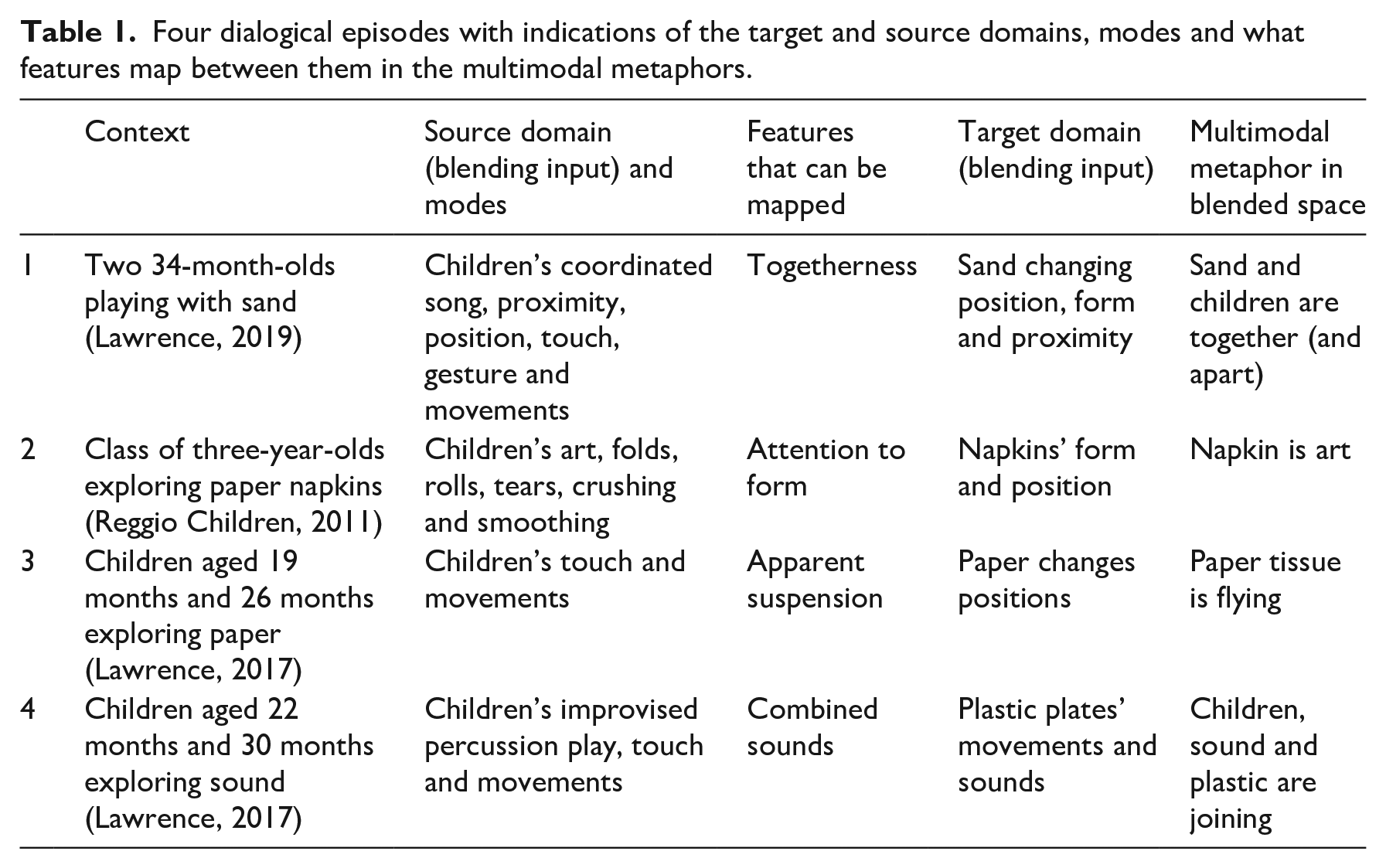
Sand and children are together (and apart)
This episode takes place in the outdoor play space of an early childhood setting for children aged 24–36 months in a small city in Hampshire, UK. There is provision for 16 children, with a culture valuing child-initiated experiences outside. Henry and Freddy are 34 months old and they are together in the sandpit.
1
Here is an extract of the description (for fuller analysis of the dialogue, see Lawrence, 2019): The mirror breaks the surface in the brick wall, it is a space in the bricks. Freddy scatters sand up against the mirror [Figure 1], so does Henry [Figure 2]. . . . The sand is dispersible and we can see a cloud effect when it is in the air in front of us. Henry and Freddy stand and watch each other and take turns to throw [Figure 3]. They are doing this scattering together. They sing ‘together forever’ repeatedly and swing their arms and the scattered sand in the air. It feels as if they are celebrating being together. (Lawrence, 2017: 117)
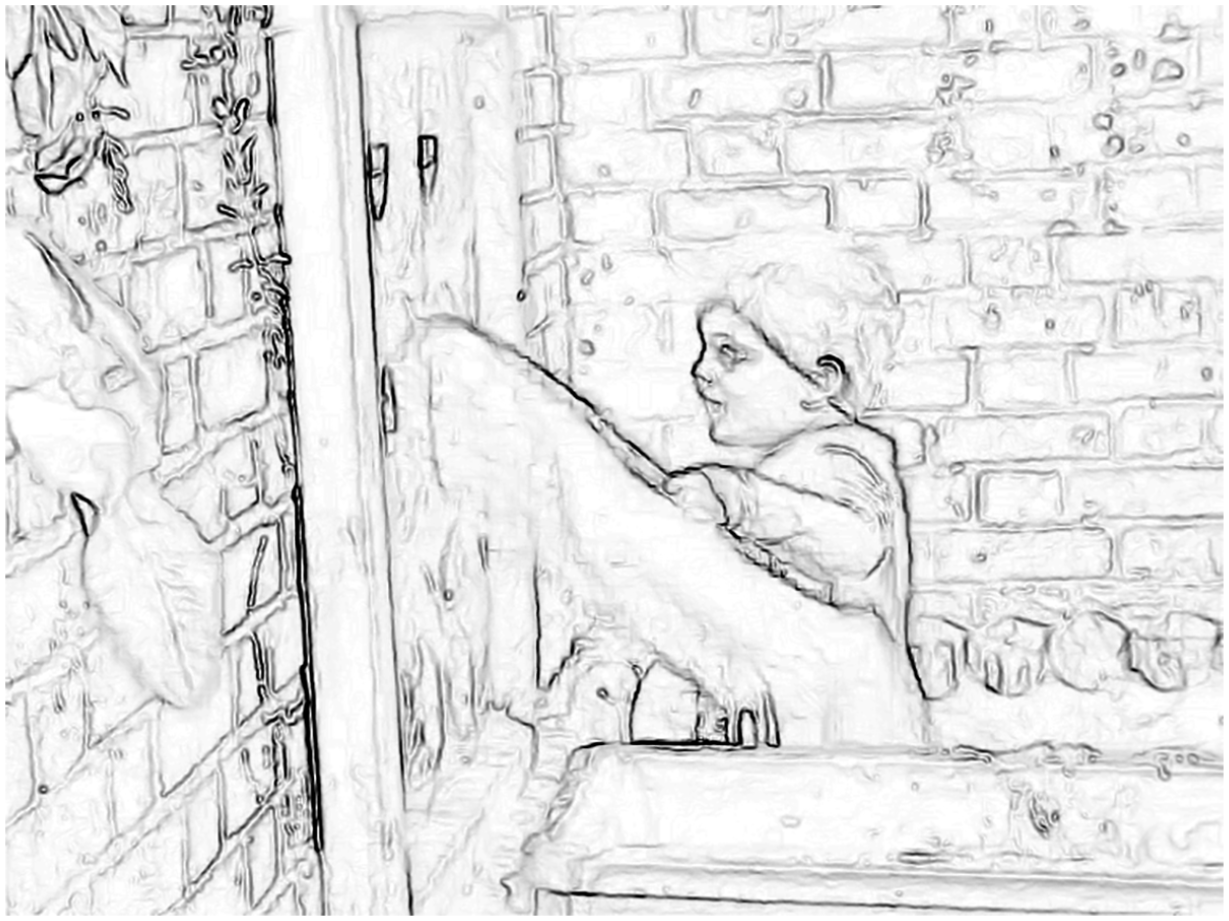
Freddy sprays sand in the mirror at 2 minutes 43 seconds into the episode.
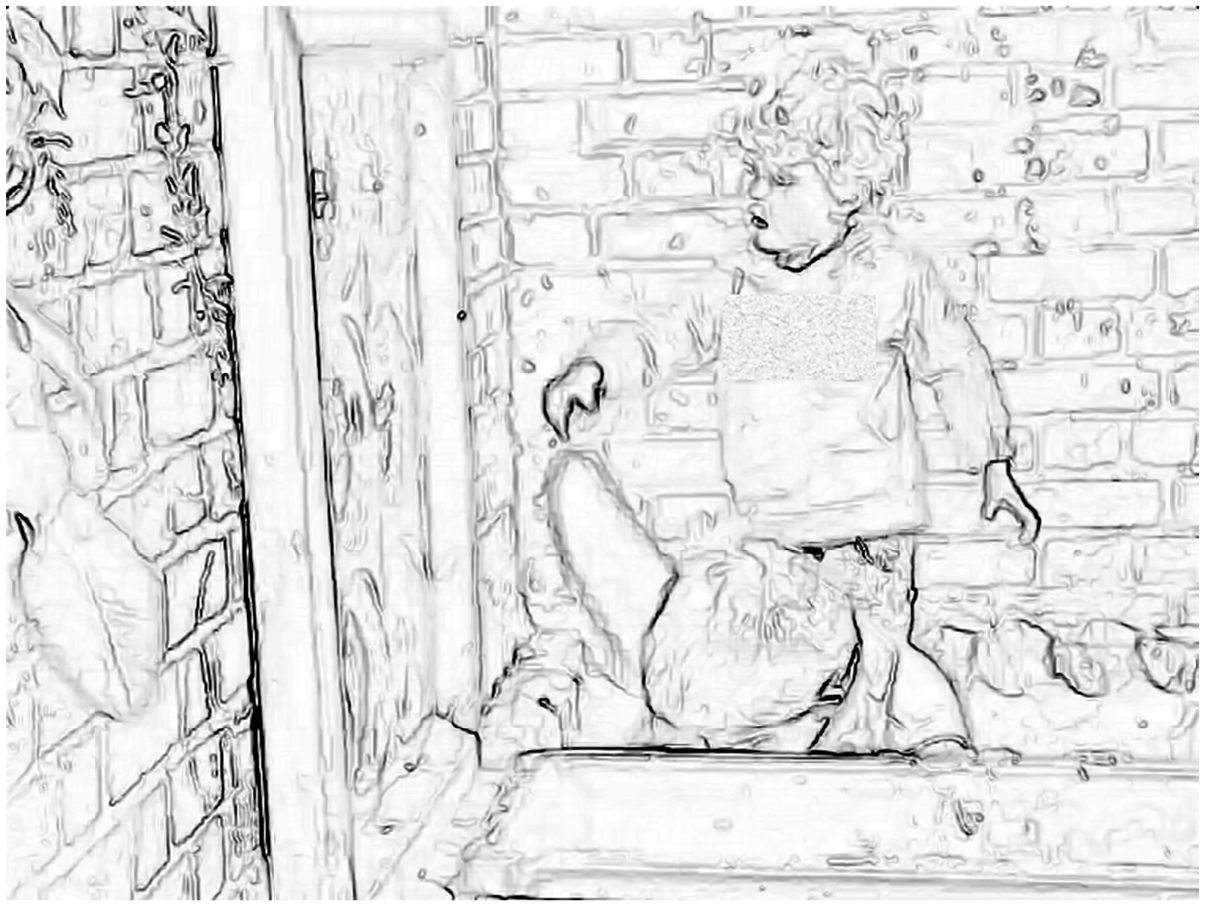
Henry sprays sand in the mirror at 2 minutes 48 seconds into the episode.
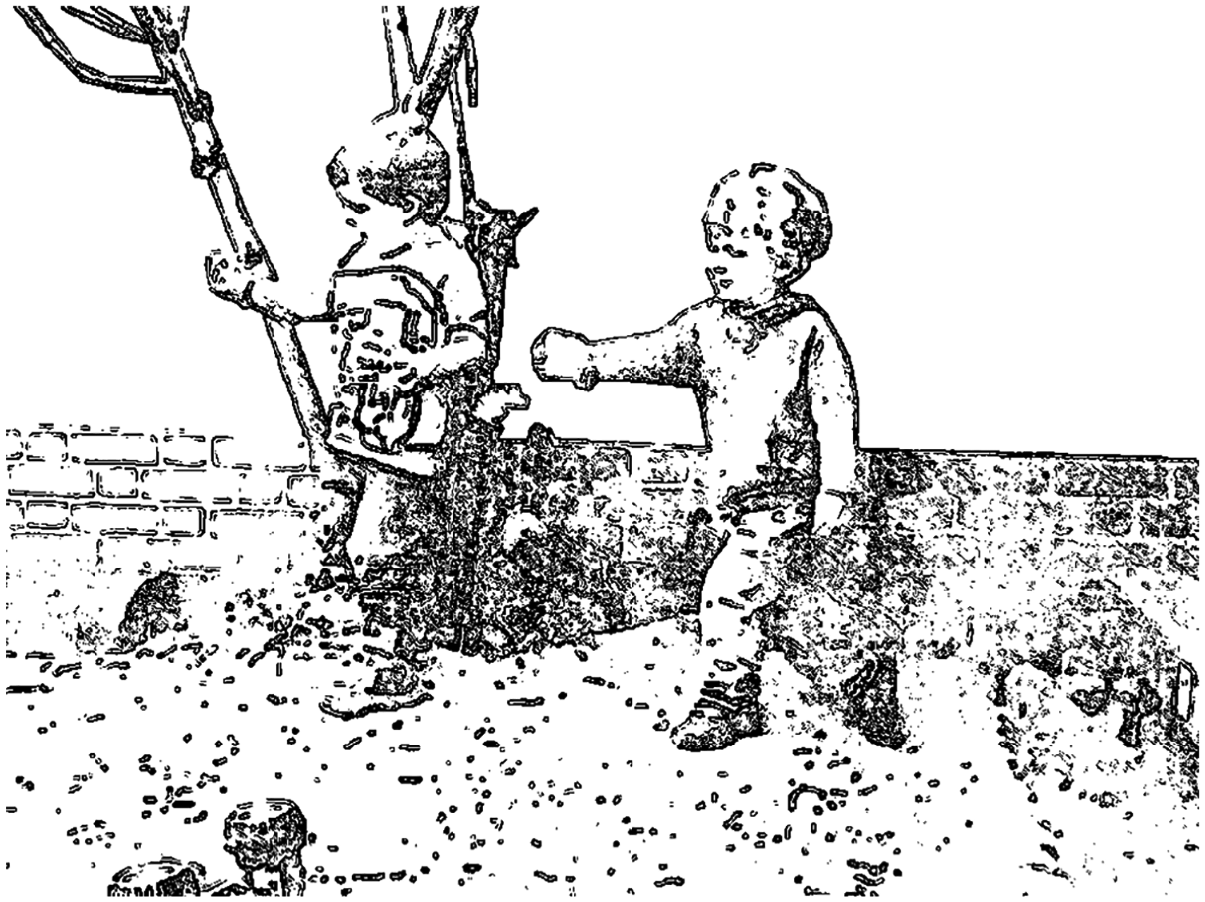
Freddy and Henry take turns to throw as they sing the sand song together.
The research discussions with the children, parents and practitioners did not explicitly involve metaphor, but they did confirm togetherness and the affect of the sand as an important concern. This interpretation applies the theorisation that metaphor is part of the entry into more-than-human dialogue. The multimodal metaphor ‘sand and children are together (and apart)’ is enacted through ‘simultaneous cuing’ (Forceville, 2009a: 31), such as that of movements and synchronised song. The modes of song, proximity, position, touch and coordinated gesture from the children affect the sand, which, in turn, through the modes of close proximity in heaps and momentary cloud, or distant positions in the air, enacts togetherness and dispersal. Henry and Freddy are highly involved in play together with the sand. They coordinate their scattering within seconds of each other (see Figures 1 and 2), synchronise alongside each other (see Figure 3), and repeatedly sing the word ‘together’. The sand particles are both momentarily together in a cloud and apart as they scatter. The metaphors of togetherness and its opposite, being apart, act in two directions, reinforcing each other. Where Fuchs et al. (2019) look at cold in tension and polarity with hot, here the sand, when it is dispersed, is in polarity with being together (together ↔ dispersed). The children being together informs the perception of the sand and the perception of the sand informs the sense of being together (Annamaria Contini, personal communication, 2018). 2 This aligns with Fuchs et al.’s (2019) and Haus’s (2018) studies, as well as Lenz Taguchi’s (2014: 79) revised understanding of materiality which suggests that sand can be ‘playing with the child’s hand, body, eyes and perceptive and productive bodymind’. Potentially, the sand transforms the child’s experience and vice versa. The children engaging with the spray form are taking up the sense scattered across the scattered sand (Merleau-Ponty, 2012). Arguably, this co-constituted metaphor is better seen as a blending of domains rather than a unidirectional bridge crossing with source to target transmission (Dancygier, 2016; Fauconnier and Turner, 2008).
In this episode, perception and emotions are not separate from conceptual understanding. We can understand the agency in the intra-action of the sand, human experiences of togetherness, and separation. I would reformulate Fuchs et al.’s (2019: 102) binary human-centric conclusion that ‘[n]ature is full of agents with whom we can interact’ as more-than-human child–song–sand togetherness intra-action in dialogue. Features from human ‘I–You’ encounters have not simply been pasted onto objects or material ‘as if’ they could be related with. The sand is more than a passive material acted on instrumentally. Of course, an instrumental attitude to it can occur at times, since the relational regard cannot be assumed to be constant (Buber, 1970). But neither can the instrumental attitude be assumed to be constant. The intra-active blend is in between the ‘I’ and the ‘You’. This is the meeting and joining place where both the blended metaphor and the more-than-human dialogue can be located.
Napkin is art
In the project ‘Dialogues with Materials’ (Reggio Children, 2011), my video work together with a team of educators, atelieristas and pedagogistas documents children in the three-year-old room of the Diana municipal preschool in the city centre of Reggio Emilia, Italy. The children encounter paper napkins, which are normally overlooked in everyday use at the lunch table: ‘A napkin removed from invisibility and made the protagonist of attentions and reflections. . . . As hands, brain, sensations, and material got to know each other, the children’s gestures constructed the first forms. . . . Combinations, alliances, dialogues of materials’ (Vecchi and Giudici, 2004: 27). The children fold, roll, tear, crush, smooth and choose a background for the transformed napkins from shades and thicknesses of white, grey or black. While the tonal composition may well centre on human aesthetics, the children explain their choices in terms of responses to the propositions of the napkin: ‘I’ve put it on white because he (the napkin) wanted white’ (Scuola Diana, 2001: 14).
The educators consider alternative interpretations of these relational processes: Is giving a voice to the objects, animating them just evidence of immaturity? Or can we also consider it as a form of sensibility in the children, capable of projecting themselves into the other, even if it is only an object? (Scuola Diana, 2001: 14–15)
The children remove the napkins from obscurity and mount them on a range of chromatic backgrounds. Arguably, this physical and relational repositioning enacts the multimodal metaphor ‘napkin is art’ through ‘filling a schematic slot unexpectedly’ (Forceville, 2009a: 31). Usually, paper napkins are not artwork but, when regarded appreciatively, they transform from an ‘it’ and are recognised as a ‘you’. The metaphor marks the entry into a more-than-human dialogue.
The sensibility of perception and relation emphasised in the Reggio approach inherently involves awareness of others, including materials with many capacities. Malaguzzi saw the environment as an agentive protagonist that will ‘promote choices and activity’ (Edwards et al., 1998: 177) within an ongoing relationship. Awareness of the availability of the materials supports further alternative interpretations to human-centric projection or wishful thinking. Malaguzzi (Reggio Children, 2018) found objects to be ‘incredibly willing to disguise endlessly, and put together somersaults and subversions of meaning’. Distinct from the serious human mental effort in Chukovsky’s (1963: 113) topsy-turvies, Malaguzzi’s (Reggio Children, 2018) suggestion is that objects are complicit, co-constituting the unexpected somersault. Napkins disguise as artworks; artworks disguise as napkins. These are human, and particularly my, interpretations, but they demonstrate the intra-actions in a dialogue between the children and the napkins.
For Buber (2002: 241), dialogical encounters are completely spontaneous. Surprise is a required element and ‘the sign that genuine dialogue is happening’ (Stern, 2013: 46). The impromptu celebratory mood of the sand–song–cloud episode is also reminiscent of Malaguzzi’s somersaulting and evokes Bakhtinian (Bakhtin, 1999) carnivalesque play with the concepts of ‘together-apart’ in a shared open space for dialogue. Even when the intra-action is non-verbal, the final two episodes with paper tissues and plastic plates demonstrate multimodal metaphor as an entry into more-than-human dialogue.
Paper tissue is flying
Paper tissues are also disposable and unattended quotidian objects. In a ‘nest’ room, children under three were observed as part of two research projects at Pen Green Research Centre in the UK (Lawrence, Howe, Howe and Marley, 2014; Lawrence and Gallagher, 2015; Lawrence, 2017). This is an ‘outstanding’ centre for children and families in the English Midlands, with predominantly play-based provision and a strong emphasis on parental involvement. 3
Oscar engages with another child, Layla, attending to the slow descent of materials in the air, twice, at 19 months and at 26 months: Oscar (19 months) is sitting on the sofa looking over the back. He looks to where Layla is in the corridor behind the sofa. He releases a paper tissue following it with his eyes as it slowly lands by her feet. Layla gestures to the tissue. He looks up to Layla’s face, she looks up too and then they both look down at the tissue. There are five or six tissues on the ground. Layla picks them up and hands them over the back of the sofa to Oscar. ‘Weagh!’ Oscar says and puts them one by one over the back of the sofa as Layla watches. Practitioner (S) says ‘It’s a tissue. Can you blow it?’ She places tissue on her face and gently blows it upwards. Oscar and Layla watch intently and Oscar smiles broadly. *** Layla climbs up on a corner box and throws some sheets of paper across a play home area. Oscar (26 months) watches the paper cross the space and follows to pick it up. Layla then throws some fabric. He watches and follows that too and picks it up.
At 19 months, Oscar and Layla share the understanding that the paper tissue will start high from Oscar’s hand and sink to the floor next to Layla. In the later episode, they share the understanding that the paper sheets and piece of fabric will make a lateral trajectory they can both follow. Fuchs et al. (2019) and Haus (2018) interpreted similar assemblages of forces and children. Human and non-human are coming into being differently: the children become different as they understand the forces, just as the material enacts the flight–float–fall experience.
The metaphor ‘paper is flying’ takes the tissue out of obscurity and attends to it in dialogue. The intra-action can be more than an instrumental displacement, ‘acting on’ the object because there is an affective engagement with the transformation from staticity and ordinariness to apparent flight and extraordinariness. The practitioner understood and joined in the dialogue. Although she used verbal communication, the non-verbal modes she engaged with were the ones gearing into the same multimodal metaphor as the children. Children also verbalise – for example, a two-year-old describes a paper sheet flying as Volava! (‘S/he/it was flying!’) in the Reggio Children (2011) ‘Dialogues with Materials’ study. The extraordinary can be seen in quotidian encounters with moving material. It can also be heard, as in the next and last example.
Children, sound and plastic are joining
Plastic plates are typically unattended everyday objects. In the same ‘nest’ room as for the paper tissue dialogue, at 30 months Oscar improvises percussion with Camille and Ivan at an empty table (Lawrence, Howe, Howe and Marley, 2014, Lawrence, 2017). Practitioners were nearby preparing snacks. The observer was close, recording with a video camera, but not seated at the table: (30 months) We are together at the table. The surface is empty between us except for the plastic plates that are also empty. With hands flat on top and sliding side to side the plates make a scraping sound. They can go faster and faster. Held in two hands and brought down hard on their edge they make a bang on the table. We see how each is holding and moving the plates. We hear the sounds joining together. (Lawrence, 2017: 101)
The key-person practitioner Sarah, Camille, her mother Susana and Oscar, with his parents Hannah and Darren, participated in the dialogical-approach-to-observation discussion. Their interpretation emphasised joining in: Sarah: I like the rhythm and how it’s the same. Darren: The sound gets intense with the movement. Sarah: It’s at that point he [Oscar] decides he’s going to join in. (Lawrence, 2017:102)
In the metaphor ‘children, sound and plastic are joining’, the source ‘improvised percussion play’ movements blend with the target ‘plastic plates’ movements, and the emergent sounds combine. Forceville (2009b) points out particular difficulties for multimodal metaphors such as the percussion example, where the source domain is not expressed in words and the target domain is unstructured. In this case, the metaphor is not only a point of entry into this dialogue, but also sustained for the duration of the percussion intra-action.
An ‘I–You’ relation with objects differs to using them in an instrumental ‘I–It’ attitude because of the open reciprocal responsiveness in the encounter, which is evident in the vital manner (Buber, 1970). The spontaneity that Buber (1970) and Malaguzzi (Reggio Children, 2018) emphasise is present in this episode. It is a creative rather than instrumental act to generate sounds. The percussionist Catherine Ring (2020) explains that fusing percussive sounds is more than the sum of the parts: ‘the combination of everything together brings something new to the table’. The children joined in a multiple more-than-human ‘I–You’ dialogue, co-constituted by the children, sounds, movements and materials.
Dialogical entry point through blended multimodal metaphor
The four dialogical episodes exemplify the theorisation of multimodal metaphor indicating an entry into more-than-human dialogue, including instances where there is not confirmation in speech. It is important to consider that this could be the case, rather than assuming that any engagement with an object or material is automatically a human-centric instrumental or ‘I–It’ monologue. To summarise this first section of the article, we have three potential joining processes involving the more-than-human in the in-between meeting place: blended multimodal metaphor, intra-action and entry into dialogue.
Modelling dialogical intra-action
The second part of this article proposes a new model, differentiating between monological and dialogical engagement including more-than-human protagonists. The model’s cue is the work of Linell (2009), who represents communication with four coordinates in a ‘diamond’ diagram (see Figure 4). ‘I’ is the first coordinate and ‘You’, the collocutor, is the second. The fourth coordinate, ‘we’, indicates the socially shared meanings understood in a culture. Here, I focus attention on the third coordinate, which Linell intends to represent ‘Object’ (referents, ‘it’). It should be stressed that Linell (personal communication, 2016) recognises that his model could be more complex, but his aim was clarity in the field of linguistics. 4 In language, people talk about things. Dialogues with objects are regarded by Linell (2009: 158) as ‘close to dialogical’, but limited to being merely ‘metaphorical extensions’ (Linell, 2009: 31; my emphasis), ascribing intentionality to inanimate objects ‘as if’ they were humans. Understood in this way, the extension of dialogue with non-humans would be a device for dealing with, rather than engaging with, the world. This would be an ‘I–It’ attitude.
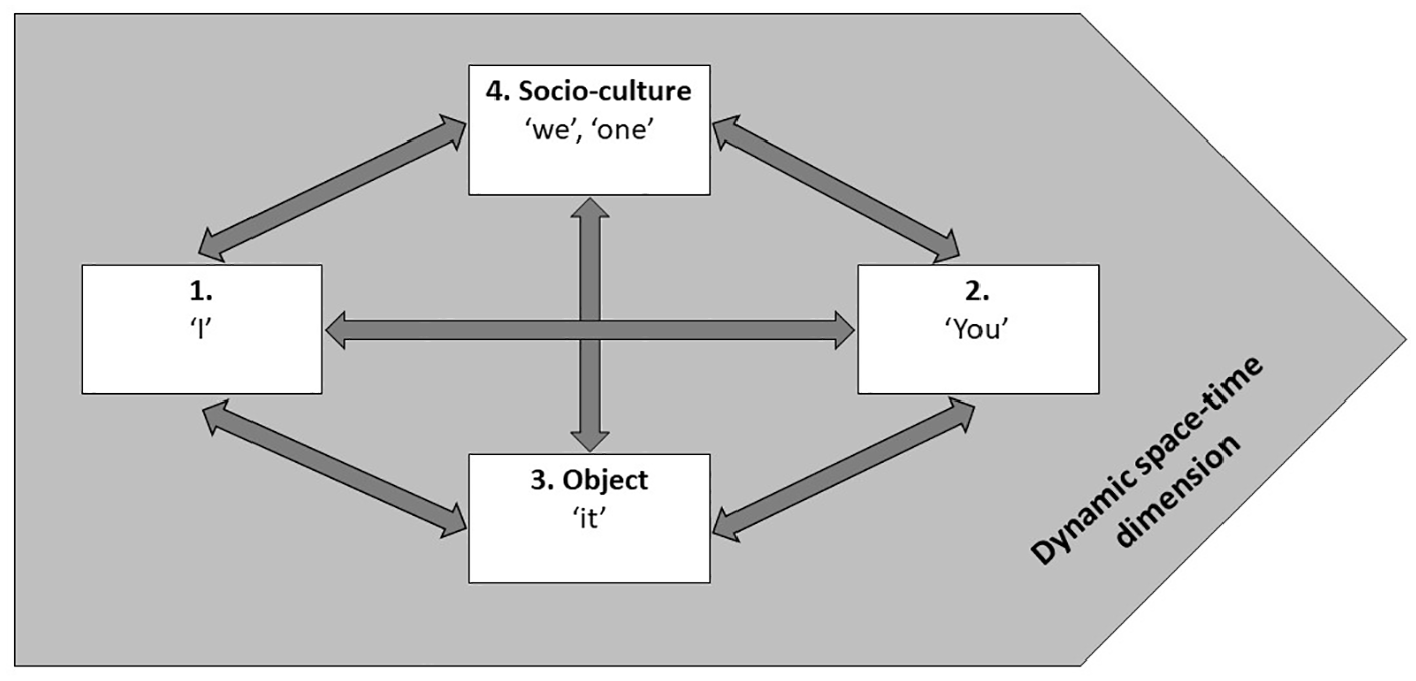
Dialogism ‘diamond’ model.
The starting point for the alternative model is to question when there is a relational regard. Linell (2009) has bidirectional arrows between the coordinates. If the attitude to the other, object or person, were about acting on or an instrumental use of the object, then I propose a unidirectional arrow from ‘I’ to ‘It’. Where there is an affect from the object, as well as from the human with an ‘I–You’ regard, which is a dialogical intra-action of more-than-human, then a bidirectional arrow (see Figure 5) would represent the dynamic process (Whatmore, 2006).
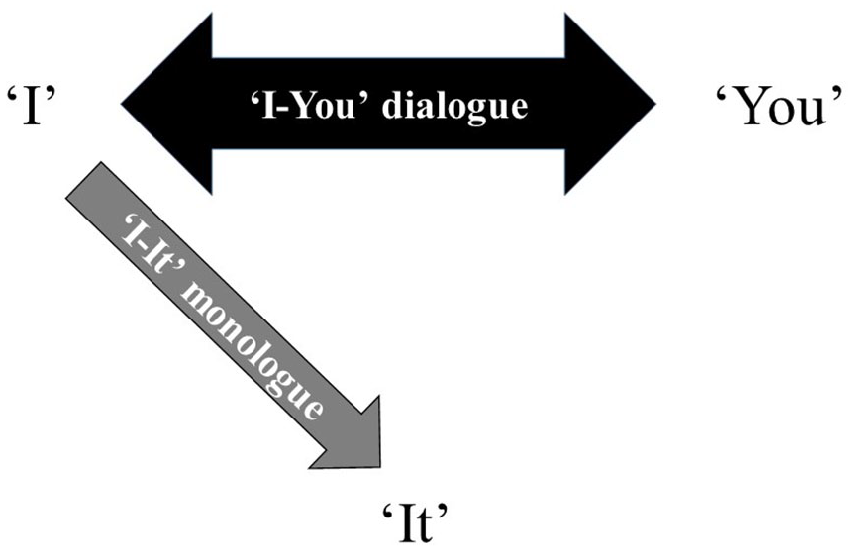
Differentiation of the ‘I–You’ dialogical relation indicated by a bidirectional arrow and a unidirectional arrow representing an ‘I–It’ attitude.
This means working with a model of dialogue that distinguishes ‘I–You’ regard from an ‘I–It’ attitude. When objects and material in the environment are not assumed to be acted upon and thereby positioned in the third ‘It’ coordinate, but are instead recognised by a relational ‘I–You’ regard, they should be repositioned in the second ‘You’ coordinate (see Figure 6). This can be without ascribing intentionality. The shifting regard can change the status of the other in the dialogue to ‘I–You’ and back to ‘I–It’. Unless the human, object or collective group were regarded as another, as ‘You’, any attitude would be monological. This is shown by the unidirectional arrows between ‘I’ and ‘It’, ‘I’ and ‘We’, and ‘We’ and ‘It’. So, there is only one bidirectional arrow in the model (Figure 6), that between ‘I’ and ‘You’.
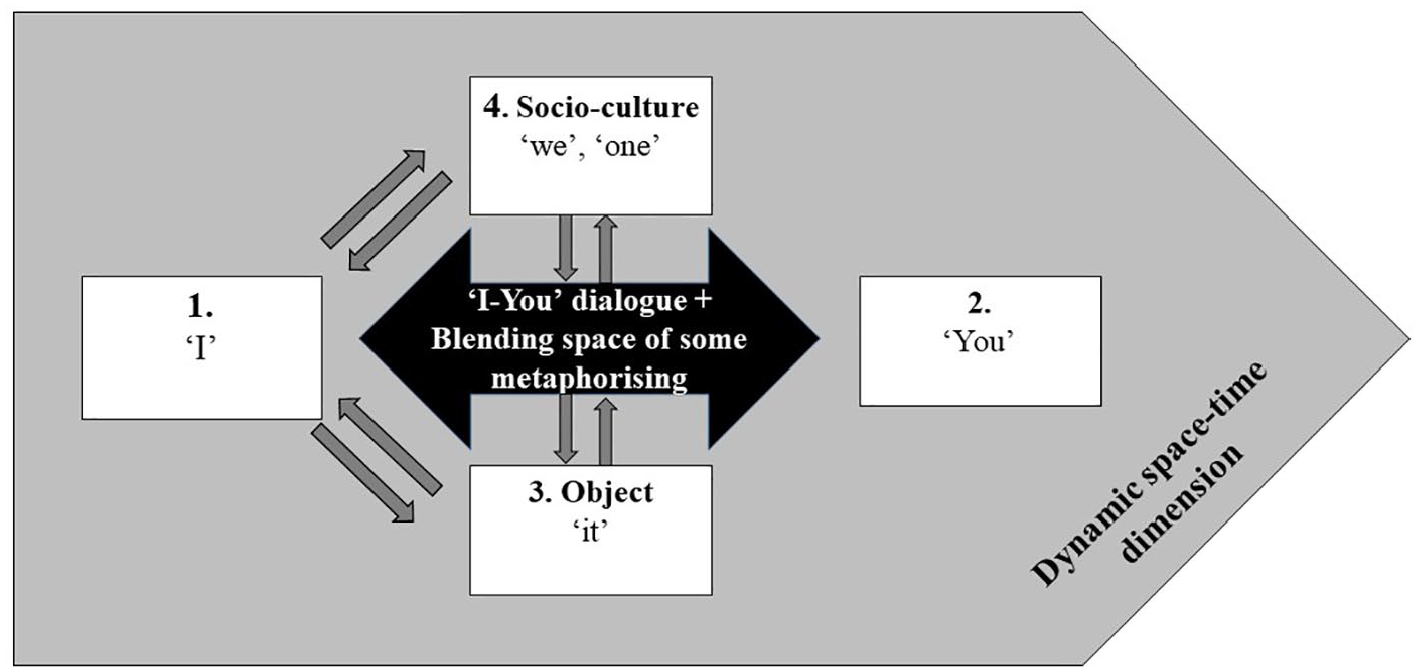
The more-than-human dialogical model, including the location of ‘I–You’ dialogue and of some relational metaphors.
The area in between ‘I’ and ‘You’ is proposed as the location for dialogical engagement and also for blending metaphors (see Figure 6), where domains co-constitute relationally. This second theorisation disrupts the assumption that objects and material are merely involved in a metaphorical extension of human dialogue for two reasons: first, relation determines dialogue, not the category of human or non-human, and second, because metaphor itself can be a relational meeting place, as established in the first part of this article.
To question the assumed view that objects cannot be in dialogue, let us consider such explanations and whether they rule out, or are necessarily better than, the argument for dialogical potential. In the preceding sand and paper napkin episodes, it could be argued that the children are relating ‘as if’ the entity involved were regarded as an ‘other’, even if it is not. Linell (2009: 31) positions this ‘ascribing intentionality to inanimate objects’ as not fully fledged engagement, and as more of a device for dealing with, rather than engaging with, the world. ‘Dealing with’ is instrumental. ‘Engaging with’ is relational, so the interpretation of relation is key to dialogue. Linell (2009) aligns with Pramling’s (2006) thinking on animism. Pramling (2006) reinterprets Piaget’s (1929) interviews with children and finds they are communicating about the world ‘as if’ elements of it, such as the sun, are aware. Pramling (2006) suggests that this is using metaphorical conventions, such as the sun knowing when to set or go to bed. In this sense, the children talking about the napkins ‘wanting’ would only be conforming to cultural norms. Figure 6 represents this by the unidirectional arrow from the fourth, sociocultural, coordinate towards the object (sun/napkin). Alternatively, both Piaget’s (1929) and Pramling’s (2006) interpretations centre on connection and belonging. For Piaget, the sun belongs in the child’s world. For Pramling, the attitude to the sun helps the child belong in the existing adult world. Therefore, the metaphorical engagement can be dialogue if it is relational and, in these instances, reposition both the sun and adult social world in the second, ‘You’, coordinate, thereby not excluding the argument for more-than-human dialogue.
At the very least, ‘as if’ sensitises without necessarily ascribing intentionality to objects or materials. Such processing could be relationally valuable and more than a weakness in young children’s cognitive capacities. For some educational purposes, it may not matter whether the connection is a verifiable relation, or not so long as metaphorical ‘as if’ thinking helps the children’s connections, processing, thinking and perhaps learning. The capacity to think of things ‘as possibly being so’ can, according to Egan (1992: 43), greatly ‘enrich rational thinking’. Therefore, it is also arguably beneficial to allow for potential more-than-human dialogue. However, the outstanding critical challenge is to move beyond interpretations where the value base is rooted in human agency.
For Giugni (2011), ‘becoming worldly’ with the other is in some ways apparent, albeit still contestable, when children speak to and for the other about what the non-human other experiences or wishes. This is evident in the attention to the napkin, which is not only centred on humans. Ingold’s (2006: 10) version of animism is a flux and flow of perceptual and active sensitivity, ‘a condition of being alive to the world’. The regard for the napkin can be seen as an aliveness to the other in ‘I–You’ relation, not only an instrumental action on the object and material. In Figure 6, the napkin would no longer be disregarded, used and positioned automatically in the third, ‘It’, coordinate, but attended to in the second, ‘You’, coordinate in intra-action with ‘I’. The same applies to the paper, tissues, plates and sand. The more-than-human dialogue has been entered into, intra-acting. The ‘I–You’ quality of regard (Buber, 1970), recognising affect and being affected by (Deleuze, 1988), transforms the ‘invisible’ materials into protagonists.
Conclusion
This article considers two dialogical theorisations of young children’s encounters in more-than-human worlds involving metaphor: (1) the role of multimodal metaphor as an entry point into the dialogues of more-than-humans and (2) a more-than-human-centric new model of dialogue that differentiates between human-centric monological and more-than-human dialogical engagement.
The application of the entry-point theorisation in four dialogical episodes contributes to and supports further research in the scarcely populated field of multimodal metaphors. The episodes demonstrate metaphor as a process of relational engagement in dialogue. In particular, the processes of blending in metaphorical processes merit further consideration in terms of intra-actions within more-than-human dialogues, such as ‘children, sound and plastic are joining’. The blending is a strong example of active assembly or bringing together, as in Taylor and Giugni’s (2012: 110) understanding of common worlds, drawing on Deleuze and Guattari (1987) and Latour (2004). Whereas, for Linell (2009), meaning comes from the human, in this more-than-human analysis, meaning and affect also are recognised in material: sand, paper, tissue and plastic.
These theorisations have significance for the study of any encounter, taking account of the potential dialogue of more-than-humans and promoting new ways of listening to affect. Awareness of the shifts from ‘I–It’ to ‘I–You’ relations needs to be increased. A new dialogical model (Figure 6) positioning relations with the more-than-human is one way of doing this, although, of course, in two dimensions it tends to suggest simplified positions rather than the dynamics of changeable relations. Ingold (2016) suggests having unfixed end points for affiliations in his theory of correspondence and, although human-centred, he offers a helpful addition to this ongoing thinking, because more-than-human protagonists are not fixed. An animated model could attempt to represent the complexity of the shifts back and forth from ‘I–It’ to ‘I–You’, the many intra-actions that are occurring in any place and time, and the unfolding changes in the protagonists themselves. The materials and objects create meeting places by affecting or ‘calling’. This new model serves the purpose of highlighting the difference between human instrumental attitudes and human realisation of relation within more-than-human intra-action in dialogue. It is when we hear the calls joining together.
Given the above conclusions, adults responsible for the environments in which childhoods occur will do well to continue regarding the environment as an educator co-conditioning with the children and adults (Edwards et al., 1998: 177) and as a surprising protagonist (Buber, 1970; Reggio Children, 2018) beyond planned ‘I–It’ instrumental uses of space and resources. Adults can expect the unexpected from objects and materials in dialogical relationship with young children, and thereby enact more-than-human practice.
Footnotes
Declaration of conflicting interests
The author declared no potential conflicts of interest with respect to the research, authorship and/or publication of this article.
Funding
The author received no financial support for the research, authorship and/or publication of this article.
