




Abstract
Childhood is a complex and socially constructed process with implications on the education of young children with issues of globalization as a powerful influence. This article presents a critical analysis of a focused ethnographic study in post-colonial rural southern Tanzania and argues a way forward in the global dialogue regarding the construction of diverse childhoods through the education of young children to balance these influences. Data was collected in rural villages of southern Tanzania including interviews, focus groups, observations from over 150 people and government and NGO policy analysis. This paper responds to the research question: whose constructs of childhood influence the opportunities young children have to learn in Ndogo villages? The larger study addresses additional significant questions and data. A critical analysis indicates decision makers, such as international donors and NGO’s, impose global influences on young children’s opportunities to learn by prioritizing resources for what they as outsiders’ value as knowledge. Although parents and local community members are essential members of a child’s life, their constructs of childhood are not valued and therefore, are either ignored or actively omitted from formal opportunities children have to learn. The findings urge scholars, NGOs, and policymakers to equally value different perspectives held by parents and community members regarding the substance of what is valuable knowledge.
Introduction
A noted early childhood Tanzanian scholar articulated to me that Tanzanian formal early childhood education was a concept put into practice in response to international community pressure. He said the international community claimed that “You [Tanzania] are not educating your young children” (personal communication). He added that after Tanzania instituted a pre-primary school curriculum in 2005, the international donor community returned to Tanzania with the message “You have done it all wrong.” A number of entities have influence over the construct of childhood in rural Tanzania. The ECE Tanzanian scholar observed international donors compared pre-primary schools in Tanzania, a majority world nation, to their own minority world nations’ pre-primary schools. This study sought to address his concern and better understand the influences of globalization on the social construct of childhood within formal education within Tanzania.
To inform their initiatives the international non-governmental agencies (NGOs) and scholarly communities focused on early childhood initiatives in Tanzania made an appeal for descriptive information to better understand how global perspectives impact children’s life experiences and opportunities to learn (personal communication with Tanzanian officials and International NGOs in Tanzania). Early childhood education in Tanzania differs from minority world models, thus it is often not recognized as learning by those outside Tanzania (Mligo, 2018).
Childhood is a complex and socially constructed process (James and Prout, 2003). Educating young children enters into the construction process of childhoods. Global Early Childhood Education (ECE) initiatives bring pedagogy and knowledge from other countries into a mix with local and national agendas for educating young children. The heightened interest in ECE globally is in part due to the United Nations initiative Education For All (EFA) (UNESCO Education for All, 1990). EFA’s Goal One focus is to increase access and quality of early childhood education and care for disadvantaged children around the world.
The Tanzania government, like many other countries, receives international aid money and in so doing they opened the door to International Non-Governmental Organizations (INGOs) agencies agendas. Tanzania is a unique situation because of the history of post-independence socialism that worked against colonial rule. INGOs are pressing the Tanzania government to initiate pre-primary initiatives that address the needs of young children’s early childhood development. The consortium Early Childhood Development (ECD) Partners Tanzania is comprised of six INGOs operating across the country that work collaboratively to address issues for young children. The INGO community focused on early childhood initiatives in Tanzania appealed to the research community for detailed information to better understand the opportunities to learn for young children in specific contexts (UNICEF, 2017). INGOs bring hegemonic ideologies into national spaces and it gets played out in local spaces. Local knowledge is not centered in the decision making processes, therefore, their knowledge is not valued, in some cases is subject to epistemicide and susceptible to coercion.
This paper illustrates the convergent and complicated nature of globalization and childhoods through formal schooling. The larger study examines sociocultural and political dimensions of knowledge production and how national and global agendas transpired for young children in southern Tanzania, both in and out of school. From a sociocultural framework, the research question examined in this paper addresses how the formal early childhood education opportunity to learn for young children is influenced by global, national, and local aspirations.
This interdisciplinary and transnational research presents a focused critical ethnography of a local context of teaching and learning in the Ndogo village and surrounding areas. Pseudonyms are used for the villages and people to protect their identity. By addressing the influences of globalization on the social construct of childhood and children’s life experience in the Ndogo villages, the study provides voice and agency to the local context of children’s life experiences and multiple opportunities of learning for young children.
Identified are connections and relationships that shape opportunities for young children to learn in this local context. In rural southern Tanzania, the area where this study focuses, perceptions about opportunities for young children to learn, reflect multiple and sometimes divergent social constructions of childhood, of aspirations for young children, and for learning. Findings shed light on young children in these communities on the unspoken tension in the construction of childhood among aspirations of parents, community, teacher, school, government, and international donors. Competing aspirations for young children are problematic to navigate and shape opportunities to learn.
Rational
Significant research literature examining formal secondary education in Tanzania exists (Mashala, 2019; Vavrus, 2003). Very little research literature exists for rural pre-primary schools, in particular, early childhood education (Mtahabwa and Rao, 2010). A relatively new global conversation regarding culturally appropriate approaches to implementing ECE addresses the social constructions of childhood through opportunities to learn (Madrid Akpovo et al., 2018). The conversation examines how formal schooling provides a space to analyze the influences of post-colonialism and globalization and its histories and reveals issues of power and influence through schooling and funding.
Globalization and international donor pressure often propel values and ideas from the minority world to influence policies and practices in the majority world. The social construction of childhood is in fluctuation within local contexts from many influences, such as in Tanzania. This paper addresses the minority world pressures on a majority world nation, Tanzania, and how this pressure played out in a rural village in the southern part of the country. Analyzing the influences of globalization on the social construct of childhood and children’s life experience locally, this paper addresses the conversation regarding whose knowledge for young children to learn is valued.
This study contributes to the literature on education and childhood, where little systematic investigation exists of children’s life experience and current approaches to pre-primary education in specific African contexts such as Tanzania (Mtahabwa, 2009). This study presents a unique opportunity to examine formal schooling and experiences of young children in a particular context. This research lays the groundwork for future research to examine the pedagogy of educating young children and initiatives to improve the quality of culturally contextualized formal education in Tanzania.
Definitions
This paper addresses the experiences of young children in the early childhood education space of the local Ndogo school. Young children in this paper are referred to as children ages three to six years old per UNICEF’s (2017) definition.
The terms “minority world” and “majority world” are used in this paper to recognize that there are significant global inequalities and imbalanced power interactions between significant parts of the world (Madrid Akpovo et al., 2018; Pence, 1998). The term majority world signifies the segment of the world where the greater part of the population lives, traditionally referred to as “developing” versus the “developed” world where the minority of the world’s population resides. The use of majority/minority is a helpful term to discourage merely geographically grouping people and recognizes social and economic influences. Binary terminology, however, is limiting and does not consider disparity within countries.
In this context, global influences refer to factors such as concepts, funding, policies, and programs outside the boundary of the national government. Globalization is the movement of ideas and goods from place to place, which can intensify existing inequalities and create dominance. These are factors that influence decision-making and program implementation both within and across national boundaries (Ogar et al., 2019).
Methods
As a critical ethnography, unlike traditional ethnography, this study sought to equitably collaborate in the production and use of knowledge with participants and connect the analysis with local, national, and international systems of power and social constructs (Chang, 2020; Delgado-Gaitan, 1993). Data used in this paper is from a study in southeast rural Tanzania with 159 participants through semi-structured interviews, participant observations, and focus groups. Participants in the study included students, teachers, parents, village members, government officials, and international donor organizations. Document analysis of education policies and curriculum materials were also included.
Listening is a key aspect of ethnographic data collection. Member checking is an important function in this study as a tool to observe and listen. The aim of collecting the data was to, as accurately as possible, give voice and validation to the opportunities young children have to learn in Ndogo and surrounding villages. In-depth local interviews shed light on the lived experiences of young children, including the informal since the child-rearing takes place in the home and in neighborhoods or communities, as well as the formal pre-primary school. Each of these data sources works together to provide a holistic picture of the opportunities young children have to learn.
I employed an ecological lens, which allows for a focus on the family, the child, the community, the government, and the school. An ecological framework within critical ethnography considers multiple levels of interaction in a world of complex overlapping systems (Dovemark, 2019). Changes or conflicts in any one layer will ripple throughout other layers. When using this framework, I examined the connections that a change in one layer may have on another layer.
This paper presents a section of the study that focused on formal learning. The data gathered included in-depth interviews with the pre-primary schoolteacher, Mbwana. This paper also includes observations gathered in the local government school and in meetings and interviews with government and donor officials. Grounded theory as a contextually oriented approach was used to systematically describe the context and allow the themes to emerge from the data analysis (Hadley, 2017; Rogoff, 1993).
Positionality
Critical self-reflection of my position in this study revealed my interests and concerns as a researcher, a mother, a US citizen, a human being, and my intersectional and entwined identities. Who I am as a researcher along with my identity affected my relationships with the people in the villages. As a mzungu, a white foreigner, I had more economic advantage and a different type of power than the people in the community. It was important for me to be aware of and monitor my subjective thoughts with the intent to be conscious of how I influenced the process. It is not possible to control subjectivity, thus to acknowledge and name it was important (Boveda and Bhattacharya, 2019).
I worked to be reflexive and aware of my positionality and to minimize its influence by the following means. I purposefully arrived in Ndogo with the least amount of formality possible in order to not be too closely associated with donors and government officials. Initially, I traveled daily by motorcycle on a dirt path to visit villagers in each of the Ndogo villages in a radius of approximately 10-km. Government officials and donors usually do not go outside the villages. I studied the local language and worked closely with a translator. I spent long days with my translator meeting people along the road, talking, and getting to know people. I did not go to the Ndogo school until a week into the process of gathering interviews. I did this in order to align myself first with the community so that I was not perceived as a government representative. I was conscientious of what I was wearing, dressing with traditional clothes commonly worn by the women in the community. I continuously sought to understand and practice culturally appropriate ways to relate to the various people with whom I met and spoke with from the villages. Despite all of these efforts, my gender, age, and ethnicity influenced my ability to align with the community. I recognize that while opposing processes linked to colonialism, I am conscious I am complicit in what I critique (Chilisa et al., 2017).
Post-colonial rural southern Tanzania context
Tanzania, located in East Africa, has a rich and complicated history. In 1961 the country of Tanganyika became independent from Great Britain. The president, Nyerere, joined with Zanzibar in 1964 to create the United Republic of Tanzania, a socialist state (Eustace et al., 2018). Each of these aspects of the history of Tanzania, including colonialism and socialism, influence the opportunities that young children today have to learn.
The United Republic of Tanzania is governed by the party, Chama Cha Mapinduzi, known as the party of the revolution. This party was in power since the beginning of the country and through a top-down model maintains power with authoritative governing. In 1967, President Nyerere, from the Chama Cha Mapinduzi party, delivered his Arusha Declaration proposing African socialism which he termed Ujamaa (Nyerere, 1968). This concept drove his economic and social policies with the aim of developing the nation. An Ujamaa village is a government-designated town that collectivized agriculture and social services. Portable water, schools, medical facilities, and other social services were only allowed in designated Ujamaa villages. Indigenous groups were moved off their land, required to live in an Ujamaa village, and required to share their land equally for cultivation (Bjerk, 2017).
During the decolonization movements of the 1960s and 70s under Nyerere, schooling was an important focus for social transformation and international development assistance (Nyerere, 1968). Nyerere created policies that brought different people groups together into a nation-state and advocated compulsory primary education using a common language, Kiswahili (Peeples, 2018). Kiswahili, a Bantu language was used for trade and in larger cities and was not known by the majority of Tanzanians until Nyerere declare it one of the national languages is 1974. Tanzania has two national languages, Kiswahili and English. Formal education occurred only in Ujamaa villages designated by Nyerere’s government. The education structure remains based on the colonial area British system. Nyerere left English as the language of secondary school and universities. However, he instituted Kiswahili as the language of primary schools rather than indigenous languages that were spoken in local areas (Buchert, 1994; Vavrus, 2006).
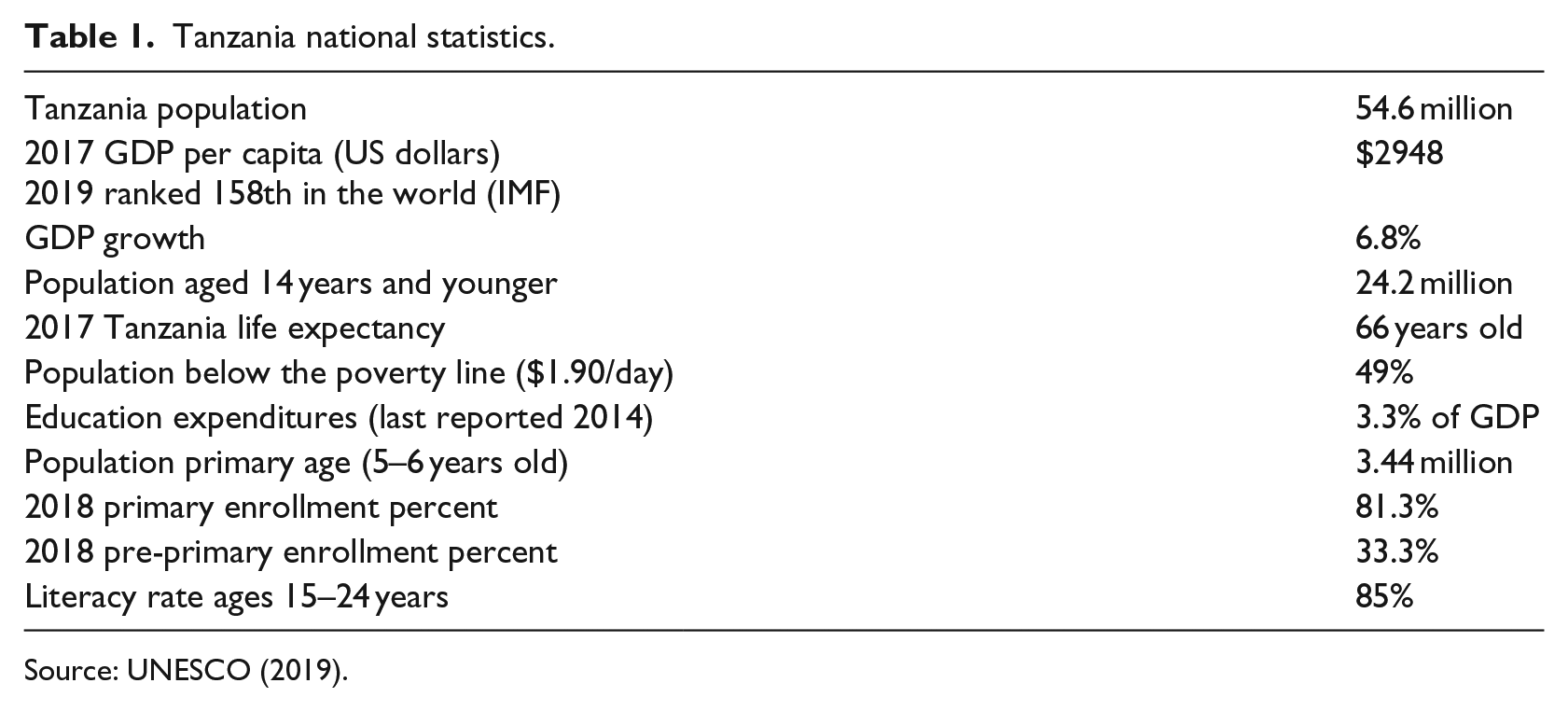
International aid money played a significant role in the development of Tanzania (Table 1).
Tanzania national statistics.
Source: UNESCO (2019).
Tobin, Hsueh and Karasawa (2009) characterize the ebb and flow of global and local influences at different time periods in history around the world. They argue that global influences were prioritized over local and other time periods localization was promoted. In a similar way, after the British colonists were pushed out of Tanzania, Nyerere emphasized localization yet with a focus on national interests. Tanzania today leans again toward global influences. The colonial to post-colonial influences of the minority world in Tanzania are significant. Tanzania is the second largest aid beneficiary in sub-Saharan Africa, “Since independence in 1961, Tanzania was one of the largest recipients of aid in Sub-Saharan Africa in absolute terms. The country still receives considerably more aid as a percentage of gross domestic product (GDP) than most other countries in the region.” (Devarajan et al., 2002: 290). Aid dependency to support the country opened doors to post-colonial and globalization influences to penetrate the country through INGO support and its influence on policymaking. Hegemonic ideologies inundated national spaces. Local knowledge was not centered in the Tanzanian culture since the implementation of Ujamaa policies in the 1960s.
Tanzania’s educational system is similar and unique in other ways to other African countries. Although Tanzania was colonized by various European countries, Nyerere’s institution of Ujamaa policies worked to reverse colonial influences differently than surrounding countries such as Kenya. The institutionalization of pre-primary school was formalized in recent history and EFA (UNESCO Education for All, 1990) initiative emphasized with all countries to achieve pre-primary school attendance for all children. A Tanzanian national focus was since 2006 when a new pre-primary curriculum was released by the national government pre-primary (Ndijuye, and Rao, 2018).
The schoolhouse
This section depicts and analyses the school in Ndogo as an illustration of the histories of globalization at work in a local context. Ogar et al. (2019) argued globalization is a neo-colonialism. Global ideologies travel typically from the minority world to majority world contexts. The drive to homogenize creates an unequal power dynamic. This is key to examine because local ideas and concerns are often not valued as much as those from outside and issues of globalization can intensify prevailing inequality.
Ten kilometers down a dirt road west and south from the Ujamaa village Mwenye in southeast Tanzania is a smaller dirt pathway only passable by motorcycles or off-road vehicles. The dirt pathway branches off from the main road and leads to small villages such as Ndogo. In the Mwenye area, villages such as Ndogo had no official records. The people in the village have no memory of ever having a formal school in the past. Prior to the recent creation of the Ndogo school, if children wanted to go to school, they had to travel in excess of 10 km into Mwenye. During some seasons the road was not traversable. Village members cited the hazards for young children getting to the school, including dangerous wildlife and the lack of resources. Villagers said they had for years requested a school from the government.
In January 2013, a government pre-primary school was built, funded by an international donor organization, Project For Tanzania (PFT), with funds from additional international NGOs. PFT is a joint international development collaboration project between a university in the USA, a Tanzanian university, and international NGO’s. The Ndogo school building materials and labor were funded with international money. The Tanzanian government selected Mbwana as the teacher and provided his salary. Additionally, the government made commitments for future resources. At the time of this writing, these commitments have yet to be fulfilled.
The designated pre-primary school quickly became a combined classroom for pre-primary and primary despite the original intention to educate only the younger children. The Ndogo school offers pre-primary and the first grade, also known as Standard I. The school sits atop a small hill overlooking a valley of thick vegetation. The school building is a one-room schoolhouse with concrete floors and walls, a wooden door, and a tin roof. See Figure 1 to view a graphic description of the inside of the school house. There are wooden desks for the older young children in Standard I facing the front of the classroom. Small tables and chairs occupy the space next to the desks for younger children in pre-primary. A desk for the teacher, Mbwana, sits at the front of the classroom facing the students. A large blackboard is on the front wall, set too high for the pre-primary aged children to reach the bottom of it. Below is a diagram of the inside of the one-room schoolhouse to illustrate the physical place of the classroom.
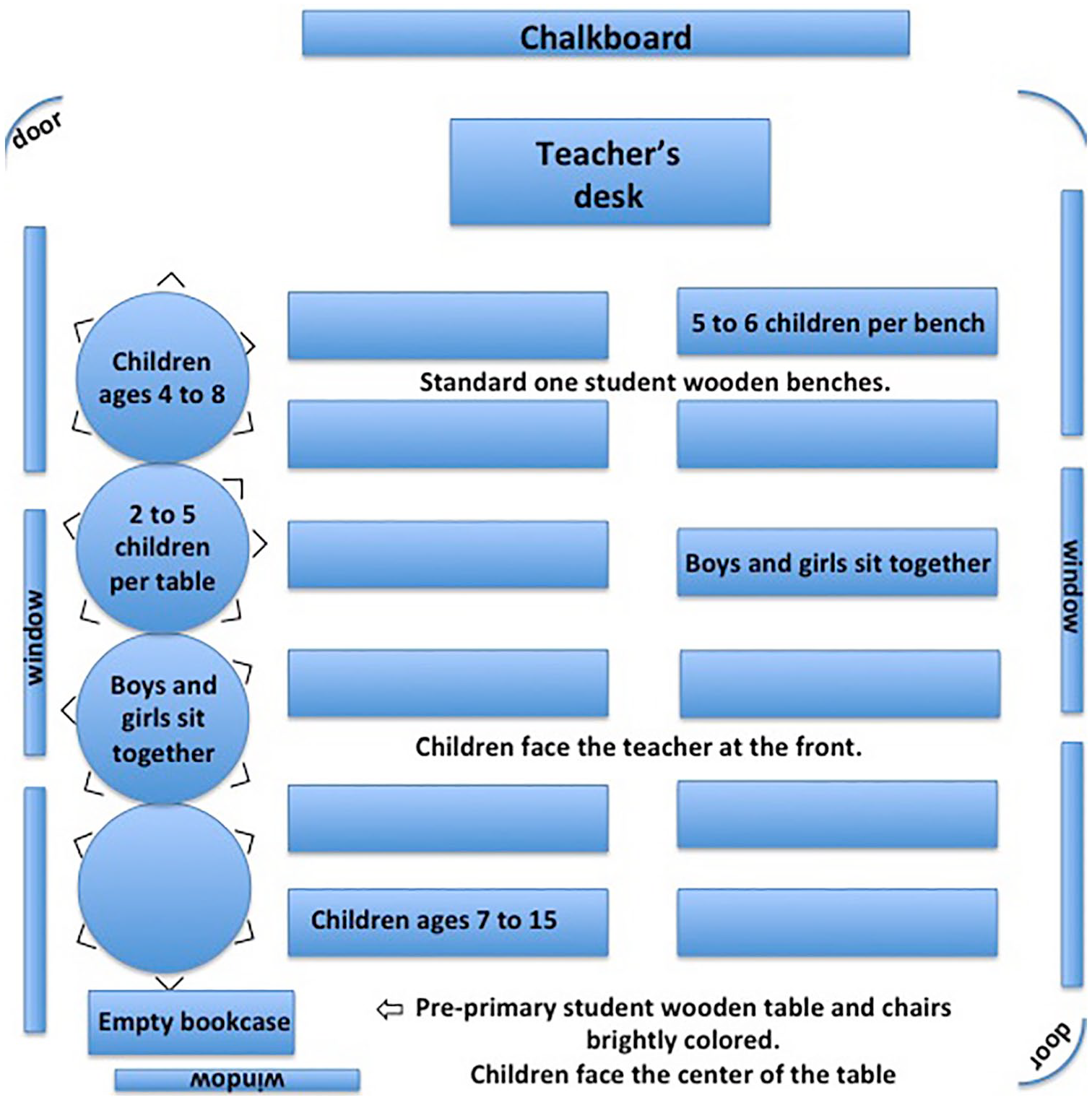
Diagram inside the Ndogo school.
This organization remained constant with an ebb and flow of the relatively consistent number of students that arrived for the school day. The room is split between the pre-primary class and Standard I class. There were roughly 15 to 20 pre-primary students in daily attendance during the time I was in Ndogo, ranging from ages four to seven or eight. The Standard I class had approximately 45 to 50 students in daily attendance, from ages seven to 15. Issa, a 7-year-old pre-primary boy, sat quietly in his seat at the desk he shared with four other students waiting for Mbwana. Issa and the other students remained quiet until it was their turn to receive Mbwana’s attention. The teacher then turned his instruction to the pre-primary students to recite the letters they knew. Issa and his classmates have the opportunity to learn such topics as letter names in Kiswahili and number value and addition while they are in school and these opportunities occurred inside the school building sitting at their desks.
Standard I primary students sat on benches five to six students on each bench with little room between them. Wooden benches with boys sitting with boys and girls with other girls sitting together facing the teacher at the front of the classroom with a chalkboard he used for instruction. Classroom instruction is delivered from the front of the classroom to primary students sitting in benches and pre-primary students in child-sized tables and chairs. Students are not allowed to talk to each other during class or work in groups or use other spaces for instruction. Examining the places where young children have opportunities to learn in the Ndogo school aids better understanding the formal opportunities for young children to have to learn. Issa’s experience in school illuminates how the physical surroundings of the school and environment influence engagement with classroom materials in a singular modality and the development of learning habits.
The formal ECE classroom was introduced in Tanzania through international donors (Mtahabwa, 2009). The classroom diagram above visualizes colonial and post-colonial global education strategies at play in the education of young children in Ndogo. The construction, furniture, and use of the schoolhouse space is a lens to explore the larger dynamics of globalization and histories on young children’s formal learning. The pre-primary round tables and chairs colorfully painted were a result of the INGO’s involvement in the school construction project (personal communication). The INGO designated money for the specific details of the table and chair design for the pre-primary class. The table and chair design are similar to a preschool classroom in the USA, which are child-size and low to the ground. These accommodations are not a common practice in the area and were not found in other government pre-primary schools I visited in Tanzania. Madrid Akpovo et al. (2018) argue that “The notion of quality in early childhood education in the United States and other Euro-Western nations is based on developmentally appropriate practice (DAP) constructed by early childhood organizations, such as the National Association for the Education of Young Childhood (NAEYC)” (p. 205). According to NAEYC (2009), “Child-size furniture. Chairs, tables, and shelves are sturdy, safe, and the right size for children so they can be more independent” (p. 1) because it encourages collaboration and work between students.
The imposition of the pre-primary furniture failed to bring about change in the teaching pedagogy. As noted in the diagram above, the pre-primary students sat around four tables large enough that their arms could not reach to touch the center. At any time, there were enough chairs to seat up to five young children per table. Several pre-primary students sat with their back to the teacher, Mbwana, which required them to crane their necks to give him their attention. The other pre-primary students sat at an angle facing the table but also had to twist their body to face Mbwana when he spoke.
Mbwana said, “Collaboration was not a part of his school curriculum.” When I inquired further about why Mbwana said it discouraged students from concentrating on their work. When Mbwana called the students inside the building, they would run to their seats, the younger ones giggling and talking. He would then stand at the front of the classroom and students would immediately fall silent. Young children have the opportunity to learn that the location and position of Mbwana reinforced his authority; he chose to stay in the front of the classroom but kept a watchful eye on the students in all parts of the room. Young children, 4 and 5 years old, sit quietly in chairs with no task to complete while they wait, which also demonstrates the significance of respect for Mbwana’s authority in the classroom.
Young children have the opportunity to learn what it means to be in school. There were two different physical settings that indicated different practices, side-by-side. The only thing that distinguishes the two seating arrangements is the age of the student. Learning occurs at round tables with the students set up to face each other and also at benches where students sit in rows facing only the teacher, Mbwana. The set-up of the schoolroom demonstrates two different models of instruction and assumptions about where and how learning occurs. The furniture and its layout, the positional space of the teacher, and the use of the space in the schoolhouse expose minority world colonial legacies and global efforts to influence young children’s formal learning. However, even though there was a unique seating arrangement for the young children, the instructional methods of Mbwana did not change from one group to another. This is significant because the imposition of developmentally appropriate measures from the international NGO did not translate into minority world developmentally appropriate teaching strategies. The influence of the British colonial educational system carried stronger weight.
Due to the history of Tanzania and the global movement of people, ideas, and technology a number of potential ideologies are at play in the village of Ndogo. The intersections of national and global influences are complicated and converge on many levels. Globalization is an ongoing influence of colonialism and connects to colonial histories of those that ruled Tanzania such as groups from the Arabian peninsula, Germans, and the British. International NGOs that bring current day decisions to bear in local situations in Tanzania (Green, 2014). These are replicated by imposing ideologies such as round colorful tables without discussing or collaborating with local people about their aspirations or initiatives.
Early childhood education is a target of international donor attention and money globally, and in particular in Tanzania. The past 15 years young children are more frequently the focus of policy and education initiatives (Mligo, 2018; Mtahabwa and Rao, 2010; Pence and Nsamenang, 2008). Yet, despite growing recognition within the national government regarding the importance of pre-primary education, the promotion of formal pre-primary school and adaptation to developmental standards are not occurring fast enough from the perspective of the donor community (personal communication with the NGO in Ndogo). From outside Tanzania in the minority world, the concern is expressed that many parents and communities do not understand the significance of early childhood education or accept the responsibility to help increase children’s access to pre-primary education (Mligo, 2018).
In an era of post-colonialism, globalization is a movement of ideas and goods between national boards that favors those with power and resources (Caouette and Kapoor, 2015). The developmental standards for preschool education in the USA are widely accepted in other countries. In Ndogo, the color and shape of the tables come from minority world initiative, money, and imposition. The benches and long tables are leftover from colonial times with the colonial British system of education. After months of observations and interviews in this study, no evidence of local customs or input in the Ndogo classroom was discovered. Sub-Saharan Africa is often discussed in deficit terms rather than a source of knowledge, Sharp (2019) argues, “sub-Saharan Africa is more often seen as a place for Western knowledge to explore and explain rather than a source of explanation itself” (p.1). Colonial and post-colonial ideologies are paramount in the Ngodo school whereas the Ndogo community was not seen as a source of knowledge that could guide the education of their children in formal schooling.
Influences and aspirations for constructs of childhood through formal school
This section addresses the various influences on the social construct of childhood and aspirations for children’s school experience from various entities. Aspirations is differentiated from expectations through the subtle detail that an aspiration is a desire to manifest and an expectation is the should achieve stance. In this situation, it is not possible to assume the motivations of the entities involved, thus, I chose to address aspirations and not assume expectations.
There were overt as well as subtle desires for young children in the Ndogo school. Family and community members informally educate children vastly different than the school. Parent’s expressed their aspirations for formal school to help their children to read and write Kiswahili as well as add and subtract to be able to function in the world around their village. However, parents were clear that any level of schooling did not prepare their children for life in the community nor life outside. The school teacher’s aspiration for young children was to respect him and learn what he taught. Through strict authoritative direct instruction, the teacher expected students to come to school and do the work he provided. The government articulated that formal schooling was instituted to create a united Tanzanian identity and move away from local or indigenous identities. International donors expressed the goal of the Ndogo formal pre-primary school to follow best practices established in the minority world. These aspirations are explored in this section and are key to examine because each perspective of the entities involved in young children’s formal ECE influence the construction of childhoods in Ndogo.
Family and community aspirations
As I spent time with people in Ndogo and the surrounding area, I discovered that people chose to return to their land from Ujamaa villages of their own free will regardless of the national government’s refusal to provide water or infrastructure nearby. People in Ndogo advocated to have a primary school and to receive support from the national government for a long time and later from global donors. They did not request a pre-primary school, although this is what they technically received.
Parents related an elusive desire for their children to finish their schooling (such as a university) to become doctors and return to the village to provide services within the community. However, this was acknowledged by parents as something that is not likely. Bado, a father of eight children, told me children who finish Standard VII and move to places like Dar es Salaam rarely are successful. He contributed this to the system that discriminates against people from the countryside without connections in the city. Bado said, “I want my children to finish school but I do not know anyone who ever finished.” The government ends the children’s education in Standard I in Ndogo. Without extenuating resources and the ability to travel children do not typically complete any further formal education. Parents stated they will not send their young children to schools after Standard I (preschool, kindergarten, and 1st grade) because the advanced schools are too far away. Sikudhani, a mother of four children, also acknowledged that if the children receive more schooling, they believe the children may leave the community for an economic gain elsewhere and not return to the village.
Parents articulated their aspiration for the pre-primary school was not care of their children but provides the opportunity, as Omari said, “we want our children to learn reading, writing, Kiswahili, as well as adding and subtracting skills.” The parents hoped these skills would eventually help their young children function in the community outside the village. For instance, in the village, Kimwera is spoken, however, Kiswahili is used in the Ujamaa villages to buy and sell crops and goods. Hamis, said that President Nyerere’s effort to unify the country led to devaluing local traditions, in particular local languages. Hamis said, “So many people [in Tanzania] are not proud to say that ‘I am from a people group’ because there are more than one hundred and twenty people groups in Tanzania. The legacy from the government is that people just say I am Tanzanian. There is a struggle to identify as Mwera in a ‘Kiswahili world.’” Parents expressed that they were not included in children’s schooling or consulted for their collaboration with children’s formal learning. Many parents did not have the opportunity to go to school and expressed alienation from the world of formal school. Iddi said, “I am glad my son can go to the school (in Ndogo) but I do not know what he learns and I hope it will help him.” Hakim said he wanted his children to go to school in order to learn how to read and write but he will train them to cultivate the land so when they can no longer go to school, which he thinks is inevitable, the children will have a livelihood. Parents shared their concern that in-school learning would not translate to a life outside of school and the teacher nor the school officials were interested in the parent’s concerns.
Teacher aspirations
Mbwana, the Ndogo school teacher, shared in interviews about his background, education, and vision for this new school. He shared his observations and thoughts about what opportunities young children have to learn at home and at school, how those opportunities are different and what they have in common. Mbwana said, “The purpose of formal education is for the students to learn to respect me and I teach them (the Ndogo students) what I know about numbers and adding and subtracting and how to write numbers and letters.” Mbwana used direct instruction pedagogy with verbal instructions asking them questions or telling them to complete a task.
Mbwana said, “The teacher is the one that provides the instruction and the students receive and retains the information.” The teacher wrote the following on the board (see Figure 2):
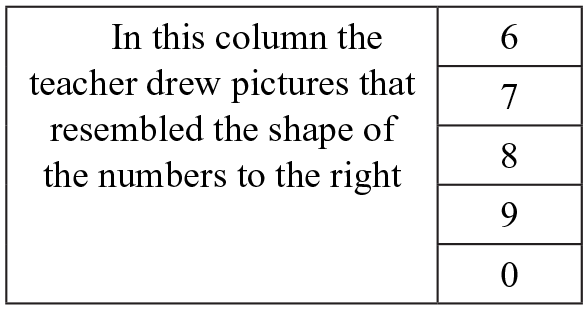
Drawing from the Ndogo school teacher’s lesson.
The teacher said a number out loud and then gave a student a stick to come up to the front and point at the correct number. The shapes that the teacher drew for the young children were not connected to any examples from their local environment. The goal of the lesson was number identification. After he went through the numbers he had written, the lesson was over and young children were released to go outside. Young children had the opportunity to observe and imitate the work of the teacher to gain numeracy.
Although addition and subtraction were common goals for home and school, the methods to reach these goals were vastly different. In the home and community, there was collaborative learning. In school, Mbwana held an authoritarian stance found in the colonial British school model (Vavrus, 2003) without collaboration. Mbwana lectured about a topic such as how to recite words that rhyme. Students then recited materials and worked silently on the information the teacher gave them.
Parents expressed Kimwera is an important part of children’s learning at home and in the community. Mbwana actively discouraged learning Kimwera because he said it was not something they could use. Additionally, Mbwana speaks Kiswahili but not the local language, Kimwera thus favored Kiswahili over learning Kimwera and provided no instruction in Kimwera, only Kiswahili.
Government aspirations
The national curriculum and the curriculum in the school classroom including outside influences such as NGOs, articulate directly and indirectly what makes valuable knowledge. The national school curriculum does not acknowledge and in some cases rejects as valuable knowledge, the systems of knowing, and learning from outside the school. For example, it is discouraged in Tanzania to go to a local medicinal doctor, and coming of age initiation rites are banned.
There is a strong legacy from President Nyerere about what it means to be a responsible Tanzanian citizen; this is accomplished, in part, through school (Bjerk, 2017). The two central aspects of Nyerere’s Ujamaa policy were economic development and unifying cultural perspectives across Tanzania. The latter included enacting free and mandatory primary school in Tanzania with the intention to “sensitize them [the Tanzanian people] to the principles of Ujamaa and the creation of a Tanzanian identity rather than tribal identities through means such as the use of a central language use of Swahili” (Taire, 2014: 2).
Meeting socialist goals were performed through various methods. The venue for creating a singular cultural perspective was formal school. Nyerere went to great lengths to construct schools but only in the Ujamaa villages. After President Nyerere retired in 1985, the same political party continued in power to the present day. The central Tanzanian government loosened socialistic initiatives yet the assumption continues that the government influences the people through schooling (Bjerk, 2017; Peeples, 2018).
International donor aspirations
Significant donor money, time, and resources are invested in the majority world by the minority world. Education for economic development is an argument that has been used as justification for minority world involvement in majority world contexts (Green, 2014). Early childhood education is one of these initiatives to promote development, progress, and modernization because formal early childhood education and care is perceived to be associated with significant educational, health, and economic benefits (Alderman, 2011; Barnett, 2008; Garcia et al., 2008; Richter et al., 2017). This is particularly an emphasis in the minority world context where many children attend preschools before kindergarten. In 2017, 86% of 5-year-olds and 68% of 4-year-olds in the USA attended preschool (National Center for Education Statistics [NCES], 2017).
To maintain the foreign investments, the Tanzanian government supports international initiatives (Green, 2015). Data gathered for this study demonstrates international initiatives promote best practices from the minority world for the education of young children in the majority world. Global ideologies are found in the national government’s first pre-primary curriculum developed in 2005. After examining the Tanzania national pre-primary policy book, the curriculum was shared with the director of State Preschool and Rathmore Preschool early childhood development centers in the USA. They were asked to analyze the curriculum of the Tanzanian curriculum. The resounding response was that the Tanzania curriculum followed the same framework or standards that were used in the USA preschools. This demonstrates the similarity between the knowledge, skill, and behavior objectives of the curriculums influenced by global actors who were at the table influencing national policies in Tanzania.
Observations from the Ndogo school reveal that not only does Mbwana, the school teacher not have a copy of the pre-primary curriculum, but he also said he had never seen it before, thus, the standards are not being met. An example of a non-contextualized approach in the Ndogo school is the international donor requirements for the pre-primary learning environment. This request from the donors was based on best practices in early childhood education from the USA but did not include local knowledge or best practices (personal communication with the NGO staff). The observed aspirations of the NGO in Ndogo implementation of USA preschool practices.
There were differing aspirations for what and how young children learn that includes the schoolteacher’s, Mbwana, the national government, and international NGO donors as well as the parents’ and community members. Aspirations led to different notions about when and what young children should learn. There exists a tension between the world of aspirations for young children to learn at home and at school. Although the overall study provides rich descriptive data about learning at home, this paper does not address this specifically.
Discussion
Childhood is a social construct (Aries, 1982). It occurs within specific physical and cultural settings. The social construct of childhood is important to examine in relation to opportunities young children have to learn. Parents have little voice in the formal schooling of their children. They expressed contentment that their children can attend school but were uncertain about how much difference it would make for them in their life due to the lack of collaboration between home and school learning. Semali (2014), a Tanzanian scholar, examined parent’s perception of education and concluded that “education is an indigenous value and throughout history, parents, grandparents, elders and the extended African families valued education as part of a child’s heritage. . . However, the colonial project interrupted such indigenous values, and instead children were left to compete against each other without safeguards or protections” (p. 117).
Progress and economic growth are agendas that emerged from colonialism and globalization (Caouette and Kapoor, 2015). Formal education is a means to that end. There are influences in Ndogo that are rooted both in a trajectory of colonialism from long ago as well as current-day global ideologies. European colonial rule is reflected in the layout of primary school classroom space and the authoritarian nature of the role of Mbwana, the teacher. In recent years, international donors from the minority world focused money in majority worlds to develop preschool programs that reflect the values of the minority world. Minority world ideologies are often synonymous with globalization and pose an imperialistic dominance. Li (2018) argues that “Globalization is at the center of modern culture and cultural practice is at the center of globalization” (p. 403). This negates cultural practices that are not at the center of modern culture.
Tanzania national government and international donors make decisions in the Ndogo school; however, the national government has more control as the gatekeeper of policies and therefore has a larger influence because they could reject an international idea. This is especially evident in terms of the social services provided to Ndogo (e.g. schools, healthcare, roads). It is not uncommon in under-resourced majority world countries that their governments may nod to the ideologies of the donor dollars in order to receive the funding, but the implementation of the said ideologies may not follow, thereby weakening the influence of the ideologies (Vavrus, 2000). This is seen in the case of the round colorful table and chairs for pre-primary students. They were purchased and used but not in an intended manner. Thus, in many ways, global influences are secondary to national influences, because, as stated earlier, the national government is the gatekeeper of influences.
Although not an “outside” influence, the national government has a legacy of colonialism as well as Ujamaa policies. It is key to note that when the national government attempts to impose practices, policies, and programs on the local level, there is still another mediating influence, which is the local people themselves. The local people are also gatekeepers about what is happening in their own community, about what opportunities exist to learn in which they choose to participate, and those in which they do not choose to participate.
The local people in Ndogo are susceptible to manipulation to accept hegemonic ideologies to be able to receive services such a local school. The situation is complicated and multilayered. Initially, I analyzed that the people in Ndogo were possibly being neglected by the national government because there had not previously been a school and there was insufficient access to water. As I pushed my assumption through interview questions and the literature I read, I came to also see the constructive intentions of the government to unify the country albeit at the cost of some of the ethnic group’s loss of language and culture. Scholars agree that the heavy hand of the Tanzanian national government led to relative peace in a region with much ethnic and religious conflict. I also came to realize the agency that the people of Ndogo exercised was more than I initially perceived.
Power and influence are not one-way. Local people have an influence on practices, policies, and programs by their choices to become involved or not involved. The intersection of global, national, and local is complicated and there is convergence at many levels. The local people of Ndogo have agency in these matters as well as the national government, however the power is not balanced. Power and influence operate in a web-like network with movement in both directions. Dictates can come down to the village from the national government. The national government may allow influence from global ideologies. These can also be diverted at multiple levels by various means, including by the people who are the objects of the influence.
INGOs bring colonial ideologies packaged in modern globalization, such as schooling is the way to advance in life, which perpetuating hegemonic ideologies into national spaces and enacted in local spaces. Omar, a father of school aged children, shared that going to school did not produce better opportunities in life and sometimes disillusioned young adults to seek a life outside of the community and that usually did not work out well and ended in tragedy or returning to the community. Omar articulated that the schooling offered to them did not prepare them for life outside, nor in many ways’ life within the community. The local knowledge is centered by families but is not centered in the decision making processes, and specific knowledge is not valued. Tanzanian national laws prevent initiation ceremonies and local medicine from operating legally.
In the Ndogo villages of Tanzania that local knowledge is prioritized by families and the community. Schools as described in this paper, were historically projects of religious colonizers and today as an entity of the national government to reinforce a united Tanzanian culture and language. Pre-primary school is a relatively new initiative and are often mixed in with Standard 1. In an interesting example of staying the same and engaging in change, the Ndogo government school build by foreign investors is run by the local village government. The issues of globalization have turned “numerous places into spaces of cultural juxtaposition and mixture” (Inda and Rosaldo, 2002: 12) such as in the case of Ndogo in Tanzania. The way forward in the global dialogue about educating young children is to examine local contexts and acknowledge the power dynamic of the multiple stakeholders. It is a complex process, it is not simply a local or global dilemma. Scholars, NGOs, and policymakers need to collaborate on education initiatives to value equally the different perspectives held by parents and community members in the construction of childhood through opportunities to learn.
Footnotes
Funding
The author received no financial support for the research, authorship, and/or publication of this article.
