




Abstract
In many Western nations (an area of the world identified by Connell as the Global North), the early childhood sector has positioned itself within the education discourse. This positioning brings along with it the neo-liberal agenda in relation to education – i.e. that education’s key aim is the preparation of employable future employees (children as human capital). Along with this is the increasing imposition of employer-identified skills and knowledges on the curriculum in order to shape children, through education, into the ‘right’ attitudes, dispositions and knowledges. Thus, early childhood education has become increasingly subject to external accreditation, whereby services are evaluated based on their adherence to predetermined standards. Early childhood educators’ work has increasingly required the operation of a panoptic view of children, whose every behaviour is observed, recorded and judged. The authors argue that such standards, in some contexts, act as barriers to effective service delivery and present examples of work from the Global South, demonstrating how an early childhood development focus facilitates a holistic approach to early childhood service delivery. The authors demonstrate how that development focus can be operationalised in the Global North and suggest that, as the sector proceeds towards professionalisation, it needs to consider its direction.
Keywords
In many Western nations – an area of the world identified by Connell (2007, 2015) as the Global North, influenced by the hegemony of a neo-liberal approach to ‘technologies of government’ (Connell and Dados, 2014: 3) – early childhood systems have developed, and continue to develop, in ways that focus strongly on an education discourse. In this discourse, early childhood education is considered valuable because of its alignment ‘with national economic prosperity’ (Hunkin, 2017: 8). Indeed, ‘educational institutions are seen as responsible for increasing productivity and competitiveness through maximising human capital and inculcating the necessary attributes and skills’ (Spohrer et al., 2017: 3). The alignment of early childhood education with this education discourse is supported by a plethora of economic evidence demonstrating that intervention early in children’s lives shows economic pay-offs in the longer term. The work of Nobel prize-winning economist James Heckman (1998, 2006, 2008, 2011, 2014) has been crucial in this positioning, given his clear synthesis of a range of early intervention studies (such as those reported by researchers including Olds et al. (2007) and Schweinhart et al. (2005)) to demonstrate the cost–benefit ratios associated with early intervention, and because of this work, Heckman has become positioned as something of an early childhood hero (Penn, 2017). Fraser Mustard (2008a, 2008b), a Canadian haematologist, used this work to underpin his argument that focusing on individual children and intervening early in their life has the potential to ameliorate poverty internationally. Thus, ‘social disadvantage is being recast as a biological effect, curable by professional interventions at the level of individuals, to be implemented across a range of early years services and infant education programmes’ (White and Wastell, 2017: 46). The role of early childhood education is to function as the tool of this intervention to ‘shape individuals earlier in life and in a more profound way: by instilling “the right” dispositions and attitudes in children and young people, there is no need for later corrections’ (Spohrer et al., 2017: 12).
Many are now beginning to argue that such intervention, coupled with the education discourse in Western nations, is creating an increasing presence of the state in young children’s lives. This presence, in a neo-liberal context, is one that is responsible for ‘more coercive and controlling social engineering’ (White and Wastell, 2017: 38). These critiques often focus on education in general, but can be applied equally to early childhood education (Sims, 2017). Giroux (2015: 15) suggests that, under a neo-liberal state, the purpose of education is to create employable graduates through a ‘pedagogy of ignorance whose hidden curriculum is the teaching of political and intellectual conformity’. Chomsky, who for the past 50 years has often been positioned in the media as an American Socrates (Lydon, 2017), argues that our current education system has had extremely unfortunate consequences for democracy. Education, he claims, aims ‘to make the population ignorant and irrational enough to safeguard short-term profit for the rich’ (Chomsky, 2013: 9) – a point supported by Giroux (2015: 15), who writes that education plays ‘a crucial, but far from straightforward, role in reproducing the culture of ignorance and instrumental rationality’. As a consequence, Western nations are facing the most significant threat to democracy ever (Chomsky, 2016).
In this article (and in others – for example, Sims, 2017), we argue that the positioning of early childhood service delivery in an education discourse exposes the sector to exactly these criticisms. We already see outcomes of this in the ongoing ‘social investment reform in ECEC [early childhood education and care] in Australia’, which ‘has been used to progress neo-liberal policy ambitions and techniques’ (Hunkin, 2016: 50). These ambitions and techniques result in a system which focuses ‘the educator’s gaze outwardly on the child who is to be assessed, measured then changed’ (Campbell, Smith, and Alexander, 2017: 58), and what becomes valued learning is defined by what can be measured using predetermined behavioural indicators – a process Hunkin (2016) identifies as a positivist discourse of quality. Odom et al. (2010), for example, illustrate this in their work in the USA, linking fidelity in curriculum implementation with children’s standardised outcomes. In the Australian early childhood sector, these predetermined behavioural indicators are identified in a national early childhood learning framework – i.e. a curriculum (Department of Education, 2009) – supported by a range of national quality standards (Australian Children’s Education, 2011a, 2011b). Early childhood educators are thus required to continually observe children, creating a panoptic environment where every moment of children’s lives in a service is scrutinised, evaluated and recorded (documented) for others to examine.
Such reforms are also enacted in other nations around the world. Moss et al. (2016: 344) note a shift in the Organisation for Economic Co-operation and Development’s rhetoric ‘towards a discourse of outcomes and investment’, exemplified in the proposed international global testing regime aimed at measuring young children’s achievement across a number of standardised domains. Such a regime is likely to encourage early childhood educators to teach to the test, resulting in a ‘pedagogy of compliance’ (Carr, Mitchell, and Rameka, 2016: 451).
We suggest that the linking of early childhood education and the human capital investment discourse in much of the Global North arises from a not surprising wish to pursue professionalism. The history of early childhood services in many nations has seen provision partly arising from a welfare perspective, where services for young children were developed to teach young working-class children what they needed for their future life as workers and, in the process, prevent them from becoming a drain on the state through developing criminal tendencies (Sims and Hutchins, 2011). In Germany, early childhood services were seen as the remedy necessary to address ‘the neglect and inadequate care of lower class children whose mothers were in employment’ (Rauschenbach and Riedel, 2015: 5). Similarly, in Australia, the first free kindergartens were set up in Sydney to address concerns such as the following: The children of the drunken and the dissolute, of the deserted wife, who earns a bare living while they play in the street; the children of the incapable, and of those who by birth or training are useless and utterly irresponsible, the coming citizens – they gather in the gutters of the narrow byways, and even in their chatter and their play, one who knows how to listen may hear a menace for the future. (Roberts and Kingston, 2001: 212)
The struggle to gain status and parity with those working in schools is reflected across the early years workforce in a number of different countries. For example, in the UK, where the intent of creating the Early Years Professional Status role was to raise the quality and status of the early years workforce (Simpson, 2010), the disparities between the salaries and conditions of teachers and early years professionals (even when they were rebranded ‘early years teachers’) still remain (Lewis and West, 2017). Osgood et al. (2017) emphasise the inequity in pay and conditions (including the lack of recognition as a qualified teacher) that applies to those who work in the early years, and continue to call for parity, particularly for those who work with children under three.
The focus on the education discourse is thus a strategy where early childhood professionals can align their work with that of colleagues in schools in an attempt to gain recognition as a valuable profession, becoming early childhood educators in the process (Sims, Forrest, Semann, and Slattery, 2014; Sims and Pedey, 2015; Sims and Tausere-Tiko, 2016; Sims and Waniganayake, 2015a, 2015b). That such an approach involves the kinds of risks discussed above – specifically the risks that come with the neo-liberal agenda, including standardisation, external monitoring and accreditation, and corporatisation (Otterstad and Braathe, 2016, Simpson et al., 2014; Sims, 2017) – is not always recognised, or is perhaps dismissed as the price that it is necessary to pay for gains in professional status. However, we argue that the trenchant criticisms around the influence of neo-liberalism on the education sector in the Global North (as identified above) indicate that such a positioning does not come without major risks – risks that may significantly impair the ability of the early childhood sector to work in the best interests of children.
In other parts of the world – for example, the Global South, as defined by Connell (2007) – early childhood services are not bound in the same way to the education discourse. Rather, early childhood services are positioned as holistic, addressing ‘adequate nutrition, health and hygiene, opportunities for learning, and protection from harm and pollution’ (UNICEF, n.d.). This holistic approach is reflected in much of the work undertaken in the Global South (some examples are discussed in Ang and Sims, 2016; Sims, 2015) and is captured in the Asia-Pacific Regional Network for Early Childhood’s 2020 Vision statement: Strategic Goal 1: Improve advocacy for holistic and inclusive ECD [early childhood development] … We will highlight approaches which focus on equitable access to and participation in holistic ECD programmes and which therefore address discrimination based on gender, economic status, vulnerability, ethnicity and language, disability and location. (Asia-Pacific Regional Network, 2016a: 7) Informed by social ecology, nurturing care extends beyond families to include community caregivers and support for families. The systems model that forms the basis for our life course conceptual framework includes both an enabling environment for caregiver, family, and community, and an enabling social, economic, political, climatic, and cultural context … . The former represents personal resources, including maternal … education and maternal physical and mental health, and community resources including safety, sanitation, and absence of stigma. The latter represents structural aspects, including policies, laws, supportive organisational systems and structures, and financial wellbeing, as well as wars, conflicts, droughts, and cultural variations. These multilevel components are mediated through nurturing care to influence children’s development. (Black et al., 2017: 79–80) Health and nutrition Security and safety Responsive caregiving (the term ‘caregiving’ is used in preference to ‘parenting’ in recognition that not all children are cared for by their parents) Early learning Enabling environments for caregivers, families and the community
Thus, holistic early childhood development programmes are positioned as the most appropriate approach for countries from the Global South beginning to develop their early childhood sectors whilst simultaneously working towards achievement of the Sustainable Development Goals (United Nations, 2015). Indeed, it is argued that achievement of most of these goals begins with appropriate early childhood development programmes (Asia-Pacific Regional Network, 2016b).
The work being undertaken in Timor Leste can be used to illustrate how holistic programmes are developed and how they operate in one Global South context. Manichan (2016) describes how UNICEF is working with the government to develop a universally available caregiver education programme, which addresses nutrition, health, education, care and protection. The programme includes fathers’ role in parenting, early stimulation (such as singing to children) and toy-making using local materials. This is delivered through targeted parenting education sessions in villages, home visits, community radio and youth theatre productions that model positive parenting behaviours. A National Policy Framework for Preschool Education was developed in 2014, which aims to ensure that all children between the ages of three and five have access to preschool by 2030. The government and UNICEF are building preschools that include water, sanitation and hygiene facilities, and educational equipment. Teacher training is provided, and a national preschool curriculum has been developed. In remote and disadvantaged areas, alternative models of preschool provision are being explored, which include the use of community centres and home-based and family-based options. Where preschools operate within a family, parents are provided with training and learning materials, and are supported by a home visitor. Communities are able to select members to receive training to operate as preschool facilitators, who then run their programme in the language of the community. Child-centred teaching is prioritised in primary schools, and schools are increasingly being provided with water and sanitation facilities. These programmes are designed to improve child outcomes in a context where children’s developmental outcomes are amongst the worst in the region: 85.5% of children have no access to preschool education, more than 50% of children under five are stunted in their growth, 50% of deaths of children under five are from preventable causes, and 35% of schools lack basic sanitation. These programmes only began in 2015–2016, so there is not yet any data available on their impact.
In contrast, Australian integrated early childhood services are only offered as a targeted approach in specific contexts, where they aim to tackle the ‘wicked problem’ (Moore, 2011) of intergenerational poverty and disadvantage; thus, they are operating in some disadvantaged communities (Communities for Children; see Department of Social Services, 2018) and some indigenous communities (Aboriginal child and family centres; see New South Wales Government, n.d.). These services tend to be place-based – i.e. available to a particular community – and thus are not universally available to all children in the country; they are also not required to be accredited under the National Quality Framework, which assesses and accredits early childhood education services (Australian Children’s Education, n.d.).
One example of such a programme is the family-activity-centre approach, exemplified in FamilyZone (sic) Ingle Farm Hub. This programme promotes integrated support facilitated by a number of professionals and agencies operating in a co-located space (the one-stop-shop concept). It is underpinned by a single entry point, no-wrong-door approach, which provides soft entry for stressed/isolated families. This approach at FamilyZone aims to avoid the stigmatisation of families at risk of vulnerability. It also helps with engagement when working with families at risk of vulnerability and provides an important entry point to more specialised services. This programme has been formally evaluated. Parents and caregivers were asked if they thought they were better off because of their involvement at FamilyZone. The report showed that: there is clear evidence that FamilyZone Hub is meeting its objectives of providing an environment which is supportive of child-friendly and inclusive communities, effective service coordination for children and families and improvements in children’s development and well-being and positive family relationships. (McInnes and Diamond, 2011: 6)
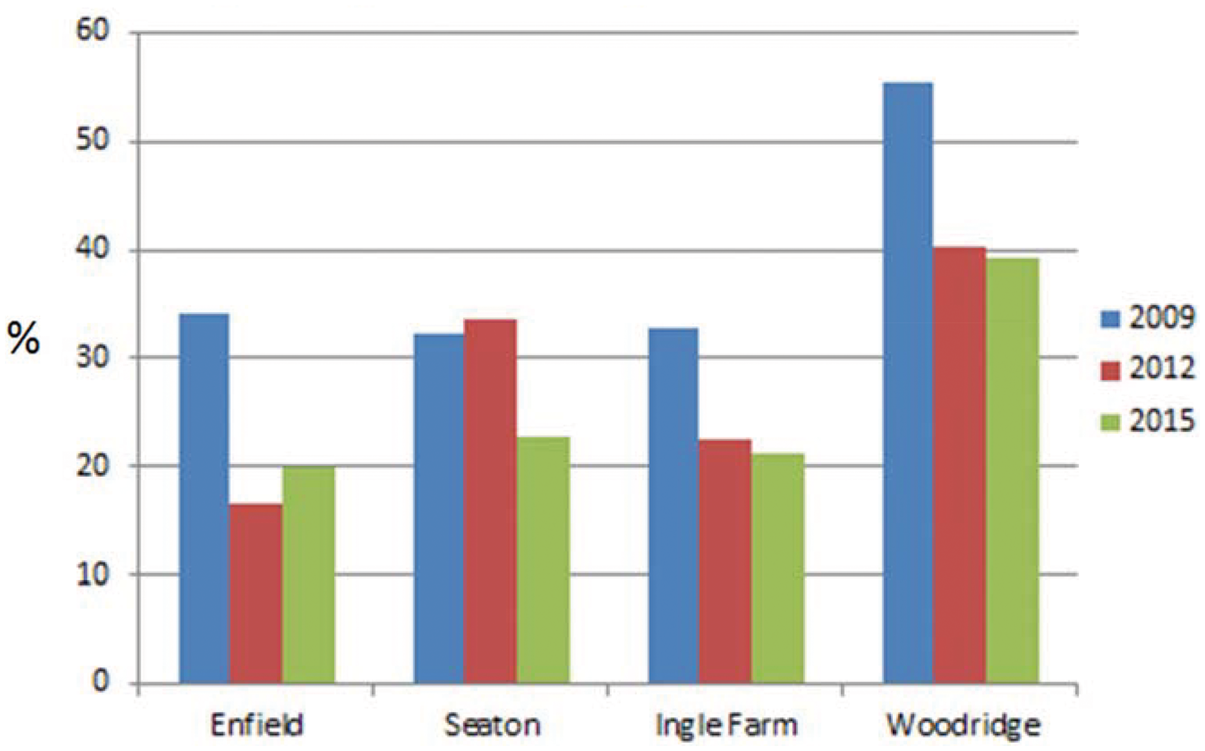
Australian Early Development Index vulnerability in one or more domains in Australian suburbs with family activity centres developed between 2004 and 2009.
The family-activity-centre approach to early intervention and prevention, as exemplified in the FamilyZone programme, facilitates prevention of child abuse and neglect by bringing together a range of universal and targeted support services for families. It provides a family-friendly environment which engages a broad range of families, including those most at risk of poor developmental outcomes. Families are engaged through a number of pathways, including referrals, hospital screening protocols, refugee settlement programmes, word of mouth, social media and Internet browsing. Parents make a very significant contribution to the way the services are designed and delivered. Typically, a family activity centre may facilitate (Brettig and Children Communities, 2016):
A range of playgroups Perinatal support groups for parents at risk of postnatal depression Parent groups Soft entry activities such as cooking and sewing Cultirally and Linguistically Diverse support activities Home visiting programmes Volunteer and early childhood leadership training Co-located non-governmental organisation and government department activities Satellite outreach activities into surrounding suburbs
These examples suggest that it is possible to conceive of different models of service delivery where the key focus may vary from a concentration on families to a concentration on children. In reflecting on the potential differences, we posit that family activity centres are most effective in the context where they have the capacity to respond to families in crisis in a timely manner, including those experiencing domestic violence or mental health issues. If these families at high risk of vulnerability can be engaged during such times and receive appropriate support, it has been found that they will be more likely to continue to access the range of wrap-around services they require. Many of these families are less likely to engage under normal circumstances, as they tend to be cautious of such support due to previous unsatisfactory experiences or inaccurate information about services. Interventions in these circumstances require a level of staffing and flexibility that it is difficult to provide in services that tend to focus more on providing non-parental care for children. In Australia, the latter can be positioned as early childhood education centres. The formalisation required under legislation in operating these kinds of services creates barriers to parental engagement, and thus limits child participation and restricts the ability to improve child outcomes. We argue that early-childhood-development-focused programmes operate best, particularly in contexts where there is disadvantage, precisely because the operation of these programmes is not (yet) as heavily shaped by neo-liberal discourses, which currently impose external standards on the education sector that function to reduce ‘the meaning of early childhood education to a preparation for compulsory education’, which is, ‘in turn – reduced to a preparation for the labour market’ (Vandenbroeck and Mariett Olsson, 2017: 86).
However, as the early childhood development sector continues to develop, it is crucial to recognise that this is not without the very risks associated with neo-liberalism discussed above. Early childhood development is already positioned as a tool for human capital formation: UNICEF (2013b) itself argues strongly that ‘Early Childhood Development is seen as one of the most cost efficient investments in human capital which leads to a country’s sustainable development’. Early childhood development initiatives in the Global South are not only focusing on developing programmes to support children and families; they are also engaging in the development of curricula for early childhood education – as discussed above in Timor Leste (Manichan, 2016). It is important that the growing early childhood development sector fight to maintain its capture of the holistic nature of its work. As Boyden and Dercon (2012: 34) identified several years ago: The problem with ‘investing in children’ as a means of realising economic growth is that children do not constitute a homogeneous group in terms of potential human capital. Children have differing skills and capacities and contribute to societies in differing ways, not always measurable in economic terms. Human-capital models offer a powerful, politically persuasive framework for policy development, but they must be understood as additional to, and not alternative to, more fundamental principles of social justice. Here it is important to uphold the foundation principle for investment in human development, which is human rights for all; this applies even if economic development depends more on some groups than others. Many children do not reach their full human potential because of their families’ income status, geographic location, ethnicity, disability, religion or sexual orientation. They do not receive adequate nutrition, care and opportunities to learn. These children and their families can be helped. It is their right to develop as well as to survive. (UNICEF, 2013c) the burden on good leadership to make the currently unthinkable thinkable, to question the obvious, to make the present systems unavailable as options for the future. The boundaries in our minds create fear about the consequences of crossing over to the undiscovered country. But the possibilities we really need do not lie on this side of our mental fences. (Oberklaid, 2017, 34.25–34.55)
Footnotes
Declaration of Conflicting Interests
The author declared no potential conflicts of interest with respect to the research, authorship, and/or publication of this article.
Funding
The author received no financial support for the research, authorship, and/or publication of this article.