



Abstract
This article explores 4- to 7-year-old children’s tablet computer (tablet) use, drawing on empirical data from day-care institutions, primary schools and private home settings in Denmark. Data were gathered via video observations in two different studies: (a) a media ethnography on children’s tablet play practices in home settings and (b) a socioculturally informed, design-based study involving children as co-producers in institutional settings. We understand children’s tablet use via practice theory, framing tablets as actor-enacted objects in play practices expressed through play moods in qualitatively distinguishable ways. We suggest a conceptual spectrum (not dichotomy) for understanding how sociomateriality is articulated in children’s tablet play practices, ranging from absorbent to utensilent. Within sociomaterially absorbent practices, the tablet is foregrounded in intense involvement, thus mediating a focused play mood which relies on not being disturbed by outside actors. Within sociomaterially utensilent practices, the tablet is backgrounded as a node or nexus, thus mediating a distributed play mood of involvement with places and agents beyond the tablet. We contribute to previous findings by Marsh framed within the post-humanist approach as we suggest the empirically observed complexity in children’s digital play can be approached by tracing the relationally generated object positions. We add to this by proposing an analytical spectrum ranging from absorbent to utensilent sociomaterial practices that can be employed when analysing children’s digital play.
Keywords
Introduction
In this article, we explore how tablets as objects take varying positions in 4- to 7-year-old children’s play practices within home as well as institutional settings. It is hardly meaningful to separate digital and non-digital play, as the digital era has brought about fundamental changes to the nature of play, allowing it to move ‘fluidly across boundaries of space and time in ways that were not possible in the pre-digital era’ (Marsh et al., 2016: 250). The children in our studies were sometimes absorbed in direct play with tablets and sometimes merely including the device in play that featured other people and/or objects as well. We suggest that these varying positions of the tablet as an object for play are interesting to consider analytically. Consequently, we propose that foregrounding of the tablet accompanies what we term absorbent practices, whereas backgrounding of the tablet accompanies what we term utensilent practices. On its surface, this might indicate a simple dichotomy between two stable object positions of the tablet that can be directly linked to qualitatively different activities within which specific power relations between tablet and child exist: the child subordinating agency to the tablet in absorbent play practices, or the child subordinating the tablet to her or his intentions in utensilent practices. However, as we will highlight empirically and develop theoretically in this article, playful interactions between children and tablets may be approached as sociomaterial mood practices that imply mutual co-configurations between agents and objects in situated play activities.
In order to deal with these phenomena, we need an analytical approach that is (a) sensitive to the relationally generated positions of human agents and non-human objects, respectively, in a given play situation and (b) sufficiently specific in its descriptive categories to provide nuanced characterizations of shifts between these positions. By employing absorbency and utensilency as a fluctuating spectrum, as well as by looking at play practices as they unfold within broader sociocultural settings, we show how the position of the tablet as an object accompanies temporally changing configurations within the sociomaterial mood practices of children’s play. We apply the notion of play moods (Karoff, 2013) in order to approach play as an end in itself. Playing is, thus, a matter of participating in fluctuating moods that generate meaningfulness in temporary configurations. Moreover, playing cannot be seen in isolation from other practices in the sociocultural milieu.
We begin by presenting our theoretical background and the framework that enable us to analytically explore two empirical data excerpts. We then provide reflections on methodology and ethical considerations. Finally, we synthetize our findings and present a spectrum for analysing the ways in which tablets are materially enacted in children’s play practices. Consequently, the contribution of this article is mainly of a theoretical nature, providing empirical nuance and direction to the analysis of young children’s digital play practices.
Theoretical framing: multifunctional objects and multi-mooded agents in play
Whenever a child engages with a tablet in a concrete situation, some specific features of this multifunctional object’s ‘layered architecture’ (Yoo et al., 2010 cited in Burnett, 2017: 16), that is, physical as well as interactive qualities, are brought into actualization. In the same manner, some specific features of the surrounding environment as well as some specific capacities of the human agent are being actualized. The question of how resources are incorporated into practices will always be empirical (Wertsch, 2007) and can thus never be answered with predeterminate notions of human or non-human agents. This is part of the above-mentioned fore- and backgrounding of human agents, material objects and environmental features, respectively, that are actualized in concrete play activities. From this perspective, children’s play practices with tablets can be conceptualized as a matter of material objects, embodied actors and physical environments that come together and relationally actualize each other in specific ways, constituting sociomaterial practices (Orlikowski, 2007; Schatzki, 2001).
Sociomaterial practices are not evolving without direction; they are shaped by certain objects (objectives) that participants orient towards when keeping an activity going. But although it may be claimed that ‘[t]here is no such thing as an object-less activity’ (Nicolini, 2012: 111), the objective of a certain activity must be seen as dynamically evolving as well as potentially tacit. This directionality emerges through an actualization of possibilities and constraints that are set by the totality of aspects involved, not as an effect of a pre-determined – and determining – objective. Practices are carried by bodies (Reckwitz, 2002: 250) and structured by changing perceptions of mood and meaningfulness. From a practice-theoretical perspective, this totality of aspects also includes the ‘routinized type of behaviour’ of the body and mind (Reckwitz, 2002: 249) characteristic of practices. The actualizing capacities of human agents, material objects, environmental features, as well as the actualizing directionalities and objectives of activities are thus seen as co-evolving and mutually defining features of sociomaterial practices.
Play practices and moods
Since we have set out to deal specifically with sociomaterial play practices, the aspect of play needs some further clarification with regard to the co-constituting aspects mentioned above, including the question of directionality or objective. We will draw on Helle Marie Skovbjerg’s (formerly Karoff) notion of play practices and play moods. Skovbjerg argues that play activities do not serve external objectives, rather they are instances of creating a ‘[. . .] reality within a reality’, ‘[. . .] a universe of meaning [. . .] where all other types of meaning make sense in relation to your set-up’ (Karoff, 2013: 78). Play practices are seen as embodied meaning creations that are expressed through play moods defined as certain ‘[. . .] way[s] of being in play’ (Karoff, 2013: 82).
Skovbjerg distinguishes between four different play practices, each expressed through a certain play mood:

Source: Karoff (2013: 85, examples added by authors).
In line with recurrent theoretical notions of a relationship in play between structure and chaos (Caillois, 1979 [1961]; Schiller, 2004 [1795]; Spariosu, 1989; Sutton-Smith, 1997), Skovbjerg presents an overall spectrum ranging from mainly repetitive to mainly disruptive practices and moods. The most repetitive practices, sliding, are expressed through moods of devotion in which actions are rhythmically routinized in accordance with certain patterns internal to the play activity. The most disruptive practices, exceeding, are expressed through moods of euphoria in which every rule and routinized expectation is deliberately ruptured. An example of the first category, sliding/devotion, which might be encountered in children’s play practices with tablet computers, could be children absorbed in playing a game over and over again, gradually appropriating its features and mastering the in-game tasks to increasing perfection, thus adding to the sliding flow. An example of the fourth category, exceeding/euphoria, could be children actively confronting the limitations of this same game, for example, by ‘dying’ in the most hilarious ways, accompanied by loud amusement of rupturing the in-game logic.
Between these practices/moods of predominantly repetitive and predominantly transgressive character, Skovbjerg defines a second and a third practice/mood category. The second category, shifting/intensity, denotes a rough-and-tumble-like practice where ‘rapid shifting between a strong predictable rhythm and short, fast change’ (Karoff, 2013: 81) is predominant and where a sense of vertigo is often part of the experience. An example could be games that provide the player with freedom to vary between fast-paced exhilarating play and calmer exploratory play. The third category, displaying/tension, has to do with ‘informal performing’ (Karoff, 2013: 81) in ways that add personal style or interpretation to some kind of cultural format, as when children create and share expressive self-portraits using snapchat filters that turn them into cute animals.
Importantly, these four different play practices and play moods should always be thought of in plural (Karoff, 2013: 85); as shifting configurations within fluctuating play practices, meaning that a playing activity can involve multiple moods, as when a gaming activity is initially characterized by sliding/devotion but then, by an impulse of rupturing the entire game procedure, turns into exceeding/euphoria. As implied earlier, playing activities do not serve play-external or functional purposes. Play is about being in the world in certain ways; the objective of playing is to enter a window of opportunity that makes mood practices possible. This makes play an end in itself, with mood as a tacit meaning-maker. The relationship between mood and meaning is also reflected in practice theory with Schatzki’s (2001) concept of teleoaffective structure that links the actions within a practice. This concept signifies a process of emphasis and exclusion – of organization – where meaning (telos) is tied to affect emanating from human agents as well as objects. In this sense, affect encompasses play moods as well as the way tablets co-constitute practices, in line with the notion of sociomateriality. In summation, the meaningfulness of objects is a structuring force along with affect and actions as embodied practices.
Tablets as multifunctional objects
A tablet is a multifunctional object, inherently capable of being many different things, depending on actors and situations. Even so, it is not just an empty canvas. It brings something into these different configurations as well and demands knowledge on part of human agents in order to make interactions work. Burnett (2017) has coined the term ‘fluid materiality’ (p. 17) in relation to tablets and their various forms of ‘actor-enactedness’ (p. 16), arguing that the material status of a tablet is enacted by its surroundings and acts on its surroundings at the same time, thus ranging from being ‘an object among many objects’ to ‘a schooled device’ and ‘a plaything’ (p. 20).
Marsh has taken a step further in foregrounding tablets in her research with young children. Following a post-humanist approach, she refers to Ash’s (2010) concept of teleplasty in describing how ‘technologies preshape the possibilities for human activities and sensory experiences’ (Marsh, 2017: para. 17). This concept originates from Caillois (1979 [1961]) and has been developed by Ash in order to analyse digital gaming practices. Ash (2010) uses this concept to describe the degree to which technologies successfully invite human beings to percept (digital) space. Marsh (2017) argues that due to their ‘close relationship between gesture and interface [tablets] are more intensely teleplastic’ (para. 17). An example of this could be how interactions usually involve touching objects on the screen rather than via a mouse/cursor, as is familiar on a desktop computer.
Moreover, Marsh introduces Ash’s (2010) concept of envelope power to describe how certain mechanisms in digital games create a space where play activities can evolve and remain contained within the game. As we shall see from the empirical examples, this includes game designs where progress and rewards are key to the structure. In conclusion, our analytical approach must be sensitive to the agency applied to the material status of tablets as well as the agency brought into the configurations by the objects themselves. While Ash and Marsh are mostly referring to digital games, their concepts point to the relevance of sociomateriality in the analysis of tablet play practices, inasmuch as they define the configuration in line with the dispositions of the human agent(s).
Children as multi-mooded agents
Following this sociomaterial approach, we implicitly conceptualize human agency as something that, with a term from Bateson (1972), ‘extends beyond the skin’. This resonates with a sociocultural approach to human agency that rejects individual and intermental reductiveness and understands agency as a socially, culturally and materially distributed phenomenon (Rajala et al., 2016). In relation to the above-outlined conceptualization of play practices as mood practices (Karoff, 2013), this has the implication that moods are not to be understood as qualities residing within the individual consciousness, nor is entering into a mood to be understood as a rational and deliberate act of an independent subject. Rather, we see moods as having to do with what Bogost (2016) has termed ‘a worldful attitude’ (p. 107) which, in relation to the material objects involved, means that ‘in play we draw them close and meld with them [. . .], subordinating our own agency to a larger system’ (p. 92). From this perspective, play is a ‘conversation of actions’ (Giddings, 2014: 105) between agents and objects, evolving within a temporarily actualized system of meaning in relation to mood.
However, although playing can be characterized as the emergence and evolution of a temporary meaningfulness that does not align with the meaning systems emerging in the surrounding practices, play practices cannot be viewed in isolation. They are not hermetically sealed from other practices in the sociocultural environment. This means that a play activity can also take place as a temporary impulse within a task-oriented activity. Conversely, activities that belong to a non-play practice may interrupt and affect play activities. Multiple objectives, sometimes of a contradictory character, do co-exist in every sociocultural milieu (Nicolini, 2012: 112).
In conclusion, children can be seen as multi-mooded agents that radically ‘extend beyond the skin’ as they engage playfully with tablets, not only in play practices but at the same time within broader sociocultural milieus. Accordingly, tablets are multifunctional objects with agentic features that invite human agents to interact in certain ways. Whether a child accepts or declines these invitations depends on the correspondence between practices, moods, materiality and meaningfulness. In the following, empirical excerpts will provide a basis for elaborating on how the material status of tablets varies with moods and practices.
Methodological and ethical considerations
The empirical basis for this article comes from two separate practice-based and video ethnographic research projects with young children (aged 4–7 years) in Denmark. Study A is grounded in practice theory (Couldry, 2012; Reckwitz, 2002; Schatzki et al., 2001) and focuses on how young children (n = 7) play with a transmedia environment provided by the Danish Broadcasting Company on tablets in home settings. Study B is a socioculturally informed and design-based study (Cole and Packer, 2016; Krange and Ludvigsen, 2009), exploring and co-developing a ‘micro transition pedagogy’ (Odgaard, 2018: 197) for children’s transition from day-care institution to primary school. A larger number of children (n = 87) have been participating in study B as co-producers of digital content such as photos, collages and multimodal books on tablets in their institutional settings. The two studies are related in terms of employing practice-based approaches (Nicolini, 2012) and by applying methods of video observation (Derry et al., 2010; Lundtofte and Johansen, 2019). Empirically, they cover a wide range of activities where children use tablets, and they reveal notable similarities in observed play practices across the two studies. In the context of the present article, we have selected two empirical cases that display extremities of utensilent and absorbent practices, respectively. Without providing a general account of the data of the two studies, these two cases exemplify the complexity in the data of the two studies and provide us with an empirical basis for developing an analytical spectrum with which we can meaningfully explore the multi-facetted positions of objects and agents in children’s tablet play practices.
Conducting video observations of young children demands ethical considerations in every part of the process. Informed consent was obtained from parents/guardians of all participating children, including information on how to withdraw consent. In addition, in situ assent (Dockett and Perry, 2011) from the children involved was a continuous focus area in relation to actual instances of video observation. In order to ask the children for their acceptance of being video recorded, we have talked with the children about the aim of our study, our reasons for making video recordings and our use of these recordings. An equally important aspect was our immediate reaction to children’s direct or indirect utterances or actions of withdrawal of their assent once video recording has commenced, for example, nonverbally uttered reluctance or discomfort related to being captured by the camera. Through these precautions, we have been aiming to strike a balance between protecting children as structurally vulnerable subjects and, at the same time, respecting children as competent agents in research (Skelton, 2008; United Nations, 1990). All participants are anonymized via pseudonyms.
Findings: a spectrum for analysing children’s digital play practices
In the following, we present and analyse two cases from our data. These cases allow us to empirically unfold our proposed spectrum between absorbent and utensilent practices. At the same time, the two cases allow us to reflect upon nuance and shifts in relation to the extremities of this proposed spectrum. Furthermore, we consider the two cases in terms of play moods (Karoff, 2013) and discuss how this can inform understandings of how different object positions, and thus play practices, were motivated.
Case 1: Sebastian
Sebastian is browsing the main menu of his tablet. His finger hovers for a bit over the Super Mario Run game, but he chooses to tap the Subway Surfers game instead. ‘That’s right. That’s one of your favourite games’, says Mum. Sebastian rests his head on his left hand. Mum helps him get rid of a few pop-up ads by tapping white Xs in red circles. Next is the loading screen. Sebastian’s head leans even further to the side, resting on the hand. Sebastian hits the sleep/wake button. ‘Oh’ says Mum. She hits the Home button and the loading screen reappears. She turns down the sound volume a bit. The main interface of the game has now loaded. Sebastian immediately taps the ‘tap to play’ icon, thus starting the game. The avatar runs forward, and Sebastian now has to interact with it in order to make it jump, duck or shift between three parallel lanes available for running. The avatar is being chased by a policeman and picks up coins as it runs along. After 21 seconds, the avatar runs into a sign post and is now forced to start over. ‘Is that Subway Surfers?’ asks the researcher. No answer. After a short while Mum answers ‘yes’. Sebastian plays in similar intervals for another couple of minutes. He then exits to the main menu and enters the ‘me’ section of the game, which is where the avatar can be configured. He swipes through the menu, selects an avatar in a space suit and exits the ‘me’ menu. During the loading time, Sebastian rocks back and forth in his chair and looks around the room. He taps to start the game again. The researcher tries to ask Sebastian about how they play in his pre-school. No answer. After playing a couple of rounds, Sebastian exits the game in order to play Fruit Ninja instead. (Sebastian, study A, 8 February 2017, video I, min. 24:46-29:57)
In line with the study design, Sebastian was asked by the researcher to show how he likes to play with his tablet. The six other children in study A always sought the attention of the researcher and other people present (namely mothers) at some point during their tablet use in order to show, ask about or comment on something. Sebastian did not, and he appeared to be struggling to align himself with the play moods intrinsic to the games he sought out. Bogost (2016) argues that ‘[p]lay is not an act of diversion, but the work of working a system, of interacting with the bits of logic within it’. (p. 114). When Sebastian was playing Subway Surfers and Fruit Ninja, the games offered him small instances of intense interaction, and he seemed to be doing his best to make the most of them. However, these kinds of games are about improving one’s performance by repeating the same challenge over and over, thus setting new records. Explorative and creative elements, on the other hand, are limited to ancillary aspects, such as changing the outfit of one’s avatar.
When Sebastian eventually made a tiny mistake and the avatar ‘died’, the game immediately invited him to start over. Sebastian played a few rounds of Subway Surfers as well as Fruit Ninja, but he did not become fully enveloped (Ash, 2010) by the invitations to start over again and again. His digressions from the main activity of ‘endless running’ in order to explore the ‘me’ section demonstrate his agency and ability to move away from the repetitive aspects. When Sebastian was done with the Fruit Ninja game, he pressed the sleep/wake button on the device and left it on the table. It would appear that the tablet never consistently achieved the material status of an interesting toy to Sebastian at this particular occasion.
Sebastian’s actions point to a routine of using the tablet as a device for solitary use. He was leaving questions and remarks from the researcher and his mother unanswered and did not comment verbally or by other means extend any invitations to participate in his activities. Interestingly, Sebastian’s mother removed the pop-up ads rather tacitly, aiding Sebastian in moving on to the game itself. This instance is interesting in terms of rote behaviour (Reckwitz, 2002), since she got rid of the ads, but accepted the premise of having to put up with them in order to enjoy a ‘free game’. Sebastian did not request her help; rather, she reacted swiftly when the ads surfaced.
Sebastian was trying to present a worldful attitude (Bogost, 2016) on the premise of being asked to play with his tablet and attempted to make the situation work. He was affording the game envelope power (Ash, 2010), but he was also agentic in his decisions to shift between apps and eventually leave the tablet altogether. Importantly, offering the game envelope power is not the same as automatically entering a play mood; rather, it suggests a willingness towards making a play mood happen. In terms of Skovbjerg’s play practices and moods, the ‘endless running’ aspects of Subway Surfers can be seen as a sliding practice of repetitive play in which devotion is the prevalent mood (Karoff, 2013: 84). However, Sebastian’s other actions also demonstrate how this particular play practice, and the play mood it represents, was not sustained for very long before he would try something else. In being drawn to the ‘me’ section of Subway Surfers, Sebastian demonstrated an explorative disposition. Perhaps, he would have been able to be drawn to an intense mood (Karoff, 2013), had the game afforded variation and explorative elements.
By ‘submitting [his] own agency to a larger system’ (Bogost, 2016: 92), Sebastian followed the objective of Subway Surfers and Fruit Ninja, but for short intervals. His example shows how the absorbent sociomaterial practices, foregrounding the tablet, has to do with envelope power, but is not necessarily upheld by strong invitations to interact in a certain way. In other words, although the game situated Sebastian as a user with limited options and promoted the continuation of his engagement, he did not stick with it. In spite of his less-than-communicative demeanour, his actions contradict passive use. Rather, his actions suggest a variety of attempts at making the situation work through a worldful attitude (Bogost, 2016) towards a foregrounded device; a play mood of devotion (Karoff, 2013) in which repetition was key, but not the only driving force. This case provides a telling image of how absorbent practices are not necessarily achieved in spite of attempts made by human agents to get into the mood afforded by the object. The next case deals with a predominantly utensilent play practice and how it is teleoaffectively structured (Schatzki, 2001) in relation to another practice.
Case 2: Sara and Sofia
Sofia laughs and hands the tablet over to Sara. She then takes a few quick steps towards a circular rug outside the primary school classrooms, jumps to the centre of the rug and looks at Sara while making funny dance moves and sticking her tongue out, ready for a snapshot. Sara looks from Sofia to the tablet screen, hesitates and concentrates on touching the icon that creates a new page in the multimodal book. She touches the picture frame on the new page and selects the camera icon to take and insert a photo. While Sara operates the tablet, Sofia slows down her movements and directs her attention to another child in the room, but as soon as Sara holds the tablet up in front of her, ready to take a picture, Sofia turns back towards Sara and intensifies her dance moves, turning them into a motion of running in circles along the outline of the multicoloured rug, faster and faster. ‘Stand still! Stand still and turn around’, Sara yells, holding the tablet in camera mode, trying to capture a portrait of Sofia who keeps running. ‘Stand still’, Sara repeats. ‘Nooo’, Sofia replies in a high-pitched voice and continues circling while making funny faces and throwing a victory sign at Sara. ‘Otherwise I can’t take a picture of you!’, Sara insists, and takes the photo. Sara displays the photo on the screen and smiles while Sofia approaches. Together they take a look at the rather blurry photo. They both giggle. ‘It should be a different photo’, Sofia says, and then she returns to the circular rug in order to resume her playful movements. (Sara and Sofia, study B, 1 May 2018, video II, min. 04:55-06:32)
In accordance with the research interests of study B, Sofia and Sara were introduced by the researcher and pedagogues to the idea of using a tablet for co-producing multimodal books with photos, audio recordings and texts about what was pedagogically framed as ‘your favourite places and favourite things within the institutional environment’, in this case, the institutional environment of a transition to school-module taking place on school premises. Sara and Sofia entered the area with the circular rug after having been in the process of producing their common book for about 10 minutes. Prior to the excerpt, they had created a front cover and a page with a photo of a mancala board game, accompanied by an audio-recorded narration about rules and procedures of playing this game. This process involved several attempts and lengthy negotiations between the two children. After having finished the mancala page, they entered the area with the circular rug and decided on taking and inserting photos of themselves. Sofia was the first to take a photo of Sara, and the above excerpt unfolded in immediate continuation of this.
As Sofia started running in circles, gesturing and making funny faces, an intense mood emerged. The photo situation, the spatial feature of the rug in the room, the tablet and the two children were all temporarily turned into elements in a play practice of displaying and a mood of tension (Karoff, 2013). However, Sara’s insisting tone and her appeal to Sofia to ‘stand still and turn around’ made apparent that two overlapping and potentially contradictory practices were evolving through the very same activity: a task-oriented practice of co-producing a digital book and a play-oriented practice of getting a mood going. In terms of teleoaffective structures (Schatzki, 2001), the two practices converged in a kind of fluctuating compromise. By running in circles, Sofia performed a mood of tension, adding personal style and letting out steam while maintaining Sara’s possibility to carry out the photo task. Sara insisted on carrying out the photo task properly, but her smile and the two children’s joint and giggling orientation towards the photo made their shared and fluctuating practices proceed, partly as a task-oriented practice, partly as a play practice.
The tablet, initially employed for the photo- and book creation task, had a rather foregrounded and absorbent materiality for Sara in relation to this task, but at the same time, it served in a more backgrounded position as a prop in the momentary play activity that Sofia initiated. In the sociomaterially utensilent play practice, the tablet functioned as a prop or a node, an object among objects, thus co-constituting a playful space for displaying/tension. At the same time, the tablet was sociomaterially connected to Sofia’s act of running. An instance of exploratory play asking ‘what will happen if I run in the picture?’. Consequently, when the two children took a closer look at the photo and giggled, the blurry photo and the activity of taking it momentarily became part of the play system, thus briefly involving a more absorbent practice with the tablet.
The two examples nuance the question of how tablets are meaningful to children, their actions and the directions of their attention. The first case demonstrated how a child can be focused on playing with a tablet, thus ignoring disturbances and accepting certain premises of games, without being endlessly directed or suspended in its economy. The case of Sara and Sofia demonstrated how two children can be engaging with, or in relation to, a tablet together without sharing the same sociomaterial practice. Furthermore, their example shows us how meaning-making and affect structure material actualizations and the practices embodied by the children. In response to the need of an analytical approach suggested by our empirical cases, we will now elaborate on our spectrum of sociomaterial practices.
Discussion: a spectrum of sociomaterial practices
In the first case, we saw glimpses of what we refer to as an absorbent play practice and how this may be constituted through a foregrounding of the tablet as well as through the emergence of a mood of devotion. This was momentarily generated through a range of related aspects: the ‘endless running’ features of the game, Sebastian’s attempts at aligning with the afforded mood intrinsic to these features, the mother’s rote removal of potentially distracting pop-up ads and Sebastian’s avoidance of the researcher’s questions. These aspects all contributed to Sebastian’s short-lived instances of slipping into a repetitive play mood and generating a momentarily absorbent play practice with the tablet. Sebastian’s use of available features such as restarting the game, modifying the avatar and trying out a different game, can all be seen as ‘routinized behaviors’ (Reckwitz, 2002) potentially contributing to enacting, restoring or keeping an absorbent play practice going.
Sofia and Sara, on the other hand, were demonstrating varying material enactments of the tablet. Sofia was running around, which was her reaction to the photo task situation. In this sociomaterial configuration, Sofia played in a way that did not seem to have very much to do with the tablet. However, when the children evaluated the blurry photograph together and giggled, the practice of taking pictures was part of the play system, and they were both briefly absorbed by the materiality of the device and its image. This example shows how tablets can be part of play systems without being perpetually foregrounded and absorbent in their materiality. We refer to this opposite end of the spectrum as utensilent play practices.
Bogost (2016) argues that play is about operating systems (p. 114). One way of playing with a tablet is to give in to its envelope power (Ash, 2010); however, this is not done solely by decision, but in unison with practice and mood (Karoff, 2013). Sometimes practices, moods and sociomateriality do not work out, so the system fails, as was the case with Sebastian. Consequently, we should not rely solely on analysis of either humans or non-humans, but rather consider the sociomaterial perspective in order to understand situationally enacted meanings (Gherardi, 2017: 49). Subsequently, we should remain sensitive to the agency children present in their play with tablets, be they absorbent or utensilent in their enacted materiality. In line with the concept of teleplasty (Ash, 2010), tablets are persuasive in the sense that they can be very clear about their invitations to take action. However, as presented in our examples, their material status and agency in play vary according to teleoaffective structures (Schatzki, 2001) of practice and mood as well as other human agents and objects.
Playing is also about being absorbed. Whether a play system is open to outsiders or not, it consists of human agent(s), non-human objects and other resources that all contribute to the possibility of keeping a mood going. The spectrum we propose, ranging from absorbent to utensilent play practices, is about the actor-enactment of objects and thus not about whether or not play is something that absorbs us. Consequently, when children are absorbed in play that involves digital toys, it does not automatically follow that their demeanour is an effect of the device. It is sociomaterially enacted and the agency of human agents and non-human objects varies accordingly. We have demonstrated how the inclusion of human and non-human perspectives nuances our understanding of agency in digital play.
In choosing the above examples, we want to underscore how (a) children can seem absorbed by tablets without necessarily being so in a consistent manner and (b) tablets can be part of play practices without being perpetually foregrounded. Importantly, our data also demonstrate rich fluctuations between these two ends of the spectrum, both of which ought to be viewed as utopic in extremum. We could have applied the spectrum to other parts of our empirical data, in which children are immersed in absorbent play practices with foregrounded tablets. Moreover, we could have elaborated how fluctuations between absorbent and utensilent play practices often coincide with exclusions or inclusions of other human actors, such as parents or researchers. However, we have chosen to remain focused on two examples in order to emphasize how the nuances that come from applying the spectrum are the salient aspects of using it analytically.
The spectrum ranging from absorbent to utensilent play practices thus refers to what can be observed in sociomaterial practices as temporary actualizations. Figures 1 and 2 illustrate momentary realizations of different materialities occurring in our examples. As we can see from the vectors, the children and the objects in our empirical examples went through a process in which practices, moods and sociomateriality were developing over time. The spectrum illustrates how positions change between absorbent and utensilent within the same situations, making it possible also to see how children shift between applying and surrendering agency in order to play. This provides a tool for making analyses that can describe these types of processes and developments without reducing human agents and non-human objects to determinate positions. Consequently, the methodological pillars associated with this research area are underscored: being sensitive to developments over time in terms of moods, practices and sociomateriality. In many ways, this empirical point is reflected in Hans-Georg Gadamer’s notions of Spiel as something that is simultaneously about being played with and playing with (Gadamer, 1989 [1960]). The spectrum we have proposed provides us with a way of making empirical inferences to this theoretical claim.

Sebastian.
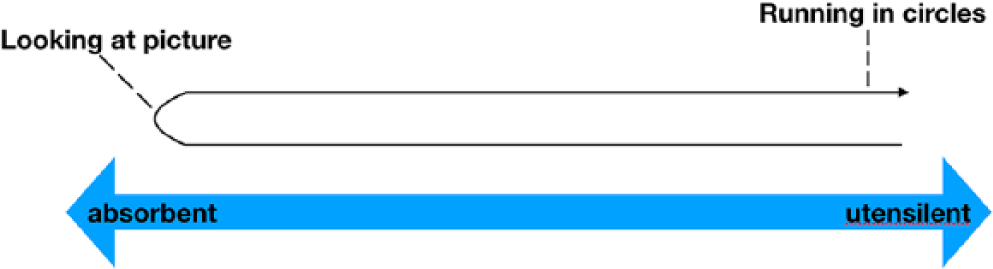
Sofia.
Conclusion
We have proposed a spectrum, ranging from absorbent to utensilent sociomaterial practices, that takes into consideration the material status of tablets in children’s play practices. Towards one end of the spectrum, we have seen Sebastian engaged in an activity characterized by a foregrounded tablet that momentarily configures an absorbent materiality, a sliding play practice and a mood of devotion. At the other end of the spectrum, we have seen Sara and Sofia involved in activities temporarily backgrounding the tablet with a utensilent materiality, aligned with a play practice of displaying and a mood of tension. The overlaps between object positions and play moods are not seen as a chain of cause and effect, rather they are seen as enacted connections between different aspects that co-constitute practices. Consequently, we need to research children’s play with different kinds of media over meaningful stretches of time in order to get a sense of how positions between agents and objects evolve and shift together with mood and meaning. The spectrum we have proposed calls for the development of new methods that capture these changes over time. Finally, we urge future research projects to consider this spectrum in reference to different kinds of objects for play.
Footnotes
Funding
The authors received no financial support for the research, authorship and/or publication of this article.
