




Abstract
This article reports on the findings of a mixed-methods, interpretive study identifying practitioners’ pedagogical approaches when children aged 3–4 years use touchscreen devices in early years settings in the West Midlands, UK. A multi-site case study approach was adopted involving interviews with 12 practitioners to identify their rationale for using these devices. Coupled with 160 observations of touchscreen practice, this allowed the opportunity to critique intentions with practice, to determine children’s opportunities to play with, and potentially learn from, touchscreen technologies. Capturing child voice was an integral aspect of this study. By providing the opportunity for children to express their views through four focus-group interviews, the study found that there was a distinct difference between children’s and practitioners’ intentions regarding touchscreen play. As a result, practitioners overlooked opportunities to strengthen children’s learning by following their interests. The data were analysed using activity theory as a central theoretical framework. From this analysis, it is argued that pedagogical approaches surrounding touchscreen use in early years settings need to be developed in order to incorporate the child’s voice in decisions which impact on the ways in which they play with these devices.
Introduction
It is widely recognised that touchscreen technologies are ubiquitous in young children’s lives. Ofcom’s (2013; 2017) studies over the last 6 years have shown how children aged 3–4 years have had increasing access to these in English homes, from 28% of pre-schoolers in 2013 to 65% in 2017. In early years settings in England, this trend is also mirrored; there has been a 36.2% increase in the number of preschool-aged children who had access to touchscreen devices in their settings from 2013 to 2015 (22% vs 58.2%, respectively; Formby, 2014; Knowland and Formby, 2016). The touchscreen is perceived as a learning resource, offering capabilities for children to develop literacy skills from literacy-based apps (Formby, 2014), and develop social skills from increased opportunities for social interaction when playing with these devices (Arnott, 2013). Communication and language development is also reported to be promoted from playing with touchscreens (Edwards, 2013; Gray et al., 2017), stemming from the interactions and conversations while playing; Neumann (2014) also reported an increase in children’s emergent literacy skills.
Although touchscreen devices are increasingly present in young children’s lives, the challenge persists that there are various barriers which impact on the learning opportunities children are provided. These include practitioner confidence and understanding of how to use the devices (Blackwell et al., 2014), resulting in potentially low-level interactions which could be damaging for young children. In response to these barriers, this article reports on an investigation into the pedagogical practices implemented in four early years settings in the West Midlands to identify the potential affordances of the touchscreen. This was guided by the research question, ‘Which early years pedagogies do practitioners implement when supporting children’s learning when using touchscreens?’.
Literature
Technology as a social tool
Building upon the social constructivist perspective that learning is a socially connected action, and that through interaction with others, people learn (Berger and Luckmann, 1991), the touchscreen device has recently begun to be perceived as a social tool. Studies across the globe have recognised the potential of the touchscreen to facilitate social play, and that through children’s interactions with their peers or adults, they learn based on others’ prior experiences (Flewitt et al., 2014; McLean and Edwards, 2016). Vygotsky (1978) recognised the importance of the ‘more knowledgeable other’ in scaffolding learning by sharing knowledge from prior experiences, and this is reflected in studies that show that when children play together, they share their knowledge and understanding so that others can benefit (Arnott, 2016). This therefore positions the touchscreen as a social tool, offering opportunities for others to share their knowledge and experiences with others to extend learning.
Technology as a skill
Aside from being perceived as a social tool, perceptions of technology in educational environments have also developed in recent years. Once perceived as a skill to acquire by learning operational skills, technology is now perceived in relation to the affordances of the device for children’s learning (Edwards, 2013). Within an early years context, an emphasis on learning operational skills is considered antithetical to the play-based pedagogy implemented across a majority of settings in England (Edwards et al., 2017). However, the use of technology challenges the play-based approach, particularly since Edwards et al. (2017) reported in an Australian study how practitioners found it difficult to foster children’s imagination when using technological devices. In England, Palaiologou (2016) reported practitioners felt unprepared to integrate technology into a play-based pedagogy, explaining practitioners were unaware of how technology fit into this approach.
The challenge of incorporating this device into early years practice is reflected in other studies too; Bird and Edwards (2015: 1149) suggested Australian practitioners struggled to ‘understand the pedagogical uses of technologies’ when the focus in many early years settings is learning through play. To contribute to this challenge, practitioner identity, confidence and previous experience impact on the ways in which these devices are used. In America, Blackwell et al. (2016) explain that when technology was positioned as a skill to acquire, observations revealed the practitioner controlled the learning rather than allowed children opportunities to explore the devices. Aubrey and Dahl (2014) and Gray et al. (2017) identified that practitioner confidence was a contributing factor which impacted on the way in which touch screen devices were used with young children, expressing concern that practitioners did not feel confident to support children’s learning with unfamiliar technologies.
Technological pedagogy
In response to these challenges, a new approach has been developed by Fleer (2017) who proposed a digital pedagogy that encompassed the practitioners’ intention and children’s interests when planning for digital play. Fleer addressed the need for children’s voice to be recognised when planning their early technological experiences, rather than focussing solely on adult intentions. The connection of both the child and adult interests allows for a deeper understanding over how the child perceives the technology, and enables links to be made from home-based technology use and setting-based activities.
Stephen and Edwards (2018) argued that there is an emphasis on learning to use the technology rather than exploring how children may learn from these devices. Subsequently, there is a risk that touchscreens could be misused (Falloon, 2013) or used in restrictive ways based on a lack of understanding or limited confidence in supporting learning. Coyne et al. (2017) discuss restrictive mediation techniques as a way to protect children when using technological devices. These focus on keeping children safe by minimising the risk of harm from factors such as the Internet, which limits the range of opportunities to explore the technology’s capabilities. Palaiologou (2016: 307) found practitioners were ‘concern[ed] for children’s safety and well-being’ which could explain why restrictive mediation techniques are implemented. Conversely, enabling mediation techniques (Livingstone et al., 2017) allow the child greater access to more features on devices but increases the risk of accessing harmful content. Therefore, Livingstone et al. (2017) argue that it is challenging to achieve a balance between these techniques whereby children are offered a range of experiences that encourage exploration and fosters learning in a way which keeps children safe from risk of harm.
Building upon Falloon’s (2013) suggestion of encouraging practitioners to assess where they place technology within children’s learning, it is important that practice is investigated to explore how children’s needs and interests are supported in meaningful, safe and effective ways. As such, this article addresses this recommendation by outlining the ways in which practitioners seek to use touchscreen devices with young children in early years settings in England. This is so, to identify the opportunities for learning that children are provided, and enables opportunities for a deeper level understanding of the ways in which children’s interests are acknowledged and incorporated within planning focused on touchscreen use.
Methodology
Sample
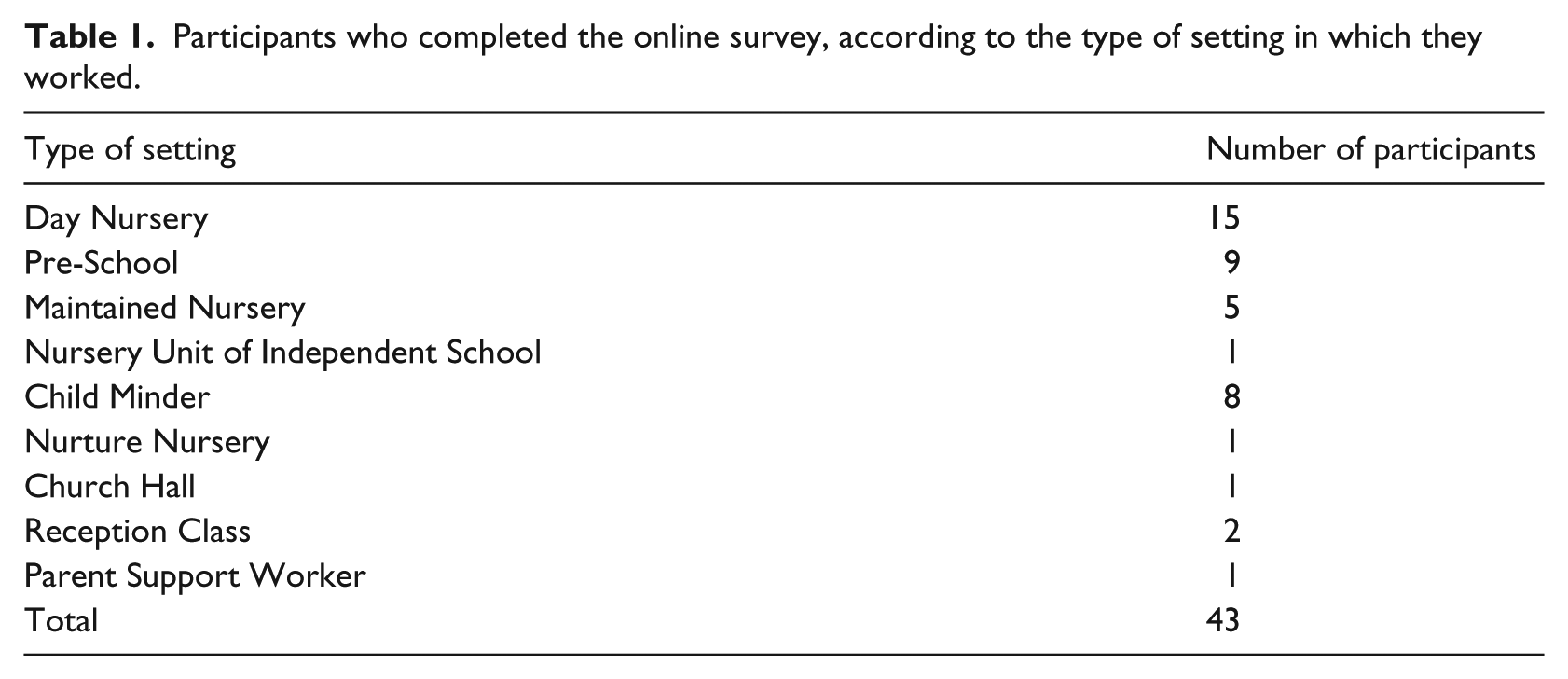
The study adopted a mixed-methods approach (Creswell, 2013; Stake, 2006) and was conducted in two stages. The first stage involved an online survey, including both open and closed questions. The questions focussed on general uses of the touchscreen, to gain an insight into the practices implemented in a range of settings with the technological devices. Questions focused on the type of device available, the ways in which the devices were used, whether children played whilst being supported by an adult or without the presence of adults to scaffold learning, and the frequency and length of availability of the devices each day and per week. Forty-three participants took part, who worked in nine different types of early years settings (see Table 1). Each participant worked at a different setting, so a range of responses were obtained. From the 43 participants who took part, four were selected via a purposive sampling method (Opie, 2004) to be involved in the second stage of the study. The participants worked at four different types of early years setting. This multiple case study approach (Yin, 2009) allowed for an ‘up-close, in-depth understanding’ of practice in each setting (Bromley, 1986: 1) to determine the pedagogical approaches implemented and the extent to which they differed.
Participants who completed the online survey, according to the type of setting in which they worked.
The second stage of the study involving four case study settings, included the following:
A Day Nursery (a private setting for children from age 6 weeks to 4 years);
A Child Minder (home-based provision);
A Pre-School (setting for children aged 3–4 years ahead of starting school age 5);
A Children’s Centre Nursery (a setting for children who live in areas of deprivation and receive support from a range of services).
As part of the second stage of the project, interviews with practitioners, observations of touchscreen practice and focus-group interviews with children were conducted. A social constructionist stance guided the study, through the generation of ‘realities’ from both practitioners and children (Denzin and Lincoln, 1994). This was considered important to learn about the touchscreen ‘world’ as perceived by both children and adults, in order to determine touchscreen intentions, and children’s perspectives of the touchscreen (Berger and Luckmann, 1991).
Data collection methods
Semi-structured interviews were conducted with practitioners to gain an understanding of beliefs and attitudes towards the touchscreen, and its implementation in a play-based pedagogy (Teddlie and Tashakkori, 2009). The questions asked during interviews with the four managers focused on a whole-setting approach to touchscreen usage and the ways in which practitioners and children responded to the new devices. The remaining interview participants were selected because of their roles in the setting; these included room leaders, the technology lead and other practitioners who frequently interacted with the children and therefore could provide detailed information regarding the use of touchscreen devices during play. Interview questions included the following:
What encouraged you to introduce touchscreen devices in your setting?
In what ways do you use the touchscreens with the children?
What do you hope to gain from encouraging children to use touchscreen devices?
Observations followed the ‘day in the life’ approach (Gillen et al., 2007), so each time the touchscreens were used across a 5-day period, observations were recorded in a written format on a proforma (Cohen et al., 2018). In total, 13 observations were recorded in the Child Minder setting, 35 were recorded in the Day Nursery, 60 were recorded in the Children’s Centre Nursery and 36 observations were recorded in the Pre-School. The length of each recording varied from 1 to 51 minutes across the four settings. Both qualitative and quantitative data were obtained from observations; field notes recorded aside from the proforma complemented the quantitative data gathered.
Focus-group interviews were important to capture the children’s voices, recognising children as experts of their own worlds (Greene and Hogan, 2005). Involving children within the study was a way in which child voice could be represented in order to seek to develop practice based on their own understandings of and intentions to use the touchscreen devices. There was one group in each setting of up to five children aged 3–4 years old participating. The questions or prompts which were used for discussion focused on children’s likes and dislikes when using touchscreen technologies, and how they best preferred to use them, whether that be independently, shared with peers, or shared with adults. The results allowed for a comparison between what practitioners discussed during interviews, and how that aligned with observed practice and children’s preferences.
Ethical considerations
The study was approved by the Birmingham City University Ethics Committee, and followed the British Educational Research Association (BERA; 2018) guidelines on ethical practice when researching with young children and adults. Anonymity and confidentiality, gaining consent and ongoing assent, and the right to withdraw were the ethical principles adhered to. Consent lanyards were designed to give children a voice which enabled them, through a smiley face system, to show whether they were ‘happy’ and consented, or ‘sad’ and withdrew their consent (Figures 1 and 2). These were used during observations and focus-group interviews to allow children opportunities to provide ongoing assent (Flewitt, 2005), and enabled children the opportunity to withdraw their consent at any point in the study.
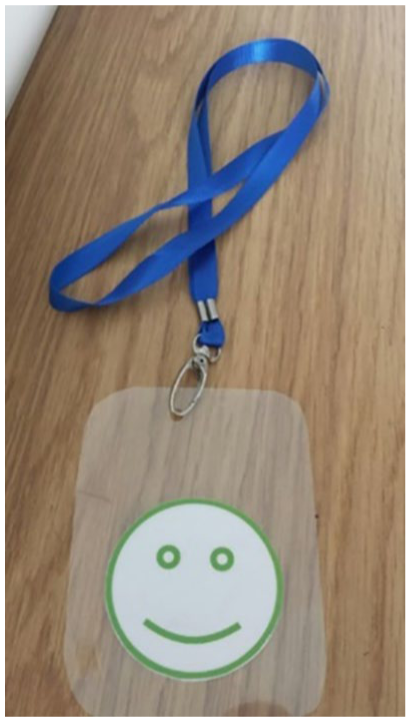
Consent lanyard ‘happy’ face.
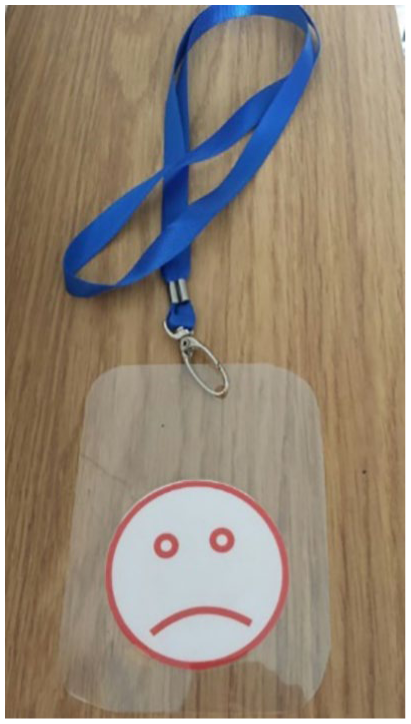
Consent lanyard ‘sad’ face.
The study was non-generalisable due to the small-scale nature of the study, but localised, ‘fuzzy generalisations’ (Bassey, 2001) were made according to the practice observed and reported in each of the settings. It was possible to determine the extent to which practices across settings were similar to each other or guided by early years principles based on how children learn. The study, and indeed this article, provides a snapshot of information into the lives of young children as they interact with touchscreen devices in their early years settings. Trustworthiness was established within this study through focussing on credibility, reflecting the reality of practice through the data, thus, presenting the data as ‘believable’ (Glaser and Strauss, 1967) rather than generalisable.
Method of analysis
Thematic analysis (Braun and Clarke, 2006) was implemented to identify themes and patterns within the data. It was important that codes were not wholly guided by the literature, rather to recognise the participants’ words or actions as themes. Guided by the social constructionist framework (Berger and Luckmann, 1991), further analysis occurred using activity theory to determine the interactions surrounding the touchscreen.
Activity theory
To explore the affordances of the touchscreen, it was important that the touchscreen was positioned centrally in relation to activity. Recognising the various factors which contribute to, and influence, touchscreen play was important to determine the extent of the influence of these factors. Activity theory was identified as an appropriate model to analyse the data, as it enables activity to be positioned as socially connected action rather than an individual action (Palincsar, 2005; Figure 3).
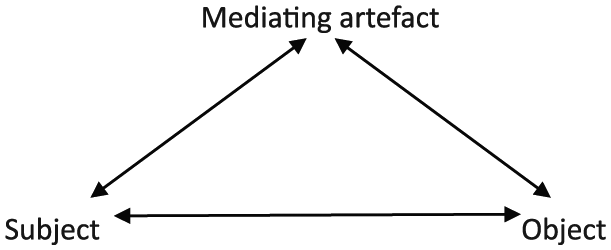
Model of mediated action (adapted from Vygotsky’s 1978 model).
The triangular model has a series of nodes to represent different aspects of the theory; the tool, the object and the subject. The multi-directional arrows on this model outline how each of these three nodes influence each other. The tool is considered any object which facilitates action (Hasan, 1998) and in this study was the touchscreen device. The interaction of the tool, subject (people) and the object results in an outcome. It is a useful model to observe the complex interactions and learning situations in natural settings (Yamagata-Lynch, 2010).
Further development of activity theory by Leont’ev (1981) and Engeström, (1999) positioned the activity as being more complex in its social environment, with some critique that Vygotsky’s (1978) model focusses on individual action rather than social action (Hedegaard et al., 1999). The development of the model which acknowledges the wider social factors can be seen in Figure 4. The rules, the community and the division of labour were social nodes which Engestrӧm (1987) asserted had the power to influence activity. Engestrӧm (1987) labelled the new model an activity system, which he describes ‘integrates the subject, the object, and the instruments (material tools as well as signs and symbols) into a unified whole’ (p. 67).
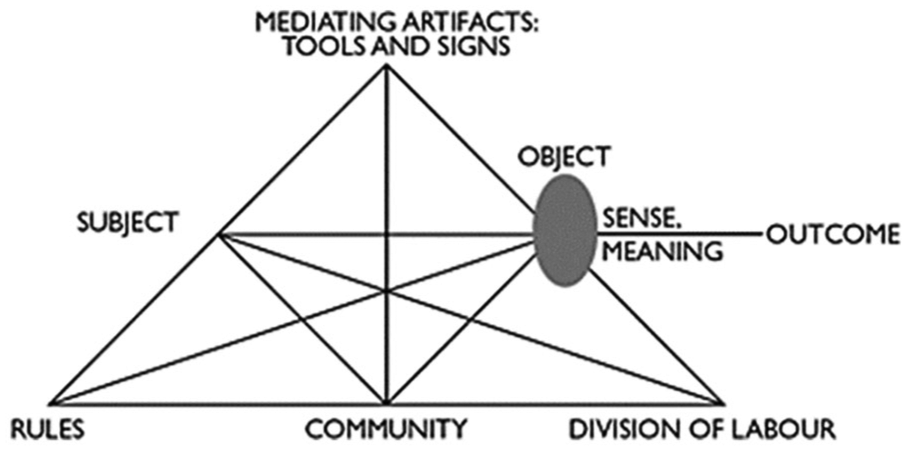
Engeström’s (1987: 78) structure of a human activity system.
Within this extended model of activity, Engeström, (1999) believed that as activity systems interact, contradictions arise whereby practice requires development in order to achieve harmonious working. Contradictions are not necessarily negative aspects of practice, rather these are tensions which identify where development is required in order to allow for effective or improved practice (Nikolaidou, 2011). Contradictions that are identified are considered ‘motive forces of change’ (Engeström and Miettinen, 1999: 9). Represented by ‘lightning bolts’ on the model, these identify where there is a contradiction between two or more nodes within a system (Figure 5). For example, a lightning bolt between ‘rules’ and ‘community’ signifies that there is a contradiction between the social element of activity and the rules established surrounding the activity. This aspect of activity subsequently requires development to enhance or improve practice.
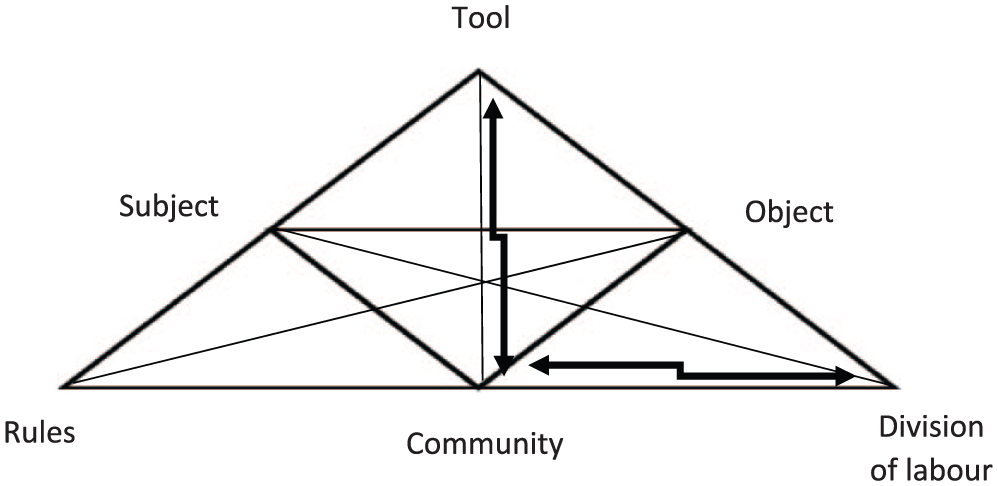
Internal contradictions within an activity system (adapted from Engeström, 1999).
This article focuses on the contradiction aspect of activity theory through the ‘rules’ associated with the touchscreen, acknowledging the ‘tensions’ between practitioners and children. This is explored through the pedagogical approaches reported by practitioners, and the pedagogical approaches desired by children.
Findings
Pedagogical approaches as reported by practitioners
Interviews with 12 practitioners revealed they intended to use touchscreen devices so that the children would learn the necessary skills to be prepared for technology use at school. There was an underlying theme of school-readiness when speaking to managers in all settings and practitioners who worked directly with the children, acknowledging that the early years was an ideal period for children to develop basic awareness and understanding of technological devices, particularly if children did not have access to technology at home.
In the Child Minder setting, one practitioner explained, It gets them ready for, they’ve got a basic knowledge of using a computer or a tablet ready for when they go to school.
This was further reiterated across the settings, with a Children’s Centre Nursery practitioner commenting: If they’re coming from home where touchscreens aren’t available, and they don’t have [touchscreens], they don’t have phones with internet connections, that they’re getting the same experiences of the new technology that the other children are getting [is a good thing].
It was reported that children would play games on the devices, but this was reinforced on occasion that children would play on educational games, since practitioners sought for children to benefit from them. The room leader in the Day Nursery was explicit about the apps children would play with: . . . more of the educational ones rather than the gaming side of it, but yeah, they’ve [children] all been asking for certain games and they’ve all enjoyed using it.
This was also reinforced in the Pre-School: They’ve [apps] got that educational, kind of, you know, that they are educational and that there’s an outcome to them so that there is some learning going on, it’s not just playing on a game.
The practitioners across all settings identified learning potential from using apps across most areas of development in the Early Years Foundation Stage (Department for Education (DfE), 2017), such as Personal, Social and Emotional Development, Communication and Language, Literacy, Mathematics and Physical Development. It was reinforced that children would be exposed to new ways of learning by using the devices based on the content of apps, but using the device itself was beneficial for children to develop their fine motor skills. Playing games for entertainment purposes was more frequently reported in the Child Minder setting compared with the other, more formal establishments. In the Pre-School, it was heavily reinforced that apps should have an outcome and there are learning intentions, reflecting the educational expectations to prepare children for school.
Using educational apps appeared to be an underlying rule across all of the settings, since these were perceived to have learning value. Rules featured heavily during interviews when speaking to practitioners about the ways in which children could use the devices. Practitioners reported how they limited children’s access to the devices using set timeframes, for example, of 10 minutes per child per day, and also reported that children were permitted access to the devices on certain days of the week. The full range of rules implemented in the four settings can be seen in Table 2. Where rules are checked, implies that a rule was implemented for this setting in relation to touchscreen use. For example, there was a rule on Internet access for the Child Minder, Day Nursery and Pre-School settings, but not for the Children’s Centre Nursery. Where there is no check for each setting, implies that there was no rule in place.
Touchscreen rules implemented in the four early years settings.
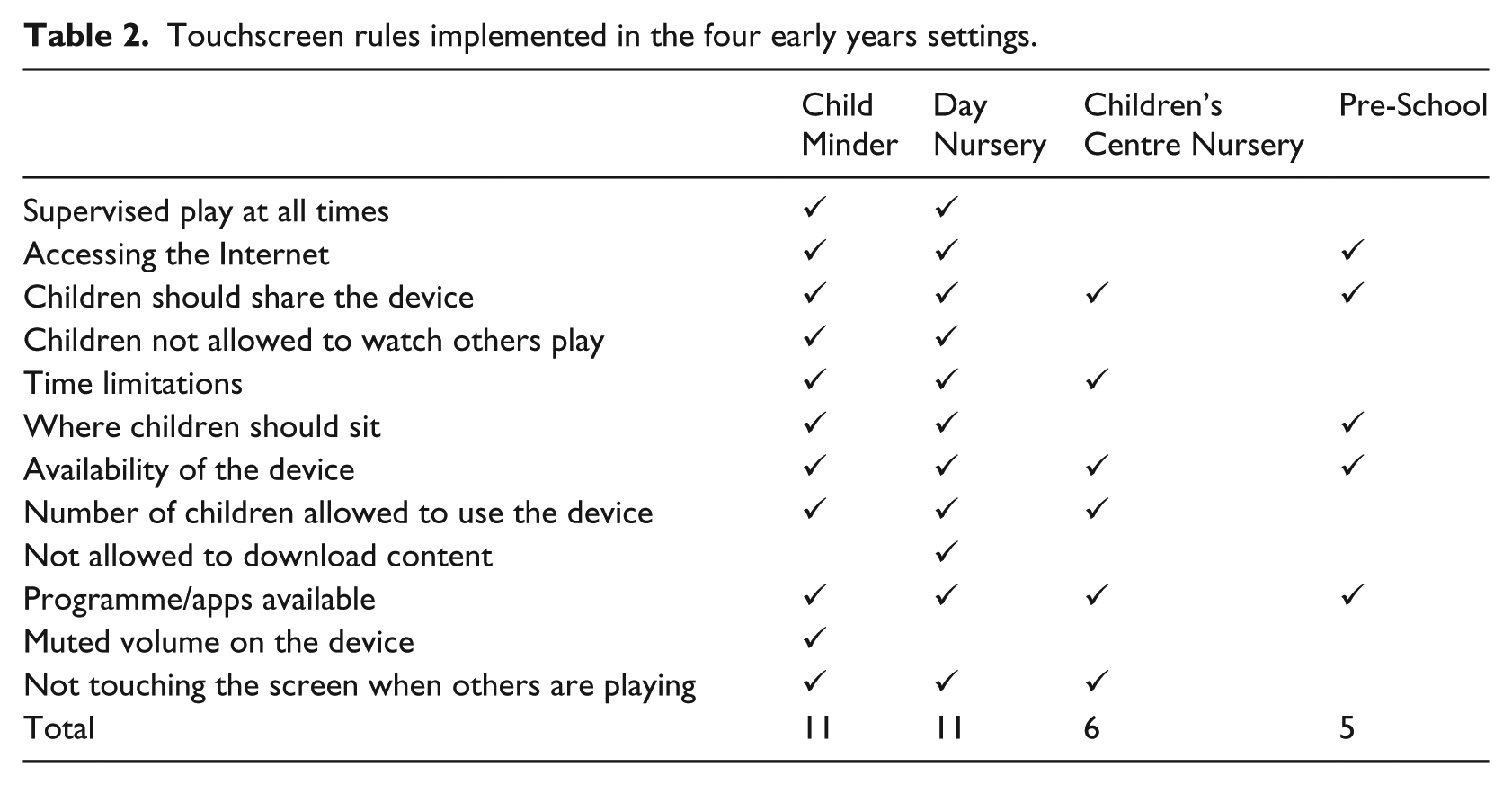
Rules were also reflected in other ways that children could use the devices; to manage access to the Internet, the Child Minder and Pre-School settings disconnected the Internet, whilst in the Day Nursery, practitioners supervised play to ensure children did not gain access. Internet connection was disabled or monitored in order to protect children from potential online risks, as reported in the Children’s Centre Nursery: You can access things that aren’t appropriate for three-year olds.
One Pre-School practitioner recognised the risks of the Internet, since children had demonstrated skills required to navigate the web, explaining children were known to: Type in things, press adverts. All sorts of things were coming on and at times, unsuitable things.
In all, reported rules centred on Internet access, the ways in which children could use the devices in order to promote learning and development, and time restrictions.
Pedagogical approaches as desired by children
Exploring the nature of their touchscreen play through focus-group interviews, children revealed that they sought a balance between solitary and shared play, and input from practitioners during their free-play time. Nine out of 13 children expressed preference in playing on their own when using touchscreens, reflected through comments such as: I don’t want anyone to see me drawing.
Children were protective of their playtime when using the touchscreens when they played unsupervised, and this was reflected in the negotiations between children in the Children’s Centre Nursery:
You’ve had a go
I haven’t
You’ve had two goes. Have one more go and then go and play
No, I’m going to get you and chop you like that [gestures with hand a chopping motion]
Children’s negotiations took violent turns on occasion, where children struggled for ownership of the devices. It was in these moments where adults intervened to ensure children were playing according to the rules and were not raising their voices or causing physical harm. Adult presence in these moments focused on mediating between children, after which they returned to other areas of the setting.
Discussions with children revealed that they sought for practitioners to be more involved in their play when they used touchscreens, rather than practitioners being present just to mediate touchscreen play. When asked if he liked to play on the touchscreen with an adult, a child from the Children’s Centre Nursery replied: I do. But we don’t, we play with the kids.
Throughout the course of collecting data, there were infrequent occasions where practitioners engaged in discussion with children while playing on the touchscreen. There were elements of scaffolding observed through supporting children to identify first words from a list on the screen, but in all, touchscreen play was a largely child-initiated activity whereby they followed rules established by practitioners.
Aside from desiring greater input from adults, children expressed preferences to explore on areas of the touchscreen which went against the rules set by practitioners. For example, children were often observed to try to access the Internet, watch videos on YouTube or to download apps from the AppStore. On one occasion, a boy in the Pre-School setting gained access to a touchscreen with Internet connection, and proceeded to watch Peppa Pig videos on YouTube: Child 1 and Child 2 share the chair which Child 1 is sitting on. Child 1 laughs as he slips off the chair. Child 1 tells Child 2 ‘I get you a chair. You can have this chair and I can have that chair. Come on’. Child 1 pauses the video and gets another chair. Both boys sit and watch the video. Child 1 asks Child 3 ‘you wanna watch this with me?’ Child 3 nods her head. ‘Go on then’ Child 1 tells her. Child 1 asks Child 3 ‘you wanna sit down? I watching Peppa Pig’. Child 1 moves over to make space between the two chairs for Child 3 to sit down. Child 3 runs off. Child 3 returns. Child 1 asks her ‘you wanna watch with me?’ Child 3 nods her head. Child 1 tells her ‘come and sit down’ and moves to the left and the girl sits down, sharing Child 1’s and Child 2’s chairs. The three children watch the video.
Other occasions were observed where children in the Day Nursery would seek to play with their peers but were discouraged from doing so by practitioners. Children would often let others come and play by taking turns to touch the screen to pop bubbles, or match pairs together. When practitioners were aware of this, they would often tell the other children to move away from the touchscreen area, disregarding children’s intentions to play together.
Overall, children’s preferences centred on seeking greater interactions between their peers and adults during touchscreen play (for most of the children), although others found this disruptive and played independently. There was significant evidence that children sought to access areas of the touchscreen that were not allowed in order to extend their play, which disregarded practitioner rules.
Discussion
The data revealed that practitioners sought for children to gain access to technology at an early age so that they would not be disadvantaged against their peers when attending primary school, which reflected recommendations from Marsh et al.’s (2015) study. This justification of using technology to prevent children being disadvantaged reflected the social construction of technology in young children’s lives, through the persistence from practitioners in acknowledging that this was an ideal time for children to develop early technological skills. Cultural and societal values of technology also influenced this decision, through practitioner reports of technology being used in schools and therefore was a cultural requirement that children had opportunities to participate in technological play (Bird and Edwards, 2015).
Of the pedagogical approaches implemented, there was a heavy reliance on restrictive mediation techniques (Coyne et al., 2017), such as supervising children’s play and the wide range of rules which practitioners reinforced. These limited children’s opportunities for exploration and engagement in activities of interest to them, but were outside of the apps available on the devices. There were many missed opportunities where children’s learning could have been extended, but were prevented from the restrictions imposed on them to keep them safe (Livingstone et al., 2017). Whilst I am not suggesting children be allowed free access to all sections within the touchscreen devices, it is important that informed decisions are made about the extent to which children’s interests can be followed in a safe manner that both challenges them yet poses minimal risk to their well-being.
It became apparent that practitioners consulted each other when planning for touchscreen play, but there was no evidence of them consulting children in terms of their own interests of what they would like to play on. This study has enabled the identification of different intentions through providing children and practitioners a platform in which to express their preferences or intentions which guide and direct touchscreen play. Activity theory has enabled identification of further differences in practice and intentions by children and practitioners (Figure 6). Two activity systems have been generated, one representing practitioners’ intentions, and the other representing children’s intentions when using touchscreen devices. When comparing these, bringing together reports from interviews with practitioners, and observations of children playing, is it clear to see that there are differences in perspectives from both children and practitioners, in how these devices are, or should be used. The two activity systems demonstrate the range of ways in which practitioners intend to support children and the measures in place to keep them safe when playing (see ‘rules’ for example), and children’s preferences expressed through focus-group interviews or observations of practice. The lightning bolt arrows represent the contradictions that arose by comparing reported practice and observed practice and allow scope to consider how practice can be further developed.
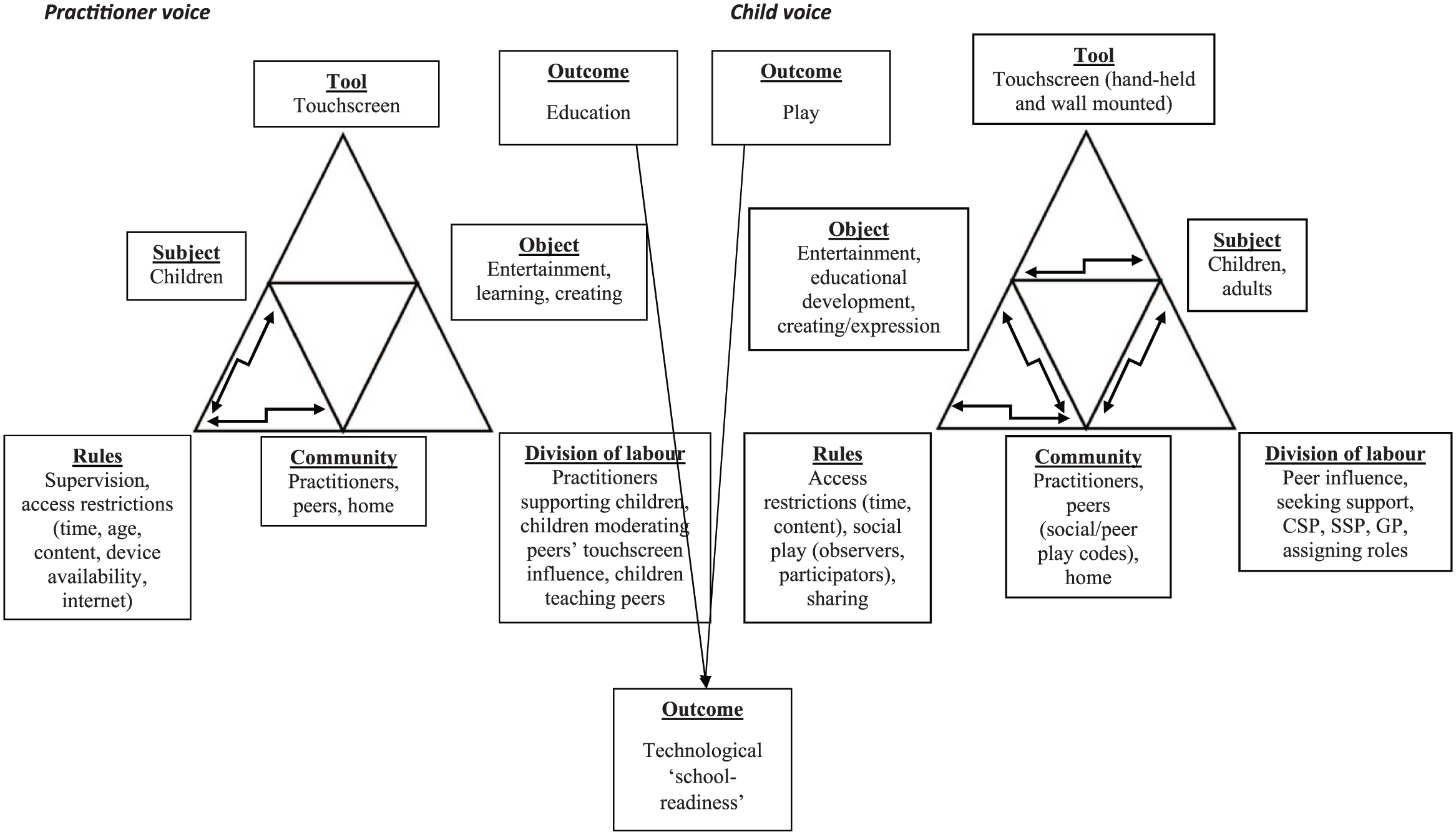
The contradictions between practitioner and child voice.
There were clear contradictions between the rules established by practitioners and the ways that children played, such as accessing the Internet to follow their interests. This demonstrated that practitioners may not always be in tune with children’s intentions and instead there should be greater communication between practitioners and children whereby practitioners speak to children to determine their interests, so that these can be incorporated into touchscreen play. Achieving this would support the adoption of Fleer’s (2017) digital pedagogy by making the connection between practitioner and child to enhance practice further. It is important to recognise that children have a voice and they should be listened to, particularly in relation to matters which impact on their learning. This approach is also in line with current child-centred pedagogies such as ‘in the moment planning’, whereby the child’s interests and needs are at the centre of practice, and planning is developed according to children’s interests, in the moment during play (Ephgrave, 2018). Since touchscreens were bought into these settings in response to a growing need to enable children to learn technological skills, it should be considered a priority for practitioners to make the connection between what children already know and how they can be challenged to extend their learning, following their interests at the same time. This includes seeking information from children and their parents in relation to their home use of technology, to further strengthen practitioners’ understanding of children’s interests and capabilities.
Contradictions also surfaced in relation to the shared aspect of touchscreen play, which reflected that practitioners could benefit by seeking to understand children’s preferences, as in the two settings where shared play was discouraged, there were frequent attempts by children to share. The vignette of the children in the Pre-School watching videos together showcases the positive interactions and the enjoyment shared between the children when provided with opportunities to share. It is therefore important for practitioners to reflect on their practice and the approaches they implement, taking into account their understandings of children’s early development and the importance of social interactions in fostering learning.
Conclusion
This article has provided an insight into the practices of using touchscreen technologies with young children in four early years settings. This article has revealed that there is a disconnect between practitioners’ and children’s intentions when using the touchscreen, and there were frequent missed opportunities where children’s interests in exploring the technology were not met. I can therefore conclude that while technological pedagogies are developing whereby practitioners recognise the presence of touchscreens within young children’s lives and provide children with opportunities to learn technological skills, there is more work to be done to fully integrate children’s interests into these play-based experiences. There is a clear difference identified between practitioners and children in relation to touchscreen intentions, and this has been demonstrated through the activity system model, providing both practitioners and children a voice. Since these voices have been provided a platform, there now needs to be further development and consultation with children to identify their interests and discover their touchscreen practices in other environments, to determine how practitioners can build upon these to further enhance these learning experiences. These practices could therefore reflect new pedagogical approaches in early years practice, such as Fleer’s (2017) digital pedagogy, bringing together practitioner intentions and children’s interests into planning, and ‘in the moment planning’, recognising the importance of following children’s interests and planning based on the developments of children’s play, as they happen.
Future developments
The activity systems have begun to uncover the way in which both children and adults approach the touchscreen, and this provides scope to explore in larger scale studies to determine whether these findings were isolated to the settings involved in this study, or whether these findings can also be seen in other early years settings. While there were positive interactions observed between children and their peers and children and practitioners within this study, these occurred infrequently partly due to lack of practitioner presence in some settings, and the rules implemented which restricted shared play. These moments can be increasingly valuable to children as they begin to support each other and share their knowledge, but there were few opportunities in light of the rules.
Footnotes
Funding
The author disclosed receipt of the following financial support for the research, authorship, and/or publication of this article: This was a PhD study funded by Birmingham City University.

Author biography
Shannon Ludgate has a PhD in early years and is a lecturer in the Department of Childhood, Youth and Community at Birmingham City University. Her research interests focus on the use of touchscreen technologies in the early years and digital pedagogies.