




Abstract
Touchscreen technologies have become an important part of many young children’s lives. While kindergarten teachers’ perceptions of the use of touchscreen devices have been investigated across many countries, empirical research on the topic remains scant in mainland China. In an exploratory study, the lead researcher interviewed six teachers from an exemplary kindergarten in Nanjing and analyzed relevant documents to further explore the teachers’ beliefs around children’s use of touchscreen technologies. The Technological Pedagogical and Content Knowledge (TPACK) model was used to understand the rationale behind teachers’ perceptions and self-reported practices. Findings showed that participants generally perceived touchscreen devices as useful tools for catering to children’s interests, believing they could provide active learning experiences. Teachers made decisions about children’s use of touchscreen technologies based on their understandings of learning, pedagogy, subject content, and the affordances of these technologies. Implications for future research on kindergarten teachers’ use of touchscreen technologies are also presented.
Introduction
It has become increasingly apparent that many children live in a world filled with digital technologies (Lips et al., 2017). Some kindergarten teachers, in Australia, the UK and China for example, have begun to use digital technologies in teaching and learning to provide young children with new learning experiences (Liu, 2017; Ludgate, 2019; Yelland, 2018). In this context, touchscreen technologies have gained much attention from kindergarten teachers because they allow children to interact through simple operations such as dragging and pointing (González-González et al., 2019), rather than requiring the skills necessary to control peripheral devices such as a mouse or keyboard (see e.g. Mercier et al., 2016).
The appropriateness of devices, including touchscreen technologies, is a subject of debate in the early childhood education (ECE) context. While one school of thought is that touchscreen technologies are important because they provide young children with more learning opportunities (e.g. Edwards, 2007; Stephen and Plowman, 2013; Yelland, 2018), another argues that they pose threats to children’s learning and development (e.g. Armstrong and Casement, 2000; House, 2012). Given that the prevalence of touchscreen technologies in many children’s daily lives is an unquestionable reality, some researchers are now suggesting the discussion should move on to investigating how these devices can be used to support children’s learning in meaningful ways (Stephen and Edwards, 2018).
In mainland China, the Ministry of Education (2012a) issued guidelines on implementing technologies in a wide range of educational settings, including kindergartens. Consequently, many teachers are keen to introduce touchscreen technologies into kindergarten classrooms. For example, after surveying 155 teachers from 13 kindergartens, Liu (2017) found 61.2% of the participants obtained interactive whiteboards and 52.9% of them provided tablets for children to use. The prevalence of touchscreen technologies has been reported by many Chinese researchers. However, kindergarten teachers’ subjective perceptions of the use of touchscreen technologies are not well reported in the literature. Because teachers’ attitudes towards touchscreen technologies and their reasons for using them would directly influence children’s learning experiences, this study aimed to investigate teachers’ perceptions and practices related to these technologies.
This article presents research conducted in Chinese but reported in English. Therefore, it is important to provide clear definitions of key terms. Touchscreen technologies are defined as devices with a glass screen interface that “detects and accurately responds to stimulation by a finger within the visual display area” (Neumann, 2014: 110). In this study, touchscreen technologies include tablets and interactive whiteboards. Kindergartens in mainland China refer to educational institutions that provide teaching and caring services for children from three to six years old (National Education Committee, Mainland China, 1996).
Touchscreen technologies in early childhood education
There are several reports on the potential benefits of providing children with opportunities to use touchscreen technologies; these studies generally find that kindergarten teachers value children’s increased learning interest and motivation. For example, Martín et al. (2019) examined the impact of using touchscreen technologies with children in three kindergartens in Spain. Interviews with teachers reflected that children’s motivation to learn increased and learning outcomes showed obvious improvement. They also noted that touchscreen technologies were thought to be appropriate tools as they allowed the learning focus to shift from teachers to children, and supported learning in new ways. After reviewing literature on the use of what the authors refer to as tangible technologies, i.e. “multitouch surfaces, smartphones, tablets, robots, and technologically-enhanced toys” in early childhood education, González-González and colleagues (2019: 2) found the most frequently used technologies in ECE context were tablets because the multitouch screens and portable size allowed children to play across a range of classroom activities.
Similarly, Yelland (2018) found tablets could engage children in multimodal learning (i.e. through different sensory modes such as linguistic, visual, audio and touch) because of their ability to display pictures and videos, play audio files, and allow gestural operations. However, while emphasizing the educational value provided by tablets, Yelland (2018) also highlighted the importance of teachers’ pedagogical planning because technologies do not automatically present children with meaningful learning experiences. To ensure children’s interactions with touchscreen technologies would benefit their learning, Yelland (2018) suggested teachers consider the integration of the devices and curricula and re-conceptualize children’s learning in the contemporary context.
The interactive whiteboard, another type of touchscreen technology used in many ECE settings, is believed to be a meaningful tool to support teaching and provide children with various learning opportunities (González-González et al., 2019). However, a review of relevant research in the ECE context found that teachers often tended to use interactive whiteboards with didactic teaching strategies and that children had limited opportunities for interaction. For example, after observing thirty ECE settings in the UK and interviewing teachers, Morgan (2010) found that, although all teachers said they valued the ‘playful’ and ‘interactive’ learning experiences that could be provided by the interactive whiteboard, their actual use was limited to didactic teaching and children’s interaction was limited to dragging an item to provide a correct answer. Without exploring teachers’ rationales for using the devices and providing children with the device in the way they reported, Morgan’s (2010) study contributed a rather limited understanding of the use of interactive whiteboards in ECE settings. To address this gap, one aim of this study was to explore teachers’ perceptions of children’s interactions with interactive whiteboards.
Gaining an in-depth understanding of teachers’ practices with touchscreen technologies is not an easy task. After interviewing and conducting focus groups with 12 teachers and observing them with several groups of 3–4 year-old children in 9 ECE settings in the UK, Ludgate (2019) concluded that teachers failed to make informed decisions about children using information and communication technology (ICT) to pursue their interests and extend their learning. There was a distinction between teachers’ and children’s intentions when using the touchscreen devices, and teachers tended to impose rules that limited children’s opportunities for exploration and engagement in activities of interest to them. By analyzing the reasons behind teachers’ practices, Ludgate (2019) noted that teachers’ perceptions of touchscreen technologies, and their pedagogical beliefs in particular, were key factors which determined their decision-making around how to plan and support children’s use of these technologies.
It has also been widely reported that the choice of software or apps that teachers provide on touchscreen technologies will determine how children can learn with them. While some researchers found kindergarten teachers tended to favour early literacy apps (e.g. Blackwell et al., 2016), Yelland (2018) argued that it should be teachers’ responsibility to make wise decisions about selecting and providing apps. For example, it is more meaningful to support children to access open-ended apps which engage their creativity, imagination, critical thinking, and problem-solving skills, rather than apps of the drill and practice type. However, Yelland and Gilbert (2018) pointed out that the way teachers provide children with touchscreen technologies depends on their understanding of the ways in which children learn as well as their knowledge about potentially useful touchscreen technologies and apps.
Accepting that teachers play a significant role in deciding when and how to provide children with touchscreen technologies, this study focuses on teachers’ perspectives in order to understand their decisions around implementation. As teachers’ understandings of pedagogies, technologies, and subject matter all contribute to their decision-making process, the study used TPACK as a theoretical framework to understand their complex thinking around the use of touchscreen technologies in the ECE context in Mainland China.
Theoretical framework: Technological pedagogical and content knowledge model
TPACK is a model developed from Shulman’s (1986) Pedagogical Content Knowledge (PCK), so it is important to understand key concepts in PCK and their complex inter-relationships. According to Shulman (1986), teachers’ PCK is the basis of sound teaching as it involves teachers’ subject knowledge (Content Knowledge), teachers’ understanding of how to teach (Pedagogical Knowledge), and teachers’ knowledge of how to design specific pedagogical activities that enhance the teaching of specific subject matter (PCK). Based on Shulman’s PCK model, and in response to the development of educational technologies, Mishra and Koehler (2006) integrated Technological Knowledge (TK, which refers to teachers’ technology-related competency and skills), in a conceptual framework to investigate teachers’ knowledge within the contemporary educational context. According to Mishra and Koehler’s (2006) development of the concept of TK, it is not a separate knowledge base but one that has complex interactions with the other two key components.
In the TPACK model, both Pedagogical Technological Knowledge (PTK) and Content Technological Knowledge (CTK) are important in understanding teachers’ thinking around technologies, as they represent “an understanding of how technology can constrain and afford specific pedagogical practices” (Park, 2015: 68) and “knowledge of the reciprocal relationship between technology and content” (p. 67) respectively. According to Mishra and Koehler (2006), when teachers plan technology-supported pedagogical activities for specific subject content, they are actually applying their TPACK. However, while Shuman (1986) emphasized that teachers’ knowledge about learners is also an important component, Mishra and Koehler (2006) did not make this knowledge base explicit in the model they developed. Therefore, it raised a critical issue for using the TPACK model in the ECE context, as teachers’ understanding of the relationship between the learners and in what ways they learn is vital for pedagogical planning (Melendez Rojas, 2008).
Through the TPACK lens, previous researchers’ discussion about kindergarten teachers’ perceptions and practice in relation to touchscreen technologies could be further understood. For example, TPACK could explain why Ludgate (2019) found teachers’ pedagogical beliefs influenced the ways they supported children’s touchscreen use; similarly, this model could also address why Morgan (2010) observed teachers’ actual use of interactive whiteboard was limited to didactic teaching despite they valued children’s interactions with it – it is possible that those teachers made decisions based on their technological pedagogical knowledge and this knowledge base was different from the beliefs they shared with Morgan (2010). More importantly, the various knowledge bases and their complex relationships in the TPACK model could work together to tell a completed story about teachers’ rationales for providing children with touchscreen technologies, by taking teachers’ understandings of technology, pedagogy, and subject content into consideration.
Although the TPACK model has been examined and widely adopted as an aid to understanding teachers’ use of ICT in various educational settings, little research has been done in the ECE context (Blackwell et al., 2016; Chuang and Ho, 2011; Park, 2015). Prior to writing this article, no evidence had been found in the literature of its use in kindergartens in mainland China. Previous researchers found that the TPACK model could be used as an analytical framework to support understandings of the complexity in both teachers’ perceptions of touchscreen technologies and the reasoning behind their practices (Chuang and Ho, 2011; Park, 2015). Therefore, the TPACK model is considered to be an appropriate choice to address the research questions in the current study.
The focus of the literature review now moves to the context of ECE in mainland China, because teachers’ thinking about the use of touchscreen technologies is highly contextualized and cannot be understood in isolation.
The context of early childhood education in mainland China
In mainland China, ICT-supported educational reform has been part of a national development plan since 2012 (Ministry of Education of China, 2012a). The plan encourages teachers (including kindergarten teachers) to “implement ICT in pedagogical practices more often”, “use ICT to cater for different students/children’s learning needs and interests”, and “encourage students/children to actively learn from ICT resources” (p. 9). As a national plan issued for ICT development in the general education context, the document did not describe the ideal use of touchscreen technologies, nor did it provide practical suggestions specifically for kindergarten teachers. However, this document has influenced many kindergarten teachers’ use of technologies by widening access and use of ICT devices (Wu, 2014). Consequently, research on the use of ICT in kindergartens has emerged in mainland China.
Researchers investigating the use of ICT in kindergarten settings have generally found that teachers’ ICT use cannot be understood without considering the educational and cultural traditions in mainland China (e.g. Dong, 2014; Liu, 2017). Through the TPACK lens, this is because when teachers plan for children’s ICT use, they make decisions based on their pedagogical beliefs, which are profoundly shaped by the educational values and norms in their contexts. For example, Dong and Newman (2018) found kindergarten teachers in mainland China tended to use ICT for whole-class activities, which meant all children were expected to do the same activity (supported by ICT) at the same time. The reasons behind the teachers’ practices were related to Chinese culture and communist ideology (Dong and Newman, 2018). It is therefore important to introduce the context of ECE in mainland China before moving on to discuss literature on children’s use of touchscreen technologies in this context.
The context of ECE in mainland China is complex due to the fusion of various educational values and norms that come from a Confucianist culture, communist ideology and collective values, and educational theories from developed countries (Rao et al., 2017). To begin with, Confucianist culture emphasizes virtue and relationships and specifically focuses on desirable child behaviour. Kindergarten children are expected to be self-disciplined, respect teachers, and aim for high academic achievement (Li and Chen, 2016). Communist ideology and collective values have also shaped cultural and educational traditions due to the implementation of a curriculum model from the Soviet Union. This curriculum model focused on teacher-centred pedagogy, planning and promoting routines, and conducting activities based on prescribed, rigid schedules (Li and Chen, 2016). In recent decades, with the introduction of educational theories from other countries (such Piaget’s cognitive constructivism and Vygotsky’s social constructivism), the focus of ECE in mainland China is shifting the emphasis from teacher-led strategies to advocating child-led teaching strategies; from encouraging collectivism to respecting individual difference (Rao et al., 2017).
Research on the use of touchscreen technologies in kindergartens in mainland China did not begin to appear until recently. Previous studies showed touchscreen technologies being used in different teaching-and-learning activities (such as whole-class teaching and small learning areas) with various pedagogical goals (e.g. Dong, 2014; Li, 2017; Tan, 2017). Based on touchscreen technologies’ affordances for supporting children’s active and independent learning, it is argued that these technologies could be used by children in kindergarten settings where their role as active learners is emphasized (Liu, 2017; Wang, 2014). However, Dong and Newman (2018) found that educational and cultural traditions in ECE in mainland China may hinder the use of ICT because of gaps between teachers’ pedagogical rationale and actual use. It is possible that these issues would affect children’s use of touchscreen technologies because teachers are the ones who make decisions about opportunities for interaction. Although relevant research is scant from mainland China, the following paragraphs review a few touchscreen studies in this context and offer discussion of the research gaps.
The potential of touchscreen technologies in facilitating kindergarten children’s learning has been reported by some Chinese researchers. For example, after investigating the appropriateness of using touchscreen tablets in numeracy activities in one kindergarten in central China, Wang (2014) found the introduction of tablets facilitated children’s communication with peers and engagement of individual interests, both of which could support active learning. Li (2017) investigated the effects of using tablets to facilitate children’s storytelling abilities, and found this could be beneficial for literacy teaching-and-learning activities. However, without exploring teachers’ thinking behind their practice, neither of them could explain why teachers chose to implement tablets in those particular pedagogical activities.
The literature on teachers’ use of touchscreen technologies showed research focused on the connection between use and specific subject matter. For example, Wang (2014) explored the combination of tablets and numeracy activities while Li (2017) investigated the use of tablets in children’s literacy activities; both linked the use of touchscreen technologies to specific subjects but did not consider the potential of touchscreen in other pedagogical activities. This contrasts with an ECE curriculum guideline encouraging teachers to promote children’s learning and provide activities in an integrated manner (Ministry of Education of China, 2012b). The guideline suggests that specific subject matter should not be considered alone when investigating the use of touchscreen technologies in kindergartens.
Only a few researchers in Mainland China seem to have moved beyond a specific subject context to consider teachers’ use of touchscreen technologies in more integrated ways. For example, Tan (2017) investigated the use of touchscreen technologies in small learning areas in a kindergarten located in an eastern city in China by surveying and interviewing teachers. The study found teachers’ rationale for use was related to children’s learning interests and teacher convenience. While claiming teachers generally held positive attitudes toward touchscreen technologies, Tan (2017) failed to develop a holistic understanding of teachers’ thinking around touchscreen technologies, for example, what is the relationship between teachers’ understanding of touchscreen technologies’ affordances and their perceptions of particular ways those devices should be used?
The current study is a part of a PhD study that explored how ICT is used as a pedagogical tool by teachers in kindergartens in mainland China. Based on the research gaps related to touchscreen technologies in ECE, this study specifically focuses on this type of ICT in kindergartens in mainland China. Using the TPACK model, the current study aimed for more in-depth investigation of kindergarten teachers’ thinking around the use of touchscreen technologies, by exploring the relationship between their understanding of the affordances and ways to facilitate pedagogical approaches. Three research questions were used to focus on the current research gap:
How do kindergarten teachers understand the affordances of touchscreen technologies? How do kindergarten teachers describe children’s use of touchscreen technologies in their classrooms? Why do teachers provide children with touchscreen technologies in the ways reported?
Methodology
In line with previous researchers who argued that teachers’ perceptions of touchscreen technologies are contextualized and profoundly influenced by their personal understanding of pedagogies, content, and technologies, the authors acknowledge there are multiple realities related to teachers’ thinking on the matter. According to Guba and Lincoln (1994), multiple realities exist and are dependent on individuals’ experiences and subjective interpretations. These realities can only be co-constructed for reporting purposes through interactions between researchers and participants. Therefore, an interpretive paradigm that supports researcher views of the world built through interpretation of individuals’ subjective experiences of these realities (Guba and Lincoln, 1994), was chosen for this study. Within this epistemological framework, a qualitative research design was used to make sense of kindergarten teachers’ various perceptions related to touchscreen technologies. The research received approval from the University of Auckland Human Participants Ethics Committee, and participants gave informed and voluntary consent for their participation.
Settings and participants
The study took place in an exemplary kindergarten in Nanjing, mainland China. Nanjing was an ideal place for the research because it is a city with both well-developed educational resources and a reputation for using educational technologies in kindergarten settings. The exemplary kindergarten was selected because of its history in providing children with opportunities to use ICT, including touchscreen technologies. A total of six teachers were recruited via purposive sampling: they all had a minimum of one year using touchscreen technologies in teaching-and-learning activities, and represented a range of educational backgrounds, teaching experiences, and qualifications. The demographic information for participants is presented in Table 1.
Demographic information of participants.
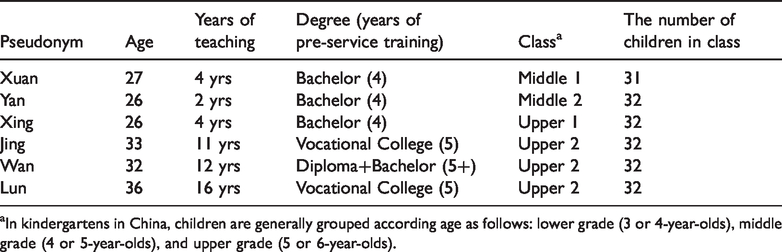
aIn kindergartens in China, children are generally grouped according age as follows: lower grade (3 or 4-year-olds), middle grade (4 or 5-year-olds), and upper grade (5 or 6-year-olds).
Methods of data collection and analysis
Individual interviews were conducted with participants to elicit their perceptions related to children’s use of touchscreen technologies (Patton, 1990). The interview questions were in a semi-structured format, because this allowed the researcher to raise spontaneous questions to further investigate the reasoning behind the respondent’s answers (Borg and Gall, 1983). The interview questions included but were not limited to:
What ICTs are available for you? Any touchscreen technologies? In what way have you provided children with ICT? How about touchscreen technologies? Why did you introduce those touchscreen technologies to your classroom in the first instance? For what purposes? In what way could ICT facilitate children’s learning and play?
Teachers’ thinking around touchscreen technologies could not be understood in isolation, so document analysis was used to gain background information of the context and to enrich knowledge of the research topic. The Guidelines for Learning and Development of Children Aged 3–6 (a national kindergarten guideline issued by the Ministry of Education of China, 2012b) and National Development Plan for ICT in Education (2011–2020) (Ministry of Education of China, 2012a) were particularly helpful in supporting the researchers’ interpretation of the reasons behind participants’ perceptions.
Thematic analysis was used to reflect the meaning behind the data by searching for patterns and themes that appear in collected information (Patton, 1990). Analysis of the data was based on the six-step guide by Braun and Clarke (2006) and the NVivo software programme. Firstly, the researchers became familiar with data through reading, transcribing, and translating (from Chinese to English) the collected data. Then, initial codes were generated by searching for recurring elements in the raw data. The researchers adopted various coding approaches during this process (see Table 2 for examples of how codes were generated from the data). The third step involved constructing themes, in which the researchers examined the initial codes for potential categories and considered how different codes would combine to form an overarching or sub-theme. The fourth and fifth steps involved the researchers’ review and revision of possible themes by re-reading the dataset and checking that the themes aligned with the research questions – before the researchers report findings (the sixth step).
Coding approaches used in the study.a
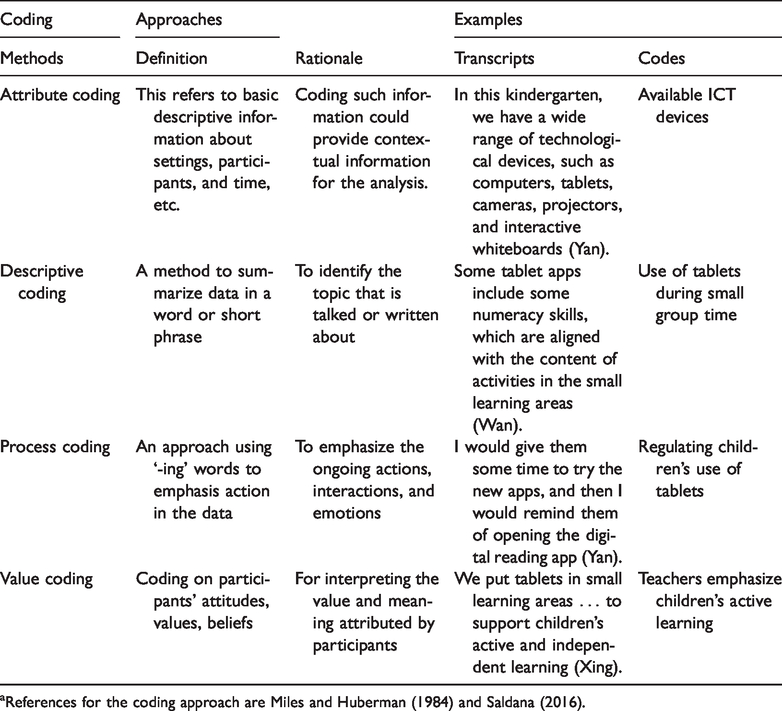
aReferences for the coding approach are Miles and Huberman (1984) and Saldana (2016).
Findings and discussions
This summary of findings begins with an overview of children’s use of touchscreen technologies in participating teachers’ classrooms, followed by discussion of three main themes: touchscreen technologies for supporting traditional pedagogies; touchscreen technologies for enabling children to become active learners; and children’s regulated and supervised use of touchscreen technologies.
The interview data showed that all participants had access to tablets and three to interactive whiteboards. With the tablets, almost all participants reported letting children interact with tablets during the small-learning-area activities (the children could choose one activity from the family corner, block-play area, numeracy area, reading area, and arts corner). Those teachers reported using three or four tablets in either reading or numeracy areas, in order to support children to gain and practise literacy/numeracy skills through the use of relevant apps. Two participants also provided children with tablets during role-play activities. For the interactive whiteboards, three participants reported inviting children to operate it to practise numeracy skills, and two reported using it to support children’s role-play.
Touchscreen technologies support traditional pedagogies
Of the participants who reported providing tablets for children during small-learning-area activities, five believed educational apps could facilitate their learning of subject knowledge (especially literacy skills and numeracy skills) and that children’s interest in ICT could encourage their engagement. … in small-area activities we put some ICT devices [tablets] in the reading area; it is a great teaching method that can engage children in reading, and they can learn more words and sentences (Xuan). … the tablets could let young children practice numeracy skills independently … they really like it (Yan). At that time, I was afraid that children would feel bored when they engage in [non-technology-related] numeracy activities. I understood that tablets could establish an engaging learning environment for children, therefore I hoped the introduction of tablets could enrich their learning. After reviewing the available apps on the tablets, I found some content of numeracy games is exactly the same as the activities in the past. For example, in the previous numeracy learning area, I put a lot of physical objects to help children learn sorting and pairing up skills; the apps we are currently using also include children’s sorting and pairing up skills (Jing).
Similarly, this study found teachers’ decisions about when, and in what ways, to let children use interactive whiteboards were also influenced by their understanding of children’s learning. For example, both Yan and Wan reported that, during whole-class teaching activities, they often invited children to practice their numeracy skills (such as pairing up) based on interactive whiteboards. One strength of interactive whiteboard is, young children can use it directly, they can drag icons freely. When I invite them to operate it, they do not need to know how to operate the mouse or keyboard; they only need to touch it (Yan). It [interactive whiteboards] is my favourite teaching strategy, because it can interact with children. For example, if the teaching aim of the math teaching activity is to let children pair something up, I can put the icons on the whiteboard and invite children to drag (Wan).
Based on this analysis, it appears that the rationales of those participants, like kindergarten teachers in other ECE contexts (e.g. Blackwell et al., 2016; Tan, 2017), was to simply use tablets and educational apps as a method (albeit one that children found more interesting) for drill and practice in parallel with traditional (non-ICT-supported) activities, rather than as part of a strategy to provide new learning experiences for children in kindergartens as suggested by researchers such as Dong (2014) and Stephen and Edwards (2018). Through the lens of TPACK, teachers seemed to make decisions about the use of touchscreen technologies based on their understanding of children’s learning. In this case, almost all participants emphasized that practice was required for children to gain and consolidate numeracy skills, which showed their PCK also had an important role to play in planning children’s use of touchscreen technologies. In addition, Yan believed the reading apps could provide children with new reading experiences (CTK). With the support of touchscreen technologies, this pedagogical strategy (i.e., practising numeracy skills) was facilitated and could increase children’s learning interest and motivation. The TPACK lens thus helped to illustrate teachers’ thinking around using touchscreen technologies to support traditional pedagogies.
Touchscreen technologies enable children to become active learners
Participants often mentioned active and independent learning to explain their rationale for providing children with tablets in small-learning-area activities and supporting their use of interactive whiteboards. The data showed that participants generally considered children’s use of tablets an active, independent and autonomous learning experience, for example: I think it [providing children with tablets] would benefit young children, as they can learn something which could not be learnt in whole-class activity. When they use it, they are actively receiving knowledge, which is more efficient than passively being taught by teachers (Lun). With the help of ICT, children can shift their learning style from teacher-instructed to autonomous (Xuan). Children can read independently by watching the pictures and listening to the stories [with ICT]. In this process, they become autonomous (Xing). The courseware was designed for a theme – sea world. The children could touch the interactive whiteboard, and some sea animals will appear on the screen. In this way, children could learn about what animals live in the sea by touching and exploring it [the interactive whiteboard] actively. That is to say, this courseware can let young children actively explore and feel the sea world (Yan).
Three participants mentioned providing children with touchscreen technologies to support role-play, and believed that this enriched children’s play. Lun reported providing tablets to help children run a teahouse during small-area activities, while Xing and Wan invited children to use the interactive whiteboard for a role-playing game called Kids Stage. According to their descriptions, with Kids Stage, children could dress up (teachers provided them with a range of costumes) and use the interactive whiteboard to select their preferred songs. They could then dance either in the way they wanted or follow a video being played on the interactive whiteboard. The three participants all valued the affordances of touchscreen technologies, which could support children making decisions for their own play, without teacher assistance, by touching the interface.
Based on the findings reported in this section, participants’ TPACK was evident when they talked about pedagogical planning related to children’s use of touchscreen technologies and why they decided to plan in the ways discussed. In particular, they valued children’s roles as active learners, believing children could learn well when they were able to explore and play actively (PK). While talking about the Kid Stage game, Xing emphasized “without the implementation of interactive whiteboard, the activity cannot be provided”, which reflected her understanding of the affordances (TK). To sum up, participants’ narratives reflected their belief that touchscreen technologies could provide children with ‘new’ learning experiences, which were different from the passive learning experience they gained from traditional, teacher-centred and whole-class activities (TPK). However, the story shared by Yan also demonstrated her understanding that children’s possible interactions with the interactive whiteboard may conflict with her understanding of the appropriate pedagogies that could be supported by that particular technology (TPK), and her consequent decision to use it in teacher-centred activities.
It appeared that almost all participants believed children could become active learners when they used tablets and interactive whiteboards. This point of view was contradicted by research conducted in ECE settings in America and Europe, in which researchers and teachers expressed concern about children’s passive learning experiences with tablets when they watch, listen, and follow instructions by pressing buttons mechanically (Marsh et al., 2018). However, this conflict is not too surprising because teachers’ understandings of children’s use of touchscreen technologies as well as their TPACK are contextualized. It is possible that ECE teachers in America and Europe may focus more on children’s active explorations throughout a day, and therefore believe the use of close-ended educational apps do not afford such active exploration (Stephen and Plowman, 2013), while teachers in this study consider children’s independent use of ICT as part of the learning experience that contrasts with more passive experiences where they simply follow teachers’ instructions. Although children’s active learning is emphasized in China’s ECE guideline, the review of that document found no clear definition of active learning. Therefore, participants in the study might interpret active learning in their own ways and regard children’s tablet use as active learning.
Children’s regulated and supervised use of touchscreen technologies
Although all participants valued what they considered active learning experiences provided by touchscreen technologies, they also believed that children’s use of those devices should be regulated and supervised. For example, four participants spoke of setting rules around the ways children should use touchscreen technologies. These rules were mainly about the amount of time spent on touchscreen technologies, use of teacher-selected content, and the device-child ratio. For example, Yan and Jing applied a child-device ratio of 1:1, expecting children to use tablets individually rather than collaboratively. Jing reported that teachers put four tablets in the reading area, and allowed only up to four children to enter the reading area. She explained: We suggest they use tablets individually; if two children share one tablet, they might have fights if they want to use it in different ways (Jing). I would give them some time to try the new apps, and then I would remind them to open the digital reading app. The tablets were implemented in the reading group, thus they should use this app when they select the reading group … I think in this case, the children need to know what the tablet is used for … such as … when it is put in the arts area, they would know to use tablet for painting, when it is put in the performance area, they should use it to watch dancing videos … They need to know that they should use the tablet for learning, rather than something insignificant (Yan).
Participants’ thinking around children’s use of touchscreen technologies and the importance of setting rules should be interpreted in context. In mainland China, kindergarten teachers developed their Content Knowledge – the common body of content knowledge that kindergarten children are expected to acquire – based on the learning goals listed in ECE curriculum guidelines. The review of these guidelines found teachers are encouraged to facilitate children’s development of the awareness of social rules in order to prepare them for future schooling (Ministry of Education of China, 2012b). In this case, participants’ CK influenced their understanding of the ways children should use touchscreens, and in what ways their social learning and development could be supported by the use of these technologies (TPACK). Furthermore, participants’ emphasis on children’s regulated and supervised use needs to be understood within the Chinese culture, where children are expect to maintain harmonious relationships with peers (i.e. teachers applied a child-device ratio of 1:1 to avoid ‘fights’) and follow teachers’ plan and instructions (i.e. teachers reminded children of which apps to use).
The findings related to children’s regulated and supervised use of touchscreen technologies echoed Ludgate (2019), who found various rules surrounding children’s use of tablets in kindergarten settings in the UK, and extended the knowledge base about children’s use by explaining why teachers made such rules. However, some of the rules might restrict the children’s role as active learners, and therefore limit an affordance the teachers valued. More importantly, rules related to the device-child ratio may also limit children’s opportunities to use touchscreen technologies in creative ways, or for collaboration and communication with peers as other researchers recommend (e.g. Dong, 2014; Stephen and Edwards, 2018).
Conclusions
This study investigated teachers’ understanding of the affordances of touchscreen technologies along with their rationales for providing children with these technologies. The findings of the study bring some clarity to the complexities in teachers’ thinking around when and how to provide children with opportunities to interact with touchscreen technologies. To sum up, participants valued the touchable and interactive interfaces and believed these interfaces were appropriate for kindergarten-age children. They also believed children could gain active learning experiences from interacting with touchscreen technologies, which increased their interest and motivation. Those beliefs helped to explain teachers’ rationales for providing children with opportunities to use touchscreen technologies.
The findings contribute to the current knowledge base on the use of touchscreen technologies in kindergarten settings. Specifically, the study repeated findings reported by Morgan (2010), who found that teachers provided children with limited opportunities to use interactive whiteboards, and extended those findings by reporting the reasoning behind teachers’ decisions. Furthermore, the participants’ narratives helped to explain why some teachers chose to use touchscreen technologies (mainly tablets) in numeracy and reading learning areas rather than other subject-related activities. More importantly, by adopting a theoretical framework which was developed for the general educational context in developed countries (Mishra and Koehler, 2006), the analysis of findings suggests the TPACK model is useful for understanding kindergarten teachers’ thinking around children’s use of touchscreen technologies in mainland China. This study concluded that teachers’ understanding of learners should be regarded as another key knowledge base in teachers’ TPACK, and that this area is ripe for further investigation.
One of two main sources of data was individual interviews, i.e. self-reported information provided by teachers. As the known limitations of this data collection method may have influenced the trustworthiness of the findings, future research could add classroom observations to triangulate with teachers’ perceptions. Furthermore, the findings of a qualitative study conducted in one technologically advanced city in mainland China might not generalize across different settings. Similar research in the future could focus on other areas and contexts. Within the interpretivist paradigm, it is impossible to avoid researcher subjectivity (Guba and Lincoln, 1994), although the lead researcher perspective was balanced by the involvement of colleagues from different educational and cultural backgrounds. Another limitation of the study related to translation. While the notion of conceptual equivalence was applied (Shklarov, 2007), it must be acknowledged that the translation could still be influenced by the lead researcher’s interpretations.
Despite these limitations, the evidence produced by the study shed some light on kindergarten teachers’ perceptions of, and practices in, the use of touchscreen technologies. The findings suggest it would be useful for teachers to reflect on their current understanding of the use of touchscreen technologies, subject content, and pedagogical approaches, to make wise decisions for its actual use. The study concluded that some of their understanding of those elements is conflicting (such as setting rules and educational value and risks). A balanced approach would involve re-conceptualizing how children learn and including the children’s perspectives in the decision-making process around learning goals and the affordances of ICT.
Footnotes
Declaration of Conflicting Interests
The author(s) declared no potential conflicts of interest with respect to the research, authorship, and/or publication of this article.
Funding
The author(s) disclosed receipt of the following financial support for the research, authorship, and/or publication of this article: The lead researcher is a recipient of Joint Scholarship of China Scholarship Council and the University of Auckland.
