




Abstract
This paper discusses findings from online surveys completed by parents of 0–3-year-old children in Norway, Portugal and Japan concerning their young children’s use of touchscreen technology. The study investigated parental practices, views and perspectives related to children’s digital practices and explored these in relation to wider cultural discourses around early childhood in the participant countries. The study adopted Bronfenbrenner’s ecological systems theory to inform the questionnaire and interpretative data analysis of how parents’ views and experiences are influenced by a wide range of social, cultural and personal factors. The findings demonstrate some coherence between beliefs among parents regarding very young children’s use of touchscreen technologies and their place in the children’s home lives. Quantitative and qualitative results highlight that the respondents from all countries expressed the need for further guidance regarding technology use, and better communication with early education and care centres. The study findings are discussed in relation to the reported uses of touchscreen technologies in the three different cultural contexts, parents’ views on the benefits and/or disadvantages of children’s touchscreen technology use, and the potential influences of dominant cultural discourses on parents’ perceptions, views and practices.
Introduction
Touchscreen technologies have rapidly become an important factor in young children’s lives and international trends suggest that the age of first use is lowering (Burns and Gottschalk, 2019) as many children have their first experience with digital technologies before the age of two (Chaudron et al., 2018). There has been an increase in the use of touchscreen technologies both at home and in early childhood settings (Dunn et al., 2018; Flewitt et al., 2015; Marsh et al., 2015; Neumann and Neumann, 2017). However, limited research on parents’ beliefs, attitudes and practices focuses on children under the age of three (Cristia and Seidl, 2015; O’Connor and Fotakopoulou, 2016; O’Connor et al., 2019; Smahelova et al., 2017).
The use of such technology by very young children can be understood as part of literacy development whereby ‘literacy’ relates to the ‘capacity to read, understand and critically appreciate various forms of communication including spoken language, printed text, broadcast media, and digital media’ (Department of Education and Skills, 2011: 8). Sefton-Green et al. (2016: 16) suggest that children’s digital literacy can be categorized as operational, cultural and critical, where operational elements refer to ways to operate ‘digital technologies in order to engage in communicative/meaning-making practices’; the cultural addresses ‘understandings and practices derived from engaging in digital literacy practices in specific social and cultural contexts’; and finally the critical refers to ‘the ability to engage critically with digital texts and artefacts, interrogating issues such as power and agency, representation and voice, authenticity and veracity’. We adopt these definitions to inform our work on digital literacy practices.
Contemporary debates in Early Childhood Education and Care (ECEC) include issues like screen-time and the effects on development for very young children and their well-being (Ahearne et al., 2016; Dauw, 2016; Lauricella et al., 2015; OECD, 2019). Many studies related to the use of touchscreen technology in home settings focus on the prevalence and frequency of activities with these technologies (Sanders et al., 2016), in line with similar concerns previously identified when television became part of daily life. Now, the concept of screen-time has grown to encompass the use of touchscreen technologies and widespread anxiety about inappropriate and passive uses influenced by parenting styles (Mascheroni et al., 2018). According to Wood et al. (2016), many parents support their children while interacting with touchscreen tablet devices in different ways that promote verbal, emotional-verbal, physical and emotional-physical support. These media habits and skills can become norms of practice for very young children when digital media are integrated into daily parental practices (Bar Lev et al., 2018). Conversely, parental monitoring of children’s behaviour may limit children’s agency and autonomy (Livingstone and Helsper, 2008; Stattin and Kerr, 2000), and discourses concerning the ‘technologization of early childhood’ in home and early childhood settings may be closely connected to parental anxiety (House, 2012), for instance regarding children’s social, motor and language developmental milestones (O’Connor, 2017). Mertala (2019) further discusses how discourses of the ‘naturally competent child’, ‘the victimized child’ or the ‘needy child’ have influenced perceptions of children’s technology use.
The present article focuses on parents’ perceptions of their young children’s touchscreen use in Norway, Portugal and Japan, and explores the influences of dominant cultural discourses on parental practices in these three different countries. We employ discourse analysis to theorise parental perspectives as ‘created, maintained and changed in myriads of everyday practices’ (Jørgensen and Phillips, 2002: 20). The study addressed the following research questions:
What are parents’ views on 0–3-year-old children’s use of touchscreen devices at home in Norway, Portugal and Japan? In what way do dominant cultural discourses influence parents’ perceptions and concerns regarding their 0–3-year-old children’s use of touchscreen devices?
Conceptual and theoretical framework
We adopted Bronfenbrenner’s bioecological model to inform our study of parents’ attitudes and beliefs and the influence of media and policy discourses pertaining to technology and young children (Bronfenbrenner, 2004). Our focus was on the mesosystem and the relations between exo- and meso-systems, as well as kronos (meso-time) and kairos (micro-time) in relation to children’s touchscreen technology use. We hypothesized that how children use their time with touch-screen technologies was a significant aspect of children’s experiences of childhood and their development (Tudge, 2008), and also contributes to popular discourses concerning technology, which in turn affect children’s opportunities to explore touchscreen technologies.
Critiques of Bronfenbrenner include his own criticism of not fully seeing the influence of the person in the different structural systems (Bronfenbrenner, 1979), which Tudge et al. (2009; 2016) noted is one of the most common mistakes made by researchers when using the model. By focusing on parents, we are choosing not to focus on the individual person (the child), but rather on the proximal processes happening around the child. We aimed to study the cultural influences on parents and how their influences on the child affect how time with touchscreen devices is perceived and regulated. By focusing on the Process–Person–Context–Time (PPCT) scheme (Bronfenbrenner, 1979) we aimed to explore parents’ perceptions of their children (microsystem) and the associated use of touchscreen technology (Darling, 2007).
To gain deep insights into the relationship between parents’ perspectives and cultural discourses on young children’s technology use, we decided to pair Bronfenbrenner’s bioecological model with Domestication theory (Silverstone and Hirsch, 1992), which offers a framework to conceptualize what happens to new technologies in society and the process they go through from being something new and exciting to mundane and taken for granted. Electricity is a good example of this, as it has gone from being a technological marvel that changed the world to being invisible, only to be noticed when missing. Silverstone and Hirsch (1992) describe four stages of technology integration in society:
Technologies are integrated into everyday situations; The user and the environment change and adapt accordingly; By changing the environment and users, the technology affects future inventions and the advent of new technology; The culture of the household can be observed through its use of technology.
These stages of technology integration are further defined by Baym (2015: 52) in three stages as ‘what once seemed marvellous and strange, capable of creating greatness and horror, is now so ordinary as to be invisible’: 1) possibilities, 2) anxiety about what might happen, 3) the slow move into invisibility. The first known case is Socrates’ concern about the new technology of ‘writing’ as recorded by his pupil Plato (Plato, c.399-347 BCE). These stages arguably apply to all technologies and are relevant for digital technology in contemporary society. Concern can be particularly strong regarding children, who are often viewed as more vulnerable to the potentially negative outcomes of new technology use (Plowman and McPake, 2013).
Cultural discourses about touchscreen devices and young children
According to Harris (1999: 19), ‘culture is the socially learned way of living found in human societies (…) it embraces all aspects of social life, including both thought and behaviour’. From this perspective, culture can be seen as a filter for human motives, traits and attitudes. In this section, we therefore present information regarding the three different countries, focusing on overlaps and divergences in country-specific approaches to young children’s use of technologies at home and in ECEC. It is important to highlight here that the figures for each country will have been collected and collated differently so although they are useful points of comparison the totals are not directly comparable across countries.
The Portuguese context
To understand contemporary discourses about young children using touchscreen devices in Portugal, we first consider general information about technology use in the country. In Portugal, 83% of the population are Internet users, 96% are mobile phone users - 93% of which own smartphones. Portuguese aged between 16 and 64 years spend on average 6½ hours per day online, including 2 hours on social media (Hootsuite, 2020). In 2007, the Portuguese Government implemented a ‘Technological Plan for Education’, aiming to connect all public schools to the Internet. As a result, Portugal has on average one computer for every five students in mandatory education, which starts at age 6 years (Pordata, 2018).
Although not widely available in kindergartens, digital devices are embedded in Portuguese homes, and children begin to use them at a very early age (Castro et al., 2017; Dias and Brito, 2016). Young children frequently use tablets and smartphones, and the activities they enjoy the most are playing games and watching videos on YouTube (Ponte et al., 2018). Parental mediation leans more towards restriction than support, as parents have been found to be deeply concerned with limiting screen-time, and less aware about the importance of monitoring content and activities (Dias and Brito, 2018).
Haddon’s (2011) work concerning the intertwining between culture, dominant media discourses, and the perceptions and attitudes of parents brings some insights into how Portuguese families are domesticating digital media. Portuguese families tend to be tight-knit and protective of children (Torres et al., 2006). Considering the three Ps that sum up children’s rights in the digital age – Protection, Participation and Provision (United Nations, 1989), protection stands out for Portuguese parents. The notion of children having the right to privacy or to making decisions is often in conflict with parents’ belief that it is their obligation to protect their children (Almeida et al., 2013). Many parents acknowledge facing dilemmas in how to mediate their children’s use of digital media (Dias and Brito, 2018), and often turn to the media in their search for solutions. For example, the guidelines of the American Academy of Pediatrics (2018), which suggest that children should not be exposed to any screen until age 2 years, were broadcast exhaustively by the Portuguese news media, and restricting screen-time is a very common parental mediation action (Dias et al., 2016). However, parents may bend established rules when they need to keep children entertained (for example, if they have to work or do house chores) (Dias and Brito, 2018). One could say that Portuguese parents have a rear-view mirror (McLuhan, 1994) perception of digital media, as they appropriate them according to standards from their own childhood. Consequently, positive perceptions about digital technologies fostering learning are restricted to school-curricular domains such as reading, writing, counting and even English, rather than other skills or competencies such as creativity, problem-solving and social skills (Dias and Brito, 2018). In addition, many Portuguese parents prefer their children to play outdoors with friends, with frequent physical activities and social interaction. Maternity leave in Portugal is 5 months, and then most children spend over 8 hours a day at nurseries and kindergartens and later play at home. Parents are nostalgic of their own childhood, which they evaluate as happier and freer, with no digital media and lots of outdoor play, whereas playing outside without adult supervision is now considered unsafe, even in rural areas (Dias and Brito, 2018). Portuguese children, on the other hand, tend to be enthusiastic about digital media (Ponte and Batista, 2019).
Summing up, the current cultural discourses in Portugal about touchscreen devices and young children emphasize more the risks than the opportunities, and look nostalgically at the present, desiring a childhood similar to the past. This view is then negotiated in each family, shaped by parenting style and by the participation of children, resulting in unique parental mediation strategies (Castro et al., 2017; Dias and Brito, 2018).
The Norwegian context
First, some statistics; 98% of Norwegians report having used the Internet during the past 3 months, 94% use Internet banking (Statistics Norway, 2019), and 92% use smartphones (Statistics Norway, 2019). For children under 4 years, statistics show that 81% have access to a TV and 77% have access to a tablet, with 60% of parents reporting that children spend up to a daily average of two hours playing on a tablet (Norwegian Media Authority, 2018). Because of this, most children are aware of, and have experience with technology from an early age, and it has made its way both into the homes of children and as a focus in early childhood education (kindergartens) (Bølgan, 2018).
Nearly 92% of children between ages 1–5 years attend kindergarten, which is not compulsory, but is very common after parents’ generous paternity and maternity leave allowance (15 weeks each, then 16 weeks to be divided between parents in addition to vacation, totalling a maximum of 56 weeks) (Working Environment Act, 2017, Ch. 12). Approximately 85% attend kindergarten before the age of two (Statistics Norway, 2019), so most children will be affected by the pedagogy and practices they encounter in ECEC. The Norwegian framework for kindergartens states, ‘digital practices in kindergarten shall encourage the children to play, be creative and learn’ (Norwegian Directorate for Education and Training, 2017: 44). This requires practitioners in ECEC to use digital technologies with children, and most kindergartens have implemented a variety of technological tools for their practice (Utdanningsdirektoratet, 2019).
The discourse in Norwegian society as a whole is currently contested when it comes to technology being ‘good’ or ‘bad’. Many parents are anxious about the effects of screen time on their children, while media discourses feature expected and unexpected positive and negative sides of using technology (Bølgan, 2018). Most parents believe that too much time in front of a screen is undesirable/potentially dangerous, but what is considered ‘too much’ varies. The World Health Organization (WHO, 2019) guidelines on physical activity, including sedentary screen time, kick-started a society-wide debate about children and screens. While some claim that reports like these should discourage the use of technology in the home and kindergarten/school, others point to how it is being used instead (O’Connor et al., 2019). Although there seems to be a consensus to limit the time children spend with screens, this does not seem to be the case in many homes (Statistics Norway, 2019). This all contributes to the dominant Norwegian discourses, which vary depending on who, where and when the usage is being discussed. As in Portugal, there is a strong focus in Norway on being outdoors and in touch with nature, which is considered essential for a ‘good’ childhood (Moser and Martinsen, 2010). This longstanding cultural expectation could influence parents’ views on using technology, with its associations of promoting passive, sedentary behaviour (WHO, 2019).
In summary, current dominant discourses about use of technology in Norway could be said to reside in the second stage of Domestication theory, where technology seems capable of both ‘great possibilities’ and ‘great horror’ (Baym, 2015). More research is needed to develop pedagogies that integrate technology in children’s learning and to inform parents about the safe and creative use of technologies at home.
The Japanese context
Japan is considered one of the most technologically advanced countries in the world. Internet use by Japanese people aged 13 to 49 years was over 90% in 2008, and remained at that level in 2017, possibly static because under 50% of people aged over 60 years used the Internet in 2017 (Child Sciences and Parenting Research Office, 2014). On the other hand, Japan has very high rates of touchscreen use by very young children (Child Sciences and Parenting Research Office, 2014). According to Fróes and Fróes (2019: 8), ‘Japanese culture is described as a technology-oriented culture therefore, it is valuable to assess how this orientation is lived and apprehended in this culture considering the pervasiveness of Western-designed gadgets, such as the iPad’. A study by Hosokawa and Katsura (2018) on parents’ perceptions related to use of mobile devices including smartphones and tablets showed that parents believe these devices might interfere with children’s development in relation to social adjustment. Although ICT (Information and Communications Technology) education is not mandatory in preschools, private nursery schools and kindergartens provide more ICT education than state preschools (Izumi-Taylor, 2008). Nonetheless, ICT is used to monitor children’s attendance and daily records, and to communicate with parents. At some preschools, children play with drawing software, observe animals or plants, and make recordings using a camera or editing functions on tablet PCs, which are used as teaching resources, including teaching simple programming in some preschools. The Japanese ECEC policy refers to ICT integration in order to foster young children’s technological skills (Taguma et al., 2012). Recent research has found that educators are concerned about the effects of digital media on children’s academic ability, physical development and motivation (Fróes and Fróes, 2019).
Recent reports suggest that 47% of two-year-old children have contact with videos or games through their parents’ smartphones or tablet-type devices for 60–80 minutes a day on average (Japanese Cabinet Office, 2019). Smartphones in Japan are ubiquitous and children encounter digital media at home and in the community from a very early age (Fróes and Fróes, 2019). Parental mediation on children’s media and technology use focuses on supervising children’s online behaviour and protection (Akiyoshi, 2016).
Methodology
Research design
In order to explore parental views, practices and perspectives towards the use of touchscreen technology by children under three years of age in the three different countries an online survey was utilised. This was translated and adapted to be culturally valid from an existing survey created by O’Connor and Fotakopoulou (2016) and sent out to parents through email invitation and social media to reach as broad a group of participants as possible. Each researcher obtained ethical approval from their affiliated university or the country’s ethical-research approval organisation and provided each participant with detailed information regarding the anticipated use of the data collected, which was anonymous, confidential and stored in secure databases at the universities.
Participants
The total sample comprised 552 respondents who registered as parents of one or more children, where at least one was under the age of three. More specifically, 180 participants were recruited from Norway, 274 from Portugal and 98 from Japan, with two respondents being grandparents. Many of the participants from each country held a university degree (30%), a smaller number had completed post-graduate studies (27%) and a limited number reported no qualifications at all (19%). Very similar responses and distribution were found with partners’ educational qualifications (33%, 25% and 15%).
Research tool and procedure
The questionnaire comprised three parts (see online Appendix). The first part focused on demographic information, including age, gender, number of children (up to three children could be registered, if parents had more than three children, they were asked to report only the youngest three), educational qualifications of the respondent and partner (if applicable), as well as family location and income characteristics. The second part focused on technology available to the children (e.g. smartphone; iPad/iPod; Kindle or other), frequency of use (explored with a 4-point Likert scale), and how (playing games, drawing/creative, learning apps, reading books, watching cartoons, looking at photos, using Skype, FaceTime etc.) and where they were being used (at home, nursery, car, restaurants, buggy, visiting friends, etc.). These questions ensured that we collected data about both availability and usage for each child, making it possible to compare data across countries.
The third part focused on parents’ thoughts on advantages and concerns around their children’s use of touchscreen technology, whether they limited children’s time with touchscreen technologies and, if so, why. In addition, parents were asked if they had received any guidance or information regarding young children’s use of touchscreens. By collecting this data, we were able to look for evidence of discourses influencing how parents view the technology and how their views might influence their children’s use of touchscreen technologies.
Findings and analysis
Data were entered in IBM SPSS v24 and descriptive and inferential statistics were obtained. In the first part of the online questionnaire, the respondents’ personal characteristics (age, gender, qualifications, and number of children) were explored. Findings from the three different cultural contexts in relation to the research questions are presented below.
0–3s’ use of touchscreen devices at home in the three countries
Parents reported on the frequency of usage of different touchscreen devices (smartphones, iPads, children’s tablets and Kindles) by their children in the three participating countries. The most widely used device reported in all countries was the smartphone (80%), followed by iPads (67%), children’s tablets (48%) and Kindles (29%).
With regard to children’s digital technology use, 17% of respondents in Portugal reported that their children never use a smartphone, iPad, children’s tablet or Kindle, despite widespread smartphone ownership in Portuguese homes. There seems to be some polarization in families, with most either responding ‘never’ or ‘sometimes’ and some reporting ‘daily’ use (for example, in Portugal, these devices have never been used by 0–3s in 49% of the families, and are used by them daily in 39% of the families). In families where children do use smartphones, they seem to do so regularly (55% of the Norwegian participants reply ‘daily’ or ‘at least once a week’; 39% of the Portuguese participants reply ‘daily’ and 49% reply ‘never’). The favourite reported activities of children with technology were watching cartoons, viewing photos and videos, using educational apps and Skype. These answers suggest 0–3s do not play many games (whereas we know this is the favourite activity of children older than 3 years old). These practices reported by Portuguese parents reflect the dominant cultural discourse in which touchscreen devices are considered harmful or dangerous for young children. This suggests that more attention is paid to restrictive parental mediation with younger children, as touchscreen device use increases with older children (Dias and Brito, 2018; Ponte and Batista, 2019).
Sixty-two percent of respondents from Norway reported that 0–3s use touchscreen devices, with 32% using smartphones and 30% tablets. Nevertheless, 45% also reported that 0–3s never use smartphones or tablets. Favourite reported activities were watching cartoons or videos, playing games and using Skype. There is reported almost no use of Kindles by Norwegian parents as Kindles have very few books for children in Norwegian.
Similarly, Japanese parents reported the favourite activities of 0–3s were watching videos, cartoons and educational programmes. Overall, smartphones seemed to be the most widely used device by young children in Japan (67%)–it should be noted that smartphone usage in Japan was predominantly reported as ‘sometimes’ (44%) rather than ‘daily’ (23%), followed by iPads (19%) and children’s tablets (1%). In Japan, no use of Kindles was reported. Children in Norway seemed to have higher rates of touchscreen technology usage, followed by Portugal and Japan.
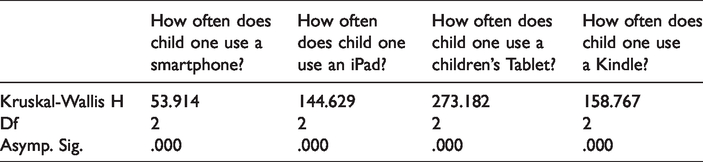
In order to explore the impact of the country of origin on the usage of the different touchscreen technologies by children, a Kruskal-Wallis test was employed, independently confirming that the impact of the country was statistically significant for each device. The results based on parental responses are displayed in Table 1, and suggest that usage of the different touchscreen technologies differed in Norway, Portugal and Japan.
Kruskall-Wallis test results for the use of different devices per country.
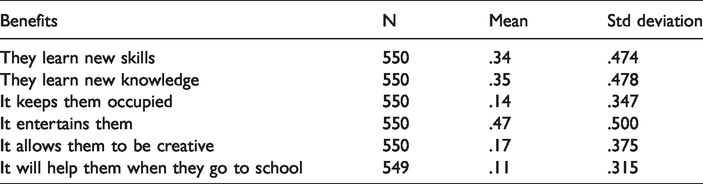
Parental views were explored in relation to perceived advantages associated with the use of touchscreen technology. As displayed in Table 2, the majority of the respondents in the three countries stated that using touchscreens entertains their children, followed by learning new knowledge, learning new skills and being creative. Slightly lower in their perception of benefits is that using touchscreens keeps them occupied and will help them when they go to school.
Parents’ beliefs related to benefits from usage of touch-screen technologies.
Home (59%) was the most frequently reported site where technologies are used in three countries, followed by restaurants/cafés (16%) and visiting friends/family (10%). Twenty-three percent (N = 42) of the participating parents from Norway reported that touchscreens were used in ECEC while only one participant parent from Portugal and one from Japan reported ECEC use of touchscreen technology.
To better understand parents’ views of the advantages of touchscreens, we created a variable called ‘advantages’ (of using touch-screen technologies) and examined the impact of country and gender on perceived benefits. Parametric assumptions were examined and met. A two-way analysis of variance (gender and country) revealed that parents’ country of origin had a statistically significant impact on perceived advantages of touchscreen usage F(1, 541) = 103.653, p = .000); whereas the impact of the child gender F(1, 541) = 0.51, p = .821), and the interaction between child gender and country on the perceived advantages of the technology use were not found to be statistically significant F(1, 541) = 1.070, p = .344). Post hoc analyses were conducted using Bonferroni’s post hoc test to further explore the main effect of country of origin on the perceived benefits. The mean difference between Norway and Portugal was found to be statistically significant (Mean difference = 1.86, p = .000), and between Norway and Japan (Mean difference = 1.47, p = .000) as well. Perceived advantages between parents in Japan and Portugal did not differ significantly (Mean difference = −.39, p = .056). The data show that the participating parents from Norway evaluated highly the benefits of the usage of touchscreen technologies by their 0–3s.
Dominant cultural discourses related to the perceptions and concerns of parents
A large proportion of Portuguese parent respondents (50%) expressed concerns about their children’s use of touchscreens, with most concerns expressed about children’s dependence on technology and children not socialising with their peers and environment. 82% of Portuguese parents expressed the view that technologies do not enhance cognitive development for 0–3s, do not stimulate creativity, and that children’s health, and more specifically their vision, is affected negatively. 50% of Norwegian parents also expressed concerns about 0–3s using touchscreens, while 90% of Japanese parents stated that they had concerns about their children’s touchscreen usage. Concerns related to passivity, addiction, social isolation and developmental worries were reported as some of the potential negative effects of use of touchscreen technology for 0–3-year-olds. The main concerns of Japanese parents were their children’s impaired vision, addiction, impoverished language and emotional development, and sleeping problems.
The relationship between parental concerns and country of origin was found to be statistically significant (χ2 = 263.286, p = .000), reflecting the variations in parental concerns and attitudes towards the use of touchscreen technology, with Japanese parents (90%) being the most overly concerned, followed by Portuguese (51%) and Norwegian parents (50%).
We further explored parents’ views regarding touchscreen devices with two open-ended questions, one about the main advantages that parents recognise for very young children in using touchscreen devices, and the other about parents’ concerns. Findings suggest that parents’ main concerns align with their country of origin, and with dominant discourses regarding the use of digital technologies as well as each country’s ECEC policy documents.
Parent respondents from all three countries viewed digital technology use by children as inevitable (mentioned by 79% of Portuguese parents). Additionally, 29% of Norwegian parents and 12% of Japanese parents reported that early use would help children when they start at school. For example, one Japanese respondent commented, ‘I think that smartphones and tablets are necessities in the days of children now.’ However, some respondents preferred to delay technology use for older children, as expressed, for example, by one Norwegian respondent, ‘I am very concerned about the increased use of such technology. I do not want it in the kindergarten at all!’ The possibility of children becoming addicted was also mentioned in all three countries, but was more frequent among Japanese parents (55% compared to 37% of Portuguese parents and 12% of Norwegian parents) for example, ‘it [playing with touchscreen devices] gets more crazy than other play’ and that ‘children obsess too much over smartphones’. Portuguese parents also mentioned that touchscreen devices are ‘too stimulating’ (22%) and ‘make children impatient’ (17%).
In Norway (29%) and Portugal (76%), a strand of answers expressed concern that excessive digital play might result in underdeveloped empathy, social skills, imaginative play and creativity. I am afraid that it affects the scope of more imaginative play, and interaction with other children or siblings. (Norway) I fear that she [daughter] becomes addicted to screens and stops playing with friends and interacting with family. (Portugal) My personal gut feeling says that it is much better for children to learn, play and experience and interact with people and the environment around them. (Norway) Too little fresh air and physical activity. (Norway) [Touchscreen devices] Make my child wait quietly. (Japan) [Touchscreen devices] make him eat better, or keep still when I want to dress him. (Portugal) [Touchscreen devices] are used as a babysitter. (Norway)
Discussion
In this study, we used a questionnaire to explore 0–3-year-olds’ use of touchscreen technologies at home in Japan, Norway and Portugal. In addition, our study aimed to explore how dominant cultural discourses influence parents’ perceptions, views and practices regarding the use of touchscreen devices by their 0–3-year-old children.
The findings of the study showed that touchscreen technologies are domesticated in all the three different countries, but there are significant differences, as well as overlaps, in parental attitudes towards their very young children’s use of touchscreen devices. Our study suggests that these differences reflect dominant discourses about technology use in each country. New parenting behaviours have emerged from technology’s omnipresence in everyday family life, raising new issues about ‘digital parenting’ (Siibak, 2019: 54) and parenting styles related to attitudes and practices with digital technologies. Parents’ concerns about when it is developmentally appropriate for their children to engage with technologies mean that many parents limit their children’s technology use, which may curtail or postpone their experiences with touchscreen technologies. Although some ECEC frameworks, as in Norway (Norwegian Directorate for Education and Training, 2017), emphasise that all children should have experiences with technologies in kindergarten, there seems to be a lack of knowledge about the competence and experiences children have in their home settings. As Gillen and Kucirkova (2018) point out, bringing children’s home experiences with technologies into classroom settings and vice versa provides opportunities for children to make connections between different uses of technologies.
Our study indicates that dominant discourses of parental protection and control towards children’s technology use are realised through parental strategies related to screen-time limitations, although parents may equally be influenced by their views on the importance of play in young children’s lives, and this in turn may influence their practices and perceptions (Bar Lev et al., 2018). Additionally, macrosystemic factors such as the role of technologies in the three different cultures affect parents’ views, beliefs and practices. For example, policy documents from Japan and Norway (Japanese Cabinet Office, 2019; Norwegian Directorate for Education and Training, 2017) influence the implementation of touch-screen technologies in home and kindergarten settings while the lack of similar policies in Portugal is also influential, feeding the already negative and restrictive cultural discourse on the use of touchscreen devices by young children.
As Bronfenbrenner’s (1979) ecological systems theory proposes, our analysis of the data generated in this study has identified the interdependency among numerous variables in influencing touchscreen use by very young children. For example, in Norway, the Norwegian Directorate for Education and Training(2017) encourages a balanced integration of touchscreen devices in ECEC, and this is reflected in the training and professional practice of ECEC Educators. This in turn is reflected in parents’ perceptions of touchscreens.
Parents often address their memories of their childhood as a ‘good childhood’ where nostalgia brings back an idealized version of their own childhoods. However, cultural discourses are not static. We suggest that cross‐cultural studies such as this can help to identify how socioecological contextual differences influence parents’ views and practices with technologies. Our results identified dominant discourses in each country about childhood and young children’s use of technologies as influential on parents’ values. Parents’ digital literacy practices in all three countries were affected by their perceptions about the benefits of touchscreens in helping children to learn to read or learn numbers or letters in relation to the operational dimensions of digital literacy (Sefton-Green et al., 2016). Nevertheless, parents from three countries saw limitations and expressed concerns when their children use touchscreens for play activities.
Furthermore, cultural perceptions about the value of outdoor play are an extra factor that appears to influence Norwegian and Portuguese parents’ views and practices with touchscreen technologies, and feeds their concerns that time spent with touchscreens will reduce their children’s time spent outdoors, which in turn will limit their children’s opportunities for physical and pro-social development. This might also be connected to the anti-social effect of technology for older children (Haddon, 2011; Haddon and Holloway, 2018).
The responses from parents in all three countries reflect the contemporary challenge of assimilating touchscreen technology into the lives of young children in ways that are perceived by parents as beneficial to their development and do them no harm. Furthermore, the conflicting information parents receive from the media and from wider social, medical and educational discourses appears to be a common factor in complicating the decisions they make about their 0–3s’ use of touchscreens.
Conclusions, limitations and implications
This study has focused on parents’ practices and perspectives on 0–3-year-olds’ use of touchscreen technologies in Norway, Portugal and Japan. The findings have indicated that there are similar concerns and ideas related to the use of touchscreen technology by 0–3-year-olds, regardless of the cultural background of the participant parents. However, cultural discourses such as what constitutes a ‘good childhood’, the relationship between play and learning, the importance of outdoor activities and concerns about possible technology addiction are identified as significant in each of the countries in relation to very young children’s use of touchscreen technologies. Concerns in the three contexts were similar and show that screen-time discourse is significantly associated with parental practices. Nevertheless, participating parents from Norway evaluated the benefits of their 0–3s’ touchscreen technologies usage more highly than participating parents from Portugal and Japan. The differences in which touchscreen devices were used are also very interesting to track in future studies.
Limitations of this study are related to the limited generalizability of the findings, as there are doubtless many other perspectives that are not represented in our data. More cross-cultural research is needed to identify the relationships between ECEC policy and provision, dominant discourses about technology, and parental attitudes and routines at home regarding very young children’s use of touchscreen technologies, including children’s perspectives and experiences.
It is clear from this study, and those that have preceded it (O’Connor and Fotakopoulou, 2016; O’Connor, 2017; O’Connor et al., 2019), that the use of touchscreen technologies by the very youngest of children is becoming a globally common occurrence as electronic interactive devices become ubiquitous in the homes of young families around the world. Young children have the potential to become digitally literate at an ever-earlier age - an opportunity that is constrained or enabled by the attitudes and beliefs held about technology by their parents, which may vary according to the cultural context.
Supplemental Material
sj-pdf-1-ecl-10.1177_1468798420938445 - Supplemental material for Use of touchscreen technology by 0–3-year-old children: Parents’ practices and perspectives in Norway, Portugal and Japan
Supplemental material, sj-pdf-1-ecl-10.1177_1468798420938445 for Use of touchscreen technology by 0–3-year-old children: Parents’ practices and perspectives in Norway, Portugal and Japan by Maria Dardanou, Torstein Unstad, Rita Brito, Patricia Dias, Olga Fotakopoulou, Yoko Sakata and Jane O’Connor in Journal of Early Childhood Literacy
Footnotes

References
Supplementary Material
Please find the following supplemental material available below.
For Open Access articles published under a Creative Commons License, all supplemental material carries the same license as the article it is associated with.
For non-Open Access articles published, all supplemental material carries a non-exclusive license, and permission requests for re-use of supplemental material or any part of supplemental material shall be sent directly to the copyright owner as specified in the copyright notice associated with the article.
