




Abstract
This study had as its aim to analyze the thoughts of Javanese–Indonesian and Sundanese–Indonesian children in Indonesia, about their aspirations for the future. In total, 271 Javanese–Indonesian and Sundanese–Indonesian children (aged 4–6) participated. The children were also asked: “what expectations of yours make you happiest?” The results revealed three categories ranging from the most mentioned to the least: aspirations for material issues, expressing doubts about their future aspirations, and wanting to do well in school performance. The results revealed that there was a statistically significant association between children’s ethnic background and their aspirations (χ(1) = 10.089, p = .006). This study offers new ways of thinking in examining young children’s aspirations with regard to ethnicity issues. As aspiring to having successful material issues were the most mentioned by students, as opposed to wanting to do well in school performance, the government should consequently conduct campaigns to build awareness among educators (both teachers and parents) that the purpose of education is to stimulate hopefulness (having aspirations for future).
Introduction
Aspiration reflects one’s desire to achieve something. Previous studies have indicated that success in achieving aspirations positively affects someone’s prosperity since it boosts satisfaction and self-efficacy (Bandura, 1997; Eccles et al., 1983). Specifically, aspirations that meet the challenges and demands of a certain life stage, or a certain situation can contribute to individual happiness (Nurmi and Salmela-Aro, 2002). A study of 12- to 14-year-old children showed that children with higher aspirations had less insecurity and depression (Boxer et al., 2011) than those who had lower aspirations.
Compared to other domains of life, the aspirations of children above the age of 5 years tend to be about what professions they want to follow (Auger et al., 2005). Even so, it does not mean that they are ignoring the other domains of life. Gottfredson (1981) reports that children above 5 years no longer dreamt of becoming a certain animal or fantasy character. Some previous studies have indicated that children aged 4 years can retell past events and make predictions about the future (Mason and Danby, 2011; Rakoczy et al., 2007; Schult and Wellman, 1997). These two skills are not gained from classroom exercises or narrative skills. A study by Wang (2001) indirectly indicates that children aged 3 are capable of predicting and picture themselves in future conditions.
Another study by Atance and Meltzoff (2005) found that children under 5 years have some difficulties in thinking about themselves in the future. Above 7 years old, they can start to be able to imagine themselves in the future, but their aspirations oscillate from reality to fantasy (Seginer, 2009).
Several previous studies have revealed that young children above 5 years have the capability to share their future aspirations in more realistic way (Gottfredson, 1981; Mason and Danby, 2011; Schult and Wellman, 1997; Wang, 2001), whereas other studies show the opposite (Atance and Meltzoff, 2005; Seginer, 2009).
Furthermore, although aspirations are an interesting topic for research, most studies tend to focus on aspirations becoming the determining factor in children’s school performance (Goodman et al., 2011; Gorard et al., 2012; Rose and Baird, 2013; St Clair and Benjamin, 2011; St Clair et al., 2013) and on the level of these aspirations (Croll et al., 2010), instead of what children’s aspirations are. Moreover, previous studies on children’s aspirations were more likely to focus on educational aspirations (Strand, 2011; Strand and Winston, 2008), and career aspirations (Gutman and Schoon, 2012; Rose and Baird, 2013).
Thus, there is limited research that discusses the aspirations of young children, especially in a country like Indonesia. There is clearly a necessity to conduct more studies in order to gain a more informed discussion about young children’s aspirations. Since children have unique perspectives, different from adults, we need to listen to the children’s views and experiences, as they are key factors that influence children’s lives.
Children’s aspirations are culture specific. In England, children from ethnic minorities tend to have higher aspirations in terms of education and occupation compared to white children (Croll et al., 2010). Culture or ethnic background should be considered when conducting research exploring the aspirations of children.
Indonesia
The World Happiness Report (2017), ranked 155 countries by their stated happiness levels, and the report puts Indonesia in the category of a happy country in the Asian region. There are however, a limited amount of research that explores Indonesian children’s happiness. Having aspirations that match the challenges and demands of a particular life stage or situation can contribute to the happiness of the individual (Nurmi and Salmela-Aro, 2002). It is, therefore, necessary to discuss Indonesian children’s aspirations as thoughts about their goals in life.
In response to some previous studies, we conducted this study to deepen our understandings of Indonesian (Javanese–Indonesian and Sundanese–Indonesian) children’s aspirations, as these are assumed to be different among different ethnic groups. This study will help parents, teachers, and other educators in guiding their children down the path toward their aspirations so that children will have a good childhood and a set of hopes for their future as adults.
Research design
The purpose of this study was to describe aspirations of Javanese-Sundanese-Indonesian young children (aged 4–6 years). The following research questions were addressed: What are Javanese Sundanese- Indonesian children’s aspirations? What do they want to achieve in their future? Is there any difference between children’s aspirations from the ethnic perspective?
Methods
Participants
The study involved 271 children (M = 4.54, SD = 4.99 years of age). Those children were drawn from various kindergartens in Indonesia. A total of 134 of these children were Javanese Indonesians and 137 were Sundanese Indonesians. These two cohorts are from different ethnic groups and live separately from each other. The research was carried out in Javanese Indonesians (the biggest ethnic group in Indonesia) followed by Sundanese Indonesians. Only children, who had informed consent from their parents, were involved.
Most Javanese Indonesians are native inhabitants living on Java Island, especially in Yogyakarta and Central Java; Sundanese–Indonesian people, on the contrary, are native inhabitants of West Java (Bandung).
The interviewer asked the children, “what do you want to achieve in your future, and if this is what you intend, do you think this will happen?.” The children were also asked: “which expectations of yours makes you happiest?” In Bahasa, the interview question was asked as follows: “Apa yang ingin kamu raih di masa depanmu? Apakah kamu berpikir hal tersebut akan terjadi? Diantara beberapa keinginanmu ini manakah yang sekiranya membuatmu paling bahagia?”
Findings and discussion
Findings
The major findings of this research were the responses of the children with regard to statements around material issues, not having any specific aspiration, and wanting to achieve well in school performance. There was a statistically significant association between the young children’s ethnic background and their aspirations.
The qualitative data gained from the students’ responses during interviews were categorized in accordance with the questions, and then compared to all the data on the children so as to provide an overall trend. This research investigates the real experiences of Javanese–Indonesian and Sundanese-Indonesian children both in their daily lives and beyond. It also delves into everyday situations and conditions that trigger hopefulness among children. Results of the qualitative content analysis of the children’s self-reports concerning their personal experience reveal the following three categories (Table 1). The categories were used in order to transform the results or content of the interviews on students’ hopes into qualitative data. The table below depicts codes for transforming qualitative data into quantitative data regarding the children’s aspirations.
Codes for transforming qualitative data to quantitative data.
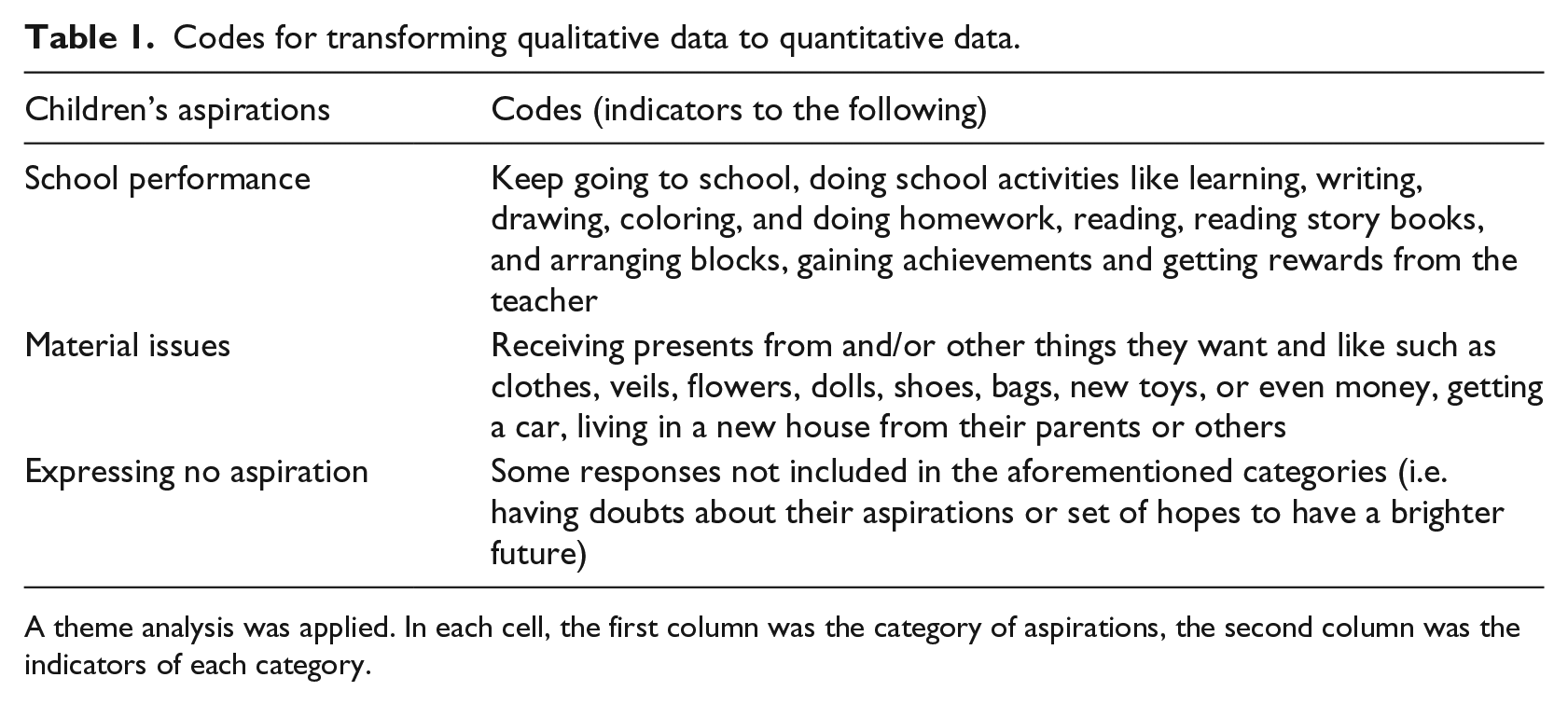
A theme analysis was applied. In each cell, the first column was the category of aspirations, the second column was the indicators of each category.
Based on Table 2, for both ethnicity categories (Javanese Indonesians and Sundanese Indonesians), the results underline that according to children’s accounts, material issues are the most commonly cited concerning what goal makes them happiest for both the Javanese-Indonesian and Sundanese-Indonesian groups, followed by not being sure and then by wanting to have a good school performance.
Aspirations and ethnic perspectives.
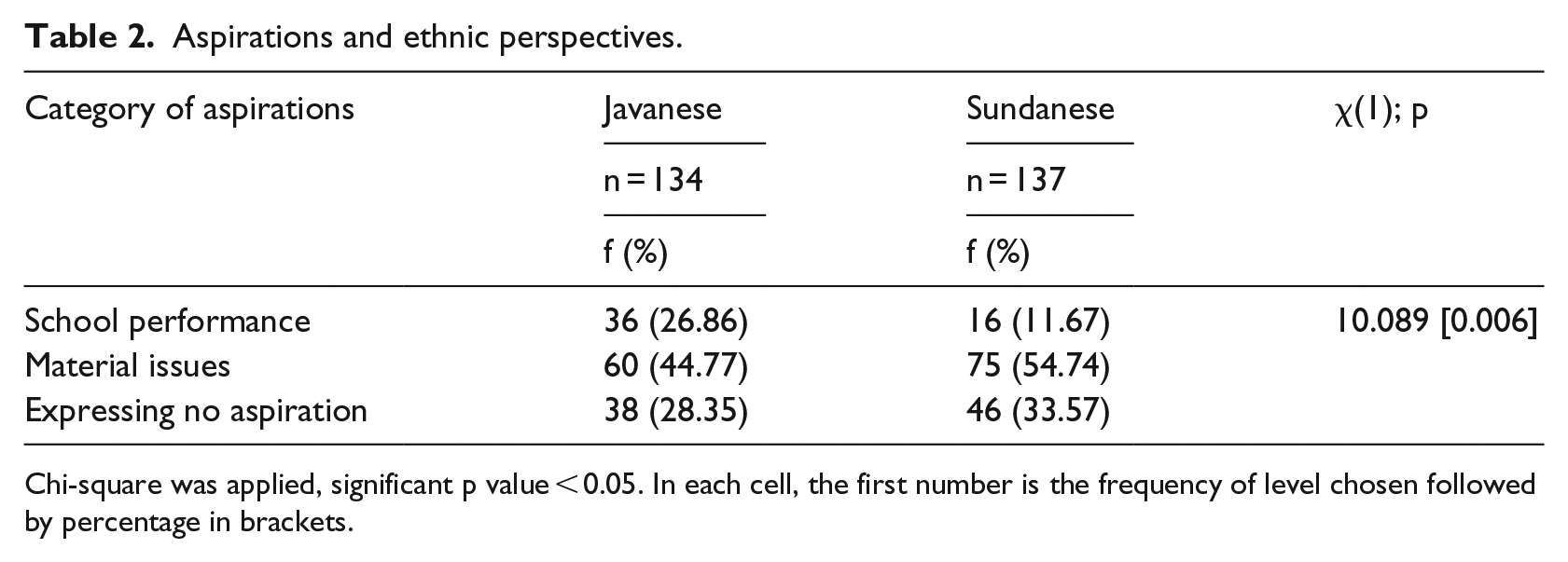
Chi-square was applied, significant p value < 0.05. In each cell, the first number is the frequency of level chosen followed by percentage in brackets.
Pearson chi-square (crosstabs) was run to evaluate the association between ethnic background and the young children’s descriptions of their aspirations. The table above depicts this result as well. Based on ethnic background, the result of the Pearson chi-square shows that χ(1) = 10.089, p = .006. In other words, there is a statistically significant association between young children’s ethnic background and their aspirations.
Discussion
This study shows that material issues are the category most mentioned by all children, followed by not stating their aspirations, with school performance as the least mentioned aspiration category. This study finds ethnic differences in the results. These results are in line with previous studies which confirm the role of culture on aspiration (Croll et al., 2010). In detail, responses categorized as material issues and not having aspiration are mentioned more by Sundanese children, while responses categorized as school performance are more mentioned by Javanese children.
In general, though ethnic differences existed in the results, material issues were the first popular response of both Javanese–Indonesian and Sundanese–Indonesian children as being one of their aspirations. This study indicates a discrepancy with Thoilliez’ (2011) study which shows that job concerns, continuity and security, emancipation, and material issues are mentioned relatively in the same amount when related to Spanish children’s responses about aspirations.
Furthermore, the Sundanese–Indonesian children provide the largest frequency of material issues. Likewise, material issues are also the most mentioned response for Javanese Indonesians. It seems as though the level of materialism increases over time for children. Some studies suggest that children nowadays are more materialistic than children of previous generations. A survey in the United Kingdom (Gfk Social Research, 2007) showed that children identify life with materialism. This is different to those raised in 1967 and 1997 (Kortan, 1999). In developing countries such as India, younger generations tend to be more materialistic than their older counterparts (Gupta, 2011). The increasing level of materialism is also related to the influence of the media. Many business people marketers spend more than $1 billion on advertisements intended for children (McNeal, 1999).
It was interesting that Sundanese as well as Javanese children gave similar answers to some of the questions. They referred to material issues when asked about their aspirations? Looking at the values and norms that are believed by each tribe, the response of the Sundanese children tends to be more dominant in relation to material issues than that of Javanese children. It is well known that the Sundanese–Indonesian people value being well balanced and mutually respectful in society. Sundanese Indonesians believe that people of higher social status should be respected by people of lower social status. This belief might lead people to place more value on higher social status. One of the efforts made to improve his or her social status is consumer consumption behavior (Cummins, 2005; Miller, 2009; Saad, 2007).
Javanese–Indonesian people, on the contrary, believe that the importance of family in society is reflected in the proverb: mangan ora mangan waton kumpul (even if there is no food to eat, being together is the most important thing). This moral value might lead people to place more value on put on non-material things over everything else in life (Geertz, 1961).
The values and norms adhered by families are considered as being related to parental aspirations in each tribe about education. Many studies have concentrated on parental educational aspirations, and they have found differences in demographic aspects like ethnicity and gender (Oketch et al., 2012; Chowdry et al., 2010). Furthermore, parents’ aspirations toward children contribute to children’s aspirations (Mau and Bikos, 2000; Schoon et al., 2007). For Sundanese, the culture emphasizes children’s upbringing, and it has higher aspirations for children’s education (Widjaja, 1989). Sundanese–Indonesian parents are not really concerned about their own education, yet they strive to focus on their children’s education (Widjaja, 1989). This manifests itself in non-educated parents who, consequently, tend to strive for even lower education for their children (Chowdry et al., 2010; Zhang et al., 2007).
In contrast, children are less happy when they are talking about their school performance as their sets of goals. It might be because school could be a place where children feel stressed. It is common for children to feel some form of stress in school. The common causes of stress in children at school are the increase in the amount of homework, competition for good grades, fear of failure, peer-pressure, and bullying (Allen and Klein, 1996). Sundanese-Indonesian children might be in situations where their parents place high expectations on their school performance. Those examples highlight differences in parental educational aspirations according to demographic characteristics (Qian and Blair, 1999).
This finding from two ethnic groups, revealed school performance was least mentioned as an aspiration. It becomes an important consideration in designing an education system for younger children for both groups of ethnicities. The study results indicate that children do not seem to have high hopes for education. Ideally, aspirations for education are in the mind of a child about their future. But in reality, this does not often happen; the child actually hopes for material benefits. This certainly becomes a real problem for teachers and requires serious handling.
Conclusion
In general, this study shows that the category of aspiring to have material issues was the most mentioned in relation to children’s aspirations followed by not stating aspirations and followed by aspirations associated with aspects of school performance. This study found an ethnic difference in the participants’ statements. Responses categorized as relating to material issues and not having aspirations are mentioned more by Sundanese children, while responses that are categorized as relating to school performance aspirations are more mentioned by Javanese children.
The analysis and examples reported in this study have offered ways of thinking about how global aspirations can be identified in children, and considers what to try and notice when looking for clues about children’s aspirations.
Footnotes
Acknowledgements
The authors would like to deliver their utmost gratitude and appreciation to the teachers, staff, parents, and children of kindergarten schools in Yogyakarta and Bandung for their participation in the present study. For all the lovely children involved in this research, they are all adorable. They shared with us what they really want in order to be happy along with their whole life stories. Whether they feel enthusiastic, happy and energetic, or even shy and reserved, they still told their storied voluntarily. We hope this study will serve as justice to their voices of aspiration. We also thank the research assistants for their help in collecting the data.
Funding
The authors received no financial support for the research, authorship, and/or publication of this article.
