




Abstract
Recent debates about children’s participation rights, formulated in the UN Convention on the Rights of the Child, primarily focus on ‘effectiveness’ of implementation. However, children’s participation remains problematic, its limited impact on adult power in decision-making or on the nature of decisions made persists, and implicated in both are reservations about children’s competence as participants. In respect of this, we analysed conceptualisations of competence in 67 articles, published between 2007 and 2017 in six childhood studies journals, in which ‘competence’ and its variations appear in the abstract. Although competence was rarely defined, conceptualisations were wide-ranging, covering competence as skills, as compliance with adult views, and as a trope signalling the field of childhood studies. As a result of our findings, we argue that epistemological clarity is vital for this concept to be useful regarding children’s participation and that attention must be paid to the different kinds of competences relevant for ‘effective’ participation.
Introduction
Since the establishment of childhood studies over the past three decades, the question of children’s agency and their social actorship has been central to the field’s scholarly work (see Buehler-Niederberger, 2010, for overview). This has complemented or overlapped with research concerning children’s participation rights under the UN Convention of the Rights of the Child (CRC) and children’s place in society within inter-generational and institutional relations. Often embedded in these debates and questions concerning participation are notions of children’s ‘competence’ – be it the competence to participate, the competence to understand social processes sufficiently, or the presence or absence of those cognitive competences presumed to be essential to making decisions.
Competence, competency and competencies have become frequently used terms, particularly with their popularity in educational, professional and business circles as key attributes in the so-called ‘skills society’ of contemporary times (e.g. see Organisation for Economic Cooperation and Development (OECD), 2018).
1
Here, competence is frequently used to denote a ‘cluster of related abilities, commitments, knowledge, and skills that enable a person to act effectively in a job or situation’.
2
In childhood studies, Hutchby and Moran-Ellis claimed in 1998 that a ‘competence paradigm’ (p. 9) had emerged in the 1990s across a range of work which sought to ‘take children seriously as social agents in their own right’ and which was aimed at explicating: … the social competencies which children manifest in the course of their everyday lives as children, with other children and with adults, in peer groups and in families, as well as the manifold other arenas of social action. (Hutchby and Moran-Ellis, 1998: 9, italics in the original)
However, even a cursory glance through childhood studies journals reveals that the term competence is used in various ways, with little attention paid to the significance of this. While we are not the first to note this – Freeman in 2007 commented, ‘‘Competence’ is one of those concepts so easily grasped, or apparently so, that it has tended to be treated as if it were unproblematic’ (p. 12) – in this article we aim to remedy the lack of critical attention to one of the core concepts circulating in childhood studies through an analysis of how scholars and researchers have deployed the concept in published articles over 10 years. Using a methodological approach based on Bryman (2006) and McNamee and Seymour (2013), we analyse the meanings bound up with the use of the term competence in a sample of published childhood studies articles and explore the implications of these for children’s participation. The benefit of doing such an analysis lies not only in elucidating emergent conceptualisations in the field, together with indications of the value of these conceptualisations for thinking about children’s participation, but also in critically appraising the extent to which different conceptualisations of competence might help or hinder children’s participation in decision-making processes.
With respect to childhood studies, and in the study of childhood in general, clarity over the ways in which competence is deployed should open up more critical reflection on how it is being used in discussions and analyses of processes of children’s participation. More generally, the question of whether competence has any sort of singular meaning is significant for sociological understandings of the relationship between agency, actorship and the capacity to act. If competence means skills, then questions of which skills come to the fore; if competence means capacity, then questions of the conditions under which that capacity can be realised gain relevance; if competence has little or no specific analytic meaning other than its everyday usage, then questions of what value it adds analytically need to be addressed. However, if the concept of competence demarcates a specific element of actorship and agency, then it is vital that it is given due attention. In our analysis of the 67 articles in our sample, we found examples of all these various uses. So, with these questions and challenges in mind, together with Freeman’s comment above about the hitherto seemingly unproblematic treatment of competence, our aim is to make explicit what competence is made to mean and how it is or is not ultimately relevant to attempts to promote children’s participation in decision-making processes.
Methodology: usages of competence in childhood studies
Our sample of articles is drawn from six English-language peer-reviewed journals that are well cited in childhood studies circles: Childhood, Children’s Geographies, Children & Society, Contemporary Issues in Early Childhood, Global Studies of Childhood and the International Journal of Children’s Rights. Some of the journals have overlapping remits but there are also key differences between them: Children & Society appeals to policy and practice as well as academia; Children’s Geographies has a tradition of testing conceptual ideas related to childhood studies; Childhood is an international journal, concerned with ‘children in global society’; 3 Global Studies of Childhood also seeks to consider children in a world context, stating that it takes a “broad view of childhoods that goes beyond the traditional biological and chronological age definitions”. 4 Two slightly more specific childhood journals are also included: Contemporary Issues in Early Childhood, which has a broad but interdisciplinary remit that includes sociological and social studies of early childhood 5 – an age group often absent from childhood studies more generally (Farrell et al., 2015) – and the International Journal of Children’s Rights which attracts more legal authors and submissions on law than the other journals.
We searched the abstracts in these selected journals over the past 10 years (2007–2018) on the presumption that if an abstract included the term, it should be important to the article. We thus generated a sample of articles during the time period which had variations of competen* or incompeten*. The results of this are found in Table 1.
Abstract sample – number of journal articles with competen* and/or incompeten* in abstract, 1 January 2007–28 Feb 2018.
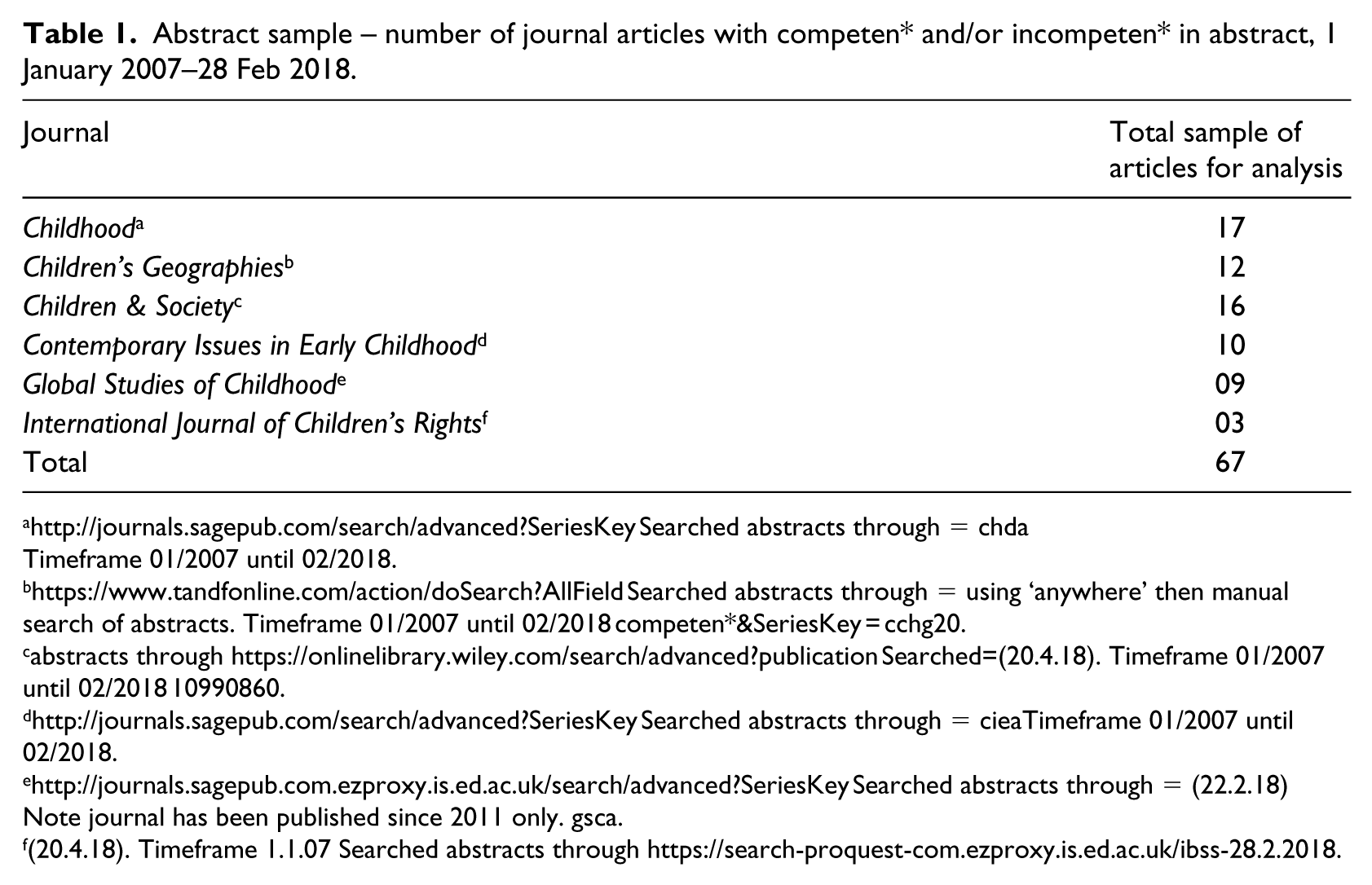
http://journals.sagepub.com/search/advanced?SeriesKey Searched abstracts through = chda Timeframe 01/2007 until 02/2018.
https://www.tandfonline.com/action/doSearch?AllField Searched abstracts through = using ‘anywhere’ then manual search of abstracts. Timeframe 01/2007 until 02/2018 competen*&SeriesKey = cchg20.
abstracts through https://onlinelibrary.wiley.com/search/advanced?publication Searched=(20.4.18). Timeframe 01/2007 until 02/2018 10990860.
http://journals.sagepub.com/search/advanced?SeriesKey Searched abstracts through = cieaTimeframe 01/2007 until 02/2018.
http://journals.sagepub.com.ezproxy.is.ed.ac.uk/search/advanced?SeriesKey Searched abstracts through = (22.2.18) Note journal has been published since 2011 only. gsca.
(20.4.18). Timeframe 1.1.07 Searched abstracts through https://search-proquest-com.ezproxy.is.ed.ac.uk/ibss-28.2.2018.
We also looked at the number of articles that used the term competen* or incompeten* anywhere in two 12-month periods (2007 and 2017) in order to gauge change in use over time. This resulted in over 200 articles. We undertook a rapid assessment to determine whether there was any notable change in usage between the 2007 and 2017 sets of articles: we did not find one. Given this, we retained only the abstract sample as our core dataset and subsequent analysis was based on the whole article, paying particular attention to the explicit and implicit meanings associated with the use of competence and its variants. These meanings were subject to thematic analysis to identify how competence is being defined and used.
We have considered the sample as a whole rather than differentiating it by journal. In this respect, we have not systematically analysed uses of the term competen* or incompeten* in particular sub-fields but rather examined usage as it appears across a range of studies that can be broadly categorised as being in the field of childhood studies.
While we have undertaken our search, sample selection and article identification systematically, we see this approach as a device to assist us with our broader agenda of considering the role of the concept of competence within childhood studies. In our discussion of our findings below, we make reference to frequency of use via broad relative proportions – for example, ‘the majority’, ‘a few’, ‘a handful’ – to give an indication of the rarity or commonness of the situation we are describing and analysing.
We acknowledge that the approach we have taken has limitations which moderate the generalisability of our findings. For example, a wider range of journals could be used; different journals and different disciplines have conventions concerning use of particular terms; abstracts may not include the word competence even though the concept is key to the article; arguments can be made for choosing different time periods; all articles are English-language only. Nonetheless, the sample represents a set of core publications in childhood studies and the analysis yields several provocative key findings.
Key findings
The vast majority of articles focus on children’s competence and not the competence of adults. We identified six key ways in which competence is used in relation to children:
As a trope that positions the work in childhood studies and/or claims a starting point of positioning children as social actors who are agentic or ‘have’ agency;
As a trope that more specifically enables arguments for, or conclusions concerning, children’s participation;
As a disciplinary-specific concept related to children’s acquisition of specific skills, which is under direct examination in the article;
As a set of skills that enables or legitimates children’s participation in social research;
As a legal concept, which is critically examined for children’s participation in legal processes;
As a sociological concept meriting direct examination of how it is operationalised in different professional and policy practices.
The meanings attached to competence are often implicit, with very few articles defining the concept or elaborating on how it is conceptualised within the article. Nonetheless, many articles have a mix of uses with only a few focusing specifically on one form alone.
In the following sections, we look in more detail at the ways the concept is used and the implications of these variations for childhood studies and children’s participation more generally.
‘Competence’ as a trope
By far the most common use of the term competence is as a trope locating the article in childhood studies (e.g. Cele and Van der Burgt, 2015; Hordyk et al., 2015; Kendrick et al., 2008; Liljestrand and Hammarberg, 2017; Rossi and Baraldi, 2009; Skelton, 2007, 2008; Tisdall, 2012; Uprichard, 2008). This involves phrases such as ‘children are competent social actors’ or ‘the competent child’, but with competence left undefined and unexpanded. This trope frequently sets up a contrast with the ‘traditional’ view that perceives children as vulnerable, dependent and incompetent, which then enables children to be positioned as legitimate participants in research, as narrators or interpreters of their own lives. In this way, competence acts as a helpful device for introducing and positioning either the epistemological or the theoretical basis of the article, or both.
The second use of the trope justifies children’s participation in decision-making. Where competence is used in this way the argument is also often tied to Article 12 of the CRC and children’s participation rights thereof (e.g. Skelton, 2007). Like the first type, competence is not dissected conceptually but used to justify recognising children’s participation rights. Also as in the first type, competence is often used as a defence against the ‘traditional’ view that children’s participation is not appropriate or valid.
In both the versions, competence operates as an ‘input’ condition. The competent child trope tends to locate competence as an attribute or trait of the child rather than something expressed and contextualised. There are certain exceptions, such as adjusting adult processes to enhance children’s competence. Only a handful of articles explicitly advocate for competence to be considered as situational and contextual (e.g. Brady, 2014; Skyrme, 2017; Uprichard, 2008, 2010).
‘Competence’ as a skill or set of skills
Both discipline-specific versions of competence and more socially orientated or sociological versions include specific skills that ‘add up’ to competence. In these cases, competence is usually more defined than in the trope use or reference is made to definitions in other fields or documents. The skills associated with competence divide between the technical (e.g. mathematical competence in Anthony and Walshaw, 2009), the cognitive in as much as understanding or knowledge are relevant (such as the competence to be a research participant discussed by Ericsson and Boyd (2017) and Macdonald (2013)), and the social or practical such as the range of skills acquired through experience, work and living circumstances by children living in Ghana (Sackey and Johannesen, 2015), Uganda (Kendrick and Kakuru, 2012) or Zambia (Payne, 2012).
Notably, the discipline-specific articles are found mainly in Contemporary Issues in Early Childhood but are usually focused on analysing the social aspects involved in acquiring competences in a subject area such as mathematics or reading (e.g. Davidson, 2008; Klein, 2007). While competence in this context relates to preset measures of acquiring skills and knowledge, the articles also include more sociological perspectives such as co-producing competence between children and teachers through interactions in instructional talk (Davidson, 2008) and the social dynamics of learning (e.g. Fassler, 2014). A few articles position competence as technical skills, reflecting the disciplinary backgrounds of the work: linguistic (Castillo et al., 2017; Parsons et al., 2011) and psychological (Robinson et al., 2012). These articles report on assessing such competences, albeit with no further elaboration or questioning of the term.
A specific connection to ‘skills’ emerges in articles concerned with supporting children to be active participants in social research. Several articles set out arguments concerning how children can be supported to participate in research by acquiring or applying the particular skills needed. Here, the focus is on adult researchers designing research which, through enhancement or careful rethinking of practicalities and cognitive requirements or demands, brings children’s already existing competences into the realm of the practical skills required for robust and ethical research to be possible (e.g. Brady, 2014; Conn, 2015; Coyne, 2010; Darian-Smith and Henningham, 2014; Macdonald, 2013; Skyrme, 2017). Careful adjustments to facilitate children’s competence is evident when Ericsson and Boyd (2017) discuss assent as an ‘ongoing relational negotiation’ (p. 300) while Thomson (2007) argues for suspending ideas of competence in favour of a ‘bottom-up approach to participatory methodologies’ (p. 303), seeking to resist the use of competence as an ability threshold that has to be passed before someone can be a research participant.
In respect of research participation, then, we see an often mixed use of the term competence and its characterisation as a product of both ‘input’ and ‘output’ modes of competence. At the same time, the ‘skills’ aspect required for research participation can be masked by the term competence. How to ensure that children can be research participants, with all the protections and rights that adults have in the same situation, is mainly dealt with at the practical or concrete level – without questioning the different kinds of skills that being a research participant requires of anyone, child or adult.
Legal concepts of competence
It is the articles considering legal contexts that tend to define and discuss competence more specifically. Attention is given to the law and, particularly in older articles, to ‘Gillick competence’ following the seminal statements by Lord Scarman in England, who stated a competent child is one who ‘achieves a sufficient understanding and intelligence to enable him or her to understand fully what is proposed’ (Gillick v West Norfolk and Wisbech Area Health Authority 1985 3 WLR 830, 189). Some articles use this definition to support children’s own competence to consent and participate in research about themselves (e.g. Coyne, 2010).
A small minority of articles detail the legal arguments concerning competence to participate in decision-making processes, providing the definitions and legal requirements as set out by law and case law. A fulsome example is Himonga and Cooke’s (2007) article on reproductive medical decision-making in South African law, which in turn relies on the conceptual typologies developed by Buchanan and Brock (1990). These articles tend not to connect to the familiar childhood studies’ trope; the articles instead connect to concepts of autonomy, self-determination and rationality – although again with limited discussion and critique (e.g. Himonga and Cooke, 2007). The threshold nature of competence becomes very apparent in the legal context. Where a child is not considered competent, that child cannot consent nor participate in research nor can the child consent to or refuse medical treatment (e.g. Freeman, 2007; Himonga and Cooke, 2007) and their views will not be influential in decision-making.
The dualism of competent/incompetent is thus divided by a threshold with a child on one side able to participate or be recognised as a social actor, and a child on the other side not able to do so. The criterion is something for an adult to judge (e.g. Brady, 2014; Karlsson et al., 2016). Rarely are children judging whether they themselves are competent or not and, even where they are, children are reported to perceive adults as more competent and that children’s competence is diminished by adults (e.g. see Britton, 2015; Milton et al., 2008). It is typically not clear how competence is being assessed in these cases. Some articles discuss the risk that children are only perceived as competent when the children’s views accord with the professionals’ views. This association of compliance and competence by practitioners is also found elsewhere: Iversen (2014) shows how social workers see children who are willing to engage in counselling as competent and those who are unwilling or uncooperative in counselling as incompetent; De Castro (2012) notes how teachers and young people both consider conformity to school values as core to competent participation.
In these institutional settings, there seems little scope for a child to express competency in one context but not another nor for competency to be considered fluid and dynamic, or contingent. In effect, when judged to be a threshold criterion, competency becomes a ‘sticky’ attribute of a child that places the child on one side of the threshold or the other. It is all or nothing, in most uses of the term, for a child to be allowed by adults to participate. However, many researchers discussing the links between compliance and competence, or practices that work with competence as a threshold criterion, are critical of this form of definition-in-practice; they argue instead that practitioners need to recognise that children’s competence can include having valid alternative views to those of adults (e.g. Schmitt, 2010; Smith, 2012).
Competence as a ‘sociological’ concept
A handful of articles focus on competence as a sociological phenomenon. These articles develop a critical analysis of how children’s competence as ‘social actors’ is constructed, achieved, realised or thwarted in different settings. One article challenges the whole notion of competence as an ideological fiction arising from a politics of child participation rather than being empirically or theoretically meaningful (King, 2007). Articles based in conversation analysis (Danby et al., 2016; Davidson, 2008; Theobald, 2016), as one might expect, place emphasis on children’s competence with respect to their understanding of social orders and their mobilisation of resources in pursuit of their agentic goals (successfully or unsuccessfully).
A few articles are notable for their critical analysis of the incorporation of ‘the competent child’ into early years education and care (ECEC) policy in the Nordic countries (Alasuutari, 2014; Franck and Dyblie Nilsen, 2015; Liljestrand and Hammarberg, 2017). These articles show how childhood competence has been construed as the child being autonomous, independent and able to express opinions from the early years of their lives. Children who do not do this are perceived as developmentally deficient or close to occupying a ‘subject position of deviance’ (Franck and Dyblie Nilsen, 2015: 230).
Within the more sociological perspectives on competence and children, some articles develop critiques of the concept of the competent social actor, on the basis of the implicit or explicit links with responsibilisation and governance of the individual as part of the neoliberal frame in contemporary society (e.g. Smith, 2012; Thomson, 2007; Uprichard, 2008). In some of these critiquing articles, challenges are also made concerning how ‘competence’ is defined de facto as conformity to social rules and expectations by practitioners.
In sum, our analysis finds at least six ways competence and its variants are used in the 67 articles. The considerable majority of articles use competence without conceptual definition or interrogation. Many articles use competence as a threshold criterion: if a child is considered competent, the child can participate; if the child is not considered competent, the child cannot participate. In some articles, competence is treated as an ‘input’ condition – something the child already possesses (or needs to possess) and brings to the situation; in other versions, competence is an ‘output’, the result of an intervention or experience. In some cases competence is articulated as both an ‘input’ and an ‘output’: the child brings their already possessed competence to a situation in which, as a result of interactions or interventions, further or different competences are generated. The implications of these finding are discussed below.
Conclusion
Competence is ripe for conceptual consideration given its not infrequent usage in childhood studies. In many articles (although not in all), it is used loosely or not made to work particularly hard as an analytic or critical concept. Competence can also be a ‘double-edged sword’ since it can be conceptually mobilised both in arguments in favour of children’s participation and in those against it.
When competence is used as a threshold criterion for participation, adults almost invariably have the power to decide whether this threshold has been reached: from participation in research through to involvement under legal requirements. Yet, because competence tends not to be engaged with critically nor empirically, the bases for judging this threshold are not evident. Furthermore, children risk being judged as competent only when they are compliant and their views accord with adults (professionals or researchers), leaving little room for children to act or think in ways contrary to what is expected. This means competence is often treated as a status or subject position that is ‘granted’ to children by adults. Only very rarely is adults’ competence called into question in the articles.
The variance in the way competence can be positioned temporally is also of critical importance analytically. On the one hand, if it is seen as an ‘input’ or a precondition, this opens up further questions as to whether it is something that can be supported or enhanced via interventions relating to knowledge, skills or advocacy. On the other hand, its status as a precondition may lead to a lack of analytic recognition of its relational, contextual or contingent nature. As an outcome of social interactions or the product of an iterative dynamic between input and output, it is analytically problematic if competence is being conceptualised as only an attribute of the child in the interaction or setting.
When competence is associated primarily with a set of skills, and practical ones at that, there is a risk that bigger questions are not asked: for example, what constitutes credible, legitimate and ethical research participation for all participants (adult or children) and what are the structures, processes and contexts that facilitate this? As recent work in childhood studies questions an apparent essentialisation of children’s agency (see Esser et al., 2016; Spyrou, 2017), so a handful of articles on children’s competence questions whether competence is less a characteristic or possession of an individual and more a relationally, contextually and temporally expressed phenomenon.
We set out with the expectation that competence would be intertwined with autonomy and self-determination, as something we could interrogate conceptually for the seminar series (see editorial). We find few examples of this, with autonomy and self-determination seldom mentioned at all within the articles in the journals we selected for our sample. Philosophical discussions of agency in childhood more often make these links (see, for example, Archard and Macleod, 2002; Hannan, 2018), but there is little evidence that this crosses over into more sociologically orientated discussions in the journals we examined. That said, there are two sets of articles in which competence, autonomy and self-determination are associated with each other. In the Nordic articles on ECEC, ‘the competent child’ is construed in policy as autonomous and independent: a constellation that is critiqued by the articles’ authors. In legal and health-related articles, competence is also associated with autonomy and self-determination with reference to legal capacity: that is, a person being able actively to enter into juristic acts themselves (Thomson, 2014: para. 10.2). However, here the conceptual relationship is rarely critically interrogated.
In what ways do our findings hold relevance for children’s participation? An argument could be made that reference to competence creates more problems than it solves, particularly when it is presumed as a threshold criterion. More positively, thinking analytically about skills and capacities required for participation can lead to useful questions about what is needed to create the right conditions for participation to be successful. As an example of this, Larkins et al. (2014) discuss the idea of a ‘lattice of participation’, which interweaves the conditions that need to be in place to support participation by children and identifies these as conditions and competences relevant for all agents in the process, and not just children.
On the basis of our analysis of its use over the past 10 years, our overall conclusion is that it is timely to be explicit about the formulation of competence that is being pressed into service, and essential that there is clarity as to why it is being used. This means paying attention to what definition of competence is being used, what its characteristics are, what it is intended to cover, whether it is an input, output, or iterative phenomenon in the case in hand, whether it has other properties embedded within it such as thresholds, degrees of mutability, or contingencies, and finally why it is a relevant concept to consider.
More specifically in relation to participation debates and questions, the concept of competence in any formulation should include a critical analysis of the role of skills – be they technical, cognitive, social, or a combination of these – and the role of experience and knowledge. In the desire to argue that all children are ‘competent social actors’ to justify their participation in matters relevant to their lives, the lack of attention to what competence specifically means can weaken the argument. It thus loses out to arguments against participation, grounded in reaching competence thresholds based on developmental judgements, common sense or expert opinion – even though these too may be nebulous when subject to close examination. The tendency for professionals to take children’s compliance with adult views or to read consensus between children and adults as indicators of children’s competence, as the literature shows in our analysis, requires strong challenge based on clarity of conceptualising alternative formulations of relevant competence and the possibilities of supporting children’s competence through information and adapting participation processes. Furthermore, attention must be paid to the different kinds of competence relevant for effective participation.
Greater clarity in the use of concepts of competence can subvert the limitations children frequently encounter in inter-generational and in institutional relations of participation. Detailed and specific challenges to the presumptions that underpin exclusionary competence criteria can serve to make questions of social orderings, power relations, social structures, material conditions and practical accomplishments more visible with concomitant relevance for enhancing participation itself as a practical accomplishment.
Footnotes
Acknowledgements
We appreciate the detailed comments from anonymous reviewers of the draft article. We are very grateful to colleagues at the seminar for their insightful challenges and comments in response to an early version of these ideas in our seminar paper.
Authors’ note
We have used the term ‘children’ and ‘childhood’ in this article, with a focus on how it is used within childhood studies journals. Broadly, these journals will cover children up to the age of 18, as recognised in Article 1 of the CRC. Both the authors confirm that this text is original and has not been published or submitted elsewhere.
Funding
The authors disclosed receipt of the following financial support for the research, authorship and/or publication of this article: A range of collaborative projects are acknowledged, funded by the Big Lottery Fund, the British Academy, Economic and Social Research Council (RES-189-25-0174, RES-451-26-0685) andKnowledge Exchange funds from the University of Edinburgh and the ESRC Impact Acceleration Account, the European Research Council, the Foundation of Canadian Studies, the Leverhulme Trust, the Royal Society of Edinburgh and the Social Sciences and Humanities Research Council of Canada.