




Abstract
Discussions about the Convention on the Rights of the Child are often excessively legalistic. This obscures the possibility for a deeper engagement with the text of the Convention to identify its underlying values and conception of childhood. This paper engages with this less chartered terrain. It first traces the shift from an instrumentalist, to a welfarist, to a rights-based conception of childhood. Next, it explores the discrete features of this rights based conception of childhood under the Convention which is shown to recognise and accommodate both children’s vulnerabilities and evolving capacities while also challenging traditional systems that silence and marginalise children. Finally, it addresses some of the enduring and emerging concerns with the idea of children’s rights – that it is divisive, grounded in western values and incapable of accommodating non-human ecological concerns – to reveal a more dynamic, relational and accommodating conception of childhood than is often assumed to be the case under a rights-based approach.
Introduction
Discussions about children’s rights are invariably tethered, albeit in varying degrees, to the UN Convention on the Rights of the Child (CRC) (Fenton-Glynn, 2019; Mutch, 2025; Todres and King, 2020). This is understandable given that the CRC is an international human rights treaty which has been ratified by every nation state except the USA. As a matter of international law, it represents the global standards with respect to the treatment of children that every state is obliged to fulfill. In this sense, it also offers a global vision for the expectations of childhood. For an international lawyer (like me) this deference to the CRC is particularly reassuring. It suggests that human rights treaties, like the CRC, might actually matter (Sikkink, 2017; Simmons, 2009). But it also carries a risk, namely that discussions about children’s rights might become exceedingly legalistic (Regilme, 2024: 9) and be reduced to considerations as to whether a particular action is consistent with, or in violation of, the CRC. Such discussions, and the skills required to undertake them, are of course critical (Tobin, 2019: 9). But they must not obscure the potential for the CRC to be considered as more than simply a legal document; the potential for it to reflect a particular conception of childhood that has implications beyond questions of compatibly with international law; as offering an ethical or moral framework that has implications that can inform adult engagement with children in all aspects of their lives (Hiskes, 2021; Tobin, 2013); as offering a theory that has the capacity to align with, complement or challenge other theories and conceptions of childhood.
The aim of this paper is to explore this less chartered terrain; to move beyond making connections between an issue concerning children and their rights or listing the challenges that impede realisation of children’s rights (Regilme, 2024; UNICEF, 2024). Instead, the aim is to explore what it means to think of the CRC as a document that offers a conception of childhood that informs the basis of what is known as a human rights or child rights-based approach to matters involving children.
Conceptions of childhood and the emergence of rights – The legal story
Instrumentalist
Prior to the 20th century, the dominant conception of children under the law, at least within Western geo-political legal systems, was that children were seen to be the property of their parents and more specifically their father (Eekelaar, 1986: 163). This was reflected in the long held Roman doctrine of patria potestas – paternal power – which entitled a father to absolute control over his children. Courts routinely maintained this position. The English case of In re Agar-Ellis (1883) 24 Ch D 317, which required resolution of a conflict between parents concerning the religious education of their children, is routinely cited as an example of this principle. When finding in favour of the father, the judge warned that any move by a court to override ‘the natural jurisdiction’ of a father over his child ‘would be really to set aside the whole course and order of nature, and it seems to me it would disturb the very foundation of family life’ (p. 336). This idea of exclusive and unfettered control of a child by their parent reflects what can be described as an instrumental (Eekelaar, 1986: 163) or property based conception of childhood.
As explained by Eekelaar, such was the influence of this approach that ‘early law viewed children primarily as agents for devolution of property within an organised family setting’ (Eekelaar, 1986: 163) and that ‘the social role of children was primarily seen as furthering the interests of the family group . . . by maintaining and perhaps extending the family’s landholding’ (Eekelaar, 1986: 163). Under this model, the relationship between children and their parents was structured such the child was ‘perceived as an instrument for furthering the interests of the adult or adult community’ (Eekelaar, 1998: 207). A child had no independent interests deemed worthy of protection under the law and certainly no rights. Childhood was a period of invisibility, a time of waiting, dependency, parental control and often exploitation (Freeman, 2020: 50).
Welfarist
In the late 19th and early part of the 20th century, there was a shift within Western legal systems from instrumentalism to what can be described as a welfarist approach to childhood (Eekelaar, 1986). Central to this approach is the recognition that children have interests that are independent from their parents and that such interests (at least in theory) must be the paramount concern in any matter concerning a child. In contemporary settings this approach still finds expression in the best interests principle. This concern for children’s interests was initially driven by increasing humanitarian (some might also say ‘child saving’) concerns regarding cases of abuse and neglect experienced by children (Australian Law Reform Commission, 2010: 170; Wells, 2011: 17). This was especially acute in circumstances of exploitative labour which was ubiquitous from the late 19th century (Sacotte et al., 2023: 2–3) and inspired international initiatives to prioritise the interests of children such as the ILO Conventions on child labour standards and the 1924 and 1959 Declarations on the Rights of the Child (Alston et al., 2005: 3–5). At the domestic level, concern at the neglect of parents also led to a raft of measures such as the Guardianship of Infants Act 1925 in the UK (Eekelaar, 1986: 167), and the development of community based services for children in the USA (Wells, 2011: 17). As Wells explains, in these contexts, ‘children were targeted as the “deserving poor”, innocent victims of circumstances beyond their control’ who needed to be saved from their dysfunctional parents (Wells, 2011: 17).
The critical point about the consequences of the welfarist approach for the idea of childhood is that it demanded a reorientation of adult agendas away from self-interest to an obligation to promote a child’s best interests. This required a paradigm shift in the moral framework regulating the relationship between children and adults. A moral obligation to care for children arose because of an acceptance that childhood was a period of vulnerability during which children, due to their lack of capacity and immaturity, were dependent on adults and invariably the state (and its agents) for protection. Under a welfarist approach, children were to be recognised as having interests independent from and possibly even in conflict with their parents. However, given assumptions about children’s lack of capacity there was no expectation or obligation that they had an entitlement to be heard in the assessment of those interests. Under this vision of childhood, children were to be seen but not heard and were defined by their vulnerability and dependency on adults.
The emergence of rights
The shift from instrumentalism to welfarism was certainly of benefit to children, but welfarism also has its ‘dark side’ (Eekelaar, 2017: 159). This arose because of the potential for ‘proxy interests’ (Eekelaar, 2017: 160) whereby the interests of others and untested assumptions about what is good for children, drive the assessment of a child’s best interests. Extreme illustrations of this danger are reflected in policies such as the removal of Aboriginal children from their families in Australia, which led to the Stolen Generation (Human Rights and Equal Opportunity Commission, 1997) and the removal of children from single mothers until the 1970s to be placed for adoption (Senate Community Affairs Reference Committee, 2012). In both instances, the legislative justification for the policy was the best interests of the child principle – a claim that was grounded not in evidence but in racism and prejudice masquerading as benevolence.
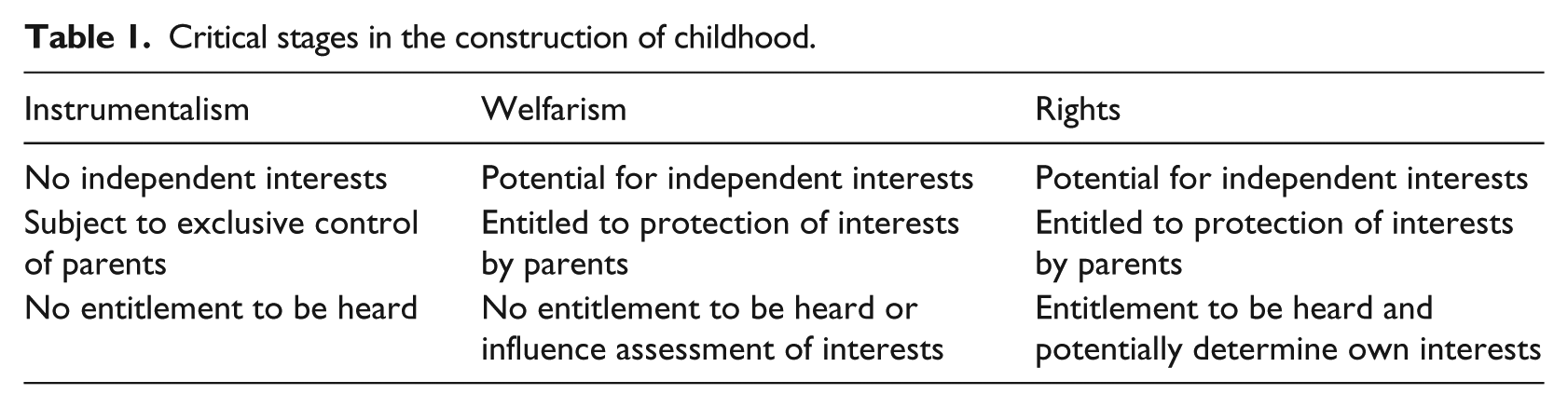
This underlying deficiency of welfarism explains, if not the inevitability, then arguably the unsurprising emergence of the idea that children should enjoy their own rights including a right to be heard. Scholars have detailed how this development is tied in with the emancipatory struggles of the civil rights and women’s movements (Guggenheim, 2007: 5). Critical to this development is a recognition that children are not just to be seen or indeed heard but taken seriously in the determination of matters that affect their interests. At a domestic level, the UK case of Gillick v West Norfolk and Wisbech Area Health Authority [1986] AC 112 provides an illustration of this shift in the conception of childhood. In deciding whether children should have access to materials concerning sexual and reproductive health contrary to the wishes of a parent, the UK House of Lords held that once a child has attained sufficient understanding and maturity, they must be recognised as having the capacity to access such materials without the consent of their parents. This case reflects a critical stage in the legal construction of childhood that, as set out in Table 1, tracks the historical progression from instrumentalism, whereby children had no independent interests, to welfarism whereby they were defined by their vulnerability and had interests which were determined by adults, to a rights based approach whereby they were given the scope to be heard and determine their own interests.
Critical stages in the construction of childhood.
Of course, legal developments do not take place in a vacuum. And sitting behind this brief overview of the shift in the legal conception of childhood is a much more complex story about the sociology of childhood (Holt, 1975; Mayall, 2015). A story where ideas about children’s visibility, agency, voice and relative power begin to emerge from the 1970s onwards. A story which also underpins, informs and arguably influenced the drafting of the CRC over a 10 year period from 1979 to 1989 (Wall, 2019: 258) to produce not just a legal instrument but also a discrete conception of childhood.
The CRC and its conception of childhood
Recognition of children’s vulnerability
When the representatives of states, who were responsible for drafting the CRC, first gathered in Geneva in 1979 they had before them a draft proposal from Poland which was based on the 1959 Declaration on the Rights of the Child. The aspirations for children under this document were clear – ‘that he (sic) may have a happy childhood (emphasis added) and enjoy for his(sic) own good and for the good of society’ the rights set out under the Declaration. The rights considered necessary to secure this vision included non-discrimination; an entitlement to special protection; a name and nationality; the benefits of social security; special treatment for the ‘handicapped’ (sic) child; the love and understanding of a family, education, protection against cruelty and exploitation, and an overriding commitment to ensure that the best interests of the child shall be the paramount consideration. The ambitions underlying this conception of a ‘happy’ childhood may have been noble in a Disneyesque sort of way but they reflected a classic welfarist approach (laced with some sexism – note the gendered language; some ableism – note the use of ‘handicapped’ and some residual instrumentalism – the Declaration concludes with a requirement that the energy and talents of children ‘should be devoted to the service of his (sic) fellow men (sic).’
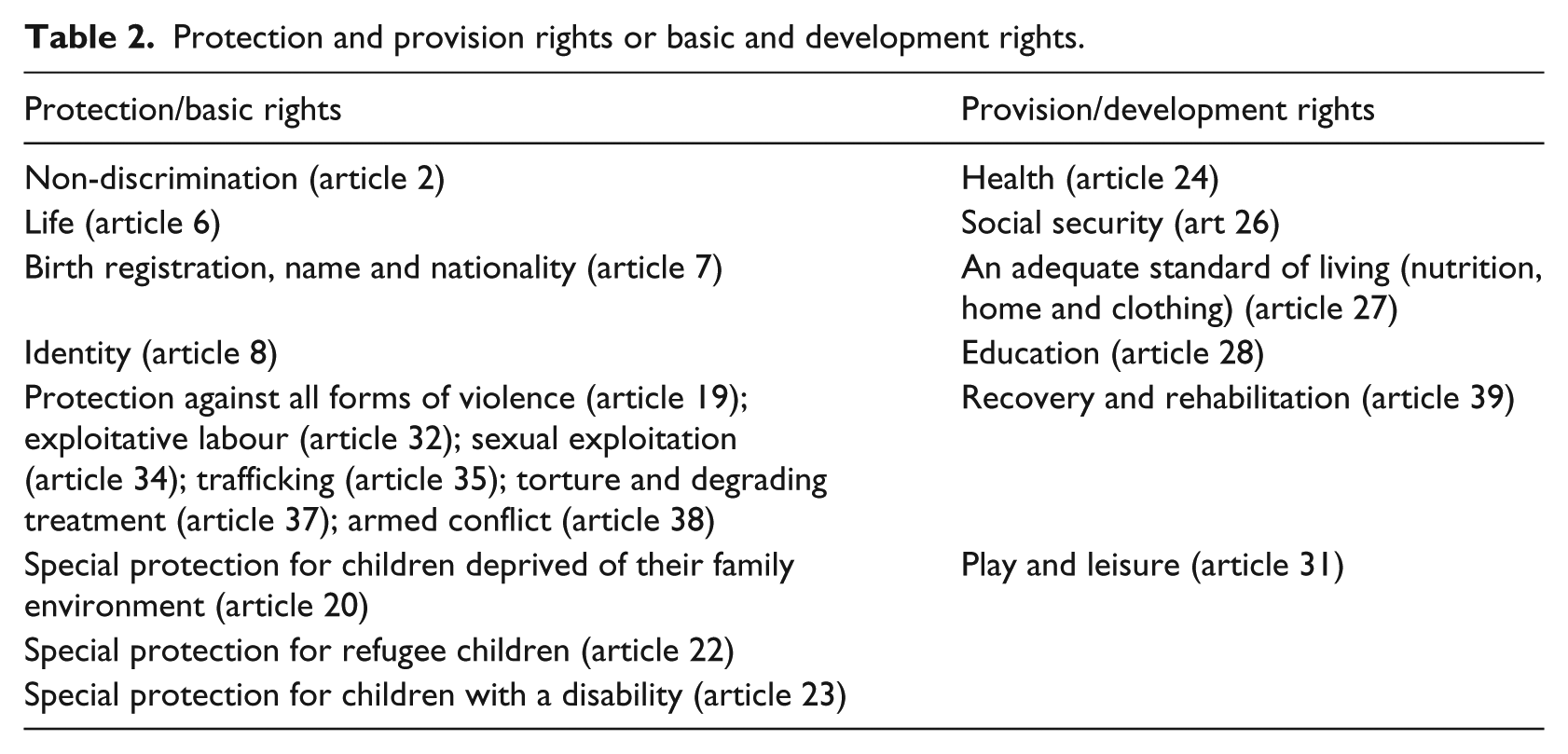
Fast forward 10 years to the adoption of the CRC in 1989, and a far more complex and nuanced conception of childhood emerges. Consistent with a welfarist approach, the preamble recognises that ‘childhood is entitled to special care and assistance’ and the CRC includes number of rights that are designed to protect and assist children and their families. These rights, which are summarised in Table 2, are sometimes referred to as protection and provision rights or basic and development rights. As such, under the CRC there is no shying away from a conception of childhood whereby children remain vulnerable relative to adults by virtue of their physical, intellectual and social status. Indeed, it is this differential vulnerability that provides the justification to recognise special human rights for children (Dixon and Nussbaum, 2012; Tobin, 2013).
Protection and provision rights or basic and development rights.
Significantly, the CRC also includes the best interests principle (article 3) – the foundational principle of a welfarist approach. But the formulation is slightly modified such that a child’s best interests are not the paramount consideration, as was the case under the 1959 Declaration on the Rights of the Child, but a primary consideration to be taken into account in all matters concerning a child. This difference is significant and was designed to move away from the simplistic and often misused rhetoric that children’s interests must always be the paramount consideration (Eekelaar and Tobin, 2019: 95–96). The formulation used in the CRC still recognises that children’s interests must be recognised and elevated in any matters concerning them. However, it also recognises that other legitimate interests may be involved and a balancing process must be adopted to minimise and justify any inference with any interests including those of children (Eekelaar and Tobin, 2019: 97–98). This approach moves beyond a pedestal model of childhood, where children are elevated to objects of special concern (often in name only) to an integrated social/relational model of childhood whereby children’s special interests must be recognised but also balanced in circumstances where there other competing interests (for example, those of another child, parents, or members of the broader community).
Recognition of children’s evolving capacities and agency
The percolation of ideas within studies and research about childhood during the late 1970s and 1980s about children’s agency and the importance of their voice spilled into the debates about the drafting of the CRC. Although these ideas were absent from the original Polish draft in 1978, a revised draft in 1979 included the following provision: The States parties to the present Convention shall enable the child who is capable of forming his own views the right to express his opinion in matters concerning his own person, and, in particular, marriage, choice of occupation, medical treatment, education and recreation (Office of the United Nations High Commissioner for Human Rights, 2003: 437)
Over the next 10 years of drafting, at no point was there any opposition to the sentiment underlying this provision and the debates among states only refined the formulation to the more expansive final version that appears in article 12 of the CRC: States Parties shall assure to the child who is capable of forming his or her own views the right to express those views freely in all matters affecting the child, the views of the child being given due weight in accordance with the age and maturity of the child.
The impact of this provision on the conception of childhood under the CRC cannot be underestimated. It is considered to the ‘lynchpin’ of the CRC (Freeman, 1994: 319) and its most ‘radical’ element (Lansdown, 2001: 1). Although commentators have spent considerable time examining its precise meaning (Lundy et al., 2019), what is clear is that is represents a significant departure from the classic welfare model. Under a rights-based approach children are not simply to be seen but also heard and taken seriously in all matters affecting them. Moreover, this emphasis on children’s views under the CRC is much greater than was recognised by the House of Lords in Re Gillick. That case was only concerned with the binary question of whether a child is considered competent – a complex idea (Moran-Ellis and Tisdall, 2019) which in a legal context, denotes a person’s sufficient maturity and understanding to provide consent to a practice or procedure). Under article 12, children’s views have a much more expansive role to play. The focus is first on the capacity of a child – can they express a view on a matter affecting them (and keep in mind an infant child can express their views very forcefully)? If so, there is then a secondary consideration as to the weight to be accorded to those views (Lundy et al., 2019: 411–415).
When implemented properly, article 12 entirely restructures relations between children and adults relative to an instrumentalist or welfarist approach. Indeed, the obligation ‘to assure’ under article 12 places on onus on adults to take positive measures to facilitate and scaffold conversations with children that are age appropriate. It recognises that traditional adult-centric methods of facilitating participation in decision-making processes will not always be accessible or appropriate for children to express their views. To borrow the words of Iris Young, the ‘terms of the discourse’ may make ‘assumptions’ that children do not share, and the interactions may privilege adult styles of expression to the exclusion of children’s modes of expression (Young, 2010: 53). Thus, article 12 demands new conceptions of participation that have the capacity to transform the decision-making process and make it more inclusive by bringing into play views that would otherwise go unheard (Thomas, 2007: 199). Under this model, childhood is not a period of passivity, of waiting, of being seen but not heard but rather a period of active and meaningful engagement between children and the adults whose decisions affect their lives across the entire period of childhood.
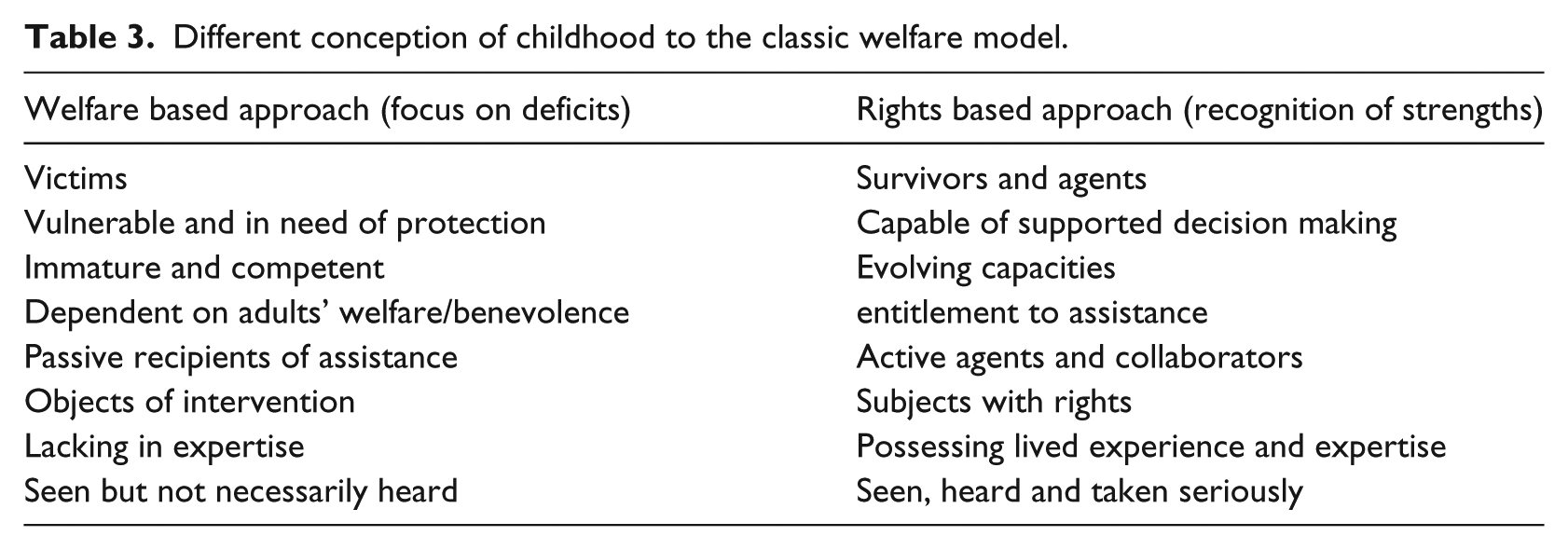
At this point, it is important to recognise the complementarity and/or strong correlation between elements of a rights-based approach to childhood and the discussions about participation and children’s agency that occur within childhood studies and the sociology of childhood (Coppock and Phillips, 2013; I’Anson, 2013). Article 12 is of course central to these conversations but so too is article 13 – the right to freedom of information (which includes the right to seek and receive information); article 14 the right to freedom of thought conscience and religion; and article 15 the right to freedom of association and peaceful assembly. Collectively, as illustrated in Table 3, these rights construct a very different conception of childhood to the classic welfare model. Under a rights-based conception of childhood, children’s vulnerability is still recognised. But children are not defined by their vulnerability (Tobin, 2015: 176). Their strengths and evolving capacities are also recognised, as is their entitlement to exercise and enjoy their autonomy and participation rights.
Different conception of childhood to the classic welfare model.
More than voice
Importantly, a rights-based conception of childhood is about more than simply enabling children to be heard. It requires a recognition that children have an entitlement to claim and enjoy all the rights under the CRC. Whereas children risk being reduced to objects of intervention under a welfare model, children are considered subjects with entitlements to assistance under a rights-based approach. As the Committee on the Rights of the Child, the body of independent experts responsible for overseeing implementation of the CRC, has explained, the CRC requires: A shift away from traditional beliefs that regard early childhood mainly as a period for the socialization of the immature human being towards mature adult status is required. The Convention requires that children, including the very youngest children, be respected as persons in their own right (Committee on the Rights of the Child, 2007, para 5).
This is significant to the extent that children do not remain dependent on the charity, discretion or benevolence of adults to offer them protection and care under a welfare model. On the contrary, children have an entitlement to claim their rights under the CRC and demand accountability from states to ensure that their entitlements are satisfied (Freeman, 2007: 5).
Overcoming anxieties about rights
The CRC and the idea of a child (or human) rights-based approach have played a significant role in shaping legislative agendas, policies, practice and research in a vast range of areas concerning children around the world (Kilkelly et al., 2021). Despite this influence, the CRC and the idea of rights for children remain deeply contentious. The list of anxieties is long and persistent. Unless addressed, they risk clouding judgments about the relevance and persuasiveness of the conception of childhood offered under the CRC. In this section I therefore seek to interrogate some of the enduring and emerging concerns about the CRC and in doing so reveal that they are often misplaced, overstated and/or fail to understand the dynamic nature and capacity of the idea of rights for children. These are:
Rights are divisive
There is often a tendency to assume that rights are trumps. That they cancel all other claims and create a zero sum game. In the context of granting rights to children, if this assumption were true, it would be particularly troubling. Abandoning children to their autonomy would be divisive and harmful to children’s relationship with their parents and broader communities. But this assumption rests on a classic libertarian conception of rights whereby autonomy and agency are vested with an individual to be exercised to the exclusion of all others who seek to interfere with this autonomy. Feminist scholars have exposed the harmful nature of such individualism and offered in its place a more relational conception of rights (Koggel et al., 2022). It is this same model that must inform the conception of rights and childhood under the CRC (Wood and Loveridge, 2015) and indeed any broader agenda for childhood studies (Mühlbacher and Sutterluty, 2019).
Thus, despite fears that the CRC and the granting of rights to children will destroy the family unit and undermine parental rights, a closer examination of the text of the CRC reveals a very different model (Tobin, 2017). Stated briefly, this model priorities the family unit; protects parental rights and imposes an obligation on States to support and assist parents in their caring responsibilities. It also includes a novel provision that recasts traditional understandings of the relationship between children and their parents. Article 5 provides that: States Parties shall respect the responsibilities, rights and duties of parents or, where applicable, the members of the extended family or community as provided for by local custom, legal guardians or other persons legally responsible for the child, to provide, in a manner consistent with the evolving capacities of the child, appropriate direction and guidance in the exercise by the child of the rights recognized in the present Convention
Within this provision can be seen a delicate balancing act between the rights of parents and the evolving capacity of children when it comes to the enjoyment of rights under the CRC. Under this model, often described as a form of ‘dynamic self determinism,’ (Eekelaar, 1994) children are deeply nested within the protective and enabling zone of their family and broader community. Parents hold a fiduciary type of role whereby they are required to offer of guidance and assistance (as opposed to control and direction) to their child which gradually subsides in light of a child’s evolving capacities (Tobin and Varadan, 2019: 163). Under this model, there is also an expectation that a child can move from dependence, interdependence and independence from their parents over the course of their childhood.
Rights are insensitive to cultural differences
As a concept, human rights are marred by constant concerns about their foundations being embedded in Western values and their inability to accommodate cultural differences (Goodale, 2006). The same concerns apply to the CRC (Andre, 2015; Boyden, 2003). But is it accurate to claim, as some do (Pupavac, 1998), that the CRC simply reflects a western conception of childhood? For starters, it is important to acknowledge that culture need not be understood as a fixed set of accepted, identifiable and enduring social practices that are passed down from one generation to the next within a particular community. Instead, anthropologists have increasingly urged that ‘culture’ is better understood as being complex, multilayered (Hannerz, 1992) and contentious (Merry, 2006) rather than being essentialised and immutable (Breidenbach and Nyiri, 2009). It reflects dominant social practices within a community that arise and are maintained by virtue of the distribution of power within a community (Merry, 2006). Under this conception of culture, social practices within a community need not be fixed or static but evolve and adjust in response to the changing power dynamics within and across the layers within a community and between communities.
The second point to note is that a careful reading of the text of the CRC suggests that complaints about its ability to accommodate different cultural practices within different communities are too simplistic (Tobin, 2013: 24). Rather than insist on a particular cultural conception of childhood, the representatives of states who drafted the CRC went to great lengths to recognise and accommodate the differences in how childhood is understood and experienced in different places. The very definition of a child under article 1 of the CRC, creates a presumption that any person under 18 will be considered a child, unless local law takes a different view.
And the CRC is replete with other provisions that recognise, celebrate, and give deference to the importance of culture and cultural differences in the conception of childhood offered under the CRC (Tobin, 2013: 25). Article 5 requires states to respect the rights, responsibilities and duties or parents, members of the extended family or community as provided for by local custom; article 17 requires states to disseminate material of cultural benefit to the child with respect to children’s linguistic needs; article 29 requires that the education of a child be directed not only to respect for a child’s parents, but also respect for his or her ‘own cultural identity, language and values’ and the national values of the country in which the child is living; article 30 recognises the right of a child to enjoy his or her own culture and language; and article 31 respects the right of a child to participate fully in cultural life. Importantly, there is a need to debate and clarify what is meant by these terms given the complex and contested nature of culture as a concept. What is clear however, is that it is inaccurate to suggest that the CRC simply reflects a Western conception of childhood (whatever that might be). A more accurate assessment of the CRC is that it reflects a normative commitment to a conception of childhood in which the rights of children are to be understood and mediated by the local and dynamic social practices in which a child lives (Tobin, 2013: 28) – a process that has been described as ‘vernacularisation’ (Merry, 2006) whereby children’s rights become a living practice that involves children, their families and communities continually interpreting and developing a contextualised understanding of children’s rights (Hanson and Nieuwenhuys, 2013: 19).
Rights are disconnected from non-human ecological concerns
When the CRC was being drafted in the 1980s, climate change was certainly occurring as a matter of science, but it was not on the human rights agenda (or indeed any other agenda). It is now and there is a plethora of measures being undertaken to address the impact of climate change on human rights with special attention often being given to children given their vulnerabilities (Committee on the Rights of the Child, 2023). The issue with this approach, however, is that it remains anthropocentric – the motivation to address climate change is driven by a need to address the needs, rights and interests of humans. Scholars have therefore rightly pointed to the deficit in the ability of a human rights-based approach to recognise and protect independent non-human ecological interests (Atapattu, 2016; Baber and May, 2022). This has spawned what is sometimes referred to as the ‘Moth’ project to describe the importance of extending recognition of rights to more than humans (Rodriguez-Garavito, 2024). This is an interesting development – but how is it relevant to the conception of childhood under the CRC in the context of a discussion about global childhoods?
First, it forces advocates of the CRC to acknowledge that the standards adopted under this instrument are historically contingent – that is, they were a product of their times. This is not to say that these standards are not enduring. However, it must be acknowledged that under the CRC, childhood is nested within a set of relationships that include their parents; families, broader community and the state with its responsibility to undertake measures to secure children’s rights. As a consequence, the CRC seeks to regulate the relationship between children, their parents and the state. Absent from this vision is any explicit reference to the relationship between children, childhood and the more than human ecological community.
This creates a genuine dilemma and invites the question, is a human rights-based conception of childhood capable of acknowledging the implications that arise from situating childhood within this broader non-human ecological community? The answer to this question is not straight forward. Duhn, for example, warns that ‘The Rights of the Child (UNCRC), as important as they still are, are not sufficient on its own when it comes to imagining liveable futures for today’s children and generations to come’ (Duhn, 2025: 77). That said, she is still not prepared to abandon the idea of rights and argues that we need ‘a shift towards integrating children’s rights with planetary rights’ as a ‘paradigmatic change in how we conceptualize rights in the Anthropocene’ (p. 80). For Duhn there is a need and opportunity to transcend ‘traditional, anthropocentric views of rights – where children’s rights are often siloed within human rights discourse – towards a more holistic, eco-centric perspective that acknowledges the interdependence of all life forms on Earth’ (p. 80). This approach offers hope that a reimagination of rights for children can produce a conception of childhood that recognises children’s connection to more than human ecologies.
For an Indigenous person this last claim might draw a smile (or perhaps a sigh) because never has there been a time when childhood for Indigenous peoples was not deeply connected to Country (Langton et al., 2024). Indigenous peoples have always honoured and embraced what Duhn’s describes as the need for ‘a holistic, eco-centric perspective that acknowledges the interdependence of all life forms on Earth’ (Duhn, 2025: 80). Clearly, the original text of the CRC does not explicitly recognise these values. But this does not mean that these values cannot be infused into the idea of a rights-based approach and its conception of childhood. Indeed, the CRC leaves open questions about the determination of children’s best interests; it invites children themselves to contribute to this conversation; and it encourages cultural considerations and values to shape the meaning and understanding of children’s rights and best interests (Tobin, 2013: 28).
It remains early days in this undertaking and, as Duhn explains, ‘there is an urgent need for learning and for research to better understand how ecological communities work, and what this shift towards relationalities means for rights perspectives’ (p. 77). We still need to find an answer to questions such as, ‘Who has rights to decide in a more-than-human ecological community? Who has a voice, who hasn’t? What do rights mean when children, trees, insects, adults, stones and water become kin in an ecological tangle’ (p. 77). But there is nothing to prevent these conversations from happening and reshaping our understanding of a conception of childhood under a rights-based approach that accounts for these broader non-human ecological concerns as reflected in the diagram below.
Conclusion – Rights, relationships and the centrality of power
Human rights and more specifically children’s rights are invariably misunderstood. Too often they are reduced to certain misconceptions as a result of assumptions about their origin, status, scope and meaning. This paper has sought to offer a counter point to some of these misconceptions by revealing an insight into the conception of childhood offered under the CRC. This conception has been contrasted with two other dominant conceptions of childhood – instrumentalism and welfarism – to reveal a shift in the status of children with respect to the recognition of their interests and status of their voice. This is not to say that this shift has now been universally internalised and represents the dominant conception of childhood. Sadly (at least from the perspective of an international lawyer) universal ratification of the CRC does not guarantee such a result and violations of children’s rights are far too abundant (Regilme, 2024). What is clear, however, is that is possible to distil discrete features of a rights based conception of childhood such that this model can be used to inform, compare and critique policies and practices concerning children in a range of fields whether it be gender affirmation care (Dimopoulous, 2023); polices affecting Indigenous children (Doel-Mackaway, 2022); or the provision of health care services (Cameron, 2024).
Central to this model is recognition that children live in relationships and that these relationships must play a critical role in facilitating and scaffolding the realisation of children’s rights. Also critical is recognition that the idea of rights is deeply concerned with the way in which power is allocated and balanced within a community. Thus, while a rights-based conception of childhood recognises the caring and nurturing role performed by parents, it is acutely aware of the potential for a conflict between the interests of a child and their parents (and indeed other community members). It therefore insists that parents must make children’s interest their ‘basic concern’ (art 18) and renders parent’s guidance of their children subject to a child’s evolving capacities (art 5). A rights-based conception of childhood also recognises that children’s vulnerability is not just caused by their evolving physical and mental development but also their social status. Put simply, children are subject to systemic bias (Lansdown, 1994: 34–35; Mayall, 2015: 131). Existing systems of decision making whether within the home, kindergarten, school, hospital, or government department, have historically been developed without any recognition of neither the need, or obligation, to take into account children’s rights including their right to be heard and influence decisions affecting their lives. A rights-based conception of childhood challenges this oversight and deficiency by reorientating actions, policies and practices concerning children towards their rights. In this sense, it must be understood as a deeply political project (Wells, 2011: 15).
This should not come as a surprise because rights have, and continue to, play the same role for a range of oppressed and marginalised groups – women, Indigenous peoples, the LGBTIQA+ community and people with disabilities. Most would recognise the importance of rights for these groups (even though they might challenge their claims). As Williams (1991) in The Alchemy of Race and Rights so eloquently explained: For the historically disempowered, the conferring of rights is symbolic of all the denied aspects of their humanity: rights imply a respect that places one in the referential range of self and others, that elevates one’s status from human body to social being (p. 163).
However, despite the almost universal ratification of the CRC, too often children are denied recognition as rights bearers. The challenge therefore is to address the ambivalence, resistance and/or lack of understanding that too often characterises the idea of rights for children and convince adults to take ‘children’s rights seriously’ (Freeman, 2020). It is hoped that this paper, by uncoupling the idea of children’s rights under the CRC as simply a legal concept, and offering a conception of childhood that addresses some of the misconceptions about children’s rights, will provide a catalyst for more informed debates about the importance of rights for children in contemporary global societies.
Footnotes

Funding
The author received no financial support for the research, authorship and/or publication of this article.
Declaration of Conflicting Interests
The author declared no potential conflicts of interest with respect to the research, authorship, and/or publication of this article.