




Abstract
Children’s agency and capabilities are often overlooked in the research literature, in particular, when it comes to young children’s reflections on their transnational childhoods and migration experiences. Nestled within an intergenerational family migration story, this article reports on a study that investigated childhood identity, home and belonging. The catalyst for the study came from N.D.’s (then) 6-year-old daughter who asked ‘Mummy, am I Australian?’ and ‘Am I more Australian than you?’ Embedded in these seemingly simple questions are complex layers of hegemonic ideology located within broader intergenerational family migration stories. Thus, to gain insight into these questions posed by N.D.’s daughter, a small-scale study was developed taking a postcolonial perspective and using narrative analysis to make sense of the ‘ordinary’ within family narratives. The study found that common themes arose for the participants, these being, nationhood and all the contradictions and challenges that can occur when an ‘outsider’ is ‘othered’ and distinct discourses of un/belonging. The findings of the study add to the growing literature on transnational childhoods. It reiterates the complexities that the child as social actor in their environment mediates and the identity making that young children undertake as agentic citizens in their own right.
Introduction
Young children’s experiences and reflections on their transnational childhoods and migration experiences are limited in research literature (Mok and Saltmarsh, 2014; White et al., 2013). In many cases, research literature is adult-centric and adult-focused overlooking children’s agency and capability to understand and know their experiences (White et al., 2013). In this article, we argue that children’s agentic notion of self is actively operational in the construction of self on multiple levels, and a worthy narrative to inquire into. We take the view that children in their early years are able to mediate between personal events and the social fabric of their home to develop active processes that inform them while constructing their identity (Jenks, 2005). Illustrating how children can be viewed as agentic and inform migration studies, two studies that have investigated transnational children’s experiences are now discussed.
In 2002, Brooker’s study focused on parents in England who were parenting 4-year-old children through the first year of school, reception. Inquiring into the ways in which home experiences of children influence their start to school, Brooker’s (2002) study highlighted the miss-match of Bangladeshi children’s home learning experiences to that of English reception teachers’ teaching and learning expectations situated in a progressive child-centred classroom. The importance of families’ diverse cultural beliefs and practices became evident through the ways it influenced their children’s learning, ability to learn in an English classroom and learning outcomes (Brooker, 2002). Moreover, Brooker’s study revealed that young children were engaged in a conceptually sophisticated process of interpreting classroom pedagogy and curriculum through their family’s cultural lens (Brooker, 2002). Drawing from her findings and noting how difficult it was for Bangladeshi families to make sense of the English reception curriculum and pedagogy, Brooker argued that it is the responsibility of teachers to communicate more effectively the dominant pedagogy in order to create greater access for families ‘outside the cultural mainstream’ (Brooker, 2002: 127).
Whereas, in Mok and Saltmarsh’s (2014) study, the formations of the transnational child, their cultural identity and family expectations were the centre of the inquiry. Defining transnationalism as a social process where people maintain ‘close social cultural, political and economic’ (p. 12) links with two or more places, Mok and Saltmarsh’s (2014) study illustrate the ‘complexity of the subject positions’ (p. 19) that children hold when negotiating identity. Their study found that despite the complexity of negotiating more than one social world, children were able to effectively manage mediating between their Chinese and Australian cultural identities. Furthermore, the plurality of home, nation and belonging were accepted, rejected and resisted by children in the study as they negotiated the complexities of transnationalism.
Adding to the body of literature exploring young children’s experiences and reflections on their transnational childhoods and migration experiences, the catalyst for this study’s inquiry came from a thought-provoking question posed by N.D.’s (then) 6-year-old daughter. She asked, ‘Mummy, am I more Australian than you?’ To contextualise this mother’s transnational cultural dilemma, the story is expanded on below. This study explores children’s negotiation of place in the domestic setting, as the currents of nation, family, ethnicity and loss influence the events that take place in the child’s life. The connections of children in this study are diversified in ways beyond national belonging. The state is a one dimension of the identity rubric that children meditate often in their early years.
‘Mummy, am I more Australian than you?’ One family’s experience of un/belonging
The challenges of belonging have been a pulse through the discourse of identity in my family (N.D.) due to the many disruptions that the civil war in Sri Lanka caused for us and other Indian, or otherwise known as ‘Upcountry Tamil’ families. Thus, articulating who I was and where I came from became particularly important. I (N.D.), identified with a particular ethnic group and this family narrative was fundamental to developing my identity. It is this knowledge of self that enabled me to understand the losses of our family during the Sri Lankan conflict, and it also taught me how to navigate culture in the diasporic community. However, the journey to this place of knowing had never been chronicled in my mind, it was mistakenly understood as an inevitable place of knowledge and being that I had arrived at as an adult. Therefore, I was surprised and perplexed when my (then) 6-year-old daughter asked me a number of thought-provoking questions during her second year of school about belonging and identity. The conversation begun:
Am I Australian?
(Replied with great certainty) Yes, you are.
Are you Australian?
(With decidedly less certainty) Well even though I only arrived in Australia as an adult, um … (pause) I have an Australian passport so … I am Australian too.
Was I born in Australia?
Yes, you were.
So am I more Australian than you?
My first reaction to my daughter’s very complicated question about belonging was to ask myself a question, ‘how can I simplify my answer, so that there is a classification she can grasp easily?’ being mindful that a ‘yes’ or ‘no’ framework that censors the layers of hegemonic ideology which is partially informed by the languages of domination (Said, 1978). I thought surely the appropriate response to give a 6-year-old child would be to remove any complexity about belonging. My interest turned to finding a classification that was removed from the plexus of identity which captures both complexity and contractions in the lives of the ‘belonged’ and ‘unbelonged’ in the nation state (Bhabha, 1997). As my resolve grew, an academic interest and curiosity emerged and I began considering this topic at a deeper level. To pursue these considerations further, a small-scale study was developed as part of a Master of Education research paper to investigate notions of home, identity and belonging.
Narrative analysis as method: making sense of the ordinary
Narrative analysis and its many iterations enable the intricacies of meaning to be uncovered in story, with particular attention given to creative elements, autobiographical details and interpretations (Riessman, 2008). Ways of knowing and being often escape us in the ordinary; however, narrative analysis becomes the vehicle in which implicit concepts in social life can become accessible. Threads of belonging are investigated in this study, through collections of narratives that focus on ‘home’. Investigating transnational children’s identity, home and belonging and how these are influenced by the idioms of the home and family, this study aims to add to the literature on children’s identity and the conceptualising of self by children.
Riessman (2008) argues that while there are many devises in narrative analysis that constitute good practice, a key element to the method is developing an analysis of the text that enables the reader to think beyond the boundaries of the narrative to the broader themes that are present. It is the move towards the bigger picture that recognises the value of narrative in the epistemologies of humans (Riessman, 1993). The particular nuances of narrative are significant because they indicate which parts of the story are memorialised by the speaker for their significance. Therefore, the act of retelling will privilege particular events while trivialising others or even omitting them from the story (Riessman and Speedy, 2007). Narrative analysis is the method used in this study for the above-mentioned reasons, to think deeply about a narrative and to make sense of the ordinary. To go beyond the surface level in transnational narratives, the stories are viewed through a postcolonial lens. This lens was selected as it can embrace multiplicity, illuminate marginalisation and wrestle with and disrupt hegemony. The way that we drew on postcolonialism is now discussed.
Postcolonial perspectives and discourses of un/belonging
Postcolonial theories provide strategies for reading narrative; however, they also speak to the construct of early childhood by identifying hegemonic practices that can be communicated as pedagogy (Viruru and Cannella, 2001). While giving voice can be problematic, as voice itself is often affected by dominant ideologies of the west that have presumed superiority in particular paradigms (Viruru and Cannella, 2001). According to Viruru (2005), it is essential that early childhood educators and families with young children are able to have a voice and articulate a practice that represents their perspective even when it does not echo the voices of the dominant majority (Viruru, 2005). Allowing for or making space for multiple views of the child recognises that notions of childhood are not constructed in one way but through multifaceted cultural landscapes that are often unaccounted for in hegemonic identity equations (Kilderry et al., 2004). This study’s primary concern was recognising the problematization that may occur when developing personal narratives that hinge on singular identities for transnational children.
Embracing the polyvocality of identities heard in transitional children’s lives is supported by a postcolonial lens. Multiplicity is riven in postcolonial discourse as the nature of being, knowing and doing is sifted through memory, migration, familial and biographical links (Ang, 2014). There are significant challenges in representing multiple homes and identities, the study enters this complexity through the lives of the participants. Drawing on Ang’s (2014) more recent work where a limiting view of national identity that is ‘homogenizing and exclusionary’ is rejected, the article views the nation state as one that embraces and ‘incorporates diversity and difference’ (p. 1184). Diversity and difference are the foundations of postcolonial perspectives and provide a much needed lens and discourse for those who are marginalised and ‘othered’. The ‘other’ space and the ‘other’ culture is crucial to discussions around un/authentic belonging and ‘unbelonging’, and is located in the discourses of transnational stories (Bhabha, 1997, 2004). Furthermore, taking a postcolonial view can been seen as a form of resistance embracing the call for multiple views as an essential element of the theory, through the aesthetic that the discourse is able to speak to power with regard to oppressive ideology by defying it, exposing it or challenging it (Ashcroft et al., 2013).
Investing in the pursuit of new narratives becomes integral to the dialogue that asks questions and perhaps imagines something new. For example, Rushdie (1988) asks, ‘How does newness come into the world? Of what fusions, translations and conjoinings is it made?’ (p. 8) The creative process becomes a vehicle for the imagination, and the imaginary is able to ask the present, by seeking accountability, hoping for the future and articulating expressions of the imagined (Wegner, 2002). The questions that illuminate something new in the context of this study have their roots in something old, a new understanding of belonging for my daughter rooted in the understandings of belonging deeply held in her grandparents’ experiences. Through narrative analysis of childhood, memories become a channel for discussion about childhood identity and belonging in current times. Newness in a narrative does not refer to a completely original story, as all stories are fundamentally influenced by the narratives that emanate in the culture around them (Kristeva, 2002). Newness in this context is the re-considering identity trajectories in terms of belonging (Young, 2015). In essence, the role of postcolonial theory for the study enables the recollections of one transnational intergenerational family to be considered and critiqued within the complexity of a migration discourse. Notably, postcolonial theories privilege voice (Spivak, 2013), experience (Said, 1978) and diverse perceptions (Bhabha, 2004) and are the foundations on which this study rests upon.
Methodology
This article reports on a small-scale study that investigated reflective narratives of four adult perspectives storying their childhood homes along with one autobiographical account written by N.D. One of the aims of the study was to consider the idioms of the domestic experiences of young children of the past as a vehicle to uncover the intricate and personal memories of home, movement and relationships. Postcolonial perspectives framed the study and narrative analysis (Hollingsworth and Dybdahl, 2007) was used as method, with the purpose to critically analyse the storied experiences of childhood homes. The key question driving the analysis was ‘What do narratives tell us about children’s negotiation of self in the home?’
Involving participants in a respectful and ethical way included allowing them to feel that they had spoken for themselves rather than thinking that they had been represented by the researcher (Josselson, 2007). Ethics approval for the study, Exploring childhood narratives in search of home, was granted through Deakin University and took into consideration the complexities of inviting family members to be participants of a research study. The study recognises the diverse knowledges embedded in lived experiences and how family experiences of home in particular can be pivotal in the formation of children’s identity. The four participants in the study were N.D.’s daughter’s paternal and maternal grandparents (Figure 1).

The study’s participants.
To focus on childhood identity narratives, four grandparent participants were invited to consider their earliest memories of home as part of an informal interview, referred to as narrative conversations in this study. These conversations bore some of the characteristics of professional storytelling that White (2002) refers to as a narrative technique. It became apparent as the study progressed that the participants were often ordering the events and translating their consequences so I could understand the process as many of the events were recalled from decades ago. The data collection process involved at least one narrative conversation per participant, either over the phone, Skype or in person. To ensure that the conversations were not too formal, researcher notes were made during and shortly after each conversation rather than using an audio recording that proved to be too formal a method, as indicated by a pilot study. Researcher notes were made available to the participants for checking. The narrative conversations were semi-structured (Riessman, 1993) and the type of questions participants were asked included ‘Please tell me something about your first home?’ and ‘tell me about the first home that you remember’. At times interview prompts were provided, such as, ‘Do you remember how the house looked? What did you like to do as a child? Who did you live with? Do you have any memories of your first home that really stand out?’
The other form of data for the study, the autobiographical journal (Ricoeur, 1991) comprised of eight journal entries reflecting on participant accounts. The journal was viewed as a reflective devise where thoughts and ideas were brought to the surface through the act of remembering and critically reflecting. Autobiography in this context takes an interpretative role and functions through its relationship with the author, interacting with interruptions and interpretations that are related to memory (Ricoeur, 1991). The relationship between autobiography and interpretation invited analysis. The researcher drew on her (N.D.) lens as a cultural ‘insider’ (Bullen and Lunt, 2015) through which to analyse participant accounts of childhood identity, home and belonging.
Participant accounts were recognised as ‘storied-lives’ that are representative expressions communicating the storyteller’s perspective, priorities and subjective moments of meaning in their life story (Atkinson, 2007). Thematic analysis pays close attention to the story being shared rather than how it is being shared. In this case, it was the content that was privileged with language playing a uniquely instrumental role in uncovering the rich themes that emerged, and how others were absent in the data (Riessman, 2008). By coding narratives (Riessman, 2008), it became possible to see themes emerge in the texts with the language used by the story teller becoming ‘the resource’ (p. 59). The narratives illuminated how the child’s view of ‘home happenings’ related to their identity. The conversation accounts were analysed with the aim to explore and to better understand the concepts of home, belonging and identity. For example, initially the notion of ‘home’ was identified as the memories that reflected on the house, garden and place. Identity was analysed in terms of all the potential relational connections and belonging was identified by those referring to ‘being cared for’, feeling secure, or adversely unloved, alone and not cared for.
Findings: children living as insiders/outsiders and un/belonging
Charting a life story is a layered exercise and the life story of an elder in a family has a natural audience, the grandchildren (Baddeley and Singer, 2007). This made the storying of this inquiry all the more meaningful for all the members of the project in terms of its cultural capital. Cultural capital in this instance refers to forms of knowledge that resides in people, the knowledge’s worth and status (Umut, 2015). Narrative analysis recognises the young child’s ‘self-understanding’ in the contextualised environment within a grandparent’s narrative, one that is ensconced in history and provides insights into self and identity (Ryan, Pearce Anas and Norris, cited in Baddeley and Singer, 2007). In the stories of Thatha and Grandma, the participants left their first home as infants in which case the narrative they shared was essentially about their second home; however, for the purpose of this study, they were identified as childhood homes. At the onset of the data collection process, I (N.D.) had made numerous assumptions about what I believed would be the childhood narratives of the participants having known my parents all my life and my mother- and father-in-law for a number of years. In many ways, I was certain that I had unconsciously become privy to their childhoods and knew these stories well. As the conversations took place, I found that there was a chasm between the assumed narrative and the story teller’s ‘truth’. There were pockets of information that contained descriptions of houses and their surrounds; however, they were soon contextualised by the network of relationships around the child and the activities he or she participated in. It was evident from the onset of Grandpa’s narrative that belonging was articulated through the family. For example, in his initial response to his earliest memories of home, he began with the full names of his parents. His recollections are secured to the interactions and activities that he participated in through his role in the family. Familial obligation and responsibility marked his recollections. Figure 2 provides excerpts from conversations with Grandpa and these offer glimpses into the discussion.
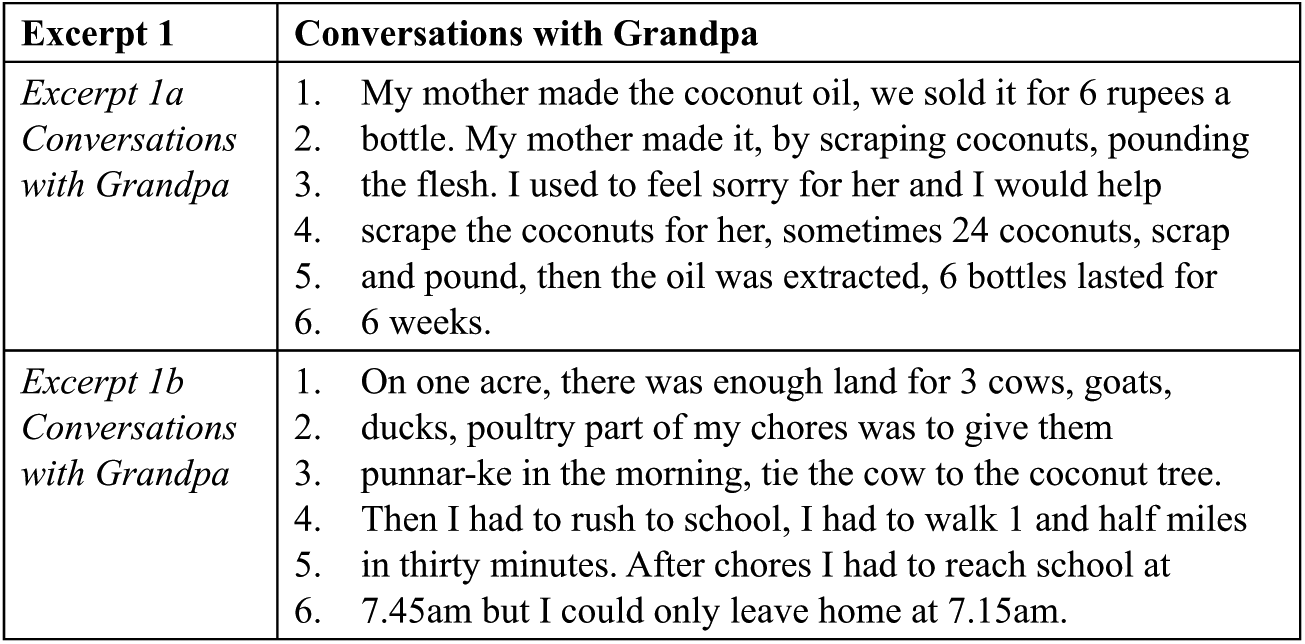
Conversations with Grandpa.
In addition to the activity of family, Grandpa’s story also repeatedly valued play by introducing numerous memories of playing that were clearly very significant to him. For example, cricket games with his cousins who were impressed by Grandpa’s abilities and had nicknamed him Keith Miller, Australia’s famously celebrated star all-rounder. These cricket stories were accompanied by memories of various athletic pursuits of various children (cousins and siblings) in the garden, including pole vaulting, racing and other sports. As the study progressed, it became more evident that familial community created a crucial network for each of the participants. The family and the domestic relationships that were taking place around the home were synonymous with the participants’ memories their early childhood home. The family and its collective context had a personal implication for the child; the construct of the child in the narratives was influenced by the forces (economic, social and political) that were shaping the environment (Jenks, 2005). Similarly as the four grandparents actively shared in the narratives, a parallel dialogue emerged in their memories from early childhood. This narrative engaged with the transitory nature of belonging. While each grandparent was quick to align memory and meaning with the family and community, it became apparent that in the narratives of childhood identity there was a deep awareness of the peripheral space in society in which the ‘unbelonged’ resided. The ‘unbelonged’ refers to Rushdie’s (1988) description of the present as the unfamiliar and the past as home. The ‘unbelonged’ also refers to the voice unheard in the margins of society (Spivak, 2013). The data illustrated that in each grandparent’s lived experience was the awareness of the ‘outsider’ and the transitory nature of belonging in the home. This usually occurred when the family underwent changes in their circumstances.
Thatha remembers key people in his early childhood, in particular, those who interacted with his family and were impoverished by their economic status. As Indian Tamil estate workers, Thatha and others resided in Sri-Lanka as employees of the British colony. However, when they retired, they were alienated from the economic framework of work in the estate and became unnaturalised members of a diasporic community (Kanapathipillai, 2009). The interactions that Thatha shared with retired workers during his childhood are vivid and he recalls seeing those who had to beg for a living illustrating their extreme state of unbelonging. Some of these memories are captured in Figure 3.
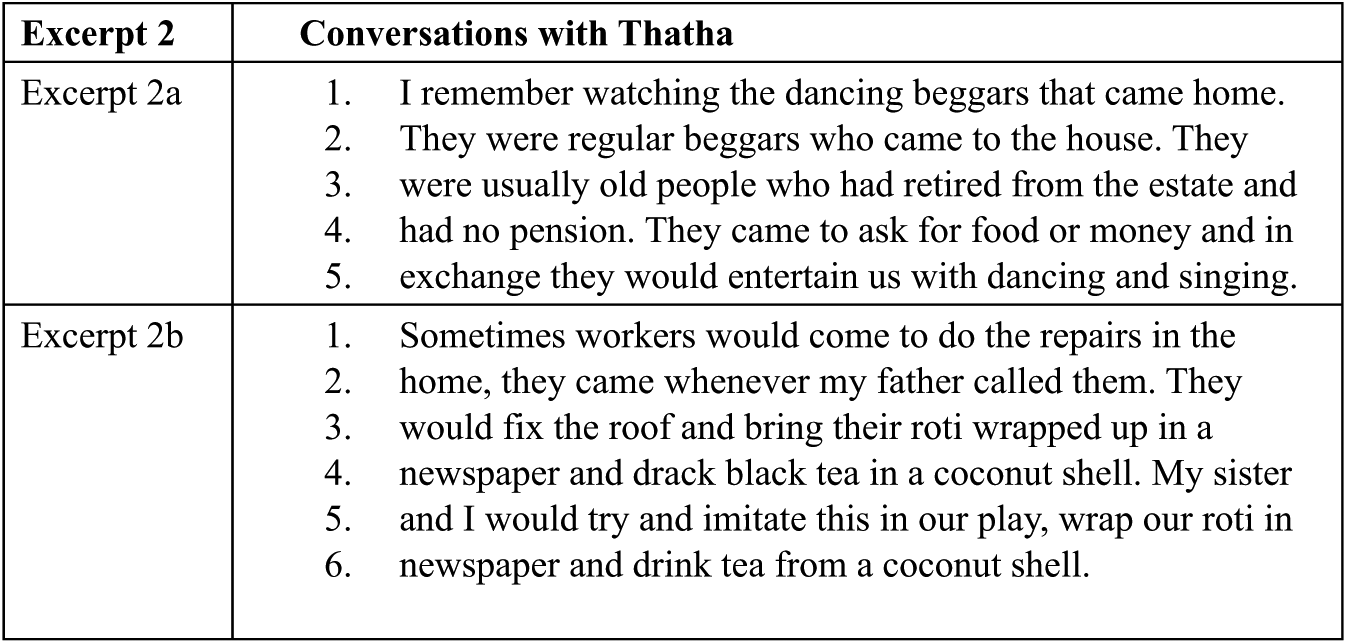
Conversations with Thatha.
It must be noted that the caste system systemically excludes and includes members of society issuing privilege and access for some while constructing boundaries for others. These practices are deeply rooted in the class-caste domination of the subcontinent of India and Sri Lanka (Kanapathipillai, 2009). As a child, it is interesting how Paaty is able to remember both acts of resistance by her father and the acts of worship by her mother. On one hand, there is religion and agitation at work while on the other, religion and subservience. Both of these are understood paradoxically through the use of similar terms in the memories of childhood. Figure 4 illustrates an example where there is a recollection of Paaty’s mother preparing food for the Buddhist monks in the area while the other depicts her father’s enacting out his responsibilities at the Hindu temple.
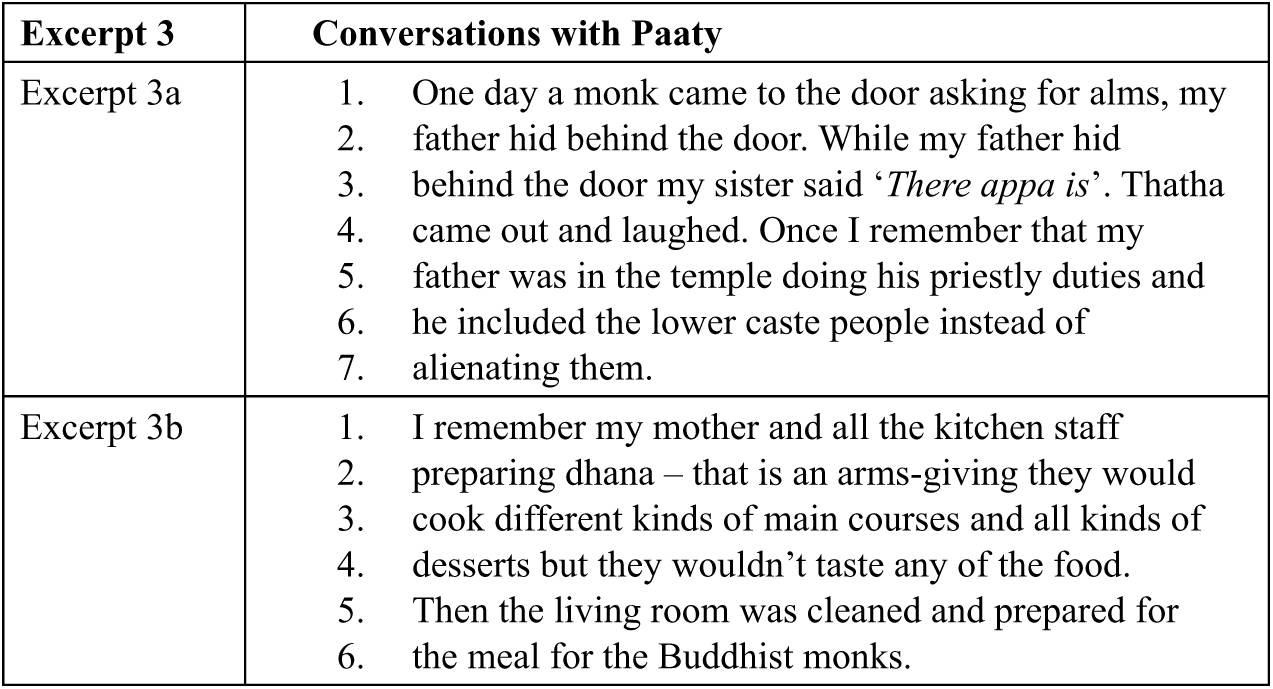
Conversations with Paaty.
Here, the ‘belonged’ and the ‘unbelonged’ coexist in the everyday world, some able to benefit from the power of their culturally assigned position while others are waiting in the wings only able to access what they are invited to by other more powerful members in the hierarchy. Hierarchal notions of belonging are expressed in this excerpt in the positioning of the family members. Paaty’s father is positioned as more powerful than the lower caste worshippers and her mother has more authority than the kitchen staff; however, she serves the Buddhist monks during dhana (religious alms-giving). The complexities of belonging that is measured by culturally constructed boundaries provides insights into children’s own encounters with cultural structure and its influences on lived experience.
Along with the concept of belonging, family stability was another key aspect that emerged from participant discussions. The non-fixed nature of family belonging was made particularly evident in Grandma’s lived experience of home. Grandma’s account captured the narrative of the home in crisis, busy and bustling in one year, devastated by death and divided the next. Figure 5 recalls Grandma’s account of home, with ‘home’ made significant by the relationships that are cultivated within it.
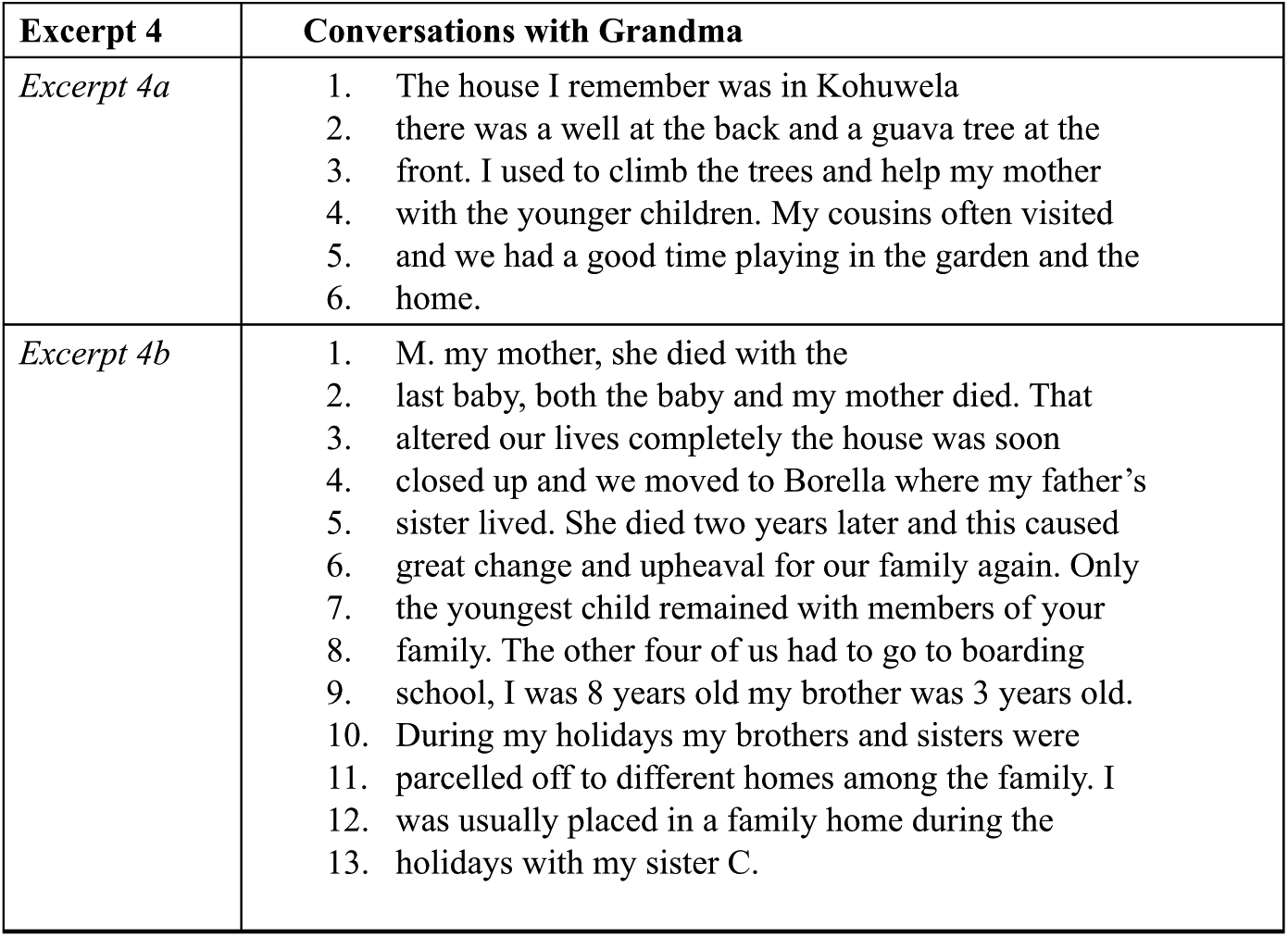
Conversations with Grandma.
The loss of those relationships has repercussions that are so significant that they are able to rend the image of home that was recalled at the start of the narrative. Belonging and identity in this case hinges on numerous elements all out of the control of the individual. Grandma’s identity was once fixed within the framework of a house, the relationships of home and play. The security of the family network cloistering her in familiar and fun activity, however, this belonging was clearly temporal and quickly lost. Figure 5 provides some key memories of home that Grandma holds. It is clear that the interruption of family life that occurs when her mother dies significantly changes Grandma’s conceptualisation of home.
Discussion: the complex and multitudinous layered experiences of young children
The child emerges in the lived experiences of the four participants as the keeper of a complex narrative. Critically thinking about the construct of childhood as a platform to assist in the process of storying belonging for a young child requires an analysis of the construct of the child as a pedagogical actor. Clearly emerging from the findings are participant accounts of ‘belonging incidents’ where a child has made significant negotiations about the belonging, unbelonging, the homed and the unhomed. Often, we mistakenly oversimplify childhood narratives rather than closely investigating children’s exposure to the ideologically fraught discourse of identity. Moreover, a ‘diasporic identity can be described as a simultaneous denationalization and transnationalization of the ethnic group by relocating it “back home”’ (Ang, 2014: 1192). There is a multiplicity in ones’ identity as the home, the context and the relationships co-exist in imagination, experiences and one could argue personal narrative. The participation, negotiation and re-presentation of self are agentic acts of self-conceptualisation that each child engaged in.
The findings from the study contrast my (N.D.) instinctive response to this inquiry and it clearly identifies the multitudinous layered experiences that young children face in their homes, in the interactions with the community and in their cultural spheres. In each of the narratives, the children operate within a knowledge of temporality of states and are illustrated in these examples. For example, the family before the death of the primary caregiver and then the family during the crisis of premature death. Similarly, the memories of childhood that were collated suggest that in childhood there is an awareness and understanding of hierarchy even if at the time it is difficult for young children to articulate. For instance, economic hierarchies and social hierarchies surface in the conversations as realms in which the children and their families were operating. The lived experiences provide glimpses into the perpetual events of life that are not censored but are fully experienced by the child. A child who will mediate their meaning in order to make meaning of the world around them (Cannella and Viruru, 2004). This was perhaps the most consistent trend that emerged from the grandparents’ narratives, each child was able to navigate between the personal disruptions, social inconsistencies and positions of privilege and poverty in and around the home.
The limitations of the oversimplified agenda for young children became all the more apparent as the study progressed. The findings illustrate that there are times when a child is not only aware of the hierarchical structures that create varying levels of belonging but also aware of where in that framework they and their families fit in. For instance, the beggars in Thatha’s story are poor and unemployed, his family supports them with food as they are currently employed in the tea estate. Interrogating views of the child through the process of the study unveiled real complexity and sophistication in the storying that the participants had shared. By recognising the limitations I (N.D.) had placed on myself in terms of my response, I recognised that I had also placed those limitations on my child. In my reconsideration and reimagining (Cannella and Viruru, 2004) of the belonging narrative, I have had to recognise the influence of dominant discourses on the practices of education for young children (Dahlberg et al., 1999). The challenge of preparing ‘citizens for the real world’ (Yelland and Kilderry, 2005) engages with children’s knowledges of belonging that are inconveniently reflective of their lives which are multifaceted and complex. My daughter understood that she and I were made different by our experience just as she understands that there are relationships she engages in where there are layers of difference. And that these differences are articulated through the filters provided in the cultures of family, the agenda of the curriculum and the discourse of the classroom. To conclude, below is an excerpt from my (N.D.) autobiographical narrative: So, is she more Australian than I? I don’t know, I’ll tell her I don’t know, I’ll tell her that I feel that I am Australian, but I also know that because she is going to school in Australia she and her brother seem to know more about Australia than I do. I’ll share with her that I am also an Indian Tamil and that I think she is connected to all our family stories in different parts of the world. I will share our stories so she can decide. And I will also share with her that even though I am quite new to Australia I can expect to feel safe, I can expect to feel welcomed to participate in events in the community. And I can object when I experience something that is negative and I can be expected to object when another human is experiencing something negative too. I’ll tell the complex story and then we will have to talk some more …
Footnotes
Acknowledgements
We would sincerely like to thank the study’s participants, the four grandparents for sharing their personal childhood stories, and N.D.’s daughter. It was her deceptively simple questions – ‘Mummy, am I Australian?’ and ‘Am I more Australian than you?’ – that were a catalyst for the study about storying un/belonging in early childhood.
Ethics Approval
Ethics approval has been granted for the study, HAE-15-121, Exploring childhood narratives in search of home through Deakin University Faculty of Arts and Education Human Ethics Advisory Group (HEAG) on 17 September 2015.
Funding
The author(s) received no financial support for the research, authorship and/or publication of this article.