




Abstract
This article explores social media engagement of fragmented life narratives. Specifically, representative comment threads below the posted story with the greatest number of comments on the Humans of New York Facebook page is scrutinized mainly utilizing a social-construction-centered division of narrative analysis. Ochs and Capps’ Dimensions of Living Narratives combined with Labov’s Six Part Model are employed as both theoretical framework and methodological approaches of the analysis. Main findings of this article are as follows: (1) Personal experiences in fragmented life narratives are socially forged and mobilized, namely become impersonal. (2) De-personalization and social forge are both reinforced by and resistant to the culture of social media. (3) Methodologically, this article demonstrates the boundary between divisions in narrative analysis is flexible and fluid. This research aims to uncover the intricate interplay between life narratives and social media and add nuance to the emerging field of narrative inquiry in the digital environment.
Plain Language Summary
Purpose This article explores the social media engagement of fragmented life narratives. Methods Narrative analysis. Conclusions 1) Personal experiences in fragmented life narratives are socially forged and mobilized, namely become impersonal. 2) De-personalization and social forge are both reinforced by and resistant to the culture of social media. 3) The boundary between divisions in narrative analysis is flexible and fluid. Implications This article aims to uncover the intricate interplay between life narratives and social media and add nuance to the emerging field of narrative inquiry in the digital environment. Limitations Only a very limited number of comments are analyzed, lacking a panorama view of the related data.
Humans of New York
Humans of New York (HoNY) began as a photography project by Brandon Stanton in 2010 with the initial goal to “photograph 10,000 New Yorkers on the street, and create an exhaustive catalog of the city’s inhabitants” (Humans of New York, 2011). Initially, all the photos were published on HoNY’s official website (www.humansofnewyork.com) and then on its social media accounts including Facebook, Instagram and Twitter. Later, HoNY evolved into a life storytelling project (Mann, 2015), which captions its portraits with quotations selected and transcribed by Brandon Stanton from his face-to-face impromptu conversations (before COVID-19 pandemic) with the person photographed. To date, HoNY has expanded from New York City to 40 countries on 6 continents around the world, having collected more than 10,000 life stories (Stanton, 2018) and attracted more than 29.77 million social media followers across the 3 social media platforms (as of 30th June 2022). Apart from its own virality, HoNY has given rise to a “Humans of” phenomenon. There are over 50 Facebook pages and 20 websites named “Humans of x.” The “x” ranges from a geographical region (e.g., Humans of Bombay), a religious community (e.g., Humans of Judaism) to an abstract concept (for example Humans of Late Capitalism). These imitators adopt and/or adapt HoNY’s storytelling format with portraits and quotes, many of which have gained popularity as well. Therefore, HoNY is a valuable example for investigating life narratives’ social media engagement in terms of representativeness and influence. Further, the post that has generated the greatest number of comments on the HoNY Facebook page would be one of the most suitable cases for the topic of this research.
Fragmented Life Stories
The post (Figure 1) that received the most comments (around 756,000 as of 31st January 2023) consisted of only two sentences and one portrait of two elderly women sitting beside each other on the street. It will be referred to as Story A for the rest of this paper. The post can be understood as a “small story,” as defined by Georgakopoulou (2016), rather than a classical story with a neat “beginning-middle-end” mode (p. 3). According to Georgakopoulou (2016), small stories are tellings of the mundane, the ordinary and the trivial from everyday life, as opposed to big complications or disruptions (p. 4), which are empirically growing especially on social media and has been, however, under-researched (p. 267). Story A could also be viewed as Howes’ (2020a)“[b]iobits” (p. 2), which are tiny or sketchy life narratives as opposed to traditional lengthy ones. Biobits take the earliest forms of a single name in genealogy, a biblical narrative or a chronicle history and appearing around the globe (Howes, 2020a). Howes (2020a) also pointed out that the urge for recording lives briefly, though not recent, has increased as media for doing so has multiplied. Twitter is one of the most convenient and widely used media platforms for recording life, briefly. McNeill (2011; 2014, p. 149) invented a term, auto/tweetographies, to refer to “short instalments of life narratives, which share moments, experiences, and lives in miniature, and which will be updated or replaced regularly […]” and mostly aim for rapid responses.
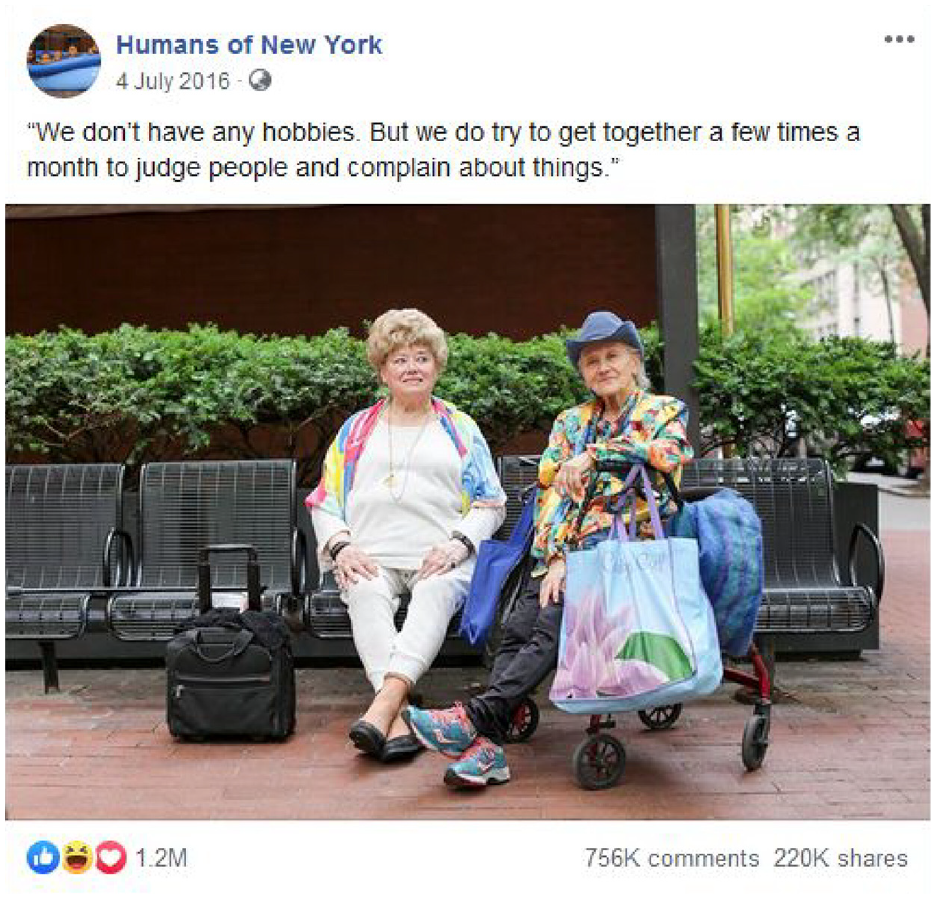
Story A (Humans of New York, 2016).
Concepts such as “small stories,” “biobits” and “auto/tweetographies” are academic responses to one of the vastly emerging practices at the interplay between life narrating and social media, the narrating of fragmented life stories as mentioned above. Meanwhile, research on fragmented life stories would contribute to and benefit both social media studies and narrative analysis as well. As to social media studies, Sadler (2018) argued that fragmented stories on social media are closer to chronicle than to narrative as they do not possess narrative features like “relationality” “temporal and spatial specificity” and “a sense of an ending” (Sadler, 2021, p. 43). He argued that the connection drawn between chronicle and fragmented stories on social media demonstrates that communication practices on social media are less new than they seem to be (Sadler, 2021). As a matter of fact, fragmented telling is a communication genre or strategy currently supported by but not a consequence of social media (Sadler, 2021). Therefore, investigation on social media fragmented stories could benefit from a shift of focus from social media structures and affordances to communication dynamics and meaning-making processes. In fact, research has shown that structures and affordances, may define a range of possibilities but do not mechanistically determine what users actually do (Hutchby, 2001; Nagy & Neff, 2015; Shaw, 2017). For example, quantitatively speaking, few of the thousands of stories on the HoNY Facebook page that are mobilized by the same structure and affordance of Facebook has shared a similar volume of popularity and engagement as that of Story A under discussion; let alone how each story is engaged with by the page viewers. Furthermore, the shift is timely as “[t]he question of interpretation and meaning in new media environments […] has received comparatively little emphasis in comparison to platforms, structures and media power” (Sadler, 2021, p. 7). Regarding narrative analysis, research on fragmented narratives has been a fast developing paradigm for narrative analysis as one “counter-move to dominant models of narrative studies” that define narrative restrictively on the basis of textual criteria and, more over, privilege a specific type of narrative that is long, relatively uninterrupted, teller-led accounts of past events or of one’s life story and typically elicited in research interview situations (De Fina & Georgakopoulou, 2015, p. 255). Ochs and Capps (2002) have long argued that understanding narratives compels going beyond the canonically privileged narratives to probe less polished, less coherent narratives that pervade ordinary social encounters instead.
Methodology
Three Divisions in Narrative Analysis
Narrative Analysis is an umbrella methodology with multiple potential approaches and directions of inquiry depending on the researcher’s academic discipline, ontological and epistemological orientations, theoretical and conceptual frameworks and specific methods of investigation. According to Squire et al. (2013), few overall rules about suitable materials or modes of inquiry are available in narrative research, unlike in other qualitative research perspectives. De Fina and Georgakopoulou (2012, p. 15) also agreed that narrative inquiry is a “minefield of multiple and at times competing perspectives.”Riessman (2008) even believed that for narrative analysis, no methods by definition of a prescribed set of steps should exist.
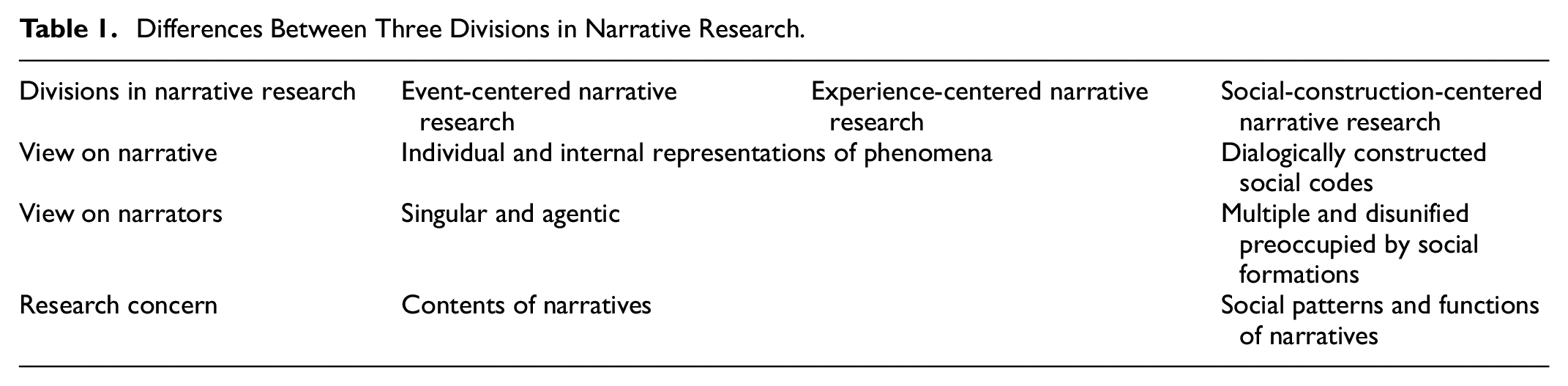
Among all the typologies of Narrative Analysis, Squire et al.’s (2013) three divisions are most useful to this research: event-centered, experience-centered, and social-construction-centered research (as summarized in Table 1). An event-centered approach focuses on the spoken recounting of events that happen to the narrator, classically described in Labov’s work (Patterson, 2013; Squire et al., 2013). An experience-centered approach, however, also encompasses stories heard or only imagined by the narrator, rather than having happened to them; stories in hours of life histories; stories presented in written and visual forms as well as in objects and actions (Squire, 2013; Squire et al., 2013).These two streams of narrative inquiry share the view of narratives as individual and internal representations of phenomena (Squire et al., 2013, p. 56), in accordance with the view of a “singular and agentic” subjectivity of the storyteller. Alternatively, the social-construction-centered form addresses co-constructed narratives developed in social interactions such as face-to-face conversations, email exchanges, and social media commentary (Squire et al., 2013). This form regards narratives more as a kind of social code and treats stories as constructed dialogically, rather than as mere expressions of internal states (Bakhtin & Holquist, 1981). Therefore, researchers applying social-construction-centered forms of narrative research are concerned more with social patterns and functions of stories than their contents and structures that is the focus on event-centered and experiences-centered inquiry (Abell et al., 2000; Bamberg, 2006; Georgakopoulou, 2007).
Differences Between Three Divisions in Narrative Research.
Narrative Analysis in digital contexts, such as on social media tends to apply the social-construction-centered approach. Fina and Perrino (2017) have concluded that narrative inquiry in the digital environment has experienced a shift from “a text-oriented” to “a practice-oriented” paradigm, in which the emphasis has transformed from characteristics of stories and their conversational embedding onto their functioning in meaning-making processes in different contexts and practices (p. 209). Or, as argued by Fina (2016), in digital environments, the focus of analysis has shifted from story content to storytelling context and participation in the process. More specifically, storytelling is increasingly more about the telling—the people who tell and listen to the story and the social activities and worlds involved in the process—than about the story (Fina, 2016). The shift also results from performance instead of content-focused interaction being the central component of digitally mediated communication (Fina, 2016).
Methodological Approaches Applied
Narrative analysis employed in this paper mainly applies the approach belonging to Squire et al.’s social-construction-centered division, in which the functioning and especially the meaning-making processes of storytelling are the focus of investigation. In addition, notions from Labov’s (1972) six-part model (Abstract, Orientation, Complicating Action, Result, Evaluation, Coda,) are also borrowed. Five out of the six notions each raises one question about an essential aspect of narratives as follows:
Abstract—what is the story about?
Orientation—who, when, where?
Complicating action—then what happened?
Evaluation—so what?
Result—what finally happened?
Finally, the Coda, sign off the narrative by returning to the present time of the telling, and hand the floor over to the narrative audience. As an event-centered approach, Labov’s six-part model is paradigmatic in narrative analysis (Patterson, 2013)and is integrated with the social-construction-centered division approach to categorize and theorize narrating elements in initial analysis of Story A’s comments.
As mentioned above, there are more than 756,000 comments under Story A (as of 31 January 2023). Comments generating a greater number of Like were targeted for sampling as they are, to some extent, more agreed upon among the commenters than those with fewer Like, and thus, are more representative in reflecting how the meaning of the posted story is interpreted and engaged with. There are seven comments with more than 1,000 Like among all the comments. After scanning all these seven threads of comments with their replies, I discovered that six of them are unique to each other in terms of content, form, and function and therefore were selected whereas one comment highly resembling Comment A1 were excluded in avoiding repetition.
Top Comment Threads of Story A
In this section, I scrutinize and summarize the six top comment threads (Comment Thread A1 to Comment Thread A6) under Story A. Both the comments and replies are numbered and displayed in the order of their popularity, that is, the number of Like they have received. There are three types of text in each of the six threads, a Comment, a Reply and a Secondary Reply. A Comment is where all the subsequent replies originate. A Reply (e.g., Reply A1.1) addresses the Comment (e.g., Comment A1) it is attached to. Some replies stand alone in the thread while others (e.g., Reply A1.2) generate Secondary Replies (e.g., Secondary Reply A1.2.1) that converse with them.
There were 93 replies to Comment A1 and most Like and secondary replies were targeted at Reply A1.1 and Reply A1.3 respectively. In Comment A1, “what everybody does” is broadly inclusive of all of the three actions in Story A (getting together a few times a month, judging people, and complaining about things) and thus keeps the abstract of the narrative multiple. However, “in moderation” reorients “a few times a month” from referring to “get together” in Story A to “judging people and complaining about things” and therefore concentrates the abstract on judging and complaining. Read generally, Comment A1 validates the action of judging and complaining. Finally, “everybody does” widens the orientation of the narrative from the two narrators of Story A1 to “everybody” and by so doing hands off the floor to possibly the widest audience for responses (Figure 2).

Comment thread A1.
Replies in Comment Thread A1 can be divided into two groups: Reply A1.1 and A1.2, and Reply A1.3 with its secondary replies. Reply A1.1 makes a connection between two of the themes in Story A: friendship and judging and complaining and thus reinvents an abstract for the narrative (the importance of judging and complaining together in friendship). Similar to Comment A1, Reply A1.1 also widens the orientation of the narrative from the two narrators of Story A1 to everybody withholding friendship and by so doing opens the floor to a wider audience for responses. Again, Reply A1.1 validates the action of judging and complaining by its importance to friendship. By creating a metaphor, Reply A1.2 turns the abstract of the Story A into lurking on Facebook and at the same time the orientation to the author and other Facebook users. Accordingly, the floor of the narrative is again transferred to the wider audience of Facebook users. By confessing “just like me,” A1.2 implies an agreement to the action of judging and complaining.
In contrast with Reply A1.1 and 1.2, ReplyA1.3 demonstrates a strong disagreement with Story A1 and meanwhile explicitly anchors the abstract of the narrative onto the validation of judging people. Also, unlike all previous comments and replies, Reply A1.3 engages not only with the text but also the portrait of Story A and includes it into the abstract of the narrative (the validation of judging according to one’s appearance). Most interestingly, Reply A1.3 could be read as a judgment itself as themed in Story A. Secondary replies to Reply A1.3 validate judging people by challenging the opinion in Reply A1.3 and even its author. Meanwhile, in accordance with Reply A1.3, they are also attentive to the portrait in describing the two narrators in it as being “honest” and “fabulous” as well as imaging their attitude toward others’ judgment on them.
In summary, Comment Thread A1 concentrates on the abstract of evaluating and validating the action of judging people as initially developed by Comment A1 out of the multiple potential themes in Story A. Nonetheless, each comment “inherit” the abstract by creating its own unique one. Regarding orientation, most comments in the thread extend it from the two protagonists in Story A to the wider audience and consequently open the floor for broader engagement.
Comment A2 generates the most replies among all the seven top comments. Similar to Comment A1, Comment A2 also evaluates and agrees with Story A1. However, instead of keeping the abstract multiple like Comment A1, Comment A2 narrows it down to judging people. Also, Comment A2 invents the orientation of “people watching,” which is more explicit in the portrait than the text (almost not mentioned at all) of Story A. Thus, the comment opens the floor of the narrative to new audience who watch passers-by (Figure 3).

Comment thread A2.
In accordance with Comment A2, Reply A2.1 also draw from the content of the portrait of Story A, where the protagonists sit by each other. Moreover, the comment narrates its own abstract as well as evaluating and approving of that of Story A by referencing one quote. It is possible that it is the popularity of the quote that attracts a tremendously high volume of Like for the comment compared to all the other replies in the top seven threads. Meanwhile, the abstract of judging people in Story A is interpreted as saying something negative about someone. This interpretation inspires the author of Reply A2.3 and engenders the discussion among the rest of replies in the thread. The move of interpreting and clarifying the abstract of judging people is most evident in Reply A2.6. As a result, unlike Comment Thread A1, where the leading comment (Comment A1.1) determines the theme for the rest of the replies, in Comment Thread A2, it is one of the replies to the leading comment (Comment A2.1) that becomes the the foci of engagement. Nevertheless, in both the threads, it is proved that controversial opinions tend to “stir up the water” the most in terms of generating replies (not Like). That being said, generally speaking, Comment Thread A2 is still more or less about validating the action of judging people in line with its leading comments.
Compared to the other top comments, Comment A3 contains the most elements of narratives (abstract, orientation, complicating action, and result) defined by Labov. The author is inspired by Story A and therefore the comment could be read as a second story. Second stories refer to stories having contiguity and topical links or thematic coherence with “first stories” told in the previous conversation (Sacks & Jefferson, 1995, p. 764). Comment A3 narrates the abstract of quality friendship where close friends enjoy a high level of intersubjectivity by knowing each others’ judgment on the same person. Moreover, the comment is also the author’s memoir to the lost friend, a secondary (or parallel) abstract unfolded by the author in their secondary replies in the thread. Alternatively, the author’s extended telling could be read as the evaluation of the narrative (meaning of the friendship), which is evoked by the replies. Further, the phenomenon of second stories turning into new first stories and inviting subsequent telling has been discovered in another research on HoNY (Guo, 2020). In replying to Comment A3, the loss of close friends becomes a dominant theme. Nonetheless, there are also replies with alternative or even irrelevant focus that also receive much attention (Figure 4).

Comment thread A3.
In some cases, D’s extended account is directly inspired by the vivid events or emotions expressed in the second telling (e.g., Reply A3.2 and Reply A3.6). In other cases, however, even if the second telling does not include much new information (e.g., Reply A3.4 and Reply A3.7), it still provoked D’s further telling. This process is analogous to psychotherapy, in which clients could be stimulated to express themselves more even by the simplest responses from the therapist, for example, “huh” or “mm” (Fitzgerald & Leudar, 2010). Semantically empty vocalizations like “huh” and “mm” were defined by Sacks and Jefferson (1995) as continuers in conversation, which indicate the utterance of one party is being listened to by the other, and therefore, encourages the continuation of the utterance.
Comment A4 could also be read as a second story of Story A. Similar to Comment A3, it also narrates multiple themes other than “judging people” drawn from Story A including “judging people” “cheap date” and “couples staying together.” Accordingly, all of the three themes are picked up by the replies that follow. Noticeably, Comment A4 changes the orientation of Story A from friends to partners and invokes couples addressing (by @) each other in the thread. Also, unlike the circumstance in Comment Thread A3, no further telling by the author of Comment A4 is unfolded in the thread (Figure 5).

Comment thread A4.
Comment A5 is a quotation from the popular character Sheldon in an American TV drama, The Big Bang Theory. The comment picks up one of Story A’s themes (judging people) with a turn to “judging silently,” switches the orientation to Sheldon and his mother and opens the floor to fans and audience of the drama. Consequently, replies to Comment A5 focus on the character and the drama accordingly (Figure 6).

Comment thread A5.
Comment Thread A6 builds a discursive promoting and performative space for L, a celebrity author, as comments in the thread are either about the information on L’s forthcoming book (Reply A6.3) or interactions between L and her fans (Reply A6.1 and Reply A6.2). Some commenter (Reply A6.4) points out L’s self-promoting agenda while others (Reply A6.1 and A6.2) enthusiastically participated in it. As a result, abstract and orientation of the narrative become irrelevant to the original ones in Story A, as most explicitly displayed by Reply A6.5 and L’s reply that follows (Figure 7).

Comment thread A6.
Narrative Dimensions: Tellership, Tellability, Embeddedness, Moral Stance
In this section, Ochs and Capps’ (2002, p. 20) “narrative dimensions and possibilities” are used as a theoretical framework to further elaborate on the top six comments threads above. Ochs and Capps (2002) proposed that narratives of personal experiences can be examined through five dimensions, Tellership, Tellability, Embeddedness, Linearity, and Moral Stance. Each of the dimensions contains a continuum of possibilities with two ends (Table 2), between which different narratives range, or alternatively, one narrative shifts while unfolding itself. Ochs and Capps (2002) also pointed out that typical narratives of personal experiences studied by the social sciences tend to fall on the left end of the continuum, namely with one active teller and high tellability, detached from surrounding contexts, with closed temporal order and certain and constant moral stance, thus leaving room for the exploration of alternative narratives in between the two poles.
Narrative Dimensions and Possibilities.
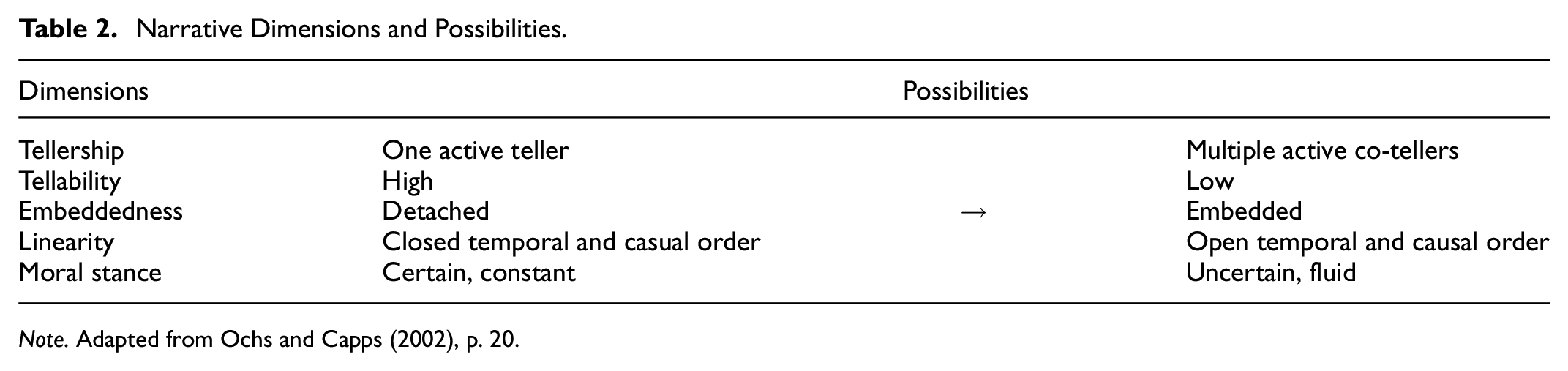
Note. Adapted from Ochs and Capps (2002), p. 20.
In this section, four of these five dimensions, excluding “Linearity,” are applied to the six comment threads under discussion. Linearity, compared to the other five dimensions, is more text-oriented (the event/experience-centered approach of narrative analysis) and less practice-oriented (the social-construction-centered approach of narrative analysis) and therefore is not the focus of this research, as explained above. Page (2015, p. 332) argued that “Ochs and Capps’ dimensional framework outlines the different structural and contextualized aspects of narrative and is well suited to the analysis of social media storytelling, which must take account of both the narrative product and the narration process.” Nonetheless, surprisingly, little research on social media storytelling has taken up Ochs and Capps’ framework according to my review.
Multiple Active Co-Tellers
Tellership describes “the extent and kind of involvement of conversational partners in the actual recounting of a narrative” (Ochs & Capps, 2002, p. 24). Possibilities of tellership range from one active teller in front of a relatively passive audience to multiple active co-tellers who collaboratively supply information and stances relevant to the recounted narrative (Ochs & Capps, 2002). For stories of HoNY, tellership gets more complicated. In a broader sense, if on the HoNY Facebook page, one posted story with its comment threads is read as one unfolding narrative, it is then produced by a three-party tellership through a two-stage co-telling process. The first co-telling occurred between the protagonist and Brandon Stanton during their conversations on the street whereas the second between Brandon Stanton and the commenters on the Facebook page. Ochs and Capps (2002) argued that in conversational storytelling, co-tellers can shape the unfolding of a story. This is most explicitly demonstrated in Comment Thread A3. Sometimes, the audience is “coaxed into the role of highly involved co-tellers” (Ochs & Capps, 2002, p. 27). As demonstrated above, leading comments of the top threads, especially those with a high level of engagement, very often extend the orientation of Story A and enable the floor to open to a potentially larger audience.
Page (2011) differentiated multiple types of co-tellership in social media storytelling according to their distribution across textual units and the co-tellers’ control over the text. Co-tellers could contribute in separated textual units or in combined contributions in one composite textual unit. Accordingly, the co-tellers involved may have equal control over the text or the control may be maintained by one teller. In the first stage of the co-telling between the protagonist and Brandon Stanton, the parties make a combined contribution in the one composite text; however, Brandon Stanton may exerts greater control over the text since he composes the final version of the story modified from its oral version. Nonetheless, he has claimed that each story would be read and consented by it protagonist before being posted (Humans of New York, 2014). In the second stage of the co-telling between Brandon Stanton and HoNY’s audience, each party makes a contribution separately and Brandon Stanton, again, seems to have greater control as he has claimed to modify the comment section and delete comments that attack the protagonists (Humans of New York, 2014). Nonetheless, as long as the comment thread remains existing on the page, Brandon Stanton has little control over how it would unfold as time passes by.
Further, there are circumstances when the comments that follow instead of the story itself that attract greater attention of potential audience, demonstrating the phenomenon called “I’m just Here For The Comments” (Abidin, 2020), which may more or less be the case in all the comment threads analyzed above. Finally, the distribution of control over the text within each comment thread varies. In one thread, a initial comment could become the lead and focus of discussion while in the other, there is no centrality of discussion. In whichever case, Ochs and Capps’ assertion on narrative’s being shaped “turn by turn in the course of conversation” (p. 2) does not apply. The reason is that turns in face-to-face conversation disappear in the air once appear (unless repeated or recorded) whereas on social media remain on the screen (unless deleted) and moreover accumulate as comment threads as time passes by. As a result, turns in conversational narrating on the screen are entitled to compete with each other for further responses and the control over the unfolding of threads and ultimately of the whole narrative.
Contextualized Tellability
Tellability refers to the extent to which personal narratives convey a sequence of reportable events and make a point in a rhetorically effective manner (Ochs & Capps, 2002). Tellability depends on the “sensational nature of events,” the “significance of events for particular interlocutors” and the rhetorical way narratives are shaped (Ochs & Capps, 2002, pp. 33–34). Ochs and Capps (2002) maintained that narratives of high tellibility are of great interest and therefore could be told again and still be appreciated. As far as I am concerned, Story A meets all the conditions of a narrative with low tellability: reporting an unsensational event with little significance to Facebook users in an unrhetorical tone. However, evidently, it has given rise to the most comments and responses on the HoNY Facebook page. While attracting volumes of attention and engagement on Facebook does not equal to holding high tellibility by definition of Ochs and Capps’, it is worthwhile considering the relevance between the two. To some extent, the popularity of Story A supports Page’s (2011) argument that instead of being stable, the norms of tellability are sensitive to context.
Story A may not hold high tellability if narrated in contexts like face-to-face conversation where the communication flows and thus only sensational and/or rhetorical events are noticeable. However, on the HoNY Facebook page, the text and portrait of Story A stay statically allowing for asynchronous reading and interpretating at anytime. Moreover, although the telling of the story is unsensational, insignificant and unrhetorical, layers of themes or meanings could be read from it (if needed): hobbies, judging people, complaining, friendship and, last but not least, visual information on the portrait. Further, a tale “dangling without resolution” can function as a “springboard” for engaging collaborative sense-making activities (Ochs & Capps, 2002, pp. 35–36). Hence, Story A has successfully attracted enthusiastic meaning-making endeavors by Facebook commenters as each layer of the meanings above, lightly touched, sticks on the page forever and, to some extent, waits for interpretation and elaboration. In the process of meaning-making, new connections between themes of Story A are created and even brand new ones are invented, increasing tellability of the general narrative. Meanwhile, when taken over by multiple interlocutors, narratives risk being twisted toward unintended or even irrelevant directions (Ochs and Capps, 2002). This was more or less demonstrated by all the comment threads analyzed.
“Face needs” (Page, 2011, p. 200), or the need for face-enhancement is an interpersonal requirement for both narrative tellability and social media interaction (Andriuzzi & Michel, 2021). On social media, where the connections between users are highly valued, making narratives tellable means telling stories in ways that enable face-enhancing involvement and avoid face-damaging engagements between participants. Page (2011) further pointed out that when the face-enhancing requirement was breached, storytelling would turn into a “socially divisive act” (p. 201). Reply A1.2 in Comment Thread A1 vividly evidences this claim as it harshly made a degrading utterance on the protagonists’ appearance in the portrait. Consequently, it is collaboratively opposed to and even verbally challenged by the other repliers. Thanks to this face rescue, Reply A1.2 even becomes the foci of discussion in the thread. Nonetheless, it is difficult to know how much authenticity exists in the collaborative face rescue as solidarity presented on social media is often understood as performative rather than genuine (Barnes, 2019; Cover, 2016; Poletti & Rak, 2013).
Ochs and Capps (2002) stated that tellability is partly related to the organization of tellership and personal narratives with higher tellability are inclined to be told by one teller to a relatively passive audience. However, Story A has displayed the opposite circumstance where higher tellability is not only linked to but also manufactured by multiple tellership.
Embedded and Detached
Narratives of personal experiences can be embedded in or detached from their surrounding discourse and social activities (Ochs & Capps, 2002). The top comment threads under discussion enclose Story A with second stories and discourse from popular culture products including TV sitcoms and comedies, quotes of celebrities and even commercial promotion. Some of the embedding discourse are highly relevant to certain theme of Story A whereas others are explicitly aimed for their own agendas. The notion of relevance between Story A and its comment thread, however, has been elaborated in the previous sections.
Page (2011) defined generic context as “the website in which the story is created, including its wider resources, stated purpose, topic, and rules for conduct” (p. 15). Interactions on Facebook were accused of shifting from being “dyadic” and “peer-to-peer” toward “a model pseudo-interaction” where “direct interaction between participants becomes an illusion” due to the collapse of context on the platform (Page, 2011, p. 207). This argument should be particularly relevant to the HoNY Facebook page, where the content is public to all its followers with an extremely large scale and scope. Yet, there is no lack of dyadic and direct peer-to-peer interactions in the comment threads analyzed above including, for example, grieving a close friend with extended telling evoked by peer commenters. One possible explanation for this might be that generic context is not determinant in shaping all interactions on Facebook. Life narrating, as a fundamental practice of humans, started long before the emergence of Facebook or any forms of social media (Howes, 2020b). It can be inferred that some of the conventions and habits developed in reading and engaging with life narratives may be enduring and transferable when the practice is performed in new contexts like social media.
Collaborative Moral Stance
Moral stance is the judgment we make according to standards of goodness. For life storytellers, instead of being objective and comprehensive accounts, personal narratives are selections of events and reality within perspectives, to which moral stance is central; for life story hearers, personal narratives provide an opportunity and forum to clarify, negotiate, reinforce and revise their moral stance through reflections and discussion (Ochs & Capps, 2002). Apart from all the analysis until now, the significance of moral stance in narrating may also explain why a post seemingly as plain as Story A turns out to be the most number of comments on the HoNY Facebook page. “Judging people” as one of the story’s topics invites and even coaxes moral judgment and perspectives. In fact, most leading comments in the threads are related to the validation of judging people. In a similar vein, analysis above has also exhibited that whenever a comment is morally topical, regarding for example, the rightness of judging people, the face damage of protagonists or the inclined negativity in judging strangers, it generates a great number of reactions among commenters. As rightly concluded by Ochs and Capps (2002, p. 46), “personal narrative provides a secular and interactive means of building a moral philosophy of how one ought to live.”
In life storytelling, collaborative affirmation of moral stance in opposition to a rival stance is common (Ochs & Capps, 2002). This is explicit in Comment Thread A1, where one reply with recognizable incivility toward the protagonists was challenged and criticized collectively. That being said, it has also been discovered that narrators often shape the narrative to make their comportment appear morally superior to that of others’, namely the “looking good principle” (Iser, 1993, p. 10). Therefore, the collaborative challenging and affirmation of moral stance in Comment Thread A1 could also be performative, of which the uncivil comment builds the “stage.”
Conclusion
This article investigates social media engagement of fragmented life narratives with Och and Capps’ Living Narrative Dimensions. Six comments threads with the greatest number of Like under the post receiving the most comments on HoNY’s Facebook page are analyzed. Findings are as follows:
One posted life narrative with its comment threads on the HoNY Facebook page, regarded as one unfolding narrative, is co-created by a three-party tellership through a two-stage co-telling process. The first co-telling occurred between the HoNY’s protagonist and Brandon Stanton during their face-to-face conversation whereas the second was between Brandon Stanton and commenters on the HoNY Facebook page. This multiple tellership and cross-context co-telling process confirm Ochs and Capps’ argument on the variety and complication of tellership in life narratives. Further, similar to the audience in face-to-face conversational narrating, commenters of the posted narrative are coaxed into the role of highly involved co-tellers that shape the unfolding of the narrative by decoding, extending and recontextualizing the meanings embedded in the telling. On the HoNY Facebook page, coaxing is often enabled by the leading comment of a thread expanding the orientation of the original telling and thus opening the floor to a larger audience for engagement. Regarding tellership’s control over the narrative, similar to circumstances in face-to-face conversational narrating, one comment could become the locus within the thread or even, by so doing, usurps the original narrative and leads it to directions unintended by the original protagonist.
Page’s argument on the norm of tellability being sensitive to context is evidenced. One fragmented life narrative seemingly plain and unrhetorical could also evoke enthusiastic meaning-making participation by Facebook commenters as long as it touches themes that are a hallmark of the human condition and are consequently open to diverse interpretation and multi-facet elaboration. In the process of participatory meaning-making, new connections between themes of the original telling would be created and even brand new ones invented, which increase the tellability. Therefore, Ochs and Capps’ statement on the relation between life narratives’ higher tellability and single tellership is not applicable to all narrating contexts. In contrast, on the HoNY Facebook page, higher tellability is linked to and in fact largely rendered by multiple tellership.
As concluded by Ochs and Capps in other narrating contexts, life narratives on the HoNY Facebook page are also embedded with other narratives (e.g., second stories) and other discourses (e.g., quotes in TV sitcoms, comedies and of celebrities and commercial promotion). The relevance between these discourses and topics in the embedded narrative ranges from being high to being none. Specifically, the embeddeness of commercial promotion manifests the influence of Facebook among other social media platforms on life narrating. Meanwhile, however, there are also conventions and habits inherited from the long history of engaging with life narratives that remain and penetrate narrating contexts like social media.
Finally, analysis on Story A also confirms that, on the HoNY Facebook page, collaborative affirmation of moral stance in opposition to a rival stance is also common as in other narrating contexts. Nonetheless, narrators tend to manipulate narratives to make themselves appear morally superior to others, adding a sense of performance to morally related actions taken in social media contexts that are already highly performative.
Findings discovered above through the lens of Tellership, Tellability, Embeddedness, and Moral Stance do not exhaust social media engagement of fragmented life narratives. Life narratives, as rightly pointed out by Ochs and Capps (2002), refuse concluding remarks on fixed, generic, and defining features. However, a central paradox of narrative penetrates the above findings: personal life experiences narrated are socially forged and mobilized, namely become impersonal. With fragmented life narratives, the process of social forge and de-personalization is intensified. Sadler (2021, p. 95) even argued that in fragmented telling, fragments and narrative wholes “come into being simultaneously and neither is prior to the other.” In this sense, Story A may only be read as a piece of fragmented telling, without the comments attached through which the narrative whole emerges and keeps emerging as time passes and more commenting are added with ever changing new abstracts, orientations and codas. Moreover, on social media like Facebook, the process of social forging and de-personalization is both reinforced by and resistant and influential to cultures of the context, manifesting the intricate interplay between life narratives and social media. In other words, while reshaped by social media, life narratives also in turn leave marks on the former by challenging and affecting some of its cultures (Zuern, 2003, p. viii). Last but not least, the combining utilization of event-centered (Labov’s model) and social-construction-centered (Ochs and Capps’ dimensions) approaches demonstrates the boundary between divisions in narrative analysis is flexible and fluid, in that, different approaches can be integrated and supplement each other among multiple facets and/or throughout successive stages of analysis on one narrative.
Limitation and Research Recommendation
As mentioned, Story A has received more than 756,000 comments, among which 7 generated more than 1,000 Like. In this article, only six representative comment threads are analyzed, leaving the rest untouched. However, comments generating much less or even no Like are by no means meaningless, let alone in this case, they form the majority of the comments. Similarly, only representative replies in the six threads have been selected to analysis due to the scope of this research. Hence, there is much room for alternative and/or panorama views on the comment section of the most discussed post on the HoNY Facebook page for future investigation. More broadly, research into other fragmented stories with great number of comments on the HoNY Facebook page (no lack of them) and comparative studies on engagement with the same HoNY story between different platforms (Facebook, Instagram, and Twitter) would also make useful contribution to a more profound understanding on social media engagement of fragmented life narratives.
Footnotes
Declaration of Conflicting Interests
The author declared no potential conflicts of interest with respect to the research, authorship, and/or publication of this article.
Funding
The author received no financial support for the research, authorship, and/or publication of this article.

Data Availability Statement
The data supporting the current study are available from the corresponding author upon reasonable request.