




Abstract
This article looks at the way in which changes in technology, as well as wider social and cultural patterns, bring about new materials in the landscape of young children’s communication practices and play. This is done in relation to a new form of screen-less digital toy known as Avakai. Avakai are a set of digitally interactive wooden dolls that combine set movements and sounds. The study had two parts that focused first on the toy’s design and second on how it was used in combined play and communication practices by seven 4- to 6-year-olds. This was to ascertain the extent to which the design and children’s use aligned. Data were gathered through conversations and email exchanges with the toy designers and observations of the children’s play and communication practices with the toy. All data were transcribed and analysed using thematic analysis. Three key findings are discussed in relation to the alignment of these two areas: (1) children’s customisation of the toy design, (2) designing to produce emotional narratives in play and (3) the use of a compartment in the toy’s base. Each finding is described in relation to the designers’ backgrounds and intentions for the toy, and then the children’s use in terms of play and communication. In doing so, the extent to which the child and the toy’s design influenced play and communication practices is shown. These findings make a contribution to the field of materialities in young children’s communication practices when playing. This is ever important given the evolving speed of new materials and technologies for play and communication. In particular to how non-visual modes of communication are foregrounded in the absence of screens. In addition, it adds to prior research that has taken an object ethnographic approach by uniquely considering the toy in relation to primary data about the toy designers’ backgrounds and design decisions rather than from what can be inferred from the object.
Introduction
This article reports on the findings of a study that considered the design of a new form of screen-less digital toy in relation to young children’s play and communication practices with it. In doing so, the research was framed with an understanding that the toy’s design carried as much significance to the findings as the young children’s use of it. The idea of giving agency to the toy’s design as well as its use builds on work across a wide range of disciplines and theories, including object-orientedness (Kaptelinin et al., 1999), object ethnographies (Carrington, 2012), artefactual literacies (Pahl and Rowsell, 2010) and material stuff (Miller, 2008, 2009; Shove et al., 2007). The commonality across all such theories is in the importance attached to devaluing the notion that communication practices are more important than material matter (Barad, 2003). In other words, neither the toy’s design or the children’s use could adequately be understood without considering the other. In this way, matter is not ‘merely an end product rather it is an active factor’ (Barad, 2003: 810). Thus, the study described here started by collecting details of the designers’ backgrounds and the design decisions they made for the toy. This was then considered in relation to the ways in which the toy was used for combined play and communication by a group of seven 4- to 6-year-olds. In this way, the project followed processes similar to the first two levels of object ethnography that of object and user described by Carrington (2012). However, the study extends on this work and makes a contribution to the field of materialities in relation to play and communication practices by researching the design stage from primary data rather than inferred meaning from artefacts. This shows how academics need to work more closely with designers to understand products made for young children. In turn, this will bring greater understanding of young children’s play and communication practices and hopefully serve to inform toy design too. The study also shows how the established field linking play and literacy practices (e.g. Christie and Roskos, 2009; Marsh, 2014; Roskos and Christie, 2011) needs extending if digital toys continue to move away from screens into material objects, thus foregrounding different modes of communication.
The toy at the centre of the study was a set of wooden dolls called Avakai (Figure 1). As can be seen in Figure 1, the design is a very simple wooden shape with two eyes. It contains embedded digital technology, which causes the Avakai to react to set movements with sonic emotional responses. For example, when one Avakai is shaken, it makes an angry sound and this triggers a calming sonic response in its twin. The toy also contains a pulsating vibration used to symbolise a heartbeat that increases in strength when in close contact with another Avakai. A light on the front of the Avakai that changes colour is used as an additional indicator of mood. Finally, the toy also has a compartment in the base.
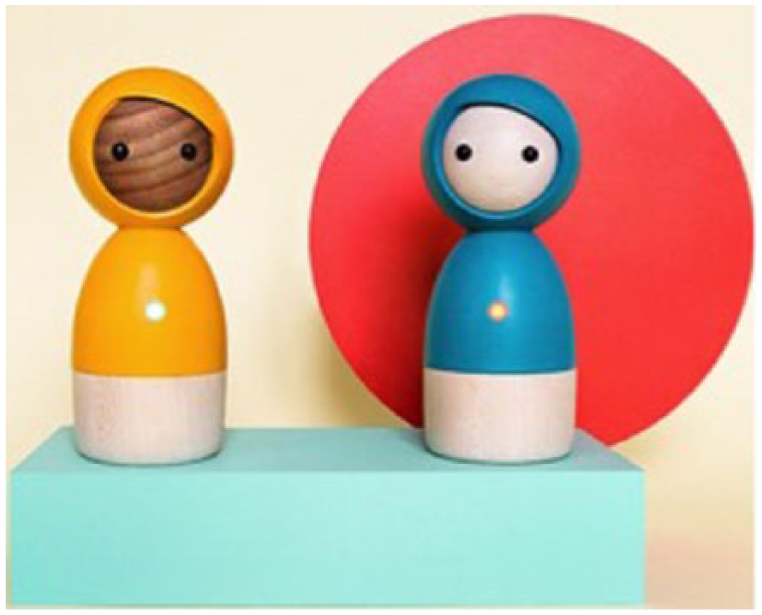
Avakai.
At the time of the study, the toy was still a prototype, meaning the two designers were interested in the ways young children would use it. This provided the rare opportunity to explore the designers’ backgrounds and intentions for their design in relation to young children’s use. Thus, the project had two stages, first was to learn about the design decisions and reasons for them from the designers, Matas Petrikas and Justyna Zubrycka, at their company Vai Kai in Berlin. Second was to observe seven 4- to 6-year-olds use of the Avakai in relation to play and communication practices in one after-school club in the United Kingdom. As a result this study adds to Miller’s (2008, 2009) work on material ‘stuff’ that has shown how the use of objects is a collaboration between the design details decided by designers and the users by considering both perspectives.
The article is structured to first consider the literature on play and communication practices. Following this, the ways in which these practices connect to the design of digital toys is discussed. Then, the research methodology and means of analysis are outlined. The last part presents the findings and discussion section, which is divided into three areas that derived from the data. These are (1) children’s customisation of the toy design, (2) designing to produce emotional narratives in play and (3) the use of the compartment in the base of the toy. Each one is discussed in relation to the designers’ intentions for their product and the extent to which this aligned with young children’s use.
Play and communication practices
Like other research that has gone before, this project focused on the connection between sociodramatic play and communication practices. Hughes (2002) defines sociodramatic play as that which is closely related to acting out personal experiences and real life. In relation to this type of play, there has been considerable research that has linked it to the development of literacy skills (see, for example, Christie and Roskos, 2009; Marsh, 2014; Roskos and Christie, 2011). Roskos and Christie (2011) write that, since Wolfgang’s work in 1974, play has continually been linked to literacy in some form or another. Referring to the work of Wolfgang (1974), they state that early research on the link showed how ‘in play, children imbue toys with meaning, just as they must do with print when reading written words’ (Roskos, and Christie, 2011: 73). Other research has shown how play interests are linked to specific types of literacy practices and texts. For example, Marsh (2014) shows how children’s interest in popular culture leads to play based on those specific texts. She did this by comparing a historic television show from the mid-20th century with a contemporary Disney animation ‘in order to identify the continuities and discontinuities in these practices over time’ (Marsh, 2014: 267). In doing so, Marsh shows how children from both eras have played with narratives from popular cultural texts using dress-up and props. Furthermore, studies have shown how exploiting children’s interest in popular culture can actively encourage literacy practices in the classroom (Marsh, 1999, 2000; Marsh and Millard, 2000; Parry, 2014; Willett, 2005).
The early body of work focused specifically on the connection between play and literacy development with regards to reading and writing. However, as with the latter example of Marsh (2014), more recent research on literacy practices considers the connection to multiple modes of communication. This is the result of a technological shift from books to screens that foreground communicative modes beyond print (Kress, 2003). It is this period of time, in which digital technological and communication changes have emerged, that Roskos and Christie (2011) see as the pivotal point in which research about the connection between play and literacy research has been in decline. The reasons for this they suggest are twofold: first, because digital technologies have altered traditional play and literacy practices and second, because play might not prepare children for the type of literacy practices they need when using digital technologies. However, the research described in this article uses this body of research on physical sociodramatic play and literacy links to consider the types of communication practices that can occur when digital play is screen-less, and instead digital technology is embedded within a material object. Thus, meaning that digital play resembles traditional sociodramatic play more closely than on-screen play. It will be shown how the nature of the screen-less digital toy extends this earlier body of research beyond a framing around play and literacy and into thinking about the connection between an emerging form of physical-digital play and wider multimodal communication practices. In doing so, the discussion put forth is underpinned by multimodal social semiotic theory that suggests all communication practices are the result of ‘simultaneous social, economic, communicational and technological changes’ (Kress, 2003: 9), which are connected to patterns formed by cultures in relation to their individual histories. As will be shown in the next section, the same also applies to changes in tools for play.
Toy design, culture and the implications for communication practices
The previous section described how communication practices are unavoidably linked to wider social and cultural patterns that include economic shifts and technological advances (Kress, 2003). Julier (2013) shows how design practices are also a product of wider cultural patterns by linking them to global economic shifts since the 1980s. In relation to recent times, he writes that ‘design culture is thus both a product and description of the wider social and economic processes of this design turn within neoliberalism’ (Julier, 2013: 220). In relation to toys specifically, Van Leeuwen (2013) has similarly shown how their design is a reflection of wider aesthetic histories and social practices. In particular, he mapped the development of Western construction toys to social and cultural practices. In doing so, Van Leeuwen shows how the construction toy, Mecanno, can be seen as a direct representation of industrial equipment such as cranes from the same era. He then applies this idea to more recent toys showing how the original red, blue and yellow Lego bricks came into production shortly after the Bauhaus art movement began producing works that were similarly created from a narrow range of primary coloured blocks. Furthermore, toys fail to interest children when wider social practices are not taken into consideration because they do not mirror their everyday experiences of making sense of the world (Zhang and Peng, 2010).
It is important to consider these changes in relation to this project because the toy at the heart of the study is a product of a start-up company, Vai Kai, with two designers who (as will be shown in more detail later) left their jobs in bigger design and digital companies to create the Avakai toy. Julier (2015) suggests that it is the very nature of being in a period of economic austerity that has brought about specific types of hacking and making activities alongside mainstream companies. In other work, Julier (2013) describes this current trend as design activism which … includes the development of new processes and artifacts … Designers, professional and otherwise, curators, critics, and historians are still experimenting with alternative modes of practice and representation to the dominant narrative of design culture. (p. 219)
In this way, it could be said that it is the very structures of the contemporary society in which Avakai has been designed, its economics and technology that have allowed the toy to be made. Traditionally toy design and production would have needed very different structures and thus been linked with large-scale toy manufacturing companies. It is therefore specific to contemporary times that two designers can set-up, crowdfund, manufacture, produce and distribute a toy.
Having acknowledged that the wider structures of societies affect the design of toys, it is important also to understand how these changing designs will impact play and communication practices. This is because different media produce texts that foreground specific communicative modes (by text, I use Halliday’s (1978) definition as a cohesive unit of meaning rather than writing). This can be seen in Kress’ (2003) work that has shown how the move from the page to the screen, brought about by evolving technologies, has altered the long-held dominance of writing in favour of foregrounding images for communicative purposes in Western contexts. Building on such work, and given this project’s focus on screen-less digital toys, it was possible to predict that the foregrounding of other communicative modes would occur in the absence of screens. In the case of the medium in this project, the Avakai dolls are foremost an object whose movement is used to produce set sounds in either one doll or interactions between a set of two as an expression of emotional responses.
Finally, Kress and Van Leeuwen (2001) wrote that many digital media are more a repackaging of older practices than anything specifically new (p. 90). However, looking through the past communication and gaming technology, it has been difficult to find an example that connects movement to produce sounds without a screen. In computer game history, physical artefacts have repeatedly been added to enhance play and communication practices on the digital platform. For example, physical objects such as musical instruments and steering wheels can be attached to Wii consoles. Crossovers are also evident in more historic digital toys such as the game Odyssey (1972) by Magnavox that had additional parts such as boards, tokens, coloured overlays for the TV screen and a light gun. However, in each of these examples, the screen still remains an essential part of the play. Therefore, it is not as easy to frame the Avakai as a repackaging of something more traditional. So the findings of this research are particularly important to understanding evolving changes in digital play. Finally, taking time to evaluate how a new toy connects to social and cultural histories also ties with giving equal agency to tools and users. For as Appadurai (1986) points out, artefacts have their own social biography. They also have ‘an individual history that is significant for the people that make use of them’ (Carrington, 2012: 28). Ideas around placing the technology as well as children’s use at the centre of the study are described in more detail in the methodology section next.
Methodology and methods
The study was split into two stages. The first sought to understand the designers’ backgrounds and how this connected to their intentions for the toy and was framed by the following research questions:
How was the design of Avakai conceived and developed?
What were the designer’s intentions for children’s play and literacy practices?
How did these intentions manifest in the design of the toy?
This part of the study built on the first two levels of object ethnography that considers … what can be ‘read’ in relation to the intentions and expectations of the designers of these objects’ and that it is this intended meaning that is ‘read and interpreted by the user’. (Carrington, 2012: 28)
Carrington’s (2012) words show how object ethnographic studies have been concerned with what can be inferred from the design of the object without firsthand information from the designers. This project was fortunate enough to be able to conduct primary research at the first level through a series of conversations and email exchanges with the designers. Therefore, it sought to add to academic understanding by seeking links beyond education and social sciences to consider how multimodal play and communication practices are designed for young children within one small part of the digital toy industry. This builds on work by academics, such as Rowsell (2013), who have considered the role of multiple modes of communication within a range of industry practices for how that knowledge might inform academia. In addition, it adds to studies and theories that have stressed the importance of considering objects’ agency alongside that of users (e.g. Carrington, 2012; Kaptelinin et al., 1999; Pahl and Rowsell, 2010).
Stage two was framed within the body of literature described earlier that has linked play and literacy practices (e.g. Christie and Roskos, 2009; Marsh, 2014; Roskos and Christie, 2011). However, in doing so, the study moved away from a narrow definition of literacy to consider these practices as plural (Flewitt, 2008). Therefore, it was positioned alongside prior contemporary literacy research that has shown how alphabetic print is increasingly combined with other communicative modes (e.g. Jewitt, 2009; Kress, 2003, 2010; Pink, 2001; Walker and Lewis, 1998): as well as studies that have specifically considered young children’s multimodal communication practices (e.g. Flewitt, 2008; Johansson et al., 2014; Kress, 2003; Lancaster, 2003; Marsh, 2016; Wolfe and Flewitt, 2010). It was also influenced by Kress’ (2010) development of multimodal theory that has shown how different modes of communication are used to convey particular types of knowledge. In relation to this, the project was undertaken to consider how a digital toy prototype with no screen might foreground different communicative modes than other digital toys. This is because screens foreground affordances of the visual mode (Kress, 2003). Thus, when screens are removed, other modal properties and their affordances will come to the fore. In the case of the Avakai, this has been centred on set movements and sounds that represent emotions.
Stage two centred on the following research question:
4. How does a group of young children’s play and communication practices with the Avakai relate or not to the designers’ intentions for their product?
To answer this question, data were collected through observations of seven 4- to 6-year-old’s play and communication practices with the Avakai. For the first 2 days, children were observed using non-technology enhanced Avakai. Then, for the last 2 days, they used the Avakai with embedded technology. The decision to look at both technology, enhanced and non-enhanced, was to understand the kinds of sounds and movements young children naturally used when playing with the Avakai and how these matched or not the set movements and sounds the designers had embedded in the technology enhanced version.
The child-participants were recruited via an after-school club attached to an infant school in an inner area of a Northern English city. Permission was sought first from the Head Teacher of the Infant school where the after-school club was based, then from the owner of the after-school club. Once these sets of permission had been received, parents were given an information sheet and a consent form to sign if they were happy for their child to take part. Finally, all children with parental consent were informed about the project and their verbal consent was gained. In addition, the children were observed for signs that they might want to leave the project. Given the nature of the after-school set-up where children moved between activities of their choice, children stopped playing with the Avakai when they felt like it and naturally moved on to other activities. These processes followed ethical guidelines for working with young children (Flewitt, 2005). They also framed the research as with rather than on children (Christensen and James, 2008).
The children’s use of the toys was recorded partly by GoPro video cameras mounted on chest harnesses worn by the child-participants and also by detailed field notes. This was because not all the children in the after-school club setting where the study took place had received parental permission to take part, meaning that for the first day GoPro camera’s were used but for the remaining 3 days field notes were made because it became impossible to separate children with and without permission due to limited space. Therefore, filming was replaced by the use of detailed field notes that recorded children’s movement of the Avakai during play, alongside examples of their multimodal communication practices. This was supported by the use of a mobile phone to photograph key play and communication moments.
The inability to use the video cameras planned for the whole study affected the multimodal means of analysis I had intended to apply to the data collected. This would have provided more detailed insight into the children’s actions, gestures and modes of communication when playing with the Avakai, because as Kress and Van Leeuwen (1996) state ‘particular modes of communication should be seen in their environment, in the environment of all the other modes of communication which surround them’ (p. 33). Instead the video data from day one were transcribed with video stills inserted to highlight key play and communication moments. Next, these transcripts combined with the field notes were analysed using thematic analysis following guidelines laid out by Braun and Clarke (2006). Specifically, the type of thematic analysis I applied was inductive in that I looked for themes in the data in relation to the research questions. This meant I coded first for all instances in the data where the designers referred to design features of the Avakai. I then coded for where these design features emerged in the observations of children using the Avakai. Finally, the decision to draw out themes related to design features and children’s use in relation to the specific examples of the materiality and agency of the Avakai related strongly to the theoretical framing of the project in relation to object-orientedness (Kaptelinin et al., 1999), object ethnographies (Carrington, 2012), artefactual literacies (Pahl and Rowsell, 2010) and material stuff (Miller, 2008, 2009; Shove et al., 2007). From this process, three key themes were identified that are discussed under individual headings next.
Findings and discussion
This section discusses three key themes that emerged across the data sets. These are (1) children’s customisation of the Avakai toy, (2) design and emotional narratives in play and (3) use of the compartment in the base of the Avakai. Each is described separately in relation to the designers’ intentionality for play and communicative practices and children’s actual use.
Children’s customisation of the toy design
Shove et al. (2007) write that ‘even when technologies appear stable, when their design is fixed’ that other elements such as the ‘social significance’ or use are shifting (p. 8). In other words, digital toys are constantly albeit sometimes subtly, customised by users. However, the Avakai designers actively encouraged users to alter its appearance and use through their design. Conversations with them showed how they had always been interested in creating a design that would use children’s imaginations in their play. Indeed the designers’ first prototype could be customised using a selection of different shaped wooden pegs (Figure 2).
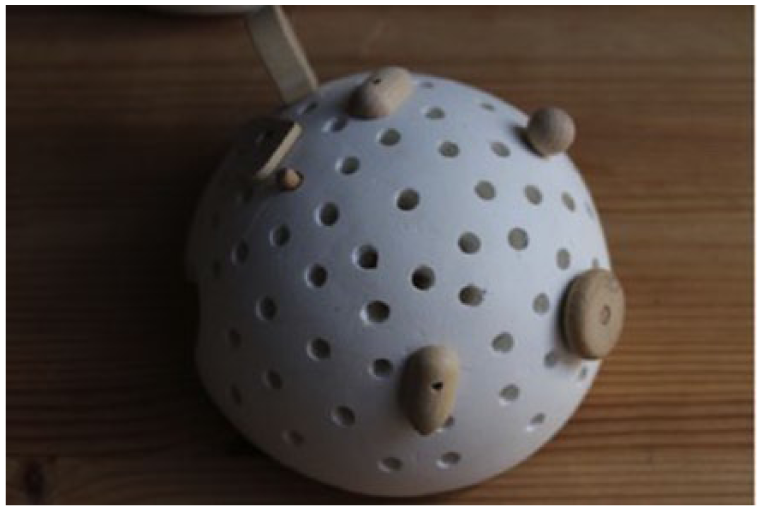
Early Avakai prototype.
After building this prototype, the designers became interested in how technology could enhance the experience of the object without taking away their original intentions to keep the design open to allow for customisation. One of the designers, Justyna Zubrycka, stated that she was influenced by Machiko Kasahara’s (n.d.) ideas on ‘Device Art’: … a form of media art that integrates art and technology as well as design, entertainment, and popular culture. Instead of regarding technology as a mere tool serving the art, as it is commonly seen, we propose a model in which technology is at the core of artworks.
Kasahara’s idea that technology should be aesthetically appealing and concerned with the design of the object and the material also tied with ideas of the other Avakai designer, Matas Petrikas. Matas told me how he had previously worked for Soundcloud, a digital platform for sharing sounds, but after many years of working in this purely digital field, he had became interested in physical materials again and their changing connection to the digital. He noticed that a movement was beginning to take place within digital industries that returned to foregrounding material objects. Watching videos on interaction design by Massachusetts Institute of Technology, Matas saw the future of digital design as emphasising the physical materials of the object embodying the technology. Furthermore, advances in digital technologies were making many things possible in the physical, such as through 3D printing and laser cutting. In other words, advances in technology were making it possible to focus on material aspect of play and communication while using the digital to communicate in new ways that do not require a screen. As a result, he said the future toys would be either digitally ‘connected’ or ‘unconnected’ but either way will revolve around physical objects: toys not screens. In this way, Matas saw digital technology as adding layers to physical toys, which could bring ‘magical/special’ properties that enhance children’s narratives in their physical play.
In developing their product further, Vai Kai decided to focus on designing a character for their toy. They believed this might make it easier for children to invent stories and play imaginatively with the toy. At the same time, they kept the aesthetic of the character as simple as possible to encourage customisation. Vai Kai’s toy workshop contained many examples of early prototypes and character design, which illustrated how the current Avakai character was developed and their thoughts on how it might be customised (Figure 3).
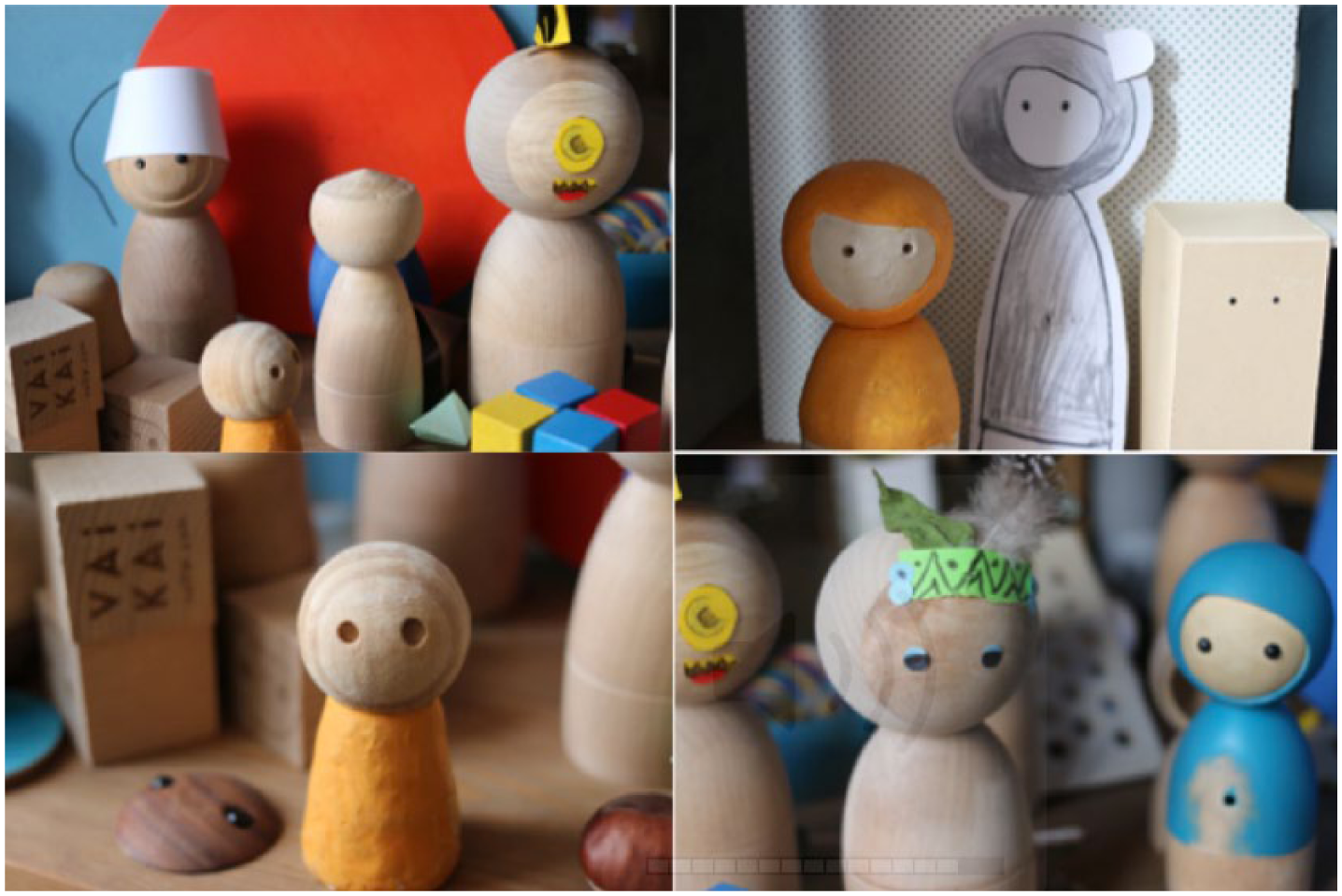
Avakai prototypes.
McCloud (1993) writes in relation to low modality graphics that the more simplistic an image of the ‘human’ form, the more able the viewer is to interpret it in a way that is meaningful for them. In this same way, the simplicity of the Avakai design was also used to entice children to customise it and make it meaningful to them.
The data on the children’s use of the Avakai showed how although they were not told of the designers’ intentions, customisation of the Avakai happened immediately. This is shown by the following extract from the data:
‘You have stuck feathers in its ears now’ (Figure 4).
‘Yes it is a bird. He is actually a bird. He is a bird at his party. Look!’
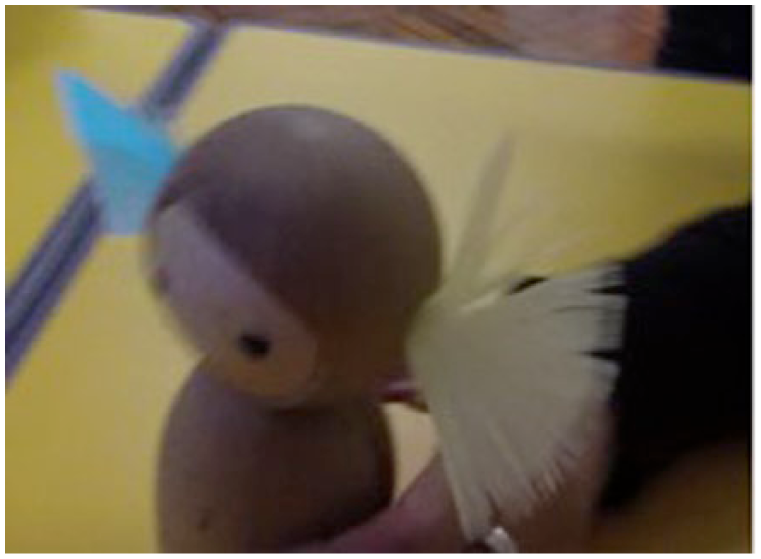
Feathers added to an Avakai.
The adding of the feathers to the Avakai brought about what Hughes (2002) describes as an imaginative state of play that took place across a range of modes including storytelling and the making of a birthday card for the Avakai to have at his party that incorporated drawing, stickers and writing. In other examples from the data, children wanted to draw on additional facial features, such as a mouth, or added stickers to its face to see what it would look like if it were a different colour. In this way, the children’s use of the Avakai seemed to match the designers’ hopes: Avakai Twins were designed for free play … Many educational digital toys are very goal oriented, preprogrammed to teach specific skills and limited to certain rules. Whereas a child directed, open-ended play enhances self-motivation, creativity and skills building … Avakai twins have a traditional wooden doll form connected with digital technology without adding any sort of interface, like screen, joystick or controller. (Justyna Zubrycka, Avakai Designer)
The examples provided in this section support the notion that designers’ backgrounds and intentions influence what ‘stuff ends up being’ (Molotch, 2003: 23). They also show that what stuff ends up being can influence how it is taken up and used. However, there were other design features that were taken up in different ways to the designers’ intentions as will be shown in the last section about the compartment in the base of the Avakai. Before that, the next section describes how the design features helped foreground emotional narratives in children’s play.
Design and emotional narratives in play
Justyna Zubrycka described her background in design production. Also, how during her prior academic studies she was interested in sensory and musical approaches to communication. As a result she began to think about how meaning making with particular modes are usually closely associated with specific media. Therefore, she began experimenting with what would occur if she matched modes of communication with media that are not normally combined. She was interested in the deaf percussionist, Evelyn Glennie, and how people can perceive sound through the body instead of the ears. Before developing Avakai, these influences led her to create Morimo, a sensory instrument where sounds are received through tactile vibrations as the user lies face up on top of it (http://inspirationist.net/morimo-a-sensory-instrument-by-justyna-zubrycka/). In relation to this, Justyna expressed concerns that education seems to pay attention to very limited ways in which humans can make meaning. Such ideas seemingly reflect those of Barad (2003): Language has been granted too much power. The linguistic turn, the semiotic turn, the interpretative turn, the cultural turn: it seems that at every turn lately every ‘thing’ – even materiality – is turned into a matter of language or some other form of cultural representation. (p. 801)
Justyna stated that these prior interests and background fed directly into her ideas for the Avakai design which also foregrounds movement and sound.
Such ideas also relate to more historic design concepts that show how media and modes have perceived affordances (Norman, 1990). As a result, it is possible to mismatch the design affordances of modes to bring about unexpected types of communication by moving information that is typically conveyed in one particular mode to another, a process Kress (2010) terms ‘transduction’. Bezemer and Kress’ (2010) show how different information is lost and gained in the process of transduction. Deliberately contrasting media and modes in the way Justyna described in relation to her past work is increasingly used in wider design practices. Walker and Fass (2015) describe these practices as deliberate design processes where something is broken ‘down into manageable or meaningful components, then remade in another form’ (p. 3). In the case of the Avakai’s design, this was to create set sounds and movements with the desire to encourage narratives based on emotions in the user’s play. This background information in relation to the development of Avakai shows that not only are technologies connected to wider patterns of communicative and play history such as described in the literature review but are also embedded in the personal backgrounds of designers who chose which patterns to use and extend. In other words, ‘everyday objects embody the values and worldviews of designers’ (Carrington, 2012: 28). This was further illustrated by the design of the Avakai’s digital layer, which the designers hoped would encourage narratives centred on emotions. To do this, they designed Avakai to be able to communicate across pairs, through set movements. These movements were directly linked to the expression of emotions. For example, when one Avakai is shaken, it makes an angry noise which triggers a sympathetic sound in its companion. In this way, the designers had created patterns of emotional interaction between sets of two Avakai.
The data concerning children’s use of the Avakai showed that it was not only the movements and sounds that brought out emotional narratives in children’s play. The data showed that the simplicity of the Avakai design and the object itself also related to a specific emotional quality in the children’s play and communication practices. Winicott’s (1971) work has shown how children invest emotions in objects. In addition, Pahl and Rowsell (2010) state that artefacts stimulate particular kinds of talk. This is because ‘objects can be described as “semiotic” when they are bound up with an act of meaning making’ (Pahl and Rowsell, 2010: 39). Beyond the object it is also the case that ‘different modalities … open up different kinds of opportunities for different kinds of talk’ (p. 40). If as these two authors describe objects can be seen as a form of semiotics, then the design aesthetics of the toy, itself an object, can be related more widely to semiotic theory. In studies about wider semiotics, it has been shown how in certain geographical contexts (Yamada-Rice, 2013) and for certain ages of people (Hackett and Yamada-Rice, 2014), as well as particular types of information (Abbott and Forceville, 2011; McCloud, 1993), low modality, ‘unrealistic’ semiotics align themselves best with the portrayal of emotional narratives. The data supported this by showing how the simplicity of the toy design brought about play narratives centred on emotions as is shown by the following extracts from the data:
[singing] ‘Happy birthday, happy birthday’.
[She makes the Avakai dance around.]
‘Yay, yay, yay it is my birthday’.
‘It is my birthday’.
‘It is my birthday too’.
…
[The two Avakai are turned to face each other.]
‘I got a sticker for my birthday. Do you want to share mine?’
‘Oh yes. Happy birthday!’
[Both children sing Happy Birthday and make their Avakai dance around].
‘I want a cake with candles because it’s my birthday too and I am 16 years old’.
Today is my birthday too. Pow!
[Child 2 makes her Avakai bump into child 1’s. Child 1 moves the Avakai around and around in circles she sings …]
…
[Child 1 makes the Avakai jump up and down on the table].
‘I can’t stop making it jump up and down on the table. It is excited’.
‘I can’t help blowing out my candles’.
On another occasion, a child imagined an Avakai to be sick:
[The child lies her Avakai down].
‘I’ve got a bad temperature’.
[The child rolls the Avakai off the side of the table].
‘I can’t help it I am going to roll off the side of my bed’.
[The child brings the Avakai back to the table].
‘Urgh I need to get back into my bed’.
[The child rolls the Avakai across the table].
And then scared,
‘Uh oh there is going to be a trouble. A wolf is going to come and eat us up. Help a wolf is going to come and eat us up. I looked out of the window and a wolf is going to come and eat us up. Hello run away as fast as you can. Even though you are not feeling well it is best to do it’.
[The child makes the Avakai run across the table].
‘Quick he is going to get you. Run as fast as you can’.
[The child makes the Avakai run all around the room, over the benches, walls and tables].
‘Oh phew I am at a safe cottage no one will find me here. Quick come to the cottage. Quick, quick faster, faster!’
[The child makes her Avakai jump quickly up and down as though it is scared].
These examples show how the children naturally paired verbal narratives about emotions with set physical movements even when the Avakai were not designed to respond in this way. For example, the Avakai were turned to face each other when in conversation, they were placed on their backs when tired or sick, and when they were happy, singing or dancing they were moved around in circles. In this way, children naturally created a series of movements to illustrate the Avakai’s emotions and moods. These findings suggest that the way in which young children naturally play to include movement and gesture alongside their narratives seems to tie with the design of the Avakai that also links these two modes of communication [sound and movement] in its design. However, the movements the designers chose and the ones the children used did not always align suggesting the design process could also have benefitted from including more extended observations of children’s play earlier on.
In addition, sound and movement in the Avakai also included an embedded heartbeat consisting of a vibrating pulse that becomes stronger when it comes in contact with another Avakai. In this way, this particular design feature signifies happiness/excitement through a tactile property. The heartbeat seemed to be the technological detail that added that ‘special/magical’ layer to children’s physical play that I described earlier in relation to Matas’ intentions for the design. In general, the children were fascinated by the heart, not only did they want to feel it, but they also wanted to see it. To do so, the children peered inside through the charger hole at the back of the Avakai. One child was interested in trying to make the Avakai’s heartbeat faster. He ran around and around the room with it, paused and felt the heartbeat. When he noticed that it was still beating to the same pace, he declared the Avakai strong and kept on running in an attempt to make it beat faster like his own. When the technology enhanced Avakai was placed on its side its heartbeat changed, it fell asleep and started to snore. It took a few seconds for this element to work and children discussed among themselves how long it took them to sleep and what they did trying to do so. As Marsh (2014) states ‘one function of play is to explore and respond to the social and cultural contexts that surround [them] … seeking to reinforce normative discourses but also to question them’ (p. 274). In other instances, the Avakai were swung in the air, which produced a ‘Whoop’ sound from the toy. When this happened right away, the children would feel for the Avakai’s heart. Finally, when playing with the narrative of a sick Avakai (as in the earlier example), the child touched to see how its heart was beating in relation to its illness.
The examples shared in this section show how play with emotional narratives come about partly through the design of the digital layer but also in the way children naturally play. In part, this seemed to be prompted by the simplicity of the toy’s design that kept narrative possibilities open and allowed the children to play with a wide range of emotions. Thus, children’s use appears to have linked with the designers’ intentions for the toy in some respects. The final findings section describes a design feature that was added at the request of children playing with an early prototype but with limited intentionality by the designers for how it would be used.
The compartment
The first toy prototype designed by Vai Kai, shown in Figure 2, afforded users the opportunity to open it and store things in the middle. With the most recent prototype that the children used in this project, the designers had not completely decided whether to have a space that could be opened or not. As a result, the technological component of the Avakai was stored in the base of the toy. To understand how children might use a space in the Avakai a couple of non-technology enhanced prototypes were included in the project where the base compartment could be opened and used by children. Before undertaking observations of children’s use, the designers said they thought the compartment might be enjoyed in playing hide-and-seek. They elaborated to say that because the Avakai’s heart beats stronger when they come into contact with another Avakai, they thought it possible that children might enjoy storing things in the base and then asking a friend to come and search for it using the heartbeat as an indication of the locality of the other Avakai. Again the data of children’s use showed how they had partly taken up this idea but also made use of the compartment in ways unanticipated by the designers.
Children on the project put feathers, sequins, stickers and other things in the base. Sometimes they told other children and asked them to come find their Avakai and its hidden treasures. However, the degree to which the children valued the opportunity to play and store stuff was perhaps under anticipated by the designers. Every child-participant used the compartment to store small items. Anthropological perspectives describe how the very essence of human contact with materials allows us to understand humanity (Ingold, 2013; Miller, 2003). Ingold (2013) theorises that the importance of materials to humans lies in their connection to thinking through making: What is the relation between thinking and making? To this, the theorist and the craftsman would give different answers … one makes through thinking and the other thinks through making … The way of the craftsman … is to practice what I would like to call an art of inquiry. In the art of inquiry, the conduct of thought goes along with, and continually answers to, the fluxes and flows of the materials with which we work. These materials think in us, as we think through them. (p. 6)
As was shown in the section on customisation, sometimes the children used the materials they collected in their making such as in the case where they added feathers to the Avakai. However, even when the children did not make with the materials, Rautio’s (2013) work suggests they are still thinking through the materials. Rautio (2013) describes how young children are interested in the materials of their lives by describing the common practice children have of picking up stones and carrying them in their pockets. This she says is an autotelic practice: … that we repeatedly engage with not for external reward or motivation such as money or outside recognition. Autotelic practices are internally motivating in that the activity is the goal and the reward in itself. (Rautio, 2013: 394)
As with object ethnographic studies and other work that gives agency to inanimate things (e.g. Carrington, 2012; Kaptelinin et al., 1999; Miller, 2008; Pahl and Rowsell, 2009, 2010; Shove et al., 2007), Rautio also gives objects, in this case, the stones agency. She describes how the specific material quality of the stones ‘asks’ for them to be picked up. Furthermore, Rautio (2013) describes how not only do children pick up and carry stones but also spend time arranging them. This can be understood as children curating what they collect. In the same way, it is possible that the materials placed into the Avakai’s compartment perhaps ‘called out’ to be picked up, arranged and kept safe. In this way, the children’s practices seem to illustrate thinking through collecting and curating in addition to making.
The compartment also had a second use that was not anticipated by the designers but nevertheless seemed to derive from the Avakai’s design. Five of the child-participants’ interests in the heartbeat triggered an interest in the inside of the Avakai’s body. In relation to this, the data showed how the compartment became an extension of the Avakai’s body. One child put imaginary strawberries inside when it was hungry:
‘Orange juice there you go. What would you like to eat?’
‘Strawberries’.
Child 1 ‘Strawberries. There you go’.
‘With one hundred spoons of sugar’.
[Child 1 counts out imaginary sugar while counting to 100].
‘There you go’.
‘Thank you’.
[Child 2 opens up the base of her Avakai and puts the imaginary strawberries inside].
Two other children, while enacting a midnight feast on a sleepover, opened up the Avakai to give them imaginary snacks. In another example, one other child opened up the Avakai and looked to see inside its body. Finally, one child inserted a brick inside the toy which was used to represent medicine when playing with the narrative that the Avakai were sick:
‘Whenever you want to you could just open yourself [referring to the compartment in the base of the Avakai] and put some medicine in it’.
[Child 1 walks around the room. Then picks up a Lego brick and puts it inside the base of her Avakai(Figure 5). She walks to the researcher].
‘Guess what I’ve got inside here?’
[She opens it up to show the researcher].
‘That’s a medicine’.
‘That’s a piece of Lego’.
‘And I am pretending it is medicine’.
[Child 1 opens up the Avakai to show Child 2].
‘It’s a brick’.
‘No it is medicine’.
‘Lets swap [bases of the Avakai] my Avakai needs medicine’.
[The children swap the bases of their Avakai].
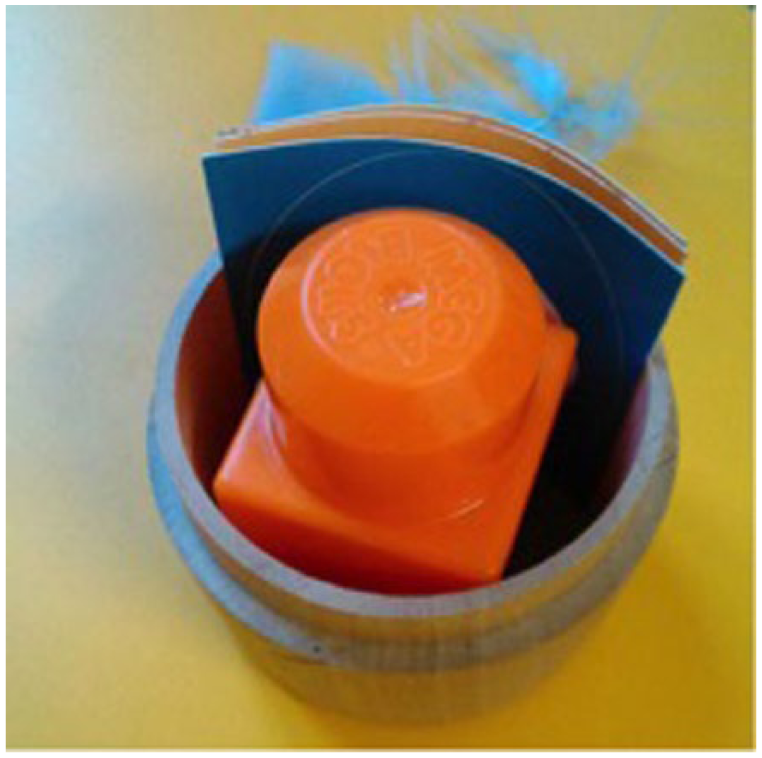
Medicine in an Avakai’s compartment.
This section has provided details of a design element that was used by children in ways furthest from the designer’s intentions.
Together the three sections in this part have shown how children’s use of the Avakai in relation to play and communication practices related to both their own agency and that of its design. For different design features, the child’s agency was stronger than the designers’ intentions but for others it matched them.
Conclusion
This article has described three key findings from a project that set out to consider the way in which changes in technology bring about new materials in the landscape of young children’s communication practices and play. Furthermore, how the design features of new technologies, in this case a toy, bring about types of play and communication that are made in relation to both the agency of the object and that of the child. Specifically, it focused on a new form of toy known as Avakai that is foremost a material object with embedded digital technology that can be felt and heard, but not seen. The findings were described in relation to design features of the toy, the designer’s intentions for it in relation to play and communication, and how it was used by a group of seven 4- to 6-year-olds. The three key themes illustrate how to varying degrees children’s use of the toy came about in relation to designer’s intentions, the aesthetic appearance of the toy and the children’s interest. Considering the Avakai in relation to both the children and the toy itself is important because the combination of child and toy makes a unique entity, in ways similar to the following description of a child playing with a stick: … with a stick in hand, the person is transformed into a ‘new’ hybrid entity – part stick, part human – that can do no more than a person or a stick alone. (Shove et al., 2007: 7)
More specifically, the design decision to embed digital technology within a physical toy rather than centre on a screen brought about use more similar to physical non-digital sociodramatic play. However, the technological features that foregrounded set movements, sounds and a heartbeat, as well as the simplistic aesthetic influenced the children’s play to centre on emotional narratives and those related to the Avakai’s body. These findings inform the field of early childhood play and communication practices by considering how communicative modes and play might change as digital technologies continue to evolve to foreground material objects rather than screens.
The children’s use of the Avakai showed how a screen-less digital toy that foregrounds sounds and movement is different to children’s use of screen-based technologies that foreground images. At times, children brought in other modes alongside these, as they would in any form of play, such as drawing, writing and the use of materials. In this way, they drew on the affordances of all the materials that surrounded them (Kress, 1997). Such findings show that going forward researchers and early years literacy specialists will likely need to spend more time considering modes of communication that are typically less mainstream in work on young children’s literacies, including a greater emphasis on the material nature of the tools they are using.
In addition, the findings contribute to the field of materialities in communication practices by considering the toy in relation to primary data on the designers’ backgrounds and design decisions. Considering the toy design and the designers’ backgrounds has implications for thinking about how toys are designed for young children and where children exist, if at all, in the design stages. Also, how academics and those designing and making products for young children can come together to combine knowledge and know-how to make products better suited to children.
