




Abstract
An international contemporary challenge for early childhood teachers is to integrate digital media in preschool. Research indicates that teachers have concerns regarding the use of digital media in preschool, especially in relation to play. In this study, we explore how an early childhood education and care (ECEC) work team takes on this challenge when, in focus group conversations, discusses digital media in relation to a theoretical framework with principles and implications for understanding play and teaching in preschool. We adopt a sociocultural perspective when examining the mediating role of theoretical concepts for reasoning about the integration of digital media in ECEC. The findings illustrate how the concepts mediate an understanding of (i) play and teaching as responsive activities with a focus on the importance of sharing the same digital media references (ii) play and teaching activities as building on a mutual frame of reference, which is a challenge as children have different experiences of digital media than adults, (iii) play as including fluctuations between “as if” and “as is” and something that must include fantasy and an openness, with digital media contributing to or hindering such openness, and (iv) how teaching can take shape in mutual activities where mutual experiences of digital media can be used as a starting point for teaching. Implications for professional development efforts and teacher agency are discussed.
Keywords
Introduction
Early childhood teachers 1 internationally are faced with the contemporary challenge of integrating digital media 2 into early childhood education and care (ECEC) (Grieshaber et al., 2021). In Sweden this challenge is manifested in the latest version of the curriculum for preschool (The Swedish National Agency for Education, 2019), which states that the preschool is now mandated to, among other things, contribute to ensuring that children develop adequate digital skills. However, the curriculum does not state how teachers should organize their work in relation to this task, which leaves its implementation up to the teachers. In addition, the integration of digital media has seen slow uptake in ECEC internationally (Grieshaber et al., 2021). For example, many early childhood teachers have concerns regarding the use of digital media, especially when this issue is discussed in relation to play, with “traditional” play being valued more highly than play including digital media (e.g. Schriever et al., 2020). Despite early childhood teachers’ attitudes toward digital media and play, research illustrates how children’s experiences of digital media are expressed through play activities, for example in relation to the choice of play materials and themes (e.g. Marsh, 2017). Hence, it is important to shed light on these experiences when discussing contemporary play (Stephen and Edwards, 2018), in particular when discussing the contemporary challenge of how early childhood teachers can develop responsive pedagogical approaches that incorporate such experiences (Wood et al., 2020). In this study, we have explored how an ECEC work team takes on this challenge when participating in a combined research and development project, including focus group conversations (FGCs). In this project, the work team was first introduced to the theoretical framework Play-Responsive Early Childhood Education and Care (PRECEC) (Pramling et al., 2019). The framework, which is described in more detail below, was chosen as it includes concepts that are helpful when attempting to understand teaching and play activities (which can include digital media) in ECEC. This study focuses on the last part of the project where the same work team, in FGCs, discusses PRECEC in relation to integrating digital media in their preschool.
Moreover, in this study, we assume a sociocultural perspective on learning (this is elaborated upon in the section A Sociocultural perspective on mediation, below) where concepts are regarded as cultural tools mediating our understanding of the world (e.g. Vygotsky, 1978). In this study, this translates to how concepts from PRECEC mediate the participating teachers’ reasoning about the relationship between play and teaching in conjunction with digital media in preschool.
The following research question guided the analysis:
How does the theoretical framework PRECEC mediate an ECEC work team’s reasoning about play and teaching in conjunction with digital media in preschool?
The findings of this study are, in the last part of this article, discussed in relation to professional development efforts in ECEC as well as in relation to the potential for enabled agency for early childhood teachers.
Digital media in preschool
Since early childhood teachers are now responsible for integrating digital media in preschool, they are faced with challenges as this integration questions established views on both teaching and learning. Research on children’s use of digital media has been polarized in terms of focusing on the negative (e.g. Cordes and Miller, 2000) or positive (e.g. Clements and Sarama, 2002) impact that it might have on children’s development and learning (Stephen and Edwards, 2018). This impact is often discussed in relation to the risks or benefits regarding children’s use of digital media, and these different views have become evident within both the research field and the teaching community. For example, some studies concerning early childhood teachers’ views on the integration of digital media in ECEC show that teachers are positive about this integration as digital media help to promote learning (e.g. Nikolopoulou and Gialamas, 2015), while others show that early childhood teachers are skeptical toward such integration (e.g. Gjelaj et al., 2020).
In addition, much of the literature reveals that views related to the risks of using digital media in ECEC become more apparent when the topic is discussed in relation to play, as many teachers regard using digital media as a threat to traditional play. For example, Palaiologou (2016) found that most teachers in an international study on teachers’ disposition toward digital media in ECEC expressed positive attitudes toward the use of digital media in their homes. At the same time, they had concerns regarding the integration of digital media in preschool as such media were regarded as hindering traditional play. In a more recent study, Schriever et al. (2020) found similar results when interviewing 19 early childhood teachers in Australia. The study showed that the teachers had concerns related to children’s play with digital media and that they valued what they regarded as traditional play, by which they meant play that does not include digital media. In addition, the same study showed that the teachers implemented pedagogical practices that restricted children’s digital experiences.
Despite the view of digital media as a threat to play, research shows that there is a connection between digital media and play (Wood et al., 2020). For example, Ågren (2015) studied the interaction and media practices of 10 sibling pairs in their home environment. The findings illustrate how different types of media (e.g. from TV and YouTube) become meaningful expressions in children’s play and interaction. Moreover, Hatzigianni et al. (2018) investigated children’s use of tablet computers in play in a preschool context. The findings show that when the children used the tablet computer in play, a technological dimension was added; the tablet computer was not turned into something else, but rather, adapted to the children’s social reality. In addition, Arnott’s (2016) research using an ecological framework shows how digital media are among many elements in a complex preschool system and therefore cannot be regarded as artifacts that, on their own, support or teach children. Arnott (2016) shows that digital play is not entirely unlike any other kind of play, which means that teachers should plan for playful experiences where digital play is not regarded as an activity on its own. Arnott’s (2016) study indicates that early childhood teachers have a significant role in terms of providing teaching and play opportunities that take into consideration children’s digital experiences, including experiences of digital media.
Play-Responsive Early Childhood Education and Care (PRECEC)
How to develop pedagogical approaches that are responsive to children’s (digital media) experiences is discussed in the theoretical framework PRECEC (Pramling and Wallerstedt, 2019; Pramling et al., 2019). PRECEC was developed by researchers and early childhood teachers in a combined research and development project. It provides conceptual tools for analyzing teaching and play activities in preschool while also providing an approach for teachers to adopt when aiming for teaching that is responsive to play. Within this perspective, play is understood as something that participants signal to each other through fluctuations between “as if” (fantasizing and imagining) and “as is” (recognized knowledge) (Pramling et al., 2019). Another central concept within PRECEC is intersubjectivity, which refers to participants coordinating their actions to create a mutual activity rather than being part of separate activities (see Rommetveit, 1979). From the perspective of PRECEC, establishing temporarily sufficient intersubjectivity is important in relation to play and teaching as it requires participants to be responsive to each other’s responses to make possible a joint activity (Pramling et al., 2019). Thus, early childhood teachers need to be responsive to children’s experiences, including experiences of digital media. The concept of intersubjectivity, as understood from the perspective of PRECEC, helps to understand how to go about this task.
The work team participating in the study had previously been introduced to PRECEC as part of a combined research and development project during which they learned about the relationship between teaching and play. Hence, they were in the process of appropriating concepts from this theoretical framework (see Stavholm et al., 2021, 2022). It is important to note that, in the current study, concepts from PRECEC were not used by the researchers to analyze the empirical data. Rather, our interest was in how the concepts mediate the participants reasoning about play and teaching in conjunction with digital media in preschool.
In sum, previous research indicates that early childhood teachers have concerns about integrating digital media in ECEC as such media are regarded as hindering children’s traditional play. Meanwhile, research shows that children’s experiences of digital media are an integral part of their play. The purpose of this study is not to present more views on the integration of digital media in preschool, but, instead, to explore how concepts from PRECEC mediate the participants reasoning about play and teaching in conjunction with digital media in preschool.
A sociocultural perspective on mediation
This study is informed by a sociocultural perspective on learning and communication, whereby learning is understood as situated in cultural and social context rather than as merely individual processes (e.g. Vygotsky, 1978). In other words, the unit of analysis is social activity and, in this study, the use of language for collective thinking in particular (Johnson and Mercer, 2019). From this perspective, an understanding of learning processes arises which includes the way in which humans use cultural tools. From a sociocultural perspective, cultural tools are regarded as having been created to solve different kind of problems. They can be both physical (e.g. a spade) or discursive (e.g. concepts). These tools are regarded as mediating our contact with the world and mediation is therefore a central concept within sociocultural perspectives (e.g. Wertsch, 2007). It suggests that people are not in immediate, uninterpreted, and direct contact with the world. Instead, we handle the world by using cultural tools, such as language and concepts, which function as integrated parts of social practices (Säljö, 2014). This means that how we perceive the world is connected to the cultural tools we have learned to use, or in sociocultural terms, the cultural tools we have appropriated (Wertsch, 2007). For example, for a person who knows how to read, a book gives certain possibilities for mediation compared to for a person who cannot read (Nilsen, 2018). In this study, the theoretical framework PRECEC is understood as a cultural tool and the focus of the study was to examine how PRECEC mediates an ECEC work team’s reasoning about the integration of digital media in preschool. The work team had previously started to appropriate cultural tools in the form of concepts from PRECEC, by participating in a research and development project, including FGCs. In this study, the participants were taking part in additional FGCs to discuss specifically how digital media can be integrated in preschool, and in these conversations, concepts from PRECEC were seen to be used.
In addition, from a sociocultural perspective, when human use available cultural tools, such as concepts, they have the ability to distance themselves from the immediate situation and reflect upon it (Gillespie, 2012). This process is, within this perspective, referred to as agency (Wertsch and Rupert, 1993). This idea of agency relates to the participants distancing themselves from their practice and using cultural tools by discussing theoretical concepts in FGCs. This will be discussed in the Discussion and Conclusion-section.
To summarize, in this study, different theoretical concepts occur on different levels. First, the participating work team have, prior to this study, appropriated concepts from the theoretical framework PRECEC (see also Stavholm et al. (2021) for a study on the appropriation process of the concept of metacommunication). Second, mediation, as understood from a sociocultural perspective, was used to analyze the empirical data in terms of how the participants used concepts from PRECEC when discussing how to integrate digital media in play in preschool. Finally, agency, also as understood from a sociocultural perspective, will be used to discuss the findings in relation to indications of how agency is enabled in an ECEC work team by means of discussing concepts from PRECEC in relation to play and teaching in conjunction with digital media in preschool.
Method and methodology
This study is part of a combined research and development project conducted in a preschool in Sweden. The project was divided into two parts. The first part included an ECEC work team learning about the relationship between teaching and play in preschool when introduced to the theoretical framework of PRECEC (for findings relating to the first part, see Stavholm et al. (2021, 2022). The current study relates to the second part of the project, focusing on how the same work team reasoned about digital media in relation to play and teaching in preschool. Thus, the data for this study derived from four FGCs conducted on Zoom, a video-conferencing tool, over a period of 3 months (see Figure 1). It was decided that conducting FGCs was an appropriate method as it allows for the generation of new ideas in addition to making it possible to observe how the participants build on the responses of others (Bourne and Winstone, 2021), which is in line with the sociocultural perspective of the study. In this study, conducting FGCs meant that the work team, together with a facilitator (the first author of this article), discussed a predefined topic, that is, digital media in relation to play and teaching in preschool. The work team consisted of one preschool teacher, one leisure-time teacher (with an educational background for teaching in leisure-time centers) and a childminder (a category of personnel, with a high school degree, working in preschools). The team worked with children aged 1–3 and was selected based on their interest in learning more about the relationship between teaching and play, and especially the role that digital media might have in play in preschool. Each FGC lasted for approximately one hour.
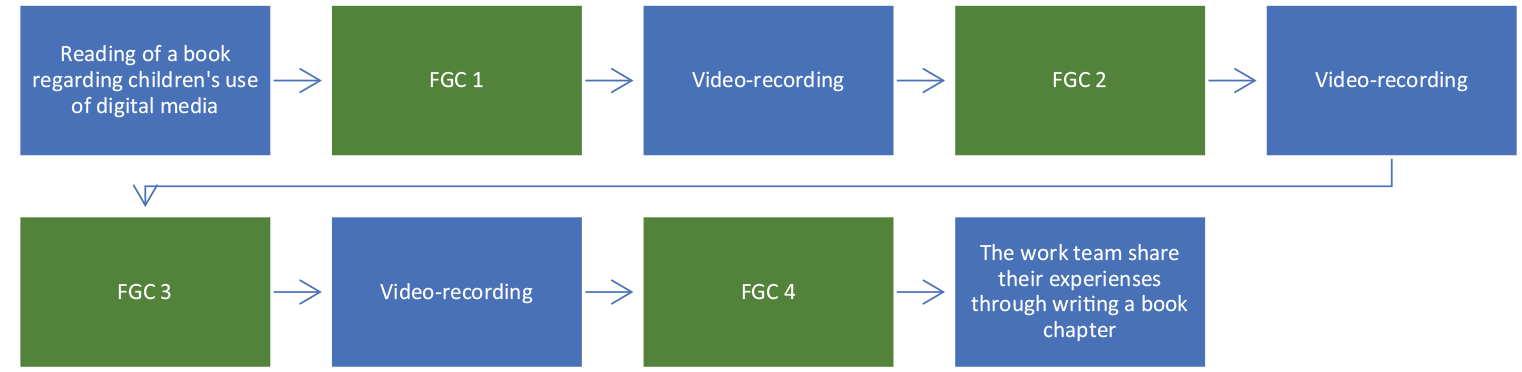
The design of the second period of data generating, conducted over a period of 3 months and resulting in four FGCs for analysis.
Prior to the first FGC, the work team read a chapter on digital play from a book about digital media in preschool (Nilsen, 2020). The three following FGCs were based on additional chapters from this book in addition to video-recorded sequences of two of the teachers participating in play with children while attempting to use different kinds of digital media. As mentioned before, the work team consisted of three teachers, however, only two of them expressed that they felt comfortable being video-recorded and it was therefore decided that only two of the teachers would participate in the video-recordings. The teachers video-recorded themselves, and the first author of this article then selected sequences (between 4 and 7 minutes long), which were watched and discussed in the FGCs. In other words, watching video-recorded sequences was used as an elicitation technique (c.f. Barton, 2015) to reflect on the topic of digital media in relation to play and teaching in preschool.
The study was conducted in accordance with the ethical guidelines developed by the Swedish Research Council (Vetenskapsrådet, 2017), meaning that informed consent was sought and received from both teachers and children’s caregivers. In addition, approval from the Swedish Ethical Review Authority was obtained (Dnr 2020-05720). Although informed consent was received from the caregivers of the children participating in the video-recordings, the preschool is a sensitive environment that requires an awareness from the researcher (Larsson et al., 2021). In this study, this meant that attention was paid to if the children expressed discomfort in relation to being video-recorded, in addition to visiting the preschool before the research project started in order for the children to get familiarized with the researcher and the video-camera.
Analysis
The four Zoom-recorded FGCs were transcribed in Swedish, as this is the language spoken by the participants. The chosen extracts were translated into English, with special attention given to context rather than the provision of a literal translation, as the latter would risk losing the meaning expressed by the participants. In relation to this, PRECEC is normally referred to as “lekresponsiv undervisning” in Swedish, which translates to “play-responsive teaching.” When transcribing the FGCs, the term “play-responsive teaching” was therefore used instead of the English version, “PRECEC.” The participants are represented with pseudonyms in the extracts. Furthermore, sociocultural discourse analysis (SCDA) was used as a tool to structure and analyze the empirical data, as it is theoretically informed by a sociocultural perspective on learning and communication due to its focus on analyzing the use of language for collective thinking (Johnson and Mercer, 2019). SCDA was considered fruitful to use as it provides clear areas for analysis, namely content, time, joint intellectual action, and impact (Johnson and Mercer, 2019).
The area of content concerns gathering evidence related to lexical content. A first coding of the content was carried out through a thorough reading and rereading of the transcribed FGCs, where it became apparent that the participants, in different manners, discussed what digital media are and how they can be used in preschool. This analytical approach to the data aligns with the combined research and development project as the researcher did not provide the participants with a definition of digital media but, instead, gave the work team itself the opportunity to define what digital media in preschool could be. This first coding of the data indicated that the participants referred to digital media in different ways. Most commonly, digital media were referred to as children’s experiences of popular culture (e.g. using a projector or tablet computer to watch TV programs), followed by the use of applications on a tablet computer (e.g. Memory or an application designed to play “café”) in addition to the use of imaginative technologies in play (e.g. pretending that a toy brick is a smart phone).
Moreover, the research question of the study concerned how PRECEC mediates the work team’s reasoning about play and teaching in conjunction with digital media in preschool. As responsivity is a central concept within PRECEC, a second coding was carried out through a word search for the word “response” [SWE:respons] in order to locate when the participants used the theory, hence when the mediating role of PRECEC might be visible. Based on this search, examples of extracts where the participants used the word “response” in relation to the use of digital media were selected for a more in-depth analysis. The selected extracts for this article are illustrative of the empirical data as a whole.
The second area (time) concerns how shared understanding is developed over time in social context, which, in this study, means that the focus of analysis was on how PRECEC mediated the work team’s reasoning about play, teaching and digital media in the four FGCs over a period of 3 months. The third area (joint intellectual action) relates to how participants acknowledge each other’s thinking and how this is used to coordinate a shared understanding. Within this area, we paid close attention to the mediating role of concepts from PRECEC—concepts that the participants were in the process of appropriating earlier in the project—and how these concepts were now used when discussing how to integrate digital media in preschool. An in-depth analysis within this area is presented in the Findings section. Regarding the fourth area, impact, which concerns “the effect that discourse has on the cognition and behavior of the participants” (Johnson and Mercer, 2019: 268), the analysis focused on how the process of mediation allowed for the participants, in interaction, to distance themselves from their work in practice, hence indicating how agency emerged. This area of analysis is elaborated upon in the Discussion and Conclusion section of the article.
Findings
The findings are presented, in line with the tradition of SCDA (e.g. Mercer, 2004), in the form of extracts supplemented with an observational commentary. The analysis of the following four extracts focused on the mediating role of PRECEC.
The following extract (Extract 1) shows how PRECEC mediates an understanding of play and teaching as a responsive activity. The discussion in the extract relates to an activity in which the teachers had projected the children’s TV program “Fireman Sam” on the wall after some children expressed an interest in it.
Play and teaching as a responsive activity.
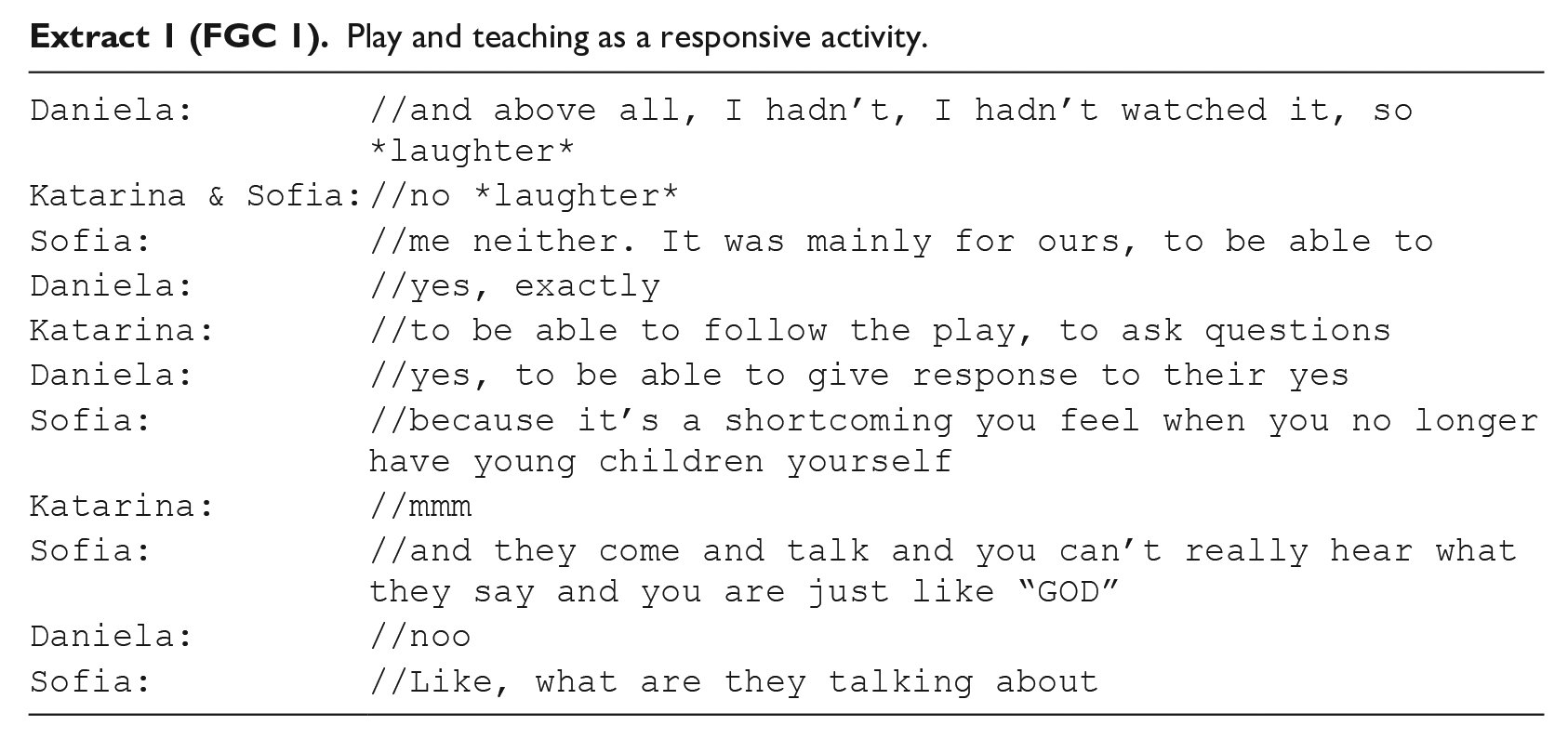
The extract starts with the teachers expressing that they have no experience of watching the children’s TV program “Fireman Sam.” Katarina connects this recognition to the idea of being able to follow the play and ask questions. Daniela then relates this reasoning to the notion of being able to be responsive to the children. This indicates that, for the participants, to be able to follow the content of an activity is regarded as a prerequisite for being part of the same narrative. This, in turn, is an overarching aspect of PRECEC, where a mutual activity demands a certain level of intersubjectivity. Sofia continues with the same line of argument when she expresses that it is sometimes difficult to understand what the children are talking about. The ongoing discussion in the extract about the importance of being part of the same narrative to be responsive suggests that, for the participants, it is, to a certain extent, important to have the same frame of reference as the children. When pointing to their own lack of experience of watching “Fireman Sam,” the teachers acknowledge that the children share a culture that the teachers are not part of. This, in turn, makes it impossible to follow the play activity, with the result, in this case, that digital media create a divide between children’s and adults’ culture, which, from the perspective of PRECEC (and the participants), is a challenge. The reasoning in this excerpt indicates that, for the participants, PRECEC mediate an understanding of play as an activity including both adult and children, where the adult needs to be responsive to, and therefore need to have insight into, the children’s (digital) experiences.
The following extract (Extract 2) shows how PRECEC mediate an understanding of play as an activity that fluctuates between “as if” and “as is,” where the teacher can contribute to different dimensions by using digital media as a resource in different ways.
The use of the concepts of “as if” and “as is” when discussing digital play activities.
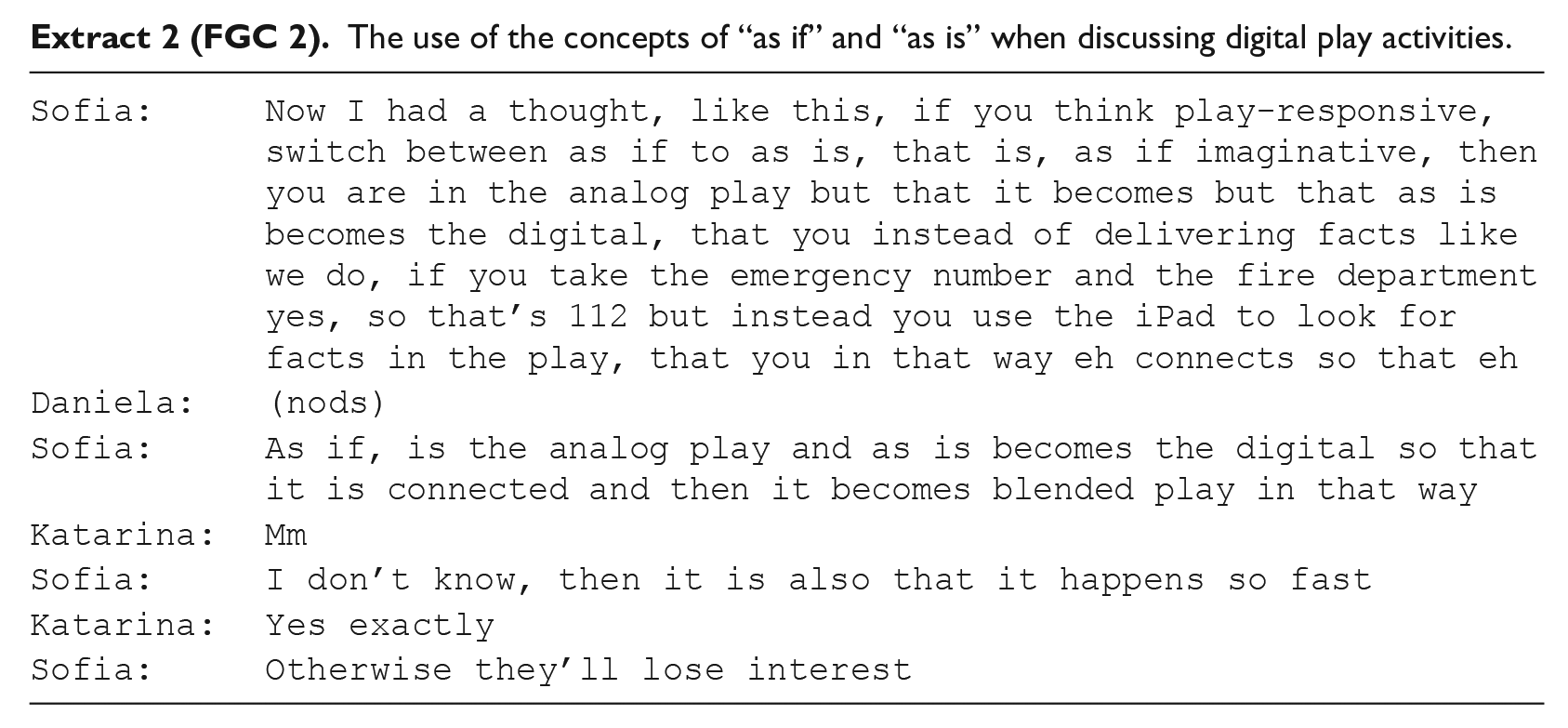
This extract starts with Sofia reasoning about digital play activities in relation to the concepts of “as if” and “as is.” She does so by using these concepts when trying to explain how digital media can be used and understood within a play activity. She suggests that “as if” can be understood as being part of an analog play activity including elements of fantasy, while the concept of “as is” can be related to digital play as it provides the opportunity to deliver facts by using a tablet computer. While the concept of response, as used by the participants, mediates an understanding of the importance of becoming a part of children’s play activities in order to teach (see Extract 1), Sofia’s use of the concepts of “as if” and “as is” suggests that, to her, they mediate a nuanced understanding of the teacher’s contribution to the activity. In other words, the teacher can contribute in different ways and in different dimensions, with what is considered as analog play being connected to “as if” and what is considered as digital being connected to “as is.” This reasoning is elaborated upon when Sofia relates it to the concept of “blended play,” a concept the participants read about in the literature (Nilsen, 2020) prior to the first FGC. The extract ends with Sofia pointing to the importance of acting quickly in a play activity, otherwise the children lose interest. While not visible in this extract, this comment could refer to the work team’s previous discussion on the importance of having a network and digital media that work, something that they expressed concerns about as this was not always the case at their workplace.
In the following extract (Extract 3), the participants use the concept of play-responsive teaching and intersubjectivity when reasoning about how play activities need to include elements of fantasy and where certain applications on the tablet computer are not in line with the perspective of play-responsive teaching since they steer the activity in a way that does not create possibilities for fantasy and togetherness.
Using the concepts of play-responsive teaching and intersubjectivity when reasoning about children’s digital experiences.
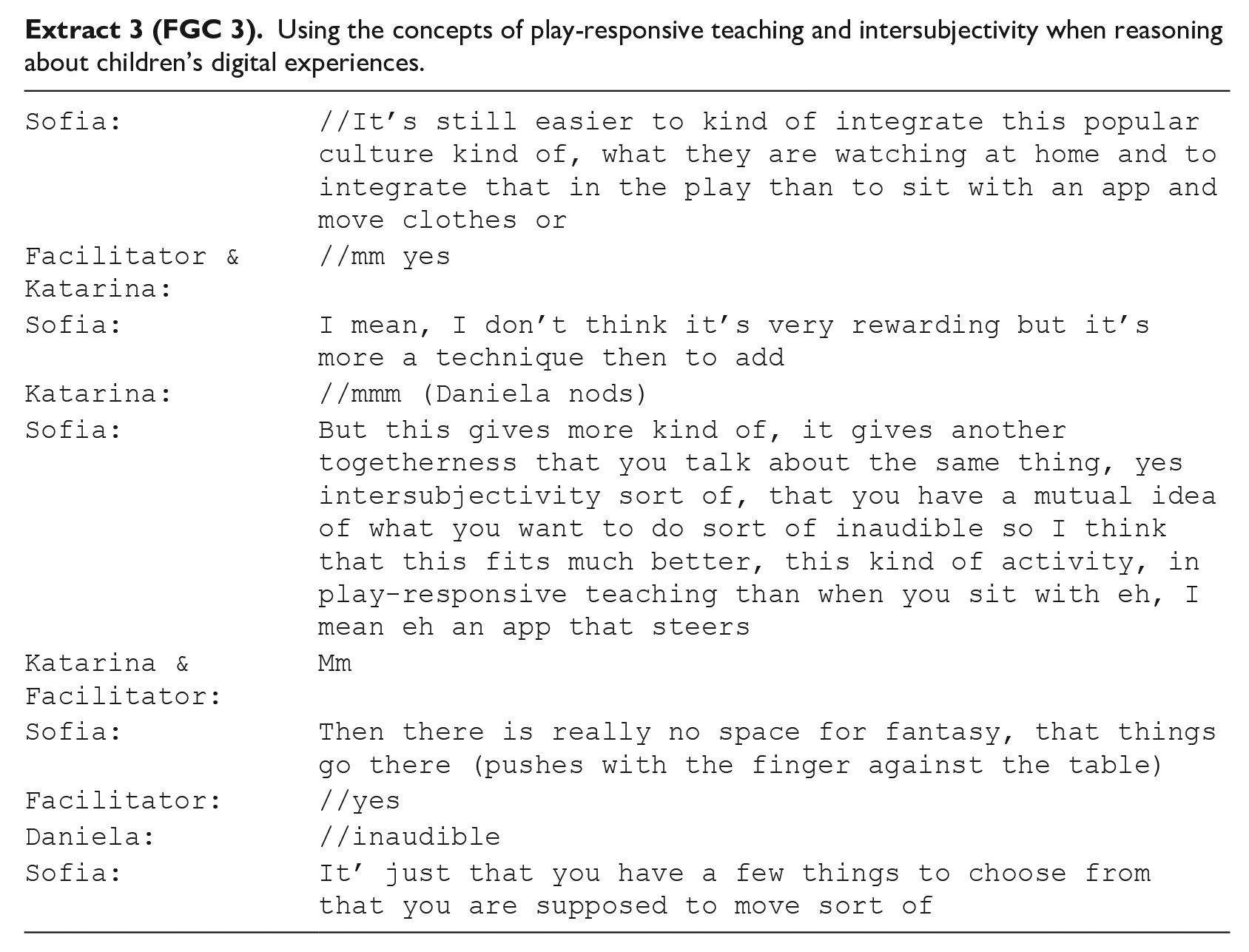
The extract begins with Sofia comparing the use of children’s experience of popular culture that they bring with them from their home environment and the use of applications in relation to digital play activities. She expresses that the notion of using popular culture in play is preferable to using an application, as the application is connected more to learning a technique, which is not regarded as a rewarding activity. When elaborating on this argument, Sofia uses the concepts of intersubjectivity and play-responsive teaching when reasoning about how using popular culture in play allows for the possibility of creating a sense of togetherness and a mutual idea of the activity, which is in line with the perspective of play-responsive teaching. She again compares this with using an application, which steers the activity too much, which, in turn, hinders the possibility of making room for fantasy. This view on different play activities with digital media implies that, to Sofia, when using the concept of intersubjectivity and play-responsive teaching, the concepts mediate an understanding of play that includes elements of fantasy, togetherness, and mutual activity. This suggests that with this understanding of play, the participants are able to analyze and reason about how to best integrate digital media in their professional practice.
The final extract (Extract 4) reveals how the participants’ understanding of teaching, means that, it is in mutual and responsive activity that teaching takes shape, through the teacher following the children’s interests, including children’s digital interests and experiences.
Teaching is formed in mutual activities.
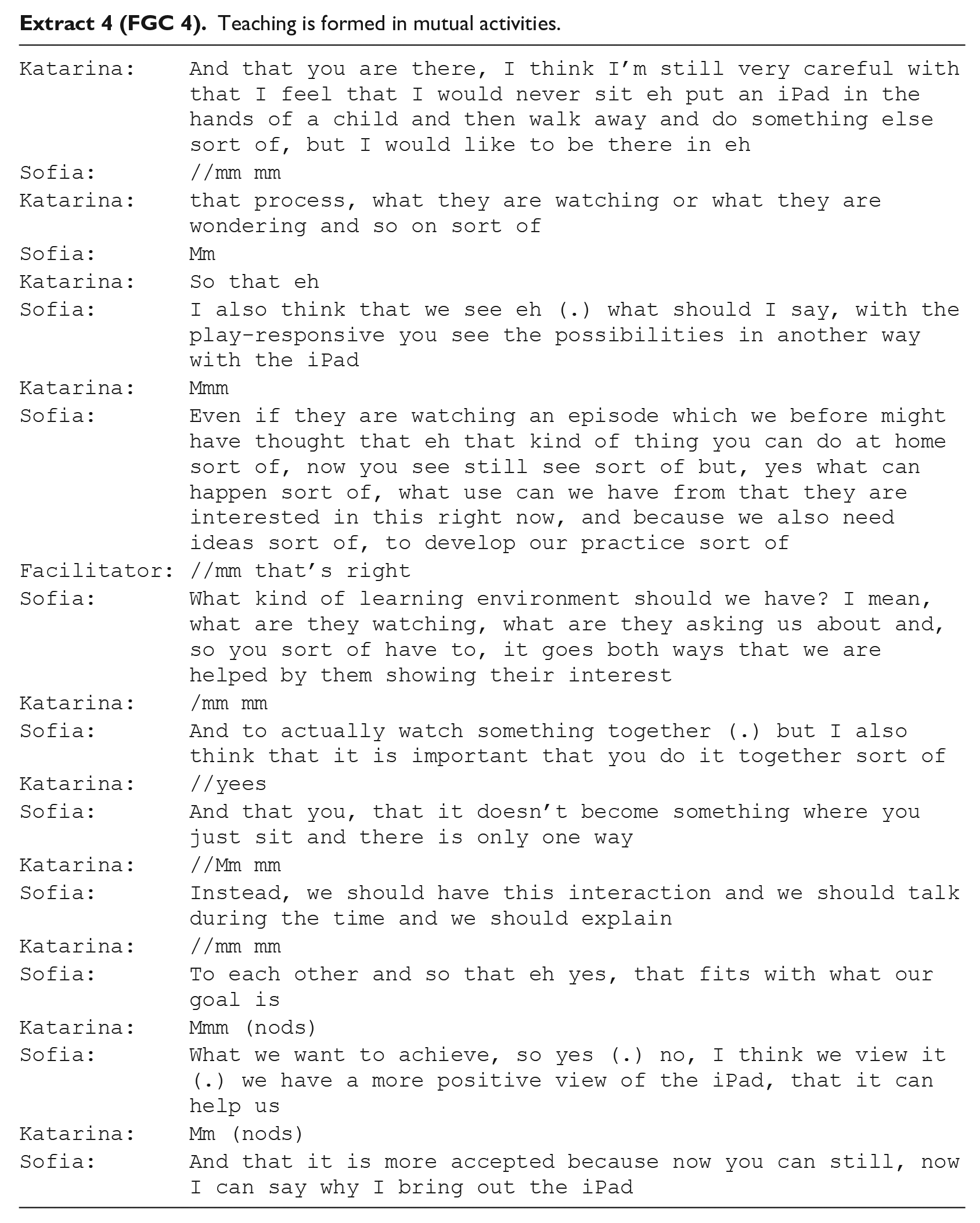
The extract begins with Katarina pointing to the importance of her being part of the children’s activity with a tablet computer to be able to follow the children’s interests and experiences, that is, what they are watching and what they are wondering about. This indicates that, to Katarina, it is in the mutual activity that teaching takes shape. Sofia confirms this line of reasoning when she expresses that “it is important that we do it together” and “we should have this interaction.” Sofia then expresses how “play-responsive teaching” has made it possible to see more opportunities of using the tablet computer than before. This comment suggests that her view of the use of digital media in preschool has become more positive (which she confirms when she states that “we have a more positive view of the iPad”). She then describes these possibilities in terms of how using children’s experiences of popular culture can help to develop their practice, a practice that includes elements of play and teaching.
This line of reasoning implies that, to the participants, when using concepts of PRECEC, these concepts mediate an understanding of arranging for teaching activities that are built on children’s interests and experiences and how these interests include popular culture and digital experiences. It also shows how the participants express an understanding of response as requiring something else than what is occurring in the current situation. That is, to be responsive also requires the teacher to make it possible for children’s experiences, both from outside and inside the preschool environment, to come together.
Discussion and conclusion
As early childhood teachers are faced with the contemporary challenge of implementing new curricular content in the form of integrating digital media in preschool, we have explored how concepts from the theoretical framework PRECEC, mediate an ECEC work team’s reasoning about such integration. Our analysis reveals that, for the participants, concepts from PRECEC mediate an understanding of:
(i) play and teaching as responsive activities that require communication and intersubjectivity, which is implied when they talk about the importance of sharing the same digital media references,
(ii) play and teaching activities as building on a mutual frame of reference, which is regarded by the participants as a challenge as children have different experiences of digital media than adults,
(iii) play as including fluctuations between “as if” and “as is” and something that must include fantasy and an openness, with digital media, to different degrees, contributing to or hindering such openness, and
(iv) how teaching can take shape in mutual activities where mutual experiences of digital media can be used as a starting point for teaching.
The findings illustrate how the process of mediation includes differentiating between children’s digital frame of references outside the play (e.g. popular culture), and the use of digital artifacts (e.g. applications on a tablet computer) inside the play. The challenge for teachers in this case is to be able to take part in children’s culture by taking advantage of the endless digital possibilities which can help to open up elements of fantasy in play, that is, the dimension of “as if.” This use of fantasy is, as discussed by the participants, in contrast to using applications on a tablet computer, as these seem to steer the play activity too much, resulting in no room for fantasy. At the same time, digital artifacts, such as a tablet computer, are discussed as enriching the play as they can be used a resource for finding information, that is, the dimension of “as is” (recognized knowledge). The challenge for the teachers becomes to create communicative activities regardless of the focus of dimension of the play activity.
The findings indicate that concepts from PRECEC have made it possible for the participants to distance themselves from the immediate (digital) activities in their practice, which, in sociocultural terms, can be described as how the mediating role of concepts allows agency to emerge. Our conclusion is therefore that the teachers’ understanding of play and teaching with and in conjunction with digital media, as mediated by concepts from PRECEC, promotes the teachers’ agency. This is particularly evident in the last extract where Sofia expressed that she can now say why she uses the tablet computer. This comment suggests that discussing concepts from PRECEC, in relation to play and teaching in conjunction with digital media in preschool has enabled a certain level of agency for the participants. To be able to exert agency in this manner becomes important in relation to research showing that one of the key issues related to technology use in schools overall, concerns how teacher agency is shaped by the tech industry in combination with education policy (Player-Koro et al., 2018). This indicates that early childhood teachers need to develop agency related to this issue in order to integrate digital media in ECEC in a manner that harmonizes with the traditions of preschool, where the notion of play is central.
Moreover, the findings of this study have implications for professional development efforts in ECEC, especially those related to the integration of digital media. These implications concern a focus on making it possible for teachers to appropriate necessary cultural tools, such as relevant concepts and/or theoretical frameworks. Our study shows how cultural tools in the form of theoretical concepts have a mediating role in terms of reasoning about the integration of digital media in ECEC. The key when planning for professional development is therefore to make it possible for teachers to, in dialogue, use appropriated concepts or theoretical frameworks when taking on challenges in their practice, such as the challenge of integrating digital media in preschool. Our study provides indications for how this approach to professional development creates possibilities for enhancing teacher agency in ECEC.
Footnotes
Funding
The author(s) disclosed receipt of the following financial support for the research, authorship, and/or publication of this article: This research is part of the Swedish National Research School on Play-Responsive Early Childhood Education and Care for Social and Cultural Sustainability (PRECEC_SCS), funded by the Swedish Research Council (grant no. 2019-03786).
