



Abstract
A documented transcript and a series of still images from two spontaneous, incidental and intra-active pedagogical encounters in a preschool are the focus and the source of this article. A turning over of data generated through a piece of doctoral research that explored intra-active learning as a phenomenon makes visible the agency of names and drawings in collaborative and intra-active literacy ‘becomings’. These are the workings of a diffractive data analysis. Already strong affective connections between the children give buoyancy to the playful recitation of written names on a pile of pages. Familiar Grade R (reception year) activities take flight and diffract with age, race and gender to produce new knowledge about ‘what matters’ in early childhood. There are both inward and outward flows between the micro and the macro worlds of ‘becoming reader’ and ‘becoming learner’ as names move in between the sounds of belonging and recognition (the children's and their classmates’ names), and the pull of identifiable shapes and letters, words and meaning. The importance of drawing as meaning-making is affirmed but exceeded as an experimental performativity spills over into further exploration that was shared and extended with a friend. The analysis moves between and among the conceptual, real and virtual through reflective and diffractive insights. The researcher notices patterns of sameness and difference in the playful literacy and drawing events performed by the children with their lively classroom environment. Reconceptualizing the material products of learning as lively co-producers of knowledge with their authors requires a reconceptualizing of the human and a refiguring of the child as learner. Making the ‘child’ visible in posthumanist research means recognizing the inseparability of the learner from the learning and the temporal, material and spatial realities that produce it, and noticing the lively entanglements of names and drawings and what they do.
Introduction
In this article, I revisit some familiar pedagogical artefacts commonly generated in reception year classes in South Africa in order to think differently about them and recognize how they can work as material-discursive and agentic and diffractive components of a learning ecology. This writing extends work done as part of a doctoral study (Giorza, 2018), for which ethical approval was obtained from the University of Cape Town and in which parents, teachers and children participated voluntarily. The research enacted a posthumanist-inspired a/r/tographical study into the ‘learning as worlding’ of a group of five-year-olds in a Johannesburg preschool. The images and transcript presented in this article have been previously published in the book Learning with Damaged Colonial Places: Posthumanist Pedagogies from a Joburg Preschool (Giorza, 2021) and are reused with the publisher's approval.
Ecologies of learning
Increasingly, research of this nature, in and with classrooms and preschool sites, raises a number of questions around what ‘participation’ means in terms of ownership and relational power, as well as the visibility of the ‘child’ and children-as-participants. Paying attention to critical macro-geopolitical concerns, posthumanist researchers risk undervaluing the smaller, everyday events that children are more directly a part of. This article proposes that the concept-making work that goes on in and through the pedagogical work of children in sites such as these is significant and merits closer attention. The concept-making happens through lively and unpredictable events that are impacted by a range of visible and invisible elements, including bodies, spaces, furniture, feelings, objects, energies and life experiences. In order to do justice to this rich and emergent reality, this research attempted to put ‘diffraction’ to work as a methodology, as suggested by both Haraway (1992, 1997) and Barad (2007, 2014), and discussed in depth, for example, by Bozalek and Zembylas (2017), Jackson and Mazzei (2012) and Mazzei (2014). This revisiting of the data performs a diffractive analysis. Names and drawings – two prominent non-human presences in the early childhood classroom space – are recognized and ‘centred’ in this article as important agentic participants in the collaborative making of meaning visible in the data – an emergent and collaborative ‘thinking-with’.
From a literacy-skills perspective, names have been recognized as the first words that children learn to read and write (Kirk and Clark, 2005), and through names children in the reception year can be introduced to all the key literacy aspects that they require at this crucial early learning stage. The strong affective connection that children have with their own names is well noted, and this is actively recruited. Children's own names can be used to help them to ‘understand functions of print, increasing their phonemic awareness, introducing lettersound correspondence (the alphabetic principle), and fostering letter and word recognition’ (Kirk and Clark, 2005: 140). But, significantly, Dyson noted in her 1984 study that children were much more sensitive to the social and relational meanings of their preschool literacy activities than their teachers, who tended to focus on narrow concerns of letter recognition. In my diffractive analysis of the first vignette, I pay attention to the more-than-linguistic aspects and ‘doings’ of names.
The long-established effects of the discourse of developmentalism in early childhood education and arts education limit teachers’ ability to see beyond age and ‘lack’ when responding to children and their interests (Dahlberg et al., 2013; Kennedy, 2006; Matthews, 1994 ; Murris, 2016). Teachers working from within this deeply embedded dominant discourse reduce children's daily drawings and expressions into ‘not yet’ competent and ‘not yet’ literate. Often, drawings are read in terms of strongly representational Piagetian notions of ‘schema’. In the second vignette presented here, for example, the emergent forms of mermaid and fairy risk being dismissed as passing ‘stages’ on the way to a better understanding of reality and a better command of language and description. Instead, I propose that speculative performance and figuration in pedagogical expression is a valuable and creative form of ‘thinking-with’.
Researching learning in classrooms, even when one attempts to move beyond anthropocentrism, inevitably raises questions about the qualities and types of thought, as in what counts as learning, when is it happening and how. In education, the critical practice of self-reflexive thinking has been increasingly dominant (Bozalek and Zembylas, 2017; Haraway, 1997; Lyons, 2010; Moxnes and Osgood, 2018; Murris and Bozalek, 2019; Pillow, 2003), although diverse in particular figurations of ‘reflection, reflexivity and critical reflection’ (Bozalek and Zembylas, 2017: 118). For Lyons (2010: 26), reflective inquiry ‘invites a consideration of how we know, how we learn and asks us to be attentive to our own awareness, to become conscious of ourselves as knowers’. Bozalek and Zembylas (2017) note that the term ‘critical reflection’ has wider social and political implications, recognizing entanglements and relations of power. Importantly, though, the theory and practice of reflective inquiry considers agency as an exclusively human capacity, which may be critiqued for adhering to a language-based and representational epistemology, using a reflection metaphor that suggests sameness (Barad, 2007; Haraway, 1992, 1997; Lenz Taguchi, 2010; Moxnes and Osgood, 2019; Murris and Bozalek, 2019), and for regarding our experiences as objects that we can distance ourselves from in order to understand (Massumi, 2015). Moving beyond a negative critique that may set up a new binary (Braidotti, 2013), a diffractive methodological approach moves between reflection and diffraction, language and sensation, and human-specific engagements, as well as materially agentic performance.
The differential and relational ontologies of Barad, Deleuze and, by implication, Derrida and Spinoza are central to the arguments I make here. Going beyond the binaries of subject and object, and recognizing difference and relationality rather than essence and identity as the foundation of reality, I can instantiate through my narrative Barad's (2003: 801) claim that ‘language has been granted too much power’. The assumptions embedded in linguistically framed epistemologies separate the human (and child) knower from the object of their knowing, enacting a Cartesian mind–body duality. Descartes assigned superior and exceptional status to the substance of the human mind over all else in the universe, which he considered mute, passive and subservient. This philosophical position aligned with humanist religious ideas and the Enlightenment and, apart from being implicated in the development of colonialism and global capitalism, supports the claim that language alone provides access to ‘outside’ reality and meaning-making possibilities (Braidotti, 2013). Noticing what goes on beyond and outside language is a politically important act in early years education. The monist (anti-dualist) onto-epistemologies of Barad and Deleuze recognize the mutual co-constitution of subject and object, and the human as part of nature, from which we have been segregated through Cartesian and other dualisms.
Barad's neologism ‘intra-action’ helps to clarify the monist ontology in terms of subject emergence and flexibility, and the related phenomenon of diffraction. The world is not made up of discrete and individually definable entities or objects. Rather, reality emerges in a forever-changing permutation of arrangements and relationships: diffraction is more than a metaphor. It is in and through these relations and mutually constituting meetings that phenomena occur – a ‘phenomenon’ being the smallest ‘ontological unit’ (Barad, 2007: 429n18). As opposed to an interaction, in which component parts of the encounter have separate identities that exist prior to the mixing, in an intra-action subjectivities are formed through it – in an agential cut (Barad, 2007: 175). Subject and object are entangled in a non-dualist mutually affecting agency, in which differences produce difference. An agential cut makes visible an in/separability of the co-constituting subject/object, nature/culture, theory/practice, material/discursive.
The behaviour of waves is, for Barad (2007, 2014), a helpful model for how diffraction works as a physical phenomenon. Waves are disturbances, not objects, and are not fixed in one location. Using the example of water waves, she describes the curving and spreading of waves as they pass through narrow spaces (like holes in a breakwater; Barad, 2007: 74). The multiple spreading patterns of waves overlap one another and combine to create an interference or overlapping, where the waves change in themselves (in intra-action) and create an interference pattern or ‘superposition’. The curving of light waves is shown to produce unexpected results, in which the shadow of an object shows ‘a pattern of alternating dark and light lines’ around its edge (Barad, 2007: 75). Light and dark are not separate and clearly bounded entities but, through diffraction, carry traces of each other within their formation. ‘Diffraction is not a set pattern, but rather an iterative (re)configuring of patterns of differentiating-entangling’ or a ‘cutting together-apart (one move)’ (Barad, 2014: 168). Barad draws on quantum physics for an example of such an entanglement: Bohr explains how it is possible for electrons to perform particle-ness under certain experimental circumstances and wave-ness under others. The key is understanding that identity is not essence, fixity or givenness, but a contingent iterative performativity, thereby reworking this alleged conflict into an understanding of difference not as an absolute boundary between object and subject, here and there, now and then, this and that, but rather as the effects of enacted cuts in a radical reworking of cause/effect. (Barad, 2014: 173–174)
An agential cut allows us to recognize the constituent parts of a phenomenon (with ourselves fully implicated).
In the available literature, diffraction as a methodology is performed in higher education empirical research by Jackson and Mazzei (2012) and St Pierre and Jackson (2014) and, in early years education research, by Davies (2014), Hultman and Lenz Taguchi (2010), Lenz Taguchi (2010) and Moxnes and Osgood (2018, 2019). Described as a post-qualitative methodology (St Pierre and Jackson, 2014), diffraction itself dwells in a place between method and no method, with St Pierre (2021: 5) arguing that ‘post qualitative inquiry is not a methodology’. In their move away from coding, Jackson and Mazzei (2012) follow Deleuze and Guattari in asking ‘which other machine the literary machine can be plugged into, must be plugged into in order to work’ (Deleuze and Guattari, cited in Mazzei, 2014: 743). The answer is a multitude of options of texts, data, ‘fragments, theory, selves, sensations, and so on’ (Mazzei, 2014: 743) for plugging ‘data into theory into data’ (Jackson and Mazzei, 2012: 13). ‘Plugging’ does have connotations of purposeful human-directed action, as in applying a pre-designed ‘method’, but a concept-led reading of data through theory and theory through data is important for opening up analysis beyond sameness and the already known. A diffractive analysis invites an emergent reading of texts through one another, and data through texts and vice versa (Murris and Bozalek, 2019). In doing this, one dwells in a threshold space: in between, ‘both/and’ (Jackson and Mazzei, 2012: 6). A diffractive analysis depends on ‘the art of noticing’ (Tsing, 2012) realities outside of the dominant discourses of schooling or, as Haraway (1997) would put it, a mutated modest witnessing – disrupting the dualist notion of the dispassionate scientist.
‘Thinking with the world’ is a concept, expressed in a range of permutations in posthumanist research, that attempts to undermine assumptions of language-dependent and psychologized internal mind workings in preference for more relation-based notions of thought (Barad, 2003, 2007, 2014; Bennett, 2010; De la Bellacasa, 2012; Haraway, 1997; Haraway and Goodeve, 2000; Rautio, 2013). These conceptions of thought relate to changes and differences wrought through experiencing or sensing anew. And the changes are not only in and by humans, but rather may have humans as part of the thinking, concept-making assemblage, placing humans as part of nature, not separate from it. ‘Being nature is to construe yourself as belonging to a universe that articulates through you and extends beyond you’ (Rautio, 2013: 455).
Posthumanist mathematics education researcher Elizabeth de Freitas notices an affiliation between the ‘cutting together-apart’ that is Barad's notion of diffraction and Deleuze's ‘baroque fold’, which ‘separates and divides but always keeps threads entangled and surfaces connected’ (Juelskjær et al., 2020: 77). They both draw their power from the connection between the real and the ‘virtual’ or indeterminate. ‘Possibility’, ‘chance’, ‘encounter’ and ‘happenstance’ are all words that help to configure a diffractive method and analysis. Diffraction depends on difference but, more importantly, on the differences that are produced in their intra-action. ‘A diffraction pattern does not map where differences appear, but rather maps where the effects of difference appear’ (Haraway, 1992: 300). De Freitas (Juelskjær et al., 2020: 82–83) makes generative use of the term ‘prosody’, which she describes as the ‘creative, material force’ of language: its musicality and rhythm, and all the other expressive features that would not be captured in a word-for-word transcript of a language event – the non-language elements of language.
A post-qualitative diffractive analysis invites me as a researcher to notice how language and the more-than-language elements work and intra-act in the data as ongoing and emergent. The article offers two vignettes from a larger research study. The first is a transcribed encounter between three children and a set of pedagogical and creative products. The second is an account of an art project initiated by one of the children in response to an event involving cut-out figures.
The gathering of data in the form of video clips, still images and transcribed verbal engagement is a method commonly used in classroom research across a range of paradigms. When considering what counts as data, ‘conventional humanist qualitative inquiry’ assumes that ‘data collected face-to-face from participants are of high quality and worthy of collection and analysis’, and that ‘those words exist as brute data independent of the interpretive desires of the data “collector”’ (St Pierre and Jackson, 2014: 716), thus reverting to a form of logical positivism . Very often, language-based analyses of data involve a process of ‘coding’ – identifying a set of themes that are relevant to the research question posed and emergent in the data. These codes are then tracked and assigned to the transcribed texts that generally constitute the data (from interviews or from in situ video material). Importantly, the data is treated as ‘complete’ and meaningful, independent of any theoretical or conceptual foundation. The intention of the analysis is to ascertain the already present meaning within the texts (Jackson and Mazzei, 2012; St Pierre and Jackson, 2014) – ‘to figure out what the subject really means’ (Bozalek and Zembylas, 2017: 116). Following a self-reflexive pattern of meaning-making, this kind of analysis ‘takes us back to what is known’ (Jackson and Mazzei, 2012: 12).
Conversely, if we accept that humans are part of the emergence and becoming of the world and do not take precedence over all else, we need to have a way of exploring thought, ideas and concepts also as intra-active parts of the world, rather than as the sole possession and exceptional intelligence of humans. For Barad, concepts are material enactments and derive their meaning from particular instantiations and relational intra-actions. In Barad's (2007: 416n2) words: ‘diffraction as a physical phenomenon and a methodology … engages with and helps me reformulate the notion of discursive analysis’. In the re-turning to the two pieces of data, I explore and practise a diffractive analysis, reaching beyond and behind the language and the direct representations of what they originally meant or essentially ‘are’. Importantly, the aim of De Freitas and Sinclair's (2014) Mathematics and the Body: Material Entanglements in the Classroom was ‘to trouble conventional research practices that were treating language as a system of recording’ (Juelskjær et al., 2020: 81). The act of knowing is dependent on diffractive transformations that are inherently active in the worlding of the world, producing difference. So, a diffractive analysis is less about what we do to the data (e.g. reflecting on it or tracking emergent codes) and more about reaching a sensory and conceptual awareness of what we are a part of and how. Intra-actions are the entanglements of co-constituting parts of reality in which space, matter and time are differently ‘in sync’ (Barad, 2007). To consider time as part of this agential mix is something strange, accustomed as we are to the idea of time as a fixed and unstoppable line of moments moving in one direction and unaffected by space or matter.
In a post-qualitative study, the idea is to keep the knowledge-making ‘analysis’ open and recursive. As a researcher, I can rework the data and include my presence and action both as a ‘collector’ and an ‘analyst’ in the ongoing production of new knowledge. The data is never ‘finished’, but performs in different ways as part of new phenomena of encounter and meaning-making with readers, analysts, writers and editors, data and theories, always in the ‘middle’ and at any time (Deleuze and Guattari, 1987: 293; St Pierre and Jackson, 2014: 717). This temporal openness is accompanied by a spatial openness as well. The classroom is not a closed and finite space (Murris, 2018). It is part of a complex and fluid system of structures (present, past and possible) and relationships that affect and are affected by the emergent pedagogical events and encounters that occur. I trace the boundary-making effects of the research methods and relationships as I go, and follow the flows of affect and desire that reverberate across bodies and space (Kuby et al., 2015).
A more complete transcription and discussion of this pedagogical event can be found elsewhere (Giorza, 2021). What follows is a selected excerpt.
Transcript story
Koketso, Bokamuso and Thulani are sorting through a pile of papers generated by their Grade R (reception) class (Figure 1). It is after the lunch break and the tables have been piled up. It will soon be time for the children to have their afternoon sleep. There is a gap in the daily routine that allows for the intra-action that follows. Koketso takes the lead and pages through the pile of papers, reading the names on the sheets and reading/describing/naming what is drawn or written there. ‘Apples, ice cream, ice, cookies, and … [reading a heart shape] I love you’. She reads a name, ‘Michelle’, then repeats it, adding a suffix of endearment: ‘Michellie!’ The rhythmic and melodic qualities of the naming put the reader-aloud Koketso in control of the timing and the mood of the activity – most commonly the place of the teacher. She sings the names of the familiar and favoured objects – apples, ice cream and cookies – conjuring other senses of taste and pleasure. The symbol of a heart is sung out as ‘I love you’. And a friend's name is first read for meaning and then again for affective connection.
The names written in the transcript record the verbal aspects of the event but do something else as well: the added ‘ie’ and the exclamation mark, for example, go beyond language to add the colour and texture of affect, which tells of friendship and appreciation for Michelle's uniqueness as a classmate. Prosody and affective flows are noticed and foregrounded as more-than-verbal expressions of meaning and shared thinking-with (Juelskjær et al., 2020: 82–83). In a space between language and non-language, new ideas are making themselves present and known. Thresholds operate in between and suggest movement (Jackson and Mazzei, 2012: 6). They are passages and processes that invite, beckon, open, close, squeeze and transform what passes through or what meets ‘other’ at this in-between place of becoming. Marks on pages lead to the sounding out of words and names as both a re-enactment of phonics instructional practice and a game of reciting friends’ names and names of objects. The binary of reader–non-reader is troubled by the intra-action between pages, pictures, voices, Koketso, Bokamuso and Thulani, being and becoming reader in an intra-active phenomenon that is this event. Pedagogical artefacts, spaces, relationships, feelings and positions of bodies, among other things, are important to the concept work happening in the classroom (much of this can be lost in transcription). Looking beyond language, a post-qualitative methodological stance will appreciate that the events that have been documented are not isolated and hermetically sealed moments. They are shot through with histories (yesterday, last week, last year, etc.) and are also impacted strongly by the pull of possible (virtual) futures (these are wannabe readers and soon-to-be Grade 1 learners). So, time is included as a lively and agential part of the encounter, as are space and matter. The individualized measurements that underpin contemporary formal education are disturbed by this kind of distributed agential subjectivity, in which ‘[t]he self is itself a multiplicity, a superposition of beings, becomings, here and there's, now and then's’ (Barad, 2014: 176).
Thulani continues with his job of wiping the tables but joins in the reading now and then. He drapes the cleaning cloth on his head to create long hair. He is enjoying this ‘dress-up’ game. He decides to show me his drawing of spring clothes. He pages through the pile of papers that Koketso is holding. Koketso allows this. They page through together. Eventually they find the one they are looking for (Figure 2).
The children's individuality and the difference in their unique responses to the artefacts change the sequencing and the pattern of the engagement. Thulani is less focused on the text and the ‘reading’ and more on the connection between his bodily sense of style (the cleaning-cloth ‘lappie’ wig) and the content of his drawings: dresses and shoes. Koketso's intended literacy event is interfered with. Like a crossing counter-wave, Thulani's desiring produces a superposition of difference.
Koketso establishes and holds her physical space as ‘would-be’ teacher. She is holding the sheaf of pages and sorting systematically through it. Their flatness and uniform size and shape allows them (invites them) to be piled and paged. Each name sounded out affirms the affective connection that exists between the children. Thulani points with his finger, modelling the perceptual skills often isolated for diagnosis in cognitive models of early learning: figure/ground differentiation, visual sequencing. Thulani has a self-conscious manner of doing this, with an introductory teacher question, ‘Can you draw a picture?’, in a sing-song voice, in an accurate imitation of so many teachers I have known. I recognize the ‘teacher’ tone and the body language. The affective eloquence of Thulani's expression goes beyond verbal language and beyond language as representation. The dominant practices of literacy instruction are also hauntingly present in these children's unofficial engagement with their pedagogical products (Figure 3).
Thulani takes the page out of the pile, leaving Koketso and Bokamuso to continue paging. He points to each item (Figure 4) and names them for me; ‘This is a skirt, this is a dress, this is also a dress … this is a quaiquai’– a colloquial onomatopoeic name for high heels that he acts out for me by walking on his toes.
Koketso finds Thulani's drawing of ‘People who help us’ and we then look at it together. The firefighters look like blonde Barbie dolls, but there is the requisite hosepipe in one of the figure's hands (Figure 5). Then Koketso finds Bokamuso's drawing. Bokamuso responds critically to the sight of his drawing of the ‘People who help us’. ‘Mine is ugly’ is a response that suggests a strongly affective relation to his own work and to the work of others, and a self-critical reflexive position, but also an awareness of the possibility of a better version, a virtual reality. They go on reading names together. ‘Ade’ comes up next. The following one also begins with ‘A’. ‘Aphiwe’, they say. I point to the name and read, ‘Arthur’. They recognize the name but they also know that Arthur's name is not used like this in the class. He is Emedi, or Meredi or Mercredi. They go through all these various possibilities, Bokamuso pronouncing a beautiful French Mercredi with guttural ‘r's. What is written is only part of the story. Emedi is a recent arrival from another country. His official name is written here, but the children know his other names. The names and the fluidity of them suggest change, movement, migration, newness, starting anew. Names are often multiple as they are not descriptions of essence but endearments, nicknames or special names used by certain people. As they go through the pages, I sound out the names they do not immediately recognize. I follow their lead and sound out the syllables. When Dorcas comes up again, Bokamuso builds on his previous chant: ‘Dorca, Dorca, Dorca, Dorcasss’. Our attention is held intensely by this ongoing litany of names and ‘praise song’ to spring.
Time as intensity (Kohan, 2015) is a concept that connects with the intensity of affect proposed by Spinoza (Deleuze, 1988: 49). It disrupts the strict chronological and developmental time that holds sway in dominant early childhood discourses, and which effectively dismisses the power and significance of emergent learning-with. For Kohan (2015), time as intensity is a child playing – the kind of time in which a sense of chronological time is lost This vignette does not document a planned pedagogical event or a classroom lesson. The ‘stolen’ time between two slots in the official daily programme catches the overflow of their ‘literacy desiring’ (Kuby et al., 2015: 398).
The next time Nhlanhla comes up, Bokamuso starts saying Naledi, but Koketso jumps in with the correct name. ‘Nhlanhla’, she reads. The ‘N’ speaks loudly and relates to a number of children in the class. The ‘N’ is shared and spread out, and collects children to itself. The ‘N’ belongs to both Nhlanhla and Naledi. The more functionally literate Koketso knows that this ‘N’ is only for one child now that it is attached to these other shapes.
Long recognized as important entry points for beginning readers, and as vehicles for early literacy learning, names in early literacy pedagogies have served as a figuration of the unknowing, incomplete child on a predictable trajectory of literacy skills development. The multiple, simultaneous and intra-active engagement by the three children with the drawings and names defies any individual measurement or comparison of skills. Names and drawings are reconfigured in posthumanist research as part of the material-discursive reality of our worlding with time, space and matter, with our human and more-than-human relations and companions.
What a name can do
In the transcript, the action and rhythmic encounters between the insides, outsides, limits and energies of children, names, images, papers and sounds create new patterns of difference. Names in particular invite the children into relational language games and operate as thresholds to literacy becomings.
In my study, children engaged in playful and personally significant activities centred on the work produced by themselves and their peers. An awareness of names, sounds and letters was integrated with an awareness of each individual child's product, their interests, style and way of working. Relationality is an important part of the game: loving and learning are affective entanglements. ‘I love you, Auntie Theresa’.
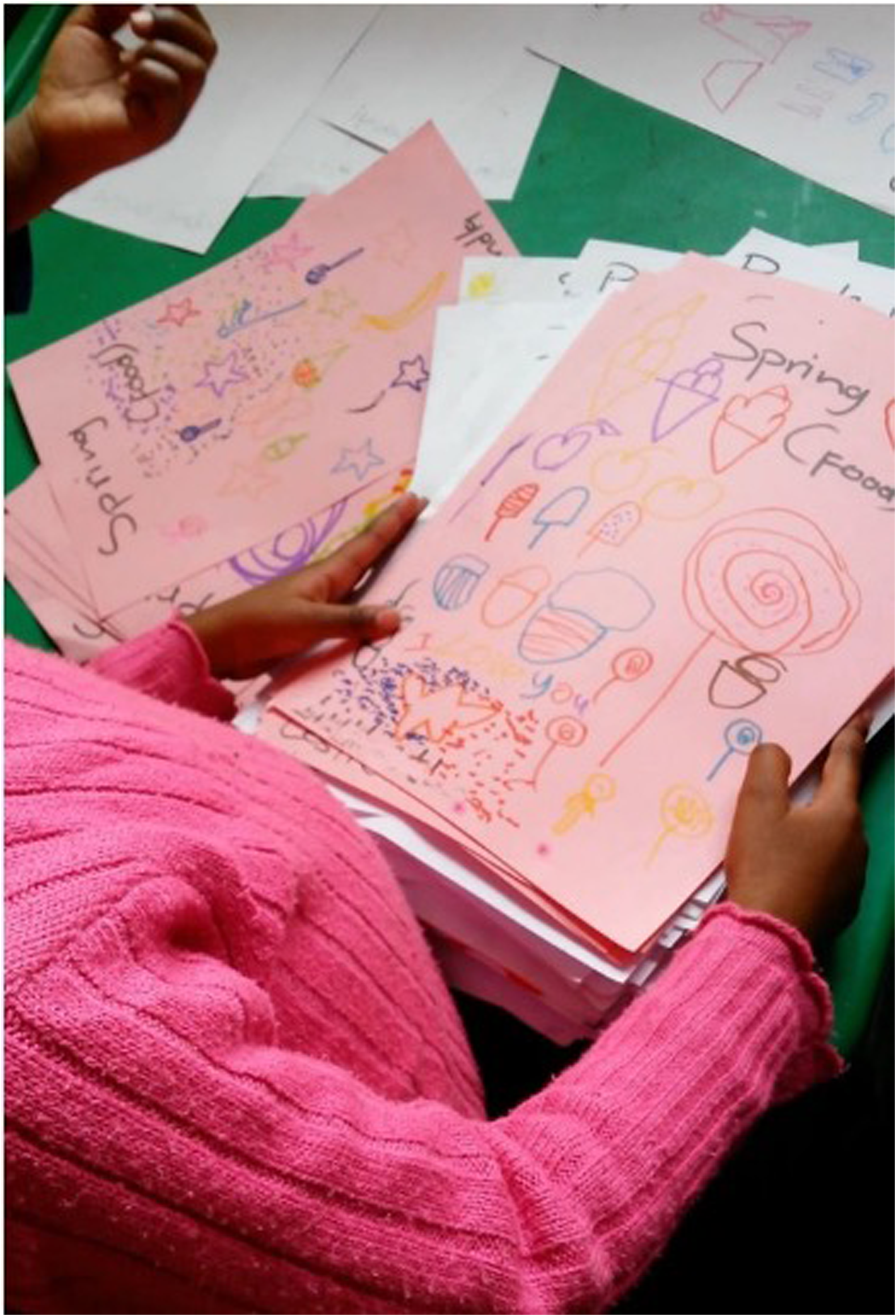
Three children sort through a pile of their peers’ work.
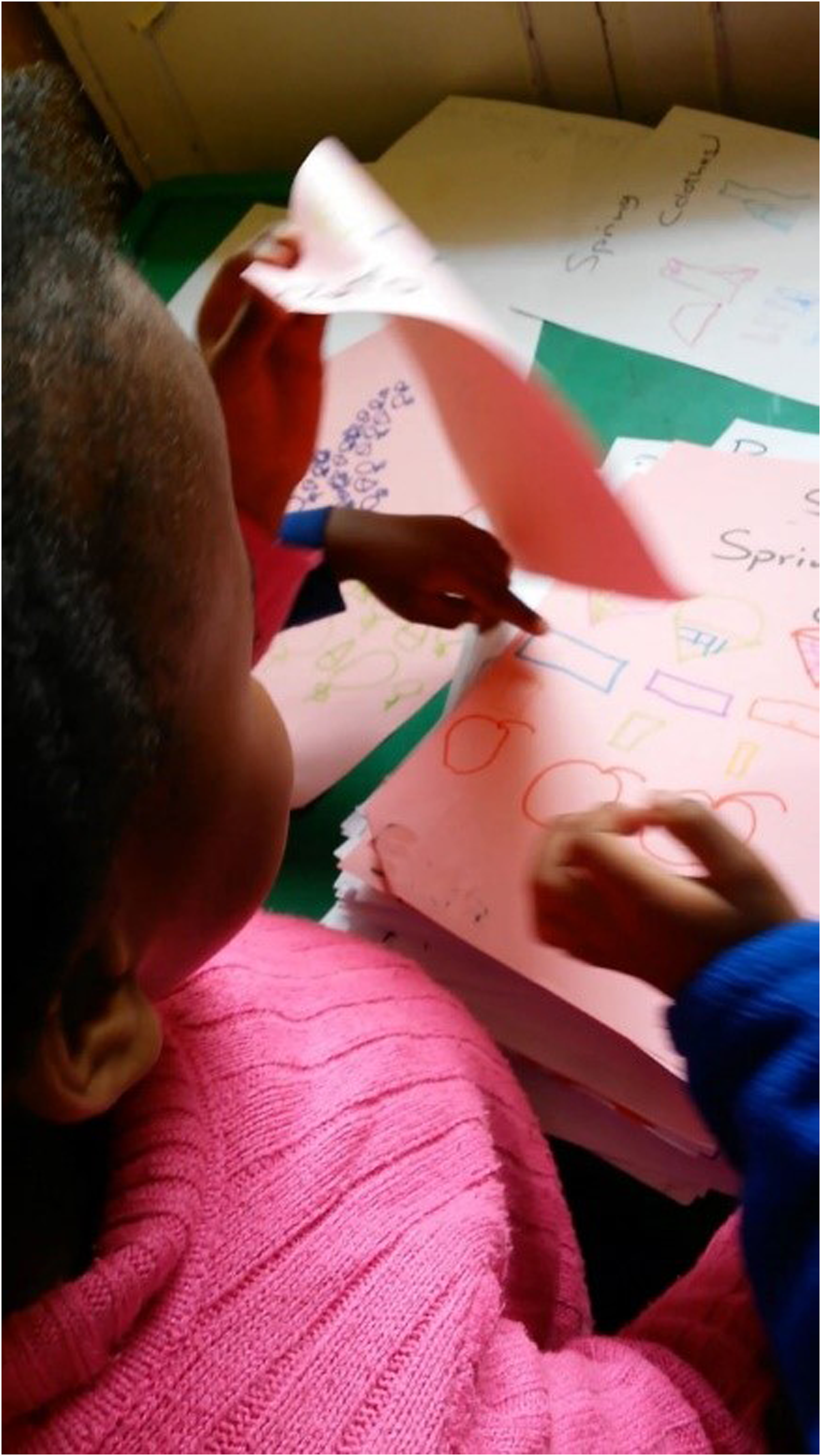
Thulani dips in and out of the sorting game.
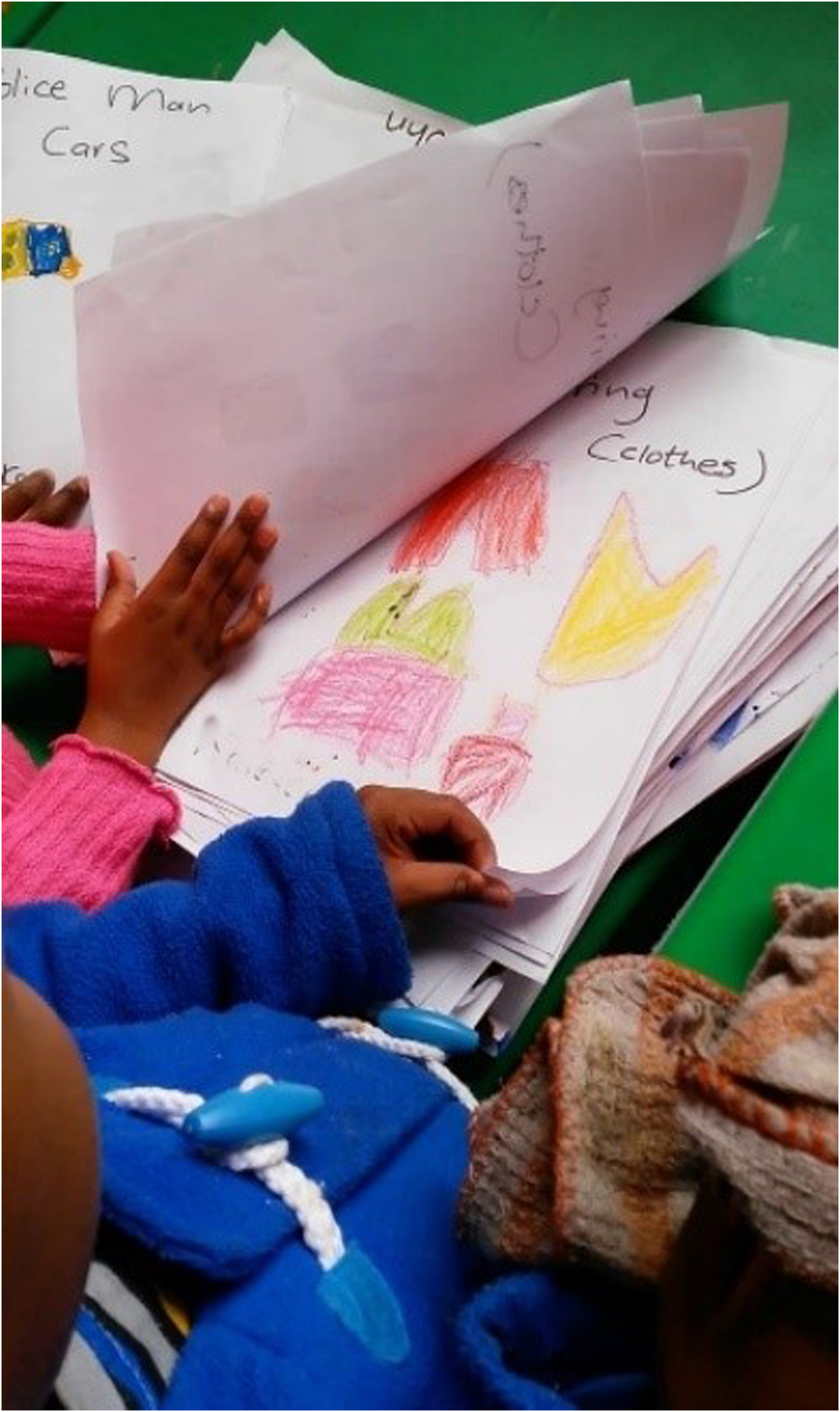
This is Thulani's page.
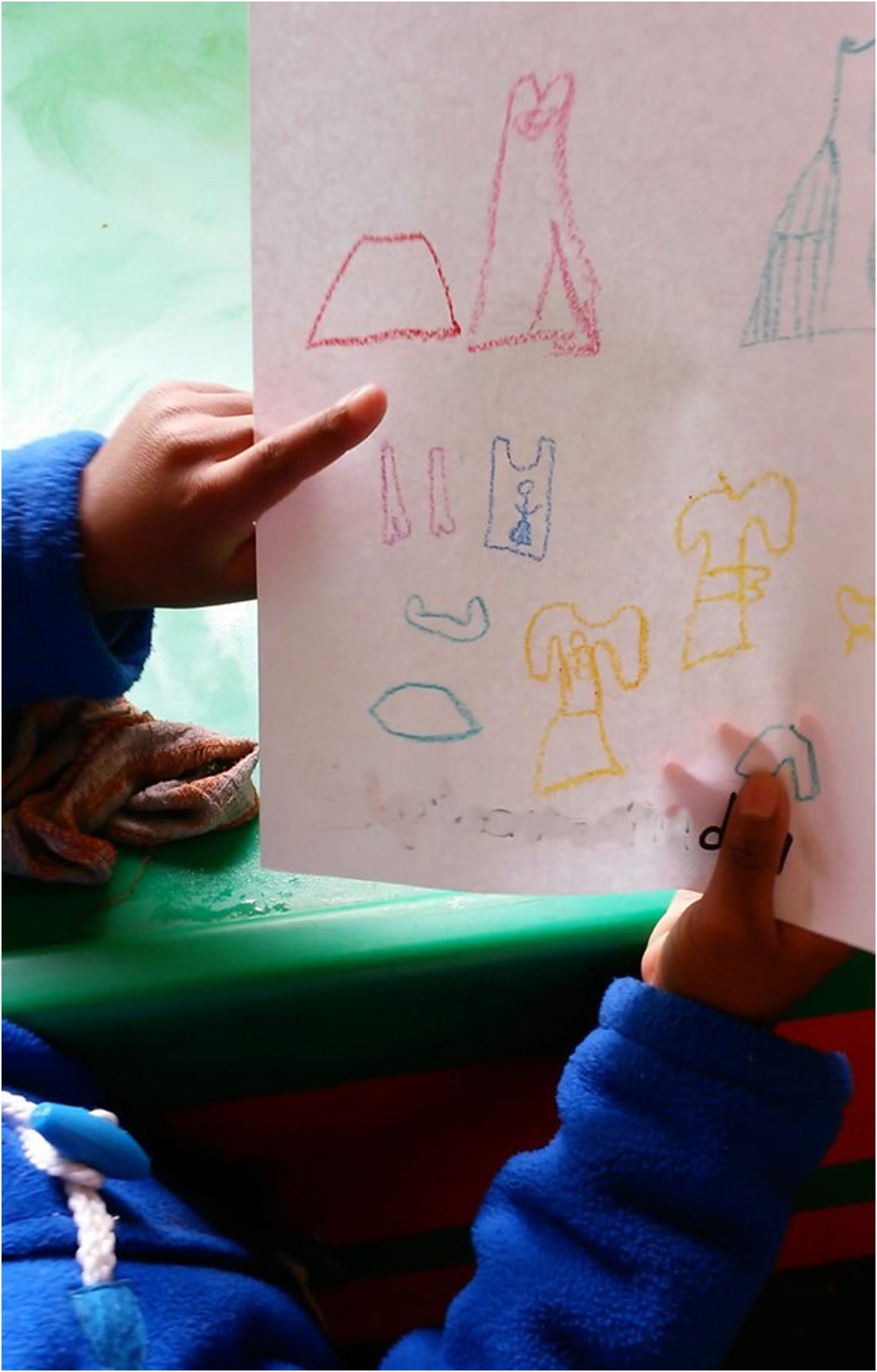
Spring clothes.
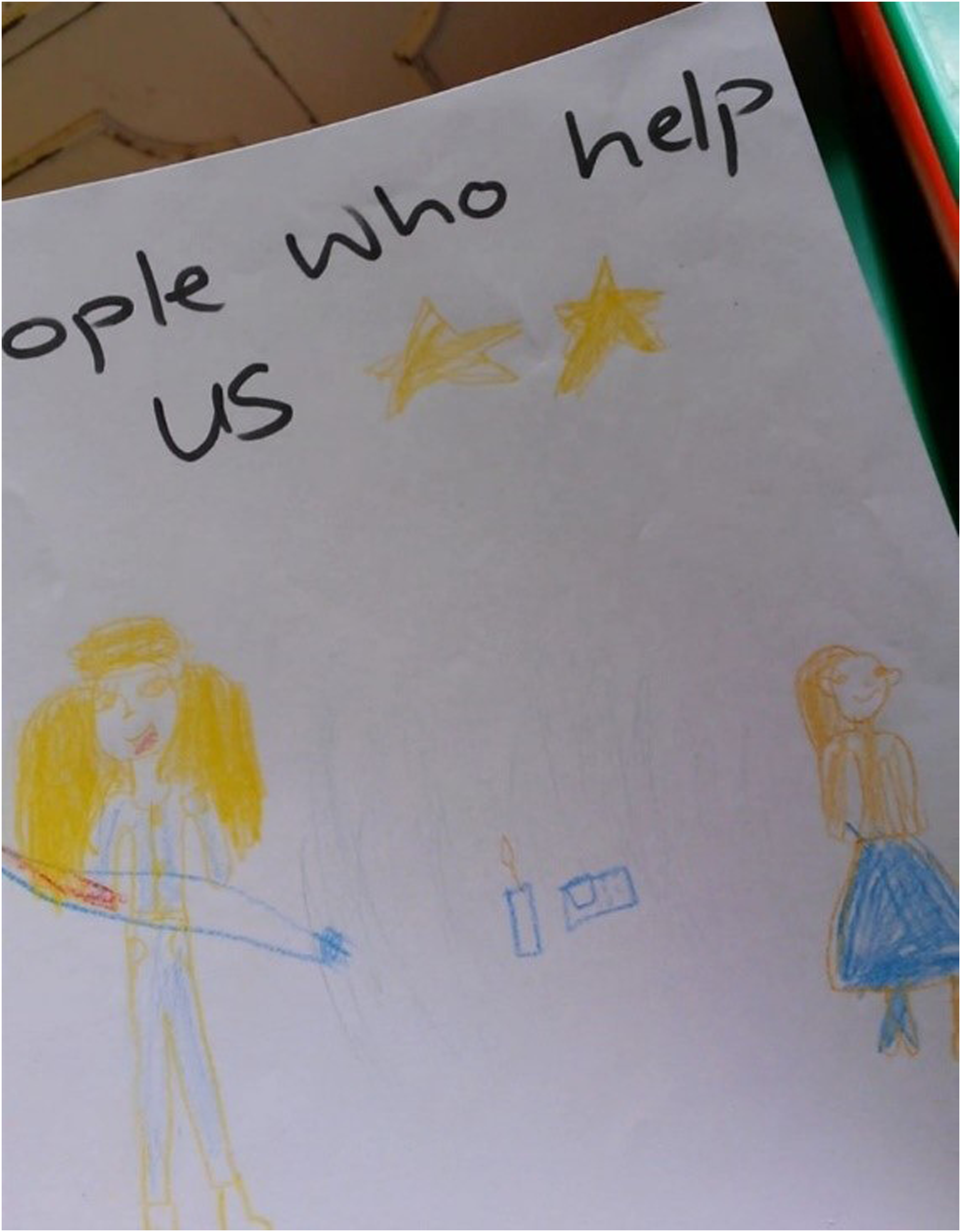
The firefighter is holding a hosepipe.
‘I love you, Bokamuso’, I reply.
‘But Auntie Theresa, do you know my other names?’
This conversation between myself and Bokamuso was an unexpected intra-action on a Grade R library visit. The conversation got me thinking about how unaware I was about the working of names, but it also made me notice (differently) this particular child and our one-on-one connection. Out of interest, I researched his name and its origins. I also found out that his parents’ names originated in different South African language groups.
However, names and nouns do more than fix the identity or essence of an object or a person in the world. The children voiced their friends’ names in musical ways, expressing their connection as members of a group. I recognize names as both connectors and markers of individuality in ways that go beyond the functional and technicist concerns of a skills-based approach to literacy learning. A name can be recognized as a word just like other words in a language, made up of letters and sounds. Like other words, names can have specific ‘linguistic’ meanings and also collect discursive associations and heritages as they get used and reused, and passed on from generation to generation. Nxumalo (2019) writes that her siSwati clan names also connect her to particular places where her ancestors are buried, through whom ongoing human–geographical relations are expressed. For many South Africans, the uprootings that occurred through forced removals from the mid 1950s to the 1980s have permanently severed this connection, and many of these names have only spectral connections with lost lands. These urban children's names hold in their differences the varied histories of their families. Emedi carries his ‘foreign’ name into the Johannesburg context. It has links to a faraway place that perhaps his friends will ask him about once he learns some English. These workings of names suggest an entanglement of discourse and material, meaning and reality, knowledge and affect.
Names actively perform in the world. Names, like concepts, work as material-discursive agents in the world. A name becomes something meaningful only in relation and in particular arrangements of performativity. Names, in their myriad ‘doings’, are central to the life of a preschooler. There are names on charts and names on bags and shoes; there are names on fee payments and names in games and rounds; there are names on drawings. A name works as a threshold between our separateness as bodies in the world and an invitation to more intimate connections.
Being other-wise
Thulani, featured in the vignette above, extended his exploration of mermaids and female figuration through the production of a multitude of cut-out people, referring to some of them as ‘fairy teachers’. I was acquainted with Thulani's immediate family, which comprises his grandmother, with whom he lived at the time, his mother and his mother's two sisters. His teachers were also female. The cut-out figures he made were all insistently female and other-than-human (mermaids and fairies). Joyful and intense, his visual narratives defy the gender-normative discourse present in the preschool curriculum and explore difference and multiplicity through playful material enactments. As Osgood et al. (2015: 349) note, if we can begin ‘to “figure” gender as multiplicities of vibrant matter, emotions, encounters, relationships and happenings that are uncertain, shifting and contingent’, we will be able to shift the way that gender is figured in early childhood.
The impulse for the production of the cut-outs seems to have been sparked for Thulani by an experience of shadow. An overhead projector brought into the preschool led to the creation of cut-outs for projection onto the ceiling (Figure 6). Thulani's cardboard cut-out fairy (Figure 7) asserted a remarkable ‘realness’ – provoking my own sense of wonder at the fact that a two-dimensional cut-out and a fully formed three-dimensional form can cast the same shadow. The shadow of the fairy held traces of both the flat drawing and the speculative possibility of a ‘real’ fairy. Derrida's ‘trace’, Barad's ‘cutting together-apart’ and Deleuze's ‘baroque fold’ are all summoned by the queer non-presence of the becoming self of Thulani's fantastical figuration.
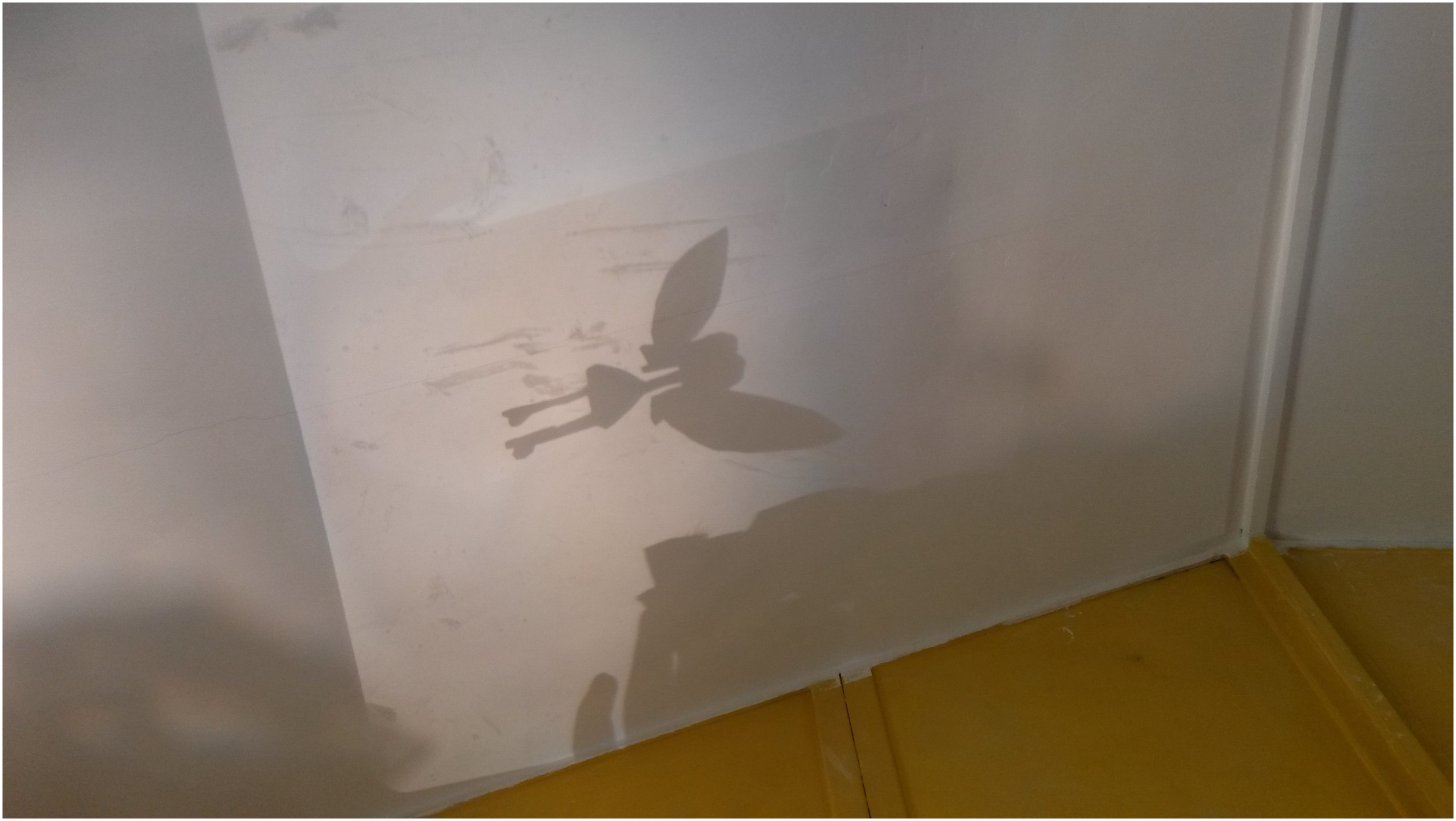
A trace of possibility.
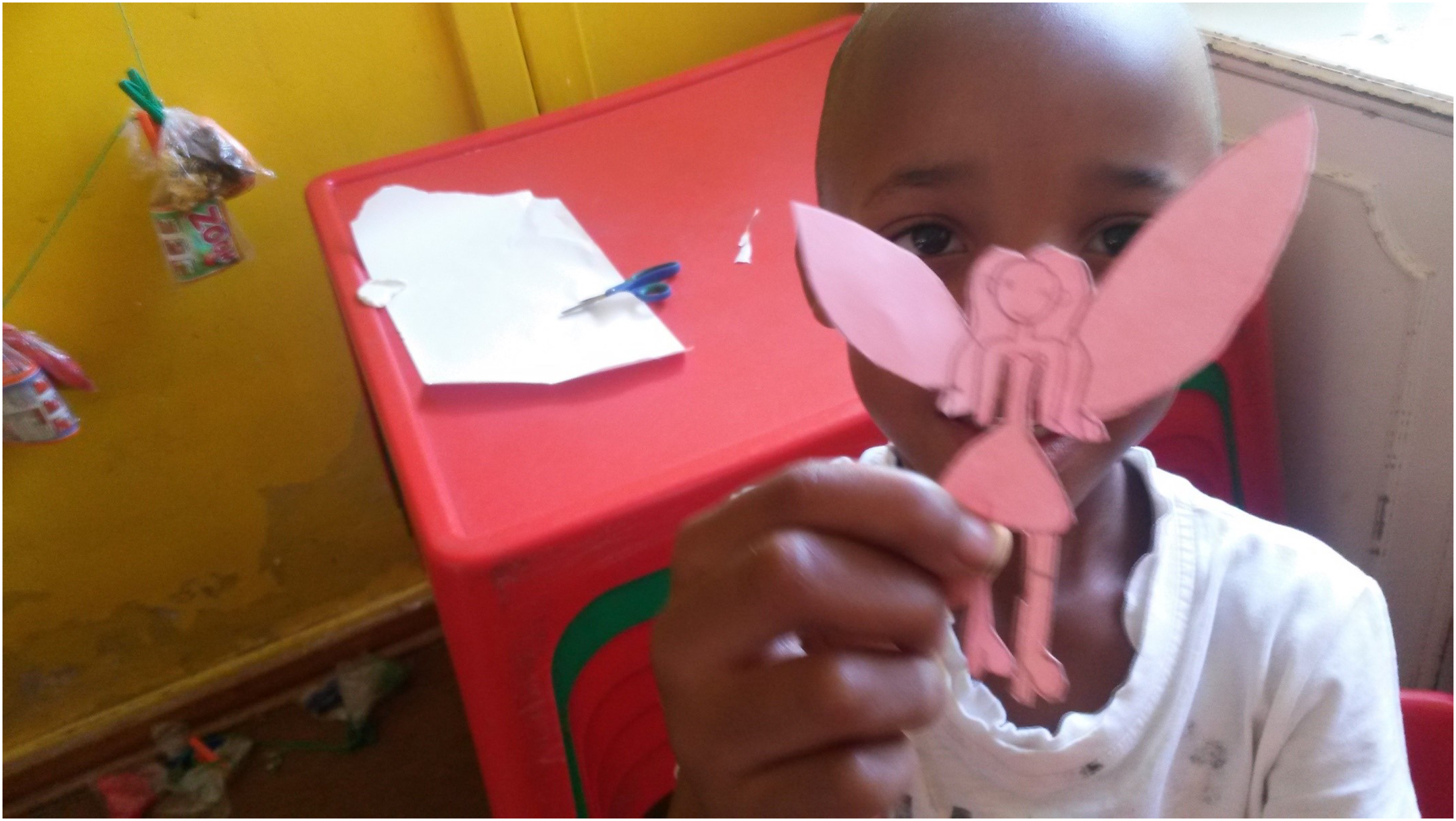
Trace and presence.
In Figure 8, Thulani's company of ‘people’ troubles the normative figurations of ‘self’ for a boy of five. Interestingly, in a much later conversation I had with Thulani about his people-making art form, he considered the possibility of making a boy. Looking across the two vignettes, Thulani's blonde firefighter, his mermaid and his cut-outs, his cleaning-cloth wig and his high-heel feet are all part of a remarkable repertoire of creative speculation. A mermaid construction (made from a branch of a bottlebrush tree found in the park) was a further expression of this exploration (Figure 9). Thulani's repertoire of mermaids and related gender-significant and more-than-human characters cannot be given adequate significance if defined as ‘schema’ – temporary holding patterns to be replaced by better, and more accurate and precise, representations of reality as he learns language and becomes literate.
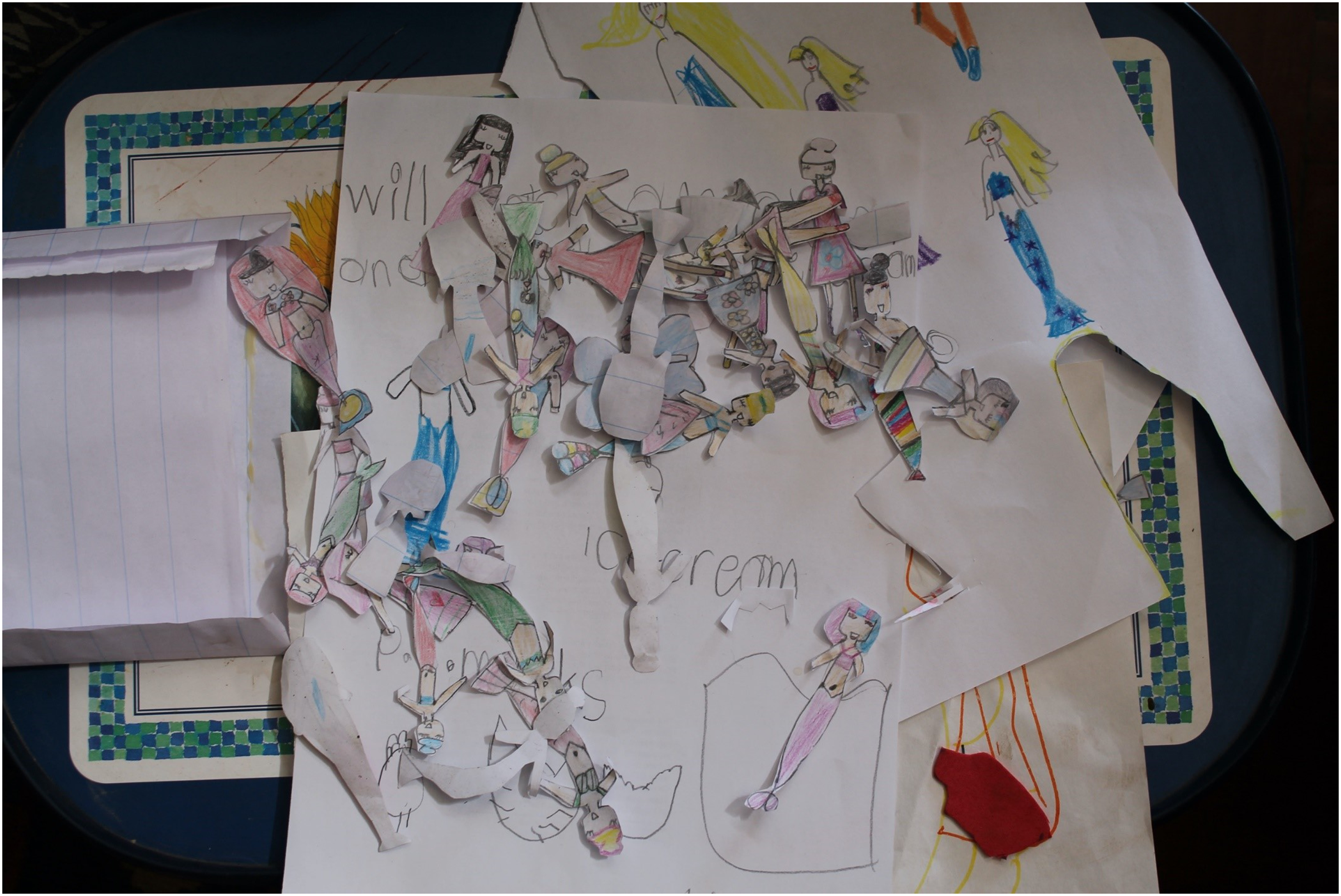
Multiplicity and difference.
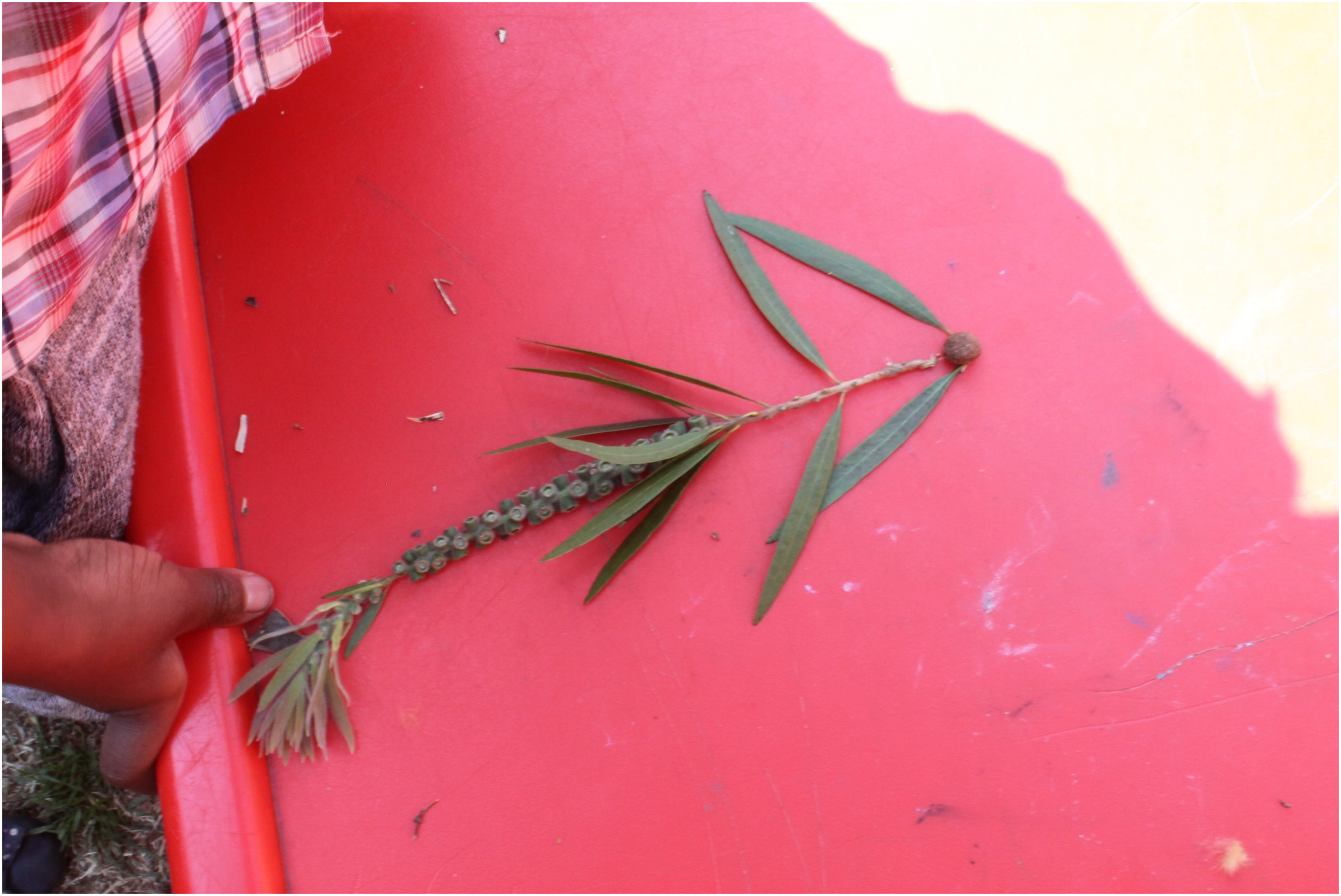
Bottlebrush mermaid.
The real and the virtual are waves that intra-sect and produce difference (superpositions). Through the drawing and gender-conscious figurations produced, I witness an intense and entangled posthumanist ‘metacognition’ – a philosophical act of concept-making.
Post-developmental and new materialist experiments and theorizings of art and art in early childhood invite us to consider the lively agency of materials and the materiality of our own liveliness – and how they meet and co-constitute the messy and often surprising encounters that occur in early learning spaces (Osgood and Sakr, 2019; Pacini-Ketchabaw et al., 2017). The human–nature dichotomy is not the only bifurcation in Cartesian and Enlightenment thought that is being blown away. Thulani's experiments with making and imagining disrupt sedimented boundaries between binaries of gender, species and reality/fantasy, enacting a queer and other worlding-with (Osgood, 2014; Osgood et al, 2015 ; Taylor and Blaise, 2014). Thus, the reconfiguring of art in early childhood is important propositional work towards a refiguring of learning as ‘worlding-with’ that does not leave the political and ethical unnoticed.
In accordance with the official curriculum, the daily products of the children's learning endeavours are collected and filed as ‘evidence’. They record the progress of drawn ‘body images’, the writing of names, their ability to colour in the lines and cut along the line. In the research site, these pages were plentiful, and heaps of drawings soon piled up. To deal with the overwhelming demands of filing each child's work, the teacher marshalled the children's assistance with the task, providing an opportunity for them to revisit and reconsider the work they had already accomplished and engage in collaborative comparisons and sharing – effectively ‘flipping the classroom’. The power of control is shared and fluid.
The documentations presented in this article are a small selection of performative encounters of being and becoming in place, time and mattering, be/coming together with human and nonhuman companions in intimate and intense intra-activity. The transcript included above is a performance of human and non-human elements in intra-action, creating anew the lived and experienced concept of ‘reading’. Children, hands, bodies, names, pages, drawings and ideas together enact a literate becoming in an in-between space and time outside of the planned programme. Similarly, the images of Thulani's mermaids and fairy people are vibrant traces of intensity, made visible and available to be revisited and reconsidered in their materiality and worlding.
Worlds worlding
The notion of ‘cognition’ is essentially Cartesian and assumes a knowing subject who is capable of separating from the object of his or her knowledge in order to gain an ‘objective’ and rational view that can be proven or described accurately and repeated for purposes of proof. ‘Metacognition’ is a term that, in itself, suggests that it has its roots in cognitive science, which follows a developmentalist and neurologically based approach to learning. Schön (1987) introduces the term ‘knowing in doing’, referring to mindful action as opposed to reflection after the event. His description of potters and other practitioners in close relation to their materials prefigures the notion of the agency of material, although he places agency solely in the realm of the human, consistent with a phenomenological approach (Lyons, 2010). The idea of metacognition as ‘thinking about thinking’ has been useful as it suggests a turning point or disruption to the ordinary thinking that is so often assumed to reside inside a human's head and to be a process of thinking directly ‘about’ the world (Haynes, 2008; Murris, 2008). The term ‘metacognition’ needs revisiting and returning to – ‘turning the soil over and over’ as earthworms do (Barad, 2014: 168) – to include the affective and intra-active more-than-human aspects of thinking, being and becoming. These aspects include the agencies of space and time, as well as matter. A non-subjective notion of knowing-with, and becoming-knower, requires a sense of the intra-active agency of human and non-human, organic and inorganic entanglements of the world coming to know itself through its ‘worlding’ (Barad, 2007: 392).
The spontaneous, incidental and intra-active engagements shown in the transcript and the images above point to the importance of timespacematter affordances in preschool contexts, and make clear the value of documentation for creating increased opportunities for children and adults to revisit these generative encounters. If adults enact the role of creating opportunities for child-led intra-active pedagogical encounters, this kind of engagement can be supported. Beyond being child/children-initiated, there needs to be an ongoing openness to the multispecies, multi-object timespacemattering realities at play. The battle is always against the ordering force of the official curriculum and the daily programme. Teachers can take the risk of relinquishing power over the administration of the products of learning (files, portfolios, displays, documentations) and support an ongoing use of daily artefacts of learning (children's responses, drawings, constructions) in follow-up activities and processes, sharing these also with other family members in collaboration and conversation, and disrupting the school–home binary.
The material products of learning can be reconceptualized through these practices. They can be seen as more than the evidence of individual learning (as in forms of assessment of past, completed activities) and also as artefacts currently and always still active in the learning processes (preserved if necessary through digital documentation). These artefacts can be revisited, as documentation to use and reuse, allowing them to affect us in an ongoing way, documenting and having agential impact on our learning. There are both inward and outward movements between the micro and the macro of becoming reader, becoming learner, with names performing at a threshold between the sounds of belonging and recognition (our personal names) and the world of letters, words and meaning.
We need to emancipate learning from the notion of teaching and, by extension, from that of language and instruction. Currently, the two concepts are bound to one another by our curricular terminology. We can uncouple them by creating times (breaks, pauses, transitions) and spaces (inside and outside spaces, piazzas, verandas, courtyards) that have affordances for small-group collaborations and unmediated intra-actions with the chaos and surprise of direct experience, and also with the potent but largely untapped richness of the fresh products of our own pedagogies. In cases when these intra-actions are witnessed and shared, as in the case of the transcribed narrative, they enter the shared life of the community. But importantly, all learning is not witnessed, not articulated and not shared. Relinquishing the mantle of the all-knowing, all-seeing pedagogue, in control and command of the learning that happens for the children in one's care, must be a significant step in becoming a posthumanist pedagogue.
Thulani is present in the research and the writing of it but is also invisible in a sense. His actual name has been held from the reader for the sake of compliance with an ethical protocol set up by a committee that is beholden to quasi-medical concerns about harm and abuse. Changes are possible in a reconfiguring of research as art-making, in which the co-researchers and artists can be celebrated and affirmed without imagined fears of victimization or cybercrime. My co-participants’ creativity and imagination has enabled me to explore and re-present the way that names perform in their material presence and how drawings allow for the navigation of alternative figurations of self, humanness and gender.
These pedagogical events are framed as Baradian ‘phenomena’ – contingent and entangled instances of becoming. The ontological shift that posthumanism makes – and, according to Kuby (2017), is needed in order to do justice to the more-than-human realities at play – opens up possibilities for more reciprocal and ethically response-able pedagogies and research.
Footnotes
Declaration of conflicting interests
The author declared no potential conflicts of interest with respect to the research, authorship and/or publication of this article.
Funding
The original research for this article was funded by the South African National Research Foundation.