




Abstract
Despite nearly three decades of the use of new technologies in education, schools seem to have remained impervious to significant change. Heritage curriculum and traditional pedagogies persist and, indeed, are dominant in school contexts, which seem to be embedded in the past, rather than preparing children for their future lives. Pockets of innovation illustrate that transformation is possible and comes with the added benefits of renewed student enthusiasm and engagement in learning. Yet, systemic changes are limited in a global context that is dominated by high stakes testing and the neo-liberal agenda. This article explores the potential for change. Focusing on the early years, which are the foundation of schooling, we report on data from a study using iPads for learning with kindergarten children in Australia (4 and 5 years of age). The data support the contention that new technologies offer the possibility for new learning by enabling young children to embark on investigations and explorations that were not possible in previous eras. In this article, we focus on transformations and explore the potential of the iPads to encourage playful explorations for investigating, reflecting, making meaning, knowledge building, and communicating ideas to a shared audience.
Introduction
New learning (Kalantzis and Cope, 2012) set the agenda for a different way of thinking about the role of education in the 21st century. It recognized that changes in technologies, commerce, and culture have reshaped our lives and that as such, schooling should have changed as well to reflect this shift. New Learning incorporates new technologies that have enabled learners to work collaboratively and engage in knowledge building, rather than be required to demonstrate how much information they can hold in their heads and regurgitate at any given summative assessment point. New learning and new technologies assist learners to shift their focus from the routine and rote learning of the past, so that they can to engage in generating new ideas and sharing them with others in collaborative work spaces that are beyond physical contexts.
In the early years of schooling, new technologies have afforded the opportunity to reconceptualize play (Yelland, 1999, 2011). New learning is multimodal and characterized by investigations and explorations that encourage knowledge building in dynamic ways. Yelland (2011) described “playful explorations” as being
… initiated by the child(ren) or the teacher and can be extended in multiple or specifically planned directions. They incorporate the use of new technologies. They are structured yet flexible. In many instances they can be linked to specified learning outcomes while in others they might make a contribution to more global aims for learning, like fostering creative thinking by enabling the children to generate diverse solutions or make suggestions for success. They extend beyond the preschool years into the early years of schooling. (p. 6)
There are pedagogical challenges for early childhood educators in this rethinking of traditional play. Early childhood teachers have historically avoided planning ahead for specific learning outcomes and let play remain unstructured and disconnected to mandated curriculum objectives. Encouraging playful explorations involves the early childhood teacher in designing learning environments and adopting new play-based pedagogies that scaffold young children’s learning. As Yelland (2011) suggested,
Rethinking play as playful explorations in which experimentations and meaning making is scaffolded and extended by a teacher has the potential to provide a much richer learning environment for young children. Further, the use of new technologies and the opportunities they create for meaning making, extending communications and interactions are vital to such explorations. (p. 10)
New technologies have also facilitated multimodal learning in the 21st century. Multimodal experiences are linguistic, spatial, visual, gestural, aural, and tactile activities. Multimodal texts can incorporate these components to different degrees that are based on decisions about how best to communicate an idea. We all experience such texts in our daily lives via the Internet and Web 2.0. In these spaces, children are able to create multimodal texts with ease on new devices such as the iPad and the associated available Apps that are available for them.
Children can have a variety of experiences, both in the “real” world and using new technologies. When these worlds come together, deeper and more complex understandings are made possible if teachers scaffold children to make connections between the modalities and suggest ways in which each can support their learning. Multimodal environments can support playful explorations, investigations, and encourage young learners to build representations and form new understandings in different dimensions. They are also able to articulate and communicate their ideas and discoveries using new technologies. Traditionally, (three dimensional) play has been viewed as laying the foundation for later abstract or symbolic thought. Research on multimodal learning (e.g. Kress, 2003; Pahl and Rowsell, 2006; Yelland et al., 2008) provides new insights into the sophisticated ways in which children are able to link modalities, and how they achieve this simultaneously in contexts that involve the use of new technologies. If this is established in the preschool years, then learning in primary school can extend this work and open up new possibilities for new learning.
This is recognized, for example, in the UK Statutory Framework for the Early Years (Department for Children, Schools and Families (DCSF), 2008). The document advocates that children should be encouraged to engage in experiences that enable them to “[e]xplore(s) different media and responds to a variety of sensory experiences. Engages in representational play” (p. 47). Kress (2003) has also noted that we need to understand the ways in which young children make meanings in a variety of contexts as they play, as a basis for supporting their literacy development that is fundamental to the early years of schooling.
The use of new technologies is an integral part of becoming multiliterate in the 21st century (New London Group, 1996). Children can use devices such as the iPad in playful explorations which enable them to create multimodal texts to represent and communicate their ideas and understandings. They are able to play with ideas and extend them with their real world experiences and materials. These are opportunities for new learning that will engage them with multiple modalities and require the teacher to transform their pedagogies to encourage optimal learning.
Using tablets in kindergarten contexts
We introduced iPads to 4-year-olds in a kindergarten group setting. The kindergarten was located in a suburban region approximately 15 km from the center of a large metropolitan city. It had a large outdoor area that facilitated the fluid movement of the children from indoor to outdoor activity. There were two groups of children each with a teacher in charge who worked with a teacher aide. The teachers were experienced as early childhood educators who had taught for over a decade and each was supported with a teacher aide. There were 49 children attending in the two groups. Each group had one tablet available to them throughout the week and additionally a pre-service teacher brought another iPad which could be used by the children, on her weekly visit to the center.
The kindergarten offered a play-based program in which the children were able to select an activity from a range of materials that were available, both inside and out in the play area. Inside, this included painting materials, a carpet and book area, a puppet theater, and a large range of craft materials and plastic items. Outside there was a sand pit, water play, space to run, and various forms of climbing frames. There were two groups of children with a total of 49 (25 and 24) attending. The average age of the children was 4 years and 9 months. Each group was taught by an experienced early childhood educator (over 7 years teaching). The tablets were available on a table which was one of many located in the center. The children were used to selecting an activity and completing it on a table. The project also involved four pre-service teachers enrolled in the third year of their 4-year early childhood teacher education program.
This was a 3-year project and the data reported here are from the second year. This project used participant observation as the methodology. Participant observation is a research method in which, “the researcher is taking part, to some degree, in the activities of the people being observed” (Deacon et al., 1999: 251). We wanted to gain access and insight to reveal the everyday learning and teaching occurrences, which cannot be captured vicariously in group discussion or interview (Mikos cited in Struppert, 2011). Through participation in the learning environment, we felt as researchers that we could gain greater insights into the practices, roles, and cultural patterns of the participants (Mikos cited in Struppert, 2011).
Our study reflected a sociocultural view of learning (Vygotsky, 1978) in which children learn on a social plane before internalizing any new information. The approach resonates with early childhood child-centered pedagogies as well as linking to the notion of social futures inherent to pedagogies of multiliteracies (New London Group, 1996) and multimodality (Kress and Jewitt, 2003). In this way, the teachers were keen to move away from using the basic and popular skills based Apps, to more creative uses of the tablets that afforded contexts for open-ended explorations and for communication of ideas and reflections. Thus, while a range of Apps were still available for the children to use during this phase of the project, we were more enthusiastic about trying a guided learning approach (Plowman et al., 2010) in which there was a structured, yet flexible, support for children’s learning with the new technology. In particular, we focused on the following:
Exploring and reflecting,
Searching for information for investigations,
Creating eBooks.
In this article, we explore the potential of the iPads to encourage playful explorations in each of these areas (Figure 1).
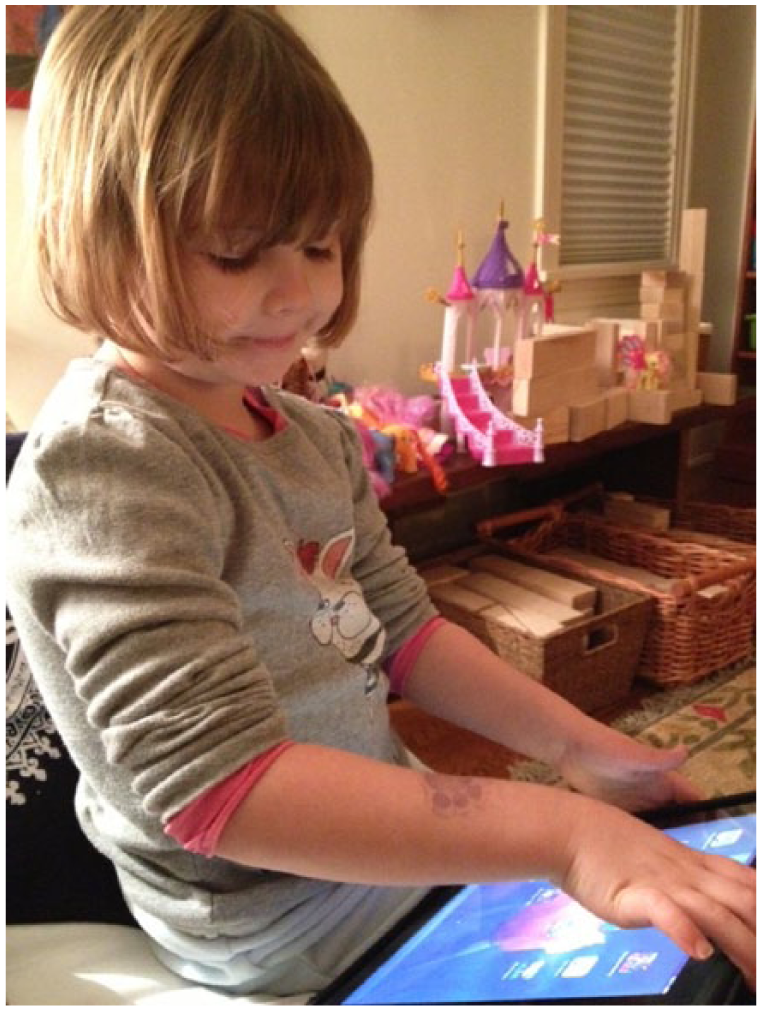
Playing with iPad.
Exploring and reflecting
In exploring sounds around us, we introduced an App called MadPad to the children. This App enables a montage of pictures and sounds to be created, shared, and replayed. One of the things that we found to be useful when introducing a new idea to young children was to show them an example, so that they were able to either use it as a model to produce their own version, or innovate on it because they can see some relevance of it to their experiences and interests. In this instance, MadPad enables users to view and play with other users of MadPad creations on the Internet and share on YouTube. In one, a series of 12 photos and sounds of a car are arranged in a 4 × 3 matrix, and in others, there are various scenes and sounds from daily lives as well as others using a range of musical instruments. The idea is that the clips are “short and snappy” and can be played individually, but it is the range of sequencing and innovating on the sounds that makes it more fun and lifts its creative potential so that each time it is a different experience.
The MadPad sets that were created engaged the children in thinking about the sounds in their environment. They realized that they could make their own sounds (clicking fingers, clapping, moving their tongue to make clicking noises) and that they could also use the various objects in the center (e.g. sieves, cups, saucepans, pieces of equipment) to create sounds. With this App, the video can be taken by the teacher or the children. Some minimal planning is needed, since the area has to be relatively quiet for an effective recording to be achieved, and the children need to know how to make the sound, and how long they need to maintain it for the recording.
The children were immediately fascinated by the actions and what they had to do. Jenna’s observations about the students in the process of creating their MadPad montage reveal their enthusiasm:
Allan said, “What about this sound?” And began clicking his tongue. Brandon followed with, “What about this?” And clapped his hands. We were walking around the playground searching for sounds we could hear. Allan said, “I know!” And ran to the swings. He stood on the swing and said, “look at his sound!” (a loud squeaking sound came from the swing). Brandon ran to a large circular decoration that was in the garden. He began tapping on the decoration with his hands. He said, “we can use this sound!” We then went to the sandpit to find new sounds. Allan picked up two pots and began said, “Look at this one!” And began banging the two pots together. Brandon continued to explore sounds by tapping on different objects that he could find (tapping a helmet, a bucket, a wooden plank and a metal box). (Observation notes, June)
The experiences with MadPad could be extended in a variety of ways to include other scenarios with the children providing statements about themselves and what they enjoy, telling stories, and using musical experiences with instruments and songs. Being able to combine the modalities of oral, aural, and images, represented a good opportunity to make and reflect on the sounds in our environment, and the sounds that we listen to in a variety of formats. They can form the basis for different learning activities—some of which we extended in the preparatory class findings later in the report.
In another example of being able to use the iPad for reflection on events as they happen occurred in the interactions between two children and a mother with new baby who were seated on the sofa in the center:
Chelsea and Gemma (kindergarten students) were sitting with Gemma’s mum (Jacqui) and 9-week-old Flynn on the sofa this morning. Jacqui was staying on at the kindergarten after bringing Gemma to preschool so she could spend some time with her and the new baby, and they were chatting about things as Chelsea joined them on the sofa. Chelsea had been playing with a game on the iPad and moved in to sit next to Jacqui, while Gemma was on the other side. She used the iPad to take a photo of the mother and baby and showed it to them. “That’s a great photo of us all … Thanks Chelsea” ! said Jacqui. Gemma then decided to get some paper and crayons and started to draw a picture of Flynn. Not in his mother’s arms but as if it was a portrait. She gives the drawing to her mum when finished. “That’s lovely Gemma! You really made it look like Flynn with the same colour of his eyes and his onesie!” Chelsea added, “It’s a good drawing! He looks like my photo!” (Observation notes, 18 June)
This reflection shows the potential to extend these representations of the baby in different modalities, and it formed the basis of later conversations when making eBooks, about whether to incorporate photos or drawings into the storyline, or indeed, whether to combine them in the illustrations. The learning context with iPads gave the learners this choice. They could combine the different formats or leave them separate. They could control what they wanted to put into their books. This would not have been possible without the tablets, and it was evident that they enjoyed making the books by the amount of time they spent reading them afterwards.
In another scenario, Chelsea collaborated with another child (Tilly) in creating a guessing game with the photos that they had taken on the iPad. They took close up and “partial” photos of objects and clothing that they could find in the center. They then went around asking their friends if they could guess what the object in the photo was. This was an extension of a game that Nicky, their teacher, had set up in the kindergarten with laminated (partial) photos of items in the playground, such as the gate or the climbing frame, which were located in various spots around the playground. We asked the children to talk about the ways in which the partial view compared to the view of the whole object in conversation time. The camera on the iPad enabled a number of activities that would not have been possible if it was not available, to use spontaneously.
In a different scenario, Nicky (teacher) got out some large sheets of paper to measure how tall some of the children were. She wrote about this in her observations:
Today we measured how long/tall everyone one was in the group. The children lay down on a large sheet of paper and I made a pen mark and recorded each child’s name beside the mark. We then took photos of those children who wanted to find out who was the tallest and made them into an eBook with sentences about each person. Tilly is taller than Chloe. Max is the tallest boy in our class. Agnes is the tallest girl. Chelsea is taller than Sylvie and Brandon is shorter than Felix. Maryam and Lena are the same length. (Nicky reflection, June)
Searching for information for investigations
The kindergarten children also used the tablet in their exploration of the topic hermit crabs, since they had two in the kindergarten. The children were fascinated by the crabs, and in particular their lack of movement while they watched them. This led Nicky (teacher) to help them search for more information about the crabs using the tablet, and the discovery that they were nocturnal animals. Photos could be taken and saved for discussions and some of the children brought items to add to the crab environment, such as additional shells, to make their lives more pleasant. Charlotte brought in a new shell for the crab when they discovered that they liked to move into larger ones as they grew (Figure 2). Here, the tablet was used to extend their experience by enabling the children to search out more information easily and also to keep a record of their observations. They drew pictures of the crabs, and moved like crabs in some of their play sessions. Again, the tablet provided a context for multimodal learning as they found videos of the crabs on YouTube, and this enabled them to actually see the crabs move which was not possible in their viewing of the crabs in the daytime.
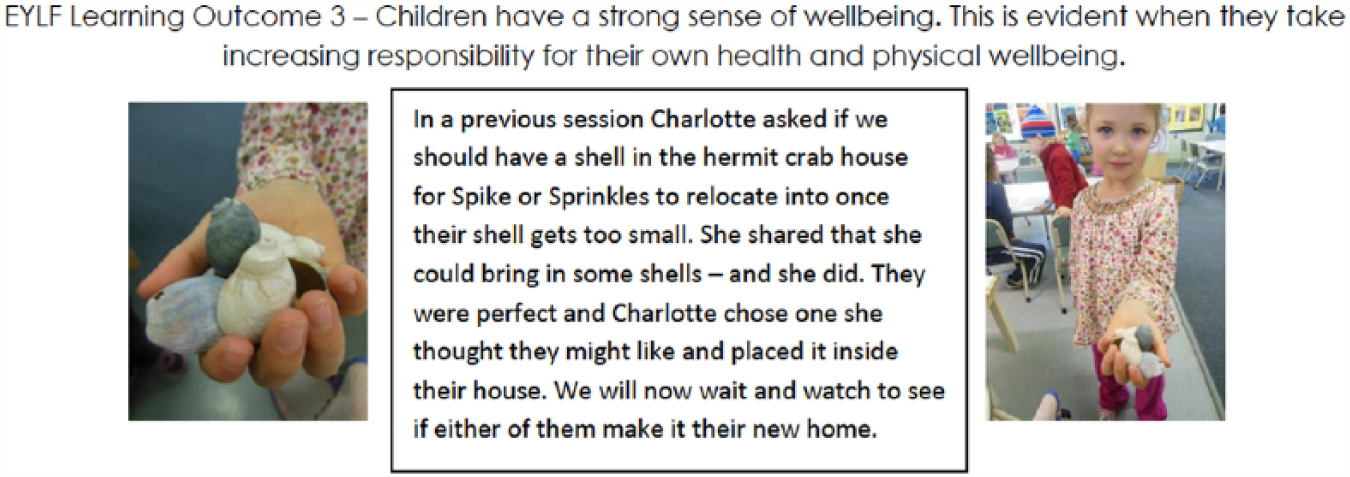
Charlotte brings a new shell for the hermit crab.
At the same time, the children were talking about planting seeds and growth to plants. Nicky was able to search and show them some time lapse photography of different types of growth and discuss how this happened with them. Some examples that are particularly good are as follows:
Radish—from seed to plant
Sunflower time lapse
Wheatgrass
Lenyssa (teacher) reflected on the use of the tablet for research when the children became interested in some fossils that Charlie brought back from his family holiday (Figure 3):
Charlie brought in a fossil that he had found at Lake Tyres to share with us. We were unsure of how the amazing shapes and patterns had formed in the sandstone, so we decided to try use the iPad to research more about them. Charlie and Meesha helped to search for pictures of sandstone that looked like Charlie’s pieces. We found out that the rock that had the shell imprints in it was actually called an erosion fossil. This gave us the idea to make our own fossil imprints. The children used all sorts of shells to make imprints in clay. We think they look fabulous! Next week we will varnish them and maybe even add some paint for colour. (Lenyssa, June)
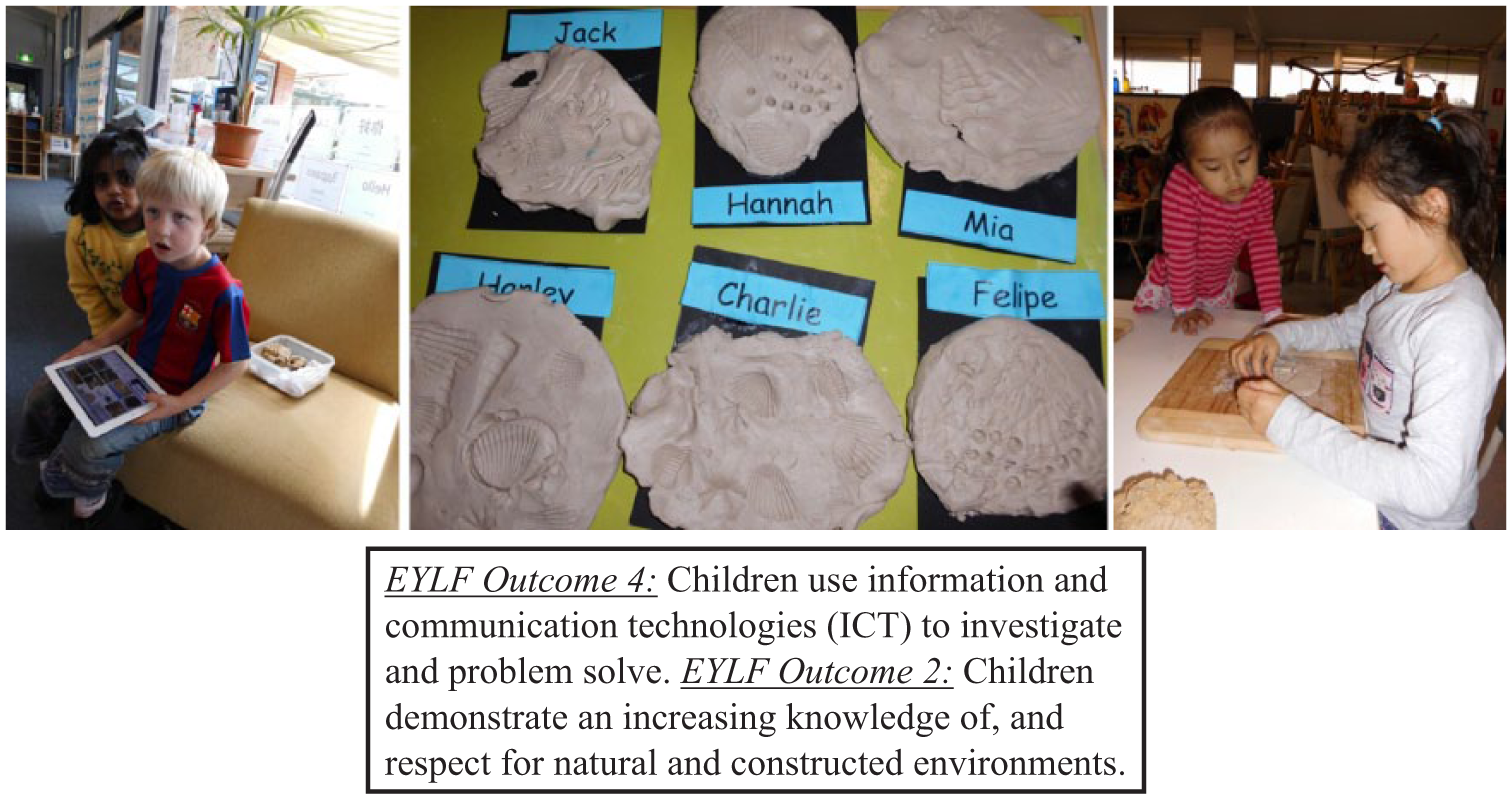
Investigating fossils.
Creating eBooks
In discussion with the teachers, we decided that it would be beneficial for the children to create an eBook. The content would be about themselves and the things they liked and could do. This was especially relevant at the time because the group had been discussing being helpful and good to each other. One of the things that both teachers were trying to extend in the children was their self-esteem and confidence, so thinking about what they were good at was a positive way to do this. As it was the first time for doing this, we planned to keep it simple and decided that a maximum of 10 children per book was optimal so that each book was a manageable size. Each child would have a photo and would introduce themselves (My name is …) followed by two statements: “I like to …” and “I am good at …” This was quite challenging to capture on the App as the center was a naturally jubilant and noisy area and recordings were thus difficult to capture without too much background noise. Additionally, the books took quite a while to create, as a few of the students were reluctant to speak into the microphone of the tablet and often spoke so quietly that it was difficult to hear the recording. But the effort was worth it (Figure 4).
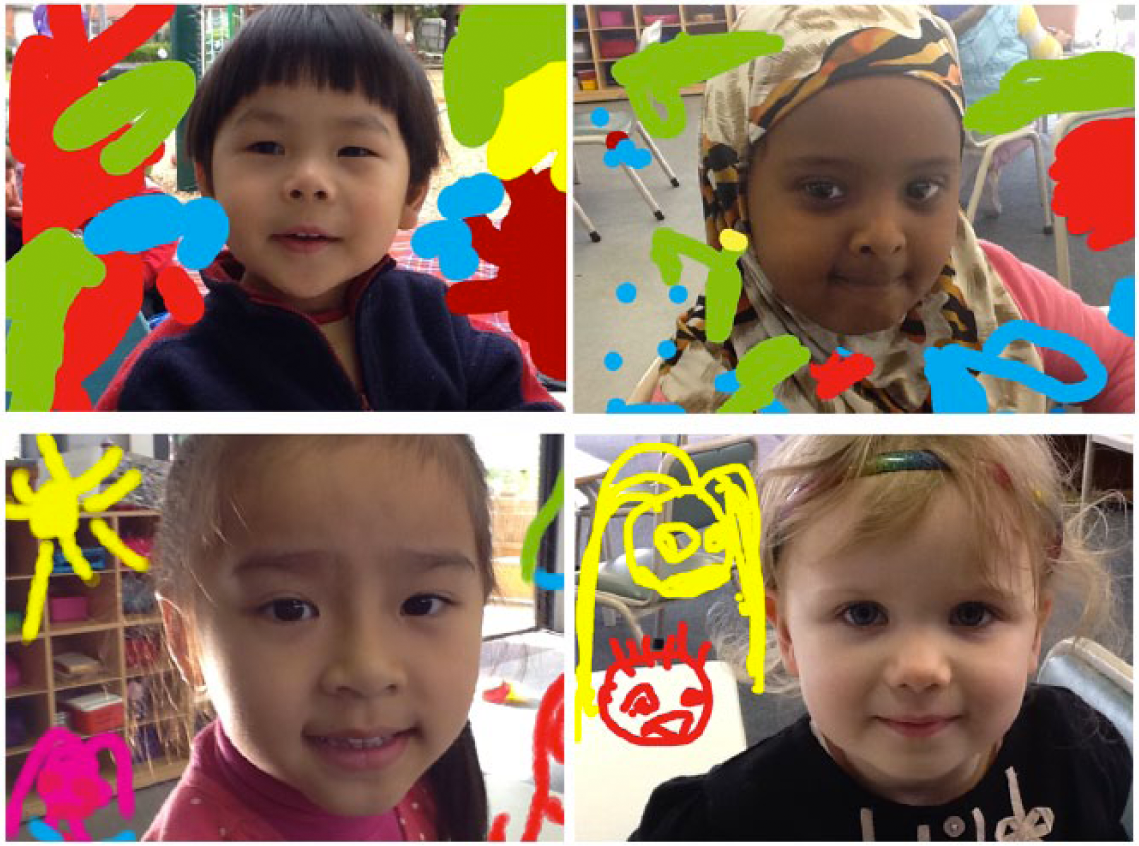
eBooks. My name is … I like … I am good at …
It was possible to type the words to accompany each recorded statement underneath the photograph. This turned out to be beneficial because it not only linked text to spoken words but also since some of the recordings were difficult to hear. When the book was completed, the children returned to it frequently to read and listen to it.
The pre-service teacher (Jess) summarized the learning that she felt had occurred during this process:
I explained what we were going to do to make an eBook … I asked M (student) what she likes to do. M told me and then practiced saying her words before we recorded them. “Hi, my name is M, I like watching TV and I am good at jumping.” As we were constructing the book M asked if she could draw on her photo and I thought this was a great way to personalize each page and it also meant that the children got to create something on the page that was unique. I told the children not to draw over their faces otherwise their friends would not be able to see them! M said, “I am not drawing anything, I’m colouring the fence!” … Olivia drew a tiara on her head. I asked why she was drawing it and she said, “Because I like to be a princess”! (Jess, observation notes, June)
Jess also made an eBook with the children that captured what they had been doing during the session that day, so that they were able to reflect on it and share it with their parents when they came to collect them. We noted that the children were able to articulate what they were doing while they played. Furthermore, making the recording facilitated their reflections after the event, so that they were able to be meta-cognitive and recall the type of learning that they were engaged in during the experience. It was apparent that the children were able to develop a strong sense of well-being about what they were doing and achieving in their play. They could effectively communicate and express their feelings and actions with others while they were engaged in various play-based scenarios. Having this recorded in an eBook enabled teachers to return to events that had already occurred to ask the children if they could recall the activity and the time it happened. This stimulated their memory and they were able to reflect how they had built on these activities. It was also a very useful way to share what children had been engaged in with their parents.
Summary
In this phase of the project, the partnership between the pre-service teachers and the kindergarten teachers enabled learning experiences to be created that built on the educational program of the center. The activities were based on the following:
Using the digital camera for explorations and reflection,
Searching for information for investigations,
Creating eBooks.
In each example provided here, the tablet both supported and extended the learning opportunities available to the children. They were able to engage in multimodal learning that incorporated linguistic, visual, oral, aural, and spatial dimensions and additionally afforded them the opportunities to make new discoveries by seeking out information as it was required and stimulated by their explorations and discoveries.
For the teachers, the availability of the tablet enabled them to support the learning of the young children, not only to substitute and augment existing ways of learning but also facilitated modifying and redefining learning that engaged them in rethinking their pedagogical approaches and extended their repertoire of pedagogies available to them.
Footnotes
Funding
The author(s) received no financial support for the research, authorship, and/or publication of this article.