




Abstract
This article reports on an Australian project involving preschool and kindergarten children learning about ‘giving’ and the environment. Teachers designed learning modules based on the Learning by Design framework, which views pedagogies as knowledge processes, and conducted action research to explore the impact of learning about ‘giving’ on student wellbeing and their literacy learning. From observations of students and analyses of students’ work samples, teachers agreed that students were more empathic, collaborative and felt more connected to their environments. Their engagement in authentic learning resulted in improved literacy outcomes as well as students taking action for the environment. Parent involvement also increased and strong connections were made between the schools and the wider community.
Introduction
You feel happy when you give things. (Preschool child 1)
It makes you feel good. (Preschool child 2)
These comments by two 4-year-old preschool children reflect their learning in a project on the topic of ‘giving’ titled ‘Growing to Give’ (Figure 1). While their initial comments focused on ‘giving’ and receiving gifts, children expanded their understanding of ‘giving’ through environmental learning as the project progressed. Teachers also promoted, modelled and encouraged acts of giving among educators, students and members of the school community, enabling students to develop their social learning and create broader social networks with the wider community.
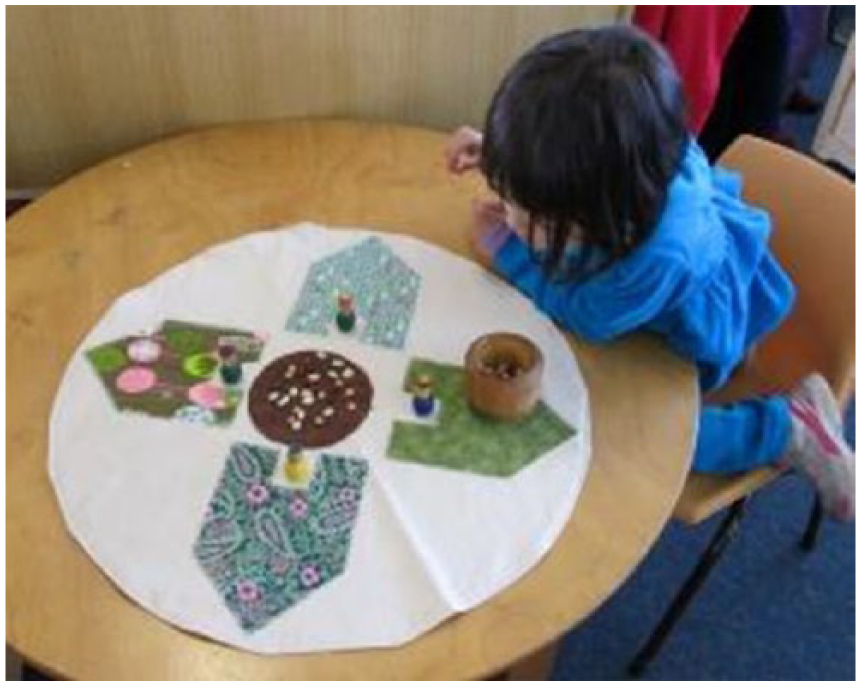
A preschool child in a play-based activity involving ‘giving’ vegetables from the garden to people in the community.
Here, we present and discuss the project ‘Growing to Give’ which was in fact part of a larger project about ‘giving’ for a group of three schools from preschool to year 10. The overall project, ‘Connecting through Giving’, involved over 1400 students, 100 teachers and 50 community members. This article will focus on preschool to year 2 and, in particular, on the action research undertaken by teachers in the preschool and kindergarten (ages 4–6 years) classes.
Background
The Lanyon Cluster 1 of Schools Connecting through Giving project involved Bonython and Gordon primary schools and preschools and Lanyon High School, and was focused on learning about sustainability, the environment and on social learning through ‘giving’.
To ensure that the learning of students in this project was of high intellectual quality, addressed the diversity of learners and was transformative, teachers used the Learning by Design framework (Cope and Kalantzis, 2015; Kalantzis and Cope, 2012; Kalantzis et al., 2005). They designed and documented 10 learning modules for students in preschool to year 10, including A Garden of Giving (Bailetti et al., 2012) for preschool and Water, Me and My Environment (Howland et al., 2012) for kindergarten to year 2. This documentation also ensured that the learning designs could be used in future years.
The range of projects was extensive, from tree planting, anti-litter and energy saving projects, and improving animal habitats to fund-raising projects for causes such as the homeless, Red Cross, Royal Society for the Prevention of Cruelty to Animals (RSPCA) animal shelter, the children’s ward at the local hospital, breast cancer awareness, 40 Hour Famine, letters of support to soldiers in Afghanistan and simple random acts of kindness. All in all, there were over 100 visits by kindergarten to year 6 students (630 students) to the local ponds and nature parks, and visits by 400 students to the local water treatment plants. Of note were the acts of giving in which students ran basketball and football clinics, organised sports events and fun days, and read to younger students. The younger children gave too, presenting seedlings to older students and the local playgroup.
Developing partnerships with the wider community was another key element of the project. The main partners included a community environmental group – the Southern Australian Capital Territory Catchment Group (SACTCG) that provided environmental educators and equipment such as water testing tools; an academic, Dr Thomas Nielsen, from the University of Canberra who provided professional learning about giving and mentoring in the teachers’ action research; and the local government water supplier – Australian Capital Territory Electricity and Water (ACTEW Water) that provided funding and in-kind support.
‘Giving’ and action research
‘Giving’ in the curriculum is related to service learning and positive psychology (Seligman, 2002). It involves building relationships through positive interactions such as acts of kindness, courtesy and gratitude (Nielsen, 2011). Nielsen (2013) articulates five domains of giving on a continuum from self (micro) to the whole (macro), including giving to self, others, community, environment and whole. ‘Whole’ can include spiritual, religious or a consciousness of humanity, the world or something bigger than ourselves. Giving and service to others can increase wellbeing, resilience and academic learning (Lovat et al., 2009; Lovat and Toomey, 2007; Nielsen, 2010).
All Lanyon Cluster teachers are involved in action research each year and the ‘giving’ project acted as one focus for their research. The teachers use action research methodology as their evidence base to inform planning and personalised learning for students. Typically, teachers select two or three focus students to collect detailed qualitative data about their learning.
The action research questions in the ‘Growing to Give’ project were as follows:
For Preschool: How does the act of giving impact on student wellbeing?
Teachers hypothesised that if they could increase the children’s connectedness with the community and establish a sense of place within the preschool environment, then an assumed sense of wellbeing would follow.
For K-2: How does the explicit teaching of ‘Giving’ impact on student wellbeing, on taking action for the environment, and on literacy outcomes?
In phase 1 of the project, teachers designed units of work using the Learning by Design framework. Teachers also collected baseline qualitative data on students’ literacy through writing samples, art work, and on wellbeing through surveys and observations. In phase 2, teachers implemented their units of work and collected ongoing observational and literacy data. In phase 3, teachers collated their data and presented their findings at school and national workshops. Three Lanyon Cluster assemblies were also held for students to share and celebrate their learning.
Theoretical frame: Learning by Design
Teachers in the Lanyon Cluster of Schools have been designing curriculum with the Learning by Design Framework since 2003. Learning by Design is based on the Pedagogy of Multiliteracies theory (New London Group, 1996), and connects to ‘Situated Practice’, ‘Overt Instruction’, ‘Critical Framing’ and ‘Transformed Practice’ of the Multiliteracies Framework. Diversity, pedagogy and multimodality are central to the Learning by Design framework (Cope and Kalantzis, 2015; Kalantzis and Cope, 2012; Kalantzis et al., 2005), and through it, teachers are able to address ‘Intellectual Quality’, ‘Significance’ and a ‘Quality Learning Environment’. These are the dimensions of the Quality Teaching Framework (Amosa et al., 2007; Ladwig, 2005) – a mandated system initiative of the ACT Education and Training Directorate, based on the work on intellectual quality by Newmann (1996) and Productive Pedagogies (Education Queensland, 2001).
Through Learning by Design, teachers ensure that learning is purposefully designed, not fragmented. In the Framework, experiential learning builds upon students’ knowledge base, enabling them to make connections to their life worlds; it also introduces students to new experiences, from which they conceptualise and analyse knowledge, before applying their learning. Multimodal meaning making is also central to the Learning by Design framework. Students represent (make meaning for themselves) and communicate (make meaning for others) through oral, audio, written, visual, gestural, tactile and spatial modes of meaning (Kalantzis et al., 2016).
The project was also an opportunity for teachers to implement the new Australian Curriculum in English and Science. The knowledge processes of the Learning by Design framework enabled teachers to address conceptual and analytical outcomes in the Science and English content descriptors, and the cross curriculum priority of sustainability. They also ensured that teachers could design experiences for the general capabilities of literacy, numeracy, information technology, critical and creative thinking, ethical behaviour, and personal and social capabilities.
Learning by design and teachers’ pedagogical moves
The knowledge processes (see Figure 2) act as the basis for the planned experiences in the learning design and represent the pedagogical ‘moves’ of the teacher. While the description of activities in the following overview of the Learning by Design knowledge processes appears to be sequential, in reality, teachers move backwards and forwards, ‘weaving’ across and between each knowledge process (Luke et al., 2004).
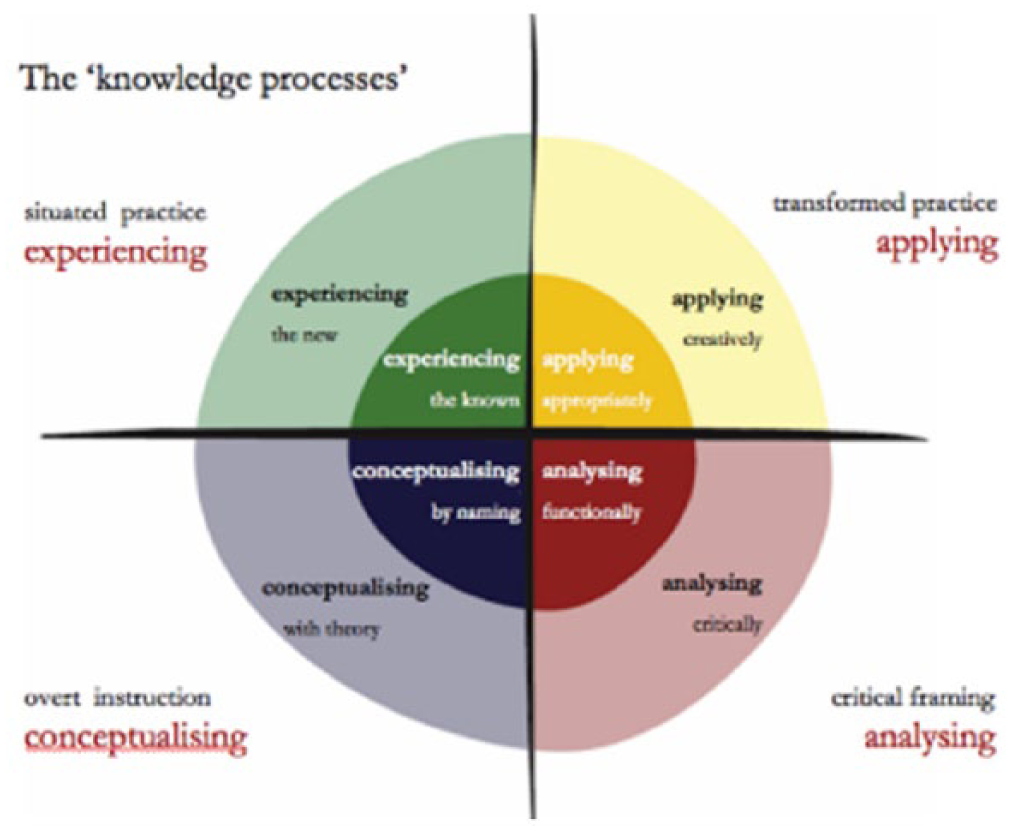
Learning by Design framework aligned with the Multiliteracies framework.
Experiential learning
Experiential learning (experiencing the known and the new) involves drawing on learner prior knowledge and experience, personal interests, life worlds, the everyday and the familiar, making connections to self and to other texts, and establishing baseline knowledge. Learners are also introduced to new experiences, multimodal texts (real and virtual), guest speakers, presentations and excursions.
In the preschool and kindergarten, children shared stories about giving and the environment. They were engaged in play-based learning activities, and excursions to the local pond and gardens. Preschoolers planted seedlings and used their prior knowledge to plan their gardens (Figure 3), while kindergarten children observed wildlife, vegetation, water quality and litter, and took habitat surveys (Figure 4). They all listened to, read and viewed stories, responding through writing, drawings, role plays, discussion and iPad videos. They were able to connect the stories, activities and excursions to their own experiences, and respond to new ideas that were presented. These provided rich environments for language and literacy development, and involved tactile, visual, oral, audio, written and gestural modes of meaning making.
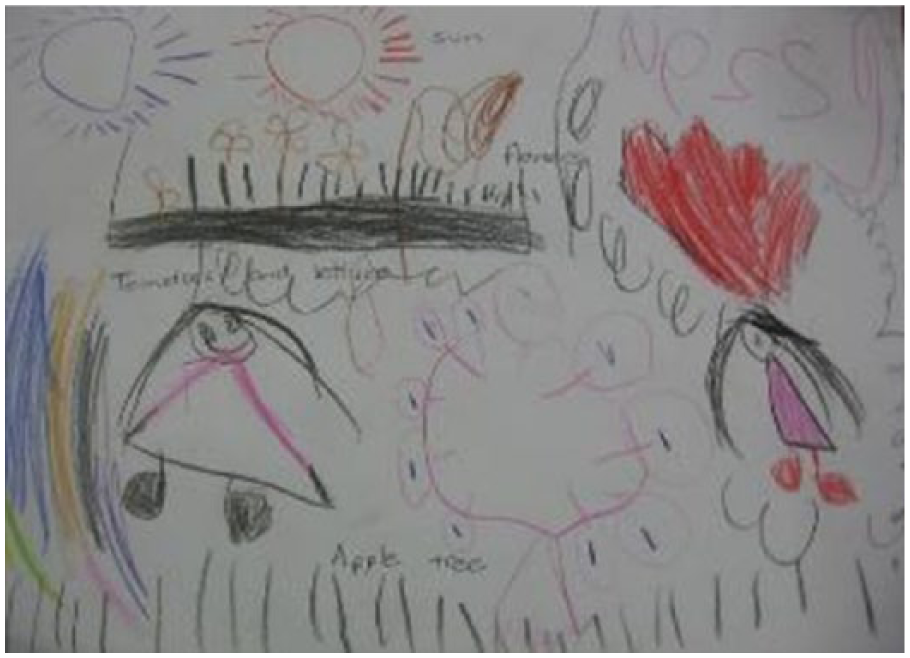
Preschool children drew on their prior knowledge to design their outdoor gardens. They represented their knowledge visually and included tree-houses, ponds, tunnels, bridges, flowers, vegetables and even tigers!
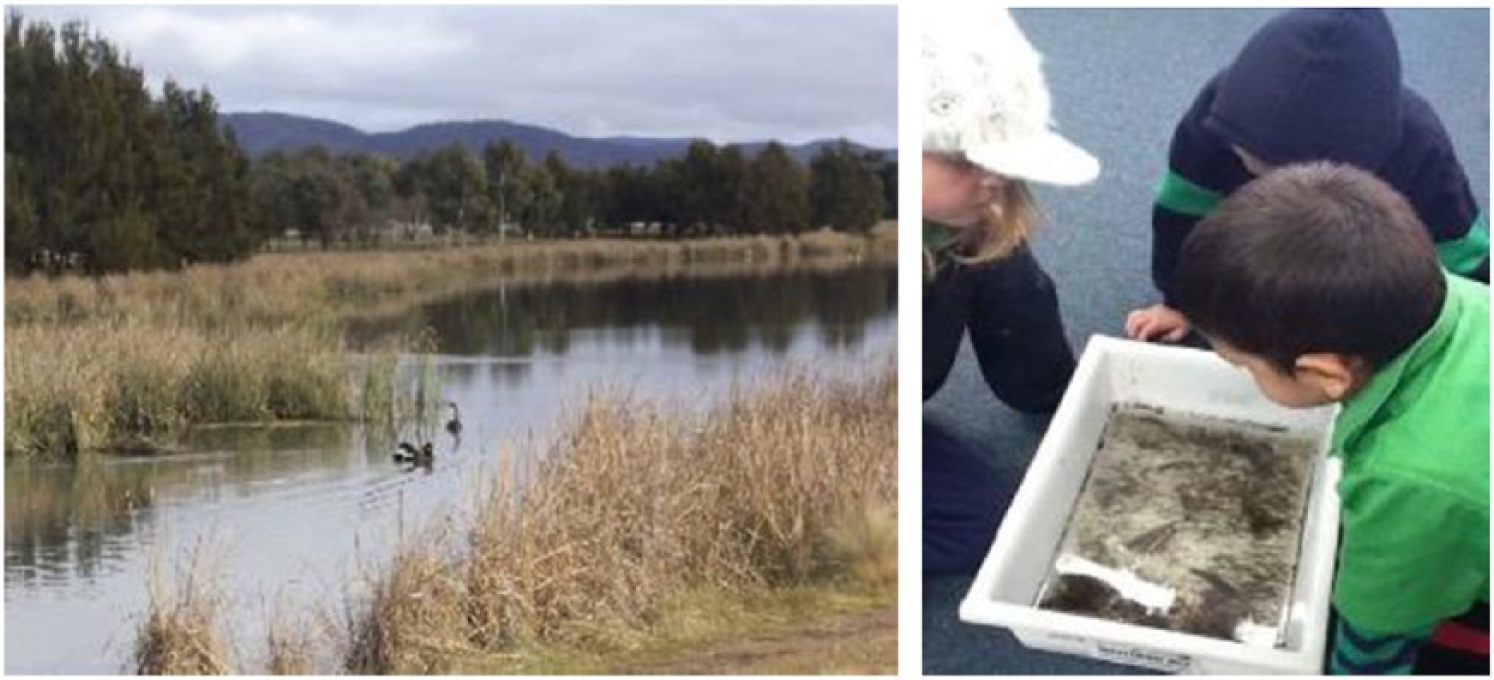
Experiential activities included visits to the Australian Botanic gardens and to the local ponds where children completed habitat surveys and looked at water samples.
Conceptual learning
Conceptualising by naming involves using the experiential learning to define and draw out new concepts, ideas, themes, understandings and vocabulary. Students then theorise by generalising and synthesising concepts, linking and drawing them together, exploring them in more depth, deepening understanding and practising skills.
From the stories they read, children expanded their understanding of giving. Also, each week, they made a different gift to give to someone special – for example, a drawing, painting, card, collage, paper lantern, butterfly and hand painting. Teachers modelled this by giving such gifts to their students when they noticed children engaging in informal acts of giving. They discussed and reflected on the experience for the giver and the receiver. Through role plays (gestural mode) and Y-charts (Figure 5), they were able to talk and theorise about whether it was better to give or to receive.
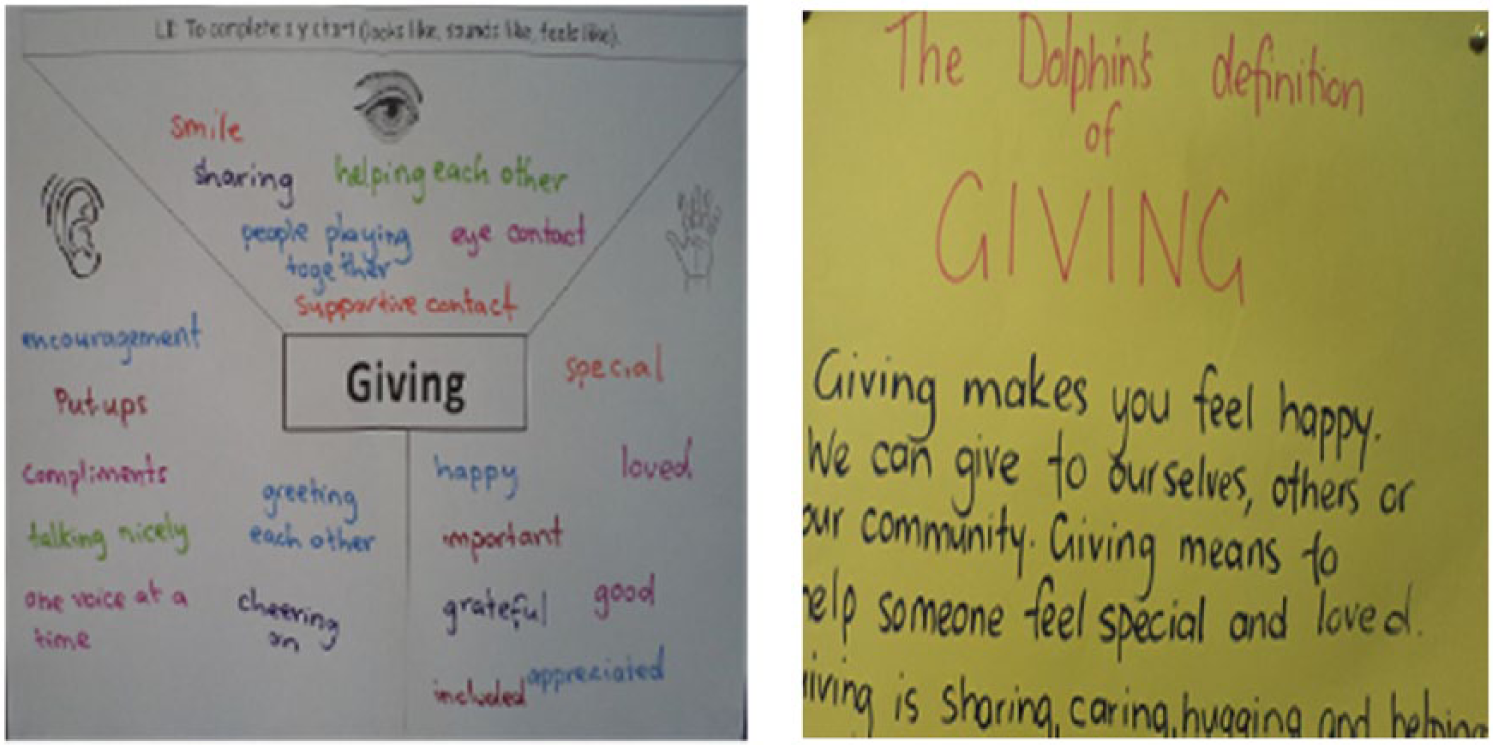
A Y-Chart was used to support kindergarten students to express what ‘Giving’ looked like, sounded like and felt like which was then used to write a class definition.
After the excursions to the gardens and ponds, teachers were able to explicitly teach concepts related to environmental learning (Figure 6). Visits to the kindergarten class by the ‘Bug Man’, one of the project partners, focused on identifying insects in water samples and defining living and non-living things (Figure 7). Kindergarten students also theorised about the effects of water quality on survival, while the preschool children planted seeds and watched them grow into seedlings, identifying the stages of growth. Students theorised about how the plants would develop with or without sunlight and water, and how the worms helped to improve the soil (Figure 8). This problematising of knowledge ensured intellectual quality and students moved to a deeper understanding of how plants grow and of environmental issues such as water quality.
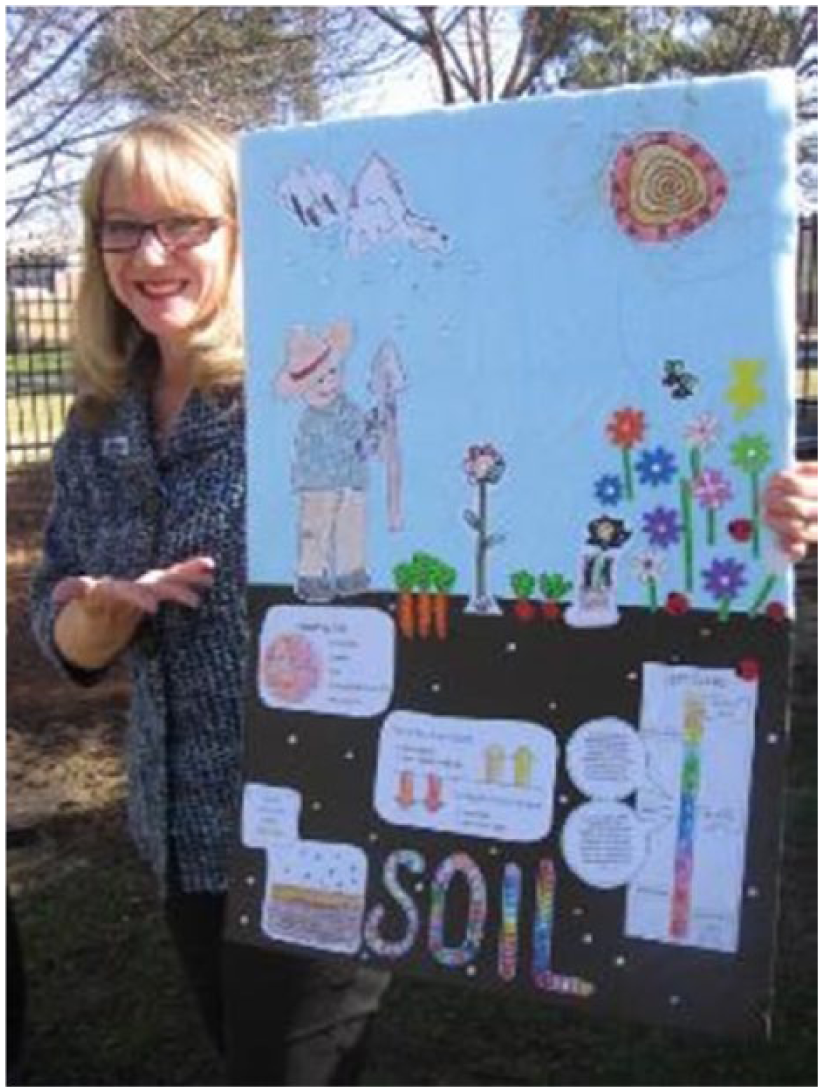
Conceptual learning about soil and how plants grow also occurred through song – oral, written, visual and gestural modes.
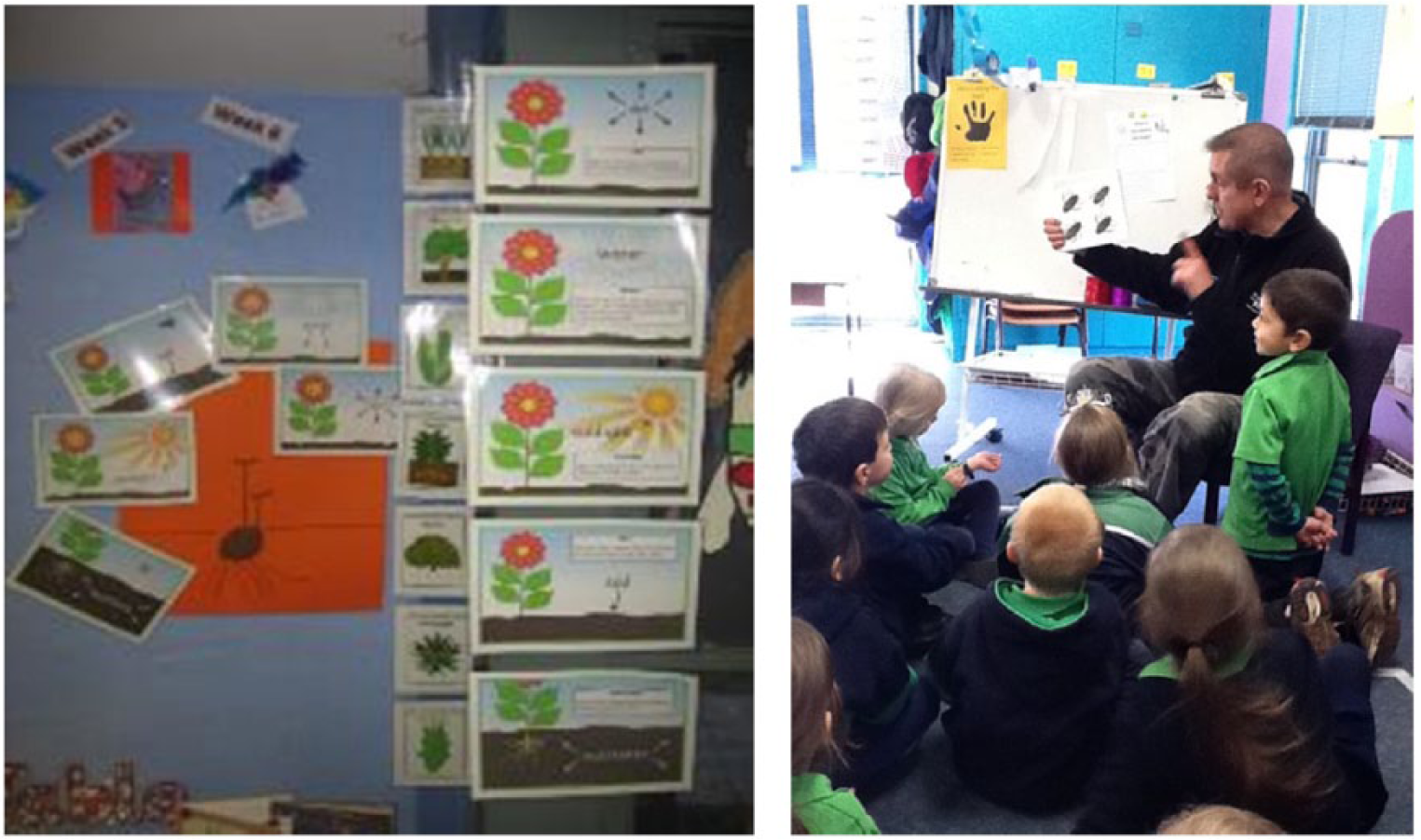
Conceptual learning in the preschool also focused on the growing cycle of plants while in the Kindergarten, led by Martin, the Bug Man, children identified the insects in the pond.
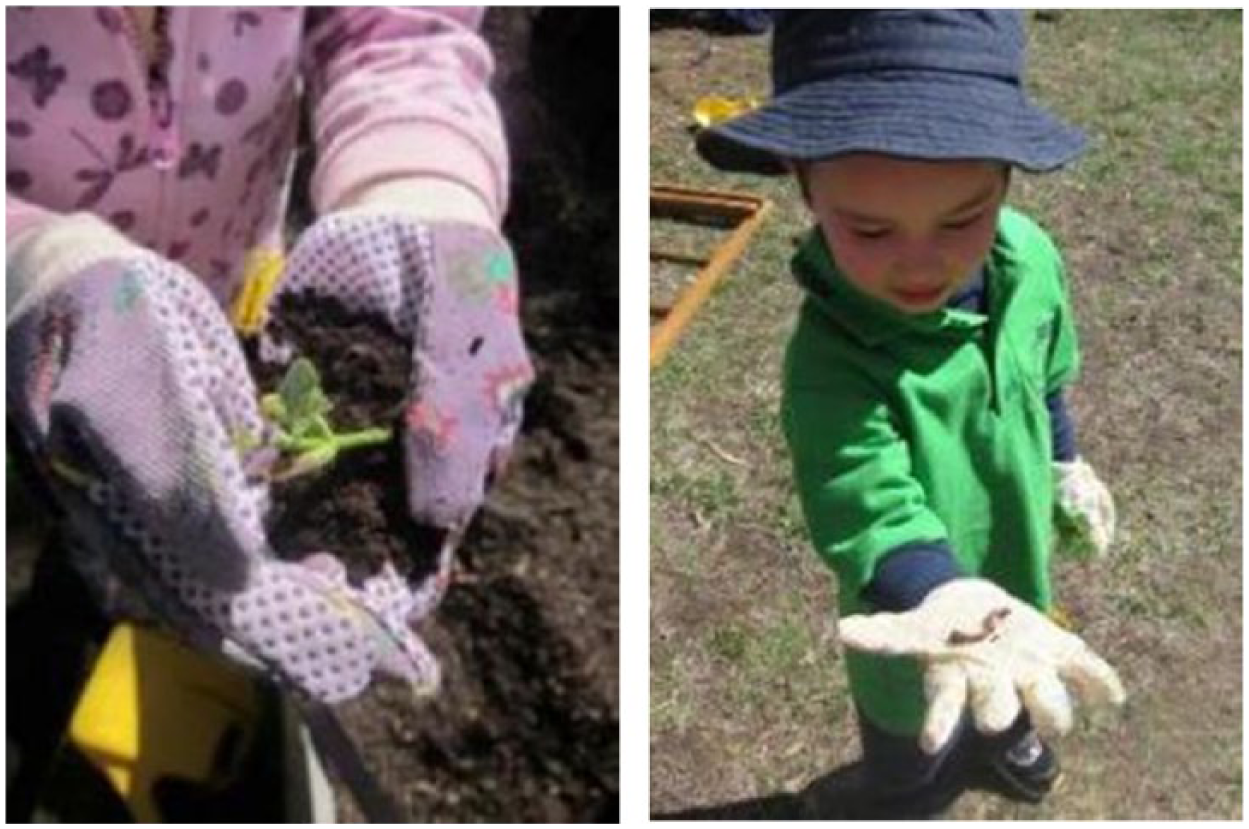
Preschool students nurtured their own seedlings and learned about how worms improve soil.
Analytical learning
In analysing functionally, students examine the structure of multimodal texts and the oral, audio, written, visual, gestural, tactile and spatial modes of meaning in context. Analysing critically involves interrogating purpose and audience and how multimodal ‘grammatical’ choices position audiences. By identifying the effects of grammatical choices, they can make deliberate choices in creating their own texts, in this case, recounts of their excursions to the local pond.
In analysing functionally, kindergarten students learned about the structure of recounts, in particular, who, what, where, when, why, how and a feeling/reflection. Including a comment/reflection/feeling was important to students’ learning so that they could elaborate on the detail in the recount and to meet its purpose of entertaining and/or informing. This was scaffolded through oral, written and visual modes.
Analysing critically also involves examining relevance, different perspectives and individual, social, cultural and environmental effects. In analytical learning, students develop their critical and creative thinking as they learn to generate and evaluate knowledge, clarify concepts and ideas, seek possibilities, consider alternatives and solve problems.
In their analytical learning, kindergarten students analysed how their actions impacted on the health of waterways and the natural environment. They explored different perspectives about environmental issues and developed a deeper understanding of giving to the environment by not littering (Figure 9).
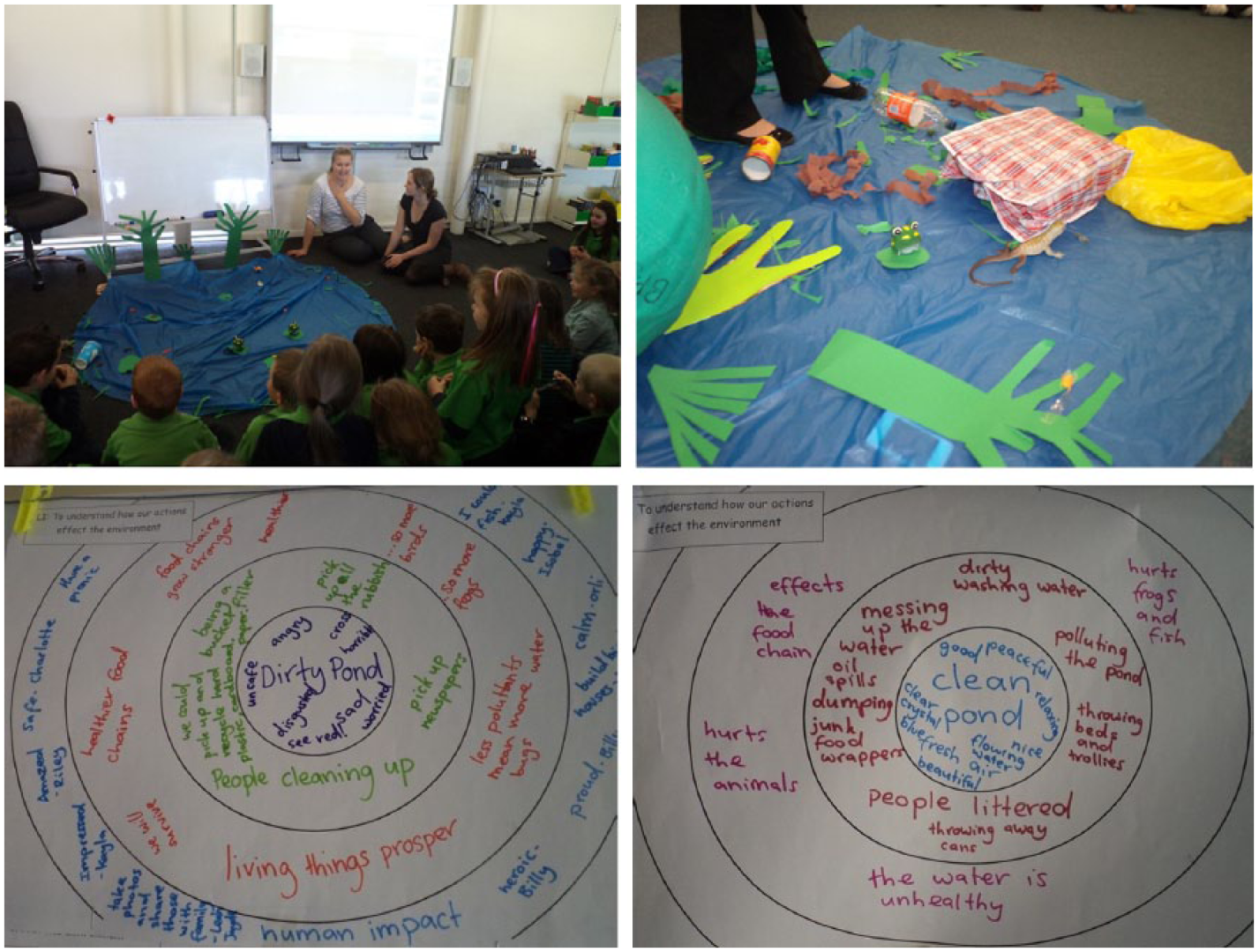
In their analytical learning, kindergarten students learnt about the effects of litter through a reconstruction of a pond from Lester and Clyde (Reece, 1991). Using ‘Cause and Effect Wheels’, students analysed the impact of human actions, both negative and positive, on the natural environment and waterways.
Analytical learning also involved exploring who gains and who loses through giving. For example, when educators noticed children engaging in informal acts of giving, they made them explicit by externalising the act and reflecting on the experience for both parties. From being involved in projects in which they were the recipients of acts of giving, children could deduce that giving could be just as or even more rewarding. For example, kindergarten children were also part of the giving projects of a group of high school students who were participating in an intensive reading programme. The older students selected and rehearsed the reading of a book that they then read to kindergarten children (Figure 10).
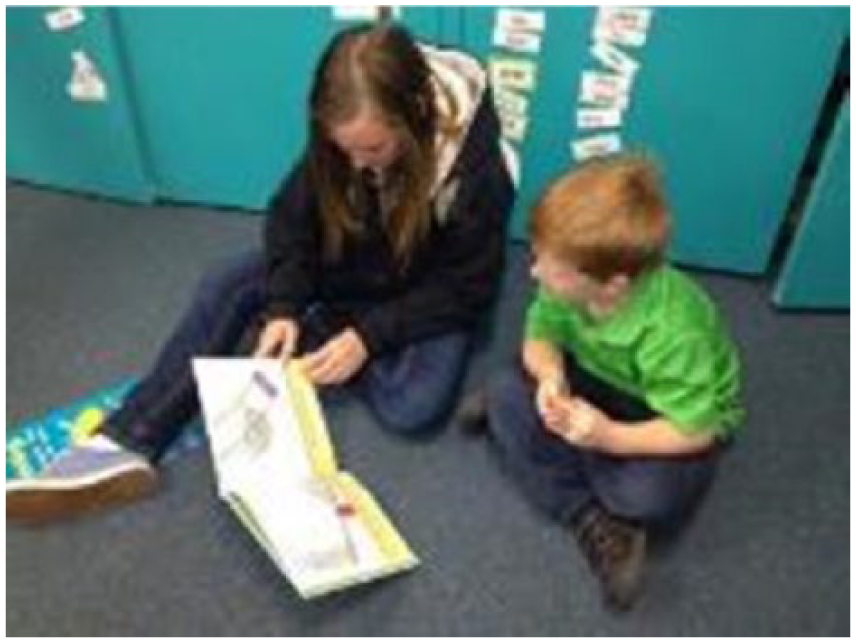
A year 8 student’s act of giving was reading to a kindergarten student.
There were other acts of giving by high-school students. These included year 9 woodwork students building a bridge for the preschool garden (Figure 11), while year 9 art students painted and decorated stepping stones for the garden, and helped lay them. The preschool children were introduced to recounts by drawing pictures of the students as they worked.
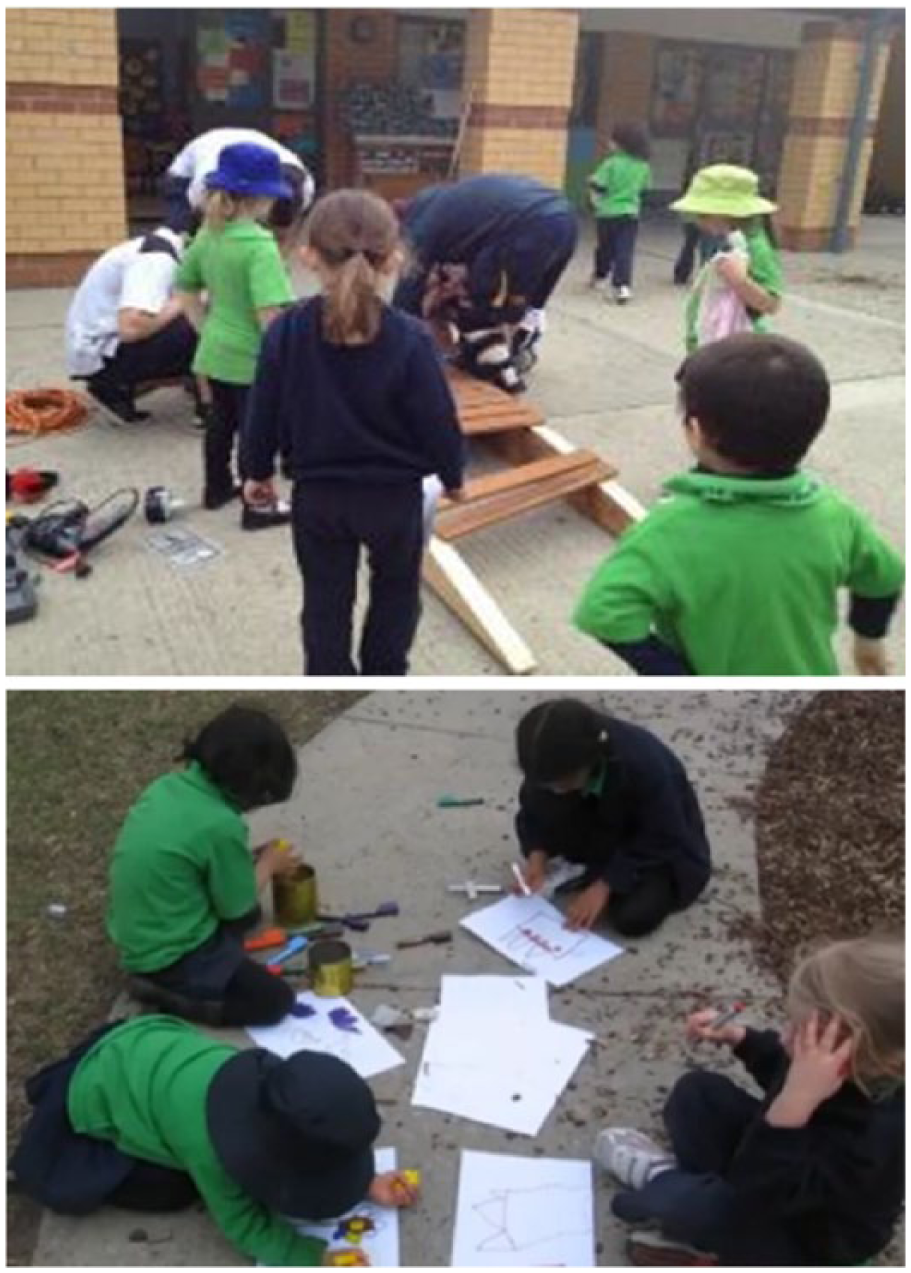
Bridge building with recounts in progress.
Applied learning
In applying appropriately, students independently apply what has been taught. It involves transformation, reinventing or re-voicing the world in a new way. It can also involve doing things in interesting ways by independently taking knowledge and capabilities from one setting and adapting them to a different setting.
The preschool children established garden beds and grew vegetables and flowers. They gave the seedlings that they grew to the kindergarten class and to a local playgroup. They also wrote thank-you letters to the local nursery that had donated the garden beds and soil. The kindergarten students cleaned up local drains and ponds (Figure 12), as well as writing recounts about their pond experiences.
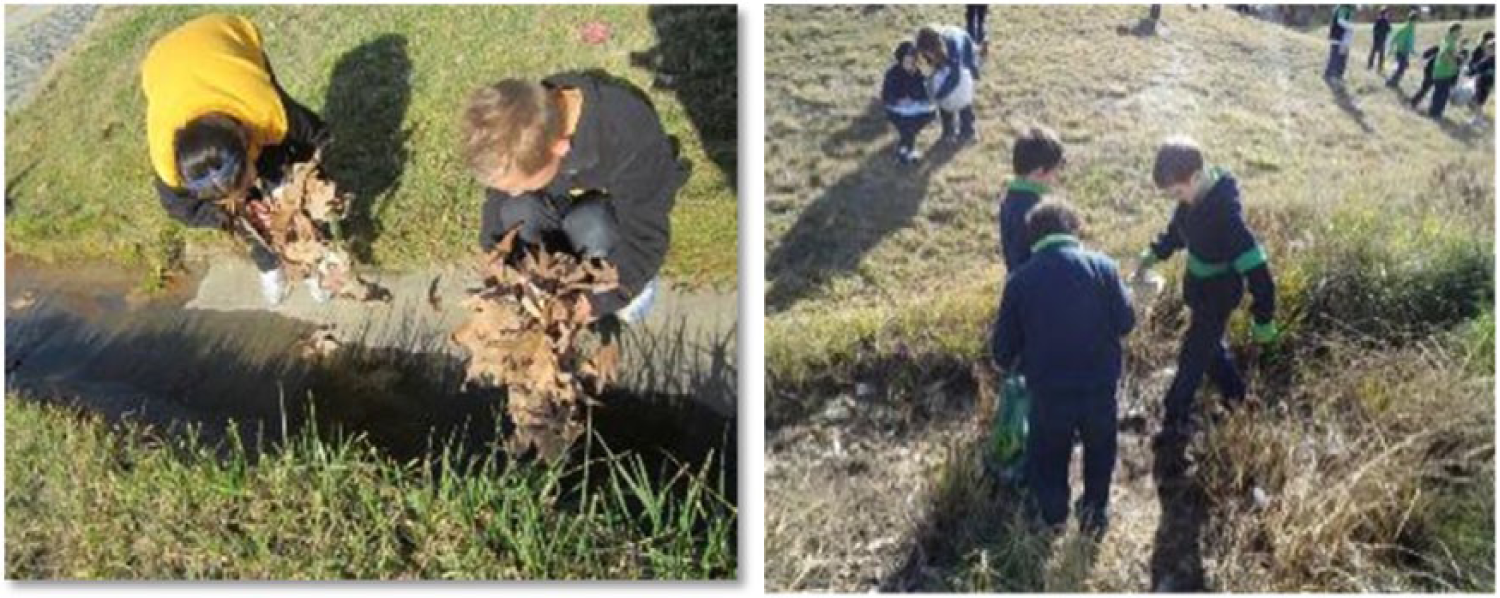
Students applying their knowledge by taking action to clear local drains and clean up litter.
Results
Understandings about ‘giving’
The teachers observed that students had broadened their understanding through their participation in the project, their reflections, writing and acts of giving.
For example, some of initial comments of the preschool children focused on the popular concept of giving on special occasions:
I give presents to my best friends, at their birthdays.
You can give a Skylanders figure to your cousin.
When it’s my birthday, I want to get given a Spiderman 3 DS Game.
You always get things people give you.
You always get things people give you.
Then they moved beyond a focus on giving and receiving gifts to being able to
Give a seat on a bus …
Give someone your bucket …
Give someone food if they can’t get it …
Students shifted their concept from seeing giving as mainly related to special days ‘giving’ (and receiving) to broader generalisations and, in doing so, were developing greater connections with their peers’ ideas. From their analytic learning, the students agreed verbally, and said,
‘You feel happy when you give things …’
‘It makes you feel good …’
Teachers administered happiness surveys to the kindergarten students in an attempt to gauge ‘well being’ (Figure 13). However, as students’ responses were based primarily on how they were feeling at a particular moment, there were no patterns in the data and it was difficult to draw conclusions about their wellbeing and resilience. Nevertheless, teachers used their observations of students’ interactions to note that children were sharing their ‘giving’ experiences independently. Teachers also noticed an increase in children verbally acknowledging their peers’ giving acts through positive affirmation such as ‘Thank you for giving that to me …’, ‘Let’s give each other some help …’ and ‘I am helping [my friend] to have a good day today because I am giving them a ride on our bike …’ From these observations, teachers in the preschool and the kindergarten concluded that based on observational data, the explicit teaching of giving had impacted positively on student wellbeing.
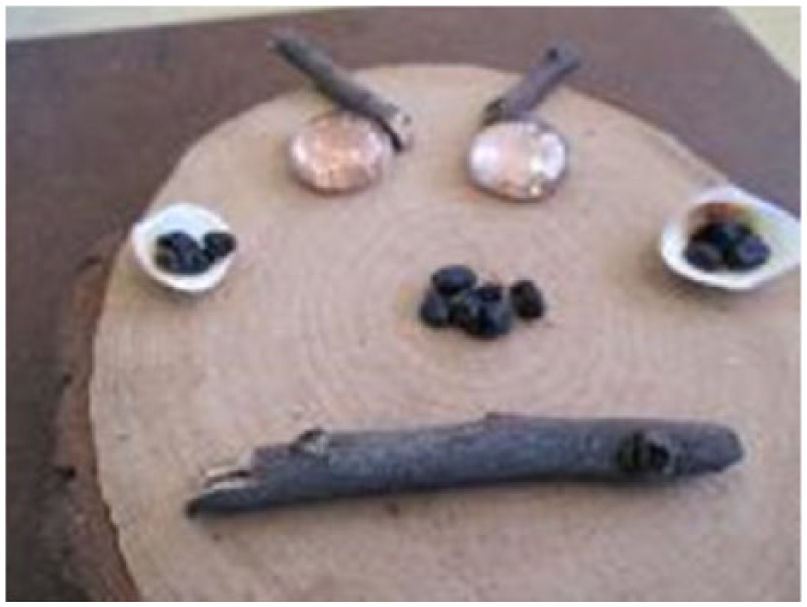
‘This is how I feel when I am giving something to my cousin …’
The majority of preschoolers verbally agreed in their discussions that the act of giving was a positive one. However, when asked to record or demonstrate their responses, some students, mainly boys, chose to represent negative or more serious emotions such as unhappy faces in drawings and sculptures. Teachers did not consider that these were accurate indicators, reflecting emotions, related to acts of giving; however, they do raise some other interesting questions and possible future avenues for research such as how students appeal for attention, or whether in the context of imaginative play children openly experiment with emotions and the expression of varied standpoints.
Literacy
Teachers also wanted to investigate the impact of learning about ‘giving’ on literacy outcomes. In baseline writing assessment, kindergarten students were asked to write a recount. There was a wide range of abilities, from students who were still learning their alphabet and corresponding sounds, to several students who were happy to use their knowledge of phonics to write independently. The samples (Figure 14) were from one of the focus students, Byron, in the kindergarten class. He is a good example to illustrate the progress of the majority of students in the class.
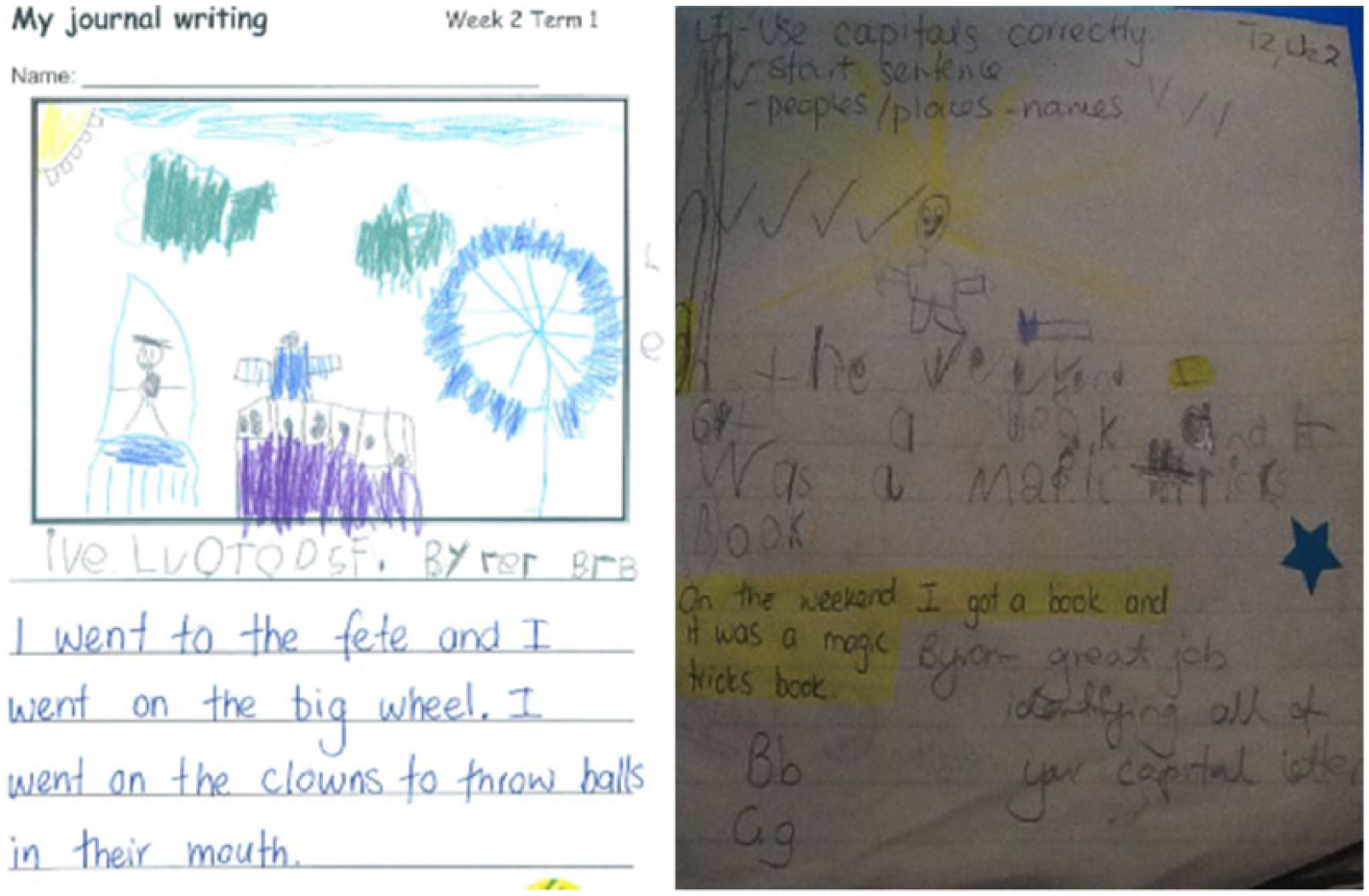
Baseline Writing Samples 1 and 2: Recounts, 7 February and 20 May, 2012.
In the first writing sample in February, the beginning of the school year, Byron understood that writing serves a purpose and that letters are a part of writing. He is unable to write his name fully but can write ‘by’.
The sample taken in May, just over 3 months later, was when the project began. Byron was progressing, as most 5-year-olds will, with balanced literacy instruction that includes explicit skill instruction and authentic texts. He could write a small bank of high-frequency words as shown in his sentence: ‘On the weekend I got a book and it was a magic tricks book’. He had a good understanding of phonics, and was able to match all the alphabet letters with their corresponding sounds. His recount contained ‘who, what and when’, and he used capital letters correctly. Using capital letters was his learning intention/focus in this writing task.
After a visit by Martin, ‘the Bug Man’, Byron was very motivated to write his next recount 2 weeks later (Figure 15): ‘Yesterday Martin came to Bonython school to show us some bugs. We saw some water waterboatman I felt happy’. Byron is using capital letters and some punctuation. He has included – when (yesterday), who and what, as in his previous recount. This time he has a reflection – adding how he felt about the experience. His drawing is also becoming more sophisticated in how he is drawing people.
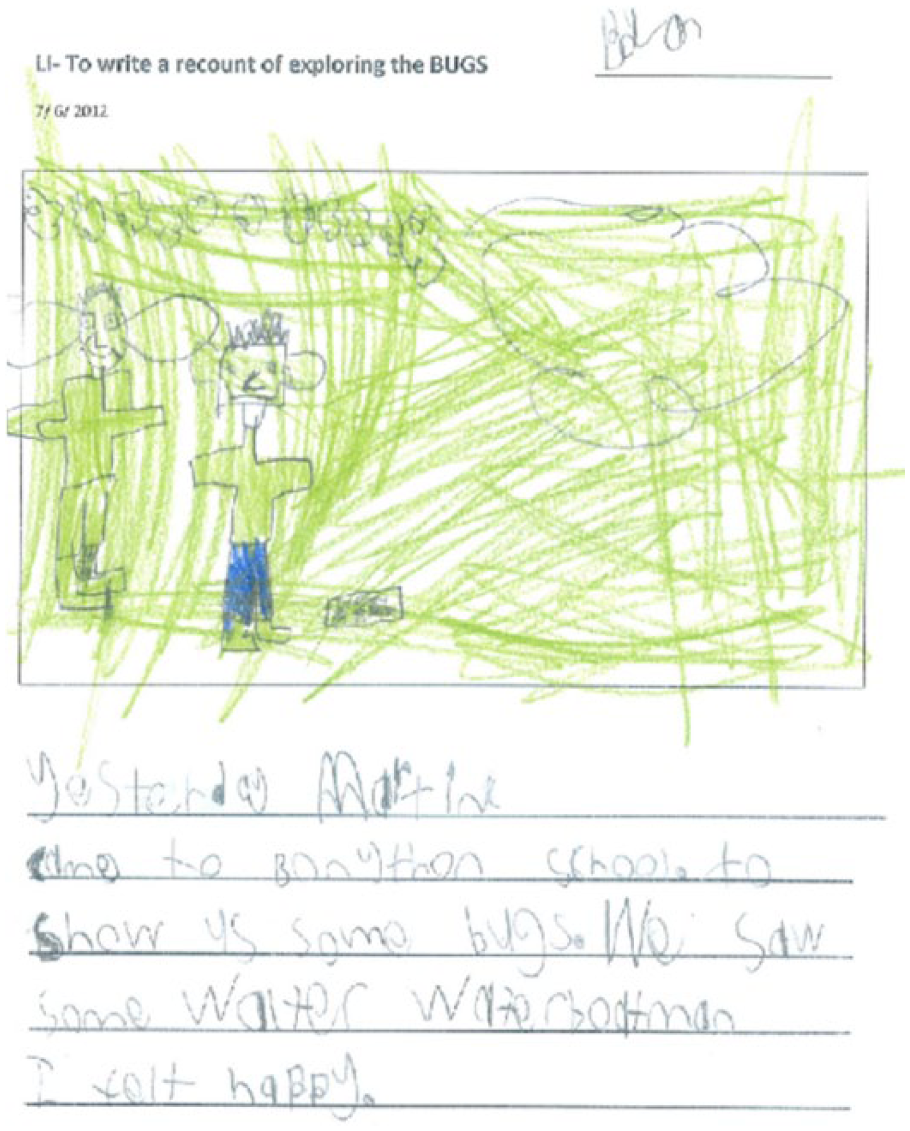
Writing Sample 3: Recount, 7 June, 2012.
Following another visit to the pond, the students wrote another recount a week later. Before writing commenced, students gathered their thoughts about the adventure; they were given thinking time, before they shared their ideas with a partner, and then each took a turn to share their partner’s ideas with the whole class. The teacher collated all of the ideas into categories of who, what, where, when, why, how and a feeling/reflection. Students were able to see what their peers wrote and extend their own writing.
Byron wrote,
On Wednesday the gorp went to Isabella pond to have a look around I felt cranky We went there becs we watd to see the rubbish
Byron expresses strong emotions in his recount (Figure 16). He has confidence to try some new vocabulary and includes when, who, what and a reflection. He builds on his prior efforts by including why, providing a reason for the visit to the pond. His drawing of a person is quite simple but he has added detail through the bags of rubbish next to the person.
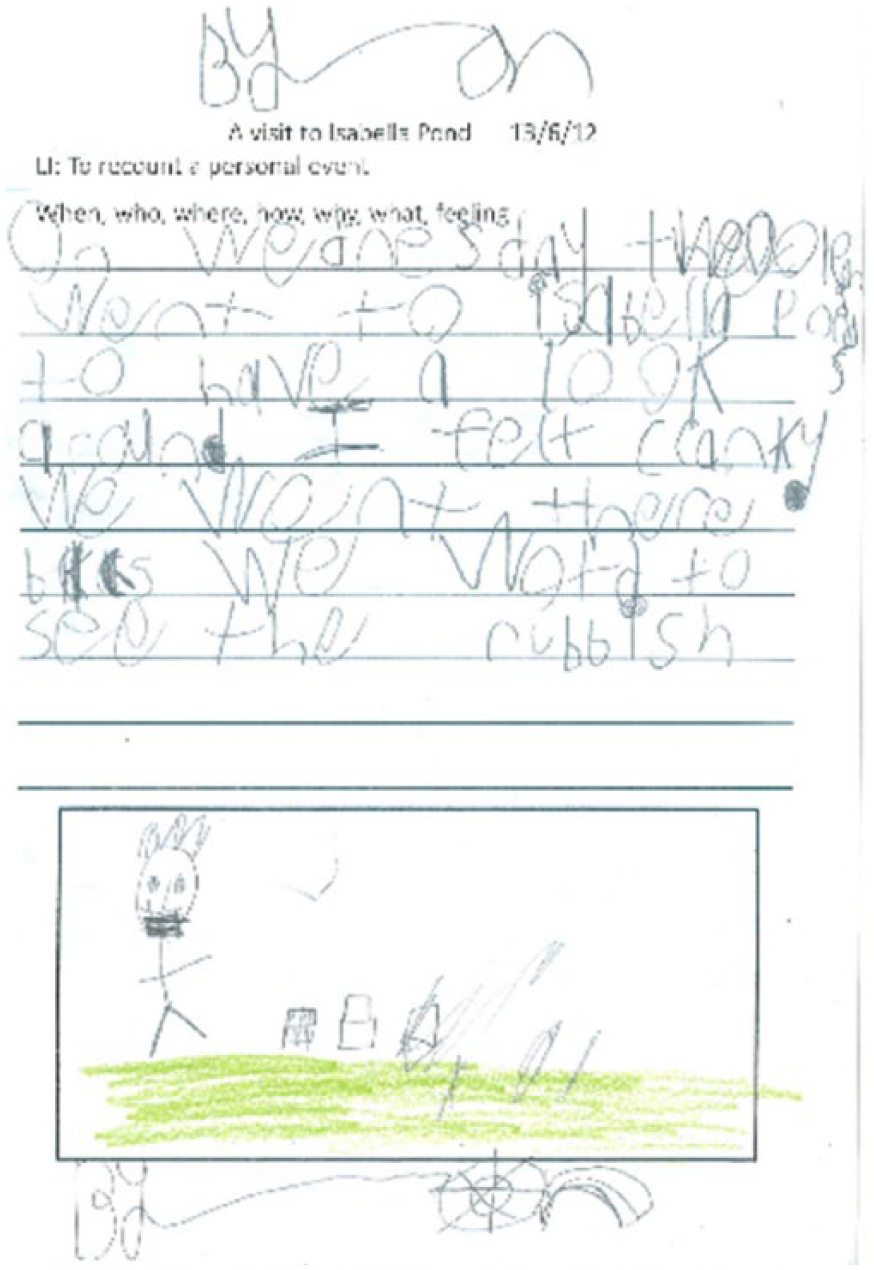
Writing Sample 4: Recount, 13 June, 2012.
On their next visit to the pond, on 27 June, the students cleaned up the pond. On returning to school, there was rich discussion related to questions such as the following: When did it happen? Who went? Why did we go? What did we do there? How did we do it? How did this make you feel and why? In this way, the teacher was continuing to teach the writing of recounts related to an authentic experience.
After students had finished sharing their experiences and ideas about their adventure to the pond, they recorded what they had discussed under the headings of who/what and where/when so that they could then refer to it as their first recorded oral recount on an iPad. Finally, they wrote it. Multimodality (Kalantzis et al., 2016; Cope and Kalantzis, 2015; Kalantzis and Cope, 2012) was important in this work as teachers included the oral, visual and written modes. The students recorded versions of their recounts before writing them. This was highly engaging for the students, and by switching between modes or synaesthesia, (Kalantzis et al., 2016), the task was scaffolded further for them:
On Tuesday K-1 m walked to Isabella Pond. We picked up rubbish. We used tongs and plastic bags. We did this to give to our community. This made us feel happy because the pond was dirty and now the pond is cleen.
As in his other recounts, Byron included when, what, who, how, why and a justified feeling. His writing has become more sophisticated in that he is now providing reasons. He is punctuating his writing and is a confident speller, using more sophisticated vocabulary (tongs, plastic, community) (Figure 17).
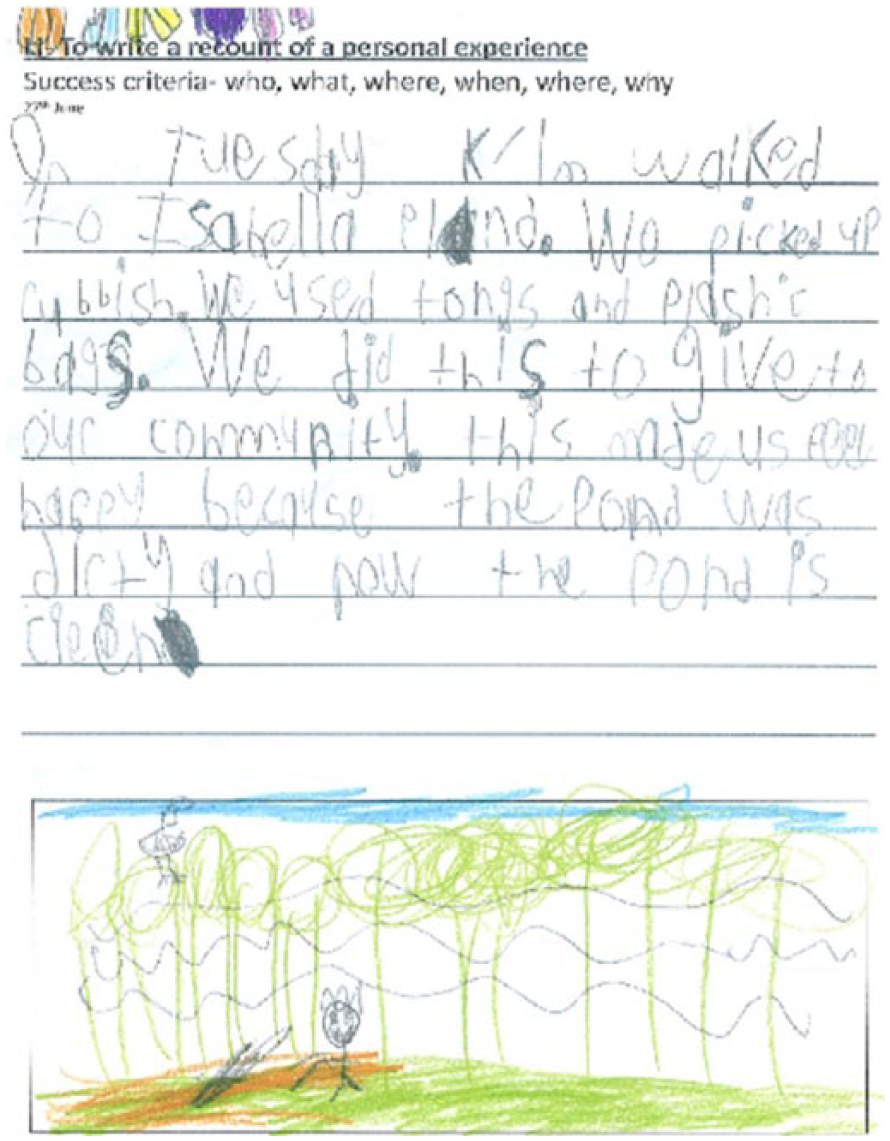
Final Writing Sample 5: Recount, 27 June, 2012.
The preschool children also drew recounts (Figure 18). Note the detail of the recounts in the visual and oral modes, the latter recorded by the teacher in the written mode. They reflect the students’ engagement as well as initial understandings of a recount.
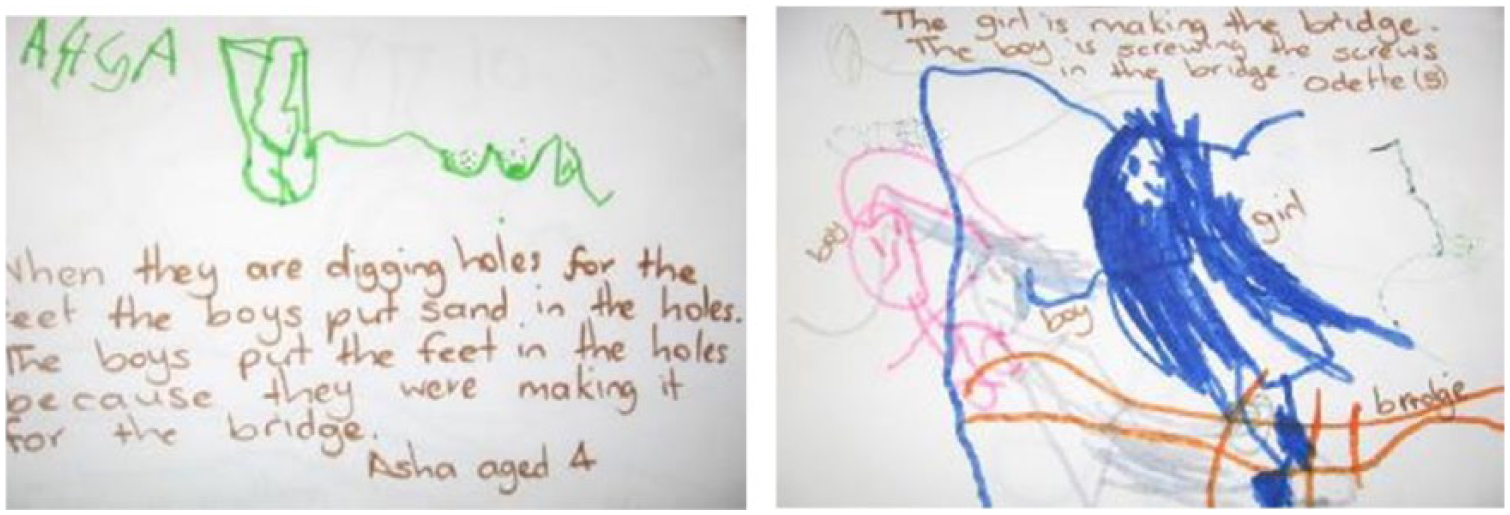
Work Samples – Preschoolers’ recounts.
Discussion
Giving and pro-social learning
From the observational data, teachers were in agreement that the giving project had resulted in a greater sense of wellbeing in their students. One factor that they observed and discussed was the increased empathy of the children, who were now able to demonstrate how they considered the perspectives of others.
A preschool child, noticing a girl who cried each morning after being dropped off by her parents, decided to draw a picture so that she would not feel so sad. This act of giving demonstrated her empathy and, more importantly, helped her classmate feel a greater sense of belonging to the group. Her teacher noted that she became a much happier child in the class and looked forward to attending preschool to connect with her peers.
One teacher explained, In the class, I’ve seen they have developed their empathy towards everyone. I think there was real growth in wanting to give to peers during the project in term 2, but even now (term 4), there is the flow on effect of just wanting to work together and support their peers in their learning, and also complimenting and helping each other in the playground. (K-1 teacher)
By learning about giving to each other, students were also enthusiastic to work collaboratively. ‘Their ability to negotiate problems and work cooperatively dramatically improved and their confidence grew knowing that they could make a difference’ (K-1 teacher).
In the project, a focus text, Have You Filled a Bucket Today: A Guide to Daily Happiness for Kids (McCloud and Messing, 2006), was used to teach students about giving through sharing, cooperating, taking turns, active listening, being considerate of others and contributing in group work. Through repeated readings of the text, students adopted ‘bucket-filling’ as a metaphor for giving as opposed to ‘bucket dipping’. This soon became the shared language for students, teachers and parents. As a year 1–2 teacher commented, I think with our school one of the really huge changes has been that we now have a whole school language that we use to talk about giving and what that means…giving students that shared language and different experiences of what it can mean to give, and giving in different ways has really been a big change within the school.
Being able to consider others’ perspectives through giving has possibilities for reducing violence, aggression and bullying in schools. While bullying was not investigated in this project, Vlachou et al. (2013) have documented the prevalence of rates of bullying in preschool contexts, particularly in joint play activities. Through the project, nevertheless, ‘bucket filling’ and ‘bucket dipping’ became the language used to deal with student conflicts, using a restorative practices approach. Students are now asked to rethink inappropriate actions, who was affected, including themselves and how (whose bucket has been dipped?). They articulated their own ideas about how they can ‘give back’, for example, by organising lunch time activities, cleaning up the playground, helping teachers on playground duty, helping the janitor and working in the library. A copy of the plan was sent to parents who unanimously supported the ‘giving back’ approach. Parents commented that their children were happier and they had observed positive changes in their children’s behaviour. The children were excited about ‘giving back’ to their school community to ‘refill the buckets’ that had been dipped into. This included theirs, their peers and teachers, leading to an increase in self-worth and rebuilding of relationships. In this way, learning about giving has provided a positive intervention to decrease acts of bullying, and create more pro-social classroom and playground environments.
Teachers were also interested in finding out whether establishing a sense of place through the gardens and visits to the local pond would increase the students’ connectedness to the community and increase their sense of wellbeing. Taylor and Giugni (2012) state that connectedness ‘… may be established on two levels…through the development of human relationships but also through the development of non-human relationships with both our natural and established environment…referred to as a sense of place’ (p. 1). Through their acts of giving to each other, students did develop human relationships. Moreover, by contributing actively to establishing their gardens, to improving the pond environment and through giving to the wider community and to the environment, students felt connected to someone or something, and felt that they could contribute to these connections. This had many benefits for engagement in their learning as well as potentially for developing resilience and wellbeing. According to Nielsen (2011), giving ‘nourishes and sustains deep and meaningful levels of happiness’. Such higher levels of happiness are regarded as being synonymous with giving to others, and increase resilience.
Giving and literacy learning
The work samples of Byron, who was one of the focus students in the action research project, provide empirical evidence of the impact of quality pedagogy on literacy skills and understandings. The student’s progress during term 1 reflected the normal development of a student over a term. However, in term 2, there was an acceleration in this student’s literacy levels over a period of 5 weeks. He moved from writing simple recounts to using a clear structure and providing reasons and reflections. He also expanded his vocabulary and used punctuation correctly.
Using the Learning by Design framework was central to this improvement in literacy skills. His teachers had created high-quality units of work that engaged students and connected them to the content of their learning. The initial activities focused on students’ knowledge base and links to their life worlds through visiting their local ponds and the National Botanic Gardens. Through these authentic experiences, students could see the direct relevance to their own lives and communities. In their designs, teachers cumulatively built on these activities, and included thinking, problem solving, investigating, hypothesising, analysing and students applying their learning. This enabled students to develop deep understanding of giving and environmental issues such as water quality and pollution, as well as improving literacy.
Explicitly teaching social-emotional skills and focusing on wellbeing has been shown extensively to impact on academic learning (e.g. Ashdown and Bernard, 2012; Bernard, 2006; Lovat et al., 2009). The focus on giving, particularly how it built engagement and connectedness, contributed to developing students’ understanding of environmental issues and sustainability, thereby improving the student’s academic outcomes. It also motivated them to take action for the environment by cleaning up their local ponds.
Building social cohesion
Another positive outcome of the project was the increased parent involvement at both formal and informal levels – especially those parents who had not previously been involved in their child’s schooling. As well as the preschools receiving community donations of garden beds, soil and mulch, parents were inspired to donate seedlings, plants, gardening tools, watering cans, gardening gloves, wheelbarrows and, most importantly, their time. Parents approached teachers more frequently with ‘tit bits’ of information and it appeared as though they were empowered as the ‘experts’, freely sharing their gardening knowledge. In this way, the project connected parents and community to the preschool and school. The South Australian Department for Education and Child Development (2008) attests to the importance of connecting parents and the wider community: By recognising the expertise, cultural understandings and social capital of communities, early childhood services can significantly contribute to social cohesion and equity through their relationships, concern, trust and support…people feel they can make a contribution, care for themselves, for others and for their physical and constructed environments. (p. 11)
Increased connectedness with the wider community was also evident in the partnerships with groups such as local playgroups, the community environmental group – the Bug Man was a frequent visitor to many classes throughout the project – local businesses, university and government groups. The connection to the local high schools was also strengthened through the acts of giving by older students (Figure 19).
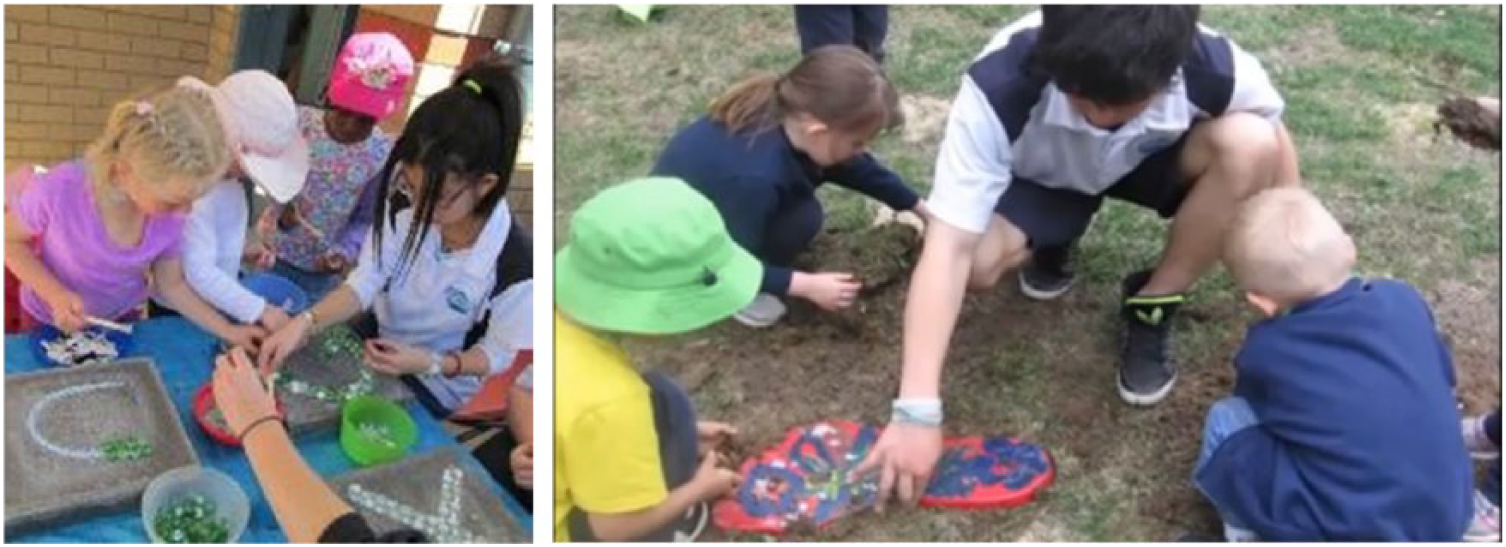
Year 9 students creating mosaic pavers and laying stepping stones at the preschools.
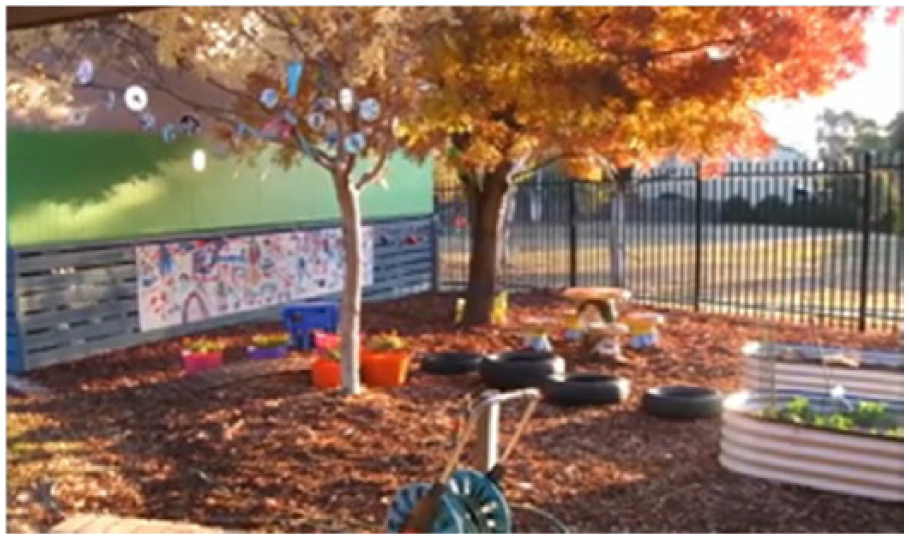
The preschool garden today.
Conclusion
From developing social and academic skills to building peer and community relationships, to knowledge building about environmental issues and building relationships, the ‘Connecting through Giving’ project has had many benefits for the students and schools involved. Through learning about the environment and sustainability, students have improved their local environments and made connections to the wider community, while teachers have collaborated to design and implement high-quality learning designs.
The project has also embedded acts of giving in school culture. Giving now underpins the schools’ approaches to student management, with children continuing to use the ‘bucket filling’ metaphor in the primary schools and preschools. Year 9 students perform ‘giving’ projects each year, enabling them to apply giving beyond their school contexts. The connections between the schools have been strengthened and combined assemblies of primary and high-school students are held regularly with giving as the focus.
Footnotes
Acknowledgements
With enormous thanks to the teachers from Gordon and Bonython preschools and primary schools, Canberra, Australia. Their commitment to their students’ learning through action research contributed to this article: Ally Cleaver, Sharon De Rooy, Bianca Bailetti and Emmy Yager in the preschools, and Emily Howland and Annie McAppion in the K-2 classrooms.
Funding
The author(s) received no financial support for the research, authorship and/or publication of this article.