




Abstract
Authentic learning pedagogy not only allows students to engage in realistic tasks using real-world resources and tools, but it also provides opportunities for students to learn with intention by thinking and acting like professionals as they address real problems. This paper describes a research conducted in a first year university course, where social media were used to support authentic and intentional learning. Principles of authentic learning guided the design of the course, and learning tasks and activities focused on the completion of realistic and complex tasks. Students’ mental effort was expended largely on the creation of polished and accomplished products, rather than on the completion of a series of decontextualised or step-by-step exercises. Importantly, opportunities for reflection were provided through the completion of a complex and collaborative task, a journal and a reflective examination. A qualitative study of two cohorts of students was conducted, as part of a larger design-based research agenda, over a period of two years. Findings showed that providing such course elements to facilitate reflection allowed students to reflect both in action as they participated in the course tasks and on action as they wrote about their learning experiences.
Authentic learning and reflection
Almost a century ago, Dewey (1916) described reflection not as a passive individual pursuit, but as an active, dynamic and intentional process that profoundly influences one’s experiences: The material of thinking is not thoughts, but actions, facts, events, and the relations of things. In other words, to think effectively one must have had, or now have experiences which will furnish … resources for coping with the difficulty at hand (pp. 156–157).
Reflection in pedagogy has itself come under increased scrutiny in recent years. After years of being an accepted consideration for educators since the benefits were espoused by Schon (1987), Boud, Keogh and Walker (1985), Moon (1999) and others in the 1980s and 1990s, more recently, some have questioned the benefits of intentionally providing for reflection in curriculum and pedagogy. For example, Atherton (2011) argued that there are few benefits from reflection that cannot be more easily accommodated by additional instruction or through communities of practice. Boud (2006, p. 3) too has recently questioned the trend for educators to adopt an instrumental approach to reflection—‘reflection by numbers or checklists’. Nevertheless, teachers continue to seek ways to support and facilitate reflective scholarship, and it remains the norm rather than the exception that both pre-service and experienced teachers engage in reflective practice as part of professional behaviour and development (Tummons, 2011). In the context of the current study, the intentional nature of an authentic learning environment and the design of pedagogical elements to promote authenticity readily accommodate conditions conducive to reflection.
Reflection is a critical aspect of an authentic learning environment (Herrington, 2012; Herrington, Reeves, & Oliver, 2010; Lombardi, 2007). In this paper, we refer to reflection in the manner envisaged by Boud, Keough and Walker in their original seminal (1985) work where they defined reflection as: ‘those intellectual and affective activities in which individuals engage to explore their experiences in order to lead to new understandings and appreciations’ (p.19). Hatton and Smith (1995) defined the term with a similar intentional emphasis as ‘deliberate thinking about action with a view to its improvement’ (p. 52). Such thinking and activity occur both contemporaneously and after the learning event, as noted in Schon’s (1987) proposition that learners can reflect in action and on action, that is, both in decision-making while engaged in the learning context and on the subsequent events in a more extended and sustained manner.
Both reflection in-action and on-action can be facilitated through the provision of an authentic task that requires considerable decision-making in its completion and through the writing of reflective artefacts such as entries in blogs and wikis and contributions to discussion forums and chats (cf. Lee & McLoughlin, 2007). As Kemmis (1985) pointed out, we do not reflect in a vacuum: ‘We pause to reflect … because the situation we are in requires consideration: how we act in it is a matter of some significance’ (p. 141). Such reflection is intentional and purposeful. It is necessary to successfully complete complex learning challenges such as those required by an authentic task set in an authentic context—not simply on request or at the prompting of an external agent. Tummons (2011) has pointed out the value of reflective practice particularly in professional courses such as teacher education, where tasks might require students to analyse sessions they have taught through a reflective practice lens or through a response to an observer’s feedback. In this study’s context, reflection was facilitated through reflective commentary in several complementary forms within an authentic learning environment.
Background and course design
The research was conducted within the context of a large first year semester unit for pre-service teachers in a Bachelor of Education (Primary) course. The pedagogical framework used to guide the design and implementation of the unit was principally that of authentic learning or authentic e-learning (Herrington & Oliver, 2000; Herrington et al., 2010) comprising nine guiding design elements:
Provide an authentic context that reflects the way the knowledge will be used in real life Provide authentic tasks and activities Provide access to expert performances Provide multiple roles and perspectives Support collaborative construction of knowledge Promote reflection to enable abstractions to be formed Promote articulation to enable tacit knowledge to be made explicit Provide coaching and scaffolding Provide for authentic assessment of learning. (p. 18)
Each of these elements is instantiated in the unit curriculum and pedagogy. Ideally, an authentic learning environment requires students to complete a single realistic and complex task encompassing the entire curriculum, with all assessable components contributing to that one endeavour. Students in the unit completed one product for overall assessment—a website. They created a prototype shell within three weeks and then populated their sites with the products of the unit to create a multifaceted web portfolio or personal learning environment. In addition to the ongoing development of a website, students wrote a blog throughout the semester to reflect on their growing understanding about the subject matter and the conditions that assist their learning. In this way, students reflected in action through decision-making on resource collaboration and development and on action as they kept their blogs (Schon, 1987).
Reflective enablers in an authentic learning environment
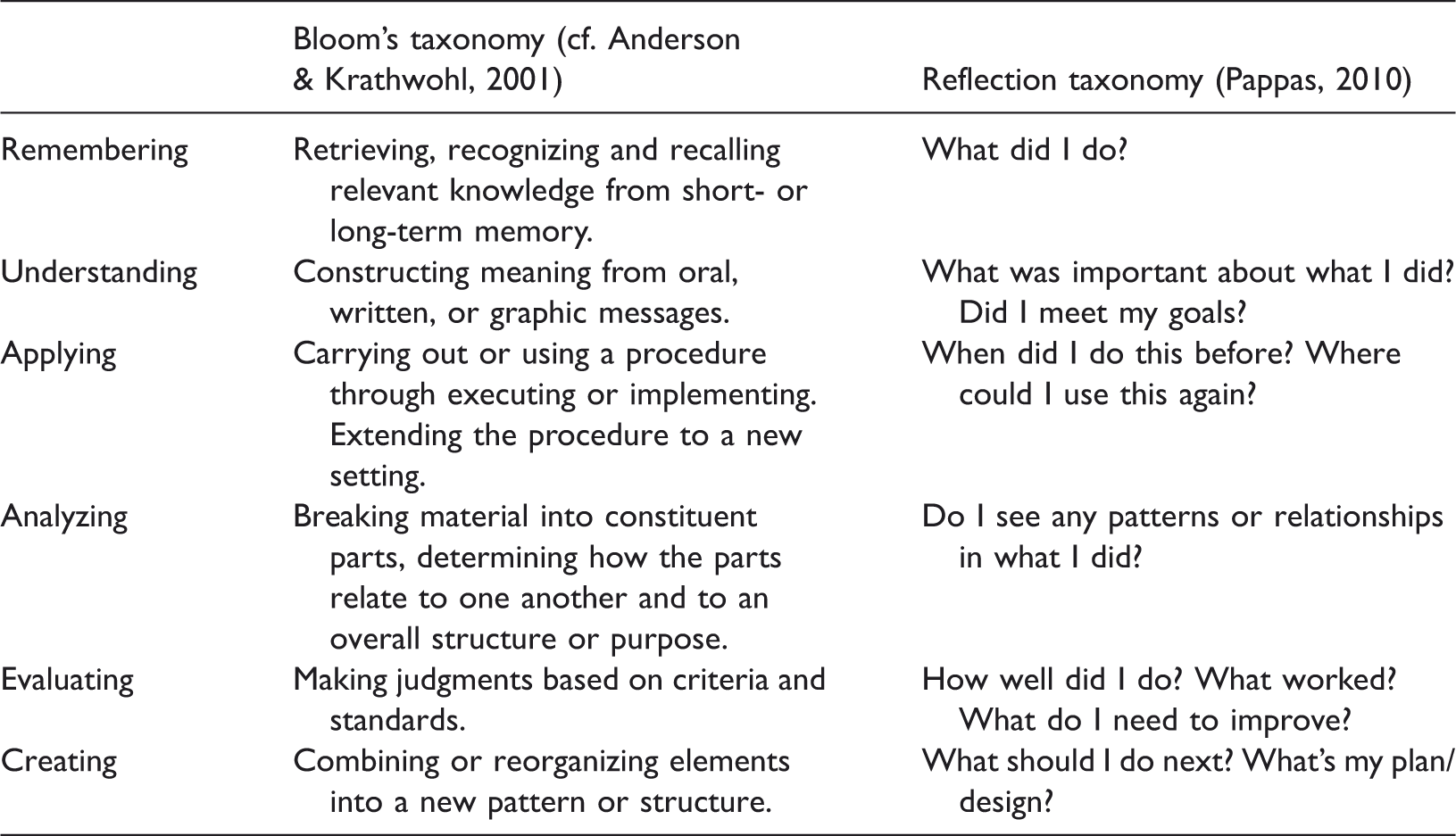
Providing opportunities for students to reflect in these ways was paramount in the design of the complex central task of the unit. The overall unit used both individual and socially mediated reflection: socially through group tasks and extensive use of communication technology and individually through the reflective journals. A final examination also facilitated both these means of reflection. These intentional reflective elements are described in more detail below.
Reflective writing
An effective means to facilitate individual reflection is though a reflective journal or blog. Black, Sileo and Prater (2000) found that the use of personal journals promoted students’ participation in learning by providing them with a formal means and structure for thinking, imagining and making choices. A reflective journal provides an effective means to accomplish this. Other researchers have found that journals facilitate learning: by enabling learners to understand their own learning process (Moon, 1999); by enhancing students’ ability to make multiple connections within a course (O’Rourke, 1998); by enabling students to discover qualities in themselves of which they were unaware (November, 1996); by giving students’ new perspectives on the learning processes they use (Costa & Kallick, 2000); by providing an alternative ‘voice’ for those not good at expressing themselves (Moon, 1999); to promote critical thinking (November, 1996) and to facilitate the maintenance of study routines (Armstrong, Berry, & Lamshed, 2004). Some researchers argue that substantial support and guidance is required if students are to gain the maximum benefits from keeping a reflective journal. For example, November (1996) used reflective journal writing with students of commerce and described the type of guidance that he used to help students benefit from the use of journals by helping students to think in terms of an agenda or list of issues that they face in the course. Hatcher and Pringle (1997) described personal journals used in service-learning classes where students write double entries, reflecting on the course content in the first column and reflecting on their service experience in the second column. This approach would equate to Hatton and Smith’s (1995) first level of descriptive writing in the first column and the much more reflective level of critical reflection in the second column, where the students reflect on their professional practice in the light of the theory of the course content.
In order to encourage students to reflect on action, they were required to keep a blog for the entire semester. The first assignment required students to create a web-based journal for this purpose and include at least one entry. Suggestions were given to students on the learning commentary they might write in a good blog entry so that their journals throughout did not comprise one-dimensional recordings of what they had done that week. Students were encouraged to reflect in their journals in increasingly sophisticated ways to incorporate Boud et al.’s (1985) three phases and Pappas’ (2010) taxonomy. For example, they were asked to reflect and comment on:
Content: Write about the content of the unit, the technologies you are using, the theory you are learning, your reading and the things you are exploring as you complete the tasks. Attitudes and feelings: Write about your thoughts and feelings about the unit, your fears and reservations and your feelings of anticipation and achievement. Learning strategies: Write about how you are learning and the strategies you use to help you learn new technologies and applications. Networks and communication: Write about your communication with others in the class (in person and online), how you learn from others and how you help others. Connections and extensions: Write about how you use your knowledge about technology in your every-day life, in your other units and how you anticipate using it in your classroom with students.
Such guidelines also encourage students to write to achieve further advantages of journal writing, such as developing writing skills, as a psychological dumping ground, a route to self-awareness and to promote critical thinking (November, 1996). Using such approaches, journal writing appears to be more productive in terms of learning outcome than greater opportunities to interact with course content (McCrindle & Christensen, 1995). Other means were also used to ensure social reflection, such as through the use of communication technology in the form of chats (cf. Parker, Boase-Jelinek, & Herrington, 2011), peer review (cf. Boase-Jelinek, Parker, & Herrington, 2013) and through discussion forums (Nicolson & Bond, 2003; Rocco, 2010) in particular in relation to the reflective examination.
Reflective examination
An examination was necessary, partly for practical reasons and partly for policy requirements, namely that 30% of assessment is invigilated. The unit was taught at two campuses and in two modes (on-campus and external) and, so logistically, an examination was a viable assessment option. However, it was necessary to consider how the examination might be conducted in such a way as to align with the authentic nature of the unit. Could an authentic learning environment include a separate final examination—a method associated more with standardised assessment—and remain true to its authentic origins? Some authors such as Lorenz (2001) suggest that a final exam can serve as a valuable reflective review of student learning, and if the exam is thoughtfully designed, it can align creatively with the course curriculum.
Practical, theoretical and pedagogical rationale for examination questions.
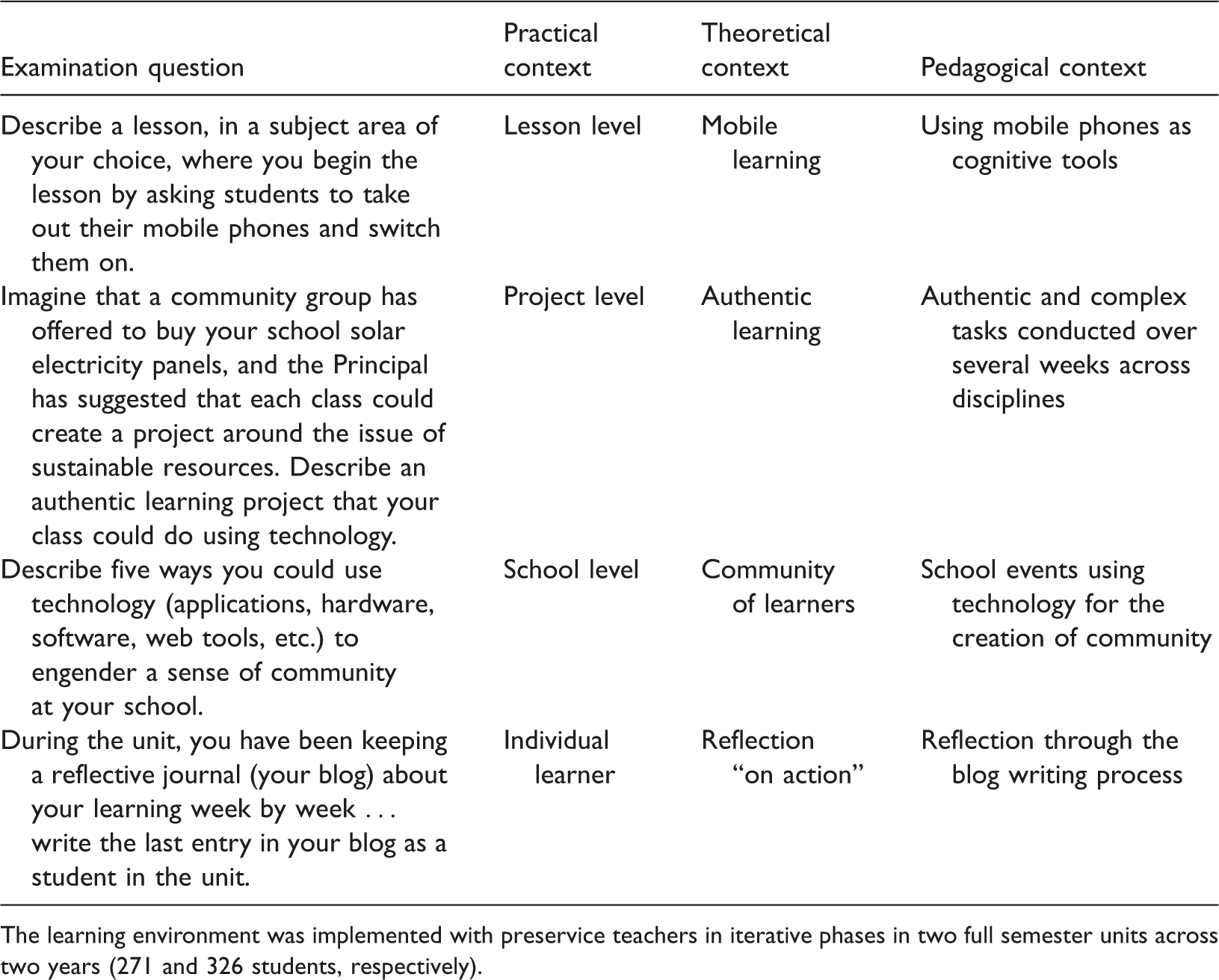
The learning environment was implemented with preservice teachers in iterative phases in two full semester units across two years (271 and 326 students, respectively).
Research methodology
A design-based research approach (specifically Reeves’s (2006) model) was used to guide a comprehensive study of the course and its implementation, comprising four iterative phases: analysis of the problem, design and development of a solution, iterative implementations and evaluation and reflection to create design principles (Herrington & Reeves, 2011). Data collected included two surveys, transcripts of chats and discussion forums, emails, student artefacts including blogs, websites, examination transcripts and assignment products. In this paper, we report on a study conducted within this much larger research agenda, focusing principally on qualitative data obtained from open-ended survey questions to explore the key issues emerging from the reflective elements. The enquiry reported here investigated the use of the reflective enablers in the course—specifically the learning journal in the form of a blog and the reflective examination—guided by the research question: in what ways can a reflective blog and examination facilitate students’ reflection on-action in an authentic learning environment?
All students enrolled in two consecutive cohorts of the unit were asked to complete an anonymous open-ended online survey at the end of the teaching and examination period. Questions related specifically to the journal and examination that were intentionally used to support reflection. Survey response rates over the two cohorts were 46% and 37%, and data were accessed and analysed only after the completion of all semester activities.
Data analysis
Data were analysed using Miles and Huberman’s (1994) overarching approach of data reduction, data display and conclusion drawing and verification. All data were compiled as anonymous comments and were analysed using a constant comparative method (Glaser & Strauss, 1967; Strauss & Corbin, 1990). Themes and issues were identified and integrated by grouping similar themes into broad categories; specifically, codes were tentatively assigned to each issue or idea within a response, and comments were then sorted to identify similar words, phrases and sequences of ideas to identify patterns of responses. Findings were then written up using select quotations to illustrate themes. Given the large volume of data, quotations were selected to illustrate a precise or distinctive point of view or as an ‘articulate and reflective’ expression of a common theme (Miles & Huberman, 1994, p. 268).
Discussion of findings
The principal design feature to instantiate reflection as an element of authentic learning was an authentic task to enable students to reflect in an engaging and intentional learning environment rather than as a response to external cues or reminders. The findings suggest that the learning task did allow students to reflect freely on their learning by enabling them to return to experiences, attend to feelings and to re-evaluate the experience (Boud et al., 1985).
Authentic task
In the survey responses, several students recognised the usefulness of the authentic nature of the task, contrasting it to a more didactic style of ‘receiving information’. For example, one student wrote: Completing authentic tasks was invaluable as I now know how to do things, working through mistakes rather than receiving information and never applying it. (Respondent 37, Iteration 2) … the ‘hands on’ approach. Allowing us to find, experiment and discover technologies for ourselves and actually have a go at putting them into context. Very authentic learning task! (R95, I2) Even though I had ups and downs with the learning of technology for this unit, I will never forget what I have learnt because of the relevance it had to the ‘real world'. The group project surprised me on how well it worked in the end after my feeling of apprehension at the start (R94, I1)
Response to reflective blog
Aside from comments about the fairness of group work, such as one person carrying much of the load, generally, students were positive in their response to the reflective task. However, there were many more varied responses to the reflective blog ranging from outright dislike and contempt to surprise and enthusiasm on how useful it was for learning. While some students found the blog to be a complete waste of time—as Hobbs (2007) explained, not all students are positively disposed to reflective writing—others begrudgingly accepted that it could be valuable: I actually found it really annoying, I understood the meaning and uses of doing the blog, but as I don’t really like to blog I sometimes found it tedious and a waste of time. But I can see the educational value in it. (R49, I1) The blog was not very useful to me I think, although it did allow reflection I felt it was more a way for the tutor to be sure I knew what I was doing, whereas I think it should be easily seen in the task itself. (R12, I1)
Benefits of reflection
In one sense, the closeness of the tutor to each student’s blog was also arguably a useful reflective construct in its own right, in that it enabled follow-up communication from the tutor if the student’s journal was bordering on the shallow or superficial, or if it indicated that other support was required. Mälkki and Lindblom-Ylänne (2012) have pointed out that: ‘Sometimes what one does not reflect on may be more relevant for one’s pedagogical development than the issues one reflects on’ leading them to suggest that with ‘an extra round of feedback, the focus could be shifted to pointing out the assumptions that are taken for granted and left unreflected’ (p. 47). On a more positive side, students’ comments at times illustrated the positive benefits of reflective journals suggested in the literature. For example, the following student’s response reflects November’s (1996) belief that journals enable students to discover qualities in themselves of which they may have been unaware: The blog was extremely enjoyable and educational. I learnt about myself by reflecting on what I’d learnt and how I was applying it. (R62, I2)
Deepening commitment to reflection
Students also commented on how they become more committed to blogging as they progressed through the unit, indicating that they were becoming more actively involved in their own learning and taking personal ownership of it (Moon, 1999): I personally found it difficult to blog and incorporate all the things that were required, personal encounters, what we learnt etc. When I did blog it was short because I had to write something. When I started writing the longer entries at the end it found it useful as it reaffirmed what I had already learnt. (R80, I2) I found the blogging exceptionally useful throughout the unit. Although it was very time-consuming, it forced me to more carefully contemplate what I was doing and how I was going about it. At times, I even referred back to my blog to remind myself how I had done something. (R19, I1) The blog was useful as I was able to retrace my journey throughout the unit. Upon commencing this unit I knew very little about technology and now feel that I have a vast amount of knowledge to be able to share with others. It's nice to be able to look back and see that I once too, was also a learner. (R4, I2)
Reflection in an examination context
The findings in response to the reflective exam at times mirrored our own reservations about having an exam in a unit designed according to authentic learning principles. One student pointed out the contradiction while at the same time acknowledging the benefits: [The exam] did help me reflect on the unit as a whole. I found the blog question in particular was very relevant because we had spent a lot of time and effort blogging and because it was a good reflection and comparison of our overall progress in the unit … The rest of the questions were good examples for us … to bring it all together. However, I can't help but feel an exam is not really relevant in a unit that has such a focus on authentic learning. (R10, I2) It was a great idea to have the blog question in the exam as it had been so much of a focus in this unit on a personal basis and something we had to do regularly, and to finish it off there was perfect! (R94, I1) The blog was useful as was the blog question in the exam. It gave the opportunity to bring together all that was learnt and reflect on the overall unit. It a way in gave closure to what was a rollercoaster ride in learning new technologies. (R108, I1) The exam was a good chance to think carefully about how to apply the knowledge and ideas generated by the assignments throughout the unit. It was also a needed kick to catch up on readings, which were very relevant and interesting and which I may have otherwise missed or been tempted to skip because of the self-directed learning promoted by this unit. That in itself was a lesson worth learning - sometimes even the most interested student needs their attention focused in a specific way in order to see the bigger picture. (R17, I2)
Conclusion
In investigating how a reflective blog and examination can facilitate students’ reflection in an authentic learning environment, a range of issues have emerged from this analysis that have implications for teachers in higher education, particularly those preparing students for the service professions where critical reflection is part of every-day practice. The reflective elements of the course could not intentionally ‘teach’ students how to reflect in a meaningful way in a learning environment. They did, however, appear to facilitate reflection both in-action, through the completion of an authentic task and on-action (Schon, 1987) through a journal blog and a reflective examination.
The authentic task required students to think, decide and act without explicit instructions on how to complete the task. The very first collaborative decisions required reflection to make choices about how each task would be completed. The data revealed that feelings of apprehension and confusion abate as students take control of their learning to create authentic products. An implication for educators is that the products of authentic tasks develop over time (Rocco, 2010), and scaffolding and support should be provided at the metacognitive level, rather than capitulation through the provision of specific step-by-step instructions in the early stages of completing the task.
The requirement to keep a reflective journal blog elicited a range of responses, including contempt (Hobbs, 2007), but also delight and satisfaction on how useful it was for learning. The fact that some students felt the blog to be little more than surveillance carries an important implication for educators. Teachers can use information provided in blogs, not to admonish, but to diagnose problems and provide support required and make positive suggestions for further enhancement of learning. Such suggestions can also build on students’ self-discovery of learning qualities of which they were previously unaware (November, 1996). They can also encourage and support students—particularly in the early stages of blog writing—until they reach the point that many students mention, where the writing becomes self-fulfilling and sustained as the benefits become more pronounced (Moon, 1999).
The reflective examination, while initially appearing to contradict the authentic nature of the course, also appeared to have many benefits in terms of reflection over the entire curriculum (Lorenz, 2001). By providing most questions in advance, students were able to review the curriculum and the tasks and products they created, in their entirety. An implication for educators is that examinations should ideally provide students with the opportunity to plan learning in an authentically described scenario, rather than testing factual knowledge about a particular subject area.
Helping to make the reflective process personally meaningful to students is a key challenge. Some researchers and theorists have expressed scepticism that reflection can be ‘taught’ and maintain that pedagogical strategies that attempt to do so fail to effect true reflection on learning (Boud, 2006). We agree, if the pedagogical strategy entails little more than checklists or instrumental prompts that must be addressed diligently in order to meet assessment requirements. However, if reflection is, in effect, woven intentionally throughout the fabric of an entire semester curriculum, and the tasks and supports implicit in the learning environment encourage a reflective response (Tummons, 2011), then we argue that it is successful. The provision of the conditions conducive to reflection—rather than explicit direction—provide a powerful enabler for this most critical of learning functions.
A limitation of this study is that it comprises a small part of a much larger study and, by necessity, cannot draw on the full context of the learning environment. Nevertheless, limiting the study also has benefits in that the important area of reflection could be explored in depth. Further areas for research can also be drawn from the study, in particular, investigation of whether development of community can be as powerful an enabler of reflection as journals and further research into the nature and affordances of reflective examinations.
The use of authentic learning principles to prepare primary school teachers in the effective use of educational technologies is an important challenge. Designing a course to promote reflection, using tools such as described in this paper, enables pre-service teachers to become thoughtful and effective professionals who can, in turn, assist their own students to engage in reflective and intentional learning.