



Abstract
This article challenges the global coloniality of the doctrine of domination that re-presents itself in Aotearoa/New Zealand as an uneven ‘partnership’ between Māori (the Indigenes) and the colonizer (the British). That domination is maintained through the western positivistic one-size-fits-all ‘global north’ policies and practices in a colonial education system which is hegemonic and racist. The work of Kōhanga Reo (Indigenous language nests) in the early year’s education stream means a continuous flow of productive unsettlement, in order to survive, in order to dismantle the hegemonic structures and in order to transform Indigenous children’s lives. Through the southern lens of a ‘counter-global coloniality’, some of the historical antecedents of the doctrine of ‘civilization’ and philosophical underpinnings of Kōhanga Reo are sketched in terms of their ability to transform pedagogies of oppression and neoliberal futures. It is argued that Indigenous knowledge and languages can mediate the power relations of colonial dominance and Indigenous subordination, because they provide the keys to unlock and liberate the spaces, places and minds of coloniality.
Keywords
Introduction
New Zealand’s founding document, The Treaty of Waitangi, 1840, was signed between the representative of Queen Victoria of England (Captain William Hobson as governor) and representatives of the Hapū (self-governing tribes) of Aotearoa/New Zealand as an international partnership accord. It provided certain guarantees, one of which is the protection of Māori rights, including language, lands, forests and fisheries. The peaceful settlement of Aotearoa/New Zealand which, the Treaty relationship portended, was far from peaceful and not the cession of sovereignty as is often claimed. Within 20 years of its signing war broke out, instigated by the British who sought to validate invalid land sales, confiscations and cement their political hegemony, particularly once their numerical dominance was achieved (Mikaere, 2011; Mutu, 2010; Walker, 2004). Powerful mythologizing hegemonic discourses bedded down in the newly formed settler institutions (Ballara, 1986; Bevan-Smith, 2012). One such powerful discourse was of the ‘cannibal/savage’. As Ballara (1986) succinctly puts it, ‘… in the end, in spite of the treaty, it was to be the concept of the wandering savage who had no rights to land that was adopted and recognized by the settler governments once self-government was attained’ (p. 36). Within seven short years of signing the Treaty, the partnership accord of 1840 was disrupted. Māori then had to test their sovereignty in the settler courts. By 1877, Judge Prendergast found Aotearoa to be inhabited only by ‘savages’ and ‘barbarians’ and not by sovereign peoples capable of signing a treaty, thereby ruling the Treaty a simple ‘nullity’.
This article posits that a challenge to the global coloniality of ‘institutionalized education’ is what underpins the kaupapa Māori (Māori-centred) initiative of Kōhanga Reo (early childhood Māori-language nests) through the regeneration of te reo Māori in a rangatiratanga (chiefly, sovereign or self-determining) approach. This article further discusses how the uneven ‘partnership’ between Māori and the colonizer is maintained through the dominance of a universal one-size-fits-all ‘global north’ (British) onto-epistemological positioning in education, making the work of Kōhanga Reo a continuous flow of productive unsettlement, in order to survive. The dominant colonial practices are maintained in education through the minds of the global-north teachers and a global-north curriculum Te Whāriki: He Whāriki Mātauranga mō ngā Mokopuna o Aotearoa: Early Childhood Curriculum (Ministry of Education, 1996) in the global south. This curriculum purports to convey the bicultural/bilingual underpinnings of a revolutionary early childhood curriculum in an early childhood field which continues to struggle with linguicism (Skutnabb-Kangas, 2015), resulting in linguafaction (Skerrett, 2014).
According to Taylor and Pacini-Ketchabaw (2015), productive unsettlement is the troubling of the business as usual in the early childhood sector. This is risky business. It involves asking the hard and provocative questions, troubling norms and interrogating conventional truths. Persky and Viruru (2015) wrote about children in the ‘borderlands’ inhabiting contested territory. For some teacher educators too, when challenging the policies, discourses and practices within teacher education in the white-stream global tertiary sector, it is risky business often ending in retrenchment to the ‘borderlands’. This article provides an exposé of some of that risky business and life in the ‘borderland’ or at the ‘interface’ as Mason Durie (2003) puts it, with implications for Kōhanga Reo in the shifting sands of neoliberal reform.
Kōhanga Reo
The rapid expansion of the revolutionary Kōhanga Reo early years language-in-culture education movement is positioned in the groundbreaking spaces, as Māori leaders, particularly Māori mothers, proposed that they start teaching their very young ones through the medium of te reo Māori. This was in order to bridge the Māori-language gap between the ageing native-speaking elders and the very young. While global-north colonial education was about taking Māori children out of the cultural–historical pedagogical contexts of whānau, hapū and iwi, 1 re-visioning early childhood care and education from global-south perspectives was about re-positioning Māori children at the centre of whānau, hapū and iwi. It poses a challenge to global coloniality of ‘schooling’ in English through the regeneration and reassertion of the global-south Māori language in a rangatiratanga (chiefly, sovereign or self-determining) approach.
Te Rangatiratanga o te Reo through Kōhanga Reo early years education
A rangatiratanga approach seeks change and to redress unjust practices. It contests the positioning of Māori children as subservient objects for subjugation. It challenges the notion of white-stream teachers as ‘authority and authoritative’, and it rejects the construct of linguistic hierarchies and linguicism (see later in this article). All languages are powerful. When one is subjugated to and by the system, an injustice occurs. Te rangatiratanga o te reo then is simultaneously about resistance and justice. It is a reassertion of the legitimation and authority of te reo Māori in children’s lives and a right to do so. It is a drive to invert the prevailing ideologies of hierarchizing languages, restoring high linguistic, symbolic and socio-political value to te reo Māori through liberatory praxis in teaching and learning environments. The liberatory power of the Māori language to free the Māori mind from the language and thinking of the colonizer is what is inherent in the te rangatiratanga o te reo, kia Māori (so that Māori worldviews are foregrounded). All this while concentrating on our children at the centre within the tribal unit of the whānau, which has historically (and still is) been undermined by colonization through monolingual English-language education.
Global coloniality
This section, through the lens of a ‘counter-global coloniality’ traces some of that history, its philosophical underpinnings and how it shapes the interface in Aotearoa. History is important. After Freire’s (Leonard and McLaren, 2004) genius, we are all walking, talking, thinking, feeling, active, loving histories, and the struggle to transform life at the interface is a struggle for liberation. Freire took Marx’s best known thesis that ‘the philosophers have only interpreted the world in various ways, the point is to change it’ (Leonard and McLaren, 2004: xiii) transforming pedagogies of oppression. He built on Marx’s criticisms of status quo materialism and idealism for being contemplative and reducing practice to theory, putting abstract reality above the physical world. He turned the corner on Marx’s thesis through enacting pedagogies of praxis, conscientization, transformation and emancipation. All knowledge are based on the socio-historical cultures of their time. The cultural particularism in the workings at the interface in Aotearoa cannot be ignored, and, at the same time, must not abandon the imperative to co-ordinate the interface within the wider global context. That interface is positioned in the space spanning the egopolitics (God-eyed and universal) of knowledge on one side and the geopolitics (embodied and local/Indigenous) of knowledge on the other.
Grosfoguel (2015) argues that all knowledge are epistemically located either in the dominant (colonial/global north) or subordinate (subaltern/global south) side of the power relations. Furthermore, the egopolitics of knowledge is privileged over the geopolitics of knowledge. He ideologically clarifies the divide between the dominant (colonial) and subordinate (subaltern) paradigms which he calls the politics of ‘global coloniality’. He argues that invariably western theorists default to producing studies ‘about’ the subaltern rather than ‘with and alongside’ subaltern perspectives, which merely reproduce the politics of coloniality. He discusses the ‘god-eyed, egopolitics of knowledge’ centred in western philosophy and sciences where the subject that speaks is always concealed from the analysis because it is a unitary that speaks for the whole. It is ‘one’ speaking for ‘all’, concealing its ‘self’ while maintaining its façade – an invented abstract ‘universality’. Furthermore, the egopolitical versus geopolitical dualism was initiated in a moment of history by the founder of modern western philosophy René Descartes with the ‘I think therefore I am’ philosophical turn. Now known as the Cartesian split, Descartes replaces god as the foundation of knowledge in European Middle Ages with (western) man as the foundation of knowledge in European Modern times. The capacity to produce a ‘God-eyed’ point of view is now placed in the mind of western ‘scientific’ man. By producing a dualism between mind and body, between mind and nature and mind over matter, Descartes was able to claim disembodied, universal knowledge as omniscient divine knowledge or a point of view that represents itself as being without a point of view. It cannot declare its egocentric particularized point of view because then it would have no power, no ‘truth’, no logic and no credence. By delinking the ethnic/racial/sexual epistemic location from the speaker (and hence the speaker’s politics), universal myths are created. Through western institutions, they are maintained.
Global north in the local south: Western man in Aotearoa
A graphic example of the omniscience of western man is exemplified here in McLintock’s (1949) history of the colonization of Otago, Aotearoa. He drew on many historical documents, including Captain Cook’s logs and other documents from the 1800s, to provide the following exposé: [That] Otago was destined to become the scene of a most interesting experiment in colonization did not even remotely enter his [Captain Cook’s] mind. The land lay empty, unkempt and wild, and upon it rested still unbroken the silence of the centuries … In the remote past the physical environment of a society was its dominant factor, and even among primitive people, such as the pre-European Māori, the human being was largely at the mercy of omnipotent nature. Natural phenomena dominated his thoughts, controlled his life and shaped his religion. In a very real sense, such history could be regarded as merely geography set in motion … This does not mean that the historian is prepared to accept the absolute dictation of the geographical [natural phenomena] factor alone. He realizes, however, the need for an adequate study of any historical problem, first, as regards the action of Nature on Man and, secondly, of equal or of greater importance, as regards the reaction of Man on Nature. Thus, if certain consequences follow certain causes, the explanation may well arise from human determination no less than from natural determinism. The colonization of Otago, which fell within the last century, gives excellent scope for such a two-fold investigation – the primitive environment, stark and unsympathetic, the pioneer society, eager to conquer and subdue. (pp. 7–8)
The quote so aptly exemplifies the colonial mind set, positioning Indigenous peoples in specific ways in the following binaries: empty land (terra nullius), with invisible tāngata whenua; 2 primitive unkempt and wild land (with unbroken silence), with primitive unkempt, wild people (who do not have a language or grammar) versus a subdued conquered land (to be filled with civilized people wielding axes and hammers, with sheep); Māori as ‘geography set in motion’, colonizers as ‘motion set upon the geography’; Māori as ‘nature on man’ versus colonizer as ‘man on nature’; natural determinism (nature determines for Māori who merely ‘exist and do not think’) versus human determination (of colonizing western man who ‘thinks and therefore is’ able to conquer and subdue). A central theme is that ‘pre-European’ Māori were at the mercy of omnipotent nature and saved with the coming of the God-eyed, bible-bearing western Man who was omnipotent (over nature and all creatures, great and small).
Of course, by the time, the British got around to colonizing Aotearoa/New Zealand, the European colonial tradition of imperial expansion outside of Europe had been around for at least 500 years. The colonization of Indigenous peoples is seen as the ‘historical problem’, but the ‘problem’ was somewhat technical; how to extricate the land out of people and the people out of the land. Colonization is a violent process in terms of what happens to nature, to Papatūānuku 3 and to the people of the land, the tāngata whenua. Indigenous peoples (their languages and ecosystems) throughout the colonized world became a disposable by-product in the territorializing colonial endeavour by those ‘eager to conquer and subdue’. Papatūānuku became ‘it’, an apparatus for western capitalist expansion (farming, fracking, mining and agriculture). All so obvious in our national ‘coat of arms’ (see Figure 1) where the woman, named Zealandia, symbolizes the national personification of New Zealand bearing the flag with hand on shield representing all that is coveted, under the crown (symbol of British sovereign power), juxtaposed with an unnamed ‘Māori warrior’ with a taiaha. 4
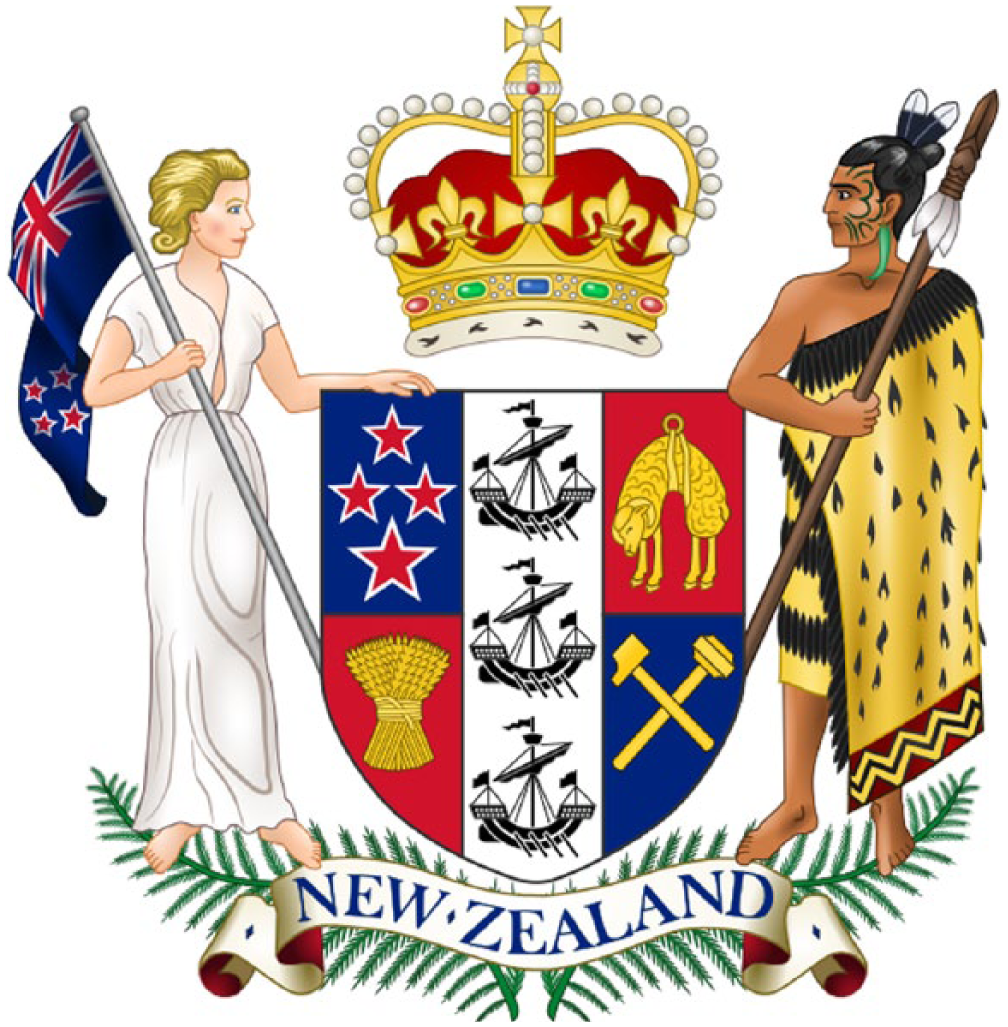
New Zealand’s coat of arms.
Since 1911, the shield has remained unaltered even though there have been various iterations. The symbols are top left a shield containing four stars representing the Southern Cross, top right a golden fleece (sheep) representing the farming industry, in bottom left a wheat sheaf representing agriculture and bottom right two hammers representing mining and industry. The broad vertical strip has three ships representing the immigrant nature of (Pākehā) New Zealanders. Māori New Zealanders’ ocean-going vehicles, the waka hourua, are noticeably absent. The shield is bereft of Māori symbols of belonging, and Māori language is invisibilized. Western man, concealed, is omnipresent not only in the totality of the symbolism of ‘the shield’ and its contents but also with the all-powerful ‘sovereign’ Crown. Aotearoa with birds, mountains and marae 5 with whānau, hapū and iwi Māori is invisibilized. But all that is coveted, lands, seas, skies, everything above and below the horizons, is claimed by the Crown (and its concealed representatives).
So it is with the God-eyed egopolitical set of ideals and beliefs in mind, symbolized in the Coat of Arms, that the vanguard to imperialistic colonial invasion of Aotearoa took place but not without struggle, both epistemically and ontologically. While the disembodied universal ideas were to mythologize Māori as savage cannibals, the embodied knowledge and lived realities of Māori caused much cognitive dissonance in the minds of the colonizers. As Fanon (1967) puts it, Sometimes people hold a core belief that is very strong. When they are presented with evidence that works against that belief, the new evidence cannot be accepted. It would create a feeling that is extremely uncomfortable, called cognitive dissonance. And because it is so important to protect the core belief, they will rationalize, ignore and even deny anything that doesn’t fit in with the core belief. (p. 194)
Savage’s (his actual name) 1805 account of Māori, on his first encounter, records his cognitive dissonance, upsetting all his preconceptions of Māori: In a country that has been described as peopled by a race of cannibals, you are agreeably surprised by the appearance of the natives, who betray no symptom of savage ferocity, and by the patches of cultivated ground in the neighbourhood of the bay; on each of which is seen a well-thatched hut, and a shed at a little distance. These are the appearances observable from the ship; which, together with the abundant supply of fish and potatoes brought on board by the natives, tend forcibly to remove the prejudices you have imbibed from former accounts of this country and its inhabitants. (Savage, 1807, cited in Salmond, 1991: 332)
Furthermore, that The people paid homage to the sun, the stars and especially the moon … When they greeted the rising sun in the morning, they spread their arms and bowed their heads ‘with the appearance of much joy in their countenances, accompanied with a degree of elegant and reverential solemnity’. At this time they sang a cheerful, harmonious song, while at sunset the song was mournful, led by one person and with all the others joining in the chorus. (Salmond, 1991: 335)
The many varied and contradictory accounts of Māori as savage barbarians were replicated ad nausea, so another myth had to be created to rationalize the core belief of Māori as savage with the evidence that went against that idea, which is the newly invented notion that Māori were indeed the ‘noble savages’. The ‘noble savage’ idea came about because of such writings by the powerful Head of the Church Missionary Society the Reverend Samuel Marsden who was suitably impressed by the intellectual capacity of the Māori he had met and documented this: A finer race of men has seldom, if ever, been found in any country, than the New Zealanders; which is strong evidence that they are well fed, and their habits and employments are congenial to the health and vigour of the human constitution. Not only were the New Zealanders healthy and robust; they were also intelligent and enterprising … I am fully convinced that they would soon become a great nation, if the Arts could be introduced among them, without the ruinous vices and prevalent diseases of Civilized Society. (Salmond, 1991: 415)
But the doctrine of civilization through the vanguard of the Evangelicals had to be ascertained in order to institute colonial political power and dominance in Aotearoa. Ghandi wrote that ‘If you don’t understand the relationship of religion to politics, you don’t understand either’. Judith Binney (1968) wrote, ‘The “gospel” and “civilization” were to the missionary inextricably linked’ (p. 8). The invasive western agenda was predetermined by the time the 1840 Treaty of Waitangi was signed. The result of the global-north invasion of Aotearoa meant that all too soon Māori struggled to sustain the lifestyles, cultural and spiritual practices, and language and education systems once the settler colonizers arrived with their insatiable demands for land.
As with the colonization of Otago, McLintock (1949) adds ‘… the native birds were fated to disappear at a rate corresponding to the destruction of the forest’ (p. 22), so too are Indigenous languages (Indigenous flora and fauna) fated to disappear at a rate corresponding to the territorialization of their lands. The mellifluous dawn chorus all but vanished, surviving only in small, isolated pockets; in much the same way as iwi Māori and language have survived in small, isolated pockets. This phenomenon is called linguafaction (see Skerrett, 2014) after the phenomenon liquefaction.
Linguafaction and linguicism through coloniality in education
Liquefaction happens during earthquakes when ground movement causes soils to liquefy. While there are many hazards that result from seismic movement, liquefaction is ground failure. It is full of contaminated water and ooze. Linguafaction, in this sense, is akin to liquefaction. Linguafaction occurs when Papatūānuku is commodified (e.g. for cities, farming, mining and other industries) through territorialization, through striation and through the seismic impact of colonization, so that she is no longer able to sustain her Indigenous populations, their ways of life and their land languages. Indigenous peoples can no longer thrive in their own homelands; their knowledge and value systems once solid now liquidated as their languages are overcome by killer ‘colonial’ languages. Language shift through territorialization, like the land shift through seismic activity, creates the ‘linguafaction’. As in the earthquake zones where liquefaction makes the ground unsafe, in colonized zones linguafaction makes communicative spaces unsafe. Smooth spaces where Indigenous languages, cultures and peoples thrived for millennia rapidly shift and disappear with colonization. The tāngata whenua (people of the land who speak land languages) typically suffer from introduced diseases, culture shock, language loss, temporal disorientation and many die. Striated spaces are hazardous spaces for land languages, and the people who use them. As Papatūānuku is conquered and subdued, so too is the terralingua of the land conquered and subdued. Language/s shift (from the terralingua of natural ‘smooth’ environments to colonial language/s of unnatural territorialized space) is the fate of all Indigenous languages living with linguafaction. Indigenous language/s undergo shift (from languages of the land to foreign colonial languages) equivalent to the rate of shift of land from Indigenous people/s to the colonizers.
Linguafaction is about creating unequal societal factions based on the languages one speaks and the culture/s (and its members) those languages represent. One language dominates and exploits for political and economic power, while the other (colonized) languages are quagmired, resulting in a language shift to the dominant language with ever decreasing Indigenous language domains. This shift is extremely harmful to children. It creates divisions and disconnections as the child’s sensibility with the language of his or her experience of life is stripped away through western (schooling) education systems.
Tove Skutnabb-Kangas (2015) coined the term linguicism which involves clear discrimination on the basis of which language(s) people speak or sign, natively or otherwise, and how they speak it, similar to the discrimination involving the social constructs of race, gender and class. The agents of linguicism are ideologies, structures and practices which are used to legitimate, effectuate, regulate and reproduce an unequal division of power and resources (both material and immaterial) between groups which are defined on the basis of language. (p. 1)
After Skutnabb-Kangas (2015), the assimilationist ideology of the global-north education instituted in Aotearoa reflects linguicism because it created a subtractive learning situation (subtracting the Māori language) privileging English. If an educational system is organized so that all teaching happens through the medium of the dominant colonizing language and the teachers are monolingual in it (as is the case in Aotearoa/New Zealand), we have a submersion learning situation, and the school’s structure reflects linguicism. All practices where people get unequal access to power and resources based on their language/s reflect linguicism.
Furthermore, Skutnabb-Kangas overviews the three processes of colonization: glorification, stigmatization and rationalization. First, dominant/majority groups, their languages, cultures, norms, traditions, institutions, levels of development, observance of human rights and so on, are glorified. This includes claims about what the languages are – for example, logical, rich and scientific (they have a grammar); what they have – for example, teaching materials, well-trained teachers and so on; and what they can do for you – such as open doors, function as a window onto the world, get a good job and so on. Second, subordinated groups, their languages, cultures, norms, traditions, institutions and so on, are stigmatized, so that they are seen as ‘traditional’ and even ‘backward’. Their grammars are not recognized, and their knowledge bases denounced. In the third process, the relationship between the groups is rationalized economically, politically, psychologically, educationally, sociologically and linguistically. What the dominant groups do is always normalized and made to seem functional and beneficial to the minorities/subordinated groups. For instance, as in the case of Māori, the dominant group is ‘civilizing’, ‘modernizing’, and so on. Linguicism then is a denial of linguistic human rights and proceeds to ‘… hierarchizing the languages and their speakers on the basis of language’ (p. 2). When the full discriminatory apparatus of the state shakes down, ‘linguafaction’ bubbles up and linguicism sets in.
Implications for early years education in Kōhanga Reo
The work of Kōhanga Reo (early years Māori-language nests) then is not easy, especially because many Māori too have been colonized and assimilated. Māori language is in crisis and there are not many speakers who speak with a ‘Māori mind’. Pedagogies of linguicism are prohibitive of transformative praxis and harmful. The relationship of language with mind is unclear for many. This has led to the situation where, while many Maori are socially located in the geopolitical camp, their minds may be fixed in the egopolitical camp. Grosfoguel (2015) puts it this way when he distinguishes the ‘epistemic location’ from the ‘social location’ and argues that The fact that one is socially located in the oppressed side of power relations does not automatically mean that he/she is epistemically thinking from a subaltern epistemic location. The success of the modern/colonial world−system consists precisely in making subjects that are socially located on the oppressed side of the colonial difference think epistemically like the ones in dominant positions. (p. 6)
The success of the modern/colonial world system is pronounced in New Zealand. Many of our own Māori people are unable to see the relationships between language, mind and culture, and so they think epistemically like the ones in dominant positions, yet purport to represent their Māori ancestral world views through a British-western world view. Their positioning is fundamentally flawed. Without the Māori language, the Māori mind and Māori thinking, unique Māori world views will be lost. The promotion of te reo Māori as a vernacular therefore is an imperative. To that end, te reo Māori was first entrenched in legislation as an official language under the Māori Language Act, 1987, and again in the updated Māori Language Act of 2016. But legislation has not been followed up with adequate educational policy. Te reo Māori does not share space alongside English in the compulsory sector. Even in the tertiary sector, there is considerable disconnect between the law and practice through the following example of what happened within a teacher education programme in Canterbury. Māori language teaching academic staff, working with the purported bicultural/bilingual document Te Whāriki: he whāriki mātauranga mō ngā mokopuna o Aotearoa: early childhood curriculum (Ministry of Education, 1996; Te Whāriki), were set upon, when a global-north recent arrival declared that when providing written feedback to students ‘our custom and practice has been to provide this in English. [To use] Te Reo Māori [is] a change in practice – [and] would need to be facilitated through program and organizational decision processes and planned action …’ She added that until such planned action occurs, it is ensured that feedback to students is provided in English. This person of power had been in the country 5 minutes so to speak and was already working through a pedagogy of linguicism. After over 1000 years of Māori language occupying this place, not only is this a classic case of linguicism, it is indicative of the systemic micro-aggressions (Rollock, 2012) levied towards Māori-language academics. This piece of policy in text goes against policy in law and policy in practice. Little wonder that the early childhood curriculum is in disarray in many places and teachers confused when those leading teacher education are confused. Suffice to say, the above issue of alienating Māori language (and Māori academics) through a pedagogy of linguicism led to challenging the politics of the ‘global north colonial center’, and subsequently the development of the inaugural Māori-language policy, Te Reo Rangatira (Tertiary Education Union, 2014) for the whole tertiary sector in New Zealand. We have yet to see the difference that makes in practice.
Curriculum reform to conform: Te Whāriki: An ideological conundrum
In the midst of New Zealand’s great socio-economic neoliberal restructure of the 1980s known as Rogernomics (combining the Christian name of the then finance minister ‘Roger Douglas’ and ‘economics’) Te Whāriki, He Whāriki Mātauranga mo ngā Mokopuna o Aotearoa (Ministry of Education, 1996; Te Whāriki), the early childhood curriculum for Aotearoa/New Zealand was instituted. The 1980s and 1990s was characterized by market-led restructuring of the socio-economic policies by the New Zealand government to line up with Thatcherism and Reaganomics. Te Whāriki was developed in the midst of the restructure and therefore was its product in the period from 1991 to 1996. Following extensive consultation with diverse groups Te Whāriki: Draft guidelines for developmentally appropriate programs in early childhood services was published in 1993. Several pilot projects were established, and at the end of 1995, the Ministry of Education funded a round of teacher development contracts offering widespread support specifically for its implementation (Nuttall, 2005) to the white stream. Even though Te Kōhanga Reo (TKR) came under the umbrella of the Ministry of Education, no such support was accessible to those of us working there. Curriculum matters for white stream were going full-steam ahead, but the paradigmatic shift that took place in the wai Māori 6 stream came about by the groundswell of whānau Māori belief in the idea of, and excitement in hearing, very young children speaking Māori, so severe had been the shift from Māori language to English.
Under the heading ‘The Educationalisation of Early Childhood’, 7 Duhn (2012) asserts that the education sector reforms coincided with major social reforms in Aotearoa. The moves constituted the political will towards the educationalization (and standardization) of early childhood. The borrowed catch phrase of the day was ‘from the cradle to the grave’ was apposite. The curriculum provides links to the primary sector curriculum, The New Zealand Curriculum Framework which mandates the use of English only as part of the core curriculum. In many respects Te Whāriki was irrelevant to TKR, but the TKR movement got swept up in the wave of regulatory reform and Māori children became part of the grid which produces the norms, locked in, school ready.
Te Whāriki is publicized as being the first bicultural curriculum statement developed in New Zealand and puts up a strong case for all children in New Zealand to being bicultural, stating, This is a curriculum for early childhood care and education in New Zealand. In early childhood education settings, all children should be given the opportunity to develop knowledge and an understanding of the cultural heritages of both partners to Te Tiriti o Waitangi. The curriculum reflects this partnership in text and structure. (Ministry of Education, 1996: 9)
The (almost traditional) opt-out clause is poignant and made visible through the words ‘should be’ (p. 9). They ‘should be’ but are not. New Zealand’s Education Review Office (ERO) is a government agency which evaluates and reports on the education and care of children and young people in early childhood services and schools. In 2013, ERO reported on implicit curriculum issues and a practice disconnect. They found that many services saw Te Whāriki as a ‘given’ and referred to it as ‘everything we do’ and ‘who we are’ (p. 9). But where services were working with Te Whāriki in this way, as an implicit curriculum, there lacked a shared understanding of the implications for practice among teachers and, therefore, outcomes for learners. ERO found that the practices are far from ‘bicultural’. Many services only made reference to the Treaty and Treaty partnerships in their philosophy statements, not in practice. Too few centres were actually working in partnership with whānau Māori and through a bicultural curriculum which was responsive to Māori community, despite the directive that … decisions about the ways in which bicultural goals and practices are developed within each early childhood education setting should be made in consultation with the appropriate tāngata whenua. (Ministry of Education, 1996: 11)
Crucially, the ambiguity in the words ‘should be’ and ‘appropriate’ is the challenge. First, there is no imperative to do anything. Second, once again, the bicultural practices ‘should be’ happening in consultation, but invariably they are not even happening, let alone in consultation. Finally, whoever determines ‘who is appropriate’ when the ‘whoever is determining’ may actually be totally ignorant, even racist, then the ‘appropriate’ determination can, and often does, become problematic. This is backed up once again by ERO reports which suggest that Te Whāriki was not well understood or simply not being implemented. ERO proposes that there is insufficient guidance, highlighting the common practice which was that very few services (only 10%) were working in-depth with Te Whāriki; most centres (80%) were only making some use of it (through having made reference to it in their philosophy statement and planning). They noted that practice was often far removed from intent and highlighted some concerns relating to the broad nature of Te Whāriki framework. It stated that the framework ‘does not provide the sector with clear standards of practice for high quality curriculum implementation’ (p. 2). Therein lies the dilemma of Te Whāriki; how do you implement a high-quality bicultural curriculum monolingually? That is not the intention of Te Whāriki. Lady Tilly Reedy, one of its architects, in a keynote address at an ECCE Conference in co-operation with the Ministry of Education and OECD Early Childhood Education and Care Network, said that she felt the responsibility of ‘… thinking in Māori and laying down a philosophical framework in Māori that would survive the challenge of an education system which had had 200 years of implementing a system that was different to Māori and ignorant of Māori’. She added, ‘unfortunately in the final analysis when the opportunity came to implement in the multicultural society we often boast about, the Ministry of Education and governments of the day could not throw off its colonial cloak entirely’ (Reedy, 2013).
Duhn (2012) discusses the conundrum of Te Whāriki when she argues that New Zealand culture remains assumed rather than explicit and that … the lack of definition of the ‘center’ re-produces power relations by re-producing the Same/Other binary. By defining New Zealand culture as different to, say British culture, solely on the basis of the presence of Māori and to a lesser extent Pasifika, New Zealand culture becomes part of the powerful center that is western culture. (pp. 89–90)
The assumption of ‘sameness’ is constructed against the backdrop of all that is not the same, providing for cognitive dissonance for many.
Similarly, I would argue that, along with the concealed ‘god-eyed’ centre being assumed, there is also an assumption that the language of that culture (English) is the language that all children will speak. The way this is framed up throughout Te Whāriki is highlighted in the following learning outcomes.
Children develop
An increasing knowledge and skill in both syntax and meaning in at least one language;
An appreciation of te reo as a living and relevant language;
Confidence that their first language is valued (Ministry of Education, 1996: 76, emphasis added). 8
Given that English is the dominant language in Aotearoa and the one compulsory language of the curriculum in schools (the compulsory sector), coupled with the idea that Te Whāriki in part is about the schoolification of the early childhood sector (at least getting children school ready), the first outcome then is to develop the ‘national Whāriki child’ knowledgeable (semantically and syntactically) in and of English but with an appreciation of the ‘other’ reo Māori language. The lack of specificity as to the language of the ‘center’ becomes obvious when it sits alongside the specificity of the ‘appreciation’ outcome linked to te reo Māori. It simply re-produces the ‘Same/Other binary’ of egopolitics and linguafied te reo Māori. It harks back to the assimilatory subtractive policies of yesteryear. That is at the heart of the dilemma of Te Whāriki. While all children must speak English, the Māori language is linguafied and locked into specific place and space (for a few Māori children only, not all the children of Aotearoa/New Zealand), evident in the following quote: The idea of a Māori immersion curriculum has emerged, grown, and been nurtured through kōhanga reo, and is now developing for school-age Māori children in kura kaupapa Māori (Māori language immersion) schools and in bilingual units and classes. This document recognises the distinctive role of an identifiable Māori curriculum that protects Māori language and tikanga, Māori pedagogy, and the transmitting of Māori knowledge, skills and attitudes through using Māori language. (Ministry of Education, 1996: 12)
To complicate the issue, this curriculum development is happening at a time when New Zealand is deeply entangled in discourses and movements of globalization with the growing flow of people across national borders as Aotearoa becomes increasingly more cosmopolitan. It is incubated in the midst of the ‘new right’ (as it was called back in the 1980s) neoliberal flurry of socio-political economic reform in a ‘user pays’ increasingly privatized system. In addition to the heavy financial subsidies for the private early childhood profit-making ‘industry’, recent government education policy has reduced the requirement for the proportion of staff required to hold a teaching degree (or equivalent diploma) to a minimum of 50%. This is significant in that qualified teachers may be more likely to have an understanding of and commitment to incorporating Māori language and worldviews within their programmes.
Te Whāriki is the product of its time. Duhn (2012) argues that Te Whāriki shies away from addressing the complexities of multiculturalism quoting Lady Tilly Reedy’s keynote speech where she asked ‘why pretend to be multicultural, if bicultural doesn’t work?’ (cited at p. 90). Central to Reedy’s point is Freire’s thinking that a critical pedagogy of transformation must be structured in partnership, devoid of hierarchical power and control. Then it will be liberated from the linguicism and linguafaction that is endemic in the current framework. Reedy’s point is apposite, that the sector is confused, trying to do something (be bicultural) when structurally it is disabled. Where there is such confusion, ‘quality’ is compromised and the egopolitical status quo remains.
Attention is drawn away from colonial power and the colonial relationship between the Māori and English languages which are Te Whāriki’s two language domains. They appear to be locked in places apart from one another, in a loom-like crisscross (weft and warp) structure. There is one English language for all, and the other Māori language for some ‘other’ children occupying the borderlands, or caught in the spaces between the weft and warp. That is not how bilingualism/biculturalism operates. Duhn (2012) uses the metaphor of the loom to explain the weft/warp relationship. She asserts the loom requires a different weaving technique to traditional weaving techniques, and to therefore generate different results. She explains the difference between the weaving techniques and why this is important, and argues that Indigenous techniques are not restricted by the demands of a structure that holds it. The weaver can weave anywhere and the process allows for much more creativity. The western weaving loom on the other hand has a particular place in the industrialization of Europe. Duhn (2012) discusses how the weaver was wedded to the industrial loom, literally. The process was mundane, labour intensive and exploitative. She states ‘… the industrial loom has long been recognised as one of the symbols of capitalism at its most inhumane’ (p. 97).
The two completely different techniques represent two very distinct world views; one the geopolitical world view of artistic form and design in the mind of the weaver using home grown resources; the other the egopolitical world view with a rigidity of productivity to a pre-determined outcome using imported raw materials. As argued by Duhn (2012), the metaphor is not as unproblematic as it may seem which is what Lady Tilly Reedy alluded to in the idea that through its implementation the cloak of coloniality has prevailed with its locked in, pre-determined outcomes.
Neoliberal reform to conform: Shifting sands
In an article titled ‘The Disappearance of Public Intellectuals’, Giroux (2012a) reveals with clarity the fundamentals of pure neoliberal economic theory. There is much that resonates with the Aotearoa/New Zealand context of neoliberal reforms, so much so that Aotearoa was seen as a ‘text-book case’ for the neoliberal project. This section discusses the hierarchical ‘politics of economic Darwinism’ transposing economics into a pedagogical frame (with dire implications). Economic Darwinism is the situation where economics drives politics, policies and socio-cultural practices. It transforms citizens into consumers and society into a stock exchange, where long-term societal investments are de-railed and replaced by short-term profits, and where compassion and concern for others are viewed as a weakness. Aotearoa is a ‘text-book’ case because, after 150 years of long-term infrastructure investment, it has not taken long to pawn off its state-owned enterprises where lands, seas, waterways and airways are all up for grabs, including health systems and hospitals, parks and prisons, airways and airports, postal and power companies, telecommunications, state housing, libraries, early childhood settings and schools. If they have not already been sold (privatized for profit), they will be well on the way to the market place. And some of these privatized companies such as Air New Zealand, the Bank of New Zealand and New Zealand Rail have subsequently had to be repeatedly rescued by substantial government bailouts.
Giroux (2012b) generalizes some of the fundamentals of neoliberal economics into education and asks Can Democratic Education Survive in a Neoliberal Society? He asserts that vulnerable populations once protected by the state are now considered a liability because they either are viewed as flawed consumers or present a threat to the politics of the right. They constitute a form of disposable human waste fit only for labour gangs or jails because they are ‘unworthy of sharing in the rights, benefits, and protections of a substantive democracy’ (Giroux, 2012a). The new politics of disposability and the competitive culture of capitalistic greed represent more than an economic crisis but speak to a deeply rooted crisis in education and social justice. The language of privatization, deregulation and commodification replaces the discourse of the ‘public good’ and all things public, particularly schools are seen as a drain on the market. The disappearance of critical intellectuals and the collapse of public spheres which offer a sense of critical agency are a major concern as the ‘critic and conscience of society’ role of academics has been eroded. The corporate-based ideology results in standardized curriculum, delivery, assessment and outcomes, pre-packaged for the stock market. This model has a deep disdain for the ideals of humanizing education and wellbeing, because it is entirely related to productivity – the production of human capital. This begs the question is education about processing people or is it a people process? Now more than ever it is incumbent on teachers to be change agents, not maintainers of the status quo. Giroux (2012b) argues, If teachers are truly concerned about how education operates as a crucial site of power in the modern world, they will have to take more seriously how pedagogy functions on local and global levels to secure and challenge the ways in which power is deployed, affirmed, and resisted within and outside traditional discourses and cultural spheres. (p. 11)
In opposition to pedagogies of recklessness (creating clones and puppets), Edward Said (cited in Giroux, 2012b, 2014) argued for what he called a ‘pedagogy of wakefulness’ and its related concern with the politics of critical engagement. He encourages critical intellectuals instead to assume roles of alert public intellectuals, wakeful and mindful of their social responsibilities and the pedagogical possibilities of knowledge production and dissemination. It is through critical pedagogy that the human brain is neurologically awakened and transformation is the platform, not domestication (as cited). Linda Smith (2012) calls it an awakening from the slumber of hegemony (p. 201). It is argued here that it is powerful knowledge, countering technologies of normalization and the clone-ialisation of regulatory modernity.
Conclusion
This article argues that te reo Māori has been systematically eroded through the politics of a global-north coloniality. The birth of the Kōhanga Reo movement poses a challenge to the global coloniality of ‘schooling’ in English through the regeneration and reassertion of the global-south Māori language in a rangatiratanga (chiefly, sovereign or self-determining) approach. Through the lens of ‘unsettling global coloniality/ies’, this article traces some of its historicity and philosophical underpinnings to expose how they have helped to shape the interface between Pākehā and Māori in Aotearoa/New Zealand, including their respective languages, knowledge bases and the curriculum.
It is argued that the socio-economic restructure of the 1980s and 1990s was ultimately about taking education (and children) to the market place through an underlying commodification agenda in a ‘user-pays’ system. Early childhood education was not immune to the neoliberal shift or somehow protected from its agenda. It merely disguises a neoliberal agenda under a new ‘colonial cloak’. The restructure was about a ‘product’ in line with the underpinning philosophy of developmentally appropriate programmes in early childhood ‘services’. Te Whāriki is both product and productive in the development of the ‘national Whāriki child’ who is monolingually English. In this regard Te Whāriki is positioned as a neoliberal instrument of the colonial north. While it may be viewed as an attempt to minimize the impact of colonization, it failed. Its attempt to institute a bicultural curriculum was futile because it did not address the structural impediments of colonial power.
The metaphor of the loom represented two very distinct world views: one the geopolitical world view of artistic form and design in the mind of the weaver using home-grown resources; the other the egopolitical world view with a rigidity of productivity to a pre-determined outcome. Each a different means to a different end. The geopolitical weave is inclusive of diversity and diverse ways of being, thinking and speaking. The egopolitical weave is about uniformity and conformity, and one way of being, thinking and speaking. While it may have been the intention of some of the architects of Te Whāriki (particularly Part B) to rid early childhood education of its colonial cloak, it has not. When that is understood, then the issues that ERO highlights throughout its evaluations of the early childhood sector can also be understood. The neoliberal underpinnings of Te Whāriki have reigned supreme in early childhood education in Aotearoa for the past 20 years. My prediction is nothing will change with its newer iteration which amounts to a reproduction of the same ideas. Additionally, the relationship between biculturalism and bilingualism is not ideologically (and therefore not pedagogically) clarified as part of the determinants of ‘quality’. The ambiguity leads to ineffective strategic planning, poor policy development and a weak support system.
The success of the modern/colonial world system consists of making clones to think epistemically like the ones in power, as if the only knowledge that counts is that able to be abstracted as a universality, not real but omniscient. That is a powerful fabrication. What is perhaps even more insidious is not just that the subjectivity of the speaker is always disembodied and concealed but also the associated reversal; the embodied knowledge of Indigenous people is always seen as ‘problem’, all that is bad. This article has focused on the contestation over knowledge (and language) systems – the power to create or kill. Indigenous knowledge and languages, all of them, can mediate those power relations and provide the keys to unlock and liberate the spaces and places of coloniality.
Footnotes
Funding
The author(s) received no financial support for the research, authorship, and/or publication of this article.